theology
“The Expanse” Episodes 1-5- A Christian Perspective
 I’ve been enjoying watching SyFy’s TV series, “The Expanse,” quite a bit. Part of that is because I’m a huge science fiction fan, but another part of it is because there is plenty of worldview discussion to go around. I’ll be posting a series on worldview in episodes from the expanse biweekly as they come out. There will be SPOILERS for the episodes discussed here. Please don’t post spoilers for later episodes on this post.
Fear and Safety
A theme that resonates all too readily with the current state of our society is that of fear of the “other.” People on Earth are afraid of anyone not from Earth, people of the outer planets/belters are afraid of people of Mars and Earth. Fear is a driving motivation for many of the characters so far. Chrisjen Avasarala is a clear example of this so far. She submits a captured suspected OPA terrorist to torture in order to try to get information from him that should protect others. The apparent callousness with which she does this act seems to be unquestioned by those around her.
It is all too easy to dehumanize those who are not like us. It is made easier when we fear “them.” Safety is the proverbial carrot that is held out to justify wrongful acts against the perceived evil “other.” We are assured that if such measures are not taken, our lives may be forfeit. Yet what price is too high to pay for safety?
Christians should be working against injustice wherever it occurs. Injustice includes cruel punishments and torture of others. Although we need not be completely without defense, there is no place for an ethic of the ends justifying the means in Christianity.
Home and Place
Episode 5 had an interesting conversation between an OPA man and Detective Miller. In it, the OPA man was pointing out how people on earth have a home, a place to call their own, but elsewhere, people do not. Throughout the series so far, there has been a sense of displacement among the characters. No one does seem entirely comfortable where they are. This notion of place is one that should not be too easily passed over.
Place is something that everyone needs–somewhere to call their own. In the Bible, this is evident in the narratives of Israel and the Promised Land, but it continues into our time with the promise of the New Creation. The hope for a home is something that is ultimately forward-looking, because we will never be truly home until we have been united with Christ. The longing evident in characters in “The Expanse” points us towards our own longings.
Conclusion
I’d love to know what you think of the series thus far and what worldview level issues you have seen therein. Leave a comment and be sure to follow the blog as I will be writing more as the series progresses.
Links
Be sure to check out the page for this site on Facebook and Twitter for discussion of posts, links to other pages of interest, random talk about theology/philosophy/apologetics/movies and more!
Eclectic Theist– Check out my other blog for my writings on science fiction, history, fantasy movies, and more!
SDG.
——
The preceding post is the property of J.W. Wartick (apart from quotations, which are the property of their respective owners, and works of art as credited; images are often freely available to the public and J.W. Wartick makes no claims of owning rights to the images unless he makes that explicit) and should not be reproduced in part or in whole without the expressed consent of the author. All content on this site is the property of J.W. Wartick and is made available for individual and personal usage. If you cite from these documents, whether for personal or professional purposes, please give appropriate citation with both the name of the author (J.W. Wartick) and a link to the original URL. If you’d like to repost a post, you may do so, provided you show less than half of the original post on your own site and link to the original post for the rest. You must also appropriately cite the post as noted above. This blog is protected by Creative Commons licensing. By viewing any part of this site, you are agreeing to this usage policy.
Book Review: “American Exceptionalism and Civil Religion” by John Wilsey
John D. Wilsey’s American Exceptionalism and Civil Religion sheds light on the ways that Americans through history have conceived of the United States as a blessed nation.
The book is organized around various historical periods, from the origins of exceptionalism in the earliest colonial periods to modern times. One aspect of American exceptionalism is “the idea that Americans are a people specially chosen by God and given a destiny to fulfill by him…” (16, cited below). Throughout the book, Wilsey shows how this idea has developed and how it has negatively impacted not only our theology but also the way the country developed politically and ethically.
Wilsey traces the sad history of slavery and expansion into North America, highlighting how the ideology of American Exceptionalism played into the whole endeavor. Because that which was deemed “American” was theologically tied to a concept of chosen nation and a skewed view of manifest destiny, people from the lowliest white farmer to the President of the United States were able to justify heinous acts upon fellow human beings. Furthermore, due to the concept of chosen nation that theologians lifted from the pages of the Bible and applied to the United States, many of these atrocities were dismissed as aspects of a new eschatological narrative pointing towards the concept of America’s growth and civil religion.
This notion is made particularly acute in the chapter entitled “The Innocent Nation” which shows how various American leaders portrayed the United States as innocent and without moral faults. Though this narrative was often challenged, it has been maintained over time and modified to keep up a notion of America as the moral light for all nations. The occasional mixing in of imagery is a powerful way Wilsey depicts narratives like this, such as the image of John Gust’s American Progress (featured on p. 78). Readers are exposed to a number of firsthand accounts and quotes from those involved in the process of theologizing and putting forth ideas about the United States.
Balance is an admirable feature of this book, which cautions against going to extremes in either direction related to the notion of the United States as a chosen nation. Moreover, even when critical of certain figures throughout history, Wilsey notes how many helped to bring about some good as well. For example, a few Presidents have perpetuated notions of America as an “Innocent Nation” while still working for justice and international peace–thus showing that exceptionalism can lead to a belief that those with the blessings ought to use them to help others.
What is all too often lacking in books like this is presentation of a way forward. That is, too often books like this focus solely on showing the problems with systematic corruption or evil, but then leave readers at a loss for how to combat it or try to move beyond it. Wilsey, however, laces commentary on “open exceptionalism” throughout the book as a way for Christians to remain appreciative of the blessings of their country without turning to an unbiblical view of deifying their nation. This open exceptionalism allows for Americans to see the United States as blessed with certain freedoms and prosperity, while still moderating notions that might lead to seeing America as above criticism or without fault. Thus, he provides a way to reevaluate our own views and move towards a position where we can remain patriotic while not falling into the traps of an exceptionalism that redefines Christianity.
American Exceptionalism and Civil Religion is an incisive critique of the notion of American Exceptionalism and Civil Religion. Moreover, it provides a way forward for those wanting to help bring about change.
The Good
+Excellent analysis of American exceptionalism
+Balanced view
+Presents a positive way forward
+Utilizes several threads of evidence
The Bad
-Requires readers to draw out definitions on some points
Disclaimer: I was provided with a review copy of the book by the publisher. I was not required to provide any specific kind of feedback whatsoever.
Source
John D. Wilsey, American Exceptionalism and Civil Religion (Downers Grove, IL: InterVarsity, 2015).
Links
Be sure to check out the page for this site on Facebook and Twitter for discussion of posts, links to other pages of interest, random talk about theology/philosophy/apologetics/movies and more!
Book Reviews– There are plenty more book reviews to read! Read like crazy! (Scroll down for more, and click at bottom for even more!)
Eclectic Theist– Check out my other blog for my writings on science fiction, history, fantasy movies, and more!
SDG.
——
The preceding post is the property of J.W. Wartick (apart from quotations, which are the property of their respective owners, and works of art as credited; images are often freely available to the public and J.W. Wartick makes no claims of owning rights to the images unless he makes that explicit) and should not be reproduced in part or in whole without the expressed consent of the author. All content on this site is the property of J.W. Wartick and is made available for individual and personal usage. If you cite from these documents, whether for personal or professional purposes, please give appropriate citation with both the name of the author (J.W. Wartick) and a link to the original URL. If you’d like to repost a post, you may do so, provided you show less than half of the original post on your own site and link to the original post for the rest. You must also appropriately cite the post as noted above. This blog is protected by Creative Commons licensing. By viewing any part of this site, you are agreeing to this usage policy.
Sunday Quote!- Sex is for Procreation?
Every Sunday, I will share a quote from something I’ve been reading. The hope is for you, dear reader, to share your thoughts on the quote and related issues and perhaps pick up some reading material along the way!
Sex is for Procreation?
A common assertion by many Christians is that the purpose of sex is for procreation. Although the value of this position in defending various other positions is not to be ignored, what is of concern is that this does not seem to encompass the totality of the biblical witness on the purposes for sex. Sexuality is a complex issue which the Bible addresses from multiple angles.
Richard M. Davidson’s seminal work, Flame of Yahweh, provides a comprehensive look at sexuality in the Old Testament. Against the notion that the purpose of sex is for procreation, he argues:
Amid the cacophony of pagan fertility rite percussion, beating out the message that sex is solely for procreation, in the Song [of Songs] the procreative function of sexuality is conspicuous by its absence. The Song does not deny this ninth facet of a sexual theology, but as in Gen[esis] 1, where procreation is added as a separate blessing (Gen[esis] 1:28), sexuality in the Song is freed from the common misunderstanding that its sole (or even primary) intent must be for the propagation of children. (605-606, cited below)
He provides much more argumentation than this, of course, but the conclusion above is telling. Perhaps we have missed something when it comes to the biblical teaching on sexuality. By focusing exclusively on procreation, we have not fully embraced the Bible’s comprehensive scope. The Song of Songs is an oft-ignored book which clearly shows the goodness of human sexuality, and that this goodness is not limited to the purpose of procreation.
That is a message worth putting forward, as couples struggle with miscarriage, infertility, and the like. Sexuality remains a good thing, even if it does not produce children, for God created human sexuality and called it good. The message of the Bible, and of Song of Songs in particular, teaches that human sexuality is wholesome and holistic, it is not reducible to one purpose or intent. See Davidson’s work, Flame of Yahweh, for further explanation and exegesis.
What do you think? How might the reductionist approach of sexuality = procreation often taught by Christians impact the perceptions about human sexuality? What can we do to better present the biblical view of human sexuality?
Links
Be sure to check out the page for this site on Facebook and Twitter for discussion of posts, links to other pages of interest, random talk about theology/philosophy/apologetics/movies and more!
Sunday Quote– If you want to read more Sunday Quotes and join the discussion, check them out! (Scroll down for more)
Source
Richard M. Davidson, Flame of Yahweh (Peabody, MA: Hendrickson Publishers, 2007).
SDG.
Sunday Quote!- Russell Moore on Christmas and the Strangeness of Christianity
 Every Sunday, I will share a quote from something I’ve been reading. The hope is for you, dear reader, to share your thoughts on the quote and related issues and perhaps pick up some reading material along the way!
Russell Moore on Christmas and the Strangeness of Christianity
Russell Moore’s Onward: Engaging the Culture Without Losing the Gospel is one of the best books I’ve read all year. He has a way with words that makes reading it a joy, while also giving new insights and perspectives on questions that are highly relevant. In his chapter on religious liberty, he writes about seeing a couple ads in a magazine on a plane. One is a beer ad that said “Silent nights are overrated” and another asked “Who says it is better to give than to receive?” Moore’s comments on the potential offense of these ads are well-worth reading. It’s a longer quote than I normally share, but I think it is worth the time to read:
The… ad agency probably didn’t reflect together… about how the song “Silent Night” is about the holy awe of the dawning Incarnation in Bethlehem. TO them, it probably seemed like just another Christmas song, part of the background music of the culture during this season. Saying it’s “overrated” probably didn’t feel any more insensitive to these copy writers than making a joke about decking the halls or reindeer games. The writers probably never thought… that the statement “It is better to give than to receive” is a quotation from Jesus, via the apostle Paul… It probably just seemed to them like a Benjamin Franklin-type aphorism, along the lines of when someone says… “to be or not to be” while not knowing the difference between Hamlet and Huckleberry Finn…
That ought not make us outraged, but prompt us to see how our neighbors see us–sometimes more in terms of our trivialities than in terms of the depths of meaning of Incarnation, blood atonement, and the kingdom of Christ. This means we need to spend more time engaging our neighbors with the sort of news that shocks angels and redirects stargazers and knocks sheep-herders to the ground. That will seem strange, and that’s all the better, because it is strange. (150, cited below)
Moore also points to Hanukkah and its importance to Judaism as going beyond selling blue stars of David at retail stores. His point is that we need to educate the broader culture about what it means to be Christian, and that means embracing the “weirdness” of our faith rather than working entirely to downplay it. In the context of religious liberty, that means not sacrificing the central claims of the Gospel when trying to make our points about what we believe and why we think it should be protected speech or act.
I recommend Moore’s book, Onward: Engaging the Culture Without Losing the Gospel to you this Christmas season. It’s not a Christmas book of course, but it is worth your time and money to acquire and read it.
Links
Be sure to check out the page for this site on Facebook and Twitter for discussion of posts, links to other pages of interest, random talk about theology/philosophy/apologetics/movies and more!
Sunday Quote– If you want to read more Sunday Quotes and join the discussion, check them out! (Scroll down for more)
Source
Russell Moore, Onward: Engaging the Culture Without Losing the Gospel (Nashville, TN: B&H Publishing, 2015).
SDG.
Really Recommended Posts 12/19/15- Christmas, the Incarnation, science, and more!
 Gotta be brief. Be sure you check out my post on Star Wars: The Force Awakens, too! Enjoy the posts.
3 Ways to Live Out Gender Equality this Christmas– The title explains it, but this is a deep post calling Christians to live out gender equality over the Christmas season. This has some great practical advice.
The Jewish Background of the Incarnation in John 4– Here is a fascinating read on how the Incarnation in John 4 reflects a Jewish background. This is a theologically deep, compelling post that I highly recommend you read.
Are Scientific Explanations the Only Show in Town?– Short answer: no. This post offers 7 quick, accessible points for why this is the case.
Does the New Testament Quote the Old Testament Out of Context– Here’s a thoughtful post by Craig Keener on this extremely complex topic. I recommend reading the post, as well as some books on this interesting topic.
Tales of a Recovering Answer-Addict: From Young Earth Apologist to Evolutionary Creationist– Though we are called to always have a reason, this does not mean we should get addicted to answers–a pitfall I have fallen into myself more than once. Here’s a post about a young earth creationist who fell into that trap, and emerged as a theistic evolutionist/evolutionary creationist.
Star Wars Advent Antiphon- Leader and Lawgiver– Over at “The Sci-Fi Christian,” they are doing a series of Advent Antiphons leading up to Christmas. Each has a look at a Star Wars character, and then relates that character back to Christianity. The’re good reading, so check them out!
Book Review: “The Love of God” by John C. Peckham
 There are many different views about what it means to say “God is love” or “God is loving.” Is God’s love like ours? Does God’s love mean God changes? Does God’s love mean God has potential rather than being pure act? How can God be loving? How is the love of God reconciled with justice and election? John C. Peckham’s work, The Love of God, is an attempt to answer many of these questions.
The book is organized topically, with each chapter focusing on a different aspect of divine-world relationship. These include the semantics of divine love, volitional and evaluative aspects of love, whether divine love can be emotional or foreconditioned, and whether that love is reciprocal. Other topics are addressed in addition to these, including the debate over various ways divine-world relationship may be portrayed.
Peckham surveys an enormous number of biblical passages as he analyzes these questions. Unfortunately, only rarely is much time spent on drawing out how these various citations are directly relevant to the points being made. Thus, readers are left to look up the many passages themselves to see whether they concur with the evaluation provided. Peckham largely sides with a perspective that favors human freedom. He also stands against the notion that God is completely immutable or changeless.
The latter point, however, is well-nuanced. Drawing on the work of Rob Lister, who affirms God’s impassibility alongside God’s capability of being impassioned, Peckham qualifies his concept of divine love and its relationship with the doctrine of impassibility. Effectively, he argues that God’s love is reciprocal but does not necessarily rule out the possibility of immutability. He does, however, seem to favor a perspective in which God at least partially changes in response to prayer and love.
Peckham’s perspective in the introduction appears to be quite broad-minded, allowing for concessions to those on either side of (and in between) debates like Calvinism-Arminianism, Thomism-other views, Augustinianism-other perspectives. However, as the book goes on, it becomes apparent that apart from a few places wherein there is some nuance (as noted above with immutability), Peckham draws conclusions with some certainty, while effectively setting aside the opposing view.
The value one gets out of The Love of God, then, largely depends on the amount of work one is willing to put into it. If one takes the time to look up the many, many biblical references, compare them back to the text, and examine the counter-arguments that Peckham offers, this is a book that is well worth the time spent. By contrast, those not willing to put in that time will at least get an idea of what the various major questions are regarding God-world relations and love, but will only be given one perspective on those questions in most cases. The questions are not left as open as many of them seem to require.
The Good
+Provides much insight into biblical teaching on various aspects of love
+Many citations to allow for further study
The Bad
-Not as broad-minded as it initially appears
-Occasionally dismissive of counter-arguments and rival positions
Disclaimer: I received a review copy of this book from the publisher. I was not obligated to write any specific kind of feedback whatsoever.
Source
John C. Peckham, The Love of God (Downers Grove, IL: InterVarsity, 2015).
Links
Be sure to check out the page for this site on Facebook and Twitter for discussion of posts, links to other pages of interest, random talk about theology/philosophy/apologetics/movies and more!
Book Reviews– There are plenty more book reviews to read! Read like crazy! (Scroll down for more, and click at bottom for even more!)
SDG.
——
The preceding post is the property of J.W. Wartick (apart from quotations, which are the property of their respective owners, and works of art as credited; images are often freely available to the public and J.W. Wartick makes no claims of owning rights to the images unless he makes that explicit) and should not be reproduced in part or in whole without the expressed consent of the author. All content on this site is the property of J.W. Wartick and is made available for individual and personal usage. If you cite from these documents, whether for personal or professional purposes, please give appropriate citation with both the name of the author (J.W. Wartick) and a link to the original URL. If you’d like to repost a post, you may do so, provided you show less than half of the original post on your own site and link to the original post for the rest. You must also appropriately cite the post as noted above. This blog is protected by Creative Commons licensing. By viewing any part of this site, you are agreeing to this usage policy.
Sunday Quote!- The Quest for the Star of Bethlehem
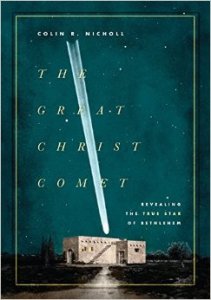
Every Sunday, I will share a quote from something I’ve been reading. The hope is for you, dear reader, to share your thoughts on the quote and related issues and perhaps pick up some reading material along the way!
The Quest for the Star of Bethlehem
I was excited to dive into The Great Christ Comet by Colin Nicholl. Not only is it seasonally appropriate as a read for Advent, but it also is a topic that I believe has much untapped theological and apologetic value. The topic has surely captured the popular imagination, as many renditions and references can attest to. There are many different lines of theological and astronomy that Nicholl draws on to make his point, however the biblical narrative, he argues, ought to be central to the quest for the Star of Bethlehem:
It should surely go without saying that any quest for the historical Star must be built firmly on the foundation of a rigorous analysis of Matthew 1:18-2:18. Only when this text has been mastered and the profile of the Star fully laid out can one realistically hope to deduce the precise astronomical phenomenon in view. (Kindle Location 563)
Nicholl does an admirable job showing how the biblical narrative of the Star ought to be central to research, and he forms his own theory around the biblical data. The Great Christ Comet is an exciting read on a topic that is little-explored. If you are interested in learning more about this fascinating topic, I know of no other work as thorough as this one. Check out my review of the book.
Source
Colin Nicholl, The Great Christ Comet (Wheaton, IL: Crossway, 2015).
Links
Be sure to check out the page for this site on Facebook and Twitter for discussion of posts, links to other pages of interest, random talk about theology/philosophy/apologetics/movies and more!
Book Review: “The Great Christ Comet” by Colin Nicholl– I review the book and provide some more background into its subject and contents.
Sunday Quote– If you want to read more Sunday Quotes and join the discussion, check them out! (Scroll down for more)
Eclectic Theist– Check out my other blog for my writings on science fiction, history, fantasy movies, and more!
SDG.
Really Recommended Posts 12/11/15- Jesus’ Wife?, Polemical Apologetics, and more!
Another week brings you another round of reads from around the web, courtesy yours truly. This week we have a report in on the “Gospel” of Jesus’ Wife, a look at “Guy Secrets revealed” (a common trap for our thoughts–making gender binaries), polemics in apologetics, our attitudes over Christmas/Advent, and a response to some arguments against the conclusions of the recent book, The Great Christ Comet.
Whatever Happened to Jesus’ Wife?– Well? Notice that the media uproar over the alleged “Gospel” of Jesus’ wife has effectively disappeared? There’s a good reason for that.
Response to an Amazon Review of “The Great Christ Comet”– Colin Nicholl, author of The Great Christ Comet, responds to a highly critical Amazon review of the book. The review argues that supernatural explanation best fits the Star of Bethlehem, while Nicholl holds it was a comet that was providentially ordered. See my review of the book here.
Guy Secrets Revealed?– Here’s an analysis of a book that claims to reveal “guy secrets.” The post provides much needed correction for the whole movement that seeks to identify the alleged inherent differences in preferences, mentality, and the like between men and women.
Polemics in Apologetics– The use of polemics in Christian apologetics is a necessary endeavor, but it requires some caution. Here is a great post putting forward how to balance the use of polemics in defending the faith.
A Note from Auntie Screwtape– If you’re not familiar with C.S. Lewis’s Screwtape Letters, I suggest you get acquainted with it ASAP. The concept is a set of letters written from a demon to another regarding temptation. Here is a post in that style about temptations this Christmas season.
Book Review: “The Great Christ Comet” by Colin Nicholl
There are few biblical images which capture the imagination as much as the Star of Bethlehem. Its prominent portrayal in films featuring the Nativity, in popular renditions of a Nativity scene, and its place in many Christmas carols demonstrates its continuing popularity. Colin Nicholl’s work, The Great Christ Comet is a significant contribution to scholarship about the nature of the Star of Bethlehem. Nicholl approaches the topic from both the standpoint of theology and astronomy.
Nicholl’s analysis of the biblical data is extensive and interesting. Early in the book, he establishes that the exegetical evidence is important to anyone–including astronomers–who would like to pinpoint what the Star of Bethlehem may have been.
As I read through the theological portions of the book, I found myself opening up my running Bible commentary document to add several notes as Nicholl provide insight into the text and argued for specifics about the narrative. In addition to interpreting the passage, he also sheds light on it from extrabiblical sources, particularly in regards to the Magi and Herod. Regarding the former, he discusses the practice and likely origin of the Magi, noting they were likely astrologer/astronomers from Babylon. Regarding the latter, he shows how the Massacre of the Innocents would not be so out of place for Herod, and why he would have been so willing to go to the depths of evil action that he did. There were many more times I found Nicholl’s exegesis enlightening on various passages–including prophetic ones in Numbers and Isaiah and others in Revelation.
The interpretation offered by Nicholl related to the movement of the Christ Comet is different than any I have read. Nicholl delves into Revelation 12:1-5a in order to argue that this passage describes a literal astronomical phenomenon with the celestial movements of Virgo, a comet, and a meteor storm in view. It was in this section that my confidence in his conclusions wavered. He makes a convincing argument for showing that the comet could have moved and shined in the way he believes is described in this passage, but I am less convinced by the simple connection of Revelation to Matthew in this literal, astronomical way. The infancy narrative of Matthew and the description in Revelation are both referencing the birth of Christ, but I’m not convinced John in Revelation is attempting to give a full explanation of a cosmic event that occurred here. Regardless of my reservations, however, Nicholl does establish that this is a possible, if not probable, reading of the text while also laying out in extensive detail how a comet could have engaged in this “cosmic drama.”
I am not an expert in astronomy, so my comments on that regard are that of an interested lay person. Nicholl gave significant background into astronomy before he delved into some of the data and the competing theories regarding the Star of Bethlehem. This included extensive discussion of the nature of different kinds of comets and how they move throughout. At many points these details are accompanied by historical drawings or artistic renditions of the aspects discussed. Nicholl’s theory is outlined in intricate detail, and it includes a kind of procession of the comet throughout various astrological signs to the point that it reaches Virgo. At this point, the Magi were convinced by the movement of the comet that a significant birth was occurring and they headed west. Nicholl draws upon the words of the Magi as well as Matthew and Luke’s infancy narrative, in addition to Revelation 12 to show that his theory corresponds to literal readings of the various passages and allows a real astronomical event to lie behind the explanation of the comet. This, however, does not mean that the comet is a purely naturalistic phenomenon, as Nicholl argues that the one-of-a-kind, astounding nature of this comet and its performance–down to marking the very location of Jesus’s home in Bethlehem–point to divine intent.
One significant difficulty with the book is the overall feeling of “assured results” found throughout. A search for “certainly” shows up 66 results; 9 for “unquestionably” (each used in context of conclusions drawn). Other words like “undoubtedly” (11 results) show up throughout as well. While it is admirable to have confidence in one’s own position, at times I wondered whether the arguments presented could yield such levels of confidence. The very existence of such continuing debate over the nature of the Star of Bethlehem calls into question any interpretation which comes along and offers certainty across the board, whether it is the refutation of other theories or the interpretation of the Book of Revelation.
So much is invested in the relation of Revelation 12 to the infancy narratives that if one remains unconvinced by his exegesis there, one may not find his overall theory convincing. However, this is not necessarily the case. The argument he presented for a great comet being the origin of the Star of Bethlehem was quite convincing to me, despite my not being fully sold on the Revelation 12 theory. One does not have to accept Nicholl’s view of how the comet played across the sky to accept that the comet is the best explanation.
As far as substantive critique of Nicholl, on the astronomical part I admit I don’t have the knowledge to offer much. Both theologically and astronomically, it seems Nicholl’s proposal is airtight and stunning. Frankly, that is probably where my suspicion comes from: I tend to be a bit suspicious of anything that is such a perfect fit. The Bible is a complex work, and the debate over the Star of Bethlehem is entrenched with many differing positions. Could it really be so simple (in the sense of having this be the answer)? I would like to say yes. I want to. But I’m not sure I can be fully on board. Nicholl has convinced me that the Star was a great comet, and the movement he describes seem possible, but it is perhaps only a personal feeling of reservation that holds me back from embracing the whole picture. This does say something for the strength of Nicholl’s argument, of course, for it suggests that it is really this personal reservation that holds me back rather than significant criticisms.
Nicholl’s concluding thoughts about the Christ Comet deserve to be quoted:
What the Great Christ Comet did… was extraordinary and merits wide telling. People of all disciplines… must come to grips with its story. In an era when science is often viewed as the enemy of religion, the Christ Comet suggests that science may be the best friend of religion. In a period when the claims of Christ are commonly disregarded, the Star callse upon all to give his claims a fresh reappraisal… (Kindle Location 7343).
Whatever one thinks about certain aspects of Nicholl’s argument, the book as a whole presents a comprehensive, deep case for the Star of Bethlehem being a great comet. The Great Christ Comet is a fantastic, deep read that will expose readers to a variety of topics in a fresh way. The amazing intricacy of the movement of the comet and its correspondence to the readings Nicholl presents in the book would be, if true, a monumentally powerful testament to the power of God and the truth of the Gospels. I enjoyed it immensely, even though I may not be fully convinced of every detail.
The Good
+Extensive look at the Biblical data
+Fascinating topic
+Provides background for astronomical analysis
+Massive scope with in-depth discussion
The Bad
-Overstates case at points
-Exegesis of some passages uncertain
Disclaimer: I received a copy of this book for review purposes from the publisher. I was not required to provide any specific kind of feedback whatsoever.
Source
Colin Nicholl, The Great Christ Comet (Wheaton, IL: Crossway, 2015).
Links
Be sure to check out the page for this site on Facebook and Twitter for discussion of posts, links to other pages of interest, random talk about theology/philosophy/apologetics/movies and more!
Book Reviews– There are plenty more book reviews to read! Read like crazy! (Scroll down for more, and click at bottom for even more!)
Eclectic Theist– Check out my other interests site for posts on science fiction, fantasy, television, and more!
SDG.
——
The preceding post is the property of J.W. Wartick (apart from quotations, which are the property of their respective owners, and works of art as credited; images are often freely available to the public and J.W. Wartick makes no claims of owning rights to the images unless he makes that explicit) and should not be reproduced in part or in whole without the expressed consent of the author. All content on this site is the property of J.W. Wartick and is made available for individual and personal usage. If you cite from these documents, whether for personal or professional purposes, please give appropriate citation with both the name of the author (J.W. Wartick) and a link to the original URL. If you’d like to repost a post, you may do so, provided you show less than half of the original post on your own site and link to the original post for the rest. You must also appropriately cite the post as noted above. This blog is protected by Creative Commons licensing. By viewing any part of this site, you are agreeing to this usage policy.
Really Recommended Posts 12/4/15- Star Wars theology, women in the early church, and more!
 We have already made it to December! Can you believe it? I can’t. That doesn’t mean I won’t keep delivering the goods, however! This week we have posts on women in the early church, dinosaurs and young earth creationism, an evil god?, the theology of Star Wars, and the Planned Parenthood shooting. As always, let me know what you think–and be sure to let the authors know as well. Also, because it’s already snowed a couple times, we’re switching back to the snowy owl to bring our post, Hogwarts style.
A Theology of Star Wars– Star Wars Episode VII comes out soon. I bet that’s news to you! I may or may not have my tickets to an early showing. The world will never know. Anyway, here’s a free e-book (sign up to newsletter required) on Star Wars and Christian theology. I haven’t gotten through the whole thing yet, but I’ve enjoyed what I’ve read so far.
Four Myths about Women in the Early Church– The topic of women in the early church is quite interesting. I’ve only read one book on the topic, but I’d like to explore further. This post highlights some myths about women in the early church that are largely taken as givens. In the debate over women in the church and home, it is important to get our facts straight.
Is an Evil God as likely as an All-Good God?– Edward Feser analyzes Stephen Law’s (in)famous “evil God challenge,” in which Law alleges that the evidence for the existence of God cannot bring us to a good God, so an evil God is just as likely. I have analyzed Law’s argument myself, and I believe I demonstrate that the assumptions behind his argument would yield radical skepticism if held consistently.
Why Pro-Life Advocates are not responsible for the Planned Parenthood Shooting– Some have alleged that the recent, horrific attack on a Planned Parenthood building can be blamed on the pro-life movement. Here is an analysis of that ad hominem attack vs. pro-life advocates that gets at the heart of the issue.
Where did all the Dinosaurs go? Ken Ham’s Climate and Human Induced Dinosaur extinction hypothesis– Young earth creationists must deal with the evidence we have about dinosaurs and their lives. Here is an analysis of Ken Ham’s hypothesis regarding what happened to all the dinosaurs after they purportedly survived a global flood alongside humans.

 J.W. Wartick - Reconstructing Faith