theology
Really Recommended Posts 11/06/15- Star Trek theology, egalitarianism, and more!
 I hope you’ll enjoy this week’s roundup of posts from around the web. You can watch a video explaining egalitarian theology from Genesis, survey challenges your kids might encounter for their faith, learn about pro-life dialogue, discover theology in Star Trek: The Next Generation, and explore a cold time before a young earth could have existed. Let me know what you think of the posts, and be sure to let the authors know as well.
Egalitarian from the Start (Vide0)– this sermon is from Richard Davidson, author of the monumentally important study on sexuality in the Old Testament, Flame of Yahweh. He argues that, from the beginning of creation, egalitarianism is the ideal perspective.
17 Ways Your Kids Will Encounter Challenges to their Faith– Children will encounter a great number of challenges to their faith as they grow up. Simply being aware of the way children can be confronted by these challenges will help parents prepare to answer them and help their kids find answers.
Four Practical [Pro-Life] Dialogue Tips from My Conversation with Brent– Josh Brahm, an excellent pro-life speaker, offers some dialogue tips alongside a case study of an actual conversation he had with a pro-choice advocate.
Star Trek Theology- “Remember Me”– The Sci-Fi Christian, an excellent website and podcast, offers up this heaping helping of theological analysis of The Next Generation episode, “Remember Me.” It’s an episode I enjoy immensely, and I also enjoyed reading this post. Check it out.
A Holocene Cold Snap In the Year 2,200 B.C. (Before Creation)– Here is an analysis which challenges the Young Earth timeline, because it demonstrates that we can observe weather patterns from before dates set by groups like Answers in Genesis.
Book Review: “Rediscovering Jesus” by David B. Capes, Rodney Reeves, and E. Randolph Richards
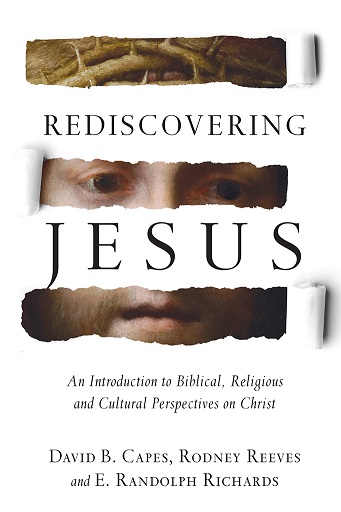 Rediscovering Jesus is part project of unearthing aspects of Jesus which are often ignored, part recovery of the biblical portrait of Jesus, and all intriguing.
The book is structured such that each chapter presents a specific portrait of Jesus. Each chapter has a brief introductory section that gives an overview of that specific Jesus, an exposition of how the specific work presents Jesus, how that Jesus is different or unique, and what we would believe about Jesus if that were the only information about Jesus we had.
The first part focuses on biblical images of Jesus, but does so by looking at individual books of the Bible (though a few writings are lumped together). Thus, rather than seeing a composite Jesus made up of all four Gospels put together–not itself a bad thing, necessarily–the chapters provide a deeper look at the individual focus of each Gospel or book. Thus, readers are confronted by a Jesus who is a man of action in Mark, a priest in Hebrews, and an apocalyptic judge in Revelation.
The second part examines pictures of Jesus outside the Bible: the ones examined are the Gnostic, Muslim, Historical, Mormon, American, and Cinematic Jesus.
The primary value of the work is how it challenges readers to rethink how they have viewed Jesus. If their Jesus has been shaped predominantly by cultural and non-biblical portraits, the book serves as a call to return to the biblical portrayal. But it does not do so at the expense of all extrabiblical imagery. The authors carefully outline how there might be truth found in various images of Jesus. If our Jesus has been shaped by biblical imagery, the authors challenge us to see how we might have glossed over specific emphases of the different authors of the New Testament.
Each chapter is filled with insights and things to explore. Readers will be continually challenged in how they may have a deficient or composite view of Jesus that does not match the Jesus of the Bible. It is a book which calls us, primarily, to learn about our Lord Jesus Christ. It does so in a way that is constantly exciting and invigorating.
I recommend Rediscovering Jesus wholeheartedly. It was a phenomenally interesting read, and one which will challenge you to rethink how you have conceived of Jesus, while calling readers back to biblical portrayals. I can’t really recommend it highly enough.
The Good
+Illuminates a number of aspects of the biblical Jesus that we often miss
+Great chapter organization
+Excellent information found throughout the book
The Bad
-Very brief on several points
Disclaimer: I received a review copy of the book from the publisher. I was not required to leave any specific kind of feedback whatsoever.
Links
Be sure to check out the page for this site on Facebook and Twitter for discussion of posts, links to other pages of interest, random talk about theology/philosophy/apologetics/movies and more!
Book Reviews– There are plenty more book reviews to read! Read like crazy! (Scroll down for more, and click at bottom for even more!)
Source
David B. Capes, Rodney Reeves, and E. Randolph Richards, Rediscovering Jesus (Downers Grove, IL: InterVarsity, 2015).
SDG.
——
The preceding post is the property of J.W. Wartick (apart from quotations, which are the property of their respective owners, and works of art as credited; images are often freely available to the public and J.W. Wartick makes no claims of owning rights to the images unless he makes that explicit) and should not be reproduced in part or in whole without the expressed consent of the author. All content on this site is the property of J.W. Wartick and is made available for individual and personal usage. If you cite from these documents, whether for personal or professional purposes, please give appropriate citation with both the name of the author (J.W. Wartick) and a link to the original URL. If you’d like to repost a post, you may do so, provided you show less than half of the original post on your own site and link to the original post for the rest. You must also appropriately cite the post as noted above. This blog is protected by Creative Commons licensing. By viewing any part of this site, you are agreeing to this usage policy.
Adhering to the Book of Concord: “In So Far As” or “Because” it agrees with Scripture?
A title page of the Book of Concord
Lutheran theology is derived from and reflective upon not just Martin Luther but also the Lutheran Confessions, as found in the Book of Concord. Within Lutheranism, there is much debate over exactly how tightly one must adhere to the Book of Concord. On one side, there are those who insist we must affirm the Book of Concord “because” it agrees with the Bible. On the other side, others maintain we should affirm it “in so far as” it agrees with the Bible.
Because it Agrees
Representative of the view that one must agree with the Book of Concord because it teaches what the Bible teaches is the following:
Authentically Lutheran churches insist on a subscription to the Confessions [The Lutheran Confessions/Book of Concord are used interchangeably] because they agree with the Bible, not merely in so far as they agree with Scripture. Otherwise, there would be no objective way to make sure that there is faithful teaching and preaching of God’s Word. Everything would depend on each pastor’s private opinions, subjective interpretations, and personal feelings, rather than on objective truth as set forth in the Lutheran Confessions. (Book of Concord (.org) FAQ)
Note some important aspects in this quote. First, the Book of Concord just does agree with the Bible. That is insisted upon. Second, the Book of Concord is said to be “objective truth” as opposed to the “subjective interpretations” of the individual. These considerations frame what I’d like to comment on regarding those who hold to the view that we must agree with the book of Concord “because…”
Because?
I’ll start with the second aspect noted above. There are, of course, all kinds of increasingly detailed issues people on either side of the debate might raise here. For example, how are “objective” and “subjective” being here defined? I’m going to set that kind of issue mostly aside and focus on a few difficulties I see.
The first is that one cannot simply read the words off the pages of the Book of Concord without going through the necessary step of interpreting them. That is, I as a reader of the Book of Concord must try to make sense of the words I am reading, and thus I am participating in the act of interpreting the Book of Concord. If, as the quote above states, the problem is the individual’s subjective nature, then the problem is completely unavoidable. Indeed, even if we grant that the Book of Concord is “objective truth” in its entirety, all we’ve done is moved the problem of subjective interpretation one step back. Now the reader must interpret the Book of Concord in order to get to the objective truth about Scripture found therein.
Another difficulty with this objective/subjective distinction is that it assumes the writers of the Lutheran Confessions were themselves either not subjective (which seems impossible) or explicitly guided by the Spirit to write out objective truth only. I would not dispute that the Holy Spirit could bring about a completely faultless writing, but the question is whether those who affirm the “because” position would like to argue this. The first thing we should do if they do want to argue this would be to see whether the writers of the Book of Concord assert the Holy Spirit did bring about such a completely objective, 100% correct work.
In the Preface to the Book of Concord, we can read:
Finally, with invocation of God Almighty and to his praise and glory and with careful deliberation and meticulous diligence through the particular grace of the Holy Spirit, they wrote down in good order and brought together into one book everything that pertains to and is necessary for this purpose. (Preface, 12)
Later, the Preface makes clear (15) that this Book was “the correct, Christian understanding of the Augsburg Confession…” In the closing of the Preface, we read (23) that those who signed on to it that they “are minded not to manufacture anything new… nor to depart in either substance or expression… from the divine truth… by the grace of the Holy Spirit we intend to persist and remain unanimously in this truth and regulate all religious controversies and their explanations according to it.”
These are all strong statements, and they clearly called upon God the Holy Spirit for guidance in the composition of the various works that make up the Book of Concord. But does it follow that they were explicitly, inerrantly inspired and guided by the Spirit to never once get a single thing wrong in this book? Those who affirm the “because” position must answer yes. There is no wiggle room.
But a close reading of the Preface seems to suggest that although the writers certainly believed everything in the Book of Concord to be without theological error (otherwise they would not have it regulate all controversies, etc.), I have yet to find anywhere that a claim could be made that the book is explicitly inerrant. It would have to be, however, for the “because” position to be true. This human composition would have to be 100% correct in every single minute detail down to the last proof text cited in order for it to be acceptable to affirm that we must agree with it “because” it agrees with Scripture.
Among other things, what follows from that is that anyone who subscribes to the Book of Concord “because” position must have read the entirety, looked up every citation, and assured themselves that every single interpretation, doctrinal position, and the like is 100% correct, lest they be saying that it is a human-made book without error on God’s Word without actually knowing every detail it contains.
The first issue raised above will be addressed in the section named “A Case Study,” below.
In So Far As
A supporting argument for the “In So Far As” position is that we should always only affirm that which is true. If we can agree that the Bible is true in all it teaches, then we should only agree with other writings about the Bible so far as they agree with the Bible. This seems like an obvious conclusion, but the whole debate centers on whether this argument is sound. It is difficult for me to figure out how to support this argument, not because I think it is a poor argument, but because it seems just intuitively clear.
It may help to use an analogy. Historians have debated how to write history and whether writers of history can ever fully get at the “true” history as it happened. Yet very few would deny that there is such a thing as a “true” history. There must be some absolutely correct sequence in which events occurred such that if we had a complete set of writings that simply reported those events, that would be the “true” history. Thus, there is an objectively true history, against which historians can be measured. Granting some of the hand waving involved in this thought experiment, suppose we had a book, The True History of the World, and we looked up the John F. Kennedy assassination therein. We would then have the objectively true report of that hotly-debated historical event as it really did happen. Now suppose I wanted to write a book about the JFK assassination based upon The True History of the World. However careful a historian I am, however excellent and detailed my mind is, however much guidance I may have had, would it be reasonable to say that you agree with my book, The Objective JFK Assassination “because” it agrees with The True History of the World or “in so far as” it does? It seems that the reasonable conclusion would be “in so far as” it does, because we know that The True History of the World is objectively true.
Though imperfect, this analogy gets at the argument written above. We can agree the Bible is inerrant. Thus, if I were to write a book entitled The Objective Bible, I think we can agree that we should only agree with my book so far as it agrees with the Bible, right? No matter how detailed I am, no matter how meticulous, no matter how large a group of thoughtful interpreters I got together to vet my work, it would be entirely reasonable to only affirm agreement with my book so far as it is biblical. Then why would such a standard not also apply to the Book of Concord? I see no reason why that standard would not.
Indeed, to argue against those who affirm the Book of Concord only “in so far as” it agrees with the Bible would mean that one would have to assert that the caution and respect for God’s word implicit in that position–that I would not want to affirm anything, even by mistake, as biblical if it is even possibly in error anywhere–are mistaken. That the care and caution necessary to say “I will only agree with any book in so far as it agrees with the Word of God” is mistaken, and that that the Book of Concord must also be included under the umbrella of books against which all others must be judged.
For the “because” position ultimately, unswervingly leads to the conclusion that we should only affirm any other book “in so far as” it agrees with the Book of Concord. After all, if it is true that the Book of Concord is affirmed because it agrees with Scripture, then it follows that the authority of the Bible is effectively equivalent to the authority of the Book of Concord. The Bible is God’s word, and the Book of Concord is the objective teaching of God’s word without even possible error. That is not simply rhetoric; it is what must follow from the “because” position. Any interpretation of the Bible must be judged against the Book of Concord; hence, any reading of the Bible must also be judged against it.
A Case Study
Finally, we are in position to ask whether the Book of Concord does indeed have any error therein. That is a crucial question, of course, and one not easily resolved by those who remain faithful Lutherans. If, however, there is even one incorrect use of a proof text in the Book of Concord, the “because” position fails.
In the Apology of the Augsburg Confession, Article XXIII (XI) on the Marriage of Priests, section 25, we read:
Therefore this law concerning perpetual celibacy is peculiar to this new pontifical despotism. Nor is it without a reason. For Daniel 11:37, ascribes to the kingdom of Antichrist this mark, namely, the contempt of women.
Daniel 11:37 reads (ESV) “He shall pay no attention to the gods of his fathers, or to the one beloved by women. He shall not pay attention to any other god, for he shall magnify himself above all.”
The whole passage is difficult to interpret given its prophetic message about the Kings of the North and the South. I’m not going to enter into whether this is specifically referencing “Antichrist” or “the kingdom of Antichrist” or anything of the sort. Instead, the issue is with the reading as “contempt of women.” The Reformers were obviously not using the ESV or anything in English. But older English editions like the KJV might support this text as a proof for contempt of women: “Neither shall he regard the God of his fathers, nor the desire of women, nor regard any god: for he shall magnify himself above all.”
But the problem is that critical editions of the Old Testament don’t support a reading as contempt of women. Without going into depths of detail, and because I’m not a Hebrew scholar by any measure, I would just point out that the Hebrew does seem to clearly state “the one desired by women.” So if we are to read 11:37 as a proof text for contempt of women, it doesn’t seem to be a right reading. It’s a minor difficulty, but one nevertheless. Did the citation above from the Book of Concord properly exegete the Bible? I would assert that the use of this proof text is mistaken. If we are to take “paying no attention” as “contempt”–itself a move that could be disputed, then the subject remains “the one desired by women” not “women.”
Now, if the Book of Concord should be agreed with because it agrees with the Bible, then how are we to take this? I don’t know. It seems to me that this is more an example of the way people read the Bible at the time and used proof texts–often stripped of context–in defense of their positions. A single dispute over a citation is not a paradigm shift; indeed, I think that the authors of the Apology were correct on this notion about the marriage of priests. But that doesn’t mean everything they wrote is correct.
Conclusion
I agree with and affirm the Book of Concord in so far as it agrees with Scripture. I think it is correct on a huge amount of the things it teaches. I am currently re-reading it (slowly) and checking citations as I go. I have found it to be edifying and a source of profound theological insight. But it is not the Bible, and I do not think that to be Lutheran–or even a confessing Lutheran–I need to affirm that the Book of Concord is without possible error.
Source
Robert Kolb and Timothy J. Wengert, eds. with Charles P. Arand, translator, The Book of Concord.
Links
Be sure to check out the page for this site on Facebook and Twitter for discussion of posts, links to other pages of interest, random talk about theology/philosophy/apologetics/movies and more!
SDG.
——
The preceding post is the property of J.W. Wartick (apart from quotations, which are the property of their respective owners, and works of art as credited; images are often freely available to the public and J.W. Wartick makes no claims of owning rights to the images unless he makes that explicit) and should not be reproduced in part or in whole without the expressed consent of the author. All content on this site is the property of J.W. Wartick and is made available for individual and personal usage. If you cite from these documents, whether for personal or professional purposes, please give appropriate citation with both the name of the author (J.W. Wartick) and a link to the original URL. If you’d like to repost a post, you may do so, provided you show less than half of the original post on your own site and link to the original post for the rest. You must also appropriately cite the post as noted above. This blog is protected by Creative Commons licensing. By viewing any part of this site, you are agreeing to this usage policy.
Sunday Quote!- Setting aside Luther?
 Every Sunday, I will share a quote from something I’ve been reading. The hope is for you, dear reader, to share your thoughts on the quote and related issues and perhaps pick up some reading material along the way!
Setting aside Luther?
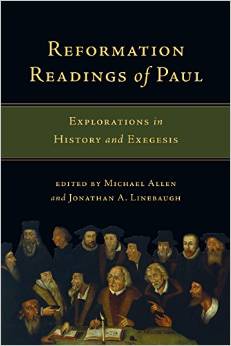
During October each year, I read some books about the Reformation to inform myself about that vastly important time in church history. October 31st is Reformation Day, of course, and so I thought I’d share a quote this Reformation Sunday from one of the books I’ve been reading. This year, Reformation Readings of Paul was high on my list, and I received a review copy from InterVarsity Press to devour.
There is a danger in the Protestant Church to enshrine the interpretations and methods of the Reformers such that the way they read the Bible becomes a new authority or at least lens through which Scripture must be read in order to be rightly understood. There is a fine line between referencing, respecting, and gleaning insight those who have come before as opposed to mechanically sticking to them. David C. Fink points out that even Reformers like Luther would have advised against this:
Luther showed no hesitation in setting aside the views of Jerome, Erasmus, or even Augustine. If we take him at his word, there is no reason to think he would not expect the same handling from modern exegetes today. (33-34, cited below)
Luther referenced these church fathers but did not see them as the authority on exegesis or interpretation of the biblical text. Similarly, Fink notes, we should not be afraid to set aside Luther if we should find that his interpretation of a passage is mistaken.
Links
Be sure to check out the page for this site on Facebook and Twitter for discussion of posts, links to other pages of interest, random talk about theology/philosophy/apologetics/movies and more!
Sunday Quote– If you want to read more Sunday Quotes and join the discussion, check them out! (Scroll down for more)
Reformation Theology- Check out my other posts on the Reformation and its theology (scroll down for more)
Source
David C. Fink “Martin Luther’s Reading of Galatians” in Reformation Readings of Paul eds. Michael Allen and Jonathan A. Linebaugh (Downers Grove, IL: InterVarsity, 2015).
SDG.
Really Recommended Posts 10/23/15- Apologetics, Diatoms and the Flood, patriarchy, and more!
Hello, dear readers! I have another round of posts that I hope you will enjoy perusing. The topics this week include apologetics, an objection to the pro-life position, patriarchy and biblical sex, and some tiny organisms that pose some big problems. Let me know what you think, and be sure to tell the authors you enjoyed their posts as well!
Apologetics Started in the Bible– Some Christians object to the use or import of Christian apologetics. However, apologetics got its start in and from the Bible. Here’s a post showing how.
Biblical Sex: Patriarchy’s Great Enemy– This post highlights the fact that in the Bible, male-female sexual relations really go against the paradigm of complementarian theology.
Book Review: “The Grand Weaver”– Ravi Zacharias is an excellent Christian apologist. Here’s an in-depth look at one of his books from Luke Nix. I recommend reading this one because it will give you some insights into Zacharias’ approach to apologetics. The book itself is also excellent.
Diatoms: Tiny Organisms Highlight Big Inconsistencies in Young Earth Flood Geology Models– Diatoms are tiny organisms that put up some big difficulties for young earth creationist models. Check out this post to read about some of these difficulties.
Response to objection that pro-lifers are “nowhere to be found once our children are born”– It is commonly objected that the pro-life position only cares about children in the womb. Once they’re born–who cares? I think that it is important for the pro-life position to be holistic and look at the totality of life rather than simply looking at unborn life as worth protecting. Here is a post that directly confronts this common objection.
Really Recommended Posts 10/9/15- Gospels, Domestic Abuse, Dinosaurs, and more!
I am pleased to present this wide range of topics to you, dear readers! I hope you enjoy the reads as much as I did. We have posts on the origins of the Gospels from an atheistic perspective, domestic abuse, the ontological argument, soft tissue in dinosaurs, and Bill Nye on abortion. Let me know what you think, and be sure to thank the authors as well!
Where the Gospels Came From– This is a satirical post that highlights how broad swaths of internet atheism tend to view the origin of the Gospels. It’s well worth reading as it highlights some of the major errors.
When Staying in an Abusive Relationship is Part of Your Theology– It is Domestic Violence Awareness Month, and this post from Christians for Biblical Equality highlights one major difficulty with some theologies- they argue that one should stay in an abusive relationship from theological reasons.
The Probability of God’s Existence is Either 0% or 100% (video)– Kenneth Keathley offers this analysis and presentation of Alvin Plantinga’s ontological argument. He defines terms and answers some major objections, with the objections offered by atheists themselves.
“Soft Tissue” Found in Dinosaur Bones– Creationists sometimes claim that the finds of “soft tissue” undermine the possibility for an old earth perspective. Is that the case? Here is some analysis of this claim and some more recent findings regarding allegations of blood and other soft tissue found in ancient fossils.
Responding to Bill Nye’s Abortion Video– Bill Nye “The Science Guy” made a lot of claims about science and abortion in a video recently. Here’s a thorough analysis and refutation of his claims.
Sunday Quote!- Sarah the Matriarch as Equal to Abraham
Every Sunday, I will share a quote from something I’ve been reading. The hope is for you, dear reader, to share your thoughts on the quote and related issues and perhaps pick up some reading material along the way!
Sarah the Matriarch as Equal to Abraham
I’ve been reading through Richard Davidson’s tome, Flame of Yahweh: Sexuality in the Old Testament, a huge study of, well, sexuality in the Old Testament. One portion focuses on the narratives in the Pentateuch and the women discussed therein. Sarah, Abraham’s wife, is shown to be the equal of Abraham, argues Davidson:
Details of Sarah’s life in the Genesis narratives reveal the high valuation of this matriarch, as she and her husband are portrayed as equal partners… given their social context, Sarah and Abraham are amazingly equal… (226, 227)
Davidson’s argument lists a number of reasons to believe this is the case. Here I will quote just a couple:
Sarah is regarded as just as critical to the divine covenant as Abraham himself… ([Genesis] 17:18-19; 21:12)… Sarah’s name is changed from Sarai, just as Abraham’s is from Abram… (17:16)… (227)
These are among the total of 10 main reasons Davidson cites to demonstrate that Sarah was “no wallflower.” The high valuation of women in the Old Testament is something Davidson demonstrates, in my opinion.
Links
Be sure to check out the page for this site on Facebook and Twitter for discussion of posts, links to other pages of interest, random talk about theology/philosophy/apologetics/movies and more!
Sunday Quote– If you want to read more Sunday Quotes and join the discussion, check them out! (Scroll down for more)
Source
Richard M. Davidson, Flame of Yahweh (Peabody, MA: Hendrickson Publishers, 2007).
SDG.
Really Recommended Posts 10/9/15- Inerrancy, Immigration, apologetics, and more!
I’m pleased to offer this go-round of the Really Recommended Posts to you, dear readers. I think they are about as diverse as you can get. We have Stephen Colbert on his faith, illegal immigration and Christianity, apologetics, Jesus’ view of Scripture, and Planned Parenthood on the docket today. Check them out and let me know what you thought!
Watch Stephen Colbert, a Lifelong Catholic, on Hearing a Female Priest Celebrate the Eucharist– I don’t put a lot of stock in celebrity comments about faith or politics or really anything. After all, they don’t automatically become authorities simply because they are famous. However, Colbert’s faith is quite sincere, and this whole interview is worth watching. Here’s a clip in which he talks about a female priest celebrating the Eucharist.
American Christianity and Illegal Immigration– Here’s a fairly lengthy look at the historic interaction with illegal immigration that American Christianity has had. It helps provide a historical perspective on some of the current debates regarding illegal immigration.
Apologetics Strategies: The Myth of a Bulletproof Argument– It is easy to think that, regarding Christian apologetics, we can come up with an argument that will convince everyone. Is that the case? Here’s a post on apologetic method that is well worth your time.
Jesus Viewed Scripture as Inerrant: A Reply to Kyle Roberts– A few weeks ago I featured an article arguing all Christians should view the Bible as inerrant. Here is a follow-up post in which Rob Bowman takes an extended look at Jesus’ view of Scripture.
3 Pinnochios to Planned Parenthood Supporters for Slippery Mammogram Language– The Washington Post calls out Planned Parenthood supporters for their claims about mammograms. Look, Planned Parenthood doesn’t provide any mammograms at all. Not a single one. It should not be used as a scare tactic against those arguing to defund the abortion provider.
Sunday Quote!- Making a Composite Jesus
Every Sunday, I will share a quote from something I’ve been reading. The hope is for you, dear reader, to share your thoughts on the quote and related issues and perhaps pick up some reading material along the way!
Making a Composite Jesus
I finished reading through Rediscovering Jesus not too long ago and I was struck by something fairly early on: the authors challenged readers to come to the realization that we are often operating under a kind of composite portrait of Jesus:
My Jesus is often a smorgasbord Jesus, a Jesus who doesn’t look like the one in the Bible. Just like a buffet in the cafeteria, where I go through the line and pick out what I want, I read through the Gospels, pulling out stories I like. (17, cited below)
The authors go on to note that our view of Jesus is not only formed buffet-like from imagery found in the Bible, but also through various ways the culture has influenced us to think about Jesus. What are some of the ways that your picture of Jesus may have been shaped by extra-biblical imagery? How might we find the composite Jesus we have created that often stands alongside us as we try to read about Jesus in the scriptures?
Rediscovering Jesus is full of insights like this, and I highly commend it to you, dear readers.
Source
David B. Capes, Rodney Reeves, and E. Randolph Richards, Rediscovering Jesus (Downers Grove, IL: InterVarsity, 2015).
Links
Be sure to check out the page for this site on Facebook and Twitter for discussion of posts, links to other pages of interest, random talk about theology/philosophy/apologetics/movies and more!
Sunday Quote– If you want to read more Sunday Quotes and join the discussion, check them out! (Scroll down for more)
SDG.
Book Review: “Rescuing the Gospel from the Cowboys” by Richard Twiss

Rescuing the Gospel from the Cowboys by Richard Twiss presents a broad, far-reaching analysis of the contact and sometimes conflict between Christianity and Native cultures.
Conflict is a major theme of the book, as Twiss traces the history of interactions between Western Christians and Native peoples. This history involves much wrongdoing, from wanton destruction of Native peoples through disease (which was at some points compared to the plagues on Egypt attacking the Native peoples), to continued missiology that refuses to adapt to new insights from anthropology.
A central question asked time and again through the book is why, in order to be Christian, people must give up all their cultural background and embrace a Eurocentric version of religious practice. The example often used is that of drums in worship. Many argue that this is an example of potentially dangerous syncretism–the incorporation of anti-Christian ideology into allegedly Christian worship. They allege that because drums have been used in spiritual fashions that are non-Christian, they must be tied to non-Christian beliefs. Twiss argues that, instead, it is an example of critical contextualization–integrating the Christian faith by means of cultural expressions. He notes that this is allowed in all kinds of ideas and expressions in Western cultures. He mentions the integration of Platonic and Aristotelian thought into Creedal expressions as one example. Another example could be the general allowance for Christmas trees–themselves once expressions of pagan practices.
Thus, a major aspect of Twiss’ project is to demonstrate that Native peoples must be allowed to develop their own understanding of how to follow the Jesus way. Just as in Western churches, incense, organs, Christmas trees, specific candle lightings, and the like are allowed and even endorsed; so too should Native expressions and critical incorporation of their own practices be allowed in worship. Only then, argues Twiss, can the Gospel be truly integrated into Native life and communities.
Twiss also outlines various ways missions have been done to Native peoples and notes that these have largely changed and adapted in response to new insights from anthropology, but these adaptations have been adapted abroad, not in Native mission fields. This means a continued colonializing is taking place as Native peoples are expected to change everything, without being allowed to keep their own religious expressions. He summons much data to support these claims.
A major chapter in the book features his amalgamation of stories into a fictional sweat lodge ceremony in which nine different Native men are talking about their struggles with following Christ in a Native culture. These provide great insights into the ways in which Native people have worked to integrate their culture and faith together and met enormous resistance.
By the time I finished the book, I realized that I’d had to be fairly introspective and consider my own faults along with all that I had learned. I had, at least in my head, thought of various practices like integrating Native dancing into worship as being some kind of syncretism. I hadn’t thought about how plenty of the things I do (Christmas trees, for example) had sprung from a cultural milieu and come to be accepted in Western Christianity. I had been convicted by Twiss, but also enlightened.
The few critiques I have to offer of the book pale in comparison to its insight, but I’ll note them here. First, there are a couple times in which it seems to repeat the same point more than once–sometimes even with the same quote or citation. I’m sure this is due to it having been finished posthumously, and so the editors drew together works from Twiss’ other materials, but it remains disconcerting at points. Another issue is that there are several points at which Twiss lists a whole slew of relevant scholars and a major work or two from each. It’s the kind of thing that could have been more easily relegated to endnotes in order to clean up the text a bit, but this is a minor nitpick.
The appendices are quite useful, including a list of various words or phrases used to refer to Native American peoples, as well as when they were first used and how they’ve come to be used now.
I recommend Rescuing the Gospel from the Cowboys as highly as possible. It is filled with excellent information, convicting insights, and hope. Pick it up and read it.
The Good
+Touches on a number of important topics
+Deep insights with convicting but guiding words
+Awesome cover
+Excellent use of stories to illustrate important points
+Provides hope and applicable insights
+Useful appendices
The Bad
-Occasionally repetitive
-Large lists of scholars at points with little context
Disclaimer: I received a review copy of this book from the publisher. They did not require any specific kind of feedback whatsoever.
Links
Be sure to check out the page for this site on Facebook and Twitter for discussion of posts, links to other pages of interest, random talk about theology/philosophy/apologetics/movies and more!
Book Reviews– There are plenty more book reviews to read! Read like crazy! (Scroll down for more, and click at bottom for even more!)
Source
Richard Twiss, Rescuing the Gospel from the Cowboys (Downers Grove, IL: InterVarsity, 2015).
SDG.
——
The preceding post is the property of J.W. Wartick (apart from quotations, which are the property of their respective owners, and works of art as credited; images are often freely available to the public and J.W. Wartick makes no claims of owning rights to the images unless he makes that explicit) and should not be reproduced in part or in whole without the expressed consent of the author. All content on this site is the property of J.W. Wartick and is made available for individual and personal usage. If you cite from these documents, whether for personal or professional purposes, please give appropriate citation with both the name of the author (J.W. Wartick) and a link to the original URL. If you’d like to repost a post, you may do so, provided you show less than half of the original post on your own site and link to the original post for the rest. You must also appropriately cite the post as noted above. This blog is protected by Creative Commons licensing. By viewing any part of this site, you are agreeing to this usage policy.

 J.W. Wartick - Reconstructing Faith