theology
“Didaskolos” by Bertil Gärtner, Part 1, in “Women Pastors?”edited by Matthew C. Harrison and John T. Pless
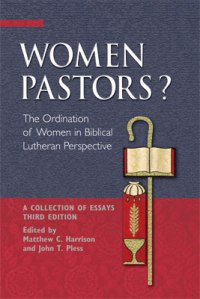 I grew up as a member of the Lutheran Church-Missouri Synod, a church body which rejects the ordination of women to the role of pastor. The publishing branch of that denomination, Concordia Publishing House, put out a book entitled Women Pastors? The Ordination of Women in Biblical Lutheran Perspective edited by Matthew C. Harrison (who is the current President of the LCMS) and John T. Pless. I have decided to take the book on, chapter-by-chapter, for two reasons. 1) I am frequently asked why I support women pastors by friends, family, and people online who do not share my position, and I hope to show that the best arguments my former denomination can bring forward against women pastors fail. 2) I believe the position of the LCMS and other groups like it is deeply mistaken on this, and so it warrants interaction to show that they are wrong. I will, as I said, be tackling this book chapter-by-chapter, sometimes dividing chapters into multiple posts. Finally, I should note I am reviewing the first edition published in 2008. I have been informed that at least some changes were made shortly thereafter, including in particular the section on the Trinity which is, in the edition I own, disturbingly mistaken. I will continue with the edition I have at hand because, frankly, I don’t have a lot of money to use to get another edition. Yes, I’m aware the picture I used is for the third edition.
Didaskolos: The Office, Man and Woman in the New Testament
Gärtner’s chapter begins by asking and answering a question “Does the New Testament contain any direct teaching about the relationship between man and woman in the office of the ministry? The answer to this question is an unequivocal yes” (27). Such a statement suggests that he will demonstrate that there is a verse, somewhere, that specifically teaches about the relationship between man and woman in the office of the ministry. After all, his claim is that one can unequivocally say that yes, the New Testament does contain such direct teaching. As we explore this chapter, we will return to this question a few times and ask whether Gärtner’s claim is correct.
Gärtner states that the ministry must be set into a larger New Testament context. Addressing 1 Corinthians 14:34 and 1 Timothy 2:12, intriguingly again pointed to as the apparent proof against women pastors, he states that a view that teaches that those verses are “intended to correct some irregularities” at the time of the writings of the letters “does not correspond with the material Paul presents” (27). To prove this, he notes that in 1 Corinthians, Paul “deals with a number of questions which have been put to him by the congregation” (ibid). He uses the example of eating meat sacrificed to idols and says that Paul “places the question in the larger context” because it “is considered in relation to the doctrine of God as the only God…” (27-28).
Expanding on the context, Gärtner appeals to the choosing of the apostles, Jesus’ conception of marriage and creation, the Christian as new creation, and heresy in Corinth in order to make his argument that women are excluded from the ministry. We’ll briefly sketch out his argument. Jesus’ apostles, Gärtner argues, are all men (29). He notes that these apostles are “leaders of the new people of God,” something important we will consider below. He also states that “although the most esteemed women… who were part of the closest circle of disciples, were present in Jerusalem during the Passover festival, it was only the apostles themselves who were invited to be present at the Last Supper… By immemorial custom both women and children shared in this dinner fellowship. Yet, this is the time that Jesus breaks that tradition and gathers only the twelve around Him” (ibid). Regarding Jesus’ concept of marriage and creation, Gärtner walks through Matthew 19:3ff in which Jesus discusses marriage (30-31). The Christian as new creation Gärtner states, after pointing to texts talking about the Christian as new creation, that “in the life of the church, the true relationship between male and female can take place” (31). Regarding Heresy in Corinth, Gärtner paints an image of the Corinthians as seeing themselves getting direct revelation from God and having everything spiritualized such that people could set above “the fundamental command of fellowship and love to the neighbor.” Then, he states that Paul teaches that “salvation rests upon creation” and that the “office” (he doesn’t, on p. 33, specify which one or the definition thereof) “is related to the order of creation; and according to the order of creation, the human race is divided into man and woman” (32-34).
There are already a number of interesting issues to explore in Gärtner’s essay. First, the question of what “office” he is referencing throughout is quite relevant. Though it is possible to divert conversation in important issues by constantly punting to definitions, the notion of “office” is a central aspect of Gärtner’s argument so far, yet it remains undefined. We do not find him providing his own definition of ordination, as Hamann did, and so are left to simply guess exactly what he means by the word throughout the essay. As Hamann found in trying to define ordination and the ministry, it is extremely difficult to find the modern idea of what a pastor is in the New Testament (Hamann ultimately admitted his own definition could not be found therein). But because Gärtner is so focused on showing that women may not hold the “office,” one must ask what that office itself is. One would not find the answer in Gärtner’s essay. The closest he comes is by stating it is the “office of the ministry” (27). Second, Gärtner’s admission that the apostles are leaders of the new people of God is particularly on point because one of the arguments against using Junia (Romans 16:7) as an example of a woman leading is that apostles are merely ones sent by God (turning the Greek literal than using it as it is throughout the NT, as an office. Gärtner here concedes this point, and so the fact that Junia was a woman apostle overthrows his entire position.
Third, Gärtner’s argument about only the Twelve being at the Last Supper is not part of the biblical text. Indeed, he even says that women were not invited to it, specifically (31). Yet in the accounts of the Last Supper, there is no such clear exclusion. Gärtner’s point relies upon an argument from silence, excluding those who were not explicitly mentioned. Yet if we used the exact same kind of argumentation, all kinds of contradictions in the NT occur. For example, Mark 16:5 mentions only one young man (angel) at the tomb of Jesus. Gärtner’s methodology would insist that this would entail there was only one angel. Yet Luke 24:4 and John 20:12 each state there were two. But if we use the lack of explicit mention to exclude those not mentioned, as Gärtner does in relation to the Last Supper, we have a direct contradiction in the Bible. Of course that is a poor argument for a contradiction, because having two angels means that at least one was present. The silence regarding the second angel does not exclude his presence in the tomb. Similarly, just because no women or children or other followers of Jesus are explicitly mentioned in the accounts of the Last Supper (though Matthew and Mark both use the generic term “disciples” and then mention specifically the Twelve as for sure being there, thus making it rather clearly open to others being there as “disciples” who had helped prepare for the Passover), one cannot exclude them any more than one could seriously charge Mark and Luke with a contradiction. Another way to think about it is this way: All of the Twelve were Jewish. Does this mean that pastors must be Jewish? After all, it is quite clear that no Gentiles were among the Twelve. So Jesus only invited Jews to dine with him at the Last Supper, suggesting that no Gentiles may be pastors, right? No. Gärtner wouldn’t agree, I’m sure, but then his point about the Twelve being men must also be conceded as incidental.
Fourth, Gärtner’s point about the new creation is to merely assert his point: that male and female are most exactly expressed in the church. But of course verses like Galatians 3:28, also Pauline, point to the reality that such distinctions as male and female in the body of Christ are not germane. Yet even if one disagrees with me on that point, Gärtner does nothing to make this aspect of his argument anything more than an assertion. Fifth, Gärtner does little to demonstrate that the heresy in Corinth is that which he asserts, and even less to show that even if he is correct that it all goes back to an kind of charismatic overthrow of the order of creation, that that has anything to do with women pastors. He simply assumes his readers will make a connection for him. But there doesn’t seem to be any relevant connection between his notion of the alleged heretical teaching at Corinth and that of women pastors. He doesn’t even argue for it. Sixth, allowing for the heresy in Corinth to be part of the interpretation actually works against him, because, as has been argued, it certainly seems possible that 1 Corinthians 14:34-35 is part of that heresy that Paul then argues against.
Thus far, context has done little for Gärtner.
Links
Be sure to check out the page for this site on Facebook and Twitter for discussion of posts, links to other pages of interest, random talk about theology/philosophy/apologetics/movies and more!
Book Reviews– There are plenty more book reviews to read! Read like crazy! (Scroll down for more, and click at bottom for even more!)
SDG.
——
The preceding post is the property of J.W. Wartick (apart from quotations, which are the property of their respective owners, and works of art as credited; images are often freely available to the public and J.W. Wartick makes no claims of owning rights to the images unless he makes that explicit) and should not be reproduced in part or in whole without the expressed consent of the author. All content on this site is the property of J.W. Wartick and is made available for individual and personal usage. If you cite from these documents, whether for personal or professional purposes, please give appropriate citation with both the name of the author (J.W. Wartick) and a link to the original URL. If you’d like to repost a post, you may do so, provided you show less than half of the original post on your own site and link to the original post for the rest. You must also appropriately cite the post as noted above. This blog is protected by Creative Commons licensing. By viewing any part of this site, you are agreeing to this usage policy.
Book Review: “Philosophical Foundations of a Christian Worldview” 2nd Edition by J.P. Moreland and William Lane Craig
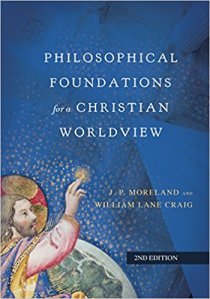 A work of the size and scope as J.P. Moreland and William Lane Craig’s massive Philosophical Foundations for a Christian Worldview is daunting, so readers will want to know if it is work going through. The short answer to that question is that yes, it is, so long as one reads the work–like any other–with a critical eye.
The book is broken up into six parts: Introduction, Epistemology, Metaphysics, Philosophy of Science, Ethics, and the Philosophy of Religion and Philosophical Theology. Each section is full of definitions and lengthy philosophical outlines arguing for the positions Craig and Moreland hold. They attempt to stick to a largely “mere” Christianity, though at times they stray from a vision that is as broad as possible. For example, regarding the debate over the soul, Moreland and Craig fall staunchly into the dualist camp, to the extent that a physicalist theory of mind from a Christian perspective isn’t even considered. Regarding the science-faith question, the authors argue lengthily against any perspective which would hold to methodological naturalism and seem to align most closely with ID theory. For a theory of time, the authors push for an A-theory of time, which later impacts their doctrine of God by making God temporal post-creation and undermines the notion of divine simplicity.
Yet even those who take issue with the positions the authors hold will continue to benefit from interacting with their views. For example, interacting with their arguments about God and time would be a great exercise whether one believes God is temporal or atemporal.
I did, however, find the choices of subjects related to philosophical theology to be particularly interesting. The first two sections make arguments related to the Trinity and the Incarnation, which are both definitional to the notion of a “Christian.” The third, however, is about the Atonement, and quickly (613) states that “an essential, and indeed central, element of any biblically adequate atonement theory is penal substitution” and then go on to say “More than that, penal substitution, if true, could not be a merely subsidiary facet of an adequate atonement theory, for it is foundational to many other aspects of the atonement, such as redemption from sin, satisfaction of divine justice, and the moral influence of Christ’s example” (613-614). I was quite surprised by this–especially the latter statement–because there are entire theories of atonement based around these aspects. Thus, for example, the Example Theory of the atonement is entirely based upon the notion that Christ is an example and would therefore give us all kinds of moral influence. Interestingly, the fourth doctrine addressed is that of Christian particularism–the notion that salvation is in Christ alone. I tend to agree that no orthodox Christian would deny this, but it is interesting to see that Craig and Moreland seem to equate belief in, say, universalism with a denial of particularism, though to my knowledge most of the 19th century Christian universalists affirmed particularlism but held to universal salvation through Christ. Craig and Moreland go on to state that views like annihilationism “are rather difficult to square with the biblical data” (632) even though, in my experience, annihilationists almost always go straight to the biblical text to support their views (see, eg. numerous passages that equate hell with death or destruction). Again, it seems odd in a book that tends to go towards “mere” Christianity to pick views that are at issue and then exclude all others.
Many readers will want to go straight to the book for arguments about the existence of God, and Moreland and Craig do not disappoint. In the two chapters on the topic, the authors summarize huge swathes of philosophical arguments for the existence of God, along with answering many objections. Like the rest of the book, this is done in summaries of longer arguments, but readers will still get much of use out of this section.
Though I’ve skimmed through many portions of the book, I’d like to focus a little bit on Christology and the discussion of what Craig elsewhere calls Neo-Apollinarianism. I was curious to see if the 2nd edition of the book would modify this position in critical ways to avoid the pitfalls of his previous position, but it seems it does not. The argument is made that “Apollinarianism achieved a genuine incarnation that… is no more implausible than the soul’s union with the body” (597). The problem was that it failed to unify body with mind in Christ. Thus, the authors propose making the divine Logos the mind of Christ, among other things (603ff). This seems to me–and many others–to punt the problem by still making it such that the Incarnated Christ does not have the totality of human nature, for the mind is from the divine nature. Simply calling it the “Logos” does not smooth over the problem of making the human nature effectively mindless without the divine. Because this Christology does not give Christ a human mind, as Gregory of Nazianzus said, “That which was not assumed was not saved” (glossing a bit). This seems an incomplete Christ.
Moreover, the discussion on the Lutheran view of Christology (a view that I as a Lutheran ascribe to) rather strangely condemns Lutherans for confusing the natures of Christ by teaching the communication of the attributes. Such a blithe dismissal seems wrongheaded, unless Moreland and Craig wish to further deny that the Incarnate Christ was incapable of divine activity. Alas, such misunderstanding of Lutheran positions are not uncommon.
With Philosophical Foundations for a Christian Worldview, Moreland and Craig have provided a truly impressive contribution to Christian philosophy of religion that will serve as a starting point for many an engagement with a huge number of topics. At some points, the authors take contentious positions, and it is unfortunate that they endorse a non-standard Christology. Thus, readers should read the work with a critical eye, treating it as a practice of interaction on a high level with a number of philosophical ideas related to Christianity.
Disclaimer: I was provided with a copy of the book for review by the publisher. I was not required to give any specific kind of feedback whatsoever.
Links
Be sure to check out the page for this site on Facebook and Twitter for discussion of posts, links to other pages of interest, random talk about theology/philosophy/apologetics/movies and more!
Book Reviews– There are plenty more book reviews to read! Read like crazy! (Scroll down for more, and click at bottom for even more!)
SDG.
——
The preceding post is the property of J.W. Wartick (apart from quotations, which are the property of their respective owners, and works of art as credited; images are often freely available to the public and J.W. Wartick makes no claims of owning rights to the images unless he makes that explicit) and should not be reproduced in part or in whole without the expressed consent of the author. All content on this site is the property of J.W. Wartick and is made available for individual and personal usage. If you cite from these documents, whether for personal or professional purposes, please give appropriate citation with both the name of the author (J.W. Wartick) and a link to the original URL. If you’d like to repost a post, you may do so, provided you show less than half of the original post on your own site and link to the original post for the rest. You must also appropriately cite the post as noted above. This blog is protected by Creative Commons licensing. By viewing any part of this site, you are agreeing to this usage policy.
A Brief Biblical Proof for Women Pastors – with Alice Guinther

A picture of my wife, the Reverend Elizabeth Wartick. Source: “Living Lutheran,” (Published by the ELCA: Chicago) March 2018 issue, page 27.
God has placed in the church first of all apostles, second prophets, third teachers, then miracles, then gifts of healing, of helping, of guidance, and of different kinds of tongues. (1 Corinthians 12:28, ESV)
In this list, Paul ranked various gifts in the church in this way 1) Apostles 2) Prophets 3) Teachers (etc…)
P1. There are biblical examples of women prophets in both the Old and New Testaments. (eg. Judges 4:4; Exodus 15:20; Acts 21:9)
P2. In the ranked list, the spiritual gift of prophet is ranked above that of teacher, a role that we find biblical examples of women filling.
C1: We therefore find women in higher ranked roles than the role of teacher. Therefore, it is biblically correct for a woman to be a prophet.
P3. But women cannot teach because we believe the bible says so. 1 Timothy 2:12 states that a woman cannot have authority over a man, and teaching is having authority.
P3.1 But the role of prophet is higher-ranked than teaching.
P3.2 According to the Bible women have held the God ordained/blessed role of Prophet, and that is ranked higher in Paul’s list than teacher. Being a prophet is having authority; women had authority over men as prophet. But how can that be, if women are not to have authority over men?
C2: Women cannot both have authority over men as prophet, and not have authority over men as (lower ranking) teachers (law of non-contradiction). Woman cannot both have/not have authority. Ǝx: Wx [Ax & ~Ax] (there exists an x such that x is a woman [x has authority AND x does not have authority])
C3. It is incoherent to claim that a woman may not have teaching authority, because it has been shown that women can have the higher authority of prophet.
C4. Therefore women may teach.
Q.E.D.
Co-Author Credit:
I wrote this with significant help and insight, including major revisions and entire construction of multiple premises/conclusions (as well as all symbolic logic) from Alice Guinther.
Alice Guinther holds a BA in Philosophy from the University of Colorado Boulder, Where she is the department assistant for Journalism and Media Studies. She is a published artist and illustrator, and has a review published in Priscilla Papers.
SDG.
Book Review: “Theistic Evolution: A Scientific, Philosophical, and Theological Critique” Summary of Response
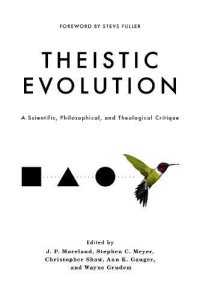 I’ve spent quite a bit of time reviewing, re-reading, and contemplating the massive book entitled Theistic Evolution: A Scientific, Philosophical, and Theological Critique edited by J.P. Moreland, Stephen C. Meyer, et al. I reviewed the book, interacting with the scientific and philosophical parts, and then looking in even more detail at some individual chapters in the theological section of the work. I wished to make a post that summarized some of my thoughts, as well as providing a one-stop shop for viewing my lengthier criticisms as well as those of others.
Review
Theistic Evolution is, without a doubt, the most comprehensive collection of arguments against the eponymous position that I know of in existence. But that is not to say there is going to be much new here for those who have read about science-faith issues. Indeed, though almost every chapter is first published here (except where otherwise noted in a few chapters), most of the arguments have been dealt with or have been ongoing for years, if not decades. Here, I can only offer the briefest interaction with the massive work (but see my longer interactions linked below).
The scientific section is largely outside my area of expertise, so I’ll limit myself to a few broad comments. Time and again, various authors move from saying that scientists cannot determine the exact order of a certain evolutionary chain to saying that there is therefore no such chain. This is deeply mistaken, though I admit I used to buy into this type of anti-evolutionary argument myself. At first it sounds compelling, until one considers that nowhere else do we allow this reasoning. For example, we would not say that no automobile accident happened just because we could not determine the exact order in which individual parts of the cars involved were crushed. Another difficulty with the scientific part of the book is that time and again, the assertions are made that theistic evolutionists do not allow there to be design as a possibility or God acting in nature; yet this is false at best and disingenuous at worst.
The philosophical critique falls largely flat. For one thing, a constant refrain is that theistic evolutionists are no different from atheists when it comes to methodological naturalism, yet this strangely ignores the “theistic” part of the term theistic evolution. Because proponents of said position are theists, they clearly allow for divine activity, and major proponents of the theory like those at Biologos constantly affirm this. Second, assertions that evolution would not allow for theism in the first place also fail both because Christians from the beginning of interaction with evolution have noted that God could simply have ordained the whole process and because those Christians who think in Aristotelian terms can still have final ends in mind with evolution, even on the level of individual species.
The theological critique musters perhaps the strongest arguments in the book, but even here there are a series of blunders that undercut much of the case. In the chapter on the Old Testament, for example, the author fails to defend or even define the meaning of the term “history” and its use to describe the early chapters of Genesis. In the chapter on the New Testament, the author strangely insists that Jude must mean Genesis is “historical” (again failing to define or even touch on what that term is supposed to mean here) while also dismissing claims that other parts of Jude would make other events historical. Then, the author turns around and says that because Jude cites the book of 1 Enoch, that means some parts of 1 Enoch are historical while others aren’t. Which are which? Well, clearly, whichever parts benefit the author are historical; those that don’t are not. Moreover, the same author does not at any point defend the notion of taking a genealogy in the way that we Westerners in the 21st century take it, despite the genealogies in the New Testament being written in an ancient time with a completely different culture. In the chapter on historical Christian theology, the word “creation” is wielded like a sword, leading to some possible confusion on categories related to Aquinas and others.
Definitions are clearly very important in the book, though vastly important terms like “history” or “historical narrative” are thrown about without ever interacting with them. This, despite the intense debate in the field of history about the changing meaning of the term and how history is written. The definition of Theistic Evolution–“God created matter and after that did not guide or intervene or act directly to cause any empirically detectable change in the natural behavior of matter until all living things had evolved by purely natural processes” (67)–given in the book fails to adequately account for the range of beliefs of theistic evolutionists and does not draw adequately from major TE groups. Nevertheless, the authors use that definition as though it can exclude or include people in the umbrella term. Not only that, but some authors rail against TEs for things the definition that the editors themselves endorse use make clear TEs don’t all believe. Prominent Christian philosopher J.P. Moreland is among those who attack TEs for denying a historical Adam and Eve, yet the definition that the editors provide does not actually exclude this belief in any way.
Overall, Theistic Evolution: A Scientific, Philosophical, and Theological Critique does not contribute much new to the intrafaith debate about evolution. For one thing, as noted above, it fails to adequately interact with the actual views of those who hold to theistic evolution, while also failing to acknowledge the breadth of thought such a position represents. Additionally, the arguments presented herein have largely been encountered in other works throughout the science-faith debate. Finally, many of the arguments presented herein are either circular or self-refuting. As noted briefly above (and in more detail in my extended analyses below), several authors simply assert that parts of the Bible are “historical” and then use that to batter theistic evolution, as if no serious exegesis has been done on the other side. Where exegesis is addressed, it is typically perfunctory and laced with dismissals of rival positions. I cannot recommend the book to those wishing to have a full and honest discussion of theistic evolution, though if it does truly represent the best of the best by way of critique of theistic evolution, I would say that those holding to that position may sleep soundly.
Disclaimer: I was provided with a copy of the book for review by the publisher. I was not required to give any specific kind of feedback whatsoever.
Extended Critique of Individual Sections and Chapters
My individual sections critiquing the book on numerous fronts can be found as follows:
Book Review: “Theistic Evolution: A Scientific, Philosophical, and Theological Critique” Part 1- Definition(s)– Definitions are a key issue throughout the book, and I take a look at a few here, including the definition the authors use for “theistic evolution” and the lack of interaction with major groups who are advocates of this position.
Book Review: “Theistic Evolution: A Scientific, Philosophical, and Theological Critique” Part 2: Science– A significant portion of the book was dedicated to scientific critique of theistic evolution, which is largely to say critique of the theory of evolution broadly speaking. Though I’m not an expert in science by any means, I interact with this portions I felt comfortable with, especially calling into question the movement from lack of 100% certainty to not having any possibility of evolution being true.
Book Review: “Theistic Evolution: A Scientific, Philosophical, and Theological Critique” Part 3: Philosophical Critique– Several philosophical issues are raised, from methodological naturalism to alleged contradiction of affirmations of Christianity that theistic evolutionists must hold. In contrast, I note that theistic evolutionists have a broader base to allow for ends in evolution, while also noting that the alleged contradictions are non-existent.
Book Review: “Theistic Evolution: A Scientific, Philosophical, and Theological Critique” Part 4: Theistic Evolution and the Old Testament– From the creation accounts to the historicity of Adam, arguments are made to the effect that the Old Testament cannot be compatible with theistic evolution. I note the circularity of several arguments the author makes, as well as questioning their use of the category “history.”
Book Review: “Theistic Evolution: A Scientific, Philosophical, and Theological Critique” Part 5: Theistic Evolution and the New Testament– Several parts of New Testament teaching, from the genealogies in the Gospels to the faith list in Hebrews are taken to show that theistic evolution is “incompatible” with the New Testament. I argue that this is mistaken, and indeed the author fails to demonstrate this incompatibility.
Book Review: “Theistic Evolution: A Scientific, Philosophical, and Theological Critique” Part 6: Theistic Evolution and Historical Christian Doctrine– Theistic evolution is often said to contradict the historic teaching of the church. Here, I analyze the extended arguments of one author who suggests this is the case, noting that at many points, modern categories are imported into the discussion of historical theology.
Other Reviews/Interactions (will update with more)
J.P. Moreland and the Book “Theistic Evolution” (Part 1: What do William Paley, Richard Dawkins, and J.P. Moreland all have in common?)– A two-part analysis of J.P. Moreland’s commentary on theistic evolution and its method. Part Two.
Links
Be sure to check out the page for this site on Facebook and Twitter for discussion of posts, links to other pages of interest, random talk about theology/philosophy/apologetics/movies and more!
Book Reviews– There are plenty more book reviews to read! Read like crazy! (Scroll down for more, and click at bottom for even more!)
SDG.
——
The preceding post is the property of J.W. Wartick (apart from quotations, which are the property of their respective owners, and works of art as credited; images are often freely available to the public and J.W. Wartick makes no claims of owning rights to the images unless he makes that explicit) and should not be reproduced in part or in whole without the expressed consent of the author. All content on this site is the property of J.W. Wartick and is made available for individual and personal usage. If you cite from these documents, whether for personal or professional purposes, please give appropriate citation with both the name of the author (J.W. Wartick) and a link to the original URL. If you’d like to repost a post, you may do so, provided you show less than half of the original post on your own site and link to the original post for the rest. You must also appropriately cite the post as noted above. This blog is protected by Creative Commons licensing. By viewing any part of this site, you are agreeing to this usage policy.
Remembering Bonhoeffer, 2018: Bonhoeffer was Not an [American] Evangelical, but he was an Evangelical Lutheran

Today is the anniversary of the execution of Dietrich Bonhoeffer by the Nazis, April 9, 1945. As I hope to do each year, I’d like to share a brief thought on Bonhoeffer’s life and legacy on this date.
Bonhoeffer and Evangelicalism(s)
One of the ways that Bonhoeffer is most frequently abused is by the assumption or argument that he was an evangelical, particularly of the American variety (eg. inerrancy and the like). In honor of the day of his death, I’d like to continue to disabuse people of that notion and instead note that he was actually a 20th century German Lutheran influenced by (but not uncritically accepting of) Neo-Orthodoxy. Here are some of his words about the creation account, specifically Genesis 1:6-10, from “Creation and Fall”:
Here the ancient image of the world confronts us in all its scientific naivete [my fault for lack of correct letters]. To us today its ideas appear altogether absurd. In view of the rapid changes in our own knowledge of nature, a derisive attitude that is too sure of itself is not exactly advisable here; nevertheless in this passage the biblical author is exposed as one whose knowledge is bound by all the limitations of the author’s own time. Heaven and the sea were in any event not formed in the way the author says, and there is no way we could escape having a very bad conscience if we let ourselves be tied to assertions of that kind. The theory of verbal inspiration will not do. The writer of the first chapter of Genesis sees things here in a very human way. [DBW 3:47-48].
Of course, as always, Bonhoeffer’s words must be understood in a much wider context than they are presented here. It is almost never a good idea to read even whole paragraphs from Bonhoeffer in isolation, because his thought is so dense that it cannot adequately be presented in sound bites. Those quotes which often are used as sound bites are either fabrications (eg. the “Not to act is to act…” quote that has yet to have an actual source found) or the exceptions (and even then I’d be very careful). Bonhoeffer throughout this work demonstrates that the Genesis is God’s Word but he means it in a sense that is very aligned to Luther, though not necessarily Lutheranism: that it is God’s Word because it ultimately teaches us about God and Christ. He strongly argues that God remains God and that God’s Word creates and brings life, but he does not demand that the text of Scripture meet his own modern standards of scientific accuracy and even suggests that yes, it would be silly to think it could.
So no, Bonhoeffer is not a modern evangelical, though he certainly was evangelical in the sense that it was used before the modern use: that of the evangelical Lutheran church. Though many (conservative) Lutherans would reject much of his thought, I’ve yet to encounter a thinker as wholly Lutheran among modern thinkers to date. He was a wonderful–dare I say, beautiful–man who applied his incredibly deep theology to his life, even unto death.
I thank God for Dietrich Bonhoeffer.
(February 4, 1906- April 9, 1945)
-4/9/1945
-4/9/2018
Racism and Ignorance in American Christianity

A Map of Redlining of Chicago, credit: University of Chicago Library – https://www.lib.uchicago.edu/e/collections/maps/chigov/
I have had an incredibly formative last couple of years, and one of the things that I have been researching and learning about is the issue of race in the United States. I have to admit my own extreme ignorance of the topic going in, and I definitely do not claim to have become an expert in the topic. I still feel I am only beginning to learn about the many interconnected ways race impacts the way we think and act in the United States, as well as the deep history of racial tensions in our country.
I admit, to my shame, that I had kind of rolled my eyes at some of the discussions of race and its impact today. After all, slavery ended in 1865 with the 13th Amendment, right? Why are people still complaining about it? Why do people complain about things that happened before people today were even alive? I ignorantly–foolishly–assumed that we had gotten over it. That I could say that because something happened more than a hundred years ago, we could safely say it was relegated to our past as something that no longer impacted us. I was deeply, badly mistaken and I apologize for my ignorance.
As I read many of the books that have become formative for me, I shared things that I learned and was alarmed to see many people reacting the way I used to. I shouldn’t have been surprised, as I had done the same, but I was and am nevertheless. I’d see people scoff at the term “systemic racism” and dismiss it as a myth. I’d witness bald incredulity when I mentioned how some of the reasoning used regarding people of color to defend slavery parallels arguments today about refugees and immigrants. People would ask for facts, but when provided with them, would filter them through their existing biases–as we all must–and find that the facts did not, in fact, provide evidence for broad, systemic racism. And, as I write this, I know many of these examples will be dismissed as merely trying to appeal to emotions or pandering to liberalism.
Yet I cannot be silent. I cannot continue to learn about the deep, abiding ways our country has managed to continue to recast issues of race in ways that negatively impact people of color. Over some indefinite period, I would like to share with you parts of my journey. My hope is that you will find it informative and interesting, and perhaps we can talk about the issues we need to work to change. I hope we can work together to bring healing and understanding where there has been very little of either. I hope we can change so that American Christianity is not silent in the face of these systemic wrongs, but rather seen as a powerful group of people working together to crush inequity.
I want to issue a true challenge to those who read this. Do not remain in ignorance. It’s not enough to simply rush to search for an article online to “refute” every fact you are uncomfortable with. And yes, I’m as guilty of this as anyone. But time and again in discussions of issues related to inequality–whether race or gender–I find that when I present historical facts based upon digging through many books on the topic, the response is frequently a link to an article that demonstrates little-to-no understanding of those facts and distorts their context. Such historical ignorance is unfortunately common–again, I admit it in myself as something I am seeking to amend–but it is something we must seek to remedy. I want you to join me in this resolution:
When discussing issues of race and faced with a fact or statistic that makes me uncomfortable, I will not rush to find a way to make the fact more comfortable for me as a first reaction.
We need to be uncomfortable. We need to find out things about the past of our country–and perhaps even our ancestors or, even more importantly, ourselves–that make us uncomfortable and make us realize change is needed.
Links
Be sure to check out the page for this site on Facebook and Twitter for discussion of posts, links to other pages of interest, random talk about theology/philosophy/apologetics/movies and more.
SDG.
——
The preceding post is the property of J.W. Wartick (apart from quotations, which are the property of their respective owners, and works of art as credited; images are often freely available to the public and J.W. Wartick makes no claims of owning rights to the images unless he makes that explicit) and should not be reproduced in part or in whole without the expressed consent of the author. All content on this site is the property of J.W. Wartick and is made available for individual and personal usage. If you cite from these documents, whether for personal or professional purposes, please give appropriate citation with both the name of the author (J.W. Wartick) and a link to the original URL. If you’d like to repost a post, you may do so, provided you show less than half of the original post on your own site and link to the original post for the rest. You must also appropriately cite the post as noted above. This blog is protected by Creative Commons licensing. By viewing any part of this site, you are agreeing to this usage policy.
Book Review: “Theistic Evolution: A Scientific, Philosophical, and Theological Critique” Part 5: Theistic Evolution and the New Testament
Crossway has published a book entitled Theistic Evolution: A Scientific, Philosophical, and Theological Critique edited by J.P. Moreland, Stephen C. Meyer, et al. The book is mammoth- right around 1000 pages of text. As the title suggests, it purports to give a comprehensive refutation of the position of theistic evolution. Due to its huge size and scope, I’ve decided to break my review up into multiple posts. I do not claim to be an expert in every field this book touches upon–that would be impossible. Instead, I’ll offer comments on those areas I took notes and had interactions with in my own reading.
For this part, I will focus on the chapter on the New Testament.
The New Testament and Theistic Evolution
Guy Prentiss Waters wrote the chapter entitled “Theistic Evolution is Incompatible with the Teachings of the New Testament.” As with John D. Currid’s chapter on the Old Testament, the implication is that the author will demonstrate not just that the New Testament works better with rival theories, but that theistic evolution (hereafter “TE”) and the New Testament cannot both be true. Whereas Currid focused on attempting to rebut the ways TEs read the Old Testament–launching a hermeneutic attack on TE, Waters instead tries to show specific passages from the New Testament contradict teachings of TE. We’ll focus on a selection of these passages.
Waters’ first move is to argue that the use of Adam in the New Testament demonstrates that TEs are mistaken in their beliefs about Adam and Eve.[1] The first line of evidence Waters uses is the genealogy in Luke 3. After blithely “setting aside the exegetical questions attending this passage, and the challenges of harmonizing this genealogy with that of Matthew…”–things that would clearly be highly relevant in one’s interpretation of this passage–Waters states that “Adam appears among dozens of figures whom the biblical writers regard as fully historical…” (882). Adam is “at the head of a linear genealogical sequence” and “Adam… is the first man” which we can tell because it simply says he is the “‘son of God,’ a reference to his special creation in Genesis 1-2.” (882-883). Waters insists that these mean that if TEs say Adam is not the first human, Jesus as “Redeemer of all human beings is void” (884).
Waters’ choosing to set aside the exegetical questions about this passage is quite strange, given that he then challenges TEs to account for it exegetically. Biblical genealogies, as argued, for example, by Robert McLachlan Wilson in his book “Genealogy and History in the Biblical World,” are grounded in ANE thought, which saw genealogies less as linear historical accounts tracing one ancestor to the next (as we think of them in the 21st century) than as legitimizing familial relationships, a view of genealogies which persists in some cultures to this day. If this is even remotely accurate given the biblical genealogies, then Waters using Adam as “head of a linear genealogical sequence” is hardly of consequence; after all, he has already read in his own modern sense of “genealogy” into the meaning of the text. Moreover, Waters’ interaction with John Walton on this point amounts to begging the question, as he simply asserts that because Adam is historical (in the sense Waters prefers, of course–as once again we have an author fail to give any definition of or reflection upon the meaning of “history” in the biblical or modern context), Walton is mistaken for making Adam a theological point (884).
Turning to 1 Timothy 2:11-14, Waters claims that Paul must be using Adam and Eve as historical persons rather than mere illustrations. But in the very same section, Waters goes on to make the complementarian argument that the “creation of Adam prior to Eve” is somehow the basis for the complementarian reading of the passage. Setting aside how poorly complementarians read this and many other passages of Scripture, it is surprising to then see Waters turn around and criticize Walton and other TEs for claiming Paul is using this passage illustratively. After all, that is exactly what Waters does: he uses the passage as an illustration for why the complementarian perspective is correct. Sure, he could object by saying he takes the original, Old Testament passage “historically” (again, without defining what that term means), but that doesn’t show that his reading isn’t doing exactly what he objects to others doing.
Remarkably, Waters then turns to the book of Jude–the same book which clearly uses a contemporary story about Satan trying to take Moses’ body–to say that Adam must be historical. Because Jude 14 states that Enoch was the seventh from Adam, Waters takes this to affirm that Jude explicitly views Adam historically. Then, because the book has passages that quote the pseudepigraphical book 1 Enoch, Waters must also make the argument that Jude does not take 1 Enoch historically. That is, according to Waters, Jude explicitly means to affirm the historicity of Adam but not the historicity of 1 Enoch despite the fact that the same author uses both in the same context! So readers are expected to agree that Jude moves from historical narrative to using a non-historical book that has perhaps some historically accurate parts. It gets even more confusing, because Waters goes on to hypothesize that perhaps the statement about Adam being seventh from Enoch was historically accurate and spoken by Enoch, but that the rest of the book (or parts of it) were invented. What is the criterion for seperating fact from historical fiction here? Quite simply, it seems to be that whatever Waters wants to affirm as historical is that which is historical, and what he feels uncomfortable about affirming as historical is not historical.
Waters asserts that Jesus would see the entire book of Genesis as historical because he mentions a range of prophets in the Hebrew Scriptures. His only support for saying Jesus was 100% intending all of this historically is to say “We have no reason to doubt, then, that Jesus regarded the entirety of the events of Genesis to be fully historical” (895). This, despite the fact that this is exactly what is at question. Time and again (see 896 for an example related to Noah), Waters seems to think that having select references to events in the Old Testament entails that every aspect of it–or at least Genesis–is “fully historical” in whatever sense he desires it to be.
The faith list in Hebrews is taken to mean that every single figure on it is historical. Why? “Nonhistorical figures could not persuasively model persevering faith for historical people” (898-899). While I tend to agree that the faith list in Hebrews is full of people who did exist, Waters’ point is mistaken. What about the example, say, of Samwise Gamgee in The Lord of the Rings? Today, he is seen by many as a great example of persevering faith and friendship. This, despite the fact that the people who see him as such (myself included) clearly know that he is nonhistorical and explicitly fictional. Examples like this could easily be multiplied ad infinitum. As such, Waters’ point that people must be historical to be seen as models for persevering faith for “historical people” is wrong, and deeply so. Because this is his central point regarding the Hebrews faith list, we see once again that TEs has no difficulty here, regardless of the position they hold.
Waters then briefly surveys a few TE readings of Paul. This survey is grounded upon his analysis that preceded it, so the comments already written apply.
Waters’ method was quite different from Currid’s. Nevertheless, his analysis, like Currid’s, fails to demonstrate the thesis of his chapter. Do TEs have a lot of exegetical work to do regarding the New Testament? Absolutely, and they have done much. But Waters’ analysis fails on a number of points: he selectively assigns historical reality where he sees fit–even in the same chapter and verse of Scripture; he sets aside exegesis or historical context when necessary to carry his view; and he makes other specific arguments that fall apart on examination.
Disclaimer: I was provided with a copy of the book for review by the publisher. I was not required to give any specific kind of feedback whatsoever.
[1] It’s worth pointing out that not only do many TEs affirm an historical Adam and Eve, but that the book’s own definition of TE does not entail that TEs cannot affirm an historical Adam and Eve. See the post on definitions.
Links
Be sure to check out the page for this site on Facebook and Twitter for discussion of posts, links to other pages of interest, random talk about theology/philosophy/apologetics/movies and more!
Book Reviews– There are plenty more book reviews to read! Read like crazy! (Scroll down for more, and click at bottom for even more!)
SDG.
——
The preceding post is the property of J.W. Wartick (apart from quotations, which are the property of their respective owners, and works of art as credited; images are often freely available to the public and J.W. Wartick makes no claims of owning rights to the images unless he makes that explicit) and should not be reproduced in part or in whole without the expressed consent of the author. All content on this site is the property of J.W. Wartick and is made available for individual and personal usage. If you cite from these documents, whether for personal or professional purposes, please give appropriate citation with both the name of the author (J.W. Wartick) and a link to the original URL. If you’d like to repost a post, you may do so, provided you show less than half of the original post on your own site and link to the original post for the rest. You must also appropriately cite the post as noted above. This blog is protected by Creative Commons licensing. By viewing any part of this site, you are agreeing to this usage policy.
Book Review: “Exile: A Conversation with N.T. Wright” edited by James M. Scott
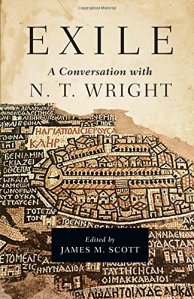 Exile: A Conversation with N.T. Wright seeks to explore N.T. Wright’s thesis about the notion of continuing exile being a controlling belief for the theology of second-temple Judaism and, by extension, early Christianity. The essays come from a variety of perspectives and are led with one by N.T. Wright himself introducing his thesis. Essay topics range from analysis of the Hebrew word(s) for “Exile” to seeing the Exile as positive rather than negative or providing a sacramental interpretation of Exile.
Any collection of essays will have highs and lows. I felt this collection was fairly even in high quality essays. Across the board, it delivered on interesting topics (even if it was not always clear why the topic is important–more on that below). Highlights for me were the inclusion of Walter Brueggemann- a phenomenally interesting OT scholar, a rather deep essay on the terminology on restoration and exile in the New Testament and LXX (Septuagint), and Robert Kugler’s “nuance” of N.T. Wright’s thesis which made it more clear what Wright was saying and highlighted some of his thesis’ importance. The book bears reading and re-reading as one considers specific theological questions about Exile–surely a pervasive theme in biblical theology–and restoration.
I was surprised, however, by how even-toned even the detractors of Wright’s thesis were in this collection. Wright’s discussion of Justification has caused serious controversy–and often shed more heat than light in some circles–and his discussion of Exile has seemed to me just as contentious. Yet the negative essays included here only touched on the areas of disagreement. Though essays like Jörn Kiefer’s “Not All Gloom and Doom” strike at the heart of Wright’s thesis by, in this case, undercutting the sheer horror of exile to the authors of the Bible, few seem to critically engage Wright on a truly broad level.
Indeed, if there’s any serious shortcoming in the book, it is that at no point is the importance of the debate truly outlined and expanded upon. Indeed, readers may be forgiven for wondering, at times, what is so contentious about some of these points–and why they matter. At one point, as I read about the positive interpretations of Exile in Judaism, I wondered- “So what?” If Wright is right, then Exile is a pervasive theme and key to understanding the entire Bible. That seems like a big deal. But most of the essays here seem to make it sound like minutiae. Having read the book, and a few chapters twice, I am left wondering about the big picture and what, exactly, is at stake in some of it.
Exile: A Conversation with N.T. Wright is an interesting collection of valuable essays. Though it doesn’t always highlight the practical importance of its topic, it does engage with some heady subjects of interpretation on many levels that readers interested in this debate would surely benefit from. As I’ve often found to be the case, though, I was left at times wondering why Wright is found to be so contentious, and
The Good
+Variety of perspectives offered
+Wide swath of engagement with Wright
The Bad
-Doesn’t explain enough of why the debate is important
Disclaimer: I was provided with a copy of the book for review by the publisher. I was not required to give any specific kind of feedback whatsoever.
Links
Be sure to check out the page for this site on Facebook and Twitter for discussion of posts, links to other pages of interest, random talk about theology/philosophy/apologetics/movies and more!
SDG.
——
The preceding post is the property of J.W. Wartick (apart from quotations, which are the property of their respective owners, and works of art as credited; images are often freely available to the public and J.W. Wartick makes no claims of owning rights to the images unless he makes that explicit) and should not be reproduced in part or in whole without the expressed consent of the author. All content on this site is the property of J.W. Wartick and is made available for individual and personal usage. If you cite from these documents, whether for personal or professional purposes, please give appropriate citation with both the name of the author (J.W. Wartick) and a link to the original URL. If you’d like to repost a post, you may do so, provided you show less than half of the original post on your own site and link to the original post for the rest. You must also appropriately cite the post as noted above. This blog is protected by Creative Commons licensing. By viewing any part of this site, you are agreeing to this usage policy.
Book Review: “The Lost World of Israelite Conquest” by John Walton and J. Harvey Walton
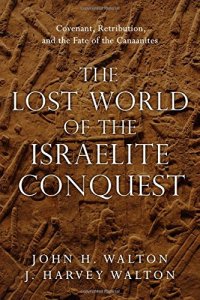 The Lost World of the Israelite Conquest is another fantastic work from the pen of John Walton, this time writing with his son, J. Harvey Walton. Walton has a number of these introductory works that focus on revealing the world of the Ancient Near East to his readers to help make sense of the Bible. In this work, the authors take on the question of what we are to make of the conquest narratives in the Bible.
There are often several perspectives Christians take in response to these accounts, as the authors note: they may argue that God is in control of all things and if God chooses to use one people to massacre another, that is God’s will; they may instead argue that the accounts are Israel’s political use of God to justify their own acts; others soften the first perspective but note how morally bankrupt the Canaanites are, arguing that they deserved destruction; or they may argue that the accounts don’t actually teach about genocide at all, but are rather, properly interpreted, rhetoric. The authors of The Lost World of the Israelite Conquest argue, instead, that when we properly understand the Ancient Near Eastern (ANE) context of these passages, their meaning becomes more clear.
Perhaps one of the most radical propositions in the book, from the modern apologetic perspective, is that there is an entire section dedicated to the argument that “The Canaanites are not depicted as guilty of sin” (31ff). They are not saying the Canaanites are perfect, but rather that the Bible does not highlight the sinfulness of the Canaanites over and against any other group of people. Thus, to argue that the Canaanites were particularly guilty of sin, or that they took what was rightfully Israel’s, is mistaken. They establish this through both looking at the Bible’s own words about the Canaanites, and by evaluating the ANE context of these accounts. After arguing, briefly, that the Conquest accounts are a recapitulation of the creation accounts, the authors delve deeply into the translation of the Hebrew word, “Herem.” The word, contextually, often allows those who are “herem”‘d to continue existing. Thus, the authors argue, the meaning of the term is not destruction of individuals but rather the destruction of identity: to “herem” something is to “remove from use” that something. Thus, they argue, the Canaanites were not all put to the sword or killed; rather, their identity was subsumed into Israelite identity.
Another important point the authors make is that wars in the ancient world were fought in different ways and often with different goals or ideals of outcomes than we have today. A people’s deity was depicted fighting alongside that people, and these wars were often over identity as people.
The authors, then, reject the popular apologetic argument today that the accounts are hyperbolic in scope and thus can be seen as something like mere skirmishes. Instead, they argue that the conquest accounts are writing about war as the people of the ANE fought it, with the purposes and in the contexts in which they fought those wars. Overall, I found the authors’ theses pretty convincing. It certainly does away with some of the simpler dismissals of the accounts as merely hyperbolic. However, I wonder how the authors might respond to a more nuanced and extended argument like that of K. Lawson Younger, Jr.’s Ancient Conquest Accounts. In that work, Younger draws upon archaeological data as well as analysis of the battles as described in the biblical texts to show, in part, that the accounts are not genocide but rather wars waged against strongholds and fortresses in rather strategically advanced ways. To anticipate a reply, I believe the Waltons might argue that such analysis could easily be incorporated into their own account, for so long as one is not trying to establish the accounts as merely hyperbolic, one may align oneself with their own perspective.
Other recent works like Did God Really Command Genocide? by Paul Copan and Matthew Flannagan offer robust defenses of the hyperbolic approach to interpreting the text. The authors did address Copan directly and I believe this book, though the index of Lost World… doesn’t feature either author, making it difficult to confirm. Responding to Copan, they argue that at least part of his approach is anachronistic and reads a modern view of demonic powers onto the Hebrew text. I think it would have been helpful, though, to have a longer discussion of the hyperbolic interpretation. Indeed, the subject index doesn’t even have the word “hyperbole,” though it was mentioned several times. It will be interesting to see how modern defenders of the hyperbolic interpretation interact with the Walton thesis.
Overall, The Lost World of the Israelite Conquest is a broad, thought-provoking book. Though readers familiar with the field will certainly be left wanting more questions answered, they will benefit as much as any other reader due to the expertise on ANE context that is brought to bear on these difficult passages. I read the book and would say I feel largely convinced by it, though either due to my own adherence to the hyperbolic view or something else, I still have questions about their thesis. I am firmly convinced, though, that any reader with interest in this topic must pick up and read this important work.
The Good
+Fascinating application of ANE context to difficult topic
+Broad focus with many lines of evidence applied to question
+Sheds fresh light on the topic
+Opens many lines of further inquiry
The Bad
-Could use more discussion of some modern alternatives
-Index seems somewhat incomplete
Disclaimer: I was provided with a copy of the book for review by the publisher. I was not required to give any specific kind of feedback whatsoever.
Links
Be sure to check out the page for this site on Facebook and Twitter for discussion of posts, links to other pages of interest, random talk about theology/philosophy/apologetics/movies and more!
SDG.
——
The preceding post is the property of J.W. Wartick (apart from quotations, which are the property of their respective owners, and works of art as credited; images are often freely available to the public and J.W. Wartick makes no claims of owning rights to the images unless he makes that explicit) and should not be reproduced in part or in whole without the expressed consent of the author. All content on this site is the property of J.W. Wartick and is made available for individual and personal usage. If you cite from these documents, whether for personal or professional purposes, please give appropriate citation with both the name of the author (J.W. Wartick) and a link to the original URL. If you’d like to repost a post, you may do so, provided you show less than half of the original post on your own site and link to the original post for the rest. You must also appropriately cite the post as noted above. This blog is protected by Creative Commons licensing. By viewing any part of this site, you are agreeing to this usage policy.
Book Review: “Theologies of the American Revivalists” by Robert W. Caldwell III
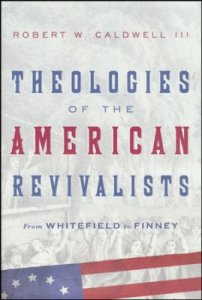 What images does the word “revival” bring to your mind? For me, the image is a rather monolithic one of fiery preaching and hands waving, altar calls and massive crowds. Robert W. Caldwell III’s Theologies of the American Revivalists: From Whitefield to Finney surveys the field of these American revivals and offers both a corrective and instructive voice.
The work is organized around different revival movements. Caldwell III differentiates between such movements as the Congregationalists, the New Divinity Movement, Jonathan Edwards, the Second Great Awakening, the Early American Baptists, Charles Finney, and more. After these chapters providing overviews of these varied movements, a chapter follows offering analysis of and response to revival theology.
What the overview chapters revealed to me was that my vision of what a “revival” looks like was really an amalgamated picture combining elements of Jonathan Edwards, the New Divinity Movement, and more. This is one of the greatest strengths of the book; it provides readers with clearer definitions of and differentiation between Revival movements. Each movement had a slightly different goal, many had differing views of what it meant to be “saved,” prayer and spirituality differed as well. Caldwell III helps draw these lines in an interesting, if sometimes dry, way.
The analysis of Revivalist theology leads Caldwell III to argue that a “moderate evangelical” theology can reveal a kind of shared link between all the revivalist movements, as well as reveal the underpinnnings of modern evangelicalism. This latter insight is particularly valuable, especially due to modern evangelicalisms oft-bemoaned lack of self-awareness regarding its roots. Caldwell, through this book, shows that evangelicalism did not spring ex nihilo, but rather had its own period of development with an interesting and sometimes checkered past.
Theologies of the American Revivalists: From Whitefield to Finney is a fascinating work. Caldwell III has shown that the American Revivals were interconnected in many important ways, but more intriguingly, has shown the spontaneity of the movement and its continuing impact.
The Good
+Demonstrates the diversity of the American revivals, as well as connections between them
+Shows a broad historical perspective while also focusing on major voices
+Important historically for understanding its topic
The Bad
-Somewhat dry at times
Disclaimer: I was provided with a copy of the book for review by the publisher. I was not required to give any specific kind of feedback whatsoever.
Links
Be sure to check out the page for this site on Facebook and Twitter for discussion of posts, links to other pages of interest, random talk about theology/philosophy/apologetics/movies and more!
What options are there in the origins debate? – A Taxonomy of Christian Origins Positions– I clarify the breadth of options available for Christians who want to interact on various levels with models of origins. I think this post is extremely important because it gives readers a chance to see the various positions explained briefly.
Origins Debate– Here is a collection of many of my posts on Christianity and science.
SDG.
——
The preceding post is the property of J.W. Wartick (apart from quotations, which are the property of their respective owners, and works of art as credited; images are often freely available to the public and J.W. Wartick makes no claims of owning rights to the images unless he makes that explicit) and should not be reproduced in part or in whole without the expressed consent of the author. All content on this site is the property of J.W. Wartick and is made available for individual and personal usage. If you cite from these documents, whether for personal or professional purposes, please give appropriate citation with both the name of the author (J.W. Wartick) and a link to the original URL. If you’d like to repost a post, you may do so, provided you show less than half of the original post on your own site and link to the original post for the rest. You must also appropriately cite the post as noted above. This blog is protected by Creative Commons licensing. By viewing any part of this site, you are agreeing to this usage policy.

 J.W. Wartick - Reconstructing Faith