I have said many times that the Lutheran view of the Bible is actually antithetical to doctrines like inerrancy. I say that for a number of reasons. The first is that reading Luther commentating on things like the book of James makes it very difficult to think that he would have held to inerrancy. But more concretely, I make this claim because Lutheran theology affirms that the Bible is both human word and God’s word. And as human word, it can indeed have error, even as this doesn’t undermine our ability to use the Scripture as normative for our faith.
Such a claim seems odd to outsiders and even insiders like me who grew up believing that one had to affirm inerrancy of Scripture or just throw the whole thing out. How could one affirm both that the Bible could have error and still take it as authoritative? Analogies could be made here (such as knowing a rulebook for a game has a misprint or an error in it and still using it for the rules of a game–and one could make this even more complex, imagining a massive, rules-heavy game like a tabletop role-playing game and how often those do have some foibles with the rules, yet players manage to make entire masterpieces of storytelling and gaming despite those), but I also think it is good to look at what people write about Lutheran theology related to this issue.
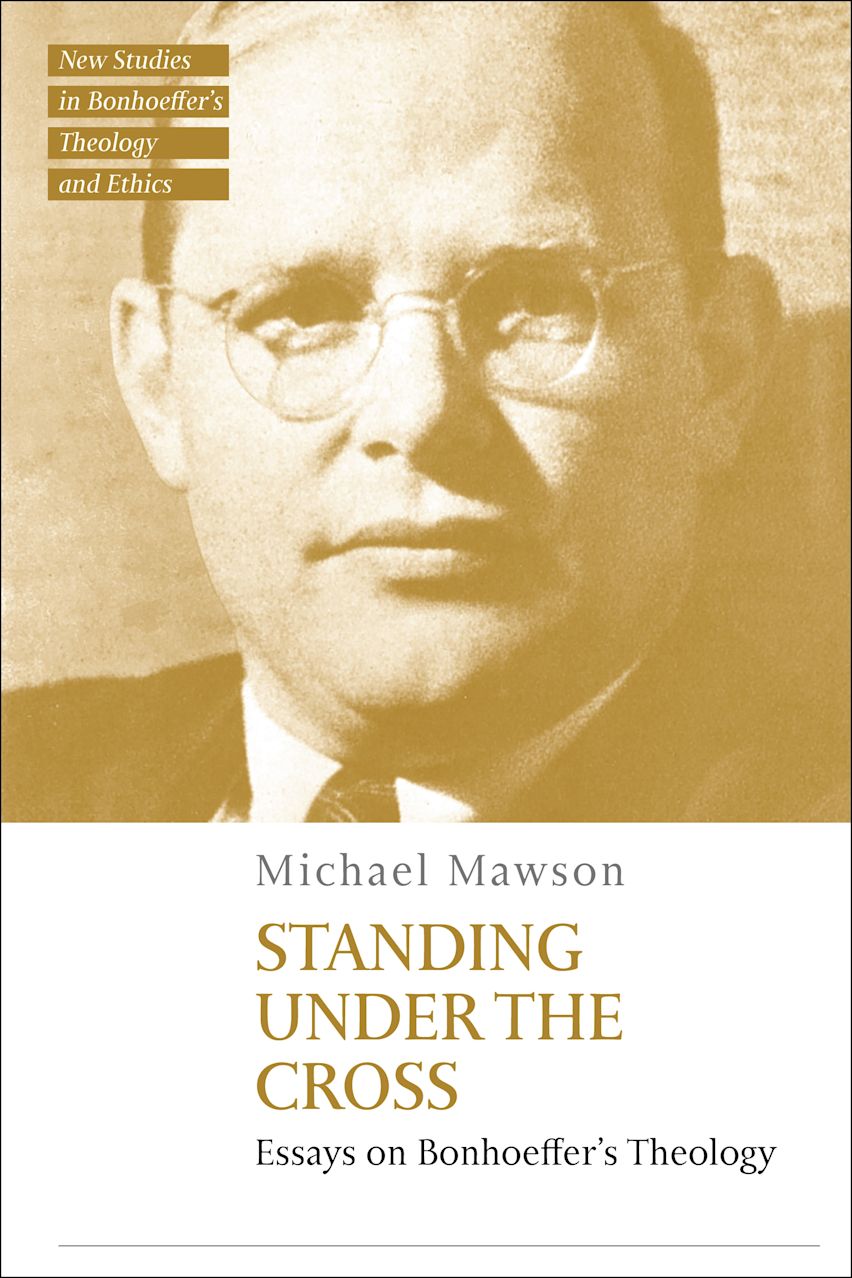
Michael Mawson’s book, Standing Under the Cross: Essays on Bonhoeffer’s Theology is a thought-provoking collection of looks at Bonhoeffer’s views. In one essay, “Living in the forms of the word: Bonhoeffer and Franz Rosenzweig on the Apocalyptic Materiality of Scripture,” Mawson makes a series of points about Bonhoeffer’s view of scripture that hammers home what I was claiming above:
“…Bonhoeffer consistently understands the Bible as God’s word and witness to Christ… from our side we are to attend to these texts as the place where God claims us and directs us towards Christ.
“On the one hand, this suggests that attending to the Bible as God’s word requires affirming the alterity of the biblical texts. In these texts, God comes to us and encounters us from without… there is always a sense in which the texts themselves stand over against us. As God’s word and witness, they continually exceed and disrupt our best attempts to interpret and make sense of them…
“On the other hand, Bonhoeffer is clear that reading the Bible as God’s word and witness – in its alterity – in no way undermines its status as a set of fully human and historical texts… God’s word remains bound to human history and language. As Bonhoeffer continues, ‘the human word does not cease being temporeally bound and transient by becoming God’s word.’ The Bible, as God’s word and witness to Christ, is bound to all the ambiguities and contingencies of history. We encounter God only in the unstable and fragile histories and lanugage of the Bible’s authors, not otherwise or more directly….” (41)
Mawson here notes what Bonhoeffer holds, apparently without internal tension: that the Bible can both be seen as “other than” us, as coming to us from without, while also being bound within human history, understanding, and language. And as such, the Bible cannot be embraced as some kind of systematically affirmed inerrant text. Indeed, that would be to effectively di-divinize Scripture, making it something that could be wholly analyzed and understood by human endeavor. And this point absolutely must be emphasized, for Bonhoeffer’s–and Luther’s–theology, God is found in weakness. This is, again, the theologica crucis – the theology of the Cross. God is experienced as the God who suffers, who comes to us in weakness, not in dominance and conquest. And this is indeed reflected in God’s word being delivered to us as well, even in the form of human fragility and language.
Mawson makes this point again in a later chapter, entitled, “The Weakness of the Word and the Reality of God: Bonhoeffer’s Grammar of Worldly Living.” In this chapter, Mawson’s focus is more upon Christian discipleship, but here he again affirms Bonhoeffer’s Lutheran perspective as seeing God in weakness, specifically in the Scriptures themselves: “As [for Bonhoeffer, so] with Luther… God’s presence in revelation – in Christ and through Scripture – remains a hidden presence. In both cases, GOd’s revelation remains concealed under the form of fragility and weakness… God’s word is ineluctably tied to human suffering and weakness” (56).
Therefore, for both Bonhoeffer and Luther (certainly excellent representatives of the Lutheran perspective on Scripture), Scripture as God’s word does not and indeed cannot entail that is perfection in whatever human terms we come up with–inerrant, for example. Instead, God is found exactly in human weakness and fragility. Scripture itself, due to it being written by humans, must remain bound historically, linguistically, and otherwise to humanity, despite still being God’s word.
Again, this may seem paradoxical to people from traditions that firmly affirm inerrancy. But Luther and Bonhoeffer would, as can be seen from their writings on human weakness in Scripture, see inerrancy as a human effort to make comprehensible Scripture and therefore put God in a box, rather than to elevate Scripture. Ironically, by clinging desperately to a human-made definition of what the word of God must be in order to remain the word of God, they have put that very word under human authority.
Links
Dietrich Bonhoeffer– read all my posts related to Bonhoeffer and his theology.
SDG.
——
The preceding post is the property of J.W. Wartick (apart from quotations, which are the property of their respective owners, and works of art as credited; images are often freely available to the public and J.W. Wartick makes no claims of owning rights to the images unless he makes that explicit) and should not be reproduced in part or in whole without the expressed consent of the author. All content on this site is the property of J.W. Wartick and is made available for individual and personal usage. If you cite from these documents, whether for personal or professional purposes, please give appropriate citation with both the name of the author (J.W. Wartick) and a link to the original URL. If you’d like to repost a post, you may do so, provided you show less than half of the original post on your own site and link to the original post for the rest. You must also appropriately cite the post as noted above. This blog is protected by Creative Commons licensing. By viewing any part of this site, you are agreeing to this usage policy.


 J.W. Wartick - Reconstructing Faith
Discussion
No comments yet.