Theistic Evolutionism
“Darwin Devolves” – Behe’s Rewriting of Evolution: A Critique from a Christian
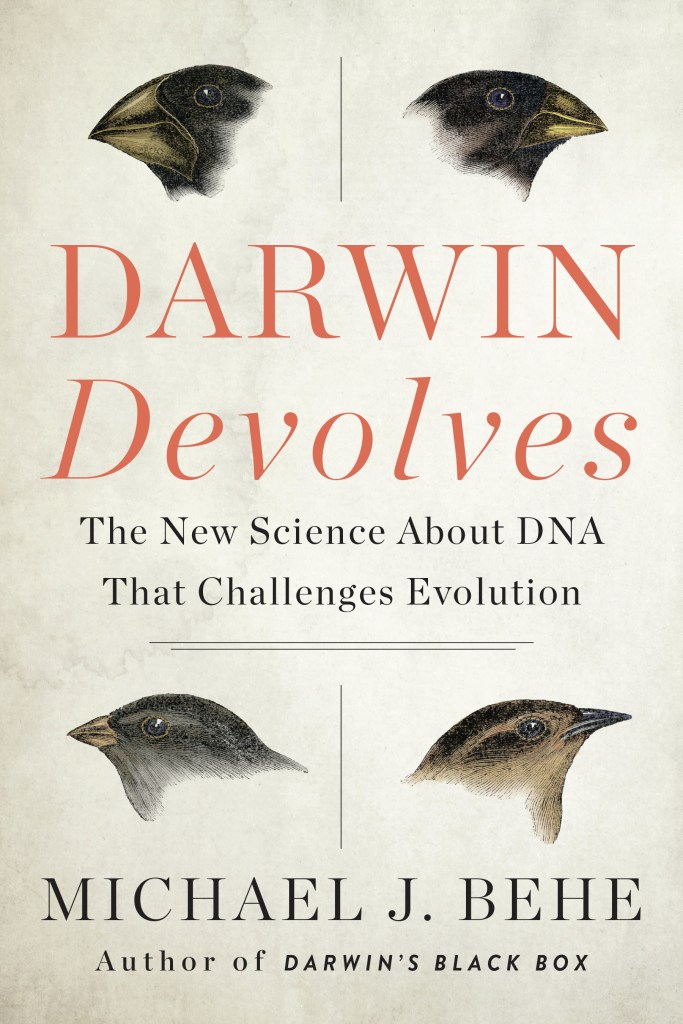
Michale Behe’s latest book, Darwin Devolves, purports to demonstrate that a major challenge to evolution is that rather than producing new functions, the demonstrable changes that we can see in experimental science is due to “devolution” or loss-of-function in genes. Behe bases this, in part, on his “First Rule”: “The First Rule of Adaptive Evolution… Break or blunt any functional coded element whose loss would yield a net fitness gain” (185). (It’s stated somewhat differently on the first page of the book: “The First Rule of Adaptive Evolution: Break or blunt any functional gene whose loss would increase the number of a species offspring” – emphasis his.)
I am sympathetic to Behe’s project. As a Christian, I would prefer there to be testable, obvious proof that God exists, and Intelligent Design theory purports to be that for at least some kind of cosmic “intelligence.” On the flip side, I am also wary, because I recall Dietrich Bonhoeffer’s words that “a god who could be proved by us would be an idol” (DBWE 11, 260). I’m not convinced that God works in such a way as to leave tantalizing fingerprints all over everything for us to find. God is personal and we relate to God in a personal way, not in an abstract way that can remain impersonal or without challenge. For most of my life, I was a young earth creationist, and then spent several years studying apologetics and advocating ID theory. Since then, I’ve become much more skeptical of ID theories, and Behe’s book illustrates several of the reasons why.
Selection Effect
One of the biggest difficulties I have with Behe’s book here, as well as with ID in general, is that there is, of necessity, a selection effect happening in the examples used. That is, the human author making the argument must be selecting examples rather than showing the whole range of life and applying their theory to it (to do the latter would be prohibitively time-consuming and likely impossible). But because there is such human agency in selecting the examples, the tendency towards selecting those examples which most easily support one’s theory is at least possibly in play.
In Darwin Devolves, selections of which evidence is discussed appears to be a large part of the weight of the argument. Evidence is mustered from polar bears and the deleterious way they acquired (perhaps not the term Behe would use) “white” fur, from laboratory experiments with bacteria and fruit flies, and from the (in)famous Darwin’s Finches. In each case, it is shown (I believe demonstrated–though I admit I’m not an expert so it is possible that this is wrong) that the “evolution” of certain features (eg. different forms of beak, see p. 143ff) is not new information or beneficial mutations but rather mutations or deletions genetically that are acting on existing DNA in ways that Behe calls “devolutions” rather than evolution.
Though it seems contentious to change the terminology of genetic reshuffling/deleting on existing information to “devolution” when it seems most assuredly an example of evolution (if not, necessarily, fitting within Behe’s specific definition(s)–more on that below), assuming Behe is right here, it would be a fascinating argument if it carried the day. But Behe must demonstrate, for his argument to work and for evolution (again, his usage) to fail, that such deletions/reshuffling is the case in every single instance of purported evolution. That would be a monumental task (and likely impossible), but one way to approach it would be to broaden the selection of data and to take on some of the most powerful evidences of evolution. But here we see the selection of Behe appears to be quite artificial. In addition to the selection effect, Behe fails to note that the very thing he’s arguing shows the failure of evolution as a theory (loss-of-function, etc.) in a lab experiment for E. Coli are, in fact, an expected outcome for such a lab experiment, and the evidence for genuinely new information is dismissed.
Additionally, given Behe’s language about loss-of-function and his “first rule,” readers would be right to expect that the data would support loss-of-function as the predominant, if not the only, means by which scientists have been able to mention what they call evolution. But that is demonstrably not the case. Rice and Lang note:
In humans only ∼3.5% of exonic and splice site variants (57,137 out of 1,639,223) are putatively loss‐of‐function (Saleheen et al. 2017), and a survey of 42 yeast strains found that only 242 of the nearly 6000 genes contain putative loss‐of‐function variants (Bergström et al. 2014).
Gregory Lang and Amber Rice ” Evolution unscathed: Darwin Devolves argues on weak reasoning that unguided evolution is a destructive force, incapable of innovation” https://onlinelibrary.wiley.com/doi/full/10.1111/evo.13710
Behe’s challenge to evolution doesn’t mention these and other related facts. The selection effect is operating strongly here, and it is selecting out those aspects of the data that do not match the theory.
Misrepresentations and Language
Throughout the book, there were difficulties with Behe’s use of terminology and misrepresentations of arguments. The definition of “evolution,” for example, seems malleable to fit Behe’s needs. He begins by noting that Darwin’s own theory couldn’t account for genetic data (Darwin didn’t know about it) and so had to be modified. But as more modifications to the theory happen, Behe seems to take that as evidence that evolution is, minimally, in crisis. Chapter 4 is dedicated to the various ways scientists have modified the theory of evolution, according to Behe–in order to “shoehorn” various discoveries into it. But one would hardly discredit the theory of gravity due to the fact that it has been modified to account for more modern discoveries. Would Behe use the same charged language that we have “shoehorned” in modern science to the theory of gravity in order to discred it? Doubtful.
Additionally, Behe is quick to dismiss evolution and evidence for it as useless or baseless. For example, across pages 22-24 he notes various examples that have been said to have evolved and then asserts that deleting the word “evolved” doesn’t change the information in the sentence. For example, “Birds like the silky flycatcher… that are mistletoe specialists have evolved a ‘wiggle dance.'” Behe then asserts that no information is lost if one just says the birds “have a wiggle dance.” But this seems to be clearly untrue, for the claim that the birds “evolved” a wiggle dance would include in it inherited traits, genes, and behaviors, where as merely “having” a dance does not. Even if one is anti-evolution, the claim that deleting the word “evolved” from sentences like that doesn’t delete information seems puzzling.
Behe is also keen to discredit natural selection. On 99-100 he offers an example that he alleges proves that increased DNA is not due to selection but rather entirely to the amorphous term called “luck.” But renaming selection “luck” doesn’t really undermine the fact that Behe doesn’t seem to have an answer for how DNA increases within his “First Rule” system. Indeed, across these pages, he actually attributes the formation of DNA increase to environmental factors and having the increased DNA continue due to isolation. But that is exactly what evolutionary theory suggests–when populations are isolated, there is the chance for selection to operate differently one one group than on another. Behe saying this is “serendipity” or “luck” seems clear obfuscation on his part–avoidance of the fact that it is exactly due to factors alleged by evolution to drive natural selection that has led to increase in DNA.
Perhaps the part of the book is Behe’s charge that evolution must produce entirely new lifeforms, including new phyla, given enough time. In looking at Darwin’s finches, he argues that the changes among them is incredibly tiny, given the amount of time they’ve had as an isolated population. he asserts that it is “very unlikely” that an environmental factor is limiting their evolution (155) and goes on to ask whether 2 million years in isolation is too little time for evolution to make major changes. After noting that “profoundly different animal phyla… arose during the Cambrian explosion… in only about ten million years” (ibid), along with some other swift evolution, he incredibly states: “Surely we should expect at least one crummy new phylum, class, or order to be conjured by Darwin’s vaunted mechanism in the time the finches have been on the Galapagos. But no, nothing” (ibid). Behe’s claim is, frankly, absurd. I don’t know of any evolutionary biologist who suggests that entirely new phyla are a necessary outcome of long-term isolation. Additionally, to compare the emergence of phyla during the Cambrian–before life had even begun to walk the land–to the state of the islands is disingenuous to the highest degree. Remarkably, Behe does nothing to acknowledge the extreme differences between the examples he cited and the state of the islands; instead, he writes, “A surprising but compelling conclusion is that Darwin’s mechanism has been wildly overrated–it is incapable of producing much biological change at all” (ibid). There is can be no doubt that this strong conclusion is in no way demonstrated by the fact that finches didn’t transform into new phyla, but Behe draws these kind of strong conclusions from minimal data throughout the book.
Conclusion
Darwin Devolves is tantalizing in theory, but in practice it does not prove what it sets out to prove. It would be nice, as the dust jacket states, to come to the point where “It’s time to acknowledge the conclusion that only an intelligent mind could have designed life.” But with all those weighted terms comes a burden of proof that is not met in the text. I have no doubt that an intelligent mind–God–brought forth life, but I remain unconvinced that God did so in a way that required direct intervention throughout the process.
Links
What options are there in the origins debate? – A Taxonomy of Christian Origins Positions– I clarify the breadth of options available for Christians who want to interact on various levels with models of origins. I think this post is extremely important because it gives readers a chance to see the various positions explained briefly.
What is the relationship between Christianity and science?- An Overview of 4 Views– How should the Christian faith interact with science? Do they interact at all? I survey 4 major views on these and other questions.
Be sure to check out the page for this site on Facebook and Twitter for discussion of posts, links to other pages of interest, random talk about theology/philosophy/apologetics/movies and more!
Origins Debate– Read a whole bunch more on different views within Christianity of the “origins debate.” Here I have posts on young and old earth creationism, intelligent design, theistic evolutionism, and more!
SDG.
——
The preceding post is the property of J.W. Wartick (apart from quotations, which are the property of their respective owners, and works of art as credited; images are often freely available to the public and J.W. Wartick makes no claims of owning rights to the images unless he makes that explicit) and should not be reproduced in part or in whole without the expressed consent of the author. All content on this site is the property of J.W. Wartick and is made available for individual and personal usage. If you cite from these documents, whether for personal or professional purposes, please give appropriate citation with both the name of the author (J.W. Wartick) and a link to the original URL. If you’d like to repost a post, you may do so, provided you show less than half of the original post on your own site and link to the original post for the rest. You must also appropriately cite the post as noted above. This blog is protected by Creative Commons licensing. By viewing any part of this site, you are agreeing to this usage policy.
Book Review: “Understanding Scientific Theories of Origins” by Bishop, Funck, Lewis, Moshier, and Walton
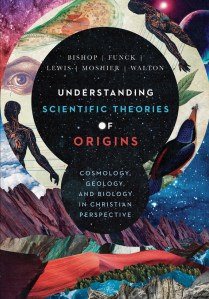 Understanding Scientific Theories of Origins: Cosmology, Geology, and Biology in Christian Perspective is a massive introduction to various sciences alongside Christian thought from the perspective of evolutionary creationists (also known as theistic evolution). It can fairly be said to be the most comprehensive book of which this reader is aware of for giving a broad look at the many related fields in the origins debate within Christianity.
The book is broken into 7 parts: Getting Started on the Journey, which offers 4 chapters on biblical interpretation, doctrine of creation, pursuing origins questions, and seeing science and theology together; Cosmic Origins, which has 6 chapters starting with a look at Genesis and then going through the details of Big Bang theory, Fine-Tuning, and biblical/theological perspectives; Origin and Geologic History of the Earth, which has 8 chapters on the origin and formation of the Earth and Solar system, the history of geology, discussions of the biblical Flood, how we know about geologic timescales, plate tectonics, finding history in rocks and fossils, and biblical/theological perspectives; Origin of Life on Earth, which has 5 chapters discussing spontaneous generation to abiogenesis, the chemistry of prebiotics, biological information, alternate scenarios, and biblical/theological perspectives; Origin of Species and Diversity of Life, which has 5 chapters on the history of the theory of evolution, the modern synthesis, evidence for evolution, developments in evolutionary theory, and biblical/theological perspectives; Human Origins, which has 4 chapters on the biblical story, physical anthropology, genomic evidence, and biblical/theological perspectives on the image of God; and a Concluding Postscript, which is 1 chapter tying things together. The book is about 630 pages of text, with a glossary, general index, and scripture index. Throughout the whole book, there are color illustrations and charts, and it is richly detailed.
To be sure, there are many books with a lot of this information that you can find elsewhere. The things that set this book apart are 1) its comprehensive scope, with experts from various fields contributing huge sections of data and reflections from a Christian standpoint; 2) its one-stop shop type of reference; 3) its extensive look at the scientific evidence for evolution alongside some counters to arguments against it; 4) its accessible format; 5) the wealth of its illustrations (in color!). Many books in the creation-evolution debate have tended to focus almost entirely on theological questions or scientific ones (though I acknowledge there are exceptions). Rarely is the evidence presented in such a balanced fashion, and with such detail when it comes to the scientific arguments. It’s a massive text that is a bit daunting to read cover-to-cover, but the tone is so accessible and the explanations so well-written that it remains interesting and readable throughout.
The book can be read either in individual chapters or front-to-back. Thus, it would be useful as a textbook in many classes, or as a study book, or as a reference tool for interested readers. This is the kind of book that people like this reader have been longing for: a truly broad introduction to the many, many topics that converge upon theories of origins that is presented from a perspective that remains thoroughly orthodox in its theology. Those who oppose evolution will find here not some conspiracy or lies, but rather evidence and data backed with a warm, winsome tone that encourages readers to explore these tough questions.
Some of the most contentious questions, of course, receive the most space. Human Origins, as noted above, has its own entire section with more than 50 pages dedicated to the topic. Some things that struck me in that section were, first, the theological introduction that shows some of the questions that come up even from a “simple” reading of the text. Second, the extensive look at the physical and genomic evidence for human evolution is presented in a straightforward way. From my own background, I tended to think that any such evidence was falsified or simply presented in a misleading way. It would be impossible to accuse the authors here of doing so, as they note (especially earlier in the discussion of evolution) some of the problems with classification. But these problems are not demonstrations of the theory being false; rather, they show that we will probably never have a complete picture. For example, one common charge I have seen is that because scientists cannot put together a sequence of fossils that show human evolution in a chain: A-B-C-D-E-F-G-H but rather that we have an idea that it may be A-D-G-J or something of the sort, this means there is no sequence. But that is demonstrably false. A ladder that is missing a step could still be identified as a ladder, just an incomplete one. Similarly, an incomplete fossil record does not demonstrate there is no such record or series. What’s particularly surprising, though, is how comprehensive the fossil record we do have is, particularly related to human origins. Though the exact sequence will likely be debate in perpetuity, the fact remains that there are many, many, many fossils of clear ancestors of humanity throughout the fossil record, and that a comparison of skulls, MRI measured brain sizes, etc. seems to demonstrate a sequence that does exist, even if incomplete. Of course, there is much more offered in regards to human evolution, such as population genetics, and the like, but the evidence is presented here and is fascinating.
Readers who are wondering about the scientific credibility of evolution will find this an excellent work to pick up. Those already convinced will have a superb introduction to the topic on hand that does not eschew faith for science or vice versa. The authors do a truly commendable job of showing that Christianity does not counter science, and neither does science show Christianity is false.
The chapters on geology are another excellent section, which teach the basics of geology alongside real-world examples that show the principles are sound. Coming from a young earth background, it was the geologic evidence that convinced me some years ago the Earth had to be much older. The authors present real, measurable evidence to show the earth is much more ancient than a few thousand years. But set alongside that is the valuable history of thought surrounding the age of the earth and how these discoveries were made, often by Christian geologists! To see how yes, science has changed as we’ve come to a fuller understanding helps readers understand that as well. The origins of life is another hotly contested area, and the authors do a good job of showing that it remains contentious while there is much work being done that suggests even biological information may have a natural origin. The many theories of origins will continue to be tested and improved, but we should be careful to attempt to plug God into the gap in understanding between what we don’t know yet and what may be discovered. Indeed, some of the scenarios presented for the origin of life continue to gain credibility as tests confirm aspects of their theorizing.
The authors have, with Understanding Scientific Theories of Origins: Cosmology, Geology, and Biology in Christian Perspective , written a book that is sure to be a reference point for years to come. Though science constantly updates and changes with new discoveries and insights, the book is destined to be fruitful for some time. It provides a serious, fairly comprehensive introduction to many of the most hotly contested issues within Christianity today. It comes highly recommended.
Disclaimer: I was provided with a copy of the book for review by the publisher. I was not required to give any specific kind of feedback whatsoever.
Links
Be sure to check out the page for this site on Facebook and Twitter for discussion of posts, links to other pages of interest, random talk about theology/philosophy/apologetics/movies and more!
Book Reviews– There are plenty more book reviews to read! Read like crazy! (Scroll down for more, and click at bottom for even more!)
SDG.
——
The preceding post is the property of J.W. Wartick (apart from quotations, which are the property of their respective owners, and works of art as credited; images are often freely available to the public and J.W. Wartick makes no claims of owning rights to the images unless he makes that explicit) and should not be reproduced in part or in whole without the expressed consent of the author. All content on this site is the property of J.W. Wartick and is made available for individual and personal usage. If you cite from these documents, whether for personal or professional purposes, please give appropriate citation with both the name of the author (J.W. Wartick) and a link to the original URL. If you’d like to repost a post, you may do so, provided you show less than half of the original post on your own site and link to the original post for the rest. You must also appropriately cite the post as noted above. This blog is protected by Creative Commons licensing. By viewing any part of this site, you are agreeing to this usage policy.
The Age of the Earth: How Interlinking Evidence from Tree Rings, Carbon-14, and Varves demonstrates an old earth

Image from Wikipedia. Credit: By Copyright © National Land Image Information (Color Aerial Photographs), Ministry of Land, Infrastructure, Transport and Tourism, Attribution, https://commons.wikimedia.org/w/index.php?curid=28702247
What kind of evidence do we have to support the notion that the Earth is truly ancient? It’s a question I often get asked, as someone who came from a young earth background. Young Earth Creationists often posit that the evidence for an “old earth,” if viewed from a different angle, could just as easily (or perhaps better) point to a young earth. However, there are some aspects of evidence for an old earth that seem to defy this argument, particularly because they interlink in such a way that independently points towards an old earth. Here, I take a look at an article by Gregg Davidson and Ken Wolgemuth in which they make this very argument. Below is the title and abstract.
Testing and Verifying Old Age Evidence: Lake Suigetsu Varves, Tree Rings, and Carbon-14
Gregg Davidson and Ken Wolgemuth
Abstract
Carbon-14 measurements from layered sediments collected in 2006 from Lake Suigetsu, Japan, together with tree-ring data, offer an unprecedented opportunity to demonstrate how competing old- and young-earth hypotheses can be quantifiably tested. Conventional observation of radioactive decay rates, atmospheric carbon-14 production, tree-ring growth, cross-dating, and varve formation yields a narrow range of expected values for the carbon-14 content of samples over the last 50,000 years. Young-earth challenges to each observation should result in specific and predictable departures from conventional expectations. This article documents a sequence of tests to demonstrate beyond reasonable doubt that carbon-14 decay rates have remained unchanged, estimates of past atmospheric production rates are accurate, cross-dating of tree rings is reliable, the sampled trees have grown one ring per year going back more than 14,000 years, and finely layered sediments from Lake Suigetsu were deposited annually going back more than 50,000 years.
Gregg Davidson and Ken Wolgemuth, in this paper, analyze three independent lines of evidence that interlink to confirm each other. Specifically, by looking at tree rings, varve formation, and carbon-14 dating, they yield a range of possible dates that matches across these independent variables. This gives a strong confirmation of the age of the earth, along with demonstrating that the decay rate of carbon-14 does not seem to have changed and remain accurate for more than 50,000 years.
The importance of this paper, and arguments like it, is that these are independent lines of evidence that all interlink to show the same conclusion. This needs to be emphasized, because young earth creationists will often call into question these pieces of evidence individually, shooting them down with objections that they then conclude shows they are individually faulty. Rarely, if ever, do young earth creationists acknowledge or deal with the fact that these evidences, while being independent, yield results that all add up to the same ages. Again, the importance of this cannot be understated, because it would mean that, for whatever reason, the young earth creationist must then assert that their independent objections to each individual dating method also can somehow explain why those dating methods to which they are objecting yield the same results.
Tree Rings
Trees record the years they’ve been growing through rings that show how quickly their cells grew during different seasons. A record of years can be traced by comparing tree rings to show wet/dry seasons that form something similar to a bar code type pattern allowing for identifications across years. The oldest living trees have 5000 years recorded, and fossilized trees can be compared to living trees to extend that record back further, with the oldest reliable comparison yielding 14,000 years. Young earth objections to tree rings typically center around the notion that multiple rings form in single years.
Carbon-14 Dating
Wolgemuth and Davidson write that, in regards to Carbon-14 dating:
The primary requirements for determining age are (1) a constant radioactive decay rate, (2) knowledge of the original carbon-14 content, and (3) quantification of any old carbon that may have been incorporated into the specimen.
Standard young earth objections are leveled at each of these three requirements. However, it is rarely (if ever–though I’m sure someone does, somewhere) disputed that certain dates are yielded when Carbon-14 testing is done. Thus, it is the young earth objections to the three requirements where they rest their case. These objections are often that we cannot know whether the radioactive decay rate changed in the past; (less typically) that the original carbon-14 content is in question; and that the samples are somehow contaminated. Now, Wolgemuth and Davidson do clearly state that scientists must account for some known factors that can vary how quickly Carbon-14 is formed. But these can be accounted for and allow scientists to get fairly accurate data on dating samples.

Image source: http://www.suigetsu.org/varves.html Used under fair use. Accessed January 2019
Varves
Probably the least familiar of these dating methods to anyone with a passing interest in the age of the earth is varves. These are sets of alternating layers formed by sediment on the floor of bodies of water due to a number of factors. With Lake Suigetsu in mind, the method of dating involved is a measurement of algae blooms via examination of the varves. At this lake, cores have yielded dependable rates that allow dates traced back to around 150,000 years.
Independent Methods, Same Results
Where this gets interesting, and where young earth creationists ought to take note, is that while it is somewhat easy to discount individual pieces of evidence based on independent objections, it is much more difficult to do so when these allegedly faulty dating systems yield the same dates.
Carbon-14 dating methods allow scientists to make predictions for how much Carbon-14 ought to be present in a sample before testing the sample. Thus, scientists can use these predictions to chart what the expected Carbon-14 content of tree rings or varves will be. The article has just such a chart, yielding a very narrow range of expectations regarding Carbon-14 content with the age of the sample. They can then take tree rings, going with the conventional assumption that the rings indicate years, and sample them for Carbon-14 to see if they match the expectations of carbon dating. What is remarkable (visually, especially, again, see the article) is that these expected ranges correspond exactly to the samples taken of tree rings. This means that a tree ring yielding an age of 14,000 years due to the number of rings also yields an age of 14,000 years when sampled for Carbon-14. But these dating methods are completely independent. The Carbon-14 date doesn’t rely at all on the number of rings in a tree, nor is reverse true.
Wolgemuth and Davidson then show the expectations from a young earth model with explanations of tree rings. For example, the expectation of multiple rings per year is tested and falls well outside the predictions of the Carbon-14 dating. This is important, because it means that the conventional assumptions about testing dates align together independent dating systems while young earth predictions yield wildly dissimilar results. These results are presented in the paper.
Scientists go further, though, and can line these evidences up with varves of Lake Suigetsu. Here, there is some technical data about how scientists can determine when significant events happened in the lake, such as extreme algae blooms or additional brackish water, but the core of the point is that when these factors are accounted for, a predictive range for Carbon-14 can again be made and set alongside the age estimate based upon the varve samples. Once again, when aligned, there is remarkable correspondence between Carbon-14 expectations and the actual measurements set alongside the varve-counting method of dating. Additionally, note Wolgemuth and Davidson, there is a steady decline backwards in the amount of Carbon-14 present, showing not a wildly erratic decay rate but rather a steady and predictable rate as one goes deeper into the sediment of Lake Suigetsu. These predictions falsify a young earth account, in part, because the young earth model “expects… massive sediment deposits during the flood year…” in addition to other expectations of many flood models for a young earth.
Next, Wolgemuth and Davidson turn to combining all of these lines of evidence together, demonstrating that the period of overlap where we can measure tree rings, varves, and Carbon-14 yields a graph just as predicted by conventional expectations, and that varves and Carbon-14 can be plotted much farther (due to their availability and the lack of reliable tree ring data older than 14,000 years), showing a constant alignment of these independent forms of evidence.
The authors state the decisiveness of this data and its implications for models of the age of the earth quite well:
we have two options. Option 1 is that God gave us amazing tools to test and verify that carbon-14 decay rates have not changed and sediments in Lake Suigetsu have been accumulating for more than 50,000 years. Option 2 is that God precisely manipulated multiple independent phenomena—tree ring growth, atmospheric carbon-14 production, and sediment couplet formation—to mimic conventional expectations.
More Methods of Dating
Wolgemuth and Davidson don’t leave the evidence there, however, because more methods of dating can converge on Lake Suigetsu, allowing for additional independent dating. Argon-Argon dating from volcanic ash in the Lake yields a radiometric test that corresponds to Carbon-14 dating and tree ring data.
They note that most young earth creationists don’t object when Carbon-14 dating is used on things that corroborate biblical materials, such as the Dead Sea Scrolls. Yet when one puts the data point for the Dead Sea Scrolls alongside the tree ring carbon data, we find that there is, again, alignment between the Carbon-14 dating for the tree rings, the actual counting of the tree rings, and the age of the Dead Sea Scrolls. This would mean that some form of manipulation of dating systems would have to yield the correct date for the Dead Sea Scrolls but incorrect dates by counting tree rings and Carbon-14 despite the fact that these align perfectly with the data for the Dead Sea Scrolls. And with this latter data, again, Argon-Argon dating with radiometric dating can be incorporated to show yet another independent method of dating.
Conclusion
Young earth creationists have not dealt with the fact that it is not just independent methods of dating that yield similar dates but rather that these independent methods correspond with each other and back each other up. On a young earth reading of the evidence, there is no explanation for why the allegedly mistaken methods of counting tree rings, varves, measuring Carbon-14 dating, and Argon-Argon dating from volcanic ash should all correspond with the same dates. After all, each of these is taken to be independently mistaken for different reasons and at different rates. But if that’s true, then the observed data should be completely different from what it actually is. Additionally, the alleged accuracy for dating things in biblical archaeology is generally conceded by young earth creationists, and this dating for biblical artifacts also corresponds to other dating methods. Thus, the accurate date of the Dead Sea Scrolls corresponds with the allegedly inaccurate methods of tree ring counting, varve counting, and radiometric dating. What possible reason could there be for this to be the case? Going back to the words of Wolgemuth and Davidson, the most reasonable explanation is that God has given us the tools to study creation, and that these tools give us an accurate record of earth’s history.
Links
Be sure to check out the page for this site on Facebook and Twitter for discussion of posts, links to other pages of interest, random talk about theology/philosophy/apologetics/movies and more!
What options are there in the origins debate? – A Taxonomy of Christian Origins Positions– I clarify the breadth of options available for Christians who want to interact on various levels with models of origins. I think this post is extremely important because it gives readers a chance to see the various positions explained briefly.
What is the relationship between Christianity and science?- An Overview of 4 Views– How should the Christian faith interact with science? Do they interact at all? I survey 4 major views on these and other questions.
SDG.
——
The preceding post is the property of J.W. Wartick (apart from quotations, which are the property of their respective owners, and works of art as credited; images are often freely available to the public and J.W. Wartick makes no claims of owning rights to the images unless he makes that explicit) and should not be reproduced in part or in whole without the expressed consent of the author. All content on this site is the property of J.W. Wartick and is made available for individual and personal usage. If you cite from these documents, whether for personal or professional purposes, please give appropriate citation with both the name of the author (J.W. Wartick) and a link to the original URL. If you’d like to repost a post, you may do so, provided you show less than half of the original post on your own site and link to the original post for the rest. You must also appropriately cite the post as noted above. This blog is protected by Creative Commons licensing. By viewing any part of this site, you are agreeing to this usage policy.
Book Review: “Theistic Evolution: A Scientific, Philosophical, and Theological Critique” Summary of Response
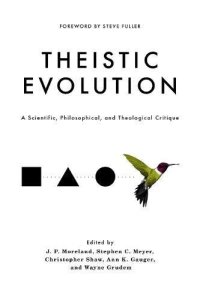 I’ve spent quite a bit of time reviewing, re-reading, and contemplating the massive book entitled Theistic Evolution: A Scientific, Philosophical, and Theological Critique edited by J.P. Moreland, Stephen C. Meyer, et al. I reviewed the book, interacting with the scientific and philosophical parts, and then looking in even more detail at some individual chapters in the theological section of the work. I wished to make a post that summarized some of my thoughts, as well as providing a one-stop shop for viewing my lengthier criticisms as well as those of others.
Review
Theistic Evolution is, without a doubt, the most comprehensive collection of arguments against the eponymous position that I know of in existence. But that is not to say there is going to be much new here for those who have read about science-faith issues. Indeed, though almost every chapter is first published here (except where otherwise noted in a few chapters), most of the arguments have been dealt with or have been ongoing for years, if not decades. Here, I can only offer the briefest interaction with the massive work (but see my longer interactions linked below).
The scientific section is largely outside my area of expertise, so I’ll limit myself to a few broad comments. Time and again, various authors move from saying that scientists cannot determine the exact order of a certain evolutionary chain to saying that there is therefore no such chain. This is deeply mistaken, though I admit I used to buy into this type of anti-evolutionary argument myself. At first it sounds compelling, until one considers that nowhere else do we allow this reasoning. For example, we would not say that no automobile accident happened just because we could not determine the exact order in which individual parts of the cars involved were crushed. Another difficulty with the scientific part of the book is that time and again, the assertions are made that theistic evolutionists do not allow there to be design as a possibility or God acting in nature; yet this is false at best and disingenuous at worst.
The philosophical critique falls largely flat. For one thing, a constant refrain is that theistic evolutionists are no different from atheists when it comes to methodological naturalism, yet this strangely ignores the “theistic” part of the term theistic evolution. Because proponents of said position are theists, they clearly allow for divine activity, and major proponents of the theory like those at Biologos constantly affirm this. Second, assertions that evolution would not allow for theism in the first place also fail both because Christians from the beginning of interaction with evolution have noted that God could simply have ordained the whole process and because those Christians who think in Aristotelian terms can still have final ends in mind with evolution, even on the level of individual species.
The theological critique musters perhaps the strongest arguments in the book, but even here there are a series of blunders that undercut much of the case. In the chapter on the Old Testament, for example, the author fails to defend or even define the meaning of the term “history” and its use to describe the early chapters of Genesis. In the chapter on the New Testament, the author strangely insists that Jude must mean Genesis is “historical” (again failing to define or even touch on what that term is supposed to mean here) while also dismissing claims that other parts of Jude would make other events historical. Then, the author turns around and says that because Jude cites the book of 1 Enoch, that means some parts of 1 Enoch are historical while others aren’t. Which are which? Well, clearly, whichever parts benefit the author are historical; those that don’t are not. Moreover, the same author does not at any point defend the notion of taking a genealogy in the way that we Westerners in the 21st century take it, despite the genealogies in the New Testament being written in an ancient time with a completely different culture. In the chapter on historical Christian theology, the word “creation” is wielded like a sword, leading to some possible confusion on categories related to Aquinas and others.
Definitions are clearly very important in the book, though vastly important terms like “history” or “historical narrative” are thrown about without ever interacting with them. This, despite the intense debate in the field of history about the changing meaning of the term and how history is written. The definition of Theistic Evolution–“God created matter and after that did not guide or intervene or act directly to cause any empirically detectable change in the natural behavior of matter until all living things had evolved by purely natural processes” (67)–given in the book fails to adequately account for the range of beliefs of theistic evolutionists and does not draw adequately from major TE groups. Nevertheless, the authors use that definition as though it can exclude or include people in the umbrella term. Not only that, but some authors rail against TEs for things the definition that the editors themselves endorse use make clear TEs don’t all believe. Prominent Christian philosopher J.P. Moreland is among those who attack TEs for denying a historical Adam and Eve, yet the definition that the editors provide does not actually exclude this belief in any way.
Overall, Theistic Evolution: A Scientific, Philosophical, and Theological Critique does not contribute much new to the intrafaith debate about evolution. For one thing, as noted above, it fails to adequately interact with the actual views of those who hold to theistic evolution, while also failing to acknowledge the breadth of thought such a position represents. Additionally, the arguments presented herein have largely been encountered in other works throughout the science-faith debate. Finally, many of the arguments presented herein are either circular or self-refuting. As noted briefly above (and in more detail in my extended analyses below), several authors simply assert that parts of the Bible are “historical” and then use that to batter theistic evolution, as if no serious exegesis has been done on the other side. Where exegesis is addressed, it is typically perfunctory and laced with dismissals of rival positions. I cannot recommend the book to those wishing to have a full and honest discussion of theistic evolution, though if it does truly represent the best of the best by way of critique of theistic evolution, I would say that those holding to that position may sleep soundly.
Disclaimer: I was provided with a copy of the book for review by the publisher. I was not required to give any specific kind of feedback whatsoever.
Extended Critique of Individual Sections and Chapters
My individual sections critiquing the book on numerous fronts can be found as follows:
Book Review: “Theistic Evolution: A Scientific, Philosophical, and Theological Critique” Part 1- Definition(s)– Definitions are a key issue throughout the book, and I take a look at a few here, including the definition the authors use for “theistic evolution” and the lack of interaction with major groups who are advocates of this position.
Book Review: “Theistic Evolution: A Scientific, Philosophical, and Theological Critique” Part 2: Science– A significant portion of the book was dedicated to scientific critique of theistic evolution, which is largely to say critique of the theory of evolution broadly speaking. Though I’m not an expert in science by any means, I interact with this portions I felt comfortable with, especially calling into question the movement from lack of 100% certainty to not having any possibility of evolution being true.
Book Review: “Theistic Evolution: A Scientific, Philosophical, and Theological Critique” Part 3: Philosophical Critique– Several philosophical issues are raised, from methodological naturalism to alleged contradiction of affirmations of Christianity that theistic evolutionists must hold. In contrast, I note that theistic evolutionists have a broader base to allow for ends in evolution, while also noting that the alleged contradictions are non-existent.
Book Review: “Theistic Evolution: A Scientific, Philosophical, and Theological Critique” Part 4: Theistic Evolution and the Old Testament– From the creation accounts to the historicity of Adam, arguments are made to the effect that the Old Testament cannot be compatible with theistic evolution. I note the circularity of several arguments the author makes, as well as questioning their use of the category “history.”
Book Review: “Theistic Evolution: A Scientific, Philosophical, and Theological Critique” Part 5: Theistic Evolution and the New Testament– Several parts of New Testament teaching, from the genealogies in the Gospels to the faith list in Hebrews are taken to show that theistic evolution is “incompatible” with the New Testament. I argue that this is mistaken, and indeed the author fails to demonstrate this incompatibility.
Book Review: “Theistic Evolution: A Scientific, Philosophical, and Theological Critique” Part 6: Theistic Evolution and Historical Christian Doctrine– Theistic evolution is often said to contradict the historic teaching of the church. Here, I analyze the extended arguments of one author who suggests this is the case, noting that at many points, modern categories are imported into the discussion of historical theology.
Other Reviews/Interactions (will update with more)
J.P. Moreland and the Book “Theistic Evolution” (Part 1: What do William Paley, Richard Dawkins, and J.P. Moreland all have in common?)– A two-part analysis of J.P. Moreland’s commentary on theistic evolution and its method. Part Two.
Links
Be sure to check out the page for this site on Facebook and Twitter for discussion of posts, links to other pages of interest, random talk about theology/philosophy/apologetics/movies and more!
Book Reviews– There are plenty more book reviews to read! Read like crazy! (Scroll down for more, and click at bottom for even more!)
SDG.
——
The preceding post is the property of J.W. Wartick (apart from quotations, which are the property of their respective owners, and works of art as credited; images are often freely available to the public and J.W. Wartick makes no claims of owning rights to the images unless he makes that explicit) and should not be reproduced in part or in whole without the expressed consent of the author. All content on this site is the property of J.W. Wartick and is made available for individual and personal usage. If you cite from these documents, whether for personal or professional purposes, please give appropriate citation with both the name of the author (J.W. Wartick) and a link to the original URL. If you’d like to repost a post, you may do so, provided you show less than half of the original post on your own site and link to the original post for the rest. You must also appropriately cite the post as noted above. This blog is protected by Creative Commons licensing. By viewing any part of this site, you are agreeing to this usage policy.
Book Review: “Theistic Evolution: A Scientific, Philosophical, and Theological Critique” Part 6: Theistic Evolution and Historical Christian Doctrine
Crossway has published a book entitled Theistic Evolution: A Scientific, Philosophical, and Theological Critique edited by J.P. Moreland, Stephen C. Meyer, et al. The book is mammoth- right around 1000 pages of text. As the title suggests, it purports to give a comprehensive refutation of the position of theistic evolution. Due to its huge size and scope, I’ve decided to break my review up into multiple posts. I do not claim to be an expert in every field this book touches upon–that would be impossible. Instead, I’ll offer comments on those areas I took notes and had interactions with in my own reading.
For this part, I will focus on the chapter on historical theology.
Historical Christian Doctrine
Gregg R. Allison’s chapter is entitled “Theistic Evolution is Incompatible with Historical Christian Doctrine.” As with the chapter on the New Testament and that on the Old Testament, this is a strong claim that requires the author not merely to demonstrate that TE has difficulty meshing with historical theology, but rather that the author show conclusively that such melding is impossible. After all, TE is supposed to not just be difficult to reconcile with historical Christian doctrine, but rather simply “incompatible” with it. As we will see, this claim is far too strong for Allison to carry.
The chapter begins with a rather strange assertion that, of anyone, church leaders cannot hold to TE because they are charged to root out false doctrine (927-928). Yet this is exactly what is at question, right? The question is whether TE is false doctrine; starting a chapter that purports to show this is the case by simply demanding church leaders drop TE because it is false doctrine is question begging from the start.
Remarkably, after a brief overview in which he claims to show that the early church held to ex nihilo creation, Allison then states that “Biblically, the silence of Scripture on how God created the heavens and the earth implied creation ex nihilo” (930). I was taken aback by reading this. Here, in the middle of a chapter with lofty enough goals to claim that TE is incompatible with historic Christian doctrine, we find that one of the key points in favor of a full on doctrine of creation ex nihilo os that Scripture is “silent” on it! Not only is this an argument from silence, but Allison words it as though no one could possibly disagree–the silence “implied” the doctrine he prefers. That’s quite convenient. Moreover, although plenty of TEs would and do affirm ex nihilo creation of the universe, Allison is of course trying to expand this to include, minimally, diversity of life. Yet he doesn’t actually show that, generally, historic thinkers would have agreed or even understood what was meant by such an application of ex nihilo creation. Indeed, that continues to be one of the biggest problems throughout this section and the two previous chapters–the authors simply assert that something is “historical” or make statements that entail ancient thinkers knew about things like the diversity of life (when manifestly they did not–hence the debates over whether fossils were actually vestiges of ancient creatures or not up through the 1600s and slightly beyond [1]).
I was equally surprised by the analysis of Aquinas’ thought regarding creation. I realize that Allison is an expert in church history and so perhaps was glossing here, but he seems to be conflating on the use of the term “creation” regarding Aquinas’ thought (and throughout the essay, in fact). That is, when Allison uses the word “creation,” he seems to take it to mean comprehensive ex nihilo creation of all things, without exception. However, he does not actually do the work to demonstrate that his meaning is the same as that of the historical figures he cites. More importantly, in some cases it seems to not be the meaning of the original author. For Aquinas, Allison cites a passage that he says shows Aquinas did not give the power to create to any creatures. But of course, the use Aquinas is intending seems to be moving from nonbeing to being, whereas TEs and evolution in general would be movement from being to being, or as Aquinas’ own categories would seem to imply, the creatures are actualizing potency rather than pure act or moving from nonbeing to being. After all, if Allison’s reading of Aquinas here is correct, it would seem to imply that procreation is impossible. But surely Aquinas knew that creatures procreate! Thus, his meaning cannot entail that creatures have no power to move from potential to actual; instead, it is Allison’s rather idiosyncratic use of the word “create” here that he uses to govern what Aquinas could mean. Of course, what Aquinas means according to Allison would, perhaps, exclude TE. But again, though I haven’t read a huge amount of Aquinas and only a dozen or so books about his thought, I am fairly confident that his use of “create” in the passage Allison uses is not what Allison makes it out to be. Potency is exactly that which creatures do have in Aquinas’ thought, so creation in his thought is, yes, ex nihilo but also, no, not meaning that creatures’ forms can never change. After all, if they did, he could simply define that as part of the potency within the creature. And that is exactly what several prominent Thomists have done.[2]
The same use of the word “create” continues through the rest of Allison’s chapter. Time and again he takes “create” to mean something like the ex nihilo formation of all things which now exist (including diversity of species). Yet many, many studies have demonstrated this is not accurate (or, minimally, called into question Allison’s reading). John Walton, for example, has argued quite extensively that creation was a way of expressing order in cosmos. It would be surprising if none of the early church writers held to the same ANE expressions as the Bible in regards to some of this language. But Allison does not engage with these kinds of studies. He simply uses the word create, declares it is unanimously and unilaterally used to mean what he says it does, and moves on.
Allison’s study of pre-Adamite theory is more interesting, but even there he does not acknowledge the questions people have asked about, for example, who Cain was afraid of in the early chapters of Genesis if the only humans on the planet were those of his family group. Allison then goes on to cite many confessions of faith that do state things like having Adam and Eve as the physical predecessors of all humans. From my own Lutheran tradition, he cites Hollaz (though not the Lutheran Confessions) and a confession of the modern Lutheran Church – Missouri Synod. I was raised LCMS but am now part of the Evangelical Lutheran Church in America, and our confession does not parallel the LCMS. If nothing else, this shows that church doctrine is intended to change and meet new challenges. Alister McGrath has written extensively on this, but I think he has conclusively shown that yes, doctrine forms in response to new ideas. Evolution is one of those new ideas and the debates we are having now demonstrate McGrath’s point. Whether the church as a whole ever settles on this issue is beside the point: it is clear that new explorations of doctrine and new arguments are being made about an issue that had not before been on the horizion of intra-Christian discussion. This ought not to be seen as a concession of Allison’s point–that TE is incompatible with historical Christian doctrine. Indeed, at best he has shown that a selection of confessions of faith are incompatible with the belief that Adam and Eve had contemporaries.
In the next section, Allison asserts that TE is incompatible with specific doctrinal standards of the church. Whence he draws these apparently universal standards is not provided; they are simply asserted. For example, the first point is that TE “does not go far enough” in its affirmations on creation. According to whom? Allison, of course. The second point, that TE holds God didn’t intervene in the creation of life or diversity thereof is “in clear conflict with the church’s historical position” is alarming in that, again, he seems to completely miss the Thomistic possibility of final causation or ends in being, and many TEs from across the Christian spectrum have already done the work showing that a robust view of providence is quite possible on TE.
Finally, Allison briefly surveys a very few of the modern theologians who affirm some form of TE. Rather than seeing this as a rather broad-spectrum demonstration that many, many, many Christians from almost every faith tradition disagree with his analysis of church history, he simply dismisses them by saying that the “overwhelming consensus of church history still argues against following their lead in embracing some form of theistic evolution” (951). This kind of doctrinal hubris is more than a little alarming, but it also goes against the entire point of his whole chapter. If TEs can cite people as broadly based as C.S. Lewis, B.B. Warfield [though there is an appendix claiming Warfield was not TE], Tim Keller, John Stott, John Walton, Deborah Haarsma, Etienne Gilson, N.T. Wright, etc., etc. as advocates for their position, is that not a kind of consensus in its own right? Or at least enough of a challenge to it? Allison says no, of course, but must we?
Once more, we see a chapter fail to demonstrate its thesis. Far from showing TE is incompatible with historical church teaching, the most Allison has done is show that some selected confessions (even having to go so far as picking the one stream of certain branches of Protestantism) would show that Adam and Eve must be the first humans. This is hardly the kind of broad spectrum consensus-based agreement against TE one would expect when the chapter purports to show incompatibility between positions. But that’s what readers have. Yet even in the analyses we do read, we find that it is Allison’s own use of the word “create” to unilaterally unite people as diverse as Aquinas and Francis Turretin in the same meaning without argument that dominates the conversation. Suffice to say, I, for one, remain unconvinced that Allison has shown TE really is incompatible with historical Christian doctrine. Is there work to do? Absolutely, but that doesn’t mean no work has been done or that it cannot be done.
[1] See the work of John Ray (1627-1705), for example, to see how the debate over the meaning of fossils. Some great readings can be found on this site (click individual links to read).
[2] One example would be Etienne Gilson, who did not consider himself as a Neo-Thomist, though he has been classified as Thomist in his thought. His work “From Aristotle to Darwin and Back Again” is an example of just how easily a Thomist model would be compatible with evolution.
Disclaimer: I was provided with a copy of the book for review by the publisher. I was not required to give any specific kind of feedback whatsoever.
Links
Be sure to check out the page for this site on Facebook and Twitter for discussion of posts, links to other pages of interest, random talk about theology/philosophy/apologetics/movies and more!
Book Reviews– There are plenty more book reviews to read! Read like crazy! (Scroll down for more, and click at bottom for even more!)
SDG.
——
The preceding post is the property of J.W. Wartick (apart from quotations, which are the property of their respective owners, and works of art as credited; images are often freely available to the public and J.W. Wartick makes no claims of owning rights to the images unless he makes that explicit) and should not be reproduced in part or in whole without the expressed consent of the author. All content on this site is the property of J.W. Wartick and is made available for individual and personal usage. If you cite from these documents, whether for personal or professional purposes, please give appropriate citation with both the name of the author (J.W. Wartick) and a link to the original URL. If you’d like to repost a post, you may do so, provided you show less than half of the original post on your own site and link to the original post for the rest. You must also appropriately cite the post as noted above. This blog is protected by Creative Commons licensing. By viewing any part of this site, you are agreeing to this usage policy.
Book Review: “Theistic Evolution: A Scientific, Philosophical, and Theological Critique” Part 5: Theistic Evolution and the New Testament
Crossway has published a book entitled Theistic Evolution: A Scientific, Philosophical, and Theological Critique edited by J.P. Moreland, Stephen C. Meyer, et al. The book is mammoth- right around 1000 pages of text. As the title suggests, it purports to give a comprehensive refutation of the position of theistic evolution. Due to its huge size and scope, I’ve decided to break my review up into multiple posts. I do not claim to be an expert in every field this book touches upon–that would be impossible. Instead, I’ll offer comments on those areas I took notes and had interactions with in my own reading.
For this part, I will focus on the chapter on the New Testament.
The New Testament and Theistic Evolution
Guy Prentiss Waters wrote the chapter entitled “Theistic Evolution is Incompatible with the Teachings of the New Testament.” As with John D. Currid’s chapter on the Old Testament, the implication is that the author will demonstrate not just that the New Testament works better with rival theories, but that theistic evolution (hereafter “TE”) and the New Testament cannot both be true. Whereas Currid focused on attempting to rebut the ways TEs read the Old Testament–launching a hermeneutic attack on TE, Waters instead tries to show specific passages from the New Testament contradict teachings of TE. We’ll focus on a selection of these passages.
Waters’ first move is to argue that the use of Adam in the New Testament demonstrates that TEs are mistaken in their beliefs about Adam and Eve.[1] The first line of evidence Waters uses is the genealogy in Luke 3. After blithely “setting aside the exegetical questions attending this passage, and the challenges of harmonizing this genealogy with that of Matthew…”–things that would clearly be highly relevant in one’s interpretation of this passage–Waters states that “Adam appears among dozens of figures whom the biblical writers regard as fully historical…” (882). Adam is “at the head of a linear genealogical sequence” and “Adam… is the first man” which we can tell because it simply says he is the “‘son of God,’ a reference to his special creation in Genesis 1-2.” (882-883). Waters insists that these mean that if TEs say Adam is not the first human, Jesus as “Redeemer of all human beings is void” (884).
Waters’ choosing to set aside the exegetical questions about this passage is quite strange, given that he then challenges TEs to account for it exegetically. Biblical genealogies, as argued, for example, by Robert McLachlan Wilson in his book “Genealogy and History in the Biblical World,” are grounded in ANE thought, which saw genealogies less as linear historical accounts tracing one ancestor to the next (as we think of them in the 21st century) than as legitimizing familial relationships, a view of genealogies which persists in some cultures to this day. If this is even remotely accurate given the biblical genealogies, then Waters using Adam as “head of a linear genealogical sequence” is hardly of consequence; after all, he has already read in his own modern sense of “genealogy” into the meaning of the text. Moreover, Waters’ interaction with John Walton on this point amounts to begging the question, as he simply asserts that because Adam is historical (in the sense Waters prefers, of course–as once again we have an author fail to give any definition of or reflection upon the meaning of “history” in the biblical or modern context), Walton is mistaken for making Adam a theological point (884).
Turning to 1 Timothy 2:11-14, Waters claims that Paul must be using Adam and Eve as historical persons rather than mere illustrations. But in the very same section, Waters goes on to make the complementarian argument that the “creation of Adam prior to Eve” is somehow the basis for the complementarian reading of the passage. Setting aside how poorly complementarians read this and many other passages of Scripture, it is surprising to then see Waters turn around and criticize Walton and other TEs for claiming Paul is using this passage illustratively. After all, that is exactly what Waters does: he uses the passage as an illustration for why the complementarian perspective is correct. Sure, he could object by saying he takes the original, Old Testament passage “historically” (again, without defining what that term means), but that doesn’t show that his reading isn’t doing exactly what he objects to others doing.
Remarkably, Waters then turns to the book of Jude–the same book which clearly uses a contemporary story about Satan trying to take Moses’ body–to say that Adam must be historical. Because Jude 14 states that Enoch was the seventh from Adam, Waters takes this to affirm that Jude explicitly views Adam historically. Then, because the book has passages that quote the pseudepigraphical book 1 Enoch, Waters must also make the argument that Jude does not take 1 Enoch historically. That is, according to Waters, Jude explicitly means to affirm the historicity of Adam but not the historicity of 1 Enoch despite the fact that the same author uses both in the same context! So readers are expected to agree that Jude moves from historical narrative to using a non-historical book that has perhaps some historically accurate parts. It gets even more confusing, because Waters goes on to hypothesize that perhaps the statement about Adam being seventh from Enoch was historically accurate and spoken by Enoch, but that the rest of the book (or parts of it) were invented. What is the criterion for seperating fact from historical fiction here? Quite simply, it seems to be that whatever Waters wants to affirm as historical is that which is historical, and what he feels uncomfortable about affirming as historical is not historical.
Waters asserts that Jesus would see the entire book of Genesis as historical because he mentions a range of prophets in the Hebrew Scriptures. His only support for saying Jesus was 100% intending all of this historically is to say “We have no reason to doubt, then, that Jesus regarded the entirety of the events of Genesis to be fully historical” (895). This, despite the fact that this is exactly what is at question. Time and again (see 896 for an example related to Noah), Waters seems to think that having select references to events in the Old Testament entails that every aspect of it–or at least Genesis–is “fully historical” in whatever sense he desires it to be.
The faith list in Hebrews is taken to mean that every single figure on it is historical. Why? “Nonhistorical figures could not persuasively model persevering faith for historical people” (898-899). While I tend to agree that the faith list in Hebrews is full of people who did exist, Waters’ point is mistaken. What about the example, say, of Samwise Gamgee in The Lord of the Rings? Today, he is seen by many as a great example of persevering faith and friendship. This, despite the fact that the people who see him as such (myself included) clearly know that he is nonhistorical and explicitly fictional. Examples like this could easily be multiplied ad infinitum. As such, Waters’ point that people must be historical to be seen as models for persevering faith for “historical people” is wrong, and deeply so. Because this is his central point regarding the Hebrews faith list, we see once again that TEs has no difficulty here, regardless of the position they hold.
Waters then briefly surveys a few TE readings of Paul. This survey is grounded upon his analysis that preceded it, so the comments already written apply.
Waters’ method was quite different from Currid’s. Nevertheless, his analysis, like Currid’s, fails to demonstrate the thesis of his chapter. Do TEs have a lot of exegetical work to do regarding the New Testament? Absolutely, and they have done much. But Waters’ analysis fails on a number of points: he selectively assigns historical reality where he sees fit–even in the same chapter and verse of Scripture; he sets aside exegesis or historical context when necessary to carry his view; and he makes other specific arguments that fall apart on examination.
Disclaimer: I was provided with a copy of the book for review by the publisher. I was not required to give any specific kind of feedback whatsoever.
[1] It’s worth pointing out that not only do many TEs affirm an historical Adam and Eve, but that the book’s own definition of TE does not entail that TEs cannot affirm an historical Adam and Eve. See the post on definitions.
Links
Be sure to check out the page for this site on Facebook and Twitter for discussion of posts, links to other pages of interest, random talk about theology/philosophy/apologetics/movies and more!
Book Reviews– There are plenty more book reviews to read! Read like crazy! (Scroll down for more, and click at bottom for even more!)
SDG.
——
The preceding post is the property of J.W. Wartick (apart from quotations, which are the property of their respective owners, and works of art as credited; images are often freely available to the public and J.W. Wartick makes no claims of owning rights to the images unless he makes that explicit) and should not be reproduced in part or in whole without the expressed consent of the author. All content on this site is the property of J.W. Wartick and is made available for individual and personal usage. If you cite from these documents, whether for personal or professional purposes, please give appropriate citation with both the name of the author (J.W. Wartick) and a link to the original URL. If you’d like to repost a post, you may do so, provided you show less than half of the original post on your own site and link to the original post for the rest. You must also appropriately cite the post as noted above. This blog is protected by Creative Commons licensing. By viewing any part of this site, you are agreeing to this usage policy.
Book Review: “Theistic Evolution: A Scientific, Philosophical, and Theological Critique” Part 4: Theistic Evolution and the Old Testament
Crossway has published a book entitled Theistic Evolution: A Scientific, Philosophical, and Theological Critique edited by J.P. Moreland, Stephen C. Meyer, et al. The book is mammoth- right around 1000 pages of text. As the title suggests, it purports to give a comprehensive refutation of the position of theistic evolution. Due to its huge size and scope, I’ve decided to break my review up into multiple posts. I do not claim to be an expert in every field this book touches upon–that would be impossible. Instead, I’ll offer comments on those areas I took notes and had interactions with in my own reading.
For this part, I will focus on the chapter on the Old Testament.
The Old Testament and Theistic Evolution
John D. Currid’s chapter is entitled “Theistic Evolution is Incompatible with the Teachings of the Old Testament.” Such a title shows that Currid’s purpose is not just to say that other science-faith positions are easier to align with the Bible, but rather that TE is explicitly excluded because it is directly incompatible with the Old Testament. There is no way Currid could fairly be expected to refute every possible way TE could be constructed, but it is clear that his task is to show that the major ways that TEs read the Old Testament on creation are not just mistaken but actually in some way are incompatible with the texts themselves. To his credit, that is what he attempts to do in this chapter.
After a brief story about an early controversy over TE and some comments on scholars who continue to embrace TE, Currid dives into his examination of some of the main TE ways to read the Old Testament. First, he examines the work of John Walton. I have read and reviewed much of Walton’s work, including several posts here (scroll down to browse). Walton is an expert on the Ancient Near East and much of his work is tied up into his thesis that we must take this ANE context into account as we read the biblical text. Currid’s strategy for approaching Walton’s interpretation is to claim that the ANE documents are not solely interested in functions but rather do teach about the material origins of the cosmos (844). To back up this claim, Currid surveys a number of texts from the ANE and says that they are clearly focusing on the physical origins of the universe. He also argues that Genesis 1-3 seems to be clearly focused on physical origin as well (850ff).
Currid’s analysis here is mistaken, however. For one thing, he himself admits that in Genesis 1:2 and thereafter “the universe and, in particular, the earth is pictured in the process of creation” (850). Because Currid states plainly that this Genesis account is about “putting things in their right places,” this seems to contradict his claim that the focus of Genesis 1-3 is primarily about physical origins or that it ought to at least in part be taken as such. His own analysis of the text effectively grants Walton’s point, that physical creation is here being ordered by function. Indeed, it is telling that Currid does not look more deeply at Walton’s own points regarding individual days of creation. As Walton argues, if we take these as physical creation events we find that they contradict our own observations of the material world. For example, there is no solid expanse in the sky, as the text speaks of on the second day of creation. Yet Currid’s own look at the days in context of Walton’s view (851) is merely to list individual things he believes were physically created on each day, completely missing Walton’s own explicitly stated point about why those verses cannot be about physical creation. It seems that here Currid has failed to demonstrate that TE is directly incompatible with the Old Testament.
Next, Currid turns his analysis to those who view Genesis 1-3 as myth “in the sense of a legendary story without determinable basis in fact or history” (851ff). This view sees the creation account(s) not as scientific but rather as a shared basis for telling stories about the purpose of creation–a mythic meaning for those stories. Currid begins his critique of this position by asking “Why does Genesis 1-3 contain so many elements that appear to be literal history if in fact it was borrowed from an ancient Near Eastern myth?” (852). But of course that is exactly what is at question on this view! That is, he can’t simply assert that Genesis 1-3 is literal history and then claim that because it “appear[s] to be literal history” it can’t be mythic. That’s just begging the question. To his credit he goes on to claim that the author of Genesis was practicing demythologization to turn the ANE mythic tale into “monotheistic, non-mythic orthodoxy” (853). To support this, he notes places where he believes there is anti-mythic polemic in the creation account(s). While I think it true that there is certainly some polemic here, one thing that Currid failed to consider is whether the polemic is anti-mythic in the sense he means–that is, is it against legendary stories that don’t have a determinable basis in fact or history–or is the polemic rather against polytheistic paganism of the groups surrounding Israel? That is, could the story not be both mythic and polemical? I think it certainly could be, and the bare possibility of this being its purpose undermines the claim that the Old Testament is incompatible with this specific view of Theistic Evolution.
The third position Currid considers is that the account is theological or figurative rather than a literal creation account. This reading is of course tied up in the previous two, to the point that it shows how diverse TE and indeed non-TE readings of Genesis 1-3 are. Nevertheless, Currid presses on and argues that “Genesis 1-3 bears all the markings of Hebrew historical narrative” (860). Yet Currid does not, at any point, demonstrate whatever he defines as “Hebrew historical narrative” is some kind of literal, objective history. As someone who has studied historiography, I find myself quite skeptical of this position and wonder what Currid’s view of “history” is. Nevertheless, if Currid is right, this still doesn’t demonstrate a complete incompatibility between TE and Genesis 1-3. After all, one could perhaps read it historically but take its objective meaning as different from whatever Currid believes.
The chapter ends on some analysis of etiological readings of Genesis 1-3. These are readings that see the Old Testament as written in response to various events or observations about the world around the authors. As I admittedly have little experience of or reading in etiology regarding the accounts here, I’ll leave Currid’s analysis as it stands.
Overall, it should be clear that Currid fails to establish his central thesis: that TE is incompatible with the Old Testament. Indeed, both Walton’s theory and the mythic theory come out largely unscathed from his rebuttal. Walton’s thesis is effectively granted by Currid’s own analysis. Regarding the mythic thesis, Currid simply offers an alternative explanation rather than a thorough rebuttal. Thus far, at least, TE seems theologically sound.
Disclaimer: I was provided with a copy of the book for review by the publisher. I was not required to give any specific kind of feedback whatsoever.
Links
Be sure to check out the page for this site on Facebook and Twitter for discussion of posts, links to other pages of interest, random talk about theology/philosophy/apologetics/movies and more!
Book Reviews– There are plenty more book reviews to read! Read like crazy! (Scroll down for more, and click at bottom for even more!)
SDG.
——
The preceding post is the property of J.W. Wartick (apart from quotations, which are the property of their respective owners, and works of art as credited; images are often freely available to the public and J.W. Wartick makes no claims of owning rights to the images unless he makes that explicit) and should not be reproduced in part or in whole without the expressed consent of the author. All content on this site is the property of J.W. Wartick and is made available for individual and personal usage. If you cite from these documents, whether for personal or professional purposes, please give appropriate citation with both the name of the author (J.W. Wartick) and a link to the original URL. If you’d like to repost a post, you may do so, provided you show less than half of the original post on your own site and link to the original post for the rest. You must also appropriately cite the post as noted above. This blog is protected by Creative Commons licensing. By viewing any part of this site, you are agreeing to this usage policy.
Book Review: “Theistic Evolution: A Scientific, Philosophical, and Theological Critique” Part 3: Philosophical Critique
Crossway has published a book entitled Theistic Evolution: A Scientific, Philosophical, and Theological Critique edited by J.P. Moreland, Stephen C. Meyer, et al. The book is mammoth- right around 1000 pages of text. As the title suggests, it purports to give a comprehensive refutation of the position of theistic evolution. Due to its huge size and scope, I’ve decided to break my review up into multiple posts. I do not claim to be an expert in every field this book touches upon–that would be impossible. Instead, I’ll offer comments on those areas I took notes and had interactions with in my own reading.
For this part, I will focus on the philosophical critique offered in the book.
Philosophical
As I read through the chapters on the philosophical critique of Theistic Evolution, I found that although each chapter was thoughtful and interesting, there was little by way of actual refutation of TE in the chapters.
Stephen C. Meyer and Paul A. Nelson, in a chapter entitled “Should Theistic Evolution Depend on Methodological Naturalism?,” state that TEs “accept a philosophical rule known as methodological naturalism… [which] asserts that, to qualify as scientific, a theory must explain by strictly physical or material–that is, non-intelligent or non-purposive–causes” (561) and then argue that “…no sound justification exists for holding methodological naturalism… Christians should not use [methodological naturalism] as a reason for adopting theistic evolution, or excluding other theories” (561-562). The chapter is extremely long and filled with a number of analogies and parallels, but the thrust of it is of course centered around these theses at the beginning. But suppose that Christians don’t use methodological naturalism as a reason for adopting theistic evolution or excluding other theories? Indeed, that is the case for myself. I am still not entirely convinced of methodological naturalism as the only way to do science; but I am leaning that direction. However, the reason I began to lean towards TE was because I found time and again that evolutionary theory seemed the best explanation for the observations we have. So I suppose it is possible that methodological naturalism is a poor reason for adopting TE; but that doesn’t mean TE is false, nor does it mean methodological naturalism is false. Indeed, in my reading, this methodological naturalism is an operating assumption. Indeed, I doubt that many TEs would say it is impossible for some natural feature of life to be designed; rather, the argument would be that we have yet to see evidence thereof, and time and again natural explanations are better. This latter point allows scientists to feel justified in looking for natural causes for the features of life rather than going through something like Dembski’s explanatory filter and positing design when current research comes to a dead end.
The very next chapter of the book, by Stephen Dilley, simply argues that “Theistic evolutionists should reject methodological naturalism” (593). Again; suppose this is true. If true, does it show theistic evolution is false? No. Maximally, it just means that methodological naturalism is not the best way to go about things as a TE.
J.P. Moreland’s chapter’s lofty title caught my attention: “How Theistic Evolution Kicks Christianity Out of the Plausibility Structure and Robs Christians of Confidence that the Bible is a Source of Knowledge.” Certainly, Moreland’s chapter appears to be a broadside against TE. In his “summary” of the chapter, Moreland puts his argument thus: “…given the widespread scientism–the view that the hard sciences are the only or the vastly superior way to know things…–in our culture, theistic evolutionists reinforce this view by constantly revising biblical teachings and interpretations because science says so. Thus, by adopting this unbiblical epistemological outlook, theistic evolutionists weaken the rational authority of biblical teaching among Christians and non-Christians” (633). Moreland’s concern, then, is not that TE actually inherently destroys Christianity, but rather that because TEs allegedly continually change what they think the Bible says [which part? where? why?], it undermines confidence in the Bible.
Moreland argues, for example, that TEs have changed their position on the soul because of science, turning towards physicalism as opposed to dualism regarding the mind-body problem due to advances in neuroscience. Alongside blithely noting that “Jesus believed in a soul” (655) (what did Jesus mean by “soul”? Does physicalism truly deny the possibility of a soul or does it say that the soul is emergent or part of the physical self? Are our ideas about the “soul” so advanced or perfect that we can easily claim Jesus is certainly in agreement with us?), Moreland’s broader claim is that TEs willingness to change what the Bible says about the soul (which, as I’ve read on this issue, is not very much and rather vague–this, coming from someone who would consider himself a Thomist regarding the mind-body problem) demonstrates that TEs are willing to undercut dualism in behalf of science.
Though Moreland does briefly acknowledges that theology may change, he quickly goes on to state that “we should be very careful and reluctant to revise what the church has held for centuries…” (657). He goes on, “…it seems hardly a coincidence that just when the naturalistically informed culture puts pressure on us to believe a certain thing, even though the history of biblical interpretation supports the exact opposite, we conveniently discover that we have misunderstood the Scriptures all along!” (658). Indeed, that would be convenient if that were what is happening, but before there was cultural pressure from the “naturalistically informed culture,” Christians like George Frederick Wright were noting that God’s special divine interaction with the world is not appealed to for the movement of planets and need not be for things like the diversification of life. Wright wrote at a time when evolution was still a theory very much debated, so he can hardly be accused of caving to cultural pressure. The TEs we see today are in that same line of tradition that stretches back more than 100 years, seeking to understand the teachings of Scripture and what God has revealed to us by nature. Moreover, as Alister McGrath notes, “Christian theology undergoes periodic revision, often in response to particular situations within the culture at large, even if it could be argued that it nevertheless keeps certain core ideas at the centre of its vision” (Alister McGrath, The Science of God, 27-28). Whether it was the development of Nicene orthodoxy, the condemnation of the Donatists, or the rejection of the prosperity gospel, Christianity has often changed or clarified issues in response to cultural pressures. That’s because we don’t have the full picture. Now we see through a glass darkly (1 Corinthians 13:12), so we must constantly seek for truth and revise our ideas as we run into more evidence, no matter where it comes from.
Moreland also turns his sights against non-overlapping magisteria (NOMA) and claims that TEs largely hold to this view and that it undercuts Christian doctrines and ethics. How? Because if we say that science can only test some claims, apparently that means that we would automatically assume that other doctrines or ethical positions are merely subjective. This unfortunate non-sequitor is the kind of argumentation I’d expect to be beneath Moreland, a scholar I respect. In no way does NOMA entail that there can be no objectivity outside of science, unless one then pairs it entirely with scientism. But very few TEs would embrace full-on scientism, because, after all, they remain theists and so affirm that God exists and is the ground of reality. Thus, this fanciful tale in which scores of TEs are out there undermining Christian doctrines and ethics and calling them subjective seems fear-mongering. Indeed, some TEs are among the most steadfast and brilliant theologians of our time and certainly do affirm objectivity in theology and ethics (for example, John Walton and Alister E. McGrath).
C. John Collins’ chapter on God’s action in the world largely seeks to say that we should allow for miracles in the workings of the natural world, something that I doubt many TEs would deny. The difference is that many TEs (though certainly not all) would see things like the emergence of life or the way nature is set up to allow for evolution and lead to humans as miraculous, while leaving the individual workings to “natural” processes. Again, very few people today would demand Christians affirm that the movement of the planets is an act of special divine intervention, even though historically many Christians did affirm that and the Bible explicitly states that the “heavens declare the glory of God, the skies proclaim the work of his hands” (Psalm 19:1). Yet we don’t have books arguing against Christians who don’t believe that the movement of the stars or weather patterns are the direct acts of God? Why not? Because we have accepted that God may use natural processes, and that this, too, is glorious.
Other chapters argue about the origin of conscience, the problem of natural evil on evolution, and the interaction of science and scripture. These are interesting, but again seem to do little to undercut the position of TE.
Disclaimer: I was provided with a copy of the book for review by the publisher. I was not required to give any specific kind of feedback whatsoever.
Links
Be sure to check out the page for this site on Facebook and Twitter for discussion of posts, links to other pages of interest, random talk about theology/philosophy/apologetics/movies and more!
Book Reviews– There are plenty more book reviews to read! Read like crazy! (Scroll down for more, and click at bottom for even more!)
SDG.
——
The preceding post is the property of J.W. Wartick (apart from quotations, which are the property of their respective owners, and works of art as credited; images are often freely available to the public and J.W. Wartick makes no claims of owning rights to the images unless he makes that explicit) and should not be reproduced in part or in whole without the expressed consent of the author. All content on this site is the property of J.W. Wartick and is made available for individual and personal usage. If you cite from these documents, whether for personal or professional purposes, please give appropriate citation with both the name of the author (J.W. Wartick) and a link to the original URL. If you’d like to repost a post, you may do so, provided you show less than half of the original post on your own site and link to the original post for the rest. You must also appropriately cite the post as noted above. This blog is protected by Creative Commons licensing. By viewing any part of this site, you are agreeing to this usage policy.
Book Review: “Theistic Evolution: A Scientific, Philosophical, and Theological Critique” Part 1- Definition(s)
Crossway has published a book entitled Theistic Evolution: A Scientific, Philosophical, and Theological Critique edited by J.P. Moreland, Stephen C. Meyer, et al. The book is mammoth- right around 1000 pages of text. As the title suggests, it purports to give a comprehensive refutation of the position of theistic evolution. Due to its huge size and scope, I’ve decided to break my review up into multiple posts. I do not claim to be an expert in every field this book touches upon–that would be impossible. Instead, I’ll offer comments on those areas I took notes and had interactions with in my own reading.
In this first part of the review, I want to focus on the book’s definition of theistic evolution.
Definition(s)
A book of this scope must have a working definition of that with which it interacts. “Theistic evolution,” or as many proponents of this idea now label it, “evolutionary creation” is quite a broad field with people of many different perspectives. For the sake of interacting with this book, I will stick to its nomenclature of “theistic evolution” while sometimes simply shortening it to TE. Appropriately enough, after the front matter, the introduction by longtime proponent of Intelligent Design Stephen C. Meyer has, as its topic, the definition of theistic evolution. After highlighting various definitions of “evolution” itself, such as “change over time,” “common descent,” “creative power of natural selection/random variation,” and more specific details on each level. Then, Meyer notes that there are different concepts of theistic evolution itself even among proponents. However, it is not really until the next section, in Wayne Grudem’s overview chapter, that we discover the editors’ agreed upon definition of theistic evolution:
God created matter and after that did not guide or intervene or act directly to cause any empirically detectable change in the natural behavior of matter until all living things had evolved by purely natural processes. (67)
For whatever reason, this agreed-upon definition of theistic evolution doesn’t actually appear in the introduction that is supposed to define theistic evolution, but that’s just a minor problem of strange oversight. Grudem then cites Francis Collins and Karl Giberson in support of this definition. I don’t have access to the work cited, but the quote is not a definition from the two authors but rather a statement that just says their model doesn’t require “intrusions from the outside” for the creative process.
The definition the editors agreed upon for this work, then, has two primary parts: an affirmation and a denial. The affirmation is simple: God created matter.” The question of what is meant by “matter” or what distinctions may be made between life and non-life are ignored in this book, though I imagine that they are of great importance to fully understanding the distinctiveness of various positions of theistic evolution.[1] The second part of the definition is the denial, and it has several components. It essentially boils down to saying that God did not specially intervene in any aspect of the development of life on earth. It is interesting that the majority of this definition is negative–that is, it is almost entirely a definition by denial.
Due to the broad diversity among theistic evolutionists, there will be plenty of disagreement with this definition. It is clear the editors needed a working definition, but it is not clear why they chose to use this rather than draw more explicitly from major TE definitions used by primary thinkers. Indeed, Biologos, the largest theistic evolutionist organization, provides its own, in depth look at the beliefs that are typical of their position. Among these are:
We believe that God created the universe, the earth, and all life over billions of years. God continues to sustain the existence and functioning of the natural world, and the cosmos continues to declare the glory of God. Therefore, we reject ideologies such as Deism that claim the universe is self-sustaining, that God is no longer active in the natural world, or that God is not active in human history.
We believe that the diversity and interrelation of all life on earth are best explained by the God-ordained process of evolution with common descent. Thus, evolution is not in opposition to God, but a means by which God providentially achieves his purposes. Therefore, we reject ideologies that claim that evolution is a purposeless process or that evolution replaces God[2]
Looking at these affirmations, it becomes clear that the definition offered in in this book will be controversial. After all, more than one author uses the editors’ definition to say that theistic evolutionists deny that God created life on Earth, while the faith statement of Biologos explicitly affirms the very same thing. Of course, the question is one of means, and this is exactly what is at question throughout much of this book and the debate between theistic evolutionists and Christians of other persuasions. But it is important not to simply define out of existence affirmations another group makes. This will be a problem throughout Theistic Evolution.
Going forward in the book, there are many times where individual authors rely directly upon the editors’ definition of TE in order to make a point. As such, the definition looms large in the work as a whole–perhaps too large. When so many points rely on a definition of a word that may be contentious in itself, those points seem to lose some weight. Perhaps the most egregious example of this is found in Wayne Grudem’s chapter in which he lists 12 doctrines that, allegedly, all TEs must deny (785). Some of the points he listed as TEs denying are, in my reading, not generally denied by TEs. Certainly, some of them are accurate, but they rely so heavily on paring down the broadness of TE thought that it makes it seem to be nearly a straw man.
Conclusion
I’ll draw my comments on this section to a close here, but will be continuing my review of the book in the following weeks.
Notes
[1] See, for example, the brief affirmation about creation made on the Biologos website: “in light of the Christian narrative — in which a rational God intentionally created a universe congenial to life — the fine tuning of the universe makes sense.” Thus, according to this theistic evolutionist organization, the creation of matter included a “fine tuning” of the universe at large, making it “congenial to life,” among other things. Source: https://biologos.org/common-questions/gods-relationship-to-creation/biologos-and-christianity
[2] See the full statement in “What We Believe.”
Disclaimer: I was provided with a copy of the book for review by the publisher. I was not required to give any specific kind of feedback whatsoever.
Links
Be sure to check out the page for this site on Facebook and Twitter for discussion of posts, links to other pages of interest, random talk about theology/philosophy/apologetics/movies and more!
Book Reviews– There are plenty more book reviews to read! Read like crazy! (Scroll down for more, and click at bottom for even more!)
SDG.
——
The preceding post is the property of J.W. Wartick (apart from quotations, which are the property of their respective owners, and works of art as credited; images are often freely available to the public and J.W. Wartick makes no claims of owning rights to the images unless he makes that explicit) and should not be reproduced in part or in whole without the expressed consent of the author. All content on this site is the property of J.W. Wartick and is made available for individual and personal usage. If you cite from these documents, whether for personal or professional purposes, please give appropriate citation with both the name of the author (J.W. Wartick) and a link to the original URL. If you’d like to repost a post, you may do so, provided you show less than half of the original post on your own site and link to the original post for the rest. You must also appropriately cite the post as noted above. This blog is protected by Creative Commons licensing. By viewing any part of this site, you are agreeing to this usage policy.
Theistic Evolution: The Charge of Deism- An answer from George Frederick Wright
A portrait of George Frederick Wright, attribution: Wikimedia Commons
George Frederick Wright (1838-1921) was one of the earliest Christian thinkers to hold the position now known as “theistic evolution” or “evolutionary creation.” He was also an incredibly thought-provoking author, having written numerous books on the subject of science and faith. In his Studies in Science and Religion (1882), he addresses a wide variety of issues related to science and Christianity. One of these was the idea that Christians affirming evolution may as well be deists.
One immediate difficulty with this notion, of course, is that no deist would affirm that God became incarnate and brought about the salvation of all humanity. But the charge is still leveled to this day: those Christians who affirm evolution are deists. Wright’s own answer to this charge took a different direction. Instead of pointing out the fact that theistic evolutionists/evolutionary creationists (terms not yet coined in his day, to my knowledge) affirm any number of doctrinal beliefs that exclude deism, Wright argued that evolution itself, understood holistically, would allow for the affirmation of things like final ends in nature. Thus, because final ends would mean telos or purpose in nature, the charge of deism must be mistaken. Moreover, any number of things can be affirmed as having natural causes without entailing deism. Wright argued that speciation could be included among these things.
Regarding the latter point, Wright argued that:
The theologian stands in no more need of miracles for the production of species than he does for that of the planets and their movements. Direct providential interposition is not for the irrational creation, but for the rational. So we may divest ourselves of theological prepossessions of any kind in reference to the material machinery by which the diversity of animal and vegetable life has been produced. (In my Kindle version, location 1173)
Wright’s point bears some elaborating. His argument is that theologians do not need to appeal to special divine activity in regards to things like the motions of planetary bodies. These types of things, he refers to as “irrational creation.” Planets, asteroids, dirt, etc. are all “irrational” in that they have no rational self. Indeed, part of his argument is that it would not make much sense to posit divine activity for all of these movements, because they would merely show that God has chosen to do everything voluntaristically or on God’s own rather than using things like natural laws. Thus far, his argument is rather uncontroversial. Very few people continue to argue that the planets’ movement, the water cycle, and the like are all, without any mediation, direct acts of God. The controversy is found, instead, in Wright’s adding the “diversity of animal and vegetable life” in among the things which need not have appeal to divine action.
Thus, for Wright, speciation is itself one of the natural processes that goes on in our universe without God’s special intervention. Of course, this is by no means an uncontroversial claim, but it must, at least, make one think about consistency of the application of these notions. Wright is surely correct to say that the movement of the cosmos need not appeal to God’s direct intervention in order to explain it. If that’s the case, then could it not be the case that other things in nature may be of the same type? Wright argues yes.
Moreover, Wright confronts one of the primary reasons for the charge of Deism. He argues evolution does not take away the possibility of final ends in nature:
The real final cause of any contrivance in nature is the sum of all the uses to which it is ever to be put. Any use to which a contrivance in nature is put, we may be sure formed a part of the Creator’s purpose in causing it to be. An element in making up the final cause of the existence of a particular tree, for example, is the good the birds get out of it in building their nests in its branches. But the birds would be very far from the truth were they to regard that good as exhausting the purposes for which the tree exists. (Kindle Location 266)
Here Wright makes what is perhaps the most important point in regards to the charge of Deism against those Christians who also affirm evolution. Though his point regarding speciation as one of the natural causes would be up for much debate, the point he’s making here seems to be one that Christians of all other persuasions would also affirm. After all, if one wanted to strip away Wright’s point, one would have to deny that individual plants or animals have no final causes in them. Such a denial would mean that one takes all telos out of nature; there would be no divine guidance or purpose in any natural process or the lives of creatures and plants. Such a denial would, in fact, be deism. So no Christian is going to want to deny Wright’s point here. But Wright’s point would apply to all life were it to have evolved as well. Simply having something come to its current form by means of evolution rather than special creation does not strip final cause away from it. And because the Christian who is affirming evolution also affirms final causation, divine interaction in nature remains even on an evolutionary perspective.
The briefest examination of Wright that we’ve put forward here could be expanded in looking at his many other works. But the point that we’ve made ought to carry. Evolution does not, in and of itself, remove the possibility of telos or final ends in nature. Because of that, theistic evolutionists (or evolutionary creationists, as many prefer the terminology now) are not deists. Wright’s other, more controversial, point is that evolution ought to be seen in the same light as the movement of planets and other heavenly bodies. Again, this is not to take away final ends or purpose in creation. Wright’s point was that even though we have natural explanations for the movements of heavenly bodies, we still observe final ends in those same movements. He extends that point to speciation, which will surely be controversial, but has precedent in Christian theology.
What is most interesting about all of this is that Wright was writing about this as one of the earliest thinkers on Christianity and evolution. Those who continue to spread the controversy about Christianity and evolution ought to listen to those who first thought on the topic. The wisdom we find there is often startling, and certainly illuminating.
Source
George Frederick Wright, Studies in Science and Religion (1882).
Links
Be sure to check out the page for this site on Facebook and Twitter for discussion of posts, links to other pages of interest, random talk about theology/philosophy/apologetics/movies and more!
What options are there in the origins debate? – A Taxonomy of Christian Origins Positions– I clarify the breadth of options available for Christians who want to interact on various levels with models of origins. I think this post is extremely important because it gives readers a chance to see the various positions explained briefly.
Origins Debate– Here is a collection of many of my posts on Christianity and science.
SDG.
——
The preceding post is the property of J.W. Wartick (apart from quotations, which are the property of their respective owners, and works of art as credited; images are often freely available to the public and J.W. Wartick makes no claims of owning rights to the images unless he makes that explicit) and should not be reproduced in part or in whole without the expressed consent of the author. All content on this site is the property of J.W. Wartick and is made available for individual and personal usage. If you cite from these documents, whether for personal or professional purposes, please give appropriate citation with both the name of the author (J.W. Wartick) and a link to the original URL. If you’d like to repost a post, you may do so, provided you show less than half of the original post on your own site and link to the original post for the rest. You must also appropriately cite the post as noted above. This blog is protected by Creative Commons licensing. By viewing any part of this site, you are agreeing to this usage policy.

 J.W. Wartick - Reconstructing Faith