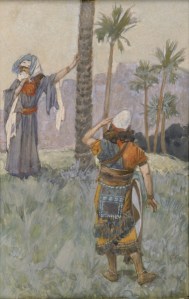
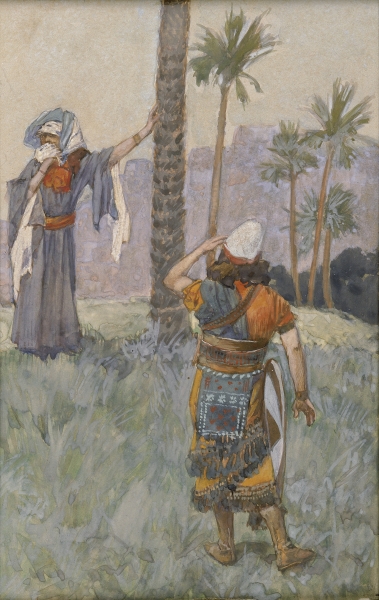
Deborah, leading the people of Israel
There are some who advocate a notion of “Biblical Manhood and Womanhood” with strict definitions of what roles men and women should occupy. Representative is John Piper, a leading voice in the movement named “Recovering Biblical Manhood and Womanhood.” In his essay “A Vision of Biblical Complementarity: Manhood and Womanhood Defined According to the Bible,” Piper writes about “biblical” manhood:
When my father came home he was clearly the head of the house… (32, cited below)
[W]hen there is no bread on the table, it is the man who should feel the main pressure to do something to get it there… a man will feel his personhood compromised if he… becomes dependent over the long haul… on his wife’s income. (42)
Shockingly, Piper even goes so far as to say that:
“[E]ven where a Christian wife may have to stand with Christ against the sinful will of her husband, she can still have a spirit of submission–a disposition to yield” (47).
Piper alleges that biblical womanhood follows this pattern:
A mature woman is glad when a respectful, caring, upright man… provides a pattern of appropriate initiatives in their relationship. (48)
[She is to follow] Biblical submission[, which] for the wife is the divine calling to honor and affirm her husband’s leadership and help carry it through… (53)
From Piper, we learn that “biblical” womanhood is to yield, to be led, not to be the head of the home, be provided for, indeed even to avoid situations in which a woman is closely leading a man in the office (52).
Proverbs 31 destroys this concept of what a “biblical” woman should be. In this astonishing passage, we read that the ideal woman:
1. Takes care when selecting products to purchase (31:13)
2. Brings food to her family (31:14)
3. Provides for her family (31:15)
4. Appraises and purchases land (31:16)
5. Brings profitable gain (31:18)
6. Works with tools of various trades (31:18)
7. Helps the poor and needy (31:20)
8. Crafts goods to be used by the family (31:22)
9. Crafts goods to sell and is shrewd in selling them (31:24; 18)
10. Speaks and instructs with wisdom (31:26)
11. Watches over the ways of the household (31:27)
12. Above all, she fears the Lord (31:30)
Now remember, this is an “ideal” and of course no woman could be or do all of these things. This passage illustrates aspects of what a biblical woman would be.
Recall, though, the roles that have been defined for women by some complementarians–people who hold a view in which man and woman occupy different roles in the home and church, with men as leaders. Which of these are found in the description of woman in Proverbs 31? Let’s just do a quick comparison of a few (Piper citations from above):
Piper: [I]t is the man who should feel the main pressure to do something to get [bread on the table]
Bible: “[The ideal wife/woman] gets up while it is still night; she provides food for her family...” (31:15a)
Do women not share the pressure in putting bread on the table when the Bible describes ideal womanhood as a provider of food for her family without excluding the husband?
Piper: When my father came home he was clearly the head of the house…
Bible: “She watches over the affairs of her household…”(31:27a)
Does watching over the affairs of the household have an unwritten, unspoken clause that excludes men?
Piper: [A] man will feel his personhood compromised if he… becomes dependent over the long haul… on his wife’s income.
Bible: “She considers a field and buys it; out of her earnings she plants a vineyard… She sees that her trading is profitable, and her lamp does not go out at night.” (31:16; 18)
Does the wife/woman’s managing money, earning it, buying fields, ensuring profit, and staying up late into the night focusing on this profitable gain compromise her husband’s personhood?
Also interesting are the things that are not said. It doesn’t say the ideal woman yields to her husband when he does wrong, she rather brings him good, not harm (31:12). Sin is a harmful cycle, and to say women are to rebuke it, but yield because a man is the leader is perpetuating that cycle.
The question, then, becomes this: where are those like Piper, who make the statements quoted above getting their ideas from? Is Proverbs 31 biblical womanhood when it contradicts these notions, or are the Scriptural quotes above instead to be defined as the properly biblical womanhood?
The question is ‘how do we define Biblical Womanhood’? The answer: A buyer, seller, purveyor, manufacturer, innovator, leader, provider, entrepreneur, and above all, one of God.
You ask “What is Biblical womanhood?” I’ll tell you: Proverbs 31.
Links
Be sure to check out the page for this site on Facebook and Twitter for discussion of posts, links to other pages of interest, random talk about theology/philosophy/apologetics/movies and more!
Check out my posts on egalitarianism – the belief that men and women are equally qualified and called in the church and home (scroll down for more).
On the Femnization of the Church– It is frequently alleged that the church is being “feminized” and that this is a bad thing. Check out this post, wherein I analyze this notion from a few different angles.
Source
John Piper, “A Vision of Biblical Complementarity: Manhood and Womanhood Defined According to the Bible” in Recovering Biblical Manhood and Womanhood edited by Piper and Grudem (Wheaton, IL: Crossway, 2006).
SDG.
——
The preceding post is the property of J.W. Wartick (apart from quotations, which are the property of their respective owners, and works of art as credited; images are often freely available to the public and J.W. Wartick makes no claims of owning rights to the images unless he makes that explicit) and should not be reproduced in part or in whole without the expressed consent of the author. All content on this site is the property of J.W. Wartick and is made available for individual and personal usage. If you cite from these documents, whether for personal or professional purposes, please give appropriate citation with both the name of the author (J.W. Wartick) and a link to the original URL. If you’d like to repost a post, you may do so, provided you show less than half of the original post on your own site and link to the original post for the rest. You must also appropriately cite the post as noted above. This blog is protected by Creative Commons licensing. By viewing any part of this site, you are agreeing to this usage policy.
 Every Sunday, I will share a quote from something I’ve been reading. The hope is for you, dear reader, to share your thoughts on the quote and related issues and perhaps pick up some reading material along the way!
Heresy as the Historical Loser?
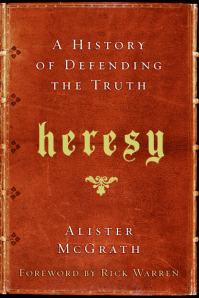
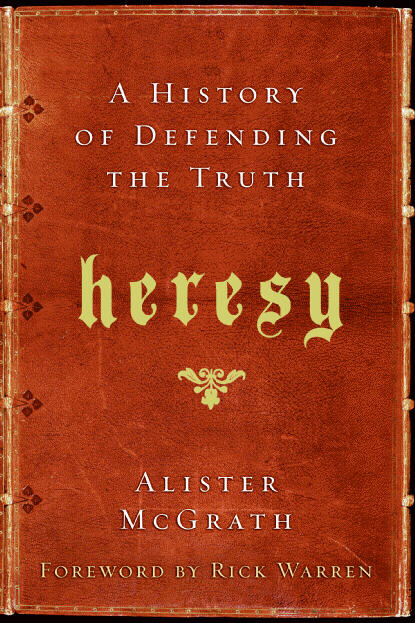
Alister McGrath’s book, Heresy: A History of Defending the Truth was a great read when I read it around two years ago, so I decided to reread it and get my notes in computer form. Almost immediately I began to discover reasons I enjoyed it so much. For example, McGrath notes that heresy has garnered much excitement and interest of late. Many see ancient heresies as something worth reconsidering, perhaps in light of losing by chance. He writes:
In this view, the distinction between heresy and orthodoxy is arbitrary, a matter of historical accident. Orthodoxy designates ideas that won, heresy those that lost. (3, cited below)
The rest of the book is dedicated to the history of heresy and how it interacted with orthodoxy. What do you think, though, of this notion that the distinction between heresy and orthodoxy is arbitrary? Could it be that orthodoxy is merely a historical accident? McGrath, of course, argues that it is not.
Links
Be sure to check out the page for this site on Facebook and Twitter for discussion of posts, links to other pages of interest, random talk about theology/philosophy/apologetics/movies and more!
Sunday Quote– If you want to read more Sunday Quotes and join the discussion, check them out! (Scroll down for more)
Book Review: “Heresy: A History of Defending the Truth” by Alister McGrath– Check out my review of McGrath’s book.
Source
Alister McGrath, Heresy: A History of Defending the Truth (New York: HarperOne, 2009).
SDG.

My favorite movie of the year so far.
Each Week on Saturday, I’ll be asking a “Question of the Week.” I’d love your input and discussion! Ask a good question in the comments and it may show up as the next week’s question! I may answer the questions in the comments myself.
Movies of 2014
I realized recently that I haven’t been to as many movies this year as I went to last year. However, it does seem that the movies I have gone to see have been awesome. Early in the year I saw the appropriately-timed Frozen, which I felt had some great themes in it to go with its fantastic music. Then, I went with a friend to see “Lone Survivor,” which I am pleased to report showed greater complexity than many war movies or commentary on the war in Iraq. Then, I saw “Captain America: The Winter Soldier,” which may have been the greatest superhero movie other than the Dark Knight trilogy. I loved its moral commentary.
Finally, I went to go see “Edge of Tomorrow” and “X-Men: Days of Future Past” back-to-back last weekend. The X-Men flick was fantastic and brought up, again, questions of morality. “Edge of Tomorrow,” I would say, is my favorite movie of the pack so far. It was just so good and it helps that it was a genuine sci-fi epic. “Edge of Tomorrow” brings up a number of topics like sacrifice and choice which aren’t always explored in movies, let alone blockbuster action flicks.
As for the question this week:
What movies have I missed that you would consider a “must see”? Let me know in the comments!
This post was adapted from my “other interests” site, which you may want to check out- Eclectic Theist.
Links
Be sure to check out the page for this site on Facebook and Twitter for discussion of posts, links to other pages of interest, random talk about theology/philosophy/apologetics/movies and more.
Question of the Week– Check out other questions and give me some answers!
SDG.
 Another week, another slew of posts for you to add some extra reading to your plate! This time around, we have a comic about self-deception, a quiz for you to test yourself, some young adult literature, and more! Let me know what you thought of the posts, and if you liked them, let the authors know on their blogs!
How to Spot a VBS Volunteer (Comic)– I found this hilarious because it speaks so well of my time as a VBS Volunteer many moons ago. I had an absolute blast though, which is something left off the comic. There’s a reason we keep going back: we love the kids, we love what we got to do, despite our eyes twitching from the caffeine (my preferred stimulant was Mountain Dew). Do you have a fun VBS Story? Share it below!
[Not your Sunday School’s] Biblical Literacy Quiz– Speaking of VBS, how about brushing up on some Bible literacy questions? Warning: this won’t be as easy as just answering “Jesus!” every time. Post your grade here! Let’s have some fun with this and maybe motivate ourselves to read more.
Why Neil deGrasse Tyson should stick to science– The host of “Cosmos” has attempted ironic philosophical critiques of philosophy, metaphysics, and more. Here’s a post arguing he should stick to science–if that.
Common Routes to Self-Deception (Comic)– Do you catch yourself following one of these common paths to pulling the wool over your own eyes? How might we work to prevent self-deception? Check out this thought-provoking comic.
Steelheart: Helping Heroes Along– Brandon Sanderson’s latest YA literature has people abuzz. For good reason? Check out this analysis from a worldview perspective by Anthony Weber.
Darwin’s Finches Show Rule Constrained Variation in Beak Shape– Here’s some heavy reading for you. Could it be that variation operates through certain constraints? What might this imply for evolution? What do you think?
 I don’t often write about politics, but today’s unanimous Supreme Court decision to strike down an MA law which restricted pro-life speech within 35 feet of an abortion clinic has me smiling. This was a clear violation of free speech and I frankly think it says something about the desperation of the pro-choice case-makers.
It seems that, at least in MA, the desperation got to the point where they realized if you can’t make your case from science or logic (links to posts arguing this), the next best thing would be to simply muzzle the opposition. Thankfully, in this case, justice was served and the blatant disregard for freedom of speech was overturned.
Let me reiterate, this was a unanimous decision. What does that say about the legal status of such an attempt? I’m not talking about objective morality, I’m speaking only of the law of the land. Why even attempt to keep such a law around?
Frankly, I think it really is a matter of the realization that when one’s case is so blatantly a house of cards, an illegal attempt to thwart free speech is the last rejoinder. Let’s be clear on this issue:
Free speech is not a matter of freedom for those with whom you agree–it’s a matter of, well, actually free speech.
And yes, I think that applies to those who are pro-choice.
Let’s read your thoughts below (follow the comment policy–there are rules for your free speech here!).
Links
Be sure to check out the page for this site on Facebook and Twitter for discussion of posts, links to other pages of interest, random talk about theology/philosophy/apologetics/movies and more!
Pro-Life– Check out my posts arguing for the pro-life position.
SDG.
 A recent tragedy has forced me to reflect a bit on the notion of “Christian Music.” This recent tragedy was the professedly Christian lead singer of the band “As I Lay Dying” being arrested for plotting to murder his wife. Then, later, admitting that he was no longer a Christian and kept the label as a way to sell records. Now this is a horrible, tragic situation and we shouldn’t downplay it. We should stay in prayer and hope that God leads him back to Christ. We should also learn from it. I simply want to reflect on the category of Christian music and, as a parent (with my first not yet born), think about how I may guide my children’s choices (and my own) when it comes to music.
The Category of Christian Music
One question that comes up from this story and something I’ve frequently thought about is whether the category of “Christian Music” is even a category that should exist. It has been noted by others that this label may serve as an excuse for sub-par musical talent to sell records by having Christian lyrics. As someone who frequents Christian bookstores, I would say this, at times, may not be far from the truth, but there are many extremely talented musicians who carry this label with pride.
I do wonder, however, whether the label just becomes that: a label. It may not reflect the actual content of the lyrics or music (as is admitted in the case of “As I Lay Dying”), but parents feel comfortable picking up a CD from that section simply because it gets called “Christian.” I think that’s not the greatest practice (more on this below). Another problem is that the label of “Christian Music” implies a wholly separate and distinct category of “non-Christian” music, which does not seem to be accurate. So-called “secular” music is often performed by or written by Christians and reflects that.
An ideal world, in my opinion, would be one in which Christian musicians simply played music and had their music on the shelves next to non-Christian music, where someone might get their redeeming lyrics. For now, it’s shoved in the corner of the music section away from all the others. Rather than labeling ourselves “Christian” musicians, why not just play music, and let our worldview flow through it? (I have similar thoughts about “Christian fiction” and the like.)
Doing the Grunt Work
A case like the “As I Lay Dying” scenario brings up another issue. Namely, we should be examining the lyrics of everything we listen to. We need to do the grunt work and examine what we consume to see whether it builds us up as people of God or not. As parents, we should not just assume a so-called Christian artist has lyrical content of value. Instead, we need to do the work and see what the artists are saying so that we can make informed choices. More importantly, we are to raise our children in a way that they make wise choices with what they consume when they get to the age where we feel we let them make their own choices. It’s a huge responsibility, and one I feel very strongly for my child already, even before he or she is born!
Thoughts
I don’t think the label “Christian Music” is going to go away. In some ways that could be a good thing, but I think that we should do due diligence in whatever we consume and assure that it is something that builds us up. I’ve put the album art from a recent album from Demon Hunter up on this post because I think that group exemplifies the character of a Christian band. Their lyrics are a reflection of their worldview. Rather than being praise music, it is music and lyrics which demonstrate the Christian worldview and the struggles of faith. See the links for some more discussion of this.
To sum up, I think we should just examine whatever we consume. Moreover, we should respect Christian artists who are operating on the shelves of “Rock” or “Pop” rather than in the “Christian Music” corner of the store. Why? Because they are letting their faith work through their music without that label. I’m not at all saying those who aren’t doing that are somehow less valuable. Instead, they ought to seek to ensure their content is truly reflective of the label they have received or given themselves. Moreover, all Christians should seek to guard themselves and walk a life of prayer and one of seeking God.
What are your thoughts? I admit I’m no expert in this area, so I’d love to read what you have to say in the comments below.
Links
Be sure to check out the page for this site on Facebook and Twitter for discussion of posts, links to other pages of interest, random talk about theology/philosophy/apologetics/movies and more!
Engaging Culture: Demon Hunter’s “Extremist” and the Apologetic Task– I discuss the latest album from Demon Hunter and how music may act as an apologetic endeavor.
Ryan Clark Interview– Ryan Clark of “Demon Hunter” discusses one of their recent songs, “The Last One Alive” and how it reflects his faith.
7 Things Christian Parents Can Learn from the Tim Lambesis Story– What can we learn from the tragic story of a Christian band leader who turned atheist and tried to murder his wife? Check out these great insights from Natasha Crain.
SDG.
——
The preceding post is the property of J.W. Wartick (apart from quotations, which are the property of their respective owners, and works of art as credited; images are often freely available to the public and J.W. Wartick makes no claims of owning rights to the images unless he makes that explicit) and should not be reproduced in part or in whole without the expressed consent of the author. All content on this site is the property of J.W. Wartick and is made available for individual and personal usage. If you cite from these documents, whether for personal or professional purposes, please give appropriate citation with both the name of the author (J.W. Wartick) and a link to the original URL. If you’d like to repost a post, you may do so, provided you show less than half of the original post on your own site and link to the original post for the rest. You must also appropriately cite the post as noted above. This blog is protected by Creative Commons licensing. By viewing any part of this site, you are agreeing to this usage policy.

I gave you milk, not solid food, for you were not yet ready for it. Indeed, you are still not ready. (1 Corinthians 3:2)
Apologetics Church
I have had many discussions with my apologetics-inclined friends on the nature and purpose of church. One thing I have heard again and again is the notion that all churches–even all services–should be seeker-friendly or should reflect what C.S. Lewis calls “mere Christianity.” Mere Christianity, as defined by C.S. Lewis, is essentially that which all Christians everywhere have believed.
Interestingly, I have run into several people from a broad spectrum of backgrounds who have told me that they think all churches should be “mere Christian” churches centered on apologetics. The point of church on this view is to evangelize and to provide Christians with reasons to believe what they believe.
Statements like this are repeated by many of my apologist friends. I had a conversation with one friend in which I was informed that the purpose of church was to evangelize, and what better way to do that then to go to “mere Christianity” and have every service revolve around apologetics discussion. That’s right, this person–and others I have talked to–said that every sermon, every service, every time the church meets should be about apologetics and should not focus on those doctrines which have caused so much division within the body of Christ.
As an apologist with an MA in the field, this has some appeal! After all, were all churches to do this it would certainly raise my “employability” quotient! I would be in demand every single Sunday. But realistically, I think that statements like this show underlying confusion about the nature of church and the importance of Christian doctrine.
The Point of Church
There is no way for a complete, systematic outline of what church is about in a post like this. Nor would I claim to be an expert on the doctrine of the church. So, at risk of being simplistic, I would say that the meaning of church is to glorify God. How is this done?* I think it’s clear that the creedal statements about the church accepted throughout the history of Christianity (dare I say, the “mere Christian” definition of church?) is that it is “holy” and a “communion of saints” (Apostles’ Creed) and it is “holy and Apostolic” and “catholic/universal” (Nicene Creed).
A church should not be a place which wards off those who are seeking, but the ultimate purpose of church, confessed for over a thousand years, is to be “holy” and a community of saints. The body of Christ is not immediately perfect; but the point of church is to have community with fellow saints–the Body of Christ. Worshiping and glorifying our Creator and Redeemer is central to the life of the church. If we abandon that, we abandon the very reason for having community to begin with.
Whatever vision we have of church, then, should incorporate how the church has always defined itself. A primary need for the Christian is to worship and thank God for the blessings poured out on us each and every day. The community of believers longs to worship Christ, to join the company of angles to laud and magnify the name of the Most High God.
Moreover, when we look at the verse I led this post with, the church is a place to get the “solid food” believers need to go beyond the “milk.” Churches instruct the community in how to move beyond the “milk” of “mere Christianity” and acceptance of the bare minimum and into “solid food” and a fuller understanding of God’s word.
 Apologetics Church, Revisited
I have my own vision of what a church that is focused on apologetics would look like.
The “Apologetics Church” would have a study group for both youth and adults to participate in which focused upon various apologetics issues. The group would start at a basic level, teaching on the nature of apologetics and its methods, then move into individual objections to the Christian faith.
The pastor would have studied apologetics on his/her own and would integrate apologetics into sermons when appropriate (Easter would be a great time to talk about evidence for the resurrection, for example). The church would have a monthly “outreach night” in which the local community was invited in to discuss questions about the faith and simply engage in dialogue over desserts or a snack. The church would have groups that went to a movie, or an art show, or a concert, etc. and then met afterwards to discuss the implications of that media for the Christian worldview.
It would be a church aware of, but not overtaken by, apologetics. It would be an evangelical, mission-oriented church, but not a missions-only church.
Conclusion
I have said only the bare minimum about the nature of church and its function. Ultimately, though, I think a vision of the nature of church should include apologetics, but it should not be reduced to it. We seek “solid food” and long for deeper knowledge of God. Your church is an excellent place to get that needed, longed-for instruction.
As the deer pants for the water, so my soul longs for you.. (Psalm 42:1)
Links
Be sure to check out the page for this site on Facebook and Twitter for discussion of posts, links to other pages of interest, random talk about theology/philosophy/apologetics/movies and more!
The Church Universal: Reformation Review– I take a deeper look into the definition of a “universal church” in a post that focuses on theology of the reformation.
*As a Lutheran, I would say that glorifying God in church is best done through Word and Sacrament, but I realize that not all churches are sacramental and do not desire to start that debate here.
SDG.
——
The preceding post is the property of J.W. Wartick (apart from quotations, which are the property of their respective owners, and works of art as credited; images are often freely available to the public and J.W. Wartick makes no claims of owning rights to the images unless he makes that explicit) and should not be reproduced in part or in whole without the expressed consent of the author. All content on this site is the property of J.W. Wartick and is made available for individual and personal usage. If you cite from these documents, whether for personal or professional purposes, please give appropriate citation with both the name of the author (J.W. Wartick) and a link to the original URL. If you’d like to repost a post, you may do so, provided you show less than half of the original post on your own site and link to the original post for the rest. You must also appropriately cite the post as noted above. This blog is protected by Creative Commons licensing. By viewing any part of this site, you are agreeing to this usage policy.
 Every Sunday, I will share a quote from something I’ve been reading. The hope is for you, dear reader, to share your thoughts on the quote and related issues and perhaps pick up some reading material along the way!
A Biblical Answer to Economic Woes?
I’m reading The Poverty of Nations: A Sustainable Solution by Wayne Grudem (theologian) and Barry Asmus (economist). In it, they propose a solution to solving the world’s national economic problems from both an economic and biblical perspective:
The goal of this book is to provide a sustainable solution to poverty in the poor nations of the world, a solution based on both economic history and the teachings of the Bible.
The introduction sounds great, but I admit that I’m a bit skeptical about its scope. Is it really the case that the Bible may be treated as an economics textbook? Or perhaps the point is, instead, that we are to care for the poor and the rest is all economic theory. Anyway, it raises two primary concerns for me:
1. Does the Bible actually propose any sort of economic policy or am I going to get a bunch of verses pulled out of context to make the Bible into an econ textbook?
2. Is there such a thing as a list of 78 factors (the authors identified this many factors as essential to economic growth and stability) that could be applied to all countries everywhere and somehow solve all economic problems?
Now, I’m not at all far into the book (about 9% based on my Kindle), so it may blow me away. Perhaps the Bible will be used contextually and instead simply note how we are to care for the poor, etc. Perhaps the economic approach will make quite a bit of sense and be very adaptable. That said, I can’t wait to dive in and read more to see whether it may convince me. For now, what are your thoughts? Is there a “Biblical” Answer to Economic woes?
Links
Be sure to check out the page for this site on Facebook and Twitter for discussion of posts, links to other pages of interest, random talk about theology/philosophy/apologetics/movies and more!
Sunday Quote– If you want to read more Sunday Quotes and join the discussion, check them out! (Scroll down for more)
Source
Wayne Grudem and Barry Asmus, The Poverty of Nations: A Sustainable Solution (Wheaton, IL: Crossway, 2013).
SDG.
 Each Week on Saturday, I’ll be asking a “Question of the Week.” I’d love your input and discussion! Ask a good question in the comments and it may show up as the next week’s question! I may answer the questions in the comments myself.
Share VBS Stories
Vacation Bible School season is in full gear now, and I remember my days as a VBS Volunteer. This hilarious comic shows “How to Spot a VBS Volunteer” and apart from being male and having Mountain Dew instead of coffee (yes, at 7AM when I got up for it–I was a teenager!), it’s pretty accurate to my experience. The reason I came back (and wanted to) was because I had an absolute blast leading kids and realizing that maybe, just maybe, you’re making an impact on their lives for the Kingdom. In light of that, here’s the question [THERE ARE GROUND RULES BELOW]:
Do you have any fun VBS Stories to share? What was your favorite experience at VBS? Why did you volunteer or participate?
If you answer this question be sure to Respect confidentiality–no names or only invented names should be used. Remember, the comment policy will still be in place so just be respectful of others too.
Links
Be sure to check out the page for this site on Facebook and Twitter for discussion of posts, links to other pages of interest, random talk about theology/philosophy/apologetics/movies and more.
Question of the Week– Check out other questions and give me some answers!
SDG.
 I’ve put together what I think is a pretty diverse array of topics for you, dear reader, to peruse. Check them out, and let me know what you thought of them! If you liked their post, let them know, too! Comments keep we bloggers going!
Gospel Truth? 10 Quick Questions– Here’s an interesting way to approach evaluation of rival Scriptural traditions–how might we determine whether one is true? What do you think of this list of questions about revealed truth? While you’re at it, Saints and Sceptics (they’re British!) is a great site that is well worth your time to follow and read on a regular basis.
Lawrence Krauss debates “A Universe From Nothing” with an Astrophysicist– Check out this review and commentary on a debate in which Lawrence Krauss continues to press his redefined version of “nothing” to try to explain the existence of the universe. This time, he debates an astrophysicist. Hint: it doesn’t go well.
Towards a Deeper Theology of Women: 4 Contributions of Women Scholars– Both men and women were created in the image of God. As such, they are each capable of contributing to theology and teaching. Check out this list of four contributions of women scholars, complete with some reading to pick up along the way!
Free Bible Icons– The title isn’t the catchiest, but these digital icons for every book of the Bible (and groupings therein) are fun, free, and a great thing to just print off and use as book markers in your Bible. Moreover, they’re just fun to look at.
Evangelical Textual Criticism– How might evangelicals engage in textual criticism? Here’s a site that explores that while also providing a number of resources like bibliographies for study, conference reminders, and the like. For an example of how this plays out, check out this post on Codex Bezae.










 J.W. Wartick - Reconstructing Faith