Archive for
Really Recommended Posts 10/9/15- Inerrancy, Immigration, apologetics, and more!
 I’m pleased to offer this go-round of the Really Recommended Posts to you, dear readers. I think they are about as diverse as you can get. We have Stephen Colbert on his faith, illegal immigration and Christianity, apologetics, Jesus’ view of Scripture, and Planned Parenthood on the docket today. Check them out and let me know what you thought!
Watch Stephen Colbert, a Lifelong Catholic, on Hearing a Female Priest Celebrate the Eucharist– I don’t put a lot of stock in celebrity comments about faith or politics or really anything. After all, they don’t automatically become authorities simply because they are famous. However, Colbert’s faith is quite sincere, and this whole interview is worth watching. Here’s a clip in which he talks about a female priest celebrating the Eucharist.
American Christianity and Illegal Immigration– Here’s a fairly lengthy look at the historic interaction with illegal immigration that American Christianity has had. It helps provide a historical perspective on some of the current debates regarding illegal immigration.
Apologetics Strategies: The Myth of a Bulletproof Argument– It is easy to think that, regarding Christian apologetics, we can come up with an argument that will convince everyone. Is that the case? Here’s a post on apologetic method that is well worth your time.
Jesus Viewed Scripture as Inerrant: A Reply to Kyle Roberts– A few weeks ago I featured an article arguing all Christians should view the Bible as inerrant. Here is a follow-up post in which Rob Bowman takes an extended look at Jesus’ view of Scripture.
3 Pinnochios to Planned Parenthood Supporters for Slippery Mammogram Language– The Washington Post calls out Planned Parenthood supporters for their claims about mammograms. Look, Planned Parenthood doesn’t provide any mammograms at all. Not a single one. It should not be used as a scare tactic against those arguing to defund the abortion provider.
Book Review: “Owen on the Christian Life” by Matthew Barrett and Michael Haykin
 Owen on the Christian Life provides a broad-spectrum approach to John Owen’s theological insights into the Christian life. It is part of the “Theologians on the Christian Life” series from Crossway (see my other reviews in this series here).
John Owen was a Puritan. Yes, one of “those people.” The word “puritan” has something of a bad connotation nowadays, but the theological movement was actually remarkably broad. Moreover, many insights can be gleaned from reading through the works of these theologians who emphasized a Christian life lived.
The authors outline Owen’s theology through a number of chapters that build on each other, including chapters on the Trinity, penal substitution, justification, and more. Readers also learn about Owen’s transition towards congregationalism, discussions about church and state, and more.
Central to Owen’s theology are the Trinitarian relations, which can help us to learn about divine-human and human-relations as well. Owen emphasized the importance of religious experience for the Christian life. This experience was never taken to trump the authority of the Bible–far from it. Instead, it was taken to be a bulwark in times of doubt and need. Justification in Owen’s view provides a way to be assured of one’s salvation, for God completes that which God has set out to do. Sanctification is where I believe Owen’s main contributions might be found, though I will outline that more below.
The primary critique I have of the book is that it doesn’t seem to focus on Owen’s specific views of the Christian life as the other works in the series have. As I outlined above, there are chapters emphasizing various aspects of Owen’s theology, but these only get tied into the Christian life in what seems like offhand fashion at times. This makes the book read more like an exposition of Owen’s broader (largely Calvinistic) theology than a specific look at his doctrine of the Christian life. Particularly surprising to me was how Owen’s insights on sanctification and overcoming sin and temptation were lumped in with discussions of the power of prayer and the indwelling Spirit. Perhaps this is at least partially my own bias, having been edified greatly by his works on sin and temptation, but I think that more space dedicated to his work in this area would have been on point in a book on the Christian life.
That said, the authors do a good job summarizing Owen’s approach to overcoming sin and putting it to death in our lives. Owen argues for several steps a Christian can take to battle sin and temptation in their lives. This is a proactive approach which views the Christian life as a Spirit-empowered battle against the temptations we face. Steps Owen describes include the envisioning of the consequences of sin, reflection on the Bible, and realizing the fact of the suffering our sin causes Christ.
Owen on the Christian Life provides insight into the whole of Owen’s theology, with a focus on his theology of Christian living. It’s not necessarily as focused on the topic at hand as some other books in the series, but it is a worthy read that provides an introduction into the thought of this theological giant.
The Good
+Excellent insights into the Christian life
+Provides broad overview of Owen’s work
+Great insights into doctrine of the Holy Spirit, sanctification, and more
The Bad
-Doesn’t seem to focus entirely on the Christian Life
Links
Be sure to check out the page for this site on Facebook and Twitter for discussion of posts, links to other pages of interest, random talk about theology/philosophy/apologetics/movies and more!
Book Reviews– There are plenty more book reviews to read! Read like crazy! (Scroll down for more, and click at bottom for even more!)
Book Review: “Overcoming Sin and Temptation” by John Owen– I review a book from John Owen which has positively impacted my spiritual life in many ways.
Source
Matthew Barrett and Michael Haykin Owen on the Christian Life (Wheaton, IL: Crossway, 2015).
SDG.
——
The preceding post is the property of J.W. Wartick (apart from quotations, which are the property of their respective owners, and works of art as credited; images are often freely available to the public and J.W. Wartick makes no claims of owning rights to the images unless he makes that explicit) and should not be reproduced in part or in whole without the expressed consent of the author. All content on this site is the property of J.W. Wartick and is made available for individual and personal usage. If you cite from these documents, whether for personal or professional purposes, please give appropriate citation with both the name of the author (J.W. Wartick) and a link to the original URL. If you’d like to repost a post, you may do so, provided you show less than half of the original post on your own site and link to the original post for the rest. You must also appropriately cite the post as noted above. This blog is protected by Creative Commons licensing. By viewing any part of this site, you are agreeing to this usage policy.
Bible Note: Psalm 50:9-13- God doesn’t need you
 I’ve been reading through the Bible and making a kind of commentary on the whole thing as I go. Needless to say this has been a lengthy project! Here’s an expanded note I made in Psalm 50.
I know the saying I’ve heard many places, “Never quote/read a Bible verse.” The meaning is of course to emphasize the word “a” and point out that all verses have context. Although that is true, I don’t think that means we can never read just one verse and get a clear meaning or teaching out of it. Here’s a pretty neat verse, though:
50:12- “If I were hungry I would not tell you, for the world is mine, and all that is in it.”
In context (50:9-13), you can see that it is surrounded by God noting that God has no needs, that God does not need to eat or drink, and the like.
In the Ancient Near East, sacrifices were often thought to be providing the needs for the gods. Here, in context (50:8, 13), it is clear that YHWH is distinguishing Himself from those alleged deities. There are no needs God has. Indeed, if God had needs, there would be no need to tell us because all belongs to God already. This is a powerful reminder of God’s sovereignty over all the universe.
There is also no small amount of irony/humor involved in the passage. The irony is centered on the fact of God’s power as well. Supposing that a God who created the entire universe does exist, is it not frankly hilarious to imagine that same deity depending on us to provide food? Against the backdrop of the Ancient Near East (see Walton’s work for an extended look), this makes more sense, though. It was thought that by providing for food and drink for the gods, the one offering the food could free the deity up to take care of more cosmic needs. In stark contrast, the God of the Bible claims not only to be fully capable of taking care of the cosmos, but also asserts there are no needs God has that we can fulfill. It’s an astonishing declaration of God’s might.
It also can provide some degree of comfort: God doesn’t need you. Grace is a gift.
What are your thoughts? How might we take this verse in its ancient context and draw out the humor for today?
Sunday Quote!- Mormonism and Breaking the Ninth Commandment
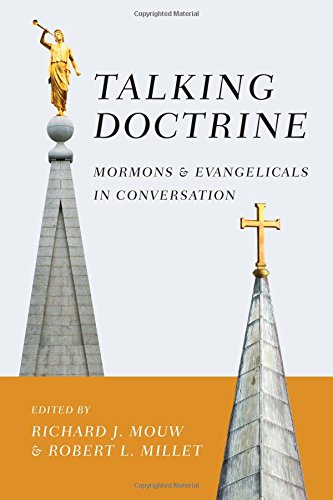
Every Sunday, I will share a quote from something I’ve been reading. The hope is for you, dear reader, to share your thoughts on the quote and related issues and perhaps pick up some reading material along the way!
Mormonism and Breaking the Ninth Commandment
Talking Doctrine: Mormons & Evangelicals in Conversation is an intriguing collection of essays from evangelical and Mormon scholars (see my review). In one essay, Cory B. Willson briefly comments on something that an evangelical, Richard Mouw, said in an address at the Mormon Tabernacle in 2004:
The common habit of telling Mormons what they believe without bothering to ask them, Mouw noted, has often led to misrepresenting and even demonizing their beliefs and practices–a form of bearing false witness against our Latter-day Saint neighbors. (80, cited below)
Mouw’s point should be well-taken. Too often in interfaith dialogue there is a tendency to jump on assumed beliefs rather than getting to know the religious “other.” Instead, we should focus on what those religious “others” are actually telling us they believe, so that we do not give false testimony against them. I wrote a post about a vision for Christian apologetics to world religions that focuses more on this topic.
What do you think? How might we map ways forward in interfaith dialogue that does not misrepresent the other side? How could this be better applied to evangelical-Mormon discussions?
[Note: there are some different ways of numbering the commandments. The Commandment Referred to here is “Do not give false testimony against your neighbor” which is commonly known as the 8th or 9th Commandment, depending on how a tradition breaks them up. I stuck with it as the 9th commandment because that’s how the quote had them numbered.]
Links
Be sure to check out the page for this site on Facebook and Twitter for discussion of posts, links to other pages of interest, random talk about theology/philosophy/apologetics/movies and more!
Sunday Quote– If you want to read more Sunday Quotes and join the discussion, check them out! (Scroll down for more)
Book Review: Talking Doctrine: Mormons and Evangelicals in Conversation edited by Mouw and Millet– I review the book from which this quote came.
Source
Talking Doctrine: Mormons and Evangelicals in Conversation edited Mouw and Millet (Downers Grove, IL: InterVarsity, 2015).
SDG.

 J.W. Wartick - Reconstructing Faith