Archive for
Book Review: “Justification” by N.T. Wright
 N.T. Wright’s views about the doctrine of justification have continued to be quite controversial, and his book Justification is a brief summary of his entire project. Essentially, Wright is attempting to go back to the Pauline corpus to see exactly what Paul means by the doctrine of justification. Part of this project, for Wright, is to become aware of the idea that we may be asking the texts the wrong questions from the get-go. We need to understand the context to which Paul was writing before we can even properly formulate questions.
Wright begins with a number of preliminary comments. He first outlines the difficulties faced by biblical interpreters when they do start with the wrong questions. He argues that a number of our interpretations are based less on the text than an interpretation of the text itself. He argues that the Reformation tradition ought to continue to lead us to question even Reformation conclusions about texts like Galatians–and Luther’s “mistaken” reading (according to Wright) thereof. In other words, we need to acknowledge that we could be deeply mistaken, and have been deeply mistaken, about the meaning of these texts for hundreds of years. It’s a tough pill to swallow, but one that ought to be taken seriously. Acknowledging the possibility that an interpretation is based less on the text than on tradition or modern assumptions is one of the first steps to understanding the text.
Then, Wright proceeds to show the context to which Paul was writing. Specifically, much of the context he was writing to makes certain parts of the text make a lot more sense than they may otherwise. When you realize what was happening in the early church it becomes easier to understand some of the basic questions Paul was asking and answering. Next, Wright outlines his view of justification, which is admittedly never distilled (so far as I can tell) down to a single sentence. It is thus difficult to say exactly what his view is without an extended excursus longer than a book review, but the bare-bones basics, at risk of being overly simplistic, is that justification is God’s work through Israel of bringing the whole world to himself, declaring it righteous not through imputed righteousness, but through a law court declaration of righteousness. Yes, before those who understand Wright’s position better than I do, this is very simplistic and misses some key points of his doctrine. Yet, I have to make the attempt to summarize as best I can what he was arguing.
Finally, Wright concludes with lengthy exegesis of a number of Pauline passages. Though he himself says these are but the first steps along the lines of understanding Paul, it ought to be noted that it is in this section of the book that Wright engages most thoroughly with critics of his position as well as providing a positive statement of his view. This new edition that I’m reviewing adds an additional introduction from Wright, which outlines the continuing debates over Pauline theology.
One difficulty with Wright’s approach that many may object to is the notion that it undermines the perspicuity of Scripture. Now, I’m one who hates throwing that term around, because perspicuity is used as a kind of battering ram doctrine to try to silence critics on all sorts of topics. However, the real doctrine of perspicuity of Scripture, yes, inherited from the Reformation, is that the Bible is clear in that which is necessary to understand for salvation. If, however, Wright is correct in saying that must understand a great deal of historical context before we can even get to the right questions for the doctrine of justification, this seems to make it quite complex indeed to get to the knowledge that people need for salvation. Of course, Wright would–and did–argue that this is already starting off on the wrong track, because Paul was not so much interested in individual salvation as he was interested in the plan of Salvation through Israel of the whole world. And that is a fair answer, though it does seem to–in some sense–undermine the clarity of Scripture as has been taught. Once again, Wright would probably accept this and argue that that idea is itself an inherited tradition that the Reformers themselves would call us to examine and test by Scripture.
Perhaps the strangest aspect of the book to me was the continued targeting of Luther and Lutheran theology by Wright. I know of some Lutheran pastors who have argued Wright’s position is not far at all from the Lutheran one, and others who believe he is as far from Lutheranism on justification as possible. Though this may simply show confusion within Lutheran theology, it may also show–and I think does–that Wright’s position (and probably Luther’s) is not so clearly stated as he thinks. Moreover, I am curious about the continued calling out of Lutherans (and, yes, Reformed thinkers) by Wright, considering that his position seems, on the face of it, so utterly close to what Lutherans do believe about justification, and much farther from some other denominational perspectives.
Justification is required reading for those interested in Pauline theology, whether one agrees with Wright or not. That said, it is unfortunate that a decent amount of the work seems to be polemical against perceived enemies rather than embracing potential allies.
The Good
+Leads readers to a deeper look at biblical texts
+Provides solid background to understanding Pauline corpus
+Outlines Wright’s ways in a concise fashion
The Bad
-Strangely focused on the Lutheran position
-Not always very clear
Disclaimer: I received a copy of the book for review from the publisher. I was not required to provide any specific kind of feedback whatsoever.
Source
N.T. Wright, Justification (Downers Grove, IL: InterVarsity, 2016).
Links
Be sure to check out the page for this site on Facebook and Twitter for discussion of posts, links to other pages of interest, random talk about theology/philosophy/apologetics/movies and more!
Book Reviews– There are plenty more book reviews to read! Read like crazy! (Scroll down for more, and click at bottom for even more!)
Eclectic Theist– Check out my other blog for my writings on science fiction, history, fantasy movies, and more!
SDG.
——
The preceding post is the property of J.W. Wartick (apart from quotations, which are the property of their respective owners, and works of art as credited; images are often freely available to the public and J.W. Wartick makes no claims of owning rights to the images unless he makes that explicit) and should not be reproduced in part or in whole without the expressed consent of the author. All content on this site is the property of J.W. Wartick and is made available for individual and personal usage. If you cite from these documents, whether for personal or professional purposes, please give appropriate citation with both the name of the author (J.W. Wartick) and a link to the original URL. If you’d like to repost a post, you may do so, provided you show less than half of the original post on your own site and link to the original post for the rest. You must also appropriately cite the post as noted above. This blog is protected by Creative Commons licensing. By viewing any part of this site, you are agreeing to this usage policy.
Book Review: “Introduction to World Christian History” by Derek Cooper
 Derek Cooper’s Introduction to World Christian History provides a look at the development of Christianity across the world. It is a broad introduction to Christianity around the globe.
The book is formatted both by space and time. That is, sections on each general area (i.e. Asia) are traced for a specific time period (i.e. First through Seventh Centuries). Thus, readers looking to have a reference to work from need not look much farther than this book. Other readers, who may simply be interested in the broad development of world Christianity will not be disappointed either. Cooper does an excellent job showing the ebb and flow of Christianity’s spread across vast regions of time and place. Individual stories of prominent Christians are told in historical context to highlight specific periods or ideas. These individual stories accompany a broader narrative that is delivered in a readable, engaging style.
What makes the book particularly excellent is the way it provides all levels of readers with more to explore. It is an introductory text, for sure, but the notes are excellent and the topics explored are so broad that even readers with serious knowledge of Christian history will find more to explore. It is such a vast topic that no one can grasp each area, and Cooper gives glimpses into history that entice, like stained glass windows, much study.
The only real downside here is unavoidable: with so much material covered, it is impossible to get a complete picture of any one topic. Readers must go beyond this introduction. But again, kudos to Cooper for making readers want to do so with such a rich narrative style.
Introduction to World Christian History is the kind of book that will broaden readers minds in a number of ways. From those merely interested in a specific region to those who want to know just how we got to where we are, the book has broad appeal. Cooper’s style makes it extremely accessible for any level of reader, with plenty to tantalize more advanced readers as well. I recommend it highly.
The Good
+Fantastic overview covering large swathes of time and space
+Provides readers with broader understanding of Christianity
+Written in an interesting, readable style
The Bad
-Extremely brief on many interesting points
Disclaimer: I received a copy of the book for review from the publisher. I was not required to provide any specific kind of feedback whatsoever.
Links
Be sure to check out the page for this site on Facebook and Twitter for discussion of posts, links to other pages of interest, random talk about theology/philosophy/apologetics/movies and more!
Book Reviews– There are plenty more book reviews to read! Read like crazy! (Scroll down for more, and click at bottom for even more!)
Eclectic Theist– Check out my other blog for my writings on science fiction, history, fantasy movies, and more!
SDG.
——
The preceding post is the property of J.W. Wartick (apart from quotations, which are the property of their respective owners, and works of art as credited; images are often freely available to the public and J.W. Wartick makes no claims of owning rights to the images unless he makes that explicit) and should not be reproduced in part or in whole without the expressed consent of the author. All content on this site is the property of J.W. Wartick and is made available for individual and personal usage. If you cite from these documents, whether for personal or professional purposes, please give appropriate citation with both the name of the author (J.W. Wartick) and a link to the original URL. If you’d like to repost a post, you may do so, provided you show less than half of the original post on your own site and link to the original post for the rest. You must also appropriately cite the post as noted above. This blog is protected by Creative Commons licensing. By viewing any part of this site, you are agreeing to this usage policy.
Really Recommended Posts 8/26/16
 Hello, dear readers. I have another round of Really Recommended Posts to share with you this week. I hope you enjoy them as much as I did!
The Knower and the Known- Interview with Stephen E. Parrish– Stephen Parrish is a Christian philosopher who has written a wonderful tome on philosophy of mind. Here’s an interview with Parrish about the central themes of the book. See also my review of the book. I’ve read it a few times now, and it is phenomenal.
Ben Hur: An Epic Movie of Christian Forgiveness in an Empire of Hate– A great look at the Christian themes that can be found in the latest iteration of the classic story of “Ben Hur.” Also check out my own reflections on the film.
Obama’s Pardons– Whatever one’s political affiliation, I believe this post from Thinking Christian will be a thought-provoking read. It is by someone who was incarcerated, and speaks to the real injustice in some portions of the United States’ criminal justice system.
Science and the Optimistic Naturalist– Is it truly rational to punt to possible future scientific understanding to answer what are currently understood as metaphysical questions?
“Ben Hur” – Gods, Faith, Baptism, and Forgiveness
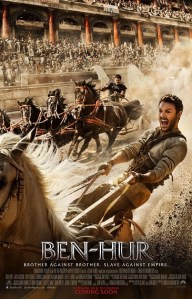 I had the chance to go see the new “Ben Hur” movie this past weekend. I think it is fair to say that I’m a huge fan of Ben Hur in many forms. I read the novel (at least) annually. I watch the Charlton Heston version of the film several times a year. It is one of the most utterly compelling plots I know of. It’s a tale of betrayal and revenge that turns into much more than that. (Be sure to see the Links at the end for several more of my posts about the book and other movie.) Here, I will look at this particular retelling of the story of Ben Hur and the worldview themes found therein. There will be SPOILERS in what follows.
Gods and Faith
A contrast of faiths is found throughout the movie, yet it isn’t just a two-sided picture. We see Messala’s devotion to Roman gods early on in the film, as he prays to those gods for the safety of his adopted brother, Judah Ben Hur (in this version, Messala was orphaned and adopted by the House of Hur). Judah’s mother chastises him, saying that they serve a different God under her household. At a later point, the Hurs are celebrating a Jewish festival, and Messala acts somewhat left out. Judah Ben Hur asks him about this and comments that wine knows no specific god (implying that Messala can at least enjoy himself with the festal wine). Judah is indeed portrayed as something of a skeptic throughout much of the film, and that’s where we see some of the most subtle but intriguing aspects of the journey of faith found here.
Judah’s journey includes doubts about God, and he even speaks these in one of his encounters with Jesus. He asks Jesus how, if God has a plan that includes us, we are any better than slaves. Jesus replies in a way that is reminiscent of so many of his responses in the Bible, nodding to Esther, a former slave who at this point is Judah’s wife, and saying “ask her.” Cynically, this could be interpreted as a non-answer, but it also shows a similarity in fashion to the way Jesus often answered such questions that were posed not as genuine questions but as challenges. He turned the question inward and forced him to confront his own life.
Judah’s ultimate turning point comes after his defeat of Messala through a chariot race in the circus. He stands before the crucified savior and he hears Jesus utter the words, “Father forgive them, for they know not what they do.” Judah breaks down and weeps, coming to a full realization that those words are not just empty: they are for him and about him. It is at the cross that Judah comes to a realization of his own inadequacy and need for forgiveness, and, yes, true faith.
Baptism
After the cross, the Hur family is healed by the water that mingles with the blood of Christ, just as in the earlier film version. This water washing away the dead flesh of leprosy is a perfect allegory for baptism, which saves through the washing of regeneration (Titus 3:5). To see the water wash away the physical ailment here is a great allegory for baptism.

Certainly one of the most interesting characters in the film.
Women in Ben Hur
The film does a pretty phenomenal job portraying women. First, there are women in the garden with Jesus when the Romans come to take him away. I think this almost certainly would have been the case, given how many women were close followers and later proclaimers of Christ. It was good to see the filmmakers decided not to skip over them. Second, the character of Esther was just as the image I shared here describes her- a defender, a confidant, and a believer. She remains faithful throughout the movie, despite having a few flaws.
Forgiveness
Perhaps the central theme in the movie is forgiveness. Indeed, they took some liberty with the plot to highlight this theme more effectively, leaving Messala alive and vengeful towards the end, only to forgive Judah as Judah forgives him. It is a beautiful scene, though it feels a tad rushed. The book doesn’t have this scene, though it also highlights forgiveness. Once again, it is clear that this is a Christian theme shown through the film.
Conclusion
“Ben Hur” is different from the Charlton Heston version of the story in several key ways, and diverges radically from the book on a few key points. That said, it is one of the most Christian messages I have seen recently in any movie. It has many wonderful portrayals of worldview found therein, and it does so in a much more intriguing way than almost any other film I know of recently.
Links
Be sure to check out the page for this site on Facebook and Twitter for discussion of posts, links to other pages of interest, random talk about theology/philosophy/apologetics/movies and more!
Ben Hur- The Great Christian Epic– I look at the 1959 epic film from a worldview perspective. How does the movie reflect the deeply Christian worldview of the book?
What About Those Who Haven’t Heard? – Part 1 of a case study on religious pluralism from Lew Wallace’s “Ben Hur”– I examine two of the most popular answers to the question about those who have not heard about Jesus (and their eternal fate) from the book.
Religious Pluralism- A case study from “Ben Hur” by Lew Wallace– The post introducing this entire series on “Ben Hur.” It has links to all the posts in the series.
SDG.
——
The preceding post is the property of J.W. Wartick (apart from quotations, which are the property of their respective owners, and works of art as credited; images are often freely available to the public and J.W. Wartick makes no claims of owning rights to the images unless he makes that explicit) and should not be reproduced in part or in whole without the expressed consent of the author. All content on this site is the property of J.W. Wartick and is made available for individual and personal usage. If you cite from these documents, whether for personal or professional purposes, please give appropriate citation with both the name of the author (J.W. Wartick) and a link to the original URL. If you’d like to repost a post, you may do so, provided you show less than half of the original post on your own site and link to the original post for the rest. You must also appropriately cite the post as noted above. This blog is protected by Creative Commons licensing. By viewing any part of this site, you are agreeing to this usage policy.
Really Recommended Posts 8/19/16- singing the Psalms, the Ontological Argument, and more!
 Hello friends! Another week has passed and it’s time to kick back on Friday and relax with some Really Recommended Posts that I’ve collected for your perusal. This edition is a snowy owl edition for two reasons. 1) New Harry Potter Book (check out my post on it here); 2) hopefully it will bring in colder weather. By the way, if you ever have suggestions for future Really Recommended Posts, let me know!
The Ontological Argument– check out this page and video from William Lane Craig at Reasonable Faith that gives the basics of the ontological argument. Be sure to also check out my own posts on the topic.
Response to Peter Jones on “Conservative Moms” and “Stunted Masculinity”– Here’s a thoughtful response to a surprising accusation from a pastor who argues for men leading in the home. His argument is basically that, despite doing everything right, “conservative moms” are the ones responsible for “stunted masculinity” that comes from their male children.
“You Lift My Head” based on Psalm 3– A frankly beautiful song that is based on a Psalm. Overview Bible is also going through all the Psalms to try to make a hymnbook that includes every single one. Check it out and follow this excellent site.
A 60,000 Year Varve Record from Japan Refutes the Young-Earth Interpretation of Earth’s History– Did you know that varves, tree rings, and radiocarbon dating align on coming up with dates? It’s awfully hard to just dismiss this kind of interwoven evidence. How could they line up if they are are faulty ways to date the age of the Earth?
Book Review: “Taking Pascal’s Wager” by Michael Rota
 Michael Rota’s Taking Pascal’s Wager is an introduction to the defense of Pascal’s Wager, one of the most maligned arguments for the truth of Christianity.
One of the things that makes Pascal’s Wager most intriguing is the fact that, unlike many theistic arguments, the Wager seems uniquely suited for reasoning with the skeptic. That is, it is intentionally put forward in such a way as to convince the skeptic that Christianity is a good idea. Rota highlights this aspect of the Wager, particularly in two places: first, where he analyzes the probability behind the argument to demonstrate that, on the whole, the Wager is more beneficial taken than not, and second, in the last section of the book which shows practical outcomes of taking the Wager.
The sections on the probability behind the Wager are excellent. Rota condenses down a lot of probability theory and philosophical reasoning based on probability in ways that are easy to understand. This alone makes the book worth a read because it will allow those interested to explain and defend the Wager much better than they may otherwise. Rota also addresses some of the most common objections to the Wager, noting that things like the many gods challenge fail to make a convincing case against the Wager.
The last part of the book utilizes people like Dietrich Bonhoeffer to highlight the practical consequences of the wager. Bonhoeffer lost his life in the pursuit of Christian faith. Was it worth it? Rota’s examples give insights into lives that readers might not otherwise know about, and show that even lives that are full of sorrow are worth it, supposing God does exist.
I did think that the book somewhat seemed to get off track in the middle section, as Rota proceeded from speaking of Pascal’s Wager into discussion of various reasons to think Christianity is more likely true than not. I understand that this was part of his project, but given the amount of works that have been offered with a general introduction to things like the moral, cosmological, and other arguments, I think the space would have better been filled with a deeper look at Pascal’s Wager and the probability theory behind it. Further, more space dedicated to objections to the wager would be helpful.
Taking Pascal’s Wager is a worthy read. It introduces readers to the strength of Pascal’s Wager while also providing–uniquely, I think–a look at the practical outcomes of taking that wager. Although it could be improved by a deeper discussion of the probability behind the Wager and various objections to it, I believe this is an important book for anyone who wants to become more acquainted with one of the most unique arguments for Christianity. Readers interested in Pascal’s Wager ought also check out Jeff Jordan’s phenomenal Pascal’s Wager: Pragmatic Arguments and Belief in God.
The Good
+Real-life examples of the cost of discipleship highlight message
+Solid analysis of probability theory behind the argument
+Provides broad-spectrum defense of the Wager
The Bad
-Uses endnotes instead of footnotes
-Not quite as focused as one might like
Disclaimer: I received a copy of this book for review from the publisher. I was not required to provide any specific kind of feedback whatsoever.
Source
Michael Rota, Taking Pascal’s Wager (Downers Grove, IL: InterVarsity, 2016).
Links
Be sure to check out the page for this site on Facebook and Twitter for discussion of posts, links to other pages of interest, random talk about theology/philosophy/apologetics/movies and more!
Book Reviews– There are plenty more book reviews to read! Read like crazy! (Scroll down for more, and click at bottom for even more!)
Eclectic Theist– Check out my other blog for my writings on science fiction, history, fantasy movies, and more!
SDG.
——
The preceding post is the property of J.W. Wartick (apart from quotations, which are the property of their respective owners, and works of art as credited; images are often freely available to the public and J.W. Wartick makes no claims of owning rights to the images unless he makes that explicit) and should not be reproduced in part or in whole without the expressed consent of the author. All content on this site is the property of J.W. Wartick and is made available for individual and personal usage. If you cite from these documents, whether for personal or professional purposes, please give appropriate citation with both the name of the author (J.W. Wartick) and a link to the original URL. If you’d like to repost a post, you may do so, provided you show less than half of the original post on your own site and link to the original post for the rest. You must also appropriately cite the post as noted above. This blog is protected by Creative Commons licensing. By viewing any part of this site, you are agreeing to this usage policy.
Faith is Belief without Evidence? Origen contra Boghossian (and others)
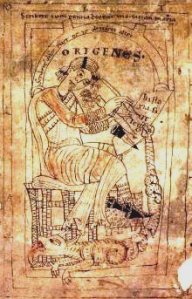
Image credit: https://commons.wikimedia.org/wiki/File:Origen3.jpg – Public Domain
Peter Boghossian is perhaps most famous for his work A Manual for Creating Atheists. In this work, he argues that believers–and Christians specifically–see faith as belief without evidence or “pretending to know what you don’t know” (Manual… [Durham, NC: Pitschstone Publishing, 2013]), 7ff. Many atheists throughout time have pushed a redefinition of faith, claiming that Christians believe without or against evidence.
Origen (ca.184-253), one of the most prolific early Christian writers, was also one of the first to offer a defense of Christianity. In his work Contra Celsusm (available for .99 in Origen’s works), in which he answered a skeptical Greek interlocutor, Ceslus, Origen began Chapter X of Book I with words that may seem to demonstrate the notion that faith is belief without evidence:
[W]e must say that, considering it as a useful thing for the multitude, we admit that we teach those men to believe without reasons, who are unable to abandon all other employments, and give themselves to an examination of arguments…
Before the party gets started however, the rest of this chapter from Origen is well-worth considering. Indeed, Origen argued that all positions require belief without reasons, and continues the above quotation directly: “and our opponents, although they do not acknowledge it, yet practically do the same.” Origen, in other words, alleged that both Christians and non-Christians must believe, in some cases, without evidence or reasons. Why? He explained:
For who is there that, on betaking himself to the study of philosophy, and throwing himself into the ranks of some sect, either by chance, or because he is provided with a teacher of that school, adopts such a course for any other reason, except that he believes his particular sect to be superior to any other? For, not waiting to hear the arguments of all the other philosophers, and of all the different sects, and the reasons for condemning one system and for supporting another, he in this way elects to become a stoic, eg., or a Platonist… or a follower of some other school, and is thus borne, although they will not admit it, by a kind of irrational impulse to the [selected] practice…. to the disregard of the others…
Origen, then, notes that humans are prone to jumping on board with whatever philosophy they first sign up with. Whether that is Christianity or militant atheism, we tend to explore that which we find familiar. Moreover, we approach rival philosophies with bias. Any philosophical position, argued Origen here, is one that we accept to some extent without evidence. After all, no one really can examine every rival belief and find that one’s own is the only one that is reasonable. Rather, we must accept that we have the relevant information at hand and move forward on that information.
Origen’s argument flies in the face of skeptics like Boghossian. Rather than accepting a definition of faith as belief without evidence, Origen notes that all belief systems have elements that are held without evidence. We seek self-confirmation. We often find it. Origen doesn’t leave it there however, through the rest of the book, he answers many objections to Christianity that persist to this day. Christianity, Origen argues, is reasonable and stands against the objections people bring against it.
Links
Be sure to check out the page for this site on Facebook and Twitter for discussion of posts, links to other pages of interest, random talk about theology/philosophy/apologetics/movies and more!
Is Faith a False Epistemology?- Debate Review: Tim McGrew vs. Peter Boghossian– I review a modern debate about this same topic between Peter Boghossian and Tim McGrew.
Eclectic Theist– Check out my other blog for posts on Star Trek, science fiction, fantasy, books, sports, food, and more!
SDG.
——
The preceding post is the property of J.W. Wartick (apart from quotations, which are the property of their respective owners, and works of art as credited; images are often freely available to the public and J.W. Wartick makes no claims of owning rights to the images unless he makes that explicit) and should not be reproduced in part or in whole without the expressed consent of the author. All content on this site is the property of J.W. Wartick and is made available for individual and personal usage. If you cite from these documents, whether for personal or professional purposes, please give appropriate citation with both the name of the author (J.W. Wartick) and a link to the original URL. If you’d like to repost a post, you may do so, provided you show less than half of the original post on your own site and link to the original post for the rest. You must also appropriately cite the post as noted above. This blog is protected by Creative Commons licensing. By viewing any part of this site, you are agreeing to this usage policy.
Really Recommended Posts 8/12/16- Luther, Strauss, and more!
I’m a little late in the day, but I still managed to get a post together for you, dear readers, full of reads that are worth tracking down across the web. This week we have Luther, Strauss, 1 Timoth 2:12, and Left Behind theology.
Left Behind and the dark side of rapture theology– I don’t agree with everything said here, but this is an interesting look at rapture theology and a potential difficulty with it.
Revisiting the Clarity of 1 Timothy 2:12– an extensive examination of the meaning of 1 Timothy 2:12, particularly in regards to gender.
Christian Thinkers 101: A Crash Course on Martin Luther– A great primer on the basics of Martin Luther, including a helpful infographic that is easily shared.
The New Faith of Strauss– Strauss was one of the historical critical scholars who effectively mythologized the Bible. Historical criticism is not itself a bad thing–indeed, it is a very good thing–but when someone takes it to the extremes Strauss did, it becomes something else. Here is a commentary from a contemporary on the “new faith” of Strauss.
“Her Dangerous Visions” by Brandon Barr- Prophecy, Evil, and Hope
 Brandon Barr’s Her Dangerous Visions is a science fiction/fantasy drama that will suck you in and not let go. Here, I’ll offer a brief review of the book alongside a few comments on themes found therein. The shortest possible review is: get the book, it’s great.
Review
Barr’s writing style is direct, but has depth. There is an enormous amount of political drama, tension around love, and action packed into each page of the book. Moreover, Barr seamlessly combines elements of science fiction and fantasy, such that it is difficult to categorize the book neatly. But that combination works remarkably well here, as Barr moves from farms to space with ease.
This first entry in the series offers glimpses of a broader universe, leaving readers wanting more from future installments. The focus is on the planets that are involved in a conflict, Loam and Hearth, that is apparently much more than any of their inhabitants realize.
Barr’s style is driven by characters. The characters are all remarkably deep. They have qualities that make readers get immediately invested, and faults that make readers want to scream at the pages as they watch favorite characters make foolish choices time and again. Meluscia was my favorite character–a woman whose ailing father is debating whom to appoint as his successor. She works to become that successor, but her desires in other areas could throw her off her apparently single-minded quest. Winter, another character, is said to be a seer, but the visions she sees continue to show sickening danger. Does she share the visions to try to prevent what they foretell, or keep them silent in the hopes that sharing them will not cause them to happen? Each character, as I said, is full of depth and develops of the course of the story. They feel very real–with motivations, aspirations, and faults that drive them.
The plot itself is complex, with layers peeled away through the course of the book and in interludes between sections. The pace never lets up, and once readers start, they won’t be able to put it down.
Overall, Her Dangerous Visions is a simply phenomenal read. I highly recommend it, just be ready to read for a while, because you’ll want to dive into the next book ASAP.
There will be SPOILERS in what follows.
Prophecy
Prophecy is clearly an important part of the book and the whole series. Winter’s gifting as a Seer means that she must try to understand what it means and come to comprehend it. There are portions where scenes with Winter remind me of biblical prophets and their own struggles. Think about it: how many prophets truly had it easy in the Bible? Nathan had to tell the King he’d committed great evil; Elijah was hunted for much of his career; John the Baptist ate bugs in the wilderness; etc. Similarly, Winter doesn’t have it easy, and finds herself questioning the wisdom of deity in this book. There is more to be explored in the coming books in the series, but at the end of Her Dangerous Visions, it is difficult to see where Winter may end up on her journey.
Evil
Evil is not often black-and-white in the real world, but there are some clear instances of it being such (i.e. Stalin/Hitler). Similarly, Barr’s book shows evil at times being black-and-white, but at other times it is much more subtle. Much of the evil in the book is from the characters themselves–finding themselves motivated wrongly by lust or vengeance rather than by virtues. It is a dimension that, as I said, makes the characters feel very real, and causes reflection in readers.
Hope
In our world, hope may be found in Christ, no matter how bad the darkness gets. Similarly, in Her Dangerous Visions, hope is found in trusting in others and the goodness of God. The spiritual realm in the novel is not fully revealed yet, so it will be interesting to see how it comes to be shaped over time.
Conclusion
I’d recommend readers pick up Brandon Barr’s book. He’s a man of faith who has written a phenomenal set of novels that are thought-provoking and thrilling.
Links
Be sure to check out the page for this site on Facebook and Twitter for discussion of posts, links to other pages of interest, random talk about theology/philosophy/apologetics/movies and more!
Popular Books– Read through my other posts on popular books–science fiction, fantasy, and more! (Scroll down for more.)
SDG.
——
The preceding post is the property of J.W. Wartick (apart from quotations, which are the property of their respective owners, and works of art as credited; images are often freely available to the public and J.W. Wartick makes no claims of owning rights to the images unless he makes that explicit) and should not be reproduced in part or in whole without the expressed consent of the author. All content on this site is the property of J.W. Wartick and is made available for individual and personal usage. If you cite from these documents, whether for personal or professional purposes, please give appropriate citation with both the name of the author (J.W. Wartick) and a link to the original URL. If you’d like to repost a post, you may do so, provided you show less than half of the original post on your own site and link to the original post for the rest. You must also appropriately cite the post as noted above. This blog is protected by Creative Commons licensing. By viewing any part of this site, you are agreeing to this usage policy.
Sunday Quote!- Why invite sinners?
Image credit: https://commons.wikimedia.org/wiki/File:Origen3.jpg – Public Domain
Every Sunday, I will share a quote from something I’ve been reading. The hope is for you, dear reader, to share your thoughts on the quote and related issues and perhaps pick up some reading material along the way!
Why Invite Sinners?
Origen is one of the greatest thinkers in the history of Christianity. In one of his works, Contra Celsum (available in an excellent Kindle edition of his works), he replies to the skeptic, Celsus, who charged Christians with effectively dismissing sin and inviting the unrighteous into Christianity instead of the righteous. Origen replied in Book III, Chapter LXI:
Not to participate in mysteries, then, and to fellowship in the wisdom hidden in a mystery, which God ordained before the world to the glory of His saints, do we invite the wicked, and the thief, and the housebreaker, and the prisoner, and the committer of sacrilege, and the plunderer of the dead, and all those others whom Celsus may enumerate in his exaggerating style, but such as these we invite to be healed.
Origen’s point is that Christianity is a religion that does call sinners of all varieties, but it does not call them to a kind of “free pass”- it calls them to the healing that can only be had through the washing by the Lord Jesus Christ.
Links
Be sure to check out the page for this site on Facebook and Twitter for discussion of posts, links to other pages of interest, random talk about theology/philosophy/apologetics/movies and more!
On Christian Music– I wrote a post about the label “Christian music” and how that can lead to a number of difficulties with discernment.
Christian Discernment Regarding Music: A Reflection and Response– I reflect in depth on how we can use our discernment properly when it comes to music.
Sunday Quote– If you want to read more Sunday Quotes and join the discussion, check them out! (Scroll down for more)
Eclectic Theist– Check out my other blog for my writings on science fiction, history, fantasy movies, and more!
SDG.

 J.W. Wartick - Reconstructing Faith
