J.W. Wartick
Book Review: “Pig and the Accidental Oink! – Picture Book Apologetics”
 When I found out about “Picture Book Apologetics” I was intrigued by the notion of bringing apologetics into the realm of picture books. Pig and the Accidental Oink!
…What? Right, that’s what the book does. But J.D. Camorlinga, the author, doesn’t just throw phrases like that into the children’s book. For this review, I’ll start at the end. The end of the book has two pages dedicated to parents interested in taking the content of the book beyond its pages. One page has an activity suggestion, the other has an explanation of the content in greater detail (here is where the term “Kalam Cosmological Argument” is used–and defined!).
The activity involves chocolate chip cookies (a bonus) and uses them to explain the notion that something does not come from nothing. The note to parents is helpful and provides avenues for further exploration.
The picture book itself is engaging and fun. Two children encounter a pig, who insists that “It makes more sense to believe that everything began by accident” than that God created the universe. The children go home, dejected, but their father explains that things don’t just pop into existence out of nothing; observation in the lives of the children shows that things which begin have causes. Armed with a new strategy for discussing beginnings, the children return to Pig and convince him that he can’t just posit an accident as the most reasonable explanation when his own experience contradicts it. They then run and play together happily.
Though I’m not completely sure about the wisdom of making the skeptical stand-in a pig (a bit too polemical, perhaps?), there is much to commend in Accidental Oink! The story is fun to follow; the characters are interesting, and the art is great. The illustrations are quite good. They’re what looks like colored pencil drawings and they’re vibrant and they avoid the generic look that some children’s books have. There remains a kind of charming style throughout the book that is recognizable on its own. Moreover, it’s definitely the kind of book to start all kinds of great conversations.
Pig and the Accidental Oink!
Links
Be sure to check out the page for this site on Facebook and Twitter for discussion of posts, links to other pages of interest, random talk about theology/philosophy/apologetics/movies and more!
Youth Apologetics Network– An interesting site which seeks to provide resources for youths related to apologetics. They are affiliated with Picture Book Apologetics as well. Great resources to explore for those interested in youth ministry.
——
The preceding post is the property of J.W. Wartick (apart from quotations, which are the property of their respective owners, and works of art as credited; images are often freely available to the public and J.W. Wartick makes no claims of owning rights to the images unless he makes that explicit) and should not be reproduced in part or in whole without the expressed consent of the author. All content on this site is the property of J.W. Wartick and is made available for individual and personal usage. If you cite from these documents, whether for personal or professional purposes, please give appropriate citation with both the name of the author (J.W. Wartick) and a link to the original URL. If you’d like to repost a post, you may do so, provided you show less than half of the original post on your own site and link to the original post for the rest. You must also appropriately cite the post as noted above. This blog is protected by Creative Commons licensing. By viewing any part of this site, you are agreeing to this usage policy.
Doubts about Evidentialism? C. Stephen Evans and a fideistic problem for evidentialists
 I’ve been reading through a few books related to apologetic methodology and epistemology of late. Most recently, I have finished Faith Beyond Reason: A Kierkegaardian Account by C. Stephen Evans. One thing that struck me in the book was a brief discussion of a possible difficulty with evidentialism as an apologetic methodology. Evidentialism is, essentially, the notion that apologetics should be based upon evidences to convince unbelievers of the truth of Christianity.* Evans himself did not direct a specific attack against the method, but some of his work could be perceived as a critique of the method. Specifically, he discussed Kierkegaard’s rejection of evidentialism:
[Kierkegaard] wants to argue that if you want something like an eternal happiness more than anything else, then it may be reasonable to commit yourself wholeheartedly to something that promises to help you obtain it, even if the chances of obtaining what you seek are not high because the objective probability that eternal happiness is truly to be gained in this way is not high either. (Evans, 108, cited below)
The thrust of this point is that one may, perhaps, rationally commit to a belief when the risk/reward is at a certain level. It’s a little similar to Pascal’s Wager, but Evans has more in mind than this: “[I]f your desire for this good is high enough… then even a very low probability would be sufficient to motivate belief” (ibid). The argument is therefore more subtle than a simple risk/reward scenario.** Instead, Evans’ point (or at least his exegetical point regarding Kierkegaard) is that one’s own desires play into commitment to beliefs, and that this is not itself an irrational thing.
Yet this point may seem a bit devastating to evidentialists. After all, evidentialists would generally hold that one should not believe without sufficient evidence, and that theistic arguments are strong enough to convince others to believe. If, however, one may grant that it may be reasonable to hold to beliefs even if there is a very low probability on the basis of one’s desire for a certain end, then it seems that evidentialism may itself be a faulty grasping for rationalistic certainty.
Within Kierkegaard’s own context, he was certainly reacting against rationalism. But evidentialism is not reducible to stark rationalism. Rather, it is a method not only of apologetics but also of epistemic investigation, depending upon one’s usage. Perhaps the evidentialist may acknowledge that one may rationally commit to a position–say, theistic belief–based upon one’s desire for that great good, but that does not preclude evidences for that belief. More importantly, the evidentialist may introduce the concept of a defeater–a belief which may serve to disprove or make another belief more improbable. Once one has been presented with defeaters, one may not rationally cling to one’s belief simply because one desires the truth of it; instead, one must either defeat the defeaters themselves or have sufficient evidence to hold to the belief in spite of possible evidence against it.
It therefore seems to me that arguments like Kierkegaard’s point does not do much to discredit evidentialism. Rather, it merely provides a possibility for people to hold beliefs in the absence of evidence either way. Once one has evidence against one’s belief, however, one should–at risk of epistemic suicide–either ground one’s belief or show that the evidence against that belief is not firmly grounded. Evans seems to acknowledge this as well, for he noted the value of evidence despite the possibility for “properly basic” belief.
Of course the question of whether one “should” think one way or another is itself highly contentious. I’ll leave that debate for another post or, even better, the comments.
*Yes, I do realize I’ve vastly oversimplified here. That’s the nature of writing shortish blog posts! For what I consider the best discussion of different apologetic methodologies, check out Faith Has Its Reasons
**I also acknowledge that Pascal’s Wager is more complex than a simple risk/reward scenario.
Source
C. Stephen Evans, Faith Beyond Reason: A Kierkegaardian Account (Reason & Religion)
Links
Be sure to check out the page for this site on Facebook and Twitter for discussion of posts, links to other pages of interest, random talk about theology/philosophy/apologetics/movies and more!
SDG.
——
The preceding post is the property of J.W. Wartick (apart from quotations, which are the property of their respective owners, and works of art as credited; images are often freely available to the public and J.W. Wartick makes no claims of owning rights to the images unless he makes that explicit) and should not be reproduced in part or in whole without the expressed consent of the author. All content on this site is the property of J.W. Wartick and is made available for individual and personal usage. If you cite from these documents, whether for personal or professional purposes, please give appropriate citation with both the name of the author (J.W. Wartick) and a link to the original URL. If you’d like to repost a post, you may do so, provided you show less than half of the original post on your own site and link to the original post for the rest. You must also appropriately cite the post as noted above. This blog is protected by Creative Commons licensing. By viewing any part of this site, you are agreeing to this usage policy.
Sunday Quote!- Does Science Limit Exegesis?
 Every Sunday, I will share a quote from something I’ve been reading. The hope is for you, dear reader, to share your thoughts on the quote and related issues and perhaps pick up some reading material along the way!
Does Science Limit Exegesis?
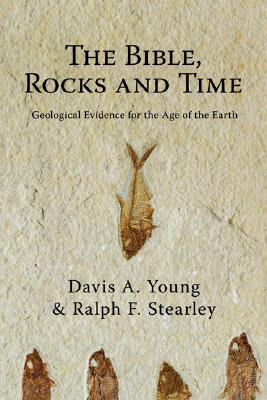
I’ve been rereading The Bible, Rocks and Time: Geological Evidence for the Age of the Earth
[T]he claims advanced in favor of a young Earth or Flood geology remain unacceptable to the scientific community. Thus their claims should also be unacceptable within the church, which… ought to be committed to truth and reality–for the simple reason that the young-Earth creationist claims lack scientific credibility. (161)
Now I think this is a pretty obviously controversial claim for a few reasons. First, the immediate question is how broad Davis and Stearley are intending this to be. After all, one might say that God creating the universe is “unacceptable” depending how one defines the scientific community. Of course, they do qualify the statement by noting that what they mean is that the evidence young earth creationists put forward can often, in principle, be tested for; and when tested, it fails muster. In this sense, I think that one might say the statement is acceptable.
Second, one may object to this noting that science often changes consensus, so what is “unacceptable” today becomes in vogue tomorrow. A problem with this claim is that it flies in the face of the real, overwhelming evidence for an ancient Earth. I’ve examined this and many other arguments YECs put forth in my post on YEC arguments.
Third, one might wonder exactly how Davis and Stearley think science and exegesis are supposed to interact. Though this is a far cry from the purpose of their book, statements like these beg the question of whether science really does limit exegesis.
What are your thoughts?
Links
Be sure to check out the page for this site on Facebook and Twitter for discussion of posts, links to other pages of interest, random talk about theology/philosophy/apologetics/movies and more!
Answering Common Young Earth Creationist Arguments– I evaluate a number of arguments for young earth creationism. There are a large number of biblical, philosophical, and scientific arguments briefly answered here.
What options are there in the origins debate? – A Taxonomy of Christian Origins Positions– I clarify the breadth of options available for Christians who want to interact on various levels with models of origins. I think this post is extremely important because it gives readers a chance to see the various positions explained briefly.
Source
Davis A. Young and Ralph F. Stearley, The Bible, Rocks and Time: Geological Evidence for the Age of the Earth
Really Recommended Posts 5/2/14- Hitler’s Philosophers, Lutheranism, and more!

I’ve once more gone through the internet archives to bring together a slew of awesome posts for you, dear readers! Let me know your thoughts, and feel free to share links you’ve enjoyed. I may even put them on an upcoming RRP!
Why I was Once an Atheist– Pastor Matt was a PK–a pastor’s kid–(like me!) and he had some expereinces in the church which led to his atheism. Reading his thoughts provides insight into what we can do better for our children and beyond.
Sanctification– Imagine a woman hearing these words: “The guys just don’t feel like they would be able to lead you spiritually…” What follows from a view in which men spiritually lead women without question? What roles do men and women play?
Why Pro-Life People Need to Become Amateur Philosophers– It is important to have some philosophical knowledge in order to make the case for the pro-life position. Here, some basics are covered with relevance for the issue.
Ways to be Lutheran– How are Lutheran splinter denominations working? What developments and trends are forming in the U.S.? An interesting background for Lutheranism in the United States. I thought it was worth the quick read.
Review: Hitler’s Philosophers by Yvonne Sherratt– What philosophical motivations lay behind Hitler’s activities? This interesting book review talks about some of them. What are your thoughts?
Bruce Gordon: problems with inflationary multiverse cosmologies– What of the multiverse? Might there be evidence for it?
Perspicuity and Inerrancy- a dialogue response
 Recently, a fellow blogger responded to my post on arguments for young earth creationism. This blogger insinuated that I deny inerrancy because I do not hold to young earth creationism. I’ve run into this frequently and apart from the fact I frequently defend inerrancy (simply scroll down to read several posts to this end), I think that Christians should not falsely represent others. For the record, I affirm inerrancy. If you say I do not, you are giving false testimony against a neighbor.
Anyway, once more, this is the link for the post that I’m responding to. Here’s the post he responded to.
The issue this fellow blogger brought up is the issue of perspicuity. At some point I’ll try to dedicate a post specifically to perspicuity and inerrancy, but for now I want to focus on how it is used to try to say every single point in Scripture is just utterly clear. I often run into this in discussions over theological issues. One person claims perspicuity for their reading, and thus says that anyone who disagrees denies the clear meaning of the text. Of course, it is appropriate to point out such clear meaning and offer correction, but one has to argue for that clear meaning rather than simply accuse the other of denying inerrancy. Also, apart from the fact that perspicuity has historically changed in meaning due to controversies during the Reformation, there is also the simple fact that defining perspicuity as the clarity of Scripture in everything simply doesn’t work. We’ll see why I say this below.
I’d like to make public record of my response and get readers’ thoughts as well. Here’s what I commented on his blog, in its entirety. I address “you” to the author of the blog response:
Thanks for taking the time to respond. I have a few thoughts, and I’ll try to be brief.
First, the doctrine of perspicuity changed during the Reformation period. As I [very] briefly point out in my post on sola scriptura in the Reformation (https://jwwartick.com/2012/10/15/who-interprets-sola/), this was because the Reformers realized there was genuine disagreement over certain passages of Scripture.
Second, there are some issues within Scripture which are genuinely unclear. If you want to deny that, I would suggest you basically have to ignore the text of Scripture. There are a number of issues: for example, underdeterminiation. One looks in vain to find the amount of detail we often wish we had on people that are listed in the genealogies, for example. More concrete examples would be the question of the meaning of certain words, lining up some apparent differences in the Gospels, etc. For example, would you say that Matthew 28:1-7 is unclear? Ah, but it says there is one angel there who speaks to the women. But then is Luke 24:1-8 unclear? But it says there are two angels!
I bring up this example not to say there is an actual contradiction (after all, it seems that Matthew just reports the one who talks), but rather to show the appeal to clear verses does not always solve the apparent difficulties. Unless you want to say that either Matthew or Luke are unclear, you have an apparent contradiction which is not solved by a “clearer” text. It is solved by thoughtful reflection and looking more deeply into the backgrounds, the way oral tradition was passed along, and the like. But your post suggests we can simply cast about for a “clearer” text to figure out the unclear. Tell me, which is unclear, Matthew or Luke?
Third, your view of perspicuity seems to mean that we only learn from being spoon fed easy truths, the exact opposite of the difference between milk and meat that Paul suggests. For example, you wrote:
“Probably the clearest example of the perspicuity of Scripture is found in Paul’s words to Timothy in 2 Timothy 3:16, 17 which says, ‘All Scripture (not just the Gospel message) is given by inspiration of God, and is profitable for doctrine, for reproof, for correction, for instruction in righteousness, that the man of God may be complete, thoroughly equipped for every good work.’ How can a person profit from Scripture so as to be reproved by it, corrected by it, and instructed in righteousness by it, if it was so unclear he had difficulty understanding it?”
Have you never learned anything by being confronted with a difficult problem and striving to understand it? I suspect that you have. I suspect you’ve struggled with specific portions of the text and come out better for it when you came to reconcile the text through other observations, insights, and reflection. If you haven’t I certainly have, and I know many others who have as well.
Regarding this text, I’d also simply point out that the interpretation of it is quite forced. Is the intent of the text teaching us that all of Scripture is inspired and profitable, or is it teaching us we can just expect to understand everything?
Finally, I firmly affirm and defend inerrancy and any suggestion to the otherwise should be withdrawn. Difference of opinion over interpretation should not be taken as denying inerrancy. Rather than misrepresent your Christian brother, you should stand beside me in a defense of inerrancy. We differ on interpretation of certain texts. Unless you take your interpretation to be itself inerrant and the word of God, I ask you to stop slandering me by implying I deny the doctrine.
Book Review: “How God Became Jesus” edited by Michael Bird
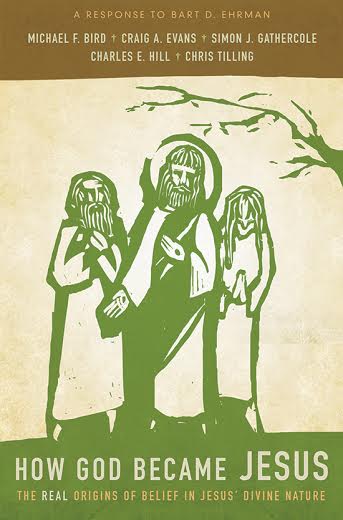 Bart Ehrman has made a name for himself through critical scholarship of Christianity. His latest challenge, a book called How Jesus Became God, contains an argument that the notion that Jesus is God was a later development in the church and not reflective of the earliest teaching. Interestingly, the book was published alongside a response book, How God Became Jesus, in which multiple scholars argue that, far from being a late development, high Christology was the belief of the church.
The book is a series of essays organized around responding to Ehrman’s book essentially point-by-point. Ehrman’s central thesis, that Jesus Christ was exalted from human to deity over the course of theological reflection and some centuries, is directly confronted in a number of ways. First, Michael Bird challenges the thesis by pointing out some major errors in the Ehrman’s use of angels and other exalted beings. Later, a kind of death blow is dealt to the thesis by pointing out that even within the earliest writings there is the alleged full “range” of development of the doctrine of Christ as divine (136ff). Simon gathercole provides interesting philosophical insight into the use of types of change in relation and actuality (114-115).
Other challenges brought against Ehrman include critical analysis of his methodology (Chris Tilling, 117ff), historical insight into the development of orthodoxy (Charles Hill, 151ff), and insight into Christ’s own claims of deity (Bird, 45ff). These present a broad-spectrum approach to analysis of Ehrman’s arguments and demonstrate the difficulty of maintaining his thesis. Readers are exposed to methodological, factual, exegetical, and other errors in Ehrman’s work.
However, the book should not be seen merely as a response to Ehrman. Although it is structured around just such a response, it is a worthy read in its own right because it provides background for exploration of the deity of Christ found throughout Scripture. It also helps readers place these writings in context by showing the cultural surroundings of the discussions over the deity of Christ. Moreover, by analyzing many of Ehrman’s skeptical claims, the authors provide responses to a broader range of objections to the Christian faith. For example, Craig Evans’ essay on the evidences for the burial traditions provides insight into how crucifixion worked in practice and, importantly, how the Biblical narratives line up with these practices.
Various excurses provide documentary evidence for things like 2nd and 3rd century belief in Christ’s deity. These help to break up the book, which can easily be read chapter-by-chapter or as individual essays.
How God Became Jesus is a great read. It provides insight not only for a response to Ehrman’s thesis but also for a number of other issues that come up when talking about the incarnate Lord Jesus Christ. Each essay has much to commend it, and the excurses found throughout provide ways forward to research various other topics. The book is a solid resource for those interested in the deity of Christ.
My thanks to Baker Book House for the book as a gift. Check out their awesome blog to read a number of theological posts a week.
Links
Be sure to check out the page for this site on Facebook and Twitter for discussion of posts, links to other pages of interest, random talk about theology/philosophy/apologetics/movies and more!
Source
How Jesus Became God edited by Michael Bird (Grand Rapids, MI: Zondervan, 2014).
SDG.
——
The preceding post is the property of J.W. Wartick (apart from quotations, which are the property of their respective owners, and works of art as credited; images are often freely available to the public and J.W. Wartick makes no claims of owning rights to the images unless he makes that explicit) and should not be reproduced in part or in whole without the expressed consent of the author. All content on this site is the property of J.W. Wartick and is made available for individual and personal usage. If you cite from these documents, whether for personal or professional purposes, please give appropriate citation with both the name of the author (J.W. Wartick) and a link to the original URL. If you’d like to repost a post, you may do so, provided you show less than half of the original post on your own site and link to the original post for the rest. You must also appropriately cite the post as noted above. This blog is protected by Creative Commons licensing. By viewing any part of this site, you are agreeing to this usage policy.
“Husband of One Wife” – What does this mean?
 A common argument for limiting the pastoral ministry to men only is to cite a number of texts where the requirements for elders/overseers/etc. are given. Among these, one which allegedly shows that women are not to hold positions of authority in the church is the statement that the holder of such a position is to be the “husband of one wife” (1 Timothy 3:2; 12; Titus 1:6).
On the face of it, this seems to be a pretty telling argument. After all, if someone is the husband of one wife, then that would certainly seem to exclude women! So what’s the problem?
Is your pastor married?
You see, if someone wants to take the statement in its most literal sense, it isn’t merely, abstractly stating that the overseer/bishop/deacon/elder is supposed to be a man; it is actually saying he is supposed to be a husband.* So if one wants to take the Bible in its most “literal” reading, then one must argue that not only may women not be pastors; neither may any unmarried (or remarried, or divorced, or widowed, etc.) men. Period.
So what’s the problem with this? The problem is that once we get to this level, it should be pretty easy to see how absurd the argument is. What the phrase is intended to convey is monogamy. That is, church leaders are to be monogamous. The teaching is pretty clear when understood in this light. If one is to be a leader in the church, it should be easily observable that they are monogamous and celibate apart from marriage. There are to be no exceptions.
If someone wants to dispute this and press that the real point is that one must be a man, then they must equally argue that no church leader should be unmarried. Considering Paul himself extolled the values of remaining unmarried (and was himself unmarried), such a reading of Paul is problematic, at best.
All of this is to set aside the other difficulties with using passages like this to restrict women from the ministry. One example is the excessive addition of male pronouns into the English translations which are not present in the Greek (see Philip Payne, Man and Woman: One in Christ, 445 [I have reviewed this book here]). Another problem is that they seem to be teaching against polygamy as opposed to any type of gender restrictions (ibid). Finally, the lists of requirements are stated in such a way as to make it actually open for women to hold such offices (Payne, 448-452).
Even if one disagrees on the last paragraph, it should be clear that one cannot use these passages to restrict women from the ministry. They simply do not have the data in them to allow for such a restriction.
*(Yes, I am aware that it may be translated “man of one woman,” but that just makes it extremely clear that the meaning is supposed to be referring to husband and wife. After all, what other reason could there be to be “of one woman”?)
Links
Be sure to check out the page for this site on Facebook and Twitter for discussion of posts, links to other pages of interest, random talk about theology/philosophy/apologetics/movies and more!
Check out my posts on egalitarianism (scroll down for more).
Paul Adams has a series of posts on Philip Payne’s work discussed herein. Check out his series, starting with the first post.
SDG.
——
The preceding post is the property of J.W. Wartick (apart from quotations, which are the property of their respective owners, and works of art as credited; images are often freely available to the public and J.W. Wartick makes no claims of owning rights to the images unless he makes that explicit) and should not be reproduced in part or in whole without the expressed consent of the author. All content on this site is the property of J.W. Wartick and is made available for individual and personal usage. If you cite from these documents, whether for personal or professional purposes, please give appropriate citation with both the name of the author (J.W. Wartick) and a link to the original URL. If you’d like to repost a post, you may do so, provided you show less than half of the original post on your own site and link to the original post for the rest. You must also appropriately cite the post as noted above. This blog is protected by Creative Commons licensing. By viewing any part of this site, you are agreeing to this usage policy.
Sunday Quote!- The Invention of Religion
 Every Sunday, I will share a quote from something I’ve been reading. The hope is for you, dear reader, to share your thoughts on the quote and related issues and perhaps pick up some reading material along the way!
The Invention of Religion
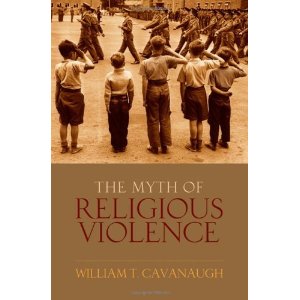
One book which has influenced my thought quite a bit was The Myth of Religious Violence. I recently reread the book and thought I’d share a rather poignant quote:
There was a time when religion, as modern people use the term, was not, and then it was invented. (81)
The notion that religion is a socially constructed concept is essential to Cavanaugh’s work, and he argues meticulously towards this end. His point is not that all so-called “religions” are false. Rather, his point is that the notion that there is such a thing as a secular/religious dichotomy is itself a construct with a historical development. Moreover, this construct, he argues, has been useful for creating an “Other” who is then deemed “religious” in order to separate this Other from spheres of influence. It’s a highly interesting book, and one I recommend strongly. I have reviewed it here.
What do you think? How might you define “religion”? If Cavanaugh is right, how might this notion influence your thought?
Links
The Myth of “Religion”: Constructing the Other as an enemy– Here, I draw out more of Cavanaugh’s claims regarding the usage of the term “religious” and how it is used at times to create an “Other” to repudiate.
Book Review: “The Myth of Religious Violence” by William T. Cavanaugh– I review the book which has led me to discuss the ways the category of religion is used to stigmatize the other and also forced me to rethink a number of issues. I highly recommend this book.
Source
William T. Cavanaugh, The Myth of Religious Violence
SDG.
Really Recommended Posts 4/25/14- Dean Koontz, egalitarianism, “Cosmos,” and more!
 Here, I have a list of great reads for you to browse, from Easter errors to Dean Koontz, from marriage to atheism. Check them all out, and let me know what you thought!
Five Errors to Drop from Your Easter Sermon– Check out this read on common mistakes made when talking about Easter.
Tie-Breaker– What happens when married couples come to a point where they are at an impasse? Does there need to be a marital tie-breaker grounded in notions of hierarchy of genders? Check out this thought-provoking post on the topic. For my own thoughts on the topic, check out my post “Who’s in Charge?” over at CBE.
Dean Koontz’s “Innocence”– From the author (links removed), Anthony Weber, “Dean Koontz is perhaps the most famous Christian author alive today. He has sold over 450,000,000 books, with 17,000,000 added each year. He’s sold more books than Stephen King…” That’s why you should care about the guy. Check out this look at a recent book from Koontz.
What I Needed to Hear as an Atheist (And How I Needed to Hear It)– Approach matters! Check out this fantastic post on how we may approach atheists who are wondering about the faith.
Cosmos Scrubs Religion’s Positive Influence from the History of the Scientific Revolution– The TV series “Cosmos” has seemingly purged any notion of the positive influence of religion from the history of scientific development. Check out this insightful article which explores some of this history and the way “Cosmos” has distorted it.
Comic Review: “Samson the Nazirite: Volume 1”
 Samson the Nazirite is the latest installment from Rooted Chronicles, a publisher describing itself as follows: “Our stories, or chronicles if you will, are a visual retelling of the Bible. We have passion, love, and reverence for the Scriptures, and so we strive to stay true, grounded, and rooted to the Biblical account we are retelling.” Samson is one of my favorite biblical characters, so I was excited to see his story depicted in comic book form. Here, we’ll take a look at it from an apologetic perspective.
Bible to Comic
One difficulty with putting stories from the Bible (particularly the Old Testament) into other forms of narration is that the biblical account is often undetermined. That is, there are rarely many details that we are used to in our novels. Samson’s story is one which has more detail in the narration than many, and the comic plays off of that by enhancing the narrative elements. It is very true that the comic stays close to the biblical account, while also introducing names and characters not mentioned therein.
The art in Samson the Nazirite is breathtaking. Seriously, this has some simply fantastic artwork. The details, shading, and depth in each panel are astounding. When the spirit of the LORD comes upon Samson, it comes in visual ways (creative license) by shining of Samson’s flesh at times.
The story is as compelling as it has always been to me. An imperfect man is chosen by God to carry out God’s will on Earth. Samson is depicted as I would imagine him: a oft-violent, impetuous, obsessive man. But he also realizes that he is part of God’s plan and his personality is at times tempered by that. I can’t wait to see the conclusion in volume 2.
Apologetic
The visual arts offer compelling ways to relate to the Bible in unforeseen ways. By seeing the story on paper, we are able to conceptualize it in ways not always immediate in the text. in Samson, for example, the angel of the LORD appears brightly as a shining angel. The strangeness of the situation and the fear such an appearance could bring about are made plain on the pages of a comic. By advancing the narrative through this visual medium, the author and artists create an apologetic narrative for the biblical text. The pictures draw us, like the story, to consider meaning beyond the text and images.
The practice of creating art like this comic is itself an apologetic practice. By thinking of imagery which will capture the imagination, the creators of a comic are engaging in a discourse with the text, drawing out its meaning in imaginative ways. The imagination is deeply connected to the intellect (consider the Narnia series, for example). Thus, by engaging the imagination, the creators of Samson also engage the mind in unique ways.
Comics?
I have talked to others about comic books as means to communicate Scripture before, and have been met with some resistance. One major critique is the notion that comics cannot adequately convey the meaning of the text. However, extensive portions of Scripture are grounded in narrative through visual imagery which lends itself to the visual arts. Anyone who has seen paintings of various biblical scenes knows that a single painting can capture the imagination and thus capture the intellect in unforeseen ways. Seeing something depicted through the arts allows one to engage on different levels. Thus, I would argue that comics are an appropriate way to transmit biblical narratives.
Conclusion
Samson the Nazirite offers a compelling way to consider the biblical truths in new ways. Through its engaging art and story, readers are drawn to consider the truths beyond the imagery and called to the text of Scripture. By engaging with the mind, the comic compels deeper understanding and immersion in the story of God’s action in human history. I encourage readers to pick up the comic either at the website Samson the Nazirite in a hard copy or on kindle
Links
Be sure to check out the page for this site on Facebook and Twitter for discussion of posts, links to other pages of interest, random talk about theology/philosophy/apologetics/movies and more!
SDG.
——
The preceding post is the property of J.W. Wartick (apart from quotations, which are the property of their respective owners, and works of art as credited; images are often freely available to the public and J.W. Wartick makes no claims of owning rights to the images unless he makes that explicit) and should not be reproduced in part or in whole without the expressed consent of the author. All content on this site is the property of J.W. Wartick and is made available for individual and personal usage. If you cite from these documents, whether for personal or professional purposes, please give appropriate citation with both the name of the author (J.W. Wartick) and a link to the original URL. If you’d like to repost a post, you may do so, provided you show less than half of the original post on your own site and link to the original post for the rest. You must also appropriately cite the post as noted above. This blog is protected by Creative Commons licensing. By viewing any part of this site, you are agreeing to this usage policy


