J.W. Wartick
Threshold Belief and Evidentialism- Can evidentialism work?
 The evidentialist school of apologetics is essentially based upon the notion that the evidence for Christianity is such as to make it rationally justified to believe (and perhaps even compel one to believe). Note that evidentialists (generally) do not claim that this means the Holy Spirit plays no part in conversion or that people are fully capable to choose God.* C. Stephen Evans, in his book Faith Beyond Reason: A Kierkegaardian Account, examined evidentialism in light of Kierkegaard’s critique of the method.
One of the primary arguments Kierkegaard had against evidentialism** is that a human being is incapable of considering the whole range of facts regarding a piece of evidence and so may never be justified in holding evidential belief. Evans characterized this argument (following the terminology of Robert Adams) the “postponement argument”:
The idea… is that historical inquiry is never completed, and thus historical beliefs based on such inquiry must always be tentative. It is always possible, at least theoretically, that new evidence will emerge that will overturn any historical conviction. Thus, if religious beliefs were based on such evidence, they would have to be of this tentative character. (Evans, 108, cited below)
Now–this is key–Evans also noted that “Kierkegaard thinks, however, that religious beliefs should have a kind of finality that differs from this kind of scholarly judgment.” With these quotes in mind, we may examine what seems to be a Kierkegaardian objection to evidentialism.
The objection seems to be that faith requires a kind of certainty which may never be provided by historical inquiry; thus, historical inquiry (evidences) may not provide a justifiable grounding for faith. I think the main problem with this is that Kierkegaard seemingly insisted on an impossible level of certainty for evidence. That is, a dismissal of evidentialism based upon this reasoning seems to be only warranted because Kierkegaard has adjusted the level of evidence needed. It is true that historical inquiry may only ever provide probability, but that does not imply we are incapable of believing anything historical.
Of course, one may argue that I have missed the point Kierkegaard is trying to make. It’s not that all historical inquiry must be subjected to the standard of certainty; rather, only on matters of ultimate import must we have certainty. If this were his claim, I think one may rightly respond by questioning why that would be the case. However, it seems, according to Evans, that Kierkegaard was less concerned with a rejection of evidentialism than he was concerned with maintaining a place for the emotions and subjectivity within faith. On that count, I don’t know of any evidentialist who would argue that one cannot have subjective or emotional reasons for faith either.
Now, to return at last to the quote block above. If all that faith were based upon within an evidentialist system were historical evidences, then it seems the quote is correct regarding the tentative nature of faith. But the evidentialist claim is not that faith may only be based upon evidence. Instead, it is that the evidence is such as to justify or ground faith (some would argue it is enough to compel faith). So perhaps Kierkegaard and evidentialism are not irreconcilable after all.
Perhaps the strongest objection which may be derived from the above comments from Evans and Kierkegaard center around the notion of threshold belief. Evans very briefly hinted at this possible problem for evidentialism: basically, the notion is that for the evidentialist method to work, there must be some “threshold” for commitment to a belief. For Kierkegaard, that threshold is certainty, which is why historical evidence cannot satisfy his criterion. However, for the evidentialists themselves, the question remains as to what that threshold is. If this threshold cannot be pinned down, it may be argued, evidentialism as a system cannot work. I think that this challenge is less an arguments against evidentialism than it is an argument for epistemic uncertainty. However, diving into such an argument is beyond the realm of what I want to hit here. For now, I think that I may answer this argument by simply saying that it does not follow that 1) if we can’t pin down an exact threshold beyond which we must be convinced to commit to a belief then 2) we cannot commit to a belief. The argument is simply off target.
Notes
*I say this so as to avoid lengthy debate, one way or the other, regarding how one comes to be saved. My intent in this post is to investigate the apologetic method, not soteriological details.
**I should note that Kierkegaard should be understood within his historical context, in which he was reacting against overly rationalistic faith. Thus, his (sometimes extreme) reaction against rationalism–while overreaching–is perhaps more understandable. There is also, of course, some anachronism in this statement because “evidentialism” is being used in its specific fashion to reference the method of apologetics, while Kierkegaard was reacting against rationalism. I acknowledge this anachronism but simply point out it is for the sake of simplifying terminology in the post.
Links
Be sure to check out the page for this site on Facebook and Twitter for discussion of posts, links to other pages of interest, random talk about theology/philosophy/apologetics/movies and more!
Sources
C. Stephen Evans, Faith Beyond Reason: A Kierkegaardian Account (Reason & Religion)
SDG.
——
The preceding post is the property of J.W. Wartick (apart from quotations, which are the property of their respective owners, and works of art as credited; images are often freely available to the public and J.W. Wartick makes no claims of owning rights to the images unless he makes that explicit) and should not be reproduced in part or in whole without the expressed consent of the author. All content on this site is the property of J.W. Wartick and is made available for individual and personal usage. If you cite from these documents, whether for personal or professional purposes, please give appropriate citation with both the name of the author (J.W. Wartick) and a link to the original URL. If you’d like to repost a post, you may do so, provided you show less than half of the original post on your own site and link to the original post for the rest. You must also appropriately cite the post as noted above. This blog is protected by Creative Commons licensing. By viewing any part of this site, you are agreeing to this usage policy.
Sunday Quote!- Every Story has a Worldview
 Every Sunday, I will share a quote from something I’ve been reading. The hope is for you, dear reader, to share your thoughts on the quote and related issues and perhaps pick up some reading material along the way!
Every Story Has a Worldview
I finished reading Hollywood Worldviews: Watching Films with Wisdom & Discernment
Every story is informed by a worldview. And so every movie, being a dramatic story, is also informed by a worldview. There is no such thing as a neutral story in which events and characters are presented objectively apart from interpretation. Every choice an author makes… is determined by the author’s worldview. (60)
Godawa’s point is similar to what I say quite often, with almost the exact words: every movie has a worldview. The same, as Godawa states, is true for any story. Every time someone tells a story, whether it is one they made up or one they picked up somewhere, it is slanted with worldview. We should be aware of this fact and be ready to critically engage with any story–fictional or non–so that we can bring into light the truths and falsehoods each story may contain.
What’s your best technique for critically engaging worldview in film? What other arts have you critically interacted with? How have you approached these?
Links
Be sure to check out the page for this site on Facebook and Twitter for discussion of posts, links to other pages of interest, random talk about theology/philosophy/apologetics/movies and more!
Engaging Culture: A brief guide for movies– I outline my approach to evaluating movies from a worldview perspective.
Source
Brian Godawa, Hollywood Worldviews: Watching Films with Wisdom & Discernment
Jesus had a wife!? Special Really Recommended Posts Issue
 Today, I have changed the standard “Really Recommended Posts” to be all about the “Gospel” of Jesus’ Wife. Check out the updated list of links for responses to this discovery. Also, it snowed again here (yes, in mid/late April), so I made this an “owl post” edition.
SEE UPDATE: It has become revealed that this fragment is almost certainly a fraud. But, if you’re still bothered by it, check out the links below.
UPDATE 2 (4/17/2014): The case has been reopened as some alleged new evidence has shown that the document might not be a forgery after all, which now makes the links below relevant again! I’ve also added a comedic video I found via Tim McGrew.
UPDATE 3 (5/2/2014): It seems to actually be likely, after all, that it is a forgery! Which is it? Anyway, I added this link to a discussion of the evidence of forgery. (5/4/14): Another update with a post summarizing much of the evidence that the manuscript is a forgery.
There has been a bit of an uproar about a 4th Century Coptic Manuscript which purportedly provides evidence that Jesus had a wife. Apart from the fact that it is 4th century and therefore a few hundred years after the events and during primetime for Gnostics making up facts about Jesus to undergird their own theological leanings, many seem to think this is somehow evidence against Christianity. Well, here are some great responses to the discovery.
Reality Check: The “Jesus’ Wife” Coptic Fragment– Daniel Wallace, an influential NT scholar, comments on the discovery. He really gets into some great textual-critical details here. I would say this is one of the more important responses. I highly recommend this response.
Durham University professor calls the “Jesus had a wife” manuscript fragment a forgery– Yep, folks, we might be cutting this one off pretty quickly. Some analyses are suggesting fragment is actually a hoax, and the arguments seem pretty decisive. See the next post:
The Gospel of Jesus’ Wife: How a Fake Gospel-Fragment Was Composed– This is a very interesting post which you can find Francis Watson, a professor of religion and theology at Durham University making a concise argument in a PDF which argues that the fragment is a fake. It’s a fascinating article, and perhaps destroys the whole controversy at the start. (To be fair, the late purported date of the fragment does little for me, anyway.)
New Coptic Fragment Says Jesus Was Married– A summary of skeptics’ attitudes towards historicity.
The Gospel of Jesus’ Wife?– Glenn Andrew Peoples has a simply fantastic discussion of the implications of this discovery. One of my favorite lines: “Prepare yourself. Suddenly, people are going to read a sensational article about a tiny scrap of parchment and become experts on early church history.”
Did Jesus Have a Wife?– A post which focuses on the authenticity of the document and the implications if it is indeed authentic. Another great response.
SHOCKING New Evidence Reveals 4th-Century Coptic Christians WONDERED If Jesus Was MARRIED!– What is the historical significance of the discovery, assuming it is genuine? A few very good, concise points.
So What if Jesus did Have a Wife?– Definitely an alternative approach. John Byron notes that Christians could grant that Jesus was married without somehow undermining the core doctrines of Christianity. This one is really interesting and I’m sure will be controversial. While not a response to this article, Aggie Catholics has a very different view of the implications of the discovery, while denying that it has historical import other than as showing the beliefs of Gnosticism: Proof That Jesus Was Married?
The Wife of Christ and the Bride of Christ– This post looks at the discovery from a more presuppositional type approach. We know the Bible is reliable, so what should we make of this discovery?
Stop the presses! Jesus was married! Oh no!– Carl Olson at the Catholic World Report comments on a number of issues with jumping to conclusions about the text. I found this one particularly insightful about how the discovery is being portrayed in the media.
Quick Thoughts on the New Jesus Wife Text– Darrell Bock, a prominent NT scholar, shares his thoughts on the implications of the text. It’s highly informative and concise.
Was Jesus Married?– A reflection on the way the media portrays stories like this along with an examination of the importance of the document and apologetics.
Get Ready for A Wave of Gnostic Looniness Again– James White notes that the discovery was made by a woman who loves to sensationalize gnosticism.
Shock! Horror! Jesus’ Wife! (Video)– a satirical video about the discovery and its alleged implications for Christian faith.
Gospel of Jesus’ Wife– New evidence has come up (5/1/14) which may show that the Gospel of Jesus’ Wife is indeed a forgery. This additional analysis suggests the fragment is forged, though the material may be genuine. H/T Tim McGrew for the find.
Wall Street Journal: How the Jesus’ Wife Hoax Fell Apart (5/4/14)- A post summarizing much of the evidence that this “Gospel of Jesus’ Wife” is indeed a forgery. There are a few comments on the end which I think are a tad unnecessary about those who are interested in women’s roles in the church and the like–after all, what one chooses to study does not necessitate certain views–but the summary of the evidence is great.
Engaging Culture: Demon Hunter’s “Extremist” and the Apologetic Task

Here, we’ll take a look at a recent album released by a favorite band of mine. Then, we’ll look at how this project relates to the broader field of apologetics.
Demon Hunter continues to release album after album, much to the delight of their fans (like me!). The heavy metal (in the spirit of nu metal/metalcore) band is formed of Christians who speak their faith through lyrics.
Musically, the album shows the range Demon Hunter has developed over time. There are a few ballads interspersed among numerous heavy riffs and screaming. The lead singer, Ryan Clark, has developed much since the first album. His voice is haunting when he sings, and his screaming continues to reverberate through the guitars and drums.
The lyrics are where the album truly shines. In “The Heart of a Graveyard,” for example, we find an existential call to awareness of the transcendent: “Tell me that your hopes and dreams don’t end in/the heart/Of a graveyard.” The cry to realize there is more to life than an ending “six feet” under is quite poignant. “I Will Fail You” is a heart-rending look into human nature: “I will fail you, of that I’m sure/I will remind you of the pain forevermore/And when my sins are just a memory, faith restored/I will fail you to the core.” The words are reminiscent of Paul’s words regarding his own failings in Romans 7:19 and present a clear call to the need for repentance. “Artificial Light” rejects the false replacements for true comfort and peace offered by a sinful world.
Overall “Extremist” is another excellent entry into Demon Hunter’s ever-growing list of hits. The music is intense, but the lyrics are truly the star in this album. From the existential need for salvation to themes of repentance and insight into human nature, Demon Hunter hit this one on all cylinders. I highly recommend the album.
So why post this review on a website dedicated to philosophy of religion, theology, and apologetics? Let’s not forget that one of the tasks of the apologist is to critically engage culture at every level. What part of reality falls outside the purview of the Christian worldview? Short answer: no part does. I want to encourage my fellow apologists to engage with the arts as much and as often as possible.
Not only that, but an album and band like this is capable of becoming an apologetic itself. I’ll never forget hearing Demon Hunter’s song “Thorns” for the first time (from an earlier album) and relating it back to the reality of the Cross and Jesus resurrection. Music like this which is lyrically fulfilling is itself an apologetic presentation. The fact that a band like Demon Hunter has the talent to headline shows at Ozzfest, among others, speaks to the appeal of the Christian worldview even in a culture which allegedly remains “checked out.” I thus also want to appeal to my fellow Christians generally: use the talents God gave you. Your worldview will come through in your writing, playing, painting, sculpting, and the like. God has uniquely gifted you to be a light to the nations.
Links
Be sure to check out the page for this site on Facebook and Twitter for discussion of posts, links to other pages of interest, random talk about theology/philosophy/apologetics/movies and more!
Engaging Culture: A Brief Guide for movies– I reflect on how Christians can engage with popular movies in order to have meaningful conversations with those around them.
Book Review: “Think Christianly” by Jonathan Morrow– Take a look at this book about how we might engage with Christianity in every aspect of our lives.
SDG.
——
The preceding post is the property of J.W. Wartick (apart from quotations, which are the property of their respective owners, and works of art as credited; images are often freely available to the public and J.W. Wartick makes no claims of owning rights to the images unless he makes that explicit) and should not be reproduced in part or in whole without the expressed consent of the author. All content on this site is the property of J.W. Wartick and is made available for individual and personal usage. If you cite from these documents, whether for personal or professional purposes, please give appropriate citation with both the name of the author (J.W. Wartick) and a link to the original URL. If you’d like to repost a post, you may do so, provided you show less than half of the original post on your own site and link to the original post for the rest. You must also appropriately cite the post as noted above. This blog is protected by Creative Commons licensing. By viewing any part of this site, you are agreeing to this usage policy.
Book Review: “Faith Founded on Fact” by John Warwick Montgomery
 John Warwick Montgomery (hereafter JWM) is about as evidentialist as they come, and Faith Founded on Fact: Essays in Evidential Apologetics
Central to JWM’s apologetic methodology is the notion that one need not presuppose the truth of the Bible in order to defend it. For him, one may make the appeal to the skeptic by going to the skeptic and battling their reasoning on their own grounds. He states his thesis succinctly:
Few non-Christians will be impressed by arguments… in which the Christian stacks the deck by first defining ‘rationality’ and ‘internal consistency’ in terms of the content of his own revelational position and then judges all other positions by that self-serving criterion. (xix, cited below)
JWM surveys various attacks on the practice of evidential apologetics and argues that they fail (28ff). Although he deals with various liberal objections to apologetics, the core of his concern is for the objections raised by those who feel as though the evidentialist approach does injustice to faith. In response, he notes that any approach which removes Jesus from historical investigation–from hard evidence capable of being explored by all–reduces Him to a “historical phantasm” and does injustice to the reality of the incarnation (34-35).
The possibility of miracles and the argument of Hume engages in “circular reasoning” for Hume’s argument relies upon “unalterable experience” which is, of course his own experience and that of those who agree with him. Moreover, the definition of miracle has been slanted in such a way as to make it either irrelevant or beyond the realm of evidence by various parties (46ff). A case study of the miracle of the resurrection provides proof that miracles may be examined with an evidentialist mentality, for any who wish to deny the notion must relegate history to a place which may never be accessed through evidence (56ff).
JWM analyzes Muslim apologetics and concludes that it provides a number of lessons for Christian apologetists. Among these is the notion that merely showing the falsity of other religions is not enough for an evidential defense (93-94), the notion that “no religion is deducible from self-evident a prioris…” (97), and mere appeal to “try out” a religion is not enough to establish its credibility (98).
One of JWM’s most famous (or infamous, depending upon your view) essays is “Once Upon an A Priori,” in which he launched a broad-spectrum attack on presuppositional apologetics as a methodology. In this essay, JWM argues that when one suggests there is no neutral epistemic ground between two positions whatsoever–as presuppositional apologists do–“Neither viewpoint can prevail, since by definition all appeal to neutral evidencve is eliminated” (115). Because there are no neutral facts, there can be no appeal to facts to make one’s case; instead, all one is able to do is argue in circles against each other… “appeal to common facts is the only preservative against philosophical solipsism and religious anarchy…” (119). Instead, Christians must, like Paul, “become all things to all” people (122) in order to make the case for Christianity.
The practice of apologetics, for JWM, is intended to break down the barriers to belief. But the evidences are so strong that they obligate belief in Christian theism. However, the work of the Spirit is the work of conversion. The “evidential facts are God’s work, and the sinner’s personal acceptance of them… is entirely the product of the Holy Spirit” (150).
After an essay appealing to Christians to continue to use mass communication to spread the Word, JWM turns to “The Fuzzification of Biblical Inerrancy.” By “fuzzification,” he means (following James Boren), “the presentation of a matter in terms that permit adjustive interpretation” (217). In its application to inerrancy, it means the constant adjustment of inerrancy to make it invulnerable to attack in often ad hoc ways. What one is left with is “inerrancy devoid of meaningful content…” (223). In order to combat this, JWM suggests explicit definitions of terms such that one has a firm grasp upon what is meant by inerrancy, rather than a constant modification of the term and meaning.
There are a few areas of disagreement I would express with JWM’s theses. First, his apparent dismissal of the practice of taking the “falsity of one religion” as proof of another (93-94). He is correct in that the falsity of any given religion does not entail the truth of any other one. However, it seems to be the case that the falsity of any one religion does entail that any which have not been proven false are inherently more probable. Second, I think his reaction against presuppositionalism has led him to reject all of its tenets a bit too vehemently. For example, it seems to me that in his rejection of the notion there can be “no neutral ground” he also seems to jettison the notion that facts are interpreted no matter what the facts are. However, at times it is difficult to distinguish whether he is making a statement in a vaccuum or against a context. In relation to “facts,” he clearly holds the facts are determinative enough to demonstrate Christianity; but he also holds that people will not accept said facts other than through God’s action. Thus, perhaps the gulf between his position and that which he rejects is not so wide.
These disagreements aside, I also have enormous respect for and agreement with much of the content of Faith Founded on Fact. JWM effectively disposed of any apologetic method which inherently ignores the value of evidentialist reasoning, and he did so through not only apologetic but also theological reasons (i.e. it turns Christ into an “historical phantasm”). Moreover, his critique of presuppositional methodology–though at times off base (as noted above), does not entirely miss the mark. In particular, his critique that presuppositionalism voids any kind of objective method for determining facts is troubling for those who have presuppositional tendencies (readers should note that I myself think presuppositionalism has some merit–see my posts on the topic).
Faith Founded on Fact, put simply, is fantastic. In this review, I have only surveyed a small number of the areas I found to be of note throughout the work. JWM is witty and clever as usual, but he also raises an enormous number of points to reflect upon whether one agrees with his views or not. He offers a number of ways to approach apologetics from an evidentialist perspective, while also offering some devastating critiques of those who would allege that evidentialism fails. The book is a must read for anyone interested in apologetics.
Links
“How Much Evidence to Justify Religious Conversion?” – John Warwick Montgomery on Conversion– I summarize and analyze an incredible lecture given by John Warwick Montgomery which I had the pleasure of attending at 2012’s Evangelical Theological Society Conference. JWM argues for an evidential view of religious conversion.
Be sure to check out the page for this site on Facebook and Twitter for discussion of posts, links to other pages of interest, random talk about theology/philosophy/apologetics/movies and more!
Source
John Warwick Montgomery, Faith Founded on Fact: Essays in Evidential Apologetics
SDG.
——
The preceding post is the property of J.W. Wartick (apart from quotations, which are the property of their respective owners, and works of art as credited; images are often freely available to the public and J.W. Wartick makes no claims of owning rights to the images unless he makes that explicit) and should not be reproduced in part or in whole without the expressed consent of the author. All content on this site is the property of J.W. Wartick and is made available for individual and personal usage. If you cite from these documents, whether for personal or professional purposes, please give appropriate citation with both the name of the author (J.W. Wartick) and a link to the original URL. If you’d like to repost a post, you may do so, provided you show less than half of the original post on your own site and link to the original post for the rest. You must also appropriately cite the post as noted above. This blog is protected by Creative Commons licensing. By viewing any part of this site, you are agreeing to this usage policy.
Sunday Quote!- The War Between Science and Religion
 Every Sunday, I will share a quote from something I’ve been reading. The hope is for you, dear reader, to share your thoughts on the quote and related issues and perhaps pick up some reading material along the way!
The War Between Science and Religion
I recently finished reading Imaginative Apologetics: Theology, Philosophy, and the Catholic Tradition. I have a review of the book coming in some time, but for now I’ll say it was an uneven experience. Lots of high points; many low points. One high point was Alister McGrath’s discussion of science and religion and the alleged war between the two:
This conflict is often expressed more generally in terms of the phrase ‘science and religion’, which unhelpfully reifies both notions, attributing concrete identity to abstractions. Science and religion are not well-delimited entities, whose essence can be defined; they are shaped by the interaction of social, cultural and intellectual factors, so that both notions are shaped by factors that vary from one cultural location to another… the historical evidence suggests that it was actually [two 19th century works not by Darwin] which crystallized a growing public perception of tension and hostility between science and religion. (144, 145)
I think this quote is particularly thought-provoking due to its two pronged approach to the “science vs. religion” mentality. First, I think McGrath is certainly correct to note that the reification of the terms is unhelpful, to say the least. People often say things like “science says ___” or “religion says ___.” Such statements turn either science or religion into separately existing, distinct entities which somehow make proclamations. In other words, they remove either concept from the people putting for the concepts under the umbrella terms “science” or “religion.” I find this unhelpful, and as McGrath later notes, only use the terms out of convention.
Second, exploring the historical origins of an idea like the “war” thesis between science and religion often has astonishing results. One finds, often, that one’s assumptions are challenged and even overthrown by the evidence.
What do you think? What other concepts might we unintentionally reify through our use of terms? How might we seek to avoid doing this?
Links
Be sure to check out the page for this site on Facebook and Twitter for discussion of posts, links to other pages of interest, random talk about theology/philosophy/apologetics/movies and more!
Source
Alister McGrath, “The Natural Sciences and Apologetics” in Imaginative Apologetics: Theology, Philosophy, and the Catholic Tradition
Really Recommended Posts 4/11/14- submission, creationism, and apologetics!
 I’m really itching for a game of Ultimate Frisbee. Seriously, can the snow please melt? Anyway, this week I’m presenting for your reading pleasure a slew of high quality posts on the (non-)tasks of the apologist, submission, “street epistemology,” presuppositionalism, and young earth creationism. How’s that for a lineup? Let me know your thoughts in the comments! I love to read what you think. Have a link to share? Drop it here with your own thoughts on it, and I may include it next time!
What an Apologist’s Job is NOT– Melissa Cain Travis offers some extremely sound advice on things to avoid as an apologist. This is a very practical post and a most read for those of us involved in apologetics. Read it!
On Submitting to One Another– What does it mean to submit? How does the notion of submission to one another play out in the church? Check out this thoughtful post by Paul D. Adams on these topics.
On Interacting with Street Epistemologists– Nick Peters has spent some time interacting with “street epistemologists” trained by atheist Peter Boghossian. Here, he shares some of his insights gained from this task. If you’re unfamiliar with the Boghossian, I highly recommend you check out “Peter Boghossian, Atheist Tactician.”
Picture Charades: Do you know your presuppositional apologists?– A fun activity of identifying key presuppositional thinkers. I take an integrative approach to apologetics, so I think it is important to read evidentialists, presuppositionalists, classical apologists, and yes, even fideists.
An Ancient and Alien Forest Reconstructed: A Challenge for young earth creationism– How might the forests of the past present difficulties for young earth creationism? Well, read the post to find out! It’s well worth it.
“Captain America: The Winter Soldier”- The Longing for Purpose and Truth
 “Captain America: The Winter Soldier” opened to a tune of a $300 million weekend. The film has been “certified fresh” by reviews aggregate Rotten Tomatoes (currently at an 89%). People are talking about the film. Here, we will explore some major themes in the movie from a Christian perspective. There will be SPOILERS in what follows.
Purpose
A question which reverberates throughout the film is that of purpose. What is Captain America’s purpose? He struggled with this himself; in a world far different from the one he sprung from, what place did he have?
It’s a kind of struggle that all humans experience at some point: an existential crisis of place. Where are we in the world? What is our purpose? How do we pursue it?
These questions speak to a longing for something greater. They are questions which address the core of human nature: awash in a universe which at times seems empty and without purpose, we mirror the uncertainty Captain America displayed. Yet the film itself speaks to the fact that there is real purpose in the universe. In “The Winter Soldier,” friendship and loyalty play major roles. The revelation that The Winter Soldier is, in fact, Bucky, a friend from the Captain’s past, leads to a poignant scene in which the Captain refuses to fight his friend due to an earlier vow. Purpose, it seems, is grounded on relationships. It is grounded in persons.
Ultimately, of course, the Christian worldview holds to that same concept but on a cosmic scale. Purpose in the universe is grounded on a person: God.
Human Nature
The depths of human nature are plumbed in the film, as it is discovered that Hydra, an evil Nazi organization, has managed to infiltrate Shield at the highest levels. At the core of the film’s portrayal of human nature is the notion that we are ruled by various fears. We are overwhelmed by chaos, and, if given enough of it, will succumb to any amount of limitations and control in order to turn away from the pit of destruction. Hydra helped bring about as much chaos as possible in order to push humanity to the brink.
It is a conspiracy theorists dream come true: the highest levels of intelligence infiltrated by an evil institution bent on wiping out all threats to its ultimate power. But the fact is that the plot twist was not really that unbelievable. But the strength of the scenario is how very believable it was. The notion that humans would give in to extreme injustice in order to flee from those things which scare them most really wasn’t unbelievable. The fact that both Hydra and Shield were working to eliminate “potential” threats ahead of time sealed the deal.
The commentary on human nature should not be missed: humanity is inherently fearful. Separated from a sense of tranquility and order, we often cling to things which are patently unjust in order to try to overcome our current situation. Think about it frankly: do you really think the scenario in this movie is all that preposterous? That’s what makes it so powerful. It’s not preposterous. In some ways, it’s already happening.
 Captain America: The Moral Compass
The portrayal of human nature discussed above leads naturally into the question of justice. Captain America acts as a kind of moral compass in the current Marvel universe. It is hard to resist the reasoning from both ends–Hydra and Shield–regarding the nature of humanity. In one scene, people are asked whether, if able, they would “press a button” to prevent violent hostage situations, terrorism, and the like. The appeal could have some nodding along with it. But think about it, touching that button would kill those who had yet to do anything wrong.
Thus, Captain America seems initially naive when it comes to this moral reasoning. After all, why would he be so opposed to a system that could prevent the loss of life and ruination of people? But the Captain doesn’t stop the chain of reasoning there. Instead, he calls for a view of justice towards all people; one in which even the “bad guys” aren’t assumed to be irreparable. Its a strong message, and one which resonates with the Christian worldview in powerful ways.
Think of Jonah, who would have preferred to see Nineveh burn than to see them repent. But he knew that God was a loving God, eager to show love and mercy to repentant sinners. Or consider the cry of Ezekiel to “turn” from wicked ways and repent to avoid certain death (Ezekiel 33:11). These themes echo in “The Winter Soldier” as the notion that simply terminating people who may be threats is explored.
Viewing the Captain as a moral compass has some interesting outcomes. For example, though Joss Whedon (director of “The Avengers”) is an avowed non-theist, in that flick, Captain America quips to Thor: “There’s only one God, and… he doesn’t dress like that.” Though an offhand remark, it is interesting to see that Captain America affirms there is “a” deity at all, let alone “only one.” This, from the man who in the face of pressure from all sides, refused to kill the man he promised to protect.
Regarding the Winter Soldier, I have to say that I see shades of the biblical Jonathan and David in the relationship here. There is a mutual vow to protect each other. The two are enmeshed in conflict and end up on opposite sides. Ultimately, they are forced to choose between destroying the other or honoring their loyalty to each other. Again, I’m not saying this is intentional, but the theme is there.
Conclusion
“Captain America: The Winter Soldier” has much for Christians to discuss. It’s an extremely compelling tale filled with themes of justice, loyalty, and friendship. In order to effectively engage the culture, we should use it as a springboard to start discussions about the deeper things. Let me know your thoughts on the movie in the comments.
Links
Be sure to check out the page for this site on Facebook and Twitter for discussion of posts, links to other pages of interest, random talk about theology/philosophy/apologetics/movies and more!
Check out my other looks at films from a Christian perspective. (Scroll down for more.)
A Christian Look at “The Avengers”– I examine a number of themes in “The Avengers” which Christians and non-Christians can discuss.
Engaging Culture: A Brief Guide for movies– I reflect on how Christians can engage with popular movies in order to have meaningful conversations with those around them.
The image is copyrighted by Marvel and I make no claim to rights. I use it under fair use.
SDG.
——
The preceding post is the property of J.W. Wartick (apart from quotations, which are the property of their respective owners, and works of art as credited; images are often freely available to the public and J.W. Wartick makes no claims of owning rights to the images unless he makes that explicit) and should not be reproduced in part or in whole without the expressed consent of the author. All content on this site is the property of J.W. Wartick and is made available for individual and personal usage. If you cite from these documents, whether for personal or professional purposes, please give appropriate citation with both the name of the author (J.W. Wartick) and a link to the original URL. If you’d like to repost a post, you may do so, provided you show less than half of the original post on your own site and link to the original post for the rest. You must also appropriately cite the post as noted above. This blog is protected by Creative Commons licensing. By viewing any part of this site, you are agreeing to this usage policy.
A Solar System and Cosmos Filled With Life? – A reflection upon Ben Bova’s “Farside” and “New Earth”
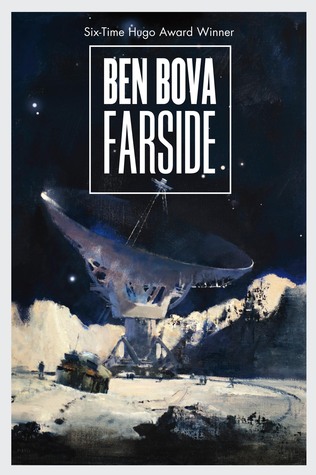
Ben Bova’s contributions to science fiction are monumental. A six-tme Hugo Award winner (!!), he is established as one of the most successful and entertaining authors of our time. I have quite enjoyed a number of his works, though I have at times been critical of his portrayal of religion. Bova’s major series, the “Grand Tour,” follows human exploration of the solar system (and at some points, beyond). The series is constructed in such a way as to not require readers to follow it chronologically. They are interlinked and interrelated, but not interdependent. Here, we’ll look at two recent books in this series which look at the discovery of an Earth-like planet. There will, of course, be major plot SPOILERS for both books in what follows.
Farside
After telescopes on Earth discover an Earth-sized planet relatively local to our own Solar System (ten light years away), the race is on to learn more about this planet. Farside portrays the struggles of a number of people in their efforts to build an observation base on the dark side of the moon. Jason Uhlrich seeks his Nobel Prize in his attempts to be the first to observe and chart the planet.
Life has already been found within the Solar System, and now two rivals rush to be the first to discover it in the great beyond of the stars. What is interesting is to note some of the assumptions that go into Bova’s characterization of life beyond Earth. First, one primary assumption seems to be that where there is water, there must be life. Second, life should be expected in all corners of the universe.
These assumptions are the subjects of much debate within the scientific community around the possibility of life on other planets and the origin of life. Regarding the former, there are those who do believe that life will be found in abundance throughout the universe. After all, given that we exist, life cannot be all that improbable, right? The other primary way of thinking is to argue that life is, in fact, quite rare in the universe and our own existence is a wonderfully improbable jackpot win.
 New Earth
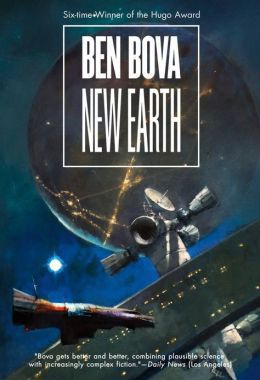
New Earth picks up some time after the events of Farside. Humanity has sent an expedition to “New Earth.” Upon arrival, there is a great mystery: “New Earth” is eerily like Earth itself. It turns out that a machine known as a “predecessor” has created the planet and grown these human-like aliens as a way to break it to humanity that there is, in fact, more intelligent life “out there.” Moreover, there is a catastrophic event coming towards the whole arm of the Milky Way which will wipe out these intelligent species, and humanity needs to help preserve themselves and the other species.
Though skeptical, ultimately all the members of the expedition are convinced, and the book ends with the message reaching Earth and the gearing up to proceed on this mission given by the Predecessor.
Reflection
There are, of course, any number of things that one could nitpick regarding the plausibility of the scenarios Bova envisions (one would be the rewiring of Uhlrich’s brain to “see” via hearing and touch… how does that work?), but here we’ll focus on two aspects of the work: the plausibility of life outside Earth and the mythos of the benevolent alien.
In Farside, readers who haven’t surveyed the body of Bova’s work discover that the Solar System itself teems with life: life once flourished on Mars, and its vestiges remain; on Jupiter, creatures soar in the skies; life is found elsewhere throughout the System. Bova’s vision of the origin of life seems to be that if there’s water, there may be life. Yet one has to wonder about the plausibility of life forming on a planet like Jupiter. How might biochemical interactions with delicate balances of material be maintained for long? What of the distance to the sun? The origin of life requires all kinds of factors to be “just right” and it simply is not enough to fudge the numbers by saying “It could have happened this way.” To develop a hypothesis around ad hoc assumptions is faulty.
Intelligent life, as explicated in New Earth, is even more problematic. It is easier to have single celled organisms than to have the complexity needed for intelligence. Even granting a naturalistic scenario, the conditions must be even more tuned for life and allow for the nurturing of that life for extremely long periods of time. The universe is indeed huge beyond belief but one has to wonder if even that immensity is enough to repeat the conditions which occur on Earth.
Of course, in the end, one must acknowledge that these are tales of science fiction, not proposals about how science fact might be. There is a certain sense of awe and wonder involved in considering whether life could exist all over the Solar System. It seems to me, however, that if that is the case, it probably got there by means of Earth–blown off the surface of our planet by an asteroid and traveled through space to Mars and possibly beyond.
Another major theme found in both books is what I dubbed the “Myth of the Benevolent Alien.” There is a kind of pervasive battle in science fiction between the notions that aliens want us dead or that aliens are going to be ultimately some kind of saviors of humankind. New Earth brings this benevolence front and center: some unknown life form created these “Predecessors” to find and aid intelligent life. It’s a scenario filled with wonder and hope. But it’s also a scenario which I’ve found time and again in materialistic literature.
The way this story goes: wherever possible, life is certain. It’s a kind of appeal to a fantasy of a godless universe wherein it may be possible to find hope and meaning in the stars. As one character (I believe it is Grant) said in Farside: Ad astra! (To the stars!). Second, the actual inherent implausibility of life both leads to this longing (we don’t want to be alone) and to a search for meaning (how did we get here?). My own answer is that theism provides a more plausible explanation of both the longing for meaning, meaning itself, and the way in which life arose. Interestingly, however, the atheistic accusation that theists are engaged in wishful thinking is perhaps mirrored through various declarations made by naturalists themselves (see the post linked above and in the links below).
Bova’s novels thus serve as a way forward in this discussion. By illustrating our longing and loneliness through the fulfillment of our desires (the discovery of life and the notion that we are not alone), Bova grants readers their wishes. However, we ultimately come to realize that these are indeed just wishes. Perhaps, one day, a “New Earth” will be discovered. But even if that happens, it will not be enough to satisfy our loneliness, nor will it answer our ultimate questions. Theism is the ultimate antidote to loneliness, the ultimate answer for our questions.
Links
Be sure to check out the page for this site on Facebook and Twitter for discussion of posts, links to other pages of interest, random talk about theology/philosophy/apologetics/movies and more!
Materialists: Where is hope? Look to the stars!– I analyze one aspect of materialism: the way that some look to hope in the “beyond” of the outer limits of the universe. Hope, for materialists, may come from the stars. Our salvation may lay beyond our solar system, in benevolent aliens who will bring great change and advances to us.
Our Spooky Universe: Fine-Tuning and God- The incredible circumstances which allow for life to exist and thrive on Earth are the cause for not merely fictional speculation, but actual reflection upon our place in the universe and how it might relate to the transcendent. Check out this post which surveys the evidence for the existence of God found in “fine-tuning.”
Sources
Ben Bova, Farside (New York: Tor, 2013).
Ben Bova, New Earth (New York: Tor, 2013).
SDG.
——
The preceding post is the property of J.W. Wartick (apart from quotations, which are the property of their respective owners, and works of art as credited; images are often freely available to the public and J.W. Wartick makes no claims of owning rights to the images unless he makes that explicit) and should not be reproduced in part or in whole without the expressed consent of the author. All content on this site is the property of J.W. Wartick and is made available for individual and personal usage. If you cite from these documents, whether for personal or professional purposes, please give appropriate citation with both the name of the author (J.W. Wartick) and a link to the original URL. If you’d like to repost a post, you may do so, provided you show less than half of the original post on your own site and link to the original post for the rest. You must also appropriately cite the post as noted above. This blog is protected by Creative Commons licensing. By viewing any part of this site, you are agreeing to this usage policy.
Sunday Quote: Do we need to agree with past thinkers?
 Every Sunday, I will share a quote from something I’ve been reading. The hope is for you, dear reader, to share your thoughts on the quote and related issues and perhaps pick up some reading material along the way!
Do we need to agree with past thinkers?
I recently read through Reading Genesis 1-2: An Evangelical Conversation, which has given me a lot to reflect upon. One quote that struck me was from Jud Davis:
A beloved teacher once said, “If you cannot find at least one ancient, one medieval, and one modern commentator who shares your view, it probably means you are wrong.” Over the years, I have thought long and hard about this statement, and I believe it is exactly right because if you could not find such examples, you would be forced to say, “Everyone before missed it until me.” (215)
I thought this was an interesting quote because it says much about how one approaches theological issues. First, there is some concern regarding this passage for me because it seems that some truths are indeed missed by everyone until someone discovers (or rediscovers) them. Second, there is a real concern for whether one innovates in doctrine and thus becomes a heretic. That is, innovation in theology is often divergence from established truths. These established truths are often established exactly because they follow from the text. Thus, an innovation which says, for example, that Jesus is not God is rightly denounced as heretical.
Based upon these conflicting concerns, I think it is permissible to say there is some tension within the practice of historical theology and exegesis. We must be careful to avoid the pitfalls of either ignoring the voices of the past or being too cautious to reconsider the evidence for certain positions. Going to either extreme would be dangerous. The most prominent danger, in my opinion, is the danger of using a passage like this to squelch debate or exploration. Ultimately, the text is the arbiter of truth, not established interpretations. If someone comes up with a “new” look at a text, it is important to consider it on its own terms rather than reject it because it is new. The weight of unanimity in the past should be seen to increase the standard of proof for those who disagree, but it should not be used to silence those who seek truth.
What are your thoughts on the balance between historical scholarship and new interpretations?
Links
Be sure to check out the page for this site on Facebook and Twitter for discussion of posts, links to other pages of interest, random talk about theology/philosophy/apologetics/movies and more!
Source
Jud Davis, “Unresolved Major Questions: Evangelicals and Genesis1-2” in Reading Genesis 1-2: An Evangelical Conversation


