Book Reviews
Book Review: “What’s Your Worldview” by James N. Anderson
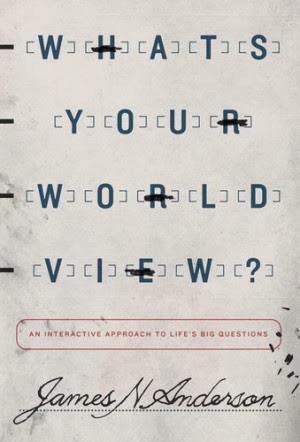 When I first learned about What’s Your Worldview?: An Interactive Approach to Life’s Big Questions
The book’s format is set up such that it outlines something (like what it means to say there is objective truth), then asks whether you believe in it. If you choose yes, you flip to one page; if no, you flip to another. Ultimately, your answers will land you in a worldview. Each worldview has a few pages of brief discussion on how it views reality and what problems might arise with that worldview.
I decided to indeed choose my own adventure and start out reading it from an atheist’s perspective. I figured that would give me a good look into the approach. I quickly realized that answering the questions in such a way got me to “dead ends.” If I said “No” to whether I believed in objective truth, I flipped to the worldview of “Relativism,” had the view explained and some major issues brought up. The end. Full stop. Or is it?
Anderson encouraged readers to go back to the previous question after any worldview evaluation if they didn’t like the conclusions drawn. Thus, continuing the example of relativism, he argued that it is self-defeating: after all, if all truth is relative, is that itself a relative truth? If so, why should I hold to it? Back to the questions! The book encourages such flipping back and forth. It encourages engagement in a way many apologetics books do not.
There is, however, one major drawback to the approach. That is, because it is a book about worldviews, and because it is only just over 100 pages long, there’s not a lot of meat to the discussion. If you’re looking for major critiques and interactions with response-rebuttal-counterpoint on various worldviews, this is not the book you’re looking for. Alongside that, there is a real danger of oversimplification. For example, in the “worldview” section on “nihilism,” it was stated that nihilism is “the view that there are no objective values” (Kindle location 1022). Properly speaking, this only refers to moral nihilism, not nihilism as a full system, which would entail a whole system of “nothings”: no meaning, no objective values, possibly even no reality one can access, etc. Due to the short length, much nuance to each worldview must be lost. Possible objections to Anderson’s brief critiques abound, and readers may be left thinking their own view was perhaps a bit too blithely dismissed.
Of course the length could just as easily be seen as an advantage. One can very easily pick it up and read it in an afternoon; one could hand it to an interested neighbor; it lends itself to use in a brief study period (youth group? adult forum?). These are all advantages. Readers just need to be aware of some disadvantages as well.
I was also very impressed by the depth of insight Anderson gave to rival theist worldviews. Once one answers that there is at least “a” deity, the book still has many more questions to peruse: do you think there is only one?; is Jesus God?; did God communicate with humans? If so, was this communication open?; etc. I found these to be fun to flip through and very informative and on-point. This isn’t an apologetics book that focuses purely on the existence of God; it is, really, a book on worldviews: complete totalities. That said, remember it is not intended to be comprehensive, by any means.
What’s Your Worldview is a really fun apologetics book. The fact that I’m able to write that shows how unique it is. I don’t know of any other book in the same format. It’s refreshing and handy. That said, at times it does feel just like those old “Choose Your Own Adventure” books; you come to the end too quickly. It was a conscious decision on the part of the author/publisher to keep it light and easy to read. And, to that extent, they succeeded. I just found myself wanting a little more. However, I do think this would be an excellent book to pick up and hand off to a friend or relative who may have doubts or may want to explore the beliefs of various worldviews. Just remember the caveat: the book may raise more questions than it answers; so be prepared to have some reasons for the hope within (1 Peter 3:15).
Links
Be sure to check out the page for this site on Facebook and Twitter for discussion of posts, links to other pages of interest, random talk about theology/philosophy/apologetics/movies and more!
Source
James N. Anderson, What’s Your Worldview?: An Interactive Approach to Life’s Big Questions
I received a review copy of the book through Crossway. I was not obligated by the publisher to give any specific type of feedback whatsoever.
SDG.
——
The preceding post is the property of J.W. Wartick (apart from quotations, which are the property of their respective owners, and works of art as credited; images are often freely available to the public and J.W. Wartick makes no claims of owning rights to the images unless he makes that explicit) and should not be reproduced in part or in whole without the expressed consent of the author. All content on this site is the property of J.W. Wartick and is made available for individual and personal usage. If you cite from these documents, whether for personal or professional purposes, please give appropriate citation with both the name of the author (J.W. Wartick) and a link to the original URL. If you’d like to repost a post, you may do so, provided you show less than half of the original post on your own site and link to the original post for the rest. You must also appropriately cite the post as noted above. This blog is protected by Creative Commons licensing. By viewing any part of this site, you are agreeing to this usage policy.
“Peter Boghossian, Atheist Tactician”- A brief look at the e-book by Tom Gilson
 I recently downloaded Tom Gilson’s evaluation of Peter Boghossian’s epistemology for my Kindle. The work is witty but also to the point. Gilson launched a full-on attack against Boghossian’s mission to create atheists. The best parts of the book–and let me be clear, I think the entire work is essential reading–were his critique of Boghossian’s view of faith and his appeal to Christians regarding the importance of the topic.
Gilson makes it clear how important it is to provide a reasoned answer to Boghossian’s view. However, he goes much further than that; he notes that Boghossian’s mission is specifically to destroy the faith of Christians. For any Christian, this should be a disturbing thing to hear. Unlike many other atheists, Boghossian seems to have a plan: he’s going to actively work to proselytize Christians for atheism. He may be called an atheist missionary. Gilson called Christians to see this as a serious threat for Christianity. It’s not that Christianity doesn’t have the resources to answer Boghossian’s arguments; instead, it is that we have not equipped ourselves to do so. The average Christian-in-the-pew is basically incapable of refuting Boghossian-esque reasoning, and so will, possibly, have their faith seriously challenged by arguments which are basically vacuous.
Part of Boghossian’s mission, Gilson notes, is to redefine the meaning of faith. For Boghossian, faith should always be understood as “pretending to know what one does not know” (kindle location 118). Gilson notes that not only would such a redefinition be catastrophic for people of faith [of “pretending to know…”], but it is also a completely invented definition with no basis in reality. That is, Boghossian sems to be pretending to know what he doesn’t know. On his own definition, he is very faithful.
Why think that Boghossian’s definition is wrong? Gilson offers a number of points. Among them is the fact that the redefinition of the term cannot account for its usage among the faithful. Gilson shows how the redefined “faith” would lead to an absurd meaning for any number of texts in the Bible. Not only that, but he also cites a number of Christian thinkers to demonstrate that the usage of “faith” is much more grounded in evidence and true belief than it is grounded in a “pretend” world. By the time Gilson has finished dismantling Boghossian’s usage, it becomes clear that the latter is truly living in his own fantasy. The problem is that if Christians do not equip themselves to combat it, the dream may become reality.
There are a number of other excellent portions of this quick read, such as Gilson’s direct interaction with a number of Boghossian’s interviews and writings. He also approaches Boghossian’s work from several angles, providing a solid ground for the refutation of the atheistic work.
In short, I implore you to pick up and read this work by Gilson. He has done an excellent job of showing how Boghossian’s work may prove to be a challenge to Christianity. But the greater service he has done is provided a tool to equip believers to combat this challenge. Read it, spread it. Keep the faith.
Links
You may get Gilson’s e-book for free at this link [I am unsure of how long this offer will last]. You may also support the ministry of Ratio Christi by purchasing the e-book.
Be sure to check out the page for this site on Facebook and Twitter for discussion of posts, links to other pages of interest, random talk about theology/philosophy/apologetics/movies and more!
Source
Tom Gilson, Peter Boghossian, Atheist Tactician (2014).
SDG.
——
The preceding post is the property of J.W. Wartick (apart from quotations, which are the property of their respective owners, and works of art as credited; images are often freely available to the public and J.W. Wartick makes no claims of owning rights to the images unless he makes that explicit) and should not be reproduced in part or in whole without the expressed consent of the author. All content on this site is the property of J.W. Wartick and is made available for individual and personal usage. If you cite from these documents, whether for personal or professional purposes, please give appropriate citation with both the name of the author (J.W. Wartick) and a link to the original URL. If you’d like to repost a post, you may do so, provided you show less than half of the original post on your own site and link to the original post for the rest. You must also appropriately cite the post as noted above. This blog is protected by Creative Commons licensing. By viewing any part of this site, you are agreeing to this usage policy.
“The Saint Who Would Be Santa Claus” by Adam English – A Seasonably Appropriate Book Review
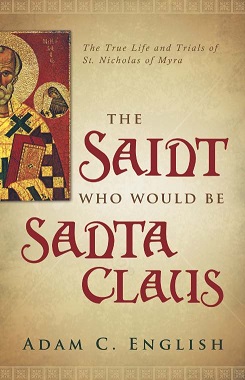
In the quest for the real Santa Claus, what is discovered more often than not is that he can assume any shape. He can accommodate anyone… (191)
There are many discussions floating around about the “real” Santa Claus, Saint Nicholas. I have a bit of a side interest in the topic because I was never a believer in Santa Claus and so I’ve always been interested in the reality behind the myth. So, when I received The Saint Who Would Be Santa Claus
for Christmas last year, I was excited to dive in for the season this year
Perhaps the most interesting portion of the work is English’s discussion of the historiographical difficulties related to unearthing the historical Nicholas of Myra. The difficulty with discovering the “real Santa Claus”–Saint Nicholas–is compounded by the fact that Nicholas of Myra (the Nicholas in question) is often confused with Nicholas of Sion (10; 80; 120; 174). Historical accounts of the life of Nicholas have often conflated these two persons, which means historians must extract them from each other in order to make an account of either. English confronts the possibility that Nicholas did not exist–a possibility put forth by some scholars, in fact–head-on by noting the multiple, independent sources for his life. Although Nicholas did not leave behind a legacy of his own writings, the extant evidence, argues English, is enough to acknowledge his existence as well as a historical core of stories about his life (11ff).
English does a great job of reflecting upon the apparently historical narrative while also drawing out the legends and apologetic tales which grew up around the narratives. Throughout the book, he reports a number of stories related to the life of Nicholas of Myra. He reports these stories seemingly in order of legendary development. For example, the famous story of Nicholas’ gift of gold to three women in need (about to be sold into prostitution) received more embellishment as time went on (57ff). However, English does not always do a great job of making the distinctions clear when these various types of tales are discussed. Part of this is probably due to the historiographical difficulties noted above, but it would have been nice for English to at least offer his opinion regarding the stories he related as to which he felt might be accurate as opposed to inaccurate. At some points he does, but at others he simply offers a series of increasingly surprising accounts without any commentary as to the possible historicity of the accounts.
A central part of the work focuses upon the council of Nicaea and the famous incident of Nicholas’ alleged slapping or punching of Arius or a different heretic (Arian) at the event. English argues that it is unlikely that it would have been Arius, because Arius was not a bishop and so likely would not have been present at the council itself (101-107). Moreover, English believes that a different story, in which Nicholas reasons with an avowed Arian to change his view, is more likely the historical background for the story (107-109). Nicholas’ own place at the council is disputed, but his orthodoxy is acknowledged by all his biographers, and it is likely that he defended the orthodox position at the council itself (107ff).
Apart from his participation at Nicaea, Nicholas also, of course, performed the basic functions of a bishop, which at his time included helping to resolve issues in Myra and the surrounding area (115ff). He helped with the struggle against pagan belief and practice, and at this point some of the stories and legends of Nicholas of Sion were often intermixed with those stories of Nicholas of Myra (120-125).
English’s work also draws out the way that Nicholas of Myra has been adapted for multiple purposes and occasions. Whether this is through the adaptation of his apparently real, historical life to various theological discussions (including Aquinas) or legends which were developed to supplement his legacy and individual viewpoints, Nicholas’ story continues to have widespread appeal.
The Saint Who Would be Santa Claus is an interesting read on a compelling man. Perhaps the most interesting part is the frequent fusion of myth and legend with the historical account. Those interested in the life of the “real Santa Claus” should immediately grab the book for their collection.
Links/Source
Adam English, The Saint Who Would Be Santa Claus: The True Life and Trials of Nicholas of Myra
Saint Nicholas- A Christian life lived, a story told– I wrote about the interplay between myth and reality in the stories about Nicholas. I wrote about how the myth of Nicholas actually bolsters the Christian worldview by pointing toward our longing for the ideal.
Be sure to check out the page for this site on Facebook for discussion of posts, links to other pages of interest, random talk about theology/philosophy/apologetics/movies and more!
SDG.
——
The preceding post is the property of J.W. Wartick (apart from quotations, which are the property of their respective owners, and works of art as credited; images are often freely available to the public and J.W. Wartick makes no claims of owning rights to the images unless he makes that explicit) and should not be reproduced in part or in whole without the expressed consent of the author. All content on this site is the property of J.W. Wartick and is made available for individual and personal usage. If you cite from these documents, whether for personal or professional purposes, please give appropriate citation with both the name of the author (J.W. Wartick) and a link to the original URL. If you’d like to repost a post, you may do so, provided you show less than half of the original post on your own site and link to the original post for the rest. You must also appropriately cite the post as noted above. This blog is protected by Creative Commons licensing. By viewing any part of this site, you are agreeing to this usage policy.
Book Review: “The Philosophy of History: Naturalism and Religion- A Historiographical Approach to Origins” by James Stroud
…Either we will stand behind objective truth or sink into the abyss of relativism in the name of political correctness. (278)
One area Christian apologists need to explore further is the study of historiography. Historiography is, basically, the study of how to study history. It provides the framework in which one might seek truth in understanding historical facts. The way we study history will directly impact the results of historical investigation. John Warwick Montgomery, Michael Licona, and N.T. Wright have done an excellent job integrating historiography into their approach, and there are several treatments of historiography in works on archaeology with apologetic import (K.A. Kitchen is but one example), but there remains much room for development of this essential discipline in the area of Christian evidences.
James Stroud, in his work The Philosophy of History: Naturalism and Religion- A Historiographical Approach to Origins
Next, Stroud turned to an analysis of positivism and academic freedom. His argument is essentially that one should not pre-commit to a “closed” philosophy of history such that one cuts off any and all debate about the presuppositions one uses to interpret history and historical sciences. The winners write the history, but they are also capable of restricting the direction research may turn (49-50). There must be a distinction between the definition of science and science in practice; that is, one should not restrict scientific study through the use of one’s presuppositions to determine what is even capable of being studied or used as a hypothesis. Instead, people should be allowed to follow the evidence where it leads, even if such a project may discover things which lie outside the accepted explanations.
It must be acknowledged that Christianity is, by its nature, a distinctly historical religion: “[T]he truth or falsity of Christianity stands or falls with individual events within history…” (69). Thus, Christianity is almost uniquely capable of being approached in such a manner as to discern its truth through historical claims.
Interestingly, Stroud did not limit his use of “philosophy of history” to the study of history. Rather, he expanded it to include origin sciences, which are, he argued, a kind of historical science themselves. Thus, he examined both the origins of the universe and the origin and diversity of life alongside the historical portions of the book. In these sections on the historical sciences, he presents the design argument both in its cosmological and biological forms.
The meat of the book, however, may be found in the exploration of human history, which comprises approximately half the book. Here, Stroud really gets into stride. One central part of his argument is that “Language, writing, civilization, and religion all seem to be in a fairly advanced stage of development [from the beginning]….” (146). Proposed solutions which argue for a gradual evolution of human culture continue to be confronted by discoveries to the contrary, such as Gobekli Tepe, which shattered preconceived notions of the history of religion (155-157). Language appears to be highly complex from the beginning, and there is little reason to think that some languages are more primitive (in the sense of development) than others (149-150). Stroud relates these points back to the expectations one might get from the biblical text and argued that the biblical text presents a plausible interpretation of such evidence (163ff).
The Flood served as one of the case studies Stroud utilized to make his point. He argued that the preponderance of evidence suggests that the biblical flood is accurate (174-177). The Table of Nations in Genesis 10 also hints at “astonishing” accuracy regarding the historical recordings in the earliest portions of the Bible. Moreover, stylistic evidence within Genesis places its date as very ancient, just as one might expect from taking the book at face value.
Yet Genesis is not the only portion of the Bible which received insight from Stroud’s analysis. The conquests recorded in Joshua have been backed up by archaeological findings. The history of David also garnered attention, and Stroud’s handling of the archaeological data is informative and concise.
The New Testament is, of course, centered around Christ, and Stroud explores the evidence for the Resurrection and the narratives related to Him. One very important point he made is that “…it must be pointed out that the… manuscripts we have for Jesus today did not start as a ‘Bible’ but were later [collected into one]… [T]o dismiss any of this manuscript evidence is in effect to dismiss the most primary sources we have on the Historical Jesus” (240). Yet even sources apart from these can account for a number historical aspects of Christian faith and practice, to the point that it becomes very difficult to reject entirely the Christian story (240ff). Stroud defended the Resurrection itself with a type of “minimal facts” argument, in which he reasoned from several largely established facts of the historical Jesus to the resurrection (248ff).
Naturalism, argued Stroud, fails to account for the historical and scientific evidences for the origins of the universe, life and its diversity, civilization, and the evidence related to the historical Jesus. One should therefore not be constricted to operating within a naturalistic paradigm when one investigates origins or history generally. An a priori rejection of the supernatural is unwarranted.
Thus far, I have shown a number of positive portions of the book. That is not to say there are no areas of disagreement or any problems. First, Stroud’s writing style often comes across as autobiographical, which takes away from the academic feeling of the overall work. Second, there are a number of grammatical errors in the book which are sometimes quite distracting. Third, there is a tendency to overstate the case in some places, such as asserting that any discussion of evolution beyond microevolution is “100 percent speculative” (117) or that “all scholars” in some certain field agree with some fact or another. Fourth, at points Stroud states the view of the opposition in ways that I suspect would be objectionable. One example may be found here: “[T]he vast majority of naturalists confirm that humankind did indeed share a common language…” (177) or the notion that “even the most adamant proponents of naturalism” would admit that the origin of life is unexplainable through naturalistic means with the current understanding (115). I suspect that adamant naturalists would object to this and argue that the RNA world hypothesis or some other origin-of-life scenario does, in fact, explain the origin of life.
Many of these difficulties are minor, but they tend to pull down an otherwise excellent work. It is unfortunate, because it also seems like these could all be solved by a good editor. As it stands, however, one should be careful when reading the work to be aware that in many cases one should perhaps temper the sweeping conclusions Stroud makes. In any field of study, there are rarely (if ever!) times where “all scholars” might agree on something, and the language in the book constantly implies that there are many such agreements in some of the most contentious areas of all historical or scientific studies. Although this does not throw his conclusions out the window, it does somewhat devalue the work, as one must read it with an actively cautious eye.
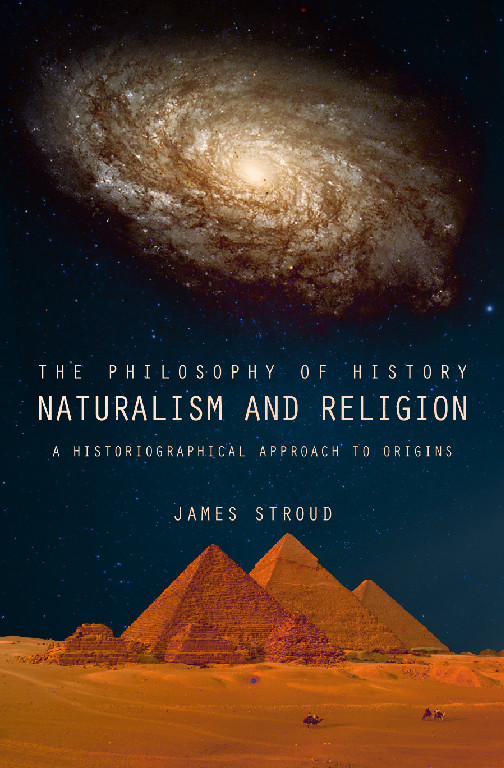
I don’t often (in fact, I can’t think of ever mentioning this before) discuss the cover of a book I’m reviewing, but I have to say this has what might be the coolest cover for an academic book I have seen. I mean seriously, look at it! It is awesome.
With The Philosophy of History James Stroud has provided much needed development for Christians who might want to look into the study of the methods of historical investigation to develop their own understanding of Christianity. He also applies these methods in sometimes surprising ways. I have noted a number of areas of difficulty found within the work, but it should be noted that these are comparatively minor when compared to the project as a whole. Stroud has provided some necessary development in an area of study that Christians should continue to develop. Historiography is an essential field for Christians to study and become involved in, and The Philosophy of History has provided a broad framework for others to continue the work (and hopefully for Stroud to continue, himself). It is an excellent, thought-provoking read which illumines areas of which many apologists, unfortunately, remain unaware.
Source
James Stroud, The Philosophy of History: Naturalism and Religion- A Historiographical Approach to Origins
Disclaimer: I was provided with a copy of this book for review. The author only asked that readers provide feedback of any kind, including negative, in order to broaden the dialogue in this area.
SDG.
——
The preceding post is the property of J.W. Wartick (apart from quotations, which are the property of their respective owners, and works of art as credited; images are often freely available to the public and J.W. Wartick makes no claims of owning rights to the images unless he makes that explicit) and should not be reproduced in part or in whole without the expressed consent of the author. All content on this site is the property of J.W. Wartick and is made available for individual and personal usage. If you cite from these documents, whether for personal or professional purposes, please give appropriate citation with both the name of the author (J.W. Wartick) and a link to the original URL. If you’d like to repost a post, you may do so, provided you show less than half of the original post on your own site and link to the original post for the rest. You must also appropriately cite the post as noted above. This blog is protected by Creative Commons licensing. By viewing any part of this site, you are agreeing to this usage policy.
Book Review: “Hardwired: Finding the God You Already Know” by James Miller
 Irreverent. That’s how I would describe Hardwired
Illustrative was his comment early on in the work. Miller was approached by a mother who was heartbroken over her son leaving the faith. She asked him, “‘How do I convince him there is a God?'” Miller’s answer is indicative of his apologetic method: “He already believes in God.” This startling statement forms the basis for the rest of the book. Miller’s approach revolved around showing people the God they “already know.”
How might one justify this outlandish claim? First, Miller argued that human beings are not “blank slates”–that is, the human mind is in fact shaping that which it observes even as it observes it: “You and I, witnessing events through the same pair of glasses, would not know the same thing, because your brain and my brain do different things with the knowledge” (42). All knowledge is filtered through the preconceptions one has that sorts it into different levels of experience. Miller provided several reasons for thinking that the notion of our minds as blank slates is wrong (42-44; see also 58-61).
The notion that we are not “blank slates” also means that we filter ideas through a number of pre-existing categories. It also means that a wholly objective approach to discovering truth is impossible; we simply cannot step entirely outside of our presuppositions about reality. Moreover, human beings seem to have a shared experience of certain affirmations, even though some may attempt to deny them. For example, “we assume that our perceptions of the world… are accurate… We assume that there are real moral rights and wrongs… We assume that life has a purpose… We assume that there can be meaningful communication in which two people accurately share what they are thinking” (26). These assumptions are not uncontroversial; indeed, many have sought to deny any or all of them. Hardwired featured concise arguments for the fact of each of these notions.
Apart from these seemingly universal human experiences, Miller also argued that the very position of agnosticism is one which does not cohere with reality. Agnosticism is fundamentally a witholding of belief, but that is itself based upon a supposed ignorance of all the available data. He compared it to a court case regarding evidence: “People are only off the hook when they can show both that they didn’t know and that there was no way they could have known.” It is not enough to plead ignorance: “they are still guilty if they didn’t know because they avoided finding out” (55). The Bible clearly states that all people are capable of knowing God, and stand without excuse (Romans 1). “The onus is on honest agnostics to produce a pretty substantial bibliography of failed research” (56).
The fact of God’s existence may be found throughout reality, argued Miller. First, there is the reality of religious experience, but Miller prefers to view these as “epiphanies” which are “a sudden piercing discovery…” which may “draw our attention to things we’ve previously taken for granted or ignored” (69). Second, the existence of moral absolutes is a universal experience. However, this is not to be taken as a proof for God; rather Miller suggested that it means we have “inclinations that cannot be filled by anything but the exisence of God” (91). Even the atheistic moral objection to the God of the Bible assumes objective morality, because it assumes that they are capable of discerning real right and wrong (91-92). The very fact of valuation hints at the Creator (108-111).
The Christian faith gives compelling reasons to believe because its story matches and exceeds the criterion of embarrassment: its “hero,” Jesus, is scorned and shamed, not glorified and given rule over all nations (121ff).
The existence of God, Miller argued, is not tied to arguments or debates, rather, “What convicts us of the existence of God [are]… the soft, subjective facts of an experience that resonates with human longing and confirms are deep suspicions” (156). Hardwired is Miller’s attempt to point to those experiential factors.
By way of analysis, I first note that I think Miller has done an excellent job summarizing a number of extremely complex and difficult issues in ways that the “person on the street” could pick up the book and understand. He is concise and clear. Moreover, I sympathize in many ways with his approach. It seems to me to be true that humans cannot approach a topic as though we are “blank slates” ready to take whatever input we are given without layers of interpretation. That, I think, is the greatest strength of Miller’s approach. He pointed out the deeply seeded assumptions we hold which influence the way we view reality and showed how these lead to God.
However, I wonder about the coherence to Miller’s approach. His critique of natural theology does not sit well with his appeal to some of the very types of arguments that natural theologians use. For example, his appeal to objective morality is essentially no different from the defense provided for the “moral argument” by natural theologians like William Lane Craig, whose approach Miller criticizes. His presuppositional argument itself depends upon some forms of evidentialism (and here I am intentionally wording this to avoid being accused of being unaware of the fact that presuppositional apologists do use evidence–it is manifestly true that even the staunchest presuppositional apologist uses evidence… my point is that the method Miller uses is often evidentialist in its approach). Ultimately, readers will be left with what essentially amounts to an existentialist evidentialism, which seems itself to rely upon natural theology in a number of traceable ways.
Another difficulty I had with Hardwired is that it seemed Miller sometimes overstated his case. Perhaps the most obvious example of this, in my opinion, is his discussion of evolution. He discussed natural selection and sought to evaluate it by looking at humans: “[I]f natural selection actually works, a few million years should make for some pretty shiny, strong, effective gladiators who have good teeth and rarely catch cold… Specifically, there are some traits of humanity that should by all means have been weeded out by now: sleep (which makes people vulnerable to predators for a third of their lives)… endoskeletons, appendices, wisdom teeth, birth defects, stupidity, and obesity” (94).
I’m not about to dive into biology, which is by no means an area of my expertise, but it seems to me that none of these are required expectations given Neo-Darwinism. Miller’s critique does not take into account the fact that humans have worked using their intelligence to circumvent many of these difficulties (i.e. we live in shelters which keep us safe while sleeping; appendices still have function; etc, etc.). The critique offered here also seems shamelessly teleological, which is the very thing Neo-Darwinists would deny within their system.
Hardwired is a brief missive which applies presuppositional apologetics in a straightforward, easy-to-understand fashion. Miller doesn’t fall into using terminology that will be difficult for the uninitiated to understand. Instead, he provides a coherent beginning-to-end approach in how to argue for faith from his presuppositional approach. It is a commendable work for its simplicity, and despite the areas of disagreement I noted above, I certainly think it is worth a read. Miller has a way of answering the difficulties that people raise against Christianity in concise but convincing fashion. It’s a mixed bag, but one well worth the time spent.
Source
James W. Miller, Hardwired: Finding the God you Already Know (Nashville, TN: Abingdon Press, 2013).
Disclaimer
I received a copy of Hardwired free of charge for review. I was only asked to give an honest review of the book.
SDG.
——
The preceding post is the property of J.W. Wartick (apart from quotations, which are the property of their respective owners, and works of art as credited; images are often freely available to the public and J.W. Wartick makes no claims of owning rights to the images unless he makes that explicit) and should not be reproduced in part or in whole without the expressed consent of the author. All content on this site is the property of J.W. Wartick and is made available for individual and personal usage. If you cite from these documents, whether for personal or professional purposes, please give appropriate citation with both the name of the author (J.W. Wartick) and a link to the original URL. If you’d like to repost a post, you may do so, provided you show less than half of the original post on your own site and link to the original post for the rest. You must also appropriately cite the post as noted above. This blog is protected by Creative Commons licensing. By viewing any part of this site, you are agreeing to this usage policy.
“Pastrix: The Cranky, Beautiful Faith of a Sinner and Saint” by Nadia Bolz-Weber: Book Review
 Nadia Bolz-Weber is an edgy, hard-hitting, and often witty pastor in the Evangelical Lutheran Church in America (ELCA). Her latest book is filled with autobiographical stories and a number of anecdotes which focus around the subtitle: they are often cranky, sometimes beautiful, and they reflect a sinner-saint.
The book traces Bolz-Weber’s path towards the ministry through her years in recovery from alcoholism to her starting a church: “House For All Sinners and Saints” and the struggles and triumphs she experienced throughout these events. I’ll not summarize the entire contents of the book but rather I have selected one story to give a brief sample of how the book flows.
The most poignant story in the entire book, in my opinion, is that of Bolz-Weber’s relationship with Chris Rosebrough from Pirate Christian Radio, a very conservative Lutheran (from the Lutheran Church–Missouri Synod [LCMS]) who runs a very conservative radio show. He is, in many ways, all that Bolz-Weber would oppose. And Rosebrough often criticized Bolz-Weber on his show. Then, one day, they had a chance to meet and they talked through the core of Lutheran theology: salvation by grace. Bolz-Weber wrote, “[The other people witnessing their meeting] saw us share a thirty-minute public dialogue about our own brokenness and need for confession and absolution, why we need the Gospel, and what happens in the Eucharist… God made my enemy my friend that day” (113).
Later, Bolz-Weber experienced criticism from her “own side”–liberals [her word, I’m not trying to use it in a derogatory fashion]–and talked with Rosebrough [who is, again, staunchly conservative] about it. They didn’t have to agree on the issues to carry on a conversation about God. “Chris [Rosebrough] doesn’t agree with me [about various issues]… But the one phone call I got in the middle of being attacked by my own tribe was from someone who is on the other side of the issue entirely… [H]e knew what it felt like… [He] said that he loved me and would pray for me. His enemy” (119-120).
Awesome, heart-stopping stories like this are scattered throughout the book. But they are in-between stories that will surely polarize readers. One is a story about a transgender girl turned boy and how Bolz-Weber helped hold a ceremony to help recognize “Asher”‘s new name and identity as a boy. Another story is about her time away from Christianity in which she worshiped a “goddess” instead.
Pastrix ends on a note about Bolz-Weber’s vision of church. Mary Magdalene becomes her foil as she reflects upon the meaning and purpose of church. She wrote, “Like Mary Magdalene, the reason we can stand up and weep and listen for Jesus is because we, like Mary, are bearers of resurrection, we are made new” (201).
Evaluation
There are no words minced in this book. The f-word is sprinkled throughout (and even featured twice in one chapter title). Bolz-Weber continually describes situations or feelings as “s***.” She is completely unapologetic in her approach in this regard.
This raised red flags for me. What does the Bible tell us about the Christian life, and does it say anything about the requirements for teacher, overseer, elder, and deacon? How might Bolz-Weber apply these to her life as a pastor? No, I’m not saying that as a woman she shouldn’t be a pastor–I’m firmly egalitarian. But I wonder about how she would take a passage like James 3 (specifically 3:1-2; 9-10):
Not many of you should become teachers, my fellow believers, because you know that we who teach will be judged more strictly. We all stumble in many ways. Anyone who is never at fault in what they say is perfect, able to keep their whole body in check… With the tongue we praise our Lord and Father, and with it we curse human beings, who have been made in God’s likeness. Out of the same mouth come praise and cursing. My brothers and sisters, this should not be.
Teachers are called to a higher standard. James noted that obviously people stumble, but that does not mean that we should give up or simply embrace whatever wrong behavior we are engaged in. “This should not be!” I wish Bolz-Weber had engaged with this issue in her book.
Another huge issue with the book for me is Bolz-Weber’s exegesis. It seems to me her preconceptions about what the text should mean often shape how she reads it. Specifically, this relates to the question of sanctification. Are Christians really in the process of being made new? If so, how does she reconcile this with the way she seems to conceive of “sinner-saint”–a valid concept–by which she seems to simply mean that one does not even have to try to change? She wrote:
Repentance in Greek means something much closer to ‘thinking differently afterward’ than it does ‘changing your cheating ways.’ Of course repentance can look like a prostitute becoming a librarian, but it can also look like a prostitute simply saying, “OK, I’m a sex worker and I don’t know how to change that, but I can come here and receive bread and wine and I can hold onto the love of God without being deemed worthy of it by anyone but God.”
It seems her primary point in this passage is that God’s grace is firm and sure and we, as sinners, can hold onto that. But I can’t help but feeling Bolz-Weber misses the mark at an astonishing margin in that she never discusses the need to go beyond that. Paul discussed various types of sins in 1 Corinthians 6, and then he went on to say “And that is what some of you were. But you were washed, you were sanctified, you were justified in the name of the Lord Jesus Christ and by the Spirit of our God.” That is, God’s work does not simply end with justification, it continues on into sanctification. We are sinner-saints in the sense that we are yet sinners but God has saved us; but also, we are being made saints by the work of the Holy Spirit. We are to flee from sin, not ignore it.
Bolz-Weber’s entire autobiographical account does speak to the way that the powerful message of grace changes someone, but she never draws this point into the open. Moreover, when she speaks about the life of others, sin is often treated lightly or even entirely ignored. It seems that she is fully willing and able to apply the Law to her own life, but she does not universalize it; she does not make the Law applicable to everyone. Thus, it seems to me she fails to properly preach Law and Gospel.
Pastrix, was a book I really wanted to love. But… I didn’t. There are a number of great insights and anecdotes scattered through the pages, but ultimately readers have to slog through gobs of unnecessary cursing, shock-value stories, and more to find them. One moment, it had me cheering along with Bolz-Weber; the next, I found myself confused about what she was trying to communicate. Ultimately, the book left me wondering who, exactly, the intended audience was supposed to be. It’s not the type of book I’d hand to someone to try to convince them of Bolz-Weber’s view. Nor is it the type of book that I, as someone who agrees in part with her, particularly enjoyed. It seems to me the audience is ultimately those who already agree with her on basically everything. That isn’t a problem, as it is perfectly acceptable to write books that preach to the choir, but I am left confused as to why Bolz-Weber actually did write Pastrix.
Throughout the book it seemed that she was trying to convince me of something, but it never really became clear what that message was. There are times when I really did “get it.” It was like she grabbed that which is Lutheran in me and just played it for all it was worth. But then she failed to make it universal; it applied to her, but she never made Law and Gospel universal. She would discuss intense need for grace which is free and abundant and ever-flowing. She would point out how we need not do works to access this. But then, so often, it seemed she would conflate this with the notion that Christians are not all called to move away from sinner and towards saint. There seemed to be no sanctification in the work. It was all about the initial call to grace; but little about the enduring, sanctifying work of the Spirit.
SDG.
——
The preceding post is the property of J.W. Wartick (apart from quotations, which are the property of their respective owners, and works of art as credited; images are often freely available to the public and J.W. Wartick makes no claims of owning rights to the images unless he makes that explicit) and should not be reproduced in part or in whole without the expressed consent of the author. All content on this site is the property of J.W. Wartick and is made available for individual and personal usage. If you cite from these documents, whether for personal or professional purposes, please give appropriate citation with both the name of the author (J.W. Wartick) and a link to the original URL. If you’d like to repost a post, you may do so, provided you show less than half of the original post on your own site and link to the original post for the rest. You must also appropriately cite the post as noted above. This blog is protected by Creative Commons licensing. By viewing any part of this site, you are agreeing to this usage policy.
“Catching Fire” by Suzanne Collins- A Christian look at the book
 The film version of Catching Fire is on the horizon (see my reflection on the movie), and as we approach the release, I thought it would be interesting to take a deeper look into the book. Here, I will consider some major themes in the work and their relation to Christian belief and practice. Check out some links at the end of the post for my other writings on the Hunger Games series. Be aware: there will be MAJOR SPOILERS in what follows.
Pragmatism
Katniss Everdeen often seems to be trying to operate under the moral system known a ‘pragmatism’–the notion that we should do what works. Sometimes, she may even border on egoism–the notion that self-interest drives what is morally right and wrong. Very often, in her first person narrative, she comments on doing things because she has “no choice” or simply because it seems to be what other people want in order for her to survive. One example is when President Snow comes to visit her in order to coerce her into attempting to help quell the rebellions which seem on the verge of breaking out across Panem, the world of The Hunger Games series. Snow himself senses this drive for self-preservation that Katniss has, and he masterfully uses it to manipulate her to his ends.
However, Catching Fire does not leave Katniss alone. She is unable to consistently hold to the moral position that her inner dialogue seems to filter her choices through. In fact, her moral decisions, in practice, often reflect virtue types of ethical theories more than egoism. But she doesn’t always or even often seem to be aware of her own moral virtues. Suzanne Collins writes Katniss in such a way as to be a believable character: her moral choices are often messy.
Katniss is confronted by the inconsistency in her own moral system–that of seeming self-preservation over all–when she is confronted by two women refugees who are fleeing from the violence in their colony (see pages 134-150). Katniss reacts initially in a way which begs for self-preservation, prepared to defend herself by killing. But then, when she discovers the reality of the situation, she actually feeds the women, listens to their story, and believes that there may be hope. The pragmatist would have turned the women in as traitors; Katniss feeds them and sends them on their way, but not before fashioning a new crutch for the one who is injured and teaching them briefly about how to survive in the wild. Her moral reality is much more complex than she herself realized.
Human Moral Worth
Although the topic is only hinted at, Catching Fire poignantly portrays the horror of objectification of the human being. Finnick’s backstory–as one of the other people who is forced to go into the Hunger Games–gives disturbing insight into the objectification of humans and the grim realities of the negative effect it has on the people involved. Finnick Odair’s story is interesting, because he was one of the youngest people to “win” the hunger games. His good looks made him popular, despite his young age of fourteen. Thus, people kept sending him things to help him. Collins writes:
The Citizens of the Capitol have been drooling over him ever since [his victory].
Because of his youth, they couldn’t really touch him for the first year or two. But ever since he turned sixteen, he’s spent his time at the Games being dogged by those desperately in love with him… He can go through four or five in his annual visit. Old or young, lovely or plain, rich or very rich, he’ll keep them company… but he never stays, and once he’s gone he never comes back. (209)
The licentious people of the Capitol are confused. They value human beings as means for their own pleasure. Hence the absurd celebration and pomp and circumstance of the Hunger Games, which trivializes an event that is really the vicious killing of children. Moreover, they eagerly await a young man to get “old enough” for them to use his body for their own ends, paying him with gifts or secrets for the pleasure his body might give them. The book is not explicit in this regard; but the implication is there.
Reality Confronts Falsehood
In fact, it is the people of the Capitol who are the real egoists. They are self-obsessed to the point of egotism as opposed to mere egoism. Their moral code is that whatever satisfies them is right. Collins, in Catching Fire, gives us a long, hard look at ourselves. How easy would it be for us to fall into the same pattern of thinking as the people of the Capitol? The book is disturbing because of how close it is to home. Human trafficking is an increasing problem, even on our “home turf.” Yet people look the other way. Children are increasingly exploited, but again, only a few are crying out.
Like the people of the Capitol, we are only concerned with ourselves. If something isn’t directly bothering us, we tend to ignore it. That’s an issue for someone else, after all.
But the real twist is President Snow. He and his cronies are in charge of preserving the illusion. He is in charge of maintaining the false reality. And in Catching Fire, Katniss finally starts to truly realize the extent of this evil. It is one thing to confront the evils going on around her; it is entirely another to confront those who are determined to keep the system in place which perpetuates the evil.
Conclusion
I am looking forward to “Catching Fire.” I am hopeful that it will, like “The Hunger Games,” preserve the raw emotion of the book and lead to a number of thought-provoking conversations. Catching Fire is a phenomenal work that ultimately confronts us with ourselves. It forces us to wonder: are we just as oblivious to the wrongs around us as the people in the Capitol?
Links
Christian Reflection on The Hunger Games Trilogy– I discuss the entire Hunger Games Trilogy, with a number of comments upon the themes and events found therein.
The Hunger Games Movie: A Christian Perspective– I wrote about the movie, “The Hunger Games” and provided some insight into what Christians may take away as talking points from the film.
Do you like The Hunger Games? Check out my evaluation of Ender’s Game both in movie and book form.
Source
Suzanne Collins, Catching Fire (New York: Scholastics, 2009).
The image is the cover of the book and the property of Scholastic Press.
SDG.
——
The preceding post is the property of J.W. Wartick (apart from quotations, which are the property of their respective owners, and works of art as credited; images are often freely available to the public and J.W. Wartick makes no claims of owning rights to the images unless he makes that explicit) and should not be reproduced in part or in whole without the expressed consent of the author. All content on this site is the property of J.W. Wartick and is made available for individual and personal usage. If you cite from these documents, whether for personal or professional purposes, please give appropriate citation with both the name of the author (J.W. Wartick) and a link to the original URL. If you’d like to repost a post, you may do so, provided you show less than half of the original post on your own site and link to the original post for the rest. You must also appropriately cite the post as noted above. This blog is protected by Creative Commons licensing. By viewing any part of this site, you are agreeing to this usage policy.
“Evermore: Edgar Allan Poe and the Mystery of the Universe” by Harry Lee Poe
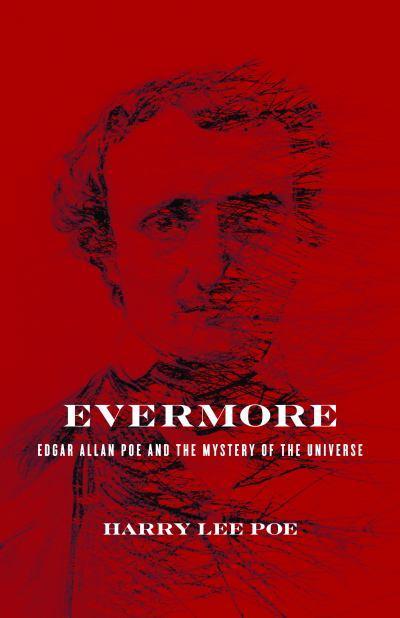 Edgar Allan Poe. His name immediately calls to mind images: a black raven haunting one’s thought, the beating of a heart driving one mad, gruesome, macabre deaths. It also brings to mind thoughts on the man himself: twisted, slightly mad, alcoholic, broken.
Are these images of the man’s work and life accurate? Harry Lee Poe (a cousin of Poe’s) argues that they are not. Instead, this kind of imagery is a result of both the popularization and the character assassination of one of the great American literary giants.
Harry Lee Poe’s work, Evermore: Edgar Allan Poe and the Mystery of the Universe
The Myth of Edgar Allan Poe
It is interesting to note that from the time he died, Edgar Allan Poe’s person was the target of a character assassination which would give rise to the popular portrayal of him as a dark, haunted drunkard. Rufus Griswold, a man who portrayed himself as a minister despite having never been ordained, published a work which has remained in the popular consciousness through the present day. In it, he falsified information about Poe and heavily edited a number of letters from the author in order to portray him as the dark, fearsome man he is often imagined even today. Harry Lee Poe exposes this mythos by noting the work of Arthur Hobson Quinn, who in 1942 published the letters Poe wrote alongside the altered letters Griswold used to make the image he created.
Thankfully, Edgar Allan Poe’s (hereafter EAP) image has been recovering in scholarship, but the damage at a popular level continues to be seemingly ubiquitous. The image of Poe as a brooding man matches what people wish to see when they read his works of horror and thrills. However, Harry Lee Poe (hereafter HLP) notes that there is much more to EAP’s body of work than is often known.
The Broader Poe
EAP’s body of work had its share of horror and mystery, but it also featured humor and satire, science fiction, and beauty. Remarkably, EAP contributed to the formation and even creation of entire genres which are extremely popular today. His science fiction was, at the time, known as “hoaxes” because no actual genre existed in order to encompass them. He also wrote the first detective mystery works to be known in literature. He was innovative and unique in his contributions to literature. He truly stands easily among the literary giants of all time.
The distribution of his works is also worth noting. EAP intentionally wrote in a number of different ways about a number of different things. HLP documents his major tales, numbering each under headings of genre. The results are surprising: EAP wrote more humor and satire than he did horror. Yet he is largely known today only for the latter (24-27). It is worth looking at Poe’s entire body of work in order to understand the man.
Mystery and Reality
One of the central parts of Poe’s work involves the writing of mystery stories. As has been noted, EAP was the first to write in the specific genre of detective mystery stories. EAP’s use of the mystery story shows that he assumed the problem of evil as a very real difficulty. However, the concept of a detective mystery story, in which the reader, through the characters, seeks to solve the mystery and find the one who committed the crime. In short, there is a broader concept of justice involved in a mystery story. Unless there is justice in the universe, the problem of evil cannot present a difficulty for one’s worldview, for evil could just be a given.
EAP, who had written horror stories already, moved the blood and gore from the climax of the story (horror) to the beginning (mystery). The rest of the story would not be about the blood and gore, but about righting a wrong: “injustice cannot be allowed to continue… the sense of justice assumes the basica rationality and order of the universe so that Truth may be discovered. The reader wants to know the truth” (115).
Beauty and Love
The concept of beauty was central to EAP’s work. He used the concept to evoke a particular feeling related to the injustice of crime, but he also saw beauty as a way to point beyond the mundane. “Beauty constituted to Poe evidence that human experience is not bound by time but belongs to eternity” (83).
The different varieties of love are exemplified throughout Poe’s works. Affection, friendship, and passion are developed by HLP to explain EAP’s concepts of how these related to the world at large. Each of these concepts could be forces for the positive or for ill. Affection, friendship, and passion could each become corrupted, and each would lead to devastating results if one allowed this to happen (86ff). Love provided a difficulty for EAP, for he saw that it may tell us about something beyond the world: it may inform us about God. But if it could be perverted, does that suggest an outside source from which love sprang, which we corrupted (107-108).
Eureka
Perhaps the most interesting portion of Evermore is the discussion of EAP’s own views as he expounded them in his work, Eureka. In this work, Poe examined the mystery of the universe. He held that the universe had a beginning and was actually expanding. He argued that light and electricity belonged “to the same continuum.” His view was close to the modern theory of the Big Bang. Yet EAP thought of this around a century before the latter came into vogue. Because the universe began, “Poe concluded that a God exists who created the universe for his pleasure. Love and Beauty provide a glimpse of God… Pain, suffering, evil, and death are the contingencies of physical existence that are left behind” (55). EAP saw the universe as a grand story, which was “the plot of God” (ibid).
The reasoning behind EAP’s amazingly prophetic vision of cosmology was found in his own observations. He noted the difficulties presented by the notion of an infinite universe, including the fact that the night sky had places where there were no stars to be seen (known as “Olber’s Paradox”).
In Eureka, EAP postulated a deity. It seemed intuitively obvious to him that if the universe began to exist, God must exist. Given that his own observational evidence led him to the conclusion that the universe began, he concluded that God exists. Moreover, he posited that this deity would have to design the universe and guide its expansion from a primordial particle (152). However, this deity was essentially pantheistic, which was his solution to the problem of evil. Each individual person would become Spirit individualized. God would become all-in-all, thus bringing holiness to all.
Edgar Allan Poe’s Beliefs?
HLP argues that EAP may indeed have become an orthodox believer late in life. Having already come to the conclusion that God exists and that the universe had a beginning (itself something EAP noted matched remarkably with the Biblical account), Poe would come forward at a Sons of Temperance meeting. HLP notes that such a move cannot be abstracted purely as coming out against alcoholism (something EAP struggled with himself). Instead, the group was explicitly evangelical in nature. Coming forward would be similar to someone today coming forward at a Billy Graham meeting (166). Those interested in Poe’s beliefs must therefore come to one of two conclusions: either he was “the charlatan and scoundrel that Griswold said he was” or “he had a conversion experience.” The Sons of Temperance taught explicitly evangelical Christianity, which would suggest that if EAP was genuine, he had come to accept a more evangelical, orthodox faith before he died.
Conclusion
Few works have intrigued me as much as Evermore has. Edgar Allan Poe has been a favorite of mine for some time, but I admit that I had bought into the stereotypical picture of the man as much as anyone else. Having only really read his horror and some poems, I have not had a complete vision of his actual body of work. Harry Lee Poe does an exemplary job of showing how EAP explicitly viewed his works as a growing body of interconnected themes, seeking to find the mysteries of the universe.
Edgar Allan Poe was a visionary. He was a great American author whose writings paved the way for hundreds of years to come. He was also well ahead of the science of his day, and similarly had already deduced the theological conclusions well before others had attempted to do so. Harry Lee Poe has presented a convincing, thorough look at EAP’s entire body of work. Having done so, he makes the man even more interesting than the myth. Edgar Allan Poe’s explorations of the mysteries of the universe leaves me profoundly interested in the man and his body of work. I highly recommend Evermore: Edgar Allan Poe and the Mystery of the Universe
Source
Harry Lee Poe, Evermore: Edgar Allan Poe and the Mystery of the Universe
SDG.
——
The preceding post is the property of J.W. Wartick (apart from citations, which are the property of their respective owners, and works of art as credited) and should not be reproduced in part or in whole without the expressed consent of the author. All content on this site is the property of J.W. Wartick and is made available for individual and personal usage. If you cite from these documents, whether for personal or professional purposes, please give appropriate citation with both the name of the author (J.W. Wartick) and a link to the original URL. If you’d like to repost a post, you may do so, provided you show less than half of the original post on your own site and link to the original post for the rest. You must also appropriately cite the post as noted above. This blog is protected by Creative Commons licensing. By viewing any part of this site, you are agreeing to this usage policy.
Book Review: “For the Beauty of the Earth” by Steven Bouma-Prediger
The practical consequences of… a radical faith are themselves radical. (182, cited below)
How should Christians think about creation care? More importantly, should Christians even bother with creation care? What is the state of the Earth? What does the Bible say about these issues? These are the primary topics which Steven Bouma-Prediger turns to in his work, For the Beauty of the Earth
Place
We are on Earth, and it is a place full of the glory of God. For the Beauty of the Earth (hereafter FBE) begins with a call to marvel at creation. Bouma-Prediger traces the beauty of the earth through ecological inter-connectedness of animals, plants, and geography in mountains, forests, and lakes. It is truly astounding to think of how the world interacts as a unit; it is still more fascinating to reflect upon how even the–to use a Biblical phrase–“least of these” has an extremely important part to play. I was reading this book while on a camping trip, and it was wonderful to resonate with FBE’s discussion of the wonders of the natural world. But what’s the point?
Bouma-Prediger notes that “We care only for what we love” (21). If we do not love the Earth, we will not care for it. Moreover, he points to the interconnections found throughout the world as a reflection of the importance of all things to creation. He draws ten primary points of importance, including a rejection of the notion that things can be “thrown away”–all things go somewhere; the fact that our actions never affect just one thing; the finitude of resources on the Earth; and the amazing complexity of Creation (19-20).
The Science
Having reflected on our place on Earth, FBE asks: What is the state of planet Earth? Put simply, it is not good. Population is booming while per-capita grain production has not increased, the extinction rates are vastly larger than ever in the past, deforestation is cutting down state-sized holes in the world forests (which leads to a decrease of plants capable of producing oxygen), water consumption is increasing exponentially, topsoil is eroding more quickly than it can be produced, and more.
Bouma-Prediger is careful to present a significant amount of documentation for the claims made in FBE. Consider “Global Warming”- there is an observable upward trend in the average global temperature. There is a real consensus on this topic, although there are always who will disagree with a consensus. It is important to note that “Global Warming” is something of a misnomer because it does not reflect the complexity of the issue. “Climate Change” is a better description, which captures the full range of the impact on the planet.
These issues remain controversial, but those who wish to deny humanity’s impact upon the planet must contend with all the lines of evidence. Bouma-Prediger notes that “The real scientific debate is not over whether global warming is real, but rather is over how much and how fast average global temperature might rise, whether other factors in the climate system will counter or amplify a temperature rise, and what the specific effects will be” (52). [2014 edit: it is interesting to observe that there seems to be some increasing skepticism among scientists over the phenomenon of global warming.]
Finally, he notes that the news is “not all doom and gloom,” for there are many bright spots regarding our care for the Earth as well. Unfortunately, “the case is overwhelming that we humans are responsible for the damage to our home planet” (55). The question it raises is: what now?
Ecological Apologetics
The charge has been made that Christianity is bad for the environment. That is, Christian belief tends to denigrate creation and thus should be rejected, for it cannot provide answers to the ecological crises discussed above. Bouma-Prediger presents a number of ways this objection can be stated and responds accordingly. The complaint ranges from charges that Christian eschatology entails a lack of concern for the current creation to (a very interesting) complaint that because a Christian worldview helped the rise of science, which has itself been the source of many things which harm creation, Christianity is to be blamed for the current crisis.
Bouma-Prediger offers multiple responses. Most importantly, the notion that there is any single root cause for our current ecological crisis is hard to sustain. He offers other responses related to eschatology and more. Christian theology, he argues, in fact gives extremely solid motivation for creation care.
Interestingly, at one point he notes that perhaps substance dualism could be divorced from Christianity (a thesis against which I have argued here). His argument is brief and largely just notes that there are other strands within Christianity which do not rely upon this substance dualism.
Finally, in an interesting spin, the charge is made that materialism actually denigrates the environment. In particular, materialism in the form of economic materialism: when wealth drives worth, the environment will suffer, period. Now, the book does not make the charge that this is the only or even the root cause of our crisis; instead, the point is that when one does value economic gain over other ends, the environment will suffer.
The Question for Christians
Clearly, the most important question is whether or not there is any reason for Christians to care about creation. Interestingly, Bouma-Prediger places this section towards the middle-end of the book as opposed to the beginning. In it, he offers an analysis of several Biblical texts to show that Christians should care for and about creation. Central to this is his conclusion that “Individual creatures and the earth as a whole have an integrity as created by God and as such have more than merely instrumental value” (136). When we view creation as a gift from God–a good gift–we see that no individual part of that creation should be denigrated or seen as merely an instrument.
He goes on to offer a number of ecological vices of excess and deficiency regarding a number of areas related to theology and ecology. These include addiction, belief in autonomy, and more.
A Vision for Creation Care
Finally, Bouma-Prediger presents a brief vision for creation care. He places this squarely within the context of the vice list and Biblical theology. Christians are to act in humility, wisdom, and virtue. As such, they are to care for that which God has given them and be aware that one should not destroy that which sustains oneself. Christians are called to emulate God’s benevolence and love for all creation as illustrated throughout the Biblical text. As such, to be dismissive of individual species or parts of creation does not line up with a Christian worldview.
Conclusion
There are many more themes found throughout FBE and in particular in the area of Christians and the environment. Overall, the book is an astounding, life-shifting read. It raises one’s awareness of the integration of their beliefs with the world around us. It is amazing to immerse oneself in a sense of place–be that a forest, mountain, lake, or elsewhere–and realize that this is truly a great good which God has created for us to enjoy. As embodied creations of God, we are to honor those other created aspects of His plan. We are to care for His creation. The book is commendable in its scope, erudition, and groundedness in those concerns which Christians would perhaps be most interested in. It comes highly recommended.
For the Beauty of the Earth.
Links
Like this page on Facebook: J.W. Wartick – “Always Have a Reason.”
Caring for Creation: A discussion among evangelicals– I write about creation care from a number of perspectives offered at a recent panel of prominent evangelical thinkers in this area.
SDG.
——
The preceding post is the property of J.W. Wartick (apart from citations, which are the property of their respective owners, and works of art as credited) and should not be reproduced in part or in whole without the expressed consent of the author. All content on this site is the property of J.W. Wartick and is made available for individual and personal usage. If you cite from these documents, whether for personal or professional purposes, please give appropriate citation with both the name of the author (J.W. Wartick) and a link to the original URL. If you’d like to repost a post, you may do so, provided you show less than half of the original post on your own site and link to the original post for the rest. You must also appropriately cite the post as noted above. This blog is protected by Creative Commons licensing. By viewing any part of this site, you are agreeing to this usage policy.
“The Knower and the Known” by Stephen Parrish, Part 2
 Stephen Parrish’s The Knower and the Known
Thought and Consciousness
What does it mean to have a thought? Parrish notes several aspects which go into the very act of knowing. There must be an object of knowledge; there must be a subject to consider the object; there must be consciousness in order to apprehend concepts and aboutness; there must be a relationship between subject and object and consciousness; there must be understanding of that relationship; and finally there must be a view of the world in which all of this can occur.
Consciousness itself is an extremely complex notion which involves phenomenality: the actual experience of thought; intentionality: the turning of one’s thoughts to consider an object; subjectivity: an agent which is itself the subject of the thought; and rationality: the capacity to order thoughts in such a way as to make sense of them. (206-213).
Consciousness has certain phenomenal properties. That is, when we consider our own thoughts, there is a distinct feeling to them which allows us to differentiate them from simple sense perceptions. There is an aspect of inentionality or attending-to our thoughts which is itself irreducible. Moreover, we are able to comprehend things which are themselves non-physical, such as the nature of a logical argument like modus ponens (226-228).
Consciousness must somehow interact with the physical world. If one is a physicalist, it becomes a matter of reducing consciousness to purely physical explanations, eliminating consciousness, or offering a brute relationship between consciousness and the physical world.
Qualia are also extremely important when considering consciousness. How is it that we are able to see objects as objects with certain properties? What process allows for individual particles/rays of light to manifest themselves in phenomenal consciousness in such a way as to provide a coherent picture of an object? Moreover, “there is more to recognizing qualia than just having color in one’s sensory field; there is also our attention to said qualia, the judgments we make about them, the objects that they represent, and also our memory of them–and these factors can make all of the difference” (257).
Subjectivity is also extremely important to forming a theory of consciousness. It seems that subjects are, in fact, irreducible. For the physicalist, the concept of a subject is extremely difficult. After all, a subject at t1 is going to be different from that subject at t2 in a number of highly relevant physical ways. Their neurons are firing differently from t1 to t2. How is it that subjectivity is maintained. The substance dualist holds that subjectivity is maintained through unity of consciousness which may not be reduced to the physical (291). The unity is preserved through intentionality but more thoroughly through rationality. The use of reason is one of the primary ways to offer continuity of the self. For the subject, S, at t3 is considering both thoughts at t1 and t2 in order to come to a conclusion at t4. Reason itself has aspects of intentionality which cannot be accounted for on a physicalist view of reality, for a physical object is capable of performing mathematical computations but not understanding the aboutness inherent in those computations (266-267).
Our Minds in the World
Parrish grounds his understanding of consciousness in a theistic worldview. There are numerous difficulties with an account of substance dualism which seem to only be soluble on a theistic interpretation. One of these is the problem of the interaction between body and mind. If God exists, then it seems inherently possible that a deity would be capable of forming the world in such a way that mind could interact with body. Parrish addresses several objections to the notion that an immaterial being could interact with a physical universe while also making an argument for non-physical selfs apart from God interacting in the universe (324ff).
The match of our minds with the world is something which must be accounted for. Parrish notes that if we ground ideal objects in an immaterial being like God, the difficulties with such objects existence and subsistence may be solved. Moreover, the glorious match of our mental life with reality is also explained, for a rational being is the source of all which we observe. If that is the case, then we no longer must appeal to simple brute fact to attempt to explain the phenomena of consciousness; instead, we may note that it is exactly as one might expect given theism (337ff).
And Then There was More…
Parrish concludes the work with a brief comparison of physicalism and substance dualism across multiple questions related to consciousness and the physical world. Finally, there are two appendices which address free will/agency and the theory of panpsychism, respectively.
Conclusion
In Part 1 of this review I outlined Parrish’s discussion of physicalism. Here, we have seen the structure of his substance dualism. It seems to me that Parrish’s deconstruction of physicalism is quite powerful. In particular, I noted that he makes a strong argument that physicalist theories ultimately boil down into either epiphenomenalism or mysterianism, neither of which is plausible. Moreover, his use of numerous examples and thought experiments throughout makes the work easier to comprehend while also providing a solid basis for grounding further discussions in philosophy of mind. Finally, the vast amount of research and documentation Parrish provides makes the work invaluable as a reference for physicalist writings alongside its clear value as a thorough critique of those same works.
The second major section, in which Parrish outlines his view of a theistic dualist ontology, is equally important. He provides a large amount of background for understanding how to put together various aspects of consciousness while also noting that, on theism, these observed phenomena cohere within an ontology, while on physicalism they are generally either discredited or ignored. The one thing the work may lack is a bit of cohesion in the section on substance dualism. Parrish has given a broad vision for how to hold a dualist ontology, but sometimes leaves it up to the reader to put the pieces together. The pieces are there, but not always assembled. I should note, however, that even here Parrish has provided an invaluable resource for those who wish to argue for a dualist vision of philosophy of mind.
I have already noted that Parrish’s The Knower and the Known is a tour de force in the realm of analyzing physicalist theories. However, the work is much more than a simple refutation of physicalism. Alongside that critique, Parrish has laid out the groundwork for substance dualism as a cogent alternative. Simply put, it is a must read for anyone with any interest in philosophy of mind. Comprehensive in scope, exhaustively documented, and interesting to read, The Knower and the Known is a must-have.
Source
Stephen Parrish, The Knower and the Known
SDG.
——
The preceding post is the property of J.W. Wartick (apart from citations, which are the property of their respective owners, and works of art as credited) and should not be reproduced in part or in whole without the expressed consent of the author. All content on this site is the property of J.W. Wartick and is made available for individual and personal usage. If you cite from these documents, whether for personal or professional purposes, please give appropriate citation with both the name of the author (J.W. Wartick) and a link to the original URL. If you’d like to repost a post, you may do so, provided you show less than half of the original post on your own site and link to the original post for the rest. You must also appropriately cite the post as noted above. This blog is protected by Creative Commons licensing. By viewing any part of this site, you are agreeing to this usage policy.

 J.W. Wartick - Reconstructing Faith