Popular Books
“Ghost Hawk” by Susan Cooper- Cultural Imperialism and Christianity
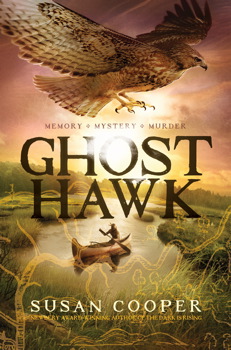
Susan Cooper is a renowned author best known for The Dark is Rising Sequence. Her latest young adult novel, Ghost Hawk, is an deeply compelling look at the dangers of cultural imperialism and the ways that cultures interact. Here, I’ll examine the book from a worldview level. The will be SPOILERS in what follows.
Cultural Imperialism
Cultural imperialism occurs when a dominant group asserts its customs or traditions as normative over those of another. For a fantastic book that looks at some of these issues in context of First Nations/Native Americans, see Richard Twiss’s Rescuing the Gospel from the Cowboys. The white settlers coming into the land are imposing their culture and customs on the Native groups in the area. That this is historical reality is beyond dispute. Cooper presents this, however, in an intriguing way.
John and others are in favor of reform–working with the Native groups and trying to understand them. Others, notably Puritans, believe that all the Natives are without any kind of possible hope. They are simply the heathen, and must be not only converted, but must conform themselves to the European cultural standards. This same imperialism carries into today as missions to Native groups too often wish to banish all Native expressions of spirituality.
The story does not take a happy turn. The efforts to come to mutual understanding largely fail, and Little Hawk is murdered in the process. Little Hawk’s spirit lingers to speak with John for some time (see below).
Despite all the reasons why Little Hawk and John might give up hope, they persist in trusting that hope might be found:
“These people[,” John said, “]they have no charity either for the Indians or for Christians who do not follow their own harsh rules. They talk about the word of the Lord, but they do not listen to it. Shall we destroy each other, in the end?”
…”Change is made by the voice of one person at a time,” [Little Hawk/Ghost Hawk] said…
“But you had no choice [to kill the wolf,” John said to Ghost Hawk. “]We too kill wolves, to keep them from eating the animals that we want to eat. We choose to do it. We have choices all the time, and so often we make the wrong ones.” (291-292, cited below)
There are a number of avenues to explore in this quote. First, it is worth noting that that different Christian voices are presented in the novel. Yes, some present a view in which the Native peoples are merely the heathen–not even worth associating with. Yet others work towards understanding and following God’s word. Second, the concept of choice is quite blatant here: our choices is what can make the difference going forward. When we choose to continue to act as a cultural aggressor, the cycle is perpetuated. What can be done to make a change? Again, different choices–following God’s word.
Ghost Hawk
The story of Ghost Hawk is set during early colonization of what would become known as Massachusetts. The first half of the book follows Little Hawk, a Native American boy who begins his quest to become a man. He encounters the spirit of a hawk/osprey in the wild, but when he returns home he discovers that plague has killed the vast portion of his family and tribe. As the story goes on, he encounters John, the son of a settler. Little Hawk is murdered by one of the settlers as John looks on, and himself becomes a kind of Manitou spirit, communicating with John for some time. Yet the story reaches beyond the initial setting, swirling past over a century of time as the land that was once used by the Massachusetts and other tribes now “belongs” to others. Ultimately, Little Hawk’s spirit is released as a kind of totem of his–his axe–is melded into a tree.
Conclusion
Ghost Hawk asks us to think about cultural imperialism from a different perspective. Susan Cooper invites us to consider the societal and systemic wrongs that have been done to Native groups and to enter into a conversation about how we can work to change that going forward. Moreover, her care to show different perspectives is admirable. Christians should be reflective of past wrongs and seek mutual reconciliation. We need to be aware of how our own expectations are not equivalent with the expectations of the Bible. Reading Ghost Hawk provides a way to start thinking about those issues.
Links
Be sure to check out the page for this site on Facebook and Twitter for discussion of posts, links to other pages of interest, random talk about theology/philosophy/apologetics/movies and more!
Popular Books– Read through my other posts on popular books–science fiction, fantasy, and more! (Scroll down for more.)
Source
Susan Cooper, Ghost Hawk (New York: Margaret K. McElderry, 2013).
SDG.
——
The preceding post is the property of J.W. Wartick (apart from quotations, which are the property of their respective owners, and works of art as credited; images are often freely available to the public and J.W. Wartick makes no claims of owning rights to the images unless he makes that explicit) and should not be reproduced in part or in whole without the expressed consent of the author. All content on this site is the property of J.W. Wartick and is made available for individual and personal usage. If you cite from these documents, whether for personal or professional purposes, please give appropriate citation with both the name of the author (J.W. Wartick) and a link to the original URL. If you’d like to repost a post, you may do so, provided you show less than half of the original post on your own site and link to the original post for the rest. You must also appropriately cite the post as noted above. This blog is protected by Creative Commons licensing. By viewing any part of this site, you are agreeing to this usage policy.
What about those who haven’t heard? – Part 1 of a Case Study on Religious Pluralism from Lew Wallace’s “Ben Hur”

A beautiful cover for an edition of Ben Hur- I was unable to locate the exact copyright information.
Ben Hur is one of my all-time favorite novels. There are many issues related to worldview raised throughout the novel. I have started a series which outlines some of the ways it interacts with
Selection from the Book
Each post in this series will begin with a segment from the book itself. Here, we jump into a scene in which one of the wise men is telling the story of how he came to be in a desert, meeting up with the others. He is Greek. I have abridged the segment to focus on the areas in which this series is most interested, namely, the ways God interacts with humanity.
“I am Gaspar, son of Cleanthes the Athenian…
…”It happens that two of our [Greece’s] philosophers, the very greatest of the many [reference to Plato and Aristotle, presumably], teach, one the doctrine of a Soul in every man, and its Immortality; the other the doctrine of One God, infinitely just. From the multitude of subjects about which the schools were disputing, I separated them, as alone worth the labor of solution; for I thought there was a relation between God and the soul as yet unknown…
“In the northern part of my country–in Thessaly… there is a mountain famous as the home of the gods… Olympus is its name. Thither I betook myself. I found a cave [nearby]… there I dwelt, giving myself up to meditation–no, I gave myself up to waiting for what every breath was a prayer–for revelation. Believing in God, invisible yet supreme, I also believed it possible so to yearn for him with all my soul that he would take compassion and give me answer.
“…One day I saw a man flung overboard from a ship sailing by. He swam ashore. I received and took care of him. He was a Jew, learned in the history and laws of his people; and from him I came to know that the God of my prayers did indeed exist; and had been for ages their lawmaker, ruler, and king. What was that but the Revelation I dreamed of? My faith had not been fruitless; God answered me!”
“As he does all who cry to him with such faith,” said the [Hindu].
“But, alas!” the Egyptian added, “how few are there wise enough to know when he answers them!”
“That was not all,” the Greek continued. “The man so sent to me told me more. He said the prophets who, in the ages which followed the first revelation, walked and talked with God, declared he would come again…
“It is true… the man told me that as God and the revelation of which he spoke had been for the Jews alone, so it would be again… ‘Had he nothing for the rest of the world?’ I asked. ‘No,’ was the answer, given in a proud voice–‘No, we are his chosen people.’ The answer did not crush my hope. Why should such a God limit his love and benefaction to one land, and, as it were, to one family? …When the Jew was gone, and I was alone again, I chastened my soul with a new prayer–that I might be permitted to see the King when he was come, and worship him. One night I sat by the door of my cave trying to get nearer the mysteries of my existence, knowing which is to know God; suddenly, on the sea below me, or rather in the darkness that covered its face, I saw a star begin to burn; slowly it arose and drew nigh, and stood over the hill and above my door, so that its light shone full upon me. I fell down, and slept, and in my dream I heard a voice say:
“‘O Gaspar! Thy faith hath conquered! Blessed art thou! With two others, come from the uttermost parts of the earth, thou shalt see Him that is promised, and be a witness for him, and the occasion of testimony in his behalf. In the morning arise, and go meet them, and keep trust in the Spirit that shall guide thee.’
“And in the morning I awoke with the Spirit as a light within me surpassing that of the sun…”
This passage can be found in Ben Hur, Book I, Chapter III. It may be read in its entirety online here (it is public domain due to expired copyright).
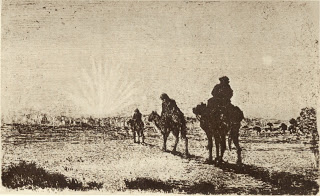
An illustration from the Ben Hur novel. I was unable to find a specific copyright.
Notes on Religion from the Selection
Christians have proposed many different answers to one of the most pressing questions, itself having been pondered for centuries: “What about those who have never heard?” The question is regarding salvation–can those who have never heard be saved? But it isn’t only that. It might be nuanced in many ways. For example, are there any who have not heard what is required to be saved who would respond if they did hear it? Though the answer initially may seem obvious, it must be thought over carefully before one simply says yes or no.
In this passage from Lew Wallace, we find not one, but two separate answers to this question combined into one account. The answers are: direct divine revelation, and sending a witness. (I have dubbed them this, but the titles summarize common proposals–see below.)
Sending a Witness
One of the answers Christians have given to the question of those who have not heard and their salvific status is pretty straightforward: there simply are none who have not heard. The claim seems rather extraordinary, for, after all, entire swathes of humanity never had contact with any Christian missionary for vast periods of time. Yet, this answer to the question suggests that God sends a witness to anyone who would respond. Thus, if there is someone in a place where Christianity had not yet reached who would have responded to a missionary, God somehow sets it up such that that person hears from someone about Christ.
In the example from Ben Hur above, we see that the Greek was looking for the divine–hoping for a response. Thus, through providential act, a Jew washed up on shore to instruct him about the truth.
It seems this solution to the problem of religious pluralism and those who have not heard is unsatisfactory. There are many reasons for this. First, it supports a rather dim view of other cultures through a system that is ultimately culturally imperialist. Second, it seems to stretch credulity, for it would follow from this position that either there have only been very few outside of the parts of the world where Christianity is dominant who would have responded to the Gospel anyway (see previous point) or that there are innumerable instances of shipwrecks washing missionaries on shore in far off places all over the world to wherever someone might respond to the Gospel. Either of these seems unsatisfactory.
However, it is possible that the “Sending a Witness” answer could be part of an answer to the questions posed here. It just does not seem capable of carrying all the weight on its own.
Direct Divine Revelation
Like the previous answer, the “direct divine revelation” solution to the problem of religious pluralism and specifically those who have not heard is one which ultimately results in the answer: None have not heard. For, if someone would respond to the Gospel, God simply reveals Christ through direct revelation. In the selection above, we see that a dream reveals the Holy Spirit to Gaspar.
This answer to the questions raised above is perhaps more satisfactory than the previous one, but difficulties remain. The primary one is that although several firsthand instances of this type of thing happening are found, they do not seem to be as ubiquitous as they might need to be in order to adequately account for all those who have not heard. Again, this may be part of a larger multi-level response, but I don’t think it can stand on its own.
Conclusion
Wallace provides here an overview of two of the traditional answers to the question of those who have not heard about Jesus Christ. Neither solution seems entirely satisfactory, though either or both might be integrated into a holistic view of witnessing and missions. We will explore other aspects of Wallace’s exploration of religious pluralism
Although I don’t agree with all of his conclusions, I think that John Sanders’ book, No Other Name is perhaps the best work I have read for providing background into the different proposed solutions for the question of those who have not heard about Christ. It would be a good read for those wishing to explore the topic further.
Links
Be sure to check out the page for this site on Facebook and Twitter for discussion of posts, links to other pages of interest, random talk about theology/philosophy/apologetics/movies and more!
Religious Pluralism- A case study from “Ben Hur” by Lew Wallace– The post introducing this entire series on “Ben Hur.” It has links to all the posts in the series.
Ben Hur- The Great Christian Epic– I look at the 1959 epic film from a worldview perspective. How does the movie reflect the deeply Christian worldview of the book?
SDG.
——
The preceding post is the property of J.W. Wartick (apart from quotations, which are the property of their respective owners, and works of art as credited; images are often freely available to the public and J.W. Wartick makes no claims of owning rights to the images unless he makes that explicit) and should not be reproduced in part or in whole without the expressed consent of the author. All content on this site is the property of J.W. Wartick and is made available for individual and personal usage. If you cite from these documents, whether for personal or professional purposes, please give appropriate citation with both the name of the author (J.W. Wartick) and a link to the original URL. If you’d like to repost a post, you may do so, provided you show less than half of the original post on your own site and link to the original post for the rest. You must also appropriately cite the post as noted above. This blog is protected by Creative Commons licensing. By viewing any part of this site, you are agreeing to this usage policy.
Brandon Sanderson’s “Calamity” – The Reckoning of Humanity
 Brandon Sanderson is one of the most gifted authors I know currently writing. Each book he writes, it seems, consistently has stunning twists, great action, and an interesting world. Here, we’ll take a look at the conclusion to his “The Reckoners” series, Calamity. We will be exploring it from a worldview perspective. There will be SPOILERS below for the whole series.
Face Your Fears
A theme that continues throughout the entire series is the notion of facing your fears. In Calamity, this is shown to be the way for Epics to gain control of their powers without going dark. Yet what does it mean to face our fears? For some epics, it is a literal sense, such as Firefight simply plunging an arm into fire–her weakness. For others, facing fear is facing failure, or a different kind of weakness.
As Calamity continues, however, we discover that these weaknesses are from Calamity himself–the things that Calamity is afraid of. Part of me wonders whether this cheapens the impact of this theme, for it makes the weaknesses of the Epics something that is imported to them rather than something intrinsic in themselves. Another part of me sees this as somewhat consistent–for as humans we are social, and we can all too easily take on the fears of others and turn them into something far greater than they are in fact.
The Nature of Humanity
In the climactic encounter between David and Calamity, Calamity is brought to a different, alternate reality in which he left the humans he’d gifted to their own devices. There, those with the powers are effectively superheroes, having had no darkness to face down, nothing from the outside to impinge upon their own reality. David challenges Calamity:
“Do you fear that?” I asked him softly. “That we aren’t what you’ve thought? Does it terrify you to know that deep down, men are not monsters? That we are, instead, inherently good?” (411)
Such a viewpoint is quite popular in our world. Humans are inherently good, right? Well, it seems that such a viewpoint is not the biblical one, which argues that humans are sinful from birth–even from conception (Psalm 51:5); that no one is good, not even one (Romans 3:10) and the like. There is some debate over this in Christian circles, but it seems quite difficult to square these (and other statements) with the notion that humans are inherently good.
Indeed, although this climactic challenge from David ultimately defeats Calamity, once Calamity is gone, not everyone suddenly turns good. Obliteration, for example, continues to seek the extermination of humanity (possibly?). The open-endedness of this makes it difficult to pin down where Sanderson was going with it, but it seems that even alleged “inherent goodness” does not guarantee goodness.
Conclusion
Calamity is one of those rare books that combines intense plot with serious discussion of worldview. Sanderson continues to weave these tales which force us to look at humanity and contemplate what it is that we are.
Links
Be sure to check out the page for this site on Facebook and Twitter for discussion of posts, links to other pages of interest, random talk about theology/philosophy/apologetics/movies and more!
The “Mistborn Trilogy” by Brandon Sanderson- Religion(s), Intrigue, and a Messiah– I look at another trilogy by Brandon Sanderson, the wildly creative “Mistborn Trilogy.”
Popular Books– Read through my other posts on popular books–science fiction, fantasy, and more! (Scroll down for more.)
Source
Brandon Sanderson, Calamity (New York: Delacorte Press, 2016).
SDG.
——
The preceding post is the property of J.W. Wartick (apart from quotations, which are the property of their respective owners, and works of art as credited; images are often freely available to the public and J.W. Wartick makes no claims of owning rights to the images unless he makes that explicit) and should not be reproduced in part or in whole without the expressed consent of the author. All content on this site is the property of J.W. Wartick and is made available for individual and personal usage. If you cite from these documents, whether for personal or professional purposes, please give appropriate citation with both the name of the author (J.W. Wartick) and a link to the original URL. If you’d like to repost a post, you may do so, provided you show less than half of the original post on your own site and link to the original post for the rest. You must also appropriately cite the post as noted above. This blog is protected by Creative Commons licensing. By viewing any part of this site, you are agreeing to this usage policy.
Andy Weir’s “The Martian”- A Christian Look at the Book: Humanity, Community, and Hope
 There is a lot of buzz surrounding Andy Weir’s novel, The Martian. It’s being made into a movie staring Matt Damon. Here, we will look at the book from a worldview perspective. There will be major SPOILERS in what follows.
The Value of a Human
One of the objections raised in the novel to moving missions around to try to save Mark is the sheer cost of the expedition. Why spend millions or even billions of dollars trying to save just one person, particularly when there are so many others who could be saved?
Towards the end, Mark himself is reflecting on this and he writes “The cost of my survival must have been hundreds of millions of dollars. All to save one dorky botanist. Why bother? …[T]hey did it because every human being has a basic instinct to help each other out. It might not seem that way sometimes, but it’s true… Yes, there are [expletive]s who just don’t care, but they’re massively outnumbered by the people who do. And because of that, I had billions of people on my side.”
The appeal to basic goodness of humanity is not without a number of assumptions. For example, how is it that the basic goodness of humanity is established? It isn’t just assumed–the evidence cited is that the overwhelming majority of people have basic instinct built into them to help others. But I wonder whether that evidence is drawn more from the extraordinary circumstances Mark found himself in than from the reality of human nature. It is a fact that women are taught in this country (the United States) to shout “fire” rather than “rape” if they are under assault, because people will answer more readily to cries to help fight a fire than they will try to intervene in an assault. The circumstances often determine how willing we are to go the extra mile to help others.
Thus, the conclusion seems a bit naive. Yes, the world pulled together in this work of fiction to help a man stranded on Mars–and I suspect that all kinds of red tape would, in fact, be cut if this ever happened–but that cannot be applied universally to every situation. The fact that there is so much human suffering happening right now–visible human suffering that can be seen in places that are, for example, attacked by IS, or wracked by storms, and the like–without humanity pulling together to stop it suggests that this notion of universal good will towards all is not as powerful as was suggested.
On the other hand, from a Christian perspective, each and every human life is precious, not because we have some inherent need to help others (though that could arguably be there), but because we share human nature, a nature given to us by God to be the image of God in this universe. Humans are valuable simply because they are humans, and we have an obligation to help those in need.
Humans and Others
It is not explored very deeply, but there is a sense throughout the book that humans are made to be with others. Mark feels a profound sense of loneliness when he realizes he is stuck on Mars, but he ultimately gets to work on trying to survive as quickly as possible. This work helps to distract him from his sense of loss, but at times throughout the book it crops up again. The sense of loneliness is at times crushing for him, but he is always able to get himself moving again, perhaps because he continually has hope that the loneliness will be squashed by being rescued or at least getting contact with Earth.
Humans are made to be people in community. I think this again reflects the Christian concept of the image of God. As God is Triune and in community (speaking here rather metaphorically, of course), we are made to be in community as well. Moreover, God created man but then realized “it is not good for man to be alone” and created a woman. These profound words are often explored from various angles, but I wonder whether they don’t also speak to us from a sense of loneliness. We are not meant to be alone but rather to exist in community. Our existential longing and loneliness ultimately points beyond ourselves to a higher reality–in which we may experience communion with God.
Conclusion
The Martian is an entertaining read. It doesn’t raise as many worldview questions as some other science fiction works do, but it does ask us to consider the value of humanity and shared experience. I’d recommend reading it, but be aware of a large amount of swearing.
Links
Be sure to check out the page for this site on Facebook and Twitter for discussion of posts, links to other pages of interest, random talk about theology/philosophy/apologetics/movies and more!
Popular Books– Read through my other posts on popular books–science fiction, fantasy, and more! (Scroll down for more.)
SDG.
——
The preceding post is the property of J.W. Wartick (apart from quotations, which are the property of their respective owners, and works of art as credited; images are often freely available to the public and J.W. Wartick makes no claims of owning rights to the images unless he makes that explicit) and should not be reproduced in part or in whole without the expressed consent of the author. All content on this site is the property of J.W. Wartick and is made available for individual and personal usage. If you cite from these documents, whether for personal or professional purposes, please give appropriate citation with both the name of the author (J.W. Wartick) and a link to the original URL. If you’d like to repost a post, you may do so, provided you show less than half of the original post on your own site and link to the original post for the rest. You must also appropriately cite the post as noted above. This blog is protected by Creative Commons licensing. By viewing any part of this site, you are agreeing to this usage policy.
A World of Darkness and War- “Eisenhorn” by Dan Abnett
 Innocence Proves Nothing.
The world of Warhammer 40,000 (hereafter WH40k) is one that has few entry points for the uninitiated. Dan Abnett’s Eisenhorn Trilogy is one such entry point. I reviewed the omnibus on my general interests blog. Here we will be exploring some themes in the trilogy from a worldview perspective. There will be SPOILERS in what follows.
The Darkness
The world of WH40k is ostensibly one set in our very far future. The major tagline for the universe is “In the grim dark future, there is only war.” Confronted by this darkness, readers sometimes struggle to find light. But the light found in the universe is that of relationships: friendships and loyalty. Another light is the fight against the Warp and the forces of Chaos. Christians are similarly called to fight against evil and destroy it. The way that struggle plays out is hotly debated, but Eisenhorn is a kind of call to fight against evil where it is visible.
Puritan or Radical?
There are different sects of the Imperial Inquisition in the WH40k universe and the major way to divide them is along lines of Puritanism or radicalism. Largely, this comes down to whether an Inquisitor would use elements or even knowledge of “Chaos” in order to fight Chaos or whether they would not. This notion of Puritan/Radical is found throughout the Eisenhorn trilogy.
These lines of separation are relevant because in some ways they are paralleled in Christian thought. How literally is the Bible to be taken? How separated from the world should Christians be? What insights can be allowed for in other faith traditions? These are just a few questions that parallel this complex line that is brought to light by Abnett.
Interestingly, the way that Eisenhorn himself develops as a character points to how these might become a false dichotomy. He begins to realize that some of the insights from the Radical side have merit, and began to shift towards a more moderate position. One wonders whether we too often become bogged down in our conservative/liberal divisions to see how the “other side” might have some helpful insights.
War Against Chaos
In the WH40k universe, demons are manifested in the flesh, the forces of darkness work through psychic powers (psykers), aliens worship evil deities, and more. Through the realism of these elements, the universe is put forward as one in which evils are, at times, much easier to identify than the evils we find in our world. Christians have differing views about spiritual warfare (read the link in those words for a brief exploration of a few), but I think we too often pretend that there are no real evils out there or that they can be reduced purely to the evils of the human heart.
Conclusion
The world of WH40k is dark, but the way it portrays evil and the battle against it serves up not only a compelling narrative but one which has some points of contact with Christianity. Ultimately, WH40k ends up left in darkness, but Christianity has the one Story which offers ultimate hope; that found in Christ as victor over death and the devil.
Links
Be sure to check out the page for this site on Facebook and Twitter for discussion of posts, links to other pages of interest, random talk about theology/philosophy/apologetics/movies and more!
Book Reviews– There are plenty more book reviews to read! Read like crazy! (Scroll down for more, and click at bottom for even more!)
Source
Dan Abnett, Eisenhorn (Black Library, 2005).
SDG.
——
The preceding post is the property of J.W. Wartick (apart from quotations, which are the property of their respective owners, and works of art as credited; images are often freely available to the public and J.W. Wartick makes no claims of owning rights to the images unless he makes that explicit) and should not be reproduced in part or in whole without the expressed consent of the author. All content on this site is the property of J.W. Wartick and is made available for individual and personal usage. If you cite from these documents, whether for personal or professional purposes, please give appropriate citation with both the name of the author (J.W. Wartick) and a link to the original URL. If you’d like to repost a post, you may do so, provided you show less than half of the original post on your own site and link to the original post for the rest. You must also appropriately cite the post as noted above. This blog is protected by Creative Commons licensing. By viewing any part of this site, you are agreeing to this usage policy.
Robert Sawyer’s “The Neanderthal Parallax” – Faith, Scientism, and Humanity
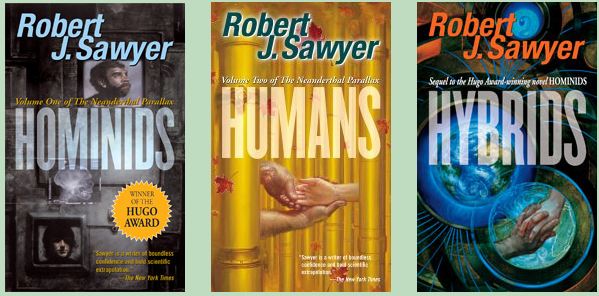 I recently finished reading Robert Sawyer’s trilogy “The Neanderthal Parallax.” I found the plot intriguing, but the worldview issues the books brought up had great difficulties in how they were conveyed and the kind of hidden premises smuggled in. Every story has a worldview, and the worldview of these books was surprisingly hostile and disingenuous particularly to Christians. I have enjoyed Robert Sawyer’s work in the past, but feel forced to interact with these books in a fairly critical fashion. There will be SPOILERS in what follows. I’ll not summarize the plot, but interested readers can see summaries on Wikipedia. I have written a review of the books here.
Faith
Perhaps the most unfortunate aspect of the books is that Sawyer seemingly did not put anything close to the amount of research and care into his portrayal of faith as he did his portrayal of biology, cosmology, and the like. On the latter topics, great detail is put into explaining aspects of various sciences and even invented science that Sawyer employs to support the plot. But people of faith are put up as frequently hypocritical but also lacking in erudition and thoughtfulness.
The central faith figure is Mary Vaughan, a specialist in ancient genetics. She consistently is put forth as the faithful counterweight to the faithlessness of the Neanderthals. However, she is a Roman Catholic who reveals objects to parts of her church’s official doctrines. She rejects the doctrine of original sin, for example. Having her put forward as the example of a religious person makes this even more difficult to swallow. I’m not suggesting that there are no people who have great cognitive dissonance in their beliefs–obviously many people do. The problem is that Sawyer uses Mary as the central image of Christianity throughout the novels, but she is woefully inept at even holding to the faith she claims for herself.
At one point in Humans, Ponter is talking to Mary at the Vietnam Memorial about life after death(188-207). He simply asserts that if you can’t see something it doesn’t exist. But of course this is as absurd as he claims “Gliskins'” (homo sapiens sapiens as opposed to the Neanderthals) belief in things like God is. I cannot see my own thoughts, yet they exist. Neither can I observe other people’s mental life, yet I am not irrational in believing that the people around me are also having thoughts.
In Hominids, Ponter speaks to Mary about the Gliskins’ viewing of a Mass taking place and again basically asserts that Christian belief in deity is absurd on its face. Mary struggles to articulate even the slightest defense of the Incarnation and other central Christian doctrines. Again, plenty of believers would struggle in this fashion, but Sawyer uses Mary as a kind of foil for all of Christianity. She’s got the best defenses Christians have to offer, and she can’t do anything but stutter when challenges to her faith are raised.
At several points, Big Bang Cosmology is challenged as something the Gliskins cling to because of their necessity of belief in a finite universe to support deity. Yet not only was Big Bang Cosmology initially rejected by the scientific community for this and other reasons (and only later accepted due to the mounting evidence for it), but even were the universe infinite, it would hardly follow that it is uncreated, as Ponter asserted without challenge. Sawyer seems to be unaware of–or at least makes his characters ignorant of–the entirety of Scholastic thought on the topic of continuous creation. Thomas Aquinas admitted this as a possibility. Thus, for Christians it is hardly an either/or of either eternal universe or finite universe. Either fits in with various strands of historic Christian theology. But again, Sawyer seems to have been either ignorant of this or willfully ignoring it to portray belief in deity in a more negative and indefensible light.
All of this wouldn’t be as unfortunate if Sawyer didn’t put discussions like this forward as if they were the best defenses Christians could come up with for their positions. Had they been simply believers who were also uninformed or insincere, it would not be as great an error. But Sawyer paints these interactions as though the defenses are the best Christians can come up with. As we have just surveyed very briefly, this is mistaken. I enjoyed the stories Sawyer put forward here, but his portrayal of people of faith is deeply flawed.
Religious Experience
Sawyer uses the books to explore the notion of a God part of the brain which, when triggered, can set off religious experiences. In Humans, it is discovered that Gliskins have a part in their brain which is able to have “religious experiences” triggered through electromagnetic interaction, while Neanderthals do not have a corresponding part of their brains.
A central scene in the entire series is near the end of Hybrids in Times Square, New York City. The Earth’s magnetic field is resetting and it triggers religious experiences, UFO sightings, and the like among the crowd gathered as this part of the Gliskin (homo sapien, remember) brain is triggered. People are crying out to their deities, fending off invading aliens, and the like all over Times Square. From this, Mary Vaughan’s faith is finally shattered:
The Pope had some ‘splainin’ to do.
All religious leaders did…
“It’s all a crock, isn’t it?” [Mary] said [to Ponter].
…”Look, I’ve changed my mind. About our child… Our daughter should not have the God organ…” (389)
Thus, we find that in Sawyer’s universe, the notion that we can induce religious experiences in the brain (and other types of experience like UFOs) means that these experiences are baseless in reality. Mary decides that her child should not have the capacity to have religious experience because it is all “a crock.” The Pope and others have some “‘splainin’ to do.” Presumably they are expected to take this as some kind of major challenge to their respective faiths.
The main problem with this is that we can conceivably trigger all sorts of things in the brain. It does not seem too outlandish to suppose that if we triggered a certain part of the brain, we might bring up a memory. If we extrapolate more, Sawyer’s vision of electromagnetically triggered religious experiences could be on par with memories as well, which could (in this scenario) be triggered in the same way. Should we start to distrust our perceptions or memories if we are able to trigger them with various impulses? Certainly not. This way lies (true) madness: distrust in our own memories and senses.
So what is left? What does the notion that religious experiences might be triggered by various brain activity demonstrate? Just that: religious experience may be triggered through manipulation. Full stop. This doesn’t in any way undercut evidence for theism or other beliefs from religious experience any more than our capacity to trigger scents, sounds, or memories would undercut our rational basis for believing this things to be real (or about real events).
Social Ills?
Sawyer uses the trilogy to attack all kinds of perceived and real social ills, from our treatment of the environment to gun control laws, and the like. But the question is how can he realistically put forward any kind of inter-cultural critique when the whole view he puts forward in the books is ultimately subjective. Mary Vaughan suffers a grotesque act of violence in a rape scene, but this is only used as an instrument in the plot (see my discussion here). Any moral critique Sawyer offers through his characters falls hollow because his only basis for it is some vague concept of pragmatism and self-preservation. Thus, it seems there is no ultimate basis for his criticisms of various ethical wrongs, and his use of several of these as mere instruments to advance the plot betrays this inability to provide an objective basis for right and wrong.
Conclusion
I’ve already written much on the difficulties with worldview in these novels. There are many more I could discuss. Again, I want to emphasize that it is very true that many Christians and believers would struggle to articulate their faith, be unable to defend various aspects of it, and not agree with at least some teachings of their church body. The problem is that Sawyer portrays this as the best Christianity can come up with. I was deeply disappointed to see that the overall thrust of the books was ultimately a kind of attack on my own faith, without any reasonable portrayal or interaction with stronger versions of it. Would that Sawyer had put the time into his depiction and study of faith as he had with the science behind this science fiction. For further reading, check out my reviews of the trilogy.
Links
Be sure to check out the page for this site on Facebook and Twitter for discussion of posts, links to other pages of interest, random talk about theology/philosophy/apologetics/movies and more!
Book Reviews: “The Neanderthal Parallax” – Hominids, Humans, and Hybrids by Robert Sawyer– I wrote a review of the trilogy on my other interests site. This review brings up some of the other worldview issues in the books, in addition to a brief summary of the plot outline and look at the science fiction elements.
Aliens that believe in God: The theological speculations in Robert Sawyer’s “Calculating God”– I write about a different Robert Sawyer book that I did enjoy quite a bit, Calculating God. I even wrote a second post discussing abortion, fundamentalism, and other issues the book raised.
Source
Robert Sawyer, Hominids (New York: Tor, 2002).
—, Humans (New York: Tor, 2003).
—, Hybrids (New York: Tor, 2003).
SDG.
——
The preceding post is the property of J.W. Wartick (apart from quotations, which are the property of their respective owners, and works of art as credited; images are often freely available to the public and J.W. Wartick makes no claims of owning rights to the images unless he makes that explicit) and should not be reproduced in part or in whole without the expressed consent of the author. All content on this site is the property of J.W. Wartick and is made available for individual and personal usage. If you cite from these documents, whether for personal or professional purposes, please give appropriate citation with both the name of the author (J.W. Wartick) and a link to the original URL. If you’d like to repost a post, you may do so, provided you show less than half of the original post on your own site and link to the original post for the rest. You must also appropriately cite the post as noted above. This blog is protected by Creative Commons licensing. By viewing any part of this site, you are agreeing to this usage policy.
“Dune” by Frank Herbert- Prophecy, Religion, and the Messiah
 Bless the Maker and His water. Bless the coming and the going of Him. May His passage cleanse the world. May He keep the world for his people.
Dune has been called “Science Fiction’s Supreme Masterpiece.” I say that this tagline is accurate. The depth of the saga is breathtaking, and its majesty is at times overpowering. Here, I’ll take a look at some key themes in the book from a Christian perspective. There will be SPOILERS in what follows.
Prophecy
Prophecy is found throughout the various factions in Dune. The Bene Gesserit is a school composed of women who are working to bring about a prophesied man–but to use him for their own ends. The Fremen, inhabitants of the desert, also have prophecies of one who would bring their world–Arrakis–to fertility and unite the Fremen against their enemies.
Prophecy has a function, which will be fulfilled one way or another. Often, this involves the conscious working of persons towards the fulfillment. This is unlike prophecy in the Bible, which is sometimes fulfilled in quite unexpected ways or even has double applications (such as the virgin birth).
Religion
Religion is a theme throughout the book, as there are many different philosophies of life on offer, but few which seem genuine. Herbert’s vision of religion is that it is essentially a function of humanity and one which is constructed through the interplay of power and belief. For example, in one biographical entry about Paul Atreides, the protagonist, the Princess Irulan writes:
You cannot avoid the interplay of politics within an orthodox religion. The power struggle permeates the training, educating and disciplining of the orthodox community… the leaders of such a community… must face that ultimate internal question: to succumb to complete opportunism as the price of maintaining their rule, or risk sacrificing themselves for the sake of the orthodox ethic. (401)
Hebert also channels much wariness about any engagement of politics and religion throughout the book. Representative is a saying allegedly from the Muad’Dib–the name given to Paul Atreides after he is seen as the fulfillment of various prophecies: “When law and duty are one, united by religion, you never become fully conscious, fully aware of yourself. You are always a little less than an individual” (408).
Yet this is not to say there is no genuine belief in the world of Dune. Debates over determinism and divinely decreed futures are placed throughout the book, and Paul Atreides himself struggles with his own role as an apparent Messiah.
The religious mixture of Buddhism, Islam, and Christianity found in the various factions provides much food for discussion and engagement for those who want to dialogue on these topics. How should we interact with those of other faiths? What lines of correlation may we see in other religions and how might we use these to engage believers in other faith traditions? These are questions which arise in Dune, and Herbert also offers challenges to believers to see what harm might be in their beliefs and to search out those aspects of their faith which lead astray from the truth.
Truth
There are many more philosophical, theological, and political questions which could be asked after reading a masterwork like Dune. A fundamental issue is that of truth. The issues of religion and prophecy listed above make one read the world of the work with a rather ambiguous eye: there seems to be some deception, but some truth, in various aspects of the different factions’ belief systems and what they present to the world as the truth.
From a Christian perspective, there is but one truth and that is found in Jesus Christ. Similarly, even on the world of Arrakis, we find that there is an objective standard of truth, it just isn’t always cut-and-dried as to how we might discern it. It is a reflection of the fallenness of the real world in which often the truth is intermingled with lies. We should work ever towards seeking the truth and working to bring it forward.
Conclusion
Weeks after reading Dune, I can still feel the hot sand under my feet, and still smell the Spice in the air. It is a simply incredible read which demands hours of reflection afterwards. I recommend it highly to you, dear readers. It will get your mind going, and it will also perhaps force some thought into one’s own faith and life–are we living a genuine life of faith, or have we turned it into a perversion?
Links
Be sure to check out the page for this site on Facebook and Twitter for discussion of posts, links to other pages of interest, random talk about theology/philosophy/apologetics/movies and more!
A Solar System and Cosmos Filled with Life?- A reflection on Ben Bova’s “Farside” and “New Earth”– I explore the notion that life should be expected all over the place in a post that looks at some of Bova’s most recent works.
“Fitzpatrick’s War”- Religion, truth, and forgiveness in Theodore Judson’s epic steampunk tale– I take a look at the book Fitzpatrick’s War, a novel of alternative history with steampunk. What could be better? Check out some of the worldview issues brought up in the book.
I have discussed the use of science fiction in showing how religious persons act. Check out Religious Dialogue: A case study in science fiction with Bova and Weber.
Source
Frank Herbert, Dune (New York: Ace, 1990). Originally printed 1965.
SDG.
——
The preceding post is the property of J.W. Wartick (apart from quotations, which are the property of their respective owners, and works of art as credited; images are often freely available to the public and J.W. Wartick makes no claims of owning rights to the images unless he makes that explicit) and should not be reproduced in part or in whole without the expressed consent of the author. All content on this site is the property of J.W. Wartick and is made available for individual and personal usage. If you cite from these documents, whether for personal or professional purposes, please give appropriate citation with both the name of the author (J.W. Wartick) and a link to the original URL. If you’d like to repost a post, you may do so, provided you show less than half of the original post on your own site and link to the original post for the rest. You must also appropriately cite the post as noted above. This blog is protected by Creative Commons licensing. By viewing any part of this site, you are agreeing to this usage policy.
The “Mistborn Trilogy” by Brandon Sanderson- Religion(s), Intrigue, and a Messiah
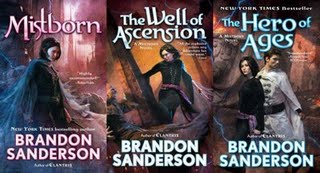 Brandon Sanderson’s Mistborn Trilogy is a wonderfully unique fantasy adventure that is absolutely filled to the brim with political intrigue and religious reflection. Here, we’ll take a look at some of the themes in this series from a worldview perspective. There will be SPOILERS below.
Religion(s)
The character Sazed is a specialist in religions. Indeed, he has the memories of three hundred religions in the trinkets he keeps on his body and preaches them to different characters throughout the first two books of the trilogy. His goal is less to convert than it is to pass on knowledge. Through the foil of Sazed, readers learn about some interesting religions which used to exist before the Lord Ruler began to eradicate them all. Sazed himself asserts that he believes all the religions are true, but in The Well of Ascension, his faith is crushed when he is confronted by the notion that his long search for the religion of his people–and its prophecies–is fruitless.
Sanderson thus presents us with an interesting perspective, through Sazed, of religion. On the one hand, Sazed is seemingly a pluralist. He tries to affirm all the religions he knows about: “I believe them all,” he declares (Well… 504). But on the other hand, his faith in the truth of these religions is decimated by his discovery of direct refutation. The tension of these two views ends up shattering Sazed’s worldview. But, as we’ll see below, it turns out that all religions were false in some sense, but they all had some truth, which Sazed himself uses to piece together the world as it should be (Hero… 716-717).
Interestingly, this resonates in some fashion with what I think is the best way to approach other religions. Rather than assuming everything the religious other believes is false, we should seek the truth in other religions and show how Christianity provides a better and fuller explanation of the same.
Messiah
The “Hero of Ages” is thought by many to be a hero who will come to save them from the oppressive rule of the Lord Ruler and Ruin. Some think that it is Kelsier after the hero of Mistborn helps to destroy the Lord Ruler and then uses a body double to act as though he has been resurrected in order to give hope to the common people. This image alone is an interesting foil for thinking about Jesus and the rise of Christianity. There is no denying the parallels in the story of Kelsier and of Christ in the sense of being seen as resurrected saviors.
But the narrative of Kelsier is intentionally subversive, it has a political aspect to it that is intentionally driven towards the overthrow of the Final Empire. Moreover, his life and times don’t match up quite right with the expected prophecies. A final aspect that is missing is the divine claims and historical evidence. It is all well and good to invent a fantastical narrative of a risen savior by means of a morphing creature; it is another thing to actually account for the historical evidence of a risen human being as confirmation of divine approval.
Ultimately, however, the Hero of Ages turns out not to be a coming hero but rather “A Hero who would preserve mankind throughout all its lives and times. Neither Preservation nor Ruin, but both. God.” (Hero, 718.) Interestingly, it is not completely clear whether the “God” referenced here is Sazed himself taking on the powers of Ruin and Preservation or whether these powers are granted by means of a transcendent deity. One’s interpretation of the final few chapters on this point will radically change how one views the book from a worldview perspective. Regardless of how one does take it, it is still quite intriguing to note that the final solution to the problem is deity. In a sense, it is a case of deus ex machina but in a way that absolutely lines up with the plot and expectations of the world Sanderson created. The ultimate source of salvation is found in deity.
Conclusion
Sanderson’s Mistborn Trilogy is a fascinating look in a fantastical world of how religion may develop and grow. It also features a number of questions which Christians should resonate with. It is a simply wonderful read for those interested in worldview questions. There is so much more with discussing in these books, so please do let me know your own thoughts and again, I highly recommend you go read them!
Links
Be sure to check out the page for this site on Facebook and Twitter for discussion of posts, links to other pages of interest, random talk about theology/philosophy/apologetics/movies and more!
Popular Books– Read through my other posts on popular books–science fiction, fantasy, and more! (Scroll down for more.)
SDG.
——
The preceding post is the property of J.W. Wartick (apart from quotations, which are the property of their respective owners, and works of art as credited; images are often freely available to the public and J.W. Wartick makes no claims of owning rights to the images unless he makes that explicit) and should not be reproduced in part or in whole without the expressed consent of the author. All content on this site is the property of J.W. Wartick and is made available for individual and personal usage. If you cite from these documents, whether for personal or professional purposes, please give appropriate citation with both the name of the author (J.W. Wartick) and a link to the original URL. If you’d like to repost a post, you may do so, provided you show less than half of the original post on your own site and link to the original post for the rest. You must also appropriately cite the post as noted above. This blog is protected by Creative Commons licensing. By viewing any part of this site, you are agreeing to this usage policy.
Interview with Christian Science Fiction Author Kathy Tyers
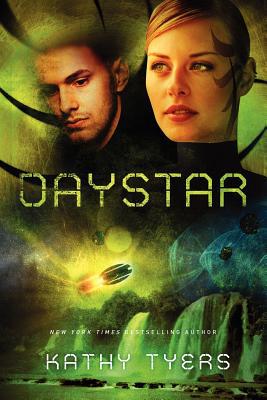 I am extremely pleased to be able to present my readers with an interview with New York Times-Bestselling author Kathy Tyers. Kathy Tyers has been instrumental in growing the genre of Christian science fiction and has published multiple books, including her award-winning “Firebird” series in this genre. She received the Mount Hermon Christian Writers Conference’s Pacesetter award for her work in developing science fiction. She has also published two Star Wars novels and appeared on the New York Times Bestseller list. She currently resides in Montana, where she continues to mentor other authors and work on her own future novels.
I have written several posts on Tyers’ “Firebird” saga (click here and scroll down or see links at the end of this post), and have immensely enjoyed her works.
What were some of the biggest science fiction influences on your writing?
The first SF novel I devoured was The Star Conquerors, an early space opera by Ben Bova. I was also a big fan of Zenna Henderson’s “People” novels. The original Star Wars movies swept me away, of course. I discovered Lois McMaster Bujold’s Miles Vorkosigan series when the first novel came out, and I kept up as she released titles in the series. Whenever I’m called to teach the craft in a classroom, I draw on Orson Scott Card’s excellent book on writing SF and Fantasy.
How has your faith inspired you to write?
My faith inspires my writing as it inspires everything I do; it’s the air I breathe, the ground I walk on, the light by which I can see and the gravity that keeps me grounded. If ever I shut my eyes, quit walking and stop breathing, it surely shows in my writing.
What do you think of the categorization of “Christian” fiction? Is it helpful to have a distinct category of “Christian” fiction?
Some people want to know, before opening a novel, whether it’s going to challenge them to think more deeply about God. Should all fiction come with a worldview alert about the author? That’s probably impractical. But if I open a novel that I know was written by a fellow Christian, or by someone of another faith, of course I approach it with different expectations.
What value do you think Christian speculative fiction has for evangelism, defense of the faith, and theology?
Whether or not we see ourselves as evangelists, we’re ambassadors for a Kingdom that is not of this world. That applies to every Christian in every profession. An author who’s known to be a Christian will have his or her books analyzed accordingly by some of the reviewers. If the book survives scrutiny as a good witness to the craft and the Kingdom, AND if it’s a good story well told, the author has accomplished what good fiction is supposed to accomplish—even if it gets the occasional one-star review.
How awesome was it to write Star Wars books?
Absolutely.
What is one piece of advice for aspiring writers?
Writing will take more time than you could possibly imagine. Don’t use that as an excuse to stop reading, because you’ll unconsciously (or consciously) emulate the books you’ve been reading. So read the good stuff.
What’s next on your plate? Any new books to look forward to?
I’ve written a contemporary supernatural novel set in Montana that I’m looking into indie publishing. Just looking, so far. Haven’t decided.
Conclusion
I would like to once more extend my thanks to Kathy Tyers for being willing to get interviewed for my site and for her excellent work in the field of science fiction.
Links
Kathy Tyers’ “Firebird” Trilogy- Faith, Humanity, and Conflict in the Far Future– The “Firebird” trilogy is one of my fondest memories of a read from when I was much younger. I recently re-read the series and was once more blown away. Here, I reflect on several issues of humanity and faith that Tyers raises in the novels.
Enter [Science] Fictional Messiah- Kathy Tyers’ “Wind and Shadow” and “Daystar”– I look into several worldview themes that Tyers raises in these sequels to her Firebird trilogy. What would a Messiah in the future look like?
Be sure to check out the page for this site on Facebook and Twitter for discussion of posts, links to other pages of interest, random talk about theology/philosophy/apologetics/movies and more!
Microview: “The Annotated Firebird Trilogy” by Kathy Tyers– I review the trilogy with a brief look at the plot and some positives and negatives in the book.
SDG.
——
The preceding post is the property of J.W. Wartick (apart from quotations, which are the property of their respective owners, and works of art as credited; images are often freely available to the public and J.W. Wartick makes no claims of owning rights to the images unless he makes that explicit) and should not be reproduced in part or in whole without the expressed consent of the author. All content on this site is the property of J.W. Wartick and is made available for individual and personal usage. If you cite from these documents, whether for personal or professional purposes, please give appropriate citation with both the name of the author (J.W. Wartick) and a link to the original URL. If you’d like to repost a post, you may do so, provided you show less than half of the original post on your own site and link to the original post for the rest. You must also appropriately cite the post as noted above. This blog is protected by Creative Commons licensing. By viewing any part of this site, you are agreeing to this usage policy.
The Wheel of Time “Towers of Midnight” and “A Memory of Light” – Reflection from a Christian
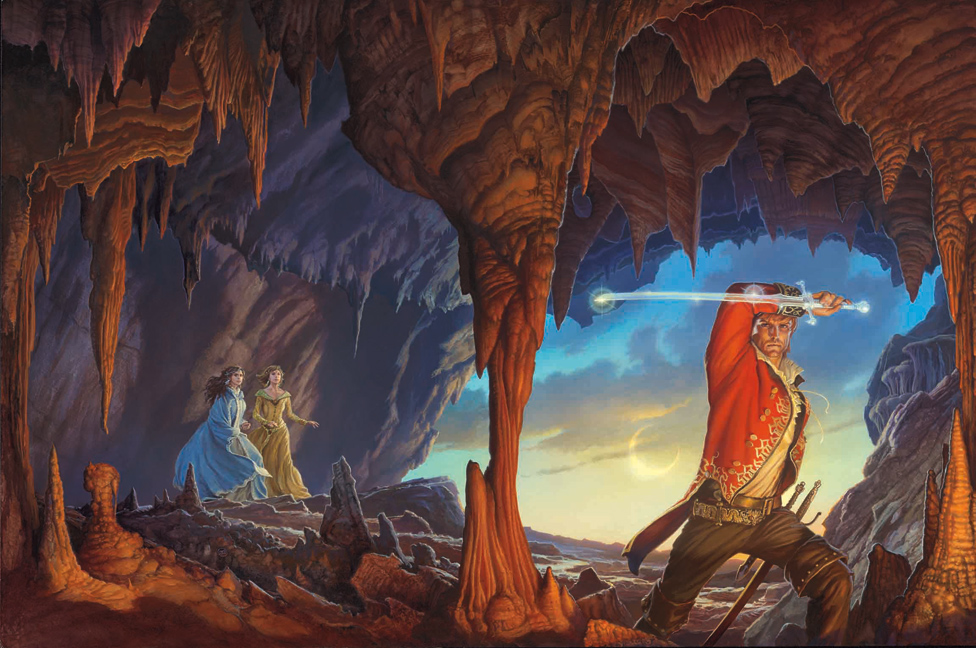 The conclusion to the Wheel of Time series has arrived at long last. It is a worth finish (well, there are no endings, nor beginnings in the Wheel of Time… but it was an ending) to the sprawling epic fantasy. There are not enough superlatives for me to describe how much I enjoyed the series. Here, we’ll discuss Towers of Midnight and A Memory of Light, the concluding volumes in the Wheel of Time. There are, of course major SPOILERS for the entire series in this post.
The Plight of the Outsiders
The last several books of the Wheel of Time series highlight at points the plight of those who are not main characters. Refugees, those who have had their homes destroyed, the people who are not often even referenced in other works of fiction. In Towers of Midnight, there is a poignant vision of the future, one in which the Aiel have been downtrodden and their power broken. A family of Aiel are starving and they beg for food from some people passing through what used to be their land. They show no mercy:
[The mother’s] tears did come then, quiet, weak. They rolled down her cheeks as she undid her shirt to nurse Garlvan, though she had no suck for him.
He didn’t move. He didn’t latch on. She lifted his small form and realized that he was no longer breathing… (1038-1039)
One wonders how often this kind of story plays out in our world. How easily we dehumanize those who are in need, and how easily we ignore them or disregard their need. Embedded in this sorrowful tale, we learn that there are always “outsiders”; always those in need, for whom we should be caring.
Disability?
Rand lost a hand earlier in the series, and it leads him to wonder about his own sufficiency as a person. A Memory of Light eloquently deals with this issue in a scene which depicts Tam, Rand’s adoptive father, sparring with Rand and forcing him to “let go.” As they spar, Rand admires his father’s swordsmanship and his ability to fight with one hand. He continues to realize that one hand may not be such a disadvantage in life and even uses his hand-less arm to block a bow. As the fight ends, the scene drives home the point:
Sweating, Rand raised his practice sword to Tam… Tam stepped back, raising his own sword. The older man wore a grin.
Nearby, standing near the lanterns, a handful of Warders [elite bodyguards of Aes Sedai–female magic users] began clapping. Not a large audience–only six men–but Rand had not noticed them. The Maidens [warrior women] lifted their spears in salute.
“It has been quite a weight, hasn’t it?” Tam asked.
“What weight?” Rand replied.
“That lost hand you’ve been carrying.”
Rand looked down at his stump. “Yes. I believe it has been that.” (312-313)
The fight has opened Rand to an awareness of his sense of loss, but also to a new sense of completeness. He has one hand, but that doesn’t make him less a man.
Fate or Free Will?
Throughout the series, the question of whether people are free in their choices or whether they are fated to have certain destinies is found front-and-center. The notion that all destinies are woven into a Pattern is used by some characters to argue for fatalism, while others believe the Pattern can be manipulated. In A Memory of Light, Egwene’s dream–a way of seeing into the future–provides a way for exploring this issue. Rand, Moiraine, and Egwene debate the meaning of a dream in which Rand is stepping into the Dark One’s prison, but there is not enough information to tell them the course of action they should take.
The debate suggests more about the world than may appear at first glance. It seems in the world of A Wheel of Time there is a tension between determinism and freedom, one which appears quite a bit in Christian thinking as well. How are we to forge our way in the world? Has everything been set before us in a Pattern, or are we able to choose our own destinies? Most importantly, A Memory of Light leaves the ambiguity there. The tension remains. Though Rand ultimately seems freed from the Pattern in some ways, it is a freedom which is never fully fleshed out. I think there is much to be said for this approach. One wonders whether the dichotomy of free/determined should be maintained, or whether more complexity exists in this world than that.
Evil and Good
When Rand confronts the Dark One in A Memory of Light, he comes to a point in which he is shown a depiction of the world without evil (679ff). It is a hideous place; the people are without the stories of their lives which shaped them in ways beyond reckoning. Bravery is impossible; as is conviction. The scene makes one wonder about the problem of evil–the notion that the existence of evil shows an omnipotent good deity does not exist–and various answers given to it. One prominent response to the problem of evil argues that evil may be used to make greater goods. Without the possibility of harm, there is no possibility of true bravery. Richard Swinburne is a well-known proponent of this response.
We live in a world which has been deeply harmed by evil. We also live in a world in which God has provided the answer to evil in the person of God’s Son. One day, God will wipe away every tear. We won’t live in the hellish nightmare of a world in which our characters have been sucked away from the elimination of all possible ills; but rather in a world that God has planned for us, a world of overpowering good.
Conclusion
The Wheel of Time series is easily my favorite fantasy series of all time. I read it through in the span of about a year. The books raise an enormous number of worldview issues, and they are also epic fantasy stories with gripping tales that will, I think, never let me go. It’s a saga of epic proportions, and one which I think any fan of literature should experience.
Links
Be sure to check out the page for this site on Facebook and Twitter for discussion of posts, links to other pages of interest, random talk about theology/philosophy/apologetics/movies and more!
Popular Books– Take a look at the other posts I’ve written on major works of fiction.
Sources
Robert Jordan and Brandon Sanderson, Towers of Midnight (New York: Tor, 2010).
Robert Jordan and Brandon Sanderson, A Memory of Light (New York: Tor, 2012).
SDG.
——
The preceding post is the property of J.W. Wartick (apart from quotations, which are the property of their respective owners, and works of art as credited; images are often freely available to the public and J.W. Wartick makes no claims of owning rights to the images unless he makes that explicit) and should not be reproduced in part or in whole without the expressed consent of the author. All content on this site is the property of J.W. Wartick and is made available for individual and personal usage. If you cite from these documents, whether for personal or professional purposes, please give appropriate citation with both the name of the author (J.W. Wartick) and a link to the original URL. If you’d like to repost a post, you may do so, provided you show less than half of the original post on your own site and link to the original post for the rest. You must also appropriately cite the post as noted above. This blog is protected by Creative Commons licensing. By viewing any part of this site, you are agreeing to this usage policy.

 J.W. Wartick - Reconstructing Faith