arguments for God
Book Review: “Existential Reasons for Belief in God” by Clifford Williams
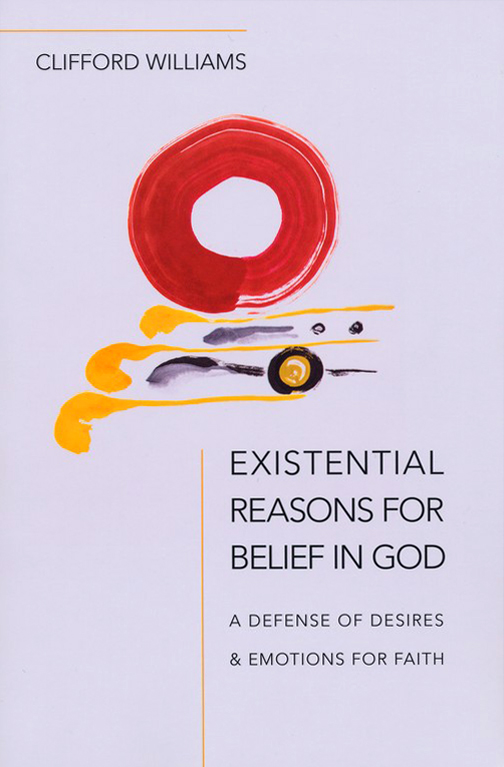 Clifford Williams’ Existential Reasons for Belief in God (hereafter ERBG) is one of the most unique philosophy of religion books this reader has experienced. Rather than engaging in systematic arguments for the existence of God based upon sensory experience or philosophical reflection on the cosmos, Williams focuses on the subject of his subtitle: A Defense of Desires & Emotions for Faith.
Williams argues that “Christians need a conception of faith that is at least as much need-based as reason-based” (13). By uniting these into one concept Christians can help acquire and sustain faith (13). Need has been too often cast aside or ridiculed when it comes to faith (12).
After these introductory remarks, Williams jumps into detailed argument on the topic. Throughout the work he focuses on the concept that “people acquire their faith partly because they feel that it meets… existential needs and partly because they think that it makes sense or is true” (17, emphasis his). He begins his argument by surveying various types of needs people have (20ff). In chapter 3, Williams presents an existential argument for believing in God:
1. We need [various things like cosmic security, meaning, awe, delight in goodness, etc.]
2. Faith in God justifies these needs.
3. Therefore, we are justified in having faith in God. (32)
Clearly, this is not the typical argument for the existence of God. It’s not an argument for God’s existence at all. Williams recognizes this fact and argues that there is a distinction between evidential and existential reasons for belief. “In evidential justification for believing in God, one believes in God because of what one takes to be good evidence for doing so ” (41). By contrast, “The existential argument… says that faith in God is justified solely because it satisfies certain needs” (41). The argument, therefore, is not to show God exists, but to show that one can rationally believe in God.
Williams argues that such existential justification is permissible for a number of reasons. First, it helps clarify what nature is–it is not merely a faith based on aspects of reality but is instead a faith which is aimed at meeting certain needs (41). Second, people use existential reasoning in other instances–for example when they need to eat, they know that they are justified in going to meet that need (41).
Objections to this reasoning will, of course, be raised. The first objection is that “the existential argument does not guarantee truth” (61). With this objection, one sees the distinction between evidential and existential arguments becoming very clear. Williams returns to the food analogy. The existential argument there would be “1. Humans get hungry; 2. Eating food assuages hunger; 3. Therefore, eating food is justified” (63). Here the argument is not to establish the existence of food but rather to establish that eating food is justified (63). Similarly, with the existential argument for God, the argument is to establish the justification for believing in God (63-64). The argument presupposes, to some extent, the existence of God, and justifies that very belief (64).
Another interesting implication of the distinction between existential and evidential reasons for belief is that they can be combined to form a cumulative type of argument for the existence of God. Williams presents such an argument, which combines these types of reasoning:
1. We [have various existential needs.]
2. The best explanation for the presence of these needs in humans is that there is a God who has put them into humans.
3. Faith in God satisfies these needs.
4. Therefore, we are justified in believing there is a God in whom we can have faith. (67)
But, it may be objected, this argument justifies belief in any type of God! Consider someone who wants to believe in “Tyrant George” because they need humans to be tortured. They could be justified in believing in such a deity based upon their in-built needs. Williams frankly admits that this objection has its merit. The existential argument should be combined with reason (88). But he also takes issue with the “need” to torture. He delimits criteria which define “needs.” These criteria are:
1. Needs must be felt by many others… most people, if not all.
2. Needs must endure…
3. Needs must be significant…
4. Needs must be part of a constellation of connected needs, each of which meets the other criteria…
5. Needs must be felt strongly (89).
Why, however, should we believe these criteria? Williams argues that these criteria are independently verified and that they have been found useful in a number of settings, including psychology, courtrooms, and in assessment of unusual phenomena (90).
A third objection notes that not everyone feels existential needs. Williams challenges this notion and argues that most people will be aware of having the various needs he has outlined (119). Finally, it may be objected that we can satisfy these needs without faith. Williams counters by presenting a various tests wherein subjects may find temporary satisfaction in varied cases but their ultimate needs are not met (133ff).
Williams also surveys various thinkers–from Pascal to William James to Freud–and what they had to say about needs. He offers critiques of several theories while advancing his own.
There are those who may be thinking this is, so far, an entirely fideist account. Williams begs to differ and provides several reasons for why faith and emotion can work with the mind and reason to bring about a satisfactory, fulfilling faith (chapter 8). He concludes by showing various ways needs can draw us toward and away from God. Ultimately, “We humans find ourselves with certain deep and abiding needs… We need meaning… We need to kneel, so we kneel” (183).
One interesting thing to note throughout the book is that Williams continually underscores his points with excerpts written by people who have had various existential needs met by faith. These illustrations are also used to show various objections or difficulties people have when their needs aren’t met. They give ERBG a unique feel to it–one that is more intimate than most philosophy works. They’re also useful in that they give readers a concrete example for his argument.
Those coming from a very evidentialist view of apologetics and philosophy will have difficulties with this book, as this reader can attest to. It’s hard to admit that needs and emotions have their place in a rational world, but Williams does an excellent job focusing the reader on this fact. Too often, the focus is only upon a posteriori arguments based upon the world as opposed to those based upon the human condition. Williams adequately defends existential reasons for belief, and–perhaps most importantly–presented them in a way to which evidentialists can relate and understand. He acknowledged difficulties in the argument and responded to many key objections. Hopefully, Williams has reopened an avenue for philosophers of religion to explore. Too long have they ignored the usefulness of existential reasoning.
Source:
Clifford Williams, Existential Reasons for Belief in God (Downers Grove, IL: InterVarsity Academic, 2011).
SDG.
——
The preceding post is the property of J.W. Wartick (apart from citations, which are the property of their respective owners) and should not be reproduced in part or in whole without the expressed consent of the author. All content on this site is the property of J.W. Wartick and is made available for individual and personal usage. If you cite from these documents, whether for personal or professional purposes, please give appropriate citation with both the name of the author (J.W. Wartick) and a link to the original URL. This blog is protected by Creative Commons licensing. By viewing any part of this site, you are agreeing to this usage policy.
William Lane Craig vs. Peter Millican- Thoughts and Links
 Theistic philosopher of religion William Lane Craig recently debated Atheistic Philosopher Peter Millican on the topic “Does God exist?” I daresay this was one of the most interesting debates I’ve heard. Millican came in with a clear strategy, and the debate covered an extreme range of topics. The friendly nature of the debate was also quite rewarding to hear. Clearly, we can have such discussions without attacking each other. Anyway, to the outline and analysis.
Craig Opening
Craig began by outlining the topic: Does God exist? The topic can be answered as yes or no. Craig argued for the former, and left the latter to Millican.
First, he argued philosophically against an infinite past. This argument would become quite important throughout the debate so I’ll outline it briefly. If we had an infinite number of coins, each with a number upon them, and took away ten, the number of coins would still be infinite. If we took away all the even coins, we’d have subtracted an infinite number of coins, and still, there would be an infinite number of coins. If, however, we subtracted all the coins above 3, we’d have subtracted infinite from infinite, and be left with 3 coins, not infinite coins. Craig argued that this is obviously a contradiction because despite subtracting the same amount (or different amounts) we can come up with two different answers (or the same answer). Therefore the past cannot be infinite.
Craig also argued scientifically that the universe began by bringing up the Borde, Guth, and Vilenkin theory which shows that irregardless of theories about the multiverse, bubble universes, and the like, the universe had a beginning.
He then presented the Kalam cosmological argument, though with a slight twist. He instead presented it as “The universe began to exist; if the universe began to exist, then it has a transcendent cause; therefore, the universe has a transcendent cause.”
He then argued the fine-tuning argument. There are a number of conditions of the universe which have been fine-tuned within a narrow range for the existence of life. Because of this, argued Craig, we can conclude the universe was designed.
Objective morality also necessitates the existence of God, argued Craig. The argument was based upon two major conditions: that objective morals exist, and that they cannot if there is no God. He quoted atheist philosopher Michael Ruse who said (in part): “morality is just an aid to survival” on naturalism.
Yet our moral experience leads us to believe that morality is indeed objective, and we know that, on naturalism, there is no ontological basis for morals. Thus, God exists.
Three facts must be explained by those who argue Jesus did not rise from the dead, and any theory must answer all of them: 1) the empty tomb; 2) on different occasions and settings to different people, Jesus appeared alive; 3) disciples showed a sudden belief that Jesus had risen, despite every predisposition to the contrary.
Craig noted that these three facts are agreed upon by New Testament scholars–both theists and non.
Finally, Craig argued for the experiential awareness of God.
Millican Opening
Millican used a different strategy here. Rather than immediately rebutting Craig’s arguments, as most have done in debates with Craig (although, notably, Stephen Law did not either in his debate with Craig), Millican argued against the method used first.
Christianity, he stated, is a hypothesis about reality. It makes a claim about what reality is. Therefore, the burden of proof lands squarely upon the theist.
He argued that people are primed for belief in gods. They have a “permiscuous teleology” which seeks for design. Furthermore, the dominant determinant of religious orientation is place of birth.
Before one could accuse Millican of the genetic fallacy (I actually wrote this on the side of my notes), he stated that he was not arguing these disprove God. Rather, he argued that if a method leads to variant beliefs, then it should discredit the method.
He then turned to rebutting Craig’s arguments. He said that quantum mechanics has shown that particles can come into existence out of nothing (note that he did indeed use the word “nothing” here). He furthermore argued that in our experience, we only see physical things being rearranged, not coming into existence ex nihilo. He argued that our experience must establish these truths.
He also cited Vilenkin, in a letter, stating that his theorem did not show the universe had a beginning.
Regarding the moral argument, he asked “what is objective?” He said that based upon how one defines this, one could have different answers about objective morality.
Craig First Rebuttal
Craig noted that Millican’s attempt to put all burden of proof on the theist didn’t work, because they also make a claim about reality: “There is no God.” This claim needs support as well, and Millican did not support it.
Regarding Millican’s claim about method, Craig responded that his method is logic, evidence, and personal experience–the same things which the scientific method relies upon. Thus, if the method yields God’s existence, it is not to be distrusted but embraced by those who value the latter method.
Not only that, but Millican’s argument seemed to suggest that religions all used the same methodology in reaching their truth claims, which is highly contentious and definitely untrue. Religions use a broad array of methods in how they discover truth.
Craig argued that absence of evidence is not evidence of absence. Only if we should expect more proof than there is should we be in doubt of the existence of something due to absence of evidence. Furthermore, argued Craig, he presented a great wealth of evidence already.
Craig then quoted Vilenkin’s letter in context. Vilenkin wrote that the beginning could be avoided only if one allowed for a contracting universe, but that this was highly unlikely and would have prevented the expansion of the universe. Thus, Vilenkin said, if he were to give a short answer to the question “Does your theory imply the beginning of the universe?” the answer would be yes. I should note that Millican dropped Vilenkin faster than Dawkins runs from Craig after this quote was read.
Craig then argued that the unembodied mind is hinted at our own experience. Furthermore, epiphenominalism simply cannot ground reality as we experience it.
Finally, regarding the moral argument, Craig asked why we should value humans and not chimps.
Millican First Rebuttal
Millican responded to the fine-tuning argument by saying that perhaps we may explain these evidences later. Further, we can’t base it all upon current physics, which may change. He also argued that there is difficulty with using the probability argument because our only sample is our current universe. God, argued Millican, would have been greatly inefficient if he made the universe as he did.
He briefly touched on the evil god thesis (as seen in the Law debate) and argued that the evidences could work for an evil deity.
Millican also suggested we should expect more evidence–why can’t there be more evidence for the existence of God?
Regarding the philosophical argument about the beginning of the universe, Millican noted that transfinite math does not allow for subtraction or addition because it yields diverse answers. Thus, he stated, Craig’s argument is confused.
He also conceded that the quantum vaccuum is not nothing, which was interesting considering he had literally used that word for it in his opening statement. He pressed his point, however, by stating that it is the closest we can come to nothing in our experience.
Unfortunately, Millican ran short on time and couldn’t respond to all Craig’s points.
Craig Second Rebuttal
Craig argued there are still no good reasons to support the contention “there is no God.” Furthermore, Millican’s response to the “absence of evidence” argument was just a personal opinion: ‘I think there should be more.’
God’s ‘inefficiency’ presupposes a God-as-engineer, argued Craig. One would have to be limited on time or resources in order to be compelled towards efficiency–limits God obviously does not have. God might be better compared to an artist or chef–enjoying the creation and beauty as he designed the universe.
The philosophical argument about infinites is problematic for Millican, argued Craig. The reason is because while we can slap the hand of a mathematician who tries to do so with abstract math, we can’t do the same thing in real life. If we literally had infinite coins, we couldn’t prevent someone from taking one away, and leading to the absurdities. In fact, Millican essentially demonstrated the point: such things are excluded in transfinite math because they are absurd, and so can’t happen in the real world.
Millican’s argument that the fine-tuning argument depends only on current physics illustrates Craig’s point exactly, countered Craig. Namely, that current physics supports the existence of God.
Millican Second Rebuttal
Millican argued that it doesn’t follow that if epiphenominalism is false, dualism is true. I think it’s really unfortunate the debate was so short–it would be interesting to see their views on this matter face off. He argued statistically that there are many moral realists who are not theists.
Why shouldn’t an atheist believe in objective moral values? asked Millican. There’s no good reason they can’t detect them and experience them. Further, we can value humans because they’re rational, and the same species.
Finally, he argued that scholars like Bart Ehrman had undermined the evidence for the resurrection by showing that the Gospels weren’t independent and unreliable.
Craig Conclusion
Craig noted there still was no good argument for atheism and that he’d presented good arguments for theism.
Bart Ehrman and the others Millican cited actually agree with the three facts Craig used to support the resurrection, so there was still no counter to that argument.
Craig noted that rationality doesn’t serve as an objective cut off point for morals. Sam Harris argued that sentience is. On atheism, argued Craig, there is no non-arbitrary line at which to base morality. Why should we value rationality? Why value humans more than chimps? Again, the line is arbitrary. The fact that many atheistic philosophers believe in realism of morality doesn’t show that it has grounds ontologically in atheism.
Millican Conclusion
Millican said there are many theories of how objective reality can be established on atheism.
He argued that physics may change and so we can’t base the existence of God upon current physics.
Finally, regarding evil, Millican said that our empirical evidence should lead us to doubt whether God exists. What should we see if there is a God? Certainly not this much suffering.
[Millican also argued throughout that there is no experiential evidence for things coming into being out of nothing, so that the causal premise of the Kalam is undermined. I forgot to write down where he started this argument, but wanted to make note of it here.]
Analysis
The debate was great. There were so many topics covered, it was a whirlwind.
Millican’s refutations of the Kalam were dramatically undercut by Craig. His citation of Vilenkin was just utterly demolished when Craig read the rest of the passage. His arguments about how we can’t add or subtract from infinity merely demonstrated Craig’s point: that it is absurd to suppose actual infinites exist. Regarding the causal premise, Craig argued in the debate that Millican would have to hold there was no essential or material cause for the universe, an argument to which Millican never had a response. To be fair, this may have been due to time.
I thought Millican’s response the fine-tuning argument was quite strange. Certainly, physics may change, but that doesn’t mean we can’t trust what we know now. As Craig argued, physicists today are quite convinced of the trustworthiness of physics. Further, Craig responded to the probabilistic argument by showing that we do indeed know the probability–despite the sample size. There is simply a life-permitting range for the values cited, so we can be justified in holding the fine-tuning argument to be true.
The moral argument was another point of contention. I don’t think Millican really undermined it. He merely referenced that atheists think they can have objective moral values, and questioned the meaning of the word “objective.” Interestingly, in the Q&A, Craig responded to Millican’s confusion: “That’s why I defined it.”
The resurrection definitely didn’t get defeated. Millican’s deferment to Ehrman and the like actually justified Craig’s 3 facts approach, because the scholars he cited affirmed the three facts.
Overall, I think Millican did much better than Law and definitely better than Harris or Krauss in those debates which I reviewed. That said, Craig still established the existence of God–at least as best can be done in under an hour to speak. Millican’s objections were interesting, but ultimately defeated by Craig. I think it’s fair to say that this debate showed, once more, that in the forum of rational inquiry, theism has an upper hand.
Links
Check out the audio of the debate at Apologetics 315. Also see their awesome feed which features tons of Craig’s debates.
See Wintery Knight’s summary of the debate.
SDG.
——
The preceding post is the property of J.W. Wartick (apart from citations, which are the property of their respective owners) and should not be reproduced in part or in whole without the expressed consent of the author. All content on this site is the property of J.W. Wartick and is made available for individual and personal usage. If you cite from these documents, whether for personal or professional purposes, please give appropriate citation with both the name of the author (J.W. Wartick) and a link to the original URL. This blog is protected by Creative Commons licensing. By viewing any part of this site, you are agreeing to this usage policy.
Thermodynamics, the Past, and the Multiverse: Arguing about the Kalam Cosmological Argument
I wrote recently about several objections to the Kalam Cosmological Argument, but I wasn’t able to cover even the most common objections in one post. Here, I’ll examine a few more objections to the argument, as well as offer critiques and more links to read.
Matter can be neither created nor destroyed
A common objection to the Kalam Cosmological Argument (hereafter KCA or Kalam) is against its principles of causation. The atheist points out the principle of the conservation of energy: that energy can be neither created nor destroyed, but only change forms (it can equally be said that “matter can be neither created nor destroyed…”). Applying this to the Kalam, they argue that because the KCA asserts the universe began and was caused, it cannot be true–matter cannot come into existence.
There are several problems with this objection. First, it assumes a causal principle: that only material causes exist. For it is true that the conservation of energy applies to material causation, but it may not apply to immaterial causation. “Ah,” the atheist may counter, saying, “but why think that there is immaterial causation anyway?” Why? Because that’s exactly what the KCA is made to demonstrate: that the universe was caused by an immaterial entity. The first premise (Everything that begins has a cause) would indeed have to surrender to the conservation of energy… but only if it is assumed that the cause is material. The Kalam is presenting an immaterial cause, creating the universe ex nihilo–out of nothing. For more on this objection, see William Lane Craig’s answer to the question “Must everything have a material cause?”
Second, using the conservation of energy to argue against the beginning of the universe reveals confusion about cosmology to begin with. Scientists can extrapolate back to the beginning of the big bang–which is the moment when both space and time came into existence, along with all of the material world (Craig and Copan, cited below, 222ff). So we know scientifically that there was a moment when there was no matter at all. It was created, not out of other matter, but out of nothing. Here is the key to note: it is once the universe came into existence that the laws of nature came into effect–before the universe, there was nothing.
Third, if it is true that matter has never been created or destroyed, matter and energy would be eternal. But if that is the case, then due to another law of thermodynamics–entropy–the entire universe would have evened out all the energy by now. There would be no stars burning, no people breathing, etc. Thus, it is easy to see scientifically that the universe is not eternal.
Infinite Past is No Problem
The late atheistic philosopher J.L. Mackie objected to the Kalam from a different perspective. He felt that there was a problem with the way William Lane Craig tried to establish a finite past. He argues that “[The Kalam] assumes that, even if past time were infinite, there would still have been a starting-point of time, but one infinitely remote, so that an actual infinity would have had to be traversed to reach the present from there. But to take the hypothesis of infinity seriously would be to suppose that there was no starting-point…” (Mackie, 93, cited below).
William Lane Craig and Paul Copan point out that, “On the contrary, the beginningless character of the series of past events only serves to underscore the difficulty of its formation by successive addition. The fact that there is no beginning at all, not even an infinitely distant one, makes the problem worse, not better” (Craig and Copan, 214, cited below). It’s not that defenders of the Kalam argue that if the past is infinite, one could not count to the present–rather, it’s that if the past is literally infinite, there is no beginning, and one could never reach the present moment by successive addition.
If one finds this line of reasoning unconvincing, however, one must also deal with the empirical problem with an infinite past: entropy. If the universe has existed forever, then all the energy in the universe should have evened out by now. We would simply not observe the universe we do. Thus, both philosophically and scientifically, we can discount the idea of an infinite past.
The Multiverse, Redux
I addressed the multiverse in my previous post on the topic, but it should be noted how much of a difficulty there is for those wishing to use the multiverse to discredit the Kalam. Jeffrey Zweerink points out that according to Arvind Borde, Alexander Vilenkin, and Alan Guth, “any cosmos that expands on average (like an inflationary multiverse) must have a beginning in the finite past” (Zweerink, 32, cited below). The multiverse does not help those trying to avoid a beginning for the universe, it merely pushes the problem up one level.
Conclusion
Again, after subjecting the Kalam Cosmological Argument to multiple objections, it emerges unscathed. It establishes its conclusion: the universe has a cause. What does this mean? That’s a question we should all consider of utmost importance.
Links
An outline of the Kalam Cosmological Argument.
Dawkins and Oppy vs. Theism: Defending the Kalam Cosmological Argument– A survey of some philosophical and popular attacks on the KCA along with rebuttals.
Sources
William Lane Craig and Paul Copan,Creation out of Nothing
J.L. Mackie, The Miracle of Theism (New York, NY: Oxford, 1982).
Jeffrey Zweerink, Who’s Afraid of the Multiverse? (Reasons to Believe, 2008).
SDG.
——
The preceding post is the property of J.W. Wartick (apart from citations, which are the property of their respective owners) and should not be reproduced in part or in whole without the expressed consent of the author. All content on this site is the property of J.W. Wartick and is made available for individual and personal usage. If you cite from these documents, whether for personal or professional purposes, please give appropriate citation with both the name of the author (J.W. Wartick) and a link to the original URL. This blog is protected by Creative Commons licensing. By viewing any part of this site, you are agreeing to this usage policy.
“The Multiverse Created Itself” and “Who made God after all?” -The Kalam Cosmological Argument

The most reasonable belief is that we came from nothing, by nothing, and for nothing. -Quentin Smith, Theism, Atheism, and Big Bang Cosmology, 135.
Is this so reasonable? Is it true that we came from nothing, by nothing, and for nothing? The Kalam Cosmological Argument is one of the most compelling arguments for theism. The broad opposition to the Kalam (or, more specifically, to its implications) from atheists has lead to some sophisticated arguments (like those of Graham Oppy or J.L Mackie), but it has also lead to some pretty poor arguments. Below, several objections to the Kalam Cosmological Argument have been outlined, along with rebuttals of varying lengths.
The Multiverse?
Some have objected to the Kalam by raising the possibility of a multiverse. They say that this counters the Kalam because it’s possible that our universe is one of nearly infinite past universes, generated as another “bubble” among untold trillions of other bubble universes. There should be one glaring difficulty with this objection that most can see immediately: “Whence the multiverse?” If the multiverse is proposed as eternal, then every objection about actual infinites applies to the multiverse. Not only that, but the multiverse itself would have to account for entropy. How is it that all the energy in this (nearly) infinite multiverse has not been used if it has existed for all eternity?
Ways around these difficulties have been proposed. For example, regarding entropy, some have argued that perhaps different laws of nature apply to the multiverse as a whole. Clearly, this is an extremely ad hoc theory that is really only invented to try to get around the argument. Once we’re allowed to modify reality to our every whim, we could indeed create anything we like–including (nearly) infinite universes.
Another problem with the multiverse objection is that we have startlingly little evidence for such a hypothesis. While there are many hypothetical scientists proposing bubble universes and the like, it’s shocking to read just how little evidence there really is for such a hypothesis.
Finally, even were there an infinite multiverse–as some have proposed due to string theory–this would not avoid an absolute beginning for the entirety of the multiverse. Bruce Gordon points out that the standard inflationary models still use inflation with a finite duration, which would entail that regardless of the number of universes which exist, there would still have to be an absolute beginning to the multiverse (Gordon, cited below, 86-87).
Perhaps, however, this multiverse (or the universe) is finite, but it created itself. There are a number of proposals suggesting just that.
The Universe Created Itself
I don’t think I can do much better than Edgar Andrews did over at his blog when he asks “Could a universe create itself?” He points out that the difficulty with each scenario proposed in which the universe creates itself is that it presupposes the existence of either matter, energy, or the laws of nature–the very things which this objection is supposed to answer. Andrews writes,
Stephen Hawking [who recently proposed the universe created itself] falls into this dilemma by claiming that the universe was created as a result of quantum mechanical fluctuations (in a vacuum) which became stabilized by gravitational forces [Hawking pp. 131-135; Hawking review]. He thus requires the laws of quantum mechanics and of gravity to have pre-existed the universe… But what is the law of gravity but a description of the way materialbodies interact — either with one another or with the space-time continuum? To claim that such a law existed in the absence of matter, energy, space or time stretches credulity and is incapable of demonstration. Only ‘mind of God’ and ‘non-material blueprint’ arguments remain and these are theological not scientific.
Similarly, suppose we took the claim of Smith (above) seriously–that the universe created itself from nothing. Does this even make sense? William Lane Craig writes, “…if prior to the existence of the universe, there was absolutely nothing–no God, no space, no time–how could the universe possibly have come to exist?” This is an extremely important question for the atheist to answer. Most often, however, atheists have instead changed the meaning of “nothing” to mean quantum vacuum or some other physical reality. This is hardly “nothing” that would have existed before the universe. Before the universe, there was no space, no time, no anything.
Edgar Andrews points out the confusion that some atheist philosophers and physicists perpetuate with this conflation of “nothing”:
[Victor Stenger] begins by utterly confusing the pre-creation ‘nothing’ that lies outside of space-time with the ‘nothing’ of a vacuum within space-time. Next, without making it clear which ‘nothing’ he is talking about, he claims that ‘the transition from nothing to something is a natural one, not requiring any agent.’ (Andrews, 97, cited below).
The problem isn’t solved when one lends it the idea of a multiverse, either. Oscillating universe models still imply a finite beginning (Gordon, 86ff). The idea that an infinite number of universes caused each other in a causal loop does no better–it leads only to a vicious regress. Ultimately, such proposals must be rejected for what they are–fiction.
Who Caused God?
Another trite response to the Kalam is the classic “Well fine, you say the universe is caused, well who caused God?” line. Here the atheist commits a number of classic blunders, to steal the phrase from “The Princess Bride.”
First, as in all scientific (and otherwise) inquiry, once one has reached the best possible explanation for an event, one has reached the end of the inquiry. An inference to the best explanation does not require an explanation of that explanation. There’s a reason that scientific inquiry can appeal to laws: they best explain how the world works.
Second, the first part of the Kalam is that “Everything which begins to exist has a cause” not “Everything is caused.” The atheist has merely misread or misinterpreted this principle. Should the atheist want to press the second point–that everything is caused, they have already conceded the weaker principle (that everything which begins has a cause), and they must further argue for a much stronger metaphysical claim. I leave it to the atheist to establish this claim.
“But,” the atheist may object, “you’re just denying the antecedent!” Not quite. I’m not saying that God didn’t begin, therefore God was uncaused–rather, I’m arguing that because God did not begin, this argument does not apply to God. There could be other arguments made to establish that God is caused, but to do so would require, as I pointed out, arguing for the metaphysical principle that “everything is caused.” Again, I leave the atheist to make this argument.
Conclusion
While many objections to the Kalam might be made in good faith, it is clear upon examination that they all fall far short of defeating the argument. The Kalam Cosmological Argument succeeds in its goal: to show that the universe is caused. What is this cause? That’s a question we must all consider with fear and trembling.
Links
Those interested in a broad outline of the Kalam Cosmological Argument can read my post on the topic.
For a discussion of one both Richard Dawkins’ and Graham Oppy’s objections to the Kalam, read Dawkins and Oppy vs. Theism: Defending the Kalam Cosmological Argument.
Sources:
Edgar Andrews, “Could a universe create itself?”
Edgar Andrews, Who Made God (Darlington, England: EP books, 2009). Reviewed here.
Bruce Gordon, “Inflationary Cosmology and the String Multiverse” in New Proofs for the Existence of God by Robert Spitzer (Grand Rapids, MI: William B. Eerdmans, 2010).
William Lane Craig and Paul Copan, Creation Out of Nothing (Grand Rapids, MI: Baker, 2004).
SDG.
——
The preceding post is the property of J.W. Wartick (apart from citations, which are the property of their respective owners) and should not be reproduced in part or in whole without the expressed consent of the author. All content on this site is the property of J.W. Wartick and is made available for individual and personal usage. If you cite from these documents, whether for personal or professional purposes, please give appropriate citation with both the name of the author (J.W. Wartick) and a link to the original URL. This blog is protected by Creative Commons licensing. By viewing any part of this site, you are agreeing to this usage policy.
Dawkins and Oppy vs. Theism: Defending the Kalam Cosmological Argument
 “[Arguments for God’s existence from an infinite regress] make the entirely unwarranted assumption that God himself is immune to the regress.” -Richard Dawkins, The God Delusion, 101.
Dawkins vs. the Kalam
Just over a year ago at Richard Dawkins’ site, someone asked Dawkins to respond to the Kalam Cosmological Argument (see an exposition of the argument here). The reader outlined the argument:
- Whatever begins to exist has a cause
- The universe began to exist
- Therefore, the universe has a cause
Dawkins is frequently witty, but often wrong. The argument is for broad theism. The Kalam is intended to show that the universe is caused, it is not an argument for Christianity specifically. I pointed out in another post that just because an argument is for broad theism (or just the brute existence of God), that doesn’t mean the argument is useless evidentially for Christianity. If we know the universe is caused, then we also know whatever caused the universe must be capable of causation (obviously), choice (it must select a moment to bring about the universe), powerful enough to bring the universe into existence out of nothing, etc. This would be powerful evidence and part of a cumulative case towards Christianity.
Then there’s Dawkins’ quote in The God Delusion which I have seen utilized to challenge the Kalam. First, I should note that Dawkins’ quote is in response to Aquinas’ Five Ways/Proofs. Further, it seems to be intentionally pointed towards a Leibnizian version of the Cosmological Argument (for a fuller defense of that argument, see here). But, a simple answer to Dawkins objection, which he seems to think is devastating, would be to point out that the universe and God are different types of entities. The universe is contingent, and God is necessary. That’s not arbitrary, that’s just the kind of things those entities are.
A Philosophical Attack On the Kalam
Not all atheists are as capable of blind, willful ignorance as Dawkins. Graham Oppy’s recent book Arguing About Gods has a thoughtful, challenging section dedicated to William Lane Craig’s exposition of the Kalam.
Oppy challenges Craig on every step of the Kalam, but I’m going to focus upon one. Oppy writes, “[I]t is quite unclear why one should suppose that the allegedly counter-intuitive behavior of the transfinite [numbers]… casts doubt on the idea that the very smallest transfinite cardinals do find application to ‘the real world'”(Arguing About Gods, 140).
This proposal is meant to challenge Craig’s contention that the infinite cannot actually exist. For, if there can be no actual infinites, then the objects we see around us–indeed, the universe itself–must have begun. Yet Oppy’s contention really only reflects mathematical truths. But surely this is a rather untenable claim. Oppy would have to provide evidence that the infinite actually exists and is not just an abstract mathematical concept. Craig’s contention is that the infinite can only be used in things like Cantor’s theory for mathematical equations. Why does Craig make this restriction? He cites David Hilbert, the famous German Mathematician, who points out that:
the infinite is nowhere found in reality. It neither exists in nature nor provides a legitmate basis for rational thought… the role for infinite to play is solely that of an idea… (David Hilbert Quoted in Craig, 87, cited below)
Yet Oppy provides no reason to think that there are actually infinite things found in reality. Rather, he resorts to claiming that Craig misinterpreted Hilbert’s paradoxes and that “If the Cantorian theory of the transfinite numbers is intelligible, then we can suppose that some parts of it find application ‘in the real world…'” (Oppy, 140). But is that true? Aren’t there plenty of things that are intelligible but for which we have no application ‘in the real world’? I abstract a bit when I point this out, but it is perfectly intelligible that there could be flying pigs, yet we don’t find an application of that in “the real world” other than as a false statement. There are nearly limitless examples of intelligible things we can think of, or intelligible theories, which have no application in the real world.
But perhaps Oppy isn’t making a claim quite as strong as saying actual infinites exist. Perhaps he is just referring to the possibility that they do. The problem then, however, is that, as Craig writes in a critique of Oppy’s position, “Oppy’s attempt to defend the possibility of the existence of an actual infinite is vitiated by his conflation of narrowly and broadly logical possibility.” The problem is that Oppy has confused broad logical possibility (that it is possible to construct a consistent set with an actual infinite) with modal (the notion that an infinite actually does exist in a possible world) or actual possibility in the real world. Again, Craig writes, ” Oppy… seems to take a proposition’s freedom from inconsistency in first-order logic to be indicative of that proposition’s being true in some possible world” (Craig b, cited below). So Oppy has not done anything to defeat the Kalam. Even were Craig to grant that Cantorian theory allows for broad logical possibility of actual infinites, it would not show that they are actually possible in our world. And again, even were they possible in the real world, an actual infinite would have to exist in order to discredit the Kalam. Thus, Oppy’s counter to the Kalam is quite weak–it’s based upon a conflation of broadly logical and actual possibility, and even were he to show that infinites are actually possible, the problem would remain that we have observed none.
Yet, and this is very important to note, even if actual infinites did exist, that wouldn’t undermine the idea that everything which began has a cause. It would only allow atheists to claim the universe did not begin. But how would they go about claiming that? They’d have to show that a model of the origins of the universe which allowed for an infinite past was plausible–more plausible than the alternative. Yet the only hope for showing this would be to make a theory as parsimonious as the Big Bang theory, which postulates an absolute beginning to the universe. So, even were there actually infinite things in the universe, which I very much doubt, that would not undermine the Kalam. It would make the argument more difficult to defend, but it would not falsify it. All it would show is that there are objects which are not caused.
Thus, I take it that the Kalam Cosmological Argument does not suffer defeat, either from vocal, misguided atheists like Dawkins, or thoughtful philosophers like Graham Oppy.
Links:
Again, see an outline and defense of the Kalam Cosmological Arugment here.
William Lane Craig discusses another objection: whether a beginningless past is actually infinite: here. He offers a number of critiques of Oppy’s position here. You can also access a review by Craig of Oppy’s book here (you will need to sign up for a free account on http://www.reasonablefaith.org/).
Check out my review of a recent debate between Craig and Lawrence Krauss, in which the Kalam was discussed here. (Includes a link to the actual debate.)
Wintery Knight writes about how to defend the Kalam at his site: http://winteryknight.wordpress.com/2009/04/08/how-to-defend-the-kalam-cosmological-argument-just-like-william-lane-craig/
Sources:
Graham Oppy, Arguing About Gods (New York, NY: Cambridge, 2006).
Richard Dawkins, The God Delusion (New York, NY: Houghton Mifflin, 2008).
William Lane Craig, The Kalam Cosmological Argument (Eugene, OR: Wipf and Stock, 1979).
William Lane Craig b, “Graham Oppy on the Kalam Cosmological Argument” (Leadership U, November 8, 2005), http://www.leaderu.com/offices/billcraig/docs/oppy.html, accessed 9/1/2011. Also found at http://www.reasonablefaith.org/site/News2?page=NewsArticle&id=5162.
Image credit: ESA/Hubble and NASA: http://spacetelescope.org/images/potw1021a/, found at http://commons.wikimedia.org/wiki/File:PGC_39058.jpg.
SDG.
——
The preceding post is the property of J.W. Wartick (apart from citations, which are the property of their respective owners) and should not be reproduced in part or in whole without the expressed consent of the author. All content on this site is the property of J.W. Wartick and is made available for individual and personal usage. If you cite from these documents, whether for personal or professional purposes, please give appropriate citation with both the name of the author (J.W. Wartick) and a link to the original URL. This blog is protected by Creative Commons licensing. By viewing any part of this site, you are agreeing to this usage policy.
Quick Links: Craig on the Ontological Argument
A common objection to the ontological argument for the existence of God is that existence is not a property. People often misunderstand that modern versions of the argument don’t rely on making existence a property, but upon the idea that necessary existence is greater than contingent existence. William Lane Craig has some clarifying comments on the ontological argument in response to two questions regarding this confusion: here.
The Kalam Cosmological Argument
 One of the most frequently cited and debated arguments for the existence of God is the Kalam Cosmological Argument. I have not written on the argument before because there is simply so much good material on it out there that I don’t think I can add anything new. I have, however, run into numerous people with questions on the argument recently, and felt the need to finally get around to a post on the Kalam. Those interested in the argument are highly encouraged to read the links included at the end.
The argument
The argument itself is quite simple:
1) Everything that began to exist has a cause
2) The universe began to exist
3) Therefore, the universe has a cause
The argument is deductively valid, so the question is whether the premises are true. If true, the conclusion is certain.
Defense of Premise 1
Why should we think that whatever began to exist has a cause? First, it seems a denial of this principle would undermine science. Science is an investigation of causation. If the anti-theist wishes to deny this premise, she is committed to a fallacy similar to that which she calls the “goddidit” fallacy: dismissing explanation for an event. (Interestingly, saying “God did it” is not a dismissal of explanation: it is, itself, an explanation. It’s saying the explanation which best fits the evidence is theism.)
Suppose premise 1 were false. In that case, things could and would be coming into existence for no reason whatsoever out of nothing. We would observe a remarkably different universe than that which we do, in fact, observe. A tiger would miraculously materialize in my room and eat me.
Now, it must be noted that some appeal to quantum physics in order to say this premise is false. They hold that certain quantum events bring things into existence without reason. Such an interpretation seems misguided at best, however, for a few reasons. First, the event would seem to have an explanation, namely, that it is a quantum phenomena of type x. Second, even were one to deny that this is a form of explanation or causation, the fact remains that these quantum events don’t originate from nothing. They originate from the laws and systems present within our universe. Third, these quantum events, on an examination of quantum theory, are not uncaused; they are merely spheres of probability. Finally, an exclusion of causal chains seems to undermine quantum theory itself or at least make it difficult to correctly interpret (on this, see William Wharton’s paper “Causation with Quantum Mechanics”). Like Wharton, I think the main reason causation is sometimes excluded from interpretations of QM is because of an avoidance of “metaphysical first causes.” Obviously, if this is the motivation for avoiding causation, it is not spurred by a commitment to science, but a commitment to avoiding the metaphysical implications of science.
Finally, consider what Wintery Knight points out about QM and the Kalam:
First, quantum mechanics is not going to save the atheist here. In QM, virtual particles come into being in a vacuum. The vacuum is sparked by a scientist. The particles exist for a period of time inversely proportional to their mass. But in the case of the big bang, there is no vacuum – there’s nothing. There is no scientist – there’s nothing. And the universe is far too massive to last 14 billion years as a virtual particle. (Wintery Knight, “How to defend the kalam cosmological argument just like William Lane Craig” April 8th, 2009).
The quantum events observed are caused: by the scientist. Therefore, they don’t undermine premise 1.
To sum up, the reasons for thinking the first premise true are clear: 1) to deny it undercuts science; 2) we don’t observe a universe with uncaused events; 3) the only reason found to deny the premise is an a priori commitment to anti-theism.
Defense of Premise 2
Did the universe begin? There are many arguments to support the premise that the universe did, in fact, begin, but I’m going to focus on only two: the impossibility of an infinite past and the empirical evidence of a finite past.
Impossibility of an infinite past
If the past is infinite, then we will have had to cross an infinite number of moments of time in order to come to the present moment. However, for any finite number of moments in time, x, there will always be a moment such that x+1 does not equal infinity. There is no way to start at any arbitrary moment in the supposedly infinite past and then add enough successive moments to arrive at the present moment. As such, it would be impossible to experience the present moment. However, we are experiencing the present moment, therefore, the past is finite.
Empirical evidence for a finite past
Despite misgivings from some Christians about the Big Bang theory, it has proven to be eminently valuable for arguments like the Kalam. I would go so far as to say the Big Bang serves as powerful evidence for a creator.
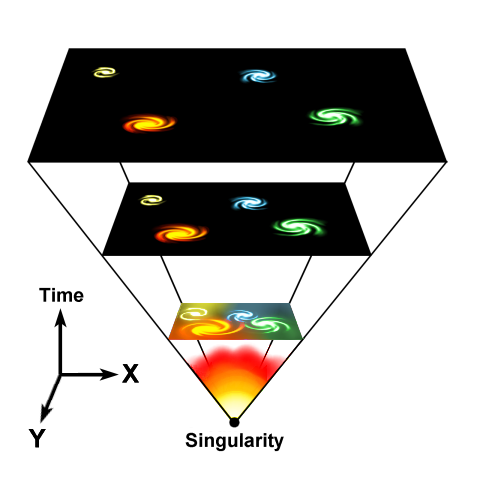
The reasoning behind this is that when we measure cosmic background radiation we can measure the expansion of the universe. Extrapolating backwards leads us to the conclusion that at some point in the finite past, the universe began to exist.
Therefore, it is reasonable to conclude that both premise 1 and 2 are true. However, because the argument is deductively valid, it follows that the universe has a cause.
Conclusions
Okay, so the universe has a cause. That doesn’t prove God exists! Well no, it doesn’t, but it does show that whatever caused the universe has many of the attributes classical theism has attributed to God, and therefore lends credence to the claim God exists. For whatever caused the universe must have extraordinary power (omnipotence); it must have made a choice to create the universe out of nothing (personal causation/agency); it must have been outside of time (the universe came into existence along with space and time); it must have been outside of space; and it must exist necessarily. As such, the Kalam doesn’t prove Christianity true instantly; it just proves theism is more plausible than atheism. Not only that, but it does show that whatever caused the universe is remarkably similar to the God Christians claim exists.
Appendix: Who made God?
Perhaps the most common objection to the argument outlined above is “Okay, well who made God?” This common retort can be answered after a minute of reflection. Classical theism holds that God exists necessarily, which means that God is eternal and beginningless. The first premise asserts that “whatever begins to exist…” therefore, it doesn’t apply to God. Is this a mere ad hoc fix on theism? No, because it isn’t saying God has no explanation for His existence (which reason is found in His necessary existence); it is saying that he did not begin, and is therefore uncaused. The detractor at this point would have to establish that “everything which exists is caused”–a much more difficult claim to defend than the claim that “everything which began to exist has a cause.” In fact, the anti-theistic claim seems necessarily false, for things which don’t begin are uncaused.
Links
Answers to objections towards the Kalam Cosmological Argument from Richard Dawkins and Graham Oppy
Did the multiverse create itself? Who made God?– more objections to the KCA are answered.
Sites
Wintery Knight “How to defend the kalam cosmological argument just like William Lane Craig”
Thinking Matters “The Kalam Cosmological Argument”
Wintery Knight, “The kalam cosmological argument defended in a peer-reviewed science journal”
Books
The Kalam Cosmological Argument by William Lane Craig
The Blackwell Companion to Natural Theology edited by Craig and J.P. Moreland
SDG.
——
The preceding post is the property of J.W. Wartick (apart from citations, which are the property of their respective owners) and should not be reproduced in part or in whole without the expressed consent of the author. All content on this site is the property of J.W. Wartick and is made available for individual and personal usage. If you cite from these documents, whether for personal or professional purposes, please give appropriate citation with both the name of the author (J.W. Wartick) and a link to the original URL. This blog is protected by Creative Commons licensing. By viewing any part of this site, you are agreeing to this usage policy.
Book Review: Is There a God? by Richard Swinburne
 The purpose of Is There a God?
ITG starts off with a chapter aptly titled “God.” In this chapter (modeled after his longer work, The Coherence of Theism), Swinburne outlines the properties and concept of God. It should be noted that Swinburne’s view of God differs from classical theism in two major ways. First, Swinburne’s conception of God does not involve knowledge of the future. His reasoning is that it is logically impossible to know that which does not yet exist (the future), so God is omniscient, but does not know the future. Going into great detail for an argument against that notion would take me too far away from this review, but suffice to say that I find the argument wrong for at least two reasons: 1) There are many coherent ways to envision the future as possible knowledge; 2) A timeless view of God would definitely entail foreknowledge, because all time would be equally present to such a deity. Second, Swinburne’s view of God differs in that he believes God’s existence is contingent, not necessary (he does believe that God is necessary in the sense that his existence does not cease–the necessity/contingence is the difference between modern and Aristotelian contingency–thanks to Tim McGrew and Chris Reese for pointing this out). Again, I disagree, but I find Swinburne’s view coherent.
Swinburne then turns in chapter two to the nature of explanation and argues that we often take personal explanations as valid even within scientific inquiry. Further, he puts much weight upon the simplicity of a theory, which leads into his third chapter, which argues for the simplicity of theism as an explanation for much of our known data. These chapters sum up his work in The Existence of God.
Swinburne then turns to other arguments for the existence of God, such as the cosmological argument and the teleological argument. In chapter 6, he provides a theodicy–an explanation of evil on theism. While I’ve read some pretty harsh critiques of Swinburne’s view on the problem of evil in the past, I found his argument here very compelling, personal, and interesting. His argument is largely a “greater good” type of argument–evils allow for things like heroism–but it is the most compelling version of such a theodicy I have read. I’m still not sure about whether I would incorporate this argument into my own apologetic, but I find Swinburne’s account compelling. (More on this topic can be found in his Providence and the Problem of Evil.)
The last chapter of ITG deals with Swinburne’s discussion of miracles and the argument from religious experience. Swinburne has been hugely influential in the field of arguing for the existence of God from religious experience, and this chapter sums up his argument. He argues that “we ought to believe that things are as they seem to be (in the epistemic sense) unless and until we have evidence that we are mistaken” (115). He then goes on to apply this to theistic experiences and concludes that “the overwhelming testimony of so many millions of people to occasional experiences of God must… be taken as tipping the balance of evidence decisively in favor of the existence of God” (120). (Swinburne’s arguments here are developed in his book, The Existence of God.)
I find two downsides to ITG. First, the concise nature of the work means that those interested in his arguments will need to go beyond the book to fully explore the issues. However, this is barely a downside because that is exactly what the book is meant to be: an introduction.
The second is that Swinburne doesn’t offer a very comprehensive “Guide to Further Reading” in his chapter of the same title. For example, about the question for the existence of God, Swinburne only offers two books arguing against God’s existence for further reading. Furthermore, the two books he suggests are heavy philosophical texts not at all comparable to ITG. I would have liked to see Swinburne offer some suggestions for equally philosophical explorations on the positive side of the theistic question. (I recommend the Blackwell Companion to Natural Theology edited by William Lane Craig and J.P. Moreland and God and Necessity by Stephen Parrish as two “heavier” books on the side of theism.)
Richard Swinburne’s Is There a God?
———
The preceding post is the property of J.W. Wartick (apart from citations, which are the property of their respective owners) and should not be reproduced in part or in whole without the expressed consent of the author. All content on this site is the property of J.W. Wartick and is made available for individual and personal usage. If you cite from these documents, whether for personal or professional purposes, please give appropriate citation and provide a link to the original URL. By viewing any part of this site, you are agreeing to this usage policy.
The Case for Christianity in 15 Minutes (or less)
 Recently, the need for defending Christianity in a short time period has come to light. I was in a discussion with some acquaintances and was asked to outline why I believe what I believe, but we were on a time crunch so I only had about 15 minutes. Thankfully, I have had access to some wonderful resources that allowed me to memorize some quick, but useful arguments.
This post is intended to provide other Christians with a case for their beliefs that they can memorize and share with others. Note that the study cannot stop here. Most people will not be convinced by the basics outlined here. The goal of this post is to provide a springboard for discussion and keep people engaged in the idea that God exists and Jesus is Lord. Each section is intended to flow directly into the next. I encourage my fellow Christians to memorize a “case for faith” in a manner like this, so they may be prepared with a reason for the hope within them (1 Peter 3:15).
The arguments are necessarily short and simple due to time constraints, but they offer a short defense that will, hopefully, spur further conversation (again, don’t forget to do more research!). Greg Koukl says we don’t need to convince someone right away–we just need to “put a rock in their shoe” so that we can keep the discussion going later. As always, the most effective apologetic is a prayerful, Christ-reflecting life. May the Holy Spirit guide you all.
1. God Exists (7 minutes)
There are many reasons to believe God exists, let me share a few:
Kalam Cosmological Argument
1) Everything that began to exist has a cause
2) The universe Began to exist
3) Therefore the universe has a cause.
It seems intuitively obvious that 1) is true. Things don’t just pop into and out of existence. 2) follows from modern scientific discoveries like the Big Bang, which implies a single cosmological beginning. 3) follows via modus ponens (the most basic form of argument) from 1 and 2. This argument shows a transcendent cause of the universe. The cause must also be personal because [it] brought the universe into existence at some point, which requires a choice. Choices can only be made by persons, so this entity is personal. (See William Lane Craig in “On Guard”, linked below, for more.)
[For more reading on the Kalam Cosmological Argument see my posts linked below.]
The Moral Argument
4) If there are objective moral values, then God exists
5) There are objective moral values
6) Therefore, God exists.
“Objective moral values” here means that moral values are true regardless of what anyone thinks. For example, “murder is wrong” would be wrong even if every single human being thought murder was the way to achieve greatest happiness and encouraged it as an extracurricular activity for teenagers. But the only way to hold that objective moral values exist is to grant God’s existence, because objective laws require an objective lawgiver.
Without God, however, morals reduce to “I don’t like that.” It seems ludicrous to believe that murder is wrong just because we don’t like it. It is something actually wrong about murder that makes it wrong. That which makes it wrong is, again, the commands of the Lawgiver: God. People have a sense of moral objectivity built into them, which also suggests both the existence of objective morals and a God who created in us this conscience. (See Craig “On Guard” and C.S. Lewis, “Mere Christianity”.)
2. Christianity is Unique (3 minutes)
Religions are not all the same:
1) Many religions have contradictory truth claims. (Some forms of Buddhism say: There is no God; Christianity argues: There is a God; Hinduism states: there are many gods)
2) Even among theistic religions, there are contradictory claims (Christianity: Jesus is God; Judaism: Jesus is not God; Islam: Mohammed is prophet; Christianity: Mohammed is not a prophet; Judaism: Mohammed is not a prophet; Islam: Jesus is not God; etc.).
3) The Law of Noncontradiction (actual contradictions like “square circles” or “married bachelors” cannot exist and are not real) shows us that therefore, these religions cannot all be true.
4) Christianity is unique in that its central religious claim is a historical one: that the person Jesus Christ died and rose again from the dead. This is a historical event which can be investigated just like any other historical event. Yet exploration of this event leads to the conclusion that…
3. Jesus is God (5 minutes)
1) The Gospels are reliable. They demonstrate many criteria for historical truth: multiple attestation (four Gospels telling the same story, but with enough significant differences to demonstrate they didn’t copy off each other), principle of embarrassment (the authors of the Gospels included details which would be embarrassing either to themselves or culturally, such as the fact that women were the first witnesses to the risen Christ in a culture in which women were not trusted), the writers died for their belief in the historical events (while many religious believers die for their beliefs, it seems unfathomable that the Christian Gospel writers would willingly die gruesome deaths for things they made up–which is what alternative theories argue), etc. (See Strobel, “Case for Christ”)
2) Jesus made divine claims “I and the Father are one” John 10:30; “Before Abraham was, I am” John 8:58; etc.
3) The miracle of the resurrection is God’s confirmation of Jesus’ divine claims. If the Gospels are reliable (per 1), then Jesus is divine.
Conclusions
There is good evidence to think that God exists. There are even other arguments that could be presented, such as the teleological, ontological, transcendental, argument from religious experience, and more. We can also see that not all religions can be true. Furthermore, there are good reasons to think the Gospels are reliable and that Jesus claimed to be God and had His claims authenticated by God Himself in Jesus’ resurrection.
Remember, this is not even close to a full defense of Christianity. It is simply a condensed, easy to remember defense designed to be ready at a moment’s notice for when the Holy Spirit leads people into our paths. We need to do more research, offer more arguments, and continue to witness as the Holy Spirit works through our testimony. This defense is by no means a total apologetic; it is meant only as an introduction to spur further conversation. Always have a reason.
Later Edit:
Some have objected to this post on various grounds, most of which are reducible to my arguments not being developed enough. I emphasize once more, this is supposed to be used for a 15-minute defense of the faith, not an entire survey of the field. See my links for more reading, and continue to investigate for yourself.
Further Reading
If you are interested in further reading on these topics, I suggest:
1) On my site, check out the posts on the existence of God: here. Specifically, for the Kalam Cosmological argument:
The Kalam Cosmological Argument
Dawkins and Oppy vs. Theism: Defending the Kalam Cosmological Argument
“The Multiverse Created Itself” and “Who made God after all?”- The Kalam Cosmological Argument
The Leibnizian Cosmological Argument (not developed in this post).
2) On Guard
3) The Case for Christ
4) Mere Christianity
———
The preceding post is the property of J.W. Wartick (apart from citations, which are the property of their respective owners) and should not be reproduced in part or in whole without the expressed consent of the author. All content on this site is the property of J.W. Wartick and is made available for individual and personal usage. If you cite from these documents, whether for personal or professional purposes, please give appropriate citation and provide a link to the original URL. By viewing any part of this site, you are agreeing to this usage policy.
Book Review: New Proofs for the Existence of God by Robert Spitzer
Robert Spitzer’s New Proofs for the Existence of God (hereafter NPEG) presents in rigorous detail, five arguments for the existence of God, a section discussing the plausibility of multiverse/string universe scenarios, and some philosophical discussion on methodology.
Before continuing the review, I should note that the “New” in NPEG is nuanced. Spitzer notes this himself (my guess is that it was a marketing technique. “New” refers to the evidence from cosmology and further research in philosophy which lend new power for these arguments.
Chapter 1 presents a cosmological argument. Spitzer cogently argues that “(1) If there is a reasonable likelihood of a beginning of the universe… and (2) if it is apriori true that ‘from nothing, only nothing comes,’ then it is reasonably likely that the universe came from something which is not physical reality” (Spitzer, 45). This conclusion is supported by explorations of current cosmological theories about the origins of the universe.
Chapter 2 presents the teleological argument, which Spitzer bases on the universal constants. The argument leads to the conclusion that “the odds against an anthropic condition occurring are astronomically high, making any life form… exceedingly improbable.” It is a probabilistic argument, the likes of which I defend in my article Past, Probability, and Teleology (Hope’s Reason 2011-1).
Following chapter 2 is a chapter which discusses the possibilities of inflationary cosmology and the string multiverse written by Bruce Gordon. It is extremely technical and will provide readers with cogent arguments against the possibility of a multiverse scenario circumventing the previous arguments.
Chapter 3 presents Spitzer’s metaphysical argument for the existence of God, which is full of sound argumentation along with some interesting Thomistic Philosophy wherein he discusses God’s simplicity in the most coherent way I have read. I greatly encourage readers to look into this chapter, if only for the discussion of this oft-neglected doctrine.
Spitzer follows this with Chapter 4’s metaphysical argument derived from Bernard Lonergan’s Insight, which is a subtle version of the argument from reason. This chapter was particularly good because it focuses on a little-used type of arguments for the existence of God–that if our universe is intelligible, that can only be explained by God’s existence.
Chapter 5 is an argument from contingency similar to the Leibnizian cosmological argument.
Chapter 6 engages the question of method in philosophy along with whether atheism is actually rational. I was intially put off by the title of this chapter (“Methodological Considerations and the Impossibility of Disproving God”), but happened throughout the book, I was pleasantly surprised by the rigorous arguments and enlightening conclusions Spitzer laid out.
Finally, the last two chapters outline some more considerations about the universe and the relation of humans and God.
NPEG was a surprising read for me. I went in with neutral expectations, and those were blown away. Spitzer’s knowledge of the topics in the work runs deep, and his writing style is clear and cohesive. It is genuinely exciting to read. Readers will be challenged by the arguments for the existence of God, and engaged in the details and philosophical explanations of these arguments. I highly recommend this work to those interested in advanced books on arguments for God’s existence.
——
The preceding post is the property of J.W. Wartick (apart from citations, which are the property of their respective owners) and should not be reproduced in part or in whole without the expressed consent of the author. All content on this site is the property of J.W. Wartick and is made available for individual and personal usage. If you cite from these documents, whether for personal or professional purposes, please give appropriate citation and provide a link to the original URL. By viewing any part of this site, you are agreeing to this usage policy.

 J.W. Wartick - Reconstructing Faith
