Creationism
The Life Dialogue: Geocreationism and Original Sin
This is a guest post by Mike Trutt on Geocreationism. Check out other posts on the “Life Dialogue” within Christianity here. Check out his other posts on Geocreationism here and here.
Mike Trutt is an evangelical Christian with a Jewish background. He believes the Bible is inspired by God, recorded by man, and given its life by the Holy Spirit. You can read about and discuss his Old Earth views on scripture, science, history, and other topics at his blog,http://geocreationism.com.
Original Sin
Whether you believe Adam was physically born or formed directly from dust, most Old Earth Creationists have the following belief in common: animals, plants, and people were alive and dying long before Adam and Eve ate of the apple. Why is this important? Because Original Sin introduced “death” into the world, and Evolution requires you to believe physical death existed before Original Sin.
Consider the following two passages, commonly used by Young Earth Creationists (YECs) to demonstrate that if the Word of God is true, then there was no physical death before Original Sin (emphasis added)…
Romans 5:12 – Therefore, just as sin entered the world through one man, and death through sin, and in this way death came to all people, because all sinned.
1 Corinthians 15:21-22 – For since death came through a man, the resurrection of the dead comes also through a man. For as in Adam all die, so in Christ all will be made alive.
In other words, so the argument goes, physical death could not precede Original Sin because physical death entered the world through Original Sin. It is in part why Christ Himself died for us. Looking at these passages, could it be any clearer? Allow for physical death before Adam, and it means either Christ had no reason to die, or the Word of God is wrong. It makes Old Earth Creationists (OECs) appear not to take the scripture very seriously.
= = =
Christians generally agree that Adam’s body began to deteriorate immediately after the Original Sin, and it eventually led to his physical death. But, is it the corrupting nature of sin that caused the deterioration, and hence death? Not according to 2 Corinthians 5 (emphasis and (comments) added)…
4 For while we are in this tent (i.e., earthly body), we groan and are burdened, because we do not wish to be unclothed but to be clothed instead with our heavenly dwelling, so that what is mortal may be swallowed up by life. 5 Now the one who has fashioned us for this very purpose is God, who has given us the Spirit as a deposit, guaranteeing what is to come.
In other words, God designed us to physically die so that our earthly mortality can be swallowed up by our heavenly immortality. Knowing that God designed us to be mortal while on earth, that same design should be found in Adam, even before his sin. In fact, it is found in Genesis 2:9 (emphasis added)…
The LORD God made all kinds of trees grow out of the ground—trees that were pleasing to the eye and good for food. In the middle of the garden were the tree of life and the tree of the knowledge of good and evil.
Why provide sinless Adam with the Tree of Life, unless his body was otherwise mortal? Without that tree, Adam would die; with the tree, he would live forever. Even after Adam’s sin, God placed angels and a flaming sword to guard the Tree of Life from him, lest he “reach out his hand and take also from the tree of life and eat, and live forever.” (Genesis 3:22b) In other words, before the Original Sin and after, Adam’s immortality depended on the Tree of Life. Like Paul said, Adam was designed to die.
= = =
We could just leave it at that, but there are a few scriptures we should address. For example, if Original Sin was merely the occasion of Adam’s physical death, never the instrument, then what was God warning Adam of when he said not to eat from the Tree of the Knowledge of Good and Evil?
Genesis 2:17b – …for when you eat from [the Tree of the Knowledge of Good and Evil] you will certainly die.
The most straightforward reading of this verse implies that eating the apple would immediately physically kill Adam. In fact, when Eve repeated God’s warning back to Satan in the Garden, she clearly thought God meant immediate physical death. But then Satan corrected her…
Genesis 3:4-5 – “You will not certainly die,” the serpent said to the woman. “For God knows that when you eat from it your eyes will be opened, and you will be like God, knowing good and evil.”
In the Gospels, Satan always tempted Jesus with the truth. That is what made it tempting. Is it not then reasonable to consider that Satan was telling Eve the truth about physical death, even while he deceived her in regards to God’s meaning? After all, when Eve ate the fruit, she did not immediately physically die. In fact, just as Satan predicted, Adam’s and Eve’s eyes were opened to knowing good and evil… and they knew what they did was evil.
What then was Satan’s deception? For one thing, he left out what God really meant by “die”, by making “death” seem like a “coming alive”. Before the Fall, Adam and Eve were in a state of sinless perfection; afterwards they were not. Before the fall, they were naked and did not think twice about it; afterwards they were self-conscious and covered themselves up. The moment they both sinned, they went from being blameless to being in need of redemption. It was a dramatic change, as sudden and jarring as Genesis 2:17 makes it sound. In a very significant and spiritual way, they both died that day.
By the same token, there was another deception. Assuming Eve realized the fruit was keeping her alive, she really had no idea that God was going to punish her by depriving her of it. God may have been promising spiritual death for her sin, but Eve was in fear of physical death. Satan knew God would not immediately kill her physical body, but he failed to tell her that she would eventually die. One possibility is that he didn’t know.
So now we see that both spiritual death and physical death indeed resulted from the Fall. However, it is the immediacy of Adam’s and Eve’s spiritual death that demonstrates the meaning of God’s promise in Genesis 2:17. Yes, they physically died… eventually. Yes, it was a result of their sin. However, the mechanism of their death was through deprivation of the Tree of Life; their tendency to deteriorate was designed into them.
= = =
When Adam and Eve sinned, they died a spiritual death. Original Sin deprived them of the Tree of Life, but the design of their bodies did not actually change. It is in this context that we can review the first proof verse on Original Sin…
Romans 5:12 – Therefore, just as sin entered the world through one man, and death through sin, and in this way death came to all men, because all sinned.
As a proof verse against evolution, YECs are essentially viewing the verse as if it says the following…
Therefore, just as sin entered the world through one man, and mortality through sin, and in this way mortality came to all men, because all sinned.
But, Paul also wrote 2 Corinthians 5:5, which says that mortality is designed into us, providing our path toward immortality with God. Therefore, mortality did not enter the world through sin. Now, Romans 5:12 is clearly a reference to the death in Genesis 2:17b, and we saw above that it was speaking of spiritual death. It is spiritual death that entered the world through sin.
= = =
The other proof verse is similar…
1 Corinthians 15:21-22 For since death came through a man, the resurrection of the dead comes also through a man. For as in Adam all die, so in Christ all will be made alive.
Similar to Romans 5:12, YECs use this verse as follows…
For since mortality came through a man, immortality comes also through a man. For as in Adam all are mortal, so in Christ all will be made immortal.
However, not only is this verse not discussing mortality and immortality, it isn’t even discussing Christ’s saving grace. According to 1 Corinthians 15:12 verses 21 and 22 are trying to explain the resurrection, which the Corinthians were on the verge of rejecting. Daniel explained the resurrection as follows…
Daniel 12:2 – Multitudes who sleep in the dust of the earth will awake: some to everlasting life, others to shame and everlasting contempt.
In other words, both saved and unsaved will be resurrected through Christ. To be sure, judgment will follow, but Paul was only talking about the resurrection itself. To paraphrase our proof verse…
For since spiritual death came through a man, the resurrection of the dead comes also through a man. For as in Adam all earn judgment, so in Christ all will resurrect to face that judgment.
In closing, Original Sin introduced spiritual death, but we were always designed to die.
———
The preceding post is the property of Mike Trutt (apart from citations, which are the property of their respective owners) and should not be reproduced in part or in whole without the expressed consent of the author. All content on this site is the property of J.W. Wartick and is made available for individual and personal usage. If you cite from these documents, whether for personal or professional purposes, please give appropriate citation and provide a link to the original URL. By viewing any part of this site, you are agreeing to this usage policy.
The Life Dialogue: Old Earth Creationism 4
 This is part of a series of posts on the “Life Dialogue/Origins Debate” within Christianity. View other posts in the series here.
The obvious point of contention between Old and Young Earth Creationism (hereafter OEC and YEC) is the age of the Earth/Universe. Hugh Ross argues powerfully for an old universe from both a theological and scientific perspective in A Matter of Days: Resolving a Creation Controversy.
The argument against the YEC position (derived from A Matter of Days) runs as follows:
1) The most coherent YEC position to explain the appearance of age in the universe is to hold that the universe appears to be old, but is not old in fact. (YECs often hold that God created light already traveling to earth, created Earth already to the point it could sustain life, etc.)
2) Scripture states that God does not lie. God is not a deceiver.
3) Scripture states that nature provides an accurate record of reality, though not a complete record.
4) 1) Scientific evidence (nature) demonstrates the universe is about 14 billion years old, as opposed to the 10,000(ish) years YECs grant.
5) Therefore, the universe is actually old. This follows from the accurate evidence of nature combined with 2) that God doesn’t deceive. If the universe is, in fact, 10,000 years (or so) old, then God has deceived humanity by making it in such a way that it appears to be much older than it is.
Premise 1) seems to definitely be the case. First, because the universe, according to the most modern science, is anywhere between 13-16 billion years old. Second, while YEC potentially has theories to explain why earth looks so old without relying on it being created already aged to a certain point (i.e. hydroplate theory), this does nothing to explain the background cosmic radiation; how we can see light from stars that are too far away to be seen yet were the universe 10,000 years old, etc. It therefore seems as though the only way to explain the apparent age of the universe is to argue that it is just that: apparent only. On this theory, God created the earth universe enough to support life, about 10,000 years ago.
Premise 2) doesn’t really need a defense (but if desired: Romans 3:4; Numbers 23:19; Deuteronomy 32:4; 1 Samuel 15:29; Titus 1:1-2).
Premise 3) can be seen in things like Psalm 19:1-4a:
“The heavens declare the glory of God;
the skies proclaim the work of his hands.
Day after day they pour forth speech;
night after night they reveal knowledge.
They have no speech, they use no words;
no sound is heard from them.
Yet their voice goes out into all the earth,
their words to the ends of the world.”
Premise 4) is at least implicitly accepted by YECs because they argue that even though science shows the universe is very old, it is not actually that old. It is worth noting that some YECs would claim that “real” and “unbiased” science would not lead to the conclusion that the universe is very old. There is little one can do to counter this claim other than argue that were that true, the YEC account would be able to present a fully testable, verifiable scientific model that shows that things like the background cosmic radiation are false.
Finally, the conclusion seems to follow from the preceding argument. God told us nature is an accurate record; He also created the universe (on YEC) in such a way that it appears to be billions of years old, but is not actually that old. Therefore, He created a universe that would deceive us into thinking, falsely, that the universe is old. But, God does not lie, so this cannot be true. Therefore, the universe is old.
I find this argument very convincing. It underscores my main problem with the YEC position: namely, that the best evidence does show the universe is old, and so God would be a deceiver were He to make it thusly.
SDG.
——
The preceding post is the property of J.W. Wartick (apart from citations, which are the property of their respective owners) and should not be reproduced in part or in whole without the expressed consent of the author. All content on this site is the property of J.W. Wartick and is made available for individual and personal usage. If you cite from these documents, whether for personal or professional purposes, please give appropriate citation and provide a link to the original URL. By viewing any part of this site, you are agreeing to this usage policy.
The Life Dialogue: Geocreationism Guest Post 2
This is part 2 of a thought-provoking series of guest posts by Mike Trutt on Geocreationism. Check out other posts on the “Life Dialogue” within Christianity here. View Part 1 here.
Mike Trutt is an evangelical Christian with a Jewish background. He believes the Bible is inspired by God, recorded by man, and given its life by the Holy Spirit. You can read about and discuss his Old Earth views on scripture, science, history, and other topics at his blog,http://geocreationism.com.
Geocreationism – Evolution and God
As the reader proceeds, I request an open mind. With many of my theories on Creation, I often get the question of “why”? I cannot always answer. But consider how often God does not explain Himself to you. Quite often, He tells us what He did and what He will do, and we have only to believe Him. Abram was promised a son in His old age. He believed God and it was accounted to Him as righteousness; Zechariah on the other hand laughed, and God shut him up mute until his son John the Baptist was born. And so I take a risk with Creation, attempting to be righteous and not mute, and trusting God’s hand will be gentle if I am wrong. If in the end you still need an answer as to “why” then I offer you this: whatever God did, it was for His glory.
= = =
Evolution is not an easy topic for Christians. Whatever the version, Evolution does not appear to require God any more than God requires Evolution. It is enough to keep atheists and Christians apart, but do not be fooled into picking sides. Such thinking is a trap of the enemy, as either choice is the result of a common theological fallacy… that God would not create using natural or “random” means. But, what if scripture showed otherwise?
Consider this passage in 1 Chronicles 14:15-16…
15 And when you hear the sound of marching in the tops of the balsam trees, then go out to battle, for God has gone out before you to strike down the army of the Philistines.” 16 And David did as God commanded him, and they struck down the Philistine army from Gibeon to Gezer.
God went before David to strike down the philistines; David’s armies went and struck down the philistines. God and David took separate actions, yet accomplished the same defeat. To say then that Evolution is false because God created everything is like saying that David did not achieve victory over the Philistines, because God obviously did. This not only limits God, it contradicts the plain meaning of scripture. If Evolution is true, then Biblically speaking, it is as much God’s instrument as David’s armies above. But, just as a secular historian may study the defeat above and see only David’s army, a scientist studying the species will only see mutation, adaptation, and Natural Selection… but the blindness of man does not negate what he sees any more than it equates to an absence of God.
= = =
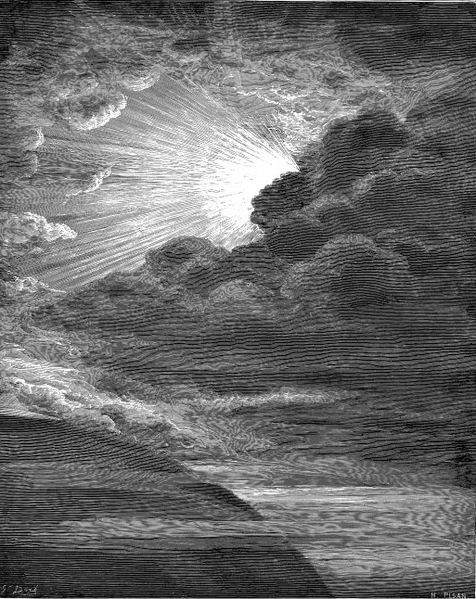
On Day 1, God hovered over the deep. As recorded in the size and age of the moon’s craters, meteor strikes devastated the earth’s early oceans, causing clouds and torrential rains throughout the world. From where God hovered in Genesis 1:2, the sun’s still-dim light could not be seen through the rain and clouds, and while the meteors continued it would be so. With His pronouncement to “Let there be light,” the meteors ceased and the light of the sun pierced the darkness. This was 3.9 billion years ago. The rains would not yet stop, but an atmosphere would begin to form. There would now be sunlight, though the sun itself remained unseen.
On Day 2, the torrential rains continued to fall so hard, there was no perceivable separation between the clouds above and the seas below. With God’s declaration to “Let the waters separate from the waters,” the rains started to let up. Was Moses aware of these conditions when he wrote of them? Given their parallels with Egypt’s creation myths, I would say not. However, their alignment with modern secular scientific theories should be enough to give one pause.
On Day 3, the skies were still hazy and the world was still covered in water. God said to “let the water gather together in one place, and let dry ground appear.” Plate tectonics began around 2.4 billion years ago, as the earth hardened beneath the water and earthquakes thrusted the earth’s crust above the seas. God then said to “Let the land produce vegetation: seed-bearing plants and trees on the land that bear fruit with seed in it, according to their various kinds.”
According to their various kinds? Most people take it to mean that the vegetation will be capable of reproduction. But examine the King James translation: “And God said, Let the earth bring forth grass, the herb yielding seed, and the fruit tree yielding fruit after his kind, whose seed is in itself, upon the earth: and it was so.” God specifically listed seeded plants. What of the non-seeded, specifically succulents and spores?
The Bible says the land produced seeded plants at God’s command. It reminds me of David’s victory above. God went before the land to produce seeded plants, and then the land went forth and produced seeded plants. And if the land’s production was as physical as David’s victory, then why be surprised that it left behind some trace? Why be surprised that production of seeded plants required spores and succulents to develop first, each giving way to the next? Why be surprised that God didn’t even wait for the seeded plants to appear before He moved into the sunset and starting His work on Day 4? That’s right. Seeded plants did not appear until 300 million years ago, long after Day 4, which we discuss below. But once again, God’s work for Day 3 was done. It was time for the land to do its work.
On Day 4, as algae and fungi made significant inroads on the land, God said “Let there be lights in the heavens to separate the day from the night.” Scientists believe the Oxygen of these primitive plants cleared up the sky around 1.9 billion years ago. The sun, moon, and stars could be seen clearly in the skies, when they had been completely obscured before.
Day 5’s pronouncement reads, “Let the water teem with living creatures, and let birds fly above the earth across the skies.” Day 6 reads, “Let the land produce living creatures according to their kinds,” and it goes on to list their groups. If interpreted as the initial appearance of sea life, birds, and land mammals, then Days 5 and 6 must overlap, because whales appeared after land mammals in the fossil record. Such overlap of Days is not Biblical, but through scientific discovery we can find a meaning that explains it.
65 million years ago, a giant meteor struck the earth. It is referred to as the KT impact, and it nearly decimated all life on the planet. It killed nearly every dinosaur, bird, sea creature, and mammal around the world. According to the fossil record, the first to recover was sea life. Placing Day 5 after the KT impact, a time when mere life was scant but there, God’s pronouncement becomes apropos, “Let the water teem with living creatures.” Next would be the birds. Why? It was the first time in their existence when they had no natural predators. And, just as Day 3 began a process leading to seeded plants, so Day 5 began a process eventually leading to whales. But wait. This required a recovery of mammals on the land, because they are what eventually led to mammals in the seas. What of the mammals of Day 6? The most comon theories have these days overlap.
According to the fossil record, the mammals that evolved on Day 5 were almost wiped out around 33.5 million years ago, after the whales appeared. The event is called the Grand Coupure. Then, almost as suddenly, the mammals that survived gave way to new varieties, the ones we see today, the ones listed in scripture: “Let the land produce living creatures according to their kinds: the livestock, the creatures that move along the ground, and the wild animals, each according to its kind.” Once again, the specificity of scripture, when compared with the discoveries of science, provides an answer.
= = =
It was hard to fit my treatise on Evolution into the word limitation of a blog, but I hope the point comes through, that secular science is useful and God is sovereign. The next installment will discuss the doctrine of Original Sin, and why death before Adam is compatible.
The Life Dialogue: Geocreationism Guest Post 1
This is part 1 of a series of guest posts by Mike Trutt on Geocreationism. Check out other posts on the “Life Dialogue” within Christianity here.
Mike Trutt is an evangelical Christian with a Jewish background. He believes the Bible is inspired by God, recorded by man, and given its life by the Holy Spirit. You can read about and discuss his Old Earth views on scripture, science, history, and other topics at his blog,http://geocreationism.com.
Geocreationism- Introduction
I believe the Earth is old, and God’s Word is true. This is not an easy position to hold. There are Christians today feeling challenged to abandon the church, because long-standing theology requires a young earth that science tells them does not exist. Faith tells them that science and scripture should not be at odds, but if the earth is so old, then what does scripture mean? Why does Genesis say what it says, and science sees what it sees? Christians can agree that science and scripture must somehow align, but disagree as to how. A science that conforms to a young earth requires one to dismiss the scientific basis of established dating techniques, while an interpretation of scripture that conforms to an old earth requires an explanation of why pre-historic death does not unravel the doctrine of Original Sin, and in turn our need for a savior. As an Old Earth proponent and a Christian redeemed from sin, I have found no mainstream theory – on either side – that satisfactorily answers these questions.
Though I consider them my brethren in Christ, the Young Earth scientists whose writings I have read do not appear to understand the science they theoretically embrace. While using science reliably for everyday tasks like keeping airplanes in the sky and maintaining reliable cell-phone signals, the moment you provide evidence of something incredibly old that The Great Flood cannot explain, they say carbon dating is unreliable beyond 5,000 years (which is roughly true), hence rendering any dating technique equally suspect. Why? Because the Bible clearly says to them that the Earth is young. To them, evidence to the contrary indicates a misunderstanding of the evidence. While such strong faith is potentially advantageous to their relationship with God, it dismisses the possibility that Genesis is what we misunderstand. But, if that is the case, and the earth is old, then where is the theory of Old Earth Creation that keeps Christian Theology intact? In all my years of looking for it, it isn’t there. Enter Geocreationism.
Most Old Earth approaches relegate Genesis 1-11 to some form of symbolism, even though every chapter is clearly written in a literal manner. For example, concordist theories (e.g., Day-Age, Progressive Creationism) map the days of creation to overlapping geological eras, even though Genesis 1 clearly discerns a break between creation days. Gap theories fail to account for the fossil record, by acknowledging the age of the earth, but not the development of the species. Theistic Evolution relegates God to the beginning of creation, when Genesis 1 clearly shows God’s involvement at every step. And so it goes, as every mainstream Old Earth theory dismisses the plain meaning of scripture, an unsatisfying response to Young Earth theories, which dismiss the plain meaning of the science. It creates a false dichotomy that puts many in the unenviable position of dismissing their heart or dismissing their mind, when God would have us dismiss neither.
= = =
The first mistake of Old and Young Earth Creationists alike is one of perspective. They read Genesis 1 from the perspective of the earth’s experience being created by God, when it is really telling us of God’s experience creating the earth. If there is any doubt then consider who it is that hovered over the deep in Genesis 1:2. God was there, physically hovering. He had a perspective, and from His perspective the earth had no form and He could see no light. “And God said ‘Let there be light,’ and there was light. God saw that the light was good, and he separated the light from the darkness. God called the light ‘day’, and the darkness he called ‘night.’ And there was evening and there was morning – the first day.” (Genesis 1:3-5) From God’s perspective, hovering over the deep, there was now light separated from darkness. In Job 38:5, God describes it as stretching the line upon the face of the earth. Proverbs 8:27 calls that line the circle on the deep, which we see from space, even today.
The Hebrew word used for day is “yom”, and it refers specifically to the period from sundown to sundown, or from darkness to darkness. In other words, God experienced the end of the day, but it was not specifically 24 hours. This has profound implications for understanding Genesis 1, and it is a perspective I have read nowhere else.
For God to, by choice, physically experience 6 days creating, calling each phase of creation “good”, it suggests an ability to watch the earth rotate beneath Him until the entire earth passed Him by. As Genesis 1:2 says so clearly, God hovered over it, an intentional physical perspective for Him to watch His work. But what would happen after 24 hours, after the entire earth has passed through His view? From the perspective of a point on the earth, one “yom” would certainly pass. However, God was not limited to a point upon the earth. He was hovering above it as the earth rotated beneath Him, hovering in the light, which imposes no arbitrary time limit on when He moves into the dark. Combined with the literal meaning of “yom”, scripture is not requiring a creation day to be a 24-hour period. Sundown for God becomes the time God chose, not a time imposed. It means the earth may be old, and God created it in 6 literal days.
= = =
Another common oversight in Genesis 1:2 is the nature of the deep over which God hovered. What is it? When was it? What if science could find a period in history when the earth was covered in water and darkness, a period that ended with the appearance of light, but no land, no life, and no visible sun? Would that confirm at least the possibility that Genesis 1:2 is recording something that literally happened? I thought it would, and I found it.
About 4.5 billion years ago, the earth is thought to have formed. According to the aging of zircon crystals from as long as 4.4 billion years ago, it strongly suggests the formation of an ocean around the world as it cooled. It would also seem from the moon’s craters that large meteors were hitting earth until around 3.9 billion years ago. The sizes of the meteors were large enough to vaporize any ocean that was forming, and blow away any infant atmosphere as well. But interestingly, that stopped quite suddenly 3.9 billion years ago. This gives us a point in time when the earth, covered in water, vapor, and gas was finally allowed to start settling down, and allow the sky to clear. The sun was dimmer at the time, and what light did reach the earth would have been too obscured to be seen. It is the precise condition described in Genesis 1:2, and would seem to record the result of God’s statement, to “Let there be light.”
= = =
While we’re on the topic of the deep and its formation, I want to jump to Genesis 2:4-7…
4 This is the account of the heavens and the earth when they were created, when the LORD God made the earth and the heavens.
5 Now no shrub had yet appeared on the earth and no plant had yet sprung up, for the LORD God had not sent rain on the earth and there was no one to work the ground, 6 but streams came up from the earth and watered the whole surface of the ground. 7 Then the LORD God formed a man from the dust of the ground and breathed into his nostrils the breath of life, and the man became a living being.
What fascinates me about this passage is verse 5. It describes the state of the earth when God first made it. Does this passage give us a clue as to when that was? Well, look at the description of the earth in verses 5 and 6…
- No shrubs
- No plants
- No rain yet, ever
- No people to work the ground
- Streams gassed up from the earth to water the ground
This is in fact a precise description of the earth 4.5 to 4.4 billion years ago. Scientists call this process outgassing. They believe it is how the deep formed, over which I believe God hovered in Genesis 1:2, and it is described quite accurately in Genesis 2:5-6. Though no mainstream theory will call Genesis scientific, the appropriateness of these verses should no longer be overlooked. Finally, we come to verse 7, which says, “Then the LORD God formed a man from the dust of the ground and breathed into his nostrils the breath of life, and the man became a living being.”
To paraphrase, God started with dust 4.4 billion years ago. He then proceeded through 6 literal days of creation until around 6,000-7,000 years ago, when Adam was born. God introduced Himself and breathed new life into him.
The Life Dialogue: Young Earth Creationism 4
 This is part of a series of posts on the “Life Dialogue” within Christianity. Check out other posts in the series here.
In my last post on Young Earth Creationism (hereafter YEC), I examined the case for the literal 24 hour periods in the Genesis account from the YEC perspective. Now I want to turn to YEC’s case against God using evolution. It should be clear to those following this debate that this post is therefore oriented towards the theological aspect of the dialogue rather than the scientific aspect.
Often, YECs argue against other beliefs in the dialogue by pressing that God would not have used evolution to bring about mankind. (This objection cannot apply to some forms of Old Earth Creationism, in which God does specially create man.) Essentially, the argument goes, “God’s character comes into question” if He used death to bring about these species (Ham, 35). They ask, “How could a God of love allow such horrible processes as disease, suffering, and death for millions of years as part of His ‘very good’ creation?” (Ham, 36).
Such questions make up some of the strong theological arguments for the YEC position. There are only a few ways I know to answer this line of reasoning. 1) One can affirm that the death which entered at original sin has the consequence of spiritual death as opposed to physical death [thus, when sin entered the world, all were condemned to hell through it, but they already died]; 2) God specially created mankind, and humans would not have died if they had not sinned; 3) Deny that such questions actually call God’s character into question.
1) seems a bit implausible from Scripture, though I suppose it is possible to hold this position (many do)
2) allows one to be more in-line with Scripture in my opinion, though one has to sacrifice some of the main reasons to hold a view other than YEC to affirm this (one can’t argue that all life evolved whether guided or not if one affirms special creation of man)
3) This may actually be the most fruitful path, though it must be combined with one of the above reasons. Just as God’s character is not called into question by the fact of death and suffering post-fall, so too is God’s character not called into question on such things pre-fall. One could argue this in a number of ways. Perhaps the possible worlds were limited to those in which God could only bring about mankind through a long process.
Does this YEC position work as intended? I think it does to some extent. It undermines some of the theological foundation of the other positions, while showing that YEC has an answer for the same problem. If there are no good answers to these challenges posed by advocates of YEC, YEC itself gains some strong theological credibility. The options above are capable of handling the challenge, but at what cost? I’ll have to see if there are better answers to be found before I give my final verdict.
——
The preceding post is the property of J.W. Wartick (apart from citations, which are the property of their respective owners) and should not be reproduced in part or in whole without the expressed consent of the author.
The Life Dialogue: Young Earth Creationism 3
This is part of a series of posts on the “Life Dialogue” within Christianity. Check out other posts in the series here.
I wrote in my last post on Young Earth Creationism (hereafter YEC) that I had missed one of its primary tenets, which is that the theological, not the scientific, should be the focus of the “origins” debate. This key point means that the challenge to YEC that it doesn’t have a fully developed scientific model doesn’t seem to be as much of a challenge as one may think, for YEC is grounded in theology, not science.
The problem with this is that this makes YEC hard to evaluate in light of the other views (Old Earth Creationism, Intelligent Design, and Theistic Evolutionism) because its advocates rarely try to put forward a competing scientific model. Instead, YEC tends to be a view which focuses on pointing out flaws the arguments of its opponents rather than constructing its own models. While YEC does have some views which are offered for explanations of the world we observe (a catastrophic global flood is one possibility, though one visitor to this site commented on the scientific impracticalities of testing this), its case is largely built on attacking the other views as invalid.
It is to this that we shall now turn. For now, let us focus on YEC’s case against the other Christian views of the age of the earth. First, YEC, because of its theological nature, is absolutely tied to the belief that the Genesis creation account of six days explicitly means six literal 24 hour periods. Ken Ham gives several reasons for taking this belief seriously in The New Answers Book 1. These reasons include the context of Genesis 1, the genealogies of Genesis 5 and 11, Exodus 20:9-11 pointing to six literal days, and that “Jesus was a young-earth creationist”. I’ll outline and critique these arguments below.
The argument about the context of Genesis 1 focuses on the light/dark cycle for the meaning of days (26). This argument has some merit, though I think one of the key problems is that there was no sun for a few of the light/periods, meaning that at least something else must have been going on here. I do think that this argument has some merit, however.
The genealogies of Genesis 5 and 11 would seem to point to the dates that Ken Ham and YECss tend to affirm (though Ham says it is about 6000 years, contrary to other YECs I have read who tend towars 10-15,o00). The problem with this is that it is that semitic genealogies tended to list only key people. Also, the individuals listed could refer to entire families or separate genealogies. I don’t think that the genealogies make a strong case for the YEC view.
Exodus 20:9-11 states (ESV), “Six days you shall labor, and do all your work, but the seventh day is a Sabbath to the LORD your God. On it you shall not do any work, you, or your son, or your daughter, your male servant, or your female servant, or your livestock, or the sojourner who is within your gates. For in six days the LORD made heaven and earth, the sea, and all that is in them, and rested on the seventh day. Therefore the LORD blessed the Sabbath day and made it holy.”
This is a fairly strong argument for the YEC, in my opinion. The parallel meaning of six literal days because of creation order tends to point to a more literal reading of Genesis 1. The only problem I see with this argument is that the 7th day clearly is longer than one 24-hour day according to all the Christian theology I know. What response could non-YECs give? I think one could argue that Exodus 20 is pointing metaphorically or figuratively back to Creation, and that the literal reading is at least slightly weakened by the 7th day.
Finally, was Jesus a YEC? I must say I find it incredibly anachronistic to apply a position in a modern debate over the creation accounts to Jesus. Ham presents the evidence as, among other verses, Jesus saying in Mark 10:6, “But from the beginning of creation, ‘God made them male and female.'” This has some initial plausibility for pointing to a Young Earth, but one immediate problem I see with taking this as literally as Ham wants to is that Jesus says “beginning of creation”, which, if one were to take it very literally, means that Jesus is asserting that man and woman were created first, contrary to the creation account in the Bible. I still do find this verse an extremely strong argument for YEC, however.
So, where does this leave us? I still think the YEC position has the strongest theological stance due to the ability to more easily read the accounts as six literal days. It seems to me, however, that other views have plausibility due to a day being as a “thousand years” for the Lord (2 Peter 3:8). YEC counters to this have not persuaded me that this could not mean that the Genesis account is longer than a literal week. The question I put forth is whether or not the Genesis account was intended as incredibly literal as the YEC position insists.
Source:
Ham, Ken. The New Answers Book 1. Master Books. 2006.
——
The preceding post is the property of J.W. Wartick (apart from citations, which are the property of their respective owners) and should not be reproduced in part or in whole without the expressed consent of the author.
The Life Dialogue: Matt Moss Guest Post Part 4
This is part 4 of a series of guest posts by Matt Moss on the Genesis Creation account. Check out the first post here, the second here, and the third here.
It would now be my contention that day two and its parallel day four are the building and filling of the Cosmic Temple. In the religious Tabernacle/Temple of Israel this comes off a bit differently because of the Fallen status of the world. Day 2’s establishment of the expanse parallels the setting up of the tent of the Tabernacle and the walls of the Temple. Notice then that day 5 is the creation/assignment of the birds of the sky (above the tent’s curtain) and the sea creatures (below the tent’s foundation). What fills the temporal Temple will come on days 3 and 6.
For now I would like to add one more decorative indicator of Temple cosmology. If you remember your temple diagrams that you’ve seen and the Levitical procedures you may have read about in various OT courses/studies, you will surely remember the pools and the washings! Priests had to regularly wash themselves and their robes before proper use in the Temple. For the Tabernacle, see Exodus 30:17-21. And for the Temple see 1 kings 7:23-26; 2 Chron 4:2-5. As with the lampstand above, these serve a symbolic purpose as well as a practical one! They are part of the Temple precisely because they are part of the Cosmic Temple in Genesis 1!
Genesis 1:11-13 and 24-25, “And God said, “Let the earth sprout vegetation, plants yielding seed, and fruit trees bearing fruit in which is their seed, each according to its kind, on the earth.” And it was so. 12 The earth brought forth vegetation, plants yielding seed according to their own kinds, and trees bearing fruit in which is their seed, each according to its kind. And God saw that it was good. 13 And there was evening and there was morning, the third day… [day 6] And God said, “Let the earth bring forth living creatures according to their kinds—livestock and creeping things and beasts of the earth according to their kinds.” And it was so. 25 And God made the beasts of the earth according to their kinds and the livestock according to their kinds, and everything that creeps on the ground according to its kind. And God saw that it was good.”
As foreshadowed above, on day 3 we have a further establishment of the Cosmic Temple and on day 6 we have the first part of the filling of the Cosmic Temple. First I will deal with day 3. While travelling through the wilderness, the Israelite Tabernacle did not uproot and replant trees in the Tabernacle every where they went. However! You will read and see Acacia wood being used in everything from the Ark of the Covenant to the pillars that hold up the curtain and the walls of the Holy Place (see The Lutheran Study Bible page 141 for a great breakdown of materials used). The tent posts all the way around the outer court too serve as a garden image with all their rich colours. Later in the Solomonic Temple, there is a similar tree-like architectural feature. First we note that cedar and cypress timber from Lebanon was used (1 Kings 5:8-9; 6:14-18). Just as the trees and vegetation of day 3 served to decorate the Cosmic Temple, so also the acacia, cedar and cypress wood are used to decorate Israel’s Tabernacle & Temple.
As for day six, I have isolated the first part from the second part (mankind) simply because man deserves a bit of time on his own. Much like the birds and fish are to fill the Cosmic Temple but are kept out of the temporal Tabernacle/Temple, so too these animals are included in the Cosmic Temple BUT are only brought into the Israelite Tabernacle/Temple to be sacrificed (more on this later!).
Genesis 1:26-31- “Then God said, “Let us make man in our image, after our likeness. And let them have dominion over the fish of the sea and over the birds of the heavens and over the livestock and over all the earth and over every creeping thing that creeps on the earth.”
27 So God created man in his own image,
in the image of God he created him;
male and female he created them.
28 And God blessed them. And God said to them, “Be fruitful and multiply and fill the earth and subdue it and have dominion over the fish of the sea and over the birds of the heavens and over every living thing that moves on the earth.” 29 And God said, “Behold, I have given you every plant yielding seed that is on the face of all the earth, and every tree with seed in its fruit. You shall have them for food. 30 And to every beast of the earth and to every bird of the heavens and to everything that creeps on the earth, everything that has the breath of life, I have given every green plant for food.” And it was so. 31 And God saw everything that he had made, and behold, it was very good. And there was evening and there was morning, the sixth day.”
I’ll cut right to the chase. Man is the priest of the Cosmic Temple. This becomes even more explicitly clear in 2:15, “The LORD God took the man and put him in the garden of Eden to work it and keep it.” These two tasks, “to work it and keep it” (avad and shamar) are only used together in reference to the Levitical priesthood. Upon God’s resting of day seven, the Cosmic Temple is fully ordered and filled, that is, it is fully functional! God is present and he places His man in the Garden of Eden, the Holy of Holies of this Cosmic Temple, to be the High Priest who serves God by working and keeping this Temple. And at the centre of this Cosmic Temple stands the Tree of Life and the Tree of the Knowledge of Good & Evil. Man is given one command by which he might serve and love the gracious Creator, “You may surely eat of every tree of the garden, but of the tree of the knowledge of good and evil you shall not eat, for in the day that you eat of it you shall surely die (Gen 2:16-17).”
Despite avoiding material creation questions throughout his book, Walton appears to lean toward the special creation of mankind. He therefore rejects the evolution of man even though he allows room for evolution of animals. For him, Genesis 2 allows us to have a material understanding of man’s formation/creation (out of the dust). I don’t think it’s the strongest part of his book, but for now I am too fixated on the notion of the man as priest of the Cosmic Temple.
God then makes a suitable helper for the man (gender roles, order of creation, marriage, and the like are topics for further discussion in other forums). We all know what happens next. The perfect, complete, finished, and functional Cosmic Temple, perfectly and wonderfully ordered by God that He might live in communion with His creation, is disturbed. No, that’s too weak a description. The fully ordered creation is hurled into disorder, chaos, and disarray. SIN enters in 3:7.
The next post will discuss Thesis 6.
The Life Dialogue: Old Earth Creationism 3
This is part of a series of posts on the “Life Dialogue” within Christianity. Check out other posts in the series here.
Hugh Ross has been the subject of the last two posts on Old Earth Creationism (hereafter OEC) I wrote in this series on the “Life Dialogue” within Christianity. His work in fields related to this debate has been invaluable to Christians seeking an understanding of the world and Scripture. Thus, I’m continuing the trend of writing about his works for the OEC side of the debate.
Hugh Ross argues in Why the Universe is the Way It Is that the incredible fine-tuning of the universe shows that God planned the universe specifically for: 1) the rise of human advanced civilization at the earliest possible time, 2) the triumph of God through Christ over evil, while also keeping the natural laws constant and using a process which took literally billions of years.
Ross argues, among other things, that the universe must be quite old. This is the point of contention which is most prevalent in his book, so it is the part I will focus upon.
The universe must be old, argues Ross, for several reasons. First, there is the most oft-cited reason: the measured age of the universe, judging from the latest technology, shows that the universe is about 13.73 billion years old (Ross, 44). Second, heavy elements required for life needed time to build up (44), along with radioactive isotopes (45), while “dangerous events” such as supernova eruptions needed to subside (47). Ross further argues that the earth must be quite old (the latest measurements indicate about 9.2 billion years) in order to sustain life. This was because the sun needed time to stabilize, while there also had to be fewer bombardments from asteroids and the like (48ff). Further, continental landmasses had to form in order to sustain advanced civilizations (50ff).
Further, Ross believes Scripture backs up claims about the universe. He cites Psalm 104:2 and Isaiah 40:22 as passages which describe the universe as “stretching out” like a tent. These verses, he argues, show a divine inspiration of Scripture, as that is exactly what has been happening with our universe since the Big Bang (131). He goes on to cite extensively verses which point to Scripture lining up exactly with current scientific discoveries (cf. particularly p. 126-145).
So what can the Christian take from such an argument? This particular work of Ross’s will (mostly) mesh well with not just OEC but also the theories of Theistic Evolution (TE) and Intelligent Design (ID). It is in Ross’s expansion of his ideas that his view becomes distinct (see this post for a wider exploration of Ross’s arguments). But the conclusions he draws will remain contested by Young Earth Creationists (YEC).
The Christian desiring to combat Ross will have to attack the verses he cites while also attacking his scientific model. Again, the YEC could appeal to differing interpretations of the same evidence, arguing that while it may appear that the universe is as old as 14ish billion years (what’s a few million years when we’re talking billions?), that is only because, as Ross frequently points out, God would know exactly how old the universe would have to be to sustain life. However, God, being all-knowing and all-powerful, could have simply created the universe already capable of sustaining life. Ross would answer by arguing (as he does on p. 147ff) that it may be a false assumption to say that God only wanted to make an environment for humans to live comfortably in (153). Rather, argues Ross, God set the universe up in such a way that humans would not only exist, but also have opportunities to learn, grow, confront evil, explore and wonder at His Divine Nature and His conquest of evil through Christ (153-158).
Ross may be challenged from the “other camp”—that is, ID and TE—that he is arguing anachronistically and trying to read science into Scripture. I’m not sure what answer Ross would provide, but I believe he could counter that if God truly did inspire Scripture, then it seems as though God would know how the universe came to be. Not only that, but he could have left “markers” or “indicators” of inspiration throughout Scripture by revealing various truths about the origins and nature of the universe to the authors of Scripture. Thus, Ross might argue, it is entirely valid to treat the Bible as a “science book”, but only secondarily so. Interestingly, those who desire to read Scripture literalistically and apply it to science often fall under the YEC label, given Genesis 1ff, but Ross argues (rather well, imo), that the Bible can be read fairly literally while discovering an Old Earth scenario.
Source:
Ross, Hugh. Why The Universe is the Way It Is. Baker Books. 2008.
——
The preceding post is the property of J.W. Wartick (apart from citations, which are the property of their respective owners) and should not be reproduced in part or in whole without the expressed consent of the author.
The Life Dialogue: Young Earth Creationism 2
This is part of a series of posts on the “Life Dialogue” within Christianity. Check out other posts in the series here.
I realized as I was reading for this post that I, for some reason, have misrepresented and misinterpreted some of the evidences and arguments of Young Earth Creationism (hereafter YEC). I wrote before that a problem with YEC was “Where is the positive case? Rather than attacking all other views, where is the scientific case building bottom up a YEC explanation of the universe? I think this is absolutely essential for YEC to offer any competition [to other theories].” The problem with my questions is that YEC takes it as given that it already has a case. Not that this case is testable by scientific means, but that the case is simply built upon Scriptural interpretation. This is why, I believe, advocates of YEC most often simply attack competing theories rather than presenting their own. It is a presupposition that YEC provides the paradigm case for the origins of life and the universe.
The issue can (and, I believe, should) still be pressed: what is the case for YEC that can be discussed even among those who may not believe Christianity, let alone theism? The answer, I’ve found, is going to hinge upon The Flood (Genesis 6 and following). Von Fange writes that “These two models of what the early earth was like are gradualism for the evolutionist, and catastrophism, such as Noah’s flood, for the creationist” (161). Once again, it seems that it is a matter of taking the same data and interpreting it differently. The difference in interpretation is incredibly vast. Other versions of the “Life Dialogue” (as I’ve dubbed it) rely on long periods of time, whereas YEC argues that it is instead massive, catastrophic events in the history of Earth which have shaped the world geologically, anthropologically, biologically, etc.
The key is granting that The Flood was truly a completely catastrophic, worldwide event. This seems to me to be the most natural and clear interpretation of the Genesis account of The Flood. Granting that there was a worldwide flood of this magnitude, what does that mean for the world? Such a flood would have absolutely destroyed the world. This would have included the leveling of mountains, earthquakes, volcanic eruptions, continents subsiding, and more unimaginable devastation (Rehwinkel, 286ff). Further, the amount of sediment that would be deposited by this worldwide flood would have been incredibly large (Rehwinkel, 288ff). The Flood could have carved canyons and presented the appearance of sedimentation that would parallel that which occurs over long periods of time (Morris). Fossils would be expected throughout this sedimentation for the obvious reason that the entirety of the world was under water. Not only that, but it would have reshaped the planet’s land masses, which would have had catastrophic effects on ecosystems upon the resurfacing of the continents (Rehwinkel, 287).
Thus, again it seems as though YEC depends thoroughly upon the account of The Flood and interpretations of what exactly such a Flood could do to the world. I don’t find this to be a weakness for the YEC position, but rather a great strength. It seems to me as though the YEC position is most capable of dealing with the Genesis account of The Flood, as well as what that would mean to the world. Further, interpreting various scientific discoveries through these lenses is what allows for proponents of YEC to argue for their position. It should also be noted that this proposition of The Flood is taken in conjunction with the belief that God created a “complete world” in the sense that it would have been already prepared for life–which includes the belief that the world was created with continents, bodies of water, and the like already formed (Rehwinkel, 283-284). This conjunction of beliefs provides a powerful theological argument for YEC.
The main problem with such an explanation of the age of the earth is that it seems to contain no ability to establish credibility in the scientific community at large. Such an account cannot be tested as it stands. I think there are prospects for YEC to present a testable model, but I still know of no such model. Such a model, were it to be created, would include predictions related to the effects of the flood, along with predictions for the condition of the universe being pre-made for human habitation. Reading from Rehwinkel in particular gave me much to think about as I’m evaluating all sides of this debate. The conjunction of The Flood with a “complete world” seems to have great explanatory power in theological terms.
Sources:
Morris, Dr. John D. “Lessons from Mount St. Helens.” http://www.icr.org/article/lessons-from-mount-st-helens/.
Rehwinkel, Alfred. The Flood. Concordia Publishing House. 1951.
Von Fange, Erich. In Search of the Genesis World: Debunking the Evolution Myth. Concordia Publishing House. 2006.
——
The preceding post is the property of J.W. Wartick (apart from citations, which are the property of their respective owners) and should not be reproduced in part or in whole without the expressed consent of the author.
The Life Dialogue: Old Earth Creationism 2
This is part of a series of posts on the “Life Dialogue” within Christianity. Check out other posts in the series here.
Last time I wrote about Old Earth Creationism (OEC), I referred to Hugh Ross’s More than a Theory. Perhaps the most interesting part of Ross’s “Reasons to Believe” (RTB) Model was that in order to harmonize a seeming mix of creationist, intelligent design (ID), and theistic evolutionist (TE) views, the model argued that humans were specially created. This was, I perceived, partially to avoid the problem that can be leveled against TE or ID, which is that man died before sin, which goes against Scripture. Thus, by asserting that mankind was specially created, and only died when humanity fell into sin, the RTB Model avoids this charge.
I was surprised to learn that it wasn’t only for theological reasons that the RTB Model made this argument. Rana and Ross (hereafter I’m going to say “RR”) argue in Who Was Adam? that there is reason to believe that Adam and Eve were specially made by God. RR assert that while the fossil record does indeed show evidence various hominids (distinguished importantly from humans), none of these can be seen as evolutionary stages or transitional forms that lead to humans.
The RTB model holds that God created the first humans through divine intervention, that all humanity came from Adam and Eve, that humanity originated in a single geographical location, that God created Adam and Eve fairly recently (10,000-100,000 years ago), that humanity’s female lineage would date later than the male lineage, that God prepared Earth for humanity’s advent and created humans at “a special moment” for humanity, human beings share physical characteristics with animals, that humanity displays distinct characteristics from animals, that life spans of humans were much longer at one time, that a universal flood shaped early human history, and that humanity spread from somewhere in or near the Middle East (RR, 43-51).
Clearly, I don’t have time to outline the entirety of their argument in a post. I’m only going to hit on the major points.
RR argue that molecular anthropology point to humanity’s origin from a mitochondrial Adam and Eve (73 and the pages surrounding). This is due to DNA evidence pointing not to multiple origins, but simply one X and one Y chromosome giving rise to the rest of humanity. This is evidence supporting a number of points in their model outlined above.
The next stage in their argument reflects the same idea that I’ve expressed before: different views of the same evidence are possible. I see ways to take the data RR presented here as evidence for evolution, but I also see how it can be interpreted as support for OEC. RR point to the fossil record, which contains various hominids. The archaeological evidence, however, does not support anything more advanced than the most basic usage of tools for these hominids. This, they argue, reflects the “image of God” in humanity. Early humans (contrasted here with hominids) arrive with complex tools immediately, religious beliefs and practices, etc. (77ff, 139ff).
RR argue that humanity came about when the conditions were exactly perfect for human civilization (97ff). This, combined with various arguments against the common descent of man from hominids (including the argument that there is no clear way to set up such a chain [139ff]), scientific analysis of and arguments refuting ideas that we came from either neanderthals (179ff) or chimpanzees (199ff), and finally examples of how “Junk” DNA is actually useful lead to the conclusion of RR’s argument:
“Genetic studies of human population groups signify that humanity had a recent origin in a single geographical location from a small population, with genetic links back to a single man and single woman… The research also demonstrates that humanity and human civilization arose relatively recently near (or in) the Middle East to fill the earth… The archaeological record reveals a veritable explosion of human culture–anthropology’s ‘big bang’–which marks the appearance of God’s image… At no other time in human history has the biblical account of humanity’s origin held greater scientific credibility than it does today… man is the crown of God’s creation (248-250).”
It seems to me that RR make a fairly strong case for their side, but the evidence they present could be easily used by theistic evolutionists (arguing within Christianity here) as well. Thus, I don’t think RR have definitively shown that the RTB Model is superior in regards to the origins of man, though they have offered a compelling argument that ties in with the rest of the RTB. Taken as a whole, I believe the RTB Model offers superior explanatory power in a number of aspects. Not only that, but as seen in Who Was Adam? it avoids the theological argument against views like Theistic Evolution or Intelligent Design.
I continue to find the RTB Model perhaps the most compelling of any side of the Life Debate within Christianity. As I’ve noted before, I don’t see any reason to throw myself in fully behind any of these views. Rather, I intend to pick and choose based on my presuppositions. In all things, however, Christ has preeminence (Colossians 1:15ff).
Sources:
Rana, Fazale and Hugh Ross. Who Was Adam? Navpress. 2005.
——
The preceding post is the property of J.W. Wartick (apart from citations, which are the property of their respective owners) and should not be reproduced in part or in whole without the expressed consent of the author.

 J.W. Wartick - Reconstructing Faith