apologetics
The Wheel of Time: “Knife of Dreams” and “The Gathering Storm” – A Christian Perspective
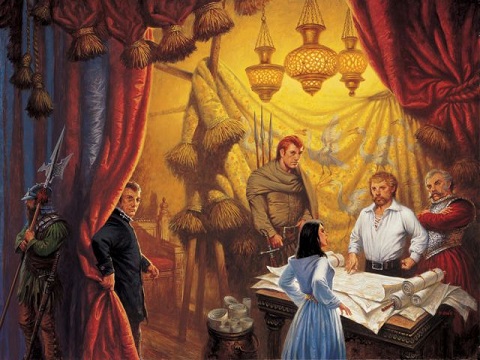 Robert Jordan’s epic fantasy series, “The Wheel of Time,” has much to reflect upon from a Christian perspective. Here, I’ll be examining books eleven and twelve, “Knife of Dreams” and “The Gathering Storm.” These fantasy books are masterworks and deserve to be read by any interested in the genre. There are SPOILERS from both books here. Please do not share spoilers from later books for the sake of readers.
Acting Becomes Reality
In Knife of Dreams, Faile and her companions are being held captive by the Shaido Aiel. In the process, they are forced into servitude and beaten at the whims of their overlords. Faile soon realized the best strategy would be to fain timidity, but also realized the dangers of this:
[Faile] hoped that Sevanna [one of the Aiel] thought her tamed… She hoped that she was not being tamed. Pretend something too long, and it could become truth… She had to escape before [her husband] got himself killed in the attempt [to rescue her]. Before she stopped pretending. (167, cited below)
There is a similar notion built into much discussion about Christianity. Pascal, for example, after outlining his famous wager (which I defend here), noted that one may align oneself towards belief. That is, when someone begins to act as though one believes a certain way, it can turn into a reality that one believes a certain way. From a worldview perspective, then, we should always be wary of how we live our lives and what we surround ourselves with. After all, it may be that our pretending becomes reality.
Preparing for War
The upcoming “Last Battle” is the primary theme of the entire series. In Knife of Dreams and The Gathering Storm, we get our first real experiences of that upcoming war. The series has built up towards this climax, and one can feel the coming “storm” in the books to come. For our world, we know that war is a constant reality. With the reality of terrorist organizations, civil unrest, deep-seated cultural hatred, and the like, war is a constant companion. The same is true in the Wheel of Time. There is an eschatological awareness in the series of this “Last Battle,” just as Christians have an awareness of the Second Coming. In one scene, a military man, one of the great captains, Bashere, reflected on the reality of war:
“Let’s hope it really is the Last Battle. If we live through that, I don’t think we’ll ever want to see another. We will, though. There’s always another battle. I suppose that will be the case until the whole world turns Tinker.” (459)
The awareness of the coming eschaton for the Wheel of Time comes with it a bitter awareness that people of all backgrounds continue to war with each other. Perhaps, it is said, the way of the Tinker–people who have sworn off violence–is best.
In The Gathering Storm, we find a dramatic reversal of the biblical theme of coming peace (found in passages like Isaiah 2:4) which speaks of a day when swords will be beaten into plowshares. Instead, the people of the Wheel of Time must prepare for a day of chaos and war:
“take your best scythes and turn them into polearms…” [advises one farmer to another]
“What do I know about making a sword? Or about using a sword, for that matter?” [the other replied]
“You can learn… Everyone will be needed.” [The first responded] (8, cited below)
The Last Battle is a day in which the nations will unite, but they will unite for war. Again, this is in contrast to the biblical theme of the abolition of war in the eschatological hope. It will be interesting to see how this plays out in the coming books.
Fighting the Darkness from Within
One of the most dramatic scenes in the entire series is found in The Gathering Storm as Verin, an Aes Sedai (female magic user in this series) who has seemed so loyal, reveals she is a darkfriend of the Black Ajah. However, it turns out that she is not wholly evil but rather did so, and did many evil things, in order to try to fight the Shadow from within its own ranks:
“You see, one rarely has a chance as this, to study a beast from inside… They [darkfriends] have many agents among us… Well, I thought it time that we had at least one of us among them. This is worth one woman’s life.” (836, 839)
Verin had sworn herself to evil, but did so in order to bring about great good. Her life was forfeit in order to expose wickedness within the ranks of the Aes Sedai. Her sacrifice forestalled a major weapon of the Dark One.
Thankfully, there is no need for we as Christians to go around swearing ourselves to evil. However, there is great need and sacrifice in going to communities in which Christians are persecuted and seeking to help in whatever ways we can.
Conclusion
The Wheel of Time continues to impress, both from the magisterial scope of its fiction and from the many issues of worldview it brings up. There are, of course, many, many more topics we could discuss related to the books and you may feel free to bring these up in the comments. There are many themes which resonate with the Christian worldview, but Jordan clearly borrowed from Eastern Mysticism as well as other religious traditions. This is a fantastic series to read and discuss at a worldview level.
Links
Be sure to check out the page for this site on Facebook and Twitter for discussion of posts, links to other pages of interest, random talk about theology/philosophy/apologetics/movies and more!
Sources
Robert Jordan, Knife of Dreams (New York: Tor, 2005).
Robert Jordan and Brandon Sanderson, Crossroads of Twilight (New York: Tor, 2009).
SDG.
——
The preceding post is the property of J.W. Wartick (apart from quotations, which are the property of their respective owners, and works of art as credited; images are often freely available to the public and J.W. Wartick makes no claims of owning rights to the images unless he makes that explicit) and should not be reproduced in part or in whole without the expressed consent of the author. All content on this site is the property of J.W. Wartick and is made available for individual and personal usage. If you cite from these documents, whether for personal or professional purposes, please give appropriate citation with both the name of the author (J.W. Wartick) and a link to the original URL. If you’d like to repost a post, you may do so, provided you show less than half of the original post on your own site and link to the original post for the rest. You must also appropriately cite the post as noted above. This blog is protected by Creative Commons licensing. By viewing any part of this site, you are agreeing to this usage policy.
Really Recommended Posts 2/27/15- Egalitarian Black Women, Diatoms, and more!
 One day, my child will let me sleep again. It is not this day. 5 months of almost no sleep starts to make you a bit crazy! What year is it? Why do I walk on the ground and not the ceiling? Why did I put a picture of a Snowy Owl on this post? Anyway, I got myself coherent for long enough to assemble this great group of posts for your reading pleasure, dear readers! Read enough about 50 Shades? So did I, until I ran into the post I share below. It sets quotes from the book alongside definitions of abuse and stalking to some dramatic effect. We also have a great look at some egalitarian black women, young earth creationism, apologetics, and women in fiction. Check them out, and let me know what you thought! Be sure to also let the authors know!
5 Black Women Every Egalitarian Should Know– This is just a fantastic post that outlines the lives and impact of 5 black women who are major voices for egalitarianism (and other issues).
Issues of Abuse and Consent in 50 Shades of Grey– Here’s an excellent post that has specific quotes from 50 Shades alongside the definitions of abuse and stalking and the like. It’s quite disturbing to realize what’s in the book, and I wouldn’t have personally thought to write a post like this myself. This is a good resource to have on hand. There is some ADULT CONTENT in this link, which the author does a good job of warning beforehand.
Life in a Glass House: Diatoms Shatter Young Earth Flood Geology– What do diatoms tell us about the plausibility of young earth creationist models? Can Flood Geology really stand up under scrutiny?
The New Frontier in Apologetics: An Open Letter to the Apologetics Community– How do we move towards a broader integration of the Christian worldview into the culture and perhaps move back to the direction that Christianity is where the intelligentsia operate?
Oh No She Didn’t: The Strong Female Character Deconstructed– What does it mean to have a “strong female character”? Do we need to have specific tendencies for such characters? Can women just be women? Check out this interesting post from sci-fi publisher “Tor”‘s blog.
Is Islam Violent? – A response to a meme

I do not condone this image nor do I claim rights to it. See post.
I saw a few friends sharing or commenting on the meme I’ve shared here the other day and thought it was definitely worth a response. Here at the start I want to note that I do not condone the image shared here and think it’s deeply problematic for reasons that will become clear in what follows.
I think that we need to be careful when discussing things like this primarily for two reasons: 1) verses quoted out of context can be used to support anything; for example, I often run into atheists quoting from Joshua and arguing that it means that Christianity is inherently violent or has violent roots; 2) the picture itself doesn’t really do much to make me think any effort was made to understand what is being quoted. See below.
I’m not an expert in Islam, but I have taken a graduate level course on the topic. Moreover, there are some basic problems with this meme. One issue with this picture is that it quotes from “Koran chapter:verse” when the proper term would be “Surah chapter:verse.” Saying “Koran” instead of “Surah” is similar to saying “Bible 12:3:15.” The Qu’ran is one book, so this does not cause distortion of where to find the quotes, but in my reading this method of citation seems not quite proper. [Thanks to several readers for pointing out a need to edit here.]
Another issue is that in the Qu’ran, people aren’t referred to as Muslims but rather believers, etc. Again, this is a fairly basic misunderstanding that would be like putting the word “Christian” into the Bible all over the place when it’s not there.
I took the liberty of looking up a couple of these Surahs. Surah 8:65 is quoted in this picture as “The unbelievers are stupid; urge the Muslims to fight them” in fact says, according to the Sahih international version of the Qu’ran, ” O Prophet, urge the believers to battle. If there are among you twenty [who are] steadfast, they will overcome two hundred. And if there are among you one hundred [who are] steadfast, they will overcome a thousand of those who have disbelieved because they are a people who do not understand.” Not only does this not have the word Muslims, but it is also much longer, and doesn’t call unbelievers stupid. In fact, a comparison of the major English versions show that almost every one says “without understanding” or “do not understand.” The closest it comes to “stupid” is “without intelligence.”
The alleged quotation of 22:19 is particularly problematic, because it completely rips the verse out of context. According to the picture, it says “Punish the unbelievers with garments of fire, hooked iron rods, boiling water, melt their skins and bellies.” Not only is this actually a reference to 22:19-20 but it also is not a command at all. The context of 22:19-20 is the day of judgment and this punishment is that described of for those in hell (see Surah 22:16-17 for more context). Quoting this verse to say Islam is violent would be akin to quoting a passage about weeping and gnashing of teeth from the Bible, turning it into a command to Christians without justification from the text itself and then saying it proves Christianity is violent.
I checked a couple more references and they too not only shortened the alleged “quotes” but also largely took them out of context.
Yet another problem with a picture like this is that it doesn’t account for the fact that in actual practice, the overwhelming majority of Muslims are not violent. I’m not sure of the actual number of Muslims in the U.S. alone, but with over a billion Muslims in the world, if every single one were indeed violent, I would imagine that fighting would be occurring in the streets of Dearborn, MI; New York, Minneapolis, etc. Yet I don’t see this happening. Isolated incidents? Yes. A complete totality of violence everywhere? No. I would argue this is because the vast majority of Muslims have a more nuanced approach to the Qu’ran and its interpretation than simply quoting verses out of context allow; just as Christians would argue for nuanced interpretations in much the same way.
I have not entered into a wider discussion of Islam and religious violence, nor is this the place to do so [see some posts in the links]. I conclude simply by noting that the use of memes like this are, I think, deeply problematic. If we as Christians expect to be treated fairly and have real differences among Christian beliefs and interpretations acknowledged, if we think that people unfairly quote our holy texts out of context and that we deserve to have our nuances of thought also conveyed, then we should do the same for those of other faiths.
Links
Be sure to check out the page for this site on Facebook and Twitter for discussion of posts, links to other pages of interest, random talk about theology/philosophy/apologetics/movies and more!
The Myth of “Religion” – Constructing the Other as Enemy– How has the category of “religion” been used to support the premise of religious violence and making the “other” into an enemy?
Book Review: “The Myth of Religious Violence” by William Cavanaugh– Here is a book which discusses the notion of “religious” violence at length with sometimes startling conclusions.
I am not sure who was the original user that put the image up, so I can’t cite it appropriately. I make no claim to owning the image and use it under fair use.
SDG.
——
The preceding post is the property of J.W. Wartick (apart from quotations, which are the property of their respective owners, and works of art as credited; images are often freely available to the public and J.W. Wartick makes no claims of owning rights to the images unless he makes that explicit) and should not be reproduced in part or in whole without the expressed consent of the author. All content on this site is the property of J.W. Wartick and is made available for individual and personal usage. If you cite from these documents, whether for personal or professional purposes, please give appropriate citation with both the name of the author (J.W. Wartick) and a link to the original URL. If you’d like to repost a post, you may do so, provided you show less than half of the original post on your own site and link to the original post for the rest. You must also appropriately cite the post as noted above. This blog is protected by Creative Commons licensing. By viewing any part of this site, you are agreeing to this usage policy.
Really Recommended Posts 2/20/15- Egalitarian Marriage, Ken Ham, Kids, and more!
Another sleep-deprived Really Recommended Posts here! Also, did you know that you can still have allergies when it is -10 degrees Fahrenheit and snowy? I’ve mastered that. Anyway, this week we have posts about Ken Ham, egalitarian marriage, teaching kids critical thinking,
6 Things Egalitarian Marriage is Not– Too often, people who critique the egalitarian position argue that egalitarian marriage means men and women are assumed to be exactly the same or that it is unbiblical. Here are some answers to some misconceptions about egalitarian marriage.
How I’m Teaching my 6-Year-Olds to be Critical Thinkers– Natasha Crain continually writes awesome posts for teaching apologetics in family settings. Here, she shares some tips for teaching critical thinking to your youngsters.
Ken Ham Ascribes Motive to Your Crime– Psychoanalysis of opponents on hot issues is not something we should engage in. Unfortunately, Ken Ham, a prominent Young Earth Creationist, continually assigns motives to those with whom he disagrees.
If Humans Evolved from Apes, Why Do Apes Exist Today? – Look! I can agree with Answers in Genesis, the prominent young earth creationist group, on something! This is a really bad argument that I have, unfortunately, seen many Christians using. Don’t do it.
Eclectic Theist– Did you know I have another web site? I do! On it, I review books, talk about Star Trek, food, tennis, economics, (and more!), and dive into all kinds of random interests. Check it out!
On the Alleged Atheism of Early Christians
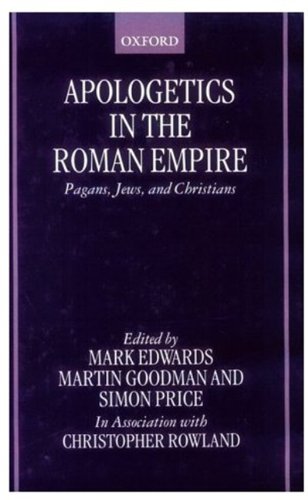 It is interesting to note that modern atheists of the internet-infidel variety share much with Pagan counterparts in the first few centuries after Christ. “How can this be?” one might ask. Well, the charge of atheism against Christians is shared both by the common internet-infidel comment that “We’re all atheists, I [the atheist] just take it one god further” and Pagans in the Roman Empire. Oddly, some atheists have gone so far as to suggest that the Pagan accusation is somehow evidence for their position.
The early Christians, it is true, were accused of being atheists. However, to suggest that this is somehow synonymous with contemporary usage of the term “atheist” is ahistorical and anachronistic. Frances Young notes several facets of the charge of atheism leveled against Christians:
What the charge [of atheism leveled against Christians] really amounted to was an expression of dismay and distaste over the fact that people were abandoning conventional ritual practices… The charge of atheism against Christians focused on their refusal after conversion to continue to participate in traditional religious customs… Religion, embedded in the ethnic cultures, was a matter not of belief but of loyalty. (99, 101, cited below)
The charge against Christians, then, was that they were abandoning the ways of the Romans. They were outsiders, outcasts, and, by extension, atheists. By refusing to worship the gods of Rome, they became targets. The fact that the Christians did this conscientiously–they intentionally abandoned the gods–led to the charge of atheism. It was a charge related not to belief in deity, but rather to rejection of shared societal practice, with a culturally charged impetus for making it.
In fact, others who yet believed in the gods were also charged with atheism. The Epicureans were accused of atheism, despite believing that the gods existed:
It is significant that these ‘atheists’ [Epicureans] did not question the existence of the gods. Rather, they liberated people from religion by suggesting that the blessed immortals were not the slightest bit interested in what goes on among human beings… (ibid, 100)
Thus, when modern atheists continue to perpetuate the claim that “we’re all atheists,” and then move on to argue that Christians should agree with them because, after all, Christians were considered ‘atheists’ by the Romans, it is difficult to take them seriously. The Pagan charge was made for cultural reasons, and is tied up in the notion of rejection of the societal norms of the time. It was also made even against those who acknowledged those gods existence. This last point is very important, because one attempted rebuttal I have seen from the modern atheist is that “You are an atheist to other religions.” Well, according to ancient Pagans, you could even be an atheist to your own religion! Of course, the point is that Christians are not atheists, but theists.
The word “atheism” was used back then as a damning charge of societal blasphemy–rejecting the ethnic practices of your own society in pursuit of another’s. Now, modern atheists attempt to forcibly include others in atheism with this kind of pithy phrase. The historical charge is interesting, but clearly entirely different from the modern one. Either charge, however, is inaccurate. Christians, by definition, are not atheists–theists cannot be atheists. The ancient cultural charge is of interest for its historical implications, but it is hardly evidence for the modern use of the charge of atheism against Christians.
I suspect that this post won’t silence many who will continue to persist in saying Christians are atheists. At that point, I suggest to others the following: the people who persist in this mislabeling should be written off as being just as irrelevant as the ancient Pagans with whom they share at least this part of their worldview.
Links
Be sure to check out the page for this site on Facebook and Twitter for discussion of posts, links to other pages of interest, random talk about theology/philosophy/apologetics/movies and more!
On the statement that “We are all atheists”– I evaluate the claim that atheists make which say that “we are all atheists.” I evaluate it from a philosophical point of view here.
On the Shoulders of Giants: Rediscovering the lost defenses of Christianity– I have written on how we may discover these enormous resources historical apologists have left behind for us. Take and read!
Source
Frances Young, “Greek Apologists of the Second Century” in Mark Edwards, Martin Goodman, and Simon Price, eds., Apologetics in the Roman Empire
SDG.
——
The preceding post is the property of J.W. Wartick (apart from quotations, which are the property of their respective owners, and works of art as credited; images are often freely available to the public and J.W. Wartick makes no claims of owning rights to the images unless he makes that explicit) and should not be reproduced in part or in whole without the expressed consent of the author. All content on this site is the property of J.W. Wartick and is made available for individual and personal usage. If you cite from these documents, whether for personal or professional purposes, please give appropriate citation with both the name of the author (J.W. Wartick) and a link to the original URL. If you’d like to repost a post, you may do so, provided you show less than half of the original post on your own site and link to the original post for the rest. You must also appropriately cite the post as noted above. This blog is protected by Creative Commons licensing. By viewing any part of this site, you are agreeing to this usage policy.
Kathy Tyers’ “Firebird Trilogy” – Faith, Humanity, and Conflict in the Far Future
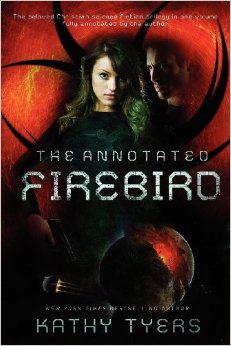
Kathy Tyers’ The Annotated Firebird
Faith in the Future
Throughout the trilogy, faith is front-and-center. The characters come from different faith backgrounds–Firebird is from a culture that worships the Nine “Powers”- essentially deified character traits; Brennan is from a people of exiles who have psychic powers and look to a coming Messiah from his line; others have no religious affiliation. This sets up a way to generate conflict among the characters but also have development.
Firebird is confronted by the notion that the “Powers” she worships are ultimately impersonal and thus seemingly without any power. Moreover, she is intrigued by a system which is not based upon what she does but rather on the grace of a Holy God. It is a struggle throughout her conversion to accept this notion–that she herself does not need to do anything to earn her salvation. Her path of faith is one that is extremely interesting because it shows how the Christian worldview can come into dialogue with other religious traditions on a number of levels–on the level of salvation/soteriology; on the level of deity; and on many other levels.
Brennan’s walk of faith is quite different as he was raised a believer. His character’s viewpoint is filled with brief prayers to the “Singer”–a primary name for deity in the book. These asides never throw off the pace of the book but rather offer ways for the readers to engage in the genuine faith of the characters therein. It’s also a call to believers to take their own faith lives more seriously. How often do we offer a brief prayer over some issue or of thanks throughout the day? How might we integrate our faith better in our daily walk?
Overall, the picture of faith in the Firebird trilogy is one that expects truth in religious belief as well as evidence, confronts rival views in a compassionate way, and is lived out.
Humans who are “Waste”?
Another major theme in the trilogy is that of human lives and the way they are often deemed waste. Firebird’s society is run by a monarchy and nobility which dominates all life and expects to be viewed as ruling with divine right. This is used as an excuse for devaluing the lower classes. Moreover, Firebird herself is considered a “Wastling”- one who is far enough back in succession that they are dedicated to serve until they die in combat or commit an ordered suicide because they are no longer deemed useful.
This is, of course, an unjust state of affairs. It is one that must be confronted on a systemic level, and this is only beginning when the trilogy wraps up. However, I think the reader cannot help but reflect upon the notion that in our own society, we treat some people like “wastlings” to be discarded as unneeded and unwanted. We do not value human life as we should–as created in the image of God.
Another aspect of this devaluing of life is found in the society of the Shuhr–a people who are the radical offshoot from Brennan’s own society. They practice genetic cloning and seek to make themselves immortal. The way they pursue this is through the creation and mutilation of embryos. Frankly, this disrespect of human life is little different from our own society’s, which allows for the murder of the unborn on demand. By putting this theme into science fiction, Tyers confronts our own worldview in a dramatic fashion.
Brief Autobiographical Note
Permit me a brief autobiographical aside:
I remember when I was younger–probably about 12 years old–shopping a table at a book sale that was going on in the parish hall at my church. I saw the cover of this book that looked like science fiction and reminded me of Star Wars. I had to have it! There were three of them, a trilogy! I begged my parents and with some extra chores loaded on I received the books.
I devoured them almost instantly, used Legos to try to build spaceships from them. I went to a Christian bookstore and demanded more science fiction from the author. The bewildered staff searched in vain to find anything else from Kathy Tyers. Without any more to read, I forgot the author but the trilogy entered that hallowed place of unassailable nostalgic bliss that we create in our childhood.
Then, when I saw a newly released edition with notes from the author pop up in my recommendations on Amazon, I was instantly intrigued. Lo and behold, sequels were on the way! I purchased the trilogy again, but didn’t read it, fearful I would penetrate that nostalgic bubble and perhaps discover the series wasn’t as amazing as I’d hoped. Finally, after over a year of owning the book, I opened it up, read it, and now offered this look at the series. Check out my review of the book on my other interests site.
Conclusion
The Annotated Firebird is an excellent edition to pick up in order to experience the whole Firebird trilogy. It is a series which resonates strongly with the Christian worldview, but more importantly it does so without ever compromising on the story, world-building, or characters. Tyers has created a masterpiece.
Links
Be sure to check out the page for this site on Facebook and Twitter for discussion of posts, links to other pages of interest, random talk about theology/philosophy/apologetics/movies and more!
Microview: “The Annotated Firebird Trilogy” by Kathy Tyers– I review the trilogy with a brief look at the plot and some positives and negatives in the book.
Popular Books– Check out my looks into other popular books (scroll down for more).
Source
Kathy Tyers, The Annotated Firebird
SDG.
——
The preceding post is the property of J.W. Wartick (apart from quotations, which are the property of their respective owners, and works of art as credited; images are often freely available to the public and J.W. Wartick makes no claims of owning rights to the images unless he makes that explicit) and should not be reproduced in part or in whole without the expressed consent of the author. All content on this site is the property of J.W. Wartick and is made available for individual and personal usage. If you cite from these documents, whether for personal or professional purposes, please give appropriate citation with both the name of the author (J.W. Wartick) and a link to the original URL. If you’d like to repost a post, you may do so, provided you show less than half of the original post on your own site and link to the original post for the rest. You must also appropriately cite the post as noted above. This blog is protected by Creative Commons licensing. By viewing any part of this site, you are agreeing to this usage policy.
Handel’s “Messiah” as Apologetic
 “I should be sorry if I only entertained them [the audience], I wish to make them better.” – Handel
Handel’s “Messiah” is one of the greatest pieces of music ever composed. It has been performed constantly since he wrote it. There is no doubting the enduring popularity of the piece and the way it brings comfort to God’s people. It is often played during the Christmas or Advent seasons and has become a way for many to hear the message of Christ during this time.
One aspect that is not often explored, however, is the way the piece may be seen as an apologetic for Christianity. Calvin Stapert, in his work on the piece, Handel’s Messiah: Comfort for God’s People, notes how the work was written in part as apologetic. The biblical selections which were put together to form the lyrics of the performance were selected by Charles Jennens, whose brother had committed suicide during some doubt-inducing talks with a famous deist (77-78, cited below).
Moreover, Christian apologists during this time–during the height of Enlightenment–were beginning to realize that simply making arguments from natural revelation or reason alone was in some way to not engage with the Deists who were at large. After all, Deists could agree God existed. The question was which God and whether God was personal. So although the arguments of natural theology were helpful, they could not do all the work on their own, and Christian apologists set about the task of proving Christianity through the Scriptures (75-77).
By simply putting forth a different narrative than that of the Deists, Handel and Jennens challenged the notion that God was impersonal. Moreover, they pressed home the need for a savior due to our own futile raging against God. The beauty of he piece serves to enhance its apologetic narrative, making it entice the heater to keep listening. The music forges links between the notion of he need for a savior and the Incarnate Son.
The Messiah, then, is part of this project. It is a story of prophecy and the way that God sent the Son into the world, incarnate in the flesh, to bring about salvation. It is a masterful interweaving of Old Testament prophecy and New Testament fulfillment. More than that, it is an apologetic voice in the wilderness.
Source
Calvin Stapert, Handel’s Messiah: Comfort for God’s People (Grand Rapids, MI: Wm. B. Eerdmans, 2010).
Links
Be sure to check out the page for this site on Facebook and Twitter for discussion of posts, links to other pages of interest, random talk about theology/philosophy/apologetics/movies and more!
Book Reviews– There are plenty more book reviews to read! Read like crazy! (Scroll down for more, and click at bottom for even more!)
SDG.
——
The preceding post is the property of J.W. Wartick (apart from quotations, which are the property of their respective owners, and works of art as credited; images are often freely available to the public and J.W. Wartick makes no claims of owning rights to the images unless he makes that explicit) and should not be reproduced in part or in whole without the expressed consent of the author. All content on this site is the property of J.W. Wartick and is made available for individual and personal usage. If you cite from these documents, whether for personal or professional purposes, please give appropriate citation with both the name of the author (J.W. Wartick) and a link to the original URL. If you’d like to repost a post, you may do so, provided you show less than half of the original post on your own site and link to the original post for the rest. You must also appropriately cite the post as noted above. This blog is protected by Creative Commons licensing. By viewing any part of this site, you are agreeing to this usage policy
Really Recommended Posts 12/12/14- Marriage, the Cross, Racism, and more!
 Another week, another set of posts for you, dear readers! I think you’ll find the post on marriage to be particularly thought-provoking. Pastor Matt’s discussion of re-thinking everything is advice we should all take. Some reflections on Martin Luther King Jr.’s peaceful resistance are well-taken in this time. A video on a conversion experience will be found deeply interesting. Finally, we wrap up with an apologetics comic! Let me know your thoughts here, and be sure to let the others know what you think as well!
The Continuance of Marriage- Luke 20:27-40– The notion that there is no marriage in the New Creation is drawn from this passage. Here, Tony Arsenal analyzes the passage to see if this is indeed what it teaches.
The Benefit of Re-Thinking Everything– What does it mean to re-think things? Can it be a helpful endeavor? Check out Pastor Matt’s thoughts on the topic.
thoughts on waiting– Here, Elizabeth Wartick shares some thoughts on Martin Luther King, Jr.’s peaceful resistance to racism. They are timely and thought-provoking.
Why I am a Christian (David Wood)– [ADULTS only]- This video is a sometimes-disturbing look into David Wood’s thoughts and life as an atheist and how Christ called him to Himself.
The Cross is a Crutch Indeed– [COMIC]- What does it mean to say that religion is a crutch? This comic offers some thoughts and reflection upon the notion.
Book Review: “Pascal’s Wager” by Jeff Jordan
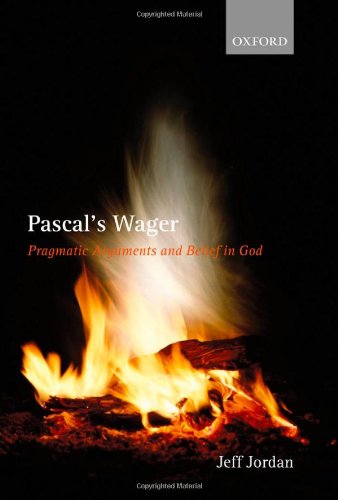
For some time, I’d been wanting to put some effort into studying Pascal’s Wager. I picked up Pascal’s Wager: Pragmatic Arguments and Belief in God by Jeff Jordan in order to familiarize myself more with the philosophical grounding behind the argument. Jordan approaches the Wager through a lens of analytic philosophy and, I think, demonstrates that the argument has some force to it.
Jordan’s work has great scope. Several aspects of the Wager are brought to light. He analyzes several different formulations of the argument, while also noting where the argument has been changed or modernized. For example, the notion that Pascal’s Wager was infinite bad vs. infinite good is a more recent innovation than Pascal’s original argument.
He studies the argument contextually to determine whether the Wager was intended as a generalized theistic proof or an argument for Christianity. Numerous objections from leading critics of the Wager are put to the test. Ultimately, a version of the Wager developed by William James is put forward as an argument that passes the philosophical muster. Jordan analyzes this argument from many angles, ultimately demonstrating that it overcomes the challenge of the “many gods” objection and provides grounds for Christian faith.
The value of Pascal’s Wager may is increased by the fact that many aspects of Jordan’s work are applicable to other arguments or areas of interest for philosophers of religion and apologists. For example, Jordan raises significant challenges to the notion that philosopher’s fictional deities may actually be counted as evidence for a “many gods” objection (75-76; 80-81). Another example is a rather interesting argument he derives from the work of James Beattie (1735-1803- Jordan notes Beattie is at times rightly accused of misrepresenting Hume’s arguments) about whether attempts to deconvert might bring about pragmatic wrongs (190-194). These and other tantalizing topics command even more interest than the book might otherwise have had.
Simply put, Pascal’s Wager: Pragmatic Arguments and Belief in God is a phenomenal, thought-provoking work that will have readers rethinking their evaluation not only of the (in)famous Wager but also of a number of related topics. Even at its steep price tag, the book is a bargain.
Links
Be sure to check out the page for this site on Facebook and Twitter for discussion of posts, links to other pages of interest, random talk about theology/philosophy/apologetics/movies and more!
Pascal’s Wager: The Utility Argument Examined– I outline and defend one of the versions of Pascal’s Wager which Jordan brings up in this work. I find it to be a very interesting argument and a great addition to the apologist’s toolkit.
Source
Jeff Jordan, Pascal’s Wager: Pragmatic Arguments and Belief in God
SDG.
——
The preceding post is the property of J.W. Wartick (apart from quotations, which are the property of their respective owners, and works of art as credited; images are often freely available to the public and J.W. Wartick makes no claims of owning rights to the images unless he makes that explicit) and should not be reproduced in part or in whole without the expressed consent of the author. All content on this site is the property of J.W. Wartick and is made available for individual and personal usage. If you cite from these documents, whether for personal or professional purposes, please give appropriate citation with both the name of the author (J.W. Wartick) and a link to the original URL. If you’d like to repost a post, you may do so, provided you show less than half of the original post on your own site and link to the original post for the rest. You must also appropriately cite the post as noted above. This blog is protected by Creative Commons licensing. By viewing any part of this site, you are agreeing to this usage policy.
Really Recommended Posts 11/14/14- an old earth, apologetics, and character!
Another round of links for you to read, dear readers! Thanks for stopping by. Let me know what you thought of the reads here, and be sure to let those authors know also! We have a snowy owl edition today because it’s 10 degrees and snowy here.
100 Reasons the Earth is Old– The position that the Earth is 6-10,000 years old is untenable. Here are 100 reasons why this is the case.
14 Ways I Teach Apologetics to my 5-Year Olds– How might we introduce apologetics to children and build a foundation for the future? Here Natasha Crain shares several ideas on her excellent web site, Christian Mom Thoughts. I very much recommend you follow her blog.
Your Character is Just As Imporant to Your Apologetics As Your Logic– From a presuppositional perspective, we have a great post about how the way we approach others is just as important as our logic or arguments.
Merchandise to Modify one of Modern Man’s Mightiest Misapprehensions (Comic)– Is disagreement possible without hate? Check out this fun apologetics comic.

 J.W. Wartick - Reconstructing Faith