apologetics
Book Review: “The Closing of the Muslim Mind” by Robert Reilly
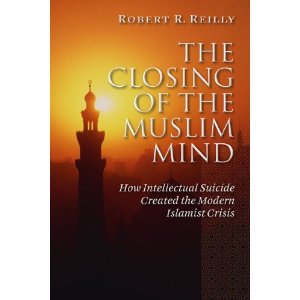 One can tell from the outset that Robert Reilly’s The Closing of the Muslim Mind
The central point of the book is “the story of how Islam grappled with the role of reason after its conquests exposed it to Hellenic thought and how the side of reason ultimately lost in the ensuing, deadly struggle” (1). Reilly contrasts this with how the West dealt with some of the same issues: “The radical voluntaraism (God as pure will) and occasionalism (no cause and effect in the natural order) found in them [Muslim theologians in the 9th-12th centuries] were not seen to any significant extent in the West until… David Hume began writing in the eighteenth century. By that time the recognition of reality had become firmly enough established to withstand the assault… Unfortunately, this was not true in Sunni Islam, where these views arrived much earlier” (7).
Reilly maps out the history of the development of Muslim thought. Initially, once Islam came into contact with western philosophy, there was a great amount of interplay (11ff). One early struggle was between man’s free will and fate. This struggle was over the meaning of key verses in the Qur’an as well as a debate over whether the Qur’an is temporal or eternal and uncreated. The notion that the Qur’an is eternal and uncreated, in turn, restricted rationality from evaluating the meaning therein (19).
The development of Muslim reflection on the Qur’an and Allah’s will led to the replacement of reason with rationality (45-46). Similarly, because the Qur’an was Allah’s will, and it did not explicitly endorse kalam (a branch of Muslim philosophy and theology), this rational discourse was to be abandoned (47). Furthermore, this entailed the destruction of the notion of the “autonomy of reason.” Only within the structures of revelation could reason operate effectively (48).
Furthermore, creation itself has no inherent reason. Each moment is merely a “second-to-second manifestation of God’s will” (51). While one may be tempted to say Christianity is exactly like this (and some branches may indeed hold to this teaching), there is an important distinction between the two views, for on the Christian view of God, God’s action is driven by His nature, and so He will operate within His promises as well as within the boundaries He has set for himself. God, on most Christian views, is inherently rational and so will operate in rational ways. So while creation indeed subsists moment-by-moment because of the will of God, God does not arbitrarily change His will (56ff). On the Muslim view, Reilly argues, God’s will is absolute (as opposed to His nature) and so there is absolute voluntarism. At any time, Allah could will that which before Allah did not will (51-53). Furthermore, one cannot say one “knows” God because God is pure will. As pure will, there is no reason for any particular action, and so God is inherently unknowable (54ff).
Another consequence of viewing God as pure will is that good and evil are essentially vacuous terms. “If Allah is pure will, good and evil are only conventions of Allah’s–some things are halal (permitted/lawful) and others are haram (forbidden/unlawful), simply because He says so and for no reasons in themselves” (70). Allah is therefore above morality and the problem of evil is made meaningless, for evil is merely that which God forbids. Essentially, the system is voluntaristic theism (71ff).
Reilly argues that these theological positions have had dire consequences for Islam in the political realm as well. These positions undermine the inherent worth of human beings and posit the primacy of power over reason (128); democracy is the answer to a question the Muslim world has not asked (130), for if God is pure will, then His regents on earth are operating merely under his whims, and can be just as arbitrary in their decisions (131); “Man’s only responsibility is to obey” (131); finally, “there is no ontological foundation for equal human rights in Islam, which formally divides men and women, believer and unbeliever, freeman and slave” (133).
The consequences reach farther, however, and touch the sciences as well. For if Allah’s will is that which causes all things, then to say that there are “natural” explanations is to insult Allah. Instead of saying that hydrogen and oxygen yield water, people are instructed to say “when you bring hydrogen and oxygen together… by the will of Allah water was created…” (142). Of course, the denial of secondary causation touches upon more pragmatic areas of life as well. After all, if Allah wants something to happen, then it will; if not, then it won’t.
Reilly presents a number of contemporary sources demonstrating how these aspects have been radically undermined in the Muslim world, where often anything can pass as a news story and anything can be stated as true (147ff). Furthermore, the Muslim world trends towards underdevelopment and illiteracy. Reilly maintains that some of this is due to the consequences of the theological views outlined above.
Historically, the dilemma within Islam over reason vs. voluntarism came to a head when the Muslim conquests began to be turned back. When defeats happened, Muslims had to ask why it was that they were losing when, presumably, Allah desired them to win (165ff). Some viewed it as a consequence of the stagnation of science and intellectual development in the Muslim world. Others, however, viewed it as a need to go back to the roots of Islam and become even more radical. The world, therefore, according to Reilly, is faced with a crisis: can reason be re-introduced into the Muslim theology and trickle down into every aspect of life, thus freeing the Muslim world from the shackles of voluntarism? Or, will Islam continue down its path and overemphasize the radical occasionalism of nature and God, while undermining reason? Such is the crisis.
It is striking how well Reilly has supported his theses with quotes from the writings of various Muslim theologians and philosophers. Throughout the work, he quotes numerous scholars from both modern and ancient sources. What these quotes reveal is that his points are not found in a vaccuum–rather, the notion that the absolute, determinating, arbitrary will of Allah underlies everything that happens does indeed undermine rationality.
It is interesting here to reflect briefly upon the notion that some of these same themes are found within certain branches of Christianity. Whenever God’s will is placed as the ultimate source of all activity on earth (voluntarism/occasionalism) rather than as a providential will which guides such activity, reason and rationality can be jettisoned just as easily as they were in the development of Muslim thought. Similarly, if Scripture is seen as above any kind of rational inquiry to determine its meaning, one can replace man’s cognitive abilities with blind faith. Reilly’s book can therefore serve as much a warning for Christians engaging in doctrinal reflection as it is a call to Muslims to restore rationality to their faith.
Reilly’s work, The Closing of the Muslim Mind should be seen as required reading for those interested in interfacing with the Muslim faith. Reilly ties together compelling chains of thought which have led to the current Muslim crisis and demonstrates how current thinking is a result of the past. It is a thoroughly researched book and those opposed to his conclusions will be hard-pressed to show the cracks in his theses. I highly recommend this work. Once one gets past the title, which may be seen as inflammatory by some, Reilly presents well-reasoned, compelling, historically grounded argument about how the theology of Islam has led to the destruction of its intellectual capacity.
Robert Reilly, The Closing of the Muslim Mind
SDG.
——
The preceding post is the property of J.W. Wartick (apart from citations, which are the property of their respective owners) and should not be reproduced in part or in whole without the expressed consent of the author. All content on this site is the property of J.W. Wartick and is made available for individual and personal usage. If you cite from these documents, whether for personal or professional purposes, please give appropriate citation with both the name of the author (J.W. Wartick) and a link to the original URL. If you’d like to repost a post, you may do so, provided you show less than half of the original post on your own site and link to the original post for the rest. You must also appropriately cite the post as noted above. This blog is protected by Creative Commons licensing. By viewing any part of this site, you are agreeing to this usage policy.
Debate Review: Greg Bahnsen vs. Gordon Stein
 Advocates of the presuppositional approach to Christian Apologetics have long hailed the debate between Greg Bahnsen (the late Christian theologian and apologist, noted for his achievements in presuppositional apologetics and development of theonomy–a view of the Law for Christians, pictured left) and Gordon Stein (the late secularist noted for his links to Free Inquiry among other things, pictured below, right) as a stirring triumph of presuppositional apologetics over atheism in a point-by-point debate. Recently, I listened to the debate and thought I would share my impressions here.
Debate Outline
Bahnsen Opening Statement
From the outset, it was clear this debate was going to be different from others I’d listened to or watched. Bahnsen outlined what he means by “God,” outlined a few general points about subjectivism, and then quickly dove into a presuppositional type of argument. He began with an attack on the idea that all existential questions can be answered in the same way:
The assumption that all existence claims are questions about matters of fact, the assumption that all of these are answered in the very same way is not only over simplified and misleading, it is simply mistaken. The existence, factuality or reality of different kinds of things is not established or disconfirmed in the same way in every case. [All quotes from the transcript linked below. My thanks to “The Domain for Truth” for linking this.]
Bahnsen then mounts an argument which is perhaps the most important innovation of presuppositional apologetics: the attack on neutrality. He notes that Gordon Stein in his writings puts forth a case for examining evidence in order to determine if God exists. He relies upon the laws of logic and seems to think that this avoids logical fallacies. Yet, Bahnsen argues, Stein has just argued in a circle as well. By presupposing the validity of the laws of logic and other forms of reasoning, he has fallen into the trap he has stated he is trying to avoid. As such, Stein’s outlook is not neutral but it is colored by his presuppositions. Bahnsen notes:
In advance, you see, Dr. Stein is committed to disallowing any theistic interpretation of
nature, history or experience. What he seems to overlook is that this is just as much begging the question on his own part as it is on the part of the theists who appeal to such evidence. He has not at all proven by empirical observation and logic his pre commitment to Naturalism. He has assumed it in advance, accepting and rejecting all further factual claims in terms of that controlling and unproved assumption.Now the theist does the very same thing, don’t get me wrong. When certain empirical
evidences are put forth as likely disproving the existence of God, the theist regiments his
commitments in terms of his presuppositions, as well.
Therefore, what Bahnsen presses is that it is only on the Christian theistic presupposition that things like the laws of logic, the success of empirical sciences, and the like can make sense. He makes the transcendental argument for the existence of God:
we can prove the existence of God from the impossibility of the contrary. The transcendental proof for God’s existence is that without Him it is impossible to prove anything.
Gordon Stein Opening Statement
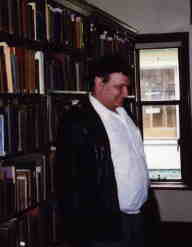 Stein opens by clarifying what he means by “atheist”: “Atheists do not say that they can prove there is no God. Also, an atheist is not someone who denies there is a God. Rather, an atheist says that he has examined the proofs that are offered by the theists, and finds them inadequate.”
Stein then argues that the burden of proof is definitely in the theist’s court. He goes on to address a number of theistic proofs and finds them wanting. In fact, the rest of his opening statement is spent addressing 11 separate arguments for the existence of God, including the major players like the moral, cosmological, and teleological arguments.
Cross Examination 1
In the first cross-examination, Bahnsen asked Stein whether the laws of logic were material or immaterial. Stein finally, quietly, admits that the laws of logic are not material. Yet then Stein turns around and in his own cross examination presses triumphantly a point he thinks will be decisive. He asks Bahnsen, “Is God material or immaterial”; Bahnsen responds, “Immaterial.”; after a brief segway, Stein poses the following question which, by the tone of his voice, he seems to think carries some weight: “Apart from God, can you name me one other thing that is immaterial?” To this question, Bahnsen responds quickly, “The laws of logic.” The crowd erupts. Stein lost that one.
First Rebuttal: Bahnsen
Bahnsen spends most of his rebuttal arguing that the laws of logic are not mere conventions, and that Stein cannot make them such. If Stein does, then, argues Bahnsen, he can’t actually participate in a logical debate, because they could each declare a convention in which they each win the debate.
He goes on to re-stress the transcendental argument and point out that Stein failed to address it. He develops it a bit further by attacking the notion that an atheistic worldview can make sense of logic:
And that’s because in the atheistic world you cannot justify,you cannot account for, laws in general: the laws of thought in particular, laws of nature,cannot account for human life, from the fact that it’s more than electrochemical complexesin depth, and the fact that it’s more than an accident. That is to say, in the atheist conceptionof the world, there’s really no reason to debate; because in the end, as Dr. Stein has said, allthese laws are conventional. All these laws are not really law-like in their nature, they’re just,well, if you’re an atheist and materialist, you’d have to say they’re just something that happensinside the brain.
But you see, what happens inside your brain is not what happens inside my brain.
Stein First Rebuttal
Stein argues that laws of logic are indeed conventions, saying:
The laws of logic are also consensuses based on observations. The fact that they can predict something correctly shows they’re on the right track, they’re corresponding to reality in some way.
Oddly, Stein continues to act as though Bahsnen’s argument was a variety of cosmological argument. He argues that before we can ask “what caused the universe” we must ask whether the universe is actually caused. He then tries to address the argument more explicitly, saying that it is “nonsense” and that various cultures do indeed have different logic. His most direct argument against the trasncendental argument is that “If matter has properties that it behaves than we have order in the universe, and we have a logical, rational universe without God.”
Debate Segment Two
Stein Opening 2
Stein argues that the problem of evil is an evidential argument against the existence of God. He states that it raises the probability that there is no God. He asserts that there is no physical evidence for God. Stein then argues that God has not provided evidence for his existence, but that He should do so. Finally, he turns to the problem of religious diversity, asking why God would allow other religions if there is only one God.
Bahnsen Opening 2
Bahnsen argues that Stein placing the laws of logic into a matter of consensus undermines their usefulness and in fact defeats the purpose of rational inquiry and debate. He argues further that Stein’s definition of laws of logic within pragmatic terms doesn’t come close to the extent of the laws of logic.
Stein Rebuttal
Stein argues that bahnsen hasn’t actually done anything to explain the laws of logic. He argues that simply saying they are the thoughts of God doesn’t mean anything, and that it does nothing to explain them. He therefore argues that Bahnsen fails to provide an adequate explanation for the facts of the universe.
Bahnsen Rebuttal
Bahnsen presses the point that Stein’s entire system is based upon presuppositions which he cannot justify. Induction is undermined in an atheistic worldview because there is no reason to believe that things will continue to happen as they do currently happen. He briefly addresses the problem of evil by saying that within an atheistic universe there simply is no evil, so it makes no sense from Stein’s perspective to press that issue.
Closing Statement: Stein
Stein’s closing statement seems to be more of a rebuttal than anything. He argues that there can be evil defined in an atheistic universe as that which decreases the happiness in people. Yet even this, he says, “We don’t know”–we don’t know that there is evil in an atheistic universe, rather it is a consensus and pragmatically useful.
He argues that we can know about induction because of statistical probability: it is highly improbable that the future will be different from the past because it has been similar in activity to the past for as long as we know.
Closing Statement: Bahnsen
Bahnsen finally presses the transcendental one last time. He argues that while Stein has called it hogwash and useless, he hasn’t actually responded to it. Bahnsen states that once more the atheistic worldview can’t make sense of itself. For example, saying the future will be like the past due to probability begs the question: there is nothing in the atheistic worldview to say that probability can help determine what the future will be like. It might work pragmatically, but it fails to give any explanation. Finally, Bahnsen argues that you cannot be a rational, empirical human being an an atheistic universe.
Analysis of the Debate
It is abundantly clear throughout this debate that the presuppositionalist takes a very different approach to debate and apologetics than those from other methods. One can see this immediately when Gordon Stein delivers his opening statement, which was presumably prepared beforehand, and goes to answer common theistic arguments like the cosmological and teleological argument. But Bahnsen never once used either of these arguments, and took an entirely different approach. I think this initially caught Stein off guard and that impression remained throughout the debate.
Stein’s responses to Bahnsen were extremely inadequate. This became very clear in their debate over induction and empiricism. For example, although Stein held that he could say the future will be like the past based upon probability, he had no way to say that the world was not spontaneously created 5 minutes ago with implanted memories and the notion that the future will be like the past. Bahnsen didn’t make this argument, but it seems like it would line up with his reasoning. Of course, he would grant that the theist has to presuppose that God exists in order to make sense of induction, but that was exactly his point: without God, nothing can be rational.
I found it really interesting that Stein kept insisting that the laws of logic are mere social conventions. He kept pressing that some cultures do not hold that they are true as defined. But of course, cultural disagreement about a concept doesn’t undermine the truth value of a concept. If, for example, there were a culture that insisted that 2+2=5, that wouldn’t somehow mean that 2+2=4 is a logical convention, it would mean the culture who insisted the sum was 5 would be wrong. Similarly, the laws of logic may be disagreed upon by some, but to deny them is to undermine all rationality.
Overall, I have to say I was shocked by how this debate turned out. I have long been investigating presuppositional apologetics and continually wondered how it would work in an applied situation. It seems to me that to insist on a presupposition in order to debate would not work, but Bahnsen masterfully used the transcendental argument to reduce Stein to having to argue that logic is merely a social convention while ironically using logic himself to attack theism.
It seems to me that this debate showed what I have suspected for some time: presuppositional apologetics is extremely powerful, when used correctly. Now I’m not about to become a full-blown presuppositionalist here. My point is that it is another approach Christians can use in their witnessing to those who do not believe. I envision a synthesis of presuppositional apologetics with evidentialism. Some may say this is impossible, that they are anathema to each other, but I do not think so. They can be used in tandem: the presuppositional approach to question the worldview of others, while the evidentialist approach can be used to support the notion that the Christian worldview provides the best explanation for the data we have.
Links
Listen to the debate yourself. Get it here. The transcript I used was also from this page. Thanks to the author for such a great resource.
I’ve been researching and writing about presuppositional apologetics. For other posts about presuppositional apologetics, check out the category.
I highly recommend starting with the introduction to the most important thinker in the area, Cornelius Van Til.
Choosing Hats– A phenomenal site which updates fairly regularly with posts from a presuppositional approach (the author uses the term “covenental apologetics”). The best place to start is with the post series and the “Intro to Covenental Apologetics” posts.
The Domain for Truth– Another great presuppositionalist web site. I highly recommend browsing the topics here.
SDG.
——
The preceding post is the property of J.W. Wartick (apart from citations, which are the property of their respective owners) and should not be reproduced in part or in whole without the expressed consent of the author. All content on this site is the property of J.W. Wartick and is made available for individual and personal usage. If you cite from these documents, whether for personal or professional purposes, please give appropriate citation with both the name of the author (J.W. Wartick) and a link to the original URL. If you’d like to repost a post, you may do so, provided you show less than half of the original post on your own site and link to the original post for the rest. You must also appropriately cite the post as noted above. This blog is protected by Creative Commons licensing. By viewing any part of this site, you are agreeing to this usage policy.
Next Challenge, Please! Dealing with Doubt
 You’ve heard it before, and you will hear it again.
Sensational Find: Jesus’ Body Found in Ossuary
The Passover Plot: Jesus’ Disciples’ Conspiracy to Form New Religion
100 Bible Errors
Was Jesus Married?
The headlines could be multiplied. We are confronted on a daily basis by challenges to the Christian faith. A simple search on Google turns up thousands upon thousands of results of anti-theists and proponents of other religions with sites to challenge Christianity. Radical claims in archaeology supposedly undermine Biblical truths. You name it.
It can be easy to be swept up in a fire-fighting mentality. As you run into one challenge, you find a quick-and-easy fix for it and then jump to the next one. You want to make sure that you believe the right thing; you want to know that you’re right.
How can a Christian deal with doubt?
In his article, “How Should We Treat New Challenges to the Christian Faith?” in The Apologetics Study Bible, Gary Habermas makes five points Christians should follow when dealing with doubts.
1) Divorce our emotions from the challenge- Rather than spending emotional energy constantly doubting due to every new challenge, realize that the Bible has “successfully withstood innumerable attacks over the centuries.”
2) Assume the Bible is true- Habermas urges this presuppositional approach for Christians. Rather than assuming the Bible is guilty until proven innocent, it should be treated with the same historical standard as other texts, and be given a chance to stand on its own before being subjected to hyper-criticism.
3) Carefully analyze each critical allegation against the Bible- Instead of jumping from challenge to challenge with only a superficial understanding, dig into each challenge individually. One thing I always told my students when I taught apologetics classes was that if you run into a question or doubt, I can guarantee someone smarter than me has already written on it. Look into the rich intellectual past of Christianity. Become familiar with the arguments. It will be enlightening and faith-strengthening.
4) Get help from Christian Scholars- Okay I jumped the gun on this one a bit! Do this! Christian brothers and sisters, we have extraordinary access to nearly limitless resources online and in person to deal with doubts. Take advantage of this. Don’t fall into blind faith or dogmatic skepticism; instead, seek to understand.
5) Be patient! Instant answers aren’t always going to happen. Search the Scriptures; follow the above steps; trust in God. I’ve found that dealing with doubt can be a rewarding experience as you pursue a question into the ground. Your faith will be stronger for the experience.
What about archaeological finds? Well again, there’s something to be said for a cautious skepticism about sensational finds. Reasons to Believe has an excellent article on the topic: “Avoiding Crackpot Archaeology”. In it, Krista Bontrager provides a 6-step process for analyzing these sensational claims. I’ll let you read the article for the full details, but here it is in summary: 1) Check the research; 2) check the credentials of the one making the claim; 3) Check for verification; 4) Was it published/where?; 5) What are other scholars saying?; 6) Caution: Is it too good (or bad?) to be true?
Christian brothers and sisters, we owe it to ourselves to pursue the truth. Jesus is the truth. When dealing with doubt, do not forget you’re not alone. All truth is God’s truth, and the pursuit of truth will not leave you ungrounded. Thank God.
SDG.
——
The preceding post is the property of J.W. Wartick (apart from citations, which are the property of their respective owners) and should not be reproduced in part or in whole without the expressed consent of the author. All content on this site is the property of J.W. Wartick and is made available for individual and personal usage. If you cite from these documents, whether for personal or professional purposes, please give appropriate citation with both the name of the author (J.W. Wartick) and a link to the original URL. If you’d like to repost a post, you may do so, provided you show less than half of the original post on your own site and link to the original post for the rest. You must also appropriately cite the post as noted above. This blog is protected by Creative Commons licensing. By viewing any part of this site, you are agreeing to this usage policy.
The Presuppositional Apologetic of Cornelius Van Til
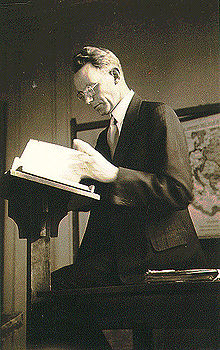 Cornelius Van Til pioneered the field of “presuppositional apologetics” primarily through his works Christian Apologetics

The Presuppositional Apologetic: Theory
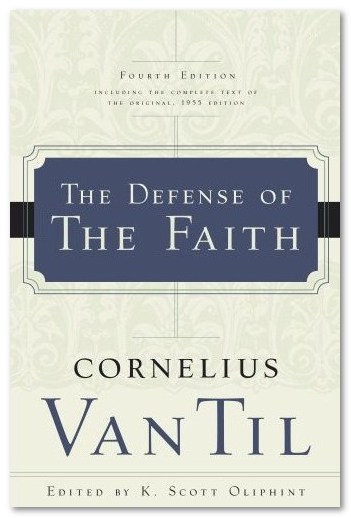
Van Til was very adamant that believers cannot and should not give up any ground to those who are non-Christian. He argued that “Christian theism is a unit. Christianity and theism are implied in one another… Christianity can never be separated from some theory about the existence and the nature of God” (Christian Apologetics, 17). Again, he is adamant: “We must defend Christian-theism as a unit” (The Defense of the Faith, 28).
Along with his emphasis on defending Christianity as a unit, Van Til equally impressed the point of the extreme divergence of views between the Christian and the non-Christian. Apologetics must acknowledge the nature of man. Van Til placed particular emphasis upon the notion that apologists cannot ignore that “we shall have to choose between two theories of knowledge. According to one theory God is the final court of appeal; according to the other theory man is the final court of appeal” (The Defense of the Faith, 58). Because of this, “it becomes quite impossible…. [to] agree with the non-Christian in his principles of methodology to see whether or not Christian theism be true” (The Defense of the Faith, 118-119).
The key to understand here is that Van Til does not accept that there is a neutral reason “out there” by which Christians and non-Christians can arbitrate the truth of Christianity; his point is that there is no neutral ground and that one’s presuppositions will determine one’s end point. Again, he writes, “this [apologetic method] implies a refusal to grant that any area or aspect of reality, any fact or any law of nature or of history, can be correctly interpreted except it be seen in the light of the main doctrines of Christianity” (Christian Apologetics, 124).
However, Van Til takes it even further and argues that one must presuppose the truth of Christianity in order to make sense of reality: ” What is the content of this presupposition, then? It is this: “I take what the Bible says about God and his relation to the universe as unquestionably true on its own authority” (The Defense of the Faith, 253); again, “The Bible is thought of as authoritative on everything of which it speaks. Moreover, it speaks of everything” (Christian Apologetics, 19). Thus, Van Til’s apologetic does not make Christianity the conclusion of an argument; rather, Christianity is the starting presupposition.
The presuppositional approach here cannot be stressed enough. For Van Til, one simply cannot grant to the non-Christian any epistemic point. “We cannot avoid coming to a clear-cut decision with respect to the question as to whose knowledge, man’s or God’s, shall be made the standard of the other. …[O]ne must be determinative and the other subordinate” (The Defense of the Faith 62-63).
What place is had for evidences in Van Til? At some points, he seems to be very skeptical of the use of Christian evidences. In particular, the fact that he argues there is no neutral evaluation grounds between the Christian and non-Christian seems to imply that there can be no real evaluation of such arguments apart from Christianity. One of Van Til’s most famous illustrations of the use of evidences can be found in The Defense of the Faith pages 332 and following. He uses three persons, Mr. Black (non-Christian), Mr. Grey (Christian non-presuppositionalist), and Mr. White (presuppositional/reformed apologist):
Mr. Grey… says that, of course, the “rational man” has a perfect right to test the credibility of Scripture by logic… by experience… [Mr. Grey then takes Mr. Black a number of places to show him various theistic evidences. Mr. Black responds:] “you first use intellectual argument upon principles that presuppose the justice of my unbelieving position. Then when it it is pointed out to you that such is the case, you turn to witnessing [subjectively].
…At last it dawned upon Mr. White that first to admit that the principles of Mr. Black, the unbeliever, are right and then to seek to win him to the acceptance of the existence of God the Creator… is like first admitting that the United States had historically been a province of the Soviet Union but ought at the same time to be recognized as an independent and all-controlling power… If one reasons for the existence of God and for the truth of Christianity on the assumptions that Mr. Black’s principles of explanation are valid, then one must witness on the same assumption [which makes witnessing wholly subjective.] (p. 332-339)
It can be seen here that even evidences for Van Til must be based within a presupposition. There is no way to look at evidences in the abstract. One can either offer them within the presuppositions of Christianity or outside of Christianity. For Van Til, once one has agreed to offer evidences outside of Christianity, one has granted the presuppositions of the non-believer, and therefore is doomed to fail.
 His argument is therefore a type of “transcendental argument.” He argues that only within the Christian worldview can even the rationalism of the unbeliever make sense. Non-Christians may reject belief in God, but this is not a rational rejection, according to Van Til. Rather, “Sin will reveal itself in the field of knowledge in the fact that man makes himself the ultimate court of appeal… Man has declared his autonomy as over against God” (The Defense of the Faith, 58). Mankind is actively suppressing the knowledge of God. “It is not that we are merely brought into existence by God, but our meaning also depends upon God” (The Defense of the Faith, 63).
To sum up Van Til’s apologetic, then, there are three major points:
1) There is no neutral starting point between the Christian and non-Christian. One must presuppose either.
2) Christians should therefore presuppose Christianity in their apologetic and seek to show how only upon Christian presuppositions can one make sense of reality.
3) The transcendental argument: Only if God exists can their be a basis for morality, science, history, and rationality.
Analysis and Application
I admit that I am quite sympathetic to those who argue this type of apologetic is viciously circular. For example, one proponent of Van Tilian apologetics is John Frame. In his defense of presuppositional apologetics, he writes, “Premise 1: Whatever the Bible says is true. Premise 2: The Bible says it is the Word of God. Conclusion: Therefore, the Bible is the Word of God” (Frame, 356, cited below). I can’t help but think that while this argument is deductively valid, using P1 is to beg the question against the non-Christian. But of course, that’s exactly what Van Til urges. One must start with Christian theism and the Bible as presuppositions and reason from there. Therefore, I’m inclined to think that presuppositionalism cannot stand on its own. However, I do think that Van Til’s method can be saved from logical absurdity and made applicable in a part of a “cumulative case” type of reasoning (or certainly, it could be paired with a type of Reformed Epistemology).
The way I would propose for this is to utilize Van Til’s apologetic by showing Christians and non-Christians how philosophical presuppositions can color one’s evaluation of evidence and even of reasoning itself. Instead of offering only evidences or only witness in a vacuum, the Christian apologist should indeed focus upon how one’s presuppositions change one’s evaluation of evidence or witnessing. One presuppositional approach to the problem of evil can be found, I’ve suggested, in Job.
Furthermore, it seems to me that the transcendental argument is extremely potent. By arguing that even the process of reasoning cannot make sense apart from God, Christians can effectively place the burden of proof upon their opponents to show how their system can cohere with reality.
Finally, I can’t help but appreciate the tenacity with which presuppostional apologists, in the spirit of Van Til, pursue incoherent positions and actively turn people back to the presuppositional approach. The presuppositional apologetic, while not necessarily one I think can stand on its own, is extremely powerful.
Conclusion
Reading Van Til leaves me at points breathless with his innovation and boldness; but at other points it leaves me frustrated. He is not easy to understand, nor are his arguments always convincing. Too often, he axiomatically states a position and assumes his argument has carried his point. However, one can hardly dismiss the whole of Van Til’s thought as useless to Christian apologetics. Van Til’s transcendental argument has staying power, and his urges to focus upon presuppositions cannot be ignored.
This is but the first in a series of posts I have planned on presuppositional apologetics. I will be analyzing Van Til’s thought further, as well as diving into some other well-known proponents of presuppositionalism like John Frame, K. Scott Oliphant, and Greg Bahnsen. A few posts will focus on applied presuppositional apologetics.
Sources
Cornelius Van Til, The Defense of the Faith
—-, Christian Apologetics
John Frame, “A Presuppositional Apologist’s Closing Remarks” in 5 Views on Apologetics (Grand Rapids, MI: Zondervan, 2000).
Links [Will update as series continues]
Proof that God Exists– an insightful view of presuppositional apologetics in practice.
Choosing Hats– A mammoth collection of articles from a presuppositional apologetic.
SDG.
——
The preceding post is the property of J.W. Wartick (apart from citations, which are the property of their respective owners) and should not be reproduced in part or in whole without the expressed consent of the author. All content on this site is the property of J.W. Wartick and is made available for individual and personal usage. If you cite from these documents, whether for personal or professional purposes, please give appropriate citation with both the name of the author (J.W. Wartick) and a link to the original URL. If you’d like to repost a post, you may do so, provided you show less than half of the original post on your own site and link to the original post for the rest. You must also appropriately cite the post as noted above. This blog is protected by Creative Commons licensing. By viewing any part of this site, you are agreeing to this usage policy.
On the Shoulders of Giants: Rediscovering the lost defenses of Christianity
 There is something missing from our arsenal as Christian apologists. I came upon this truth about a year and a half ago, but have only begun to realize how much we have been missing. Let me begin with an illustration:
It was a short, scenic drive down Interstate-94 to meet with Dr. Timothy McGrew, a professor of philosophy at Western Michigan University. At the time I was living in Ann Arbor, and I had only conversed with Tim on Facebook. He told me, with ill-concealed glee, about a folder on his computer that was filled with PDF scans of copyright-free (public domain) books by forgotten Christian apologists and theologians. The arguments in them, he told me, were not often used by modern apologists and could but increase my knowledge.
We met at a restaurant along the highway and talked for about an hour and a half while Tim uploaded files on my computer. Tim described to me a number of the items in this collection, but what struck me was how many arguments he referenced which are simply forgotten in current apologetics discussions. For example, he described the argument from “undesigned coincidences,” which basically goes through the Bible and shows how interrelated texts confirm each other’s historical veracity. I was shocked that I had not run into such a profound argument for the Christian faith. I was tremendously excited to find out that there were many such treasures waiting to be discovered.
Despite our continued interactions, I only very slowly began to read through this fantastic set of resources with which Tim had provided me. Once I got my Kindle, however, I began to tear through them. I have discovered so many delightful discussions, wonderful arguments, thought-provoking works that I could hardly begin to list them here. But I will try at least provide a few avenues for study.
I want you, and yes, especially you–the spirited apologist who has your Kalam argument memorized, your Leibnizian argument polished, and the like–to consider this fact: there are scores more arguments for the veracity of Christianity just waiting to be accessed. These arguments have little-to-no discussion in the apologetic blogosphere, they very rarely appear in modern books (if ever), and many of them are quite strong. What is your reaction to that knowledge?
I suspect it is a salivating, whetting of the appetite; it is a yearning desire to learn more. Fear not! These books, and the arguments within them, are, as I said, at your fingertips. The following is my brief, annotated list of fantastic free resources to help you, my fellow Christian apologists, broaden your knowledge.
Repositories of Resources
Library of Historical Apologetics (Currently DOWN)- Here is where I got started, with Tim McGrew’s phenomenal collection of works. In particular, the “annotated bibliography” will set you up with some fine works. The site features a “spotlight” on the main page for various fantastic reads. Browse and download at will. Also check out their Facebook page.
Open Library– Open Library has a number of the books listed at the Library of Historical Apologetics available in a more Kindle-friendly format, if that’s your reading method of choice. I highly recommend using it to send books to your Kindle for free (when you select wi-fi delivery). See below for some specifics.
 Getting Started
Yes, it can be daunting once you realize the voluminous nature of the study ahead of you. So I’ve made it easy by providing links to a few books–again, for free–to get you started, along with some comments. Oh, and I’ll be running a series shortly which outlines and examines several of these arguments.
Forgotten Arguments for Christianity: Undesigned Coincidences- The argument stated– I outline one of the many forgotten arguments for the truth of Christianity.
The Four Gospels from a Lawyer’s Standpoint– Edmund Bennett. Short and sweet, this book presents an argument I find extremely compelling: undesigned coincidences. Essentially, what Bennett argues is that the authors of the Gospels, writing individual histories, incidentally confirmed each other’s histories. I can’t recommend this highly enough. [To download, click the [G] or [A]; or if you want it for kindle, click here and on the right select “send to Kindle.”
A View of the Evidences of Christianity– by William Paley. It would be hard to describe the impact this book will have on your apologetic. Paley is simply masterful. In his first section alone he tears apart Humean arguments against miracles. This book is of extreme import for anyone interested in apologetics. Again, Kindle users.
Undesigned Coincidences– by J.J. Blunt. Once you’ve read Bennett, this book takes you through the entire Bible pointing out more historical arguments of great import throughout. I find this argument stunningly powerful, and I think as apologists we must incorporate it. Kindle [warning-lots of typos in this one due to the transition from PDF to Kindle. If you find a better version for Kindle, let me know].
Historic Doubts Relative to Napoleon Bonaparte– I’ll let Tim McGrew describe it: ” In this delightful spoof, published while Napoleon was still alive, Whately turns Hume’s skeptical doubts regarding miracles against reports of the career of Napoleon—with devastating results.” One can’t help but think of those who deny the historical Jesus today and how one might apply this to Abraham Lincoln, JFK, or (as I have), the Titanic. Kindle users.
The Bridge of History over the Gulf of Time– Thomas Cooper’s exhortation to apologetics and a general introduction to a number of arguments against Christianity. Check out this essay on Cooper.
A Dissertation on Miracles– by George Campbell. A devastating critique of Hume’s argument against miracles.
The Voyage and Shipwreck of St. Paul– by James Smith [click the link in the article]. This work is an argument for the historical accuracy of Luke in Acts constructed by a sailor who also knew numerous languages and was intimately familiar with the documents with which he worked for this account.
There is now a fire within me that seeks after these forgotten or little-known arguments–a burning that is only quenched by finding more early writings–and I can’t help but hope that you, too, will be delighted to delve into these lost treasures. We can’t let the past escape us. One thing I always tell the apologetics class I teach is this: “If you have a doubt or a question about the Christian faith, I can guarantee you that someone smarter than me has already thought about it and written on it. Don’t go at it alone.” Christian brothers and sisters, don’t let this knowledge escape you. We must spread it to this generation and beyond.
Final Thoughts
My thanks to Tim McGrew for his guidance in this study. May we all strive for Christ as he has.
I leave you with something he told me about these historical apologetics books:
I know …
… a music theory professor who read Thomas Cooper’s _Bridge of History_ and phoned me up screaming violently for more …
… a seminary graduate who confessed that he had never been taught the evidences of Christianity that he was discovering in the old, forgotten works …
… a marathon runner and stay-at-home mom who fell in love with George Campbell’s _Dissertation on Miracles_ …
… a construction worker who was captivated by the argument from undesigned coincidences …
… a daycare worker who has educated himself by reading dozens of old works of apologetics …
… a civil service worker in Chicago who set out to refute the arguments in Thomas Chalmers’s _Evidence and Authority of the Christian Revelation_ and ended up becoming a Christian …
… the list goes on and on …
SDG.
——
The preceding post is the property of J.W. Wartick (apart from citations, which are the property of their respective owners) and should not be reproduced in part or in whole without the expressed consent of the author. All content on this site is the property of J.W. Wartick and is made available for individual and personal usage. If you cite from these documents, whether for personal or professional purposes, please give appropriate citation with both the name of the author (J.W. Wartick) and a link to the original URL. If you’d like to repost a post, you may do so, provided you show less than half of the original post on your own site and link to the original post for the rest. You must also appropriately cite the post as noted above. This blog is protected by Creative Commons licensing. By viewing any part of this site, you are agreeing to this usage policy.
Method or Madness? A reflection on Jesus, the Titanic, and Parallelomania
“[I]n the case of Jesus Christ, where virtually every detail of the story fits the mythic hero archetype, with nothing left over, no ‘secular,’ biographical data, so to speak, it becomes arbitrary to assert that there must have been a historical figure lying back of the myth.”[1]
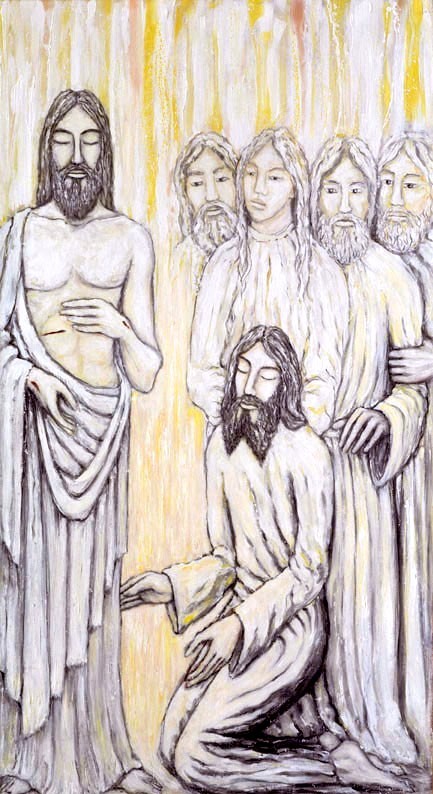
One needs only to ask the question, “Did Jesus exist?” in order to spark intense debate amongst skeptics and Christians. A simple search for the question online turns up any number of non-professionals who boldly assert that there was no historical Jesus, or even that the evidence that Jesus was a myth outweighs the evidence that he was a real man.[2] There are even a few scholars who allege that Jesus never existed.[3] Perhaps the most frequently-cited “evidence” that Jesus never existed is the purported evidence of parallels in pagan and mystery religions.[4] The notion that legendary or historical parallels can discredit a historical account is itself on shaky epistemological ground. If, however, one were to take seriously the notion that parallels discredit a historical account, vast swathes of history would also evaporate into skepticism. Simply put, if the hyper-skepticism related to parallels about Jesus were applied to all of history without bias, historical inquiry would be undermined. In order to draw out the implications of parallelomania[5] for what are generally acknowledged as historical accounts, the rest of this study will start off with a tongue-in-cheek investigation of one historical event (the wreck of the Titanic), emphasizing the parallels between it and a fictional account; then an inquiry into historiographical investigation will be launched in relation to the methodology which utilizes alleged parallels and their connotations for historical study. Thus, the following study will show that the methodology of those who argue from alleged parallels to the non-existence or “legendary hypothesis” of Christ is mistaken, rather than arguing that individual parallels are wrong.[6]
There is a tradition within Christian apologetics of pointing out the absurdity of rival positions, sometimes even by satire.[7] Essentially, by showing that an opponent’s method or conclusions lead to absurd conclusions about things nearly everyone agrees upon, the apologist can discredit the method or conclusion that is under investigation. The following section will be an exercise in this strategy. Note that the author is satirically employing the methods found in several sources of supposed historical inquiry into the existence of Jesus.[8]
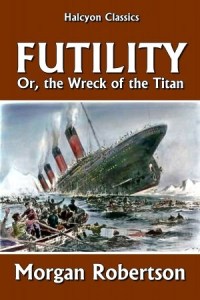 The Myth of the Titanic: An argument from a “Titanic myther”
It is clear that the wreck of the Titanic is a mythic tale which has been foisted upon history. Few people know that Morgan Robertson’s novel, Futility, or the Wreck of the Titan,[9] which was written in 1898, 14 years before the RMS Titanic sank, outlines a highly telling, fictional account that has any number of parallels to the purported wreck of the Titanic. First, note the number 14’s significance: the Titanic hit an iceberg on April 14th, 1912![10] The book itself discusses the wreck of the Titan, which a child could see is very similar to Titanic. Consider the first line of Robertson’s work: “She was the largest craft afloat and the greatest of the works of men.”[11] The Titanic was supposedly the largest ship afloat at the time of her voyage.[12] The captains on both ships had the same name, Robert Porter. Not only that, but both the fictional and supposedly historical ships[13] had three propellers. Both were said to be unsinkable.[14] Both ships carried the minimum number of lifeboats required by law and therefore both ships lost an enormous number of passengers when sunk. [15] Finally, the clinching piece of evidence is that both the Titan and the Titanic were sunk by hitting an iceberg.[16]
From these evidences one would not be hard-pressed to conclude that the story of the Titanic is merely the plot of the Titan with historical embellishments. Consider the parallels once more. From the description (unsinkable) to the propulsion system (three propellers); from the lifeboats to the size of the ship; from the names of the ships to the very means of destruction, the Titan and Titanic are the same. Furthermore, numerology is inherent in the Titan/Titanic narratives. The 14 years between the two stories echoes in the alleged date of the wreck of the Titanic. Therefore, in the case of the Titanic, where virtually every detail of the story fits the “shipwreck” archetype, with nothing left over, it becomes arbitrary to assert that there must have been a historical event lying behind the myth.[17]
Parallels and Historiography
Setting aside the satire, it is clear that the example of the Titanic used here is only[18] the tip of the iceberg.[19] There are a number of other historical accounts and persons one could do a similar “study” upon.[20] But what does such an investigation prove? The notion that parallels can somehow discredit a historical account is on a very faulty ground. First, the notion of “parallel” is highly subjective and can mean different things to different readers. “One tends to read into accounts the commonalities one is looking for.”[21] If one assumes that a text is mythical—if one assumes the text is not trustworthy or at least had other sources or was derived—then one will find exactly that which one has assumed in the text. Samuel Sandmel writes, “I am not denying that literary parallels and literary influence, in the form of source and derivation, exist… I am speaking words of caution about exaggerations about the parallels and about source and derivation.”[22] He goes on to argue, regarding alleged parallels as derivations in Paul’s writings, “[T]o make Paul’s context conform to the content of the alleged parallels is to distort Paul… if we make him mean only what the parallels mean, we are using the parallels in a way that can lead us to misunderstand Paul.”[23] Similarly, if readers look at a historical account—even one that they believe only alleges to be historical—and make it mean only that which the parallels allow, then they distort the text’s meaning. Indeed, it can lead one to look only to the parallels for meaning rather than to the text itself.[24]
A second problem with the kind of parallelomania found in some skeptics’ looks at Jesus and alleged sources for the Jesus “legend” is that they have discounted many principles of historical inquiry. Historians begin by looking at the conventional meaning of a text.[25] They also look at the historical context of the text in order to interpret the text.[26] However, in order to do this accurately, they must be aware of their own biases and be open to correction.[27] It is of the utmost importance for historians to consider the complexities of a historical picture as well as the links between causation, contingency, and counterfactual reasoning in historical research.[28] To put it more precisely, history is not a simple task in which one can conclude with certainty the causes of a past event.[29] Rather, historians must consider the interdependency of variables in a historical event[30] and avoid the temptation to oversimplify a historical account in an attempt to “clean it up.”[31] Those who seek to reduce the story of Jesus “without remainder” to legendary figures have fallen victim to a historiography of their own invention. They’ve followed their intellectual biases to their own conclusions and failed to take the texts into account.
 Those who argue that the Gospels are discredited because of alleged parallels also utilize a poor, unjustified inference. Even were there a huge number of parallels between Jesus and the supposed mystery (and other pagan) religions, these would not, of themselves, discredit the account of Jesus as historical. Consider the “Titanic Myther”[32] in the satirical account above. The myther seeks to show that, due to all the parallels one can draw between the Titan and the Titanic, the latter is derived from the former. But by what principle of reasoning does it follow that similarities show derivation? Is there a way to determine when a document is derived from another? What is the cutoff point at which we know that a supposedly historical event can be said to be legend? None of these questions is intended to say that historians can never accurately say that a document—even one that claims to be historical—is legend. Rather, the question is whether the Gospels are shown to be legend by supposed parallels. If one holds that they are legends, then how is it that one comes to the conclusion? One can see by looking at most of the purported “studies” online that the conclusion is most often reached simply by citing a number of alleged parallels to Jesus across differing accounts, but of course that won’t do. One would have to show that these parallels are accurate in their claims (and many of them are not),[33] while also showing that the parallels are not mere coincidences, like those between the Titan and Titanic. Finally, the question remains: what rule of logic or historical inquiry yields the outcome that a prima facie historical account is in fact legend because there are legendary parallels?
Finally, there is the question of the burden of historical proof. The burden of proof is upon the one making the claim,[34] and in this case, people claim that Jesus was a legend. That is a positive claim in need of evidence. Unfortunately, the argument is most often made in a manner which simply dismisses counter-evidence while vastly overstating and sometimes even lying about the parallels which are found in other religious figures.[35] The dismissal without argument of counter-evidence, combined with a sometimes blatant disregard for historical accuracy[36] radically undermines the case of those who claim Jesus was a legend based on parallels.
Jesus and Legend
Hypotheses about historical events must take into account the entire body of evidence.[37] The theories which try to reduce Jesus to a legendary figure alone do not take into account the entire body of evidence, and therefore fail the test of historical credibility.[38] Suppose, for the moment, the numerous alleged historical parallels to Jesus were true. How, then, would historians account for the willingness of the disciples to go to their deaths for their beliefs in the truth of the Gospel accounts?[39] What of the Pauline epistles?[40] What of the archaeological evidence and extra-biblical documentation about the life of Jesus?[41] By reducing their historiography to a mere shadow of that which is used in standard historical studies, those who argue that the parallels of Jesus discredit the Gospel accounts have failed the test of explanatory scope for their theories. Like the “Titanic Myther” above, who didn’t take into account the photographs of the wreckage of the Titanic or the numerous firsthand accounts of her voyage, their theory cannot begin to account for the above questions—it does not cover the whole body of evidence. The “Jesus Legend” is a pure figment of their own imaginations–one which is not backed by historical inquiry.
 Finally, those who argue from parallels make a number of other methodological blunders. First, they tend to lump all the mystery religions in with other pagan and ancient religions in order to form a kind of “composite parallel” to Jesus from which the Gospels are supposedly derived.[42] The problems with such a method, of course, are that it is extraordinarily anachronistic and that those proposing such theories “have been a bit too casual in fitting Christian elements into mystery religion data.”[43] Second, they borrow terminology from Christianity in order to retrospectively apply it to mystery religions, despite what are often entirely different contexts.[44] Third, the theories disregard the first century context of the Gospels in which, first, the “Homeric assumption” about resurrection (that is, that humans did not rise from the dead) persisted throughout the world;[45] second, the Jews would have been staunchly opposed to letting pagan religions undermine Judaism.[46] Fourth, the groundwork which must be laid down in order to establish dependence of one religion upon another is often ignored or misrepresented by those who alleged the ahistorical nature of Jesus.[47] Finally, at least some of the “sources skeptics typically cite as evidence that pagan religions influenced early Christian beliefs postdate the writings of the New Testament.”[48]
Concluding Remarks
Just like the “Titanic Myther” above, who drew upon disparate, unconnected, and self-invented (the reader may have noted one such example in the satirical section above)[49] connections and connotations to prove his point, those who hold that Jesus never existed, or that the Gospel narratives are reducible to legend have fallen into the trap of parallelomania. In their search for meaning, they have found exactly that which they set out to find. By rejecting the standard methods of historiography and embracing a hyper-skeptical approach to the Gospels, those who argue from parallels to the non-existence of Jesus become caught in their own arguments. Without any kind of historiographic base, their theories are trumpeted as unassailable facts. The study that has been presented here reveals that rather than using sound historiographic methods, these hyper-skeptics have fallen into historical madness. Once one applies their method to widely acknowledged historical facts, history collapses in upon itself. In short, the way of parallelomania leads only to madness.
Links
Some people, reading this post, may immediately object because they find the parallels referenced in things like Zeitgeist very convincing. My stated topic in this paper was not to explore the individual parallels and refute them, but rather to point out the flawed methodology of these persons. However, for those who want more point-by-point rebuttals of these “parallels,” I have included a few links:
All About Horus– in-depth analysis of Horus as a potential parallel for Christ. Also, follow the links for discussions of other supposed parallels. See the next link.
Evidence for Jesus and Parallel Pagan “Crucified Saviors” Examined– More supposed parallels examined.
Zeitgeist Part I– a fairly thorough rebuttal of the movie.
[1] Robert Price, “Christ a Fiction.” Infidels.org. 1997, http://www.infidels.org/library/modern/robert_price/fiction.html.
[2] Mark Thomas, “Did Jesus Really Exist?” Godless Geeks. 2011. http://www.godlessgeeks.com/JesusExist.htm.
[3] Robert Price, Alan Dundes, and others are cited in Paul Eddy and Gregory Boyd, The Jesus Legend (Grand Rapids, MI: Baker, 2007), 136ff.
[4] Eddy and Boyd dedicate a chapter to rebutting such claims in The Jesus Legend, 133ff. Examples of those who use this evidence are in abundance, for example: Robert Price, “Christ a Fiction”; Mark Thomas, “Did Jesus Really Exist?”; Jim Walker, “Did a historical Jesus exist?” No Beliefs. 22 April, 2011. http://www.nobeliefs.com/exist.htm.
[5] Following Samuel Sandmel’s study of Parallelomania, “We might for our purposes define parallelomania as that extravagance among scholars which first overdoes the supposed similarity in passages and then proceeds to describe source and derivation as if implying literary connection flowing in an inevitable or predetermined direction.” (Sandmel, “Parallelomania” Journal of Biblical Literature 81, 1962: 1-13, 1.) I came upon this source independently of Eddy and Boyd, but am pleased that they cite this excellent paper as well.
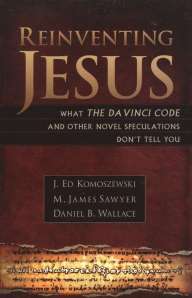
[6] Again, for a study of these supposed parallels, see Eddy and Boyd, The Jesus Legend, esp. 133f; see also the excellent study in J. Ed Komoszewski, M. James Sawyer, and Daniel Wallace, Reinventing Jesus (Grand Rapids, MI: Kregel Publications, 2006), 219-258.
[7] Perhaps the most interesting and humorous of these can be found in Richard Whately, Historical Doubts Relative to Napoleon Bonaparte (1819), where Whately applies Humean skepticism about the historical Jesus to Napoleon Bonaparte with great success.
[8] This study is not intended to be a comprehensive refutation of the sources which have already been cited. However, by showing the flaws in historical methodology, it seeks to show that those who ascribe to the non-existence of Jesus due to parallels are starting off from a flawed position.
[9] Morgan Robertson, Futility, or the Wreck of the Titan, 1898.
[10] This Day in History, April 14th, The History Channel. http://www.history.com/this-day-in-history/rms-titanic-hits-iceberg.
[11] Robertson, Futility, Kindle location 15.
[12] “Historic Images from the Titanic Sinking” Times Union, 2012, http://www.timesunion.com/news/slideshow/Historic-images-from-the-Titanic-sinking-41504.php#photo-2803535.
[13] “The Titanic: All About the Ship” Titanic Facts, 2012, http://www.titanicfacts.net/the-titanic.html.
[14] Robertson, Futility, Kindle Location 15; “Sinking the Unsinkable” 2005, http://www.snopes.com/history/titanic/unsinkable.asp.
[15] Robertson, Futility, Kindle Location 32; “Titanic Lifeboats” Titanic Facts, 2012, http://www.titanicfacts.net/titanic-lifeboats.html.
[16] “The Titanic Iceberg” Titanic Facts, 2012, http://www.titanicfacts.net/titanic-iceberg.html; Robertson, Futility, Kindle Location 329.
[17] The wording here intentionally parallels that of Robert Price at the beginning of this study.
[18] A search on Bing of “weird parallels between fiction and history” turns up millions of results. Many of these parallels are extremely thoughtful and creative, and demonstrate parallelomania (intentionally) in a perfect way.
[19] No pun intended in relation to the Titanic. Or was it the Titan? Sorry.
[20] One of the more popular historical examples is to compare Abaraham Lincoln to John F. Kennedy—in particular, the stories of their assassinations. A skeptical treatment investigating these parallels (while still acknowledging that many of them are parallels) can be found at “Linkin’ Kennedy”, 2007, http://www.snopes.com/history/american/lincoln-kennedy.asp.
[21] Boyd and Eddy, The Jesus Legend, 141.
[22] Sandmel, “Parallelomania,” 1.
[23] Ibid, 5.
[24] There are indeed writings on the internet which allege, for example, that Robertson was “inspired” to prophesy the wreck of the Titanic in his novel. This is an example of parallels dictating not only the history but also the interpretation of a text. See “Inspiration 1: Futility, or the Wreck of the Titan” http://www.light-eternal.com/Titan.htm/.
[25] C. Behan McCullagh, The Logic of History (New York: Routledge, 2004), 18.
[26] McCullagh, The Logic of History, 24-26.
[27] Ibid, 31-34.
[28] John Lewis Gaddis, The Landscape of History (New York: Oxford, 2002), 71ff.
[29] Gaddis, The Landscape of History, 102-103.
[30] Ibid, 69-70.
[31] Ibid, 108-109.
[32] Using the terminology of those who denote themselves “Jesus Mythers” who deny the historical existence of Jesus.
[33] Eddy and Boyd evaluate many claims in The Jesus Legend, 142ff; another problem with assessing many of these claims is that they are often given without any citation. One infamous example of outright lies is the “Zeitgeist” video (Peter Joseph, “Zeitgeist, the Movie” 2007, accessible here: http://www.youtube.com/watch?v=oZgT1SRcrKE), which literally makes up a number of its parallels (a critique can be found here: Edward Winston “Zeitgeist Part I: The Greatest Story Ever Told” 2007, http://conspiracies.skepticproject.com/articles/zeitgeist/part-one/). For example, it uses the English words’ “sun” and “son” to supposedly demonstrate that Jesus was the Sun God (despite the fact that English didn’t exist when the Gospels were written).
[34] For an argument to this effect see Michael Licona, The Resurrection of Jesus: A New Historiographical Approach (Downers Grove, IL: InterVarsity, 2010), 94ff.
[35] A number of claims are analyzed and come up wanting, or as simply inaccurate or false in Komoszewski, Sawyer, and Wallace, Reinventing Jesus, 219ff.
[36] Ibid; see also Eddy and Boyd, The Jesus Legend, esp. 139-146.
[37] McCullagh, The Logic of History, 49-52.
[38] On testing for historical credibility, see McCullagh, The Logic of History, 138ff.
[39] William Lane Craig, “Opening Statement” in Jesus’ Resurrection: Fact or Figment? Edited by Paul Copan and Ronald Tacelli (Downers Grove, IL: InterVarsity, 2000), 34ff; William Lane Craig, The Son Rises (Eugene, OR: Wipf and Stock, 1981), 127-134.
[40] Licona, The Resurrection of Jesus, 400ff.
[41] Gary Habermas, The Historical Jesus (Joplin, MS: College Press, 1996), 187-242.
[42] Komoszewski, Sawyer, and Wallace, Reinventing Jesus, 223-224.
[43] Ibid, 224.
[44] Ibid, 224-226.
[45] See N.T. Wright’s brief but devastating criticism of the “dying and rising gods” alleged motif in The Resurrection of the Son of God (Minneapolis, MN: Fortress, 2003), 80-81.
[46] Eddy and Boyd, The Jesus Legend, 136ff.
[47] Komoszewski, Sawyer, and Wallace, Reinventing Jesus, 226ff.
[48] Ibid, 233; for even more historiographical blunders made by those putting forward this theory, see Eddy and Boyd The Jesus Legend, 134ff.
[49] The reader may not have caught the lack of citation for the notion that the Captains’ names were the same in the book Titan and the “real life” Titanic. It is that easy to sneak a claim in between the lines. The actual names of the captains were Captain Bryce of the Titan and Captain Edward Smith of the Titanic.
SDG.
——
The preceding post is the property of J.W. Wartick (apart from citations, which are the property of their respective owners) and should not be reproduced in part or in whole without the expressed consent of the author. All content on this site is the property of J.W. Wartick and is made available for individual and personal usage. If you cite from these documents, whether for personal or professional purposes, please give appropriate citation with both the name of the author (J.W. Wartick) and a link to the original URL. If you’d like to repost a post, you may do so, provided you show less than half of the original post on your own site and link to the original post for the rest. You must also appropriately cite the post as noted above. This blog is protected by Creative Commons licensing. By viewing any part of this site, you are agreeing to this usage policy.
The Argument from Religious Experience: A look at its strength
 I have written previously about the argument from religious experience. I provided a brief outline of the argument and commented on its usefulness. Now, I turn to the question of the strength of the argument from religious experience.
[Note: Through this post, when I say “religious experience” I am referring to experience generally–that is, numinous, sensory, and the like. I will distinguish when I mean otherwise.]
The Sheer Numbers
Religious Experience is pervasive throughout human history. You can find accounts of it in the Upanishads, the Vedas, the Qur’an, the Torah, the Gospels, and more. Not only that, but recent, systematized studies have found that religious experience continues to be a part of people’s realm of experience.
Consider David Hay’s study, Religious Experience Today. The book is based upon a number of national and community surveys in the UK. For example, one Gallup poll in Britain in 1987 yielded a response rate of 48% of people saying they had had a religious experience as described by the poll. In 2000, another poll in the UK yielded a 36% positive response. Granted that some of this may be due to false positives, one must also realize that there is a kind of repression of expressing religious experience due to embarrassment and/or personal bias, so these numbers may also lean towards the lower end (Hay, 57ff).
One could also look at the sheer number of luminaries throughout all time who have claimed religious experience. Throughout the literature, such experiences are far too numerous to be restricted to a descriptor like “many.”
One can’t help but agree with Richard Swinburne, who wrote, “[T]he overwhelming testimony of so many millions of people to occasional experience of God must… be taken as tipping the balance of evidence decisively in favour of the existence of God” (Is There a God?, 120).
The Balance of the Scales
“The argument from religious experience” (hereafter ARE) is itself somewhat of a misnomer–there are many forms of arguments from religious experience, so it is helpful to clarify when one is in dialog which version one is using. I have noted elsewhere that the ARE comes in two varieties: one which argues for public belief and one which argues for personal justified belief. There are two more variants to introduce here: the broad version and the narrow version.
1. The Broad Version of the ARE presents religious experience as a general proof for either:
A) the existence of some transcendent realm–this being a transcendent aphysical realm. This is the broadest version of the argument.
B) the existence of God. This is a broader version of the argument, but isn’t as generalized as A).
2. The Narrow Version of the ARE argues for the truth of a particular religion based upon religious experience. Note that this is narrow in that many religions could affirm a “transcendent realm” or the existence of God[s], but if the argument is construed in this fashion, only the religion which is claimed to have superior evidence from religious experience is [fully] true. [Other religions could have many truths which could be affirmed through RE, but only one would have the “full” or “realized” truth.]
 The argument from religious experience is much easier to defend if it is presented broadly. As one narrows the argument, one is forced to deal with potential defeaters from religious experiences which do not accord with the argument being made. For example, if one argues that God exists based upon religious experience, one would have to somehow contend with the great amount of evidence for monistic or Nirvanic religious experience.
Think of the argument like as a bridge with a counterbalance or a scale with a counterbalance. The more weight one places on the argument [i.e. saying that it can justify the existence of God] (scale/bridge), the more one must deal with that weight on the other end (counterbalance).
If the argument is presented as a way to prove general transcendence of experience, it is extremely strong and very easy to defend. When one instead uses the argument to try to justify the truth claims of a specific religion, one then must come up with a mechanism for determining how to evaluate competing religious experiences. For example, if I argue that religious experiences prove Christianity to be true because so many people have experienced in sensory ways Jesus Christ as Lord and Savior, then it is my task to also show that the experiences of, say, Shiva as god are unwarranted. Thus, the philosopher’s task increases in difficulty the more narrowly he presents the arguments conclusion.
Consider the following two conclusions from arguments (granting me authorial privilege to assume that readers can plug in the premises): 1) Therefore, religious experience justifies the belief that there is a realm apart from our mere physical existence; 2) Therefore, religious experience serves as powerful evidence for the truth of Christianity. The fact that 2) is much more narrow means that one must do much more to show that the conclusion is justified.
Does this mean that the argument is useless when arguing for a particular religion? Certainly not. There are many who have used the ARE for a defense of Christianity specifically (cf. William Alston Perceiving God and Nelson Pike Mystic Union). What is important to note is that when one uses the argument in dialog they must be very aware of how they formulate the argument. As a “Broad/public” version, it can serve as powerful evidence in part of a cumulative case for Christianity; as a “narrow/private” version, it can be strong confirmation of the justification of one’s faith. These variants can be used together or separately.
The Strength of the Argument
So how strong is the ARE? I hope I don’t disappoint readers when I respond by saying: that depends! As far as my opinion is concerned, it seems to me that the “broad/public” and “broad/private” version of the argument are nearly irrefutable. I think it is an invaluable tool for apologists and philosophers of religion. The “narrow/private” or “narrow/public” versions of the argument are not as strong by necessity: they must contend with more objections as they narrow. However, as part of one’s own faith life, I think the “narrow/private” and “narrow/public” versions can give great comfort and solace.
[Author’s note: The next post on the argument from religious experience will defend the principle of credulity.]
Further Reading
See my “The Argument from Religious Experience: Some thoughts on method and usefulness“- a post which puts forward an easy-to-use version of the ARE and discusses its importance in apologetic endeavors.
The following books are all ones I have read on the topic but do not present a comprehensive look at literature on the subject.
Caroline Franks Davis, The Evidential Force of Religious Experience
Jerome Gellman, Experience of God and the Rationality of Theistic Belief
Paul Moser, The Evidence for God
Richard Swinburne, Is There a God?
There are a number of other fantastic books on the topic as well. Swinburne’s The Existence of God
William Alston’s Perceiving God
Keith Yandell’s The Epistemology of Religious Experience
Kai-man Kwan’s Rainbow of Experiences, Critical Trust, and God
Nelson Pike provides a unique look at the phenomenology of RE and a synthesis of theistic and monistic experiences in his work Mystic Union
SDG.
——
The preceding post is the property of J.W. Wartick (apart from citations, which are the property of their respective owners) and should not be reproduced in part or in whole without the expressed consent of the author. All content on this site is the property of J.W. Wartick and is made available for individual and personal usage. If you cite from these documents, whether for personal or professional purposes, please give appropriate citation with both the name of the author (J.W. Wartick) and a link to the original URL. If you’d like to repost a post, you may do so, provided you show less than half of the original post on your own site and link to the original post for the rest. You must also appropriately cite the post as noted above. This blog is protected by Creative Commons licensing. By viewing any part of this site, you are agreeing to this usage policy.
Book Review: “7 Truths that Changed the World” by Kenneth Samples
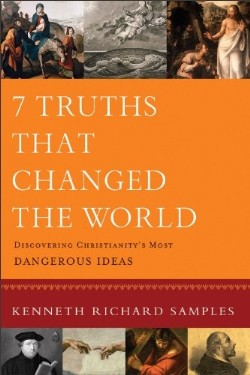 Kenneth Samples’ latest book, 7 Truths That Changed the World
Samples presents 7TC as a kind of investigation into the “dangerous ideas” that are central to Christianity. These dangerous ideas are:
- Not all men stay dead. In this section, Samples defends the historicity of Jesus’ resurrection. Christians who are actively involved in reading apologetics will find that the argument is the fairly well-known “minimal facts” style, but Samples does manage to give some uniqueness to the argument in the next chapter, wherein he examines various objections to the argument for the resurrection. Particularly unique was the fact that Samples takes the time to offer critiques of some of the more outlandish objections, like the twin brother theory (38).
- God walked the earth- Here, Samples puts the “dangerous idea” squarely in the context of religious pluralism. Not all religions can be true (48ff) and if Jesus was God on earth, then Christianity is true. Interestingly, rather than simply presenting arguments for Jesus’ Godhood, Samples offers a few theories of the incarnation and only then moves towards Biblical evidence for Jesus’ deity (50-53; 53ff). Again, Samples engages with some little-known but often abused objections, including the notion that Jesus was a guru (69-70) or even an alien (70-71).
- A fine-tuned cosmos with a beginning- Samples then engages in an argument from cosmic fine-tuning. Again, Samples puts the argument into a context rather than simply throwing it out to be fielded. Throughout the book, Samples grounds the arguments he makes within the broad theological history that surrounds the ideas. For this argument, he points out the historical doctrine of creation out of nothing through the Bible and church history (78-80). He also points out the “weighty theological implications” of the fine-tuning argument (82-83). He then argues that Christian theology helped ground the emergence of science (91ff).
- Clear pointers to God- Explanatory power is one way to evaluate worldviews, and Samples weighs atheistic naturalism against Christian theism. Samples offers a method by which people can evaluate worldviews. Essentially, this is a summary of his excellent work, A World of Difference, which I comment on in my post “Can We Evaluate Worldviews? How to navigate the sea of ideas.” Throughout this section, Samples offers a number of arguments in favor of the notion that God exists and can best explain the universe we observe.
- Not by Works- One of the core tenets of Protestantism, and indeed of evangelicalism (and in many ways, more modern Roman Catholicism) is salvation by grace. The fact that Christianity offers salvation as a gift provides another way to analyze it in light of other worldviews (134ff). All humans feel an urge to try to work for salvation, but this is mistaken. Ultimately, we cannot do it by ourselves (136ff). Sin is a predicament in which we find ourselves, it is a condition (137-138). Thus, Christianity offers a “way out” by salvation through grace in Christ.
- Humanity’s Value and Dignity- Humans have value. Most humans realize that it is wrong to cause harm or suffering and that certain virtues are good. However, without theism, there is no basis for human values (167ff). Some atheists have realized this and rejected meaning (163-166), but their worldviews dim in comparison to the light Christianity brings.
- The Good in Suffering- The problem of evil is the most oft-trumpeted argument for atheism, and Samples responds to it mostly by utilizing the “greater good” theodicy (theodicy means, basically, a defense from the problem of evil). First, he points out that it is not logically incoherent to suppose God is all powerful and all good while still believing evil exists (196-200). Then, he argues that God can have good purposes for evil and suffering (205ff). While we may not come up with a specific reason for every single evil that occurs, God’s sovereignty ensures that good will triumph and that all things work for His purposes (209ff). I don’t tend to favor the “greater good” theodicy because I’m not sure I can swallow the notion that every evil has a greater good–but I think that when applied to evil generally it may be more powerful. Samples does a good job introducing the reader to the basics on the problem of evil and a theodicy here.
While much of the material in 7TC goes over things the avid reader of apologetics will have encountered, the novelty of some of the arguments as well as the answers to some infrequently-considered objections makes the book worthwhile even to “veterans.” It is also very helpful to have some of the background in historical theology that Samples gives to contextualize many of his points. These kinds of extra details with the overall argument give readers a level of background knowledge that not all introductory apologetics books can provide.
Moreover, the format makes it work well as the kind of book to hand to a skeptic or a believer with doubts. It presents the core doctrines of the Christian faith in their broad contexts and defends them admirably. While hardened skeptics may laugh a book like this off, for those with open minds the arguments will be compelling enough to start conversations. Due to the effort to make the book readable for a general audience, it is clear that Samples can’t touch on every objection, but it will get readers thinking.
Overall, 7 Truths That Changed the World
Disclosure: I received a copy of the book for review from the publisher. I was not asked to endorse it, nor was I in any way influenced in my opinion by the publisher. My thanks to the publisher for the book.
SDG.
——
The preceding post is the property of J.W. Wartick (apart from citations, which are the property of their respective owners) and should not be reproduced in part or in whole without the expressed consent of the author. All content on this site is the property of J.W. Wartick and is made available for individual and personal usage. If you cite from these documents, whether for personal or professional purposes, please give appropriate citation with both the name of the author (J.W. Wartick) and a link to the original URL. This blog is protected by Creative Commons licensing. By viewing any part of this site, you are agreeing to this usage policy.
Really Recommended Posts 5/11/2012
 Owl Post edition. If you get it, I like you even more. As usual, I don’t necessarily agree with everything in the posts I recommend, but I do think they are all worth reading (and probably agree with much of their content, so there!).
A very interesting video in which a pastor, Voddie Baucham, addresses the problem of evil.
Altar to a Well-Known God– One of my favorite apologetics sites, No Apologies Allowed is a site which largely features comics that draw out discussion about various issues. This one, I thought, was particularly striking.
Lawrence Krauss on God and Morality– an analysis of Krauss’ views on the moral argument with a thoughtful critique.
How to Refute Christianity: A Handy Guide– A tongue-in-cheek process to show how one could go about refuting Christianity. I found this very thought-provoking.
A young Christian comes out to talk about pornography and its addictive qualities. Not a victimless endeavor.
Reflections on a lyric by 3 Doors Down– very interesting cultural apologetics related to the 3 Doors Down song, “When I’m Gone.”
A Brief Word on Ken Ham, Stand To Reason, and the OEC/YEC Debate– Young Earth Creationist Ken Ham recently wrote a rant about the apologetics group Stand to Reason. This link discusses the strangeness of Ham’s litmus test method for theology. I have also posted my own reaction.
Is Christ Risen?
 Did Jesus rise from the dead?
Now I want you to step back for a moment and think of your immediate response to that question.
Was it “Yes!” Well, why do you think so?
Was it “No!” Again, why?
I mean this very seriously. Read the question again, and now reflect on your answer. Does it come from a well-informed position or does it flow from your presuppositions or worldview? Why do you think Jesus rose or did not rise from the dead? Does your belief come from a careful study of the texts and the critical debate on the topic? Have you read sources from both sides of the debate, have you listened to top scholars in dialog about the topic?
Is it even important?
This one is for the atheists and skeptics out there: look at the picture I have posted on the top left. What feelings does it provoke within you? Disgust? Skepticism? Laughter? Joy?
Why do you think that is?
Christians, I ask you the same question.
What is the point of me taking this space to write all of this? I want everyone to be aware of the fact that when they consider the question I asked to start this post–“Did Jesus rise from the dead?”–they are influenced profoundly by their worldview and their starting point.
No, I want you to consider the evidence–both atheists and Christians. Christians, because it is your solemn duty to discern the truth of the resurrection (1 Corinthians 15:14-19); atheists, because you owe it to yourself to follow the evidence where it leads.
I’m not going to make a sustained argument here. Rather, I encourage you to investigate the topic yourself. A good starting point is this podcast, which argues from the “minimal facts” approach. A summary of the usage of this method can be found here.
Is Christ risen? That’s a question we all must answer, but let us not answer it based on dogma, on presuppositions, or on a dismissal of the evidence. Let us engage with the facts and formulate a hypothesis. Let us investigate the historicity of the event and follow the evidence where it leads.
I know that my redeemer lives,
and that in the end he will stand on the earth.
And after my skin has been destroyed,
yet in my flesh I will see God;
I myself will see him
with my own eyes—I, and not another.
How my heart yearns within me! (Job 19:25-27)

 J.W. Wartick - Reconstructing Faith