atheist
Debate Review: Fazale Rana vs. Michael Ruse on “The Origin of Life: Evolution vs. Design”
 Fazale Rana recently debated Michael Ruse on the topic of the origin of life. Essentially, the question of the debate was whether the origin of life is best explained by naturalism or design. Here, I will provide brief comments on the debate.
Please note I make no claims to being a scientist and I am fully aware that I evaluate this debate as a lay person.
Michael Ruse Opening
Michael Ruse was careful to note that he is not keen on saying design is not possible. Rather, his claim is that naturalism is the most plausible explanation for the origins of life.
Ruse’s argued that design is implausible. Specifically, he noted that if design is the hypothesis put forward, there are any number of ways that one might consider that hypothesis. Is the designer a natural being within the universe or a supernatural being like God? Is there only one designer, or was there a group of designers (and he notes that a group of designers seems more plausible because automobiles require many designers to bring them about)? Finally, he raised the issue of bad design choices. He asked why, if there were a “hands-on” designer, would that designer not grant immunity to HIV and the like.
Ruse also argued that one can fall into the fallacy of selective attention- if one focuses upon only one example in isolation, then one might come to a conclusion that certain laws/theories may not be correct. But placing these same problems in context shows that they can be explained against “the background of our knowledge.”
Finally, Ruse ended with a number of examples for how problems which were seemingly insoluble were explained by naturalistic means. He also argued that one of the popular arguments for design, the flagellum, has so many different varieties (and is sometimes found to be a vestigial organ), and so cannot be shown to be designed.
Fazale Rana Opening
The problems which must be accounted for within an origins of life model are numerous. One must account for self-replication, the emergence of metabolism, the formation of protocells, the synthesis of prebiotic materials, the formation of life’s building blocks, and more.
Rana then turned to some primary models used by researchers to explain origin of life (hereafter OOL). First, there was the replicator-first model, which was problematic because in order for a molecule to be a self-replicator, it must be a homopolymer. But the complexity of the chemical environment on early earth rendered the generation of a homopolymer on the early earth essentially impossible. Next, the metabolism-first model runs into problem due to the chemical networks which have to be in place for metabolism. But the mineral surfaces proposed for the catalytic systems for these proto-metabolic systems cannot serve as such; Leslie Orgel held that this would have to be a “near miracle” and Rana argues that it is virtually impossible. Finally, the membrane-first model requires different steps with exacting conditions such that the model is self-defeating.
Rana argued positively that OOL requires an intelligent agent in order to occur. The reason is because the only way that any of these models can be generated is through the work on OOL in a lab. Thus, they can only be shown to be proof-of-principle and the chemistry breaks down when applied to the early earth. The fact that information is found in the cell is another evidence Rana presented for design. The systems found in enzymes with DNA function as, effectively, Turing machines. Moreover, the way that DNA finds and eliminates mistakes is machine-like as well. The fact that the needed component for success in lab experiments was intelligence hinted, according to Rana, at positive evidence for design.
Finally, Rana argued that due to the “fundamental intractable problems” with naturalistic models for the OOL and the fact that the conditions needed for the OOL and the processes required to bring it about have only been demonstrated as in-principle possible with intelligent agents manipulating the process.
First Cross Examination
At this point, Ruse and Rana engaged in a dialogue. Ruse first challenged Rana to show how the OOL model based on design could actually be based upon Genesis, as he quoted from Rana’s book (written with Hugh Ross), Origins of Life. He pointed out a few difficulties with using the Genesis account in this manner. Rana answered by putting forth his view of the Genesis account as an account of the origins of life on earth–a view which sees the Genesis account as corresponding with the scientific account (concordism). Yet the Genesis account is itself written from the perspective of a hypothetical observer found on the face of the earth rather than a perspective above the earth.
Rana asked Ruse for his thoughts on how much impact philosophy has on the debate over the OOL. He noted that it may be a presupposition of naturalism which lends itself to interpreting the OOL. Ruse answered by saying it is a good point and that philosophy cannot be denied a role in the discussion. But the question is not simply one of “gut commitments” and that one has to also take into account the scientific evidence and a “pragmatic reason” for holding to naturalism: naturalism works. It continually explains problems, even if it takes time.
Ruse Rebuttal
The difficulty with the OOL debate is that it is too easy to take things out of context in order to show how many problems there are with a model. He argued that it is “peculiar” to take the results of a group of researchers and yet somehow go “flatly” against the “overall interpretation that each and every one of these people” would have taken from the research.
Despite all the difficulties, Ruse argued, researchers are starting, slowly, to get some view of how to explain the OOL. He pointed to some successes within the OOL sciences to show how eventually we may discover a naturalistic explanation.
Rana Rebuttal
Rana began with the notion of a creation model. He argued that models are not always drawn from the data, but rather models and theories are constructed from a number of different points.
Regarding the science itself, Rana noted that there is no established source of prebiotic materials on the early earth. The popular theories for how these materials might be generated fail for a number of reasons.
The argument, Rana said, is not a god-of-the-gaps argument. Instead, it is an observation of the breadth of scientific evidence which shows that in-principle experiments have been successful, but when applied to the scenarios for the early earth, the only way for success to be achieved is through intelligent agency (scientists in a lab manipulating the conditions).
 Second Cross Examination
Rana asked Ruse to respond to the notion that OOL research is similar to literary criticism in that all the different theories continue to be debated but none have come into dominance or can be established over the others. Ruse responded by noting that OOL research does have some “just so” stories but that science has taken seriously the criticisms and come towards the possibility of answering some of the questions.
Ruse asked why God would not intervene for things like cancer. Rana answered by noting that in the broad scope of a model with intelligent agency, poor design is no problem. But because Rana believes it is the God of the Bible, he says it may be a legitimate criticism of the design position. However, things which appear to be bad designs can turn out later to have some reason for the way they are used. Moreover, once a creator has put in place designs, they are subjected to the laws of nature and so they could become decayed or break down.
Ruse Closing Argument
Ruse argued that when one takes a “Biblical position” one is “not doing science any more.” If one wants to assert that the science points to miracles, then Ruse said he would argue that the nature of our experience is not “blank” in relation to the OOL, but rather that the previous successes of naturalism means we should fall back upon naturalism regarding the OOL because it has worked in so many other areas. Thus, the problem with the OOL is not with the problems themselves but rather with our own ability to solve the problems.
Rana Closing Argument
The OOL and complexity of the cell require an intelligent agency in order to account for the OOL on earth, Rana maintaned. The problems with naturalistic accounts appear to be intractable, and the role of intelligent agency in lab work cannot be ignored because that same agency is what leads to the allegedly naturalistic successes. The information found in biological systems also give evidence for design.
Finally, methodological naturalism turns science into a game to be played in which the goal is always to find a naturalistic explanation, even if none is forthcoming. Instead, science should be, in practice, open to the possibility of agency within the natural world. Ruse’s argument is essentially an appeal to the future in which the notion is just that one day the answers will come forth.
Analysis
First, I would note how pleased I was with the nature of this dialogue. Unlike some other debates, Ruse and Rana were largely cordial and even amiable towards each other. It is clear that they each had respect for the other’s work and arguments.
The debate itself was very interesting. Fazale Rana continually went back to the science and pointed out the difficulties which remained, while Ruse seemed to continually appeal to the overall success of the naturalistic paradigm. Regarding Ruse’s position, I think it was perhaps disingenuous to conflate naturalism with science, particularly considering that very point was largely at the center of the debate. Is it indeed the case that we must be methodological naturalists? It seems that even Ruse agreed that our answer to this question will largely shape one’s interpretation of the problems and reactions to the problems brought up.
Regarding the science itself: Ruse brought up several successes which scientific research has yielded, but it seemed clear that none of these offered evidence which countered Rana’s arguments of the intractable problems for the OOL. Rana did an excellent job showing how the models which are in vogue right now for the OOL all fail on a number of levels to account naturalistically for the OOL.
Moreover, the fact that current research does rotate around the actions of intelligent agents. Given that such intelligent agents are necessary to bring about even the in-principle results for the OOL, it seems that Rana’s argument that this hints at an intelligent agent in the overall OOL schema was largely successful. It seems to me to count as positive evidence for design.
Overall, I have to say this was a great debate. I think one’s conclusions regarding the outcome of the debate largely will come down to a matter of worldview.
Links
Be sure to check out my extensive writings on the origins debate within Christianity.
The debate can be found here. It is worth a watch/listen due to the complexity of the issues involved. Or you could just watch it here:
Be sure to check out the Reasons to Believe web site, which is the organization Fazale Rana is part of.
SDG.
——
The preceding post is the property of J.W. Wartick (apart from citations, which are the property of their respective owners, and works of art as credited) and should not be reproduced in part or in whole without the expressed consent of the author. All content on this site is the property of J.W. Wartick and is made available for individual and personal usage. If you cite from these documents, whether for personal or professional purposes, please give appropriate citation with both the name of the author (J.W. Wartick) and a link to the original URL. If you’d like to repost a post, you may do so, provided you show less than half of the original post on your own site and link to the original post for the rest. You must also appropriately cite the post as noted above. This blog is protected by Creative Commons licensing. By viewing any part of this site, you are agreeing to this usage policy.
Book Review: “Inerrancy and Worldview” by Vern Sheridan Poythress
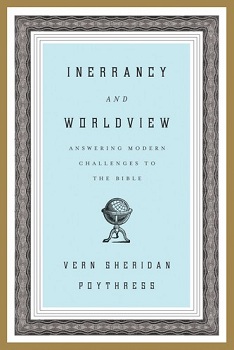 Vern Sheridan Poythress approaches the defense of the truth of the Bible in a unique way in his recently-released duo of books, Inerrancy and Worldview

Overview
Poythress has set Inerrancy and Worldview
That is the central thesis of the book: our preconceived notions shape how we will view the Bible. Poythress writes:
Part of the challenge in searching for the truth is that we all do so against the background of assumptions about truth. (21)
Thus, it is critical to recognize that one’s presuppositions will in some ways guide how they view the Bible.
Poythress then introduces the materialistic worldview as the primary presupposition for the Western world which sets itself up against a Biblical worldview. The essential point here is that the world is a very different place if primary causes are personal or impersonal.
From here, Poythress dives into the various challenges which are set up against the Bible. First, he looks at modern science. The major challenges here are the Genesis account of creation, which he argues is explained by God making a “mature creation” where the world appears aged (41) and other alleged scientific discrepancies, which he argues are due to God’s condescending to use human expressions to explain the concepts in the Bible (38-39).
What of historical criticism? Again, worldview is at the center. If God exists, then history inevitably leads where God wills it. If, however, one assumes the Bible is merely human, then it is unsurprising to see the conclusions which historical critics allege about the text.
Challenges from religious language are dealt with in the same fashion. On a theistic worldview, God is present “everywhere” including in “the structures of language that he gives us.” Thus, we should expect language to refer to God in meaningful ways (101). Only if one assumes this is false at the outset does one come to the conclusion that language cannot possibly refer to God (ibid).
Sociology, psychology, and ordinary life receive similar treatments. The point which continues to be pressed is that ideologies which reject God at the outset will, of course, reject God in the conclusions.
Analysis
Inerrancy and Worldview was a mixed read for me. Poythress at times does an excellent job explaining points of presuppositional apologetics, but at others he seems to be floundering in the vastness of the topics he has chosen to discuss.
There are many good points Poythress makes. Most importantly is his focus on the concept of one’s worldview as the primary challenge to Biblical authority. It seems to me that this is the most important thing to consider in any discussion of inerrancy. If theism is true, inerrancy is at least broadly possible. If theism is false, then inerrancy seems to be prima facie impossible.
The continued focus upon the fact that worldview largely determines what one thinks about various challenges to the Bible is notable and important. In particular, Poythress’ conclusion about challenges from religious language is poignant. The notion that we can’t speak meaningfully about God is ludicrous if the God of Christianity exists.
While there are numerous good points found in the book, but they all seem to be buried in a series of seemingly random examples, objections, and response to those objections. For example, an inordinate amount of space is dedicated to the OT discussing “gods” (including sections on p. 63-65; 66-70; 71-78; 79-81; 111-112; 116-117). His discussion of the Genesis creation account also left much to be desired. The “appearance of age” argument is, I believe, the weakest way to defend a Biblical view of creation.
Poythress’ discussion of feminism is also problematic. The reason is not so much because his critique of feminist theology is off-base, but rather because his definition is far too broad for the view he is critiquing. He writes, “feminism may be used quite broadly as a label for any kind of thinking that is sympathetic with gender equality. For simplicity we concentrate on the more popular, militant, secular forms” (121). But from the text it seems clear that Poythress is focused upon feminist theology more broadly speaking then secular feminism specifically. Where he does seem to express secular feminism, he still mentions the Bible in context (124). Not only that, but his definition of feminism seems to express a view which should be entirely unproblematic (“sympathy with gender equality”) yet he then spends the rest of the section as though there is some huge negative connotation with gender equality. One must wonder: is Poythress suggesting we should advocate for “gender inequality”? And what does he mean by “equality” to begin with? Sure, this section is a minor part of the book, but there are major problems here.
Furthermore, one is almost forced to wonder how this work is a defense of inerrancy. For example, the lengthy discussion of gods referenced above has little if anything to do with inerrancy. Instead, Poythress spends the bulk of this space attempting to show how the gods referenced are really idols which people worship instead of God. Well, of course! But what relevance does this have for inerrancy specifically? Perhaps it helps solve some issues of alleged errors, but solving individual errors does little to defend the specific doctrine of inerrancy.
And that, I think, is one of the major issues with the book. Poythress seems to equate rebutting specific errors with a defense of inerrancy. While this obviously has relevance for inerrancy–if there were errors, the Bible is not inerrant–it does little to provide a positive case for inerrancy.
Perhaps more frustratingly, Poythress never spends the time to develop or explain a robust doctrine of inerrancy. It seems to me that this is part of the reason the defense seems so imbalanced. Rather than clearly defining the doctrine and then defending it, he spends all his time defending the Bible against numerous and varied errors. This is important; but it does not establish inerrancy specifically. There are plenty of Christians who are not inerrantists who would nevertheless defend against particular alleged errors in the Bible.
Conclusion
Inerrancy and Worldview
Addendum
I must make it clear that I am an inerrantist. The reason I do this is because I have seen other critical reviews of this work where comments are left that the author of the review must not believe inerrancy. Such an accusation is disingenuous. It is perfectly acceptable to say that a specific defense of inerrancy is insufficient while still believing the doctrine itself.
Links
Like this page on Facebook: J.W. Wartick – “Always Have a Reason”.
Inerrancy, Scripture, and the “Easy Way Out”– I analyze inerrancy and why so many Christians reject it. I believe this is largely due to a misunderstanding of the doctrine.
The Presuppositional Apologetic of Cornelius Van Til– I analyze the apologetic approach of Cornelius Van Til, largely recognized as the founder of the presuppositional school of apologetics.
The Unbeliever Knows God: Presuppositional Apologetics and Atheism– I discuss how presuppositional apologetics has explained and interacted with atheism.
Source
Vern Sheridan Poythress, Inerrancy and Worldview
SDG.
——
The preceding post is the property of J.W. Wartick (apart from citations, which are the property of their respective owners, and works of art as credited) and should not be reproduced in part or in whole without the expressed consent of the author. All content on this site is the property of J.W. Wartick and is made available for individual and personal usage. If you cite from these documents, whether for personal or professional purposes, please give appropriate citation with both the name of the author (J.W. Wartick) and a link to the original URL. If you’d like to repost a post, you may do so, provided you show less than half of the original post on your own site and link to the original post for the rest. You must also appropriately cite the post as noted above. This blog is protected by Creative Commons licensing. By viewing any part of this site, you are agreeing to this usage policy.
The Unbeliever Knows God: Presuppositional Apologetics and Atheism
[A]ll men already know God–long before the apologist engages them in conversation–and cannot avoid having such knowledge… People lack neither information nor evidence… [A]ll men know that God exists… In a crucial sense, all men already are “believers”–even “unbelievers” who will not respond properly by openly professing and living obediently in accordance with the knowledge they have of God. (Greg Bahnsen, Van Til’s Apologetic
, 179-180, emphasis his, cited below).

One crucial point of presuppositional apologetics is that even the unbelieving atheist really does know God. All people have knowledge of God. None can turn from it, none can escape it: everyone knows God. This knowledge is not saving knowledge. Instead, it is knowledge which is suppressed. The knowledge is ignored or even reviled. The quote above from the famed presuppositionalist Greg Bahnsen is just one example. C.L. Bolt, a popularizer of presuppositional apologetics, says similarly:
It is in the things that have been created that God is clearly perceived. This perception is, again, so clear, that people have no excuse. Not only do all of us believe in God, but we know God. (C.L. Bolt, cited below)
What are we to make of this claim? What is the point from the presuppositionalist perspective? The claim is firmly rooted in Paul’s discussion of God’s wrath against evil in Romans 1-2 (see the text at the end of this post). Therefore, it behooves all Christians to reflect upon the notion that God is known to all people. Presuppositional Apologists have done much reflecting on these subjects, and here we shall reflect upon their insights.
 What is meant by ‘knowledge of God’?
It is important to outline what exactly it is that this knowledge is supposed to be. Greg Bahnsen notes in Van Til’s Apologetic
Note that there is an important distinction within presuppositional thought about what this knowledge of God means. John Frame makes it clear that there is a sense in which the unbeliever knows God and yet another sense in which the unbeliever does not know God (Frame, The Doctrine of the Knowledge of God
Frame also makes clear the reasons why all people know God in at least the limited sense: “God’s covenental presence is with all His works, and therefore it is inescapable… all things are under God’s control, and all knowledge… is a recognition of divine norms for truth. Therefore, in knowing anything, we know God” (18). Frame elaborates: “[B]ecause God is the supremely present one, He is inescapable. God is not shut out by the world… all reality reveals God” (20).
Therefore, this knowledge should be understood as the blatant, obvious awareness of God found in the created order. It is not saving faith or saving knowledge; instead, it is knowledge which holds people culpable for its rejection. All are accountable before God.
 The Implications of the Knowledge of God
The Practical Implications of the Knowledge of God
Of primary importance is the notion that there is no true atheism. Instead, atheism can only be a kind of pragmatic or living atheism: a life lived as though there were no God. All people know that God exists. The eminent Calvinist theologian, William Greenough Thayer Shedd writes, “The only form of atheism in the Bible is practical atheism” (Shedd, Dogmatic Theology
Van Til notes, “It is… imperative that the Christian apologist be alert to the fact that the average person to whom he must present the Christian religion for acceptance is a quite different sort of being than he himself thinks he is” (The Defense of the Faith
Furthermore, this knowledge of God is of utmost importance. Bahnsen writes, “Our knowledge of God is not just like the rest of our knowledge… The knowledge that all men have of God… provides the framework or foundation for any other knowledge they are able to attain. The knowledge of God is the necessary context for learning anything else” (181). As was hinted at above, without God, there is no knowledge. Even the unbeliever relies upon God for any true beliefs he has. Van Til notes, “our meaning… depends upon God” (63).
Apologetics in Practice
For presuppositionalists, this means that apologetics is reasoning with people who already know and use their knowledge of God to ground whatever knowledge they do have and bringing them to an awareness of their double-standards. They reject God in practice, but accept God in their epistemology. Thus, presuppositional apologists use the transcendental argument: an argument which seeks to show that without God, the things which we take for granted (knowledge, logic, creation, etc.) would not exist.
Can evidentialists use the insights of presuppositionalists here as well? It seems they must; for the Bible does clearly state that everyone knows God. However, the way evidentialists may incorporate this insight is by using an evidential approach to bring the unbeliever into an awareness of the knowledge they are rejecting in practice. Thus, a cosmological argument might be offered in order to bring the unbeliever into an awareness that their assumptions about the universe can only be grounded in a creator.
Conclusion
We have seen that presuppositional apologetists makes use of the knowledge of God attested in all people by Romans 1 in order to draw out a broadly presuppositional approach to apologetics. I have also given some insight into how evidentialists might use this approach in their own apologetic. We have seen that the core of this argument is that all people know God. Therefore, there are no true atheists; only practical atheists. All true knowledge must be grounded on the fact of God. There are none with an excuse to offer before God at judgment. God’s existence is clear. The unebeliever knows God.
I end with the Biblical statement on the state of the knowledge of the unbeliever, as written by Paul in Romans 1:
The wrath of God is being revealed from heaven against all the godlessness and wickedness of people, who suppress the truth by their wickedness, since what may be known about God is plain to them, because God has made it plain to them. For since the creation of the world God’s invisible qualities—his eternal power and divine nature—have been clearly seen, being understood from what has been made, so that people are without excuse.
For although they knew God, they neither glorified him as God nor gave thanks to him, but their thinking became futile and their foolish hearts were darkened. Although they claimed to be wise, they became fools…
Links
Like this page on Facebook: J.W. Wartick – “Always Have a Reason”
Unbeliever’s suppression of the truth-A brief overview of the notion that unbelievers are suppressing the truth from a presuppositional perspective.
The Presuppositional Apologetic of Cornelius Van Til– I analyze the apologetic approach of Cornelius Van Til, largely recognized as the founder of the presuppositional school of apologetics.
Choosing Hats– A fantastic resource for learning about presuppostional apologetics.
Sources
C.L. Bolt, “An Informal Introduction to Covenant Apologetics: Part 10 – Unbeliever’s knowledge of God.”
Greg Bahnsen, Van Til’s Apologetic
John Frame, The Doctrine of the Knowledge of God
Cornelius Van Til, The Defense of the Faith
Shedd Dogmatic Theology
SDG.
——
The preceding post is the property of J.W. Wartick (apart from citations, which are the property of their respective owners, and works of art as credited) and should not be reproduced in part or in whole without the expressed consent of the author. All content on this site is the property of J.W. Wartick and is made available for individual and personal usage. If you cite from these documents, whether for personal or professional purposes, please give appropriate citation with both the name of the author (J.W. Wartick) and a link to the original URL. If you’d like to repost a post, you may do so, provided you show less than half of the original post on your own site and link to the original post for the rest. You must also appropriately cite the post as noted above. This blog is protected by Creative Commons licensing. By viewing any part of this site, you are agreeing to this usage policy.
Really Recommended Posts 3/22/2013- Rob Bell, Loftus, and Dawkins, oh my!
 Very often, I am just taken aback by the consistent high quality of posts I turn up in a search across the web. Check out the posts I bring to your attention this week! The topics include Loftus’ “outsider test” of faith, John Carter, Farmers, Richard Dawkins, morality, and Rob Bell with the emergent church.
Loftus vs Marshall I: An Alphabet of Errors (on Science and Faith)– I can’t tell you how much I recommend this for reading. Loftus is one of the up-and-comers in the “New Atheist” movement, and he is in love with his own devised argument against theism: “The Outsider Test of Faith.” Marshall exposes numerous flaws in Loftus’ latest work on the topic, as well as showing many of the difficulties which persist in his position.
A “John Carter” Calendar: Twelve Months, Twelve Reasons to Visit Barsoom– A great look at reasons to watch “John Carter,” a film I feel has been very underrated. I have written an analysis of the movie itself, in which I discuss many of the themes found therein: “A Christian look at ‘John Carter.'”
God Made a Farmer (Video)– A video recognizing women farmers, which is itself a companion to the original, a Dodge Super Bowl commercial which lauds farmers generally but doesn’t show any women. That original version, itself very much worth watching, can be found here. I found the message here to be very endearing.
Richard Dawkins defends the moral goodness of infanticide and adultery– I’ll be one of the first to say atheists are perfectly capable of being moral people. God’s moral law is clear to anyone. Yet, once someone denies that grounding for morality, it is permissible for them to develop all kinds of random moral systems. Dawkins’ comments about infanticide and adultery are just one example of the kind of hedonism which can occur when the basis for morality is jettisoned.
The Submergent Church– A powerful image showing the way some “emergent” people have put holes into the notion of orthodoxy and thus undermined their own credibility. This is one of my favorite websites, and I highly recommend that you follow it: No Apologies Allowed.
“For Greater Glory” – A look at a movie about Christianity in the face of violence
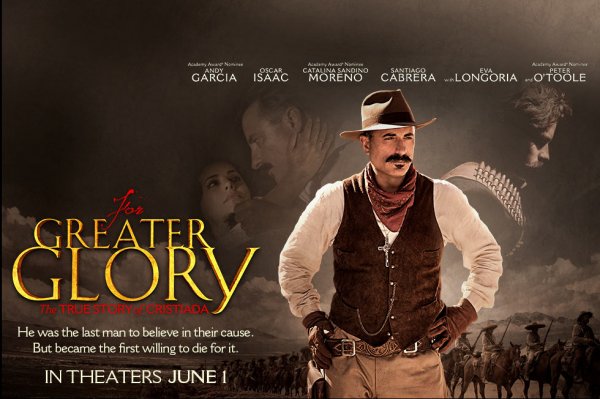 “For Greater Glory“
The Good, the Bad, and the Ugly
The Good
The general Enrique Gorostieta Velarde is clearly a “good guy.” He was, himself, no Christian and certainly not a Roman Catholic, but he stood up against those who would persecute people simply for their beliefs. He also did not stand for compromise: he wanted toleration to be granted to Roman Catholics. He fought for an ideal. Even if that ideal was not one of the faith he was fighting to defend, he felt that there was injustice, and fought against it.
It is unclear whether the historical Enrique Gorostieta Velarde ever became a Christian. In the film, it certainly make it seem as though in making his arguments, he came into a kind of faith in God. It also seems to be the case that the historical general had some political ambitions in that he desired to bring about a change in the Constitution to provide for more toleration.
Father Christopher is an example for Christians everywhere. He does not back down in the face of violence. He became a martyr by standing in front of men who were doing him violence and proclaiming Christ to them. His martyrdom served as inspiration for a number of people in the film.
The Bad
The anti-catholics in the film are clearly the “bad guys.” It is hard to argue with this. Anyone who chooses to attack and kill people simply because of their beliefs certainly qualifies for the catchall “bad guy” terminology.
Plutarco Elías Calles, the Mexican President, an atheist, decides that he must use a violent crackdown to keep the Roman Catholic Church from becoming involved in Mexico. He couches his oppression of the Roman Catholics in language of secularism. Instead of focusing upon their religion, he makes his argument based upon the rule of government: the Roman Catholics serve a ruler (the Pope) who is outside of this country, and so they are a danger to the stability of this country. Despite this “secular” language, the fact of the matter is that throughout the film, the government is viscous not just towards the Roman Catholics as people who serve a different master, but also simply as religious persons. Crosses are burned and churches are destroyed. People are slaughtered during worship. It is a wholesale war against Christianity.
The Ugly
The film does not draw a hard and fast line between “good” and “bad,” however. There are also the ugly: those who, with good intentions, also commit atrocities. The Cristeros (those who fought for religious tolerance of Roman Catholicism) who commit atrocities were the “ugly.” Some felt they had to fight evil with evil, and committed horrible acts in the name of their cause. This is exactly what Christians are called to avoid.
Just War and Pacifism
The movie brought up the constant debate within Christianity between just war theorists and pacifists. It was surprising how lucidly it presented the issues. There were those in the film who refuse to use violence to fight against the government, citing Christ’s example of turning the other cheek. Yet even they become involved in getting supplies such as bullets to the Cristeros. On the other hand, there are those who argue for a just war tradition: when injustice is running rampant, should not Christians be among those who stand up against it, even if that calls for using force? The film never answers one way or another; instead, it leaves it to those watching to weigh the merits of just war and pacifism.
I tend to favor the just war theory myself. It seems to me that if a government like the Nazi Regime exists, then it is perfectly justifiable to use force to prevent them from perpetuating their evils.
Historically, according to more than one source I looked up, it is argued that the Cristeros actually had little impact on the overall outcome of the changes and toleration which came to Mexico. Instead, it was a deal negotiated by the Vatican with the Mexican government. Yet it seems for me historically perplexing as to why, exactly, the Mexican government would have desired a compromise if the Cristeros were not in operation. I speak here as no expert on the topic by any means. I’d be interested in reading your own thoughts.
The Elephant in the Room
It is hard to see this movie without thinking about the elephant in the room: atheists are in power, and religious people are killed. It’s a theme in the movie, but it also plays out time and again throughout human history: the French Revolution, the Soviet Union, the massacres of Armenians in Turkey, the Spanish Civil War, and more. Why is it that it seems, historically, every time a secularist government has taken power, the religious persons are the ones who suffer violence?
The answer to this vexing question seems to me to be quite clear: the notion that religion is violent and secularism stops violence is just false. Not only that, but the distinction between secular and religious is, itself, a mere construct with no ontological reality. I have argued this before when I discuss the Myth of Religion.
Conclusion
“For Greater Glory” is a movie that should be a must-see for those interested in worldview discussions. I could see it being used at an interfaith group, church youth group, or seeker group to generate discussion. The movie is definitely violent, and it shows the good, the bad, and the ugly unapologetically. It is for that reason that it must be seen.
What is perhaps the most shocking part of this movie is the fact that, prior to watching it, I had never heard or even imagined that Mexico had persecuted Christians. The violence committed against Christians by others in authority continues into the modern era, and it is truly depressing to know how little we hear about it. I can’t help sometimes but join with David and say “How long, Oh LORD?” (Psalm 13).
Links
I discuss the way that construct of “religion” has been used to denigrate an alleged “religious other” in my post: The Myth of Religion.
I have looked at a number of other popular movies. Check them out (scroll down to see more posts) in my movies category.
An interesting discussion of Christian pacifism can be found over at Glenn Andrew Peoples’ blog: Pacifism, Matthew 5, and ‘Turning the other cheek’.
SDG.
——
The preceding post is the property of J.W. Wartick (apart from citations, which are the property of their respective owners, and works of art as credited) and should not be reproduced in part or in whole without the expressed consent of the author. All content on this site is the property of J.W. Wartick and is made available for individual and personal usage. If you cite from these documents, whether for personal or professional purposes, please give appropriate citation with both the name of the author (J.W. Wartick) and a link to the original URL. If you’d like to repost a post, you may do so, provided you show less than half of the original post on your own site and link to the original post for the rest. You must also appropriately cite the post as noted above. This blog is protected by Creative Commons licensing. By viewing any part of this site, you are agreeing to this usage policy.
Did God Create the Universe for Humans? – Some thoughts on God’s purposes for creating
 I have read on more than one occasion an atheist making the argument that goes something like this: if humans are the most important creation, why did God create such a vast universe? The argument is that God really wasted a lot of space if the universe was created for us. Another way I’ve seen this argument is as follows: the universe is full of galaxies that are even beyond our capacity to ever observe. Why, if God created the universe for us, is there so much here that is worthless to us? Furthermore, why is so much of the universe hostile to human life? Humans can’t live in overwhelming majority of the universe. Why is it so hostile if it were created for us?
A different discussion with an atheist was touched off when they asserted that the Bible states humans are the most important creation, so why create so much of the universe outside of our power to observe?
I’m going to offer an explanation which may come as something of a surprise: there is nothing in the Bible which makes it explicit that humans are the most important creation. I would go so far as to say that anyone who claims that is reading an unjustified anthropocentric worldview onto the text.
Perhaps the most commonly cited explanation for why we should think humans are the center of creation is the Genesis creation account, and specifically Genesis 1:27-28:
So God created mankind in his own image,
in the image of God he created them;
male and female he created them.God blessed them and said to them, “Be fruitful and increase in number; fill the earth and subdue it. Rule over the fish in the sea and the birds in the sky and over every living creature that moves on the ground.” (NIV)
But again, where in this text does it suggest that humans are the most important creation? It does show that we were made in God’s image, but it does not say that because of that, we are more important than anything else in creation. Too often people read into texts what they think it says, as opposed to reading what the text actually says. Again, I simply ask this: where in the text does it say that humans are the most important part of all of creation? As a friend pointed out, one could easily say the sun is the most important part of creation, because without it, we would not all be alive. But either view is equally unsupported by the Bible.
Another rationale that is used from this passage is the notion that humans are to have dominion over or rule over the earth (verse 28). But again, how does it follow from this that humans are more important? The problem is that we have a skewed view of importance. For us, very often, we think importance is equal to power. When someone has power, they are more important than someone without power. But such notions of power and hierarchy are extrabiblical ideas which we have read onto the text.
In fact, it seems that the Bible says we are not the greatest of all creation. Psalm 8:5 references humans and says that “You [God] have made them [humans] a little lower than the angels and crowned them with glory and honor.” So yes, humans are “crowned” with glory, but they are also ” a little lower than the angels.” It seems the Bible says that we may not be the greatest things to walk the universe. [I should note that the Bible may, in fact, note that humans are the most important part of all creation, but were I to grant this, my reasoning below still holds.]
But some people remain dissatisfied by this explanation, and claim that Christians very often do claim that humans are the crown of all creation or that the universe was made for us. Here, I suggest that once again, people have been thinking very anthropocentrically. In fact, they have limited God to the point of making God incapable of even having the same range of possibilities that humans have. The assumption built into this argument is that God created for the sole purpose of humanity. But just like other persons, it is possible for God to have more than one end in taking an action. Thus, even if we grant that humans were the most important creation–in contrast to the above argument–it still does not follow that the universe is exclusively for humans. God can have different ends.
Think about it this way: when you take an action, you very often have more than one end in mind. For example, you may get in your car to go to a local shopping store so that you can go to the grocery store and also because you want to stop and look at books at the bookstore. Here, you have taken an action (gotten into the car and taken it somewhere) with more than one end in mind. Similarly, God can create with more than one end in mind. Even if humans are the greatest of all creation (which I deny), it is also possible that God also created for other reasons. For example, God may have created gratuitous galaxies because they are beautiful. I can’t help but look at the stars and have my heart stop. The beauty of creation is extraordinary. It cannot be described in words. Perhaps this was one end God had in mind, along with the creation of humans. There are a number of other reasons God could have created apart from humans, so it seems to me that the objection here is short-sighted.
Only by creating God not just in our own image, but in an image less than our own, can we come up with an objection to the existence of such a God based upon the vastness of the universe, or its hostility to life.
Links
Beauty is a powerful reason to favor the Christian worldview. Check out this excellent post on the topic over at Well Spent Journey: Christianity and High Beauty (With Pictures!).
More Planets Than Stars – Exoplanets and Our Little Blue Ball– Naturalis Historia features a simply superb post on the possibilities of other life/planets like ours. It also briefly addresses the issue I have discussed in this post. I recommend checking it out.
From Divine Engineer to Divine Architect– Over at Faithful Thinkers, Luke Nix wrote about a similar topic. His post explores the notion of God as an architect, transcending the either/or dichotomy created by some about God’s purpose for creation.
I have reflected on what life on other planets might mean for Christianity: Theological Reflections on Life on Other Planets.
SDG.
——
The preceding post is the property of J.W. Wartick (apart from citations, which are the property of their respective owners, and works of art as credited) and should not be reproduced in part or in whole without the expressed consent of the author. All content on this site is the property of J.W. Wartick and is made available for individual and personal usage. If you cite from these documents, whether for personal or professional purposes, please give appropriate citation with both the name of the author (J.W. Wartick) and a link to the original URL. If you’d like to repost a post, you may do so, provided you show less than half of the original post on your own site and link to the original post for the rest. You must also appropriately cite the post as noted above. This blog is protected by Creative Commons licensing. By viewing any part of this site, you are agreeing to this usage policy.
Really Recommended Posts 11/30/12
Today’s Really Recommended Posts were honestly really hard for me to select. There are so many good posts out there that I’ve had to prep posts for over a month out so far. Soon I’ll have these things set up for years. Oh well, I guess that will mean the blog will keep going! Anyway, pacifism, literary apologetics, magicians, creationism, Dawkins, and more are featured this week. Like ’em? Let me know!
Pacifism, Matthew 5, and “Turning the other cheek”– Glenn Andrew Peoples is, in my opinion, one of the most lucid and fun bloggers on the planet. I don’t always agree with him, but when I do…. I almost made a tired joke. Anyway, this post is lengthy, but it is worth a thorough read. I can’t wait for his podcast episode to come out on it… sometime.
HP Lovecraft and Christian Thought– Readers, if you have not followed Hieropraxis, let me tell you right now to just go ahead and do it. Holly Ordway’s site is just full of phenomenal posts on cultural apologetics, and the posts are always fascinating. This one discusses HP Lovecraft’s view of the universe and compares it to the theistic picture.
Shouldn’t a magician be a skeptic?– A very insightful post on the distinctions between illusion and the Creator. Can magicians be Christians?
The Toba Super Eruption and the Polar Ice Cores– Some very interesting scientific data which may bring into question a young earth.
Friedrich Nietzsche Was not a Nihilist– Max Andrews argues that Nietzche saw an “abyss” from which he could find no value and thus the development of the übermensch served his need for value and teleology.
Defecting from Darwinian Naturalism: A review of Thomas Nagel’s Mind and Cosmos– does Darwinian Naturalism have an adequate worldview? Nagel argues no, and this look at his fascinating book draws out several reasons why.
Atheist’s Reviews of Dawkins’ The God Delusion– Some fascinating insights into Dawkins’ book from atheists.
Really Recommended Posts 10/12/12
Another great run around the internet today. I noticed that this edition of Really Recommended Posts has a lot on Christianity and Science, Islam, and religious or activist violence. Abortion, biochemistry, the Qur’an, violence in Islam, Mitt Romney, and more are all featured. Check out the posts. If you like them, let me know.
Cataloging the Historical Anachronisms in the Qur’an– Does the Qur’an potray accurately the period that it purports to describe in historical narrative? It does not seem so. Check out some of the anachronisms which crept in.
New peer-reviewed paper in Nature falsifies Darwinian junk DNA prediction– Darwinian Evolution has long used the notion of “junk DNA” as confirmation of its naturalistic processes. However, recent study has confirmed one of the predictions of the Intelligent Design movement: this supposed junk DNA would prove to be useful. I don’t claim to be a scientist at all, but I find this very intriguing. Check out the article.
Hey Atheists, Just Shut Up Please [LANGUAGE WARNING]- I found this article very interesting. An atheist discusses how people can tend to hate the “other” in their over-enthusiastic attempts to refute them. I was pleased with the article in general, but be aware that there is some strong language there. I myself have written about how religion is often used as a mechanism to hate the “religious other.”
Would a Romney presidency boost Mormonism?– Some Christians have come out saying they are afraid to vote for Romney because it would boost Mormonism. A pastor responds briefly to these claims.
Why Abolition Must be Non-Violent– The Abolish Human Abortion blog discusses why we in the pro-life movement must not resort to violence. The struggle is between worldviews, and pro-life persons cannot say they are pro-life while using violence.
Modern Muslims Who Choose the Path of Violence– Nabeel Qureshi discusses violence in Islam and the fact that Islam is not monolithic. The important thing to think about is how and when Islam turns violent. As I have emphasized elsewhere, religion and violence must be analyzed empirically, not with a mind towards demonizing the religious “other.”
Yes, the media does deliberately misrepresent and demonize creationists– Readers of my blog know I do not hold to a young-earth position. However, like Glenn Andrew Peoples I am still offended when the media blatantly misrepresents my Christian brothers and sisters. Check out this thoughtful post.
Really Recommended Posts 9/21/12
There are so many fantastic posts out there it has been hard for me to keep up. I actually have another RRP scheduled with all the backlogged posts I’ve run into. Let me know which posts you’ve enjoyed. I feature here a diverse spread of posts. The necessity of apologetics, atheism, the Gospel of Barnabas (!?), young earth creationism, and resisting sin are all featured. Check ’em!
Sarah Geis provides pointers for constructive debate and disagreement– A creative look at how to debate constructively by showing how not to do so.
Why Apologetics Should Be A Requirement For Every Pastor– Fellow Christians, I hope this post convicts you like it convicted me. We need to be doing apologetics. We owe it to our youths, we owe it to the adults in our congregations, and we owe it to ourselves.
Born Atheists?– Yes, you have heard it somewhere. We’re all born atheists. Really? What is that even supposed to mean? I found this post really excellent and it got me thinking. Check it out.
What is the Gospel of Barnabas?– Some Muslims have been claiming that the so-called Gospel of Barnabas falsifies the Christian doctrine of the Son of God. It is not, however, a serious threat. Check out this post to get some great historical information on this attempt to refute Christianity.
Atheism, Agnosticism, and the New Atheists– It never gets old. What does “atheist” mean? Don’t atheists just believe in one fewer god than believers? I’ve written about this topic myself. Check out this great post on the subject.
A Young Earth Chronometer?– One of my favorite websites has recently taken an intense three-part look at the claim that the amount of salt in the ocean is evidence for a young earth. I highly, heartily recommend the site itself to all my readers, Naturalis Historia.
How to Start a Preemptive Strike on a Sinful Inclination– Another one of my favorite and highly recommended sites, No Apologies Allowed, posted this thought-provoking comic about resisting sin.
Religious Dialogue: A case study in science fiction with Bova and Weber
I love science fiction. One of the main reasons is because it provides a medium for authors to share their philosophical outlook for the world. Some authors portray their vision of what the world would like like if…. and what fills in that “if” is that which the author would like readers to be wary of our condemn. For example, distopian fiction often takes some aspect of society and shows how if we allow it to run rampant, we will create a world wherein we would not want to dwell. Other authors use science fiction to portray an ideal (or nearly ideal) society and show how the things they are promoting or believe fit into that ideal society.
Ben Bova and David Weber are two of my favorite science fiction authors. Bova blends hard science fiction (sci-fi which is largely focuses upon the applications of science that is at least seemingly possible) with great storytelling. His “Grand Tour” series of books is the story of humanity spreading across our solar system and even finding life on mars and founding a colony on the moon. David Weber writes military science fiction on an epic scale, complete with amazing battles in space (and who doesn’t like some big explosions in space?). I was fascinated to see both authors interact with Christianity, particularly on a fundamentalist level, and see how they took that discussion.
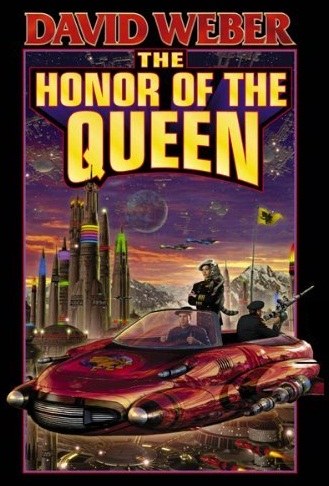 David Weber
David Weber’s book, The Honor of the Queen
What really struck me is that David Weber fairly presented firm believers as a spectrum. He showed that believers can be reasoned with and even persuaded to believe differently based upon evidence. Furthermore, he showed that even those who may line up on the side with which he disagrees [presumably–I don’t know where he stands on the issue] are not all (or even mostly) blinded by faith or foolishness. Rather, although there are some truly evil and disillusioned people, Weber shows that many are capable of changing their position or at least acknowledging that rival views are worth consideration.
The most vivid portrayal of this theme is found in a conversation between Admiral Courvosier and Admiral Yakanov. Courvosier is from the same nation as Honor Harrington and wholly endorses his female officer in a position of command. They discuss Captain Honor Harrington:
[Yanakov responds to Courvosier’s question about his society’s reaction to Honor]: “If Captain Harrington is as outstanding an officer as you believe–asI believe–she invalidates all our concepts of womanhood. She means we’re wrong, that our religion is wrong. She means we’ve spent nine centuries being wrong… I think we can admit our error, in time. Not easily… but I believe we can do it.”
“Yet if we do[” Yanakov continues, “]what happens to Grayson [their world]? You’ve met two of my wives. I love all three of them dearly… but your Captain Harrington, just by existing, tells me I’ve made them less than they could have been… Less capable of her independence, her ability to accept responsibility and risk… How do I know where my doubts over their capability stop being genuine love and concern?”
The exchange is characteristic of the way Grayson’s people are treated throughout the book. They are real people, capable of interacting with other views in honest ways. They feel challenged by a view contrary to their own. Some react poorly, and there are extremists who are blinded by hatred and anger. Yet all of them are treated as people with real concerns shaped by their upbringing and backgrounds.
Honor Harrington ends up saving Grayson, and at the end of the book, she is commended by the rulers of that planet. She talks to the “Protector” [read: king/president]:
“You see,” [said the Protector] “we need you.”
“Need me, Sir?” [Responded Honor]
“Yes, Grayson faces tremendous changes… You’ll be the first woman in our history to hold land… and we need you as a model–and a challenge–as we bring our women fully into our society.”
Weber thus allows for even ardent supporters of specific religious backgrounds to respond to reasoned argument and to change. They are capable of interacting on a human level and deserve every bit of respect as those who disagree with them. Again, there are those who are radicals and will not be reasoned with, but they are the minority and they do not win out.
Weber therefore presents religious dialogue in The Honor of the Queen as a genuine interaction between real people from differing backgrounds. Those who are “fundamentalist” are capable of changing their views when challenged with a rival view which out-reasons their own. Religious dialogue is possible and fruitful.
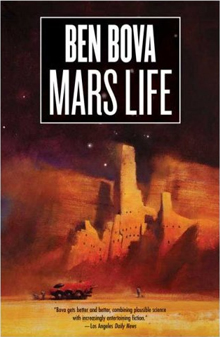 Ben Bova
Ben Bova’s whole “Grand Tour” series has a number of dealings with “fundamentalists.” He never really defines the term to be specifically Christian but one can tell when reading the books that it is pretty clear he is referencing hardcore fundamentalist evangelical Christianity.
I recently finished reading Mars Life
Bova’s treatment of extremist positions in religion is somewhat disingenuous in my opinion, particularly when one compares his portrayal with that of Weber. Bova tends to illustrate religious fundamentalists as a black and white issue. Basically, if you are a hardcore believer, you’re in it for power and control, you are willing to incite violence to achieve your ends, and you are incapable of reasoning. Again, note the contrasts with Weber’s depiction above. A few examples will help to draw this out.
On page 142 and following there is a discussion about putting together a panel to discuss the finding of a fossil on Mars. The interaction shows that no matter what, fundamentalists cannot accept scientific findings:
“Look,” said the bureau chief… “everybody’s calling it a fossil…. …”Call it an alleged fossil, then,” insisted the consultant (from the fundamentalists)… [The group then continues to suggest terms for the fossil:] “A probable fossil?” …”A possible fossil”… [Then, finally] “Say that the scientists believe it’s a fossil and until proven otherwise that’s what we’re going to call it.”
Here one can see that fundamentalism is intrinsically tied to an anti-science mentality. The key for them is to use words which deny absolutes, essentially skirting issues rather than discussing the truth. But that’s not all there is to it. Later on, one of the fundamentalists is engaged in a discussion about “requesting” that some lyrics in music they view as morally reprehensible be changed. The musician flat out refuses, angering the fundamentalist in the process. The section closes as follows:
[The musician] was shot to death at a Dog Dirt concert three months later. His killer surrendered easily to the police, smilingly explaining that he was doing God’s work.
What is interesting about this example is that it is illustrative of a number of such examples throughout the book. These are completely unrelated to the main plot. Rather, it seems what Bova is doing is very explicitly showing that fundamentalists are unafraid to use immoral tactics, censoring, and even incite violence in order to get their way. Theirs is an unquestioned and unquestionable faith. Those in power in fundamentalism are inherently evil and devious. They only want to control. Again, these asides are in no way tied to the plot of the book. It’s almost as though Bova is preaching a different worldview, one which views religiosity as inherently dangerous and violent, with few exceptions.
There is one positive example, however. A Roman Catholic, Monsignor Fulvio DiNardo, who is also a world-renowned geologist decides he wants to go to Mars to find the answer to a question about faith which is pressing on him. Namely, why God would exterminate an entire intelligent species. His thread in the story seems to show two things: first, that fundamentalism is inherently incapable of responding to reason; second, that it is possible to have reasoned faith and science together. The second point is illustrated very well when DiNardo is finally on Mars. He suffers from a likely stroke and is dying and begins a dialog with God:
Why did you kill them, Lord? They were intelligent. They must have worshipped You in some form or other. Why kill them? How could you–
And then DiNardo understood. Like a calming wave of love and peace, comprehension flowed through his soul at last… God had taken the Martians to Him! Of course. It was so simple, so pure. I should have seen it earlier. I should have known. My faith should have revealed the truth to me.
The good Lord took the Martians to Him. He ended their trial of tears in this world and brought them to eternal paradise. They must have fulfilled their mission. They must have shown their Creator the love and faith that He demands from us all. So He gave them their eternal reward…
The light was getting so bright… Glaring. Brilliant… Like staring into the sun. Like looking upon the face of… (297-298)
So Bova does offer a counterbalance to fundamentalism, and I appreciate that portrayal. Although DiNardo’s death and his revelation receives very little further comment (and no further comment at all on the revelation), it seems as though it is positively portrayed.
A reason for criticism is that Bova is uncompromising with fundamentalists. I’ve already drawn out his portrayal of them, and it seems to me to be a bit disingenuous. Although there are plenty on the “religious right” who would be all too happy to be able to legislate all morality, control the media, and deny well-attested scientific findings, I have hardly found that to be the majority. And certainly, fundamentalism is not a homogeneous entity filled with people who are trying to control everyone else. I’ll grant that this is a work of fiction, but in light of how Weber was able to handle a fairly similar issue with respectful portrayals of the ‘other side,’ I had hoped for more from Bova, whose work I enjoy greatly. For Bova, it seems, religious dialogue is not a real possibility, with few exceptions. Fundamentalists are incapable of reasoning and are barely even convinced believers; rather they are using their positions of authority within their organizations to consolidate power and execute their own prerogatives on their witless followers.
Fair Discussion
It seems pretty clear to me that David Weber provided a better model for utilizing science fiction in religious dialogue than Ben Bova did. The people representing the ‘bad guys’ in Weber’s book did have some who were truly evil and/or beyond reason, but also had many with whom reason resonated. When confronted with rival views, they were thoughtful and even receptive. On the other hand, the characters with whom Bova disagreed were a true black/white dichotomy with the “good guys.” Fundamentalists were bad. Period. He portrayed them as power-hungry, censor-happy maniacs. Although there was one notable exception (the Catholic priest, DiNardo), who showed a bright spot for “believers” at large, he was by far the exception.
It seems clear this study has applications for real-world dialogue about religion. When we interact with other worldviews, we should be capable of treating the other side with the same kind of dignity we would like to be treated. Although other worldviews may have their extremists who will not respond to reason, our attitude should be that of the humble friend trying to explore the beliefs of the “other.” The “other” is not that which must be demonized, but rather understood and with which to interact.
More Reading
I explore the theological implications of life on other planets.
I discuss a book which will change the way you think about about the notion that religion is violent. It also deals with the notion of the religious “other” as a construct.- William Cavanaugh’s The Myth of Religious Violence.
Sources
Ben Bova, Mars Life
David Weber, The Honor of the Queen
SDG.
——
The preceding post is the property of J.W. Wartick (apart from citations, which are the property of their respective owners, and works of art as credited) and should not be reproduced in part or in whole without the expressed consent of the author. All content on this site is the property of J.W. Wartick and is made available for individual and personal usage. If you cite from these documents, whether for personal or professional purposes, please give appropriate citation with both the name of the author (J.W. Wartick) and a link to the original URL. If you’d like to repost a post, you may do so, provided you show less than half of the original post on your own site and link to the original post for the rest. You must also appropriately cite the post as noted above. This blog is protected by Creative Commons licensing. By viewing any part of this site, you are agreeing to this usage policy.

 J.W. Wartick - Reconstructing Faith