book review
Book Review: “The New Christian Zionism” edited by Gerald R. McDermott
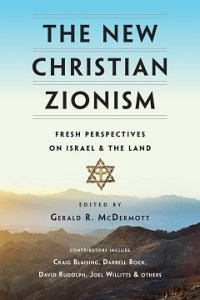 The New Christian Zionism is a book of essays aimed to show that Zionism is both true and not necessarily linked to dispensationalism. Chapters range from hermeneutics to international law as authors approach the questions related to Christian Zionism from a number of angles.
The best chapters are those that focus specifically on exegesis and one controversial but historically interesting chapter on international law and theology. The exegetical chapters provide, at times, a formidable challenge to contrary opinions. In particular, David Rudolph’s chapter arguing for Zionism in the Pauline corpus argues cogently that some of the alleged proof-texts against “particularity” (read: Zionism/etc.) that speak of differences between Jew and Gentile as “nothing” do not literally eliminate all distinctions, because similar language is used by Paul in contexts that do not or cannot mean nothing. Robert Nicholson’s analysis of international law is sure to be controversial, but cannot be simply dismissed.
Perhaps the biggest problem with the book is that at several points the authors undermine their own commitment to scholarly engagement and instead resort to mud-slinging at their opponents. Discussions of eschatology are often unnecessarily heated, and at times authors if The New Christian Zionism do little but stoke the flames. For example, in a chapter on “Biblical Hermeneutics,” Craig Blaising writes “…the claim that Matthew is thereby teaching that Israel’s identity as an ethnic, national, territorial reality is ending as such and being replaced by the singular person of the Christ… reads too much into the text. It belongs to an anti-Semitic, anti-Judaic interpretation of Matthew that is generally rejected today” (84).
Apart from not actually putting forward what I think most amillennialists I’ve read believe with Matthew (i.e. not replacement but rather fulfillment; not redefinition but revealing), it’s stunning that this claim can be just thrown out there basically without commentary or defense. Though not frequent, such accusations are found in various parts of the book and do little to sell the point that McDermott attempted to put forward in the introduction that this book was not uniquely dispensational nor were its authors unaware of the complexity of the debate. Flat-out accusations of Antisemitism against those who believe Jesus is the fulfillment of the OT promises does little to advance discussion and smacks of being either desperate or uncomprehending. Blaising does little here to refute the alternative interpretation but rather dismisses it through guilt by (perceived) association. This is intellectual dishonesty at the basest level, and shows little-to-no engagement with one’s opponents.
In a chapter entitled “Theology and the Churches: Mainline Protestant Zionism and Anti-Zionism,” Mark Tooley reports on several Mainline Protestant Denominations’ interactions with Israel and policy related thereto. Interestingly, the United Methodist Church’s repeated stance to note that both Israeli Jews live amidst oppression while also citing Palestinian suffering and injustice against Palestine is labeled as an attempt to equate Zionism with racism. The Presbyterian Church (USA) urged the United States in 1983 to stop sending aid to Israel so long as they continued to settle on the West Bank. Episcopalians opposed moves by Israel that were seen as violating human and civic rights. This support of basic human rights for Palestinian peoples is put under a subheading called “‘Final Solution’ of Palestinian Problem.” This is astonishing. The call by these church bodies for protection of human rights was then labeled by the author as a “Final Solution,” hearkening ominously to the Final Solution the Nazis heinously carried out against the Jews. Such labeling shows a monumental incapacity for understanding opposing viewpoints, as well as an astounding lack of tact and awareness of historical perspective. The concluding statements of the chapter are most revealing:
Official mainline Protestantism’s outspoken hostility toward Israel and indifference to human rights abuses by far more repressive regimes reflects a divorce from ethical reality by religiously heterodox church bodies… Evangelical leaders… tempted to follow the mainline example should study its consequences. (219)
Of course, no reference was given to show that this indifference is indeed the case. For example, the briefest search on the internet turns up that just in 2015 the United Methodist Church raised $2 million for the Syrian/Iraq refugee crisis–hardly a show of indifference towards human rights abuses. The message of several of the authors of The New Christian Zionism, then, ought not to be missed: if an individual or a church body does not express Zionist tendencies, they will be denounced as similar to Nazis, as Antisemites, and the like, and your contributions to other areas will be overlooked or ignored.
Another difficulty is the constant use of verses stripped of context in order to make points. At many points, discussion will be happening in one book, and then a portion of a single verse from another book will be brought over as a proof text to put forward the interpretation being given. Certainly some of this is for space considerations, but it seems strange to jump around so frequently in citations. It would be simpler to follow the argument if proof texts were put either in parentheses after a statement (as is the case in the overwhelming majority of instances in the book) or cited in full with deeper discussion.
The historical analysis offered in the book is often uneven. Several early church writers are cited as supersessionists, and often labeled as having that position due to anti-Judaism, though these same writers are frequently taken out of context. When it is alleged that the majority of patristics scholars agree on something, only one citation of one scholar is offered. Moreover, some of the same church writers are cited as both Zionist and anti-Zionist writers. For example, though Irenaeus and Justin Martyr are both stated to be “replacement theologians,” they are recruited as Zionists-in-principle because they believed that eschatological fulfillment would center around Jerusalem (54). In other words, though these early writers were explicitly the opposite of Zionists by the author’s own admission, they are still recruited to the cause as early Christian Zionists.
None of these criticisms should be taken to mean that it is unnecessary or even wrong to support Israel in some endeavors. However, the dangers of both making one-to-one connections with the current nation-state and the theocracy of the Hebrew Scriptures and of blithely dismissing real wrongs committed by the current state of Israel are illustrated throughout this book.
The New Christian Zionism set out to show that Zionism is not intrinsically linked to dispensationalism and that Zionism is the correct viewpoint for Christians. I believe it failed on the latter point, and the former point is still in dispute. Though some arguments found in the book are intriguing, the majority are built on poor use of church history, proof-texting out of context, or simply by insulting and dismissing opposing views.
The Good
+Interesting exegetical background
+Insight into wide range of topics
The Bad
-Flat-out accusations of anti-Semitism against those who disagree
-Strips many verses of context to make points
-Historical analysis lacking
-Fails to carry thesis
-Highly uneven in presentation
Disclaimer: I received a copy of the book from the publisher for review. I was not obligated to provide any specific kind of feedback whatsoever.
Links
Be sure to check out the page for this site on Facebook and Twitter for discussion of posts, links to other pages of interest, random talk about theology/philosophy/apologetics/movies and more!
Book Reviews– There are plenty more book reviews to read! Read like crazy! (Scroll down for more, and click at bottom for even more!)
Eclectic Theist– Check out my other blog for my writings on science fiction, history, fantasy movies, and more!
SDG.
——
The preceding post is the property of J.W. Wartick (apart from quotations, which are the property of their respective owners, and works of art as credited; images are often freely available to the public and J.W. Wartick makes no claims of owning rights to the images unless he makes that explicit) and should not be reproduced in part or in whole without the expressed consent of the author. All content on this site is the property of J.W. Wartick and is made available for individual and personal usage. If you cite from these documents, whether for personal or professional purposes, please give appropriate citation with both the name of the author (J.W. Wartick) and a link to the original URL. If you’d like to repost a post, you may do so, provided you show less than half of the original post on your own site and link to the original post for the rest. You must also appropriately cite the post as noted above. This blog is protected by Creative Commons licensing. By viewing any part of this site, you are agreeing to this usage policy.
Book Review: “Silence and Beauty” by Makoto Fujimura
 Makoto Fujimura’s Silence and Beauty: Hidden Faith Born of Suffering is a difficult book to categorize. It is, in part, an answer to the problem of evil, part an examination of Shusaku Endo’s book Silence, part cross-cultural dialogue between Western Christianity and Japan, and part a work of art criticism. It is, in my opinion, itself a work of beauty that inspires much reflection.
Fujimura’s major reflections center around Shusaku Endo’s classic, Silence. An appendix at the end of the book provides a summary of Silence that is pretty deep, so readers who haven’t read the novel can read and appreciate this book regardless. Of course Fujimura strongly urges readers to carefully read Silence, and I’d echo that sentiment, as Endo’s work is one of the most profound explorations of faith I have ever read. The basics are that a missionary arrives in Japan, where major persecution of Christians is currently occurring. One of the central images–figuratively and literally–in the book is that of the fumi-e, which is an image of Christ that the Japanese believers are required to trample upon in order to renounce their faith and demonstrate allegiance with Japan rather than foreign faith.
Fujimura continually returns to this image–the fumi-e–as an image of betrayal, hiddenness of God, and beauty. The novel Silence constantly asks the question: Why is God silent through this suffering? This leads Fujimura to reflection upon what it means to say God is silent, as well as the meaning of apostasy and faith. His reflections are often poetic–not literally, but the way he writes is beautiful and lyrical. He leads readers to deeper thought rather than providing immediate answers.
Another major aspect of Silence and Beauty is the unity of arts and faith. Fujimura is a renowned artist who utilizes ancient Japanese techniques to create modern art. Several of his–and other–works are featured in color in a set of plates towards the middle of the book. I found his reflection upon these and other artworks to be fascinating, and to demonstrate how the visual arts are extremely important in a life of faith. Even more intriguingly, however, he also points to how art and the image of the fumi-e may not be easily understood in a Western context.
At last, this leads us to the third major aspect of the book, which is that Japanese culture and Western culture are different. Yes, this seems a no-brainer, but Fujimura, who has straddled the line between these cultures for his entire life, approaches it from an insider’s perspective on both sides, demonstrating how blithe dismissal of certain symbolic aspects in the West does not do justice to the importance of those same ideas in Japan. This, he argues, is part of the way that Christians have been talking past the Japanese in a culture that, at some times in history, was considered prime territory for seeds of faith to grow. Fujimura issues a call for better evangelistic efforts to Japan, as well as a cry for those in the West to try to come to a fuller understanding of Japanese culture and history.
Silence and Beauty: Hidden Faith Born of Suffering is an amazing book that fuses multiple disciplines and ideas together into a wonderfully readable, thought-provoking whole. I recommend it highly.
The Good
+Integrates arts seamlessly into narratives
+Full of anecdotes with direct application
+Careful and thought-provoking examination of the problem of evil
+Cross-cultural insights are fair and substantive
+Exposes readers to many new ideas
The Bad
-More subdued in some conclusions than necessary
Disclaimer: I received a copy of the book for review from the publisher. I was not required to provide any specific kind of feedback whatsoever.
Source
Makoto Fujimura Silence and Beauty: Hidden Faith Born of Suffering (Downers Grove, IL: InterVarsity, 2016).
Links
Be sure to check out the page for this site on Facebook and Twitter for discussion of posts, links to other pages of interest, random talk about theology/philosophy/apologetics/movies and more!
Book Reviews– There are plenty more book reviews to read! Read like crazy! (Scroll down for more, and click at bottom for even more!)
Eclectic Theist– Check out my other blog for my writings on science fiction, history, fantasy movies, and more!
SDG.
——
The preceding post is the property of J.W. Wartick (apart from quotations, which are the property of their respective owners, and works of art as credited; images are often freely available to the public and J.W. Wartick makes no claims of owning rights to the images unless he makes that explicit) and should not be reproduced in part or in whole without the expressed consent of the author. All content on this site is the property of J.W. Wartick and is made available for individual and personal usage. If you cite from these documents, whether for personal or professional purposes, please give appropriate citation with both the name of the author (J.W. Wartick) and a link to the original URL. If you’d like to repost a post, you may do so, provided you show less than half of the original post on your own site and link to the original post for the rest. You must also appropriately cite the post as noted above. This blog is protected by Creative Commons licensing. By viewing any part of this site, you are agreeing to this usage policy.
Book Review: “Justification” by N.T. Wright
 N.T. Wright’s views about the doctrine of justification have continued to be quite controversial, and his book Justification is a brief summary of his entire project. Essentially, Wright is attempting to go back to the Pauline corpus to see exactly what Paul means by the doctrine of justification. Part of this project, for Wright, is to become aware of the idea that we may be asking the texts the wrong questions from the get-go. We need to understand the context to which Paul was writing before we can even properly formulate questions.
Wright begins with a number of preliminary comments. He first outlines the difficulties faced by biblical interpreters when they do start with the wrong questions. He argues that a number of our interpretations are based less on the text than an interpretation of the text itself. He argues that the Reformation tradition ought to continue to lead us to question even Reformation conclusions about texts like Galatians–and Luther’s “mistaken” reading (according to Wright) thereof. In other words, we need to acknowledge that we could be deeply mistaken, and have been deeply mistaken, about the meaning of these texts for hundreds of years. It’s a tough pill to swallow, but one that ought to be taken seriously. Acknowledging the possibility that an interpretation is based less on the text than on tradition or modern assumptions is one of the first steps to understanding the text.
Then, Wright proceeds to show the context to which Paul was writing. Specifically, much of the context he was writing to makes certain parts of the text make a lot more sense than they may otherwise. When you realize what was happening in the early church it becomes easier to understand some of the basic questions Paul was asking and answering. Next, Wright outlines his view of justification, which is admittedly never distilled (so far as I can tell) down to a single sentence. It is thus difficult to say exactly what his view is without an extended excursus longer than a book review, but the bare-bones basics, at risk of being overly simplistic, is that justification is God’s work through Israel of bringing the whole world to himself, declaring it righteous not through imputed righteousness, but through a law court declaration of righteousness. Yes, before those who understand Wright’s position better than I do, this is very simplistic and misses some key points of his doctrine. Yet, I have to make the attempt to summarize as best I can what he was arguing.
Finally, Wright concludes with lengthy exegesis of a number of Pauline passages. Though he himself says these are but the first steps along the lines of understanding Paul, it ought to be noted that it is in this section of the book that Wright engages most thoroughly with critics of his position as well as providing a positive statement of his view. This new edition that I’m reviewing adds an additional introduction from Wright, which outlines the continuing debates over Pauline theology.
One difficulty with Wright’s approach that many may object to is the notion that it undermines the perspicuity of Scripture. Now, I’m one who hates throwing that term around, because perspicuity is used as a kind of battering ram doctrine to try to silence critics on all sorts of topics. However, the real doctrine of perspicuity of Scripture, yes, inherited from the Reformation, is that the Bible is clear in that which is necessary to understand for salvation. If, however, Wright is correct in saying that must understand a great deal of historical context before we can even get to the right questions for the doctrine of justification, this seems to make it quite complex indeed to get to the knowledge that people need for salvation. Of course, Wright would–and did–argue that this is already starting off on the wrong track, because Paul was not so much interested in individual salvation as he was interested in the plan of Salvation through Israel of the whole world. And that is a fair answer, though it does seem to–in some sense–undermine the clarity of Scripture as has been taught. Once again, Wright would probably accept this and argue that that idea is itself an inherited tradition that the Reformers themselves would call us to examine and test by Scripture.
Perhaps the strangest aspect of the book to me was the continued targeting of Luther and Lutheran theology by Wright. I know of some Lutheran pastors who have argued Wright’s position is not far at all from the Lutheran one, and others who believe he is as far from Lutheranism on justification as possible. Though this may simply show confusion within Lutheran theology, it may also show–and I think does–that Wright’s position (and probably Luther’s) is not so clearly stated as he thinks. Moreover, I am curious about the continued calling out of Lutherans (and, yes, Reformed thinkers) by Wright, considering that his position seems, on the face of it, so utterly close to what Lutherans do believe about justification, and much farther from some other denominational perspectives.
Justification is required reading for those interested in Pauline theology, whether one agrees with Wright or not. That said, it is unfortunate that a decent amount of the work seems to be polemical against perceived enemies rather than embracing potential allies.
The Good
+Leads readers to a deeper look at biblical texts
+Provides solid background to understanding Pauline corpus
+Outlines Wright’s ways in a concise fashion
The Bad
-Strangely focused on the Lutheran position
-Not always very clear
Disclaimer: I received a copy of the book for review from the publisher. I was not required to provide any specific kind of feedback whatsoever.
Source
N.T. Wright, Justification (Downers Grove, IL: InterVarsity, 2016).
Links
Be sure to check out the page for this site on Facebook and Twitter for discussion of posts, links to other pages of interest, random talk about theology/philosophy/apologetics/movies and more!
Book Reviews– There are plenty more book reviews to read! Read like crazy! (Scroll down for more, and click at bottom for even more!)
Eclectic Theist– Check out my other blog for my writings on science fiction, history, fantasy movies, and more!
SDG.
——
The preceding post is the property of J.W. Wartick (apart from quotations, which are the property of their respective owners, and works of art as credited; images are often freely available to the public and J.W. Wartick makes no claims of owning rights to the images unless he makes that explicit) and should not be reproduced in part or in whole without the expressed consent of the author. All content on this site is the property of J.W. Wartick and is made available for individual and personal usage. If you cite from these documents, whether for personal or professional purposes, please give appropriate citation with both the name of the author (J.W. Wartick) and a link to the original URL. If you’d like to repost a post, you may do so, provided you show less than half of the original post on your own site and link to the original post for the rest. You must also appropriately cite the post as noted above. This blog is protected by Creative Commons licensing. By viewing any part of this site, you are agreeing to this usage policy.
Book Review: “Introduction to World Christian History” by Derek Cooper
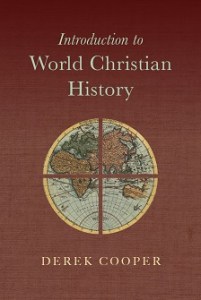 Derek Cooper’s Introduction to World Christian History provides a look at the development of Christianity across the world. It is a broad introduction to Christianity around the globe.
The book is formatted both by space and time. That is, sections on each general area (i.e. Asia) are traced for a specific time period (i.e. First through Seventh Centuries). Thus, readers looking to have a reference to work from need not look much farther than this book. Other readers, who may simply be interested in the broad development of world Christianity will not be disappointed either. Cooper does an excellent job showing the ebb and flow of Christianity’s spread across vast regions of time and place. Individual stories of prominent Christians are told in historical context to highlight specific periods or ideas. These individual stories accompany a broader narrative that is delivered in a readable, engaging style.
What makes the book particularly excellent is the way it provides all levels of readers with more to explore. It is an introductory text, for sure, but the notes are excellent and the topics explored are so broad that even readers with serious knowledge of Christian history will find more to explore. It is such a vast topic that no one can grasp each area, and Cooper gives glimpses into history that entice, like stained glass windows, much study.
The only real downside here is unavoidable: with so much material covered, it is impossible to get a complete picture of any one topic. Readers must go beyond this introduction. But again, kudos to Cooper for making readers want to do so with such a rich narrative style.
Introduction to World Christian History is the kind of book that will broaden readers minds in a number of ways. From those merely interested in a specific region to those who want to know just how we got to where we are, the book has broad appeal. Cooper’s style makes it extremely accessible for any level of reader, with plenty to tantalize more advanced readers as well. I recommend it highly.
The Good
+Fantastic overview covering large swathes of time and space
+Provides readers with broader understanding of Christianity
+Written in an interesting, readable style
The Bad
-Extremely brief on many interesting points
Disclaimer: I received a copy of the book for review from the publisher. I was not required to provide any specific kind of feedback whatsoever.
Links
Be sure to check out the page for this site on Facebook and Twitter for discussion of posts, links to other pages of interest, random talk about theology/philosophy/apologetics/movies and more!
Book Reviews– There are plenty more book reviews to read! Read like crazy! (Scroll down for more, and click at bottom for even more!)
Eclectic Theist– Check out my other blog for my writings on science fiction, history, fantasy movies, and more!
SDG.
——
The preceding post is the property of J.W. Wartick (apart from quotations, which are the property of their respective owners, and works of art as credited; images are often freely available to the public and J.W. Wartick makes no claims of owning rights to the images unless he makes that explicit) and should not be reproduced in part or in whole without the expressed consent of the author. All content on this site is the property of J.W. Wartick and is made available for individual and personal usage. If you cite from these documents, whether for personal or professional purposes, please give appropriate citation with both the name of the author (J.W. Wartick) and a link to the original URL. If you’d like to repost a post, you may do so, provided you show less than half of the original post on your own site and link to the original post for the rest. You must also appropriately cite the post as noted above. This blog is protected by Creative Commons licensing. By viewing any part of this site, you are agreeing to this usage policy.
Book Review: “Taking Pascal’s Wager” by Michael Rota
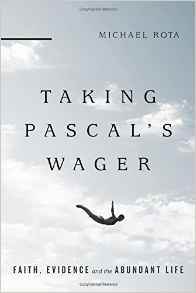 Michael Rota’s Taking Pascal’s Wager is an introduction to the defense of Pascal’s Wager, one of the most maligned arguments for the truth of Christianity.
One of the things that makes Pascal’s Wager most intriguing is the fact that, unlike many theistic arguments, the Wager seems uniquely suited for reasoning with the skeptic. That is, it is intentionally put forward in such a way as to convince the skeptic that Christianity is a good idea. Rota highlights this aspect of the Wager, particularly in two places: first, where he analyzes the probability behind the argument to demonstrate that, on the whole, the Wager is more beneficial taken than not, and second, in the last section of the book which shows practical outcomes of taking the Wager.
The sections on the probability behind the Wager are excellent. Rota condenses down a lot of probability theory and philosophical reasoning based on probability in ways that are easy to understand. This alone makes the book worth a read because it will allow those interested to explain and defend the Wager much better than they may otherwise. Rota also addresses some of the most common objections to the Wager, noting that things like the many gods challenge fail to make a convincing case against the Wager.
The last part of the book utilizes people like Dietrich Bonhoeffer to highlight the practical consequences of the wager. Bonhoeffer lost his life in the pursuit of Christian faith. Was it worth it? Rota’s examples give insights into lives that readers might not otherwise know about, and show that even lives that are full of sorrow are worth it, supposing God does exist.
I did think that the book somewhat seemed to get off track in the middle section, as Rota proceeded from speaking of Pascal’s Wager into discussion of various reasons to think Christianity is more likely true than not. I understand that this was part of his project, but given the amount of works that have been offered with a general introduction to things like the moral, cosmological, and other arguments, I think the space would have better been filled with a deeper look at Pascal’s Wager and the probability theory behind it. Further, more space dedicated to objections to the wager would be helpful.
Taking Pascal’s Wager is a worthy read. It introduces readers to the strength of Pascal’s Wager while also providing–uniquely, I think–a look at the practical outcomes of taking that wager. Although it could be improved by a deeper discussion of the probability behind the Wager and various objections to it, I believe this is an important book for anyone who wants to become more acquainted with one of the most unique arguments for Christianity. Readers interested in Pascal’s Wager ought also check out Jeff Jordan’s phenomenal Pascal’s Wager: Pragmatic Arguments and Belief in God.
The Good
+Real-life examples of the cost of discipleship highlight message
+Solid analysis of probability theory behind the argument
+Provides broad-spectrum defense of the Wager
The Bad
-Uses endnotes instead of footnotes
-Not quite as focused as one might like
Disclaimer: I received a copy of this book for review from the publisher. I was not required to provide any specific kind of feedback whatsoever.
Source
Michael Rota, Taking Pascal’s Wager (Downers Grove, IL: InterVarsity, 2016).
Links
Be sure to check out the page for this site on Facebook and Twitter for discussion of posts, links to other pages of interest, random talk about theology/philosophy/apologetics/movies and more!
Book Reviews– There are plenty more book reviews to read! Read like crazy! (Scroll down for more, and click at bottom for even more!)
Eclectic Theist– Check out my other blog for my writings on science fiction, history, fantasy movies, and more!
SDG.
——
The preceding post is the property of J.W. Wartick (apart from quotations, which are the property of their respective owners, and works of art as credited; images are often freely available to the public and J.W. Wartick makes no claims of owning rights to the images unless he makes that explicit) and should not be reproduced in part or in whole without the expressed consent of the author. All content on this site is the property of J.W. Wartick and is made available for individual and personal usage. If you cite from these documents, whether for personal or professional purposes, please give appropriate citation with both the name of the author (J.W. Wartick) and a link to the original URL. If you’d like to repost a post, you may do so, provided you show less than half of the original post on your own site and link to the original post for the rest. You must also appropriately cite the post as noted above. This blog is protected by Creative Commons licensing. By viewing any part of this site, you are agreeing to this usage policy.
Book Review: “Modern Art and the Life of a Culture” by Jonathan Anderson and William Dyrness
 Jonathan Anderson and William Dyrness analyze how modern art reflects the cultural mindset in Modern Art and the Life of a Culture, the inaugural entry in a new series on Studies in Theology and the Arts from InterVarsity Press. The most important thing is whether the book will be of interest to those who have little-to-no training in arts or theology. That is, can the book really bridge the gap between these fields? As one trained in theology, but with only the most introductory (read: general studies requirements) knowledge of art, from that side, I’d say the answer is a resounding yes.
Anderson and Dyrness explore modern art through the lens of H.R. Rookmaaker’s Modern Art and the Death of a Culture. However, they are not uncritical of this source material. Rookmaaker, they argue, was too quick to see more points of contact between Christianity and modern art than might be intended. However, Rookmaaker also provided a paradigm for viewing works of art as the basis for critical interaction rather than the life of or intentions of the artists themselves. This paradigm is quite useful, but it would be remiss to completely ignore the intent or life of the artist when looking at a work of art. It is this latter point which carries throughout the book, as the authors look at individual works of art, critically reflecting on them while also giving a holistic view of the artists themselves.
These descriptions are never boring or overdone. The authors write in an engaging style that weaves theology and art together in ways that are often surprising and frequently thought-provoking. The artists included are from a range of theological background and understandings. Thus, the book provides a broad look at different geological regions and their art from about the 1800s on (with some dabbling into earlier periods) that will give readers a working understanding of how the development of these styles interacted with the surrounding culture. At times, these stories are fascinating–how did the aristocracy or church react to differing depictions of icons in Russia, for example–and they always provide needed background and concrete examples.
The book also includes a number of full-color pictures to examine which are integrated into the text in useful ways. They are beautiful and often haunting. If there is one critique I may offer of the book, it is that more pictures would have been helpful. Some chapters have almost no images. Some have only black-and-white pictures. It is great to have more pictures, but the black-and-white ones make it a little difficult to discern details. More pictures would have helped readers like me–untrained in the arts–to get a better grasp on what some parts of the text were discussing. I looked up multiple paintings and images online to get a better understanding, but having them included in the text would have made it an even more excellent resource.
What is perhaps most important in the book, however, is the critical perspective the authors offer. It is impossible to give a wholesale acceptance or rejection of a field of art, and the authors provide ways to engage with both individuals and single pieces of art in ways that go beyond simply looking at the painting. It can be said, honestly, that the book will make readers want to go out, look at art, and let it speak to them in new and more profound ways. To say that about a book intended to get Christians thinking theologically about art is to give it the highest praise.
Modern Art and the Life of a Culture provides an excellent way to kick off a series on theology and the arts. It is engaging, eye-opening, and beautiful. Readers from many fields will find things of interest, and the authors provide numerous points of contact for future study. It is a highly recommended work.
The Good
+Introduces reader to an array of topics
+Critical interaction with source material
+Provides example of art criticism from Christian perspective
+Draws from international sources
+Includes beautiful color artwork
The Bad
-Difficult to discern some details in the black and white pictures
Disclaimer: I received a review copy of this book from the publisher. I was not required to provide any specific kind of review whatsoever.
Source
Jonathan Anderson and William Dyrness, Modern Art and the Life of a Culture (Downers Grove, IL: InterVarsity, 2016).
Links
Be sure to check out the page for this site on Facebook and Twitter for discussion of posts, links to other pages of interest, random talk about theology/philosophy/apologetics/movies and more!
Book Reviews– There are plenty more book reviews to read! Read like crazy! (Scroll down for more, and click at bottom for even more!)
Eclectic Theist– Check out my other blog for my writings on science fiction, history, fantasy movies, and more!
SDG.
——
The preceding post is the property of J.W. Wartick (apart from quotations, which are the property of their respective owners, and works of art as credited; images are often freely available to the public and J.W. Wartick makes no claims of owning rights to the images unless he makes that explicit) and should not be reproduced in part or in whole without the expressed consent of the author. All content on this site is the property of J.W. Wartick and is made available for individual and personal usage. If you cite from these documents, whether for personal or professional purposes, please give appropriate citation with both the name of the author (J.W. Wartick) and a link to the original URL. If you’d like to repost a post, you may do so, provided you show less than half of the original post on your own site and link to the original post for the rest. You must also appropriately cite the post as noted above. This blog is protected by Creative Commons licensing. By viewing any part of this site, you are agreeing to this usage policy.
Book Review: “The Earliest Christologies” by James L. Papandrea
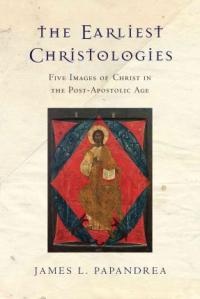 James L. Papandrea’s The Earliest Christologies is an introduction to examination of five views of who Christ was in the earliest church. Papandrea examines views of Christ as angel, prophet, phantom, cosmic mind, and Word/Logos.
The strongest point of the book is that it provides a reasoned, non-sensationalist accounting of the diversity of Christological positions in the early church. Too often, authors try to play up great conflict in the early church and what became orthodoxy as merely whatever view happened to have the most powerful adherents. None of that exists in The Earliest Christologies, which instead gives an overview of each position and shows that orthodoxy was superior in key ways.
Readers will get a broad overview of each of the five positions examined, along with multiple directions they could take further study, should they desire. It’s a solid introductory text.
Two primary difficulties face the book, and they are interlinked. The book is quite short, and so is necessarily brief on multiple important points, offering little by way of analysis. Papandrea notes throughout that the looks at Christology provided herein are “neater, cleaner, and more well-defined than they would have been in ‘real life'” (105). This brevity isn’t necessarily a major drawback, as it is intended as a work that introduces readers to the various positions on Christology in the earliest church, but it may leave some readers wanting more.
Well-written and stuffed with information, The Earliest Christologies provides a much-needed introduction to historical views of Christ. Although its brevity may limit its usefulness to introductory reading, such a work is necessary and it comes recommended. It would serve as an excellent text for a class on Christology or a high-level Bible study group.
The Good
+Provides a reasoned voice in examining early Christology
+Wealth of information in an accessible format
The Bad
-Extremely brief on multiple points
-Little by way of analysis
Disclaimer: I received a review copy of this book from the publisher. I was not obligated to provide any specific feedback whatsoever.
Links
Be sure to check out the page for this site on Facebook and Twitter for discussion of posts, links to other pages of interest, random talk about theology/philosophy/apologetics/movies and more!
Book Reviews– There are plenty more book reviews to read! Read like crazy! (Scroll down for more, and click at bottom for even more!)
Eclectic Theist– Check out my other blog for my writings on science fiction, history, fantasy movies, and more!
SDG.
——
The preceding post is the property of J.W. Wartick (apart from quotations, which are the property of their respective owners, and works of art as credited; images are often freely available to the public and J.W. Wartick makes no claims of owning rights to the images unless he makes that explicit) and should not be reproduced in part or in whole without the expressed consent of the author. All content on this site is the property of J.W. Wartick and is made available for individual and personal usage. If you cite from these documents, whether for personal or professional purposes, please give appropriate citation with both the name of the author (J.W. Wartick) and a link to the original URL. If you’d like to repost a post, you may do so, provided you show less than half of the original post on your own site and link to the original post for the rest. You must also appropriately cite the post as noted above. This blog is protected by Creative Commons licensing. By viewing any part of this site, you are agreeing to this usage policy.
Book Review: “Undeniable” by Douglas Axe
 Undeniable: How Biology Confirms Our Intuition That Life is Designed by Douglas Axe is an explanation of Intelligent Design theory at a lay level. Axe contends that by appealing to “common science”—the notion that experience is integral to how we live and that each individual is, in a sense, a scientist because we use experience to make models and figure out how things work (60-61)—the inference to design will be vindicated.
A central aspect of Axe’s case is appeal to what he calls “The Universal Design Intuition” defined as “Tasks that we would need knowledge to accomplish can be accomplished only by someone who has that knowledge” (20). This intuition, argues Axe, is supported by experimental data, including difficulties with forming proteins to form specific chemical transformations (33ff). He also utilizes mathematical modeling to show that it is effectively impossible to achieve certain results purely by chance (89ff). It is insight that is required to achieve the results that we see in biology, he argues. There is no amount of repetition possible to offset the improbability of life in our universe and life as we see (103).
Counter-arguments to design are addressed, including the multiverse. Axe argues that “aimless wandering” of chance effectively means that anything but design for the results we observe is impossible. There is a specific “target area” which must be achieved to get life, and the odds against hitting that target are infinitesimal to the point that they are practically impossible (113ff).
Ultimately, Axe concludes, “Functional coherence makes accidental invention fantastically improbable and therefore physically impossible” (160). The sheer improbability stacked against the notion that life could evolve functionally to new life forms makes it physically impossible, thus showing that design is the best inference when it comes to life. Scenarios which are alleged to show evolution in action require tweaking from outside, thus demonstrating that insight and design are required for life (198ff; 209). Moreover, “Nothing evolves unless it already exists” (214), and the existence of life cannot merely evolve from non-life given the probabilities stacked against it.
Why, then, do so few scientists advocate for design or see it in nature? Axe’s answer to this question is that there is enormous bias and no small amount of power being wielded against the design inference: “Harm comes to science not by people hoping to find a particular result but by people trying to suppress results that go against their hopes” (45). He argues that there is at least some intentional suppression of design theory and that new ideas take time to gain space in academia (46ff; 215ff).
Axe’s argument is geared towards lay readers, though it does have a few new things to offer those who have read the majority of ID literature already. His analysis of the mathematics behind design inferences will help gain an understanding of what is meant by “possible” in logical vs. physical senses. Moreover, his firsthand experience of experimental confirmation gives him a voice that is not often heard in defense of ID. It is not merely modeling that is happening, but rather experimentation with results.
That said, there are a few issues in the book. First, I think that the continued appeal to bias as the reason for rejecting ID is overdone. Although some certainly do reject ID due to bias against the notion of a creator or designer, there are many who reject it because they find its arguments either inconclusive or mistaken. Bias exists, but it is not the only reason for rejecting ID theory any more than materialism is the only reason for rejecting ID. Second, evolution is treated as a kind of singular entity, with natural selection as the only mechanism proposed to accomplish the diversification of species. Though he acknowledges some efforts to modify evolutionary theory that acknowledge other mechanisms (220-224), he dismisses such efforts as “patching holes” instead of as serious alternative proposals. I admit I have no expertise in evolutionary biology, but I am familiar enough with the idea to know that several different notions of how evolution may produce new life forms are proposed, and that most acknowledge some combination of several factors is probably right. It seemed strange for Axe to largely dismiss these as dead ends. Third, there are several points of the argument that seemed rushed or simply passed by. I understand this is a book for laity, but the movement from seeing some aspect of evolution as physically impossible to design is an inference that requires some explanation beyond assertion.
Overall, Undeniable provides more food for thought for those interested in Intelligent Design and the debate between ID advocates and opponents. Axe does offer some insights that I, at least, haven’t read anywhere else. The book is also written at a level that almost any reader could pick it up and get the core of Axe’s argument. Those interested in the debate over Intelligent Design would be well-served to pick up a copy. I will be interested in seeing what responses are offered.
The Good
+Good introduction to ID theory
+A fresh take on some aspects of ID
+Use of examples that are easy to understand
The Bad
-Relies too much upon perceived bias in science
-Skims through much argumentation
-Little interaction with alternate evolutionary scenarios
Source
Douglas Axe, Undeniable: How Biology Confirms Our Intuition That Life is Designed (New York: HarperOne, 2016).
Disclaimer: I received a copy of the book for review from the publisher. I was not obligated to provide any specific feedback whatsoever.
Links
Be sure to check out the page for this site on Facebook and Twitter for discussion of posts, links to other pages of interest, random talk about theology/philosophy/apologetics/movies and more!
Book Reviews– There are plenty more book reviews to read! Read like crazy! (Scroll down for more, and click at bottom for even more!)
Eclectic Theist– Check out my other blog for my writings on science fiction, history, fantasy movies, and more!
SDG.
——
The preceding post is the property of J.W. Wartick (apart from quotations, which are the property of their respective owners, and works of art as credited; images are often freely available to the public and J.W. Wartick makes no claims of owning rights to the images unless he makes that explicit) and should not be reproduced in part or in whole without the expressed consent of the author. All content on this site is the property of J.W. Wartick and is made available for individual and personal usage. If you cite from these documents, whether for personal or professional purposes, please give appropriate citation with both the name of the author (J.W. Wartick) and a link to the original URL. If you’d like to repost a post, you may do so, provided you show less than half of the original post on your own site and link to the original post for the rest. You must also appropriately cite the post as noted above. This blog is protected by Creative Commons licensing. By viewing any part of this site, you are agreeing to this usage policy.
Book Review: “The Great Divide: A Lutheran Evaluation of Reformed Theology” by Jordan Cooper
 The Great Divide: A Lutheran Evaluation of Reformed Theology presents a broad-spectrum look at Reformed theology from a Lutheran perspective.* Cooper breaks this analysis up into three parts: Predestination and Free Will, Worship and the Sacraments, and Salvation. These parts are intended to show the greatest dividing lines between Reformed and Lutheran thought.
It is really quite exciting to see how well-read Cooper is on both Reformed and Lutheran thought. On the Reformed side, he frequently cites Calvin (of course), Bavinck, Edwards, Piper, Grudem, and more. On the Lutheran side, he draws from Luther, Chemnitz, Melanchthon, Kolb, and more. This thorough use of sources on both sides helps shield against bias, as Cooper continually cites the words of prominent theologians of each tradition.
Cooper provides in each chapter a presentation of Reformed thought on the topic, drawing extensively from prominent Reformed thinkers past and present, as well as various Reformed Confessions. Then, he provides a look at the Lutheran perspective, often quoting the Lutheran Confessions as well as prominent Lutheran thinkers. After providing this comparison, Cooper argues for the Lutheran position, noting the points of divergence along the way. At many points, this analysis is fairly robust. However, at other points Cooper does swiftly move from one point to another before providing enough to establish each point.
One of the things that comes to the front most clearly in the book is just how close Reformed and Lutheran thought are on a number of issues. Unfortunately, as close as the two traditions come on many areas, the chasm between the two remains vast. This is particularly clear in regards to the Sacraments and Predestination. I was also pretty surprised to see how different the Reformed and Lutheran view regarding worship is. The regulative principle within Reformed thought–that whatever is not commanded in Scripture ought not to be done in worship–was something that startled me. I hadn’t considered such a position, but Cooper showed the arguments for and against this position, coming down on the side of Lutheranism (again, he’s coming from that perspective), which sees worship as something that God allows for more leeway in than do Reformed thinkers.
It is truly amazing how much information Cooper manages to convey in just 200 pages. Readers are introduced to both Lutheran and Reformed perspectives on a number of important theological topics, treated to both exposition of those views and offered critique of the Reformed position all in a very clear style and form.
There are two minor critiques I’d offer of the book. The first is the continued use of the archaic “man” to refer to all people. There were, in fact, a few places in which I had to work to discern whether Cooper meant all people or just men when it came to what he was writing. A second critique is that because of the books relatively short length, some of the arguments on either the Reformed or Lutheran side seem extremely brief, leaving some of the arguments inconclusively demonstrated.
Jordan Cooper’s The Great Divide: A Lutheran Evaluation of Reformed Theology is a vast trove of information and analysis. Extensively researched and well-reasoned, it will provide readers unfamiliar with either Reformed or Lutheran theology (or both) an introduction to each tradition as well as a look at how they may interact with one another.
The Good
+Engages with prominent theologians from each group
+Historically informed
+Treats Reformed thought fairly
+Vast wealth of information
The Bad
-Continued use of archaic “man” etc. as inclusive
-Some points are breezed through very quickly
*It is worth noting my own bias here: I am a Lutheran who was raised Lutheran and, though I wandered a little bit, have become quite convinced of Lutheran theology in recent years.
Disclaimer: I was provided with a copy of the book for review by the publisher. I was not required to provide any specific kind of feedback whatsoever.
Source
Jordan Cooper The Great Divide: A Lutheran Evaluation of Reformed Theology (Eugene, OR: Wipf & Stock, 2015).
Links
Be sure to check out the page for this site on Facebook and Twitter for discussion of posts, links to other pages of interest, random talk about theology/philosophy/apologetics/movies and more!
Book Reviews– There are plenty more book reviews to read! Read like crazy! (Scroll down for more, and click at bottom for even more!)
Eclectic Theist– Check out my other blog for my writings on science fiction, history, fantasy movies, and more!
SDG.
——
The preceding post is the property of J.W. Wartick (apart from quotations, which are the property of their respective owners, and works of art as credited; images are often freely available to the public and J.W. Wartick makes no claims of owning rights to the images unless he makes that explicit) and should not be reproduced in part or in whole without the expressed consent of the author. All content on this site is the property of J.W. Wartick and is made available for individual and personal usage. If you cite from these documents, whether for personal or professional purposes, please give appropriate citation with both the name of the author (J.W. Wartick) and a link to the original URL. If you’d like to repost a post, you may do so, provided you show less than half of the original post on your own site and link to the original post for the rest. You must also appropriately cite the post as noted above. This blog is protected by Creative Commons licensing. By viewing any part of this site, you are agreeing to this usage policy.
Book Review: “Karl Barth’s Infralapsarian Theology” by Shao Kai Tseng
 Shao Kai Tseng’s Karl Barth’s Infralapsarian Theology is a thorough examination of Barth’s lapsarian position. There are two major positions in Reformed circles regarding how God ordered the divine decrees. Supralapsarianism teaches that God decreed election (who would be saved) and reprobation (who would be condemned) prior to the Fall, while infralapsarianism teaches that God first decrees the Fall, then election and reprobation (among other things). Not all Reformed thinkers hold to one of these two positions. For a fuller explanation, see here, or look more deeply at the book. Barth, historically, has been understood as a supralapsarian, and even at times explicitly claimed that position for himself. Tseng argues, however, that Barth’s position is truly infralapsarian.
Tseng argues for his thesis through an examination of Barth’s developing thought. He begins with Barth’s earliest works and then traces his thought on problems of atonement, decree, and redemption throughout his life. Tseng interacts with numerous interpreters of Barth, utilizing them to support his theory or showing where they are mistaken.
The two greatest difficulties with the book are linked. Tseng’s tone is relentlessly even, such that there are few breaks for readers to pause and consider the contents, and few examples of application of the texts are given. This means that there is little reason given to investigate the central topic of the book: Barth’s lapsarian position. Why, exactly, does Barth’s lapsarian position actually matter to us now? Other than scratching a curious itch, what application does it have? Surely, for historical reasons, it is good to know where Barth ought to line up, but beyond that Tseng doesn’t give much of a reason for seeing why this impacts broader theological studies.
Of course, that doesn’t mean the book is without merit. Those deeply interested in Barth will want to engage with it and debate its contents. Moreover, because Tseng looks deeply at Barth’s developing thought, it provides some analysis of Barth’s overall theology.
Karl Barth’s Infralapsarian Theology is dry and fairly esoteric. For those who are deeply interested in Barthian thought, however, this will be necessary reading, particularly if one wants to engage in Barth’s doctrine of election. If one wishes to delve deeply into Barthian thought and Reformed disputes over lapsarian positions, this is a good read, but its audience is limited to that group.
The Good
+Exposes readers to large amounts of Barth’s thought
+Utilizes interpreters of Barth well
+Detailed look at the central topic
The Bad
-Little reason offered to pursue central topic
-Tone doesn’t put much “life” in the text itself
Disclaimer: I was provided with a review copy of the book by the publisher. I was not required to provide any specific kind of feedback whatsoever.
Source
Shao Kai Tseng, Karl Barth’s Infralapsarian Theology (Downers Grove, IL: InterVarsity, 2016).
Links
Be sure to check out the page for this site on Facebook and Twitter for discussion of posts, links to other pages of interest, random talk about theology/philosophy/apologetics/movies and more!
Book Reviews– There are plenty more book reviews to read! Read like crazy! (Scroll down for more, and click at bottom for even more!)
Eclectic Theist– Check out my other blog for my writings on science fiction, history, fantasy movies, and more!
SDG.
——
The preceding post is the property of J.W. Wartick (apart from quotations, which are the property of their respective owners, and works of art as credited; images are often freely available to the public and J.W. Wartick makes no claims of owning rights to the images unless he makes that explicit) and should not be reproduced in part or in whole without the expressed consent of the author. All content on this site is the property of J.W. Wartick and is made available for individual and personal usage. If you cite from these documents, whether for personal or professional purposes, please give appropriate citation with both the name of the author (J.W. Wartick) and a link to the original URL. If you’d like to repost a post, you may do so, provided you show less than half of the original post on your own site and link to the original post for the rest. You must also appropriately cite the post as noted above. This blog is protected by Creative Commons licensing. By viewing any part of this site, you are agreeing to this usage policy.

 J.W. Wartick - Reconstructing Faith