book review
Book Review: “None Like Him: 10 Ways God is Different from Us (And Why That’s a Good Thing)” by Jen Wilkin
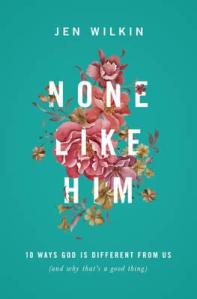
Jen Wilkin’s None Like Him is an introduction to the study of divine attributes.
Each chapter is laid out in much the same fashion: an anecdote begins each with a way to conceptualize the topic of the chapter (such as omnipotence), then an exposition of the meaning of the term and its importance in the Bible, following this there are a few ways that humans distort whatever divine attribute is being discussed, and the chapter closes with a few study questions, verses for more exploration, and a prayer. The format makes it ideal to use as a 10-11 meeting study group.
Upon starting the book, I immediately realized I wasn’t the intended audience. Although I checked the catalogue description and didn’t see anything about this, the book is apparently intended for study by women who are interested in getting deeper into theology. I’m a man, but I don’t think this precluded me in any way from doing a review of the book.
Wilkin’s use of examples, I felt, was particularly helpful. As I said, each chapter begins with an anecdote that helps illustrate the attribute or quality that is being disussed. Wilkin uses examples throughout the text to help make the abstract concrete, and I didn’t notice any that seemed to be off point. I also thought including sections on how humans distort various divine attributes was a wise choice, and made the book even more practical and applicable than it might otherwise have been.
The book is not without flaws, however. One of the most obvious is the somewhat ironic continued usage of the archaic “man” to refer to all humanity. Because the book is explicitly written for women (see the Introduction), this makes saying things like “our fellow man” in the same context as “we” sound stilted and strange. A deeper problem is that control of one’s own body is treated as a “sin” explicitly and exclusively even when it comes to a disease like anorexia or other eating disorders (Kindle Location 1746): “when we cross the line into unhealthy control [of our bodies], we move… to idolatry. This can take the form of… eating disorders…” No grace is offered in this passage for those who do struggle with things like eating disorders. Indeed, the message conveyed is contextually that all we need to do is stop “striving for control” and take away our commitment to “your own sovereignty” and we can then conquer these sinful issues. This is a deeply problematic to engage with something like an eating disorder, because eating disorders impact people mentally as well as physically to the point where it takes outside intervention to stop. Indeed, it is at this point that it might make the most sense to offer grace, because God’s inworking on humanity is what it takes to fight against such darkness in the world.
None Like Him is, ultimately, a decent introduction to the topics it covers. It doesn’t go much beyond the basics, but it does offer a good format and examples to help think through the issues. However, it is marred by a simplistic understanding of sin and adherence to archaic forms of expression.
The Good
+Interesting use of day-to-day examples
+Helpful format
The Bad
-Archaic use of masculine to refer… to women
-Treats disorders as inherently sinful
Disclaimer: I was provided with a copy of the book for review by the publisher. I was not obligated to provide any specific kind of feedback whatsoever.
Source
Jen Wilkin, None Like Him (Wheaton, IL: Crossway, 2016).
Ken Follett’s “Fall of Giants” – Deconversion, Hope, and Strife
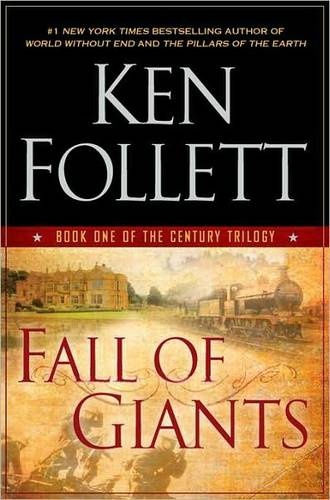
Ken Follett’s “The Century Trilogy” is a sweeping series . I just finished the first book, Fall of Giants, and realized there were several themes found therein that begged comment here. Here, I will analyze the book from a worldview perspective. There will be SPOILERS in what follows.
I will not go over the plot of the book. A brief summary may be found here.
Deconversion
Billy Williams is a Welsh boy who goes to work in a coal mine. The first day on the job he is left alone in the pitch black–his lamp went out. Rather than wandering lost in the tunnels he keeps working until someone comes to get him. To keep himself from being too frightened, he sings Christian hymns and draws comfort from them. At the end, when the light is restored, he sees a fleeting vision of Christ just at the corner of the light and says “Thank you.”
If that sounds like the start of a storyline that will be an example of a life of faith to you, you would be disappointed. After an explosion in the coal mine, he is distressed by the problem of evil–why does God let bad things happen? As he grows older, Billy is exposed to textural criticism. He is disturbed that we don’t have copies of the original texts from which we get the words of the Bible. His father, who often preaches at their worship services, has insufficient answers. Later in life, Billy’s sister gets pregnant and is judged sharply by his father and their town because she is not married. He is strongly put off by the apparent hypocrisy of the people. He never returns to church.
I admit that “deconversion” may be a bit of a misnomer because it is never specifically said that Billy doesn’t believe in God anymore, but the implications are there. He has a deep distrust of and distaste for Christianity, it seems, after this.
The story illustrates the need for a firm foundation. Textual criticism is not something Christians should fear, as it allows us to recover the text of the Bible more accurately. The problem of evil is not unsolvable. And, unfortunately, Christian hypocrisy is actually something to be expected. Indeed, the Christian worldview would expect hypocrisy at times because we are still sinners in this world and will continue to commit wrongs, despite being people of faith. None of this was hinted at in the novel, but I suspect that this is due in part to the fact that Follett is himself an avowed secular humanist. There seems to be an agenda here (and see below).
Unfortunately, Billy’s story is similar to one we can see repeating in churches and families all over. We have not studied our faith. We have not worked out the hard problems related to Christianity, so when we are confronted by them, we are often found with pat answers rather than the truth. We need to actively seek out answers and be aware of our own limitations. Unable to answer every question, we should commit ourselves to a life of faith seeking understanding.
Hope
There is hope found in the darkness throughout the coming World War and the plights of the individual people. Hope is found largely in the actions of other people–the small kindnesses that are done even in the face of evil. As the world seems to be crashing down all around, it is relationships which keep people going. Some of these are vaguely religious in nature, though the persisting theme seems to be that people need to do for themselves whatever they’d like to accomplish.
Religious Leaders?
One persistent theme throughout the book is that those involved in the church are mean, nasty, and most likely sexual deviants. Any time a priest-whether Roman Catholic or Eastern Orthodoxy or Anglican–is mentioned or encountered, it is almost always in context of some offhand remark about how they sexually harassed a child or how someone who is now an adult remembers when they were asked to have sex with the priest, etc. It’s actually quite tiresome. While on the one hand it is important to note that there are those within Christianity who have abused power throughout time, on the other hand, to suggest that everyone in some sort of position in power was a power-hungry sexual predator is uneven, to put it mildly.
Those who are not in established religion–like Billy’s dad–are portrayed as aloof, distant, and largely uncaring. Billy’s dad does get a chance to redeem himself as he accepts Ethel back into the family, but only after he had to consider the possibility of having his whole family fall apart.
Conclusion
Follett has woven an intriguing story with a very strong premise. It is unfortunate that throughout there also seem to be straight polemics against Christianity. A better balance was needed to make it seem realistic and not so much a diatribe against Christianity. Some good takeaways can be had from reading the book, but the worldview it presents is largely bleak and hopeless.
Links
Be sure to check out the page for this site on Facebook and Twitter for discussion of posts, links to other pages of interest, random talk about theology/philosophy/apologetics/movies and more!
Popular Books– Check out my other posts on popular books, including several other science fiction works. (Scroll down for more.)
Source
Ken Follet, Fall of Giants (Signet, 2012).
SDG.
——
The preceding post is the property of J.W. Wartick (apart from citations, which are the property of their respective owners, and works of art as credited) and should not be reproduced in part or in whole without the expressed consent of the author. All content on this site is the property of J.W. Wartick and is made available for individual and personal usage. If you cite from these documents, whether for personal or professional purposes, please give appropriate citation with both the name of the author (J.W. Wartick) and a link to the original URL. If you’d like to repost a post, you may do so, provided you show less than half of the original post on your own site and link to the original post for the rest. You must also appropriately cite the post as noted above. This blog is protected by Creative Commons licensing. By viewing any part of this site, you are agreeing to this usage policy.
Book Review: “Wesley and the Anglicans” by Ryan Nicholas Danker
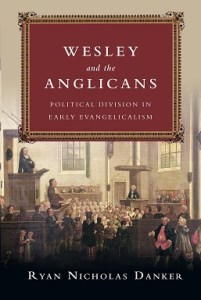 Wesley and the Anglicans by Ryan Nicholas Danker is an historical project about the developing split between John Wesley and the Methodists on the one hand and the Anglicans and Evangelicals on the other. Danker’s work offers a mixture of data and correction, exploring the topic in a way that brings new insights.
Danker does an excellent job interweaving different disciplines into his approach to the issues at hand. Instead of taking a purely theological approach to the reasons Wesley and the Anglicans split, he argues forcefully that sociological and political issues were just as–if not more–important to the division than the theological reasons. Indeed, theologically there was an Evangelical movement with Anglicanism (Danker uses Evangelical to refer to those within the Anglican church and evangelical to refer to those either immediately or ultimately outside of it). There were plenty of theological sympathies to be had for Wesley’s movement within the Anglican communion, but John Wesley (and Charles Wesley, his brother) ultimately pushed against the political and sociological hierarchy too hard to maintain unity.
Indeed, for Wesley, his commitment to aspects of the Anglican Church made the pushback from Evangelicals (and others) within the church more surprising to him. These ideas are developed through a number of case studies. For example, because of Wesley’s commitment to evangelism, he continued to encourage lay preaching. When confronted about how this may lead to laity taking over the Sacraments and the like, Wesley was (to sum up Danker’s argument) surprised; after all, he was not encouraging these lay preachers to make their own church buildings or orders of hierarchy–how could this therefore be seen as a challenge to the Anglican Church? Wesley’s own intriguing mixture of old and new made it difficult both for him to understand why he was being criticized so harshly and for those within the Anglican Church to see why he was being so divisive.
Political pressures were also brought to bear on the topic, and much of this was due to hierarchy within the church and concerns over how Wesley’s teaching might lead to a collapse of this hierarchy and unity of belief. Thus, laws were passed which began to make lay preaching more and more difficult, for small groups were suddenly considered rivals to official church business by law. Further pressure came from the laity, which began to push back and wonder why they couldn’t do things like administer the Sacraments. All of this came to a head over the course of several meetings of the Methodists, and ultimately led to the split with the Anglican Church we see today.
Danker does an admirable job uniting so many divergent threads into one continuous stream, but he does so in a way that sometimes leaves a bit to be desired. Perhaps the main downside of the book is that it reads very dryly. It doesn’t so much bring life to the historical persons and events as it does describe them. This does an adequate job of presenting the ideas and important topics, but it makes it less exciting to read than some other historic works. It conveys information, but doesn’t necessarily awaken a love of the topic in the reader.
Wesley and the Anglicans is an interesting read about a vital point in church history. Danker also demonstrates that church history ought to incorporate broader studies into its approach than just theology or history. It isn’t the most exciting history book, but it presents readers with a great deal of information on a topic of interest.
The Good
+Sheds light on an important time in church history
+Multi-disciplinary approach that incorporates sociology and politics into theology
+Full of information
The Bad
-Dryly presented
Disclaimer: I received a review copy of this book from the publisher. I was not obligated to provide any specific kind of feedback whatsoever.
Source
Ryan Nicholas Danker, Wesley and the Anglicans (Downers Grove, IL: InterVarsity, 2016).
Links
Be sure to check out the page for this site on Facebook and Twitter for discussion of posts, links to other pages of interest, random talk about theology/philosophy/apologetics/movies and more!
Book Reviews– There are plenty more book reviews to read! Read like crazy! (Scroll down for more, and click at bottom for even more!)
Eclectic Theist– Check out my other blog for my writings on science fiction, history, fantasy movies, and more!
SDG.
——
The preceding post is the property of J.W. Wartick (apart from quotations, which are the property of their respective owners, and works of art as credited; images are often freely available to the public and J.W. Wartick makes no claims of owning rights to the images unless he makes that explicit) and should not be reproduced in part or in whole without the expressed consent of the author. All content on this site is the property of J.W. Wartick and is made available for individual and personal usage. If you cite from these documents, whether for personal or professional purposes, please give appropriate citation with both the name of the author (J.W. Wartick) and a link to the original URL. If you’d like to repost a post, you may do so, provided you show less than half of the original post on your own site and link to the original post for the rest. You must also appropriately cite the post as noted above. This blog is protected by Creative Commons licensing. By viewing any part of this site, you are agreeing to this usage policy.
Book Review: “The Grand Canyon: Monument to an Ancient Earth- Can Noah’s Flood Explain the Grand Canyon?” Edited by Carol Hill, Gregg Davidson, Tim Helble, and Wayne Ranney
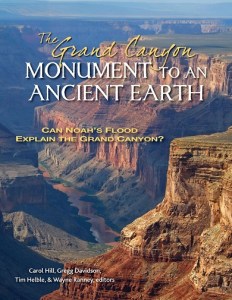 The Grand Canyon: Monument to an Ancient Earth is one of the best analyses of young earth creationism on the market. In this beautifully illustrated text, the Grand Canyon is used as a test site to analyze Flood Geology, the notion that Noah’s Flood radically shaped the face of the Earth and can account for much of the sedimentary layers we observe. The Grand Canyon is an especially appropriate test case because there are young earth creationist (hereafter YEC) books published on the Canyon, and many YEC works reference the Grand Canyon in explanations of their theories.
Part 1 outlines two views of the Grand Canyon: that of flood geology, in which the vast majority of the Canyon’s sediment was laid down during Noah’s Flood; and that of conventional geology, in which long time periods and observable, repeated processes can account for the Canyon. This part includes chapters contrasting the time frames of flood geology and conventional geology, showing the massive difference between the two views conclusions about how the Canyon formed. Part 2 is entitled “How Geology Works” and covers things like sedimentary rocks, plate tectonics, and time measurements. Part 3 looks at fossils and what they tell us about the age of the Grand Canyon. Part 4 surveys how the Grand Canyon was carved. Part 4 gives a verdict on flood geology from the evidence provided.
The authors provide an introduction to geology generally speaking, and then focus what is covered onto the Grand Canyon. Throughout the whole book, the Grand Canyon serves as the testing ground for what modern geology teaches about the Earth. Then, it is contrasted with what YECs claim about the age of the earth and the processes that formed it. Time and again, this shows that YEC claims are found wanting. The chapters on fossils are particularly telling in this regard.
For example, Joel Duff demonstrates, in “Tiny Plants – Big Impact: Pollen, Spores, and Plant Fossils” that there are entire, massive chunks of sediment without any pollen or plant spores contained therein. And these layers aren’t just randomly distributed; they’re in the oldest layers of the rock, such that it demonstrates what conventional scientists have claimed, that there simply were no pollinating plants long ago. But if flood geology is to be believed, these sediments were laid down during Noah’s Flood, which would have entailed all kinds of mixing of dead plants and animals as the surface of the Earth was radically changed. How then, are there thousands of feet of sediment without any pollen? How did microscopic plant matter manage to get sifted out in such a clear distinction from other layers? This is the kind of in-depth look at the specifics of flood geology that abound everywhere in the book. YEC arguments are subjected time and again to direct refutation like this, making the book invaluable.
The book is also valuable simply as an introduction to geology as well as some biology and other sciences. I learned an extraordinary amount from the book, and I feel fairly confident that I had a working knowledge of geology. In other words, the book is not simply a refutation of flood geology in the Grand Canyon, it can also serve as a valuable introduction to several related topics.
I would be remiss if I did not call out the beauty of the book. There are breathtaking full-color photographs of the Grand Canyon throughout the book, accompanied by numerous graphs and charts. But these illustrations do more than just look pretty, they are almost always explicitly tied into the text in meaningful ways. I found myself thoroughly poring over each and every one, whether I was looking for the division between layers of rock in a photograph or flipping back to a chart repeatedly as I came to understand it better. These illustrations are perhaps made more impressive by the modest price of the book ($26.99 regular price on Amazon). Simply put, you can’t get books with this much information and as beautifully put together as this for that price, yet here it is.
There are only two minor points I’d like to mention as negatives, but they are closer to nitpicking than anything else. First, although the introductory chapters (and a few other places) note that the young earth creationist arguments about the Grand Canyon are scientific and expressly stated as being testable, I suspect many YECs will respond to the book by appealing to some presuppositional theological perspective. Though this would be a mistaken response, it would have helped the book to perhaps include one chapter showing how the YEC claims about the Canyon are inherently scientific and can be tested without a specific theological narrative. Again, this point is made, I just think it could have been elaborated a bit more. Second, there was the briefest mention of one of the most popular arguments for Intelligent Design, that of the Cambrian explosion. The mention was so short that it is difficult to see what the authors were intending.
I have read dozens, perhaps hundreds of books on the debate over science and religion. That said, The Grand Canyon: Monument to an Ancient Earth is a remarkable achievement. It provides some of the most thorough, in-depth analysis of young earth creationist reasoning that is available to date. It is beautifully illustrated with photos and charts that are directly related to the text, and it is reasonably priced. If you’re looking for analysis of flood geology from a scientific perspective, this book gives you the perfect test scenario. I cannot recommend it enough.
The Good
+Huge amount of information from geology to biology
+On-point analysis of flood geology
+Helpful charts and graphs
+Stunning photographs throughout linked to the text
+Features women’s voices
+Direct engagement with prominent YEC writings
+Reasonable price
The Bad
-Perhaps too light on the theological side
-Only the briefest engagement with ID
Disclaimer: I was provided with a review copy of the book by the publisher. I was not required to provide any specific kind of feedback whatsoever.
Source
The Grand Canyon: Monument to an Ancient Earth (Kregel, 2016).
Links
Be sure to check out the page for this site on Facebook and Twitter for discussion of posts, links to other pages of interest, random talk about theology/philosophy/apologetics/movies and more!
Book Reviews– There are plenty more book reviews to read! Read like crazy! (Scroll down for more, and click at bottom for even more!)
Eclectic Theist– Check out my other blog for my writings on science fiction, history, fantasy movies, and more!
SDG.
——
The preceding post is the property of J.W. Wartick (apart from quotations, which are the property of their respective owners, and works of art as credited; images are often freely available to the public and J.W. Wartick makes no claims of owning rights to the images unless he makes that explicit) and should not be reproduced in part or in whole without the expressed consent of the author. All content on this site is the property of J.W. Wartick and is made available for individual and personal usage. If you cite from these documents, whether for personal or professional purposes, please give appropriate citation with both the name of the author (J.W. Wartick) and a link to the original URL. If you’d like to repost a post, you may do so, provided you show less than half of the original post on your own site and link to the original post for the rest. You must also appropriately cite the post as noted above. This blog is protected by Creative Commons licensing. By viewing any part of this site, you are agreeing to this usage policy.
Book Review: “Bonhoeffer Speaks Today” by Mark Devine
 Mark Devine’s Bonhoeffer Speaks Today is a pithy summary of the doctrines of Dietrich Bonhoeffer and how they might be applicable now.
The book is organized around chapters that each focus on how Bonhoeffer’s thought might be applied to today. Within each chapter are sub-headings, sometimes as short as one paragraph, that look at specific aspects of his works or life to apply them now. The brevity of the book is one of its strengths. Often, stirring insights can be found in a section no longer than a few sentences. I think this shows both the depth and intricacy of Bonhoeffer’s own thought as well as the way Devine has arranged the book to highlight them.
There are two areas I’d like to critique in regards to the book. The first is that Bonhoeffer’s clear Lutheranism is ignored. Dietrich Bonhoeffer is clearly a Lutheran through-and-through with a commitment to orthodox Lutheran understanding of Baptism and the Lord’s Supper. To write of Bonhoeffer speaking today without incorporating his sacramental understanding which is so integral to his theology is to take away from Bonhoeffer much of his voice. The second criticism is that the language used throughout the book continues to use the archaic “man” to refer to “men and women” as well as other gendered language when it would be just as simple to make the language inclusive.
Bonhoeffer Speaks Today is full of practical theology from the writings of one of the most engaging theologians of the 19th Century. If you’re looking for an introduction to his thought, this is a good place to start. However, be aware that a central aspect of Bonhoeffer–his Lutheranism–is notably absent.
The Good
+Excellent brief introduction to Bonhoeffer’s life and context
+Filled with juicy quotations
+Many, many digestable insights
The Bad
-Does not use gender inclusive language
-No mention of Bonhoeffer’s Lutheranism
Links
Be sure to check out the page for this site on Facebook and Twitter for discussion of posts, links to other pages of interest, random talk about theology/philosophy/apologetics/movies and more!
Bonhoeffer’s Troubling Theology?- A response to an article on Dietrich Bonhoeffer’s theological perspectives– I look at an argument that Bonhoeffer’s theology is “troubling” to evangelicals and point out how much of it is merely a product of his Lutheran background.
Book Reviews– There are plenty more book reviews to read! Read like crazy! (Scroll down for more, and click at bottom for even more!)
Eclectic Theist– Check out my other blog for my writings on science fiction, history, fantasy movies, and more!
SDG.
——
The preceding post is the property of J.W. Wartick (apart from quotations, which are the property of their respective owners, and works of art as credited; images are often freely available to the public and J.W. Wartick makes no claims of owning rights to the images unless he makes that explicit) and should not be reproduced in part or in whole without the expressed consent of the author. All content on this site is the property of J.W. Wartick and is made available for individual and personal usage. If you cite from these documents, whether for personal or professional purposes, please give appropriate citation with both the name of the author (J.W. Wartick) and a link to the original URL. If you’d like to repost a post, you may do so, provided you show less than half of the original post on your own site and link to the original post for the rest. You must also appropriately cite the post as noted above. This blog is protected by Creative Commons licensing. By viewing any part of this site, you are agreeing to this usage policy.
Book Review: “Evolution and Holiness: Sociobiology, Altruism, and the Quest for Wesleyan Perfection” by Matthew Nelson Hill
 Matthew Nelson Hill’s book, Evolution and Holiness might cause a great number of double-takes when it comes to the subject matter revealed in the subtitle: Sociobiology, Altruism, and the Quest for Wesleyan Perfection. Indeed, this is one of the more unique studies I have read.
Hill’s thesis is essentially that, granting the truth of human evolution, it is still possible to maintain the highest possible levels of belief in sanctification and holiness. To support this thesis, he examines the Wesleyan concept of holiness, which is essentially that humans can be made perfect in this life. He argues that, if evolution and Wesleyan holiness are not incompatible, then effectively any view of sanctification can be compatible with evolution. The reason for this conclusion is that Wesleyan holiness is largely agreed upon as the most stringent type of holiness, and so if it can past the test put forward by human evolution, other views ought to be able to as well.
Now that we have looked at the thesis of the book, it is important to take a step back. Hill is not concerned here with whether evolution is true, though it seems that he certainly would say it is. His concern is, instead, to see how this might impact the specific doctrine of sanctification. Thus, the book is not a critical analysis of either evolution or Wesleyan holiness (or any other variety). Instead, it is put forward as a defense of their compatibility.
Hill analyzes various theories of evolutionary psychology and the notion that we have “selfish genes” which determine our behavior. Though he offers a few critiques of these theories, his main aim is to see whether the truths of Christianity might overcome the deterministic aspects of these ideas. The filter through which these questions are analyzed is the concept of altruism. Hill argues that naturalistic evolutionary accounts cannot fully explain human altruism. Various proposed naturalistic mechanisms are examined and found wanting, though Hill admits they may offer partial explanations. Ultimately, however, Hill argues that Christianity offers a way around the alleged determinism of our behavior by genes. The power of the Holy Spirit may enable us to overcome the “selfishness” of our genetic lineage and the evolutionary struggle in order to seek to live holy lives. Christianity therefore offers a superior explanation of altruism, even within the strictures of evolutionary theory.
One difficulty throughout the book is the number of assumptions made that will be unpalatable or even irrational to readers. At one point (123-124), Hill simply states that mind is the product of the brain without any argument. He cites in a footnotes Daniel Dennett’s work, but that seems a weak reason to think that such an assumption is worth carrying on, particularly in light of powerful, convincing reasons to think that the mind not only is not but cannot be merely the workings of the brain. Of course, Hill may simply be making this assumption (one he seems to agree with) without argument because the stated purpose of the book basically grants the whole narrative of evolution, which most often includes some form of denial of substance (or other) dualism. Another place this happens is when Hill refers to a number of arguments from natural theology and apologetics as “God of the gaps” type arguments. He doesn’t specifically cite any argument, but it seems odd for him to throw out that phrase without singling out any specific argument as an instance of the type.
Evolution and Holiness is a book that stands unique in my reading experience. It meshes ideas that seem completely disparate into a coherent whole and challenges assumptions we might make regarding these differing ideas. Readers looking for critical interaction with these ideas will have to look elsewhere. Hill offers a synthesis, not a critique. Whether one agrees with his conclusions or not, I suspect they will find the book an interesting read.
The Good
+Unique topic exposes readers to many new ideas
+Deep look at central theses
The Bad
-Assumes without argument many unconnected points
Source
Matthew Nelson Hill, Evolution and Holiness (Downers Grove, IL: InterVarsity, 2016).
Links
Be sure to check out the page for this site on Facebook and Twitter for discussion of posts, links to other pages of interest, random talk about theology/philosophy/apologetics/movies and more!
Made Perfect in this Life?- A Lutheran reflection on Methodist sanctification– I analyze the notion of Wesleyan perfection from a Lutheran perspective.
Book Reviews– There are plenty more book reviews to read! Read like crazy! (Scroll down for more, and click at bottom for even more!)
Eclectic Theist– Check out my other blog for my writings on science fiction, history, fantasy movies, and more!
SDG.
——
The preceding post is the property of J.W. Wartick (apart from quotations, which are the property of their respective owners, and works of art as credited; images are often freely available to the public and J.W. Wartick makes no claims of owning rights to the images unless he makes that explicit) and should not be reproduced in part or in whole without the expressed consent of the author. All content on this site is the property of J.W. Wartick and is made available for individual and personal usage. If you cite from these documents, whether for personal or professional purposes, please give appropriate citation with both the name of the author (J.W. Wartick) and a link to the original URL. If you’d like to repost a post, you may do so, provided you show less than half of the original post on your own site and link to the original post for the rest. You must also appropriately cite the post as noted above. This blog is protected by Creative Commons licensing. By viewing any part of this site, you are agreeing to this usage policy.
Book Review: “Bonhoeffer on the Christian Life” by Stephen J. Nichols
 Bonhoeffer on the Christian Life by Stephen J. Nichols is part of the “Theologians on the Christian Life” series from Crossway. This volume focuses on Dietrich Bonhoeffer, a German Lutheran theologian who was murdered by the Nazis. What is remarkable about this book is the way it successfully shows the interplay between Bonhoeffer’s theology and his life lived, and then demonstrates this is something we, too, can comprehend.
Nichols balances discussion about Bonhoeffer’s theology with discussion of his life. This is more than simply combining biography with theology. Instead, Nichols demonstrates that Bonhoeffer’s theology of Christian life is acted out by Bonhoeffer. Thus, readers are able to read about Bonhoeffer while learning what it means to lead a Christian life. This is fitting, because Bonhoeffer did act out the core of his theology, which, as the subtitle of the book (“From the Cross, For the World”) suggests, is cruciform. For Bonhoeffer, Christian living is living as Christ to the world, and this includes living and dying with Christ.
The book has chapters on ecclesiology, prayer, confession, and more. The chapters noted are particularly insightful. Nichols draws much from Bonhoeffer’s Life Together to show his doctrine of the church, which itself is deeply connected to a life of spiritual discipline, confession to one another, and willingness to suffer for Christ. Nichols notes well, however, that we in the West are not likely to be asked to pay the same cost of discipleship that Bonhoeffer did: execution for his lived faith. But that, Nichols argues, does not mean that we cannot live Christ-like lives. Rather than making Bonhoeffer a hero–and Nichols notes that Bonhoeffer would have rejected that categorization–we ought see him as a Christian living out the life God called him to.
Nichols balances the excitement of learning about Bonhoeffer’s life with the unveiling of deeper thoughts on the way Bonhoeffer points to a Christian life lived. It makes the book quite readable, despite its often complex subject matter.
There is, however, one glaring hole in the treatment of Bonhoeffer’s theology of the Christian life. That is, Bonhoeffer’s Lutheranism, and specifically his view of the proper theology as one of Word and Sacrament. A search of the book reveals but one reference to baptism, and only two references to the Lord’s Supper. However, Bonhoeffer continually held to the importance of these sacraments throughout his theology. For example, in The Cost of Discipleship, he wrote:
How then do we come to participate in the Body of Christ, who did all this for us? …The answer is, through the two sacraments of his Body, baptism and the Lord’s Supper. (239, edition linked above)
From this and many other references, it is clear that sacraments are central to Bonhoeffer’s understanding of ecclesiology. Yet Nichols doesn’t even mention them in the section on ecclesiology, an otherwise richly rewarding section of the book. Only a passing reference is made to the sacraments, despite their centrality to Bonhoeffer’s Lutheran understanding of grace and Christian living. This is a significant difficulty, for it effectively removes Bonhoeffer’s theology from its context.
Bonhoeffer on the Christian Life is an excellent, practical read. It shows how integrated Bonhoeffer’s theology is with his life, and gives many practical examples for readers to apply to their own lives. The book does, however, de-contextualize his theology by ignoring key aspects of his Lutheranism and their impact on Christian living. Readers will get much good from the book, but perhaps not as much good as they could have had it allowed Bonhoeffer’s Lutheranism to shine through.
The Good
+Focused on Bonhoeffer’s practical theology
+Gives insight into Bonhoeffer’s life with applications
+Excellent annotations for further reading
The Bad
-Little attention paid to Bonhoeffer on the sacraments
Disclaimer: I received a copy of the book for review from the publisher. I was not obligated to write any specific kind of feedback whatsoever.
Source
Stephen Nichols, Bonhoeffer on the Christian Life (Wheaton, IL: Crossway, 2014).
Links
Be sure to check out the page for this site on Facebook and Twitter for discussion of posts, links to other pages of interest, random talk about theology/philosophy/apologetics/movies and more!
Bonhoeffer’s Troubling Theology?- A response to an article on Dietrich Bonhoeffer’s theological perspectives– I look at an argument that Bonhoeffer’s theology is “troubling” to evangelicals and point out how much of it is merely a product of his Lutheran background.
Book Reviews– There are plenty more book reviews to read! Read like crazy! (Scroll down for more, and click at bottom for even more!)
Eclectic Theist– Check out my other blog for my writings on science fiction, history, fantasy movies, and more!
SDG.
——
The preceding post is the property of J.W. Wartick (apart from quotations, which are the property of their respective owners, and works of art as credited; images are often freely available to the public and J.W. Wartick makes no claims of owning rights to the images unless he makes that explicit) and should not be reproduced in part or in whole without the expressed consent of the author. All content on this site is the property of J.W. Wartick and is made available for individual and personal usage. If you cite from these documents, whether for personal or professional purposes, please give appropriate citation with both the name of the author (J.W. Wartick) and a link to the original URL. If you’d like to repost a post, you may do so, provided you show less than half of the original post on your own site and link to the original post for the rest. You must also appropriately cite the post as noted above. This blog is protected by Creative Commons licensing. By viewing any part of this site, you are agreeing to this usage policy.
Book Review: “A New Kind of Apologist” edited by Sean McDowell
A New Kind of Apologist edited by Sean McDowell is a collection of essays addressing many of the challenges facing apologetics and apologists now. The chapters offer insights in such diverse topics as apologetics and economics, Islam, and sexuality. The chapters range from 2-14 pages and so are necessarily brief.
Several of the chapters are particularly insightful. For example, “Why We Should Love Questions More Than Answers” by Matthew Anderson notes that we need to be careful listeners when we take questions. It does no good to be able to answer questions if we are answering the wrong ones. The chapter “Telling the Truth about Sex in a Broken Culture” by John Stonestreet speaks to how the changing cultural climate regarding exposure to, consumption of, and even understanding of sexuality has changed such that we need to have a holistic biblical vision of human sexuality is another example of the broad perspectives this book offers on apologetics.
The topics in the book aren’t limited to some kind of ivory tower arguments (though I believe such arguments and books are very valuable); here, topics have direct application to life while maintaining an apologetic perspective. It’s a practical book, though it is necessarily brief on each topic that is covered. It provides more of a grab bag of ideas than well-developed approaches to the topics. Readers will be exposed to many different ideas, each with some insight on where to pursue further reading on the topic. The sheer breadth of issues touched upon make the book guaranteed to have something of interest for anyone even remotely concerned with apologetics. Method, Christian living, other religions, and a host of topics in between are covered. It’s an exciting book, as each chapter presents a new avenue for readers to explore.
An admirable aspect of the book is that it features several women’s voices. Too often, collections of apologetic essays do not have even one woman in the work. Here, there are several, including an excellent chapter by Holly Ordway on the use of imagination in apologetics and another chapter by Mary Jo Sharp that calls on women to be involved in aoplogetics.
Section breaks often feature interviews with prominent apologists, but the most intriguing of them are the interviews with atheists–including some who were once apologists. This provides a look at areas that some readers may never engage with–genuine interaction with atheists and an attempt to understand why the “other” believes as they do.
One area of critique is that some chapters persist in using “man” and “men” as descriptors for “human” and “humanity.” Although it is commonly argued that people just know that the latter is what is meant, precision of language as well as the real possibility of confusion suggests use of gender-neutral language ought to be preferred.
A New Kind of Apologist is an important, helpful book. It is just the kind of work that someone interested in apologetics should pick up as quickly as possible. It opens the reader up to several new topics, as well as new authors and ideas. It comes recommended.
The Good
+Engages a ton of topics
+Insightful interviews
+Features women’s voices
The Bad
-Very brief on the topics it touches
-Lack of gender-neutral language in some chapters
Disclaimer: I received a copy of the book for review from the publisher. I was not required to provide any kind of feedback whatsoever.
Source
A New Kind of Apologist edited by Sean McDowell (Eugene, OR: Harvest House, 2016).
Links
Be sure to check out the page for this site on Facebook and Twitter for discussion of posts, links to other pages of interest, random talk about theology/philosophy/apologetics/movies and more!
Book Reviews– There are plenty more book reviews to read! Read like crazy! (Scroll down for more, and click at bottom for even more!)
Eclectic Theist– Check out my other blog for my writings on science fiction, history, fantasy movies, and more!
SDG.
——
The preceding post is the property of J.W. Wartick (apart from quotations, which are the property of their respective owners, and works of art as credited; images are often freely available to the public and J.W. Wartick makes no claims of owning rights to the images unless he makes that explicit) and should not be reproduced in part or in whole without the expressed consent of the author. All content on this site is the property of J.W. Wartick and is made available for individual and personal usage. If you cite from these documents, whether for personal or professional purposes, please give appropriate citation with both the name of the author (J.W. Wartick) and a link to the original URL. If you’d like to repost a post, you may do so, provided you show less than half of the original post on your own site and link to the original post for the rest. You must also appropriately cite the post as noted above. This blog is protected by Creative Commons licensing. By viewing any part of this site, you are agreeing to this usage policy.
Book Review: “How to Be an Atheist” by Mitch Stokes
 I’ll admit it: going into Mitch Stokes’ How to Be an Atheist: Why Many Skeptics Aren’t Skeptical Enough, I was skeptical [har, har]. Any book that claims to discuss “how to be x” where “x” is some worldview to which the author does not describe has an uphill battle. After finishing, I have to say that my fears were premature. In this astonishing book, Stokes does well what few even attempt: relational, witty engagement with those with whom one disagrees. The book is a calling for self-described skeptics to examine their own skepticism and see whether they are being skeptical enough. Throughout the book, key tenets of “belief” that most people share are challenged by means of classical and modern skeptical argument. Few aspects of life are left unexamined. Whether it is the belief in other minds, morality, or the origin of the universe, Stokes encourages consistent skepticism on all counts.
The book is organized around three parts: Sense and Reason, Science, and Morality. Stokes avoids the potential pitfalls of getting bogged down in complex attempts to defend an alternative view and focuses instead upon skeptical inquiry. He takes a microscope to these topics and asks, effectively, “How should we treat this topic if we were really going to be skeptics?” It’s a refreshing perspective, and one that makes the book highly readable. It reads like an inquiry in the best, technical sense of the term.
‘How do the topics of this inquiry fare?’ you might wonder. Under skeptical scrutiny, very little is left for us. This is not an extended apologetic for the Christian faith. No, this book is specifically aimed at seeing where skepticism takes us if we are actually consistent about it. Free will, objective morality, sense perception, and even realism about scientific inquiry are each cast into doubt. None of this is done in a condescending way or through trickery. Instead, Stokes continually utilizes the works of atheists as sources for his points. True skepticism leaves very little to be affirmed in the world, and what is left behind looks rather pale in comparison to what we experience.
How to Be an Atheist is one of those rare apologetics books that could, I think, reasonably be handed to a skeptical, atheistic friend as a book they might be willing to read–and engage with. Stokes’ humorous style is never offputting. Instead, he encourages a consistent, skeptical look at the world. He shows just how bleak such a vision of the world ought to be. Moreover, he does so by using the words and works of atheists themselves. The New Atheists (Sam Harris, Christopher Hitchens, Richard Dawkins, and Daniel Dennett) are featured throughout, but Stokes doesn’t limit the scope of the work to them. He delves deeper, citing some of the great skeptical minds of all time–people like J.L. Mackie and David Hume. The continued engagement with the best and brightest atheists demonstrates a willingness to engage with the “other side” on the part of Stokes that is admirable and fascinating.
If there is anything to critique in this excellent work, it would be that Stokes, having demonstrated the bleak view of the world through skeptical eyes, doesn’t do enough to dig readers back out of the “hole” of doubt that has been descended into. There are a few moments where this happens, but the book is almost entirely a work of skeptical inquiry–showing what it would look like if people consistently applied their skepticism. It is an endeavor to show the absurdity of life without God.
How to Be an Atheist: Why Many Skeptics Aren’t Skeptical Enough is an enjoyable read that provides both a mental workout and a bit of fun. It will serve as a valued reference and resource for me for some time to come, I’m sure. I recommend it very highly.
The Good
+Humorous examples
+Encourages consistency
+Engages top skeptical minds
+Valuable resource all-around
The Bad
-Little direction about where to go next
Disclaimer: I received a copy of this book for review from the publisher. I was not required to provide any specific kind of feedback whatsoever.
Source
Mitch Stokes, How to Be an Atheist: Why Many Skeptics Aren’t Skeptical Enough (Wheaton, IL: Crossway, 2016).
Links
Be sure to check out the page for this site on Facebook and Twitter for discussion of posts, links to other pages of interest, random talk about theology/philosophy/apologetics/movies and more!
Book Reviews– There are plenty more book reviews to read! Read like crazy! (Scroll down for more, and click at bottom for even more!)
Eclectic Theist– Check out my other blog for my writings on science fiction, history, fantasy movies, and more!
SDG.
——
The preceding post is the property of J.W. Wartick (apart from quotations, which are the property of their respective owners, and works of art as credited; images are often freely available to the public and J.W. Wartick makes no claims of owning rights to the images unless he makes that explicit) and should not be reproduced in part or in whole without the expressed consent of the author. All content on this site is the property of J.W. Wartick and is made available for individual and personal usage. If you cite from these documents, whether for personal or professional purposes, please give appropriate citation with both the name of the author (J.W. Wartick) and a link to the original URL. If you’d like to repost a post, you may do so, provided you show less than half of the original post on your own site and link to the original post for the rest. You must also appropriately cite the post as noted above. This blog is protected by Creative Commons licensing. By viewing any part of this site, you are agreeing to this usage policy.
Book Review: “The Reality of God and Historical Method” by Samuel V. Adams
The Reality of God and Historical Method by Samuel V. Adams offers an in-depth look into how God’s existence impacts historical method. Adams specifically utilizes the work of N.T. Wright as a lens for apocalyptic theology and historical study.
The central thesis of the book is that the reality of God ought to have a significant impact on our historical method. Thus, a method like N.T. Wright’s which specifically sets out to treat the Bible like any other historical book takes away the power of God’s breaking into history. God’s activity in history causes an “irruption” in which history is reconstituted and centered around that event. Specifically, Jesus Christ’s death and resurrection entail that all of history is now oriented around those events, rather than being a kind of unified whole without any outside influence.
Adams pursues his argument by first outlining Wright’s historical method. Then, he introduces the notion of a theological view of history. For Adams, history ought to be informed by theology. The reason for this is because Christology demands that if Christianity is true, then God’s acting in history ought to determine how history is done, rather than having Christians attempt to do history in a way that puts God on the sideline. Thus, history is not a continuous chain, but rather the in-breaking of God into history brings discontinuity. Adams therefore argues that historiography cannot be theologically neutral. Believing God exists means that the way we do history must itself change. He uses the notion of apocalyptic to show how this method plays out, with theology informing historical study.
The book provides fascinating insight into and critique of N.T. Wright’s historical method, but it is much more than that. Adams presents a significant step forward into how theological history is to be understood.
The main criticism I have of the book is that it does little to present how, exactly, one is to do history going forward. Granting the notion of God’s in-breaking into history and the discontinuity that makes, what impact does this make for historical study beyond those things we tend to think of as theological. For example, how does Adams’ view of historical method impact how one does investigation into a specific event like McCarthyism or the Presidency of George Washington? Does it have no impact at all? That seems to be unlikely given the commitments Adams has drawn out. Does it mean that all history must be redefined by God’s in-breaking of the Word? If so, how?
The Reality of God and Historical Method is a fascinating, deep work that warrants careful reading. It is the kind of book that opens up new avenues to explore, and I think it should make an impact farther reaching than just one book. It will be interesting to see if Adams will continue the project and offer a way to interpret history more broadly than apocalyptically.
The Good
+In-depth look at N.T. Wright’s historical method
+Fascinating thesis with historical and theological import
+Well-documented with many insights
+New avenues to explore
The Bad
-Not enough specifics on a way forward
Disclaimer: I was provided with a copy of this book for review by the publisher. I was not required to write any specific kind of feedback whatsoever.
Source
Samuel V. Adams, The Reality of God and Historical Method (Downers Grove, IL: InterVarsity, 2015).
Links
Be sure to check out the page for this site on Facebook and Twitter for discussion of posts, links to other pages of interest, random talk about theology/philosophy/apologetics/movies and more!
Book Reviews– There are plenty more book reviews to read! Read like crazy! (Scroll down for more, and click at bottom for even more!)
Eclectic Theist– Check out my other blog for my writings on science fiction, history, fantasy movies, and more!
SDG.
——
The preceding post is the property of J.W. Wartick (apart from quotations, which are the property of their respective owners, and works of art as credited; images are often freely available to the public and J.W. Wartick makes no claims of owning rights to the images unless he makes that explicit) and should not be reproduced in part or in whole without the expressed consent of the author. All content on this site is the property of J.W. Wartick and is made available for individual and personal usage. If you cite from these documents, whether for personal or professional purposes, please give appropriate citation with both the name of the author (J.W. Wartick) and a link to the original URL. If you’d like to repost a post, you may do so, provided you show less than half of the original post on your own site and link to the original post for the rest. You must also appropriately cite the post as noted above. This blog is protected by Creative Commons licensing. By viewing any part of this site, you are agreeing to this usage policy.

 J.W. Wartick - Reconstructing Faith