christian apologetics
Really Recommended Posts 9/25/15- Biblical language preaching, mosques, “War Room,” and more!
 Hello dear readers! I have put together another list for you to peruse. This week, we’re looking at mosques and churches, using biblical languages in preaching, dealing with aggression in apologetic interactions, the age of the earth based on coral reefs, and “War Room.”
3 Tips for Using Biblical Languages in Preaching– How should pastors make use of that great seminary education and the biblical languages? Well, for one, they should use it big time for research and also doing apologetics. For another, here are some tips about how to use it in preaching in such a way that it won’t go over people’s heads.
The Mosque Denied Today Could Be the Church Denied Tomorrow– When we speak of “religious freedom” we should be aware that that freedom stands or falls for people of different faiths together. That’s why, for example, several Lutheran groups stood with several Native American groups on getting the rights to use various natural drugs in their ceremonies: one day it is trying to make those illegal, the next communion wine might not be served. Here’s a post reflecting on that reality in a time in which a mosque has been denied.
Greg Koukl Explains the Right Way to Deal with an Angry Aggressive Atheist– Unfortunately there are times when people think the way to interact with others is to simply try to “steamroller” them out of the conversation. This doesn’t apply only to angry atheists but can be applied to even theological discussions in which people don’t want to allow for genuine interaction.
Coral reefs are too old to be young!– When we look at the various methods for dating coral reefs, it becomes pretty clear that a Young Earth Creationist understanding of their age cannot hold up under scrutiny.
An Egalitarian War Room Review– I have seen many theological critiques of War Room, from its apparent allowance for people to stay in abusive (verbally) relationships to a kind of God as divine vending machine mentality. Here is one coming at it from the angle of egalitarianism.
“Never use an argument that you don’t find convincing”?

Not an argument, but a pretty picture nonetheless.
I was contemplating a post I was working on not too long ago and realized I didn’t find one of the arguments I put forward very convincing.
I think that there may be situations in which it is permissible and perhaps even wise to use arguments that you don’t personally find convincing. I want to start this with the caveat that as Christians in no way should you use arguments in this fashion without honestly prefacing them by saying something like “I don’t find this convincing necessarily” or “This is not my view, but some think…” We must be honest in our argumentation, but that doesn’t mean we have to be limited in it.
The Impossibility of Knowing Everything
One reason to use arguments that you don’t personally find convincing is because it is impossible for us to know everything. For example, for a long time I thought Pascal’s Wager was an okay, but not ultimately convincing argument. However, I then read a book on the argument, Pascal’s Wager: Pragmatic Arguments and Belief in God by Jeff Jordan (review linked), which convinced me that the argument is actually fairly powerful. Indeed, after reading the book I even started to use the argument myself.
Thus, what this means is that there was an argument I did not find convincing at one point, but which I later found to be quite convincing indeed. I didn’t have a complete picture of the Wager type argument, and I still don’t. It’s possible that one day I might discover a strong counter-argument which undermines my confidence in the argument.
Effectively any argument that we consider is in a situation like this. We cannot possibly have read every single angle on most (any?) arguments, and so it is possible that any number of arguments we find convincing are really not; or vice versa.
Thus, it might not be a bad idea in some situations to offer something like this: “I haven’t studied X argument much, but as of now I don’t find it very convincing. However, I do think the position it ultimately argues for is true. Perhaps you’d find X argument convincing, and we can talk about it. [Offer X argument.]”
Opening Up New Avenues for Discussion
The closing example above offers another insight into why mentioning or “using” arguments that we don’t personally find convincing could be effective- they might open up avenues for more discussion. For example, when one is doing apologetics, I could see a conversation happening in which an opening could be found by saying something like “I agree! I don’t find X to be a convincing reason to believe in God. Here’s why. Can we talk about Y, though, which I do find convincing?”
Moreover, we are called to pursue the truth and hold fast to what is good. In discussing an argument we might not find convincing, there might be new points raised which cause us to reevaluate the rejected argument in a different light.
The Pragmatic Use of Arguments
Finally, another reason it might be even wise to utilize arguments that we don’t personally find convincing would be pragmatic. For the sake of the following example, just assume that the positions presented are thought be the apologist to be acceptable biblically, though they favor one over the other. Suppose one is talking to an atheist whose only objection left to Christianity is the doctrine of eternal conscious punishment. In that case, the apologist might mention the alternative Christian doctrine of annihilationism/conditionalism, pointing out that although they don’t personally hold the view, it is a view that is established within the Christian tradition and offers an alternative to the eternal conscious punishment view.
In this case, the atheist’s final objection is at least possibly answered–they are confronted with the reality that their final objection is possibly mistaken. And, the apologist with whom they are having this discussion was honest enough to point out they don’t hold to the view, merely that it is a view which answers their objection.
This pragmatic use of argument must be done carefully, and again very openly and honestly. I have found that if one does use this method in a conversation, it generally goes to more fruitful discussions and drawing out more areas of agreement.
Conclusion
Thus, I am of the opinion that it is at least permissible to use arguments that you do not personally find convincing, with the caveat that you do so honestly.
What do you think? Should you only use arguments you personally find convincing? Is it permissible to use arguments you don’t find convincing? Are there circumstances in which this is different?
By the way, I did take that argument out of the post I was working on.
SDG.
——
The preceding post is the property of J.W. Wartick (apart from citations, which are the property of their respective owners, and works of art as credited) and should not be reproduced in part or in whole without the expressed consent of the author. All content on this site is the property of J.W. Wartick and is made available for individual and personal usage. If you cite from these documents, whether for personal or professional purposes, please give appropriate citation with both the name of the author (J.W. Wartick) and a link to the original URL. If you’d like to repost a post, you may do so, provided you show less than half of the original post on your own site and link to the original post for the rest. You must also appropriately cite the post as noted above. This blog is protected by Creative Commons licensing. By viewing any part of this site, you are agreeing to this usage policy.
Really Recommended Posts 8/28/15- The Socratic Method, Planned Parenthood, science, and more!
I have put together another slew of reads with which you, dear readers, can engage. Here we have evidence for God, Planned Parenthood, Peter Boghossian’s “Street Epistemology,” evaluating scientific discoveries, and boys and girls. I hope you enjoy them! Let me know your thoughts, and be sure to let the authors know as well!
Can the Evidence for God Have Other Explanations?– Natasha Crain, a Christian apologist focused on putting together apologetics for parents and children, answers a question from a skeptic about the evidence purporting to show the existence of God having other explanations. Short answer: of course it might have other explanations; the problem is whether these explanations are better. Check out her post for elaboration.
A Response to “Planned Parenthood is Not Selling Baby Parts, You F*****g Idiots”– In the typical, well-reasoned manner of those who support abortion on demand, a”Skepchick” published a profanity-laden video and a shortened blog-version of the same response to those asking questions about Planned Parenthood. Here is a response to said video.
Boghossian’s Street Epistemology is Not the Socratic Method– Peter Boghossian attempts to reason believers out of their faith, largely by defining faith however he wants. Here is an analysis of his “Street Epistemology” and its attempts to use the Socratic Method against believers.
Girls’ Area– All the recent discussions about boys and girls and whether we need labels for boys’/girls’ toys and bedding has some farther reaching consequences. Here’s a post which highlights how perceived gender roles can impact children.
How to Evaluate Certainty in Scientific Discoveries– A good discussion of the use and importance of error bars in calculations, with the expansion of the universe as a case-study.
Women, Emotions, and Apologetics: A Response to “Apologetically Blonde”
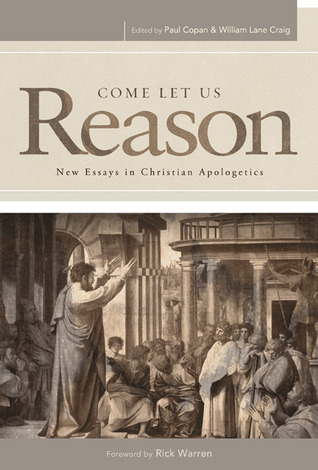 I recently came upon Come Let Us Reason: New Essays in Christian Apologetics, a book I’d been meaning to read for some time. I decided to take a break from the unpacking I was doing to do a little browsing as my son crawled around on my lap. I turned to the index to discover an article entitled: “Apologetically Blonde: The Struggle of Women to Defend Their Faith and What They Should Do about It” by Toni Allen (full citation below- all references to this text). As I browsed the article I knew I needed to write a response, because–with apologies to Toni Allen–I felt much of it was misguided.
Emotional Reasoning
The first critique I have of Allen’s article is the continued references to emotional reasoning and its apparent lack of justification for knowledge. Writes Allen:
…I find that women often depend on their experience and emotional connection with God as the primary justification for the beliefs they hold. In other words, women tend to perceive meaningful experiences and their corresponding emotions to be validation that what they believe is accurate. (40)
She goes on to say:
Yes, the gospel is for the whole person, and this includes existential reasons (including personal experience as well as our deepest emotions and longings)… However, a well-rounded defense of the gospel will include rational reasons and evidences. (40)
Throughout this section, Allen affirms the reality of personal experience and emotions as a basis for believing, but continually asserts that rational reasons are required in the public defense of Christianity. It is difficult to pin down exactly what Allen’s critique is in this section, because the wording is such that it could allow any number of exceptions. Words like “typically,” “often,” “includes,” and the like allow for broad interpretations of her meaning. But it does seem like the whole tone of the article as a whole is that emotions are somehow inadequate as a defense of the faith or that they are opposite or opposed to reason. This latter point is particularly problematic, and it seems like it is closest to the way Allen is leaning throughout the essay.
The reason I say this is because emotions are set up not alongside reasons and rationality, but rather as something separate from them. But this is itself mistaken. As any number of authors have pointed out, emotions themselves are part of the reasoning process and indeed can be integral or even essential to rationality. For example, Daniel Westberg argues in Renewing Moral Theology, a Thomistic approach to ethical theology, that emotions are a central part of the process of reasoning and judgment (see especially 40-43; see also my review of the book here). If Westberg is right, then for Thomists–a formidable bunch of philosophers indeed–emotions are a central aspect of reasoning; not something separate from and possibly antithetical to it. But even if he’s wrong, his case is fairly persuasive that emotions should not be dismissed from the reasoning process, and philosophers of several other flavors have agreed.
Thus, one of the major points of Allen’s assessment is itself mistaken because it operates from a false understanding of the relationship between emotions and reasoning.
As an aside, Allen’s assertion that “we must realize that appeals to religious experience typically do not function as a decisive apologetic” (41) is shifty in its wording (“typically”) while also being mistaken, as philosophers like Richard Swinburne, Caroline Franks Davis, Keith Yandell, and the like have made the argument from religious experience a powerful apologetic tool. Moreover, people like Alvin Plantinga have argued (persuasively, in my opinion), that we can have a rational basis for belief in God through properly basic belief and religious experience.
Can Women Do Apologetics?
Alongside Allen’s constant stream of arguing that women think more emotionally, there is the question of what exactly that is supposed to mean. Again and again we are treated to quotes like the one shared above and those below:
“[W]omen are naturally more cognizant of their emotions… depending on them as the primary validation for our beliefs directly affects our judgment.” (42)
“[I]n mentoring many women over the years, I have found it very common that rather than evaluate an idea on its merits, they are instead more reluctant to adopt an idea if it actuates negative feelings, or more eager to accept it because of positive ones.” (42)
“As women, we should welcome the challenge of defending our faith, even if this pushes us out of our comfort zone.” (45)
Lines like these are found throughout the essay with little supporting evidence other than personal experience–itself a great irony given the previous analysis. But apart from this, it fails to take into account that men and women operate on bell curves in regard to emotional–and other–reasoning skills and so making broad statements like these fails to reflect the reality of the spectrum of capacities for either gender.
Women, according to Allen, also are hamstrung in their attempts to do apologetics through “their natural inclination to avoid conflict” (37). But again, what does this say about men and women essentially (in the philosophical sense)? Do men who have an inclination to avoid conflict somehow become women or more feminine because of this? If so, in what fashion? And what biblical basis do we have for these kinds of assertions?
These and other issues betray a primary underlying presupposition of Allen’s article: gender essentialism. This is a deep topic that I cannot explore thoroughly here, but basically what Allen has–consciously or not–bought into is the notion that men and women operate in largely different spheres with clearly defined cognitive and other barriers between them. That’s why lines like “Women are naturally more cognizant of their emotions…” manage to sneak into the text. But these lines find little argumentative support and again fail to take into account the aforementioned reality that men and women do not operate in entirely different planes of existence–or even emotions. Although Allen generally included lines that allowed for some wiggle room, the overall message was clearly based on this presupposed and unfounded adherence to gender essentialism.
Apologetically Blonde?
A final issue I wanted to mention with the article is the title itself. Although “blonde jokes” have become part of our culture, I think that we as Christians are called to a higher standard. “Blonde” jokes select a specific portion of the population for the sake of ridicule. Though these are often “in good fun” the question is whether such jokes are taken that way and what kind of impact that might have on the people who are, well, blonde. I am not, but it’s easy to see how the use of “blonde” in the title as a synonym for “challenged” could be taken poorly and works against the gentleness and respect we need to display as Christian case-makers.
Links
Be sure to check out the page for this site on Facebook and Twitter for discussion of posts, links to other pages of interest, random talk about theology/philosophy/apologetics/movies and more!
Source
Toni Allen, “Apologetically Blonde: The Struggle of Women to Defend Their Faith and What They Should Do about It” in Come Let Us Reason: New Essays in Christian Apologetics eds. Paul Copan & William Lane Craig (Nashville, TN: B&H Publishing Group, 2012).
SDG.
——
The preceding post is the property of J.W. Wartick (apart from quotations, which are the property of their respective owners, and works of art as credited; images are often freely available to the public and J.W. Wartick makes no claims of owning rights to the images unless he makes that explicit) and should not be reproduced in part or in whole without the expressed consent of the author. All content on this site is the property of J.W. Wartick and is made available for individual and personal usage. If you cite from these documents, whether for personal or professional purposes, please give appropriate citation with both the name of the author (J.W. Wartick) and a link to the original URL. If you’d like to repost a post, you may do so, provided you show less than half of the original post on your own site and link to the original post for the rest. You must also appropriately cite the post as noted above. This blog is protected by Creative Commons licensing. By viewing any part of this site, you are agreeing to this usage policy.
Book Review: “God’s Crime Scene” by J. Warner Wallace
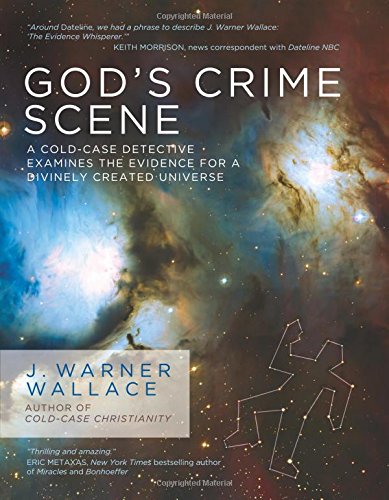 J. Warner Wallace is the a homicide detective and the author of Cold Case Christianity, one of my favorite introductory apologetics books (see my review). He recently came out with his second apologetics book, God’s Crime Scene. The former work focuses on the evidence for the resurrection and the reliability of the New Testament. In God’s Crime Scene, Wallace makes a convincing case presenting evidence for the existence of God.
The first question I think readers will ask is: “What separates this introductory apologetics book from the pack?”
That’s a valid question. There really are a rather large number of intro-to-apologetics books on the market now (thank goodness!). God’s Crime Scene is different from the rest in that it makes real-world examples central to the case that is made therein. That is, Wallace uses examples of crime scenes that he has experienced throughout the book (sans much of the gory details) to set the stage for each exploration of a different argument for the existence of God.
The way this works is simple: each chapter begins with a story that reads much like a mystery novel. Then, Wallace asks a question like “How might we figure out the evidence inside the room with the victim?” After he presents an answer to that question, he shows how similar evidence inside our own “room” (the universe) points to a being outside the room (aka a transcendent being) as the explanation. This makes the book eminently readable while also being almost immediately applicable.
The arguments that Wallace surveys are the cosmological argument, the fine-tuning argument. an argument from the origin of life, a biological design argument, the argument from consciousness, the argument from free will, and the moral argument. Then, he examines the problem of evil before summing up the case. Each chapter presents a look at the evidence, non-theistic explanations (with critiques), and an argument for why a theistic explanation is superior. The chapters then end with what this evidence tells us about God.
Wallace does a great job summing up many of the arguments involved in some of the standard theistic proofs. Each is analyzed briefly, but with a sometimes astonishing amount of information packed into a tight space. Thus, careful reading is required, and the benefit from a careful read is immense.
There are many illustrations and sidebars found throughout the book. These illustrations are always helpful rather than distracting, and highlight key parts of the arguments that Wallace makes. The sidebars are often discussions of how to weigh evidence according to the U.S. Criminal Justice system or Expert Witnesses that are either for or against the presented argument (this latter point is worth highlighting: Wallace does not only appeal to those with whom he agrees–he fairly presents the opposition’s viewpoint and even references their works directly).
There are a few criticisms I would offer. The first is that it seems like some conclusions are reached rather hurriedly, which is addressed in part through the excellent appendices that add more detail to the cases. Even there, however, one gets a sense that the sheer volume of material to cover is at times a stretch, with some objections only given two or so sentences as rebuttals. The other, admittedly nitpicky issue is that it does seem a little bit weird to have the analogue of the criminal being God. That is, the analogy being used is that just like we can detect a criminal through investigation of a murder scene, so to could we detect God through investigation of the universe. It just seems a little weird. It works; but it’s worth mentioning.
God’s Crime Scene is a valuable resource for those interested in apologetics. The way it is written makes it exciting rather than a chore, and the huge amount of information and argumentation contained therein is well worth the price of entry. I highly recommend it.
The Good
+Great use of criminal investigations to highlight points
+Clear exposition of arguments
+Good illustrations that add to what is written
+Real-world situations increase possibility of retaining information
+Includes experts who are not only theists but also anti-theists
The Bad
-Conclusions at times feel rushed
-A bit weird to have analogue of criminal as God
Disclaimer: I received a review copy of this book from the publisher. They did not require any specific kind of feedback whatsoever.
Links
Be sure to check out the page for this site on Facebook and Twitter for discussion of posts, links to other pages of interest, random talk about theology/philosophy/apologetics/movies and more!
Book Reviews– There are plenty more book reviews to read! Read like crazy! (Scroll down for more, and click at bottom for even more!)
Source
J. Warner Wallace, God’s Crime Scene (Colorado Springs, CO: David C. Cook, 2015).
SDG.
——
The preceding post is the property of J.W. Wartick (apart from quotations, which are the property of their respective owners, and works of art as credited; images are often freely available to the public and J.W. Wartick makes no claims of owning rights to the images unless he makes that explicit) and should not be reproduced in part or in whole without the expressed consent of the author. All content on this site is the property of J.W. Wartick and is made available for individual and personal usage. If you cite from these documents, whether for personal or professional purposes, please give appropriate citation with both the name of the author (J.W. Wartick) and a link to the original URL. If you’d like to repost a post, you may do so, provided you show less than half of the original post on your own site and link to the original post for the rest. You must also appropriately cite the post as noted above. This blog is protected by Creative Commons licensing. By viewing any part of this site, you are agreeing to this usage policy.
Really Recommended Posts 7/17/15- Inside Out, women and sacraments, apologetics, and more!
I’m excited to present this week of “Really Recommended Posts” to you, dear readers, because it is a truly extraordinary lineup. I’ve worked ’round the clock (or at least for an hour) to read and bring to you some excellent posts from all over. Our diverse reads today include the latest Pixar movie, “Inside Out,” the necessity of not sharing (or apologizing for) fake news, women in sacramental churches, an exciting new book, and the criminal justice system. As always, let me know what you think! Be sure to let the authors know you appreciated their posts as well.
Inside Out– One of my favorite web sites, Empires and Mangers, takes a look at Pixar’s latest smash hit, “Inside Out.” Anthony Weber looks at the worldview issues raised in the movie, as well as how it might be used to start discussions about some good topics with children. Check out this great reflection.
An Embarassing Week for Christians Sharing Fake News– Here is some advice that we all need to take to heart. Ed Stetzer goes beyond just calling on Christians to check their sources to a real urgency to repenting and admitting wrong when we do share falsities. This is a phenomenal read that deserves to go viral.
Women Leadership in Sacramental Churches– The debate over women’s “role” in the church looks different in those church bodies which are sacramental in nature. I am Lutheran and have experienced the kind of reasoning outlined in this post to try to restrict women’s places in the church firsthand. This is a good read that will not only broaden perspectives about sacramental churches but also make headway in the debate over women in the church.
New Book by James Warner Wallace: “God’s Crime Scene: A Cold Case Detective Examines the Evidence for a Divinely Created Universe– Here is some background on an exciting upcoming release from the author of “Cold Case Christianity,” J. Warner Wallace. It looks like it will be examining arguments like the fine-tuning argument for the existence of God. I wrote a glowing review of Wallace’s previous book, and I look forward to reading this one as well.
Obama frees drug offenders whose terms ‘didn’t fit crimes’– I think that the criminal justice system has turned into a major issue of injustice that we need to address. I think the President’s calling attention to this is a great thing, regardless of what political stance I and others take. There is gross injustice in inequality of sentencing for drug-related crimes, and there is data to back up that much sentencing is racially-biased. We as Christians must speak up for those treated unjustly, and this is an issue worth talking about. What are your thoughts? I’d love to read them here.
Rhetoric as Apologetic- Can we learn from ancient apologetics?
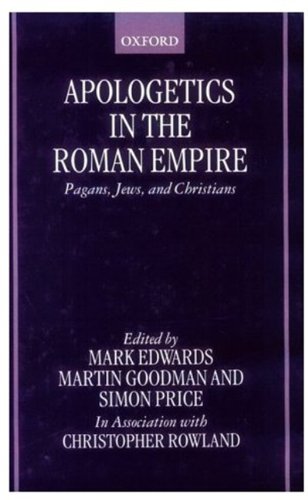 In the ancient world, rhetoric was a major field of study. Briefly, classical rhetoric is the practice of discourse as a means to motivate, inform, persuade. It is hard to pin down to an exact degree what rhetoric is, but here we will use the term as broadly defined above.
Ancient Rhetoric in Apologetics
Mark Edwards, in “The Flowering of Latin Apologetic: Lactantius and Arnobius,” (cited below) examines the way these ancient apologists used rhetoric in their defense of the Christian faith. This involved demonstrating that Christians were educated over and against the notion that Christians were all slaves and fools. It also involved showing that Christians were the paragons of (Roman) society rather than people who overthrew society. They presented Christianity as an alternative way of thinking–a whole system which was to overthrow the Pagan thought of the time.
These different aspects of rhetoric in apologetics were specifically aimed at the audience of the time of Lactantius and Arnobius. Perhaps we can learn from their example.
Rhetoric in Apologetics Today
There are a number of ways we may apply rhetoric to apologetics today. One may argue that the use of memes is one (lowbrow) way of utilizing rhetoric in apologetics–making brief points in a provocative manner that brings forth further thought. How might we best use memes in apologetics? Are they even appropriate? These are questions that I will not delve into, but I think they are worth trying to work out for those involved in apologetics or interested in doing the same.
Another aspect of rhetoric which may be integrated into today’s apologetic is the continued deflection of charges from non-Christians against the faith. Specifically, some allege that Christians are stupid. Like Lactantius and Arnobius, we may feel free to flourish the names of Christian scholars through time and into today. Christians cannot truly be classified as necessarily stupid or foolish when they continually work in the highest levels of academia.
Rhetoric in apologetics seems as though it may necessarily be focused on the “low hanging fruit” like the examples given above. I’m not convinced this is the case, nor am I convinced that this is a valid objection to its use. Regarding the latter point, surely if charges are made against Christians necessarily being foolish or lacking education, a valid response is to demonstrate how this is false. The use of memes is frequently effective, though we must be wary of their tendency to oversimplify.
Regarding the former point–that rhetoric is not necessarily focused on “low hanging fruit,” I would note that in many ways, a convincing case depends on how it is presented. Moreover, as Christians we are called to present our case in a way that will put us above reproach in character. If we’re able to eloquently present a case, then perhaps more will consider the case itself. I’m not suggesting we try to obfuscate, but we should try to work to present our case in a winsome manner that utilizes the best scholarship, the most current language, and integrates the fewest possible errors (and this includes typos and spelling errors–something of which I am guilty, I’m sure).
Moreover, Lactantius and Arnobius were both clearly concerned with the imminent attacks on Christianity. They weren’t seeking to anticipate and shoot down future problems so much as they were dealing with the current attacks on their faith. Perhaps we can take this as a call to focus on the issues which face Christianity today ourselves. Like them, we need to confront the most popular of our naysayers and utilize the best scholarship in order to refute criticisms of Christianity.
Links
Be sure to check out the page for this site on Facebook and Twitter for discussion of posts, links to other pages of interest, random talk about theology/philosophy/apologetics/movies and more!
Sunday Quote– If you want to read more Sunday Quotes and join the discussion, check them out! (Scroll down for more)
On the Shoulders of Giants: Rediscovering the lost defenses of Christianity– I have written on how we may discover the enormous resources historical apologists have left behind for us. Take and read!
Source
Mark Edwards, “The Flowering of Latin Apologetic: Lactantius and Arnobius” in Mark Edwards, Martin Goodman, and Simon Price, eds., Apologetics in the Roman Empire
SDG.
——
The preceding post is the property of J.W. Wartick (apart from quotations, which are the property of their respective owners, and works of art as credited; images are often freely available to the public and J.W. Wartick makes no claims of owning rights to the images unless he makes that explicit) and should not be reproduced in part or in whole without the expressed consent of the author. All content on this site is the property of J.W. Wartick and is made available for individual and personal usage. If you cite from these documents, whether for personal or professional purposes, please give appropriate citation with both the name of the author (J.W. Wartick) and a link to the original URL. If you’d like to repost a post, you may do so, provided you show less than half of the original post on your own site and link to the original post for the rest. You must also appropriately cite the post as noted above. This blog is protected by Creative Commons licensing. By viewing any part of this site, you are agreeing to this usage policy.
Book Review: “Fool’s Talk” by Os Guinness
 Os Guinness’ Fool’s Talk is an argument for the need to change the forms of Christian persuasion used in apologetics specifically but also more generally in evangelism.
Guinness critiques the way that many go about their witnessing in categories that really only make sense within contexts that are foreign to a biblical understanding and worldview. He also shines the light on how often we allow our modern concepts to distort our witness–often for the worse. There are also a number of incisive arguments against the ways that people use excuses or sinfulness to avoid the truth in witness.
There are also many helpful comments on how we need to change our communication to confront the assumptions of our cultures and resonate even with those who are predisposed to disagree with us or not want to listen to the message of Christ. These include the need to confront sin, but do so in a winsome manner; to surprise listeners with a story told in a different way, and more.
The book is also supremely quotable, with many excellent one-line examples that people might use to illustrate points about communication, culture, and other important topics.
My main complaint with the book is that Guinness uses few practical examples to go with his critique or discerning of the styles of witnessing and engagement. The main examples used are biblical examples–surely a good way to find some effective communication!–but often these feel highly occasional rather than applicable to everyday situations. Guinness does an admirable job explaining these examples and highlighting how they were effective means of communication, but it would have been nice to have several practical applications in order to see exactly how Guinness thinks we are to change in these areas.
In several sections does offer some examples of how we might better communicate, but often it seems he is more concerned with informing the readers about how communication needs to change rather than following that with exactly how change might look.
Another complaint is that one of the hooks used by Guinness to start a chapter was to talk about a misogynist who successfully redirected the ire towards his position into making people think about what they were saying. It was an example that caught my attention, but using such a negative example to try to make a positive point was jarring.
Fool’s Talk provides many insights into how apologetically- and evangelically-minded people can explore new avenues for witnessing. However, it does not provide many practical examples for how people might go about exploring these avenues. It’s a good starting point, but readers will need to go farther.
The Good
+Clever wording often puts new perspective on old issues
+Some helpful hints at directions apologetics may pursue effectively
+Insightful commentary on ways engagement needs to change to be successful
The Bad
-Doesn’t offer many practical applications
Disclaimer: I was provided with a review copy of the book from the publisher. I was not asked to give any specific kind of feedback whatsoever.
Links
Be sure to check out the page for this site on Facebook and Twitter for discussion of posts, links to other pages of interest, random talk about theology/philosophy/apologetics/movies and more!
Book Reviews– There are plenty more book reviews to read! Read like crazy! (Scroll down for more, and click at bottom for even more!)
Source
Os Guinness, Fool’s Talk (Downers Grove, IL: InterVarsity, 2015).
SDG.
——
The preceding post is the property of J.W. Wartick (apart from quotations, which are the property of their respective owners, and works of art as credited; images are often freely available to the public and J.W. Wartick makes no claims of owning rights to the images unless he makes that explicit) and should not be reproduced in part or in whole without the expressed consent of the author. All content on this site is the property of J.W. Wartick and is made available for individual and personal usage. If you cite from these documents, whether for personal or professional purposes, please give appropriate citation with both the name of the author (J.W. Wartick) and a link to the original URL. If you’d like to repost a post, you may do so, provided you show less than half of the original post on your own site and link to the original post for the rest. You must also appropriately cite the post as noted above. This blog is protected by Creative Commons licensing. By viewing any part of this site, you are agreeing to this usage policy.
Book Review: “Mapping Apologetics” by Brian Morley
 Although there is widespread agreement over the need to have a defense of the faith (a biblical charge–1 Peter 3:15-16), there is much disagreement over exactly how that defense should proceed. Brian Morley’s Mapping Apologetics
There are few books that deal exclusively with apologetic methodology by outlining various approaches. Perhaps the most comprehensive is Faith Has Its Reasons
After a couple introductory chapters on apologetics in the Bible and history, the following chapters each highlight individuals who are major contemporary proponents of different apologetics methods. Included are such people as Cornelius Van Til, Alvin Plantinga, E.J. Carnell, Richard Swinburne, William Lane Craig, and John Warwick Montgomery, just to name a few.
Each of these chapters presents an extended overview of the apologist’s method of defending the faith along with several quotes and often detailed analysis of their primary arguments with examples. Thus, readers are given the resources to compare and contrast the various approaches on the level of the actual arguments and counter-arguments presented.
The people chosen are each major contributors to their specific variety of apologetics, so both those who are well-versed in apologetics and those who are just beginning will get insights from top defenders of the faith. I personally have an MA in Christian Apologetics, and I was familiar with each author, but the way that each was presented gave me a good refresher on their method and primary arguments–and sent me scampering to re-read some of my favorites!
The book includes some great follow-up questions after each chapter to help readers review the material in the chapter, along with useful further reading sections for those interested in learning more about specific defenders. Each chapter also includes criticisms of the specific type of apologetic the individual puts forward. These are often only about 1 1/2 to 2 pages, though, and it would have been nice to have a bit more space dedicated to the critiques and rebuttals to each approach. Morley also very quickly dismisses the fideistic approach as being “unbiblical” with only a brief argument. Although I am not at all a fideist, I do think that the approach has at least some merit and the aforementioned work by Boa and Bowman has some great insights into how it might also offer some insights into apologetics.
Mapping Apologetics
The Good
+Great summaries of top apologists from multiple methodological approaches
+Invaluable insight into different apologetics methodologies
+Helpful review questions and resource lists
The Bad
-Dismisses fideism too quickly
-Could stand to have more reflection on criticisms of each position
Disclaimer: InterVarsity Press provided me with a copy of the book for review. I was not obligated to provide any specific kind of feedback whatsoever, nor did they request changes or edit this review in any way.
Links
Be sure to check out the page for this site on Facebook and Twitter for discussion of posts, links to other pages of interest, random talk about theology/philosophy/apologetics/movies and more!
Book Reviews– There are plenty more book reviews to read! Read like crazy! (Scroll down for more, and click at bottom for even more!)
Source
Brian Morley, Mapping Apologetics
SDG.
——
The preceding post is the property of J.W. Wartick (apart from quotations, which are the property of their respective owners, and works of art as credited; images are often freely available to the public and J.W. Wartick makes no claims of owning rights to the images unless he makes that explicit) and should not be reproduced in part or in whole without the expressed consent of the author. All content on this site is the property of J.W. Wartick and is made available for individual and personal usage. If you cite from these documents, whether for personal or professional purposes, please give appropriate citation with both the name of the author (J.W. Wartick) and a link to the original URL. If you’d like to repost a post, you may do so, provided you show less than half of the original post on your own site and link to the original post for the rest. You must also appropriately cite the post as noted above. This blog is protected by Creative Commons licensing. By viewing any part of this site, you are agreeing to this usage policy.
Really Recommended Posts 5/8/15- Sola Scriptura, National Day of Prayer, and more!
I’m pretty excited to offer you, dear readers, another round of Really Recommended Posts this week. These should give you some nice diverse topics to explore! As usual, be sure to let me know your thoughts on the links, and let the authors of the posts know themselves!
A Short Defense of Sola Scriptura– Here is some insight into the defense of the doctrine of sola scriptura against those who would allege that there needs to be some authenticating authority for the books that make up Scripture. What do you think of this argument?
“I can’t help you” – What Should Never Be Heard at Church– The way we invite (or don’t) others into the life of the church matters. What ways might we best provide an environment that welcomes others into our community? Here’s an example of how not to do it.
Beware of Prayer–New Apostles and Prophets on the National Day of Prayer– Some insight into the documents that are being passed around by leadership for the National Day of Prayer. I think this is pretty unfortunate. However, I don’t think this needs to interrupt your own participation in said day. For some insight into spiritual warfare (including the view of “warfare prayer” and the like), see my review of Understanding Spiritual Warfare: 4 Views (and the book itself, of course!).
5 Changes Elementary Sunday Schools Need to Make ASAP– How might we better equip our children to engage with the challenges they will face against Christianity? Here are 5 important points for changing Sunday School to set children up for success.
LOL Interwebz: Putin the Memes Away– Here’s a challenging post on the use of memes, what they do for us (and to us) and the relation of free speech and Christianity.

 J.W. Wartick - Reconstructing Faith