christian apologetics
Really Recommended Posts 4/24/15- abortion and evangelicals, apologetics, and more!
 Winter is back, apparently, here in Minnesota. It’s COLD! And it snowed on Monday and Tuesday. Anyway, here we have some reading to keep you entertained on chilly nights. The topics are abortion and evangelicals, raising kids, apologetic methods, science fiction, and a debate over the Reformation.
Evangelicals Opposed Abortion Much Earlier than You Think– It has been said that evangelicalism wasn’t originally pro-life or oriented against abortion. Is that true? Moreover, does it even matter? Here’s an article examining the historical claim. My own thoughts are that it doesn’t matter when evangelicals began working against abortion. The question is whether abortion is morally permissible (or not). Whether a group historically opposed it or not doesn’t do much to the current debate other than provide a rhetorical flair. This post takes away some of that rhetorical flair.
4 Reasons the Internet May Influence Your Kids’ Faith More Than You– What influence does the internet have on kids exploring questions about the faith? How might awareness of this influence help us to confront worldview issues?
Comparing Apologetics Systems: Methodology and Practice– How should we do apologetics? Here is a post outlining some different approaches to apologetics and how they might be applied.
Spec[ulative]-Fic[tion] Subgenres: Superheroes & Fairy Tales– Christian publisher (of science fiction and fantasy) Enclave has an interesting post comparing the genres of superhero writing to fairy tales. They’re the same publisher who is re-releasing Kathy Tyers’ works. I had an interview with this awesome sci-fi author regarding worldview questions and science fiction here.
Revelation TV Debate: Church would have been better off without the Reformation?– Here’s an interesting debate about whether the Reformation was a good development in church history. The debaters are James White and Rev. Dr. Thomas Norris.
Is Natural Theology Excluded for Apologetics? – Sunday Quote!+
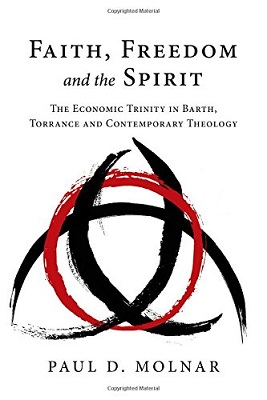 Here’s a special edition Sunday Quote which features a more extended discussion. Let me know what you think in the comments.
Is Natural Theology Excluded for Apologetics?
Paul Molnar’s Faith, Freedom and the Spirit 
If contemporary theologians were to make explicit the role of the Holy Spirit in enabling our knowledge of the triune God, then there could be wide agreement that natural theology of whatever stripe is not only unhelpful but is directly excluded from any serious understanding of theological epistemology. (82)
Now, “natural theology” is, according to Justo Gonzalez’s Essential Theological Terms, “A theology that claims to be based on the natural gifts of the human mind, and on the ‘general revelation’ granted to all… rather than on a ‘special revelation’ in Scripture or Jesus Christ” (118). Natural theology, that is, is the attempt to show that God exists and certain other truths through looking at the world. From this quote, it seems that Molnar is arguing that if we had a better notion of the role of the Holy Spirit, we would basically think that natural theology is worthless related to knowledge of God.
Molnar develops this notion further throughout the next 50 pages or so. His argument basically is that if we acknowledge that it is the Holy Spirit who enables faith and knowledge of God, then any “knowledge” of God which is not directly through faith (i.e. through something like a cosmological argument) is not objective knowledge of God.
Although some of what Molnar argues resonates with me–particularly the notion that the Holy Spirit is the one who imparts faith rather than it being some kind of choice we make–I think that his dismissal of natural theology is unnecessary and mistaken. First, the most obvious question to be asked is whether the Spirit can use natural theology to create faith. If it is the case that the Holy Spirit can work through natural theology–something which seems to be clearly correct to me–then the objection that natural theology ignores the role of the Spirit is mistaken.
Second, Molnar’s argument seems to rely on a concept of natural theology which is entirely about trying to impart knowledge of God to those who do not have faith. This, however, ignores the use of apologetics in strengthening the faith of believers. Natural theology can be a valuable tool for those who have faith to pursue the call of 1 Peter 3:15 and have a reason for the hope within them. Whatever one’s view of whether natural theology can bring people to the true God, it seems that it can and should be used for believers to explore the natural world and bolster their faith.
Third and finally, it seems to me that Romans 1 in particular demonstrates that natural theology is not a worthless project. If God’s invisible attributes are capable of being discovered in the things God has made, then surely natural theology has some value in tracing God’s handiwork.
Should we think that natural theology is a failed project? Can it have other uses like those I listed? Is it possible to go from God to Christ? What of the role of the Spirit in apologetics?
Faith, Freedom and the Spirit
Links
Be sure to check out the page for this site on Facebook and Twitter for discussion of posts, links to other pages of interest, random talk about theology/philosophy/apologetics/movies and more!
Sunday Quote– If you want to read more Sunday Quotes and join the discussion, check them out! (Scroll down for more)
Source
Paul D. Molnar, Faith, Freedom and the Spirit (Downers Grove, IL: InterVarsity, 2015).
SDG.
——
The preceding post is the property of J.W. Wartick (apart from quotations, which are the property of their respective owners, and works of art as credited; images are often freely available to the public and J.W. Wartick makes no claims of owning rights to the images unless he makes that explicit) and should not be reproduced in part or in whole without the expressed consent of the author. All content on this site is the property of J.W. Wartick and is made available for individual and personal usage. If you cite from these documents, whether for personal or professional purposes, please give appropriate citation with both the name of the author (J.W. Wartick) and a link to the original URL. If you’d like to repost a post, you may do so, provided you show less than half of the original post on your own site and link to the original post for the rest. You must also appropriately cite the post as noted above. This blog is protected by Creative Commons licensing. By viewing any part of this site, you are agreeing to this usage policy.
Really Recommended Posts 4/3/15- Golden Son, Tyndale, Judaism, and more!
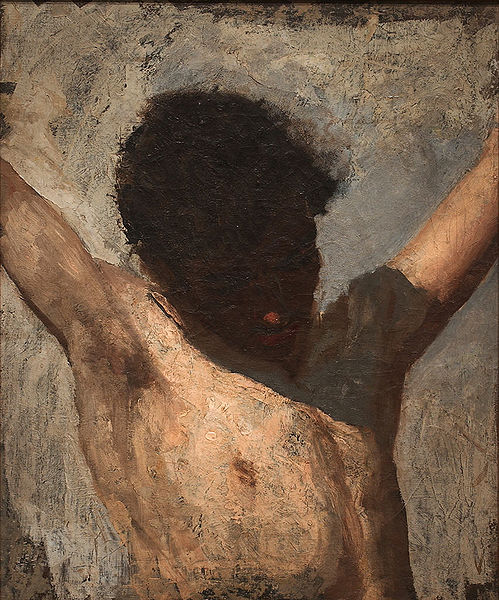
Sketch for the Crucifixion by Thomas Eakins
Today is Good Friday. Let us reflect upon the greatness of God and the power of the Son for our salvation. Amen!
Now, be sure you also dive into this reading material as I have collected it from all corners of the internet for you, dear readers. A broad array of topics is here for your reading pleasure.
Golden Son (Red Rising)– Golden Son is book two of a trilogy by Pierce Brown which is quite interesting. I reviewed the first book myself here. Anthony Weber’s look at the second book provides some solid insights into this YA novel and human nature.
Reject Jesus for Judaism?– A great question and answer about whether it is more reasonable to reject Jesus and embrace Judaism.
“Feminist” is not a Dirty Word– Too often, we see the word “feminist” and react against it with a whole slew of beliefs about what the word must mean before we ask the person who self-identifies as such what it does mean. Here’s a good read to get some insight into the matter.
Tyndale (Comic)- Who was Tyndale and why does he matter? Here’s a neat little comic that answers these and other questions.
Evaluating RC Sproul’s Objection to Presuppositional Apologetics at the Inerrancy Summit– Apologetic method is a debate I try to avoid generally because I think that we need to realize that different approaches will work better for different people and situations. I favor an integrated approach with different methods meshed together. Here’s a look at one objection to the presuppositional method and a response from a presuppositional apologist. What are your thoughts on the matter?
Really Recommended Posts 2/27/15- Egalitarian Black Women, Diatoms, and more!
One day, my child will let me sleep again. It is not this day. 5 months of almost no sleep starts to make you a bit crazy! What year is it? Why do I walk on the ground and not the ceiling? Why did I put a picture of a Snowy Owl on this post? Anyway, I got myself coherent for long enough to assemble this great group of posts for your reading pleasure, dear readers! Read enough about 50 Shades? So did I, until I ran into the post I share below. It sets quotes from the book alongside definitions of abuse and stalking to some dramatic effect. We also have a great look at some egalitarian black women, young earth creationism, apologetics, and women in fiction. Check them out, and let me know what you thought! Be sure to also let the authors know!
5 Black Women Every Egalitarian Should Know– This is just a fantastic post that outlines the lives and impact of 5 black women who are major voices for egalitarianism (and other issues).
Issues of Abuse and Consent in 50 Shades of Grey– Here’s an excellent post that has specific quotes from 50 Shades alongside the definitions of abuse and stalking and the like. It’s quite disturbing to realize what’s in the book, and I wouldn’t have personally thought to write a post like this myself. This is a good resource to have on hand. There is some ADULT CONTENT in this link, which the author does a good job of warning beforehand.
Life in a Glass House: Diatoms Shatter Young Earth Flood Geology– What do diatoms tell us about the plausibility of young earth creationist models? Can Flood Geology really stand up under scrutiny?
The New Frontier in Apologetics: An Open Letter to the Apologetics Community– How do we move towards a broader integration of the Christian worldview into the culture and perhaps move back to the direction that Christianity is where the intelligentsia operate?
Oh No She Didn’t: The Strong Female Character Deconstructed– What does it mean to have a “strong female character”? Do we need to have specific tendencies for such characters? Can women just be women? Check out this interesting post from sci-fi publisher “Tor”‘s blog.
On the Alleged Atheism of Early Christians
 It is interesting to note that modern atheists of the internet-infidel variety share much with Pagan counterparts in the first few centuries after Christ. “How can this be?” one might ask. Well, the charge of atheism against Christians is shared both by the common internet-infidel comment that “We’re all atheists, I [the atheist] just take it one god further” and Pagans in the Roman Empire. Oddly, some atheists have gone so far as to suggest that the Pagan accusation is somehow evidence for their position.
The early Christians, it is true, were accused of being atheists. However, to suggest that this is somehow synonymous with contemporary usage of the term “atheist” is ahistorical and anachronistic. Frances Young notes several facets of the charge of atheism leveled against Christians:
What the charge [of atheism leveled against Christians] really amounted to was an expression of dismay and distaste over the fact that people were abandoning conventional ritual practices… The charge of atheism against Christians focused on their refusal after conversion to continue to participate in traditional religious customs… Religion, embedded in the ethnic cultures, was a matter not of belief but of loyalty. (99, 101, cited below)
The charge against Christians, then, was that they were abandoning the ways of the Romans. They were outsiders, outcasts, and, by extension, atheists. By refusing to worship the gods of Rome, they became targets. The fact that the Christians did this conscientiously–they intentionally abandoned the gods–led to the charge of atheism. It was a charge related not to belief in deity, but rather to rejection of shared societal practice, with a culturally charged impetus for making it.
In fact, others who yet believed in the gods were also charged with atheism. The Epicureans were accused of atheism, despite believing that the gods existed:
It is significant that these ‘atheists’ [Epicureans] did not question the existence of the gods. Rather, they liberated people from religion by suggesting that the blessed immortals were not the slightest bit interested in what goes on among human beings… (ibid, 100)
Thus, when modern atheists continue to perpetuate the claim that “we’re all atheists,” and then move on to argue that Christians should agree with them because, after all, Christians were considered ‘atheists’ by the Romans, it is difficult to take them seriously. The Pagan charge was made for cultural reasons, and is tied up in the notion of rejection of the societal norms of the time. It was also made even against those who acknowledged those gods existence. This last point is very important, because one attempted rebuttal I have seen from the modern atheist is that “You are an atheist to other religions.” Well, according to ancient Pagans, you could even be an atheist to your own religion! Of course, the point is that Christians are not atheists, but theists.
The word “atheism” was used back then as a damning charge of societal blasphemy–rejecting the ethnic practices of your own society in pursuit of another’s. Now, modern atheists attempt to forcibly include others in atheism with this kind of pithy phrase. The historical charge is interesting, but clearly entirely different from the modern one. Either charge, however, is inaccurate. Christians, by definition, are not atheists–theists cannot be atheists. The ancient cultural charge is of interest for its historical implications, but it is hardly evidence for the modern use of the charge of atheism against Christians.
I suspect that this post won’t silence many who will continue to persist in saying Christians are atheists. At that point, I suggest to others the following: the people who persist in this mislabeling should be written off as being just as irrelevant as the ancient Pagans with whom they share at least this part of their worldview.
Links
Be sure to check out the page for this site on Facebook and Twitter for discussion of posts, links to other pages of interest, random talk about theology/philosophy/apologetics/movies and more!
On the statement that “We are all atheists”– I evaluate the claim that atheists make which say that “we are all atheists.” I evaluate it from a philosophical point of view here.
On the Shoulders of Giants: Rediscovering the lost defenses of Christianity– I have written on how we may discover these enormous resources historical apologists have left behind for us. Take and read!
Source
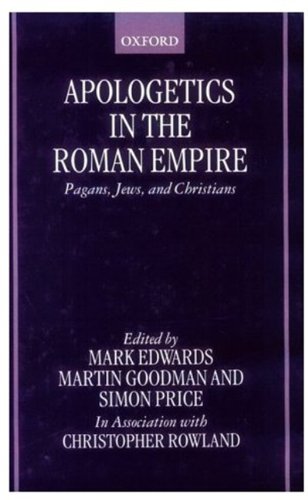
Frances Young, “Greek Apologists of the Second Century” in Mark Edwards, Martin Goodman, and Simon Price, eds., Apologetics in the Roman Empire
SDG.
——
The preceding post is the property of J.W. Wartick (apart from quotations, which are the property of their respective owners, and works of art as credited; images are often freely available to the public and J.W. Wartick makes no claims of owning rights to the images unless he makes that explicit) and should not be reproduced in part or in whole without the expressed consent of the author. All content on this site is the property of J.W. Wartick and is made available for individual and personal usage. If you cite from these documents, whether for personal or professional purposes, please give appropriate citation with both the name of the author (J.W. Wartick) and a link to the original URL. If you’d like to repost a post, you may do so, provided you show less than half of the original post on your own site and link to the original post for the rest. You must also appropriately cite the post as noted above. This blog is protected by Creative Commons licensing. By viewing any part of this site, you are agreeing to this usage policy.
Handel’s “Messiah” as Apologetic
 “I should be sorry if I only entertained them [the audience], I wish to make them better.” – Handel
Handel’s “Messiah” is one of the greatest pieces of music ever composed. It has been performed constantly since he wrote it. There is no doubting the enduring popularity of the piece and the way it brings comfort to God’s people. It is often played during the Christmas or Advent seasons and has become a way for many to hear the message of Christ during this time.
One aspect that is not often explored, however, is the way the piece may be seen as an apologetic for Christianity. Calvin Stapert, in his work on the piece, Handel’s Messiah: Comfort for God’s People, notes how the work was written in part as apologetic. The biblical selections which were put together to form the lyrics of the performance were selected by Charles Jennens, whose brother had committed suicide during some doubt-inducing talks with a famous deist (77-78, cited below).
Moreover, Christian apologists during this time–during the height of Enlightenment–were beginning to realize that simply making arguments from natural revelation or reason alone was in some way to not engage with the Deists who were at large. After all, Deists could agree God existed. The question was which God and whether God was personal. So although the arguments of natural theology were helpful, they could not do all the work on their own, and Christian apologists set about the task of proving Christianity through the Scriptures (75-77).
By simply putting forth a different narrative than that of the Deists, Handel and Jennens challenged the notion that God was impersonal. Moreover, they pressed home the need for a savior due to our own futile raging against God. The beauty of he piece serves to enhance its apologetic narrative, making it entice the heater to keep listening. The music forges links between the notion of he need for a savior and the Incarnate Son.
The Messiah, then, is part of this project. It is a story of prophecy and the way that God sent the Son into the world, incarnate in the flesh, to bring about salvation. It is a masterful interweaving of Old Testament prophecy and New Testament fulfillment. More than that, it is an apologetic voice in the wilderness.
Source
Calvin Stapert, Handel’s Messiah: Comfort for God’s People (Grand Rapids, MI: Wm. B. Eerdmans, 2010).
Links
Be sure to check out the page for this site on Facebook and Twitter for discussion of posts, links to other pages of interest, random talk about theology/philosophy/apologetics/movies and more!
Book Reviews– There are plenty more book reviews to read! Read like crazy! (Scroll down for more, and click at bottom for even more!)
SDG.
——
The preceding post is the property of J.W. Wartick (apart from quotations, which are the property of their respective owners, and works of art as credited; images are often freely available to the public and J.W. Wartick makes no claims of owning rights to the images unless he makes that explicit) and should not be reproduced in part or in whole without the expressed consent of the author. All content on this site is the property of J.W. Wartick and is made available for individual and personal usage. If you cite from these documents, whether for personal or professional purposes, please give appropriate citation with both the name of the author (J.W. Wartick) and a link to the original URL. If you’d like to repost a post, you may do so, provided you show less than half of the original post on your own site and link to the original post for the rest. You must also appropriately cite the post as noted above. This blog is protected by Creative Commons licensing. By viewing any part of this site, you are agreeing to this usage policy
Book Review: “Pascal’s Wager” by Jeff Jordan
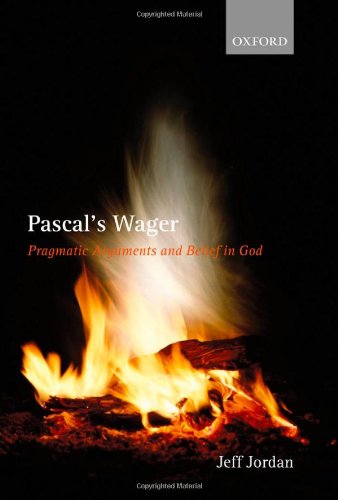
For some time, I’d been wanting to put some effort into studying Pascal’s Wager. I picked up Pascal’s Wager: Pragmatic Arguments and Belief in God by Jeff Jordan in order to familiarize myself more with the philosophical grounding behind the argument. Jordan approaches the Wager through a lens of analytic philosophy and, I think, demonstrates that the argument has some force to it.
Jordan’s work has great scope. Several aspects of the Wager are brought to light. He analyzes several different formulations of the argument, while also noting where the argument has been changed or modernized. For example, the notion that Pascal’s Wager was infinite bad vs. infinite good is a more recent innovation than Pascal’s original argument.
He studies the argument contextually to determine whether the Wager was intended as a generalized theistic proof or an argument for Christianity. Numerous objections from leading critics of the Wager are put to the test. Ultimately, a version of the Wager developed by William James is put forward as an argument that passes the philosophical muster. Jordan analyzes this argument from many angles, ultimately demonstrating that it overcomes the challenge of the “many gods” objection and provides grounds for Christian faith.
The value of Pascal’s Wager may is increased by the fact that many aspects of Jordan’s work are applicable to other arguments or areas of interest for philosophers of religion and apologists. For example, Jordan raises significant challenges to the notion that philosopher’s fictional deities may actually be counted as evidence for a “many gods” objection (75-76; 80-81). Another example is a rather interesting argument he derives from the work of James Beattie (1735-1803- Jordan notes Beattie is at times rightly accused of misrepresenting Hume’s arguments) about whether attempts to deconvert might bring about pragmatic wrongs (190-194). These and other tantalizing topics command even more interest than the book might otherwise have had.
Simply put, Pascal’s Wager: Pragmatic Arguments and Belief in God is a phenomenal, thought-provoking work that will have readers rethinking their evaluation not only of the (in)famous Wager but also of a number of related topics. Even at its steep price tag, the book is a bargain.
Links
Be sure to check out the page for this site on Facebook and Twitter for discussion of posts, links to other pages of interest, random talk about theology/philosophy/apologetics/movies and more!
Pascal’s Wager: The Utility Argument Examined– I outline and defend one of the versions of Pascal’s Wager which Jordan brings up in this work. I find it to be a very interesting argument and a great addition to the apologist’s toolkit.
Source
Jeff Jordan, Pascal’s Wager: Pragmatic Arguments and Belief in God
SDG.
——
The preceding post is the property of J.W. Wartick (apart from quotations, which are the property of their respective owners, and works of art as credited; images are often freely available to the public and J.W. Wartick makes no claims of owning rights to the images unless he makes that explicit) and should not be reproduced in part or in whole without the expressed consent of the author. All content on this site is the property of J.W. Wartick and is made available for individual and personal usage. If you cite from these documents, whether for personal or professional purposes, please give appropriate citation with both the name of the author (J.W. Wartick) and a link to the original URL. If you’d like to repost a post, you may do so, provided you show less than half of the original post on your own site and link to the original post for the rest. You must also appropriately cite the post as noted above. This blog is protected by Creative Commons licensing. By viewing any part of this site, you are agreeing to this usage policy.
Sunday Quote!- Ancient Apologetics and the Disinterest of the Modern Age
Every Sunday, I will share a quote from something I’ve been reading. The hope is for you, dear reader, to share your thoughts on the quote and related issues and perhaps pick up some reading material along the way!
Ancient Apologetics and the Disinterest of the Modern Age
After getting a recommendation from… I don’t remember whom/which book, I picked up Apologetics in the Roman Empire
[T]he style of the ancient apologists has estranged them further from practical apologetic than their contents did in any previous century… The only modern scholars, therefore, to whom the [ancient] apologists [like Justin Martyr, Josephus, Tatian, and the like] mean anything are those who take a sympathetic interest in the culture and the interplay of religious traditions in the Roman Empire… (13, cited below)
Thus, according to the editors of this volume, the “only” reason that anyone would be interested in these works in the modern era is because they wish to explore the cultural understanding of the religious traditions in Ancient Rome.
That makes me quite sad, to be honest! As one who is deeply interested in the study of historical apologetics, it seems clear that much of what is discussed in this volume is actually of interest to modern apologists, those interested in church history, and many others. Of course the editors are perhaps merely speaking only of the interest which they have found for their subject, which speaks of the sorry state of how we modern apologists have abandoned our historic roots. Perhaps these words can serve as a rallying cry to raise us from our stupor of historical ignorance and realize the vast, untapped wealth of historical apologetics.
I have written to that end in a post in which I discuss the lost defenses of Christianity. Explore, take, and read!
The book itself has much appeal for those interested in historical apologetics. I’m about halfway through right now and have found it to be quite excellent.
Links
Be sure to check out the page for this site on Facebook and Twitter for discussion of posts, links to other pages of interest, random talk about theology/philosophy/apologetics/movies and more!
Sunday Quote– If you want to read more Sunday Quotes and join the discussion, check them out! (Scroll down for more)
On the Shoulders of Giants: Rediscovering the lost defenses of Christianity– I have written on how we may discover these enormous resources historical apologists have left behind for us. Take and read!
Source
Mark Edwards, Martin Goodman, and Simon Price, eds., Apologetics in the Roman Empire
SDG.
Really Recommended Posts 10/24/14- Reconciling in Christ, Walking Dead, and more!
 Hello friends! I have another set of links for you to peruse. As always, let me know what you think of the links and if you enjoyed them, leave a comment on those blogs! Thanks for stopping in and reading!
Ambassadors for Reconciliation– There has been much ire flying around over the director of the theistic evolutionist group Biologos’ invitation to creationists like Ken Ham to have dinner and talk over the issues. Here, Hugh Ross reflects upon the extreme reactions of some and the ways we can work towards reconciliation. One quote in particular is helpful:
Enough is enough. There are mission fields still to be reached. How can we ask nonbelievers to dialogue with us if we cannot graciously dialogue with one another, if we treat one another as enemies? Unless we make some progress in reconciling our differences, how can we expect to help reconcile a skeptical world to Christ? We are commissioned by God to be His ambassadors. It’s time for us to start behaving as ambassadors.
I think this is spot on. I have personally been accused by a number of those who disagree with me of being a vile compromiser, someone who is actively leading people away from Christ, etc. If this is how we treat fellow believers, why should those who do not yet believe think that we will be capable of honest dialogue with them? Let’s stop the insults and start genuine dialogue. Let us show one another charity.
When Humans Lose their Humanity: “No Sanctuary” and the real Horror of Terminus– What happens when humans are dehumanized? Here’s an interesting look at ‘The Walking Dead’ which explores this question in deeply insightful ways.
Do we really need to teach our kids apologetics when God is in control anyway?– Here’s an excellent post on the need to educate our children in the Christian faith. Unfortunately, some think that we shouldn’t bother because God is in control. How might we answer this?
Is the Shroud Evidence for God’s Existence?– I have a number of friends in apologetics who are convinced that the Shroud of Turin is genuinely the image of Christ. I am personally unconvinced, but I found this article on it interesting for analyzing what we should make of the Shroud, were it to prove genuine.
Intersections: Summit on Origins– I’m going to be at this conference hosted by Bethel University. It’s on the origins debate, a topic of great interest to me. If you’re able to make it, I’d love to see you there! Let me know!
“The Monuments Men” – An Apologetic of Culture
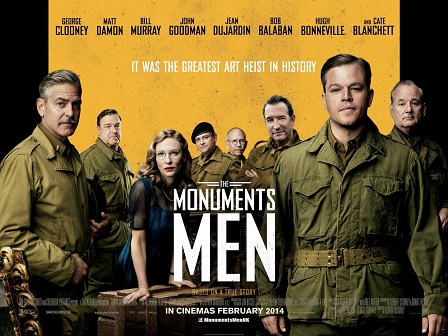 “The Monuments Men” is a film based on a true story of a group of soldiers sent to salvage cultural artifacts from destruction by the Nazis. Here, we’ll analyze the film from a worldview perspective. There will be SPOILERS in what follows.
Aesthetics
One question the film puts front and center is this: “Of what value is art?”
The question is put in a number of poignant ways, such as a moving scene in which Donald Jeffries is killed in an effort to protect Michelangelo’s Madonna and Child. The scene is powerful because Jeffries finds his value in his efforts to defend and preserve this beautiful art. He writes a letter to his father about the value of defense of such a work of art, which is overlaid with the imagery of him being killed by a Nazi officer.
Claire Simone works against the Nazis to try to protect and preserve the ownership of art. Her recognition of the importance of these pieces of history to those who collected them is a recognition of the power of the human mind to transcend the mundane.
The power of art to shape humanity, or even become a monument to humans–a way to transcend–is front and center throughout the film. The question that is then begged is this: if the natural world is all which exists, whence the transcendence? Where or to what might the transcendence point?
History and Life
History is important aspect of human life. Long have various cultures held notions that if one’s name were erased from historical record, it was as if one never had existed. The driving force to be remembered is a powerful one in human life, but perhaps it is also something which drives us towards art.
By collecting the art and stealing the works from their rightful owners, the Nazis were essentially attempting to rewrite history and capture the cultural past of those who owned or produced the art. There is a powerful message behind this of the need to be aware of how history is shaped by even those who are writing it.
Argument from Aesthetics?
How is it that humans recognize the value of art, or, more abstractly, of beauty? Some would allege that it is merely something we assign to things. The value is entirely a construct. In some ways that seems true, but there is something inherent in the notion that beauty–that art–is something which it is a great evil to destroy or take from someone else. Beauty is in the eye of the beholder, but it is also something which points beyond itself, to the transcendent.
The very possibility for recognizing that which is beautiful itself cries out for explanation. Whence the need for, dedication to, and recognition of beauty? A Christian would point beyond these towards God. Without the actual existence of the transcendent, there is little possibility for explaining the capacity for humans to reach out and grasp it.
Conclusion
“The Monuments Men” is a very solid flick to explore from worldview perspectives. It’s not as action-packed as most war movies, but it is more thoughtful and because of that it is in many ways more compelling. Perhaps most interestingly, it offers a view of the arts as something concrete, to be appreciated, and perhaps even transcendent.
Links
Be sure to check out the page for this site on Facebook and Twitter for discussion of posts, links to other pages of interest, random talk about theology/philosophy/apologetics/movies and more!
SDG.
——
The preceding post is the property of J.W. Wartick (apart from quotations, which are the property of their respective owners, and works of art as credited; images are often freely available to the public and J.W. Wartick makes no claims of owning rights to the images unless he makes that explicit) and should not be reproduced in part or in whole without the expressed consent of the author. All content on this site is the property of J.W. Wartick and is made available for individual and personal usage. If you cite from these documents, whether for personal or professional purposes, please give appropriate citation with both the name of the author (J.W. Wartick) and a link to the original URL. If you’d like to repost a post, you may do so, provided you show less than half of the original post on your own site and link to the original post for the rest. You must also appropriately cite the post as noted above. This blog is protected by Creative Commons licensing. By viewing any part of this site, you are agreeing to this usage policy.

 J.W. Wartick - Reconstructing Faith