christian
Apologetics Guided Reading: Historical Apologetics Read-Along

Image from a camping trip I took. The beauty of creation points to the existence of God.
I am going to lead a read-through of a historical apologetics work, Manual of Christian Evidences by George Park Fisher. Why choose this book? There are a few reasons. First, it is public domain and therefore available for free through various online formats (including getting it on your Kindle or other e-reading formats). Second, it provides a good framework for understanding the historical development of apologetics from its time (late 19th century) until now. Third, it introduces a few arguments that most people familiar with modern apologetics will find novel, thus showing the importance of exploring historical apologetics. Finally, fourth, I’ve already been doing a read-along of the book in the Facebook group, “Dead Apologists Society,” and I can both tie this discussion back to that group and also use what I’ve been writing up there for this.
I’m interested to get some feedback on this read along because I want it to be useful both for myself and for you, my readers. I have a few questions for you, then, readers. First, are you interested in this? Second, what kind of format would be most helpful for you? I already have a few posts in the works with some questions on the content and application. Third, how often would work for reading along? The chapters are quite short and readable, and I was thinking either weekly or monthly would be the goal. I’m leaning towards monthly so I can space them out more easily.
The book can be acquired here. We’ll be using the 1892 edition, which is available in various e-formats here.
I hope you’ll join me in this read-along!
Read Along Links
Chapter 1– What is the purpose of the Manual? This chapter gives us a preview of what kind of arguments Fisher will use going forward. I provide some questions and discussion for chapter 1 here.
Chapter 2– Fisher defines and defends the possibility of miracles. Come talk about some related issues regarding free will, the definition of miracles, and more.
Chapter 3– Fisher introduces the “argument from felt need” for Christianity (also known as the “argument from desire”). Learn about this argument and its defense.
Chapter 4– A great difference between Christianity in Fisher’s time and in our time is revealed. How does it impact his defense of Christianity? How must ours change?
Chapter 5– Jesus’s character is unique, argues Fisher, such that we can see the person himself as unique.
Chapter 6– Jesus’s behaviors, argues Fisher, show that they are not invented.
Chapter 7– Paul’s letters offer more insight into the life of Christ.
Chapter 8– A brief argument for the authenticity of the Gospels is offered.
Chapter 9– Are the writers of the apostles themselves trustworthy? If we can trust them to tell the truth and their words are accurately reported, then we have reason to believe Christianity.
Links
Dead Apologists Society– A page for Christians interested in the works of historical apologetics. There is also a Facebook group for it.
Made Perfect in this Life? – A Lutheran reflection on Methodist sanctification

I was visiting a United Methodist Church and the pastor preached on the doctrine of sanctification. She referenced the affirmation within the Methodist church that Christians can receive perfection in this life.
I’ve been curious about this assertion for some time, and I decided to explore some more. On the United Methodist Church’s website, in the section entitled “Our Wesleyan Heritage,” sanctification is defined, in part:
We’re to press on, with God’s help, in the path of sanctification toward perfection. By perfection, Wesley did not mean that we would not make mistakes or have weaknesses. Rather, he understood it to be a continual process of being made perfect in our love of God and each other and of removing our desire to sin. (accessed here)
The embedded link sends readers to a sermon from John Wesley. In that sermon, he talks about what he means by being made perfect in this life. He distinguishes between what, in his view, is not attainable in this life regarding perfection, as well as what is attainable. Christians, he argues, are not made perfect in knowledge in this life, nor will they become free from making mistakes, nor from illness, nor from temptations. Instead, Christian perfection in this life will lead to various blessings:
First, not to commit sin… Secondly, to be freed from evil thoughts and evil tempers…
Wesley, of course, goes into much more detail than that, and defends his positions from various objections. The length of the sermon makes it prohibitive for a detailed interaction, so I just want to focus on these aspects of Wesleyan/Methodist sanctification.
Sanctification Over Time?
The notion of achieving perfection over time is something that causes difficulty because it makes sanctification a biographical account. To clarify, a quote from Oliver O’Donovan in his chapter in the book Sanctification: Explorations in Theology and Practice entitled “Sanctification and Ethics,”- “Sanctification understood biographically [as occurring over the span of a life] has given encouragement to a belief in progressive and incremental moral improvement, to be attained with maturity and age” (155, cited below).
The implication of a view of continual sanctification that is progressive leads to the assumption that a more mature Christian ought to also be more sanctified. Yet this may lead to failed expectations related to the Christian life. If one is led to expect perfection in this life, and they continue to find themselves simul iustus et peccator (to borrow a very Lutheran phrase: simultaneously justified and a sinner [or a sinner and a saint, as it has come to be said]), they may lose their assurance of hope not just in sanctification but also in salvation. After all, their expectations of the Christian life are undercut.
It may be answered that the proper interpretation of Wesley is, rather, that he argued for instantaneous perfection. But this is a debate for a different time. (See the book Sanctification: Explorations in Theology and Practice for chapters related to this topic.)
A Lutheran Interaction
The Lutheran Confessions make it clear that sanctification is the work of the Holy Spirit (Formula of Concord, Article III, paragraph 41). In the Large Catechism, Luther refers to the basics of what could be considered a Lutheran view of sanctification:
…because holiness has begun and is growing daily, we await the time when our flesh will be put to death, will be buried with all its uncleanness, and will come forth gloriously and arise to complete and perfect holiness in a new, eternal life. Now, however, we remain only halfway pure and holy. The Holy Spirit must always work in us through the Word, granting us daily forgiveness until we attain to that life where… there will be only perfectly pure and holy people… (The Large Catechism, Second Part, section 57-58)
Thus, a Lutheran perspective of sanctification sees humans as part holy and part sinful. But what are we to make of this? Here, perhaps, is where the Methodist and Lutheran view of sanctification may split most sharply, for the Lutheran will note that what makes us holy is the Spirit through Word and Sacrament. That is, through the taking of Holy Communion and the receiving of absolution, we are daily made holy by the Spirit of God. Thus, holiness is, yes, in part works driven and completed by the Spirit, but it is also and perhaps mostly that which we gain through participation in the community of Christ, the church. For Lutherans, Word and Sacrament stand paramount.
Some object to this Lutheran position, charging Lutherans with a kind of antinomianism. After all, it can’t be that easy, right? Yet on the Lutheran view, sanctification is ongoing, but not in the sense that we discussed above. Instead, it is something that the Spirit works continually for us. Moreover, though the topic is hotly debated in Lutheran circles, the notion of the “third use of the law”–as a guide for Christian life–helps curb antinomianism and turn the Christian back to Christ for forgiveness.
Conclusion
I believe I have more to learn in this area, and I am interested to read on the topic further. I have a book on the topic I’m currently reading, so I’m hoping this will give me some more insight into the fascinating topic. For now, it seems to me that the primary division between the Lutheran and Methodist view here is centered not so much on the concept of perfection now (though that is an intriguing topic to explore), but rather on a view of sanctification through the Sacraments.
Sources
Robert Kolb and Timothy J. Wengert, eds. The Book of Concord: The Confessions of the Evangelical Lutheran Church (Minneapolis, MN: Fortress, 2000).
Oliver O’Donovan, “Sanctification and Ethics” in Sanctification: Explorations in Theology and Practice edited by Kelly M. Kapic (Downers Grove, IL: InterVarsity, 2014).
Other sources are linked above.
Links
Be sure to check out the page for this site on Facebook and Twitter for discussion of posts, links to other pages of interest, random talk about theology/philosophy/apologetics/movies and more!
Eclectic Theist– Check out my other blog for posts on Star Trek, science fiction, fantasy, books, sports, food, and more!
SDG.
——
The preceding post is the property of J.W. Wartick (apart from quotations, which are the property of their respective owners, and works of art as credited; images are often freely available to the public and J.W. Wartick makes no claims of owning rights to the images unless he makes that explicit) and should not be reproduced in part or in whole without the expressed consent of the author. All content on this site is the property of J.W. Wartick and is made available for individual and personal usage. If you cite from these documents, whether for personal or professional purposes, please give appropriate citation with both the name of the author (J.W. Wartick) and a link to the original URL. If you’d like to repost a post, you may do so, provided you show less than half of the original post on your own site and link to the original post for the rest. You must also appropriately cite the post as noted above. This blog is protected by Creative Commons licensing. By viewing any part of this site, you are agreeing to this usage policy.
Really Recommended Posts 3/25/16- conditional hell, creationism, parenting, and more!
 I have more reading for you, dear readers, gathered from around the internet. This week’s topics are the doctrine of annihilationism (conditional immortality), Christian parenting, creationism, complementarian women, and the question of rape and abortion. Let me know what you think of the posts, and be sure to let the authors know as well. This is a snowy owl edition because it snowed here yesterday.
Death After Death– The concept of annihilationism, or, as its proponents prefer to call it: conditional immortality, is gaining more traction. It ought not be dismissed simply because it feels new or different. Here is a thoughtful post engaging with conditional immortality from a perspective of disagreement. What do you think about this issue?
Can We Tolerate Creationists?– Is it permissible to give a creationist a job anywhere? This might sound hyperbolic, but this post investigates a controversy that has surrounded the hiring of a young earth creationist for a BBC television spot. It ends with an insightful comment from the National Secular Society.
10 Ways to Get Your Kids More Interested in Their Faith– Developing faith is an important aspect of Christian parenting. Here’s a post that discusses how we might get kids interested in their faith.
Remember the Complementarian Woman– A call to egalitarians to not portray complementarian women in a way that isn’t true to their experiences and beliefs.
Responding to the Question of Rape with Wisdom and Compassion– “we should clearly express the genuine compassion we have for survivors of rape” [emphasis in the article]. These are words that pro-life people need to read and understand. Turning to an argument immediately is not always the best choice. If we don’t genuinely show compassion and care for those involved in making these horrific choices, then how can we truly call ourselves “pro-life”?
Book Review: “A New Kind of Apologist” edited by Sean McDowell
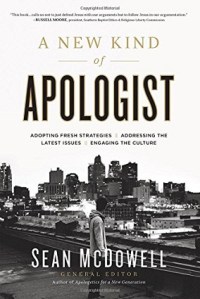
A New Kind of Apologist edited by Sean McDowell is a collection of essays addressing many of the challenges facing apologetics and apologists now. The chapters offer insights in such diverse topics as apologetics and economics, Islam, and sexuality. The chapters range from 2-14 pages and so are necessarily brief.
Several of the chapters are particularly insightful. For example, “Why We Should Love Questions More Than Answers” by Matthew Anderson notes that we need to be careful listeners when we take questions. It does no good to be able to answer questions if we are answering the wrong ones. The chapter “Telling the Truth about Sex in a Broken Culture” by John Stonestreet speaks to how the changing cultural climate regarding exposure to, consumption of, and even understanding of sexuality has changed such that we need to have a holistic biblical vision of human sexuality is another example of the broad perspectives this book offers on apologetics.
The topics in the book aren’t limited to some kind of ivory tower arguments (though I believe such arguments and books are very valuable); here, topics have direct application to life while maintaining an apologetic perspective. It’s a practical book, though it is necessarily brief on each topic that is covered. It provides more of a grab bag of ideas than well-developed approaches to the topics. Readers will be exposed to many different ideas, each with some insight on where to pursue further reading on the topic. The sheer breadth of issues touched upon make the book guaranteed to have something of interest for anyone even remotely concerned with apologetics. Method, Christian living, other religions, and a host of topics in between are covered. It’s an exciting book, as each chapter presents a new avenue for readers to explore.
An admirable aspect of the book is that it features several women’s voices. Too often, collections of apologetic essays do not have even one woman in the work. Here, there are several, including an excellent chapter by Holly Ordway on the use of imagination in apologetics and another chapter by Mary Jo Sharp that calls on women to be involved in aoplogetics.
Section breaks often feature interviews with prominent apologists, but the most intriguing of them are the interviews with atheists–including some who were once apologists. This provides a look at areas that some readers may never engage with–genuine interaction with atheists and an attempt to understand why the “other” believes as they do.
One area of critique is that some chapters persist in using “man” and “men” as descriptors for “human” and “humanity.” Although it is commonly argued that people just know that the latter is what is meant, precision of language as well as the real possibility of confusion suggests use of gender-neutral language ought to be preferred.
A New Kind of Apologist is an important, helpful book. It is just the kind of work that someone interested in apologetics should pick up as quickly as possible. It opens the reader up to several new topics, as well as new authors and ideas. It comes recommended.
The Good
+Engages a ton of topics
+Insightful interviews
+Features women’s voices
The Bad
-Very brief on the topics it touches
-Lack of gender-neutral language in some chapters
Disclaimer: I received a copy of the book for review from the publisher. I was not required to provide any kind of feedback whatsoever.
Source
A New Kind of Apologist edited by Sean McDowell (Eugene, OR: Harvest House, 2016).
Links
Be sure to check out the page for this site on Facebook and Twitter for discussion of posts, links to other pages of interest, random talk about theology/philosophy/apologetics/movies and more!
Book Reviews– There are plenty more book reviews to read! Read like crazy! (Scroll down for more, and click at bottom for even more!)
Eclectic Theist– Check out my other blog for my writings on science fiction, history, fantasy movies, and more!
SDG.
——
The preceding post is the property of J.W. Wartick (apart from quotations, which are the property of their respective owners, and works of art as credited; images are often freely available to the public and J.W. Wartick makes no claims of owning rights to the images unless he makes that explicit) and should not be reproduced in part or in whole without the expressed consent of the author. All content on this site is the property of J.W. Wartick and is made available for individual and personal usage. If you cite from these documents, whether for personal or professional purposes, please give appropriate citation with both the name of the author (J.W. Wartick) and a link to the original URL. If you’d like to repost a post, you may do so, provided you show less than half of the original post on your own site and link to the original post for the rest. You must also appropriately cite the post as noted above. This blog is protected by Creative Commons licensing. By viewing any part of this site, you are agreeing to this usage policy.
“What’s Behind it All?” Debate Review: Lawrence Krauss vs. Stephen Meyer vs. Denis Lamoureux
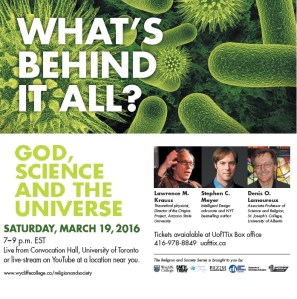
The official image for the debate. I use it under fair use.
A debate on the topic of God, science, and the universe; “What’s Behind it All?” was had at Wycliffe College in Toronto, Canada. The speakers were physicist Lawrence Krauss, philosopher of science Stephen Meyer, and biologist and theologian Denis Lamoureux. Meyer and Lamoureux are Christians, but differ on evolution. Lamoureux holds to theistic evolution/evolutionary creation, while Meyer advocates Intelligent Design theory. Krauss is an atheist. Here, I will sum up different parts of the debate, then offer some analysis. I skip over the roundtable discussion. It should be noted Meyer was visibly suffering from a migraine and at points had great difficulty throughout the debate due to the impact of this migraine.
Lawrence Krauss Introduction
Krauss took a good amount of time at the beginning of his introduction to “disparage” (his word) Stephen Meyer. He took time to specifically insult Meyer and others who hold to Intelligent Design.
After these remarks, Krauss went over a number of slides showing the evidence for how the universe is laid out, finally asserting that “nothing” makes energy flat. By nothing, he meant dark matter and other forms of nothing (again, according to his ). “Empty space, with nothing in it, can start to produce particles.” According to a slide he showed right after saying this, “Gravity plus quantum mechanics allows space (and possibly time) to appear from nothing.” There were no causal relations before the Big Bang, and so there was nothing to cause anything. “Classical notions of cause and effect may go out the window,” Krauss claims, due to this.
“Life is fine-tuned for the universe” rather than the universe being fine-tuned for life. Life adapts to the universe, and it is natural selection that leads to life being what it is.
Ultimately, “us [sic] and ultimately everything in the universe” is irrelevant, according to Krauss.
Stephen Meyer Introduction
Meyer notes that Krauss didn’t even critique the theory of intelligent design, because he never even explained what it was. To engage with an idea, one has to at least explain what that idea is. Meyer notes that he is defending a theistic view of science rather than a materialistic view of science.
Meyer then presented an overview of the biological argument for intelligent design, noting that DNA is a kind of information conveyance mechanism. The origin of information, then, is the difficulty that materialists are faced with. DNA information provides functional information. From an evolutionary point of view, Meyer argues, this is difficult to explain, because the number of functional arrangements of this information is vastly outweighed by the number of non-functional arrangements.
After this lengthy presentation on ID theory from a biological perspective, presented further positive evidence for ID theory alongside a few papers he cited that critique the theory. He noted that the objections fail, and that the evidence is powerful enough to show that ID theory must be taken seriously as a theory. Information, that is, relies upon mind in order to be generated. Then he surveyed a number of origin of life scenarios and noted significant problems with each.
Denis Lamoureux Introduction
There is a false dichotomy in these discussions, argued Lamoureux. One side is presented as being science, evolution, and atheism; the other is presented as being God, miracles, and the Bible. Lamoureux noted that he walks the line between these, arguing that evidence for biological evolution is overwhelming and that there is no debate whatsoever on it while also believing in the inspiration of the Bible.
The problem of intermediary fossils is often plugged in with a “God of the gaps.” Lamoureux cites the difference between Sharks and boney fish as an area where the transitional fossil was thought to be missing, but then a fish without a jaw was found that would be an intermediary between the two (an earlier fossil that could lead to both). Thus, the gaps that we have, argued Lamoureux, are best explained for evolution as gaps in knowledge, not an area to import God or design. Missing fossils may require us to wait for hundreds of years to find anything, but we keep plugging the gaps.
Lamoureux appealed to the notion of teleology- purpose vs. the notion of dysteleology – that there is no purpose. Culturally, people tend to think of evolution as being dysteleological and creation as teleological, but these present yet another false dichotomy. Instead, teleology with evolution is possible. He argued that natural processes like embryology is still seen as teleology, despite the fact that we know how the development continues through the stages. That is, teleology is not thrown out by knowing how it all works. Therefore, Lamoureux argued that we can hold to evolution and teleology, a view he calls Evolutionary Creation (commonly called theistic evolution). Rather than appealing to specific examples of design, this view sees creation as artistry and all of creation pointing to the creator, despite our capacity to explain it. He continued to cite Charles Darwin quotations from late in life showing that he also agreed that theism is compatible with evolution.
Lamoureux argued that concordism- the notion that the Bible and science correspond specifically- is mistaken. The Bible, he said, reflects an ancient cosmology, and argued that we have to read ancient texts in the context in which they were written.
Meyer Response
ID is not a “god of the gaps” argument. Rather, the form of the argument presented is an inference to the best explanation. We make this kind of inference all the time. Meyer argued that the a priori ruling out of intelligence for certain kinds of causes and effects means that you will miss evidence. Rather than assume it impossible, we ought to follow the evidence where it leads.
Lamoureux Response
Meyer’s theory relies on things that we can ultimately disprove, and he noted one aspect of the Cambrian Explosion that Meyer tries to use, but has been shown to have an evolutionary path.
Krauss’s science is pretty good, but he delves into metaphysics frequently and does so poorly. Krauss’s notion of a universe out of nothing is not really out of nothing, and other physicists note that Krauss is mistaken regarding the definition of “nothing.”
Krauss Response
DNA is not the first form of life, and pointing to the most complex forms possible fails to take science seriously. An RNA world is the most likely origin of life scenario. RNA could be naturally formed, and although we don’t know the answer yet, we could find it.
Lamoureux’s position is untenable because he basically just says the Bible is scientifically garbage and then says we should follow it. The Bible, he argues, is the most immoral document he’s ever seen.
Analysis
First, the decision made by Krauss to start the debate with personal attacks on Meyer is inexcusable. Time and again, Krauss has proven himself incapable of mature conversation. To be fair to him, he did try to help Meyer with his difficulty getting his powerpoint set up later, and also at least acknowledged some of the difficulty Meyer was having with a migraine, but the fact he made the conscious decision to begin a debate with personal attacks shows his character.
Krauss continues to make up whatever definition of “nothing” suits him at the moment. If it is convenient for “nothing” to refer to dark matter, then nothing is dark matter. If “nothing” needs to be used as empty space, then nothing is empty space. He doesn’t just move goal posts, he simply carries them around, dropping them wherever he sees fit. To claim that gravity and quantum mechanics can make a universe come out of nothing is so nonsensical, it hardly warrants comment. After all, what are gravity and quantum mechanics? If Krauss is to be believed, they are nothing. But of course he isn’t using the term in any restrictive sense, because he is just using “nothing” to refer to anything whatever. For Krauss, “nothing” is something. Why? Because he says so.
It’s difficult to analyze the theory of ID in this format, because the debate is ongoing and the reasoning complex. Moreover, Meyer’s difficulty with his migraine at points meant he had to skip over explanations and examples. I believe that Lamoureux in particular offered some strong critique, particularly in his notation of the way that transitional forms continue to be found. Moreover, Lamoureux was able to show that at least one specific example used by Meyer has been shown to be mistaken. However, Meyer’s presentation does raise questions about the origin of information and its use. In the roundtable discussion, Krauss, Meyer, and Lamoureux all got into it regarding whether Meyer’s analysis presents an accurate view of evolution. Lamoureux argued it did not because Meyer approaches the question like an engineer, expecting specific mathematical permutations; but he said that evolution does not work that way. Krauss noted that natural selection removes much of the randomness of evolution, thus undercutting some of the math in Meyer’s view. Ultimately, the debate over ID will almost certainly continue, and I can’t help but feel that Meyer would have made a better showing without the migraine. He did a wonderful job despite it, and largely held his own.
Lamoureux’s position has much to commend it, particularly because he doesn’t demand a kind of reading of the Bible as a science text. However, I wonder whether Krauss’s critique is forceful: that Lamoureux effectively tosses the Bible and what it says about the natural world out, but then expects it to be believed on other aspects. Of course, Krauss quickly demonstrated a complete lack of nuance with reading of the Bible, but his point ought not be dismissed too swiftly. Can Lamoureux offer a way of reading the Bible that reconciles this seeming incongruity? Meyer’s position allows for God to be active in the world, without appealing to the notion of artistry as a way to show God’s activity. Does this show Meyer’s position is superior?
As an aside, I’d like to commend Lamoureux for using gender neutral language repeatedly in his presentation. Even when quoting Darwin at points, where Darwin used the archaic “man” to refer to humans, Lamoureux read the quotes as “men and women.” I believe he did the same in a Billy Graham quote, though I didn’t catch if the original also said “men.”
“The universe doesn’t care about us.” Quoted from Krauss in this debate, this is the summary of his worldview. Of course, his worldview does not matter, if he’s right. If he’s right, then there is no purpose for even having this debate. And that, perhaps, is what we should take away from this debate. On a worldview level, Krauss offers nothing (har har) to go on. The interesting debate, then, is whether Meyer or Lamoureux are correct.
Links
Be sure to check out the page for this site on Facebook and Twitter for discussion of posts, links to other pages of interest, random talk about theology/philosophy/apologetics/movies and more!
Gregg Davidson vs. Andrew Snelling on the Age of the Earth– I attended a debate between an old earth and young earth creationist (the latter from Answers in Genesis like Ken Ham). Check out my overview of the debate as well as my analysis.
Ken Ham vs. Bill Nye- An analysis of a lose-lose debate– In-depth coverage and analysis of the famous debate between young earth creationist Ken Ham and Bill Nye the science guy.
SDG.
——
The preceding post is the property of J.W. Wartick (apart from quotations, which are the property of their respective owners, and works of art as credited; images are often freely available to the public and J.W. Wartick makes no claims of owning rights to the images unless he makes that explicit) and should not be reproduced in part or in whole without the expressed consent of the author. All content on this site is the property of J.W. Wartick and is made available for individual and personal usage. If you cite from these documents, whether for personal or professional purposes, please give appropriate citation with both the name of the author (J.W. Wartick) and a link to the original URL. If you’d like to repost a post, you may do so, provided you show less than half of the original post on your own site and link to the original post for the rest. You must also appropriately cite the post as noted above. This blog is protected by Creative Commons licensing. By viewing any part of this site, you are agreeing to this usage policy.
Sunday Quote!- The Flame of the LORD
 Every Sunday, I will share a quote from something I’ve been reading. The hope is for you, dear reader, to share your thoughts on the quote and related issues and perhaps pick up some reading material along the way!
The Flame of the LORD
Too often, we are afraid to talk about the love of God in any but the most circumspect way. Richard Davidson, in his massive study on sexuality in the Old Testament, Flame of Yahweh, does a magnificent job discussing this topic with clarity and poetry. The Song of Songs (or Solomon) is at the center of his discussion. He writes that human love is the…
very flame of Yahweh, then this human love at its best—as described in the [Song of Songs]—points beyond itself to the Lord of Love. The human ‘spark of the Eternal Flame’ reveals the character of that divine flame… ‘Christians can discern the eternal dance… of divine Persons in the reciprocal love of a man and a woman.’ [citing Robin Payne.]…
[H]uman sexual love, already so highly esteemed elsewhere in Scripture, is here given its highest acclamation. The song of Songs thus becomes the… supreme statement on the theology of sexuality… in the OT. We have indeed reached the holy of holies, ablaze with the flame of Yahweh. (630-632, cited below)
Within this book of Scripture, the Song of Songs, we find the fullest expression of human sexuality and wholeness. It is filled with doctrinal content, and Davidson fantastically draws out the implications of the book for readers. Moreover, the entire work is a survey of and commentary on every major (and minor) passage that deals with sexuality throughout the entire Old Testament. I very highly recommend his book, Flame of Yahweh to you.
Links
Be sure to check out the page for this site on Facebook and Twitter for discussion of posts, links to other pages of interest, random talk about theology/philosophy/apologetics/movies and more!
Sunday Quote– If you want to read more Sunday Quotes and join the discussion, check them out! (Scroll down for more)
Eclectic Theist– Check out my other blog for my writings on science fiction, history, fantasy movies, and more!
Source
Richard M. Davidson, Flame of Yahweh (Peabody, MA: Hendrickson Publishers, 2007).
SDG.
Really Recommended Posts 3/18/16- women in church history, video games, and more!
 Here we have another round of posts for your reading, friends. Topics range from parenting gamers to Augustine, from women in church history to talking about abortion. As always, let me know what you think, and be sure to let the authors of the individual posts know as well!
Christian Thinkers 101: A Crash Course on St. Augustine– We need to be aware of thinkers from the past for a number of reasons: so we don’t repeat mistakes made in the past, so that we don’t have to re-learn what was learned before, so we can have our biases challenged across time, and many more. Here’s a post that helps us do just that by introducing, concisely, the thought of Augustine, one of the greatest luminaries of all time.
A Parent’s Guide to Living with Gamers– Some parents may express concern about their kids playing video games. Here are some helpful thoughts from a Christian perspective for parents of gamers.
Women in Church History: Footnoted and Forgotten?– Too often, women’s voices are ignored. Here is a post highlighting some women throughout church history. Be sure to also check out a series of women in church history at a different blog that starts with early church history and the Desert Mothers.
Apologia Raido and the Defamation of Tony Lauinger: A Call for an Apology– There are different schools of thought regarding the pro-life movement, and this post is revealing as to how these schools of thought differ radically on method of engagement in law and in person.
What about those who haven’t heard? – Part 1 of a Case Study on Religious Pluralism from Lew Wallace’s “Ben Hur”

A beautiful cover for an edition of Ben Hur- I was unable to locate the exact copyright information.
Ben Hur is one of my all-time favorite novels. There are many issues related to worldview raised throughout the novel. I have started a series which outlines some of the ways it interacts with
Selection from the Book
Each post in this series will begin with a segment from the book itself. Here, we jump into a scene in which one of the wise men is telling the story of how he came to be in a desert, meeting up with the others. He is Greek. I have abridged the segment to focus on the areas in which this series is most interested, namely, the ways God interacts with humanity.
“I am Gaspar, son of Cleanthes the Athenian…
…”It happens that two of our [Greece’s] philosophers, the very greatest of the many [reference to Plato and Aristotle, presumably], teach, one the doctrine of a Soul in every man, and its Immortality; the other the doctrine of One God, infinitely just. From the multitude of subjects about which the schools were disputing, I separated them, as alone worth the labor of solution; for I thought there was a relation between God and the soul as yet unknown…
“In the northern part of my country–in Thessaly… there is a mountain famous as the home of the gods… Olympus is its name. Thither I betook myself. I found a cave [nearby]… there I dwelt, giving myself up to meditation–no, I gave myself up to waiting for what every breath was a prayer–for revelation. Believing in God, invisible yet supreme, I also believed it possible so to yearn for him with all my soul that he would take compassion and give me answer.
“…One day I saw a man flung overboard from a ship sailing by. He swam ashore. I received and took care of him. He was a Jew, learned in the history and laws of his people; and from him I came to know that the God of my prayers did indeed exist; and had been for ages their lawmaker, ruler, and king. What was that but the Revelation I dreamed of? My faith had not been fruitless; God answered me!”
“As he does all who cry to him with such faith,” said the [Hindu].
“But, alas!” the Egyptian added, “how few are there wise enough to know when he answers them!”
“That was not all,” the Greek continued. “The man so sent to me told me more. He said the prophets who, in the ages which followed the first revelation, walked and talked with God, declared he would come again…
“It is true… the man told me that as God and the revelation of which he spoke had been for the Jews alone, so it would be again… ‘Had he nothing for the rest of the world?’ I asked. ‘No,’ was the answer, given in a proud voice–‘No, we are his chosen people.’ The answer did not crush my hope. Why should such a God limit his love and benefaction to one land, and, as it were, to one family? …When the Jew was gone, and I was alone again, I chastened my soul with a new prayer–that I might be permitted to see the King when he was come, and worship him. One night I sat by the door of my cave trying to get nearer the mysteries of my existence, knowing which is to know God; suddenly, on the sea below me, or rather in the darkness that covered its face, I saw a star begin to burn; slowly it arose and drew nigh, and stood over the hill and above my door, so that its light shone full upon me. I fell down, and slept, and in my dream I heard a voice say:
“‘O Gaspar! Thy faith hath conquered! Blessed art thou! With two others, come from the uttermost parts of the earth, thou shalt see Him that is promised, and be a witness for him, and the occasion of testimony in his behalf. In the morning arise, and go meet them, and keep trust in the Spirit that shall guide thee.’
“And in the morning I awoke with the Spirit as a light within me surpassing that of the sun…”
This passage can be found in Ben Hur, Book I, Chapter III. It may be read in its entirety online here (it is public domain due to expired copyright).
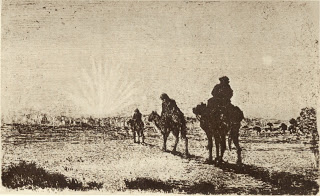
An illustration from the Ben Hur novel. I was unable to find a specific copyright.
Notes on Religion from the Selection
Christians have proposed many different answers to one of the most pressing questions, itself having been pondered for centuries: “What about those who have never heard?” The question is regarding salvation–can those who have never heard be saved? But it isn’t only that. It might be nuanced in many ways. For example, are there any who have not heard what is required to be saved who would respond if they did hear it? Though the answer initially may seem obvious, it must be thought over carefully before one simply says yes or no.
In this passage from Lew Wallace, we find not one, but two separate answers to this question combined into one account. The answers are: direct divine revelation, and sending a witness. (I have dubbed them this, but the titles summarize common proposals–see below.)
Sending a Witness
One of the answers Christians have given to the question of those who have not heard and their salvific status is pretty straightforward: there simply are none who have not heard. The claim seems rather extraordinary, for, after all, entire swathes of humanity never had contact with any Christian missionary for vast periods of time. Yet, this answer to the question suggests that God sends a witness to anyone who would respond. Thus, if there is someone in a place where Christianity had not yet reached who would have responded to a missionary, God somehow sets it up such that that person hears from someone about Christ.
In the example from Ben Hur above, we see that the Greek was looking for the divine–hoping for a response. Thus, through providential act, a Jew washed up on shore to instruct him about the truth.
It seems this solution to the problem of religious pluralism and those who have not heard is unsatisfactory. There are many reasons for this. First, it supports a rather dim view of other cultures through a system that is ultimately culturally imperialist. Second, it seems to stretch credulity, for it would follow from this position that either there have only been very few outside of the parts of the world where Christianity is dominant who would have responded to the Gospel anyway (see previous point) or that there are innumerable instances of shipwrecks washing missionaries on shore in far off places all over the world to wherever someone might respond to the Gospel. Either of these seems unsatisfactory.
However, it is possible that the “Sending a Witness” answer could be part of an answer to the questions posed here. It just does not seem capable of carrying all the weight on its own.
Direct Divine Revelation
Like the previous answer, the “direct divine revelation” solution to the problem of religious pluralism and specifically those who have not heard is one which ultimately results in the answer: None have not heard. For, if someone would respond to the Gospel, God simply reveals Christ through direct revelation. In the selection above, we see that a dream reveals the Holy Spirit to Gaspar.
This answer to the questions raised above is perhaps more satisfactory than the previous one, but difficulties remain. The primary one is that although several firsthand instances of this type of thing happening are found, they do not seem to be as ubiquitous as they might need to be in order to adequately account for all those who have not heard. Again, this may be part of a larger multi-level response, but I don’t think it can stand on its own.
Conclusion
Wallace provides here an overview of two of the traditional answers to the question of those who have not heard about Jesus Christ. Neither solution seems entirely satisfactory, though either or both might be integrated into a holistic view of witnessing and missions. We will explore other aspects of Wallace’s exploration of religious pluralism
Although I don’t agree with all of his conclusions, I think that John Sanders’ book, No Other Name is perhaps the best work I have read for providing background into the different proposed solutions for the question of those who have not heard about Christ. It would be a good read for those wishing to explore the topic further.
Links
Be sure to check out the page for this site on Facebook and Twitter for discussion of posts, links to other pages of interest, random talk about theology/philosophy/apologetics/movies and more!
Religious Pluralism- A case study from “Ben Hur” by Lew Wallace– The post introducing this entire series on “Ben Hur.” It has links to all the posts in the series.
Ben Hur- The Great Christian Epic– I look at the 1959 epic film from a worldview perspective. How does the movie reflect the deeply Christian worldview of the book?
SDG.
——
The preceding post is the property of J.W. Wartick (apart from quotations, which are the property of their respective owners, and works of art as credited; images are often freely available to the public and J.W. Wartick makes no claims of owning rights to the images unless he makes that explicit) and should not be reproduced in part or in whole without the expressed consent of the author. All content on this site is the property of J.W. Wartick and is made available for individual and personal usage. If you cite from these documents, whether for personal or professional purposes, please give appropriate citation with both the name of the author (J.W. Wartick) and a link to the original URL. If you’d like to repost a post, you may do so, provided you show less than half of the original post on your own site and link to the original post for the rest. You must also appropriately cite the post as noted above. This blog is protected by Creative Commons licensing. By viewing any part of this site, you are agreeing to this usage policy.
Sunday Quote!- King David and Christian Living
 Every Sunday, I will share a quote from something I’ve been reading. The hope is for you, dear reader, to share your thoughts on the quote and related issues and perhaps pick up some reading material along the way!
King David and Christian Living
J.J. Blunt (1794-1855) was an Anglican who lectured and wrote much of import for Christians. His most famous and impactful book was his Undesigned Coincidences in which he argues for the veracity of the Old and New Testaments. The scope of this book was not limited to apologetics, however. He continually put forward insights into the topics at hand. For example, writing about King David’s fall into sin and the betrayal by his son, he notes:
Meanwhile, by means of the fall of David, however it may have caused some to blaspheme, God may have also provided in his mercy, that many since David should stand upright; the frailty of one may have prevented the miscarriage of thousands; saints, with his example before their eyes, may have learned to walk humbly, and so to walk surely, when they might otherwise have presumed and perished; and sinners, even [those] of the darkest and most deadly sins, may have been saved from utter desperation and self-abandonment, by remembering David in all his trouble; and that, deep as he was in guilt, he was not so deep but that his bitter cries for mercy, under the remorse and anguish of his spirit, could even yet pierce the ear of an offended God, and move him to put away his sin. (155, cited below)
The concern with Christian living here is appropriate. Balance must be had between finding out what a biblical narrative “really” means [to the original audience? to us? etc.] and the application of that narrative to our lives. Here, Blunt is focused on application, but he does so in a way that is of value to apologetics as well as biblical interpretation. We sometimes wonder why so many stories of people doing bad things are recorded in the Bible. Indeed, some of these stories would be very R-rated were they made into a movie. But this is because the Bible is about real people engaged in real events. And, we can be sure that at least some of these stories can serve as a warning to us.
Blunt didn’t only offer law here, however. It’s not just a word of conviction. He noted the fact that David still turned to God and that God was merciful. May we also be moved to seek out God’s mercy through life’s trials.
Links
Be sure to check out the page for this site on Facebook and Twitter for discussion of posts, links to other pages of interest, random talk about theology/philosophy/apologetics/movies and more!
Sunday Quote– If you want to read more Sunday Quotes and join the discussion, check them out! (Scroll down for more)
Eclectic Theist– Check out my other blog for my writings on science fiction, history, fantasy movies, and more!
Source
J.J. Blunt, Undesigned Coincidences in the Writings both of the Old and New Testaments: An Argument of their Veracity (New York: Robert Carter & Brothers, 1855).
SDG.
Downton Abbey: The Final Season Episodes 8 and 9 – a Christian Perspective
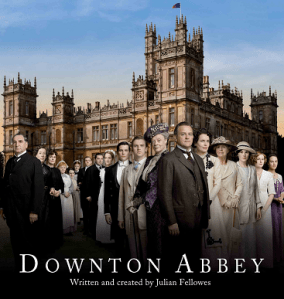 I will be analyzing each episode of the final season of Downton Abbey from a worldview perspective. I will be doing them two at a time to make space for my series on “The Expanse.” There will, of course be SPOILERS for each episode, and I will assume readers know about each previous season and episode’s content as well. It will be assumed that readers are familiar with the characters and circumstances. I will not be summarizing the plot of the episode; I will merely interact with the content from a perspective of worldview. BE COURTEOUS AND DO NOT BRING UP LATER EPISODES THAN THE ONE DISCUSSED HERE IN YOUR COMMENTS.
Episode 8
Self-giving love is something that has been evidenced throughout this season of Downton Abbey, largely in the person of Phyllis Baxter. Here, she manages to save the life of Thomas Barrow because she senses something in him that suggests he will attempt suicide–something that has been somewhat anticipated all season.
Jealousy is one of the most dangerous emotions, as we see throughout the Bible in narratives, wisdom, and letters. Lady Mary’s jealousy of Lady Edith’s happiness led, once again, to her visiting ruination upon that happiness. The rebuke that Tom Branson brought to Mary was well-deserved and it also shows something that we are not always comfortable with in our own lives–the need to confront sin. As the next episode shows, such a rebuke brought about change in behavior. This is a kind of demonstration of a Christian theme that is very Lutheran as well–the use of the Law to bring about change of behavior. By rebuking Mary’s self-serving attitude and calling her to better living, Branson was acting rightly.
Episode 9
Loyalty is something that often grows with us, and Barrow’s loyalty to Downton at last comes to the forefront in this final episode. His own bitterness and cruelty got him to a point in which he felt no return, but ultimately the kindness of some saved his life. It is a wonderful story of redemption to see Barrow taking on the duties of Butler to close out the series. There were times in the series I felt nothing good could come of Barrow, but that is just what we are as sinners: grace is something that breaks through and without deserving it, God lifts us from our sin. Barrow’s story of redemption is a powerful reminder of the concept of grace.
Forgiveness is another theme that has played throughout the series, and the first steps towards broader understanding and forgiveness were taken by Lady Mary and Lady Edith. Edith (at last!) has happiness, and that is at least partly due to Mary’s intervention. Mary took Branson’s rebuke to heart and made efforts to change the outcomes of her pettiness. There is little that can be said kindly about Mary, but her own story shows one in which the proud are humbled.
Downton Abbey is finished. It has brought us tales of sorrow, of joy, and of grace. I hope you’ve enjoyed the journey as much as I have.
More!
I know there is a ton more to discuss, and in this post we can feel free to talk about the whole series. I’d love to read your thoughts. Be sure to let me know what you thought of the episodes, and what worldview-level issues you saw them raise, in the comments below.
Links
Be sure to check out the page for this site on Facebook and Twitter for discussion of posts, links to other pages of interest, random talk about theology/philosophy/apologetics/movies and more!
Eclectic Theist– Check out my other blog for my writings on science fiction, history, fantasy movies, and more!
SDG.
——
The preceding post is the property of J.W. Wartick (apart from quotations, which are the property of their respective owners, and works of art as credited; images are often freely available to the public and J.W. Wartick makes no claims of owning rights to the images unless he makes that explicit) and should not be reproduced in part or in whole without the expressed consent of the author. All content on this site is the property of J.W. Wartick and is made available for individual and personal usage. If you cite from these documents, whether for personal or professional purposes, please give appropriate citation with both the name of the author (J.W. Wartick) and a link to the original URL. If you’d like to repost a post, you may do so, provided you show less than half of the original post on your own site and link to the original post for the rest. You must also appropriately cite the post as noted above. This blog is protected by Creative Commons licensing. By viewing any part of this site, you are agreeing to this usage policy.

 J.W. Wartick - Reconstructing Faith