christian
Young Earth Creationism and Presuppositionalism: An Analysis
 Young Earth Creationism stands or falls based upon the specific use of presuppositionalism as an epistemological groundwork. Here, I will challenge the very core of the young earth paradigm: I will charge that it is an invalid presuppositionalist approach to viewing science and theology.
Young Earth Creationism (YEC will be used hereafter for “young earth creationism,” “young earth creationist” and other forms of those words as needed), is, of course, the position that the Genesis account of the creation of the universe took place over the course of seven literal 24-hour days about 6-12,000 years ago. I have extensively explored various aspects of young earth creationism and other positions, and my posts can be found under the “Origins Debate” page.
Presuppositionalism is a type of apologetics (defense of the faith) which relies upon presupposing the truth of the Christian worldview in order to defend it. I have analyzed presuppositional apologetics a number of times. For an introduction into this position, check out “The Presuppositional Apologetic of Cornelius Van Til.”
Epistemology is the study of how we come to know things. Essentially, it asks questions like “How do we know that we know?”
Before proceeding, it is worth noting that many debates between YECs and people who believe in an ‘old earth’ perspective turn on the YEC use of presuppositionalism. A common theme for mocking YECs is to say they just refuse to hear evidence or shout over evidence, yet it seems that this is an unfair portrayal. As we evaluate the young earth position, it will become clear that the YEC perspective operates from within a presuppositional framework that explains much of the way YECs reason. It will also become clear, however, that the YEC use of this framework is invalid.
Thus, it is my contention that YEC is directly dependent upon a presuppositional approach to how we know things. For support of this contention, I note the fact that many YECs see this connection themselves. For example, Answers in Genesis has a number of posts on the topic, including a post outlining the meaning of and need for presuppositional apologetics. Or again, Nathaniel Jeanson of ICR presented a presuppositional case for YEC (analyzed by the Geochristian). However, this is not the only evidence. YECs tend to argue exclusively within a presuppositional framework.
Consider this argument:
The Bible clearly states that the earth was made in seven days. There is no room to interpret the text in any way other than as a literal week of creation.
Such an argument is extremely typical within the YEC community. However, it is also clearly a presuppositionalist approach to the question of the age of the earth. YECs will argue that science must be interpreted in such away as to line up with the creation account. A common theme is that “The data is the same, it is the interpretations of that data that differ,” another notion is that people are rejecting the “plain and obvious meaning of the text” when they offer an old earth interpretation. Such a position is often united with the notion that only by using “man’s fallible ideas” can one come up with a date of millions or billions of years.
The thought process goes in this order: we presuppose the truth of the Bible => the Bible teaches that the earth is 6-12,000 years old => all scientific evidence for the age of the earth must line up with the truth of the Bible. The Bible is the infallible word of God, and so it cannot be in error. Because, according to the YEC paradigm, the only possible interpretation for the Biblical account of creation is the young earth perspective, it therefore becomes clear that all science and truth must line up with YEC.
We are thus left with two possible ways to challenge YEC. Evidence simply is not the problem. Any evidence, if the YEC use of presuppositionalism is valid, simply must line up with YEC. Thus, to challenge YEC, one must confront directly its presuppositions. First, one can challenge the position by attacking the premise that the YEC paradigm is the only possible interpretation of the Genesis creation account. Second, one can challenge the position by directly attacking the presuppositional epistemological groundwork that the arguments are built upon. Rather than focus upon the first challenge, we will here explore whether or not the YECs have validly made use of the presuppositional approach.
 Assuming a Young Earth
It is important to note that the way the YEC argument works is to begin by simply assuming the truth of young earth creationism. I know this may sound radical, but it plays out time and again when discussing the various positions on the age of the earth. The young earth paradigm brokers no alternatives; only the young earth perspective is even possibly correct. How is it that YECs are so confident in their approach?
Simply put, the confidence is gained from the very way that they defend the young earth. YEC is not defended based upon evidence. It is not as though scientists are examining the earth and coming to the conclusion that the earth was formed only some thousands of years ago. Indeed, several prominent YECs assert that the very notion of finding the age of the earth from investigation of the geologic past is impossible or hampered by sin and fallible ideas. For just one example, Whitcomb and Morris, in their highly influential work, The Genesis Flood
[I]f He [God] did this [created a universe full-grown], there would be no way by which any of His creatures could deduce the age or manner of Creation by study of the laws of maintenance of His Creation. (238, emphasis theirs, cited below)
Such a notion persists throughout much YEC literature. In principle, the only way to conclude a young earth is to abandon supposed “uniformintarianism” (hold that the processes in place today continue at the same rate they did in the past–see an evaluation of one YEC’s use of this notion here) and view all of the history of the earth through the lens of God’s word. Now, whether or not it is valid to assume that the Genesis text is a scientific account, the argument here should be fairly clear. Namely, the young earth position is assumed. It is not something demonstrated by science, but rather a given before any scientific investigation takes place. Similarly, the position is assumed to be true before any exegesis has occurred. All scientific evidence and any exegetical hints at a different position are subsumed into the YEC position because it is assumed from the outset as correct. Because YEC is correct, all evidence must line up with it.
Some may object by arguing that frequently YECs offer evidence for their position. They may cite various catastrophic theories or flood geology as alternative explanations of Earth’s geologic past. However, even the authors of books like these (such as Whitcomb and Morris, or Walter Brown in his In the Beginning) admit that the key is to presuppose Scripture, which is of course, on their view, to presuppose a young earth.
The Validity of the Young Earth Assumption
It is clear that YEC turns upon presupposing its truth. YEC is assumed to be true, and all alternative views are simply wrong by default. Unfortunately, this is an abuse of presuppositional apologetics.
It is important to contrast the specifically YEC use of presuppositionalism with the wider use of presuppositional apologetics. Presuppositional apologetics in general is the method of engaging entire worldviews by granting their core assumptions and lining them up against reality in a competition of best explanation. The YEC use of presuppostionalism is to defend a single contention–a young earth–against all comers. There are very significant disanalogies here. What the YEC has done is use presuppositionalism not to enter into the square of debate over whole worldviews, but rather to insulate their interpretation against any possible counter-evidence.
There is a distinct difference between the use of presuppositional apologetics, and the use of YEC in presuppositionalism. The latter tends to simply reject outright any challenge as either against the “clear word of God” or as “assuming uniformitarianism.” By placing their own view beyond the realm of rational inquiry, they have undermined their own potential to know that it is true.
 The Faulty Grounds of the YEC Presuppositionalist
The foregoing evaluation leads us to the greatest difficulty facing the YEC approach: a faulty epistemology. Unfortunately, the way that the defense of YEC has been shown to work introduces a paradigm of knowledge which is impossible to sustain. Essentially, the YEC must assume what they think they know. Such an assumption seems to be viciously circular. The YEC must reason thus: “The Bible teaches a young earth=> The Bible is True=> the earth is young.” When presented with counter evidence, rather than engaging with the evidence, the YEC generally falls back to this same argument and reinterprets the evidence. That is where the whole system breaks down: the YEC has not made the right use of presuppositionalism, which allows for entire worldviews to be falsified. Instead, the YEC has misused presuppostionalism to put a young earth interpretation beyond falsification.
The objection will be made that everyone has core beliefs that must be assumed without evidence. Although such an assertion is itself hotly debated, I think it is possible to sidestep such a difficult discussion. Instead, one can note that even if one grants that core beliefs are necessarily assumed, the burden of proof is squarely placed upon the YEC to show how holding to a young earth is necessary for knowledge. Why is this the case? The simplest explanation is that if one assumes the epistemology needed for presuppositionalism is correct, then one has essentially a framework that involves the assumption of core beliefs that are necessary to allow for any knowledge. Thus, for example, the existence of God might be argued as necessary for knowledge (a la Alvin Plantinga, Cornelius Van Til, Greg Bahnsen, and the like) because without God to make us rational, there is no basis for thinking that our beliefs have any actual relationship to reality. Whether or not this is the case, it seems that a young earth is not one of these core beliefs.
Thus, we have finally come to the ultimate failing of the presuppositional defense of YEC: it abuses its epistemological framework to the point of breaking. The YEC has utilized an epistemological approach that allows for core beliefs to be assumed, but has done so in such a way that essentially any belief could be assumed with equal validity. An old earth creationist or theistic evoloutionist could equally argue that their position is based upon a core belief that must be assumed, in which case YEC is undermined. In turn, they could assume their reading of Scripture and make all others wrong by default.
Presuppositionalism must walk a fine line to determine which presuppositions are genuinely those which must be assumed for knowledge. When challenged, the presuppositionalist must make arguments to show that the presuppositions are indeed necessary for knowledge. Unless and until a YEC makes a case that by abandoning the notion of a young earth, one necessarily undermines all knowledge–a case which I must admit seems impossible–the YEC use of presuppositionalism is undermined. Rather than making a valid use of that apologetic approach, YECs have undermined its very principles, and have thus eliminated their own possibility of knowledge. They have relativized all truth by introducing as “first principles” things which are not necessary for knowledge.
A Final Defense
The YEC may object, saying that they have indeed established that YEC is necessary for knowledge. After all, if one denies YEC, which is the clear teaching of Scripture, one has denied God’s word, which is the basis for the entire presuppositional approach.
Setting aside a critique of presuppositionalism as the notion that one must assume the entirety of Scripture to have any knowledge, I would respond by simply noting that this argument does nothing to rebut my charge. I have argued that believing the notion that the earth is merely thousands of years old is not necessary for knowledge. The burden of proof rests squarely on the YEC to show how it is. By merely asserting that denying YEC undermines all of Scripture, one has begged the question. They have engaged in a presuppositional defense of something for which it has been charged that such an approach is epistemologically impossible. In order to defend it, one cannot simply assume that the other side is wrong, one must show how they are wrong.
Objective Knowledge
We have seen that YEC misuses presuppositionalism. A final point worth noting is that the YEC approach to apologetics actually undermines the possibility of objective knowledge. For, as we have noted, the YEC simply assumes their interpretation of the text without argument and then evaluates all science and theology through that lens. However, the YEC offers no reason for rejecting the notion that others could do exactly the same thing with their interpreatations of the text. The YEC has essentially made all truth relative. Anyone can simply assume their position is correct without argument, and then reinterpret all counter-evidence based on that approach. It therefore becomes clear that the YEC use of presuppositionalism must be rejected.
Unfortunately for YECs, the young earth position itself stands upon the bedrock of its faulty use of presuppositionalism. It remains to be seen whether it can adapt itself for a solid evidential base.
A Way Forward in the Age of the Earth Dialogue
It has become clear that YEC is based upon a faulty use of presuppositionalism and that its use of the presuppositional approach undermines the very possibility of objective knowledge.
How, then, can one proceed? It seems that the best way to proceed is to simply throw off the bindings of the misuse of presuppositionalism (taking note that presuppositionalism in general is not necessarily invalid if used properly–see discussion here) and engage in an honest debate over the evidence for either position. Rather than throwing out rote accusations at the other side (“You’re denying Scripture”; “That’s just because you’re assuming ‘uniformitarianism'”; etc, etc), let us engage in dialogue on the evidence at hand. Let’s look at the text in its cultural and linguistic context. Let’s examine the geological evidence of the earth and see where the evidence leads us. Let us not cut off the discussion before it has even begun by simply assuming we’re right and the others are wrong. We are called to always have a reason (1 Peter 3:15). By abandoning the necessity of reasoning when it comes to an issue such as young earth creationism, YECs have undermined the very possibility of a consistent apologetic.
Links
I examine a number of common young earth creationist arguments. Also check out my extensive writings on the origins debate.
Naturalis Historia is a phenomenal site which largely focuses upon investigating claims about a young earth. Some great starting places would be the series on the amount of salt in the oceans (Part 1 here) or some of the thoughts on baraminology.
Geocreationism is another site that examines evidence for the age of the earth with a theological approach. I highly recommend it.
Finally, the GeoChristian offers a number of critiques of the young earth theological and scientific perspectives.
Sources
John Whitcomb and Henry Morris, The Genesis Flood 50th Anniversary Edition
The last image is from NASA. The other images were personal photographs and protected by the copyright on this site.
SDG.
——
The preceding post is the property of J.W. Wartick (apart from citations, which are the property of their respective owners, and works of art as credited) and should not be reproduced in part or in whole without the expressed consent of the author. All content on this site is the property of J.W. Wartick and is made available for individual and personal usage. If you cite from these documents, whether for personal or professional purposes, please give appropriate citation with both the name of the author (J.W. Wartick) and a link to the original URL. If you’d like to repost a post, you may do so, provided you show less than half of the original post on your own site and link to the original post for the rest. You must also appropriately cite the post as noted above. This blog is protected by Creative Commons licensing. By viewing any part of this site, you are agreeing to this usage policy.
Review of “Love Wins” by Rob Bell: Preface and Chapter 1
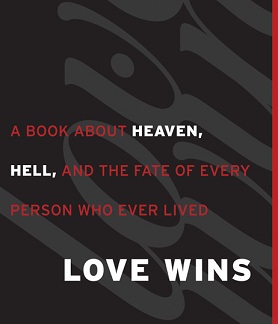 I know I am late to this party. It has taken me a while to get around to reading Love Wins
Rob Bell’s argument will be examined for historical accuracy and philosophical rigor. Furthermore, I will examine how Rob Bell makes his argument, because method is often one of the primary ways that people err in their theology. I begin with an analysis of the Preface and Chapter 1. I am hoping to release one post a week as I analyze this text. I will post each section with an outline of the arguments followed by my analysis.
Before I begin, one more note on this analysis: I have not read the book yet. My reason for this is I want to have it fresh in my mind as I do the analysis instead of coming to the text with a preconceived notion of what I remember it saying. Thus, these analyses will be based on a reading of the book chapter by chapter. I will end with an overall review once I wrap up the book. See the end of the post for links to other chapters.
Preface- “Millions of Us”
Outline
Rob Bell begins his book with a fairly simple statement “I believe that Jesus’s story is first and foremost about the love of God for every single one of us” (vii). Bell asserts that “Jesus’s story has been hijacked by a number of other stories… it’s time to reclaim it” (vii-viii). He points out that some teachings about Jesus have caused people to stumble, and that others do not discuss the issue of hell for various reasons.
Analysis
Bell is to be commended for taking on an issue that many are afraid to discuss. It is true that some people and even churches will not delve into the topic of hell. It is important to talk about this doctrine, as it has been part of Christian teaching from the beginning.
Unfortunately, it seems that Bell has already made a methodological mistake. He implored readers to “please understand that nothing in this book hasn’t been taught, suggested, or celebrated by many before me. I haven’t come up with a radical new teaching… That’s the beauty of the historic, orthodox Christian faith. It’s a deep, wide, diverse stream that’s been flowing for thousands of years…” (x-xi).
There are actually two errors here. First, simple diversity on a topic doesn’t somehow automatically validate all positions. Just because there was diversity about the doctrine of the Trinity doesn’t mean that the Arian position is somehow a valid theological perspective. Thus, it seems that Bell’s point here is moot. Diversity does not mean validity.
Second, historic, orthodox faith is not a diverse array of beliefs. The historic Christian faith has been define in universally acknowledged creeds which state what the universal church teaches on various essentials for the Christian faith. In fairness to Bell, he may be using “orthodox” to mean a denominational perspective, wherein the wider spectrum of beliefs is what may be considered “orthodox.”
Chapter 1: “What About the Flat Tire?”
Outline
Bell starts with a story about a quote from Gandhi, which prompted someone to write “Reality check: He’s in hell.” Bell reacts to this with a series of questions: “Really? Gandhi’s in hell? He is? We have confirmation of this? Somebody knows this? Without a doubt?” (1-2). Elsewhere, he focuses in on the individual again, asking whether it is true that the Christian message for someone who claimed to be an atheist during life has “no hope” (3).
He goes on to ask: “Has God created millions of people over tens of thousands of years who are going to spend eternity in anguish? Can God do this, or even allow this, and still claim to be a loving God? Does God punish people for thousands of years with infinite, eternal torment for things they did in their few finite years of life?” (2).
After focusing on the case of an individual’s salvation and whether there is an age of accountability, Bell focuses on the nature of salvation. “[W]hat exactly would have to happen… to change [an individual’s] future? Would he have had to perform a specific rite or ritual? Or take a class? Or be baptized? Or join a church? Or have something happen somewhere in his heart?” (5). Bell notes that some hold that one has to say a sinner’s prayer or pray in a specific way in order to get saved.
Bell continues to contemplate what it is to be saved, and points out that some believe that it is about a “personal relationship” but that that phrase is never used in the Bible. He asks why, if it is so central to salvation, would such a phrase not be in the Bible? (10-11). Bell asks whether “going to heaven is dependent on something I do” and then asks “How is any of that grace?” (11).
Then, Bell looks at various Biblical narratives, including the faith of the centurion, the discourse with Nicodemus, Paul’s conversion, and more, providing a constant stream of questions and noting apparently different things said about faith and salvation (12-18).
Analysis
Bell is right to focus on the notion of one’s personal fate. It is indeed impossible to declare with certainty that a specific person is in hell. It is always possible that God called them to faith in Christ before they died, even at the last moment. We should never say with 100% certainty that someone is in hell.
Bell is also correct to raise doubts about various things that people allegedly need to do in order to “get saved.” His critique of such theologies is again based around questions instead of head-on arguments, but even that is enough to poke holes into works-based theologies.
There seems to be a rather major methodological error in Bell’s analysis of a “personal relationship” with God.” His argument against using this notion to discuss salvation is to say that the phrase is not used in the Bible anywhere. As noted in the outline, he asks a number of very pointed questions regarding this and notes that the phrase isn’t in the Bible. But there are other phrases not used in the Bible which are central issues for Christianity, like “Trinity.” A phrase not appearing in the Bible does not automatically mean it isn’t taught by the Bible. Things can be derived from Biblical teaching without having the exact phrase we use to describe that teaching appear in the Bible. Just to hammer this home, let me point out that the phrase “Love Wins” nowhere appears in the Bible. One using Bell’s methodology here might come to the conclusion that his book is unbiblical.
Just as an aside, I found it a bit of a methodological problem that Bell begins the book with a chapter that is almost entirely questions. He promises answers later, but for now it seems like all the reader is left with is a bunch of–make no mistake about it–leading questions. I think that leading questions are appropriate for teaching, but not so much for defense of a position.
Conclusion
So far, we have seen that Bell makes a few methodological errors, each at a central part of his chapter. First, he made the assumption that diversity of views means validity of all. We have seen that such is not the case, diversity of views does not put them all on a level playing field. Second, he argued that because a phrase isn’t in the Bible, it doesn’t seem to be Biblical. We pointed out that this would collapse Bell’s own work because “love wins” is not found in the Bible. Even if it were, however, we noted that the mere absence of a phrase does not entail its falsehood or unbiblical nature.
However, we have also had several good things to say about Love Wins. In particular, his analysis of works-based systems of salvation was helpful. The fact that Bell is willing to discuss a controversial topic and ask the hard questions is also commendable.
Next week, we’ll analyze Chapter 2, which is about heaven. I look forward to your comments!
Links
Review of “Love Wins” by Rob Bell: Chapter 2– I review chapter 2.
Review of “Love Wins” by Rob Bell: Chapter 3– I look at Chapter 3: Hell.
Review of “Love Wins” by Rob Bell: Chapter 4– I look at Chapter 4: Does God Get what God Wants?
Review of “Love Wins” by Rob Bell: Chapter 5– I analyze chapter 5.
Love Wins Critique– I found this to be a very informative series critiquing the book. For all the posts in the series, check out this post.
Should we condemn Rob Bell?– a pretty excellent response to Bell’s book and whether we should condemn different doctrines. Also check out his video on “Is Love Wins Biblical?”
Source
Rob Bell, Love Wins
SDG.
——
The preceding post is the property of J.W. Wartick (apart from citations, which are the property of their respective owners, and works of art as credited) and should not be reproduced in part or in whole without the expressed consent of the author. All content on this site is the property of J.W. Wartick and is made available for individual and personal usage. If you cite from these documents, whether for personal or professional purposes, please give appropriate citation with both the name of the author (J.W. Wartick) and a link to the original URL. If you’d like to repost a post, you may do so, provided you show less than half of the original post on your own site and link to the original post for the rest. You must also appropriately cite the post as noted above. This blog is protected by Creative Commons licensing. By viewing any part of this site, you are agreeing to this usage policy.
Aliens that believe in God: The theological speculations of Robert Sawyer’s “Calculating God”
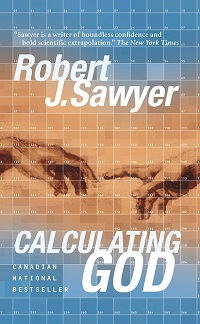 The interplay between worldviews and science fiction is very strong. In any writing, an author’s viewpoint will show through, but I think that it is particularly true in sci-fi. For in science fiction, the author is most frequently presenting a view of the world as it should be or as it should not be. The speculative future can be used as a foil through which the reader views reality in a new way. Often, science fiction will touch upon theological issues.
Robert Sawyer’s Calculating God
Fine Tuning
The most immediately striking and pervasive theme of Calculating God is that aliens show up on earth, and they believe in God. In fact, they take the existence of God to be a scientific certainty. The main character of the book, a paleontologist named Tom Jericho, is very skeptical throughout. Here’s the kicker, though, the aliens have been convinced of the existence of God through the evidence–specifically, the fine-tuning argument. Said argument is presented throughout the course of the book in interactions between Tom and Hollus, an alien paleontologist.
What is surprising is how much depth the book goes into while exploring the argument. Yes, Sawyer does fudge the argument a bit by allowing the aliens the possibility of a grand unified theory of science as well as a few other fictionalized aspects of the argument, but overall the fine-tuning argument he presents is very similar to the modern fine-tuning argument.
Not only that, but the characters Sawyer created go to great lengths to explore objections to and defenses of the fine tuning argument. For example, there is a discussion on p. 144ff (mass market paperback edition) in which Hollus and Tom discuss some objections to fine tuning. Tom is arguing against the probability of God:
“All the actions you ascribe to God could have been the doing of advanced aliens” [said Tom].
“There are… problems with your argument,” said Hollus, politely. “[E]ven if you dispense with the need for a god in recent events–events of the last few billion years; events after other conscious observers had emerged in this universe–you have done nothing to dispense with the relative strengths of the five fundamental forces [its science fiction, so there is an extra force], who designed the thermal and other properties of water, and so on. And therefore what you are doing is contrary to the razor of Occam you spoke of: you are increasing, not reducing the number of entities that have influenced your existence…”
The book is replete with debates like this, and the inevitable conclusion is that, shock of all shocks, God exists. I don’t say that sarcastically, I mean that I was genuinely surprised that the book affirmed God exists. But what kind of God?
God Exists… but?
It should be clear that in Calculating God, God is nowhere near the God of classical theism. In fact, one could almost argue that what Sawyer has offered here is a materialistic supplanting of God. The “god” of this work is essentially a super-powerful alien which is capable of swallowing the enormous energy output of a supernova, while also capable of designing our biology and fixing the constants of the universe during the early stages of the Big Bang.
God’s action is described purely in non-transcendent language. For example, the aliens confirm that god caused ice ages and mass extinctions on all the planets with intelligent life. The way this was accomplished was a matter of some speculation–perhaps God generated a dust cloud by using particles from across the galaxy to shield the planets from light and lower the temperature, or perhaps God redirected an asteroid or two to send them hurtling at the planets with life that needed a ‘jump start’ of evolution (146ff).
So why think that this is an image of god supplanting the classical theistic God? Well, clearly many who use the teleological argument are intending for it to point towards a creator God. What Sawyer has offered is a more naturalistic explanations of these events. Yes, there is a ‘god’ in the sense of a being capable of tampering with the very fabric of our universe, but that ‘god’ is itself trapped within the spatio-temporal boundaries of the known universe. In fact, god is said to subsist by recreating itself via a kind of reproductive method and passing one generation through a Big Crunch (think of a bouncing universe model).
Now what?
Calculating God offers a unique look at theology from a science fiction perspective. The fine tuning argument is presented in full force–even enhanced by some fudging of the science–and it leads to the inevitable conclusion that god exists. Yet this ‘god’ is not at all amenable to the god of Christianity or classical theism. So what should we do with this book?
Well, it is important to note that it is a work of fiction. The author clearly adds in some extra ‘fluff’ to make the fine tuning argument more powerful than it is (and I think it is quite powerful as it stands). And really Sawyer’s shoehorning in of a materialistic entity that is able to fiddle with physics boils down to hand-waving. Again, it is fiction, but it is important to note that Sawyer’s attempt to supplant the God of classical theism simply doesn’t work. Think of it this way: how would a purely physical being, however powerful, manage to transcend the physical universe in such a way as to literally rewrite the laws of physics? Extremely interesting science fiction? Yes. Compelling argument? No.
So where are we left? Sawyer does present the fine tuning argument in a way that is quite compelling, even when one strips away all the layers of fiction over it. It seems to me that, at a minimum, readers are left with a rock in their shoe: how do we explain away all this fine tuning without going beyond the cosmos? Sawyer’s own proffered answer, while entertaining fiction, remains that: fiction.
Other Issues
I have not yet even begun to delve into the depths of Sawyer’s Calculating God. The book covers an extremely broad array of topics related to science and faith as well as the secular-religious [false] dichotomy. For example, he discusses abortion in a few places, and I think the view the characters favor is very inconsistent. There is also some clear portrayal of the religious “other” as only a fundamentalist who seeks to halt scientific advancements. Yes, Sawyer panders to Christians in a few places, but the overall look at religious persons seems to be fairly negative (apart from Tom’s wife). I wish I could do justice to each of these topics, so I think I may follow this post up with another touching on more. For now…
Conclusion
Ultimately, Sawyer’s work is a simply phenomenal read. The amount of scientific, ethical, and religious issues upon which it touches is stunning, and readers will be forced to deal with the argument. Sawyer has done an excellent job using fiction for what I think it is called to do: inspire, entice, and force thought. Readers will be uncomfortable. The work will challenge people to really think about the arguments, and to think about the offered solutions.
Links
I have discussed the use of science fiction in showing how religious persons act. Check out Religious Dialogue: A case study in science fiction with Bova and Weber.
What would it mean if we discovered life? I have reflected on the possibility: Alien Life: Theological reflections on life on other planets.
Our Spooky Universe– I make the case for the intelligent design argument for the existence of God, which is heavily used throughout Calculating God.
Check out my other looks at popular level books. (Scroll down to see more!)
Source
Robert Sawyer, Calculating God
SDG.
——
The preceding post is the property of J.W. Wartick (apart from citations, which are the property of their respective owners, and works of art as credited) and should not be reproduced in part or in whole without the expressed consent of the author. All content on this site is the property of J.W. Wartick and is made available for individual and personal usage. If you cite from these documents, whether for personal or professional purposes, please give appropriate citation with both the name of the author (J.W. Wartick) and a link to the original URL. If you’d like to repost a post, you may do so, provided you show less than half of the original post on your own site and link to the original post for the rest. You must also appropriately cite the post as noted above. This blog is protected by Creative Commons licensing. By viewing any part of this site, you are agreeing to this usage policy.
Really Recommended Posts 2/8/13
 I could do these every day and still not catch up to the amount of fantastic posts out there. This week’s Really Recommended Posts feature “Love Wins,” natural evil, apologetics methodology, Tolkien, and more! As always, I’d love to hear your thoughts (and recommendations!).
Love Wins Critique– Rob Bell’s book on hell (or lack thereof?) caused quite a stir when it came out, and it continues to be discussed widely. Check out this excellent multi-part critique of the book. You can access all 5 parts here.
Why Would God Allow Natural Disasters? – One of the hardest parts of the problem of evil is the difficulty of “natural evils.” Check out this insightful response to the problem.
Is the Cold Case Still Valid? – One of the debates within Christianity is about apologetics methodology. Should we be evidentialists or presuppositionalists or something else (spoiler: I don’t think we need to be either/or)? This post discusses a critique of Cold-Case Christianity from an apologetic methodology standpoint. The book is phenomenal and I recommend it highly (see my review). See also J. Warner Wallace’s own response to the objection.
John Lennox vs. Richard Dawkins– A great video in which Lennox discusses science and Christianity, set against beautiful backdrops and quotes from the Bible. It also features some other excellent Christian thinkers. It’s worth the watch.
Loyal dog continues to attend mass at church where owner’s funeral was held– Just a heart-wrenching story about a loyal dog. Not apologetics related, really, but I enjoyed it.
Tolkien’s essay, “On Fairy Stories” continues to have massive influence today. Read it here online (or obtain the PDF file to read later). I found this post through another excellent list of links which is well worth checking out.
“For Greater Glory” – A look at a movie about Christianity in the face of violence
 “For Greater Glory“
The Good, the Bad, and the Ugly
The Good
The general Enrique Gorostieta Velarde is clearly a “good guy.” He was, himself, no Christian and certainly not a Roman Catholic, but he stood up against those who would persecute people simply for their beliefs. He also did not stand for compromise: he wanted toleration to be granted to Roman Catholics. He fought for an ideal. Even if that ideal was not one of the faith he was fighting to defend, he felt that there was injustice, and fought against it.
It is unclear whether the historical Enrique Gorostieta Velarde ever became a Christian. In the film, it certainly make it seem as though in making his arguments, he came into a kind of faith in God. It also seems to be the case that the historical general had some political ambitions in that he desired to bring about a change in the Constitution to provide for more toleration.
Father Christopher is an example for Christians everywhere. He does not back down in the face of violence. He became a martyr by standing in front of men who were doing him violence and proclaiming Christ to them. His martyrdom served as inspiration for a number of people in the film.
The Bad
The anti-catholics in the film are clearly the “bad guys.” It is hard to argue with this. Anyone who chooses to attack and kill people simply because of their beliefs certainly qualifies for the catchall “bad guy” terminology.
Plutarco Elías Calles, the Mexican President, an atheist, decides that he must use a violent crackdown to keep the Roman Catholic Church from becoming involved in Mexico. He couches his oppression of the Roman Catholics in language of secularism. Instead of focusing upon their religion, he makes his argument based upon the rule of government: the Roman Catholics serve a ruler (the Pope) who is outside of this country, and so they are a danger to the stability of this country. Despite this “secular” language, the fact of the matter is that throughout the film, the government is viscous not just towards the Roman Catholics as people who serve a different master, but also simply as religious persons. Crosses are burned and churches are destroyed. People are slaughtered during worship. It is a wholesale war against Christianity.
The Ugly
The film does not draw a hard and fast line between “good” and “bad,” however. There are also the ugly: those who, with good intentions, also commit atrocities. The Cristeros (those who fought for religious tolerance of Roman Catholicism) who commit atrocities were the “ugly.” Some felt they had to fight evil with evil, and committed horrible acts in the name of their cause. This is exactly what Christians are called to avoid.
Just War and Pacifism
The movie brought up the constant debate within Christianity between just war theorists and pacifists. It was surprising how lucidly it presented the issues. There were those in the film who refuse to use violence to fight against the government, citing Christ’s example of turning the other cheek. Yet even they become involved in getting supplies such as bullets to the Cristeros. On the other hand, there are those who argue for a just war tradition: when injustice is running rampant, should not Christians be among those who stand up against it, even if that calls for using force? The film never answers one way or another; instead, it leaves it to those watching to weigh the merits of just war and pacifism.
I tend to favor the just war theory myself. It seems to me that if a government like the Nazi Regime exists, then it is perfectly justifiable to use force to prevent them from perpetuating their evils.
Historically, according to more than one source I looked up, it is argued that the Cristeros actually had little impact on the overall outcome of the changes and toleration which came to Mexico. Instead, it was a deal negotiated by the Vatican with the Mexican government. Yet it seems for me historically perplexing as to why, exactly, the Mexican government would have desired a compromise if the Cristeros were not in operation. I speak here as no expert on the topic by any means. I’d be interested in reading your own thoughts.
The Elephant in the Room
It is hard to see this movie without thinking about the elephant in the room: atheists are in power, and religious people are killed. It’s a theme in the movie, but it also plays out time and again throughout human history: the French Revolution, the Soviet Union, the massacres of Armenians in Turkey, the Spanish Civil War, and more. Why is it that it seems, historically, every time a secularist government has taken power, the religious persons are the ones who suffer violence?
The answer to this vexing question seems to me to be quite clear: the notion that religion is violent and secularism stops violence is just false. Not only that, but the distinction between secular and religious is, itself, a mere construct with no ontological reality. I have argued this before when I discuss the Myth of Religion.
Conclusion
“For Greater Glory” is a movie that should be a must-see for those interested in worldview discussions. I could see it being used at an interfaith group, church youth group, or seeker group to generate discussion. The movie is definitely violent, and it shows the good, the bad, and the ugly unapologetically. It is for that reason that it must be seen.
What is perhaps the most shocking part of this movie is the fact that, prior to watching it, I had never heard or even imagined that Mexico had persecuted Christians. The violence committed against Christians by others in authority continues into the modern era, and it is truly depressing to know how little we hear about it. I can’t help sometimes but join with David and say “How long, Oh LORD?” (Psalm 13).
Links
I discuss the way that construct of “religion” has been used to denigrate an alleged “religious other” in my post: The Myth of Religion.
I have looked at a number of other popular movies. Check them out (scroll down to see more posts) in my movies category.
An interesting discussion of Christian pacifism can be found over at Glenn Andrew Peoples’ blog: Pacifism, Matthew 5, and ‘Turning the other cheek’.
SDG.
——
The preceding post is the property of J.W. Wartick (apart from citations, which are the property of their respective owners, and works of art as credited) and should not be reproduced in part or in whole without the expressed consent of the author. All content on this site is the property of J.W. Wartick and is made available for individual and personal usage. If you cite from these documents, whether for personal or professional purposes, please give appropriate citation with both the name of the author (J.W. Wartick) and a link to the original URL. If you’d like to repost a post, you may do so, provided you show less than half of the original post on your own site and link to the original post for the rest. You must also appropriately cite the post as noted above. This blog is protected by Creative Commons licensing. By viewing any part of this site, you are agreeing to this usage policy.
“Is Faith in God Reasonable?” Brief Debate Review: Alex Rosenberg vs. William Lane Craig
 Recently, the atheist Alex Rosenberg debated the theist William Lane Craig. The meat started to happen in the rebuttals, so I will focus on those. For a full review, check out Wintery Knight’s excellent summary.
Craig’s First Rebuttal
Craig pointed out the extreme implausibility of the naturalistic worldview in contrast to theism. He outlined several ways in which naturalism fails as an explanation of reality and cited Rosenberg’s work several times throughout this discussion. He argued that mental states have an “aboutness” which naturalism cannot explain.Then, he pointed out the profound difficulty naturalism has with locating truth and meaning within the worldview. He asserted that libertarian free will and purpose are incompatible with naturalism. Finally, the concept of the “self” and the first-person awareness cannot be explained by naturalism.
Rosenberg’s First Rebuttal
Alex Rosenberg: He focused on this question quite a bit in his rebuttal: “How is it possible for one chunk of manner to be ‘about’ some other piece of matter?” Yet after saying that this, he asserted that this debate over naturalism has nothing to do with the topic of the debate: “Is Faith in God Reasonable?”
He then turned to a discussion of the problem of evil. “If God is omnibenevolent, omniscience, and omnipotent, then the suffering of animals and humans needs desperately to be explained… Nobody has yet to offer a satisfactory explanation… Dr. Craig needs to tell us how [God] had to have the holocaust!”
He also argued that different religious books are false, so there is no reason to trust the New Testament.
Rosenberg said if Craig could provide an explanation for this, then he would become a Christian.
Craig 2nd Rebuttal
Craig immediately exclaimed his excitement over Rosenberg’s possibility of becoming a Christian, arguing that the logical problem of evil, which Rosenberg seemed to be using, has been largely abandoned due to its immense problems. In order to make this argument, the atheist assumes that if God is all powerful than he can create any world he wants, but this is not necessarily true. It is logically impossible for God to make someone freely do something. The atheist would have to prove that there is a world with as much free good in this world but without as much free evil. It seems this premise is impossible to prove. Thus, the logical problem of evil has largely been dropped.
Craig pointed out the fact that Rosenberg was simply mistaken about the importance of metaphysical naturalism. If metaphysical naturalism is false, then it seems clear that theism is that much more plausible.
Craig also once again pointed out that discrediting things like the Book of Mormon or the Qur’an does nothing to undermine the truth of the New Testament documents.
Rosenberg Final Rebuttal
Rosenberg continued to attack Craig as well as the format of the debate. He asserted that Craig was merely repeating himself. Then he commented that the format of a debate does not work to discuss questions like those at hand. One honestly is forced to wonder why Rosenberg chose to engage in the debate, if such were his opinions. Rosenberg attacked Craig’s arguments for “giving philosophy a bad name” and said he would be “embarrassed” to outline Craig’s defense of his arguments.
He did get into some actual comments on the arguments, however. He argued that some things can come into being from “nothing at all,” specifically alpha particles.
Finally, he got to the problem of evil. Here I continued to be confused over whether Rosenberg was sure which variety of the problem of evil he was presenting. He continued to utilize the evidential problem of evil as though it were the same as the logical problem of evil. He was confusing his arguments, mixing necessity with contingency. There is little to comment on here, because it was so confused.
Regarding the New Testament, Rosenberg essentially argued that we cannot know how corrupt the New Testament is.
Craig Closing
Craig turned once more to Rosenberg’s construction of the problem of evil. He pointed out that Rosenberg was mistaken about free will as well as the nature of the God’s creation. He pointed out that the holocaust was not necessary. Instead, he noted that the onus is upon Rosenberg to show that God could have actualized a world with as much good as there is in this world while simultaneously showing there would be less evil, which is of course beyond the ken of the atheist (or the theist).
Craig pointed out that we can confirm that New Testament sources we have go back to within 5 years of the actual events. Furthermore, Rosenberg was mistaken in saying that the New Testament documents were written in Aramaic. They were written in Greek.
Rosenberg Closing
Rosenberg used his closing to present an “obvious” argument for atheism. He argued that science has no need of the God hypothesis and that there is no basis “to invoke God for explanatory or any other purpose” in science. Thus, science has no reason to accept the existence of God. I find it interesting that he chose to save this argument for the point when he couldn’t be rebutted on the argument. Perhaps that is due to the extreme weakness of the argument. Only be equating science with knowledge could this argument have any relevance. This is not to mention that he is mistaken on this, but to show that he is mistaken would take us too far afield. Interested readers can view the links at the end of this post.
Rosenberg closed with “advice from an atheist.” His advice was to tell theists to not demand that their faith be reasonable. He continued with a discussion saying that theists should say “I believe because it is absurd.” He essentially asserted that theists cannot be reasonable. Honestly, this was just an insult. I admit I was not surprised by this comment by the end of the debate, as Rosenberg’s general strategy had seemed to be to denigrate, rather than interact with, theism.
Comments
I was honestly stunned by Rosenberg’s assertion that substance dualism or a debate over naturalism had nothing to do with faith in God. It seems quite obvious that such things are indeed germane to the discussion. If substance dualism is true, then theism has a much better account than non-theistic worldviews. If naturalism is false, the plausibility of theism increases greatly.
In the Q+A following the debate, someone asked Rosenberg why they should believe anything he said in the debate if he himself doesn’t believe in true. Rosenberg basically answered by saying that he’s just rearranging the brain in a way to meet truth… but of course he already denied that we can know what truth is. It’s just a certain way of orienting the matter in one’s brain! Ridiculous. I’m sorry, but it is ridiculous.
Regarding the debate itself, there were a number of non-scientific ways that people voted on the results of the debate. A formal panel awarded Craig the victory 4-2. The local (Purdue) voting on the debate 303-1390 Craig won. Online vote favored Craig 734-59. In other words, Craig crushed Rosenberg. I agree wholeheartedly. Let me know your thoughts. Comment below!
One awesome line from the debate came from Craig: “The purpose of life is not happiness. The purpose of life is knowledge of God.”
An awesome tweet: “Rosenberg apparently knows not only what God could have done but what would have been best for us for all eternity.” @ThnkngChristian
Links
Wintery Knight provided a simply fantastic summary of the debate.
Glenn Andrew Peoples has a post on quantum events in relation to the cosmological argument which is very relevant to this debate.
Shoulders of Giants?- Philosophy and Science in Context, or, “Lawrence Krauss Jumps off!”– I write on the relationship of science to philosophy as well as Christianity.
Science: “Thanks Christianity!”– Does Christianity say anything about science?
Really Recommended Posts 2/1/13
Thinking About ‘Future Things,’ Part 1– One area I will admit I have very little knowledge about in relation to Christian theology is eschatology. This series by Reasons to Believe provides an introductions to many aspects of eschatology and provides a fairly balanced view. I enjoyed it greatly and came away feeling much better informed. I recommend checking out the whole series.
Wukong’s Dilemma– An interesting look at Buddhist philosophy and the dilemma of a works-based religious system. I found this a very fascinating post.
Lance Armstrong, Thor and Ideal Heroism– A comparison of ‘real life heroes’ to the idealized heroes we construct. I found this post very insightful. I highly recommend it.
Christianity and High Beauty (With Pictures!)– A simply excellent post on the relation of the Christian worldview to beauty. There is much to be said about the importance of aesthetics in reality. This post hints at many of these themes.
Tim Keller, Women, and Ignoring your own rules– I found this post really excellent. It evaluates some of the Gospel Coalition’s stance on women in light of the rules that one of its adherents, Tim Keller, holds regarding discussion with other people. The problem is that they make many claims about egalitarians which simply are not true.
Critiquing Mormon Theology: An Innovative Approach– A presuppositional apologist examines various doctrines of Mormonism and offers a critique. It’s an interesting look into how the presuppositional approach can be integrated into a broad apologetic.
The Cross and the Stars– This is a fascinating look at some Roman Catholic science fiction authors. Readers of this site know I love science fiction and write about it frequently under popular books.
Our Spooky Universe: Fine-Tuning and God
 The Fine-Tuning Argument for the existence of God has been acknowledged as one of the most powerful arguments for theism. Proponents of this argument, also known as the teleological argument note that our universe is “spooky.” So many facets of our universe appear designed. It is startling to me to read about many of these in literature and realize that the very fingers of God seem apparent in these qualities of our universe. The way that these pieces fit together should not be viewed as independent variables. Any theory which seeks to explain the features of our universe must take into account the full range of factors.
The Argument Stated
The fine-tuning argument for the existence of God can be stated fairly simply:
1) The fine-tuning of the universe is due to either physical necessity, chance, or design
2) It is not due to physical necessity or chance
3) Therefore, it is due to design (Craig 1, 161 cited below)
The first premise turns on the notion of “fine-tuning”–something which is widely acknowledged to exist. It is the explanation of this fine-tuning that becomes controversial. Before trying to offer a way forward in this controversy, it will be prudent to list some of these evidences for fine tuning. Finally, before diving it it should be noticed that this argument can be seen probabilistically: that is, one should view it in light of which is more probable- are the properties we observe more probable in a universe that came about by chance, design, or necessity?
Various Evidences for Fine-Tuning
There are any number of independent, fine-tuned factors which make our universe capable of sustaining life. Without these factors in place, our universe would be uninhabited, and we would not exist.
Low Entropy
If the entropy in our universe were high, then the energy required for life to function would be distributed in such a way as to make the complexity required for life impossible. In order to determine the likelihood of a life-permitting range for a universe, Roger Penrose calculated the total entropy in our universe as “equal to the total number of baryons (protons and neutrons) in the universe… times the entropy per baryon… which yields a total entropy of 10^123.” This means that our universe falls within a range of accuracy regarding entropy of one part in 10 to the 10th to the 123rd power, 10^10^123. As Penrose put it, “the Creator’s aim must have been… to an accuracy of one part in 10^10^123” (quoted in Spitzer, 58).
The Existence of Matter
The very existence of matter is something which cries out for explanation. Why? Well, to put it as simply as possible, the basic particles of matter, quarks and anti-quarks form via pair production. They annihilate each other.
However, during the Big Bang, a slight asymmetry in this pair production resulted in approximately 1 extra particle of matter for every 10 billion produced.
It turns out that this 1 in 10 billion ratio of “leftover particles” happens to be the exact amount of mass necessary for the formation of stars, galaxies, and planets. As much as 2 in 10 billion, and the universe would have just been filled with black holes. As little as 0.5 in 10 billion, and there would not have been enough density for galaxies to form. (Bloom, cited in Rodgers).
The Nuclear Binding Force
If the nuclear binding force were much about 2% stronger, then the universe would form mega-elements which would make life impossible. Our universe would be filled with black holes and neutron stars. Furthermore, if it were weaker by about 5%, we would eliminate a large portion of the periodic table…. in fact, it would reduce it so much as to make the universe composed entirely of hydrogen (Bloom, cited in Rodgers).
 The Properties of Water
Water is required for life. Don’t take my word for it: just look into the works of those who are working on investigating the origins of life, people like Iris Fry

Water also has high adhesion which is critical for plants to grow. They rely upon capillary action with cohesion to grow upwards. This would be impossible if water were less cohesive. Water is a universal solvent, which is important for life because life relies upon a medium for chemistry to occur. If the medium were gas, the interactions would be too far apart, while if it were solid the interactions would occur to slowly or there wouldn’t be enough movement within the substance for chemical interactions needed for life to occur. Perhaps most “spooky” of all, a more recent discovery hints that water has quantum effects which cancel each other out, reducing the effects of quantum indeterminacy on the covalent bonds in water. This allows for water to have many of the properties outlined above.
There is no set number to assign to this chemicals of water, but it should be seen that property after property regarding water lines up exactly with the needs for life.
For a more in-depth discussion of the “spooky” properties of water, see the RTB Podcast on the topic.
Gravity
If gravity were increased by a significant margin, complex life could not exist due to their own weight. Even if life only came to be in water, the density of such life would have to be high simply to resist gravitation, which would again make complex life impossible. The lifespan of stars would also be reduced if gravity were increased by about a factor of 3,000 (or more). Robin Collins, in noting gravity as fine-tuned, argues:
Of course, an increase in the strength of gravity by a factor of 3,000 is significant, but compared to the total range of strengths of the forces in nature… this still amounts to a… fine-tuning of approximately one part in 10^36 (Collins, 190, cited below).
More
There are more of these requirements for fine tuning found in a number of the sources I cite below. But even looking at those I have outlined here, the possibility for our universe to exist as a life-permitting universe is absurdly low. It is so small that it baffles the imagination.
 The Fine-Tuning is Neither Chance nor Necessity
Robert Spitzer outlines the argument which leads from these constants to design:
1) The values of universal constants… must fall within a very narrow, closed range in order to allow any life form to develop
2) …the possible values that these universal constants could have had that would have disallowed any life form from developing are astronomically higher (falling within a virtually open range)
3) Therefore, the odds against an anthropic condition occurring are astronomically high, making any life form… exceedingly improbable. This makes it highly, highly unlikely that the conditions for life in the universe occurred by pure chance, which begs for an explanation (Spitzer, 50, cited below)
Thus, the argument turns on this contention: is it reasonable to think that the fine-tuning we observe in our universe is based merely upon chance? Now it is important here to realize that any of the three proposed explanations for the fine-tuning of our universe must carry the burden of proof for their position. That is, if someone puts “chance” out there as the explanation for the fine-tuning in the universe, they must defend their position as being more probable than the hypotheses of necessity and design.
Therefore, it is not enough to simply say that “anything is possible.” The key point is that any theory must take into account the full range of intersecting evidences for fine tuning. To make the inference for design, furthermore, is not a failure to attempt explanation. Instead, it is itself an explanation. The argument is that design is the best way to explain the evidence for fine-tuning in the universe.
William Lane Craig notes that it is important to take into account that the probability in play in the teleological argument is epistemic probability. That is, is it reasonable to believe that our life-permitting universe occurred merely by chance (Craig 2, 169)? Again, turning to Spitzer’s contention above and taking into account the enormously huge range of possibilities that turn against a life-permitting universe, one has to take into account the fact that it is almost infinitely more probable that a universe would be lifeless than to be one that has life. Yet Spitzer’s point is also that there is a “closed range” for values which are life-permitting. That is, there is only a limited set of values which will allow for their to be life. Yet the range of values which are life prohibiting is essentially open–that is, it is infinite. Therefore, the fact that our universe exists and is life permitting makes it reasonable to believe that it was designed. Design is the only explanation which can account for the full range of the evidence, for it explains why our universe would fall within a specific set of parameters which all must be aligned in order to meet the end of life. In the set of possible worlds, purposeless chance would give us an extraordinarily higher probability of having a lifeless universe, while necessity fails to provide any explanation at all. Only design provides a reason to believe that a life permitting universe would be the one to be brought into existence.
One may object by saying “well of course, but our universe is life permitting, so it appears that we hit the jackpot.” It should be seen now that that just begs the question. The person who makes this argument is in fact assuming that chance is the explanation without providing any evidence to think this is the case. Again, when one considers how vastly improbable our universe is, the most reasonable conclusion is that it is not, in fact, a random occurrence. As John Bloom put it, it would be like throwing a dart from outer space and hitting a bullseye on the surface of the earth that is smaller than a single atom. In other words, it is statistically impossible.
One may also object by noting that all universes are equally improbable, so our universe had to have some values. But again this misses the point. The argument is not that our universe is improbable, but rather that our universe, as life-permitting, is part of a limited set of possibilities against the much larger realm of possible worlds. In other words, the fact that our universe is life-permitting rather than life-prohibiting is what is surprising–not the brute fact of its existence. Although the fact of the universe’s existence is itself something in need of explanation.
Yet what about necessity? Is it possible that our universe simply has the constants that it has due to some kind of necessity? Here, mere physical necessity will not do as an explanation. For something which is physically necessary is not metaphysically necessary. That is, something can happen due to laws of nature and the like, while not being something required by logical necessity. Thus, it seems the burden of proof in this case is upon the one claiming that the universe is metaphysically necessary to show their case to be more reasonable than the chance and design hypotheses. Frankly, I think that the prospect is quite bleak.
Conclusion
We have noted a number of scientific evidences for the fine-tuning of the universe. These form our data set that any theory needs to explain. Chance has been found epistemologically wanting. It is simply not reasonable to say that chance is the explanation. Necessity seems to fare no better. There is no way to account for the necessity of the universe, and in fact our universe seems to be apparently contingent. Therefore, the most reasonable explanation for the apparent design in our universe is to infer that there is, in fact, a designer. Our universe is not so much spooky as it is spectacular.
Links
Evidence for God: A Fine-Tuned Universe– Matt Rodgers gives a great summary of a talk by John Bloom I attended as well. This post gives a really concise summary of a number of the evidences for fine-tuning.
The Teleological Argument– I present Robin Collins’ version of the fine-tuning argument and briefly defend it against a few objections. The Past, Probability, and Teleology– I answer a few objections to the teleological argument.
What about the multiverse? I have answered a number of issues related to the multiverse in my previous posts on the topic.
Max Andrews offers a discussion of the multiverse and the fine-tuning argument, wherein he notes that the existence of a multiverse does not undermine the argument.
Sources and Further Reading
John Bloom, “A Fine-Tuned Universe.” Lecture given at the EPS Apologetics Conference, 2012.
Robin Collins, “Evidence for Fine Tuning” in God and Design
William Lane Craig 1, Reasonable Faith
William Lane Craig 2, “Design and the Anthropic Fine-Tuning of the Universe” in God and Design
Fazale Rana, “Science News Flash: ‘Water Fine-Tuned for Life'” (October 27, 2011). Reasons to Believe.
Matt Rodgers, “Evidence for God: A Fine-Tuned Universe.”
Robert Spitzer, New Proofs for the Existence of God
SDG.
——
The preceding post is the property of J.W. Wartick (apart from citations, which are the property of their respective owners, and works of art as credited) and should not be reproduced in part or in whole without the expressed consent of the author. All content on this site is the property of J.W. Wartick and is made available for individual and personal usage. If you cite from these documents, whether for personal or professional purposes, please give appropriate citation with both the name of the author (J.W. Wartick) and a link to the original URL. If you’d like to repost a post, you may do so, provided you show less than half of the original post on your own site and link to the original post for the rest. You must also appropriately cite the post as noted above. This blog is protected by Creative Commons licensing. By viewing any part of this site, you are agreeing to this usage policy.
Response to a Complementarian video about why women cannot be pastors- Part 1
I am here responding to a youtube video, “Why Oranges Can’t be Apples.”
Recently, I came across a video arguing why women should not be pastors. I watched it and I have to say that it seems to reflect generally the arguments often used for complementarian positions. I thought it worth responding to this video simply to show how this debate is often focused around preconceived notions of manhood and womanhood instead of the actual Biblical texts.
Here, I will simply quote some of the things Jonathan Fisk claims in this video. Then, I shall respond to the comments he makes. I tried to include times for any of the quotes. They may not be exactly to the second, so I’ll take blame for any of these that aren’t lined up properly.
“God created authority, he made it good.” (3:00ish)
This line is troublesome. Did God create “authority”? Think about that claim. Is it possible to “create authority”? That doesn’t seem to me to be the case. In fact, I would argue that God has authority by fiat. Upon creation, God had authority over creation. Authority requires something to be authoritative over, but it is not created. Anyway, this is a minor point.
“Okay so put that [family roles] into the role of man and woman in Christ.” (4:46-4:48).
Fisk makes this comment after a rather lengthy discussion over authority structures in the family. Again, there are some really major problems with this statement. First, Fisk fails to make the argument that the roles of man and woman in Christ are distinct. Instead, he reads such roles onto the positions of male and female only after assuming them in the family. Fisk made the claim before this that man is placed as an “actual authority over the wife.” But here he must rely upon the interpretation of “head” as “authority.”
Consider the line of reasoning that is happening here: man is the head (authority) over woman in the family; Christ is the head (authority) over the church. Therefore, man should be the head (authority) over the church.
The conclusion simply does not follow from the premises. Even were I to grant that the two premises were true (which I don’t), the conclusion still would not follow. There is no argument here, only an assumption.
Second, reading human relationships onto God and then back onto humans is extraordinarily problematic. Many heresies have developed because humans have decided to make God in their own image. Fisk is here bordering on that by reading a preconceived notion of family onto God and then from God back onto the church.
“Christ himself, in order to save the world, had to be a man…” (7:03-7:05)
“It’s impossible for a woman to redeem the world.” (7:08-7:09)
Here Fisk claims to be talking about Christology, but I’m hesitant to agree with him. Fisk’s argument is a bit convoluted and he mostly just throws out a number of Christological phrases, so rather than quoting him at length I’ll sum up his argument.
Essentially, the argument is that Christ had to be male because he had to act as the head (here still using head as “authority”) of creation in order to save creation Because man is the head of the family and therefore somehow responsible entirely for the fall (?) Christ had to be a male.
Now one problem with this argument that should be immediately apparent is that the way Fisk is using “head” to mean “authority” actually undermines his claim that the Redeemer had to be male. Why? Well Fisk’s claim is that Christ had to be male to act as the head over all creation so that He could redeem creation. But in order to make sense of Fisk’s claim, one would have to ground all creation in Christ, which would work only if Christ was the “head” over all creation in the sense of source not of authority. The reason is because Christ would have to have the ontological capability to redeem creation, not simply the authority. This is actually at the heart of Christology.
Why would God have to become incarnate as a human, suffer, die, and rise again if redemption is merely a matter of authority? After all, surely the Godhead would have the authority to forgive sins in the first place! The issue is not one of authority but one of ontology. God simply offering a brute forgiveness of violations of His Law would not adequately bring to fulfillment God’s justice. Instead, God had to become incarnate so that God could fulfill His perfect Law without sin. The issue was not authority. God had the authority already. So Fisk’s use of “head” as “authority” is inconsistent. When he applies it to Christology, he equivocates on the term, using it as though it means source, despite claiming it means authority. That is the root of the problem with his argument here: he mixes ontology with authority.
But there are still more problems: if Christ had to be male in order to save humanity from sin, does that not speak to something about the nature of maleness and femaleness? If Christ can only be male, does that not mean that males more closely reflect the image of God than females? If Christ had to be male, does that not mean that males are closer to the incarnate deity? It does indeed imply these things, and there’s a reason such thinkers as Augustine explicitly reject this faulty, nigh-heretical teaching.
“This was such a clearly defined teaching… that they [apostles/church fathers] don’t do a lot of talking to say ‘women cannot be pastors.'”
Fisk goes on to say that “the word pastor wasn’t really the common word used for talking about pastors, instead they said things like ‘elder’ or… ‘deacon’ or ‘bishop’ or ‘overseer’.”
Let’s turn to a text here really quickly:
I commend to you our sister Phoebe, a deacon [Greek: diakonon] of the church in Cenchreae. (Romans 16:1)
So let’s just contemplate for a moment what Fisk said. He claimed that the apostles don’t much discuss women not being pastors, in part because they used other words, like “deacon.” But Paul sends a greeting to the churches in Rome, and he talks about “our sister Phoebe” whom he called “a deacon.” Perhaps this explains why we don’t get a lot of talk about women not being pastors; because they were pastors. Phoebe is explicitly called a deacon, the very word Fisk himself cites as an example of a word used for pastor.
But Fisk goes on to say that “they” go on to describe what a pastor should be over in 1 Timothy. This list, he notes, says that an overseer must be a “husband of one wife.” Now, Fisk actually says that this is the “first thing” it claims about being an overseer. Fisk is wrong. The first thing the text says is actually that an overseer must be above reproach.
Fisk’s ultra-literalistic reading of this text is problematic. In order to realize this, it is important to have the text out there:
Therefore an overseer must be above reproach, the husband of one wife, sober-minded, self-controlled, respectable, hospitable, able to teach… [1 Timothy 3:2- note that there are quite a few more requirements of the overseer listed after this verse]
Fisk is trying to read this verse as saying that an overseer must be a man, because after all, how else could the overseer be the husband of one wife? But what of all the pastors who are unmarried? If the text is teaching that an overseer must be the husband of one wife, why is it only the masculine part of the verse that applies today? Why is it not the entire phrase? Why are not all pastors required to be husbands of one wife?After all, that is what the text says.
Before someone accuses me of claiming that the Bible is wrong or diverging from Biblical truth, I should note that the problem is not with the text; it is with Fisk’s interpretation of the text. The problem is that Fisk is reading this text ultra-literalistically only in order to prove his point, but no farther. He wishes to read only that the overseer must be a man, but not that the overseer must be a husband. His exegesis is a mixed approach. Instead, I would point out that the requirement of being a “husband of one wife” shows that pastors should be faithful spouses. If Fisk wants to make his point, he must be consistent in his hermeneutic. He must read the whole passage in the same literalistic manner he has read “husband” to imply absolute maleness in the pastoral office. Thus, all pastors must be married. But they must have children that they keep submissive (verse 4), they must not be recent converts, etc. Now many of these requirements for pastors can be read literally and work just fine. Pastors should not be lovers of money (heaven help them if they are! they are in the wrong profession!). But the whole point of the verse is general requirements; not explicit, literalistic requirements.
Now I realize that I’m at about 1500 words and I’m not even halfway into the video, so it looks like this will have to be a multi-part response, if people find this useful. Do you?
Preview of some other issues: the Trinity, more problems with texts, and more!
Further Reading
How complementarianism is getting the Trinity wrong.
How complementarianism undermines the image of God in male and female.
A book review of an excellent work addressing every major text on this issue.
Women teach us all the time, through the Bible.
SDG.
——
The preceding post is the property of J.W. Wartick (apart from citations, which are the property of their respective owners, and works of art as credited) and should not be reproduced in part or in whole without the expressed consent of the author. All content on this site is the property of J.W. Wartick and is made available for individual and personal usage. If you cite from these documents, whether for personal or professional purposes, please give appropriate citation with both the name of the author (J.W. Wartick) and a link to the original URL. If you’d like to repost a post, you may do so, provided you show less than half of the original post on your own site and link to the original post for the rest. You must also appropriately cite the post as noted above. This blog is protected by Creative Commons licensing. By viewing any part of this site, you are agreeing to this usage policy.
Did God Create the Universe for Humans? – Some thoughts on God’s purposes for creating
 I have read on more than one occasion an atheist making the argument that goes something like this: if humans are the most important creation, why did God create such a vast universe? The argument is that God really wasted a lot of space if the universe was created for us. Another way I’ve seen this argument is as follows: the universe is full of galaxies that are even beyond our capacity to ever observe. Why, if God created the universe for us, is there so much here that is worthless to us? Furthermore, why is so much of the universe hostile to human life? Humans can’t live in overwhelming majority of the universe. Why is it so hostile if it were created for us?
A different discussion with an atheist was touched off when they asserted that the Bible states humans are the most important creation, so why create so much of the universe outside of our power to observe?
I’m going to offer an explanation which may come as something of a surprise: there is nothing in the Bible which makes it explicit that humans are the most important creation. I would go so far as to say that anyone who claims that is reading an unjustified anthropocentric worldview onto the text.
Perhaps the most commonly cited explanation for why we should think humans are the center of creation is the Genesis creation account, and specifically Genesis 1:27-28:
So God created mankind in his own image,
in the image of God he created them;
male and female he created them.God blessed them and said to them, “Be fruitful and increase in number; fill the earth and subdue it. Rule over the fish in the sea and the birds in the sky and over every living creature that moves on the ground.” (NIV)
But again, where in this text does it suggest that humans are the most important creation? It does show that we were made in God’s image, but it does not say that because of that, we are more important than anything else in creation. Too often people read into texts what they think it says, as opposed to reading what the text actually says. Again, I simply ask this: where in the text does it say that humans are the most important part of all of creation? As a friend pointed out, one could easily say the sun is the most important part of creation, because without it, we would not all be alive. But either view is equally unsupported by the Bible.
Another rationale that is used from this passage is the notion that humans are to have dominion over or rule over the earth (verse 28). But again, how does it follow from this that humans are more important? The problem is that we have a skewed view of importance. For us, very often, we think importance is equal to power. When someone has power, they are more important than someone without power. But such notions of power and hierarchy are extrabiblical ideas which we have read onto the text.
In fact, it seems that the Bible says we are not the greatest of all creation. Psalm 8:5 references humans and says that “You [God] have made them [humans] a little lower than the angels and crowned them with glory and honor.” So yes, humans are “crowned” with glory, but they are also ” a little lower than the angels.” It seems the Bible says that we may not be the greatest things to walk the universe. [I should note that the Bible may, in fact, note that humans are the most important part of all creation, but were I to grant this, my reasoning below still holds.]
But some people remain dissatisfied by this explanation, and claim that Christians very often do claim that humans are the crown of all creation or that the universe was made for us. Here, I suggest that once again, people have been thinking very anthropocentrically. In fact, they have limited God to the point of making God incapable of even having the same range of possibilities that humans have. The assumption built into this argument is that God created for the sole purpose of humanity. But just like other persons, it is possible for God to have more than one end in taking an action. Thus, even if we grant that humans were the most important creation–in contrast to the above argument–it still does not follow that the universe is exclusively for humans. God can have different ends.
Think about it this way: when you take an action, you very often have more than one end in mind. For example, you may get in your car to go to a local shopping store so that you can go to the grocery store and also because you want to stop and look at books at the bookstore. Here, you have taken an action (gotten into the car and taken it somewhere) with more than one end in mind. Similarly, God can create with more than one end in mind. Even if humans are the greatest of all creation (which I deny), it is also possible that God also created for other reasons. For example, God may have created gratuitous galaxies because they are beautiful. I can’t help but look at the stars and have my heart stop. The beauty of creation is extraordinary. It cannot be described in words. Perhaps this was one end God had in mind, along with the creation of humans. There are a number of other reasons God could have created apart from humans, so it seems to me that the objection here is short-sighted.
Only by creating God not just in our own image, but in an image less than our own, can we come up with an objection to the existence of such a God based upon the vastness of the universe, or its hostility to life.
Links
Beauty is a powerful reason to favor the Christian worldview. Check out this excellent post on the topic over at Well Spent Journey: Christianity and High Beauty (With Pictures!).
More Planets Than Stars – Exoplanets and Our Little Blue Ball– Naturalis Historia features a simply superb post on the possibilities of other life/planets like ours. It also briefly addresses the issue I have discussed in this post. I recommend checking it out.
From Divine Engineer to Divine Architect– Over at Faithful Thinkers, Luke Nix wrote about a similar topic. His post explores the notion of God as an architect, transcending the either/or dichotomy created by some about God’s purpose for creation.
I have reflected on what life on other planets might mean for Christianity: Theological Reflections on Life on Other Planets.
SDG.
——
The preceding post is the property of J.W. Wartick (apart from citations, which are the property of their respective owners, and works of art as credited) and should not be reproduced in part or in whole without the expressed consent of the author. All content on this site is the property of J.W. Wartick and is made available for individual and personal usage. If you cite from these documents, whether for personal or professional purposes, please give appropriate citation with both the name of the author (J.W. Wartick) and a link to the original URL. If you’d like to repost a post, you may do so, provided you show less than half of the original post on your own site and link to the original post for the rest. You must also appropriately cite the post as noted above. This blog is protected by Creative Commons licensing. By viewing any part of this site, you are agreeing to this usage policy.

 J.W. Wartick - Reconstructing Faith