Christianity
Sunday Quote!- Why invite sinners?
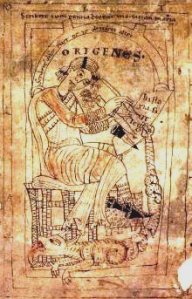
Image credit: https://commons.wikimedia.org/wiki/File:Origen3.jpg – Public Domain
Every Sunday, I will share a quote from something I’ve been reading. The hope is for you, dear reader, to share your thoughts on the quote and related issues and perhaps pick up some reading material along the way!
Why Invite Sinners?
Origen is one of the greatest thinkers in the history of Christianity. In one of his works, Contra Celsum (available in an excellent Kindle edition of his works), he replies to the skeptic, Celsus, who charged Christians with effectively dismissing sin and inviting the unrighteous into Christianity instead of the righteous. Origen replied in Book III, Chapter LXI:
Not to participate in mysteries, then, and to fellowship in the wisdom hidden in a mystery, which God ordained before the world to the glory of His saints, do we invite the wicked, and the thief, and the housebreaker, and the prisoner, and the committer of sacrilege, and the plunderer of the dead, and all those others whom Celsus may enumerate in his exaggerating style, but such as these we invite to be healed.
Origen’s point is that Christianity is a religion that does call sinners of all varieties, but it does not call them to a kind of “free pass”- it calls them to the healing that can only be had through the washing by the Lord Jesus Christ.
Links
Be sure to check out the page for this site on Facebook and Twitter for discussion of posts, links to other pages of interest, random talk about theology/philosophy/apologetics/movies and more!
On Christian Music– I wrote a post about the label “Christian music” and how that can lead to a number of difficulties with discernment.
Christian Discernment Regarding Music: A Reflection and Response– I reflect in depth on how we can use our discernment properly when it comes to music.
Sunday Quote– If you want to read more Sunday Quotes and join the discussion, check them out! (Scroll down for more)
Eclectic Theist– Check out my other blog for my writings on science fiction, history, fantasy movies, and more!
SDG.
“Harry Potter and the Cursed Child”- A Christian Perspective- Re-enchantment, Grace, and Loyalty
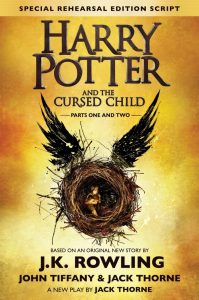 The new Harry Potter book is out, and people all over the world are diving back into the series. What kind of world does the latest adventure depict? How might Christians interact with the book? There will be SPOILERS in what follows. There will also obviously be SPOILERS for any other books in the series.
Harry Potter and Christianity… what?
Some may immediately object to the notion that Christians can or should interact with something like Harry Potter. What I say likely won’t convince anyone. But what I would say is that Harry Potter helps re-enchant the world, and our world is in great need of re-enchantment. The Bible speaks of a world created by God, inhabit by angels and demons, and full of the miraculous. The world we most often observe is utterly mundane in comparison: a world which we often think we have entirely figured out.
Harry Potter, however, opens the door to re-enchantment. The world of Harry Potter is magical–and the wonder of magic is similar to the wonder that readers have the first time they enter that certain Wardrobe from the Spare Room or see the White Wizard reappear. It’s a world that moves beyond the mundane and speaks to something more. And Christianity teaches that there is something more. The world is not just what we see with our eyes–it is a world that is utterly enchanted, full of mystery, and created by a loving God.
What’s more, the Harry Potter story so far ended in a kind of re-telling of the Messianic story. Potter laid down his life for his friends, was resurrected, and saved them. It’s a familiar story with different trappings, but one that each generation must learn anew.
Grace
One of the most important themes in “Cursed Child” is grace. Harry must have the grace to love his son, Albus, despite the imperfections. Albus must forgive his father and show grace to him to begin healing their relationship. Albus must learn the lesson Harry learned long before–that grace can defeat evil. He spares Delphi, an act of grace, despite her deserving great punishment. It’s a lesson that is brought forward time and again. In every relationship mentioned in the book, grace is needed to help heal wounds of doubt, of barbed words, and more.
Loyalty
Loyalty is another theme that shows up time and again throughout the series, and Serverus Snape’s loyalty to Lily and Dumbledore is perhaps the greatest example. Even in the alternative future that Albus visits, Snape remains loyal to the memory of Lily and his promises to Dumbledore. He fights alongside those who, in some cases, he has every reason to despise, at least historically.
That history is another major theme of the book: does one’s past determine one’s present and future? Delphi felt as though she must follow a prophecy that would allow her to be reunited with her father. Snape had to get beyond the history that he had with Harry’s father to continue the fight against darkness in an alternative future. Harry and his son Albus’ relationship is strained both by their own history and by the history of Harry. Who you are, it seems near the beginning, is determined by what you–or your parents–were. But that myth is dispelled as it becomes apparent that current action and decisions can break away from the bonds of history. Through the power of grace, as already mentioned, relationships may be healed, people may move forward.
But is it good?
Okay, okay, we get it. There are themes that interact with Christianity in Harry Potter. Is the new book worth reading?
I’d say absolutely, for fans of the series already. It’s not as detailed as the novels are, because it’s a script. But it is a good script, and the characters do develop quite a bit. There are some moments that will make you gleeful as you pick up references to previous books. The main complaint I’d have is that because it is a script, there is so little description of the environment and the characters’ internal struggles–something Rowling excels at. It’s a good entry in the series that won’t make you completely disappointed, but it isn’t as fabulous as the previous books in the series.
Links
Be sure to check out the page for this site on Facebook and Twitter for discussion of posts, links to other pages of interest, random talk about theology/philosophy/apologetics/movies and more!
Popular Books– Read through my other posts on popular books–science fiction, fantasy, and more! (Scroll down for more.)
SDG.
——
The preceding post is the property of J.W. Wartick (apart from quotations, which are the property of their respective owners, and works of art as credited; images are often freely available to the public and J.W. Wartick makes no claims of owning rights to the images unless he makes that explicit) and should not be reproduced in part or in whole without the expressed consent of the author. All content on this site is the property of J.W. Wartick and is made available for individual and personal usage. If you cite from these documents, whether for personal or professional purposes, please give appropriate citation with both the name of the author (J.W. Wartick) and a link to the original URL. If you’d like to repost a post, you may do so, provided you show less than half of the original post on your own site and link to the original post for the rest. You must also appropriately cite the post as noted above. This blog is protected by Creative Commons licensing. By viewing any part of this site, you are agreeing to this usage policy.
Practical Lutheranism: What is Sabbath?
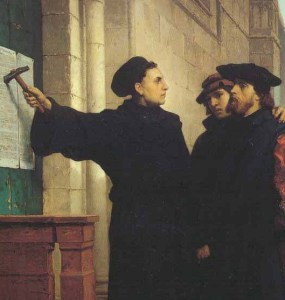 I have been reading through the Book of Concord. I think it is vitally important for one who, like me, claiming to be Lutheran to be familiar with the Lutheran Confessions. That is, after all, what we believe and confess. I have been writing a series of posts on Practical Lutheranism based on the Book of Concord. These teachings remain viable and valuable today.
What is Sabbath?
One of the debates that has raged within Christianity (with different levels of flame behind this raging, whether it be a mere flickering candle or a roaring fire) has been the meaning of “Sabbath” and how it is integrated into the Christian life. Volumes have been written, multi-view books published, denominations split or created, and the like on this topic.
Luther’s Large Catechism offered a way forward in this debate, offering an understanding of keeping the day holy that could be lived by the Christian. He wrote:
Accordingly, when you are asked what “You are to hallow the day of rest” means, answer: “Hallowing the day of rest means to keep it holy.” What is meant by “keeping it holy”? Nothing else than devoting it to holy words, holy works, and holy living… [The Sabbath Day] becomes holy or unholy on your account, depending on whether you spend it doing something holy or unholy. How does such sanctifying take place? Not when we sit behind the stove and refrain from hard work, or place a garland on our head and dress up in our best clothes, but… when we make use of God’s Word and exercise ourselves in it. [The Large Catechism, Part I, 87-88, cited below]
Yet Luther, as is so often the case for Luther (and Lutherans), was not content to leave it there. In the spirit of the Lutheran both/and, he expanded this notion of making holy to the whole of Christian life:
Truly, we Christians ought to make every day such a holy day and devote ourselves only to holy things, that is, to occupy ourselves daily with God’s Word and carry it in our hearts and on our lips… For non-Christians can spend a day in rest and idleness, too… but without keeping a single day holy, because they neither preach nor practice God’s Word… [Large Catechism, I:89-90]
Thus, for Luther, we ought to remember Christ’s words: we were not made for Sabbath, but Sabbath for us. Moreover, Sabbath is part of the overall Christian life instead of being relegated to merely one part of the week. Making the day holy is something we ought always be doing: reflecting on God’s Word, singing Psalms, and praying.
Source
Robert Kolb and Timothy J. Wengert, eds. The Book of Concord: The Confessions of the Evangelical Lutheran Church (Minneapolis, MN: Fortress, 2000).
Links
Be sure to check out the page for this site on Facebook and Twitter for discussion of posts, links to other pages of interest, random talk about theology/philosophy/apologetics/movies and more!
Adhering to the Book of Concord “In So Far As” or “Because” it Agrees with Scripture?– I argue that Lutherans must hold the position that we adhere to the Book of Concord In So Far As it Agrees with Scripture.
Eclectic Theist– Check out my other blog for posts on Star Trek, science fiction, fantasy, books, sports, food, and more!
SDG.
——
The preceding post is the property of J.W. Wartick (apart from quotations, which are the property of their respective owners, and works of art as credited; images are often freely available to the public and J.W. Wartick makes no claims of owning rights to the images unless he makes that explicit) and should not be reproduced in part or in whole without the expressed consent of the author. All content on this site is the property of J.W. Wartick and is made available for individual and personal usage. If you cite from these documents, whether for personal or professional purposes, please give appropriate citation with both the name of the author (J.W. Wartick) and a link to the original URL. If you’d like to repost a post, you may do so, provided you show less than half of the original post on your own site and link to the original post for the rest. You must also appropriately cite the post as noted above. This blog is protected by Creative Commons licensing. By viewing any part of this site, you are agreeing to this usage policy.
“Star Trek: Beyond”- A Christian perspective- Humanism, Unity, and Fear of the Unknown
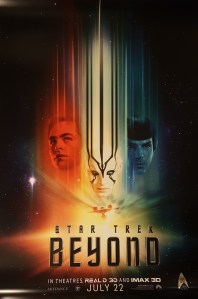
An official movie poster. Used under fair use.
Star Trek: Beyond has just released, and it is garnering critical praise. Full of special effects, the film has more heart and humor than might be expected. I quite enjoyed the movie. Here, I will discuss the movie from a Christian perspective. There will be SPOILERS for the film in what follows.
Humanism
One of the earliest scenes of the movie is a breathtaking view of a space station, Yorktown. The space station has rings encircling the interior and intersecting each other, with gravity presumably holding people down in a kind of inverted globe with trains and other vehicles zooming past. Huge crowds are observed milling about. It is a kind of utopic vision of the future. One can’t help but sit back and think: look what we could accomplish if we just set our minds to it!
Star Trek has always been about offering a kind of humanist vision of the future. Of course it goes beyond humanism and into a kind of inter-species unity in which we can hopefully learn to interact without conflict. What is striking, however, is how swiftly this vision falls.
Unity vs. Conflict
The most prominent theme in the movie, one that is repeatedly emphasized, is that of unity vs. striving and conflict. Krall is obsessed with the idea that humanity has grown weak through unity. It has made humans complacent and taken away their drive. He seeks to push humanity to new heights through conflict, bringing destruction in his wake. As he put it, the Federation has been pushing into the frontier, but now “the frontier pushes back!”
Of course, this shows a significant contrast with the vision of humanism offered early in the film. Indeed, Kirk and others do everything they can to show that unity is strength rather than weakness. Ultimately, they succeed, but only through striving and conflict.
Is it therefore possible that Krall actually succeeded in his plan, in some way, after all? He did force conflict–he brought it to the Federation–and in doing so, he made Kirk and others strive for something further, seeking new solutions and pushing new heights. It’s a subversive way to interpret how the film ended, but the implications are interesting to pursue. Krall’s vision is one that is so similar to the humanist vision it is difficult to pull them apart. When we make humanity the measure of all things, we inevitably must strive to continue to better ourselves. We will never find a limit beyond which we cannot or should not push.
Unity is a worthy goal, but without something to unite us, it is a vain hope.
Fear of the Unknown
The message of exploring the frontiers and having the frontiers push back is particularly poignant in this film. We approach a time–and are in many ways already in that time–in which changing DNA is possible, we push more and more boundaries every day. How long until we push a boundary and find that we have delved too deeply? Such a fear of the unknown ought not to forestall any advancements, but it should serve as a cautionary reminder that we should not rush blindly into the beyond.
Women
One thing I have really appreciated about the new Trek movies, and Beyond in particular, is their treatment of women. Lieutenant Uhura is assertive, decisive, and intelligent. Jaylah is a character who offers the kind of complexity that is too rarely seen in female leads in film. Moreover, her innovation and power help to save the day on multiple occasions. I hope that she continues to show up in future iterations of the franchise.
Conclusion
Star Trek: Beyond is a phenomenal film that will make viewers think. There are many more avenues to explore that I haven’t even touched upon here. What I think is most interesting, though, is the idea that unity is what we ought to strive for. I agree it is a worthy goal, but it is one that requires something around which we can all unite. Christ, I believe, has provided that something- we may guide our lives by his commands, and rely upon God’s grace when we fail.
Links
“Star Trek: Into Darkness”- A Christian Perspective– I take a look at the previous film
Be sure to check out the page for this site on Facebook and Twitter for discussion of posts, links to other pages of interest, random talk about theology/philosophy/apologetics/movies and more!
Read more movie reflections (scroll down for more).
Eclectic Theist– Follow my “other interests” blog for discussion of sci fi, fantasy, movies, sports, food, and much, much more.
SDG.
——
The preceding post is the property of J.W. Wartick (apart from quotations, which are the property of their respective owners, and works of art as credited; images are often freely available to the public and J.W. Wartick makes no claims of owning rights to the images unless he makes that explicit) and should not be reproduced in part or in whole without the expressed consent of the author. All content on this site is the property of J.W. Wartick and is made available for individual and personal usage. If you cite from these documents, whether for personal or professional purposes, please give appropriate citation with both the name of the author (J.W. Wartick) and a link to the original URL. If you’d like to repost a post, you may do so, provided you show less than half of the original post on your own site and link to the original post for the rest. You must also appropriately cite the post as noted above. This blog is protected by Creative Commons licensing. By viewing any part of this site, you are agreeing to this usage policy.
Book Review: “The Earliest Christologies” by James L. Papandrea
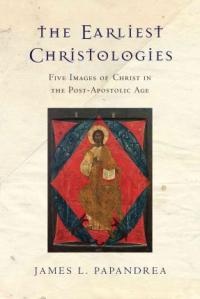 James L. Papandrea’s The Earliest Christologies is an introduction to examination of five views of who Christ was in the earliest church. Papandrea examines views of Christ as angel, prophet, phantom, cosmic mind, and Word/Logos.
The strongest point of the book is that it provides a reasoned, non-sensationalist accounting of the diversity of Christological positions in the early church. Too often, authors try to play up great conflict in the early church and what became orthodoxy as merely whatever view happened to have the most powerful adherents. None of that exists in The Earliest Christologies, which instead gives an overview of each position and shows that orthodoxy was superior in key ways.
Readers will get a broad overview of each of the five positions examined, along with multiple directions they could take further study, should they desire. It’s a solid introductory text.
Two primary difficulties face the book, and they are interlinked. The book is quite short, and so is necessarily brief on multiple important points, offering little by way of analysis. Papandrea notes throughout that the looks at Christology provided herein are “neater, cleaner, and more well-defined than they would have been in ‘real life'” (105). This brevity isn’t necessarily a major drawback, as it is intended as a work that introduces readers to the various positions on Christology in the earliest church, but it may leave some readers wanting more.
Well-written and stuffed with information, The Earliest Christologies provides a much-needed introduction to historical views of Christ. Although its brevity may limit its usefulness to introductory reading, such a work is necessary and it comes recommended. It would serve as an excellent text for a class on Christology or a high-level Bible study group.
The Good
+Provides a reasoned voice in examining early Christology
+Wealth of information in an accessible format
The Bad
-Extremely brief on multiple points
-Little by way of analysis
Disclaimer: I received a review copy of this book from the publisher. I was not obligated to provide any specific feedback whatsoever.
Links
Be sure to check out the page for this site on Facebook and Twitter for discussion of posts, links to other pages of interest, random talk about theology/philosophy/apologetics/movies and more!
Book Reviews– There are plenty more book reviews to read! Read like crazy! (Scroll down for more, and click at bottom for even more!)
Eclectic Theist– Check out my other blog for my writings on science fiction, history, fantasy movies, and more!
SDG.
——
The preceding post is the property of J.W. Wartick (apart from quotations, which are the property of their respective owners, and works of art as credited; images are often freely available to the public and J.W. Wartick makes no claims of owning rights to the images unless he makes that explicit) and should not be reproduced in part or in whole without the expressed consent of the author. All content on this site is the property of J.W. Wartick and is made available for individual and personal usage. If you cite from these documents, whether for personal or professional purposes, please give appropriate citation with both the name of the author (J.W. Wartick) and a link to the original URL. If you’d like to repost a post, you may do so, provided you show less than half of the original post on your own site and link to the original post for the rest. You must also appropriately cite the post as noted above. This blog is protected by Creative Commons licensing. By viewing any part of this site, you are agreeing to this usage policy.
“Manual of Christian Evidences”- Fisher Chapter 3 Guided Reading

Image from a camping trip I took.
I am leading a guided reading of the Manual of Christian Evidences by George Park Fisher. It is freely available online and will serve as a base for discussing Christian apologetics throughout this series. The chapters are short and readable. I encourage you to join in by reading the chapters and commenting with your thoughts. When I discuss the book, I will be citing page numbers from the edition linked above.
Chapter 3
Chapter 3 is quite short but has some thoughts to chew on. Perhaps the highlight is a brief exposition of the argument from felt need (also commonly called the argument from desire). Let’s talk about this and other issues below!
First, the discussion of the felt need for revelation in humanity (22-24). I wonder if this is an aspect of the argument that could be made stronger. It seems to me that the Bible speaks to the notion of all humanity knowing God, in some sense (Romans 1). But how do we tap into that? Do all people really have this felt need? There are plenty of atheists who deny such a felt need. I wonder if arguments focused on the existential need for Christianity could be expounded and strengthened. This argument is a different type than the more common one (below), but it still appeals to an pparent need within human nature that is met by Christianity. As more discoveries point to the notion of a “God gene” or psychological desire to believe in God, this argument, I think, actually gains more empirical support. Can such needs be reduced to nothing but genetics?
Second, regarding Fisher’s argument for the “way in which Christianity meets the deep wants of human nature” (25ff) is quite engaging. It is just the kind of argument people like us who are interested in historical apologetics are looking for: one that is not so commonly used now. But I think Fisher puts it forward masterfully. It is worth noting that he integrates wide ranges of evidence into his points. The first point is that the main truths of natural religion are put forth in Christianity in a “clear and vivid form” (25). Thus, Fisher is arguing that whatever is revealed in nature should point to the truth of Christianity. I’ve found this to be true time and again. After this first point, Fisher notes several lines of evidence that appeal to human conscience and desires.
I think this is an argument that could have broader appeal in our culture. People want to know that what they believe resonates with reality and pointing to how Christianity relates to desires can make it seem more real.
I do, however, wonder about things like the claim on p 26- “The moral precepts of Christianity are conformed to the dictates of conscience.” I think that this aspect of the argument would meet with vehement challenge as people charge Christianity with teaching against common sense and nature in regards to morality. How might we counter these responses?
Links
Be sure to check out the page for this site on Facebook and Twitter for discussion of posts, links to other pages of interest, random talk about theology/philosophy/apologetics/movies and more!
Apologetics Read-Through: Historical Apologetics Read-Along– Here are links for the collected posts in this series and other read-throughs of apologetics books (forthcoming).
Dead Apologists Society– A page for Christians interested in the works of historical apologetics. There is also a Facebook group for it.
SDG.
——
The preceding post is the property of J.W. Wartick (apart from quotations, which are the property of their respective owners, and works of art as credited; images are often freely available to the public and J.W. Wartick makes no claims of owning rights to the images unless he makes that explicit) and should not be reproduced in part or in whole without the expressed consent of the author. All content on this site is the property of J.W. Wartick and is made available for individual and personal usage. If you cite from these documents, whether for personal or professional purposes, please give appropriate citation with both the name of the author (J.W. Wartick) and a link to the original URL. If you’d like to repost a post, you may do so, provided you show less than half of the original post on your own site and link to the original post for the rest. You must also appropriately cite the post as noted above. This blog is protected by Creative Commons licensing. By viewing any part of this site, you are agreeing to this usage policy.
Book Review: “The Great Divide: A Lutheran Evaluation of Reformed Theology” by Jordan Cooper
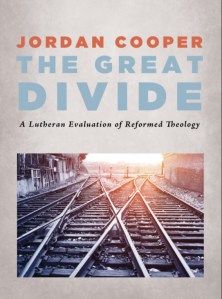 The Great Divide: A Lutheran Evaluation of Reformed Theology presents a broad-spectrum look at Reformed theology from a Lutheran perspective.* Cooper breaks this analysis up into three parts: Predestination and Free Will, Worship and the Sacraments, and Salvation. These parts are intended to show the greatest dividing lines between Reformed and Lutheran thought.
It is really quite exciting to see how well-read Cooper is on both Reformed and Lutheran thought. On the Reformed side, he frequently cites Calvin (of course), Bavinck, Edwards, Piper, Grudem, and more. On the Lutheran side, he draws from Luther, Chemnitz, Melanchthon, Kolb, and more. This thorough use of sources on both sides helps shield against bias, as Cooper continually cites the words of prominent theologians of each tradition.
Cooper provides in each chapter a presentation of Reformed thought on the topic, drawing extensively from prominent Reformed thinkers past and present, as well as various Reformed Confessions. Then, he provides a look at the Lutheran perspective, often quoting the Lutheran Confessions as well as prominent Lutheran thinkers. After providing this comparison, Cooper argues for the Lutheran position, noting the points of divergence along the way. At many points, this analysis is fairly robust. However, at other points Cooper does swiftly move from one point to another before providing enough to establish each point.
One of the things that comes to the front most clearly in the book is just how close Reformed and Lutheran thought are on a number of issues. Unfortunately, as close as the two traditions come on many areas, the chasm between the two remains vast. This is particularly clear in regards to the Sacraments and Predestination. I was also pretty surprised to see how different the Reformed and Lutheran view regarding worship is. The regulative principle within Reformed thought–that whatever is not commanded in Scripture ought not to be done in worship–was something that startled me. I hadn’t considered such a position, but Cooper showed the arguments for and against this position, coming down on the side of Lutheranism (again, he’s coming from that perspective), which sees worship as something that God allows for more leeway in than do Reformed thinkers.
It is truly amazing how much information Cooper manages to convey in just 200 pages. Readers are introduced to both Lutheran and Reformed perspectives on a number of important theological topics, treated to both exposition of those views and offered critique of the Reformed position all in a very clear style and form.
There are two minor critiques I’d offer of the book. The first is the continued use of the archaic “man” to refer to all people. There were, in fact, a few places in which I had to work to discern whether Cooper meant all people or just men when it came to what he was writing. A second critique is that because of the books relatively short length, some of the arguments on either the Reformed or Lutheran side seem extremely brief, leaving some of the arguments inconclusively demonstrated.
Jordan Cooper’s The Great Divide: A Lutheran Evaluation of Reformed Theology is a vast trove of information and analysis. Extensively researched and well-reasoned, it will provide readers unfamiliar with either Reformed or Lutheran theology (or both) an introduction to each tradition as well as a look at how they may interact with one another.
The Good
+Engages with prominent theologians from each group
+Historically informed
+Treats Reformed thought fairly
+Vast wealth of information
The Bad
-Continued use of archaic “man” etc. as inclusive
-Some points are breezed through very quickly
*It is worth noting my own bias here: I am a Lutheran who was raised Lutheran and, though I wandered a little bit, have become quite convinced of Lutheran theology in recent years.
Disclaimer: I was provided with a copy of the book for review by the publisher. I was not required to provide any specific kind of feedback whatsoever.
Source
Jordan Cooper The Great Divide: A Lutheran Evaluation of Reformed Theology (Eugene, OR: Wipf & Stock, 2015).
Links
Be sure to check out the page for this site on Facebook and Twitter for discussion of posts, links to other pages of interest, random talk about theology/philosophy/apologetics/movies and more!
Book Reviews– There are plenty more book reviews to read! Read like crazy! (Scroll down for more, and click at bottom for even more!)
Eclectic Theist– Check out my other blog for my writings on science fiction, history, fantasy movies, and more!
SDG.
——
The preceding post is the property of J.W. Wartick (apart from quotations, which are the property of their respective owners, and works of art as credited; images are often freely available to the public and J.W. Wartick makes no claims of owning rights to the images unless he makes that explicit) and should not be reproduced in part or in whole without the expressed consent of the author. All content on this site is the property of J.W. Wartick and is made available for individual and personal usage. If you cite from these documents, whether for personal or professional purposes, please give appropriate citation with both the name of the author (J.W. Wartick) and a link to the original URL. If you’d like to repost a post, you may do so, provided you show less than half of the original post on your own site and link to the original post for the rest. You must also appropriately cite the post as noted above. This blog is protected by Creative Commons licensing. By viewing any part of this site, you are agreeing to this usage policy.
Book Review: “Karl Barth’s Infralapsarian Theology” by Shao Kai Tseng
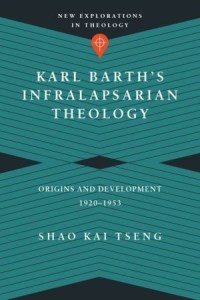 Shao Kai Tseng’s Karl Barth’s Infralapsarian Theology is a thorough examination of Barth’s lapsarian position. There are two major positions in Reformed circles regarding how God ordered the divine decrees. Supralapsarianism teaches that God decreed election (who would be saved) and reprobation (who would be condemned) prior to the Fall, while infralapsarianism teaches that God first decrees the Fall, then election and reprobation (among other things). Not all Reformed thinkers hold to one of these two positions. For a fuller explanation, see here, or look more deeply at the book. Barth, historically, has been understood as a supralapsarian, and even at times explicitly claimed that position for himself. Tseng argues, however, that Barth’s position is truly infralapsarian.
Tseng argues for his thesis through an examination of Barth’s developing thought. He begins with Barth’s earliest works and then traces his thought on problems of atonement, decree, and redemption throughout his life. Tseng interacts with numerous interpreters of Barth, utilizing them to support his theory or showing where they are mistaken.
The two greatest difficulties with the book are linked. Tseng’s tone is relentlessly even, such that there are few breaks for readers to pause and consider the contents, and few examples of application of the texts are given. This means that there is little reason given to investigate the central topic of the book: Barth’s lapsarian position. Why, exactly, does Barth’s lapsarian position actually matter to us now? Other than scratching a curious itch, what application does it have? Surely, for historical reasons, it is good to know where Barth ought to line up, but beyond that Tseng doesn’t give much of a reason for seeing why this impacts broader theological studies.
Of course, that doesn’t mean the book is without merit. Those deeply interested in Barth will want to engage with it and debate its contents. Moreover, because Tseng looks deeply at Barth’s developing thought, it provides some analysis of Barth’s overall theology.
Karl Barth’s Infralapsarian Theology is dry and fairly esoteric. For those who are deeply interested in Barthian thought, however, this will be necessary reading, particularly if one wants to engage in Barth’s doctrine of election. If one wishes to delve deeply into Barthian thought and Reformed disputes over lapsarian positions, this is a good read, but its audience is limited to that group.
The Good
+Exposes readers to large amounts of Barth’s thought
+Utilizes interpreters of Barth well
+Detailed look at the central topic
The Bad
-Little reason offered to pursue central topic
-Tone doesn’t put much “life” in the text itself
Disclaimer: I was provided with a review copy of the book by the publisher. I was not required to provide any specific kind of feedback whatsoever.
Source
Shao Kai Tseng, Karl Barth’s Infralapsarian Theology (Downers Grove, IL: InterVarsity, 2016).
Links
Be sure to check out the page for this site on Facebook and Twitter for discussion of posts, links to other pages of interest, random talk about theology/philosophy/apologetics/movies and more!
Book Reviews– There are plenty more book reviews to read! Read like crazy! (Scroll down for more, and click at bottom for even more!)
Eclectic Theist– Check out my other blog for my writings on science fiction, history, fantasy movies, and more!
SDG.
——
The preceding post is the property of J.W. Wartick (apart from quotations, which are the property of their respective owners, and works of art as credited; images are often freely available to the public and J.W. Wartick makes no claims of owning rights to the images unless he makes that explicit) and should not be reproduced in part or in whole without the expressed consent of the author. All content on this site is the property of J.W. Wartick and is made available for individual and personal usage. If you cite from these documents, whether for personal or professional purposes, please give appropriate citation with both the name of the author (J.W. Wartick) and a link to the original URL. If you’d like to repost a post, you may do so, provided you show less than half of the original post on your own site and link to the original post for the rest. You must also appropriately cite the post as noted above. This blog is protected by Creative Commons licensing. By viewing any part of this site, you are agreeing to this usage policy.
Book Review: “None Like Him: 10 Ways God is Different from Us (And Why That’s a Good Thing)” by Jen Wilkin
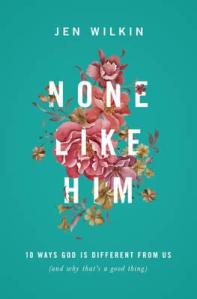
Jen Wilkin’s None Like Him is an introduction to the study of divine attributes.
Each chapter is laid out in much the same fashion: an anecdote begins each with a way to conceptualize the topic of the chapter (such as omnipotence), then an exposition of the meaning of the term and its importance in the Bible, following this there are a few ways that humans distort whatever divine attribute is being discussed, and the chapter closes with a few study questions, verses for more exploration, and a prayer. The format makes it ideal to use as a 10-11 meeting study group.
Upon starting the book, I immediately realized I wasn’t the intended audience. Although I checked the catalogue description and didn’t see anything about this, the book is apparently intended for study by women who are interested in getting deeper into theology. I’m a man, but I don’t think this precluded me in any way from doing a review of the book.
Wilkin’s use of examples, I felt, was particularly helpful. As I said, each chapter begins with an anecdote that helps illustrate the attribute or quality that is being disussed. Wilkin uses examples throughout the text to help make the abstract concrete, and I didn’t notice any that seemed to be off point. I also thought including sections on how humans distort various divine attributes was a wise choice, and made the book even more practical and applicable than it might otherwise have been.
The book is not without flaws, however. One of the most obvious is the somewhat ironic continued usage of the archaic “man” to refer to all humanity. Because the book is explicitly written for women (see the Introduction), this makes saying things like “our fellow man” in the same context as “we” sound stilted and strange. A deeper problem is that control of one’s own body is treated as a “sin” explicitly and exclusively even when it comes to a disease like anorexia or other eating disorders (Kindle Location 1746): “when we cross the line into unhealthy control [of our bodies], we move… to idolatry. This can take the form of… eating disorders…” No grace is offered in this passage for those who do struggle with things like eating disorders. Indeed, the message conveyed is contextually that all we need to do is stop “striving for control” and take away our commitment to “your own sovereignty” and we can then conquer these sinful issues. This is a deeply problematic to engage with something like an eating disorder, because eating disorders impact people mentally as well as physically to the point where it takes outside intervention to stop. Indeed, it is at this point that it might make the most sense to offer grace, because God’s inworking on humanity is what it takes to fight against such darkness in the world.
None Like Him is, ultimately, a decent introduction to the topics it covers. It doesn’t go much beyond the basics, but it does offer a good format and examples to help think through the issues. However, it is marred by a simplistic understanding of sin and adherence to archaic forms of expression.
The Good
+Interesting use of day-to-day examples
+Helpful format
The Bad
-Archaic use of masculine to refer… to women
-Treats disorders as inherently sinful
Disclaimer: I was provided with a copy of the book for review by the publisher. I was not obligated to provide any specific kind of feedback whatsoever.
Source
Jen Wilkin, None Like Him (Wheaton, IL: Crossway, 2016).
Ken Follett’s “Fall of Giants” – Deconversion, Hope, and Strife
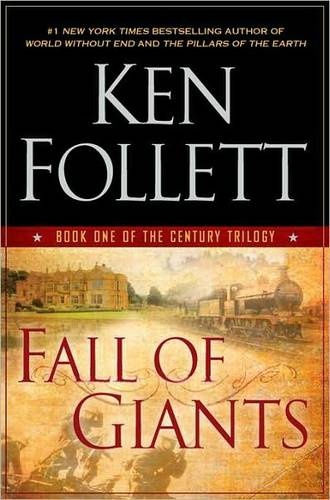
Ken Follett’s “The Century Trilogy” is a sweeping series . I just finished the first book, Fall of Giants, and realized there were several themes found therein that begged comment here. Here, I will analyze the book from a worldview perspective. There will be SPOILERS in what follows.
I will not go over the plot of the book. A brief summary may be found here.
Deconversion
Billy Williams is a Welsh boy who goes to work in a coal mine. The first day on the job he is left alone in the pitch black–his lamp went out. Rather than wandering lost in the tunnels he keeps working until someone comes to get him. To keep himself from being too frightened, he sings Christian hymns and draws comfort from them. At the end, when the light is restored, he sees a fleeting vision of Christ just at the corner of the light and says “Thank you.”
If that sounds like the start of a storyline that will be an example of a life of faith to you, you would be disappointed. After an explosion in the coal mine, he is distressed by the problem of evil–why does God let bad things happen? As he grows older, Billy is exposed to textural criticism. He is disturbed that we don’t have copies of the original texts from which we get the words of the Bible. His father, who often preaches at their worship services, has insufficient answers. Later in life, Billy’s sister gets pregnant and is judged sharply by his father and their town because she is not married. He is strongly put off by the apparent hypocrisy of the people. He never returns to church.
I admit that “deconversion” may be a bit of a misnomer because it is never specifically said that Billy doesn’t believe in God anymore, but the implications are there. He has a deep distrust of and distaste for Christianity, it seems, after this.
The story illustrates the need for a firm foundation. Textual criticism is not something Christians should fear, as it allows us to recover the text of the Bible more accurately. The problem of evil is not unsolvable. And, unfortunately, Christian hypocrisy is actually something to be expected. Indeed, the Christian worldview would expect hypocrisy at times because we are still sinners in this world and will continue to commit wrongs, despite being people of faith. None of this was hinted at in the novel, but I suspect that this is due in part to the fact that Follett is himself an avowed secular humanist. There seems to be an agenda here (and see below).
Unfortunately, Billy’s story is similar to one we can see repeating in churches and families all over. We have not studied our faith. We have not worked out the hard problems related to Christianity, so when we are confronted by them, we are often found with pat answers rather than the truth. We need to actively seek out answers and be aware of our own limitations. Unable to answer every question, we should commit ourselves to a life of faith seeking understanding.
Hope
There is hope found in the darkness throughout the coming World War and the plights of the individual people. Hope is found largely in the actions of other people–the small kindnesses that are done even in the face of evil. As the world seems to be crashing down all around, it is relationships which keep people going. Some of these are vaguely religious in nature, though the persisting theme seems to be that people need to do for themselves whatever they’d like to accomplish.
Religious Leaders?
One persistent theme throughout the book is that those involved in the church are mean, nasty, and most likely sexual deviants. Any time a priest-whether Roman Catholic or Eastern Orthodoxy or Anglican–is mentioned or encountered, it is almost always in context of some offhand remark about how they sexually harassed a child or how someone who is now an adult remembers when they were asked to have sex with the priest, etc. It’s actually quite tiresome. While on the one hand it is important to note that there are those within Christianity who have abused power throughout time, on the other hand, to suggest that everyone in some sort of position in power was a power-hungry sexual predator is uneven, to put it mildly.
Those who are not in established religion–like Billy’s dad–are portrayed as aloof, distant, and largely uncaring. Billy’s dad does get a chance to redeem himself as he accepts Ethel back into the family, but only after he had to consider the possibility of having his whole family fall apart.
Conclusion
Follett has woven an intriguing story with a very strong premise. It is unfortunate that throughout there also seem to be straight polemics against Christianity. A better balance was needed to make it seem realistic and not so much a diatribe against Christianity. Some good takeaways can be had from reading the book, but the worldview it presents is largely bleak and hopeless.
Links
Be sure to check out the page for this site on Facebook and Twitter for discussion of posts, links to other pages of interest, random talk about theology/philosophy/apologetics/movies and more!
Popular Books– Check out my other posts on popular books, including several other science fiction works. (Scroll down for more.)
Source
Ken Follet, Fall of Giants (Signet, 2012).
SDG.
——
The preceding post is the property of J.W. Wartick (apart from citations, which are the property of their respective owners, and works of art as credited) and should not be reproduced in part or in whole without the expressed consent of the author. All content on this site is the property of J.W. Wartick and is made available for individual and personal usage. If you cite from these documents, whether for personal or professional purposes, please give appropriate citation with both the name of the author (J.W. Wartick) and a link to the original URL. If you’d like to repost a post, you may do so, provided you show less than half of the original post on your own site and link to the original post for the rest. You must also appropriately cite the post as noted above. This blog is protected by Creative Commons licensing. By viewing any part of this site, you are agreeing to this usage policy.

 J.W. Wartick - Reconstructing Faith
