Christianity
Book Review: “The New Atheist Novel” by Arthur Bradley and Andrew Tate
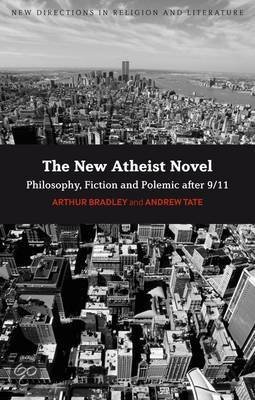 There are moments in which you pick up a book and are delivered into a completely unexpected and fresh-feeling experience. The New Atheist Novel: Fiction, Philosophy and Polemic after 9/11 was one such experience for me. Arthur Bradley and Andrew Tate take readers on a journey through the literature of four modern authors who, they argue, are representative of a new form of novel: the “New Atheist Novel.” This novel is a kind of counter-mythology which invents the transcendent within an atheistic universe. Bradley and Tate analyze the work of Ian McEwan, Martin Amis, Philip Pullman, and Salman Rushdie. The authors show how some have shifted their polemic after 9/11 to viewing religion as a kind of one-size-fits all mentality that has no distinction between liberalism and fundamentalism.
Bradley and Tate apply critical theory to the works of fiction presented in this book in incisive fashion. They draw out themes of the authors analyzed in order to show how often they are just as guilty of irrationality as those against whom they pontificate through the voices in their novels.
Ian McEwan’s fiction, they argue, shows a distinctly New Atheist bent. He sees religious persons as ultimately violent and anti-intellectual. Interstingly, McEewan’s vision of transcendence develops through music and the written word. His post 9/11 writings show a more distinctly anti-Islamist bent, which sees religion as a failure of the imagination. However, Tate and Bradley argue that McEwan’s imagination is itself failing in its capacity to see the radical Muslim act of terror as inherently symbolic and transcendent itself.
This kind of analysis proceeds across the authors analyzed, from Martin Amis’ cliché-filled war against cliché to Salmun Rushdie’s more even-handed but nevertheless anti-theistic vision of the “Quarrels over God.” The analysis of Philip Pullman’s work is perhaps the highest point of the work, as it shows how even in disagreement, one might learn from the “New Atheist Novel.” Pullman’s work shows the myth of the death of God as a kind of human transcendence and freedom from restraint. This vision may be seen as a sometimes on target critique of religion which sometimes becomes authoritarian and too bent towards heresy-hunting. Tate and Bradley ultimately see Pullman’s fiction as a kind of neo-heresy which is attempting to purify religion of its alleged bent towards fundamentalism and too-small vision of deity.
The book’s usefulness goes beyond simple critique. Instead, it gives readers a chance to interact with all literature in a critical fashion. Moreover, Bradley and Tate are not entirely unsympathetic to the “New Atheist Novel” and show how it may help to inform future discussions. The critical interaction is not merely critical but also constructive.
Perhaps the biggest weakness in the book is that its thesis doesn’t seem to carry throughout. The “New Atheist Novel” makes its debut with McEwan, but by the time the author’s reach Rushdie’s slightly more amiable vision of religions in conflict, it seems to lack cohesion as a concept. Perhaps it would be more accurate to say that the “New Atheist Novel” is more of an “Anti- (or Alter-) Theistic Novel” which encompasses not mere anger against religion but rather a critical and sometimes polemical and mistaken vision of the “religious other.” Thus, it seems in the end the “New Atheist Novel” namenclature might not be inaccurate after all, but I tend to think–and the authors reinforce this–of the “New Atheism” along specifically Dawkinsian lines of thought, and Rushdie and Pullman’s works did not seem to fit this usage of the term. A minor gripe, but one worth noting.
This is a book well worth reading and referencing. Don’t be deceived by its length (111 pages of text); it truly has an enormous amount of useful information and discussion. I took a monstrous amount of notes on this book given its length. It will get you thinking, whatever your own view. I recommend it without reservation.
Links
Be sure to check out the page for this site on Facebook and Twitter for discussion of posts, links to other pages of interest, random talk about theology/philosophy/apologetics/movies and more!
Sunday Quote!- The New Atheist Mythology– I share a quote from The New Atheist Novel which discusses the notion that there is a mythology growing up around atheism.
Source
Arthur Bradley and Andrew Tate, The New Atheist Novel: Fiction, Philosophy and Polemic after 9/11 
SDG.
——
The preceding post is the property of J.W. Wartick (apart from quotations, which are the property of their respective owners, and works of art as credited; images are often freely available to the public and J.W. Wartick makes no claims of owning rights to the images unless he makes that explicit) and should not be reproduced in part or in whole without the expressed consent of the author. All content on this site is the property of J.W. Wartick and is made available for individual and personal usage. If you cite from these documents, whether for personal or professional purposes, please give appropriate citation with both the name of the author (J.W. Wartick) and a link to the original URL. If you’d like to repost a post, you may do so, provided you show less than half of the original post on your own site and link to the original post for the rest. You must also appropriately cite the post as noted above. This blog is protected by Creative Commons licensing. By viewing any part of this site, you are agreeing to this usage policy.
Christian Discerment Regarding Music: A reflection and response
 I recently read a post which called for “discernment concerning the Christian music world.” The author, “EvangelZ” writes:
We have been told to be discerning in terms of what types of secular music to not assimilate into our minds if it is degrading, anti-Christ, and vulgar, to name a few. But what about the call to be discerning concerning the Christian music world?
I agree wholeheartedly with this sentiment. We should–must–be discerning when it comes to what music we engage with. Our engagement with both Christian music and “secular” music (whatever these categories even mean) should be reflective of the content of that music. The list EvangelZ provided above is hardly comprehensive, but a good place to start. If our “Christian” music is “degrading” or “vulgar,” that would certainly seem to exclude it from any use in a worship service, and should be a strong reason against our integrating that music into our lives.
Indeed, I would contend that the content of the music should be essentially the criterion (with notable exceptions below) for the music deemed acceptable for a Christian to consume. Of course, there should be a real acknowledgement that some people have different levels of discernment or resilience than others (can we eat the meat offered in sacrifice to false gods or not? after all, it’s just some meat left out for some false idol? [see here if you’re not sure what I’m referencing]).
However, after this introductory comment, EvangelZ spent the rest of the post discussing how we should us discernment regarding Christian music by way of the lives of those who made the music. For example, one issue highlighted was Tim Lambesis’ (singer for “As I Lay Dying”) apostasy. Now, setting aside the issue of whether any “As I Lay Dying” song could even possibly be used in a worship service (although I like metal, I hardly think it lends itself to corporate worship and singing praises), what I want to briefly touch on is exactly this notion: should our discernment apply to content of the music or to the lives of the musicians (or, of course, both)?
After reading the post, I wrote a comment, and I’d like to just reflect on what I wrote there a bit more. I’ll reproduce my comment, in part, here:
[T]he criteria given for discernment in “Christian” music are pretty much all matters of personal character of the musicians, not the actual content of the music. I’m wondering why on the one hand it is content (“secular” music) but on the other (“Christian” music), it is the people producing the music. This raises a number of questions for me:
1) Why the difference in criteria?
=> 1A) Is it because music functions didactically and so we should be aware of who is “teaching” us through music?
=> 1B) If so, then do we need to know about the lives of every single person who has written a song that we use in worship before we are able to use it?
2) If we are to use character as a criteria of discernment for worship music, does that not essentially mean we can’t use any music?
=> Explanation: everyone is a sinner in the process of sanctification, so by default anyone who has written a song we use in worship has still sinned.
=> 2A) Or is the issue simply unrepentant sin?
I think all of these questions are issues we must deal with as we consider the need for discernment in whatever music we listen to. I’ll provide a brief reflection on each issue I raised in these questions:
1) I am unconvinced that there should be any difference in our criteria for discernment when reflecting on Christian or “secular” music. Part of this is because I’m not sure such a dichotomy actually does exist (see here), and part is because I don’t know why such a distinction should exist.
1A) If we grant that hymns or music used in church functions didactically–as teaching–then perhaps a case could be made, but I think, abstractly, the content should once again be the ultimate judge of whether a teaching is good (or not).
1B) Because we cannot feasibly be required to know about the lives of all who write the music we listen to, this cannot serve as a viable criterion for discernment. Perhaps exceptions could be made in those cases wherein we do know something should (and what does “should” mean here?) disqualify one (i.e. I could see the knowledge that ‘the person who wrote this hymn is a satanist’ as a perfectly sound reason for not using a hymn), but one cannot realistically be expected to know about the lives of every single artist who writes any part of our hymnody (or music generally).
2) Because all are sinners, if character is a criterion for discernment, it would seem that all are disqualified.
2A) However, perhaps the qualification could be made that it is merely persistent, unrepentant sin which should disqualify one. But then one has muddied the waters via 1B again.
Thus, I think that for Christians, the best way to use discernment is to apply the truths of the Bible to the content of the music. We cannot realistically be expected to know the backgrounds of every individual who writes the music we may listen to or use in worship, and with the caveat noted above, I think the criterion simply should be the content–the lyrics–of the music. How do we analyze the content? Well I think there are a number of factors, including those rightfully noted above by EvangelZ. God’s revelation in Scripture and the gift of conscience should be our guides.
Links
Be sure to check out the page for this site on Facebook and Twitter for discussion of posts, links to other pages of interest, random talk about theology/philosophy/apologetics/movies and more!
On Christian Music– I reflect on the category of “Christian Music” and whether it is even a functionally helpful tool.
Engaging Culture: Demon Hunter’s “Extremist” and the Apologetic Task– I discuss the latest album from Demon Hunter and how music may act as an apologetic endeavor.
The Call for Discernment Concerning the Christian Music World– Be sure to read the post to which I responded here, and see what you think of their reasoning. I think this is an issue worth discussing.
SDG.
——
The preceding post is the property of J.W. Wartick (apart from quotations, which are the property of their respective owners, and works of art as credited; images are often freely available to the public and J.W. Wartick makes no claims of owning rights to the images unless he makes that explicit) and should not be reproduced in part or in whole without the expressed consent of the author. All content on this site is the property of J.W. Wartick and is made available for individual and personal usage. If you cite from these documents, whether for personal or professional purposes, please give appropriate citation with both the name of the author (J.W. Wartick) and a link to the original URL. If you’d like to repost a post, you may do so, provided you show less than half of the original post on your own site and link to the original post for the rest. You must also appropriately cite the post as noted above. This blog is protected by Creative Commons licensing. By viewing any part of this site, you are agreeing to this usage policy.
Sunday Quote!- Building the Argument from Undesigned Coincidences
 Every Sunday, I will share a quote from something I’ve been reading. The hope is for you, dear reader, to share your thoughts on the quote and related issues and perhaps pick up some reading material along the way!
Build the Argument
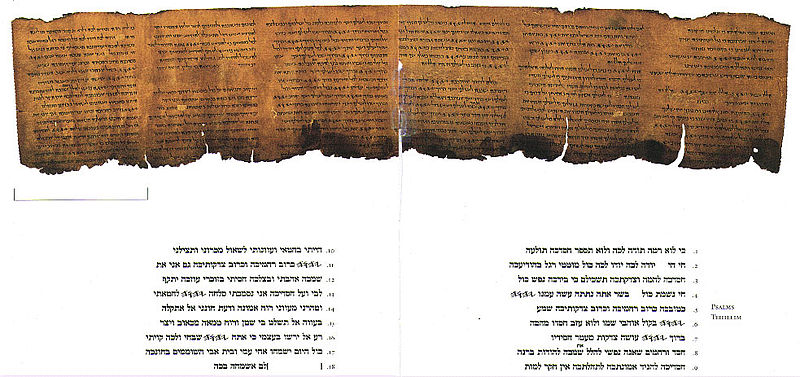
J.J. Blunt (1794-1855) wrote what I consider to be one of the strongest pieces of apologetics literature ever written, Undesigned Coincidences in the Writings Both of the Old and New Testaments. The book focuses, clearly enough, on the argument from undesigned coincidences. I’ll not explain the argument here, as I have done so already. But Blunt operated under no false hopes of having comprehensively covered this extremely broad argument:
Much, however, of the same kind of testimony I have no doubt has escaped all of us; and still remains to be detected by future writers on the Evidences. (v, cited below)
Blunt’s words are a call to action for the Christian apologist. The argument from undesigned coincidences is extremely powerful, but it also has massive depths to explore throughout the totality of the Bible which have not even begun to be explored. Moreover, Blunt began the work of relating these “coincidences” to contemporary literature by relating the Gospels and Acts to Josephus, but surely there is much more work to be done by exploring other literature outside of the Bible and seeing how these might be cross-confirmed.
So, fellow Christian apologists, let’s get to work!
Links
Be sure to check out the page for this site on Facebook and Twitter for discussion of posts, links to other pages of interest, random talk about theology/philosophy/apologetics/movies and more!
Forgotten Arguments for Christianity: Undesigned Coincidences- the argument stated– I outline the basics of the argument from undesigned coincidences. I also provide an example of the argument in practice.
Sunday Quote– If you want to read more Sunday Quotes and join the discussion, check them out! (Scroll down for more)
Source
John James Blunt, Undesigned Coincidences in the Writings of both the Old and New Testament, New York, 1847.
SDG.
Question of the Week: Favorite “Worldview” Fiction
 Each Week on Saturday, I’ll be asking a “Question of the Week.” I’d love your input and discussion! Ask a good question in the comments and it may show up as the next week’s question! I may answer the questions in the comments myself.
Favorite Worldview Fiction
I recently asked about favorite movies regarding worldview. I think that any time we interact with any portrayal of fiction, we still run into major questions of worldview. We should always be watching or reading or listening with a critical mindset, ready to interact on worldview-level questions. We love to read, but we need to do so in a way that acknowledges that “every story has a worldview.”
What is your favorite fictional book in regards to the way it interacts with worldview? Which worldview is presented? How might we learn from this presentation?
I know I’ve had many moments when I’ve finished a piece of fiction and just had to sit and think for a while afterwards. They’re wonderful times, and I think we’ve all had them. Let’s read about them in the comments!
Links
Be sure to check out the page for this site on Facebook and Twitter for discussion of posts, links to other pages of interest, random talk about theology/philosophy/apologetics/movies and more.
Question of the Week– Check out other questions and give me some answers!
SDG.
Really Recommended Posts 9/5/14- Jesus’ resurrection, logical fallacies, and more!
 Well depending on if my child comes on time, I may currently be in the hospital with my wife and a baby being born today, as it is our due date! Thus, I may not respond right away to any comments. On the other hand, I may just be hanging out waiting for the baby (or he or she may come early!). So long story short keep my family in your prayers, if you please. This week’s posts include Jesus’ resurrection, logical fallacies, “The Unbelievers” movie, Michael Behe’s design argument, and Rob Bell and Oprah Winfrey.
Prior Probability of the Resurrection– David Marshall presents a lengthy argument related to the prior probability of the resurrection of Jesus. This argument is very important, and Marshall’s approach is one of many leading ways to argue for the truth of Jesus’ resurrection. This article has much depth and is worth the read.
How Not to Argue: The Problem of “Folk Fallacies”– It is easy to fall into the trap of Googling random fallacies and charging others with committing these errors. Here, some difficulties with pointing out an alleged stream of fallacies are pointed out. It’s a good post for apologists to consider.
Are “The Unbelievers” Unbelievable?– Here, Saints and Skeptics addresses several issues of “The Unbelievers” film, including its method, arguments, and conclusions.
A Pretty Sharp Edge: Reflecting on Michael Behe’s Vindication– Michael Behe’s argument for intelligent designed is based upon the concept of irreducible complexity. Check out this post which argues that his argument has been vindicated.
Rob Bell, Oprah Winfrey, and the missing Jesus– What happens when Rob Bell meets Oprah Winfrey? Check out this post for some interesting thoughts on the missing Christ in the conversation. See my own series of posts on Rob Bell’s Love Wins for some more reading.
Book Review: “Questioning the Bible” by Jonathan Morrow
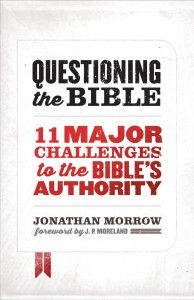 Questioning the Bible
Is the Bible Anti-Intellectual?
What can we really know about Jesus?
How do we Know what the earliest Christians believed?
Why were some Gospels banned from the Bible?
Did the Biblical writers lie about their identity?
Has the Biblical text been corrupted over the centuries?
Are the Gospels full of contradictions?
Is the Bible unscientific?
Is the Bible, sexist, racist, homophobic, and genocidal?
What do Christians believe about the Bible?
Which interpretation of the Bible is correct?
Each of these questions is addressed through a number of means, and Morrow utilizes the latest scholarship in providing answers to these tough questions. Moreover, critical scholars like Bart Ehrman and Richard Dawkins are quoted and interacted with, which opens up avenues for more applications of the work to conversations.
Really, that’s what Questioning the Bible is intended for: a way to start conversations. The book is written for an introductory audience, but it is not ultra-light or lacking in content. There is an enormous amount of information packed into a small space in each chapter here, and that information will be invaluable to the reader tackling the above questions. It is also useful for those wishing to have the everyday conversations about faith that may come up.
Representative of Morrow’s approach is the chapter titled “Did the Biblical Writers Lie About Their Identity?” In this chapter, Morrow first provides a challenge from critical scholar Bart Ehrman. He then provides definitions of key terms like pseudonymity and pseudepigraphy. After that, he provides a critique of Ehrman’s position methodologically, and discusses how forgeries came into being and were recognized in the ancient world and the early church. He provides criticism in a way which is readable yet robust:
[W]e need to clearly state that the earliest Christians held to the thoroughly Jewish conviction… that God does not lie and he hates deception… Lying–even in the name of an apostle, done in love and for the greater good–would not be tolerated. (83)
These kinds of insights are found throughout every chapter, and can be immediately applied to everyday conversations about the faith. Finally, Morrow ends the chapter with a discussion of whether we can identify the authors of the Gospels with their traditional names/authors. Each chapter follows a similar format in that it outlines the issue, provides definitions, and then offers correction and expansion where needed.
Morrow writes with a tone that maintains interest, while explaining sometimes technical arguments in ways that the average reader can understand. Another strength of the work is the way that Morrow balances different Christian viewpoints on issues like creation. Rather than assuming only one viewpoint is possible, he presents several major viewpoints in a way which favors none but allows for open dialogue about origins.
At the end of each chapter there is a helpful section which summarizes three major thinking points from the chapter, provides tips for having conversations on the topic of the chapter, and provides recommended reading on the topic of that chapter. These are invaluable sections and sometimes even have little homework assignments which will allow readers to practice what they have learned. Questioning the Bible is therefore made into a very valuable study tool which may be used by small groups like youth groups or Bible study groups to explore some of the most common questions leveled towards Christians.
Questioning the Bible: 11 Major Challenges to the Bible’s Authority
Disclaimer: I was provided with a review copy by the publisher. I was not obligated by the publisher to give any specific type of feedback whatsoever.
Source
Jonathan Morrow, Questioning the Bible: 11 Major Challenges to the Bible’s Authority
SDG.
——
The preceding post is the property of J.W. Wartick (apart from quotations, which are the property of their respective owners, and works of art as credited; images are often freely available to the public and J.W. Wartick makes no claims of owning rights to the images unless he makes that explicit) and should not be reproduced in part or in whole without the expressed consent of the author. All content on this site is the property of J.W. Wartick and is made available for individual and personal usage. If you cite from these documents, whether for personal or professional purposes, please give appropriate citation with both the name of the author (J.W. Wartick) and a link to the original URL. If you’d like to repost a post, you may do so, provided you show less than half of the original post on your own site and link to the original post for the rest. You must also appropriately cite the post as noted above. This blog is protected by Creative Commons licensing. By viewing any part of this site, you are agreeing to this usage policy.
Book Review: “In Search of Moral Knowledge” by R. Scott Smith
R. Scott Smith’s In Search of Moral Knowledge: Overcoming the Fact-Value Dichotomy
Smith begins by providing overviews of various historical perspectives on ethics, including biblical, ancient (Plato and Aristotle), early (Augustine through Aquinas), and early modern (Reformation through the Enlightenment) systems. This survey is necessarily brief, but Smith provides enough information and background for readers to get an understanding of various ethical systems along with some difficulties related to each.
Next, the major options of naturalism, relativism, and postmodernism for ethics are examined in turn, with much critical interaction. For example, Smith argues that ethical relativism is deeply flawed in both method and content. He argues that relativism does not provide an adequate basis for moral knowledge, and it also undermines its own argument for ethical diversity and, by extension, relativism. Moreover, it fails to provide any way forward for how one is to live on such an ethical system and is thus confronted with the reality that it is unlivable. Ultimately, he concludes that “Ethical Relativism utterly fails as a moral theory and as a guide to one’s own moral life” (163).
For Naturalism, however, Smith contends the situation is even worse: “we cannot have knowledge of reality, period, based on naturalism’s ontology. Yet there are many things we do know. Therefore, naturalism is false and we should reject it not just for ethics, but in toto” (137). His argument for this thesis is, briefly, that naturalism has no basis for mental states–and therefore, for beliefs–and so we cannot have knowledge (see 147ff especially).
Various postmodern theses are also examined, including the highly influential views of Alasdair MacIntyre and Stanley Hauerwas. Ultimately, Smith argues that there are several issues with these ethical positions, and primary among them is the difficulty that without any facts which are un-interpreted, there is no way to have moral knowledge, dialogue, or grounding (see 264ff, esp. 265; 277-278).
Finally, the book ends with Smith’s proposal for grounding moral knowledge: namely, Christian theism. First, he notes that there is a “crisis of moral knowledge” which is that it seems we really do have moral knowledge, but no solid basis for this knowledge. However, to solve the difficulty, we may find another ethical stance which can support this fact of moral knowledge. For supporting this thesis, he both presents arguments for Christian theism and notes the paucity of rival positions.
One major strength of Smith’s work is that he doesn’t merely outline or only critique the ethical systems with which he interacts. Instead, each system is allowed to present its theses on its own terms before Smith turns to a critical assessment. This is particularly evident in his interactions with Alasdair MacIntyre and Stanley Hauerwas–each of whom has a dedicated chapter to their own systems and then a shared chapter of analysis and critique–but is the case in each instance of a system which he evaluates. This strength is increased when one considers the number of ethical systems Smith interacts with throughout the book. Although no work of this length (or any length, really) could be truly comprehensive, here is offered a broad enough variety of ethical theories that readers will be able to engage with those which are not mentioned.
There are tables scattered throughout the book which actually add quite a bit to the readability and argument. I commend Smith for a great use of these tools throughout the work.
I would have liked to see more development of the positive notion of exactly how Christian theism serves as the basis for moral knowledge. Smith does provide some clear insight into this, but it seems that after the significant development given to so many rival theories, the case for the Christian perspective could have gone deeper.
R. Scott Smith has accomplished an enormous achievement with In Search of Moral Knowledge both by providing an excellent survey and critique of relevant ethical systems and by coupling it with a positive case for a theistic–Christian–grounding for morality. The book can serve as an excellent text for a class on ethics, but may also be used by those interested in exposure to and critical insight into various ethical systems. Smith’s argument for Christian metaethics is compelling and strong, and his criticisms leveled against other systems–particularly naturalism and relativism–are crucial.
Disclaimer: I was provided with a review copy by the publisher. I was not obligated by the publisher to give any specific type of feedback whatsoever.
Links
Be sure to check out the page for this site on Facebook and Twitter for discussion of posts, links to other pages of interest, random talk about theology/philosophy/apologetics/movies and more!
Source
R. Scott Smith, In Search of Moral Knowledge: Overcoming the Fact-Value Dichotomy
SDG.
——
The preceding post is the property of J.W. Wartick (apart from quotations, which are the property of their respective owners, and works of art as credited; images are often freely available to the public and J.W. Wartick makes no claims of owning rights to the images unless he makes that explicit) and should not be reproduced in part or in whole without the expressed consent of the author. All content on this site is the property of J.W. Wartick and is made available for individual and personal usage. If you cite from these documents, whether for personal or professional purposes, please give appropriate citation with both the name of the author (J.W. Wartick) and a link to the original URL. If you’d like to repost a post, you may do so, provided you show less than half of the original post on your own site and link to the original post for the rest. You must also appropriately cite the post as noted above. This blog is protected by Creative Commons licensing. By viewing any part of this site, you are agreeing to this usage policy.
Sunday Quote!- Mythical Wars in the Bible?
 Every Sunday, I will share a quote from something I’ve been reading. The hope is for you, dear reader, to share your thoughts on the quote and related issues and perhaps pick up some reading material along the way!
Mythical Wars in the Bible?
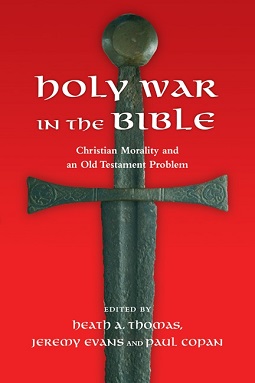
I was reading through Holy War in the Bible: Christian Morality and an Old Testament Problem and was surprised to come upon an essay which essentially argues that the narratives in Joshua were mythical retellings of the entry into Israel:
…Deuteronomy 7:1-5 is incoherent if read literally, for the command to kill all the inhabitants of the land is followed by an exhortation against intermarriage with them. In other words, in a “mythological” sense, Deuteronomy 7 itself encourages not so much annihilation of Canaanites as radical separation from them and their idolatrous practices–exactly as Joshua 23-24 exhorts. (163, cited below)
The essay was by Douglas Edwards, whose argument is essentially that Joshua does not recount actual events but rather a mythology with a specific purpose to show that God’s goal of placing Israel in the promised land was fulfilled. It’s an interesting perspective which helps make sense of some pointers in the narratives (and the fact that Judges follows Joshua with discussion of people who were allegedly exterminated in the prior canonical book).
However, I’m not convinced we may categorize the narrative as being a mythology, for it seems to have some clear historical claims about how, when, and where Israel entered into Canaan. Indeed, there are other essays in the same book which do not dehistoricize the text while also not putting forward genocide in the Bible.
What do you think? How do you interpret the texts which some take to mean genocide occurred in the Bible? How might one maintain Earl’s view and inerrancy, or can one not do so?
Links
Be sure to check out the page for this site on Facebook and Twitter for discussion of posts, links to other pages of interest, random talk about theology/philosophy/apologetics/movies and more!
Sunday Quote– If you want to read more Sunday Quotes and join the discussion, check them out! (Scroll down for more)
Book Review: “The Myth of Religious Violence” by William T. Cavanaugh– I review the book which has led me to discuss the ways the category of religion is used to stigmatize the other and also forced me to rethink a number of issues. I highly recommend this book.
Source
Douglas Earl, “Holy War and Hesed” in Holy War in the Bible: Christian Morality and an Old Testament Problem
SDG.
Really Recommended Posts 8/29/14- Eschatology, Creationism, Morality, and more!
There is a lot of good reading to be found in this round of Really Recommended Posts. Be sure to leave comments on those you enjoyed and let me know what you thought here! The topics include eschatology, creationism, morality, Star Trek, and more!
Hitchens’ Challenge: Name one moral act that a religious person can do that an atheist cannot– Jason Wisdom takes on Christopher Hitchens’ challenge to name a moral act that is exclusive to a religious person. He challenges the core assumptions behind the argument, along with the notion of what it means to be “moral.” This is a great read.
Coexist? – A Pox On Both Bumper Stickers-This post is about more than you may think, so be sure to read it. Philosopher David Marshall takes on the “bumper sticker” mentality of both the “Coexist” bumper sticker and its negation.
Exceptional Dinosaur Tracksite in Denali National Park Reveals Herd of Hadrosaurs– Who doesn’t love to read about dinosaurs and creationism? Put your hand down, you, you’re lying! Check out this post which talks about how a rather awesome find of dinosaur tracks presents a challenge for a young earth paradigm.
What does the Bible say about “End Times”? Three Historic Perspectives– Eschatology is something of a side interest for me, and I found this post by J. Warner Wallace to be a pretty solid summary of a few major positions Christians hold regarding end times.
Some Tips on Research– The title pretty much says it all. These are some handy things to keep in mind while doing research.
Make It So- Parody of “Let it Go”– It’s no secret that I love Star Trek. I’ve discussed it on this site with theological/apologetic questions, and I’ve also had an ongoing series of reviews of TNG on my “alternate interests” site. Here, there is a parody of the song “Let it Go” based on Star Trek: First Contact. I thought it’d be a fun way to round out this week’s posts.
Book Review: “The Illustrated Guide to the 12 Apostles”
 Let’s get this out of the way: it’s really hard to tell the disciples apart. They have similar names, they’re all lumped together usually, some are barely even mentioned, etc., etc. The Illustrated Guide to the 12 Apostles by Jeffrey Kranz and illustrated by Laura Converse Kranz is a free (!) e-book which seeks to solve some of these difficulties.
Each apostle has a pretty neat sketch drawing depicting them (which is largely conjecture), along with several icons and other images which help to distinguish between them. These are each individually helpful, and the icons and the like are based upon the few details mentioned about each apostle in the Bible.
The work surveys all the information we know for certain about the apostles as found in the Bible, while also noting other details we know from tradition and the like. For example, John is one of the most prolific writers of the Bible, as he authored Revelation, John, and 1-3 John as well. These details are extraordinarily helpful at distinguishing the various apostles from each other, and provide some sort of way to remember them as individuals rather than as a group.
The book is brief (55 pages) but packed with useful information. It’s a quick read that can also serve as a handy reference book related to the apostles. I highly recommend it, particularly at its (free) price. The book may be downloaded here. I would also very highly recommend you check out The Overview Bible, a web site dedicated to bringing general Bible knowledge to all. It’s very informative and the posts are all great reads.
Links
Be sure to check out the page for this site on Facebook and Twitter for discussion of posts, links to other pages of interest, random talk about theology/philosophy/apologetics/movies and more.
SDG.

 J.W. Wartick - Reconstructing Faith