Christianity
Our Spooky Universe: Fine-Tuning and God
 The Fine-Tuning Argument for the existence of God has been acknowledged as one of the most powerful arguments for theism. Proponents of this argument, also known as the teleological argument note that our universe is “spooky.” So many facets of our universe appear designed. It is startling to me to read about many of these in literature and realize that the very fingers of God seem apparent in these qualities of our universe. The way that these pieces fit together should not be viewed as independent variables. Any theory which seeks to explain the features of our universe must take into account the full range of factors.
The Argument Stated
The fine-tuning argument for the existence of God can be stated fairly simply:
1) The fine-tuning of the universe is due to either physical necessity, chance, or design
2) It is not due to physical necessity or chance
3) Therefore, it is due to design (Craig 1, 161 cited below)
The first premise turns on the notion of “fine-tuning”–something which is widely acknowledged to exist. It is the explanation of this fine-tuning that becomes controversial. Before trying to offer a way forward in this controversy, it will be prudent to list some of these evidences for fine tuning. Finally, before diving it it should be noticed that this argument can be seen probabilistically: that is, one should view it in light of which is more probable- are the properties we observe more probable in a universe that came about by chance, design, or necessity?
Various Evidences for Fine-Tuning
There are any number of independent, fine-tuned factors which make our universe capable of sustaining life. Without these factors in place, our universe would be uninhabited, and we would not exist.
Low Entropy
If the entropy in our universe were high, then the energy required for life to function would be distributed in such a way as to make the complexity required for life impossible. In order to determine the likelihood of a life-permitting range for a universe, Roger Penrose calculated the total entropy in our universe as “equal to the total number of baryons (protons and neutrons) in the universe… times the entropy per baryon… which yields a total entropy of 10^123.” This means that our universe falls within a range of accuracy regarding entropy of one part in 10 to the 10th to the 123rd power, 10^10^123. As Penrose put it, “the Creator’s aim must have been… to an accuracy of one part in 10^10^123” (quoted in Spitzer, 58).
The Existence of Matter
The very existence of matter is something which cries out for explanation. Why? Well, to put it as simply as possible, the basic particles of matter, quarks and anti-quarks form via pair production. They annihilate each other.
However, during the Big Bang, a slight asymmetry in this pair production resulted in approximately 1 extra particle of matter for every 10 billion produced.
It turns out that this 1 in 10 billion ratio of “leftover particles” happens to be the exact amount of mass necessary for the formation of stars, galaxies, and planets. As much as 2 in 10 billion, and the universe would have just been filled with black holes. As little as 0.5 in 10 billion, and there would not have been enough density for galaxies to form. (Bloom, cited in Rodgers).
The Nuclear Binding Force
If the nuclear binding force were much about 2% stronger, then the universe would form mega-elements which would make life impossible. Our universe would be filled with black holes and neutron stars. Furthermore, if it were weaker by about 5%, we would eliminate a large portion of the periodic table…. in fact, it would reduce it so much as to make the universe composed entirely of hydrogen (Bloom, cited in Rodgers).
 The Properties of Water
Water is required for life. Don’t take my word for it: just look into the works of those who are working on investigating the origins of life, people like Iris Fry

Water also has high adhesion which is critical for plants to grow. They rely upon capillary action with cohesion to grow upwards. This would be impossible if water were less cohesive. Water is a universal solvent, which is important for life because life relies upon a medium for chemistry to occur. If the medium were gas, the interactions would be too far apart, while if it were solid the interactions would occur to slowly or there wouldn’t be enough movement within the substance for chemical interactions needed for life to occur. Perhaps most “spooky” of all, a more recent discovery hints that water has quantum effects which cancel each other out, reducing the effects of quantum indeterminacy on the covalent bonds in water. This allows for water to have many of the properties outlined above.
There is no set number to assign to this chemicals of water, but it should be seen that property after property regarding water lines up exactly with the needs for life.
For a more in-depth discussion of the “spooky” properties of water, see the RTB Podcast on the topic.
Gravity
If gravity were increased by a significant margin, complex life could not exist due to their own weight. Even if life only came to be in water, the density of such life would have to be high simply to resist gravitation, which would again make complex life impossible. The lifespan of stars would also be reduced if gravity were increased by about a factor of 3,000 (or more). Robin Collins, in noting gravity as fine-tuned, argues:
Of course, an increase in the strength of gravity by a factor of 3,000 is significant, but compared to the total range of strengths of the forces in nature… this still amounts to a… fine-tuning of approximately one part in 10^36 (Collins, 190, cited below).
More
There are more of these requirements for fine tuning found in a number of the sources I cite below. But even looking at those I have outlined here, the possibility for our universe to exist as a life-permitting universe is absurdly low. It is so small that it baffles the imagination.
 The Fine-Tuning is Neither Chance nor Necessity
Robert Spitzer outlines the argument which leads from these constants to design:
1) The values of universal constants… must fall within a very narrow, closed range in order to allow any life form to develop
2) …the possible values that these universal constants could have had that would have disallowed any life form from developing are astronomically higher (falling within a virtually open range)
3) Therefore, the odds against an anthropic condition occurring are astronomically high, making any life form… exceedingly improbable. This makes it highly, highly unlikely that the conditions for life in the universe occurred by pure chance, which begs for an explanation (Spitzer, 50, cited below)
Thus, the argument turns on this contention: is it reasonable to think that the fine-tuning we observe in our universe is based merely upon chance? Now it is important here to realize that any of the three proposed explanations for the fine-tuning of our universe must carry the burden of proof for their position. That is, if someone puts “chance” out there as the explanation for the fine-tuning in the universe, they must defend their position as being more probable than the hypotheses of necessity and design.
Therefore, it is not enough to simply say that “anything is possible.” The key point is that any theory must take into account the full range of intersecting evidences for fine tuning. To make the inference for design, furthermore, is not a failure to attempt explanation. Instead, it is itself an explanation. The argument is that design is the best way to explain the evidence for fine-tuning in the universe.
William Lane Craig notes that it is important to take into account that the probability in play in the teleological argument is epistemic probability. That is, is it reasonable to believe that our life-permitting universe occurred merely by chance (Craig 2, 169)? Again, turning to Spitzer’s contention above and taking into account the enormously huge range of possibilities that turn against a life-permitting universe, one has to take into account the fact that it is almost infinitely more probable that a universe would be lifeless than to be one that has life. Yet Spitzer’s point is also that there is a “closed range” for values which are life-permitting. That is, there is only a limited set of values which will allow for their to be life. Yet the range of values which are life prohibiting is essentially open–that is, it is infinite. Therefore, the fact that our universe exists and is life permitting makes it reasonable to believe that it was designed. Design is the only explanation which can account for the full range of the evidence, for it explains why our universe would fall within a specific set of parameters which all must be aligned in order to meet the end of life. In the set of possible worlds, purposeless chance would give us an extraordinarily higher probability of having a lifeless universe, while necessity fails to provide any explanation at all. Only design provides a reason to believe that a life permitting universe would be the one to be brought into existence.
One may object by saying “well of course, but our universe is life permitting, so it appears that we hit the jackpot.” It should be seen now that that just begs the question. The person who makes this argument is in fact assuming that chance is the explanation without providing any evidence to think this is the case. Again, when one considers how vastly improbable our universe is, the most reasonable conclusion is that it is not, in fact, a random occurrence. As John Bloom put it, it would be like throwing a dart from outer space and hitting a bullseye on the surface of the earth that is smaller than a single atom. In other words, it is statistically impossible.
One may also object by noting that all universes are equally improbable, so our universe had to have some values. But again this misses the point. The argument is not that our universe is improbable, but rather that our universe, as life-permitting, is part of a limited set of possibilities against the much larger realm of possible worlds. In other words, the fact that our universe is life-permitting rather than life-prohibiting is what is surprising–not the brute fact of its existence. Although the fact of the universe’s existence is itself something in need of explanation.
Yet what about necessity? Is it possible that our universe simply has the constants that it has due to some kind of necessity? Here, mere physical necessity will not do as an explanation. For something which is physically necessary is not metaphysically necessary. That is, something can happen due to laws of nature and the like, while not being something required by logical necessity. Thus, it seems the burden of proof in this case is upon the one claiming that the universe is metaphysically necessary to show their case to be more reasonable than the chance and design hypotheses. Frankly, I think that the prospect is quite bleak.
Conclusion
We have noted a number of scientific evidences for the fine-tuning of the universe. These form our data set that any theory needs to explain. Chance has been found epistemologically wanting. It is simply not reasonable to say that chance is the explanation. Necessity seems to fare no better. There is no way to account for the necessity of the universe, and in fact our universe seems to be apparently contingent. Therefore, the most reasonable explanation for the apparent design in our universe is to infer that there is, in fact, a designer. Our universe is not so much spooky as it is spectacular.
Links
Evidence for God: A Fine-Tuned Universe– Matt Rodgers gives a great summary of a talk by John Bloom I attended as well. This post gives a really concise summary of a number of the evidences for fine-tuning.
The Teleological Argument– I present Robin Collins’ version of the fine-tuning argument and briefly defend it against a few objections. The Past, Probability, and Teleology– I answer a few objections to the teleological argument.
What about the multiverse? I have answered a number of issues related to the multiverse in my previous posts on the topic.
Max Andrews offers a discussion of the multiverse and the fine-tuning argument, wherein he notes that the existence of a multiverse does not undermine the argument.
Sources and Further Reading
John Bloom, “A Fine-Tuned Universe.” Lecture given at the EPS Apologetics Conference, 2012.
Robin Collins, “Evidence for Fine Tuning” in God and Design
William Lane Craig 1, Reasonable Faith
William Lane Craig 2, “Design and the Anthropic Fine-Tuning of the Universe” in God and Design
Fazale Rana, “Science News Flash: ‘Water Fine-Tuned for Life'” (October 27, 2011). Reasons to Believe.
Matt Rodgers, “Evidence for God: A Fine-Tuned Universe.”
Robert Spitzer, New Proofs for the Existence of God
SDG.
——
The preceding post is the property of J.W. Wartick (apart from citations, which are the property of their respective owners, and works of art as credited) and should not be reproduced in part or in whole without the expressed consent of the author. All content on this site is the property of J.W. Wartick and is made available for individual and personal usage. If you cite from these documents, whether for personal or professional purposes, please give appropriate citation with both the name of the author (J.W. Wartick) and a link to the original URL. If you’d like to repost a post, you may do so, provided you show less than half of the original post on your own site and link to the original post for the rest. You must also appropriately cite the post as noted above. This blog is protected by Creative Commons licensing. By viewing any part of this site, you are agreeing to this usage policy.
Response to a Complementarian video about why women cannot be pastors- Part 1
I am here responding to a youtube video, “Why Oranges Can’t be Apples.”
Recently, I came across a video arguing why women should not be pastors. I watched it and I have to say that it seems to reflect generally the arguments often used for complementarian positions. I thought it worth responding to this video simply to show how this debate is often focused around preconceived notions of manhood and womanhood instead of the actual Biblical texts.
Here, I will simply quote some of the things Jonathan Fisk claims in this video. Then, I shall respond to the comments he makes. I tried to include times for any of the quotes. They may not be exactly to the second, so I’ll take blame for any of these that aren’t lined up properly.
“God created authority, he made it good.” (3:00ish)
This line is troublesome. Did God create “authority”? Think about that claim. Is it possible to “create authority”? That doesn’t seem to me to be the case. In fact, I would argue that God has authority by fiat. Upon creation, God had authority over creation. Authority requires something to be authoritative over, but it is not created. Anyway, this is a minor point.
“Okay so put that [family roles] into the role of man and woman in Christ.” (4:46-4:48).
Fisk makes this comment after a rather lengthy discussion over authority structures in the family. Again, there are some really major problems with this statement. First, Fisk fails to make the argument that the roles of man and woman in Christ are distinct. Instead, he reads such roles onto the positions of male and female only after assuming them in the family. Fisk made the claim before this that man is placed as an “actual authority over the wife.” But here he must rely upon the interpretation of “head” as “authority.”
Consider the line of reasoning that is happening here: man is the head (authority) over woman in the family; Christ is the head (authority) over the church. Therefore, man should be the head (authority) over the church.
The conclusion simply does not follow from the premises. Even were I to grant that the two premises were true (which I don’t), the conclusion still would not follow. There is no argument here, only an assumption.
Second, reading human relationships onto God and then back onto humans is extraordinarily problematic. Many heresies have developed because humans have decided to make God in their own image. Fisk is here bordering on that by reading a preconceived notion of family onto God and then from God back onto the church.
“Christ himself, in order to save the world, had to be a man…” (7:03-7:05)
“It’s impossible for a woman to redeem the world.” (7:08-7:09)
Here Fisk claims to be talking about Christology, but I’m hesitant to agree with him. Fisk’s argument is a bit convoluted and he mostly just throws out a number of Christological phrases, so rather than quoting him at length I’ll sum up his argument.
Essentially, the argument is that Christ had to be male because he had to act as the head (here still using head as “authority”) of creation in order to save creation Because man is the head of the family and therefore somehow responsible entirely for the fall (?) Christ had to be a male.
Now one problem with this argument that should be immediately apparent is that the way Fisk is using “head” to mean “authority” actually undermines his claim that the Redeemer had to be male. Why? Well Fisk’s claim is that Christ had to be male to act as the head over all creation so that He could redeem creation. But in order to make sense of Fisk’s claim, one would have to ground all creation in Christ, which would work only if Christ was the “head” over all creation in the sense of source not of authority. The reason is because Christ would have to have the ontological capability to redeem creation, not simply the authority. This is actually at the heart of Christology.
Why would God have to become incarnate as a human, suffer, die, and rise again if redemption is merely a matter of authority? After all, surely the Godhead would have the authority to forgive sins in the first place! The issue is not one of authority but one of ontology. God simply offering a brute forgiveness of violations of His Law would not adequately bring to fulfillment God’s justice. Instead, God had to become incarnate so that God could fulfill His perfect Law without sin. The issue was not authority. God had the authority already. So Fisk’s use of “head” as “authority” is inconsistent. When he applies it to Christology, he equivocates on the term, using it as though it means source, despite claiming it means authority. That is the root of the problem with his argument here: he mixes ontology with authority.
But there are still more problems: if Christ had to be male in order to save humanity from sin, does that not speak to something about the nature of maleness and femaleness? If Christ can only be male, does that not mean that males more closely reflect the image of God than females? If Christ had to be male, does that not mean that males are closer to the incarnate deity? It does indeed imply these things, and there’s a reason such thinkers as Augustine explicitly reject this faulty, nigh-heretical teaching.
“This was such a clearly defined teaching… that they [apostles/church fathers] don’t do a lot of talking to say ‘women cannot be pastors.'”
Fisk goes on to say that “the word pastor wasn’t really the common word used for talking about pastors, instead they said things like ‘elder’ or… ‘deacon’ or ‘bishop’ or ‘overseer’.”
Let’s turn to a text here really quickly:
I commend to you our sister Phoebe, a deacon [Greek: diakonon] of the church in Cenchreae. (Romans 16:1)
So let’s just contemplate for a moment what Fisk said. He claimed that the apostles don’t much discuss women not being pastors, in part because they used other words, like “deacon.” But Paul sends a greeting to the churches in Rome, and he talks about “our sister Phoebe” whom he called “a deacon.” Perhaps this explains why we don’t get a lot of talk about women not being pastors; because they were pastors. Phoebe is explicitly called a deacon, the very word Fisk himself cites as an example of a word used for pastor.
But Fisk goes on to say that “they” go on to describe what a pastor should be over in 1 Timothy. This list, he notes, says that an overseer must be a “husband of one wife.” Now, Fisk actually says that this is the “first thing” it claims about being an overseer. Fisk is wrong. The first thing the text says is actually that an overseer must be above reproach.
Fisk’s ultra-literalistic reading of this text is problematic. In order to realize this, it is important to have the text out there:
Therefore an overseer must be above reproach, the husband of one wife, sober-minded, self-controlled, respectable, hospitable, able to teach… [1 Timothy 3:2- note that there are quite a few more requirements of the overseer listed after this verse]
Fisk is trying to read this verse as saying that an overseer must be a man, because after all, how else could the overseer be the husband of one wife? But what of all the pastors who are unmarried? If the text is teaching that an overseer must be the husband of one wife, why is it only the masculine part of the verse that applies today? Why is it not the entire phrase? Why are not all pastors required to be husbands of one wife?After all, that is what the text says.
Before someone accuses me of claiming that the Bible is wrong or diverging from Biblical truth, I should note that the problem is not with the text; it is with Fisk’s interpretation of the text. The problem is that Fisk is reading this text ultra-literalistically only in order to prove his point, but no farther. He wishes to read only that the overseer must be a man, but not that the overseer must be a husband. His exegesis is a mixed approach. Instead, I would point out that the requirement of being a “husband of one wife” shows that pastors should be faithful spouses. If Fisk wants to make his point, he must be consistent in his hermeneutic. He must read the whole passage in the same literalistic manner he has read “husband” to imply absolute maleness in the pastoral office. Thus, all pastors must be married. But they must have children that they keep submissive (verse 4), they must not be recent converts, etc. Now many of these requirements for pastors can be read literally and work just fine. Pastors should not be lovers of money (heaven help them if they are! they are in the wrong profession!). But the whole point of the verse is general requirements; not explicit, literalistic requirements.
Now I realize that I’m at about 1500 words and I’m not even halfway into the video, so it looks like this will have to be a multi-part response, if people find this useful. Do you?
Preview of some other issues: the Trinity, more problems with texts, and more!
Further Reading
How complementarianism is getting the Trinity wrong.
How complementarianism undermines the image of God in male and female.
A book review of an excellent work addressing every major text on this issue.
Women teach us all the time, through the Bible.
SDG.
——
The preceding post is the property of J.W. Wartick (apart from citations, which are the property of their respective owners, and works of art as credited) and should not be reproduced in part or in whole without the expressed consent of the author. All content on this site is the property of J.W. Wartick and is made available for individual and personal usage. If you cite from these documents, whether for personal or professional purposes, please give appropriate citation with both the name of the author (J.W. Wartick) and a link to the original URL. If you’d like to repost a post, you may do so, provided you show less than half of the original post on your own site and link to the original post for the rest. You must also appropriately cite the post as noted above. This blog is protected by Creative Commons licensing. By viewing any part of this site, you are agreeing to this usage policy.
Did God Create the Universe for Humans? – Some thoughts on God’s purposes for creating
 I have read on more than one occasion an atheist making the argument that goes something like this: if humans are the most important creation, why did God create such a vast universe? The argument is that God really wasted a lot of space if the universe was created for us. Another way I’ve seen this argument is as follows: the universe is full of galaxies that are even beyond our capacity to ever observe. Why, if God created the universe for us, is there so much here that is worthless to us? Furthermore, why is so much of the universe hostile to human life? Humans can’t live in overwhelming majority of the universe. Why is it so hostile if it were created for us?
A different discussion with an atheist was touched off when they asserted that the Bible states humans are the most important creation, so why create so much of the universe outside of our power to observe?
I’m going to offer an explanation which may come as something of a surprise: there is nothing in the Bible which makes it explicit that humans are the most important creation. I would go so far as to say that anyone who claims that is reading an unjustified anthropocentric worldview onto the text.
Perhaps the most commonly cited explanation for why we should think humans are the center of creation is the Genesis creation account, and specifically Genesis 1:27-28:
So God created mankind in his own image,
in the image of God he created them;
male and female he created them.God blessed them and said to them, “Be fruitful and increase in number; fill the earth and subdue it. Rule over the fish in the sea and the birds in the sky and over every living creature that moves on the ground.” (NIV)
But again, where in this text does it suggest that humans are the most important creation? It does show that we were made in God’s image, but it does not say that because of that, we are more important than anything else in creation. Too often people read into texts what they think it says, as opposed to reading what the text actually says. Again, I simply ask this: where in the text does it say that humans are the most important part of all of creation? As a friend pointed out, one could easily say the sun is the most important part of creation, because without it, we would not all be alive. But either view is equally unsupported by the Bible.
Another rationale that is used from this passage is the notion that humans are to have dominion over or rule over the earth (verse 28). But again, how does it follow from this that humans are more important? The problem is that we have a skewed view of importance. For us, very often, we think importance is equal to power. When someone has power, they are more important than someone without power. But such notions of power and hierarchy are extrabiblical ideas which we have read onto the text.
In fact, it seems that the Bible says we are not the greatest of all creation. Psalm 8:5 references humans and says that “You [God] have made them [humans] a little lower than the angels and crowned them with glory and honor.” So yes, humans are “crowned” with glory, but they are also ” a little lower than the angels.” It seems the Bible says that we may not be the greatest things to walk the universe. [I should note that the Bible may, in fact, note that humans are the most important part of all creation, but were I to grant this, my reasoning below still holds.]
But some people remain dissatisfied by this explanation, and claim that Christians very often do claim that humans are the crown of all creation or that the universe was made for us. Here, I suggest that once again, people have been thinking very anthropocentrically. In fact, they have limited God to the point of making God incapable of even having the same range of possibilities that humans have. The assumption built into this argument is that God created for the sole purpose of humanity. But just like other persons, it is possible for God to have more than one end in taking an action. Thus, even if we grant that humans were the most important creation–in contrast to the above argument–it still does not follow that the universe is exclusively for humans. God can have different ends.
Think about it this way: when you take an action, you very often have more than one end in mind. For example, you may get in your car to go to a local shopping store so that you can go to the grocery store and also because you want to stop and look at books at the bookstore. Here, you have taken an action (gotten into the car and taken it somewhere) with more than one end in mind. Similarly, God can create with more than one end in mind. Even if humans are the greatest of all creation (which I deny), it is also possible that God also created for other reasons. For example, God may have created gratuitous galaxies because they are beautiful. I can’t help but look at the stars and have my heart stop. The beauty of creation is extraordinary. It cannot be described in words. Perhaps this was one end God had in mind, along with the creation of humans. There are a number of other reasons God could have created apart from humans, so it seems to me that the objection here is short-sighted.
Only by creating God not just in our own image, but in an image less than our own, can we come up with an objection to the existence of such a God based upon the vastness of the universe, or its hostility to life.
Links
Beauty is a powerful reason to favor the Christian worldview. Check out this excellent post on the topic over at Well Spent Journey: Christianity and High Beauty (With Pictures!).
More Planets Than Stars – Exoplanets and Our Little Blue Ball– Naturalis Historia features a simply superb post on the possibilities of other life/planets like ours. It also briefly addresses the issue I have discussed in this post. I recommend checking it out.
From Divine Engineer to Divine Architect– Over at Faithful Thinkers, Luke Nix wrote about a similar topic. His post explores the notion of God as an architect, transcending the either/or dichotomy created by some about God’s purpose for creation.
I have reflected on what life on other planets might mean for Christianity: Theological Reflections on Life on Other Planets.
SDG.
——
The preceding post is the property of J.W. Wartick (apart from citations, which are the property of their respective owners, and works of art as credited) and should not be reproduced in part or in whole without the expressed consent of the author. All content on this site is the property of J.W. Wartick and is made available for individual and personal usage. If you cite from these documents, whether for personal or professional purposes, please give appropriate citation with both the name of the author (J.W. Wartick) and a link to the original URL. If you’d like to repost a post, you may do so, provided you show less than half of the original post on your own site and link to the original post for the rest. You must also appropriately cite the post as noted above. This blog is protected by Creative Commons licensing. By viewing any part of this site, you are agreeing to this usage policy.
Teaching Effective Apologetics for Small Time Periods
 So you think you have what it takes to be an apologist? You’ve mastered the arguments, and you’re ready to go? Well, using apologetics effectively involves not just making formal, lengthy arguments, but also the ability to condense those arguments down into everyday conversations. Sometimes God presents opportunities which only last for a few minutes. It is important as Christians to be able to present a reasoned defense in the time given to us. Here, I will explore a few of the ways to effectively defend one’s faith in short time periods. Then, I’ll give a brief lesson in teaching this to others.
Listen
It may come as a surprise, but the most important thing for apologists to do in any circumstance is to be a thoughtful listener. Get ready for a bigger surprise: No two people are the same, and all people have beliefs they hold strongly. By having a simple conversation with someone about a topic (politics, environmentalism, God, sports), you will immediately see the things that they find important begin to appear in the topics they choose to discuss.
The importance of listening comes into play when using apologetics in small time frames because it allows you to effectively engage with people where they stand as opposed to whatever presuppositions you may hold about them. They will reveal to you their own knowledge level and convictions as you ask them perceptive questions.
Ask Perceptive Questions
One of the most important tools in the apologist’s kit is the use of open-ended, probing questions. Consider an encounter in which someone is claiming that there is no such thing as objective truth. They say “There is no truth.” But if you’ve applied your skills as an effective listener, you should immediately pick up on the problem with this statement. Asking a simple question like “Is that true?” can be just as effective as a fully-fledged case for objective truth.
When you start asking questions like these, you’ll find that your skills as an effective listener will be expanded as well. Someone’s response to the perceptive questions you ask will key you in on where they stand on issues. Do they really think there is no truth? Have they even thought about the implications of such a statement?
Again, suppose someone says “all morality is relative.” How would you answer that? Well suppose such that person has launched into an extended defense of relativism and argued that because various cultures evolve over time and seem to have different laws across the board, it seems that morality is a human construct which has been created for the purpose of sustaining society. You are going to answer that person very differently than if they said “All morality is relative” and only put it in context by saying that smoking marijuana shouldn’t be illegal. That’s a very different perspective than the former, and you need to ask them different questions.
Guide the Discussion and Make Your Case
Utilizing perceptive questions will allow you to guide the discussion while making your case in a winsome manner. Instead of outlining a lengthy case for Christianity, be aware of the time you have available and allow the discussion to guide your case-making.
One example for this would be someone who argues against you by simply saying “The Bible is corrupt.” Instead of launching into a huge outline of why you think the New Testament is reliable, why not just ask: “Why do you think so?” Their answer should guide the rest of your discussion. Often, you’ll find that the answer you get doesn’t really need an extended defense. But suppose that they launch into an argument about textual criticism: “Well, we can be pretty confident that passages like the ending of Mark are later additions.” Wow! I would very much commend this person on their knowledge on the topic, and I am not being sarcastic here. Such an answer shows thoughtfulness, and that should be commended: “Wow, I’m so pleased you brought that up. Did you know that almost every translation of the Bible has a note about how we’re fairly sure that is indeed a late addition? But more importantly, do you have any evidence for me to suggest that the entire Bible is corrupt? Are you suggesting that there is not one verse in the Bible that conveys a truth?”
Questions like these show that you’re listening, and also help guide the discussion. This is exactly what we want as apologists. The goal is not to force-feed huge amounts of information to other people. The goal is to engage in winsome dialogue with them that will allow both sides to feel affirmed, while giving them things to think about later.
Engage in More Tactics
I cannot emphasize enough how important Greg Koukl’s book, Tactics
Teaching Apologetics to Others
Okay, so you’ve mastered the ability to listen, ask perceptive questions, guide the conversation, and think apologetically. What about teaching these skills to others?
I have found that role-playing is perhaps the best way to do this. Make a list of common objections to Christianity and then do a question-and-answer session to guide the discussion.
Utilize these role-playing sessions in between sessions where you present effective arguments for the truth of Christianity. At some point, the goal is to get to the point where we can indeed present these longer arguments to people whose minds have been expanded beyond trite comments. For more on making a simple case for Christianity, see my post “The Case for Christianity in 15 Minutes (or less).”
Another really effective way to get apologetics discussions going is to watch movies. Yes, I said it: watch movies! Movies are full of worldview questions, and watching them with an eye towards seeing these themes is absolutely essential practice. What is the movie saying about truth? What does it say about reality? Is it a movie about a moral issue? If so, what is it saying? Why should we think that way? I have presented a number of these very discussions in my looks at popular movies.
Here are some sample statements to get started on a role-play session, along with sample perceptive questions. Be sure that when you do this role play, you do not supply the guiding questions. Try to guide your group to think of questions themselves. Implement tactics into the discussion.
There is no truth. Is that true?
Morality is relative. Would you say that Hitler was only ‘relatively evil’?
The Bible is corrupt. Why do you think that?
There is no God. Why do you think so?
All religions are the same. If all religions are the same, why do some believe in one God, some many gods, and some no god?
There are so many more of these question/answer pairs. Try thinking of some yourself!
Winsome Dialogue, a final note
You are not going to be converting people on the spot by using these effective apologetics methods. In fact, conversion is not the ultimate end-goal of apologetics. Apologetics is about presenting a winsome case for Christianity, but God Himself is the one who brings about conversion by the Holy Spirit. Thus, do not be Remember, as Greg Koukl says, the goal is to put stones in shoes: we want to get people thinking about Christianity and to get them to notice that it is very much an intellectual faith capable of interacting in the arena of worldviews.
The examples given above, particularly in the “Teach” portion, are not meant to be exhaustive. Instead, they are meant to give you some insight into how to discuss a worldview issue with someone you bump into at Barnes and Noble or Starbucks. I’m not suggesting that my simple questions above are comprehensive refutations of the statements they are placed alongside. Instead, I’m suggesting that these are great ways to kick off continuing dialogue.
That said, as Christians, we must carry on this dialogue in a winsome manner. The paraphrase on the name for this site: “Always have a reason” comes from 1 Peter 3:15-16, which makes this explicit: “Always be prepared to give an answer to everyone who asks you to give the reason for the hope that you have. But do this with gentleness and respect, keeping a clear conscience, so that those who speak maliciously against your good behavior in Christ may be ashamed of their slander.”
Truth will win out in the end. But to make the only goal persuasion is to miss the very purpose of apologetics. We are not only to be good case makers, but also to be Christ’s mediators on earth. Your good behavior will be an effective witness, and it will be perhaps an even better witness than your arguments.
Above all, pray for the Holy Spirit to open hearts and minds. Always have a reason.
Further Reading
The Case for Christianity in 15 Minutes (or less)– It is extremely important to have developed a way to present the case cor Christianity in a concise form that is easy to share and effective. In this post, I present my own 15-minute case for Christianity.
Greg Koukl’s Tactics
SDG.
——
The preceding post is the property of J.W. Wartick (apart from citations, which are the property of their respective owners, and works of art as credited) and should not be reproduced in part or in whole without the expressed consent of the author. All content on this site is the property of J.W. Wartick and is made available for individual and personal usage. If you cite from these documents, whether for personal or professional purposes, please give appropriate citation with both the name of the author (J.W. Wartick) and a link to the original URL. If you’d like to repost a post, you may do so, provided you show less than half of the original post on your own site and link to the original post for the rest. You must also appropriately cite the post as noted above. This blog is protected by Creative Commons licensing. By viewing any part of this site, you are agreeing to this usage policy.
Really Recommended Posts 1/17/13
 I have searched the ‘net far and wide to bring you this lineup of really recommended posts. Check out posts on morality, abortion, archaeology, Carl Jung’s theology, and more.
As always, if you liked something, drop a comment!
Does the Future Have Moral Authority– It is common in debates about morality related to Christianity to see someone appeal to the moral progress we have made and to argue that in the future we won’t think x, y, or z are wrong, or we’ll think a, b, and c are right. What authority do such arguments have? Read this great post on the topic.
Abortion Methods: An Overview– A disturbing look (with pictures) at the methods used for abortions. This is a truly horrifying thing we are allowing in our country and across the world.
The Gobekli Tepe Ruins and the Origins of Neolithic Religion– An archaeological discovery may be turning what some thought about the origins of religion on its head. It’s also informing us about early religion.
Interpreting Similarities between Christian Doctrine and Pagan Mythology– An interesting look at how to think about the alleged similarities between Christianity and pagan mystery religions.
Jung’s Therapeutic Gnosticism– A fascinating (lengthy) read about Carl Jung’s theology. I really enjoyed this one.
The Powerful Resolutions of Jonathan Edwards– Think you were awesome with your New Year’s resolution? Check out this list from Jonathan Edwards.
“Fitzpatrick’s War”- Religion, truth, and forgiveness in Theodore Judson’s epic steampunk tale
The roar of our guns was more than my ears could hear. The slaughter in the two rivers was more than one man’s mind could absorb… A sort of madness over came us; we had an infinity of bullets and an infinity of Chinese before us. Every one of our men felt he was killing thousands… Death ran wild. How terrible it is, I thought, that the Yukons should be so good at this. (Judson, 319-320)
Fitzpatrick’s War
Brief Overview of the Plot
Fitzpatrick’s War is written as an autobiographic tell-all from the perspective of Sir Robert Mayfair Bruce. He is writing about Lord Isaac Prophet Fitzpatrick, a man who, like Alexander the Great, had conquered the world at a young age and also died young. Bruce was a close friend of Fitzpatrick (whom he calls Fitz) and so reveals a number of less-than-flattering aspects of his personality in his account of the life of the former ruler. It describes Fitzpatrick’s rise to power, his preparations for war during behind his father’s back, and his post-war rule.
Fitzpatrick is revealed as a man who lusted for power and ruled ruthlessly. He participated in assassinations, set up deaths, and mercilessly slaughtered his enemies. He used biological and chemical weapons and burned his enemies to the ground, all simply because of a desire to conquer the world. He had delusions of grandeur, envisioning himself as a kind of modern Alexander who would outdo the other man in every way.
The Timermen are another major player throughout the book. They are mysterious in their motivations and have supreme power over all space travel and most communications. Bruce reveals a number of unflattering details about these people as well.
The book has been edited by Doctor Professor Roland Modesty Van Buren, who is hostile to Bruce’s recounting of the events. Van Buren does not believe that Bruce is telling the truth about the great Fitzpatrick and believes he is instead attempting to make his own name live on through his lies. Thus, the book is footnoted throughout with Van Buren’s corrections to Bruce’s “lies.”
Religion
Religion is pervasive throughout Judson’s work. The characters constantly quote from the Bible to justify their positions which frequently seem unbiblical and evil. Although the society at large seems to think highly of the Bible, the United Yukon Church itself seeks to take over all religion and has repressed other expressions of religion for quite some time.
Yet Bruce is fully aware of how the Christian faith is being abused throughout the work for evil ends. In one scene, he is speaking privately with Fitzpatrick, who asks Bruce whether God can love someone who will wreak such evil on the world. Specifically, he asks about King David in the Bible. Fitzpatrick wants to know whether he himself is like King David and why God would love someone who so frequently strayed from righteousness. Bruce realizes that it is here that he could have influenced Fitzpatrick to turn from the great evils he would perpetuate. Yet, coveting power, Bruce makes the decision he would regret for the rest of his life and backs Fitzpatrick’s notions of glory and God. He writes:
I would today give up my soul if I could go back to that moment and tell Fitz he could still turn back from his awful destiny. I grant that he had at this date already committed murder. It was equally true that he had not yet made his oceans of blood… The world could have still been saved from his wrath… (204)
Instead, Bruce caves into his own lust for power and desire to please Fitzpatrick. He tells Fitzpatrick:
God loves you… There are a few special men… who, like David, walk through History as Angels walk through thunderstorms. Those about them become wet with sin, while they remain untouched. They may seem to be bad men, these special ones. If we judge them by the standards we hold ordinary men to, they are the worst of men. Ordinary standards do not apply to them. They are doing God’s work here on earth, and as we do not know God’s motives or His ends we cannot judge His servants… You [Fitzpatrick] will be said to be God’s beloved. (204-205)
Bruce regrets this discussion with Fitzpatrick for the rest of his life and struggles with the notion that he can be redeemed.
Fitzpatrick himself seeks a kind of syncretism of all religions, but realizes that it will not ultimately work. He keeps his old tutor, Dr. Flag, around mostly to feel superior about himself. But he had initially attempted Dr. Flag’s project of making all faiths equally valid. One discussion in the book is particularly revealing. Dr. Flag is expounding upon the notion that all religions are essentially the same, but Marshal Jeremiah Truth Hood challenges him on this notion:
“Sir, am I to understand you believe all major religions profess the same core beliefs?” [Hood Asked]
“Yes…” [replied Flag]
“Then that would mean, let us say, that the Chinese and the Arabs share the same beliefs on marriage and family?” asked Hood… “Can we say,” asked Hood, “that Arabs and the Chinese value life to the same degree? Or is human life another secondary question?”
“I mean specific, general matters. You see, such as treating others well.” [Responded Flag]
“You say cultures are essentially the same,” continued Hood. “How would you explain, sir, the different Histories of North and South America? Both continents are inhabited by Christians. The majority in both continents are of European descent…” (364-366)
Hood’s point is well taken. The fact of the matter is that all religions are not the same and to say otherwise devalues the religious persons themselves. The way that Judson presents this dialogue allows for some real insight into the issue: how is it possible to say that, at their core, all cultures or religions are the same when they are so radically different?
Evil, Repentance, and forgiveness
There is great evil in the world, and Bruce’s world is no different. Much of the evil is caused by Fitzpatrick and the war which he created in his lust for power.
Ultimately, Fitzpatrick is reduced to a broken, suspicious man who becomes incapable of even doing the simplest tasks on his own. Marshal Hood is greatly distressed over his own incapacity to make amends for the evils he had done during the War. Hood is sitting with Fitzpatrick and several other Lords when they watch a video from an aerial shot of China and see the destruction their war had done to the country. The bodies were strewn about and death was everywhere. Bruce, too, feels the need for repentance: “There were no words in my vocabulary I could utter that could justify this abomination, no act of contrition that could ever take away what I had done” (410). Hood himself begins quoting from the Bible, Joel chapter 1. He relates the evils they have done to the crimes that Joel cries out against. Later, Hood is found among the Chinese, trying to help them by growing food and feeding them. It was his way of making amends.
Bruce himself finds forgiveness only through his wife, who speaks with clarity on God’s will and his grace. It seems to me that this theme of forgiveness is grounded thoroughly in the Christian notion wherein people are to forgive each other. We act as God’s agents here on earth, and so we are called to repentance and forgiveness.
Charlotte
Bruce’s wife, Charlotte, is a paradigm example of a powerful, spiritual, loving woman. Van Buren, the hostile editor of the book, has several choice words to describe Charlotte, whom he believes is overstepping her bounds by attempting to be equal to Bruce. She often seems overbearing, but ultimately she strives to be equal to Bruce, and to temper the poor qualities of Bruce’s character. Charlotte is Roman Catholic, a religion which is violently oppressed in Yukon, until Fitzpatrick allows for religious freedom to endorse his own pluralism. Charlotte’s character is important throughout the work as one who provides the positive example of womanhood and the equality of men and women.
History and Doing History
History (always with a capital “H”) is an area of extreme interest in the world of Fitzpatrick’s War. Fitzpatrick himself continues to utter a recurring theme: History is written by the winners. Above, there was a discussion of King David. Fitzpatrick in that same conversation presses the notion that King David rewrote the history books in order to paint him in the most positive light. Later, in his own life, Fitzpatrick would do the same thing. He had the greatest poets and historians of his age come and write histories about him which were highly favorable in their portrayals of himself.
There is active repression of historical knowledge due to the fact that the culture at the time the book is set in believes that the “Electronic Age” (20th and 21st centuries) was a blight upon all History. During one scene, Bruce is being questioned about the Electronic Age and readers discover that only one history exists from that period. The reason is because “[A]ll other Histories of that era were perverted by the strange ideologies of the day…” (35).
As one who has studied historiography (and written on the method regarding Jesus), I can’t help but think of all the issues these discussions raise throughout the book. Interested readers should check out the post linked in the parentheses for one brief account of historiographic method.
Conclusion
I have read few books which have had such a great depth of knowledge about so many subjects as is demonstrated in Fitzpatrick’s War. The book is just phenomenal, and it touches upon so many areas of great importance for Christians and non-Christians alike. As with all great fiction, it does this without becoming overbearing, but instead focuses upon the story. Judson develops wonderful characters whom the reader can relate to, love, or loathe. He explores heady themes with wit and precision. I highly recommend this book to my readers.
Links
Religious Dialogue: A case study in science fiction with Bova and Weber– I explore two excellent science fiction books alongside each other to see how they speak to religious dialogue.
The Presumption of Pluralism: How religious pluralism devalues all religious persons– I discuss religious pluralism, a topic which is brought up throughout Fitzpatrick’s War and show how it fails.
Check out more of my looks at popular level books. (Just scroll down to see more!)
Hieropraxis is an excellent site which focuses upon a number of cultural issues and how they relate to Christianity. I really cannot recommend this site highly enough.
Empires and Mangers– Another phenomenal site which looks at many popular level works from a Christian perspective. The posts are consistently fantastic. I encourage you to follow this site closely.
SDG.
——
The preceding post is the property of J.W. Wartick (apart from citations, which are the property of their respective owners, and works of art as credited) and should not be reproduced in part or in whole without the expressed consent of the author. All content on this site is the property of J.W. Wartick and is made available for individual and personal usage. If you cite from these documents, whether for personal or professional purposes, please give appropriate citation with both the name of the author (J.W. Wartick) and a link to the original URL. If you’d like to repost a post, you may do so, provided you show less than half of the original post on your own site and link to the original post for the rest. You must also appropriately cite the post as noted above. This blog is protected by Creative Commons licensing. By viewing any part of this site, you are agreeing to this usage policy.
Resource Review: “In the Days of Noah: A Deeper Look at the Genesis Flood”
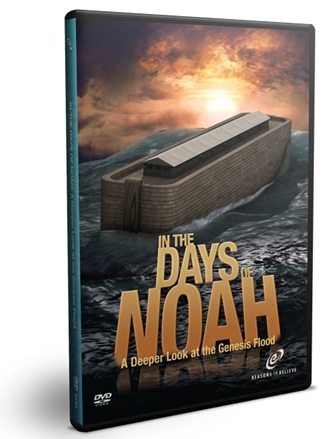 Reasons to Believe is a science faith think-tank dedicated to showing that Christianity is true. Recently, I had the opportunity to view their resource, “In the Days of Noah.” The video features a lecture by Hugh Ross regarding the extent, location, and timing of the Noahic (Biblical) Flood.
One of the central points of Ross’ argument is that people must take an integrative approach to the question of the Genesis Flood. It is not enough to look at just one verse or one chapter or even one book of the Bible and declare the question closed. Instead, Ross argues, one must take the entirety of the Scriptural data and see what it tells readers about the Flood. Not only that, but the relevant scientific findings must be taken into account as well.
For many Christians, the extent of the Flood is taken as a test for orthodoxy. Ross argues convincingly, however, that the Biblical account does not necessitate that the Flood covered the entire surface of the planet. He goes over a wide range of texts that discuss events that are said to be “world wide” or to “cover the whole earth” or that are supposed to bring “every nation” to a certain place and shows how the usage of the term was relative to the author. Ross cites a number of texts to back up this claim and shows how in many places–the Joseph narrative, writings about Solomon, etc.–the words taken as universals generally (“whole earth,” “all nations,” etc.) are used specifically to mean the whole immediate/relevant world.
There are a number of texts describing creation that go into greater detail about specific aspects of the Genesis account. Ross outlines his argument via these texts by specifically noting a number which discuss the limits set for the waters. For example, Proverbs 8:29 states quite explicitly that God gave the sea its boundary. Ross continues through the Bible and cites numerous examples wherein it talks about God setting boundaries for the waters. From there, he makes the argument that these verses give us a principle: God has set the oceans in their boundaries from Creation. He then utilizes this as an argument for a local flood as opposed to a global flood.
I think that this may be the weakest part of Ross’ argument, because it is possible to counter this reasoning by saying that just because there are a number of texts talking about the boundaries set for the water, it does not mean that the water can never cross these boundaries. In fact, one might counter by noting that Ross’ view entails a kind of uncertainty over what exactly is meant when the Bible discusses the boundaries or limits for the oceans. After all, even on Ross’ view, some body of water covered a vast expanse of land–indeed, the whole inhabited world at the time. In fact, one may argue that due to what we know about plate tectonics, the oceans have not, in fact, had clear boundaries from the beginning but have instead been shifting as the continental plates drift.
Of course, Ross could counter by noting that those continental plates themselves act as boundaries for the oceans. Even though these plates shift, they remain ‘fixed’ in the sense of constant. Regardless, it seems that the rebuttal given above must be given at least some weight in considering Ross’ overall argument. However, even if one denies the force of his argument for the Scriptural notion of fixed boundaries as being a limit for a global flood, one must still contend with his argument to open up the possibility of a local flood by noting the difference between general and specific uses of the notion of a “worldwide” event.
That said, Ross turns to the scientific evidence and notes a number of evidences against a global flood. First, there are such things as unambiguous signs of a flood. He points out the possibility of checking ice cores and sediment cores for the continuous record of the last several hundred thousand years, so if there was a global flood there should be a signal in the ice layers evidence for a global flood. These layers are annual and we know this by looking for volcanic eruptions lined up in the layers at the correct times. These can therefore be calibrated by lining them up with volcanic eruptions that we know of historically. Moreover, the ice layers line up with the ellipticity of the earth, so there are multiple independent ways to test these ice layers. However, in these layers there are none of the telltale signs for a global flood.
So where was the flood? Ross notes a number of verses in the Bible to narrow in on the location of Eden, and then extrapolates from that where civilization would flourish. Due to some geological evidence for there having been a blockage on the end of the Persian Gulf which would have, combined with the melting of ice and the extreme amount of rain noted in the Biblical account, flooded a huge portion of the Mesopotamian Plain. The region is surrounded by mountains which would have blocked in the water for the flood. Such a flood would have wiped out the extent of known humanity at the time, argues Ross.
 There are a number of arguments that young earth creationists, who often rely upon “Flood Geology” to explain a number of features of the geological past to maintain their view of the history of the earth, would raise to Ross’ presentation. For example, the image on the right was created by Answers in Genesis to parody the notion that a flood can be local when the Bible says that even the mountain-tops were covered (Genesis 7:18-20) [all credit for the image to Answers in Genesis, I make no claim to having produced it in any way]. Ross answers this argument by noting that the word can also mean hills and that with the extent of the flood he proposed, there would be no visible hills or mountains from the Ark. Thus, Ross’ argument is much along the lines of his integrative approach: that we must take into account all the relevant Biblical texts as well as noting the scientific evidence.
It would be remiss to have a review of a video without looking into the visuals. The video is a lecture divided into chapters, so a decent portion of it is spent watching Hugh Ross talk. However, there are also a number of very useful images and slides presented which will provide viewers in groups with opportunity for discussion and individual viewers with valuable resources to discuss the Biblical Flood.
“In the Days of Noah” is a great resource for those interested in the Noahic Flood. Hugh Ross is a lucid thinker and clearly lays out his perspective on the flood in terms that listeners will easily comprehend. Ross’ case is based off a holistic approach to natural and special revelation. Although Ross does not answer every counter-argument which those opposed to his view may present, the video can act as a valuable way to open discussions and perhaps come to a better understanding of God’s truth.
Source
“In the Days of Noah: A Deeper Look at the Genesis Flood” (Reasons to Believe), 2010.
Image Credit for the second image goes to Answers in Genesis.
SDG.
——
The preceding post is the property of J.W. Wartick (apart from citations, which are the property of their respective owners, and works of art as credited) and should not be reproduced in part or in whole without the expressed consent of the author. All content on this site is the property of J.W. Wartick and is made available for individual and personal usage. If you cite from these documents, whether for personal or professional purposes, please give appropriate citation with both the name of the author (J.W. Wartick) and a link to the original URL. If you’d like to repost a post, you may do so, provided you show less than half of the original post on your own site and link to the original post for the rest. You must also appropriately cite the post as noted above. This blog is protected by Creative Commons licensing. By viewing any part of this site, you are agreeing to this usage policy.
Gregg Davidson vs. Andrew Snelling on the Age of the Earth
 I was recently at the Evangelical Philosophical Society conference (see my thoughts on every talk I attended) and one of the sessions was a debate between Gregg Davidson of Solid Rock Lectures and Andrew Snelling of Answers in Genesis on “Scripture, Geology & the Age of the Earth.” A number of readers requested more information on this talk, and I found it very interesting myself. Here, I’ll touch on the highlights of this dialogue as well as my own thoughts.
Davidson- A Biblical Worldview and an Ancient Earth
Gregg Davidson, a geologist who authored When Faith and Science Collide
Another problem is that YECs fail to recognize that their position itself is an interpretation of Scripture. Their view is not Scripture itself. There is a tendency in debates about theology to view one’s own position as what the Bible teaches, but that fails to take into account the possibility of fallible human interpretation.
Davidson argued for an approach to Scripture that takes note of the fact that God often deigns to make use of “the knowledge of the day to communicate truths about the nature of God.” As an example, he referenced Jesus saying that the mustard seed is the smallest seed of all the plants on earth, despite the fact that it is not (Mark 4:30-32). The point was not the size of the seed, but rather the power of faith. Thus,we must be careful not to make Scripture teaching something it does not claim for itself. He pressed that to read into the Genesis text specific dates and time periods is to make the text teach something that it is not claiming.
Turning to the science, Davidson noted that there are any number of evidences for an ancient earth, but that he chose to focus upon just one area from a number of evidences in order to show how interdisciplinary and cross-confirmed the age of the earth is. He focused upon the Hawaiian Islands and their formation and age. There are multiple, independent ways to investigate the age of these islands. The islands were formed by a hot spot–a place where magma shoots up from underneath the crust and bubbles to the surface. This eventually would form islands when enough of the lava cooled and hardened. The islands are on a moving continental plate and so as they move away from the hot spot, the expectation is the islands get progressively older. Thus, in a series of 3 islands arranged thusly: 3-2-1-0 (0 being the hot spot), 3 would be the oldest island.
Davidson first noted the ages that were found by testing the age of the volcanic rock with radiometric dating. These ages yielded millions of years. Now of course most young earth creationists hold that radiometric dating methods are deeply flawed, but Davidson noted that this procedure can be tested for accuracy with independent methods. Before turning to that, he showed a picture of what the estimate for the movement per year of the plate over the hot spot would be based solely upon the radiometric dating. Basically, this works by just taking the distance of 3-2-1 and measuring how far each is from the hot spot, then dividing the radiometric date by that distance to see how far the islands move per year. The estimate yielded movement of 2.6-3.6 inches per year.
Recent technology has allowed us to utilize Global Positioning Systems (GPS) to actually measure the rate that the islands are moving. These measurements yield approximately 3.1 inches per year, which is exactly in the middle of the estimate given by the radiometric dating. Given the measured rate, scientists can extrapolate how many millions of years old the islands are based upon their distance from the hot spot. It’s kind of an inverse way to get the date. They simply divide the measured distance of the islands from the hot spot by the measured rate of movement per year. Of course, this way of measuring is not dependent in any way upon radiometric dating. Thus, there are two independent sources showing the date in millions of years for the Hawaiian Islands.
The coral growth around the Islands was a third confirmation of the ancient age of these formations. This argument was more complex than the first two. Basically, it seemed the argument was that because different corals form closer to the surface, we can look at the coral reefs formed around the islands as they are farther out and see how much the coral has moved up the island as it subducted (moved under the water with the continental plate). Thus, as the islands move farther away, and therefore sink into the water, the coral that can only survive at certain depths is submerged too far for it to get adequate sunlight, and it dies. One can then measure radiometrically the age of rings of corals. When one measures the coral on the islands, they can correlate that with the ages of the corals and the islands themselves. This measurement also lined up with the previous two.
Davidson concluded that the problem with the YEC paradigm is that they will often focus upon rebutting multiple, independent claims. While this may work for each claim individually, the problem is that all of these types of evidence add up to form one cohesive picture. When they are cross-referenced and they all hit on the same age or date range, they all show the same predictions of distance, and the like, it becomes extremely implausible to say that every single way to find the age of the earth is faulty. They form a full picture. Furthermore, Davidson critiqued YECs for often presenting a selective picture of the evidence–only showing the evidence which favors their position.
Snelling- A Biblical and Geological Defense of a Young Earth and the Global Flood
Andrew Snelling is a well-known proponent of YEC, the author of Earth’s Catastrophic Past
Snelling began by offering the common argument that Jesus taught the global flood and young earth creationism. He argued that the Hebrew word used in Genesis 7:17 is only used for this event, which hints at the incredible devastation.
 Furthermore, the language in Genesis states that the mountains were covered. Snelling’s slideshow had the image shown here on the right, which is becoming pervasive in discussions about the extent of the Flood. The argument is that if the Flood were local, it makes a mockery of the Biblical text. (See a different perspective on this issue with Hugh Ross’ “In the Days of Noah.”)
Snelling outlined several things we should look for if there was a global flood. Among these expectations are:
1) Marine fossils in strata for terrestrial creatures- Snelling named a number of places these could be found. This is an expectation because the Flood covered the whole earth, so the creatures should all be mixed together.
2) Rapid burial of creatures and plants- Snelling noted a number of places where fossils show rapid burial. This is expected because the Flood would have suddenly come upon these creatures.
3) Fossil graveyards- The Flood would have killed huge numbers of animals, so we should expect to find huge fossil graveyards, which we do.
4) Evidence that the ocean flooded the continents- if the Flood were global, we would expect to find its sedimentation upon the continents, and we do.
He argued that these are all evidenced in Earth’s catastrophic past, and he pointed to the Grand Canyon as evidence for a number of these evidences.
Snelling also looked at various geological features he said were evidences for a global flood and a young earth. Among these were several layers of sedimentary rock which are bent. He argued that this can only occur when the rock is liquefied like cement–otherwise it cracks–so this sedimentation had to happen during the Flood.
Discussion- Q+A
Next, there was a dialogue between Snelling and Davidson in the form of them asking each other questions. The highlights were a few specific questions:
Davidson asked Snelling about the Grand Canyon: specifically, he noted that the terrestrial fossils were found in similar strata, but never in the same layers, which instead suggests an ebbing and flowing of the water; not a global flood. Furthermore, he pointed out the lack of any pollinating plants in an entire mile of sediment. He asked how Snelling’s account lines up with this data. Snelling responded by arguing that the fossils are indeed mixed together and that we even find footprints in the wrong layers. He argued that due to “devastating tsunamis” which would have swept the earth, some of this could be undone and/or specific types of creatures/plants might have been swept out of the layers.
Snelling gave a brief outline of problems with radiometric dating giving divergent ages and asked Davidson to comment on the difficulties he pointed out with radiometric dating. He argued that often, old earth proponents and “secularists” simply assume an age for the rock and interpret the tests to get that age. Davidson responded noting that he worked with radiometric labs for quite some time and that there is mixing in the chemicals which can be accounted for. He showed a picture showing how some of this can work and how labs have to account for certain elements contaminating the rocks. However, he pointed out there is a margin of error to account for some of these difficulties.
Davidson then brought up a slide with images of bent rocks. One was a “bench” at a graveyard in which the middle had sagged despite being made of stone. He argued that with enough pressure/time rock can sag under its own weight or (as the picture showed) even no weight at all. Given this evidence, he asked why bent rocks should count in favor of YEC. Snelling responded by saying that hard rock can be bent by pressure but that if the pressure is sufficient the rock will crack. He continued to emphasize that in the Grand Canyon one can observe rocks bending without fracture.
Evaluation
I have to say I was struck by how much this interaction turned on the scientific aspects of the debate. I had thought that Snelling would focus more upon an attack of Davidson’s interpretation of Scripture, and while he did some of that, the majority of his responses were related to scientific arguments. Davidson followed suit and kept hammering examples that showed how the YEC interpretations Snelling gave of various natural phenomena failed.
Davidson’s scientific presentation in his paper was extremely strong. It would be very hard to explain away the fact that three completely independent methods for dating the islands lined up so clearly to point towards an ancient earth. If I had been on the border between young earth or old earth going in, I would have come out as convinced of an old earth. I actually did go in as one who holds to an old earth, having been convinced by the evidence a few years ago, and I came away utterly convinced that YEC is false.
Snelling’s talk was a great defense of the YEC position, but it demonstrated the flaws that Davidson was quick to capitalize on. I was really impressed by the fact that Davidson had a number of slides ready to respond to both Snelling’s presentation and his questions. Davidson’s critique of the “bent rocks” was particularly devastating.
Davidson’s critique of YEC: that they focus upon independently repudiating various dating methods, came to fruition in this discussion. He really showed how the YEC paradigm is utterly dependent upon a selective presentation of data at the exclusion of pieces that do not fit.
One thing I would have liked to see was more debate over the Flood and the Bible passages in general. I was surprised by how much the talk focused on the science–though that was extremely interesting.
Let me know your thoughts on the topic. Have you any insights on any of these issues?
Links
I have written on other talks that I attended at the ETS/EPS Conference in 2012. Specifically, check out my post on Caring for Creation: A discussion among evangelicals. I have also written briefly on every talk I attended. See my post on the ETS/EPS Conference 2012.
There are a great many posts on creation issues on my site. You can access them by checking out my page on the Origins Debate.
Naturalis Historia is a site that focuses primarily on the scientific evidence for an old earth. I highly recommend it.
For the theological aspects of the debate (and also more of the scientific discussion), check out The GeoChristian as well as Geocreationism, two fantastic sites.
Finally, for a comprehensive Biblical and scientific old earth view, see Reasons to Believe.
SDG.
——
The preceding post is the property of J.W. Wartick (apart from citations, which are the property of their respective owners, and works of art as credited) and should not be reproduced in part or in whole without the expressed consent of the author. All content on this site is the property of J.W. Wartick and is made available for individual and personal usage. If you cite from these documents, whether for personal or professional purposes, please give appropriate citation with both the name of the author (J.W. Wartick) and a link to the original URL. If you’d like to repost a post, you may do so, provided you show less than half of the original post on your own site and link to the original post for the rest. You must also appropriately cite the post as noted above. This blog is protected by Creative Commons licensing. By viewing any part of this site, you are agreeing to this usage policy.
Really Recommended Posts 1/4/13
 Readers, I encourage you to check out the posts I have linked here. Let me know what you think and be sure to check out the other Really Recommended Posts!
What’s Wrong with the Zeitgeist Movie? – Jonathan McLatchie has written this excellent article which thoroughly rebuts the Zeitgeist movie. That movie claims that Jesus is an amalgamation of Pagan myths and never actually existed. It claims that the very foundation of Christianity is a lie. McLatchie’s examination dispels this claims in the movie with insight. I highly recommend reading this.
Philosophical Arguments Destroy “Pro-Choice” Case on Abortion – Clinton Wilcox presents a fantastic look at how strong the philosophical arguments against abortion are, along with an evaluation of some common pro-choice arguments.
Time for a New Hobby – An apologetics comic (!) which poignantly shows the truth about end-of-the-world predictions. Short, sweet, and awesome.
Alien Particles Challenge a Young-Earth Creationist Model – This fascinating article presents a great difficulty with the young earth paradigm. Namely, the fact that we have particles from places which are too far away for a young universe. It’s a fascinating read. Check it out.
Apologetics: Fighting Last Year’s Battles, Last Year’s Way – A really insightful post on the need for story with arguments. A worldview is a story of how the universe works, and it is important to keep that in mind. This will stretch your mind.
J.P. Moreland’s EPS Address– I had the pleasure of attending the 2012 ETS/EPS conference. J.P. Moreland’s address was fantastic, with a message that deserves to be heard. I have written on the conference itself here.
“Cross Roads” by Wm. Paul Young- An Evangelical’s Perspective
 One of the biggest publishing phenomena of late, The Shack

Free Will
The notion of crossroads is a major theme throughout the work, and Young utilizes the imagery to discuss free will metaphorically. Anthony Spencer (Tony), the main character, finds himself inside his mind, which is portrayed as a kind of land with various roads and places inside it. Initially, he begins exploring this land and finds himself coming to numerous forks in the road. He continues to find these forks and realizes that as he continues to make choices, “it occurred to Tony that the number of direction decisions was diminishing; options were significantly decreasing” (35). Young doesn’t expand on this much, but it seems like a vivid illustration of libertarian free will, wherein one’s choices in the past do indeed influence their choices in the future. As Tony makes choices on his path, he finds that the choices available to him decrease. The reason, it seems, is because his choices have started to form his world. It seems to me that this is a great way to show libertarian free will in literature.
Church
A robust theology of church and salvation is something that I think is necessary for an adequate theology. I find one reason for this illustrated well by Young:
Church, thought Tony. He hadn’t set foot inside one of those since his last foster family had been religious. He and Jake [Tony’s brother] had been required to sit silently for what seemed like hours… He smiled to himself, remembering how he and Jake had schemed together and ‘gone forward’ one night at church, thinking it would win them points with the family, which it did. The attention their conversions garnered was initially rewarding, but it soon became clear that ‘asking Jesus into your heart’ dramatically increased expectations for strict obedience to a host of rules they hadn’t anticipated. He soon became a ‘backslider,’ in a category, he discovered, that was profoundly worse than being pagan in the first place. (124)
It seems clear to me that here the act of conversion has itself become a work, rather than a gift of grace. Tony’s concept of conversion at this point in the book is that of “asking Jesus into your heart.” Unsurprisingly, when he fails to perform other adequate works–obeying a set of rules. The problem with this theology should become clear immediately. By suggesting that Christianity is about “going forward” and publicly affirming a faith, this form of theology puts the believer in the position of affirming faith, rather than receiving it as a gift. When faith becomes a public work, it becomes the Law instead of the Gospel. When demands for works are made on faith, then faith itself becomes a work. Unfortunately, this kind of works-righteousness sneaks into theology at all levels, ever seeking a place to grow.
The problems with this theology are portrayed vividly in this illustration. The notion that people need to make a public declaration of faith leads to its abuse, as Tony and Jake attempted to do, but it also leads to difficulties for those who believe their declaration was itself true (unlike Tony and Jake, who simply did it to glorify themselves in the eyes of their foster parents). When someone makes their “decision for Christ,” their faith life becomes wrapped up in that decision. Their walk with God is contingent upon their continuing to make this decision. Unfortunately, this type of theology makes faith all about one’s own decisions, rather than Christ’s justification and the free gift of faith.
Women
There are many church bodies who do not ordain women to the office of the ministry. That is, they hold beliefs that say women should not be spiritual leaders of men in the church. Young explores this issue when Pastor Skor shows up and challenges Maggie, one of the main characters, regarding her outburst during a church service. Pastor Skor takes Maggie’s outburst and disruptive behavior as a clue to him from God that he has been too lax in his instructing his congregation in the Bible. He makes an argument that women should not be leaders in church and should remain silent:
And we affirm the Word, which declares there is no longer male or female [Galatians 3:28], but… the Word is speaking of how God sees us, not about how we function in the church, and we must always remember that God is a God of order. It is vital that each person play their part, and as long as they stay within the roles that God has mandated, the church functions as it was meant to… (167)
The pastor goes on to quote 1 Corinthians 14:34-35 to support his position. Yet Young, through Clarence, an elder who is with the pastor to talk with Maggie, provides a counter-argument to this reasoning:
It is sarcasm… I believe that the apostle Paul was being sarcastic when he wrote what you read… He is quoting a letter that these folk sent him with questions, and he is in total disagreement with what they have written to him. (168-169)
Clarence defends this position by alluding to 1 Corinthians 14:36, apparently using the KJV: “What? came the word of God out from you? or came it unto you only?” Given the way this verse is worded, Clarence holds that verses 34-35 are a quote from a letter the Corinthians sent to Paul which Paul then responds to sarcastically by wondering whether the Corinthians think that God’s word came only to them.
Young’s offered interpretation seems possible, but perhaps not made explicit enough. It seems to me possible that Paul would have made it more clear that he was quoting another’s writing here. The KJV seems to support the interpretation given to 1 Cor 14:36 here, but other translations phrase it differently, in such a way that the verse seems to be more of a challenge to readers to dismiss what Paul is declaring in 34-35.
Of course, one could still argue that Young’s interpretation has great strength, noting that nowhere in the Bible do we see this command in the Scripture “as the law also says” and so we may infer that Paul is referencing an extra-biblical teaching and rebutting it. In fact, this seems to line up with Young’s argument perfectly because we can see that Paul would be citing a Judaizer’s teaching in the church in Corinth–who would hold that the silence of women is taught by the Law [Jewish extra-biblical law]–and then refuting this by noting that the word of God did not come from them alone (see Katharine Bushnell’s God’s Word to Women
Therefore, it seems to me that Young offers a fairly decent egalitarian interpretation of the passage, though he could have given other arguments which would take into account the passage’s cultural context, in which women were speaking out of turn in worship. The core of the statement seems to me to be that the women in this specific context needed to learn from their husbands at home and remain silent in church so that they did not cause disruption.
The way the scenario plays out in the book is also difficult to evaluate because Maggie definitely was disrupting the church service and would have appeared at least slightly crazy to those around her. She was screaming about a demon speaking to her and was, in fact, mistaken about that. I think she can be forgiven for her extreme reaction given the strange situation in which she found herself, but the Corinthians passage is in context all about order in worship in general, and certainly people bursting in screaming about demons would be disorderly worship.
Thus, it seems to me that Young offers a possible interpretation of 1 Corinthians 14:34-35, but he has made his case problematic by the narrative context in which he placed it. It is worth noting that this work will get people talking about the issue. Young has given a somewhat strong version of a lengthy egalitarian argument in the form of narrative.
Practical Ethics and Disability
Cabby, a boy with Down’s Syndrome, is featured prominently throughout the book. Young uses him as a foil to show that those with disabilities have much to contribute to modern society. Perhaps the most poignant way he does this is through the negative portrayal of Tony’s view of Cabby:
Tony had never known a ‘retarded’ person. He wasn’t sure if that is what you called them… His opinions on most nonbusiness matters may not have been founded on evidence or experience, but he was sure of them. People like Cabby were an unproductive drain on the resources of society; they were valuable only to their families. He believed they were tolerated because of liberal persuasions, not because such people had any intrinsic worth… It is easy to create a category of persons, like retarded or handicapped, and then pass judgment on the group as a whole. He wondered if that was not the heart of all prejudice. (108-109)
In contrast to Tony’s view, Cabby turns out to be insightful and delightful. He is shown to have positive value in a number of ways that go beyond his immediate family. He ultimately shows the practical usefulness of inherent human worth.
God
For Young, understanding God as relationship is central to the concept of deity. The concept of deity that is presented is that of Trinity. Much ink will be spilled, I feel certain, on whether or not Young portrays the persons of the Trinity correctly, just as there was in The Shack (see my own discussion here).
Young’s position seems to be largely unchanged from that in The Shack, and so much of the commentary will follow the same line. I think he does a very good job of exploring the inter-relational character of God and the temporal submission of Christ in the incarnation to God the Father. Some may see the primary difficulty with Young’s portrayal of God is that the Father makes very little appearance in the book, but near the end readers find out that is not the case. In fact, the Father is intricately involved in all aspects of God and the life portrayed in the novel.
Those who conceptualize God as inherently male will have a problem with the book, however. Unfortunately, some paganism has indeed hung on in the church, wherein some view God as a gendered being. In the Bible, however, we find that God is spirit and not a man. Thus, I think that Young’s use of gender with God may shock some but also underscores the fact that God is not a gendered being, and instead transcendent.
Historical Theology
Young offers a short discussion of historical theology and God that seems to me to at least partially miss the mark. It is very brief, but I think it is worth discussing. Young puts the following commentary in the mouth of Jesus himself:
The Greeks, with their love for isolation [of deity] influence Augustine and later Aquinas… and a nonrelational religious Christianity is born. Along come the Reformers, like Luther and Calvin, who do their best to send the Greeks back outside the Holy of Holies, but they are barely in the grave before the Greeks are resuscitated and invited back to teach in their schools of religion. The tenacity of bad ideas is rather remarkable, don’t you think? (73)
There are a number of problems with this small passage. First, Augustine heavily influenced both Calvin and Luther. In fact, Calvin’s theology is tied very intricately to Augustine’s view of free will and original sin. Similarly, Luther’s view of original sin derives directly from Augustine’s exposition in City of God. Second, it seems unfair to view Aquinas as a kind of anti-relationalist when it comes to God’s nature. Aquinas very much emphasized the triunity of God, which was (and is!) an extremely important topic. To thus accuse Aquinas of undermining God’s relational-ness seems unfair. Finally, the notion that the influence of Greek philosophy on Christianity is somehow inherently bad seems a bit shortsighted. There are innumerable positive contributions that reflection on Greek thought has brought into the fold of Christianity. Among these are the very concept of free will that Young pushes in his book, along with a number of aspects of Trinitarian and Incarnational theology that Young seems to support. This may seem to be a nitpick, but it seems to me that if Young is going to use his book to make comments about historical theology, it is vastly important to get that historical development right.
Conclusion
Cross Roads
SDG.
——
The preceding post is the property of J.W. Wartick (apart from citations, which are the property of their respective owners, and works of art as credited) and should not be reproduced in part or in whole without the expressed consent of the author. All content on this site is the property of J.W. Wartick and is made available for individual and personal usage. If you cite from these documents, whether for personal or professional purposes, please give appropriate citation with both the name of the author (J.W. Wartick) and a link to the original URL. If you’d like to repost a post, you may do so, provided you show less than half of the original post on your own site and link to the original post for the rest. You must also appropriately cite the post as noted above. This blog is protected by Creative Commons licensing. By viewing any part of this site, you are agreeing to this usage policy.

 J.W. Wartick - Reconstructing Faith