Christianity
Is Christ Risen?
 Did Jesus rise from the dead?
Now I want you to step back for a moment and think of your immediate response to that question.
Was it “Yes!” Well, why do you think so?
Was it “No!” Again, why?
I mean this very seriously. Read the question again, and now reflect on your answer. Does it come from a well-informed position or does it flow from your presuppositions or worldview? Why do you think Jesus rose or did not rise from the dead? Does your belief come from a careful study of the texts and the critical debate on the topic? Have you read sources from both sides of the debate, have you listened to top scholars in dialog about the topic?
Is it even important?
This one is for the atheists and skeptics out there: look at the picture I have posted on the top left. What feelings does it provoke within you? Disgust? Skepticism? Laughter? Joy?
Why do you think that is?
Christians, I ask you the same question.
What is the point of me taking this space to write all of this? I want everyone to be aware of the fact that when they consider the question I asked to start this post–“Did Jesus rise from the dead?”–they are influenced profoundly by their worldview and their starting point.
No, I want you to consider the evidence–both atheists and Christians. Christians, because it is your solemn duty to discern the truth of the resurrection (1 Corinthians 15:14-19); atheists, because you owe it to yourself to follow the evidence where it leads.
I’m not going to make a sustained argument here. Rather, I encourage you to investigate the topic yourself. A good starting point is this podcast, which argues from the “minimal facts” approach. A summary of the usage of this method can be found here.
Is Christ risen? That’s a question we all must answer, but let us not answer it based on dogma, on presuppositions, or on a dismissal of the evidence. Let us engage with the facts and formulate a hypothesis. Let us investigate the historicity of the event and follow the evidence where it leads.
I know that my redeemer lives,
and that in the end he will stand on the earth.
And after my skin has been destroyed,
yet in my flesh I will see God;
I myself will see him
with my own eyes—I, and not another.
How my heart yearns within me! (Job 19:25-27)
The Argument from Religious Experience: Some thoughts on method and usefulness
 The argument from religious experience (hereafter referred to as “argument from RE”) has seen a resurgence in scholarly work. Keith Yandell, Richard Swinburne, Jerome Gellman, Kai-man Kwan, Caroline Franks-Davis, Paul Moser, and others have contributed to the current discussion about the topic.
One thing which has disappointed me on more than one occasion is the dismissive attitude that some Christian apologists show towards the argument from religious experience.
What reasons are there for apologists to adopt such a stance? Well it seems possible that some of them simply haven’t studied the argument enough to consider its plausibility. I admit that before interacting with the argument, I was skeptical of the possibility for its having any value. But I want to suggest another possibility: apologists tend to favor arguments which can be presented and defended in a debate format or which are useful in short conversations with others. I’m not suggesting this as an attack on my fellow Christians, merely as an observation. And this is not a bad thing; it is indeed greatly useful to have arguments which can be presented quickly and defended easily when one is trying to present a case for Christianity to others.
The problem is the argument from RE requires a great deal of epistemological background in order to get to the meat of it. The authors listed above each develop a robust epistemology to go with their argument. This seems to put a limit on the usefulness of the argument; if it must be conjoined with a broad discussion of epistemology, then how can one present it in such a way that those who aren’t professional philosophers (or at least interested in the topic) can understand? It is to this question I hope to present an answer.
Background Information
Formulations of the Argument
There are two primary ways the argument from RE can be formulated (Caroline Franks Davis suggests a number of ways the argument can presented in The Evidential Force of Religious Experience, 67-92). The first is the personal argument; the second is the public argument. Now I have seen very few versions of the former in the literature. The personal argument is essentially an argument from RE which centers not on trying to demonstrate the existence of God to others, but rather upon justifying one’s own belief that such an experience is genuine. In other words, the personal argument from RE focuses upon defending one’s own conviction that a religious experience is veridical.
Paul Moser, in his work The Evidence for God, suggests one possible way to formulate this argument [he does not refer to it in the same terminology as I use here]:
1. Necessarily, if a human person is offered and receives the transformative gift, then this is the result of the authoritative power of… God
2. I have been offered, and have willingly received, the transformative gift.
3. Therefore, God exists (200, cited below).
This argument is one example of what I would call the personal argument from RE. It focuses on one’s own experience and uses that to justify one’s belief in God. [It seems Moser could be arguing for this as a public argument as well, but a discussion of this would take us too far afield.]
A public argument from RE is generally formulated to establish the belief in God (or at least a transcendent reality), just as other theistic arguments are intended. It will best function as part of a “cumulative case” for the existence of God. One example of an argument of this sort can be found in Jerome Gellman, Experience of God and the Rationality of Theistic Belief:
If a person, S, has an experience, E, in which it seems (phenomenally) to be of a particular object, O… then everything else being equal, the best explanation of S’s having E is that S has experienced O… rather than something else or nothing at all (46, cited below).
Readers familiar with the literature on RE will note the similarities between this and Richard Swinburne’s principle of credulity. The basic idea is that if someone has an experience, then they are justified in believing they had that experience, provided they have no (epistemic) defeaters for that experience.
Brief Epistemological Inquiry
I’ve already noted the intricate ties the argument from RE has with epistemology, and a quick introduction to the argument would be remiss without at least noting this in more explicit detail. The core of establishing the argument from RE is to undermine methodological/metaphysical naturalism. Thus, a robust defense of the argument from RE will feature building up a case for an epistemological stance in which theistic explanations are not ruled out a priori.
A second step in this epistemological background is to establish a set of criteria with which one can judge and evaluate individual religious experiences. Caroline Franks Davis’ study (cited below) is a particularly amazing look into this tactic; she explores a number of possible defeaters and criteria for investigating REs. These range any where from hallucinogenic drugs to the multiplicity of religious experience.
The Force of the Evidence
One concern I had when I was exploring the argument from RE is that it would not have very much force. Upon investigating the topic, however, I can’t help but think the force of the argument is quite strong. Swinburne seems correct when he writes, “[T]he overwhelming testimony of so many millions of people to occasional experience of God must… be taken as tipping the balance of evidence decisively in favour of the existence of God” (Swinburne, Is There a God?, 120, cited below). The important thing to remember is that an overwhelming number of people from all stations of life and cultures have had experiences that they deem to be “spiritual” or hinting at “transcendence.” Denying universally all of these experiences as genuine would seem to require an enormous amount of counter-evidence.
A Suggested Version for Quick Discussion
So what to do with this background knowledge? It seems to me it is possible to at least sketch out a version of the argument from RE for a brief discussion, with a defense. Further reading is provided below.
The Argument Stated
1. Generally, when someone has an experience of something, they are within their rational limits to believe the experience is genuine.
2. Across all socio-historical contexts, people have had experiences of a transcendent realm.
3. Therefore, it is rational to believe there is a transcendent realm.
The argument made more explicit
The reason I suggest this as the way to use the argument from RE in a brief discussion is because it can more easily form part of a cumulative case and requires less epistemological work to justify it. The first premise is, in general, a principle of rationality. While there are many who have attacked Swinburne’s principle of credulity, it does seem that we generally affirm it. If I experience x, then, provided I have no reasons to think otherwise, I should believe that x exists/was real/etc.
The second premise is the result of numerous studies, some of which are cited in the works cited below. To deny this nearly universal experience is simply to deny empirical evidence. People like William James have observed this transcultural experience of the transcendent for hundreds of years.
Thus, it seems that we are justified in being open to the existence of things beyond the mundane, everyday objects we observe in the physical reality. If people from all times and places have had experiences of things beyond this everyday existence, then it does not seem irrational to remain at least open to the possibility of such things existing.
The conclusion may come as something of a letdown for some theists. But I would like to reiterate that this is a version of the argument intended for use in a brief conversation. There are versions of the argument in the cited literature below which defend theism specifically and engage in synthesis of these experiences into the theistic fold. What I’m trying to do here is make the argument part of the apologist’s arsenal. If we can use the argument merely to open one up to the reality of the transcendent, then perhaps they will be more open other theistic arguments. As part of a cumulative case, one can’t help but shudder under the overwhelming weight of millions of experiences.
Conclusion
The argument from religious experience has enjoyed a resurgence in scholarly popularity. A number of books from publishers like Oxford University Press, Cornell, and Continuum have reopened the argument to the scholarly world. It is high time that Christian apologists put in the work needed to utilize these arguments in everyday, accessible apologetics. The argument formulated above is just one way to do this, and Christians would do well to explore the argument further. The experience of God is something not to be taken lightly; Christians throughout our history have had such experiences and been moved into intimate relationships with God. We should celebrate these experiences, while also realizing their evidential value.
Further Reading and Works Cited
The following books are all ones I have read on the topic but do not present a comprehensive look at literature on the subject.
Caroline Franks Davis, The Evidential Force of Religious Experience
Jerome Gellman, Experience of God and the Rationality of Theistic Belief
Paul Moser, The Evidence for God
Richard Swinburne, Is There a God?
There are a number of other fantastic books on the topic as well. Swinburne’s The Existence of God
William Alston’s Perceiving God
Keith Yandell’s The Epistemology of Religious Experience
Kai-man Kwan’s Rainbow of Experiences, Critical Trust, and God
Nelson Pike provides a unique look at the phenomenology of RE and a synthesis of theistic and monistic experiences in his work Mystic Union
SDG.
——
The preceding post is the property of J.W. Wartick (apart from citations, which are the property of their respective owners) and should not be reproduced in part or in whole without the expressed consent of the author. All content on this site is the property of J.W. Wartick and is made available for individual and personal usage. If you cite from these documents, whether for personal or professional purposes, please give appropriate citation with both the name of the author (J.W. Wartick) and a link to the original URL. If you’d like to repost a post, you may do so, provided you show less than half of the original post on your own site and link to the original post for the rest. You must also appropriately cite the post as noted above. This blog is protected by Creative Commons licensing. By viewing any part of this site, you are agreeing to this usage policy.
Book Review: “Learning to Jump Again” by Anthony Weber
 Anthony Weber’s work, Learning to Jump Again, is part memoir of a lost father, part philosophical treatise on the problem of suffering. The focus throughout is Weber’s father and the issues with mourning, suffering, and heroism his life and death brought up.
The book starts with “the Journal”–a series of entries from Weber’s journal during the time surrounding the death of his father. As one who is very close to his father, these entries truly struck home. There were many moments where this reader just lost it in tears. Weber does not hold back, at all. His father was suffering from jaundice due to cancer. He writes, “A friend stopped by that weekend to borrow some tools, and I stammered through an explanation of why my visiting father was yellow… He [the friend] knew that after the fall comes winter, and after the chill comes the cold, and he was mercifully silent” (2).
Weber does not restrict the period of mourning or the discussion thereof to the months immediately surrounding his father’s death; rather, the Journal contains entries as far as eight years (and later) after his father’s death. Christians reading the book are forced to the realization that it is not easy to struggle through these issues. When a beloved father dies, it is not something that passes with the seasons. Even eight years later, he wrote of his withholding himself from his wife and children, and the realization that came with it that he must trust in God, “even if I don’t always understand him” (76-78).
Yet the journal section is not merely a reflection. Weber shares lessons and thoughts he has on mourning, God, and the reality of pain in the world throughout his memoirs. He notes that too many people know about God without knowing God (72-73); refers to the experiences of wrestling God (45); and contrasts the ways and beliefs of “the flesh” with that of reality (33). Throughout this section, there is much for readers to take away.
The second part of the book focuses on the issues behind suffering and the Christian worldview. Weber’s discussion is an admirably easy-to-read introduction to many of the philosophical issues surrounding the problem of evil and other issues. In particular, his discussions of emotions, dreams, and prayer in particular offered a number of insights that readers will be interested in reading more about. Weber included a lot of resources for interested readers to explore, so the book serves as a valuable resource in that regard as well. His discussion of the problem of pain does an excellent job introducing difficult notions like distinguishing between types of the problem of evil (122ff). His discussion of the various possible routes theists can take to discuss the problem of evil is also brief but informative.
Throughout the book there are numerous quotes from various authors. Many of these are novelists such as J.R.R. Tolkien, Dean Koontz, Shakespeare, and C.S. Lewis. Others are from people like Helen Keller, Phillip Yancey, and Scripture. These quotes are often profound and fit the context perfectly. As a reader, this reviewer admits to frequently skimming past quotes when I see them in texts, particularly when they are out of context, but with Learning to Jump Again, the quotes all draw out new emotions, thoughts, and ideas very well. They add to, rather than distract from, the text.
Learning to Jump Again was a bit of a surprise for me. The section of the book that was a memoir served poignantly to draw readers into the heart of a mourning man. But it did not leave readers with that; rather, Weber constantly struggled with issues that Christians at all stages must deal with. Further, the philosophical section which encompassed the latter part of the book is an excellent survey of a number of issues. Many will benefit from the insights Weber provides. The book tugs at the heart strings and gets the mind working. Readers who have already extensively explored the issues of the latter part of the book will benefit from viewing the issues in the context of a memoir. Those who have not will benefit greatly from the discussion throughout the book. I recommend it very highly.
SDG.
——
The preceding post is the property of J.W. Wartick (apart from citations, which are the property of their respective owners) and should not be reproduced in part or in whole without the expressed consent of the author. All content on this site is the property of J.W. Wartick and is made available for individual and personal usage. If you cite from these documents, whether for personal or professional purposes, please give appropriate citation with both the name of the author (J.W. Wartick) and a link to the original URL. If you’d like to repost a post, you may do so, provided you show less than half of the original post on your own site and link to the original post for the rest. You must also appropriately cite the post as noted above. This blog is protected by Creative Commons licensing. By viewing any part of this site, you are agreeing to this usage policy.
Naturalis Historia: Is Young Earth Creationism True?
I recently came upon what is, in my opinion, the finest collection of essays challenging the scientific aspects of Young Earth Creationism to date. The blog, Naturalis Historia features a broad spectrum of posts offering challenges to Young Earth perspectives from a scientific viewpoint. I can’t recommend the blog highly enough. Below are a few links with brief summaries of the contents.
An Ancient and Alien Forest Reconstructed– the recent finds of several fossilized forests have revealed alien landscapes not similar to our own forests in any way. In fact, many of these ancient forests lack any kind of flowering plant whatsoever. If the biodiversity found across all of fossil history is compressed into a young earth timespan, the possibility of explaining these anomalous forests without contemporary features becomes extremely difficult for young earthers. Another forest found in New York exacerbates the problem.
The impact craters from various meteorites presents another difficulty for YEC. Dating these craters puts them well beyond the allowances of a young earth perspective, but the young earth explanations stretch credibility beyond the breaking point.
What of dinosaur eggs? The fact is that these eggs are found across the various strata. Now most YECs I have read argue that the large amounts of sediment across the earth were deposited by the Flood. If that is the case, then how did these dinosaur nests appear across various layers. Natural Historian put forward this challenge in the post, “Juvenile Dinosaur Fossils In a Nest…” One current YEC explanation is that the dinosaurs moved on top of the sediment as it was deposited and laid their eggs on the various layers, which were then covered as the rains continued to fall. The problem is that discoveries have now been made of juveniles in these nests, which would mean they would have had to hatch and grow before being buried by the Flood. Again, this truly stretches credulity beyond the breaking point.
What is the point of linking to these posts and challenging YEC? I am a devout Christian and I’ve struggled with the issues involved in this debate myself. I’ve written extensively on the topics involved and I continually seek to read and understand more about the debate. So why have I been focusing on rebutting YEC? The more I’ve read on the topics involved, the more I’ve realized that YEC truly does undermine the Christian faith. I’m not suggesting those who defend YEC are actively seeking to discredit Christianity; no, I think that YECs generally have their hearts in the right place–they are seeking to defend what they view as the only possible Biblical position against attack. The problem is that when one investigates the scientific evidence, one finds that if one ties Christianity to YEC, it simply cannot hold up to a deep investigation. The issues above are just a number of peripheral problems with YEC, and I don’t see any feasible answers forthcoming on just those topics. There are a great many to be found over at Naturalis Historia, as well as across the web. We must not marry Christianity to positions that are indefensible.
Adam, Animals, and the Fall: A response to ‘Defending Genesis’
 I recently argued that Young Earth Creationism makes a theological blunder in that its picture of God is morally impermissible. Please read the full post here, as well as my response to the Answers in Genesis critique here.
The post has generated a large amount of discussion and a number of critiques. I am thankful for numerous thoughtful responses and while I can’t respond to all of them I’d like to at least answer a few more criticisms.
First, let me restate the argument:
1. If animals did not die before the fall, then their death must be the result of sin.
2. Animals are incapable of sinning (they are not morally responsible agents)
3. Therefore, animal death must be the result of a morally culpable agent’s sin.
From this, I concluded that because God kills animals due to Adam’s sin, and not their own, this would make God unjust. As I noted in my response to Answers in Genesis, “The argument as it stands contains a few assumptions which I’ve found in YEC literature. 1) Animals did not die before the fall; 2) Death is inherently a bad thing; 3) all physical death is the result of sin. Now a denial of these assumptions can undermine my argument; I grant that. My point is that if one holds to these three assumptions, my argument shows that YEC is morally impermissible.”
Now, the post has received another lengthy critique from “Defending Genesis” over at http://siriusknotts.wordpress.com/. The post in question can be found here.
I’d like to thank Rev. Tony Breeden for his thoughtful criticism of my post, but still offer my response and hope that any dialog that continues can ensure that iron sharpens iron.
One criticism that has been repeated, and Rev. Breeden continues in this vein, is “At no point does his [my, J.W.’s] argument start with the Bible because he is supposing he can simply use Young earth Creationism’s presuppositions against us. So he’s not asking if Young Earth Creationism is Biblically correct but whether it will stand up to his rational critique. In this regard, his objection is more philosophical than theological.”
Others, like Elizabeth Mitchell at Answers in Genesis, have stated the objection more simply, “He cites no Scripture…”
Again, I must reiterate that in no way is exegesis the limit of theology. Those who wish to discredit my argument by this subtly veiled ad hominem seem to be unaware of the entire practice of analytic theology. I can’t help but think that these two examples are much less an attempt at getting to the issues as they are an attempt to discredit me personally because I did not use a passage from Scripture in my argument. Let me point out something: if someone’s theological background leads their position to paint a portrait of God that is unjust, that is very much a theological problem.
Moving on, the Rev. Breeden writes, “In any case, we can firmly establish that he’s not starting with the Bible as his ultimate authority.”
I’m very curious as to where this statement comes from. Clearly, God is my ultimate authority. The Bible, as I’ve argued elsewhere, is God’s inerrant word. I can’t help but think that this quotation is a not-so-subtle ad hominem. Perhaps it’s not, but one can’t help but wish that those criticizing my argument had stuck to the premises rather than going off on tangents and speculation.
Unfortunately, that is not the only tacit hint at my lack of Christian fortuity hinted at in the article. The Rev. proceeds to say, “In his rebuttal, Wartick admits that he remains oblivious [to Romans 8:20-22]…” Of course, in the post to which he is referring, I do not say anywhere that I remain oblivious. Rather, I pointed out that the verses do not establish that which Answers in Genesis (and apparently Rev. Breeden) want them to.
Thankfully, Rev. Breeden does turn to the arguments eventually. He agrees with my contention that animals are not moral agents (he says that it is “true enough”). Yet the Rev. does not believe that God’s character is called into question despite the notion that if YEC’s contentions are true then God would have apparently decided to start killing animals due to Adam’s sin. Rather, he turns to Romans 8:20-22 and a bit of exegesis in order to draw out this point.
Writes Breeden, “The passage referenced [Romans 8:20-22] notes that all of creation has come under the bondage of corruption. It also admits that the whole of creation was not made subject to this futility willingly, which admits the point that it suffers but not of any decision it made itself. So why was it made bondage to decay, so that the whole of creation groans and travails in pain until now?”
Again, as I read this, I note that there is nothing here which states that animals did not die before the fall. Rather, as will be seen shortly, it seems the YEC control belief that animals could not have died before the fall forces this interpretation of the passage. Note that Rev. Breeden’s own words say that creation is subject to bondage and decay. There is nothing which mentions the explicit death of animals suddenly starting to occur post-fall.
Moving on, he writes, “The answer is found in Genesis 1:28, where God gave dominion over all creation to Adam. This is the answer to Wartick’s objection and to the more common atheist objection that God is unjust for making the rest of us culpable for Adam’s sin: just as when a kingdom suffers for the actions of its king, all of creation [including animals and humanity itself] suffered for the sin of the one who had been given dominion over them.”
Now this is the exact response one astute reader of the original post gave, and I admitted that this does seem to have some plausibility (of course my admission to plausibility was translated by Rev. Breeden into “So it appears his argument is refuted by his own admission…” which is hardly the case–again it seems that I am refused a fair hearing. But what is the problem with this interpretation? Let’s look at the verse in question, Genesis 1:28:
God blessed them and said to them, “Be fruitful and increase in number; fill the earth and subdue it. Rule over the fish in the sea and the birds in the sky and over every living creature that moves on the ground.” (NIV)
Does this verse establish a link between Adam’s death and animal death? I do not see how it does, at all. In fact, one could just as plausibly read it in conjunction with Romans 8:20-22 to show that mankind’s fallen state has lead to a misuse of man’s dominion over the earth which has indeed subjected it to decay and ruin–as anyone who does research on our impact on the environment could attest to. Such a reading does no damage to the text. Adam’s fall led to the corruption and decay of the earth due to Adam’s subjugation and dominion over it.
As pointed out by GeoChristian, the passages YECs cite to support their contentions only lead to this support if one assumes YEC is correct to begin with. And here again we see that the reading of Genesis 1:28 in conjunction with Romans 8:20-22 is linked to animal only by the control belief that animal death is the consequence of the fall. The verses don’t say anything about animal death; that is simply read into the text.
Thus, it seems to me that despite my initial nod to the potential plausibility of this response, the texts that YECs use to support it do not offer anything near the robustness of the link between Adam’s dominion and animals’ death that is required for their position.
Moving on with the ad hominiems, we find that:
“For example, he [I, J.W. Wartick] suggests that a traditional orthodox reading of the text is incorrect and must be modified. This impugns the doctrine known as the perspicuity of Scripture, for he suggests that the traditional reading of Genesis is unclear; it also suggests a form of neo-Gnosticism, for it suggests that the Scriptures cannot be understood without an understanding of 21st century science. While he claims that his argument shows that the traditional Biblical interpretation of Genesis is morally impermissible, he admits that his argument is partly a reaction to [dare I say, rebellion against] the point that a compromise with extraBiblical millions of years requires pre-Fall animal death, and that, as he notes, ‘animal death before the fall makes God morally questionable.'”
I would like the Reverend Breeden to point out where I made these assertions. Nowhere have I suggested that a “traditional orthodox reading of the text is incorrect” (unless one assumes that the YEC reading is the traditional, orthodox reading, contrary to evidence that as far back as Augustine, this has not been the required reading). Further, I do not suggest that reading Genesis is unclear. I have nowhere done this. Nor do I endorse neo-Gnosticism.
I noted on his blog that there seemed to be at least one subtle ad hominem in his post (and one seemingly can’t deny the string of unestablished claims about my Christian character above) and the Rev Breeden responded, saying “This is not an attack on you personally, but on your presuppositions, which begin with man’s fallible ideas rather than the Bible…”
I must object and point out this is simply false. One can’t help but notice several points throughout the post where Rev Breeden poisons the well regarding my character. A quick survey: “If you’re reading that from an orthodox Christian worldview [contrasted with my worldview]…”; “we can firmly establish that he’s [meaning me, J.W.] not starting with the Bible as his ultimate authority”; “if he were to examine the consequences of his own worldview, he would come to some troubling conclusions” [again suggesting that I am not an orthodox Christian]; “your [my, J.W.’s] presuppositions, which begin with man’s fallible ideas rather than the Bible” [in other words, I am accused of not taking the Bible as authoritative (again)]; “I would expect an apologist to recognize the difference between an ad hominem and a critique of one’s starting points” [a not-so-subtle hint that I am an inadequate apologist].
I’ll let the reader decide here. Read through my site, and notice that I defend the inerrancy of the Bible; that I argue for the existence of God; affirm the deity of Christ; have defended the Trinity against errors; have continually attacked naturalism; etc. Contrast that with Rev Breeden’s comments, in which he implies repeatedly that I am not orthodox, that I am “oblivious” to the Bible, and that I do not use Scripture as a starting point for my theology.
Frankly, I’m insulted, but I’m here going to publicly offer my forgiveness to the Reverend Breeden for his hopefully unintentional poisoning of the well in regards to my character. If he wishes to continue this dialog, I’d be happy to do so… but only provided he abstains from insulting my character in the process.
Conclusion
To sum up my answer to this criticism. First, my argument clearly has not been answered by “Defending Genesis.” As I pointed out, the majority of the criticisms were in fact just thinly veiled (if at all) insults, for which I have offered forgiveness. The substantive part of the critique focused upon a few verses for which I’ve pointed out at least one alternative, and which I have noted do not, in fact, establish the point that “Defending Genesis” attempted to make. I pointed out that only with the assumed truth of the control belief that animal death is the result of the fall will those verses be read as YECs do. I noted that the case for linking animal death to Adam’s dominion is not nearly as robust as it would have to be in order to establish the link YECs hope to establish.
Thus, it seems my argument has not been refuted. It still seems that if we grant the YEC control belief that animal death is inherently bad and link it to the fact (granted by “Defending Genesis”) that animals are not moral agents then we find that according to the theological tenants of YEC, God unjustly punishes animals.
Finally, I have made an appeal to those in this debate to stay away from personal attacks. I have demonstrated that I have already weathered some of these, but have offered my forgiveness in the name of Jesus Christ for these personal attacks. Going forward, I hope these can be avoided.
Image credit: http://commons.wikimedia.org/wiki/File:R%C3%B8d_r%C3%A6v_(Vulpes_vulpes).jpg
The Hunger Games Movie: A Christian Perspective
 I saw The Hunger Games
I’ve already written about the whole trilogy and my thoughts on talking points a Christian can take away from it, and the movie really brought to light a number of the things that I wrote about there. I’m not going to bother to summarize the movie here. Rather, I’m going to provide what I found to be some talking points that Christians can take away from the movie along with my general observations. At the end I include a brief note for parents who might be concerned with their children seeing the film. See also my look at “Catching Fire.”
Christian Talking Points
The movie portrays a world in which there is a stark contrast between those in power and those without it. District 12, whence Katniss Everdeen hails, is a bleak place. The imagery seen on screen evokes mental images of the Great Depression and the photography from that era. There are sad faces looking out the windows, people marching to the coal mines, and children playing with sticks in the mud because they have nothing else with which to play.
That contrasts starkly with the decadence of the Capitol. At the Capitol, the people spend their time on frivolity. They decorate themselves as much as they decorate the places around them. Their showers cover them with the scent of the day; they can bring up whatever pleasant imagery they would like on their screens; their food is the best; they do whatever they want.
The imagery throughout the movie portrays this stark contrast. The children themselves are called upon to battle to the death, yet everyone is congratulating them as though this is some great honor and opportunity. They are required to dress their best for the “reaping” in which the Capitol personnel select contestants who will fight in the arena. The people of the Capitol pack the stands to watch the introductions and interviews of the contestants; they cheer wildly for their favorites and root for those they choose. Yet the whole time the movie makes it clear there is something deeply wrong happening. How can these people be so excited, so utterly out-of-touch with reality, when children’s lives are at stake?
 The world of the Hunger Games is a commentary on our own. The world in which we live is one in which our greatest goal is comfort, yet their are children dying in our streets from starvation. This is not just far away, it is right in our own country. This is just one talking point for Christians and the Hunger Games: what is it that we should be doing to curb our own “capitol”-like tendencies?
Yet it seems like that alone doesn’t take it far enough. The film also portrays clearly the level to which people deceive themselves about right and wrong. There is a struggle in the movie (and the books) that goes beyond the strangeness of the contrast between the districts and the Capitol. The struggle is a fight over what is right and wrong. The society of the Capitol has relativized morality. They have decided that might makes right and that their comfort is the greatest good. Yet the entire movie gives imagery to that view and one can’t help but notice the feeling that something is just wrong throughout the film. How is it these people who are living lives of such great comfort are so oblivious? The meaning is subtle, but it is throughout the whole movie: there simply is something wrong, and it is the dismissive attitude with which people treat right and wrong when it comes to their own comfort and desires.
It is telling that President Snow comments on the reason the Hunger Games have a winner is in order to give hope, but “too much hope” is a bad thing. As the leader of the Capitol, Snow realizes the power of hope and how it can work even better than fear to control the masses. As long as he provides the districts with hope, he has them in control. But if they get too much hope, they will break, and the cracks start to show near the end of the movie.
The Hunger Games, I think, provide a stunning critique of our society. We live in the Capitol; we exist in a society which relativizes morality for its own convenience. And when we are presented with it in our face, when the imagery of a film like The Hunger Games shows us the very kind of decadence and futility which we so often celebrate, we are repulsed. The wrongness of the situation comes to the forefront and we must act.
Christians, I think, have much to take away from the movie (and books). We know that there is wrong in the world, and we know the dangers of comfort and futility–we are warned of these things in our Scriptures. The Christian path is one which fights against this futility and points to the one true Hope: that of our savior.
A Word to Parents
This is not a film for children. It is rated PG-13 and I think could very easily have been R. Children are killing each other. The film is, however, I think appropriate for teenagers, and parents who keep in mind some of the talking points listed above could utilize the film as a way to discuss some of the very real world issues it hints at.
Links
Check out the Christianity Today review of the movie.
For those concerned with whether Christians can/should use movies like this to interact with the culture, check out my post on “Engaging Culture” with movies.
SDG.
——
The preceding post is the property of J.W. Wartick (apart from citations, which are the property of their respective owners) and should not be reproduced in part or in whole without the expressed consent of the author. All content on this site is the property of J.W. Wartick and is made available for individual and personal usage. If you cite from these documents, whether for personal or professional purposes, please give appropriate citation with both the name of the author (J.W. Wartick) and a link to the original URL. If you’d like to repost a post, you may do so, provided you show less than half of the original post on your own site and link to the original post for the rest. You must also appropriately cite the post as noted above. This blog is protected by Creative Commons licensing. By viewing any part of this site, you are agreeing to this usage policy.
Really Recommended Posts 3/25/12
 The recommended posts this week feature some extremely important topics. I can’t emphasize how much I recommend each one. As always, check out my brief description, browse as you want. Let me know of any other great links! Topics this week feature atheistic hermeneutics, after-birth abortions, the Reason Rally, Harold Camping’s admission of sin, Mormon scriptures, and apologetic methods. Like I said, a great array!
What Happens When Atheists Don’t Care About Hermeneutics?– A really excellent post highlighting the importance of intellectual honesty and humility in dialog.
“If there is no difference between a fetus in the womb and a new born baby, it should follow that neither should be killed. But, granting the scientific evidence demonstrating the continuity of life, some “ethicists” and pro-abortion fanatics are coming to a different conclusions: Since we can abort fetuses, we should also be able to “abort” new-born infants. So says an article in one of the most influential journals in medical ethics…” Check out the article and a brief evaluation here.
Atheistic fundamentalism? Is it a contradiction? No, not at all. The Reason Rally is full of it.
Harold Camping, who infamously failed in a number of doomsday predictions has confessed his sin. I’m honestly quite touched by this level of academic honesty and what seems like a sincere confession and repentance from another Christian brother.
Often, Mormons will tell you that if you just read the Book of Mormon and pray you’ll know it’s true. I’ve done so and not been convinced, but so have others. Sean McDowell points out some of the difficulties he found in the Mormon scriptures.
Holly Ordway has a simply fantastic series on effective communication in apologetics. Check out the first post here.
Finally, I couldn’t resist a plug for my favorite band. Check out this interview with the Christian Metal band, Demon Hunter.
A Vision for Christian Apologetics to World Religions
 Christian Apologists seem to only rarely focus upon world religions. Perhaps that is because many Christian apologists feel uncomfortable interacting with other religions. It is easy to be weighed down by fears that one might say something wrong and be deemed either ignorant or bigoted. It may also be simply that Christian apologists don’t feel they have the expertise do operate in this area. It is my goal in this post to paint in broad strokes and provide areas of development for Christian apologetics and theology regarding world religions. Because I’m painting in broad strokes, I’ll be raising many questions I’ll leave unanswered for now. I’ve included links at the end of the post for those interested in reading more.
A Vision for Christian Apologetics and World Religions
It has been said that evangelicalism needs a theology of religions. What does the existence of other religions mean? Do they have truths? How do we interact with them? These questions must be addressed by Christians who desire to explore the reality of their faith. Christian apologists, in particular, must be learned enough to know what position they take on these issues before they seek to defend their faith.
The study of another religion should not be done superficially. It is a good start to have a general volume on “world religions” and then read each religion’s respective section, but it is not nearly enough for the Christian apologist to do if the apologist desires to interact with believers from these other religions. A study of another religion, particularly for those interested in witnessing to them, must be more in-depth. The holy book(s) of the other religion is(are) necessary reading. But one cannot stop there. Few religions are based upon one book. Christians can readily acknowledge this, having had much thought and belief defined through tradition, apostolic and patristic. Similarly, when a Christian studies another religion, he or she must be willing to delve into the religion, to understand it from an insider’s perspective.
It is not enough for the apologist to read books about other religions, seeking to find fast and easy ways to refute them. Rather, the Christian apologist must engage with believers of other faith, acknowledging shared truths where they exist and seeking to understand the differences. Certainly, apologists must know the areas of weakness in other religions so that they can point these out as they debate and dialog on the religions. What I’m suggesting is that this cannot be the only thing Christians know about other religions. They must not be satisfied merely by knowing a series of arguments against those from other religions. Rather, they must be willing and able to engage with those in other religions.
Thus, this vision for Christian Apologetics to World Religions is a vision not just of debate but of dialog; a vision of give-and-take. The Gospel will not be heard where it is beat into people. It will not be heard where the only avenues for its witness are arguments. Paul wrote,
Although I am a free man and not anyone’s slave, I have made myself a slave to everyone, in order to win more people. (1 Corinthians 9:19)
The attitude of the apologist is a servant’s heart–one that seeks to understand. In understanding, he or she will win many. Thus, when apologists approach another religion, they must understand that religion enough to engage with those who believe it and who live it. The Christian apologist must not deceive, but rather seek to understand. In understanding, Christians will understand more about their own faith, and be better able to spread it to those of other faiths.
There are five major things to keep in mind when doing apologetics regarding world religions:
- Know what the other believes. Never assume you know their faith as much as they do.
- Read their book. Nothing will open up avenues for discussion as much as the knowledge that you have read the books they find holy.
- Know Christianity. If you don’t know what you yourself believe, how are you to share that with others? As you engage with people of other faiths, you must continue to learn about your own faith and its answers to the questions others pose.
- Preach the Gospel. The goal should not only be to rebut the others assertions and beliefs. It should be to guide the other towards Christ crucified and the salvation provided for by God.
- Build a Genuine Relationship. It isn’t enough to simply engage in dialog; one must show they are interested in what the other has to say and what they believe. They must also be more than an occasional debate partner; they must build a relationship and become a friend. I’m not suggesting deception here, the relationship must be genuine. By showing a Christlike life to others, we can show them the intimate joys of Christianity.
Going forward, it is time to turn to a method for Christian Apologists to learn about other religions.
 Studying a Religion: A Method of Learning for Christian Apologists
- Read general discussions about the religion. A book on world religions is a good place to start, but be aware that these are, by necessity, generalized.
- Read what other Christians have said about the religion. Neighboring Faiths by Winfried Corduan is a simply phenomenal resource which surveys the world religions from a Christian perspective.
- Read the holy books of the religion with which you are going to interact. If you wish to engage a Muslim, read the Quran. If you want to interact with a Taoist, read the Tao Te Ching. As you read these books, keep in mind that you will find truths in other religions due to God’s natural revelation to all people.
- Seek out believers from the religion, and engage with them in discussion. Ask them what they believe, but don’t allow your questions to be that general. Instead, focus on specifics. For example, “If I were seeking to learn more about your religion and beliefs, how would I go about doing so?”; “What is[are] your favorite passage[s] from your holy book, and why?” Questions like these will show them you’re not seeking to attack but to understand.
- Read web sites dedicated to explaining other religions to those seeking. In this way, you will get a basic introduction to the religion while also viewing it from an insider’s perspective.
- Read other Christians who have engaged these religions in dialog and mission work.
- Consider responses from scholars within the religion to Christians working in that field. Be familiar with arguments for and against the positions you seek to put forward.
- Above all, read God’s word. Only by being familiar with the Bible will one become an effective apologist and missionary. Jesus’ words will draw people from all backgrounds, and the Bible’s richness and truth will gain a hearing from all nations.
This list is, of course, not comprehensive. It merely provides avenues for research.
What to do with the knowledge?
Christians must engage with those of other faiths. Seek out those who are willing to discuss their faith with you. You will find that many interesting discussions will follow and you will learn much about yourself and Christianity in the process. Never stop seeking truth. All truth is from God. If someone from another faith says something which challenges you, seek the answer. There are thousands of years of Christian writing out there just waiting to be tapped. Not only that, but simple searches online will turn up innumerable apologetic resources. Do not let the discussions turn into debates only. Debates are good when there is an audience of people who may be swayed one way or the other, but in individual conversation, your goal should be to spread the Gospel, not to win an argument.
Become a prayer warrior. Do not let a day go by where you do not pray for those with whom you are engaged in discussions about the faith.
Tap your fellow resources. There are many other Christians working in the areas of religions, and they are willing to help. Do not be afraid to ask for it when needed.
Conclusion
The vision for Christian apologetics and world religions I’ve put forth here is admittedly vague, but I hope it will provide a way forward for those interested in dialog with those of other faiths. This vision has followed five primary thoughts: know the other’s faith, read their book, know Christianity, preach the Gospel, and build a genuine relationship. The most important thing to remember is that as a Christian it is your duty to spread the Gospel. Do not let yourself come in its way.
Resources
Some argue that there is no real way to tell whether any religions are true. That is not the case. There are some very real ways to determine truth in a religious paradigm. Check out this post: “Can we evaluate worldviews? How to navigate the sea of ideas.”
What about the truth found in other religion? How do we relate that to Christianity? Kenneth Samples is an amazing writer in this area. Check out this post in which he provides a way forward for thinking about other religions from a Biblical perspective: “Thinking Biblically About the World’s Religions.”
I highly recommend Winfried Corduan’s book Neighboring Faiths.
What about some of those unanswered questions–what about the unevangelized? This is matter of considerable debate and there are numerous books on the topic. I would recommend “What About Those Who Have Never Heard?” for an introduction to these views. For those wanting to explore inclusivism further, see No Other Name by John Sanders. Those interested in exclusivism/particularlism, see Is Jesus the Only Savior? by Ronald Nash.
SDG.
——
The preceding post is the property of J.W. Wartick (apart from citations, which are the property of their respective owners) and should not be reproduced in part or in whole without the expressed consent of the author. All content on this site is the property of J.W. Wartick and is made available for individual and personal usage. If you cite from these documents, whether for personal or professional purposes, please give appropriate citation with both the name of the author (J.W. Wartick) and a link to the original URL. If you’d like to repost a post, you may do so, provided you show less than half of the original post on your own site and link to the original post for the rest. You must also appropriately cite the post as noted above. This blog is protected by Creative Commons licensing. By viewing any part of this site, you are agreeing to this usage policy.
Animal Death?- A Response to AiG Critique of My Argument
I recently wrote a post called “A theological argument against young earth creationism.” In it, my stated claim was “YEC is morally impermissible…” Why? Because “on YEC, animals died because of Adam’s sin…” not because of anything they themselves did. This argument is intended to use the YEC assumption that animal death is an inherently bad thing against them. Let’s outline the argument:
1. If animals did not die before the fall, then their death must be the result of sin.
2. Animals are incapable of sinning (they are not morally responsible agents)
3. Therefore, animal death must be the result of a morally culpable agent’s sin.
The argument as it stands contains a few assumptions which I’ve found in YEC literature. 1) Animals did not die before the fall; 2) Death is inherently a bad thing; 3) all physical death is the result of sin. Now a denial of these assumptions can undermine my argument; I grant that. My point is that if one holds to these three assumptions, my argument shows that YEC is morally impermissible.
Now, Answers in Genesis has provided a critique of my argument, and I must say that I’m very appreciative of their interaction on this important topic. Elizabeth Mitchell wrote the entry, check out her critique, in its entirety, here (under the “And don’t miss…” section). Let me examine the criticism below. (I recommend reading my entire post prior to this one in order to have proper interaction with it.)
First, Mitchell wrote, that my post “…attempts to show young earth creationism is wrong by demonstrating death documented in the fossil record preceded human sin and was unrelated to it.”
I admit I was a bit befuddled when I read this, because nowhere in my post did I try to “demonstrate death document in the fossil record preceded human sin…” I’m not sure where this claim was made in my original post. I don’t mention the fossil record anywhere in the original post and so I’m a bit concerned by this apparent misreading of my article.
Then, she wrote, “He cites no Scripture…” Indeed, I did not cite a single Scripture passage. However, the argument is directly based upon the assertions that some YECs make. But what kind of rebuttal is it to say “He cites no Scripture…” anyway? An argument must be dealt with whether it has Bible passages in it or not.
 The argument itself is based upon the logic of the YEC argument against old earth positions. The picture to the right here demonstrates pictorially the view most YECs present of old earth positions–that animal death before the fall makes God morally questionable (image credit to AiG, accessed here). For example, premise 1 is backed up by this quote from the AiG critique: “the connection between Adam’s sin and animal death…” Premise 2 is indeed mostly an assumption, but I think it is one that most Christians would grant. Animals are not on the same level as humans; they are not moral agents made in God’s image. Three is again backed up by the quote I put above; the AiG (and more generally, YEC) argument assumes that all death is the result of Adam’s sin.
Now, AiG does claim that the Bible backs up this position. They wrote, that I “[seem] oblivious toRomans 8:20–22, which explains the connection between Adam’s sin and animal death” (Mitchell, cited below). Well no, I’m not oblivious to Romans 8:20-22, which makes no mention of animal death. In fact, the word “death” is not even used in the passage. Thus, it looks like this an inference from Scripture, not an obvious connection. And an inference is subject to presuppositions. The YEC presupposition is that animals did not die before the fall, so of course their inference will lead to a reading of Romans 8 in light of that presupposition.
Mitchell argues in regard to my statement, “The post on Answers in Genesis hints that it is because animals are cursed due to the serpent’s deception of Adam and Eve,” that “…we [AiG] teach no such thing” (Mitchell, cited below). That’s fair, and I appreciate the clarification. The reason was that I read the following quote on the original post I was working from: “The first recorded death and passages referring to death as a reality came with sin in Genesis 3 when the serpent, Eve, and Adam all were disobedient to God” (Hodge, cited below). The wording here does seem to at least “hint” at a connection between the serpent and the rest of animal death, but I could be mistaken here and I’m fine with that.
To sum up, my argument was based upon rather firmly established YEC assumptions. That animals did not die before the fall is argued throughout YEC literature, and both posts I cite have this idea in them. That animal death is due to the sin of Adam is demonstrated in the AiG response to my post. That animal death is somehow inherently bad is shown in the picture above as well as throughout YEC literature. For just one example, Bodie Hodge wrote, in the article I was originally linking (cited below), “God gave the command in Genesis 2:16–17 that sin would be punishable by death. This is significant when we look at the big picture of death. If death in any form was around prior to God’s declaration in Genesis 1:31 that everything was ‘very good,’ then death would be very good too—hence not a punishment at all.” But just from these three theses I can construct my argument (as above) which leads to the conclusion:
“Animal death must be the result of a morally culpable agent’s sin…” (on the YEC position).
And, as I argued in my original post, this seems to undermine the goodness of God on YEC, for “the animals didn’t do anything. One day, they were happily living potentially infinitely long lives, eating plants, and doing their animal things. The next day, Adam sinned, and so God decides to start killing them all… not because they themselves sinned” (here).
So, given the assumptions that YECs make, I have constructed an argument that shows their own position is morally impermissible. What does this entail? I suggest it entails that the reading of the texts that YECs present is incorrect and must be modified. I suggested a few ways to do this in the original post, so I won’t repeat them here. Ultimately, it seems my original post has not been refuted.
Sources
Bodie Hodge, “Biblically, Could Death Have Existed before Sin?” Answers in Genesis. 2010. Accessible here: http://www.answersingenesis.org/articles/2010/03/02/satan-the-fall-good-evil-could-death-exist-before-sin
Elizabeth Mitchell, “News to Note, March 17, 2012.” Answers in Genesis. Accessible here: http://www.answersingenesis.org/articles/2012/03/17/news-to-note-03172012.
J.W. Wartick, “Animal Death?- A Theological Argument Against Young Earth Creationism.” 2012. Accessible here: https://jwwartick.com/2012/03/12/against-yec-theology/.
——
The preceding post is the property of J.W. Wartick (apart from citations, which are the property of their respective owners) and should not be reproduced in part or in whole without the expressed consent of the author. All content on this site is the property of J.W. Wartick and is made available for individual and personal usage. If you cite from these documents, whether for personal or professional purposes, please give appropriate citation with both the name of the author (J.W. Wartick) and a link to the original URL. If you’d like to repost a post, you may do so, provided you show less than half of the original post on your own site and link to the original post for the rest. You must also appropriately cite the post as noted above. This blog is protected by Creative Commons licensing. By viewing any part of this site, you are agreeing to this usage policy.
Book Review: “Where the Conflict Really Lies” by Alvin Plantinga
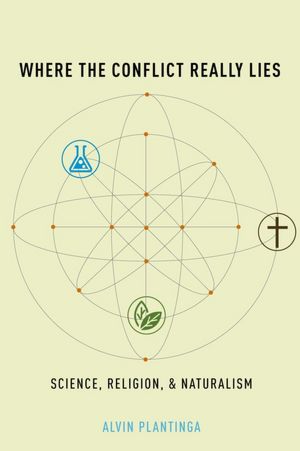 There are few names bigger than Alvin Plantinga when it comes to philosophy of religion and there are few topics more hotly debated than science and religion. Plantinga’s latest book, Where the Conflict Really Lies
Plantinga minces no words. The very first line of the book outlines his central claim: “there is superficial conflict but deep concord between science and theistic religion, and superficial concord and deep conflict between science and naturalism.”1
The first part of the book is dedicated to the superficial conflict between science and religious belief. The reason this alleged conflict is important is due, largely, to the success of the scientific enterprise. Because science has shown itself to be a reliable way to come to know the world, if religion is in direct conflict with science, then it would seem to discredit religion. Not only that, but, Plantinga argues, Christians should have a “particularly high regard” for science due to the foundations of the scientific enterprise on a study of the world.2
In order to examine this alleged conflict, Plantinga first takes on the article of science most often taken to discredit religion: evolution. Here, readers may be surprised to find that Plantinga does not try to argue against evolution itself. Rather, Plantinga draws a distinction between the notion of evolution and Darwinism. The former, argues Plantinga, is consistent with Christian belief, whether or not it is the way the variety of life came to be, while the latter is not consistent with Christianity because central to its account is the notion that the process of evolution is unguided.3
WCRL then turns to Richard Dawkins. Plantinga argues that “A Darwinist will think there is a complete Darwinian history for every contemporary species, and indeed for every contemporary organism.”4 Here again there is nothing which puts such a theory in conflict with Christian belief. Writes Plantinga, “[The process of evolution] could have been superintended and orchestrated by God.”5 But Dawkins (and others) claim that evolution “reveals a universe without design.” But what argument is provided towards this conclusion? Plantinga draws out Dawkins reasoning and shows that the only logic given is that evolution could have happened by way of unguided evolution. But then:
What [Dawkins] actually argues… is that there is a Darwinian series of contemporary life forms… but [this series] wouldn’t show, of course, that the living world, let alone the entire universe, is without design. At best it would show, given a couple of assumptions, that it is not astronomically improbable that the living world was produced by unguided evolution and hence without design. But the argument form ‘p is not astronomically improbable’ therefore ‘p’ is a bit unprepossessing… What [Dawkins] shows, at best, is that it’s epistemically possible that it’s biologically possible that life came to be without design. But that’s a little short of what he claims to show.6
Plantinga then moves on to argue that Daniel Dennett’s argument is similarly flawed.7 Paul Draper’s argument that evolution is more likely on naturalism than theism is more interesting, but assumes that “everything else is equal.”8 But then, everything is not equal. Theism provides a number of relevant probabilities which weigh the argument in favor of theism instead.9
The arguments against theism from evolution are therefore largely dispensed. What of the possibility of divine action? Some argue that God doesn’t actually act in the world—in fact, the argument is made that even most theologians don’t believe this, despite writing that God does act in various ways. The argument is made that because of natural laws, God cannot or does not intervene.10 However, one can simply argue that the correct view of a natural law is that “When the universe is causally closed (when God is not acting specially in the world), P.”11
Plantinga does acknowledge that there are some fields in science which do provide at least superficial conflict with theism. These include evolutionary psychology and (some) historical critical scholarship.12 Evolutionary psychology generally doesn’t challenge religious belief. “Describing the origin of religious belief and the cognitive mechanisms involved does nothing… to impugn its truth.”13 Now some suggest that religious beliefs are due to devices not aimed at truth, and this would provide a reason to doubt religious belief.14 However, the way that most do this is by conjoining atheism with psychology or operating under other assumptions which undermine religious belief a priori. While this may mean that specific conclusions in psychology are in conflict with theism, these conclusions only follow from the anti-theistic assumptions at the bottom. Thus, while some accounts of evolutionary psychology are in conflict with theism, they don’t provide a solid basis for rejecting it.15 Similarly, varied methods of historical concept may draw some conclusions which are in conflict with Christian theism, but these methods are themselves undergirded by assumptions that theism is, at best, not to be entered into historical discussion.16
There are, Plantinga argues, significant reasons to think that theism is in concord with science. First, the argument from cosmological fine-tuning, he argues, gives “some slight support” for theism.17 The section on fine-tuning has responses to some serious criticisms of such arguments. Most interesting are his responses to Tim and Lydia McGrew and Eric Vestrup—in which Plantinga argues that we can indeed get to the point where we can assess the fine-tuning argument;18 Plantinga’s discussion of the multiverse;19 and his discussion of relevant probabilities regarding fine-tuning.20
Michael Behe’s design theory is discussed at length in WCRL.21 Plantinga offers some additional insights into the Intelligent Design debate. He argues that one can view design not so much as a probabilistic argument but instead as simple perception.22 He reads both Behe and William Paley in this light and argues that they are offering design discourses as opposed to arguments.23 This, in turn, allows him to argue that design is a kind of “properly basic belief” and he offers a robust discussion of epistemology to support this intuition.24
Further, there is deep concord between Christian Theism and Science when one looks at the very roots of the scientific endeavor. Here, rather than simply listing various theists who helped build the empirical method, Plantinga argues that science relies upon various theistic assumptions in order for its methods to succeed. These include the “divine image” in which humans are capable of rational thought;25 God’s order as providing regularity for the universe;26 natural laws;27 mathematics;28 induction;29 and simplicity and “other theoretical virtues” (like beauty).30
Finally, Plantinga turns to naturalism: does it really resonate so well with science? Plantinga grants for the sake of argument that there is at least superficial concord between naturalism on science, if only because so many naturalists trumpet this “fact.”31 Yet there is, he argues, a deep conflict between science and naturalism: namely, that if evolution is true and naturalism is true, there is no reason to trust our cognitive abilities.32 “Suppose you are a naturalist,” he writes, “you think there is no such person as God, and that we and our cognitive faculties have been cobbled together by natural selection. Can you then sensibly think that our cognitive faculties are for the most part reliable?”33
Plantinga argues you cannot. The reason is because we have no way to suppose that evolution is truth aimed, but rather it is merely survival aimed (if indeed it is aimed at all!). He also argues that because naturalists are almost all materialists, there is no way to adequately ground beliefs.34 Finally, because naturalism and evolution conjoin to give a low probability that our rational abilities are reliable, we have received a defeater for every belief we have, including naturalism and evolution.35 Thus, the conflict “is not between science and theistic religion: it is between science and naturalism. That’s where the conflict really lies.”36
WCRL covers an extremely broad range of topics, and will likely be critiqued on each topic outlined above and more. The book touches on issues that are at the core of the debate between naturalists and theists, and as such it will be highly contentious. That said, the book is basically required reading for anyone interested in this discourse. Plantinga provides extremely valuable insights into every topic he touches. His discussion of biological design, for example, provides unique insight into the topic by locating it within epistemology as opposed to biology alone. Further, his “evolutionary argument against naturalism” continues to live despite endless criticism. The list of important topics Plantinga illumines in WCRL is extensive.
Where the Conflict Really Lies
——
1 Alvin Plantinga, Where the Conflict Really Lies (New York, NY: Oxford, 2011), ix.
2 Plantinga, Where the Conflict Really Lies, 3-4. (Unless otherwise noted, all references are to this work.)
3 12 (emphasis his).
4 15 (emphasis his).
5 16.
6 24-25.
7 33ff, esp. 40-41.
8 53.
9 53ff.
10 69ff.
11 86, see the arguments there and following.
12 129ff.
13 140.
14 141ff.
15 143ff.
16 152ff.
17 224.
18 205-211.
19 212ff.
20 219ff.
21 225-264.
22 236ff.
23 240-248.
24 248ff; see esp. 253-258, 262-264.
25 266ff.
26 271ff.
27 274ff.
28 284ff.
29 292ff.
30 296ff.
31 307ff.
32 311ff.
33 313.
34 318ff.
35 339ff.
36 350.
This review was originally posted at Apologetics315 here: http://www.apologetics315.com/2012/02/book-review-where-conflict-really-lies.html
SDG.
——
The preceding post is the property of J.W. Wartick (apart from citations, which are the property of their respective owners) and should not be reproduced in part or in whole without the expressed consent of the author. All content on this site is the property of J.W. Wartick and is made available for individual and personal usage. If you cite from these documents, whether for personal or professional purposes, please give appropriate citation with both the name of the author (J.W. Wartick) and a link to the original URL. This blog is protected by Creative Commons licensing. By viewing any part of this site, you are agreeing to this usage policy.

 J.W. Wartick - Reconstructing Faith
.jpg)