Christianity
Animal Death?- A Theological Argument Against Young Earth Creationism
 [Answers in Genesis recently posted a critique of this article. I have responded here.] I have explored extensively the varied positions within Christianity about the origins and diversity of life. I come from a background in which I was a young earth creationist for quite some time, but my research has caused me to reject this position in favor of another. Those reading this article, please understand I do not wish to denigrate or devalue those who are young earth creationists (hereafter YEC and YECs). I appreciate that many who are YEC are doing their work in the field because they feel it is closest to the Biblical position and that they often believe science supports their view. That said, I cannot agree. In the following, I present a theological argument against the YEC position.
One of the theological arguments YECs use against other Christian positions (such as Intelligent Design or Theistic Evolutionism) is that it would imply death before the fall. I tried to track down an explicit syllogistic form of this argument and couldn’t find any in the literature with which I am familiar, however the argument is everywhere presented. For example, Ken Ham writes in The New Answers Book 1:
The book of Genesis teaches that death is the result of Adam’s sin… and that all of God’s creation was ‘very good’ upon its completion… But if we compromise the history of Genesis by adding millions of years, we must believe that death and disease were part of the world before Adam sinned… How could a God of love allow such horrible processes as disease, suffering, and death for millions of years as part of his ‘very good’ creation? (36)
Elsewhere, we can find statements like this: “The Bible tells us very clearly that there was no death before sin from many passages. In fact, there are no Bible verses indicating there was death prior to sin.”
Now it is not my point in this post to cite every disagreement I have with such arguments (there are a great deal of them), but rather to show that the implications of an argument like this are absurd. One immediate problem with the argument is that it begs the question in the opening sentence by smuggling in a hidden premise. Namely, the notion that all death is the result of sin, as opposed to the death of mankind or a kind of spiritual death. Further, note the conflation of the terms in the second quote–just because there are no Bible verses which show there was death before sin, it does not follow that the Bible teaches that there was no death before sin. But those parts aside, I wish to show that this argument from YECs actually works against their position.
Suppose we lay out the argument:
- Death is the result of sin.
- If YEC is false, then things died before sin.
- Therefore, if YEC is false, God is unjust.
Now I know this is not the full argument. There are many premises I have left unstated, but it seems that is the gist of the passage cited from Ham. Why do I find this problematic? Well, it seems that the logic is that if death happened because of sin, then animals would not have died before the fall. But if that is the case, then why do animals die after the fall? The post on Answers in Genesis hints that it is because animals are cursed due to the serpent’s deception of Adam and Eve (cited below). One is still forced to wonder why all animals are cursed because a serpent–Satan–deceived Adam and Eve. Thus we are led to the following argument:
- If animals did not die before the fall, then their death must be the result of sin.
- Animals are incapable of sinning. (They have no culpability.)
- Therefore, their death would have to be the result of morally culpable agents’ sins.
But this argument, it seems, shows that YEC is morally impermissible. For on YEC, animals died because of Adam’s sin. The animals themselves didn’t do anything. One day, they were happily living potentially infinitely long lives, eating plants, and doing their animal things. The next day, Adam sinned, and so God decides to start killing them all, putting countdowns on their lifespans. But why? Because Adam sinned, not because they themselves sinned. Thus, animals, through no culpability of their own, suffered the punishment of death for Adam’s sin. This seems to be morally impossible.
Now it seems the YEC position could be modified to get around this argument, but it would have to drop the argument against the other positions that death could not have happened before the fall. The modification would essentially have to hold that animals were part of the natural world which lived and died. Or, the YEC position could charge that animals were moral agents, but that would seem absurd. Finally, the YEC position could hold that, somehow, the serpent’s culpability transferred to all other animals, but that would seem extremely difficult as well, particularly because the serpent is Satan.
The argument, therefore, has been that animals are not morally culpable because they are not moral agents. Because that is the case, if they died due to sin, it was through not fault of their own. This would make God seem unjust if He caused animal death due to Adam’s fall. I’ve noted that YECs can avoid this injustice, but only by dropping the argument that Ham and others use against other positions.
There have been some interesting reactions to this article, and some of them are confusing my argument. What I’d like to note is this post is written from a perspective inside of YEC. In other words, I’m using the presuppositions of YEC against itself. What I’m not doing is personally saying that the death of animals is a morally impermissible state of affairs. What I am doing is saying that, on YEC, they assert it is morally impermissible, and so they have to accept the consequences of that argument.
Finally, I’d like to note that even if readers are unconvinced by this argument, they still must contend with other theological problems with YEC. For example, the notion that YEC makes God a deceiver. For this and other reasons I am no longer a YEC.
But what of the argument itself from YEC? What of the argument that there cannot be death before the fall? I urge readers to check out the following post over at geocreationism: Death before the fall — an old-Earth Biblical perspective. See also Luke Nix’s phenomenal post on the topic, “Cartoons, Animal Death, and Theology.”
Image Credit- http://commons.wikimedia.org/wiki/File:R%C3%B8d_r%C3%A6v_(Vulpes_vulpes).jpg image by Malene
Sources
Answers in Genesis, “Biblically, Could Death Have Existed Before Sin?” – http://www.answersingenesis.org/articles/2010/03/02/satan-the-fall-good-evil-could-death-exist-before-sin
Ken Ham, The New Answers Book 1 (Green Forest, Arizona: Answers in Genesis, Master Books, 2006).
SDG.
——
The preceding post is the property of J.W. Wartick (apart from citations, which are the property of their respective owners) and should not be reproduced in part or in whole without the expressed consent of the author. All content on this site is the property of J.W. Wartick and is made available for individual and personal usage. If you cite from these documents, whether for personal or professional purposes, please give appropriate citation with both the name of the author (J.W. Wartick) and a link to the original URL. If you’d like to repost a post, you may do so, provided you show less than half of the original post on your own site and link to the original post for the rest. You must also appropriately cite the post as noted above. This blog is protected by Creative Commons licensing. By viewing any part of this site, you are agreeing to this usage policy.
Abortions rates are lower in countries where it is legal- some thoughts on recent pro-choice comments
Highly restrictive abortion laws are not associated with lower abortion rates. For example, the abortion rate is high, at 29 and 32 abortions per 1,000 women of childbearing age in Africa and Latin America, respectively—regions where abortion is illegal under most circumstances in the majority of countries. In Western Europe, where abortion is generally permitted on broad grounds, the abortion rate is 12 per 1,000. ( Sedgh G et al. cited below)

There it is in black and white. Countries in which abortion is illegal have higher rates of abortion in most cases. What does this mean for the pro-life argument? Some have argued that pro-life advocates should work to make abortion legal. For example, Margot Magawan writes, “It’s clear that top Republican candidates are being short-sighted and ineffective, rushing off in precisely the wrong direction if their goal truly is to reduce abortions.” The argument seems to be quite simple. After all, if the goal of the pro-life advocates is to reduce the number of abortions, then if making it legal reduces them, they should argue to legalize abortions.
There are a number of problems with this argument, however, and I’ll briefly list them before examining them in turn.
1. Those making this argument seek to compare countries unilaterally based on a situation with all kinds of factors which cannot possibly be weighed fairly.
2. The argument reduces the goal of the pro-life movement to reducing abortions only; but the movement has a broader range than that. The argument is susceptible to a reductio ad absurdum which shows that the premise on which it is based is absurd.
3. The argument begs the question against the pro-life position by assuming the position itself is false.
3. The argument assumes consequentialism as a metaethical theory without argument.
1. Comparing Countries Unilaterally
It seems strange to me to compare the situations of different countries unilaterally on an issue like this. For example, it seems to have been shown that many things cannot be compared in this way. Installing democracy into random countries does not have a stabilizing effect. Comparing the economic situation of Rwanda with that of the United States seems almost grotesque. I’m not disputing the results of the study cited above; rather, I’m disputing the application of those results to a moral sphere. Think of all the factors which must be weighed: economic status, education, career choices, etc. To then take the raw data and apply it to a moral sentiment is quite a stretch. After all, it doesn’t take into consideration all the factors that those countries in which abortion is legal may have.
I do not want to make this the focus of my rebuttal, however, because I think the next 3 points are much stronger. To those we shall now turn.
2. Is Pro-Life About Reducing Abortions?
Another problem with the argument is that it assumes the pro-life position is dedicated to reducing abortions. That sentence may seem strange on a first reading, but read it this way instead: “the pro-life position is dedicated to reducing abortions only.” That is where one of the major difficulties arises for those making this argument. The pro-life position is not only about reducing abortions. In fact, while reducing the number of abortions is a goal of the pro-life movement, that is not the only goal or even, perhaps, the highest goal.
Suppose that reducing abortions was the only goal of the pro-life candidate. In that case, one way to reduce abortions would be by eliminating all human beings. If, after all, not a single human being were alive, there would be no abortions! This is, of course, patently absurd. Why? Not just because it seems obviously wrong to murder everyone on earth (or to murder anyone) in order to reduce the number of abortions, but also because this is a gross reduction of the pro-life position.
The pro-life position isn’t just about reducing the number of abortions. It is about advocating for life. In other words, those in the movement are making a factual and a moral claim: the entities aborted are human persons and it is wrong to kill them. But those who want to make the argument that pro-life advocates should legalize abortions in order to reduce them are, on a pro-life view, essentially arguing something similar to this:
Suppose that making murder legal reduced the number of murders. If you are against murder, you should then legalize murder.
The absurdity of this argument becomes clear because no one but a psychopath wants to legalize murder. But then it becomes clear that those pro-choice people making this argument have begged the question against the pro-life person. Let’s turn to that.
3. The Argument Begs the Question
If the pro-life position is correct, then it makes a mockery of this argument. Suppose, for the sake of argument, that the advocate of the pro-life position is right: the unborn are not merely embryos (and other stages of development) but are rather human persons who deserve the same rights as people outside of wombs. Now, granting these assumptions, suppose one finds that legalizing abortions reduces them. To then argue that “we should legalize abortions to reduce their number” is exactly equivalent to arguing that we should legalize murder to reduce the number of murders. Note here that I’m not saying legalizing murder does reduce the number of murders; I’m arguing that if the pro-life position is correct, these arguments are exactly analogous. One who argues we should legalize abortions would be the same as one who argues we should legalize murders, if the pro-life position is correct.
Thus, it becomes clear that those who make an argument like that of Margot Magawan have begged the question against the pro-life position. They simply assume that it is morally permissible to have an abortion, and combine that with the false position that the pro-life position is only about reducing abortions. Thus, the argument fails because it begs the question. Without argument, the pro-choice advocate has caricatured its opposition and argued against this false image.
4. It assumes consequentialism.
The last rebuttal is more technical, but I want to keep it brief. Consequentialism is, basically, the position that it is not the status of actions themselves which are judged as moral but rather the consequences. If one takes an action which has morally good consequences, that action is deemed good.
Now consider once more the argument, “If your goal is to reduce abortions, you should legalize them [because if abortion is legal, the number is reduced].”
This argument doesn’t take into consideration the moral status of an abortion [again, see above: they’ve already begged the question]. Rather, it assumes that because the consequences (fewer abortions) are considered by pro-life advocates as morally good, they should take the action (legalizing abortions) which open the door for these consequences.
Without too much strain, it becomes clear that most pro-life advocates do not hold to consequentialism as a metaethical theory. There are many alternative metaethical theories which are preferable for any number of reasons. If a pro-life advocate holds to a deontological theory of ethics, for example, he will argue that the wrongness of abortion is outweighed by the benefits of reducing the number. Such examples could be multiplied almost beyond comprehension. Thus, the pro-choice advocate has assumed, again without argument, a controversial position and then utilized that position to argue against pro-life advocates. Therefore, the argument fails.
Conclusion
The argument which has been considered here is that “if the goal of the pro-life advocates is to reduce the number of abortions, then if making it legal reduces them, they should argue to legalize abortions.” I have rebutted this argument in four ways. First, it seems to trivialize the enormous amount of factors which must go into consideration of comparing abortion rates across countries. Second, it reduces the pro-life position almost beyond recognition and is susceptible to a reductio ad absurdem. Third, it begs the question. Fourth, it utilizes a controversial metaethical theory to justify its premise. For these four reasons, I conclude that the argument is unsound.
Source
Sedgh G et al., “Induced abortion: incidence and trends worldwide from 1995 to 2008,” Lancet, 2012. (accessible: http://www.thelancet.com/journals/lancet/article/PIIS0140-6736%2811%2961786-8/fulltext); summary: http://www.guttmacher.org/media/presskits/abortion-WW/statsandfacts.html.
Image Credit: http://commons.wikimedia.org/wiki/File:Prolife-DC.jpg
SDG.
——
The preceding post is the property of J.W. Wartick (apart from citations, which are the property of their respective owners) and should not be reproduced in part or in whole without the expressed consent of the author. All content on this site is the property of J.W. Wartick and is made available for individual and personal usage. If you cite from these documents, whether for personal or professional purposes, please give appropriate citation with both the name of the author (J.W. Wartick) and a link to the original URL. If you’d like to repost a post, you may do so, provided you show less than half of the original post on your own site and link to the original post for the rest. You must also appropriately cite the post as noted above. This blog is protected by Creative Commons licensing. By viewing any part of this site, you are agreeing to this usage policy.
“A New Vision for Natural Theology” A Book Review of “The Open Secret” by Alister McGrath
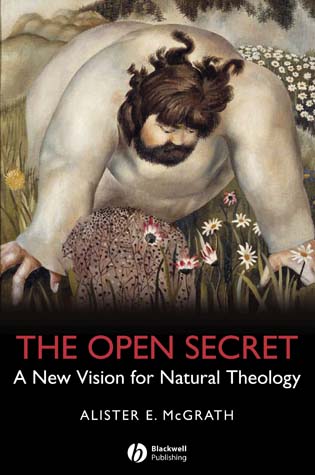 Alister McGrath is a well-known name in Christian philosophy, science, and apologetics. His book, The Open Secret
Natural theology, according to McGrath, is not just a way to argue for the existence of God. Rather, “The enterprise of natural theology… is one of discernment, of seeing nature in a certain way…” (3). He argues that natural theology in fact should not be viewed as a system to prove the existence of God. Rather, it “addresses fundamental questions about divine disclosure and human cognition and perception. In what way can human beings, reflecting on nature by means of natural processes, discern the transcendent?” (5, emphasis his). Natural theology can be seen as an entire worldview, put forth to view the world in a certain way (17).
McGrath, after outlining his vision thus, turns to the human experience of the transcendent. He focuses on three thinkers- Iris Murdoch, Roy Bhaskar, and John Dewey (41ff). He then turns to various ways humans have accessed the transcendent (59ff) and includes an evaluation of the psychology of perception (80ff).
He once more emphasizes the need to see natural theology as a type of “seeing” (115) and turns to Jesus to demonstrate the approach McGrath favors. Jesus’ parables are a model for natural theology, argues McGrath. They are “open… the interpretation is generally left indefinite and imprecise… the imagery of the parables is readily grasped [but] their meaning is often veiled…” (120-121). Similarly, nature itself is easy to grasp, but it has hidden meanings which can only be perceived by viewing the world in a certain way (126ff).
The Enlightenment approaches to natural theology have been largely unsuccessful historically and are in need of modification (140ff).
A Christian approach to natural theology should focus on “seeing” God in the natural. God has chosen to “self-disclose in history and nature” (178) and natural theology can reveal God in nature (178ff). Christian natural theology is “eschatological… The fading beauty and goodness of the world are to be interpreted in the light of the hope of their restoration and renewal” (206).
Natural theology must also break out of its boundaries. It is not just the realm of philosophical reflection, but also opens many points of contacts with the world. It is “about perceiving nature in a certain way” (221). Beauty, goodness, and truth are all aspects of reality which can be drawn out through a Christian Natural Theology (222ff). Again,
“natural theology… cannot be regarded as ‘proving’ God’s existence. Rather, it insists that the existence of a God such as that proposed by the Christian tradition makes sense of what may be observed of the world. Such an approach holds that there is an accumulation of considerations which, though not constituting logical proof (how could experience prove anything in such a way?), is at the very least consistent with the existence of a creator God (233).
The goal is not proof but a demonstration of consistency, which will “reinforce the plausibility” of Christianity (234).
Beauty and goodness draw out the reality of the Christian vision of the world. Beauty must not be neglected in natural theology (262ff). Beauty “can… call us, seeking a response” (283). Goodness underlies the resonance with natural law and the moral truths that can be seen as built in to “the fabric of the universe” (293ff).
McGrath concludes by urging readers to see natural theology as a key to open the “mysteries” and “hidden meaning” of nature’s “open secret” (314-315). Natural theology is primarily a vision–a way of viewing the world. The goal of the natural theologian, therefore, is to show how the reality of the world resonates best with a Christian worldview.
There is little to find at fault in McGrath’s powerful work. The Open Secret has enormous depth and breadth. Few areas of development are left unexplored. As one who has great interest in natural theology and who frequently discusses it, this reader must agree with McGrath that the arguments of natural theology often don’t work as proofs so much as pointers. Few are willing to embrace Christianity due only to an argument from natural theology, but the arguments themselves can be used to show how Christianity touches and explains many aspects of reality. McGrath’s vision is really an expanded “cumulative case”; one which focuses not just on many arguments, but brings the beauty of the world and its inherent goodness (while acknowledging ugliness and evils) into the folds of natural theology.
Alister McGrath’s The Open Secret provides a vision for the development and integration of natural theology into the arts, the sciences; indeed, into every aspect of life. It is a vision that will resonate with readers and drive them to see Christianity as an integrated whole. The book is, without a doubt, a must read.
Source
Alister McGrath, The Open Secret
SDG.
——
The preceding post is the property of J.W. Wartick (apart from citations, which are the property of their respective owners) and should not be reproduced in part or in whole without the expressed consent of the author. All content on this site is the property of J.W. Wartick and is made available for individual and personal usage. If you cite from these documents, whether for personal or professional purposes, please give appropriate citation with both the name of the author (J.W. Wartick) and a link to the original URL. This blog is protected by Creative Commons licensing. By viewing any part of this site, you are agreeing to this usage policy.
Really Recommended Posts 3/3/12
 The really recommended posts this go-round feature Richard Dawkins, bioethics, philosopher’s opinions, women in the ministry, and more!
Arguments about Jesus’ resurrection are fascinating, and can be extremely useful in the question of theism. See this great article which features rigorous application of probability theory to the arguments from the resurrection.
Richard Dawkins’ book, The Greatest Show On Earth claims to show the undeniable evidence for evolution. Does it succeed? Jonathan Mclatchie does not think so and has written an excellent, lengthy review to show how Dawkins fails.
Philip Payne, the author of “Man and Woman, One in Christ” (which I reviewed here) has an excellent web site which responds to many criticisms of his positions. Those interested in the issue of women in the ministry should look into it.
No peer reviewed papers advocating intelligent design? False! Check out this list.
After birth abortions? Basically the logical conclusions of the general pro-choice position. Read more.
Prosblogion conducted a survey about philosopher’s opinions on theistic arguments. The results are mostly unsurprising, but interesting nevertheless. Check it out.
The Ontology of Morality: Some Problems for Humanists and their friends

Louise Anthony did indeed present the case for secular metaethics. The problem is that this case is utterly vacuous.
It will be my purpose in the following arguments to show that secular humanistic theories which try to ground moral ontology fail–and fail miserably.
Recently, I listened [again] to the debate between William Lane Craig and Louise Anthony. Some have lauded this debate as a stirring victory for secular ethics. (See, for example, the comments here–one comment even goes so far as to say “I swoon when someone evokes the Euthyphro Dilemma and frown at the impotent, goal-post-moving, ‘Divine nature’ appeal.”) In reality, I think Louise Anthony did indeed present the case for secular metaethics. The problem is that this case is utterly vacuous.
I’ll break down why this is the case by focusing upon three areas of development in secular and theistic ethics: objective moral truths, suffering, and moral facts.
Objective Moral Truths
Louise Anthony and William Lane Craig agree that there are objective moral truths. Now, this is important because many theists take the existence of objective morality to demonstrate–or at least strongly suggest–the existence of God. Interestingly, other humanist/secular scholars have agreed with Anthony, claiming there are objective truths (another example is Sam Harris–see my analysis of his position contrasted with theism here). The question, of course, is “How?” Consider the following:
Louise Anthony seems to be just confused about the nature of objective morality. She says in response to a question from the audience, “The universe has no purpose, but I do… I have lots of purposes…. It makes a lot of difference to a lot of people and to me what I do. That gives my life significance… The only thing that would make it [sacrificing her own life] insignificant would be if my children’s lives were insignificant. And, boy you better not say that!”
Craig responded, “But Louise, on atheism, their lives are insignificant.” Anthony interjected, “Not to me!”
But then she goes on to make this confused statement, “It’s an objective fact that they [her children] are significant to me.”
Note how Anthony has confused the terms here. Yes, it is an objective fact that according to Louise Anthony, her children matter to her. We can’t question Anthony’s own beliefs–we must trust what she tells us unless we have reason to think otherwise. But that’s not enough. What Craig and other theists are trying to press is that that simple fact has nothing to do with whether her children are actually valuable. Sure, people may go around complaining that “Well, it matters to me, so it does matter!” But that doesn’t make it true. All kinds of things can matter to people, that doesn’t mean that they are ontologically objective facts.
It matters to me whether the Cubs [an American baseball team] win the World Series. That hasn’t happened in 104 years, so it looks like it doesn’t matter in the overall scheme of the universe after all. But suppose I were to, like Anthony, retort, “But the Cubs matter to me! It’s an objective fact that them winning the World Series is significant to me!” Fine! But all the Cardinals [a rival team] fans would just laugh at me and say “SO WHAT!?”
Similarly, one can look at Anthony with incredulity and retort, “Who cares!?” Sure, if you can get enough people around Anthony who care about her children’s moral significance, you can develop a socially derived morality. But that’s not enough to ground objective morality. Why should we think that her values matter to the universe at large? On atheism, what reason is there for saying that her desires and purposes for her children are any better than my desires and purposes for the Cubs?
Another devastating objection can be found with a simple thought experiment. Let’s say Anthony didn’t exist. In such a world, there can be no one complaining that her children matter “to me!” Instead, her children just exist as brute facts. How then can we ground their significance? Well, it seems the answer for people like Anthony would be to point to the children’s other family say “Those children matter to them!” We could continue this process almost endlessly. As we eliminate the children’s family, friends, etc. and literally make them just exist on their own, we find Anthony’s answer about allegedly objective morality supervenes on fewer and fewer alleged moral facts. Suddenly “Those children matter to themselves!” is the answer. But then what if we eliminate them? Do humans still have value? The whole time, Anthony has grounded the significance of her children and other humans in the beliefs, goals, and purposes of humans. But without humans, suddenly there is no significance. That’s what is meant by objective morality. If those children matter even without humans, then objective morality is the case. But Anthony has done nothing to make this the case; she’s merely complained that her children matter to her.
Now, some atheists–Anthony and Sam Harris included–seem to think they have answers to these questions. They seem to think that they can ground objective morality. We’ll turn to those next.
Suffering
One of the linchpins of humanists’ claims (like Anthony and Sam Harris) is suffering. The claim is that we can know what causes suffering, and that this, in turn, can lead us to discover what is wrong. We should not cause suffering.
But why not?
Most often the response I’ve received to this question is simply that because we do not wish to suffer, we should not wish to have others suffer or cause suffering for others. But why should that be the case? Why should I care about others’ suffering, on atheism? That’s exactly the question humanism must answer in order to show that objective morality can exist in conjunction with secularism. But I have yet to see a satisfactory answer to this question.
Anthony was presented with a similar question in the Q&A segment of her debate with William Lane Craig. One person asked (paraphrased), “Why shouldn’t I base morality as ‘whatever benefits me the most’?” Anthony responded simply by simply arguing essentially that it’s not right to seek pleasure at the expense of others, because they may also want pleasure.
But of course this is exactly the point! Why in the world should we think that that isn’t right!?
The bottom line is that, other than simply asserting as a brute fact that certain things are right and wrong, atheism provides absolutely no answer to the question of moral objectivity. People like Anthony try to smuggle it in by saying it’s objectively wrong to cause suffering [usually with some extra clauses], but then when asked why that is wrong, they either throw it back in the face of the one asking the question (i.e. “Well don’t you think it’s wrong?”) or just assert it as though it is obviously true.
And it is obviously true! But what is not so obvious is why it is obviously true, given atheism. We could have simply evolved herd morality which leads us to think it is obviously true, or perhaps we’re culturally conditioned by our close proximity to theists to think it is obviously true, etc. But there still is no reason that tells us why it is, in fact, true.
Moral Facts
Anthony (and Harris, and others with whom I’ve had personal interactions) centralize “moral facts” in their metaethical account. As a side note, what is meant by “moral fact” is a bit confusing but I don’t wish to argue against their position through semantics alone. They claim that we can figure out objective morals on the basis of moral facts. Sam Harris, for example, argues that there is a “continuum of such [moral] facts” and that “we know” we can “move along this continuum” and “We know, we know that there are right and wrong answers about how to move in this space [along the moral continuum]” (see video here).
Now it is all well and good to just talk about “facts” and make it sound all wonderful and carefully packaged, but Anthony and Harris specifically trip up when they get asked questions like, “How do we figure out what moral facts are?”
Anthony was asked “How do you determine what the objective moral facts are”, and responded by saying, “We do it by, um, testing our reactions to certain kinds of possibilities, um, thinking about the principles that those reactions might entail; testing those principles against new cases. Pretty much the way we find out about anything” (approximately 2 hours into the recorded debate).
 One must just sit aghast when one hears a response like that. Really? That is the way we discover moral truths? And that is the way we “find out about anything”? Now I guess I can’t speak for Anthony herself, but when I’m trying to find out about something, I don’t test my reaction to possibilities and then try to figure out what my reaction “might entail.” That is radical subjectivism. Such a view is utterly devastating for not just morality but also science, history, and the like. If I were to try to conduct scientific inquiry in this manner, science would be some kind of hodgepodge of my “reactions” to various phenomenon. Unwittingly, perhaps, Anthony has grounded the ontology of her morality in the reactions of people. But this error isn’t restricted to Anthony. Harris also makes this confounding mistake. His basic argument in the talk linked above is simply, “Science can tell us what people think about things, so it can tell us about morality.” This is, of course patently absurd. Suppose I tried to test these humanists’ theories on groups of people by sticking them in a room and having them watch all kinds of things from murder to the rape of children to images of laughter and joy. Now suppose I randomly sifted my sample among the population of the world, but somehow, by pure chance, got a room full of child molesters. As I observe their reactions, I see they are quite joyful when they observe certain detestable images. Now, going by Anthony/Harris’ way to “find out about anything” and thinking about what these people’s reaction entails, I conclude that pedophilia is a great good. But then I get a room full of parents with young children, who react in horror at these same images. Then, as I reflect on their reactions, I discover that pedophilia is a great evil. And I repeat this process over and over. Eventually, I discover that the one group was an aberration, but it was a group nonetheless.
What does this mean?
Quite simply, it means that both Harris and Anthony haven’t made any groundbreaking theory of ethics. Rather, they’ve just made a pseudo-humanistic utilitarianism. They ground moral ontology in our “reactions” to various moral situations. The only way for them to say something is morally wrong if people have different reactions is either to go with the majority (utilitarianism) or choose one side or the other, which essentially turns into a kind of Euthyphro dilemma against atheists. Either things are wrong because enough people think they’re wrong (in which case morality is arbitrary) or things are wrong because they simply are wrong, period (in which case the humanist has yet to provide an answer for moral ontology).
Conclusion
Given the discussion herein, one can see that those atheists, humanists, and/or secularists who desire to ground objective morality still have a lot of work to do. Louise Anthony’s best attempt to ground morality boils down into radical subjectivism. Sam Harris’ account fares no better. Those who are trying to ground objective morality within an atheistic universe will just have to keep searching. The solutions Anthony and Harris have attempted to offer are vacuous.
Image Source:
http://commons.wikimedia.org/wiki/File:SecularHumanismLogo3DGoldCropped.png
SDG.
——
The preceding post is the property of J.W. Wartick (apart from citations, which are the property of their respective owners) and should not be reproduced in part or in whole without the expressed consent of the author. All content on this site is the property of J.W. Wartick and is made available for individual and personal usage. If you cite from these documents, whether for personal or professional purposes, please give appropriate citation with both the name of the author (J.W. Wartick) and a link to the original URL. If you’d like to repost a post, you may do so, provided you show less than half of the original post on your own site and link to the original post for the rest. You must also appropriately cite the post as noted above. This blog is protected by Creative Commons licensing. By viewing any part of this site, you are agreeing to this usage policy.
Devotion for a Philosopher/Apologist: Philippians 1-2
To be sure, some preach Christ out of envy and strife, but others out of good will. These do so out of love, knowing that I am appointed for the defense of the gospel; the others proclaim Christ out of rivalry, not sincerely, seeking to cause me anxiety in my imprisonment. (Philippians 1:15-17 HCSB)

“Why do I defend the faith?”
I encourage all Christian philosophers and apologists to ask themselves this question. It is a question, I admit, with an answer I’ve been ashamed to discover at times. Sometimes, the answer is “I defend the faith because I feel smart doing so” or “I defend the faith because it makes me look good.”
The defense of the faith is not about yourself. The focus is, and should always be, on Christ. Troubles come the way of the defender of the faith. It is not easy to continue to press on towards knowledge and truth. The Christian philosopher faces the scorn of his fellows, and the Christian apologist the ridicule of those who disagree. Yet in such striving, one can rejoice in the salvation of Christ and His glory alone.
It is often too easy to get wrapped up in yourself when you are defending the faith. Look at the people discussing the arguments you make! Look at those who think you are so strong; so faithful; so spiritual! I tell you, Christian brothers and sisters, such glory is nothing to be had in comparison to the glory of Christ crucified.
Further, do we preach the Gospel in such a way as to gainsay others? Paul experienced those who did this very thing; such people are in our midst to this day. Let us not use the Gospel to slander or attack. Rather, let us preach the grace of God.
Paul wrote,
So then, my dear friends, just as you have always obeyed, not only in my presence, but now even more in my absence, work out your own salvation with fear and trembling. For it is God who is working in you, enabling you both to desire and to work out His good purpose. (Philippians 2:12-13 HCSB)
Thus, it is not by ourselves that we spread the Good News. It is God’s work in us, empowering us and enabling us to do His work. We cannot take credit for this, but should always turn our victories back to God. When we are tempted to delight in our own wisdom or knowledge, we must ask for forgiveness and acknowledge that it is from God.
Paul’s warnings ring home to me. I have too often congratulated myself with a successful argument, a sound rebuttal. These things matter not if we do not advance the Kingdom. Let us unite with each other, build each other up, and encourage one another. By doing these things, we can work together, each with his or her strength covering another’s weakness. Let us together hold firmly to the message of life (Phil. 2:16).
Reading
Read Philippians 1 and 2. Reflect on Paul’s joy in the spread of the Gospel and his own striving to keep the focus on Christ, not on himself.
Prayer
Dear Lord God,
Help us to keep our focus always only on you. Please forgive us for the times we struggle and delight in the admiration of others. Forgive us for using your message for our own ends. Help us to forgive others when they stumble, and grant us the grace to lift them up. We work for your glory, oh Lord.
Amen.
SDG.
——
The preceding post is the property of J.W. Wartick (apart from citations, which are the property of their respective owners) and should not be reproduced in part or in whole without the expressed consent of the author. All content on this site is the property of J.W. Wartick and is made available for individual and personal usage. If you cite from these documents, whether for personal or professional purposes, please give appropriate citation with both the name of the author (J.W. Wartick) and a link to the original URL. If you’d like to repost a post, you may do so, provided you show less than half of the original post on your own site and link to the original post for the rest. You must also appropriately cite the post as noted above. This blog is protected by Creative Commons licensing. By viewing any part of this site, you are agreeing to this usage policy.
Christian Reflection on The Hunger Games Trilogy
 I devoured the entire Hunger Games Trilogy
I’ll give my thoughts on the overall plot and what I take as the meaning in the books, from my own Christian perspective. I provide a brief look at things Christians can take from the books, as well as a discussion of the ethical theory one could see in the books.
This post focuses first on the reflections, and readers who don’t know the plot should read my summary before reading that section. Next, I briefly outline some content for parents. Third is my summary of the trilogy. Finally, I share a few interesting links, including one which I think will be very useful for Christian parents wondering if these are appropriate for their children.
WARNING: MAJOR SPOILERS INCLUDED BELOW
I’ll first present my reflections, and follow it with a brief note for parents. Those who haven’t read the books and aren’t planning to do so can read 3. Summary for a broad summary of the plot. There are spoilers in the reflections section, so readers who don’t want to have anything spoiled should abstain from reading this post and perhaps just read the one linked above.
1. Reflections
[I have had the wonderful pleasure of interacting with many thoughtful Christian on this trilogy and found that there is so much more to the books than I could delve into here. Please see the links at the end for more reflections.] Initially, as I reflected on The Hunger Games Trilogy, I felt that the biggest issue was that there didn’t seem to be a major point to it beyond entertainment. I asked to be corrected, and I was. Many people commenting on this post have shared incredible insights. For the Christian reflecting on the Hunger Games, one can see it as a commentary on the horrors done to children in our time (Audra Franz below brings up this excellent point), a stunning condemnation of relativistic ethical theories (see A.T. Ross’s link), a narrative of Christian martyrdom, a critique of poor moral decisions, a horrible look at a nihilistic worldview, and more. In other words, there are any number of things Christians reflecting on the Hunger Games Trilogy can take away from the series. As such, I’ve lengthened this post a bit to take more of this into account.
I’ve been perplexed by Katniss’ decision to vote to hold a Hunger Games for the children of the leaders of the Capitol. Now, upon further consideration, I have to agree with the astute reader whose idea I put forward below, but I’ve left my original view untouched here [see the last few sentences two paragraphs down]. Consider the following passage in which they are voting on this very issue (p. 370 of Mockingjay):
Was it like this then? Seventy-five years ago? Did a group of people sit around and cast their votes on initiating the Hunger Games? Was there dissent? Did someone make a case for mercy that was beaten down by the calls for the deaths of the districts’ children? …All those people I loved, dead, and we are discussing the next Hunger Games in an attempt to avoid wasting life. Nothing has changed. Nothing will ever change now…. I say, “I vote yes… for Prim.”
I’m just honestly confused by this passage and Katniss’ decision. The vote was, according to her and Coin, a way to avoid losing more life. Some want to kill everyone in the Capitol, while others think they should just integrate with them in order to help stabilize the population. These last Hunger Games were proposed as a solution–a middle ground. But it seems to me they don’t serve a middle ground, just another atrocity. And Katniss seemed to realize that, but voted yes anyway. It is unclear that these Hunger Games ever take place, however, because shortly after making this decision, Coin is killed by Katniss and it’s uncertain as to whether an announcement is ever made. One reader gave me an interest comment on this–that it seems Katniss’ vote for the Hunger Games was, in fact, a ruse to lure Coin into the open so she could take her down. This gains credence when one considers that she says “for Prim”–even though she knew it was not Capitol people, but rather Coin, who killed Prim. On such a view, her utterance of “for Prim” is ironic, and indeed may have been intended to show Haymitch what Katkniss was planning. This makes more sense to me. My thanks to the astute reader!
The world in the Hunger games is stark. It is real, and one can’t help but be drawn into it while simultaneously feeling repulsed. Perhaps that was Suzanne Collins’ point, however. There isn’t always a triumph. Sometimes it’s just bitter reality. The trilogy ends on a happy note, but the overall scheme is one which forces the reader to reflect.
So what do I take from the Hunger Games trilogy? I readily admit my worldview does permeate my thought, and the main thing I took from the trilogy is the sinful condition of humanity. Katniss acknowledges it, noting that it could be better to allow some less sadistic species take over. As I already said, there is a fairly happy ending, but looking at the state of Panem and the world–there has been war after war, there’s no clear idea that the totalitarian government hasn’t just been replaced by another under the guise of democracy, children are killed, and a “compromise” to prevent more death is to send the Capitol’s children to fight to the death once more. The sinfulness of the human race, it seems, is at the forefront. And I think that’s why I long for more in the Hunger Games–I long for that comfort of the Redeemer. There seems to be no hope in the books that things will be made right, only that eventually, the nightmares may get better. Having the comfort of redemption and hope, I can’t help but wish for that in the world of Panem–a Redeemer to come and wash away the tears. And so, because there is no such Redeemer, I see the stories as a reflection of the brutal reality of a world without God. In such a world the best that can be hoped for is that the nightmares may one day end; that children may have a better life than their parents. But ultimately, it is a hard reality, one in which there is no true hope, no way to atone for past wrongs. Perhaps that is the central message of the books, or perhaps I am reading my own worldview onto it. Either way, I find this central message compelling.
Some have expressed concern that the Hunger Games express moral relativism. A.T. Ross has an excellent discussion of this on his site. The books themselves never present a moral theory–obviously that is not their intent–but they certainly do not seem to espouse moral relativism. It is clear throughout that the government’s actions are quite evil and that killing, sexual exploitation, and the like are all wrong. Ross notes that some have complained that it seems all the actions are up to chance. The phrase used in Panem is “May the odds be ever in your favor.” But Ross has astutely pointed out that no fictional character ever survives by chance. There is an Author who guides and directs their destinies. As Ross says, “The world operates on grace whether we like it or not; what we see as luck is nothing more than a tiny slice of divine grace offered in the form of survival and the tensions of the story resolving.”
But the Hunger Games, as noted below in the comments, can also be seen as a critique of our own world and our abuse of our children. In our world, children are sold for sex, they are forced to fight, they are fearful for their next meal, just as they are in the Hunger Games. Collins has poignantly potrayed the reality of our own world in the fictional realm of Panem.
A final thought is that Christians can definitely see parallels between the Hunger Games and the plight of the first Christians as they were forced to battle wild animals in Rome. There are a great many parallels here, and I can’t help but think some of this may be intentional. I’m not suggesting Collins is Christian–indeed, I don’t know what faith (if any) she professes. But I do think that the Hunger Games trilogy brings in many concepts from Christianity–the hopelessness of life without God, the objective wrongness of certain actions (and one’s requirements to act against them [provided the alternative reading of Katkniss’ vote]), and even an allusion to the Christian’s martyrdom in the arena. These all provide significant talking points for Christians throughout the series. The books are not overtly Christian, but they can open up conversations about these topics, and that, in itself, makes them worth reading in my opinion.
Thus, it can be seen that even though the Hunger Games Trilogy is not explicitly Christian, Christians who are interested can take all kinds of talking points away from it. Parents will find much to discuss with their children, and readers who are simply interested in the series will be unable to keep themselves from earnestly reflecting on the series afterwards. My own thoughts have been wonderfully shaped by readers who have shared their comments, so please keep them coming. It is clear that the Hunger Games can captivate Christians and have us look at the world through the eyes of faith–observing what is wrong and praying for God’s aid as we turn to those problems highlighted in the series. Most of all, we have the message of redemption, which is notably absent in the series–a message which is necessary to avoid the nihilistic collapse of Panem.
2. Brief note for Parents
Parents interested in the Hunger Games should know the series is very violent and depicts the death of children in sometimes graphic detail. While not explicit, there is some sexual exploitation involved as well (again, it is never explicit, but it can easily be drawn out from the text that is there). These are not books for young children. Please see 3. Summary for more details about the plot itself to hopefully help decide whether it is for your children.
 3. Summary
Katniss Everdeen narrates the series from a first-person perspective. The Hunger Games is an annual tournament in which the Capitol collects 2 children from the 12 districts of Panem–the mini-country that has risen from the dust of several wars–and makes them battle to the death. Only one of the 24 children will survive. Why does the Capitol do this? Because about 74 years ago, the districts revolted against the Capitol. The Capitol won and the Hunger Games serve as an annual reminder of the Capitol’s might. The Hunger Games are aired on national television and everyone in Panem is required to watch their children die. There are interviews and extensive coverage of the event.
In the first book, The Hunger Games, Primrose, Katniss’ sister, is selected to compete in the Hunger Games. Katkniss almost immediately volunteers to take her place–she can’t watch her sister die. Gale, her friend and hunting partner for years, agrees to take care of her family. Peeta, a boy who had saved Katkniss’ life by giving her food some years ago, is the male selected from District 12, their home. They get shipped to the Capitol, where they begin to gain popularity due to their stylist, Cinna, and their story of hopeless lovers. Peeta told everyone at an interview that he loved Katniss and she plays that up in order to get gifts from “sponsors”–people who like certain children and pay to send food, weapons, medicine, and the like to them while they’re in the Hunger Games arena. As children die and are killed (including Katniss’ ally, Rue), it becomes apparent that Peeta and Katniss may be among the last few. The Capitol changes the rules to allow two to survive if they are the last ones and from the same district. Katniss finds Peeta and nurses him back to health, pretending to love him the whole time (and occasionally feeling very real about it). They end up barely surviving, but then the Capitol decides to change the rules back so they must fight to the death. They are about to kill themselves when the Capitol stops them and allows them both to win.
It turns out Peeta wasn’t pretending about his love, but Katniss was. The Capitol is furious that they were outwitted by the attempted suicide, and Peeta and Katniss are in danger. The book ends with Katniss in confusion about her interests in Peeta, and Peeta totally disappointed.
Catching Fire picks up a few months later and highlights the political drama playing out as President Snow and the Capitol are still furious that Peeta and Katniss both survived. The year is the 75th Hunger Games and in it, they select victors. Peeta and Katniss once more go to the Games. There is more to the Games than meets the eye, however, and Katniss and Peeta are part of a bigger scheme now to overthrow the Capitol. Katniss is confused about her feelings for Peeta and Gale. During the Games, Katniss is rescued and transported to the previously thought-destroyed District 13. District 12, her home, has been bombed to rubble. There are revolts happening across Panem.
In Mockingjay, Katniss must decide whether to help District 13 unite the Districts against the Capitol. Eventually she does and the revolution begins to take over district-by-district. District 13’s own motivations are unclear and it’s not certain they are any better than the Capitol in some ways. Their leader, Coin, is particularly unforgiving. Peeta has been tortured and tries to kill Katniss due to brainwashing, but through the course of the book he is rehabilitated and begins sorting his false memories from his true ones. It becomes apparent Coin doesn’t like the political clout Katkniss has as the “Mockingjay”–honorary leader of the rebellion. Katniss continues to go after President Snow, determined to kill him for his atrocities. Eventually, she reaches his estate and witnesses the killing of dozens of children with a secret weapon that only the Rebellion knows about. Snow is captured.
Katniss votes to put the Capitol’s leaders’ children in one final Hunger Games as retribution[? see more on this in my reflection] for their crimes. She and Coin had agreed to allow Katniss to kill Snow, and she is about to when she shoots Coin instead, due to Coin’s involvement in murdering other children. Katniss is pardoned for temporary insanity, and goes home to District 12. Eventually she and Peeta get together and the book ends with them having children despite Katniss’ fear that some great evil will come upon them.
4. Links
“Catching Fire”– A Christian reflection on the film. I review a number of themes found in the movie “Catching Fire” and tie them back to the message of Christianity and social justice.
Please check out my other writings on movies and books. For starters, if you liked The Hunger Games you may want to check out John Carter.
Christian Children’s Book Review- Check out this review of the series to get more specific information parents may want to consider as they think about getting these books for their children.
The Hunger Games, Ethics, and Christianity– A very interesting look at moral relativism and realism in The Hunger Games.
The Hunger Games: Focus on the Family– Essentially a book review of the first book, The Hunger Games, with an emphasis on issues Christian parents might have with it. I don’t agree withe everything here, but I think the talking points they’ve provided for parents are pretty interesting.
Hungering for Satisfaction– a poignant look into the Hunger games. “Real or unreal?”
Deeper Hungers and Darker Games– The Hunger Games reflects a world without God. What does it mean?
The Hunger Games: The Atheist’s Utopia– No God: Utopia?
SDG.
——
The preceding post is the property of J.W. Wartick (apart from citations, which are the property of their respective owners) and should not be reproduced in part or in whole without the expressed consent of the author. All content on this site is the property of J.W. Wartick and is made available for individual and personal usage. If you cite from these documents, whether for personal or professional purposes, please give appropriate citation with both the name of the author (J.W. Wartick) and a link to the original URL. If you’d like to repost a post, you may do so, provided you show less than half of the original post on your own site and link to the original post for the rest. You must also appropriately cite the post as noted above. This blog is protected by Creative Commons licensing. By viewing any part of this site, you are agreeing to this usage policy.
Really Recommended Posts 02/17/12
 God and Art– Deeper Waters discusses the beauty of our world along with God. Fairly lengthy post, but it’s very interesting. I recommend it.
How the Ontological Argument Proves God’s Existence– a brief discussion of the ontological argument. For more, check out my own posts on the topic which can be accessed here.
An interesting discussion on Intelligent Design’s denigration in the public square.
Interview of Erik Larsen– A fascinating interview with comic giant Erik Larsen. It brings up a few apologetic issues and is overall just a good read. I’m not even a comic book fan and loved it.
The Theological Advantages of Molinism– A great look at the reasons to accept molinism theologically over other views.
Explaining Beauty Away– A follow up post on the argument from aesthetics. (See the first one here.)
Book Review: “Why It Doesn’t Matter What You Believe If It’s Not True” by Stephen McAndrew
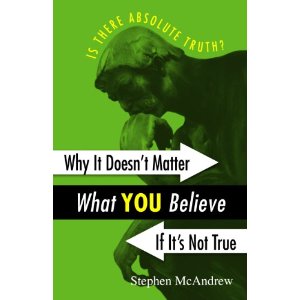 Is there absolute truth? Such is the topic of Stephen McAndrew’s new book, Why It Doesn’t Matter What You Believe If It’s Not True (hereafter DMYB).
McAndrew begins the work by noting that his book is an examination of a position and an affirmation of absolute truth. This is done because it is important to “examine even the most comfortable beliefs and leave standing only those that survive the disciplined assault of reason” (9).
He begins this testing by exploring some philosophical background, from Plato to positivism to relativism. These summaries are succinct, but provide a great background for those who haven’t read much on the topic. He turns next to a discussion of the effects of an abandonment of absolute truth. Relativism divorces one from any capacity to judge right and wrong. McAndrew notes, “These actions [such as the holocaust, racism, etc.] may brutally offend our sense of right and wrong, but the moral relativist cannot apply his or her values to others” (27).
What is interesting, however, is that McAndrew doesn’t stop at discussing relativism alone, but rather a conjunction of two beliefs: relativism and universal human rights. Many people, McAndrew notes, hold to relativism but also want to affirm universal human rights. In DMYB, he uses the discussion of the Nuremberg Tribunals–at which Nazis were tried for war crimes–as a case study for these conflicting views. He notes that “The defendants at Nuremberg argued that international law could only punish states and not individuals…. The Nuremberg court held that individuals could be punished for crimes against humanity under international law” (34).
Relativists, however, cannot consistently agree with the Nuremberg court, because “If there are no absolute truths, there can be no universal human rights” (35). These rights, if relative, are “contingent upon our cultural and historical position…” (ibid).
But relativism has a worse problem–it is contradictory. If all truth is contingent, then the statement “All truth is relative” is also relative, and therefore cannot be true for all people in all places (43ff). McAndrew next turns to the source for the “human rights urge”–the notion that all humans have certain universal rights. This source, argues McAndrew, is God (62ff). He makes a final case study when he turns to art–if there is no absolute truth, then there is no enduring beauty or truth in art (77ff).
The strengths of McAndrew’s book are readily apparent. He does a great job explaining difficult philosophical topics with terms and examples that anyone can understand. Not only that, but his discussion of Wittgenstein and the book 1984 give concrete, workable topics for those interested in the topic to use as talking points. My only criticism is that I believe I found a minor error. On page 85 McAndrew refers to the law of the excluded middle as the law that “propostion A and its direct contradiction–proposition B–cannot both be true at the same time.” This is in fact the law of noncontradiction. The law of the excluded middle is “For any proposition, it is either the case that the proposition is true or its negation is true.” This is a minor quibble, and one can derive the law of noncontradiction from the law of the excluded middle, but I thought I should note it.
Overall, the book may not convince everyone that there is absolute truth, but it will certainly force them to think about the positions they hold and wonder whether they can consistently cling to a relative absolutism. Those who already own a few books on the topic may wonder whether it is worth adding to their collection. Simply put, yes it is, if only to have at hand some great specific examples and talking points to discuss with relativists. It’s also a quick read that can be handed out to friends to open up the path for future discussion. I highly recommend DMYB.
Source
Stephen McAndrew, Why It Doesn’t Matter What You Believe If It’s Not True (Sisters, OR: Deep River, 2012).
Disclaimer: I was provided a review copy of this book by the author. My thanks to Stephen for the opportunity to review his book.
SDG.
——
The preceding post is the property of J.W. Wartick (apart from citations, which are the property of their respective owners) and should not be reproduced in part or in whole without the expressed consent of the author. All content on this site is the property of J.W. Wartick and is made available for individual and personal usage. If you cite from these documents, whether for personal or professional purposes, please give appropriate citation with both the name of the author (J.W. Wartick) and a link to the original URL. If you’d like to repost a post, you may do so, provided you show less than half of the original post on your own site and link to the original post for the rest. You must also appropriately cite the post as noted above. This blog is protected by Creative Commons licensing. By viewing any part of this site, you are agreeing to this usage policy.
Guest Post: “Is There Life on Other Planets?” by Greg Reeves
 If you’ve been reading the science news lately, you’ll find there has been a lot of buzz about “extrasolar planets”, or “exoplanets” (i.e., planets that orbit other stars). For an example, see here. The reason why is in the last several years, the number of exoplanets that we’ve discovered has increased dramatically, mostly due to the Kepler mission. But regardless of the reason why, one interesting question this brings up is, “Are there other planets that host life?”
This is an incredibly profound question for both the religious and non-religious alike. For the Christian, the knee-jerk reaction might be “no, of course not, God specially created the life on earth and did not do so elsewhere.” (By the way, I do not necessarily espouse this view.) For the secularist, the presence of life on other planets only adds weight to the idea that life arose here on earth by strictly naturalistic processes. So what does science have to say about this subject? Given the sensationalistic popular news articles, one might think the universe is teeming with alien life. However, the data actually say otherwise.
First, answering the origin of life question, from a scientific standpoint, is incredibly hard. In fact, after investigating the state of affairs on this problem in order to write a book, it has driven agnostic physicist Paul Davies to proclaim1:
When I set out to write this book, I was convinced that science was close to wrapping up the mystery of life’s origin…Having spend a year or two researching the field, I am now of the opinion that there remains a huge gulf in our understanding…This gulf’s not merely ignorance about certain technical details, it is a major conceptual lacuna.
He goes on to say:
Many investigators feel uneasy about stating in public that the origin of life is a mystery, even though behind closed doors they freely admit that they are baffled. There are two reasons for their unease. First they feel it opens the door to religious fundamentalists…Second, they worry that a frank admission of ignorance will undermine funding…
Second, even though it is a conceptually difficult phenomenon to study, scientists are incredibly confident that it will be resolved one day. The main reason why is that the alternative to having a naturalistic origin of life would be a supernaturalistic origin of life, something that most secular scientists not only do not believe in but also that they rule out completely according to their philosophical worldview.
Third, we now know that life on our planet originated in a geological instant. As soon as this planet became even remotely suitable for life, roughly 3.9-3.8 billion years ago, life began (our earliest evidence for life is between 3.86 and 3.80 billion years ago). To the secular scientist, this implies that even though we have no idea how, the origin of life must be a very simple, fast process.
Fourth, because the origin of life is simple and fast, it probably is not a finely-tuned process, according to the reasoning of secularism. In other words, all you need are some minimal requirements (liquid water, a rocky planet, some carbon-containing compounds, and a short window of time) and life will surely appear. This principle led astronomer Steve Vogt, upon discovery of a rocky exoplanet in the “Goldilocks zone” (the distance from their star that would allow a planet to potentially harbor liquid water), to state, “The chances for life on this planet are 100 percent.” (As an interesting sidenote, the particular planet he was referring to may not even be a planet. Of course, we are still discovering exo-planets, and I have been confident for some time that we would find a near-earth-sized rocky planet in the Goldilocks zone. And lo and behold, we have. For examples, see here and here.)
 So, given this background, is it likely that such “Goldilocks planets”, which are likely to be all over the place in the universe, harbor life? Well, there are two sides to this story. As I laid out above, the popular secular point of view (and the point of view portrayed by the media) is that life is inevitable whenever loose conditions are met (background point four). So of course, whenever you have a planet in the Goldilocks zone, life is inevitable. This view springs solely from the assumption of naturalism (background point 2) and the fact that life arose on earth quickly (background point 3). You can easily see this point of view when reading the popular news articles, which are overflowing with unbridled optimism.
The other view is that life is rare in the universe, because all of the prowess of the origin-of-life scientific community has returned a comparatively small amount of promising data (background point 1). In fact, not only has little actual progress been made towards discovering naturalistic pathways towards origin of life, but instead the more we know the more we discover how far away we are. Problems such as the lack of a prebiotic soup, the irreducible complexity of life, the homochirality problem (all bio-molecules must be either 100% right-handed or 100% left-handed), the difficulty in producing a cell membrane, and the finely-tuned conditions needed to carry out the chemical reactions that produce biological precursors all reveal a much less optimistic story from the point of view of hard science.
The problems for the hypothesis of the naturalistic origin of life don’t stop there, however. The more we study our planet, the more we realize that an exoplanet needs a lot more going its way than just to be in the Goldilocks zone. There are a whole host of astronomical and geological parameters that must be exquisitely finely-tuned for life to (1) exist and (2) persist on a planet. The timing of the formation of the exosolar system, the location of the exosolar system within the galaxy, the type of galaxy the exosolar system is in, the elemental composition of the star and planet, and the existence of stable, long-lasting plate tectonics are just a few of the finely-tuned parameters that must be met for life to exist and thrive.
None of this is to say that we should not be investigating how life could have originated, or whether exoplanets may harbor other life forms. Indeed, if God did create the universe and life, I am convinced that these scientific disciplines will serve only to glorify Him further.
But these observations do beg the question: which is it? Is life abundant in the universe, a premise based on one data point and questionable assumptions, or is life rare, a premise based upon the empirical findings of the fields of biochemistry, organic chemistry, astronomy, and geology? It seems to me that hope springs eternal for the secular exoplanet researcher, but the hard scientific data tells another story.
1. Davies, Paul. “The Fifth Miracle: The Search for the Origin and Meaning of Life.” Simon & Schuster; 1 edition (March 16, 2000)
Dr Greg Reeves holds a PhD in Chemical Engineering from Princeton University, and is currently an assistant professor of chemical and biomolecular engineering at North Carolina State University. He is the co-director of the NC State chapter of Ratio Christi. His blog can be found at twobooksapproach.blogspot.com.

 J.W. Wartick - Reconstructing Faith
.jpg)

