egalitarianism
Really Recommended Posts 12/30/12
 Another round of Really Recommended Posts here. Featured are undesigned coincidences, literary and culutral apologetics, egalitarianism/complementarianism, young earth creationism, and the “Gospel of Jesus’ wife.” I hope you’ll check them out and let me know what you thought!
Tim McGrew replies to Ed Babinski’s Critique of his Discussion of Undesigned Coincidences– I recently wrote on one of the [mostly] forgotten arguments for the truth of Christianity- Undesigned Coincidences. Tim McGrew is the best current proponent of this argument, and here he offers a response to some of the standard objections to the argument, along with a general criticism of trying to rebut the argument based on Markan priority. Check out my post, and check out this post to see the excellent defense of the argument.
“Full Dark, No Stars”: Stephen King’s Worlds of Night– An excellent blog that often looks into cultural apologetics, “Empires and Mangers,” Anthony Weber’s Blog takes a look at one of Stephen King’s work from a Christian perspective. It’s a very intriguing read. Anthony Weber is the author of “Learning to Jump Again,” which I reviewed.
It’s About the Bible, not Fake ideas of Progress– NT Wright is one of the most lucid Christian thinkers with whom I have ever interacted. Here, he takes a look at some strategies of those who are both for and against women in the ministry and evaluates the arguments. He offers a way forward in the discussion.
How prestigious evangelical scholars helped debunk the Jesus wife myth– Did Jesus have a wife? Some recent controversy occurred over the alleged finding of a fragment purporting to tell the truth on this exact detail. However, it has come to light that the fragment is almost certainly a fraud. Wintery Knight’s post looks at how evangelical scholars helped to expose this fraud. I have linked to a number of posts about this “Gospel” myself. For those wondering: even if it were not a fraud (which it is), it is a late fragment that doesn’t tell us much other than what some heretics believed at the time.
The Call to Adventure– Why is it that we are so intrigued by stories of adventure? Garret Johnson at Hieropraxis–one of my favorite websites–offers a look into this theme.
Nathaniel Jeanson of the Institute for Creation Research in Montana– I found this post extremely interesting. It is often alleged by young earth creationists that old earth proponents and “secularists” follow a strict uniformitarianism. Unfortunately, this definition of uniformitarianism is outdated by a couple hundred years.The GeoChristian offers a response to this YEC argument. Yes, this is part 3 of a 5 part series, no you don’t have to read them all to make sense of it. But do check out the whole series, because it is interesting!
Nonrandom Mutations Scramble the Case for Common Descent: Reasons to Believe, my favored resource for science-faith discussions, is chock-full of excellent articles like this one, which argues that mutations are not necessarily always random, but rather take place in such a way that reflects design.
My Trip to the Evangelical Philosophical/Theological Society Conference 2012
 Last weekend I had the supreme pleasure of attending the 64th annual meeting of the Evangelical Theological Society and the Evangelical Philosophical Society (there’s a mouthful!). I took over 80 pages of notes (43 front/back) and enjoyed the entire time immensely. I’ll be posting in the upcoming weeks and months on a number of these topics, so for now I’m just going to very briefly outline the talks I went to and give one or two comments each. I encourage readers to browse through these and let me know which ones they’d be interested on me writing on in a bit more depth. Feel free to ask questions as well.
Scripture, Geology, and the Age of the Earth
Readers know that I am very interested in the controversy among Christians over the age of the earth. I’ve written quite a bit on the topic. This session featured Gregg Davidson (University of Mississippi), a geologist, facing off against Andrew Snelling of Answers in Genesis. I have to admit that I was surprised by how much this debate focused on the science. Specifically, Davidson presented two very thorough evidences for an old earth, while Snelling rebutted these and argued that a catastrophic interpretation was perfectly consistent with the record. It was a fascinating back-and-forth. You can read an extended outline/review of this talk in my post: Gregg Davidson vs. Andrew Snelling on the Age of the Earth.
Bioethics – Genetic Enhancement
Gary Alkin(? his name wasn’t in my program) presented a paper on genetic enhancement and whether it is morally permissible. Essentially, his argument was that while as Christians we are obligated to heal diseases and help others, we are not obligated to try to become superhuman, and indeed are perhaps prohibited from doing so. He countered numerous arguments for the notion that we should continue to try to ‘enhance’ humanity. It was an interesting paper. I have since written an extended examination of his paper here: Genetics and Bioethics: Enhancement or Therapy?
Whose Moral, Which Axiom- The Transforming Virtue of Sub-Creation in J.R.R. Tolkien’s Mythology
Thomas Provenzola presented a mind-stretching paper on how Tolkien’s use of myth helps us to think about care for creation. It was a fascinating look into philosophy and literature.
The Metaphor of Divine Repentence
Rob Lister of Talbot School of Theology presented a paper in which he argued that we must understand language about God both literally and analogically. He argued that open theists often err too far towards creating an anthropocentric concept of God, rather than understanding passages about God’s repentance in light of clear statements about His being. I was so fascinated by this talk that I went and got his book on the topic afterwards. I look forward to reading it.
Other Voices in Interpretation Panel Discussion: An Evangelical Statement on the Trinity, Part 2: Application to the Ongoing Discussion on the Trinity
Kevin Giles (Victoria, Australia), Steve Tracy (University of New Brunswick), Mimi Haddad (Christians for Biblical Equality), and David Malick (CBE) participated in a panel discussion on the evangelical statement on the Trinity. I was surprised to see how contentious this talk was, but unfortunately there are people who are undermining the Trinity by eternally subordinating GOD the Son. This discussion went beyond an egalitarian/complementarian debate and essentially touched on how we must not distort the Trinity for our own purposes.
The Stars Will Fall From Heaven: Cosmic Catastrophe in the Synoptic Gospels
N.T. Wright, who needs no introduction, presented a paper arguing that the cosmic language used for the destruction of the temple is not so much due to an end of the space-time universe as it is because the Temple was the center of the universe for Judaism.
The Orthodox Doctrine of the Trinity
Kevin Giles presented a paper arguing that orthodoxy on the Trinity does not subordinate the persons. Rather, the distinctions made between persons according to the orthodox faith are made according to generation (the Son is begotten by the Father, and the Spirit proceeds from the Father and Son). He stressed the importance of drawing implications of the Trinity from the Godhead and not from humanity.
An Examination of Jesus’ View of Women through Three Intercalations in the Gospel of Mark
David cogently argued that we can look at the narratives in the Gospels to see what Jesus’ view of women was. Because we can see with clarity how Jesus elevated women’s roles to that of equal to men, he argued that we should interpret hard passages in light of the clearer passages. This paper was very clearly argued and extremely compelling. I hope more work is done in this area, because the argument was very tight, and there is much development to come from it.
Complementarians, Egalitarians, and Unicorns: What are they, and do they exist?
Walker argued that the categories we are using to identify people in the gender debate reflect a genus/species fallacy which essentially drains them of all meaning. It may be helpful to develop new terms to make the distinctions more clear.
Biblical Theology and Creation Care
I must confess that I only went to this one because there weren’t any others going on. I’m very pleased I did, because this plenary talk proved to be one of the most interesting discussions that I attended. Moo argued decisively that we must not cause Christianity to lose credence due to clinging to faulty science. Furthermore, he argued that it is our duty to take care of creation. He traced an interpretive strategy through Scripture and argued very convincingly for the use of the hermeneutic he was pressing for looking at Christianity and the environment. I wrote an extended post on this paper and the following panel discussion: Caring for Creation: A dialogue among evangelicals.
Panel Discussion on Creation Care
Following Moo’s plenary talk, there was a panel discussion with Moo, E. Calvin Beisner, Russell Moore, and Richard Bauckham. This panel discussion was highly contentious and the audience clapped for their favored party numerous times. Beisner seemed to be the odd man out, as he did not deny climate change, but rather argued that we don’t yet know conclusively that it is anthropogenic (caused by humans). The other panelists argued that the science is convincing and that we do cause people to look with wariness upon Christianity. It was a very invigorating debate.
Body-Soul Interaction and the Theism-Naturalism Divide
Ryan West presented a paper arguing that many of the arguments raised against substance dualism are essentially faulty once one grants theism. He further argued that naturalistic dualists (of which there are few!) would be better off embracing theism, for their view is in extreme tension given the arguments he presented. It was a brief paper that was very well argued. The Q+A was great.
How Much Evidence to Justify Religious Conversion? Some Thoughts on Burden and Standard of Proof vis-a-vis Christian Commitment
The great apologist John Warwick Montgomery presented his paper on religious conversion. Essentially, the argument was that given certain benefits and a low price of commitment, people should commit to Christianity assuming the standard of proof has been carried. It was a fascinating paper, and Montgomery’s presentation style was both engaging and endearing. It was a huge pleasure to get a chance to talk to him briefly after the talk.
Taking a Stand Against Rand: A Biblical Evaluation of Ayn Rand’s Capitalism
I’m not very interested in Rand, but this paper by David Kotter was interesting enough to get me interested in the topic. He noted both good and bad portions of Ayn Rand’s philosophy and argued that ultimately, her perfect man has come to fulfillment in Christ. He presented a critique of a number of her views, while arguing that some things are worth looking at for Christians and the government. A truly engaging paper.
Miscellaneous Extras
Throughout the conference I had numerous pleasures of running into fellow bloggers, friends, and huge names in philosophy and theology. I enjoyed lunch with Matt over at Well Spent Journey and stayed with Kurt over at Real Clear Apologetics. I was so delighted to meet Holly Ordway from Hieropraxis and engage with her in some great discussion. Other examples include running into Hugh Ross from Reasons to Believe, socializing with William Lane Craig, however briefly, and bumping into numerous others (Jerry Walls, David Baggett, Nabeel Qureshi, and more). I also enjoyed interacting more with David Malick of CBE. What a blast!
SDG.
——
The preceding post is the property of J.W. Wartick (apart from citations, which are the property of their respective owners, and works of art as credited) and should not be reproduced in part or in whole without the expressed consent of the author. All content on this site is the property of J.W. Wartick and is made available for individual and personal usage. If you cite from these documents, whether for personal or professional purposes, please give appropriate citation with both the name of the author (J.W. Wartick) and a link to the original URL. If you’d like to repost a post, you may do so, provided you show less than half of the original post on your own site and link to the original post for the rest. You must also appropriately cite the post as noted above. This blog is protected by Creative Commons licensing. By viewing any part of this site, you are agreeing to this usage policy.
Book Review: “Good News for Women” by Rebecca Groothuis
 The debate over women’s roles in the home and in the church rages on. A large part of the debate has focused upon the Bible verses that either side raises in defense of their view. Little of the debate has focused on the philosophical implications of either position. Rebecca Groothuis’ Good News for Women
Groothuis first turns to a Biblical case for the equality of men and women. She bases this notion on several Biblical texts. She refers to God’s creation of both male and female in the image/likeness of God (21ff). Her argument also goes into Galatians 3:26-28 and notes how it again draws out the equality between male and female. Regarding the discussions of women’s silence in the churches, Groothuis parallels these passages to those about slaves submitting to their masters:
[T]he strategy of the New Testament church was to tolerate the social subordination of slaves and women so as not to risk alienating non-Christians from the gospel, and yet to modulate and moderate these customs, and ultimately to point beyond them to God’s original intention for human relations. Today, however, when non-Christians are not likely to be offended by an equalitarian gospel, but are likely to find a hierarchical gospel offensive, we have no reason to perpetuate the cultural practices that were intially intended for Christians living in patriarchal societies (25).
Groothuis concludes that throughout the Bible, there is a pattern in which male and female are equal in being. They are, in other words, ontologically equal. Neither is more valuable than the other.
It should be noted that most complementarians today are willing to grant this case. They agree that women and men are indeed created equal and should have equal rights. Groothuis then turns to a series of philosophical arguments which seek to demonstrate that the complementarian position cannot consistently hold that women are equal to men while holding that they are excluded from the ministry. Her argument, therefore, goes deeper than an exegetical challenge. Instead, her argument undermines the theological core groundings of complementarianism.
The very core of Groothuis’ argument is that complementarianism is grounded upon an ontological difference between male and female. The reason she holds that complementarinism must hold this position is “[b]ecause a woman’s traditionally inferior status follows necessarily from the single fact of her essential, female nature, her status is itself a function of her ‘being’ [ontology]; it is determined by what she is, not by what she can do” (53). Complementarians hold that women cannot hold certain offices of the church due only to the fact of her femininity. It is not based upon a functional subordination in which the female chooses to take up a role that is subordinate (62ff); instead, it must be grounded upon the female’s nature as a female. There is nothing about the female which limits her from being a pastor, on most contemporary complementarian positions (that is, those which no longer hold that women are excluded from the ministry simply because she is not as smart or gifted as men in general). Instead, it is exclusively her feminine nature which determines her role as subordinate. Therefore, it is part of her essential nature. I have argued this point myself elsewhere: “Women in the Ministry: The philosophy of equality and why complementarianism fails.”
Grothuis continues with extensive argument to rebut the notion of servant leadership (78ff). She also deals with various analogies complementarians use to attempt to ground equality and hierarchy, such as the Trinity (55ff–it should be noted that grounding subordination in the Trinity undermines the doctrine of the Godhead). It should become immediately apparent as to how this leads to a problem for complementarians. Biblically, they are forced to concede that women and men are, in fact, equal. However, their position undermines this Biblical position of the equality of men and women. Therefore, it seems their position fails.
Groothuis then turns to a number of strategies that complementarians have used in order to try to tie the subordination of women in to patterns of the Godhead. Unfortunately, many of these strategies end up making God into a gendered creature rather than a transcendent Creator. Some complementarians, such as C.S. Lewis, actually go so far as to make God male (93). Groothuis points out that this gendering of God cannot be affirmed based upon the Bible. One difficulty is that both male and female language is used of God (93-94). Yet she insists that the debate must not become a simple adding up of verses on either side to see how God illustrates either gender. That would turn God into a “God who suffers from some gender identity confusion” (93). Instead:
The view that God is both masculine and feminine confuses and distorts the image of God in humanity. It requires that the divine image be divided between women and men, such that women image God’s feminine aspects and men image God’s masculine aspects. This sexualizing of spiritual attributes renders men and women spiritual ‘opposites,’ creating a need to compartmentalize aspects of spiritual life and ministry into separate masculine and feminine quarters. (98)
Groothuis also spends some time dealing with some of the odd–and frankly, pagan–ideas used by some complementarians. For example, some argue that God must act as a male in the creation event: one who gives so much, while the created world merely receives. To be blunt, they describe God’s creative act as a sexual act, with no Biblical support. Groothuis rightly points out that this idea is little more than paganism dressed up in theism, but goes on to note that “It seems a good deal of imagination and determination is required in order to characterize the strenuous effort required of a woman’s body in nourishing, growing, and delivering a child as ‘overwhelmingly passive,’ while depicting the male role of standing around watching it happen as ‘active’!” (95). Another abuse of gender in the Godhead involves some complementarians arguing that because Jesus was a man, only men can be priests (109ff). Groothuis points out that “If we are to regard maleness as essential to who Christ is as Christ, not only must we question whether Jesus Christ can represent women as fully as he can men… we must also view women as essentially inferior to men. Women lack the Christlike attribute of maleness that renders men best qualified to represent Christ…” (113). Interestingly, then, complementarians who utilize this argument essentially undermine the doctrine of the atonement: for Christ’s maleness is emphasized to the point that Jesus is not an adequate representation of humanity. He is essentially male.
The second half of Good News for Women focuses upon an evaluation of the texts used to support complementarianism. These texts are examined in light of the theological points already established. Namely, women and men are created equally as imagers/likenesses of God; and that any attempt to ground hierarchy ultimate fails because it undermines this Biblical concept of equality. A full presentation of Groothuis’ analysis of these texts would probably triple the length of this review, and I don’t see any way to sum up these arguments adequately in a few sentences, so I unfortunately must leave it to those interested to read the book to see these analyses.
Finally, it would be remiss to go without mentioning the outstanding contribution Groothuis gives to the discussion of egalitarian marriage. Groothuis discusses marriage in detail for over 40 pages of the book. What is astonishing is how lucidly she lays out the principles of egalitarian marriage. She illustrates the nature of marriage and how it is a give-and-take with both persons involved as opposed to one ruling over the other. She also discusses in detail how such an egalitarian system can work without having anyone to have a vote to “trump” the other’s vote. Frankly, the book is worth reading just for her discussion on marriage.
Groothuis’ most important contribution here is in the first part of her book, which establishes a strong theological and philosophical case for the equality of men and women in teaching roles in the Church and equal roles in marriage. However, there are numerous important insights throughout the text, both into specific verses and into overarching themes in the debate from both the complementarian and egalitarian positions. Groothuis’ discussion of egalitarian marriage provides a way forward for discussion on the roles of men and women in marriage and also helps to give insight into the Biblical view of marriage. Overall Good News for Women
Links
See my other writings on egalitarianism on my theology page (scroll to the bottom).
I argue that certain complementarian arguments undermine the Trinity.
I review a book which focuses entirely upon exegetical issues related to egalitarianism: Man and Woman: One in Christ.
Source
Rebecca Groothuis, Good News for Women
SDG.
——
The preceding post is the property of J.W. Wartick (apart from citations, which are the property of their respective owners, and works of art as credited) and should not be reproduced in part or in whole without the expressed consent of the author. All content on this site is the property of J.W. Wartick and is made available for individual and personal usage. If you cite from these documents, whether for personal or professional purposes, please give appropriate citation with both the name of the author (J.W. Wartick) and a link to the original URL. If you’d like to repost a post, you may do so, provided you show less than half of the original post on your own site and link to the original post for the rest. You must also appropriately cite the post as noted above. This blog is protected by Creative Commons licensing. By viewing any part of this site, you are agreeing to this usage policy.
Really Recommended Posts 7/28/2012
 I’m excited by the great diversity of topics Christian bloggers have taken up all over the web. It’s hard to keep up. Here is my attempt to try. Check out these excellent selections.
Subordinating the Trinity for Gender Purposes– A brief post discussing the unfortunate fact that some theologians have been distorting the Trinity simply to push their own agenda regarding gender. I have discussed this at length in my own post, “Women, Complementarianism, and the Trinity.”
H.P. Lovecraft and the horror of Naturalistic Materialism– A very thought-provoking post about Lovecraft’s view of a Godless universe as a thing of horror. I highly recommend this read.
In Praise of Personal Retreats– there is something to be said for taking a break and delving into the Word. Check out this post, and think about a retreat of your own.
Spider-Man Spins a Design Argument– An interesting post about intelligent design and Spider-Man.
Which is Hate Speech? – Is it hate speech if you disagree with someone? Dan Savage, ironically an anti-bullying advocate, recently used a number of curse words and slurs to describe a group of Christian students. Meanwhile, Douglas Wilson is called out for hate speech due to talking about a controversial topic. Check out this insightful discussion.
Really Recommended Posts: 6/23/12
Charles Darwin, Meet Friedrich Nietzsche– Really challenging post on Nietzsche’s thought as a reaction to Darwin’s theory. In particular, Max Andrews focuses upon the secular teleology of Nietzche’s system of thought, “Nietzsche’s attempt to construct a secularized teleology is subjective and produces no objective purpose or meaning. He understands this to be true, particularly more so if God is dead.” Very interesting.
“This is the End of America”– Eric Metaxas weighs in on the HHS mandate. I think this is spot on: ‘The requirement that religious institutions violate their consciences proves “the government, with all its power, can bully people,” he said. “This is the end of America.”‘
Even if the universe is eternal, it still needs a cause– Atheists miss an important point in regards to the Kalam Cosmological Argumentwhich Jason does an excellent job drawing out. Namely, a denial of the first premise of the Kalam does not show that the universe is acausal.
From Jesus to Us: A Look at P.O.W.E.R.– Eric presents a unique way to remember the evidences about Jesus.
‘Prometheus’ raises big questions– A look at the recent movie, Prometheus and the big questions it raises about life’s origins and the universe.
MP3 Podcasts on Presuppositional Apologetics– I’ve been prepping a post on presuppositional apologetics for a while now, and was delighted to find these discussions of the topic.
Ask an Egalitarian (Response)– An insightful post to how egalitarians (those who are for ordaining women) respond to various complementarian (people against) questions. For my own discussion of this issue, see my posts on egalitarianism.
Women, Complementarianism, and the Trinity- How getting subordination wrong has undermined the Trinity

[Please see note at end of this post for some qualifications added 2/1/15.]
Even though [God the Son] is in all ways equal to the Father and in no way inferior to the Father, he is nevertheless utterly subordinate to the Father… Christ’s relation as Son to his Father is therefore characterized by his subordination to the headship of the Father. (John Kleinig, 222-223 cited below)
In opposition to the above:
The subordination of Jesus Christ is this: it is his freely chosen submission ‘for us and for our salvation.’ The person of the Son is truly subordinate only for ‘economic’ reasons, and only insofar as these reasons entail being subordinate (and even thus far only contingently)–even while his full divinity, equality, and communion with the Father and Holy Spirit continues unabated, world without end. (Thomas McCall and Keith Yandell, 358, cited below)
The doctrine of the Trinity is a subject of enormous theological debate. One of the major debates of our time is social trinitarianism as opposed to substance views of the Trinity or other classical positions. However, another important area to explore is the nature of Christ’s submission to the Father. Paul writes in 1 Corinthians 15:28 “When he [God the Father] has done this [put all things under Christ’s feet], then the Son himself will be made subject to him who put everything under him, so that God may be all in all.” Some have argued that this means that Jesus Christ is eternally into the future, and even from eternity past, subordinate to God the Father (see Wayne Grudem and Bruce Ware for two examples of scholars who hold to this view–in fairness to John Kleinig, cited above, I do not include him as one of those who assert these positions because his view of the Trinity was not fully developed in the material from him to which I have access). We shall refer to this position as “necessary role subordination,” following McCall and Yandell.
What does such a position entail about the Trinity? First, if the functional subordination of the Son (and, very often, the Spirit is also said to be subordinate) is indeed necessary, then “it is necessarily true that the Father is authoritative over the Son, and the Son subordinate to the Father” (McCall and Yandell, 354). Why? Because the modal implications of this necessary subordination entails that the Father has, as an essential property, “being authoritative over the Son” (Ibid). Now, this in turn entails that the Father has an essential property the Son (and perhaps the Spirit) do not have. Then, by simple evaluation of the law of identity, the Father has different being than the Son and Spirit. Indeed, the Son would then be “heteroousios rather than homoousios.”
The error can be understood by viewing the Trinity within the substance based metaphysics from which the doctrine has been classically analyzed. As William Alston notes in his study of substance metaphysics and the Trinity, the formulation of the Trinity has been placed squarely within a substance metaphysics, and this provides a grounds for viewing the Trinity as three persons in one being (Alston, 183ff, cited below). Tying this into the laws of identity, one finds that in order for the Trinity of persons to be one being, none of them can lack essential properties of the others. But, as noted, once one asserts that the Son (and/or the Spirit) are necessarily subordinate to the Father, one has separated their essential properties and therefore confounded the Triune nature of God.
The Biblical arguments for such a position are fairly weak. For example, Ware and Grudem (and Kleinig, who does make this argument) argue that 1 Cor. 15:25ff entails the eternal subordination of the Son. But these verses explicitly state that “God may be in all in all.” It does not state “God the Father alone may be all in all” (I owe this point to McCall and Yandell, 342-344).
It may be that these theologians are not drawing this necessary role subordination from Scripture so much as allowing their other theological dispositions to color their trinitarianism. Grudem, Ware, and Kleinig are all explicit complementarians–that is, they restrict women from the ministry. Now please understand I absolutely do not think that complementarianism entails this position on the Trinity. However, I am asserting that complementarianism can color one’s perception of the doctrine of God.
Why think that the correlation between those who hold to necessary role subordination and complementarianism is interesting? First, because necessary role subordination, if true, would give some philosophical bolster to complementarianism; second, because at least one complementarian makes the connection himself.
Regarding the first point, complementarianism has been struggling with a major philosophical challenge presented by Rebecca Groothuis (among others). Namely, the problem of how to ground the subordination of women. Groothuis argues, essentially, as follows: If the permanent, comprehensive, and ontologically grounded subordination of women is justified, then women are inferior persons; Women are not inferior persons; Therefore, women’s subordination is not justified (Groothuis, cited below, 317). Now I’ve defended this argument elsewhere, and I think that some complementarians actually agree with the general argument. Instead of rejecting complementarianism, however, they choose to model their doctrine of the Trinity in order to try to preserve their position. How? By grounding subordination analogously in the submission of God the Son to God the Father. Here, Kleinig is an explicit example of this position. Following the quote at the beginning of this post, he writes, “Those who serve in [the pastoral ministry] pass on what they have received from God the Father through Christ… The exercise of the public ministry depends on this pattern of subordination within the church…” (Kleinig, 223). Now, the subordination of Christ, it is claimed, “has nothing to do with the dominance and power of the Father. It involves and expresses the harmony of the Son with the Father and his love for the Father” (Ibid). Thus, according to Kleinig, the model for women and men in the church is grounded in the Trinity, and because, according to him, the Son is subordinate to the Father yet remains equal, so too should women be subordinate to men and yet remain equal.
Does this complementarian view entail necessary role subordination? It seems so. For what is woman’s role subordinate upon? It seems it must be because of her being (for an argument to that end, see my post linked above and here). Yet her being is, of course, her essential nature. It is necessarily the case, therefore, that she is subordinate.
Finally, it is interesting to note that even were the egalitarian to grant to Ware, Grudem, and Kleinig their points about the Son’s subordination to the Father, it would not follow that the Trinity is an adequate model for women in the church. Why not? Kleinig essentially says it himself, “Now this call to subordination in the divinely instituted order of the church is based on the willing subordination of the Son to the Father” (Kleinig 223, emphasis mine). Well that’s exactly the point egalitarians make! Egalitarians argue that the roles of subordination in the church are taken willingly by those who serve at various levels. The laity has not been called to the ministry, and therefore willingly cede the authority of the office of the ministry to their ministers. It is a bit stunning to see Kleinig make this remark, for it also undermines his own case. Women, unlike Christ, are not [all] willingly subordinate. Rather, some very much would like to be ordained. Thus, if Christ’s subordination is grounded in his “willing subordination” then it seems that Kleinig’s case has completely evaporated. So too, of course, has the case of other complementarians who make this argument.
Do I think that those who make these arguments are heterodox? I wanted to explicate that I think that Ware, Kleinig, and Grudem are more likely victims of misuse of philosophical theology and their own presuppositions than they are actually trying to claim that the Trinity is not of one being. Certainly, I think, were they to examine their position on the subject, they would distance themselves from such a claim. Instead, as I’ve pressed, I think they’ve allowed their presuppositions–that women cannot be pastors and that they must ground this in the Trinity–to cause philosophical confusion on the topic. Kleinig, for example, almost so much as admits this point when he favorably cites Willliam Oddie, making the claim “that the ordination of women would involve a radical changing in the teaching of the church about the fatherhood of God” (224). It seems that it is not so much egalitarians who are guilty of misconstruing the Trinity, but rather over-eager complementarians who are shaping the Trinity to match their own preconceived notions of subordination and roles. Perhaps it should serve as a warning to take more care when doing philosophical theology and systematics. In any case, I sincerely hope these Christian brothers do not reject the doctrine of the Trinity as one being.
The theological implications of this discussion can now be brought to light. Some complementarians, in their eagerness to support their philosophically vacuous position, have read eternal subordination into the doctrine of the Trinity. I agree that complementarians are correct to worry about the implications of women’s ordination for the doctrine of the Trinity, but I disagree with their conclusions. In their zeal to exclude women from the ministry, they have undermined the doctrine of God. By confusing the willing, economic, salvific role of Christ submitting to the Father in a contingent manner with the eternal, ontological “subordination” of women, complementarians have mounted an attack on the Godhead. Indeed, as has been shown above, their position entails the that the Trinity is not “of one being.” Thus, it is a position that must be rejected. Again, I do not think that all or even most complementarians hold this position in relation to the Trinity, but those who do must consider the theological implications of their position: it entails that God the Son lacks at least one essential property of God the Father and therefore is of a different being; it fails to adequately account for the Scripture related to the Trinity; and finally, it doesn’t even make their case because the subordination is grounded in Christ’s willingness to do so.
In light of these major problems, it seems complementarianism, when tied to necessary role subordination, must be rejected. Should it be rejected outright, even with such ties severed? I certainly think so. Complementarianism is philosophically tenuous and can’t account for all the Scriptural evidence (see Philip Payne’s book, reviewed here). It is time to stop allowing preconceptions to shape all doctrine. Rather than reforming God in the image of complementarianism, we should allow God to shape our image of humanity. God is coequal, with no essential properties split among His being. Similarly, human kind is equal, sharing the image of God. Man and woman: one in Christ.
[It has come to my attention that there is a newer edition of Kleinig’s essay which was published in the 2009 version of the book from which I quoted. A message sent to me on the topic informed me that Kleinig’s essay is substantially different–to the extent that the first four quotes I present from him are not present in the newer edition, which is also a page shorter. I am pleased to note that perhaps this means Kleinig has dropped his original view, which seemed to entail necessary role subordination. Regardless, my points would still stand for any who do hold such a position.]
[NOTE: I complementarians do not necessarily have to hold to eternal subordination; nor do those who argue for eternal subordination have to be complementarian. One can be an egalitarian with gender roles but argue for the Son’s subordination and vice versa.]
Sources
William Alston, “Substance and the Trinity” in The Trinity ed. Stephen Davis et al. (New York, NY: 1999), 179-201.
Rebecca Groothuis, “‘Equal in Being, Unequal in Role’: Exploring the Logic of Woman’s Subordination” in Discovering Biblical Equalityed. Ronald Pierce and Rebecca Groothuis, 301-333 (Downers Grove, IL: InterVarsity Academic, 2005).
John Kleinig, “The Ordination of Women and the Doctrine of the Holy Trinity” in Women Pastors? The Ordination of Women in Biblical Lutheran Perspective (St. Louis, MO: Concordia, 2008), p. 217-225.
Thomas McCall and Keith Yandell, “On Trinitarian Subordinationism”Philosophia Christi 11-2, 2009, p. 339-358.
SDG.
——
The preceding post is the property of J.W. Wartick (apart from citations, which are the property of their respective owners) and should not be reproduced in part or in whole without the expressed consent of the author. All content on this site is the property of J.W. Wartick and is made available for individual and personal usage. If you cite from these documents, whether for personal or professional purposes, please give appropriate citation with both the name of the author (J.W. Wartick) and a link to the original URL. If you’d like to repost a post, you may do so, provided you show less than half of the original post on your own site and link to the original post for the rest. You must also appropriately cite the post as noted above. This blog is protected by Creative Commons licensing. By viewing any part of this site, you are agreeing to this usage policy.
Women in the Ministry: The philosophy of equality and why complementarianism fails
 The argument advanced in this post will make the following claim:
If women are excluded from the ministry solely due to their nature as women, then women are ontologically inferior.
The argument entails:
If complementarianism (the position that women should not be in the ministry) is true, then women are ontologically inferior to men.
Some may note that this doesn’t necessarily imply that complementarianism is false, but astute readers will note that there is one further implication, namely:
If complementarianism holds that women are ontologically equal to men, but the position entails that women are inferior to men, then complementarianism holds contradictory propositions to be true.
And this would entail that complementarianism is false.
The Argument
Argument 1:
The argument is directly from Rebecca Groothuis, “Equal in Being, Unequal in Role,” 317 (full citation below). She writes,
P1: If the permanent, comprehensive, and ontologically grounded subordination of women is justified, then women are inferior persons.
P2: Women are not inferior persons.
Conclusion: Therefore, women’s subordination is not justified.
Premise one is contentious. Complementarians often anticipate such arguments and counter by asserting that women are “equal in being, unequal in role.” Groothuis has cogently argued that this is merely a semantics game. First, she notes that “functional differences often are compatible with personal equality…” (“Equal in Being…” 315). The problem for those who wish to exclude women from the ministry is that the role of women is not simply functional. Rather, it “differs from functional subordination in its scope, duration, and criterion” (316). Women’s subordination is permanent, because women are subordinate throughout their life, and it applies to all women at all times (Ibid). The subordination is comprehensive in scope because everything a woman does must be done in submission to males (if one disputes this they need only browse complementarian literature: see John Piper, cited below, 50ff). Finally, the criterion for women being subordinate is not analogous to functional subordination (wherein the subordinate member enters the functional relationship either willingly or through need) because the subordination is based merely on the woman’s unalterable female being (Groothuis, 317).
P2 is almost universally acknowledged as true. Unless the complementarian is willing to swallow the pill and affirm that women are inferior persons, they must grant P2.
The conclusion follows from P1 and P2. Therefore, it seems that women should not be made subordinate to men. There are, of course, many objections to this argument. We shall turn to these below.
Objections
Objection 1: The argument above is all well and good, but it is a philosophical argument. We all know that it is Sola Scriptura, and your argument assumes that philosophy can trump the Bible, which it doesn’t.
There are a number of clarifications required to respond to this objection. First, those who assert Sola Scriptura are themselves making a philosophical claim: that Scripture alone is the basis for our faith. Second, if one wishes to jettison philosophy because they hold a position which is philosophically untenable, then they cannot coherently assert “My position is true.” Why? Because when one throws philosophy out the window, one throws logic out the window. Thus, the principle of non-contradiction would also be false. If that is true, then when one says “My position is true” they could be both right and wrong, and therefore their position could also be false. This is absurd, and it undermines every single truth claim. Those who reject philosophy must also reject truth.
Finally, even those who argue that philosophy and logic must have a “ministerial role” implicitly accept that their claims are governed by logic. I can think of at least two extremely plausible reasons for this to be true. First, those who want philosophy to occupy a “ministerial” place argue that because they have come to the logical conclusion that the Bible must govern reality. Here’s the problem: they also seek to reconcile contradictions in the Bible and draw out its claims–and this is a philosophical endeavor. Thus, those who argue in this fashion are, themselves, doing philosophy and logic. Second, those who argue that philosophy must be “ministerial” often do so because a position they hold is logically untenable. But if philosophy (and, by implication, logic) must function underneath Biblical truth, why reject logic to begin with? If philosophy and logic don’t apply to Biblical teaching, then there’s no reason to reject it, because things can be true and false! Yet those who argue this way realize that their claims are philosophical (without using that word), and so reject the counterarguments by trying to make the logical move of throwing philosophy out the window. It’s incoherent.
Objection 2: P1 is false because ontologically grounded subordination does not imply inferiority.
Clearly, this objection is more thought out than objection 1. Those who object in this way accept that logic governs these disputes, and instead set on rejecting a premise of the argument so that the conclusion will not follow.
I cannot answer this objection without a bit of philosophical development, so my readers will have to forgive me.
Adam Omelianchuk addresses this objection head on in his article “Ontologically Grounded Subordination” (full citation below). He writes that “the central metaphysical concern is over whether subordination is essential to the personal identity of woman” (169). He goes on to introduce the notion of “proper function” (well known in philosophy due to Alvin Plantinga’s series on “Warrant”). Proper function “means something is functioning properly if it is doing what it is supposed to do” (170). Now, on complementarianism, women are designed in such a way as to be subordinate to men, while men are designed to be the leader. Thus, the woman’s proper function is to be subordinate by nature, while the man’s function is to be leader by nature. When a woman tries to become a minister, she is violating her proper function. She is, by nature, only functioning properly when subordinate. Now, we’ve already addressed the notion of unequal roles, but here we are trying to establish that a woman is, in fact, ontologically inferior if complementarianism is true. Omelianchuk writes:
[I]t is not plausible to believe that men and women are ontologically equal, because manhood and womanhood are not ontologically equal. Obviously, manhood and womanhood are “different,” so they are not equal in the sense that they are not identical. But if we differentiate manhood and womanhood by hierarchical features essential to manhood and womanhood themselves, and if we maintain that God designed men and women to fulfill these functions of manhood and womanhood, then we have a prima facie reason to believe that women are essentially inferior to men. Hence, complementarianism fails. (174).
In other words, the very nature of manhood and womanhood is such that man is at a greater position on the hierarchy of authority than woman. They are not equal. Again, as Omelianchuk writes, “[Women] simply are not equal in being, and their ‘role’ obtains just because their being is fit for subordination” (176-177).
Finally, those who continue to object may assert that I have not yet made explicit how women are inferior to men. It seems to me to have already been made fairly explicit–men, by nature, are higher in authority than women–but some persist in this objection. Perhaps a thought experiment may help illustrate my point. Complementarians hold that women should also be subordinate in the home to their husbands. Consider Jackie and Jim. Jim gets a job offer in Alaska which pays about the same as Jackie’s current job, but is something he would enjoy (as opposed to the job he currently has, which he hates and pays much less). Jackie loves her current job, but would have to work at a job she didn’t like were they to move to Alaska. They argue about whether or not to move to Alaska. Finally, they get to the point where they are at an impasse, and neither is willing to budge. Jim, on complementarianism, is the leader of the home, and Jackie is subordinate. So, when push finally comes to shove, Jim decides they will move, and Jackie, on complementarianism, should submit with all due respect and go to Alaska without further debate. Jim has asserted his role as the leader of the home, and therefore they must move.
It seems clear to me that this story may not make explicit how subordination entails inferiority, but it does seem to show that the woman has a clearly inferior position. If an argument comes to the point where neither side will go one way or the other, the man always gets his way. Now I realize that complementarians often argue that men should be loving leaders, should not use their leadership role to trump their wife all the time, etc., but when it comes down to the nitty-gritty details, Jim in the above story was acting in his role as the leader in the home. His decision is the one which must be followed. Perhaps Jim later grants Jackie’s requests to visit friends and family “back home” and does all sorts of other things for her to make her comfortable in Alaska, but that doesn’t change the fact that her position is inferior to his–at least in the sense that whenever a decision is made about which they are split, his choice wins out.
Conclusion
[Thanks to one reader who was kind enough to point out I hadn’t properly drawn my points together, I have added this conclusion a few hours after this post originally went up.]
The argument I have written above shows that on complementarianism, women are ontologically inferior. Why should that entail that complementarianism is false, as noted in the introduction? Well, there are few (if any) who actually assert that women are inferior. In fact, the Biblical teaching on this topic is extremely clear. God, throughout His Word, affirms the equality of man and woman. Galatians 3:28 is one oft-cited example, but one can also look at Genesis 1:26-28, wherein male and female are created equally in God’s image. Groothuis addresses the notion of Biblical equality more in her chapter, so I won’t expand much more.
We therefore have issued a major challenge to complementarians: Women, according to Scripture (and essentially universal affirmation of all involved), are equal to men in being. Yet complementarianism entails that women are inequal in being–they are, in fact, inferior. If that’s true, then complementarianism affirms contradictory truths: women are equal and inequal, equal and inferior. Thus, complementarianism is false.
Sources
Adam Omelianchuk, “Ontologically Grounded Subordination,” Philosophia Christi 13-1, 2011, p. 169-180.
John Piper, “A Vision of Biblical Comlementarity: Manhood and Womanhood Defined According to the Bible” in Recovering Biblical Manhood and Womanhood ed. John Piper and Wayne Grudem, 31-59 (Wheaton, IL: Crossway, 2006).
Rebecca Groothuis, “‘Equal in Being, Unequal in Role’: Exploring the Logic of Woman’s Subordination” in Discovering Biblical Equality ed. Ronald Pierce and Rebecca Groothuis, 301-333 (Downers Grove, IL: InterVarsity Academic, 2005).
SDG.
——
The preceding post is the property of J.W. Wartick (apart from citations, which are the property of their respective owners) and should not be reproduced in part or in whole without the expressed consent of the author. All content on this site is the property of J.W. Wartick and is made available for individual and personal usage. If you cite from these documents, whether for personal or professional purposes, please give appropriate citation with both the name of the author (J.W. Wartick) and a link to the original URL. If you’d like to repost a post, you may do so, provided you show less than half of the original post on your own site and link to the original post for the rest. You must also appropriately cite the post as noted above. This blog is protected by Creative Commons licensing. By viewing any part of this site, you are agreeing to this usage policy.
Book Review: “Man and Woman: One in Christ” by Philip Payne
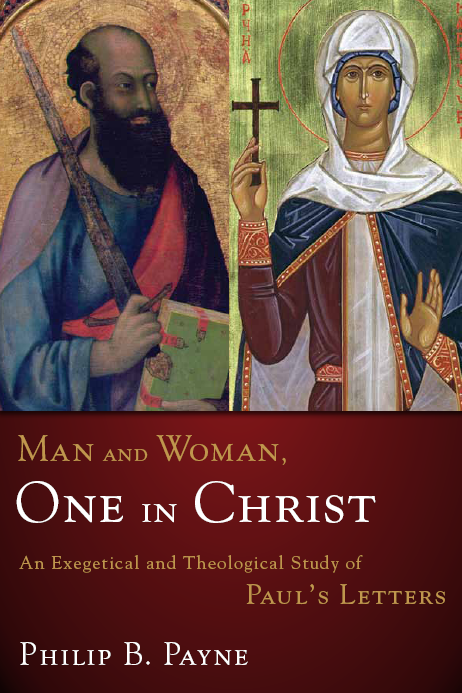 Philip Payne’s book Man and Woman, One in Christ
Summary of Contents
Paul’s Background
Payne notes that Paul was taught by Gamaliel, who was far more egalitarian than his contemporaries. Given this background, it is implausible that Paul had a low view of women (37).
Galatians 3:28
Those opposed to egalitarians (basically, egalitarians are people for women pastors, complementarians are those opposed to women pastors) often portray the position as having its only support in Galatians 3:28. Philip Payne does not base the egalitarian position on this verse alone, but he does argue that the passage provides a strong basis for the egalitarian position. Payne writes, “The natural implication of the equality of male and female in Paul’s teaching is that the gifts of women for ministry in the church should be recognized, welcomed and exercised in all areas of church life, including… church leadership” (104).
1 Corinthians 7- the equal rights of men and women in marriage
In 1 Corinthians 7, Paul explicitly parallels the obligations, rights, and conditions of men and women in marriage. Payne notes a large number of verses in which Paul uses the same language for both men and women (105-106). Not only that, but Paul specifically challenges the concept that men should be the spiritual leaders in the home in 1 Cor. 7:14 (107).
1 Corinthians 11
Payne’s book quickly turns to an extremely in-depth exegesis of the core verses related to the debate over women in church leadership. To put this into concrete terms, Payne’s analysis of 1 Timothy 2:8-15 covers eight chapters and 142 pages; 1 Corinthians 14 has nearly 50 pages dedicated to it, 1 Corinthians 11 is covered by over 100 pages. Payne does not set theology or exegesis to the side in favor of emotional appeals, as some complementarians tend to accuse egalitarians of doing. Rather, he centralizes the Bible as the inerrant Word of God and unswervingly demands that all sides conform to what the Bible teaches, no matter how difficult that teaching may be.
Regarding 1 Corinthians 11, Payne notes that the analogy regarding the “head” of woman does not imply authority, as complementarians must hold. Rather, “source” is a better exegetical and philological fit (113ff, see especially 131, 133). Payne further argues that the proper application of 1 Corinthians 11 would draw out the respect and honor men and women should have for each other as equals (214-215).
1 Corinthians 14:34-35
Rather than mincing words, I’ll jump right to the point: Payne argues that these verses are an interpolation. I’ll cover my own thoughts in the section below “Analysis/Critique,” but for now, I’ll focus on Payne’s argument.
Payne notes that there are a number of ways offered to interpret the passage, but he argues that the only plausible interpretation of the text is that women must be silent, no matter what, in every circumstance. The reasoning is lengthy, but the primary rationale behind this interpretation as most plausible is the it reiterates the prohibition three times, which, in the 1st Century, would have been seen as an absolute prohibition (218-219). Complementarians who allow women to sing in worship, therefore, are inconsistent in their interpretation of this passage, because they add a qualification which is not in the text (221).
Payne, however, argues the text is an interpolation. The evidence is both internal and external. First, the external evidence. The movement of the text itself hints that it was an interpolation which was placed in different parts of 1 Corinthians depending on the textual lineage (227ff). There is also a distigme which is used elsewhere to mark interpolations that is in the last line of 14:33, the correct place to mark 14:34-35 as an interpolation (232ff). Bishop Victor, between AD 541-544, corrected the text to omit 14:34-35 as an interpolation (246ff). Victor’s acumen for detecting interpolations is noteworthy, because he also omits the Trinitarian interpolation in 1 John 5:7-8 (246). MS88 omits the text, likely because it was copied from a manuscript which lacked the interpolation (249). Clement reflects a text without the verses (250-251). He notes other evidence as well (251ff). Payne also notes 9 lines of internal evidence for the text being an interpolation (253ff).
1 Timothy 2:8-15
These verses occupy the largest treatment in MWOC. The key to properly interpreting this passage, argues Payne, is the context and the church situation to which it is addressed. Context is always important in properly interpreting the Bible, but with letters it is even more important. Payne approvingly quotes Raymond Collins on this point, “…it is the epistolary genre that is most conditioned by the coordinates of time and space, historical and relational circumstances… They are ad hoc compositions whose essential import relates immediately and directly only to the situation that dictated their composition” (291).
Payne asserts that scholars know the situation in Ephesus–there was a preponderance of false teaching (296ff). Because of this, it is important to read the letter as a letter designed to put a stop to these teachings. Paul’s prohibition of women’s teachings is tied directly to the fact that false teachers had been praying upon women (299ff). The phrase Paul uses, “I am not permitting” “indicat[es] a new, case-specific injunction in response to a problem in Ephesus that does not carry the weight of church tradition” (321).
Payne also highlights the importance of the Greek word oude as conjoining the prohibitions Paul makes in this passage. The word is used throughout the Pauline corpus to “join together expressions that reinforce or make more specific a single idea” (338). Because of this, it is important to note that the word is used to conjoin the prohibitions in 1 Timothy 2:12. The prohibitions are “to teach” and “to assume authority.” Thus the prohibition is not Paul saying women cannot teach or assume authority over man… rather it is “Women should not teach in conjunction with assumed authority” (348-356).
But does authenteo mean “assume authority”? Complementarians generally must argue that it means simply “have authority.” Payne destroys such arguments, citing etymological (363-365) and document (365-373) evidence to demonstrate the word means “assume authority [to oneself-385ff].” Payne also deconstructs the complementarian argument to the contrary, showing that Paul used other words to refer to authority in a basic sense (373-380).
Importantly, Payne draws out the implications of Paul’s exhortations to women to learn quietly. This was the proper position of students. Paul is not telling women they have no place in the church, he’s calling them to learn in a proper fashion before teaching (see 316-317 for an example of this argument).
Thus, Payne concludes that Paul is not prohibiting women from teaching in the church. In the face of the counter-evidence of Paul’s affirmation of women teachers (61-68), the specific context of 1 Timothy, and the proper translation of the Greek words, the text should be read as a temporal restriction on teaching by women in a church struggling with false teachings being spread by women.
…And More
I have not even begun to draw out all of Payne’s arguments in MWOC. There are many more lines of reasoning including Paul’s affirmation of women in positions of ministry, Paul’s theological axioms which imply equality of man and woman, “salvation through childbirth,” Ephesians 5:21-33 and Colossians 3:18-19 with husband-wife relationships, Titus 1:5-9 and 1 Timothy 3:1-13 and the requirements for deacons and overseers, etc., etc. I cannot emphasize how broad Payne’s line of argument is, and how lucidly he explains his points. The book simply must be read by anyone interested in the topic.
Analysis/Critique
There are so many points Payne makes in MWOC that it would be impossible to cover them all. I found Payne’s arguments largely persuasive. That said, I have a few minor notes.
First, I am not convinced that 1 Corinthians 14:34-35 is an interpolation. I also think Payne dismisses the possible egalitarian readings of the passage too quickly (219ff). That said, Payne’s arguments are extremely powerful. I would have dismissed such arguments before reading this book, but now I’d say I’m very close to agreeing with Payne that these verses are an interpolation.
However, I wish that Payne had did a bit more work on the text to at least investigate the exegetical possibilities. I believe very few complementarians would be willing to accept that these verses are an interpolation, so if Payne had offered other possible interpretations, complementarians might find his case stronger. However, it is the case that complementarians who desire to use this passage to exclude women from the ministry now have the burden of proof upon them to demonstrate that it is not an interpolation, and they must do so with the same careful attention to the internal and external evidence which Payne utilized.
Initially I thought Payne might be overstating the case from Galatians 3:28, but he drew out enough parallel passages that it seems pretty convincing that egalitarians can interpret other passages in light of the Galatians verse (Payne does not use this method–he deals directly with the texts said to undermine egalitarianism… I’m merely suggesting that Payne’s work on Galatians 3:28 would allow egalitarians to be justified in utilizing it as a kind of “proof text” by which others must be judged).
Conclusion
Payne’s sustained positive argument for the equality of man and woman essentially convinced me of the egalitarian position over a year and a half ago. I have only recently finished the book, but when I first got it and skimmed through the arguments, I realized every argument I’d been using as a complementarian had an egalitarian answer. Not only that, but Payne’s critique of the complementarian position undermined the theological position which I’d held my entire life. I think it takes a great deal of intellectual integrity to read books which challenge one’s fundamental beliefs, and I have experienced it firsthand. I challenge readers on both sides of the issue to read this book.
Man and Woman, One in Christ provides an insurmountable challenge to the complementarian position. Any scholar working on the topic in the future must interact with this magnificent work. I simply must recommend it over and over again. I am thoroughly convinced that egalitarianism has a much stronger Scriptural and theological basis than the complementarian position, and MWOC is one of the works which lead me to that position. Payne’s thorough and thought-provoking analysis of the texts themselves demonstrates the Biblical accuracy of the egalitarian position. His work is one with which all must contend. The issue of women in the ministry is one we [the church] cannot get wrong. A thoughtful, open-minded approach to the Biblical issues is necessary. Let us make men and women one again.
Source
Philip B. Payne, Man and Woman, One in Christ
SDG.
——
The preceding post is the property of J.W. Wartick (apart from citations, which are the property of their respective owners) and should not be reproduced in part or in whole without the expressed consent of the author. All content on this site is the property of J.W. Wartick and is made available for individual and personal usage. If you cite from these documents, whether for personal or professional purposes, please give appropriate citation with both the name of the author (J.W. Wartick) and a link to the original URL. This blog is protected by Creative Commons licensing. By viewing any part of this site, you are agreeing to this usage policy.
Quick Link: N.T. Wright on Women in the Ministry
Eminent New Testament scholar N.T. Wright, former Bishop of Durham, is an egalitarian. Yes, he knows Pauline writing, and he believes women can (and should) be pastors. Check out his wonderfully lucid article on the topic: here.
Here are some choice quotes:
Mary Magdalene and the others are the apostles to the apostles. We should not be surprised that Paul calls a woman named Junia an apostle in Romans 16.7. If an apostle is a witness to the resurrection, there were women who deserved that title before any of the men.
In regards to 1 Timothy 2:
The key to the present passage, then, is to recognise that it is commanding that women, too, should be allowed to study and learn, and should not be restrained from doing so (verse 11). They are to be ‘in full submission’; this is often taken to mean ‘to the men’, or ‘to their husbands’, but it is equally likely that it refers to their attitude, as learners, of submission to God or to the gospel – which of course would be true for men as well. Then the crucial verse 12 need not be read as ‘I do not allow a woman to teach or hold authority over a man’ – the translation which has caused so much difficulty in recent years. It can equally mean (and in context this makes much more sense): ‘I don’t mean to imply that I’m now setting up women as the new authority over men in the same way that previously men held authority over women.’ Why might Paul need to say this?
Now if you were writing a letter to someone in a small, new religious movement with a base in Ephesus, and wanted to say that because of the gospel of Jesus the old ways of organising male and female roles had to be rethought from top to bottom, with one feature of that being that the women were to be encouraged to study and learn and take a leadership role, you might well want to avoid giving the wrong impression. Was the apostle saying, people might wonder, that women should be trained up so that Christianity would gradually become a cult like that of Artemis, where women did the leading and kept the men in line? That, it seems to me, is what verse 12 is denying. The word I’ve translated ‘try to dictate to them’ is unusual, but seems to have the overtones of ‘being bossy’ or ‘seizing control’. Paul is saying, like Jesus in Luke 10, that women must have the space and leisure to study and learn in their own way, not in order that they may muscle in and take over the leadership as in the Artemis-cult, but so that men and women alike can develop whatever gifts of learning, teaching and leadership God is giving them.
Really, check out the rest of his article.
Check out my argument for women pastors: here.
The Unacknowledged Teachers: an argument for women pastors.
 An argument for the position of egalitarianism (the position that women are not to be restricted from certain offices in the church):
1) Women say things in Scripture which are not condemned (cf. Deborah’s song, Mary’s Magnificat which is used in liturgical worship, Ruth’s words which are used in wedding ceremonies, Esther’s story and her actions, etc., etc.). [Edit: this premise must be made more clear. The things women say in Scripture are not simply not condemned, but are often explicitly centralized. The Song of Deborah; Ruth’s words to Naomi; the magnificat; etc. These words are made into liturgies and used for teaching. Yet they are the words of women. Thanks to Adam at Unworthy Yet Redeemed for pointing out this flaw in the argument. Consider P1 to be modified to “Women say things in Scripture which are centralized and utilized for church liturgies and teaching.”]
2) All Scripture is useful for teaching, rebuking, correcting, and training in righteousness (1 Timothy 3:14-17).
3) Those things which women say in Scripture teach us truths useful for teaching, rebuking, correcting, and training in righteousness (1, 2).
4) If we use truths women teach us in Scripture to teach doctrine/righteousness/etc., we should not exclude women from the ministry. (Premise)
5) We use truths women teach us in Scripture to teach doctrine/righteousness/etc. (1-3)
6) Therefore, we should not exclude women from the ministry (4, 5, modus ponens).
Defense of premise 1: I cited examples in the argument itself. See Judges 4-5; Luke 1:46-56; Ruth 1:16-17 (and the rest of the book); the book of Esther; these are just a few examples.
Defense of premise 2: Again, directly from Scripture: 1 Timothy 3:14-17.
3 follows from 1 and 2.
Premise 4 is likely to be the most controversial of these premises. The position of those who hold that women should not be ordained into the office of the ministry (complementarianism) is generally based upon the suggestion that women should not teach doctrine in a public setting (see more on this below). Therefore, I think that premise 4 must be accepted by complementarians because a denial of this premise would undermine their position. In other words, if one wants to hold that premise 4 is false, they would have to provide a different reason to exclude women from the ministry. Premise 4 simply states that which the sides agree upon. Ultimately, the strength of premise 4 will depend upon one’s definition of “the office of the ministry.” However, if one’s definition of “office of the ministry” includes “teaching”; “teaching doctrine”; “rebuking” [those who need correction]; etc., then premise 4 is correct.
Further, premise 4 could be weakened so that its conclusion would be not quite as strong. Instead, one could reword it as:
4′) If we use truths women teach us in Scripture to teach doctrine/righteousness/etc., we should not exclude women from teaching doctrine/righteousness/etc. to others.
This modified premise will not yield the conclusion that women should not be excluded from the “office of the ministry” but it would yield the conclusion that women should be allowed to teach doctrine, righteousness, and other things no matter who the audience happens to be.
Premise 5 follows from 1-3. 6 follows via modus ponens from 4 and 5. The same could be said for 4′ and the perceived 5′ and 6′.
The language used by those who are against women preaching must be very carefully selected because they do not wish to say women cannot be teachers at the university, or that they cannot teach elsewhere–rather, it is restricted to the church. Yet the argument above would be specifically useful for permitting women to teach in the church. After all, their words are used to teach continually. Whenever the Magnificat is sung or spoken, we use the words of Mary to teach us truths about Jesus. Whenever we read the story of Ruth or use her words in our wedding vows, we use them authoritatively.
Another way we could put this argument would be “If it is okay for women to compose sections of the Bible, perhaps we should let them teach it?” (quoted from Lamb, 64, citation below). I think the answer to the question is eminently obvious: yes
Therefore, women are already acting as a kind of “unacknowledged teacher” in the church: their very words are being used to tell us about God. I conclude that women should not be excluded from the ministry.
Note on terminology: by “teach” I am explicating the role of “teacher” in the church–the pastor.
Part of this argument was developed from a reading of God Behaving Badly by David Lamb (Downers Grove, IL: InterVarsity Press, 2011), 64-65, wherein he states “If it is okay for women to compose sections of the Bible, perhaps we should let them teach it?” (64).
SDG.
——
The preceding post is the property of J.W. Wartick (apart from citations, which are the property of their respective owners) and should not be reproduced in part or in whole without the expressed consent of the author. All content on this site is the property of J.W. Wartick and is made available for individual and personal usage. If you cite from these documents, whether for personal or professional purposes, please give appropriate citation with both the name of the author (J.W. Wartick) and a link to the original URL. This blog is protected by Creative Commons licensing. By viewing any part of this site, you are agreeing to this usage policy.

 J.W. Wartick - Reconstructing Faith