God
The Hobbit: An Unexpected Journey- A Christian perspective
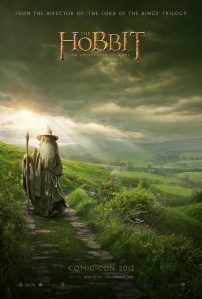
 Unless you’ve been living in a Hobbit-hole somewhere (forgive me!), you know that The Hobbit: An Unexpected Journey was just released in theaters. Short, spoiler free review: It was amazing, go see it. Hereafter, I offer my thoughts on the themes present in the film from a Christian worldview perspective, followed by some links to great posts on the movie and related items. Yes, there are SPOILERS ahead.
An Unexpected Journey
Yes, there is an unexpected journey which begins in this film, believe it or not. Yet the journey was not just unexpected but also vehemently resisted. Bilbo Baggins did not want to go. He was too comfortable with his armchair, his full cabinet, and his total lack of adventure. He was comfortable in his home. He liked it there, and as long as nothing was bothering him, he’d like to stay put, thank you very much.
I can’t help but think of how so many people today are in that same position. We are too comfortable in our pleasant (or at least largely undisturbed) lives, living as though we haven’t a care in the world. We avoid those things which make us uncomfortable. We don’t want to think about them, and we’d rather not even say the words that have anything to do with these hard topics which have become our “adventures.”
For the Christian, this is especially poignant. The scene where Bilbo finally decides to go on the journey has him waking up the next morning after his refusal. He sees his hobbit-hole cleaned up and looking as though the previous night had never happened. But then he sees the contract from Thorin Oakenshield on a table. He picks it up and realizes what he has been called to do. He has to step out and live that life in the great beyond. It is as Gandalf tells him: the world is not contained in books and maps, it is “out there.” Similarly, we cannot become too comfortable in our lives. We are to be in the world, changing it through our actions and through the call to repent and believe. Yes, we can have all the books, we can pray the prayers, but what are we doing? Are we running, leaping, yelling like Bilbo to join the adventure, to spread the Gospel?
Big Evil
Defeating Evil
When the party comes to Rivendell, they encounter Saruman, who had summoned Galadriel. After a brief conference on whether the dwarves should continue their quest and a debate over the existence of a Necromancer, Galadriel privately confronts Gandalf. She asks him why he chose a Hobbit, Bilbo, to embark on such a dangerous quest as a burglar. Gandalf’s insight is telling. He says that “Sarumon thinks evil must be defeated with great power.” But Gandalf is not so convinced. He argues that it is the little things, the everyday choices, which can lead to the defeat of evil. When enough choices are made for good, evil cannot overcome the turning tide against it. Bilbo is weak, but he will become strong in his actions. He will be used for good, despite not having great power.
We can fight evil in that same way. The choices we make everyday have larger consequences. How will I spend my time? Will I make that nasty remark? Will I forgive? There is big evil in this world, but it can be fought, by God’s grace.
Its Reality and Our Resistance
Evil is real. There is evil everywhere in the world, and we need only to look at the headlines to see it. Gandalf is aware of the rising evil in Middle Earth as well. The evils which confront the adventurers are “big.” There are trolls, stone giants, a goblin with a grudge, and more. They are resisted at every turn.
Who can help but see how this theme ties into the last one? Christians are called into a world of big evil. We are called to go into a world which is resisting them–often violently–at every turn.
Evil’s Foothold
Evil seeks places to dwell. The things which are evil must be actively resisted, for any foothold evil gains, it will utilize. Bilbo, Gandalf, Thorin, and Radagast the Brown must all fight against evil as it seeks its foothold in their lives. Radagast is a particularly poignant example. He runs through the forest, fighting evil as much as can be done. He is eccentric and seems crazy, yet he does what he can to fight the evil which seeks to penetrate at every level into the forest. Our hearts are too often willing dwelling places for evil. We must fight it.
 Small Mercies
Courage is the strength to show mercy. Gandalf urges Bilbo to remember this as he considers the adventure. A mercy shown can have important ramifications in the future, as those who know not only the Hobbit but also the Lord of the Rings trilogy should note. By sparing Gollum, Bilbo opened the door for the defeat of a much greater evil far into the future. What mercies can we show? Certainly, we don’t often have a life-or-death situation placed at our feet, but we have the capacity to show mercy on a day-to-day basis.
Evidence and Will
Saruman was confronted by Gandalf with evidence for the existence of a great evil, a Necromancer, who had been discovered by Radagast. Saruman–perhaps already in the thrall of Sauron–seeks any avenue to redefine the evidence. He says that Radagast cannot be trusted, for he is too eccentric and perhaps crazy. Saruman says Radagast spends too much time in the forest, eating mushrooms. Even when confronted with physical evidence, a blade full of evil, he seeks to offer an alternative explanation.
This dialogue between Gandalf, Elrond, Galadriel, and Gandalf is a powerful example of how our will can change the evidence. If we do not wish something to be true, we will seek every avenue to escape its truth. Perhaps Saruman was not yet in the thrall of Sauron, perhaps he merely did not want to think evil could gain such a foothold in his world, but he nevertheless made a decision to doubt his brother wizards. If he had trusted them, he perhaps would not have trodden down the path he takes in Lord of the Rings.
Back Again- Conclusion
JRR Tolkien wrote one of the greatest fantasy epics of all time. He was also a deeply thoughtful Christian. The themes which appear throughout his novels are portrayed vividly on screen. I urge readers to see this movie. When you put on those 3-D glasses, don’t forget to put on your worldview glasses as well. What themes are occurring in this film? How do they relate to my worldview? What worldview can account for these things? The Hobbit: An Unexpected Journey was a fantastic exploration of these themes. We are called to live in the world, we are called to adventure, no matter how much we want to resist. We are called to Christ.
Links
The Call to Adventure– What does the call to adventure mean? Garret Johnson offers a thought-provoking look at the call to adventure in literature and how it can inform our worldview.
Tolkien Experts Talk About His Christian Themes– A video with a number of experts on Tolkien offering their thoughts on the Christian themes in his body of work. Definitely worth watching.
Big Truths from the Hobbit– An excellent post calling Christians to step out of their hobbit-holes.
SDG.
——
The preceding post is the property of J.W. Wartick (apart from citations, which are the property of their respective owners, and works of art as credited) and should not be reproduced in part or in whole without the expressed consent of the author. All content on this site is the property of J.W. Wartick and is made available for individual and personal usage. If you cite from these documents, whether for personal or professional purposes, please give appropriate citation with both the name of the author (J.W. Wartick) and a link to the original URL. If you’d like to repost a post, you may do so, provided you show less than half of the original post on your own site and link to the original post for the rest. You must also appropriately cite the post as noted above. This blog is protected by Creative Commons licensing. By viewing any part of this site, you are agreeing to this usage policy.
Book Review: “Good News for Women” by Rebecca Groothuis
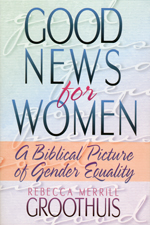 The debate over women’s roles in the home and in the church rages on. A large part of the debate has focused upon the Bible verses that either side raises in defense of their view. Little of the debate has focused on the philosophical implications of either position. Rebecca Groothuis’ Good News for Women
Groothuis first turns to a Biblical case for the equality of men and women. She bases this notion on several Biblical texts. She refers to God’s creation of both male and female in the image/likeness of God (21ff). Her argument also goes into Galatians 3:26-28 and notes how it again draws out the equality between male and female. Regarding the discussions of women’s silence in the churches, Groothuis parallels these passages to those about slaves submitting to their masters:
[T]he strategy of the New Testament church was to tolerate the social subordination of slaves and women so as not to risk alienating non-Christians from the gospel, and yet to modulate and moderate these customs, and ultimately to point beyond them to God’s original intention for human relations. Today, however, when non-Christians are not likely to be offended by an equalitarian gospel, but are likely to find a hierarchical gospel offensive, we have no reason to perpetuate the cultural practices that were intially intended for Christians living in patriarchal societies (25).
Groothuis concludes that throughout the Bible, there is a pattern in which male and female are equal in being. They are, in other words, ontologically equal. Neither is more valuable than the other.
It should be noted that most complementarians today are willing to grant this case. They agree that women and men are indeed created equal and should have equal rights. Groothuis then turns to a series of philosophical arguments which seek to demonstrate that the complementarian position cannot consistently hold that women are equal to men while holding that they are excluded from the ministry. Her argument, therefore, goes deeper than an exegetical challenge. Instead, her argument undermines the theological core groundings of complementarianism.
The very core of Groothuis’ argument is that complementarianism is grounded upon an ontological difference between male and female. The reason she holds that complementarinism must hold this position is “[b]ecause a woman’s traditionally inferior status follows necessarily from the single fact of her essential, female nature, her status is itself a function of her ‘being’ [ontology]; it is determined by what she is, not by what she can do” (53). Complementarians hold that women cannot hold certain offices of the church due only to the fact of her femininity. It is not based upon a functional subordination in which the female chooses to take up a role that is subordinate (62ff); instead, it must be grounded upon the female’s nature as a female. There is nothing about the female which limits her from being a pastor, on most contemporary complementarian positions (that is, those which no longer hold that women are excluded from the ministry simply because she is not as smart or gifted as men in general). Instead, it is exclusively her feminine nature which determines her role as subordinate. Therefore, it is part of her essential nature. I have argued this point myself elsewhere: “Women in the Ministry: The philosophy of equality and why complementarianism fails.”
Grothuis continues with extensive argument to rebut the notion of servant leadership (78ff). She also deals with various analogies complementarians use to attempt to ground equality and hierarchy, such as the Trinity (55ff–it should be noted that grounding subordination in the Trinity undermines the doctrine of the Godhead). It should become immediately apparent as to how this leads to a problem for complementarians. Biblically, they are forced to concede that women and men are, in fact, equal. However, their position undermines this Biblical position of the equality of men and women. Therefore, it seems their position fails.
Groothuis then turns to a number of strategies that complementarians have used in order to try to tie the subordination of women in to patterns of the Godhead. Unfortunately, many of these strategies end up making God into a gendered creature rather than a transcendent Creator. Some complementarians, such as C.S. Lewis, actually go so far as to make God male (93). Groothuis points out that this gendering of God cannot be affirmed based upon the Bible. One difficulty is that both male and female language is used of God (93-94). Yet she insists that the debate must not become a simple adding up of verses on either side to see how God illustrates either gender. That would turn God into a “God who suffers from some gender identity confusion” (93). Instead:
The view that God is both masculine and feminine confuses and distorts the image of God in humanity. It requires that the divine image be divided between women and men, such that women image God’s feminine aspects and men image God’s masculine aspects. This sexualizing of spiritual attributes renders men and women spiritual ‘opposites,’ creating a need to compartmentalize aspects of spiritual life and ministry into separate masculine and feminine quarters. (98)
Groothuis also spends some time dealing with some of the odd–and frankly, pagan–ideas used by some complementarians. For example, some argue that God must act as a male in the creation event: one who gives so much, while the created world merely receives. To be blunt, they describe God’s creative act as a sexual act, with no Biblical support. Groothuis rightly points out that this idea is little more than paganism dressed up in theism, but goes on to note that “It seems a good deal of imagination and determination is required in order to characterize the strenuous effort required of a woman’s body in nourishing, growing, and delivering a child as ‘overwhelmingly passive,’ while depicting the male role of standing around watching it happen as ‘active’!” (95). Another abuse of gender in the Godhead involves some complementarians arguing that because Jesus was a man, only men can be priests (109ff). Groothuis points out that “If we are to regard maleness as essential to who Christ is as Christ, not only must we question whether Jesus Christ can represent women as fully as he can men… we must also view women as essentially inferior to men. Women lack the Christlike attribute of maleness that renders men best qualified to represent Christ…” (113). Interestingly, then, complementarians who utilize this argument essentially undermine the doctrine of the atonement: for Christ’s maleness is emphasized to the point that Jesus is not an adequate representation of humanity. He is essentially male.
The second half of Good News for Women focuses upon an evaluation of the texts used to support complementarianism. These texts are examined in light of the theological points already established. Namely, women and men are created equally as imagers/likenesses of God; and that any attempt to ground hierarchy ultimate fails because it undermines this Biblical concept of equality. A full presentation of Groothuis’ analysis of these texts would probably triple the length of this review, and I don’t see any way to sum up these arguments adequately in a few sentences, so I unfortunately must leave it to those interested to read the book to see these analyses.
Finally, it would be remiss to go without mentioning the outstanding contribution Groothuis gives to the discussion of egalitarian marriage. Groothuis discusses marriage in detail for over 40 pages of the book. What is astonishing is how lucidly she lays out the principles of egalitarian marriage. She illustrates the nature of marriage and how it is a give-and-take with both persons involved as opposed to one ruling over the other. She also discusses in detail how such an egalitarian system can work without having anyone to have a vote to “trump” the other’s vote. Frankly, the book is worth reading just for her discussion on marriage.
Groothuis’ most important contribution here is in the first part of her book, which establishes a strong theological and philosophical case for the equality of men and women in teaching roles in the Church and equal roles in marriage. However, there are numerous important insights throughout the text, both into specific verses and into overarching themes in the debate from both the complementarian and egalitarian positions. Groothuis’ discussion of egalitarian marriage provides a way forward for discussion on the roles of men and women in marriage and also helps to give insight into the Biblical view of marriage. Overall Good News for Women
Links
See my other writings on egalitarianism on my theology page (scroll to the bottom).
I argue that certain complementarian arguments undermine the Trinity.
I review a book which focuses entirely upon exegetical issues related to egalitarianism: Man and Woman: One in Christ.
Source
Rebecca Groothuis, Good News for Women
SDG.
——
The preceding post is the property of J.W. Wartick (apart from citations, which are the property of their respective owners, and works of art as credited) and should not be reproduced in part or in whole without the expressed consent of the author. All content on this site is the property of J.W. Wartick and is made available for individual and personal usage. If you cite from these documents, whether for personal or professional purposes, please give appropriate citation with both the name of the author (J.W. Wartick) and a link to the original URL. If you’d like to repost a post, you may do so, provided you show less than half of the original post on your own site and link to the original post for the rest. You must also appropriately cite the post as noted above. This blog is protected by Creative Commons licensing. By viewing any part of this site, you are agreeing to this usage policy.
The Church Universal: Reformation Review
 Perhaps the most crucial debate of the Reformation Era was over the nature of the universal church. During the Reformation, the church had split into numerous separate bodies. But were each of these bodies truly “the church”? Was salvation only found through membership in the Catholic Church? Finally, how did one determine what church bodies were part of “the church” if there were some new criterion for establishing what counted as “the church”? Having found their origins prior to the Reformation and a spectrum of answers during the Reformation, these questions continue to be debated into our own time.
The Church Universal
The key to understanding the emerging doctrine of the church within the Reformation is to note a distinction in meanings for “apostolic continuity.” On the one hand, one could note a literal apostolic continuity in which the authority of the Apostles themselves was passed from one person to another. On the other hand, some argued that the authority of the church was found in continuity with apostolic doctrine, not with a literal continuity of passed-on authority (McGrath, Reformation Thought: An Introduction
The Protestants began to view church authority as a consequence of right doctrine. This view allowed them to divorce themselves from the Roman Catholic church (and thus potentially lose the literal passing down of authority from one to another from the apostles) while still maintaining that their own churches remained part of the church universal.
Yet this was not the only question facing those trying to distinguish which churches were “true” as opposed to “false” churches. Surely there ought to be some signs of a “true church” to distinguish it from those that had fallen away. Martin Bucer and Martin Luther offered ways forward on this: the marks of the church. Luther insisted that what made a true church was “right administration of the sacraments and true preaching of the Gospel” while Bucer held that there was a third mark: discipline (Diarmaid MacCulloch The Reformation
The Background to the Reformation Debate
Alister McGrath notes how important it is to note the origins of the reformation debate regarding the church here. Specifically, the debate can be traced back to the Donatist controversy in the earlier church (third century). Essentially, this controversy centered around the very nature of the true church. The Christian church had been persecuted, and many had renounced their faith in order to avoid persecution. The question was asked: should these persons be allowed back into the true church? Could they still administer the sacraments and interact with the true body of Christ?
The Donatists said that those who had lapsed had become apostate and could not be allowed back into the church. However this belief was eventually considered to be incorrect and detrimental to the unity of the Church. Augustine argued against the Donatists and pointed out how the church is a “mixed body” of sinners and saints (McGrath, 144ff).
The concept of a sinner-saint was utilized by Martin Luther and other Reformers to note that the church was a body in which the Holy Spirit was actively working sanctification. That is, God was working to make the Church holy, but that did not mean that each individual in the church was absolutely devoid of sin.
How did all of this fit into the Reformation discussions on the true church? Simply put, the Donatists were radically schismatic. They sought to divorce themselves from “sinners” within the church. The Donatists were condemned for their schismatism, and so the Reformers had to deal with the fact that they themselves had either been forcibly removed from or split from the Roman Catholic Church. Thus, the importance of apostolic authority through theological unity became central in understanding the continuity of the Church.
The Modern Debates
The notion that right doctrine delineates the true church as opposed to literal apostolic continuity has a number of interesting outcomes which are very relevant for today’s church bodies.
First, it introduces a great difficulty for many church bodies in determining with whom one can fellowship. If the authority of the church universal is based upon true teachings rather than a passing down of authority from one person to another, then where is the line for how much teaching must be correct in order to remain as the true church?
Different church bodies offer different answers. Some church bodies err on the side of openness and humility and allow many into their fold who hold radically differing views. People in these organizations may hold to different views on things like the ordination of women, the age of the earth, and the like. Other church bodies err on the side of unity in doctrine and restrict membership to those that affirm sound doctrine as taught by their own body. For these church groups, a certain creed or body of work is referenced as the authoritative teaching of the church. If one differs from these teachings, then one is not part of their church body. (For more on the notion of using creeds or bodies of teachings as authoritative interpretations, see my post on “Who Interprets Scripture? Sola Scriptura, the Reformation, and the modern era.”)
To be frank, some Christians fail to recognize the diversity of these answers and simply assume that anyone who has a differing organizational structure is “liberal” or “conservative”–using the words in a derogatory manner. Such an attitude does not contribute to discussions on church organization. By failing to recognize the commendable attitude of humility in the churches that emphasize the unity of faith as opposed to the unity of individual doctrines, some unfairly label other church bodies as unbiblical or apostate. Similarly, by failing to recognize the commendable need for unity of belief in church bodies that emphasize right belief, some unfairly label these church bodies as schismatic or unchristian.
It also seems to me that both of these groups should learn from each other. Too many church groups vary too far one way or the other on these issues. Church bodies that emphasize humility in doctrine can often undermine their own church’s teachings. Similarly, church bodies that emphasize unity in doctrine can undermine their capacity for outreach and cooperation with other church bodies.
The Roman Catholic Church, following Vatican II, officially viewed non-Catholic churches as separated brethren–other bodies of true believers who were practicing independently. Such an affirmation ultimately undermines part of the debate that has raged since the Reformation: are Protestants saved, according to Roman Catholic teaching? This debate was hot during the Reformation and beyond, as the Roman Catholic church continued to deny salvation outside of the Catholic Church. Now, however, it is acknowledged that salvation can be found within Protestant circles as well.
Finally, the options Luther and Bucer offered to describe the “marks of the church” continue to be extremely important. Bucer’s emphasis on independent church discipline has–insofar as I can tell–largely fallen by the wayside, though it remains a point of interest in Anabaptist and other traditions. Although I would be hesitant to make a structured church discipline one of the marks of the true church, it would appear to be greatly important to have a system for disciplining those within the church who do not adhere to basic moral and/or doctrinal norms. However, this must be consistent with the notion that all believers are sinners being formed into saints through the process of sanctification. The modern church in the West perhaps does not have enough emphasis on the importance of church discipline, but caution should be taken so that a reform in this area does not lead the church back to a Donatist-like position.
Conclusion
So what makes a church a true church? The Reformers do still speak to us on this issue. Continuity with apostolic teaching is that which designates a true church. It is not easy to know where to draw the line between unity and humility, but over-emphasizing either leads to great difficulties for a church body. Of utmost importance, however, is the acknowledgement that though not all church bodies agree on every topic (there’s an understatement!), these church bodies are part of the saving body of Christ and therefore part of the salvific work of the Holy Spirit. Remembering this simple fact might help to spur on a bit of humility and unity among the Church Universal.
Links
Please check out my other posts on the Reformation:
I discuss the origins of the European Reformations and how many of its debates carry on into our own day.
The notion of “sola scriptura” is of central importance to understanding the Reformation, but it is also hotly debated to day and can be traced to many theological controversies of our time. Who interprets Scripture?
Sources
Alister E. McGrath a, Reformation Thought: An Introduction
Diarmaid MacCulloch The Reformation
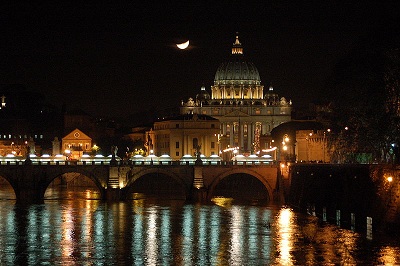
Image: credit to Beatrice- http://commons.wikimedia.org/wiki/File:San_Pietro_e_Ponte_SAngelo_(notte).jpg
Thanks
Alister McGrath’s Reformation Thought: An Introduction was a gift from an anonymous donor. I was blown away when I saw it show up at my door and I have to say Thank you so much for being such a blessing! Whoever you are, you made my day. Well, more than just one day actually. This series of posts is a direct result of your donation. Thank you!
SDG.
——
The preceding post is the property of J.W. Wartick (apart from citations, which are the property of their respective owners, and works of art as credited) and should not be reproduced in part or in whole without the expressed consent of the author. All content on this site is the property of J.W. Wartick and is made available for individual and personal usage. If you cite from these documents, whether for personal or professional purposes, please give appropriate citation with both the name of the author (J.W. Wartick) and a link to the original URL. If you’d like to repost a post, you may do so, provided you show less than half of the original post on your own site and link to the original post for the rest. You must also appropriately cite the post as noted above. This blog is protected by Creative Commons licensing. By viewing any part of this site, you are agreeing to this usage policy.
The Avengers: Sin, Salvation, and Jonah
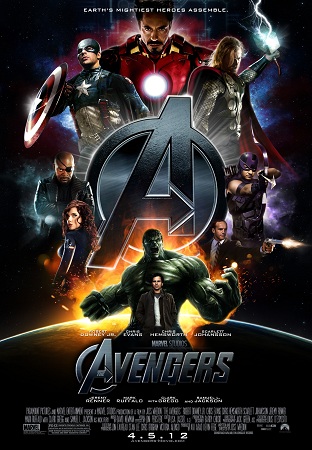 I have already reflected on Marvel’s “The Avengers” from a Christian perspective, but upon watching the recently released blu-ray and DVD
There will be SPOILERS here.
Slavery of all mankind
A thoughtful friend of mine on Facebook pointed to the dialogue between Loki and a crowd of people near the beginning of the film wherein he forces them all to kneel. Loki stands before them and shouts:
Kneel before me. I said… Kneel! Is not this simpler? Is this not your natural state? It’s the unspoken truth of humanity that you crave subjugation. The bright lure of freedom diminishes your life’s joy in a mad scramble for power. For identity. You were made to be ruled. In the end, you will always kneel.
Think of how this resonates with the Christian notion of slavery in sin. We align ourselves with things that we love. Greed. Envy. Pride. Lust. Gossip. These things, while initially pleasurable, ultimately enslave us. Loki’s speech was very discerning, however. For even though these things come to enslave us and take time away from the goods in life, we come to love them, to glorify them, and to become attached to them. We want to be enslaved in sin. We desire it. Sin calls to us, enslaves us, and we love it.
Yet, as in the movie, we are called to rise up against this sin. But we can’t do it on our own. As I discussed in my other post on “The Avengers,” we “need a hero.” We cannot rise out of slavery. Paul discusses this very notion in his letter to Rome:
Don’t you know that when you offer yourselves to someone as obedient slaves, you are slaves of the one you obey—whether you are slaves to sin, which leads to death, or to obedience, which leads to righteousness? But thanks be to God that, though you used to be slaves to sin, you have come to obey from your heart the pattern of teaching that has now claimed your allegiance. You have been set free from sin and have become slaves to righteousness. (Romans 6:16-18, NIV)
Who is it that set us free? We did not do it on our own. After all, we became slaves to sin and offered ourselves freely to it. No, it is Christ Jesus who set us free. He was the “hero” who broke the chains and gave us our freedom in Him.
Debts that Cannot Be Paid
Later on, Loki converses with Black Widow. They discuss the notion that Black Widow has “debts” to others. She owes them for the things they’ve done for her. She says that her ledger is in the “red”–she is on the wrong side of debt. During this conversation, Loki tries to break Black Widow down verbally, “Can you wipe out that much red? …Your ledger is… gushing red.”
Loki’s comments are telling, for they are actually true of not just Black Widow but of everyone. We all have our debts. We have our sins that we commit in private, away from others. We have the anger we have expressed through thought and deed. Our ledgers are overflowing, they gush red. Our sins are too great for us to repay; we cannot wipe away the red.
Yet God has loved us so much that He paid the debt. Jesus, God in human form, came to earth and paid that debt for each and every one of us. Our ledgers were full, but now we’re in the black. We have become co-heirs with Christ and have received salvation by grace through faith. We are justified through Jesus’ death and resurrection. God forgives us our sins and wipes our ledgers clean on His behalf. Loki’s comments are not unlike those of the Devil, trying to convince us that we are still in debt. Can anyone–even God–wipe away all the wrongs we’ve done? Fortunately, that answer is yes. Although we ourselves cannot repay it, God has done so for us.
Jonah
Another great line in the film is when New York City is under attack (seriously, why can’t that city catch a break?). Iron Man comes face to face with a gigantic enemy ship/creature/thing (my wife named it “Leviathan” and I think that’s a great title) and has to take it down. He asks his onboard computer: “You ever heard the tale of Jonah?” He then bursts into the mouth of the Leviathan and flies through it, exploding from the end and destroying it.
No, the reference was never explained. Hey, if you don’t know the story, look it up! It’s one of my favorites in the Bible. Just get out a Bible (or search online) and flip to “Jonah.” It’s short, and I guarantee you it’s worth the read!
Conclusion
It seems to me that there are a number of themes in “The Avengers” that Christians can relate to. The notion of the incredible debt we owe and cannot pay due to our past resonates directly with the Christian worldview. It points towards the salvation we have in Christ. Similarly, our slavery to sin cannot be overlooked. We want to sin, we crave it, but thankfully those bonds are broken in Christ.
Links
A Christian Look at “The Avengers”– I examine a number of other themes in “The Avengers” which Christians and non-Christians can discuss.
Engaging Culture: A Brief Guide for movies– I reflect on how Christians can engage with popular movies in order to have meaningful conversations with those around them.
SDG.
——
The preceding post is the property of J.W. Wartick (apart from citations, which are the property of their respective owners, and works of art as credited) and should not be reproduced in part or in whole without the expressed consent of the author. All content on this site is the property of J.W. Wartick and is made available for individual and personal usage. If you cite from these documents, whether for personal or professional purposes, please give appropriate citation with both the name of the author (J.W. Wartick) and a link to the original URL. If you’d like to repost a post, you may do so, provided you show less than half of the original post on your own site and link to the original post for the rest. You must also appropriately cite the post as noted above. This blog is protected by Creative Commons licensing. By viewing any part of this site, you are agreeing to this usage policy.
Really Recommended Posts 9/1/12
 I am constantly delighted by the great quality of posts by my brothers and sisters in Christ. This week, I have provided a choice selection. The topics range from politics (the doctrine of peace through strength) to young earth creationism to presuppositional apologetics and Islam and beyond. I even linked to three of my favorite songs, to give a slightly different feel this go-round.
As always, please let me know what you liked!
———
The Natural Historian writes about Isaac Newton’s thoughts on the Mosaic account of creation. Check out this excellent quote:
Attempts to bring explanations for the physical origins of the geographic features of the earth into conformity with a six day creation and a universal flood has never yielded a unified view of how to interpret the data… [T]he application of that traditional view [young earth creationism] to an understanding of the physical creation and the origin of the earth has never accomplished a satisfying nor widely accepted result.
Refuting Islam: Philosophical Analysis– Mike Robinson uses presuppositional apologetics to evaluate Islam and argues that Islam is founded upon a logical fallacy.
Of Jesus, the Woman Caught in Adultery, Public Morality, The Law…– A fantastic and lengthy post on Christianity in the public square, legislating morality, and some specific moral issues. Recommended if you enjoy political discussion and the interaction of faith with politics.
What is the Doctrine of Peace Through Strength?– Wintery Knight weighs in on a national defense policy of peace through strength. This isn’t directly related to Christian apologetics, but I found it interesting, and Wintery Knight is a master of discussing Christianity in the public square. Check out the rest of his site. A choice quote from the article on peace through strength:
The way to stop most wars is to make dictators believe that you have the means and the will to stop their aggression.
The Ring Makes All the Difference: A Word to the Wise on Cohabitation– Does marriage make a difference? Should we do trial runs of living together first? What does sociology say about these issues? Check out this informative article.
Some of My Favorite Music– Here are some links to songs by three of my favorite artists. Yes, they range wildly in genre. I like some Christian rap- like Lecrae; I like Christian Metal like Demon Hunter (my favorite band) and I love some Christian Blues too, check out the Glenn Kaiser Band.
Christianity, Hope, and Art- An Interview with Lisa Guinther
 Recently, I had the opportunity to talk to Lisa Guinther. Lisa is a late-in-life college student who has been accepted as a philosophy major (undergraduate) at CU Boulder (2014 expected graduation) She had been a student at Colorado Christian (College of Adult Studies) since 2009 with an undergraduate Certificate in Biblical Studies.
She is the owner/designer of Woman of Wisdom Creations and is an illustrator who was published in a national Christian magazine, and is illustrating a children’s book scheduled to be in book stores summer 2013.
J.W.: Describe for me your journey as an artist.
Lisa: I started being involved in art in high school. I was a freshman in an art department and surrounded by art majors. I was surrounded by people starting to experiment in art. I learned from some sessions and took some classes. So I’ve always fiddled around with art, a lot of classes in oil painting, water colors, and acrylics. It never really was encouraged, but I never let it go.
I never considered how my art could affect my Christian walk until recently.
I was apostate for almost 12 years. Within a year or two of my “coming back”, so to speak, I went to the Denver Museum of Art. They had a featured handwritten Bibles and they just caught my attention and wouldn’t let me turn away. They were pre-Gutenberg press, handwritten Bibles, and the care that it took to write out and draw out the words and frame each passage clicked with me. I began thinking what if I could make the Bible art? That was when I started Illuminated Texts [Lisa’s Blog].
I was making presents… eventually I was done with that and decided to express Bible verses in a painting.
J.W.: How has your Christian worldview influenced your art?
Lisa: Something I noticed with art in the Christian tradition: I find when I visit the Lutheran churches that they still have a tradition of promoting art. But in a lot of other evangelical-type churches, there is little promotion of art. There’s not a lot of art. It’s gotten really short shrift.
An artist friend who used to be involved in the Abstract-Expressionism movement explained to me that the whole ideology of abstract impressionism is actually idol making. About the time of impressionism, which started with Monet, at that point people thought art was dead. Paintings were seen as a framed window. But with the camera, artists had to see art in a different way. They began to put themselves onto canvas and put themselves on the wall. Artists kept trying to outdo each other—this is a truncated explanation—but it became creating idols. It became the artist’s impression of nature, and then it became the artist emotional expression.
If you’re creating art that’s just that—the inner expression of a moment—then you can put anything on a canvas. Now is that really art? I don’t know! What is the nature of art? Nicholas Wolterstorff gave a lecture on this topic—is art an intrinsic good or an instrumental good? It may be both, I don’t know.
Is there a part of this that we could get possibly back to a definition of art as representing God’s creation and the beauty within that creation that’s there because beauty is a part of God’s nature? …[T]here is just so much gratuitous beauty in the created world. I think that’s one way to do natural theology, a way to point to God. Is there a way to get back to a representation of beauty in art that would point us back to God?
We can be authentically Christian and authentically artists. You have to engage… [some kinds of] art to begin to see its beauty. The Bible is kind of like that. You can surface read it and you learn things and this is good, but you don’t really get the deep level of beauty in Scripture until you really dig in and study it.
At times when I’m painting or drawing, it’s almost as though I’m praying. There is a mystical aspect—I feel like there are times when I’m thinking about prayers or meditating on Scripture or just thinking about God as I’m painting or drawing and I know these are God’s gifts that He gives me, but I feel like in some tangible way I’m showing what I feel. It’s a tangible way to express other than in writing—it’s the way abstract impressionism should be.
I think we need a better working definition of art. A paperclip… might be under the definition of instrumental art, but we need to bring back representational art but we can also see abstract art that can draw us into a deeper understanding just like the way we read Scripture.
J.W.: What are some ways for the Church to promote art and artists?
Lisa: Look at the history of art in the church. You needed people for stained glass, for alter decorations, and there was a whole system in place that would support artists. But we haven’t been doing that since the Reformation.
People don’t understand what a painting costs. A 30×40 canvas is 100$, along with the palette of colors, and the other costs—tubes of paint as 4-12$—and I have a full palette of colors. It’s expensive.
J.W.: How could the church support artists more effectively, in light of that?
Lisa: In a larger church, there could be an art show. Some churches do this every quarter or even every month. You generally find that within every church there are artists. They’re there. You just need to put up a sign up sheet and people will come out of the wordworks. Remind parents that if you really want to stimulate imagination—the same skills you need in math are important in art and music—to promote kids to do artwork is to promote their reading skills, creativity, and math skills.
We want creative expression in how we worship. Worship is creativity and if you’re worshiping you generally have some spark in you of artistic talent. If we could encourage art as a form of worship, we can’t lose that.
I’d like to share a quote from Hans Urs von Balthasar [The Glory of the Lord: A theological aesthetics 1967 as “Herrichkeit: Eine theologische Asthetic, I: Schau der Gestalt” Ignatius Press, San Francisco Translated to English in 1982]:
Beauty is the last thing which the thinking intellect dares to approach, since only it dances as an uncontained splendor around the double constellation of the true and the good and their inseparable relation to one another. Beauty is the disinterested one, without which the ancient world refused to understand itself, a word which the ancient world refused to understand itself, a word which both imperceptibly and yet unmistakably has bid farewell to our new world, a world of interests, leaving it to its own avarice and sadness. Now longer loved or fostered by religion, beauty is lifted from its face as a mask, and its absence exposes features on that face with threaten to become incomprehensible to man. We no longer dare to believe in beauty and we make of it a mere appearance in order the more easily to dispose of it. Our situation today shows that beauty demands for itself at least as much courage and decision as do truth and goodness, and she will not allow herself to be separated and banned from her two sisters without taking them along with herself in an act of mysterious vengeance. We can be sure that whoever sneers at her name as if she were the ornament of a bourgeois past—whether he admits it or not—can no longer pray and soon will no longer be able to love. (p. 18)
Within Roman Catholicism there always was a theology of beauty as an attribute of God.
J.W.: What can you tell us about the “Bold Girls of the Bible” and your illustrations?

(c) Lisa Guinther 2012
Lisa: One of the points I’d like to make is that I’ve tried to keep the illustrations as real as possible. I think it is important that we not present Biblical stories in some kind of airbrushed, phony way. I’ve always been a history buff. I’d like to present these characters in a way that people see them as real—the kids can see them as real. I don’t think that beautiful pristine white robes is historically accurate.
Can I present characters that illustrate the stories in as real way as possible so that kids can relate? Can I make it real for the kids reading it so they can relate to the people? When I was growing up I saw the Bible as something not really real. Can I, in artwork, make it real for us? And that’s what my friend Mary [the author of Bold Girls of the Bible] tries to do in her writing.
Can we make the characters in the Bible real enough that little girls can relate to them? Everyone knows about David and Goliath, but I never had a Bible hero.
J.W.: How are you composing the art?
Lisa: I pose kids, take a photograph, print out the picture, and do an outline sketch. Then I put the backers on it, drape the clothing, create the character, and create the image from the sketch.
J.W.: Do you have a Bible hero now?
Lisa: Hands down, St. Paul. I often try though, if I had to pick a character that I could write a story around or draw a picture of, I wonder a lot about Deborah and what she had to go through.
J.W.: You mentioned natural theology, how would you look to integrate your art with apologetics?
Lisa: We all have a sense of beauty in art and in nature and in music even though it may be amorphous. Everyone has a universal sense called “beauty” and the only way there can be a [Platonic] universal is if there is a creator. It’s why we have the idea of good, beauty, truth.
I agree with the idea that we know good because God is the exemplar of that. We know beauty because it is a part of God’s very nature. I think we know beauty and we can see it in the world around us because we are created in the image of God. We also want to, in our own way, create. That creative spark within us is really a part of the image of God in man.
——————-
My thanks to Lisa for this wonderful interview. I think we both had a lot of fun talking about God, apologetics, and art.
You can view some of Lisa’s art at Illuminated Text…. by Lisa.
Lisa has her own apologetics site, Insights from the Furnace, which integrates the arts with apologetics.
SDG.
——
The preceding post is the property of J.W. Wartick (apart from citations, which are the property of their respective owners, and works of art as credited) and should not be reproduced in part or in whole without the expressed consent of the author. All content on this site is the property of J.W. Wartick and is made available for individual and personal usage. If you cite from these documents, whether for personal or professional purposes, please give appropriate citation with both the name of the author (J.W. Wartick) and a link to the original URL. If you’d like to repost a post, you may do so, provided you show less than half of the original post on your own site and link to the original post for the rest. You must also appropriately cite the post as noted above. This blog is protected by Creative Commons licensing. By viewing any part of this site, you are agreeing to this usage policy.
The Consolation of Counterfactuals: The Molinism of Boethius
Whence comes this powerful understanding
That all things sees and all discerns?
…This is a cause more powerful
More forceful and effectual
Than that which passively awaits… (Boethius, The Consolation of Philosophy, Book V, section IV)
Molinism is holds that God has counterfactual knowledge of every situation. What this boils down to is that God knows conditional statements for every possible situation, such that God knows statements like “If J.W. has free time, then he will read.”
One prominent challenge to molinism is the notion that such counterfactuals about future choices cannot exist or that God simply couldn’t know them. I was startled as I read Boethius’ (480-525 AD) work, The Consolation of Philosophy, to see that he had anticipated this objection and provided the outline of an answer to it about 1500 years ago.
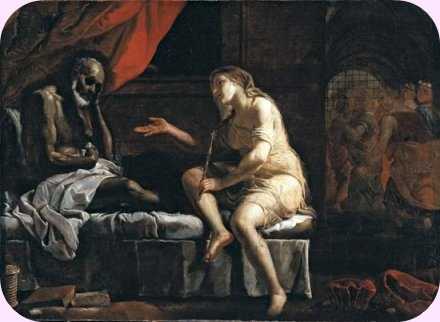
Boethius wrote the work as a dialog between himself and Philosophy, a woman who represented, well, philosophy. The last book focuses upon God’s foreknowledge and human freedom.
Writing as philosophy, Boethius states
All those things which happen without happening of necessity are, before they happen, future events about to happen, but not about to happen of necessity… But this, you will say, is the very point in question–whether there can be any foreknowledge of things whose occurrence is not inevitable. (Book V, section IV)
Again, it was amazing to see that Boethius had anticipated an objection to molinism–a system of theological thought which hadn’t been conceived fully yet (and wouldn’t be for about 1100 years!)–and provided an answer. The objection was seen above: many modern philosophers and theologians contend that God could not know that which is not necessitated to happen.
Yet Boethius answers the problem in a unique way:
The cause of this mistake [believing that God couldn’t know things that will not happen by necessity] is that people think that the totality of their knowledge depends on the nature and capacity to be known of the objects of knowledge. But this is all wrong. Everything that is known is comprehended not according to its own nature, but according to the ability to know of those who do the knowing. (Book V, section IV)
Before developing this argument, it is important to note that it rests squarely within Boethius’ later reflection upon the eternity of God–a being who has “the complete, simultaneous, and perfect possession of everlasting life” (Book V, section VI). Because Boethius holds that God is eternal in this sense–timeless–he can reasonably hold that God’s capacity to know is not limited by temporal constrictions.
Thus, we get back to the nature of his response to the counterfactual objection to molinism. Boethius, holding that God is eternal and therefore not limited by time, grounds the knowledge of counterfactuals not in their own inherent ability to be known or not known, but rather in the ability of the knower to know them.
It is worth emphasizing how radical and powerful this response is to the modern argument against molinism. If God is indeed timeless in the sense Boethius presses, then God would have access to the entirety of time as far as knowledge and action are concerned. Thus, by grounding knowledge not in the objects of knowledge themselves but in the capacity of the knower, Boethius grounded counterfactual knowledge.
Objection
Now, modern opponents of molinism would take this in stride and argue either against the contention that God is timeless or against the contention that knowledge is based in the capacity of the knower rather than the known. Exploring either of these objections is beyond the scope of this post, but it is worth noting that Boethius’ rebuttal to the problem of counterfactual knowledge works if both of his contentions are true. The question is, of course, whether they are.
A Final Objection and Response
Another way to attack Boethius’ defense of God’s knowledge of counterfactuals is to argue that even if it is the case that God is eternal and that His knowledge is grounded in the knower rather than the known, then it still would only mean that God knows what will happen, not what would happen if something were to happen. In other words, one could hold that Boethius’ answer doesn’t actually apply to counterfactual knowledge.
It seems possible, however, to modify Boethius’ defense to counter this argument as well. One could note that because God is eternal, any event that would happen, God would know about it. In other words, if x were z instead, then God’s knowledge would simply be z instead of x. This response turns the counterfactual into a counterfactual about God’s knowledge rather than about freedom. The response offered turns the question from whether God could know that “If x, then y” about John Smith into a question of “If z instead of x, then God knows z.”
Conclusion
It seems clear to me that there is much to develop yet in the objections and responses offered above. The last critique offered and my response certainly opens a number of areas of inquiry. However, for now it seems clear that Boethius has offered a unique way to look at the problem of counterfactual knowledge. Whether his perspective is correct remains a matter for further inquiry.
Boethius offered a unique and stirring defense of molinism over a thousand years before it was fully articulated by Luis de Molina. It is worth looking into his answer, even if it fails, simply for the foresight it provided. But Boethius’ work is known as an astounding discussion of divine eternity as well, among other things. Thus, I encourage readers to look into his short work, The Consolation of Philosophy. Who knows, you may even find the consolation of counterfactuals therein.
Edition Used: For this post I used the Penguin Classics edition of The Consolation of Philosophy (New York: Penguin, 1999).
SDG.
——
The preceding post is the property of J.W. Wartick (apart from citations, which are the property of their respective owners) and should not be reproduced in part or in whole without the expressed consent of the author. All content on this site is the property of J.W. Wartick and is made available for individual and personal usage. If you cite from these documents, whether for personal or professional purposes, please give appropriate citation with both the name of the author (J.W. Wartick) and a link to the original URL. If you’d like to repost a post, you may do so, provided you show less than half of the original post on your own site and link to the original post for the rest. You must also appropriately cite the post as noted above. This blog is protected by Creative Commons licensing. By viewing any part of this site, you are agreeing to this usage policy.
Really Recommended Posts 8/3/12
Wow, there are some really excellent posts out there. I am constantly blessed by reading or viewing great material from others. This week, the topics covered are all over the board: abortion, Leviticus, 50 Shades of Grey, apologetics methodology, and more! Check out these really recommended posts.
Grey Areas: How explicit literature went mainstream– You’ve heard of 50 Shades of Grey. What’s all the fuss about? And what kind of junk are we putting on the bookshelves?
The Mistake of Leviticus– Leviticus is one of those books in the Bible many balk at reading. Check out the insight provided here by Credo House. I really, really recommend this post.
Some Standard Definitions From the Doublespeak Dictionary– Bigot, Christian, and Intolerant tie together so well! Check out this great apologetic cartoon.
The Bibliographical Test Updated– Clay Jones, a professor over at Biola University, offers an update to the number of ancient manuscripts available for the various “bibliographic tests” for the accuracy of the New Testament. A brief, readable, and important post.
Is Abortion Really Wrong?– A great introduction to the debate over abortion.
Why I don’t reply to everyone (and neither should you)– It’s easy to get caught up in online debates or try to respond to everyone who comments on a blog or forum. Glenn Andrew Peoples offers an excellent post on why he doesn’t respond to everyone. He also gives some good guidelines for deciding whether you’re going to respond to someone.
The Atheist War Against Logic and Philosophy– I’m not sure this video is fairly named, because it seems like it is more the extreme views on philosophy of a number of people dismissed by the vast majority of others. Good watch if you want to pull your hair out at people rejecting logic while using it.
Apologetic Taxonomy: Methodological Approaches– Readers of my blog know I’ve been exploring a few other apologetic approaches. Here’s an excellent post which outlines the various methodological approaches to apologetics in a brief, readable format.
Debate Review: Greg Bahnsen vs. Gordon Stein
 Advocates of the presuppositional approach to Christian Apologetics have long hailed the debate between Greg Bahnsen (the late Christian theologian and apologist, noted for his achievements in presuppositional apologetics and development of theonomy–a view of the Law for Christians, pictured left) and Gordon Stein (the late secularist noted for his links to Free Inquiry among other things, pictured below, right) as a stirring triumph of presuppositional apologetics over atheism in a point-by-point debate. Recently, I listened to the debate and thought I would share my impressions here.
Debate Outline
Bahnsen Opening Statement
From the outset, it was clear this debate was going to be different from others I’d listened to or watched. Bahnsen outlined what he means by “God,” outlined a few general points about subjectivism, and then quickly dove into a presuppositional type of argument. He began with an attack on the idea that all existential questions can be answered in the same way:
The assumption that all existence claims are questions about matters of fact, the assumption that all of these are answered in the very same way is not only over simplified and misleading, it is simply mistaken. The existence, factuality or reality of different kinds of things is not established or disconfirmed in the same way in every case. [All quotes from the transcript linked below. My thanks to “The Domain for Truth” for linking this.]
Bahnsen then mounts an argument which is perhaps the most important innovation of presuppositional apologetics: the attack on neutrality. He notes that Gordon Stein in his writings puts forth a case for examining evidence in order to determine if God exists. He relies upon the laws of logic and seems to think that this avoids logical fallacies. Yet, Bahnsen argues, Stein has just argued in a circle as well. By presupposing the validity of the laws of logic and other forms of reasoning, he has fallen into the trap he has stated he is trying to avoid. As such, Stein’s outlook is not neutral but it is colored by his presuppositions. Bahnsen notes:
In advance, you see, Dr. Stein is committed to disallowing any theistic interpretation of
nature, history or experience. What he seems to overlook is that this is just as much begging the question on his own part as it is on the part of the theists who appeal to such evidence. He has not at all proven by empirical observation and logic his pre commitment to Naturalism. He has assumed it in advance, accepting and rejecting all further factual claims in terms of that controlling and unproved assumption.Now the theist does the very same thing, don’t get me wrong. When certain empirical
evidences are put forth as likely disproving the existence of God, the theist regiments his
commitments in terms of his presuppositions, as well.
Therefore, what Bahnsen presses is that it is only on the Christian theistic presupposition that things like the laws of logic, the success of empirical sciences, and the like can make sense. He makes the transcendental argument for the existence of God:
we can prove the existence of God from the impossibility of the contrary. The transcendental proof for God’s existence is that without Him it is impossible to prove anything.
Gordon Stein Opening Statement
 Stein opens by clarifying what he means by “atheist”: “Atheists do not say that they can prove there is no God. Also, an atheist is not someone who denies there is a God. Rather, an atheist says that he has examined the proofs that are offered by the theists, and finds them inadequate.”
Stein then argues that the burden of proof is definitely in the theist’s court. He goes on to address a number of theistic proofs and finds them wanting. In fact, the rest of his opening statement is spent addressing 11 separate arguments for the existence of God, including the major players like the moral, cosmological, and teleological arguments.
Cross Examination 1
In the first cross-examination, Bahnsen asked Stein whether the laws of logic were material or immaterial. Stein finally, quietly, admits that the laws of logic are not material. Yet then Stein turns around and in his own cross examination presses triumphantly a point he thinks will be decisive. He asks Bahnsen, “Is God material or immaterial”; Bahnsen responds, “Immaterial.”; after a brief segway, Stein poses the following question which, by the tone of his voice, he seems to think carries some weight: “Apart from God, can you name me one other thing that is immaterial?” To this question, Bahnsen responds quickly, “The laws of logic.” The crowd erupts. Stein lost that one.
First Rebuttal: Bahnsen
Bahnsen spends most of his rebuttal arguing that the laws of logic are not mere conventions, and that Stein cannot make them such. If Stein does, then, argues Bahnsen, he can’t actually participate in a logical debate, because they could each declare a convention in which they each win the debate.
He goes on to re-stress the transcendental argument and point out that Stein failed to address it. He develops it a bit further by attacking the notion that an atheistic worldview can make sense of logic:
And that’s because in the atheistic world you cannot justify,you cannot account for, laws in general: the laws of thought in particular, laws of nature,cannot account for human life, from the fact that it’s more than electrochemical complexesin depth, and the fact that it’s more than an accident. That is to say, in the atheist conceptionof the world, there’s really no reason to debate; because in the end, as Dr. Stein has said, allthese laws are conventional. All these laws are not really law-like in their nature, they’re just,well, if you’re an atheist and materialist, you’d have to say they’re just something that happensinside the brain.
But you see, what happens inside your brain is not what happens inside my brain.
Stein First Rebuttal
Stein argues that laws of logic are indeed conventions, saying:
The laws of logic are also consensuses based on observations. The fact that they can predict something correctly shows they’re on the right track, they’re corresponding to reality in some way.
Oddly, Stein continues to act as though Bahsnen’s argument was a variety of cosmological argument. He argues that before we can ask “what caused the universe” we must ask whether the universe is actually caused. He then tries to address the argument more explicitly, saying that it is “nonsense” and that various cultures do indeed have different logic. His most direct argument against the trasncendental argument is that “If matter has properties that it behaves than we have order in the universe, and we have a logical, rational universe without God.”
Debate Segment Two
Stein Opening 2
Stein argues that the problem of evil is an evidential argument against the existence of God. He states that it raises the probability that there is no God. He asserts that there is no physical evidence for God. Stein then argues that God has not provided evidence for his existence, but that He should do so. Finally, he turns to the problem of religious diversity, asking why God would allow other religions if there is only one God.
Bahnsen Opening 2
Bahnsen argues that Stein placing the laws of logic into a matter of consensus undermines their usefulness and in fact defeats the purpose of rational inquiry and debate. He argues further that Stein’s definition of laws of logic within pragmatic terms doesn’t come close to the extent of the laws of logic.
Stein Rebuttal
Stein argues that bahnsen hasn’t actually done anything to explain the laws of logic. He argues that simply saying they are the thoughts of God doesn’t mean anything, and that it does nothing to explain them. He therefore argues that Bahnsen fails to provide an adequate explanation for the facts of the universe.
Bahnsen Rebuttal
Bahnsen presses the point that Stein’s entire system is based upon presuppositions which he cannot justify. Induction is undermined in an atheistic worldview because there is no reason to believe that things will continue to happen as they do currently happen. He briefly addresses the problem of evil by saying that within an atheistic universe there simply is no evil, so it makes no sense from Stein’s perspective to press that issue.
Closing Statement: Stein
Stein’s closing statement seems to be more of a rebuttal than anything. He argues that there can be evil defined in an atheistic universe as that which decreases the happiness in people. Yet even this, he says, “We don’t know”–we don’t know that there is evil in an atheistic universe, rather it is a consensus and pragmatically useful.
He argues that we can know about induction because of statistical probability: it is highly improbable that the future will be different from the past because it has been similar in activity to the past for as long as we know.
Closing Statement: Bahnsen
Bahnsen finally presses the transcendental one last time. He argues that while Stein has called it hogwash and useless, he hasn’t actually responded to it. Bahnsen states that once more the atheistic worldview can’t make sense of itself. For example, saying the future will be like the past due to probability begs the question: there is nothing in the atheistic worldview to say that probability can help determine what the future will be like. It might work pragmatically, but it fails to give any explanation. Finally, Bahnsen argues that you cannot be a rational, empirical human being an an atheistic universe.
Analysis of the Debate
It is abundantly clear throughout this debate that the presuppositionalist takes a very different approach to debate and apologetics than those from other methods. One can see this immediately when Gordon Stein delivers his opening statement, which was presumably prepared beforehand, and goes to answer common theistic arguments like the cosmological and teleological argument. But Bahnsen never once used either of these arguments, and took an entirely different approach. I think this initially caught Stein off guard and that impression remained throughout the debate.
Stein’s responses to Bahnsen were extremely inadequate. This became very clear in their debate over induction and empiricism. For example, although Stein held that he could say the future will be like the past based upon probability, he had no way to say that the world was not spontaneously created 5 minutes ago with implanted memories and the notion that the future will be like the past. Bahnsen didn’t make this argument, but it seems like it would line up with his reasoning. Of course, he would grant that the theist has to presuppose that God exists in order to make sense of induction, but that was exactly his point: without God, nothing can be rational.
I found it really interesting that Stein kept insisting that the laws of logic are mere social conventions. He kept pressing that some cultures do not hold that they are true as defined. But of course, cultural disagreement about a concept doesn’t undermine the truth value of a concept. If, for example, there were a culture that insisted that 2+2=5, that wouldn’t somehow mean that 2+2=4 is a logical convention, it would mean the culture who insisted the sum was 5 would be wrong. Similarly, the laws of logic may be disagreed upon by some, but to deny them is to undermine all rationality.
Overall, I have to say I was shocked by how this debate turned out. I have long been investigating presuppositional apologetics and continually wondered how it would work in an applied situation. It seems to me that to insist on a presupposition in order to debate would not work, but Bahnsen masterfully used the transcendental argument to reduce Stein to having to argue that logic is merely a social convention while ironically using logic himself to attack theism.
It seems to me that this debate showed what I have suspected for some time: presuppositional apologetics is extremely powerful, when used correctly. Now I’m not about to become a full-blown presuppositionalist here. My point is that it is another approach Christians can use in their witnessing to those who do not believe. I envision a synthesis of presuppositional apologetics with evidentialism. Some may say this is impossible, that they are anathema to each other, but I do not think so. They can be used in tandem: the presuppositional approach to question the worldview of others, while the evidentialist approach can be used to support the notion that the Christian worldview provides the best explanation for the data we have.
Links
Listen to the debate yourself. Get it here. The transcript I used was also from this page. Thanks to the author for such a great resource.
I’ve been researching and writing about presuppositional apologetics. For other posts about presuppositional apologetics, check out the category.
I highly recommend starting with the introduction to the most important thinker in the area, Cornelius Van Til.
Choosing Hats– A phenomenal site which updates fairly regularly with posts from a presuppositional approach (the author uses the term “covenental apologetics”). The best place to start is with the post series and the “Intro to Covenental Apologetics” posts.
The Domain for Truth– Another great presuppositionalist web site. I highly recommend browsing the topics here.
SDG.
——
The preceding post is the property of J.W. Wartick (apart from citations, which are the property of their respective owners) and should not be reproduced in part or in whole without the expressed consent of the author. All content on this site is the property of J.W. Wartick and is made available for individual and personal usage. If you cite from these documents, whether for personal or professional purposes, please give appropriate citation with both the name of the author (J.W. Wartick) and a link to the original URL. If you’d like to repost a post, you may do so, provided you show less than half of the original post on your own site and link to the original post for the rest. You must also appropriately cite the post as noted above. This blog is protected by Creative Commons licensing. By viewing any part of this site, you are agreeing to this usage policy.
Really Recommended Posts 7/28/2012
 I’m excited by the great diversity of topics Christian bloggers have taken up all over the web. It’s hard to keep up. Here is my attempt to try. Check out these excellent selections.
Subordinating the Trinity for Gender Purposes– A brief post discussing the unfortunate fact that some theologians have been distorting the Trinity simply to push their own agenda regarding gender. I have discussed this at length in my own post, “Women, Complementarianism, and the Trinity.”
H.P. Lovecraft and the horror of Naturalistic Materialism– A very thought-provoking post about Lovecraft’s view of a Godless universe as a thing of horror. I highly recommend this read.
In Praise of Personal Retreats– there is something to be said for taking a break and delving into the Word. Check out this post, and think about a retreat of your own.
Spider-Man Spins a Design Argument– An interesting post about intelligent design and Spider-Man.
Which is Hate Speech? – Is it hate speech if you disagree with someone? Dan Savage, ironically an anti-bullying advocate, recently used a number of curse words and slurs to describe a group of Christian students. Meanwhile, Douglas Wilson is called out for hate speech due to talking about a controversial topic. Check out this insightful discussion.

 J.W. Wartick - Reconstructing Faith
.jpg)