J.W. Wartick
“The Hunger Games” movie reviewed and discussed by a Christian
 I have already written about the Hunger Games trilogy and offered some uniquely Christian insights into the Hunger Games movie, but here I wanted to give a brief review of The Hunger Games
Rather than giving an overview of the plot (any interested reader can get such an overview here), I’m going to dive right into a review.
Review
The movie is definitely not for children. There is a great deal of violence in the film as well as a number of scary images. Anyone who looks at my previous posts on the Hunger Games and sees the comments will realize there is a great deal of controversy over whether it is appropriate viewing for the Christian. I will comment on that shortly.
I enjoyed the movie a great deal. The moral conflict is pervasive throughout the film is so dense and immediate that it almost presses on one as a viewer. On the other hand, the conflict is not blatantly obvious, nor does the film clearly portray who is in the right or wrong. Everyone has dirty hands. It’s a movie that seems to reflect life in its parallels with the real world. Obviously, these parallels are blown out of proportion in some ways (for example, we do not sacrifice children in a battle to the death for our pleasure), but on reflection one can easily find disturbing ties into our own society (child trafficking, child pornography, and the like–these can easily be seen as parallels to the Hunger Games).
The action in the film is great but I have to admit the occasional use of camera waggle to try to make the action intense is unneeded and distracting. I think this is a modern convention among filmmakers that has far outlived its welcome. For a few movies it seems to work, but now it seems every film uses camera waggle for every explosion, every punch, every fall to the ground. It can be really, really distracting.
Back to the controversy: a number of Christians have spoken out against viewing this film. For example, some who commented on my previous posts argue that we should not view it because it shows violence (or even glorifies it) and that such things are not good for the Christian to view. But the Bible itself depicts all kinds of horrifically violent scenes. Surely these same Christians would not object to reading the Bible! The question to ask ourselves is this: what is the point of the violence? Is there a purpose in the portrayal of the horrors on screen? It seems to me, as far as the Hunger Games is concerned, there is indeed a purpose. I’ve written in extended detail on this in my post on the trilogy, but I’d like to point it out here one more time: the impact of this film and its story is not so much that it is an action flick that gets your blood going; the impact is rather that we are so close to being the Capitol in so many ways. The film practically screams that we must stop this unnecessary violence. We must work against injustice in our world. And those who are affected most by the conflicts, greed, and malevolence in our world are children. Having that portrayed on screen is a powerful call to Christians to fight for justice.
Talking Points for Christians
Why is what’s happening in the Hunger Games wrong?
Think about this question for a moment. If you think that there is something inherently wrong about what the Capitol is doing to the people of the Districts in the movie, then there must be some kind of basis for your moral reasoning. But, as I’ve argued extensively (for example, in my post on secular humanism), on an atheistic worldview there really is no ultimate moral code. How then, do we consistently condemn violence like this, even if it is someone else’s belief that such things are good or necessary?
Is there anything wrong with the lives of those in the Capitol?
As Christians, we can use this as a talking point. The people of the Capitol seem to be doing pretty well for themselves. They have others to do their every bidding and they can effectively enjoy life to its fullest. Yet it is interesting to note that there are a few characters who seem to be unfulfilled. President Snow is an obvious example–he is a despot who must maintain his power. Why is it that these people are unsatisfied? Do we need more than limitless pleasure and leisure to have a satisfactory life?
What is unjust in our world and how are we working to stop it?
Let us be frank. There are things in our own “backyard” that are reflected in the hunger games. Any time a child is abused, we can see that injustice portrayed and subtly condemned in this movie. What are we going to do to stop injustices like these? Is the Capitol really so different from our everyday lives?
Conclusion
Overall I think The Hunger Games is a movie that Christians can watch in good conscience. In fact, I think there are any number of talking points that Christians can bring to the movie and discuss with those who are talking about it. Some of these talking points were illustrated above. The movie is a call to fight injustice, and yes, it is a good action flick while it makes this point. I recommend it.
SDG.
Links
Deeper Hungers and Darker Games– The Hunger Games reflects a world without God. What does it mean?
The Hunger Games: The Atheist’s Utopia– No God: Utopia?
Christian Reflection on the Hunger Games Trilogy– My thoughts on the entire book trilogy.
——
The preceding post is the property of J.W. Wartick (apart from citations, which are the property of their respective owners, and works of art as credited) and should not be reproduced in part or in whole without the expressed consent of the author. All content on this site is the property of J.W. Wartick and is made available for individual and personal usage. If you cite from these documents, whether for personal or professional purposes, please give appropriate citation with both the name of the author (J.W. Wartick) and a link to the original URL. If you’d like to repost a post, you may do so, provided you show less than half of the original post on your own site and link to the original post for the rest. You must also appropriately cite the post as noted above. This blog is protected by Creative Commons licensing. By viewing any part of this site, you are agreeing to this usage policy.
The Consolation of Counterfactuals: The Molinism of Boethius
Whence comes this powerful understanding
That all things sees and all discerns?
…This is a cause more powerful
More forceful and effectual
Than that which passively awaits… (Boethius, The Consolation of Philosophy, Book V, section IV)

Molinism is holds that God has counterfactual knowledge of every situation. What this boils down to is that God knows conditional statements for every possible situation, such that God knows statements like “If J.W. has free time, then he will read.”
One prominent challenge to molinism is the notion that such counterfactuals about future choices cannot exist or that God simply couldn’t know them. I was startled as I read Boethius’ (480-525 AD) work, The Consolation of Philosophy, to see that he had anticipated this objection and provided the outline of an answer to it about 1500 years ago.
Boethius wrote the work as a dialog between himself and Philosophy, a woman who represented, well, philosophy. The last book focuses upon God’s foreknowledge and human freedom.
Writing as philosophy, Boethius states
All those things which happen without happening of necessity are, before they happen, future events about to happen, but not about to happen of necessity… But this, you will say, is the very point in question–whether there can be any foreknowledge of things whose occurrence is not inevitable. (Book V, section IV)
Again, it was amazing to see that Boethius had anticipated an objection to molinism–a system of theological thought which hadn’t been conceived fully yet (and wouldn’t be for about 1100 years!)–and provided an answer. The objection was seen above: many modern philosophers and theologians contend that God could not know that which is not necessitated to happen.
Yet Boethius answers the problem in a unique way:
The cause of this mistake [believing that God couldn’t know things that will not happen by necessity] is that people think that the totality of their knowledge depends on the nature and capacity to be known of the objects of knowledge. But this is all wrong. Everything that is known is comprehended not according to its own nature, but according to the ability to know of those who do the knowing. (Book V, section IV)
Before developing this argument, it is important to note that it rests squarely within Boethius’ later reflection upon the eternity of God–a being who has “the complete, simultaneous, and perfect possession of everlasting life” (Book V, section VI). Because Boethius holds that God is eternal in this sense–timeless–he can reasonably hold that God’s capacity to know is not limited by temporal constrictions.
Thus, we get back to the nature of his response to the counterfactual objection to molinism. Boethius, holding that God is eternal and therefore not limited by time, grounds the knowledge of counterfactuals not in their own inherent ability to be known or not known, but rather in the ability of the knower to know them.
It is worth emphasizing how radical and powerful this response is to the modern argument against molinism. If God is indeed timeless in the sense Boethius presses, then God would have access to the entirety of time as far as knowledge and action are concerned. Thus, by grounding knowledge not in the objects of knowledge themselves but in the capacity of the knower, Boethius grounded counterfactual knowledge.
Objection
Now, modern opponents of molinism would take this in stride and argue either against the contention that God is timeless or against the contention that knowledge is based in the capacity of the knower rather than the known. Exploring either of these objections is beyond the scope of this post, but it is worth noting that Boethius’ rebuttal to the problem of counterfactual knowledge works if both of his contentions are true. The question is, of course, whether they are.
A Final Objection and Response
Another way to attack Boethius’ defense of God’s knowledge of counterfactuals is to argue that even if it is the case that God is eternal and that His knowledge is grounded in the knower rather than the known, then it still would only mean that God knows what will happen, not what would happen if something were to happen. In other words, one could hold that Boethius’ answer doesn’t actually apply to counterfactual knowledge.
It seems possible, however, to modify Boethius’ defense to counter this argument as well. One could note that because God is eternal, any event that would happen, God would know about it. In other words, if x were z instead, then God’s knowledge would simply be z instead of x. This response turns the counterfactual into a counterfactual about God’s knowledge rather than about freedom. The response offered turns the question from whether God could know that “If x, then y” about John Smith into a question of “If z instead of x, then God knows z.”
Conclusion
It seems clear to me that there is much to develop yet in the objections and responses offered above. The last critique offered and my response certainly opens a number of areas of inquiry. However, for now it seems clear that Boethius has offered a unique way to look at the problem of counterfactual knowledge. Whether his perspective is correct remains a matter for further inquiry.
Boethius offered a unique and stirring defense of molinism over a thousand years before it was fully articulated by Luis de Molina. It is worth looking into his answer, even if it fails, simply for the foresight it provided. But Boethius’ work is known as an astounding discussion of divine eternity as well, among other things. Thus, I encourage readers to look into his short work, The Consolation of Philosophy. Who knows, you may even find the consolation of counterfactuals therein.
Edition Used: For this post I used the Penguin Classics edition of The Consolation of Philosophy (New York: Penguin, 1999).
SDG.
——
The preceding post is the property of J.W. Wartick (apart from citations, which are the property of their respective owners) and should not be reproduced in part or in whole without the expressed consent of the author. All content on this site is the property of J.W. Wartick and is made available for individual and personal usage. If you cite from these documents, whether for personal or professional purposes, please give appropriate citation with both the name of the author (J.W. Wartick) and a link to the original URL. If you’d like to repost a post, you may do so, provided you show less than half of the original post on your own site and link to the original post for the rest. You must also appropriately cite the post as noted above. This blog is protected by Creative Commons licensing. By viewing any part of this site, you are agreeing to this usage policy.
Book Review: “The Closing of the Muslim Mind” by Robert Reilly
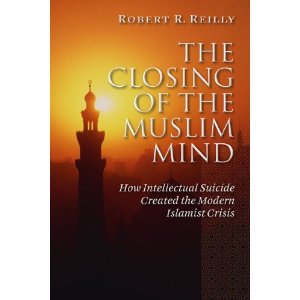 One can tell from the outset that Robert Reilly’s The Closing of the Muslim Mind
The central point of the book is “the story of how Islam grappled with the role of reason after its conquests exposed it to Hellenic thought and how the side of reason ultimately lost in the ensuing, deadly struggle” (1). Reilly contrasts this with how the West dealt with some of the same issues: “The radical voluntaraism (God as pure will) and occasionalism (no cause and effect in the natural order) found in them [Muslim theologians in the 9th-12th centuries] were not seen to any significant extent in the West until… David Hume began writing in the eighteenth century. By that time the recognition of reality had become firmly enough established to withstand the assault… Unfortunately, this was not true in Sunni Islam, where these views arrived much earlier” (7).
Reilly maps out the history of the development of Muslim thought. Initially, once Islam came into contact with western philosophy, there was a great amount of interplay (11ff). One early struggle was between man’s free will and fate. This struggle was over the meaning of key verses in the Qur’an as well as a debate over whether the Qur’an is temporal or eternal and uncreated. The notion that the Qur’an is eternal and uncreated, in turn, restricted rationality from evaluating the meaning therein (19).
The development of Muslim reflection on the Qur’an and Allah’s will led to the replacement of reason with rationality (45-46). Similarly, because the Qur’an was Allah’s will, and it did not explicitly endorse kalam (a branch of Muslim philosophy and theology), this rational discourse was to be abandoned (47). Furthermore, this entailed the destruction of the notion of the “autonomy of reason.” Only within the structures of revelation could reason operate effectively (48).
Furthermore, creation itself has no inherent reason. Each moment is merely a “second-to-second manifestation of God’s will” (51). While one may be tempted to say Christianity is exactly like this (and some branches may indeed hold to this teaching), there is an important distinction between the two views, for on the Christian view of God, God’s action is driven by His nature, and so He will operate within His promises as well as within the boundaries He has set for himself. God, on most Christian views, is inherently rational and so will operate in rational ways. So while creation indeed subsists moment-by-moment because of the will of God, God does not arbitrarily change His will (56ff). On the Muslim view, Reilly argues, God’s will is absolute (as opposed to His nature) and so there is absolute voluntarism. At any time, Allah could will that which before Allah did not will (51-53). Furthermore, one cannot say one “knows” God because God is pure will. As pure will, there is no reason for any particular action, and so God is inherently unknowable (54ff).
Another consequence of viewing God as pure will is that good and evil are essentially vacuous terms. “If Allah is pure will, good and evil are only conventions of Allah’s–some things are halal (permitted/lawful) and others are haram (forbidden/unlawful), simply because He says so and for no reasons in themselves” (70). Allah is therefore above morality and the problem of evil is made meaningless, for evil is merely that which God forbids. Essentially, the system is voluntaristic theism (71ff).
Reilly argues that these theological positions have had dire consequences for Islam in the political realm as well. These positions undermine the inherent worth of human beings and posit the primacy of power over reason (128); democracy is the answer to a question the Muslim world has not asked (130), for if God is pure will, then His regents on earth are operating merely under his whims, and can be just as arbitrary in their decisions (131); “Man’s only responsibility is to obey” (131); finally, “there is no ontological foundation for equal human rights in Islam, which formally divides men and women, believer and unbeliever, freeman and slave” (133).
The consequences reach farther, however, and touch the sciences as well. For if Allah’s will is that which causes all things, then to say that there are “natural” explanations is to insult Allah. Instead of saying that hydrogen and oxygen yield water, people are instructed to say “when you bring hydrogen and oxygen together… by the will of Allah water was created…” (142). Of course, the denial of secondary causation touches upon more pragmatic areas of life as well. After all, if Allah wants something to happen, then it will; if not, then it won’t.
Reilly presents a number of contemporary sources demonstrating how these aspects have been radically undermined in the Muslim world, where often anything can pass as a news story and anything can be stated as true (147ff). Furthermore, the Muslim world trends towards underdevelopment and illiteracy. Reilly maintains that some of this is due to the consequences of the theological views outlined above.
Historically, the dilemma within Islam over reason vs. voluntarism came to a head when the Muslim conquests began to be turned back. When defeats happened, Muslims had to ask why it was that they were losing when, presumably, Allah desired them to win (165ff). Some viewed it as a consequence of the stagnation of science and intellectual development in the Muslim world. Others, however, viewed it as a need to go back to the roots of Islam and become even more radical. The world, therefore, according to Reilly, is faced with a crisis: can reason be re-introduced into the Muslim theology and trickle down into every aspect of life, thus freeing the Muslim world from the shackles of voluntarism? Or, will Islam continue down its path and overemphasize the radical occasionalism of nature and God, while undermining reason? Such is the crisis.
It is striking how well Reilly has supported his theses with quotes from the writings of various Muslim theologians and philosophers. Throughout the work, he quotes numerous scholars from both modern and ancient sources. What these quotes reveal is that his points are not found in a vaccuum–rather, the notion that the absolute, determinating, arbitrary will of Allah underlies everything that happens does indeed undermine rationality.
It is interesting here to reflect briefly upon the notion that some of these same themes are found within certain branches of Christianity. Whenever God’s will is placed as the ultimate source of all activity on earth (voluntarism/occasionalism) rather than as a providential will which guides such activity, reason and rationality can be jettisoned just as easily as they were in the development of Muslim thought. Similarly, if Scripture is seen as above any kind of rational inquiry to determine its meaning, one can replace man’s cognitive abilities with blind faith. Reilly’s book can therefore serve as much a warning for Christians engaging in doctrinal reflection as it is a call to Muslims to restore rationality to their faith.
Reilly’s work, The Closing of the Muslim Mind should be seen as required reading for those interested in interfacing with the Muslim faith. Reilly ties together compelling chains of thought which have led to the current Muslim crisis and demonstrates how current thinking is a result of the past. It is a thoroughly researched book and those opposed to his conclusions will be hard-pressed to show the cracks in his theses. I highly recommend this work. Once one gets past the title, which may be seen as inflammatory by some, Reilly presents well-reasoned, compelling, historically grounded argument about how the theology of Islam has led to the destruction of its intellectual capacity.
Robert Reilly, The Closing of the Muslim Mind
SDG.
——
The preceding post is the property of J.W. Wartick (apart from citations, which are the property of their respective owners) and should not be reproduced in part or in whole without the expressed consent of the author. All content on this site is the property of J.W. Wartick and is made available for individual and personal usage. If you cite from these documents, whether for personal or professional purposes, please give appropriate citation with both the name of the author (J.W. Wartick) and a link to the original URL. If you’d like to repost a post, you may do so, provided you show less than half of the original post on your own site and link to the original post for the rest. You must also appropriately cite the post as noted above. This blog is protected by Creative Commons licensing. By viewing any part of this site, you are agreeing to this usage policy.
Debate Review: Greg Bahnsen vs. Gordon Stein
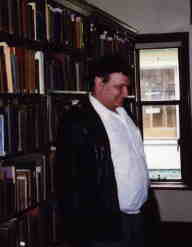
 Advocates of the presuppositional approach to Christian Apologetics have long hailed the debate between Greg Bahnsen (the late Christian theologian and apologist, noted for his achievements in presuppositional apologetics and development of theonomy–a view of the Law for Christians, pictured left) and Gordon Stein (the late secularist noted for his links to Free Inquiry among other things, pictured below, right) as a stirring triumph of presuppositional apologetics over atheism in a point-by-point debate. Recently, I listened to the debate and thought I would share my impressions here.
Debate Outline
Bahnsen Opening Statement
From the outset, it was clear this debate was going to be different from others I’d listened to or watched. Bahnsen outlined what he means by “God,” outlined a few general points about subjectivism, and then quickly dove into a presuppositional type of argument. He began with an attack on the idea that all existential questions can be answered in the same way:
The assumption that all existence claims are questions about matters of fact, the assumption that all of these are answered in the very same way is not only over simplified and misleading, it is simply mistaken. The existence, factuality or reality of different kinds of things is not established or disconfirmed in the same way in every case. [All quotes from the transcript linked below. My thanks to “The Domain for Truth” for linking this.]
Bahnsen then mounts an argument which is perhaps the most important innovation of presuppositional apologetics: the attack on neutrality. He notes that Gordon Stein in his writings puts forth a case for examining evidence in order to determine if God exists. He relies upon the laws of logic and seems to think that this avoids logical fallacies. Yet, Bahnsen argues, Stein has just argued in a circle as well. By presupposing the validity of the laws of logic and other forms of reasoning, he has fallen into the trap he has stated he is trying to avoid. As such, Stein’s outlook is not neutral but it is colored by his presuppositions. Bahnsen notes:
In advance, you see, Dr. Stein is committed to disallowing any theistic interpretation of
nature, history or experience. What he seems to overlook is that this is just as much begging the question on his own part as it is on the part of the theists who appeal to such evidence. He has not at all proven by empirical observation and logic his pre commitment to Naturalism. He has assumed it in advance, accepting and rejecting all further factual claims in terms of that controlling and unproved assumption.Now the theist does the very same thing, don’t get me wrong. When certain empirical
evidences are put forth as likely disproving the existence of God, the theist regiments his
commitments in terms of his presuppositions, as well.
Therefore, what Bahnsen presses is that it is only on the Christian theistic presupposition that things like the laws of logic, the success of empirical sciences, and the like can make sense. He makes the transcendental argument for the existence of God:
we can prove the existence of God from the impossibility of the contrary. The transcendental proof for God’s existence is that without Him it is impossible to prove anything.
Gordon Stein Opening Statement
 Stein opens by clarifying what he means by “atheist”: “Atheists do not say that they can prove there is no God. Also, an atheist is not someone who denies there is a God. Rather, an atheist says that he has examined the proofs that are offered by the theists, and finds them inadequate.”
Stein then argues that the burden of proof is definitely in the theist’s court. He goes on to address a number of theistic proofs and finds them wanting. In fact, the rest of his opening statement is spent addressing 11 separate arguments for the existence of God, including the major players like the moral, cosmological, and teleological arguments.
Cross Examination 1
In the first cross-examination, Bahnsen asked Stein whether the laws of logic were material or immaterial. Stein finally, quietly, admits that the laws of logic are not material. Yet then Stein turns around and in his own cross examination presses triumphantly a point he thinks will be decisive. He asks Bahnsen, “Is God material or immaterial”; Bahnsen responds, “Immaterial.”; after a brief segway, Stein poses the following question which, by the tone of his voice, he seems to think carries some weight: “Apart from God, can you name me one other thing that is immaterial?” To this question, Bahnsen responds quickly, “The laws of logic.” The crowd erupts. Stein lost that one.
First Rebuttal: Bahnsen
Bahnsen spends most of his rebuttal arguing that the laws of logic are not mere conventions, and that Stein cannot make them such. If Stein does, then, argues Bahnsen, he can’t actually participate in a logical debate, because they could each declare a convention in which they each win the debate.
He goes on to re-stress the transcendental argument and point out that Stein failed to address it. He develops it a bit further by attacking the notion that an atheistic worldview can make sense of logic:
And that’s because in the atheistic world you cannot justify,you cannot account for, laws in general: the laws of thought in particular, laws of nature,cannot account for human life, from the fact that it’s more than electrochemical complexesin depth, and the fact that it’s more than an accident. That is to say, in the atheist conceptionof the world, there’s really no reason to debate; because in the end, as Dr. Stein has said, allthese laws are conventional. All these laws are not really law-like in their nature, they’re just,well, if you’re an atheist and materialist, you’d have to say they’re just something that happensinside the brain.
But you see, what happens inside your brain is not what happens inside my brain.
Stein First Rebuttal
Stein argues that laws of logic are indeed conventions, saying:
The laws of logic are also consensuses based on observations. The fact that they can predict something correctly shows they’re on the right track, they’re corresponding to reality in some way.
Oddly, Stein continues to act as though Bahsnen’s argument was a variety of cosmological argument. He argues that before we can ask “what caused the universe” we must ask whether the universe is actually caused. He then tries to address the argument more explicitly, saying that it is “nonsense” and that various cultures do indeed have different logic. His most direct argument against the trasncendental argument is that “If matter has properties that it behaves than we have order in the universe, and we have a logical, rational universe without God.”
Debate Segment Two
Stein Opening 2
Stein argues that the problem of evil is an evidential argument against the existence of God. He states that it raises the probability that there is no God. He asserts that there is no physical evidence for God. Stein then argues that God has not provided evidence for his existence, but that He should do so. Finally, he turns to the problem of religious diversity, asking why God would allow other religions if there is only one God.
Bahnsen Opening 2
Bahnsen argues that Stein placing the laws of logic into a matter of consensus undermines their usefulness and in fact defeats the purpose of rational inquiry and debate. He argues further that Stein’s definition of laws of logic within pragmatic terms doesn’t come close to the extent of the laws of logic.
Stein Rebuttal
Stein argues that bahnsen hasn’t actually done anything to explain the laws of logic. He argues that simply saying they are the thoughts of God doesn’t mean anything, and that it does nothing to explain them. He therefore argues that Bahnsen fails to provide an adequate explanation for the facts of the universe.
Bahnsen Rebuttal
Bahnsen presses the point that Stein’s entire system is based upon presuppositions which he cannot justify. Induction is undermined in an atheistic worldview because there is no reason to believe that things will continue to happen as they do currently happen. He briefly addresses the problem of evil by saying that within an atheistic universe there simply is no evil, so it makes no sense from Stein’s perspective to press that issue.
Closing Statement: Stein
Stein’s closing statement seems to be more of a rebuttal than anything. He argues that there can be evil defined in an atheistic universe as that which decreases the happiness in people. Yet even this, he says, “We don’t know”–we don’t know that there is evil in an atheistic universe, rather it is a consensus and pragmatically useful.
He argues that we can know about induction because of statistical probability: it is highly improbable that the future will be different from the past because it has been similar in activity to the past for as long as we know.
Closing Statement: Bahnsen
Bahnsen finally presses the transcendental one last time. He argues that while Stein has called it hogwash and useless, he hasn’t actually responded to it. Bahnsen states that once more the atheistic worldview can’t make sense of itself. For example, saying the future will be like the past due to probability begs the question: there is nothing in the atheistic worldview to say that probability can help determine what the future will be like. It might work pragmatically, but it fails to give any explanation. Finally, Bahnsen argues that you cannot be a rational, empirical human being an an atheistic universe.
Analysis of the Debate
It is abundantly clear throughout this debate that the presuppositionalist takes a very different approach to debate and apologetics than those from other methods. One can see this immediately when Gordon Stein delivers his opening statement, which was presumably prepared beforehand, and goes to answer common theistic arguments like the cosmological and teleological argument. But Bahnsen never once used either of these arguments, and took an entirely different approach. I think this initially caught Stein off guard and that impression remained throughout the debate.
Stein’s responses to Bahnsen were extremely inadequate. This became very clear in their debate over induction and empiricism. For example, although Stein held that he could say the future will be like the past based upon probability, he had no way to say that the world was not spontaneously created 5 minutes ago with implanted memories and the notion that the future will be like the past. Bahnsen didn’t make this argument, but it seems like it would line up with his reasoning. Of course, he would grant that the theist has to presuppose that God exists in order to make sense of induction, but that was exactly his point: without God, nothing can be rational.
I found it really interesting that Stein kept insisting that the laws of logic are mere social conventions. He kept pressing that some cultures do not hold that they are true as defined. But of course, cultural disagreement about a concept doesn’t undermine the truth value of a concept. If, for example, there were a culture that insisted that 2+2=5, that wouldn’t somehow mean that 2+2=4 is a logical convention, it would mean the culture who insisted the sum was 5 would be wrong. Similarly, the laws of logic may be disagreed upon by some, but to deny them is to undermine all rationality.
Overall, I have to say I was shocked by how this debate turned out. I have long been investigating presuppositional apologetics and continually wondered how it would work in an applied situation. It seems to me that to insist on a presupposition in order to debate would not work, but Bahnsen masterfully used the transcendental argument to reduce Stein to having to argue that logic is merely a social convention while ironically using logic himself to attack theism.
It seems to me that this debate showed what I have suspected for some time: presuppositional apologetics is extremely powerful, when used correctly. Now I’m not about to become a full-blown presuppositionalist here. My point is that it is another approach Christians can use in their witnessing to those who do not believe. I envision a synthesis of presuppositional apologetics with evidentialism. Some may say this is impossible, that they are anathema to each other, but I do not think so. They can be used in tandem: the presuppositional approach to question the worldview of others, while the evidentialist approach can be used to support the notion that the Christian worldview provides the best explanation for the data we have.
Links
Listen to the debate yourself. Get it here. The transcript I used was also from this page. Thanks to the author for such a great resource.
I’ve been researching and writing about presuppositional apologetics. For other posts about presuppositional apologetics, check out the category.
I highly recommend starting with the introduction to the most important thinker in the area, Cornelius Van Til.
Choosing Hats– A phenomenal site which updates fairly regularly with posts from a presuppositional approach (the author uses the term “covenental apologetics”). The best place to start is with the post series and the “Intro to Covenental Apologetics” posts.
The Domain for Truth– Another great presuppositionalist web site. I highly recommend browsing the topics here.
SDG.
——
The preceding post is the property of J.W. Wartick (apart from citations, which are the property of their respective owners) and should not be reproduced in part or in whole without the expressed consent of the author. All content on this site is the property of J.W. Wartick and is made available for individual and personal usage. If you cite from these documents, whether for personal or professional purposes, please give appropriate citation with both the name of the author (J.W. Wartick) and a link to the original URL. If you’d like to repost a post, you may do so, provided you show less than half of the original post on your own site and link to the original post for the rest. You must also appropriately cite the post as noted above. This blog is protected by Creative Commons licensing. By viewing any part of this site, you are agreeing to this usage policy.
“The Dark Knight Rises”- A Christian Reflection
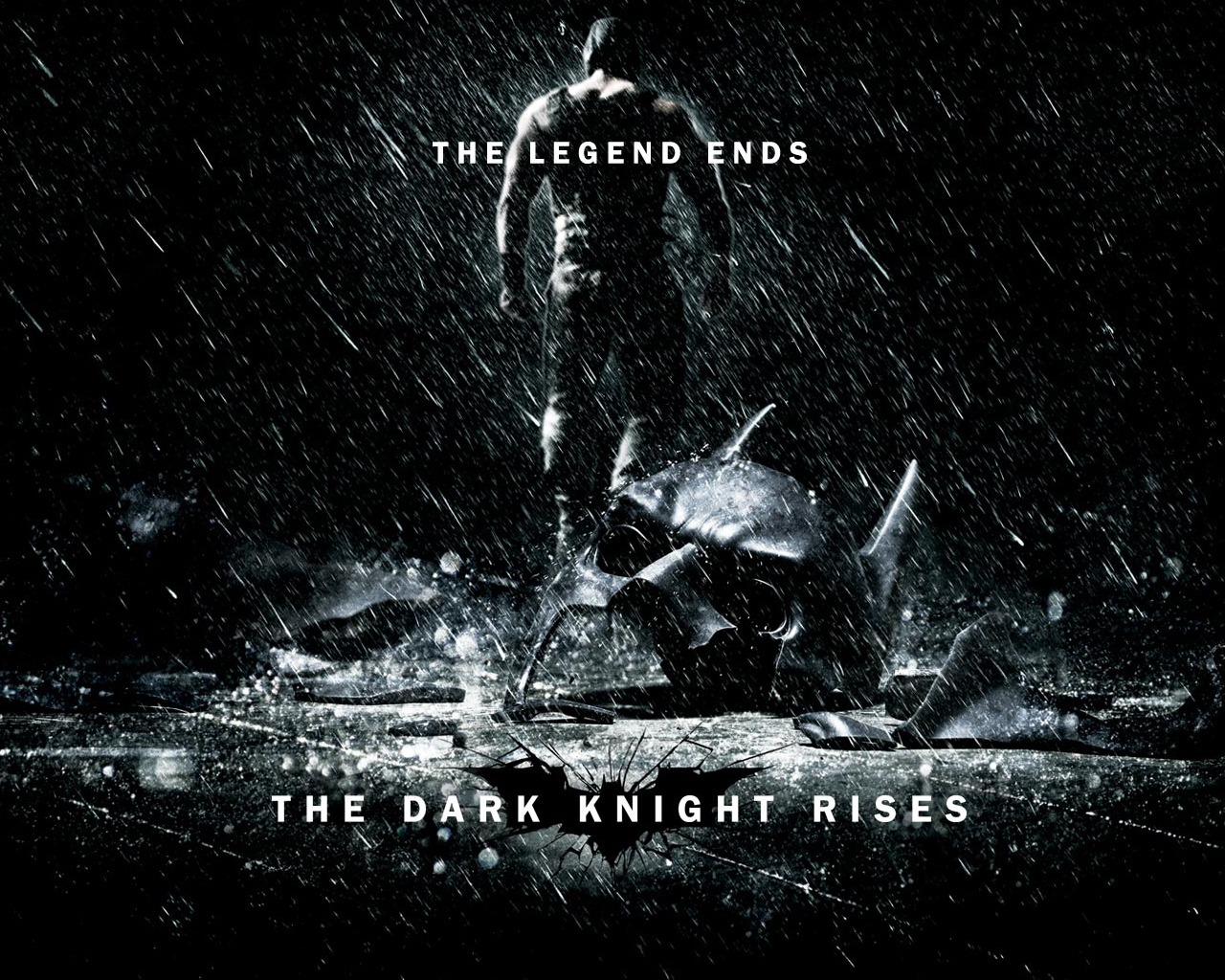 The epic tale begun with Batman Begins


Here’s the last warning: THERE ARE SPOILERS HERE. BIG ONES.
I’m going to eschew giving a plot summary because what I want to contribute to the conversation is a discussion on the themes. If you don’t feel like bothering with the movie, it would be good to at least know about the plot before reading this post. Check here for a brief summary.
Faith
Throughout the movie I kept noticing faith as a major theme. There were those who had maintained faith in a lie: Harvey Dent. Batman had taken the fall for him in The Dark Knight in order to provide Gotham with a needed hero. This faith was misplaced, and Jim Gordon, the police commissioner of Gotham City, almost destroyed himself keeping it inside himself. He said, at one point, “I knew Harvey Dent. I was his friend. And it will be a very long time before someone… Inspires us the way he did. I believed in Harvey Dent.” Yet the whole time Gordon knew he was speaking a lie. He believed in Dent, but he no longer believes in him.
Batman placed his faith in Catwoman/Selina Kyle. He firmly believed that there was more to her than the anger she continually expressed. This interplay was made more interesting by the interaction between Batman’s and Catwoman’s alter egos, Bruce Wayne and Selina Kyle. Selina Kyle, who seemed generally upset with all the rich and famous in Gotham and the decadence found therein–told the rich billionaire Bruce Wayne, “You think this can last? There’s a storm coming, Mr. Wayne. You and your friends better batten down the hatches, because when it hits, you’re all gonna wonder how you ever thought you could live so large and leave so little for the rest of us.” More on the interaction between the two later.
Alfred put his trust in Bruce Wayne. He strongly wanted Wayne to have a satisfying, fulfilling life, and throughout the film he worried that Batman would destroy Wayne. When push came to shove, Alfred was willing to leave Wayne in order to try to save him. Again, more on this later.
Finally, there were those who had faith in Batman. Batman, to them, was more than just a hero, he was a symbol of hope and justice.
One thing viewers should note is that the use of “faith” in The Dark Knight Rises is not some kind of hack definition. It doesn’t mean “belief in the face of insurmountable evidence to the contrary” or “belief in something you know ain’t true.” Instead, faith in the movie is faith in–a trusting faith based on evidence. Those who believed in Harvey Dent were mistaken, but that wasn’t due to evidence, it was active deception. Batman’s faith in Selina Kyle was firmly based on his ability to read her character. Others’ faith in Batman was based upon either a personal knowledge of the secret (Gordon) or knowledge of his actions as Batman (John Blake, others). It is very similar to the faith of the Christian, which is based upon knowledge.
 Rise
Rise
The most obvious theme in the movie was that of “arising.” Bruce Wayne had to overcome his doubts, fears, and become something greater. Yet he had to rely on others to build this journey. The knowledge of his fellow prisoners in ‘the pit’–a prison into which people were thrown, but could climb out. Only one had ever managed it, however, and that was Ra’s Al Ghul’s daughter, who had subsequently saved Bane. Ironically, then, the rise of his enemies forced the Dark Knight to meet their challenge. He had to transcend his limits and become that which Gotham needed in order to save it.
Yet Batman/Wayne wasn’t the only one who rose in the movie. Selina Kyle also experienced a major transition. As a character, she was initially powerfully motivated by anger and a desire to escape. She was portrayed as being very frustrated and angry with the social imbalance of the world and determined to not only try to balance it–in her favor, of course–but also to punish those who made it so imbalanced. When Batman returns to Gotham after his exile by Bane, he confronts Selina. He points out that the storm she predicted earlier has hit, and it doesn’t seem like it was what she wanted. Still, however, she seems determined to be in it all for herself. Yet ultimately she comes back to fight with the Dark Knight against the evil powers that are trying to destroy Gotham. In the end, she does manage to rise, with the guidance and help of Bruce Wayne/Batman.
John Blake–the incorruptible cop–also rose. It is revealed shortly before the film’s end that he is Robin–and that he is about to take up the cowl of Batman, to become the symbol for Gotham. Here, I sensed a feeling of fulfillment. We encourage others to walk in our shoes and left them up when they are down. Without Batman, Blake would not have survived. Yet he goes on to [presumably] become the next Batman, to save others.
Corruption
The world is not all sunshine and daisies. The world is full of corruption and sin. Interestingly, The Dark Knight Rises has much less corruption on the part of the police force than the previous movies. The turn was a noticeable, perceptible shift. As far as the plot goes, I wonder if any of that was due to the “Dent Act” which effectively ended organized crime in Gotham. Despite the relative “cleanness” of the police force, however, there was plenty of corruption to go around. Once Bane overthrows the city, there are “people’s courts” where “justice” is dole out on those already deemed guilty. The prisons are ripped open due to the lie [Harvey Dent] that many were imprisoned by. One wonders, how much of this is justice? Is any of what Bane says true?
Furthermore, it is a powerful reminder of the human condition. Given the chance to rule themselves, Gotham erupted into violence and brutality. It is little wonder that this should happen, given a Christian worldview, because all are sinful and need grace. All deserve justice.
Justice and Freedom
Is there justice? Was Batman just in continuing his adventures as the Caped Crusader? Is violence ever a justifiable means to an end?
Within Christianity there is a long history–traceable to Augustine, at least–of the concept of a “Just War.” There will be much debate over whether the actions of someone like Batman could be justified. Is it ever permissible to take justice into one’s own hands? I leave the question open.
Yet more important questions loom. What is justice? Who is to determine it?
One wonders what worldview could plug these holes that continue to open as human nature is probed by director Christopher Nolan throughout the Batman Trilogy. From the irrational desire to cause fear and anarchy of Scarecrow to the anarchist nihilism of the Joker to the over-reactive retribution of Bane, Nolan has exposed viewers to the depths of human freedom. What price, freedom? Bane tells Gotham he has set them free, yet he has truly imprisoned them by their own nature. What occurs is a vivid portrayal of human nature and destruction.
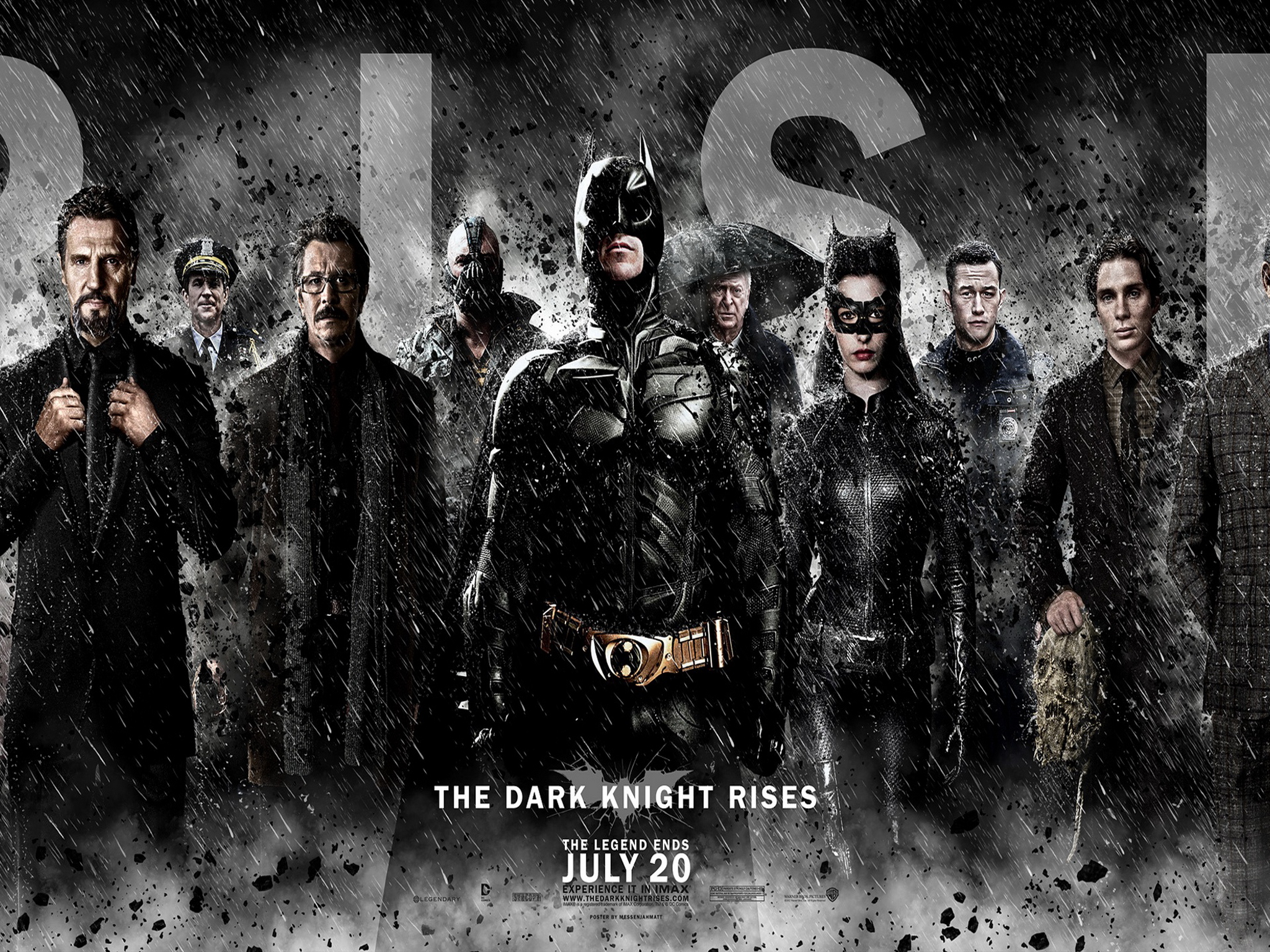 Christian Threads- Redemption and Cleansing
I can’t help but think of Bruce Wayne’s ascension from the pit to the chants of “rise” without thinking of the Christian faith. We sinners are in our own pits of sin. Yet just as Wayne we have a very real lifeline. Yes, Bruce Wayne shunned the physical lifeline, but he clung to an idea: he clung to faith. Similarly, the Christian shuns the physical realm and is saved by faith. Rise.
There is the notion of a “clean slate.” Selina Kyle is primarily motivated by her desire to have such a clean slate. She wants to start over. Batman offers it as a tantalizing price to pay for her help in the final battle. Yet in the end, Selina comes back and redeems herself more than was required by the Bat. At the end of the movie, however, it is revealed that both Bruce Wayne and Selina Kyle have managed to use the “clean slate.” They have started afresh. Again, a Christian allegory or overlay could be applied here. We are all sinners in search of a clean slate, yet we cannot provide it for ourselves. While have no nearly-magical technology to give us a clean slate, we do have salvation by grace through faith. And that, my friends, is something worth considering.
Finally, Wayne’s “rise” coincides with the need I described earlier. The fact that enemies had arisen meant that Batman had to also rise to the challenge. Christians know that once sin came into the world, the only way to cure it would be for God to come into the flesh to save us. Such is poignantly portrayed when Jim Gordon talked to John Blake. Gordon talks about the evils of Gotham and describes how Batman transcends the filth, but he “puts his hands into the filth [with us]” [I believe he says filth, but I have a suspicion it may have been muck–correct me if I’m wrong here]. Wayne, though having no obligation to these people, still loves Gotham, and he is willing to condescend to get his hands dirty–to put his hands into the filthy muck and dirty them in order to save it. Is it an allegory? It certainly works as one. Jesus is God incarnate. A God who loved His creatures so much that He was willing to become one of them–to put his hands into the filth and reach down to save us. Just as Batman did what was necessary to save while also dealing justice, Christ did what was necessary in order to save humanity from its own sin. The Son Rises.
Links
Check out more of my reflections on movies. If you liked The Dark Knight Rises, check out my look at The Avengers.
SDG.
——
The preceding post is the property of J.W. Wartick (apart from citations, which are the property of their respective owners) and should not be reproduced in part or in whole without the expressed consent of the author. All content on this site is the property of J.W. Wartick and is made available for individual and personal usage. If you cite from these documents, whether for personal or professional purposes, please give appropriate citation with both the name of the author (J.W. Wartick) and a link to the original URL. If you’d like to repost a post, you may do so, provided you show less than half of the original post on your own site and link to the original post for the rest. You must also appropriately cite the post as noted above. This blog is protected by Creative Commons licensing. By viewing any part of this site, you are agreeing to this usage policy.
The Presuppositional Apologetic of Cornelius Van Til
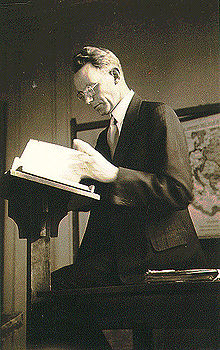 Cornelius Van Til pioneered the field of “presuppositional apologetics” primarily through his works Christian Apologetics

The Presuppositional Apologetic: Theory
Van Til was very adamant that believers cannot and should not give up any ground to those who are non-Christian. He argued that “Christian theism is a unit. Christianity and theism are implied in one another… Christianity can never be separated from some theory about the existence and the nature of God” (Christian Apologetics, 17). Again, he is adamant: “We must defend Christian-theism as a unit” (The Defense of the Faith, 28).
Along with his emphasis on defending Christianity as a unit, Van Til equally impressed the point of the extreme divergence of views between the Christian and the non-Christian. Apologetics must acknowledge the nature of man. Van Til placed particular emphasis upon the notion that apologists cannot ignore that “we shall have to choose between two theories of knowledge. According to one theory God is the final court of appeal; according to the other theory man is the final court of appeal” (The Defense of the Faith, 58). Because of this, “it becomes quite impossible…. [to] agree with the non-Christian in his principles of methodology to see whether or not Christian theism be true” (The Defense of the Faith, 118-119).
The key to understand here is that Van Til does not accept that there is a neutral reason “out there” by which Christians and non-Christians can arbitrate the truth of Christianity; his point is that there is no neutral ground and that one’s presuppositions will determine one’s end point. Again, he writes, “this [apologetic method] implies a refusal to grant that any area or aspect of reality, any fact or any law of nature or of history, can be correctly interpreted except it be seen in the light of the main doctrines of Christianity” (Christian Apologetics, 124).
However, Van Til takes it even further and argues that one must presuppose the truth of Christianity in order to make sense of reality: ” What is the content of this presupposition, then? It is this: “I take what the Bible says about God and his relation to the universe as unquestionably true on its own authority” (The Defense of the Faith, 253); again, “The Bible is thought of as authoritative on everything of which it speaks. Moreover, it speaks of everything” (Christian Apologetics, 19). Thus, Van Til’s apologetic does not make Christianity the conclusion of an argument; rather, Christianity is the starting presupposition.
The presuppositional approach here cannot be stressed enough. For Van Til, one simply cannot grant to the non-Christian any epistemic point. “We cannot avoid coming to a clear-cut decision with respect to the question as to whose knowledge, man’s or God’s, shall be made the standard of the other. …[O]ne must be determinative and the other subordinate” (The Defense of the Faith 62-63).
What place is had for evidences in Van Til? At some points, he seems to be very skeptical of the use of Christian evidences. In particular, the fact that he argues there is no neutral evaluation grounds between the Christian and non-Christian seems to imply that there can be no real evaluation of such arguments apart from Christianity. One of Van Til’s most famous illustrations of the use of evidences can be found in The Defense of the Faith pages 332 and following. He uses three persons, Mr. Black (non-Christian), Mr. Grey (Christian non-presuppositionalist), and Mr. White (presuppositional/reformed apologist):
Mr. Grey… says that, of course, the “rational man” has a perfect right to test the credibility of Scripture by logic… by experience… [Mr. Grey then takes Mr. Black a number of places to show him various theistic evidences. Mr. Black responds:] “you first use intellectual argument upon principles that presuppose the justice of my unbelieving position. Then when it it is pointed out to you that such is the case, you turn to witnessing [subjectively].
…At last it dawned upon Mr. White that first to admit that the principles of Mr. Black, the unbeliever, are right and then to seek to win him to the acceptance of the existence of God the Creator… is like first admitting that the United States had historically been a province of the Soviet Union but ought at the same time to be recognized as an independent and all-controlling power… If one reasons for the existence of God and for the truth of Christianity on the assumptions that Mr. Black’s principles of explanation are valid, then one must witness on the same assumption [which makes witnessing wholly subjective.] (p. 332-339)
It can be seen here that even evidences for Van Til must be based within a presupposition. There is no way to look at evidences in the abstract. One can either offer them within the presuppositions of Christianity or outside of Christianity. For Van Til, once one has agreed to offer evidences outside of Christianity, one has granted the presuppositions of the non-believer, and therefore is doomed to fail.
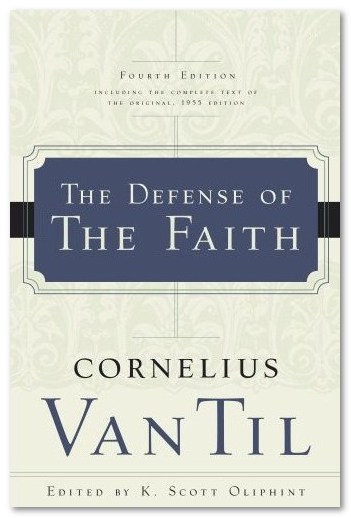 His argument is therefore a type of “transcendental argument.” He argues that only within the Christian worldview can even the rationalism of the unbeliever make sense. Non-Christians may reject belief in God, but this is not a rational rejection, according to Van Til. Rather, “Sin will reveal itself in the field of knowledge in the fact that man makes himself the ultimate court of appeal… Man has declared his autonomy as over against God” (The Defense of the Faith, 58). Mankind is actively suppressing the knowledge of God. “It is not that we are merely brought into existence by God, but our meaning also depends upon God” (The Defense of the Faith, 63).
To sum up Van Til’s apologetic, then, there are three major points:
1) There is no neutral starting point between the Christian and non-Christian. One must presuppose either.
2) Christians should therefore presuppose Christianity in their apologetic and seek to show how only upon Christian presuppositions can one make sense of reality.
3) The transcendental argument: Only if God exists can their be a basis for morality, science, history, and rationality.
Analysis and Application
I admit that I am quite sympathetic to those who argue this type of apologetic is viciously circular. For example, one proponent of Van Tilian apologetics is John Frame. In his defense of presuppositional apologetics, he writes, “Premise 1: Whatever the Bible says is true. Premise 2: The Bible says it is the Word of God. Conclusion: Therefore, the Bible is the Word of God” (Frame, 356, cited below). I can’t help but think that while this argument is deductively valid, using P1 is to beg the question against the non-Christian. But of course, that’s exactly what Van Til urges. One must start with Christian theism and the Bible as presuppositions and reason from there. Therefore, I’m inclined to think that presuppositionalism cannot stand on its own. However, I do think that Van Til’s method can be saved from logical absurdity and made applicable in a part of a “cumulative case” type of reasoning (or certainly, it could be paired with a type of Reformed Epistemology).
The way I would propose for this is to utilize Van Til’s apologetic by showing Christians and non-Christians how philosophical presuppositions can color one’s evaluation of evidence and even of reasoning itself. Instead of offering only evidences or only witness in a vacuum, the Christian apologist should indeed focus upon how one’s presuppositions change one’s evaluation of evidence or witnessing. One presuppositional approach to the problem of evil can be found, I’ve suggested, in Job.
Furthermore, it seems to me that the transcendental argument is extremely potent. By arguing that even the process of reasoning cannot make sense apart from God, Christians can effectively place the burden of proof upon their opponents to show how their system can cohere with reality.
Finally, I can’t help but appreciate the tenacity with which presuppostional apologists, in the spirit of Van Til, pursue incoherent positions and actively turn people back to the presuppositional approach. The presuppositional apologetic, while not necessarily one I think can stand on its own, is extremely powerful.
Conclusion
Reading Van Til leaves me at points breathless with his innovation and boldness; but at other points it leaves me frustrated. He is not easy to understand, nor are his arguments always convincing. Too often, he axiomatically states a position and assumes his argument has carried his point. However, one can hardly dismiss the whole of Van Til’s thought as useless to Christian apologetics. Van Til’s transcendental argument has staying power, and his urges to focus upon presuppositions cannot be ignored.
This is but the first in a series of posts I have planned on presuppositional apologetics. I will be analyzing Van Til’s thought further, as well as diving into some other well-known proponents of presuppositionalism like John Frame, K. Scott Oliphant, and Greg Bahnsen. A few posts will focus on applied presuppositional apologetics.
Sources
Cornelius Van Til, The Defense of the Faith
—-, Christian Apologetics
John Frame, “A Presuppositional Apologist’s Closing Remarks” in 5 Views on Apologetics (Grand Rapids, MI: Zondervan, 2000).
Links [Will update as series continues]
Proof that God Exists– an insightful view of presuppositional apologetics in practice.
Choosing Hats– A mammoth collection of articles from a presuppositional apologetic.
SDG.
——
The preceding post is the property of J.W. Wartick (apart from citations, which are the property of their respective owners) and should not be reproduced in part or in whole without the expressed consent of the author. All content on this site is the property of J.W. Wartick and is made available for individual and personal usage. If you cite from these documents, whether for personal or professional purposes, please give appropriate citation with both the name of the author (J.W. Wartick) and a link to the original URL. If you’d like to repost a post, you may do so, provided you show less than half of the original post on your own site and link to the original post for the rest. You must also appropriately cite the post as noted above. This blog is protected by Creative Commons licensing. By viewing any part of this site, you are agreeing to this usage policy.
The Argument from Religious Experience: A look at its strength
 I have written previously about the argument from religious experience. I provided a brief outline of the argument and commented on its usefulness. Now, I turn to the question of the strength of the argument from religious experience.
[Note: Through this post, when I say “religious experience” I am referring to experience generally–that is, numinous, sensory, and the like. I will distinguish when I mean otherwise.]
The Sheer Numbers
Religious Experience is pervasive throughout human history. You can find accounts of it in the Upanishads, the Vedas, the Qur’an, the Torah, the Gospels, and more. Not only that, but recent, systematized studies have found that religious experience continues to be a part of people’s realm of experience.
Consider David Hay’s study, Religious Experience Today. The book is based upon a number of national and community surveys in the UK. For example, one Gallup poll in Britain in 1987 yielded a response rate of 48% of people saying they had had a religious experience as described by the poll. In 2000, another poll in the UK yielded a 36% positive response. Granted that some of this may be due to false positives, one must also realize that there is a kind of repression of expressing religious experience due to embarrassment and/or personal bias, so these numbers may also lean towards the lower end (Hay, 57ff).
One could also look at the sheer number of luminaries throughout all time who have claimed religious experience. Throughout the literature, such experiences are far too numerous to be restricted to a descriptor like “many.”
One can’t help but agree with Richard Swinburne, who wrote, “[T]he overwhelming testimony of so many millions of people to occasional experience of God must… be taken as tipping the balance of evidence decisively in favour of the existence of God” (Is There a God?, 120).
The Balance of the Scales
“The argument from religious experience” (hereafter ARE) is itself somewhat of a misnomer–there are many forms of arguments from religious experience, so it is helpful to clarify when one is in dialog which version one is using. I have noted elsewhere that the ARE comes in two varieties: one which argues for public belief and one which argues for personal justified belief. There are two more variants to introduce here: the broad version and the narrow version.
1. The Broad Version of the ARE presents religious experience as a general proof for either:
A) the existence of some transcendent realm–this being a transcendent aphysical realm. This is the broadest version of the argument.
B) the existence of God. This is a broader version of the argument, but isn’t as generalized as A).
2. The Narrow Version of the ARE argues for the truth of a particular religion based upon religious experience. Note that this is narrow in that many religions could affirm a “transcendent realm” or the existence of God[s], but if the argument is construed in this fashion, only the religion which is claimed to have superior evidence from religious experience is [fully] true. [Other religions could have many truths which could be affirmed through RE, but only one would have the “full” or “realized” truth.]
 The argument from religious experience is much easier to defend if it is presented broadly. As one narrows the argument, one is forced to deal with potential defeaters from religious experiences which do not accord with the argument being made. For example, if one argues that God exists based upon religious experience, one would have to somehow contend with the great amount of evidence for monistic or Nirvanic religious experience.
Think of the argument like as a bridge with a counterbalance or a scale with a counterbalance. The more weight one places on the argument [i.e. saying that it can justify the existence of God] (scale/bridge), the more one must deal with that weight on the other end (counterbalance).
If the argument is presented as a way to prove general transcendence of experience, it is extremely strong and very easy to defend. When one instead uses the argument to try to justify the truth claims of a specific religion, one then must come up with a mechanism for determining how to evaluate competing religious experiences. For example, if I argue that religious experiences prove Christianity to be true because so many people have experienced in sensory ways Jesus Christ as Lord and Savior, then it is my task to also show that the experiences of, say, Shiva as god are unwarranted. Thus, the philosopher’s task increases in difficulty the more narrowly he presents the arguments conclusion.
Consider the following two conclusions from arguments (granting me authorial privilege to assume that readers can plug in the premises): 1) Therefore, religious experience justifies the belief that there is a realm apart from our mere physical existence; 2) Therefore, religious experience serves as powerful evidence for the truth of Christianity. The fact that 2) is much more narrow means that one must do much more to show that the conclusion is justified.
Does this mean that the argument is useless when arguing for a particular religion? Certainly not. There are many who have used the ARE for a defense of Christianity specifically (cf. William Alston Perceiving God and Nelson Pike Mystic Union). What is important to note is that when one uses the argument in dialog they must be very aware of how they formulate the argument. As a “Broad/public” version, it can serve as powerful evidence in part of a cumulative case for Christianity; as a “narrow/private” version, it can be strong confirmation of the justification of one’s faith. These variants can be used together or separately.
The Strength of the Argument
So how strong is the ARE? I hope I don’t disappoint readers when I respond by saying: that depends! As far as my opinion is concerned, it seems to me that the “broad/public” and “broad/private” version of the argument are nearly irrefutable. I think it is an invaluable tool for apologists and philosophers of religion. The “narrow/private” or “narrow/public” versions of the argument are not as strong by necessity: they must contend with more objections as they narrow. However, as part of one’s own faith life, I think the “narrow/private” and “narrow/public” versions can give great comfort and solace.
[Author’s note: The next post on the argument from religious experience will defend the principle of credulity.]
Further Reading
See my “The Argument from Religious Experience: Some thoughts on method and usefulness“- a post which puts forward an easy-to-use version of the ARE and discusses its importance in apologetic endeavors.
The following books are all ones I have read on the topic but do not present a comprehensive look at literature on the subject.
Caroline Franks Davis, The Evidential Force of Religious Experience
Jerome Gellman, Experience of God and the Rationality of Theistic Belief
Paul Moser, The Evidence for God
Richard Swinburne, Is There a God?
There are a number of other fantastic books on the topic as well. Swinburne’s The Existence of God
William Alston’s Perceiving God
Keith Yandell’s The Epistemology of Religious Experience
Kai-man Kwan’s Rainbow of Experiences, Critical Trust, and God
Nelson Pike provides a unique look at the phenomenology of RE and a synthesis of theistic and monistic experiences in his work Mystic Union
SDG.
——
The preceding post is the property of J.W. Wartick (apart from citations, which are the property of their respective owners) and should not be reproduced in part or in whole without the expressed consent of the author. All content on this site is the property of J.W. Wartick and is made available for individual and personal usage. If you cite from these documents, whether for personal or professional purposes, please give appropriate citation with both the name of the author (J.W. Wartick) and a link to the original URL. If you’d like to repost a post, you may do so, provided you show less than half of the original post on your own site and link to the original post for the rest. You must also appropriately cite the post as noted above. This blog is protected by Creative Commons licensing. By viewing any part of this site, you are agreeing to this usage policy.
The Ontology of Morality: Some Problems for Humanists and their friends

Louise Anthony did indeed present the case for secular metaethics. The problem is that this case is utterly vacuous.
It will be my purpose in the following arguments to show that secular humanistic theories which try to ground moral ontology fail–and fail miserably.
Recently, I listened [again] to the debate between William Lane Craig and Louise Anthony. Some have lauded this debate as a stirring victory for secular ethics. (See, for example, the comments here–one comment even goes so far as to say “I swoon when someone evokes the Euthyphro Dilemma and frown at the impotent, goal-post-moving, ‘Divine nature’ appeal.”) In reality, I think Louise Anthony did indeed present the case for secular metaethics. The problem is that this case is utterly vacuous.
I’ll break down why this is the case by focusing upon three areas of development in secular and theistic ethics: objective moral truths, suffering, and moral facts.
Objective Moral Truths
Louise Anthony and William Lane Craig agree that there are objective moral truths. Now, this is important because many theists take the existence of objective morality to demonstrate–or at least strongly suggest–the existence of God. Interestingly, other humanist/secular scholars have agreed with Anthony, claiming there are objective truths (another example is Sam Harris–see my analysis of his position contrasted with theism here). The question, of course, is “How?” Consider the following:
Louise Anthony seems to be just confused about the nature of objective morality. She says in response to a question from the audience, “The universe has no purpose, but I do… I have lots of purposes…. It makes a lot of difference to a lot of people and to me what I do. That gives my life significance… The only thing that would make it [sacrificing her own life] insignificant would be if my children’s lives were insignificant. And, boy you better not say that!”
Craig responded, “But Louise, on atheism, their lives are insignificant.” Anthony interjected, “Not to me!”
But then she goes on to make this confused statement, “It’s an objective fact that they [her children] are significant to me.”
Note how Anthony has confused the terms here. Yes, it is an objective fact that according to Louise Anthony, her children matter to her. We can’t question Anthony’s own beliefs–we must trust what she tells us unless we have reason to think otherwise. But that’s not enough. What Craig and other theists are trying to press is that that simple fact has nothing to do with whether her children are actually valuable. Sure, people may go around complaining that “Well, it matters to me, so it does matter!” But that doesn’t make it true. All kinds of things can matter to people, that doesn’t mean that they are ontologically objective facts.
It matters to me whether the Cubs [an American baseball team] win the World Series. That hasn’t happened in 104 years, so it looks like it doesn’t matter in the overall scheme of the universe after all. But suppose I were to, like Anthony, retort, “But the Cubs matter to me! It’s an objective fact that them winning the World Series is significant to me!” Fine! But all the Cardinals [a rival team] fans would just laugh at me and say “SO WHAT!?”
Similarly, one can look at Anthony with incredulity and retort, “Who cares!?” Sure, if you can get enough people around Anthony who care about her children’s moral significance, you can develop a socially derived morality. But that’s not enough to ground objective morality. Why should we think that her values matter to the universe at large? On atheism, what reason is there for saying that her desires and purposes for her children are any better than my desires and purposes for the Cubs?
Another devastating objection can be found with a simple thought experiment. Let’s say Anthony didn’t exist. In such a world, there can be no one complaining that her children matter “to me!” Instead, her children just exist as brute facts. How then can we ground their significance? Well, it seems the answer for people like Anthony would be to point to the children’s other family say “Those children matter to them!” We could continue this process almost endlessly. As we eliminate the children’s family, friends, etc. and literally make them just exist on their own, we find Anthony’s answer about allegedly objective morality supervenes on fewer and fewer alleged moral facts. Suddenly “Those children matter to themselves!” is the answer. But then what if we eliminate them? Do humans still have value? The whole time, Anthony has grounded the significance of her children and other humans in the beliefs, goals, and purposes of humans. But without humans, suddenly there is no significance. That’s what is meant by objective morality. If those children matter even without humans, then objective morality is the case. But Anthony has done nothing to make this the case; she’s merely complained that her children matter to her.
Now, some atheists–Anthony and Sam Harris included–seem to think they have answers to these questions. They seem to think that they can ground objective morality. We’ll turn to those next.
Suffering
One of the linchpins of humanists’ claims (like Anthony and Sam Harris) is suffering. The claim is that we can know what causes suffering, and that this, in turn, can lead us to discover what is wrong. We should not cause suffering.
But why not?
Most often the response I’ve received to this question is simply that because we do not wish to suffer, we should not wish to have others suffer or cause suffering for others. But why should that be the case? Why should I care about others’ suffering, on atheism? That’s exactly the question humanism must answer in order to show that objective morality can exist in conjunction with secularism. But I have yet to see a satisfactory answer to this question.
Anthony was presented with a similar question in the Q&A segment of her debate with William Lane Craig. One person asked (paraphrased), “Why shouldn’t I base morality as ‘whatever benefits me the most’?” Anthony responded simply by simply arguing essentially that it’s not right to seek pleasure at the expense of others, because they may also want pleasure.
But of course this is exactly the point! Why in the world should we think that that isn’t right!?
The bottom line is that, other than simply asserting as a brute fact that certain things are right and wrong, atheism provides absolutely no answer to the question of moral objectivity. People like Anthony try to smuggle it in by saying it’s objectively wrong to cause suffering [usually with some extra clauses], but then when asked why that is wrong, they either throw it back in the face of the one asking the question (i.e. “Well don’t you think it’s wrong?”) or just assert it as though it is obviously true.
And it is obviously true! But what is not so obvious is why it is obviously true, given atheism. We could have simply evolved herd morality which leads us to think it is obviously true, or perhaps we’re culturally conditioned by our close proximity to theists to think it is obviously true, etc. But there still is no reason that tells us why it is, in fact, true.
Moral Facts
Anthony (and Harris, and others with whom I’ve had personal interactions) centralize “moral facts” in their metaethical account. As a side note, what is meant by “moral fact” is a bit confusing but I don’t wish to argue against their position through semantics alone. They claim that we can figure out objective morals on the basis of moral facts. Sam Harris, for example, argues that there is a “continuum of such [moral] facts” and that “we know” we can “move along this continuum” and “We know, we know that there are right and wrong answers about how to move in this space [along the moral continuum]” (see video here).
Now it is all well and good to just talk about “facts” and make it sound all wonderful and carefully packaged, but Anthony and Harris specifically trip up when they get asked questions like, “How do we figure out what moral facts are?”
Anthony was asked “How do you determine what the objective moral facts are”, and responded by saying, “We do it by, um, testing our reactions to certain kinds of possibilities, um, thinking about the principles that those reactions might entail; testing those principles against new cases. Pretty much the way we find out about anything” (approximately 2 hours into the recorded debate).
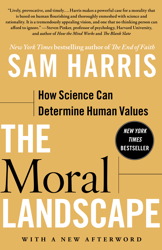 One must just sit aghast when one hears a response like that. Really? That is the way we discover moral truths? And that is the way we “find out about anything”? Now I guess I can’t speak for Anthony herself, but when I’m trying to find out about something, I don’t test my reaction to possibilities and then try to figure out what my reaction “might entail.” That is radical subjectivism. Such a view is utterly devastating for not just morality but also science, history, and the like. If I were to try to conduct scientific inquiry in this manner, science would be some kind of hodgepodge of my “reactions” to various phenomenon. Unwittingly, perhaps, Anthony has grounded the ontology of her morality in the reactions of people. But this error isn’t restricted to Anthony. Harris also makes this confounding mistake. His basic argument in the talk linked above is simply, “Science can tell us what people think about things, so it can tell us about morality.” This is, of course patently absurd. Suppose I tried to test these humanists’ theories on groups of people by sticking them in a room and having them watch all kinds of things from murder to the rape of children to images of laughter and joy. Now suppose I randomly sifted my sample among the population of the world, but somehow, by pure chance, got a room full of child molesters. As I observe their reactions, I see they are quite joyful when they observe certain detestable images. Now, going by Anthony/Harris’ way to “find out about anything” and thinking about what these people’s reaction entails, I conclude that pedophilia is a great good. But then I get a room full of parents with young children, who react in horror at these same images. Then, as I reflect on their reactions, I discover that pedophilia is a great evil. And I repeat this process over and over. Eventually, I discover that the one group was an aberration, but it was a group nonetheless.
What does this mean?
Quite simply, it means that both Harris and Anthony haven’t made any groundbreaking theory of ethics. Rather, they’ve just made a pseudo-humanistic utilitarianism. They ground moral ontology in our “reactions” to various moral situations. The only way for them to say something is morally wrong if people have different reactions is either to go with the majority (utilitarianism) or choose one side or the other, which essentially turns into a kind of Euthyphro dilemma against atheists. Either things are wrong because enough people think they’re wrong (in which case morality is arbitrary) or things are wrong because they simply are wrong, period (in which case the humanist has yet to provide an answer for moral ontology).
Conclusion
Given the discussion herein, one can see that those atheists, humanists, and/or secularists who desire to ground objective morality still have a lot of work to do. Louise Anthony’s best attempt to ground morality boils down into radical subjectivism. Sam Harris’ account fares no better. Those who are trying to ground objective morality within an atheistic universe will just have to keep searching. The solutions Anthony and Harris have attempted to offer are vacuous.
Image Source:
http://commons.wikimedia.org/wiki/File:SecularHumanismLogo3DGoldCropped.png
SDG.
——
The preceding post is the property of J.W. Wartick (apart from citations, which are the property of their respective owners) and should not be reproduced in part or in whole without the expressed consent of the author. All content on this site is the property of J.W. Wartick and is made available for individual and personal usage. If you cite from these documents, whether for personal or professional purposes, please give appropriate citation with both the name of the author (J.W. Wartick) and a link to the original URL. If you’d like to repost a post, you may do so, provided you show less than half of the original post on your own site and link to the original post for the rest. You must also appropriately cite the post as noted above. This blog is protected by Creative Commons licensing. By viewing any part of this site, you are agreeing to this usage policy.
Christian Reflection on The Hunger Games Trilogy
 I devoured the entire Hunger Games Trilogy
I’ll give my thoughts on the overall plot and what I take as the meaning in the books, from my own Christian perspective. I provide a brief look at things Christians can take from the books, as well as a discussion of the ethical theory one could see in the books.
This post focuses first on the reflections, and readers who don’t know the plot should read my summary before reading that section. Next, I briefly outline some content for parents. Third is my summary of the trilogy. Finally, I share a few interesting links, including one which I think will be very useful for Christian parents wondering if these are appropriate for their children.
WARNING: MAJOR SPOILERS INCLUDED BELOW
I’ll first present my reflections, and follow it with a brief note for parents. Those who haven’t read the books and aren’t planning to do so can read 3. Summary for a broad summary of the plot. There are spoilers in the reflections section, so readers who don’t want to have anything spoiled should abstain from reading this post and perhaps just read the one linked above.
1. Reflections
[I have had the wonderful pleasure of interacting with many thoughtful Christian on this trilogy and found that there is so much more to the books than I could delve into here. Please see the links at the end for more reflections.] Initially, as I reflected on The Hunger Games Trilogy, I felt that the biggest issue was that there didn’t seem to be a major point to it beyond entertainment. I asked to be corrected, and I was. Many people commenting on this post have shared incredible insights. For the Christian reflecting on the Hunger Games, one can see it as a commentary on the horrors done to children in our time (Audra Franz below brings up this excellent point), a stunning condemnation of relativistic ethical theories (see A.T. Ross’s link), a narrative of Christian martyrdom, a critique of poor moral decisions, a horrible look at a nihilistic worldview, and more. In other words, there are any number of things Christians reflecting on the Hunger Games Trilogy can take away from the series. As such, I’ve lengthened this post a bit to take more of this into account.
I’ve been perplexed by Katniss’ decision to vote to hold a Hunger Games for the children of the leaders of the Capitol. Now, upon further consideration, I have to agree with the astute reader whose idea I put forward below, but I’ve left my original view untouched here [see the last few sentences two paragraphs down]. Consider the following passage in which they are voting on this very issue (p. 370 of Mockingjay):
Was it like this then? Seventy-five years ago? Did a group of people sit around and cast their votes on initiating the Hunger Games? Was there dissent? Did someone make a case for mercy that was beaten down by the calls for the deaths of the districts’ children? …All those people I loved, dead, and we are discussing the next Hunger Games in an attempt to avoid wasting life. Nothing has changed. Nothing will ever change now…. I say, “I vote yes… for Prim.”
I’m just honestly confused by this passage and Katniss’ decision. The vote was, according to her and Coin, a way to avoid losing more life. Some want to kill everyone in the Capitol, while others think they should just integrate with them in order to help stabilize the population. These last Hunger Games were proposed as a solution–a middle ground. But it seems to me they don’t serve a middle ground, just another atrocity. And Katniss seemed to realize that, but voted yes anyway. It is unclear that these Hunger Games ever take place, however, because shortly after making this decision, Coin is killed by Katniss and it’s uncertain as to whether an announcement is ever made. One reader gave me an interest comment on this–that it seems Katniss’ vote for the Hunger Games was, in fact, a ruse to lure Coin into the open so she could take her down. This gains credence when one considers that she says “for Prim”–even though she knew it was not Capitol people, but rather Coin, who killed Prim. On such a view, her utterance of “for Prim” is ironic, and indeed may have been intended to show Haymitch what Katkniss was planning. This makes more sense to me. My thanks to the astute reader!
The world in the Hunger games is stark. It is real, and one can’t help but be drawn into it while simultaneously feeling repulsed. Perhaps that was Suzanne Collins’ point, however. There isn’t always a triumph. Sometimes it’s just bitter reality. The trilogy ends on a happy note, but the overall scheme is one which forces the reader to reflect.
So what do I take from the Hunger Games trilogy? I readily admit my worldview does permeate my thought, and the main thing I took from the trilogy is the sinful condition of humanity. Katniss acknowledges it, noting that it could be better to allow some less sadistic species take over. As I already said, there is a fairly happy ending, but looking at the state of Panem and the world–there has been war after war, there’s no clear idea that the totalitarian government hasn’t just been replaced by another under the guise of democracy, children are killed, and a “compromise” to prevent more death is to send the Capitol’s children to fight to the death once more. The sinfulness of the human race, it seems, is at the forefront. And I think that’s why I long for more in the Hunger Games–I long for that comfort of the Redeemer. There seems to be no hope in the books that things will be made right, only that eventually, the nightmares may get better. Having the comfort of redemption and hope, I can’t help but wish for that in the world of Panem–a Redeemer to come and wash away the tears. And so, because there is no such Redeemer, I see the stories as a reflection of the brutal reality of a world without God. In such a world the best that can be hoped for is that the nightmares may one day end; that children may have a better life than their parents. But ultimately, it is a hard reality, one in which there is no true hope, no way to atone for past wrongs. Perhaps that is the central message of the books, or perhaps I am reading my own worldview onto it. Either way, I find this central message compelling.
Some have expressed concern that the Hunger Games express moral relativism. A.T. Ross has an excellent discussion of this on his site. The books themselves never present a moral theory–obviously that is not their intent–but they certainly do not seem to espouse moral relativism. It is clear throughout that the government’s actions are quite evil and that killing, sexual exploitation, and the like are all wrong. Ross notes that some have complained that it seems all the actions are up to chance. The phrase used in Panem is “May the odds be ever in your favor.” But Ross has astutely pointed out that no fictional character ever survives by chance. There is an Author who guides and directs their destinies. As Ross says, “The world operates on grace whether we like it or not; what we see as luck is nothing more than a tiny slice of divine grace offered in the form of survival and the tensions of the story resolving.”
But the Hunger Games, as noted below in the comments, can also be seen as a critique of our own world and our abuse of our children. In our world, children are sold for sex, they are forced to fight, they are fearful for their next meal, just as they are in the Hunger Games. Collins has poignantly potrayed the reality of our own world in the fictional realm of Panem.
A final thought is that Christians can definitely see parallels between the Hunger Games and the plight of the first Christians as they were forced to battle wild animals in Rome. There are a great many parallels here, and I can’t help but think some of this may be intentional. I’m not suggesting Collins is Christian–indeed, I don’t know what faith (if any) she professes. But I do think that the Hunger Games trilogy brings in many concepts from Christianity–the hopelessness of life without God, the objective wrongness of certain actions (and one’s requirements to act against them [provided the alternative reading of Katkniss’ vote]), and even an allusion to the Christian’s martyrdom in the arena. These all provide significant talking points for Christians throughout the series. The books are not overtly Christian, but they can open up conversations about these topics, and that, in itself, makes them worth reading in my opinion.
Thus, it can be seen that even though the Hunger Games Trilogy is not explicitly Christian, Christians who are interested can take all kinds of talking points away from it. Parents will find much to discuss with their children, and readers who are simply interested in the series will be unable to keep themselves from earnestly reflecting on the series afterwards. My own thoughts have been wonderfully shaped by readers who have shared their comments, so please keep them coming. It is clear that the Hunger Games can captivate Christians and have us look at the world through the eyes of faith–observing what is wrong and praying for God’s aid as we turn to those problems highlighted in the series. Most of all, we have the message of redemption, which is notably absent in the series–a message which is necessary to avoid the nihilistic collapse of Panem.
2. Brief note for Parents
Parents interested in the Hunger Games should know the series is very violent and depicts the death of children in sometimes graphic detail. While not explicit, there is some sexual exploitation involved as well (again, it is never explicit, but it can easily be drawn out from the text that is there). These are not books for young children. Please see 3. Summary for more details about the plot itself to hopefully help decide whether it is for your children.
 3. Summary
Katniss Everdeen narrates the series from a first-person perspective. The Hunger Games is an annual tournament in which the Capitol collects 2 children from the 12 districts of Panem–the mini-country that has risen from the dust of several wars–and makes them battle to the death. Only one of the 24 children will survive. Why does the Capitol do this? Because about 74 years ago, the districts revolted against the Capitol. The Capitol won and the Hunger Games serve as an annual reminder of the Capitol’s might. The Hunger Games are aired on national television and everyone in Panem is required to watch their children die. There are interviews and extensive coverage of the event.
In the first book, The Hunger Games, Primrose, Katniss’ sister, is selected to compete in the Hunger Games. Katkniss almost immediately volunteers to take her place–she can’t watch her sister die. Gale, her friend and hunting partner for years, agrees to take care of her family. Peeta, a boy who had saved Katkniss’ life by giving her food some years ago, is the male selected from District 12, their home. They get shipped to the Capitol, where they begin to gain popularity due to their stylist, Cinna, and their story of hopeless lovers. Peeta told everyone at an interview that he loved Katniss and she plays that up in order to get gifts from “sponsors”–people who like certain children and pay to send food, weapons, medicine, and the like to them while they’re in the Hunger Games arena. As children die and are killed (including Katniss’ ally, Rue), it becomes apparent that Peeta and Katniss may be among the last few. The Capitol changes the rules to allow two to survive if they are the last ones and from the same district. Katniss finds Peeta and nurses him back to health, pretending to love him the whole time (and occasionally feeling very real about it). They end up barely surviving, but then the Capitol decides to change the rules back so they must fight to the death. They are about to kill themselves when the Capitol stops them and allows them both to win.
It turns out Peeta wasn’t pretending about his love, but Katniss was. The Capitol is furious that they were outwitted by the attempted suicide, and Peeta and Katniss are in danger. The book ends with Katniss in confusion about her interests in Peeta, and Peeta totally disappointed.
Catching Fire picks up a few months later and highlights the political drama playing out as President Snow and the Capitol are still furious that Peeta and Katniss both survived. The year is the 75th Hunger Games and in it, they select victors. Peeta and Katniss once more go to the Games. There is more to the Games than meets the eye, however, and Katniss and Peeta are part of a bigger scheme now to overthrow the Capitol. Katniss is confused about her feelings for Peeta and Gale. During the Games, Katniss is rescued and transported to the previously thought-destroyed District 13. District 12, her home, has been bombed to rubble. There are revolts happening across Panem.
In Mockingjay, Katniss must decide whether to help District 13 unite the Districts against the Capitol. Eventually she does and the revolution begins to take over district-by-district. District 13’s own motivations are unclear and it’s not certain they are any better than the Capitol in some ways. Their leader, Coin, is particularly unforgiving. Peeta has been tortured and tries to kill Katniss due to brainwashing, but through the course of the book he is rehabilitated and begins sorting his false memories from his true ones. It becomes apparent Coin doesn’t like the political clout Katkniss has as the “Mockingjay”–honorary leader of the rebellion. Katniss continues to go after President Snow, determined to kill him for his atrocities. Eventually, she reaches his estate and witnesses the killing of dozens of children with a secret weapon that only the Rebellion knows about. Snow is captured.
Katniss votes to put the Capitol’s leaders’ children in one final Hunger Games as retribution[? see more on this in my reflection] for their crimes. She and Coin had agreed to allow Katniss to kill Snow, and she is about to when she shoots Coin instead, due to Coin’s involvement in murdering other children. Katniss is pardoned for temporary insanity, and goes home to District 12. Eventually she and Peeta get together and the book ends with them having children despite Katniss’ fear that some great evil will come upon them.
4. Links
“Catching Fire”– A Christian reflection on the film. I review a number of themes found in the movie “Catching Fire” and tie them back to the message of Christianity and social justice.
Please check out my other writings on movies and books. For starters, if you liked The Hunger Games you may want to check out John Carter.
Christian Children’s Book Review- Check out this review of the series to get more specific information parents may want to consider as they think about getting these books for their children.
The Hunger Games, Ethics, and Christianity– A very interesting look at moral relativism and realism in The Hunger Games.
The Hunger Games: Focus on the Family– Essentially a book review of the first book, The Hunger Games, with an emphasis on issues Christian parents might have with it. I don’t agree withe everything here, but I think the talking points they’ve provided for parents are pretty interesting.
Hungering for Satisfaction– a poignant look into the Hunger games. “Real or unreal?”
Deeper Hungers and Darker Games– The Hunger Games reflects a world without God. What does it mean?
The Hunger Games: The Atheist’s Utopia– No God: Utopia?
SDG.
——
The preceding post is the property of J.W. Wartick (apart from citations, which are the property of their respective owners) and should not be reproduced in part or in whole without the expressed consent of the author. All content on this site is the property of J.W. Wartick and is made available for individual and personal usage. If you cite from these documents, whether for personal or professional purposes, please give appropriate citation with both the name of the author (J.W. Wartick) and a link to the original URL. If you’d like to repost a post, you may do so, provided you show less than half of the original post on your own site and link to the original post for the rest. You must also appropriately cite the post as noted above. This blog is protected by Creative Commons licensing. By viewing any part of this site, you are agreeing to this usage policy.

 J.W. Wartick - Reconstructing Faith
