Pro-Life
Abortions rates are lower in countries where it is legal- some thoughts on recent pro-choice comments
Highly restrictive abortion laws are not associated with lower abortion rates. For example, the abortion rate is high, at 29 and 32 abortions per 1,000 women of childbearing age in Africa and Latin America, respectively—regions where abortion is illegal under most circumstances in the majority of countries. In Western Europe, where abortion is generally permitted on broad grounds, the abortion rate is 12 per 1,000. ( Sedgh G et al. cited below)

There it is in black and white. Countries in which abortion is illegal have higher rates of abortion in most cases. What does this mean for the pro-life argument? Some have argued that pro-life advocates should work to make abortion legal. For example, Margot Magawan writes, “It’s clear that top Republican candidates are being short-sighted and ineffective, rushing off in precisely the wrong direction if their goal truly is to reduce abortions.” The argument seems to be quite simple. After all, if the goal of the pro-life advocates is to reduce the number of abortions, then if making it legal reduces them, they should argue to legalize abortions.
There are a number of problems with this argument, however, and I’ll briefly list them before examining them in turn.
1. Those making this argument seek to compare countries unilaterally based on a situation with all kinds of factors which cannot possibly be weighed fairly.
2. The argument reduces the goal of the pro-life movement to reducing abortions only; but the movement has a broader range than that. The argument is susceptible to a reductio ad absurdum which shows that the premise on which it is based is absurd.
3. The argument begs the question against the pro-life position by assuming the position itself is false.
3. The argument assumes consequentialism as a metaethical theory without argument.
1. Comparing Countries Unilaterally
It seems strange to me to compare the situations of different countries unilaterally on an issue like this. For example, it seems to have been shown that many things cannot be compared in this way. Installing democracy into random countries does not have a stabilizing effect. Comparing the economic situation of Rwanda with that of the United States seems almost grotesque. I’m not disputing the results of the study cited above; rather, I’m disputing the application of those results to a moral sphere. Think of all the factors which must be weighed: economic status, education, career choices, etc. To then take the raw data and apply it to a moral sentiment is quite a stretch. After all, it doesn’t take into consideration all the factors that those countries in which abortion is legal may have.
I do not want to make this the focus of my rebuttal, however, because I think the next 3 points are much stronger. To those we shall now turn.
2. Is Pro-Life About Reducing Abortions?
Another problem with the argument is that it assumes the pro-life position is dedicated to reducing abortions. That sentence may seem strange on a first reading, but read it this way instead: “the pro-life position is dedicated to reducing abortions only.” That is where one of the major difficulties arises for those making this argument. The pro-life position is not only about reducing abortions. In fact, while reducing the number of abortions is a goal of the pro-life movement, that is not the only goal or even, perhaps, the highest goal.
Suppose that reducing abortions was the only goal of the pro-life candidate. In that case, one way to reduce abortions would be by eliminating all human beings. If, after all, not a single human being were alive, there would be no abortions! This is, of course, patently absurd. Why? Not just because it seems obviously wrong to murder everyone on earth (or to murder anyone) in order to reduce the number of abortions, but also because this is a gross reduction of the pro-life position.
The pro-life position isn’t just about reducing the number of abortions. It is about advocating for life. In other words, those in the movement are making a factual and a moral claim: the entities aborted are human persons and it is wrong to kill them. But those who want to make the argument that pro-life advocates should legalize abortions in order to reduce them are, on a pro-life view, essentially arguing something similar to this:
Suppose that making murder legal reduced the number of murders. If you are against murder, you should then legalize murder.
The absurdity of this argument becomes clear because no one but a psychopath wants to legalize murder. But then it becomes clear that those pro-choice people making this argument have begged the question against the pro-life person. Let’s turn to that.
3. The Argument Begs the Question
If the pro-life position is correct, then it makes a mockery of this argument. Suppose, for the sake of argument, that the advocate of the pro-life position is right: the unborn are not merely embryos (and other stages of development) but are rather human persons who deserve the same rights as people outside of wombs. Now, granting these assumptions, suppose one finds that legalizing abortions reduces them. To then argue that “we should legalize abortions to reduce their number” is exactly equivalent to arguing that we should legalize murder to reduce the number of murders. Note here that I’m not saying legalizing murder does reduce the number of murders; I’m arguing that if the pro-life position is correct, these arguments are exactly analogous. One who argues we should legalize abortions would be the same as one who argues we should legalize murders, if the pro-life position is correct.
Thus, it becomes clear that those who make an argument like that of Margot Magawan have begged the question against the pro-life position. They simply assume that it is morally permissible to have an abortion, and combine that with the false position that the pro-life position is only about reducing abortions. Thus, the argument fails because it begs the question. Without argument, the pro-choice advocate has caricatured its opposition and argued against this false image.
4. It assumes consequentialism.
The last rebuttal is more technical, but I want to keep it brief. Consequentialism is, basically, the position that it is not the status of actions themselves which are judged as moral but rather the consequences. If one takes an action which has morally good consequences, that action is deemed good.
Now consider once more the argument, “If your goal is to reduce abortions, you should legalize them [because if abortion is legal, the number is reduced].”
This argument doesn’t take into consideration the moral status of an abortion [again, see above: they’ve already begged the question]. Rather, it assumes that because the consequences (fewer abortions) are considered by pro-life advocates as morally good, they should take the action (legalizing abortions) which open the door for these consequences.
Without too much strain, it becomes clear that most pro-life advocates do not hold to consequentialism as a metaethical theory. There are many alternative metaethical theories which are preferable for any number of reasons. If a pro-life advocate holds to a deontological theory of ethics, for example, he will argue that the wrongness of abortion is outweighed by the benefits of reducing the number. Such examples could be multiplied almost beyond comprehension. Thus, the pro-choice advocate has assumed, again without argument, a controversial position and then utilized that position to argue against pro-life advocates. Therefore, the argument fails.
Conclusion
The argument which has been considered here is that “if the goal of the pro-life advocates is to reduce the number of abortions, then if making it legal reduces them, they should argue to legalize abortions.” I have rebutted this argument in four ways. First, it seems to trivialize the enormous amount of factors which must go into consideration of comparing abortion rates across countries. Second, it reduces the pro-life position almost beyond recognition and is susceptible to a reductio ad absurdem. Third, it begs the question. Fourth, it utilizes a controversial metaethical theory to justify its premise. For these four reasons, I conclude that the argument is unsound.
Source
Sedgh G et al., “Induced abortion: incidence and trends worldwide from 1995 to 2008,” Lancet, 2012. (accessible: http://www.thelancet.com/journals/lancet/article/PIIS0140-6736%2811%2961786-8/fulltext); summary: http://www.guttmacher.org/media/presskits/abortion-WW/statsandfacts.html.
Image Credit: http://commons.wikimedia.org/wiki/File:Prolife-DC.jpg
SDG.
——
The preceding post is the property of J.W. Wartick (apart from citations, which are the property of their respective owners) and should not be reproduced in part or in whole without the expressed consent of the author. All content on this site is the property of J.W. Wartick and is made available for individual and personal usage. If you cite from these documents, whether for personal or professional purposes, please give appropriate citation with both the name of the author (J.W. Wartick) and a link to the original URL. If you’d like to repost a post, you may do so, provided you show less than half of the original post on your own site and link to the original post for the rest. You must also appropriately cite the post as noted above. This blog is protected by Creative Commons licensing. By viewing any part of this site, you are agreeing to this usage policy.
Really Recommended Posts 3/3/12
 The really recommended posts this go-round feature Richard Dawkins, bioethics, philosopher’s opinions, women in the ministry, and more!
Arguments about Jesus’ resurrection are fascinating, and can be extremely useful in the question of theism. See this great article which features rigorous application of probability theory to the arguments from the resurrection.
Richard Dawkins’ book, The Greatest Show On Earth claims to show the undeniable evidence for evolution. Does it succeed? Jonathan Mclatchie does not think so and has written an excellent, lengthy review to show how Dawkins fails.
Philip Payne, the author of “Man and Woman, One in Christ” (which I reviewed here) has an excellent web site which responds to many criticisms of his positions. Those interested in the issue of women in the ministry should look into it.
No peer reviewed papers advocating intelligent design? False! Check out this list.
After birth abortions? Basically the logical conclusions of the general pro-choice position. Read more.
Prosblogion conducted a survey about philosopher’s opinions on theistic arguments. The results are mostly unsurprising, but interesting nevertheless. Check it out.
The Issue at the Heart of the Abortion Debate
 I’m going to make what may initially seem to be contentious statements, so read the post to contextualize:
If the unborn is not a person, then abortion is morally permissible, and it doesn’t matter what you do with the unborn.
If the unborn is a person, then abortion is morally impermissible, and the unborn must be protected.
Note that these statements are conditional, marked by the word, “If.”
Why would I make these statements? Simply because I want to clarify the issue that is at the heart of the abortion debate. Namely, the status of the unborn.
Consider the following arguments in favor of the pro-choice position:
We shouldn’t bring unwanted fetuses into the world. It’s better to abort fetuses than force a woman to have an unwanted child.
If a mother can’t afford to have a child, she shouldn’t be forced to continue her pregnancy.
Women’s rights are at stake: it is a woman’s body we’re talking about!
Now, let’s contextualize them. Rather than debating the viability of these arguments, suppose we plug in the case in which we all agree there is a “person” involved. Suppose in place of the “unborn” or “fetus” we put “toddler” into the argument. In that case, the arguments would be:
We should kill unwanted toddlers. It’s better to kill them than to have them live in homes where they are unwanted.
If a woman can’t afford to feed her toddler, we should kill it.
Women’s rights are at stake! Think of the drain toddlers place upon their mothers!
These arguments are clearly absurd. Why? Because we all know that we can’t just go around killing children because their families don’t want them. We can’t kill toddlers because their families can’t afford to feed them. But that’s exactly the question these types of arguments beg: what is the unborn?
And so we return to the statements at the beginning of this post. Suppose the unborn is, in fact, just a cluster of cells, no different from a wart or growth. In that case, I would agree it is perfectly permissible to discard of the unborn whenever a woman desires.
But then, what if the unborn is, in fact, a “person”? What if the unborn is a baby after all? Well, in that case, it is certainly not permissible to discard of the baby.
The fact is, many arguments raised in favor of the pro-choice position are made from a position where one simply assumes that the fetus is no more than a clump of cells. But that’s exactly what the debate is supposed to be about! If the fetus is no more then a clump of cells, the debate is over. But if the fetus is indeed a person, then the arguments raised in favor of the pro-choice position are just as shoddy as those arguments with “toddler” substituted in for “unborn” or “fetus.”
Thus, arguments like this must always be contextualized. The heart of the abortion debate is the status of the unborn. Once that question is answered, the answer to the question: “Is abortion permissible?” becomes crystal clear.
For arguments against abortion, check out my Pro-Life Page. Specifically, one can find my arguments for the personhood of the fetus here.
Scott Klusendorf does a simply phenomenal job of centralizing this issue and pointing out how most of the issues which cloud the debate can simply be dropped in favor of debating the status of the unborn. The arguments presented here are based upon his tactic “trot out the toddler” which one can find in his book, The Case for Life or in his lectures in Ethics at the Edge of Life (found in the links here).
SDG.
——
The preceding post is the property of J.W. Wartick (apart from citations, which are the property of their respective owners) and should not be reproduced in part or in whole without the expressed consent of the author. All content on this site is the property of J.W. Wartick and is made available for individual and personal usage. If you cite from these documents, whether for personal or professional purposes, please give appropriate citation with both the name of the author (J.W. Wartick) and a link to the original URL. If you’d like to repost a post, you may do so, provided you show less than half of the original post on your own site and link to the original post for the rest. You must also appropriately cite the post as noted above. This blog is protected by Creative Commons licensing. By viewing any part of this site, you are agreeing to this usage policy.
The Pro-Life position and the Bible
 We are currently in the time of the year known as “40 Days for Life.” During these 40 days (as well as the rest of the year), it is important to focus on issues related to the beginning of life. The Bible has much to say about the topic.
A survey of the Bible can reveal many verses which can be used for the pro-life position. I will focus upon a few (verses in ESV). I will outline how they argue for the pro-life position, how a pro-choice Christian might respond to them, and a rebuttal or concession based upon their response.
Jeremiah 1:5- “”Before I formed you in the womb I knew you,and before you were born I consecrated you;I appointed you a prophet to the nations.”
Here we see that God called Jeremiah to be a prophet before he was born. In other words, even before his birth he was valuable to God, to the point of being called as a prophet. One interesting counter to a verse like this would be to hold that all it is saying is that God knew about Jeremiah from eternity, so the “before” is being used here as logical priority as opposed to temporal priority. I think this objection has some merit, so perhaps this verse isn’t as strong as it seems. I looked up the Hebrew in this verse and it seems to me that the first clause may be referencing pre-ordination, however the verb is not in the right form (Pual) to make this certain, and so the first clause may be referencing a process of forming not yet completed (which would mean the verse suggests God is interacting with a person before that person is born). The word “before” here, however, again could be said to note that the verse is talking about pre-ordination even though the verb doesn’t necessitate that reading. I tend to lean towards the pre-ordination meaning, but not as the only possibility. However, the second clause is even stronger because it talks about “consecrating,” and that word seems to entail the existence of something to be consecrated. Thus, it would mean that Jeremiah would have had to exist in order to be consecrated while in the womb, before being born.
There is a more powerful verse on this topic to be found:
Luke 1:15- “for he [John the Baptist] will begreat before the Lord. And he must not drink wine or strong drink, and he will be filled with the Holy Spirit, even from his mother’s womb.”
Here there is no question of the verse just being God’s knowledge of John the Baptist’s prophetic call before his birth, rather, God will fill him with the Holy Spirit, even while John is in the womb. In other words, before he is born, John will be empowered by God. I don’t see how a pro-choice response could get around this. That John will be filled with the Spirit before his birth is a powerful argument for the pro-life position from Scripture because it would mean John would have to be capable of being filled. Pro-choice Christians often have to fall back to saying the unborn aren’t “persons”, but that would be impossible here, for why would the Holy Spirit fill a being which is impersonal?
Psalm 51:5 states: “Surely I was sinful at birth, sinful from the time my mother conceived me.” It would seem to be quite absurd for someone who is not a person to be sinful. Pro-choice Christians who argue that the unborn is not a human person are placed in a very difficult position by this verse. It quite clearly states that from conception a person is sinful. Without personhood, one cannot sin. One must have the capacity to be sinful in order to sin. It would seem very odd for the pro-choice Christian to have to say an impersonal ‘blob of cells’ is capable of sinning.
There are many verses which point to God forming us in the womb (i.e. Job 31:15; Isaiah 44:2; and Psalm 139:13-16). These verses could be seen as supporting the pro-life position. However, the pro-choice Christian may respond by saying that it does not follow that just because God makes us in our wombs, we exist as persons in the womb or that we are inherently valuable in the womb. The counter to this argument is that the verses do not make sense otherwise. For if it were true that all the verses were pointing out were God’s creative activity, then much of the sense of the verse would be lost. In the Isaiah passage, for example, God is talking about His interaction with the nation of Israel, the implication is that because he formed them in the wombs, they are loved by Him–His creative act was an act of love to His people. So it would seem these verses must be understood as pointing towards the value of the baby in the womb, as opposed to a mere observation of God’s action.
But there are more sophisticated arguments against abortion that can be drawn from the Bible. I wrote elsewhere on Exodus 21:22-25, which has interestingly been used by pro-choice Christians to say their position is correct:
“If men who are fighting hit a pregnant woman and she gives birth prematurely but there is no serious injury, the offender must be fined whatever the woman’s husband demands and the court allows. But if there is serious injury, you are to take life for life, eye for eye, tooth for tooth, hand for hand, foot for foot, burn for burn, wound for wound, bruise for bruise.” Some believers use this passage to state that it shows the unborn fetus has a lesser status of personhood. They state that verse 22 shows that though the woman loses the child, she sustains no injury, and the penalty is but a fine. They say that this, then, shows that the fetus does not demand the same repercussions as hurting a fellow human (Feinberg 63). There are several problems with this interpretation, however. First, it must be stated that even if one is to concede this interpretation [which is incorrect], it does not authorize abortion. The baby is not intentionally harmed in any manner, but only unintentionally hurt. Second, just the fact that there is a penalty shows that there is wrongdoing here. If the fetus something that may be discarded at will, why is there even a fine for its destruction? Third, the reason the fetus’ death does not require the death penalty is in keeping with the Mosaic exception to the death penalty in cases of accidental death (Exodus 21:13-14, 20-21, Numbers 35:10-34, Deuteronomy 19:1-13). Therefore, the fact that there is “merely” a fine does not show that the fetus is less valued. Finally, it absolutely must be noted that Exodus 21 states various penalties for the killing of individuals that cannot be explained away with personhood. For example, verses 20-21 show that one who kills a slave unintentionally has no penalty. No one could argue that the slave is not a “person” (Feinberg, 64).
Further, the correct interpretation of this passage must be seen as the woman giving premature live birth, not a miscarriage. The implication is quite clear. If the mother gives a premature live birth because of the fight, there is merely a fine (despite no serious injury to anyone), but if either the mother or the fetus is injured, the law of retaliation (eye for an eye) is invoked. Thus, if the fetus is killed, the man causing harm is to be killed. This is remarkable, because it is the only place in Scripture where death is required for accidental homicide. It shows the extreme value placed on the life of the fetus (Feinberg, 65). This interpretation is based on the Hebrew verbs and nouns used in this passage… (here)
Given these passages (and there are more where those came from), it seems as though the pro-life position has very solid grounding in the Bible
Image: http://commons.wikimedia.org/wiki/File:Pro-Life_Demonstration_at_Supreme_Court.jpg
Feinberg and Feinberg, Ethics for a Brave New World (Wheaton, IL: Crossway, 1993).
SDG.
——
The preceding post is the property of J.W. Wartick (apart from citations, which are the property of their respective owners) and should not be reproduced in part or in whole without the expressed consent of the author. All content on this site is the property of J.W. Wartick and is made available for individual and personal usage. If you cite from these documents, whether for personal or professional purposes, please give appropriate citation with both the name of the author (J.W. Wartick) and a link to the original URL. This blog is protected by Creative Commons licensing. By viewing any part of this site, you are agreeing to this usage policy.
Abortion: Is It Justified as Non-intentional Killing?

A recent innovation within the pro-choice repertoire of arguments doubles as perhaps the most chilling argument to date: namely, that abortion is justified as non-intentional killing of an infant.
Judith Jarvis Thomson is a proponent of this view. She argues that while the fetus has a right to life, that does not mean that permissibly kill it (“A Defense of Abortion”, 174-175). She argues that “[t]here is a distinction between intentional killing… and bringing about death as a side effect, and instances of choosing not to make a great sacrifice [carrying the fetus to delivery], rather than refusing to make a small one. Thus, many abortions are morally right” (Patrick Lee, 11o).
Thomson infamously uses an analogy of a violinist and the violinist appreciation society. Suppose there is a famous violinist who is dying, and the violinist appreciation society discovers you are the only living match for her blood type. While you’re sleeping, they hook your vitals up to the violinists in order to keep you both alive. You only need to stay in this bedridden state for 9 months, and then she’ll have recovered. Would you be culpable for cutting off the treatment?
Intuitively, the answer seems to be no. The problem is when Thomson uses this analogy for pregnancy. For one, pregnancy is the result of a choice (other than in the case of rape), whereas the violinist was hooked up against someone’s will. Second, mothers have a duty to protect their children. Thomson agrees that the fetus is a human person, but then seems to think that the mother has no duty to protect this human person. Third, “…the child is committing no injustice against [the mother]. The baby is not forcing himself or herself on the woman, but is simply growing and developing in a way quite natural to him or her. The baby is not performing any action that could in any way be construed as aimed at violating the mother” (Patrick Lee, 129).
There are other problems with this view, of course. For example, what if caring for a three year old is deemed a “great burden”; perhaps even a burden which is as great as pregnancy. Should mothers and fathers be allowed to cut off care, thus leading to the “side-effect” death of the toddler?
Another problem is that Thomson’s view depends totally upon the distinction between “intentional killing” and causing death as a “side-effect.” Thomson argues that it is permissible to bring about death as a “side effect” as opposed to intentionally killing an infant. There are two ways to argue against Thomson. The first is to deny her major premise, namely, that abortion is non-intentional killing. One could argue that in every case, abortion brings about the intended death of an infant. Such an argument has initial plausibility, but mostly falls apart when one considers that in at least some cases the death of the infant really is a “side-effect.” Consider the case in which a woman “dislikes the prospect of bodily changes due to pregnancy” (Lee, 115). In such a case, the woman’s intent is to prevent the bodily changes. That the infant is killed in the process is an unintended, but known side-effect of terminating the pregnancy.
In light of this, a more fruitful counter is to deny that Thomson’s conclusion follows from her argument. One could argue that abortion is morally wrong for, among other reasons: 1) the parent has a responsibility to the child (again, contra Thomson’s scenario) and 2) the harm of destroying one’s life is significantly greater than the harm of things such bodily changes.
Justifying 1) should be intuitively obvious, but consider Patrick Lee’s example in Abortion and Unborn Human Life:
Suppose I am in a motorboat in a lake and speeding past the pier I knock… four children into the lake…. I am responsible for their being in a dependency condition [like that of the fetus upon the mother], and… I owe it to them to go back and try to help them out of the water, lest they drown. However… I might also claim that I was only responsible for their being in the water, not for their being in an imperiled condition. It is not my fault… that they do not know how to swim… But clearly, it is specious to distinguish between my causing them to be in the water (for which I am responsible) and their being in a dependency condition due to their inability to swim… (Patrick Lee, 122-123)
Thomson would have us believe that we should draw such distinctions, which are indeed specious. The mother is responsible for her child.
Similarly, 2) also defeats Thomson’s argument. Lee points out that “Death is not just worse in degree than the difficulties involved in pregnancy; it is worse in kind” (128). To kill an infant in order to avoid pregnancy is to confuse not only the degree of “difficulty” but also the kind of difficulty involved.
If either 1) or 2) is correct, Thomson’s argument fails. In order to deny 1), the advocate of abortion must deny that parents have responsibility for their children. In order to deny 2), the advocate of abortion must show that killing someone is no better or worse than putting them in the state of pregnancy. Either alternative is totally implausible. Therefore, abortion is not justified as non-intentional killing.
Sources:
Judith Jarvis Thomson, “A Defense of Abortion” in The Problem of Abortion, ed. Joel Feinberg (Belmont, CA: Wadsworth, 1984), 173-187.
Patrick Lee, Abortion and Unborn Human Life, 2nd edition (Washington, D.C.: Catholic University of America, 2010).
———
The preceding post is the property of J.W. Wartick (apart from citations, which are the property of their respective owners) and should not be reproduced in part or in whole without the expressed consent of the author. All content on this site is the property of J.W. Wartick and is made available for individual and personal usage. If you cite from these documents, whether for personal or professional purposes, please give appropriate citation and provide a link to the original URL. By viewing any part of this site, you are agreeing to this usage policy.
Pro-Life Resources
 Abortion is killing millions of children a year. We need to stand together to speak for those who cannot. Biola University recently had a seminar called “Ethics at the Edge of Life” during which they had several speakers come to make the case for life. They’ve offered this fantastic resource free online. I cannot stress how awesome this is. It is available in video and audio. Please take the time to download this programs and listen to them, as they will equip you for making the case for life. I listened to them on my way to and from work for about a week and a half, and I gained so much practical knowledge. Ethics at the Edge of Life: Video //// Audio.
Another fantastic resource is the Life Training Institute. There are free articles which will give you useful arguments against abortion, as well as educate you on the issue itself. For just one great article, check out “Are Embryos Constructed or Do They Develop?” Also available are the lecture notes from “Ethics at the Edge of Life” for free.
There are tons of great websites out there. LifeNews.com features news stories related to right-to-life issues. National Right to Life has news stories as well as several resources. Americans United for Life is one of my favorite sites. I recommend subscribing as their e-mails keep you updated with news and information about the legislation having to do with abortion.
Don’t forget to check out the many great books on the topic. Two of my favorites are Pro Life Answers to Pro Choice Arguments by Randy Alcorn and The Case for Life by Scott Klusendorf.
Life: Defining the Beginning by the End- A great article on the question of when life begins.
The case against abortion: Medical Testimony– a series of quotes from textbooks, pro-choice advocates (including Peter Singer), and others showing that life begins at conception.
Does the case for pro-life rest only on religious foundations? No, it doesn’t. Check out a fascinating article on the topic, here.
Also, stop by my page which features all the pro-life posts I’ve written. It is accessible here.
Book Review: Abortion and Unborn Human Life by Patrick Lee
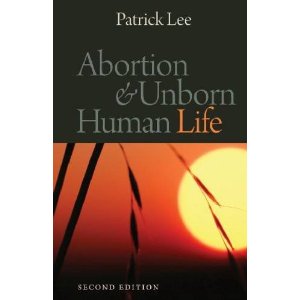 There are few ethical topics more controversial than abortion.Finding books on the topic is not very difficult, one needs only to search “abortion” on Amazon to find more than 10,000 results in the books category. Patrick Lee’s Abortion & Unborn Human Life (hereafter AUHL) stands out as one of the better pro-life books I have read, despite one major flaw.
AUHL starts with a syllogism:
1) Intentionally killing an innocent person always is morally wrong
2) Abortion is the intentional killing of an innocent person
3) Therefore, abortion is always morally wrong.
The rest of the book (164 pages of content) serves to defend this syllogism.
Chapter one argues against the idea that unborn human beings become persons after birth. Lee’s arguments are very good until he starts to argue by going against substance dualism to make his case. I think that this is a major flaw of Patrick Lee’s book. Substance dualism serves as a powerful argument against abortion. Not only that, but to argue against substance dualism primarily for the sake of an ethical position doesn’t make a lot of sense. Lee does introduces several philosophical arguments against dualism, but they fail to make a sufficient case against the position. This makes the rest of his case seem weaker than it is, had it been bolstered by substance dualism rather than arguing against it. It is really unfortunate, because readers may walk away thinking that the case against humans becoming persons after birth is weaker than it is.
In chapter two, Lee argues against the idea that human beings become persons during gestation. This chapter is particularly strong, and Lee introduces many arguments I hadn’t thought about before. Particularly important to this argument is what it means to have “moral standing.” Often, pro-life advocates forget that we sometimes don’t share the same basic presuppositions as the pro-choice advocates. Lee helps to bring the focus back to the basics (I have focused on this elsewhere myself, see here).
Lee argues in chapter 3 that individual human beings come to be at the moment of fertilization. This is another very strong chapter in which Lee offers scientific and philosophical reasons to accept this position.
Chapters 4 and 5 address the particularly chilling (and more recent) arguments that abortion can be justified as non-intentional killing of human beings (4) or that preventing certain consequences permit the killing of human beings (5).
Overall, AUHL is a fantastic read. Lee produces a compelling and powerful case that abortion is morally wrong, no matter what. Despite the rather large flaw of arguing against substance dualism, the book is a must-read for those interested in a philosophical defense of the pro-life position.
Abortion and Unborn Human Life
——
The preceding post is the property of J.W. Wartick (apart from citations, which are the property of their respective owners) and should not be reproduced in part or in whole without the expressed consent of the author. All content on this site is the property of J.W. Wartick and is made available for individual and personal usage. If you cite from these documents, whether for personal or professional purposes, please give appropriate citation and provide a link to the original URL. By viewing any part of this site, you are agreeing to this usage policy.
Abortion: The Struggle Between Objectivity and Subjectivity
 I’ve noticed in the past that as I debate the moral issue of abortion, it seems as though people tend to ignore reason in lieu of emotional appeals. Upon further examination of the issue, I am even more convinced that this is the case. But what is at the bottom of this appeal? Why is it that something which must have an objective answer is treated like subjective, lukewarm hogwash? The reason, I believe, is because the issue of abortion is involved in the overarching debate of subjective (relative) versus objective ethical theories.
What reasons do I have for making this claim? First, we must examine the most prominent pro-choice arguments. Pro-choice arguments generally fall into two broad categories:
1) Devaluing the fetus
2) Pointing towards the value of personal choice/control over one’s own body
Now, 1) fails miserably on a number of logical and scientific levels. See my other posts on the topic for discussions of these reasons (notably, this post and this one). But if 1) is rejected, then 2) may be the only way for pro-choice advocates to argue for their position. Unfortunately, 2) boils down to a kind of subjectivism about morality which ends up being self-defeating.
I am reminded of the echoing catch-phrase popular with politicians, “I am pro-choice, but against abortion.” What does this mean? Often, those who say such things generally mean that whatever someone else wants to do is fine with them. We shouldn’t try to limit the choices others make. We don’t have any reason to regulate what choices someone else can make or can’t make. And sure, I think abortion is wrong, but what right do I have to force my morality on others?
Initially, such arguments seem to make intuitive sense. The problem is that while the argument is trying to avoid forcing any “ought” statements, it has one huge “ought” planted right in the middle of its train of thought. That is, that “We ought not limit the choices of others.” But why should this be the case? There are certainly a huge number of cases in which I would limit the choices of others. Rape, for example, would be one instance where I would say this choice is not to be allowed. Perhaps the argument could be modified, then, and say that as long as one’s choice doesn’t harm anyone else, we ought not limit it. But then this pushes the burden of proof back onto argument 1), which is becoming ever more difficult for the pro-choice advocate to uphold.
Not only that, but having an “ought” statement like any of those above goes exactly contrary to what such statements are asserting. What if I choose to disagree with the statement that we “ought not limit the choices of others”? Should my choice to disagree be limited?
Furthermore, what reasons are their to argue that one should have absolute and total control over one’s own body? For if we do think that this is the case, we should then cease efforts in trying to limit substance abuse, cutting, anorexia, suicide, bulimia, and the like! These are all cases in which someone is simply making choices about his/her own body! If I want to cut myself, that should be my choice! If I want to starve myself, that should be my choice!
No, the bottom line is that the pro-choice camp wants to advocate total relativism. On this view, that which is ethically right for one person is okay for that person. There are innumerable difficulties with such a view (I’ve only touched on these above).
Thus, it seems to me that the pro-choice advocate has insurmountable difficulties with his or her position. First, this view cannot accurately measure when one’s “personhood” begins objectively. Second, it desires to claim an objective “ought” statement which ultimately defeats itself. Third, it runs contrary to scientific advances in measuring the stages of life of the human. Fourth, it stands on shift philosophical soil, for it is unable to accurately define “personhood” in any sufficient manner.
Thus, I conclude, as I’ve done so many times before, that to be pro-abortion is to hold a view that is positively irrational.
——
The preceding post is the property of J.W. Wartick (apart from citations, which are the property of their respective owners) and should not be reproduced in part or in whole without the expressed consent of the author.
Abortion: The Minority Rules
A Gallup Poll last year indicated that more Americans self-identify as pro-life than pro-choice. The more interesting results, however, indicate that 40% of all those surveyed believe that abortion should only be legal in a “few circumstances”. I would be interested to see a breakdown of specific circumstances and see where those who hold this view would restrict abortion.
Those who favor the pro-choice stance should be alarmed by these results, however. In a society that is increasingly utilitarian as far as ethical values are concerned, it appears as though the pro-life stance is gaining steam (interestingly enough, the Gallup Poll linked above suggests this may be due to President Obama’s stance as a firm advocate of the “pro-choice” side). We live in a democratic society, and it is clear that for some reason, the minority rules when it comes to abortion. The tides are turning.
But the problem with an issue like abortion isn’t so much getting a majority when it comes to voting, it comes down to what is right and wrong. Again, a utilitarian society has trouble acknowledging this, but the bottom line is that abortion commits murder. It is the willful destruction of a human being. I’ve issued challenges before for any pro-choice advocate to provide some kind of logical argument for abortion which can stand up under scrutiny. Despite hundreds of views, I have yet to have one solid argument for the pro-choice side advocated. Mostly, it boils down to name-calling and appeals ad misericordiam. In light of strong arguments against abortion and the failings of arguments for abortion (noted here, here, and here, for some examples), the pro-choice position falls by the wayside.
So it appears to me that the pro-choice position is the rule of the minority in more ways than one. On the one hand, the position is losing popular support, and on the other, it lacks logical justification.
[Author’s Note: I will be away for about a week, so any new comments will be approved when I get to them]
Pro-Choice, unless you’re a man
Recently, I posted a list of quotes from advocates of abortion. There was one in particular which struck me as being particularly odd. The quote was from Stella Ramsaroop, who wrote an article entitled “Why Men Should Have No Say On The Abortion Issue.” I’ve placed it, in its entirety, after my discussion below.
While it is telling that the people who call themselves “pro-choice” say things such as “men, your opinion [choice?] just doesn’t matter”, it is equally interesting to see the context such a quote was in. Ramsaroop writes that “when men start choosing to be fathers, that’s when they will have the right to pipe in on whether women can choose to be mothers.” I’m curious as to whether she’d actually follow through on such claims. The entirety of her article is based on premises such as these. She writes in her introductory paragraph, “unless he is the father of the fetus, what he says really doesn’t matter because he’s a man.”
My question for Ramsaroop, and any others who would argue in such a manner, is: Do you really mean what you say? There are certainly instances in which the man does want to be a father. He wants to have the child. Should he then have a “say” in the matter? According to Ramsaroop, he should. I sincerely doubt she is consistent in this, however.
Ramsaroop also writes, “a man can just impregnate a woman and walk away, which is exactly what many have done. If a man can have the right to choose whether he wants the responsibility of fatherhood, shouldn’t the woman have the same choice concerning motherhood?” (Let us ignore the fact that the baby has no choice in the matter either way, apparently.) Seemingly, Rasmaroop is disregarding the fact that men are required to pay child support [yes, each word is a different link]. So a simple fact check shows that the man does not have the right to choose whether he wants the responsibility of fatherhood–he faces jail time if he doesn’t support his child–even if he doesn’t want the child himself.
The problem is that I seriously doubt that Rasmaroop would say that if a man truly, really wanted a child, but the mother wanted an abortion, that the man’s choice matters. This stance of “pro-choice” is really only pro-abortion. It endorses abortion at any cost–the life of the child and the pain and broken heart of the mother and father. Rasmaroop doesn’t care what men have to say, and I doubt very much that she’d care even if the man did fulfill the conditions she set. The bottom line is abortion at any cost.
There are good reasons, both scientific and philosophical for being against abortion. I’ve outlined them in my other posts on the topic (click here and simply scroll down for many other posts arguing against abortion). Those who argue for abortion are inconsistent, illogical, and unscientific.
Article:
By Stella Ramsaroop 
I had a discussion with a close male friend this week who says he is pro-choice – to
an extent. He went on for sometime sharing his views on abortion with me. While he
was talking I realized something very important – unless he is the father of the
fetus, what he says really doesn’t matter because he’s a man.
It really gets me steamed when a man sits in judgment of a woman who has had an
abortion. I just don’t see how a man can speak to this issue at all. Why should men
need to establish any type of position at all on a subject that is clearly feminine by
nature? I know many are already cowering away from this article in fear of hell’s fire.
Think about it though, there are several reason why men should not have a say in
what women do with their bodies.
Congratulations Sir, You’re Pregnant
For example, men have never had to face the decision of whether they should allow
a child to grow inside them. They have never been in the position of reconciling the
gift of life with the invasion of life. In fact, a man can just impregnate a woman and
walk away, which is exactly what many have done. If a man can have the right to
choose whether he wants the responsibility of fatherhood, shouldn’t the woman
have the same choice concerning motherhood?
Men have never been in the position of having a foreign object growing in their
bodies and being told it would be immoral to want that object removed. Men cannot
relate to the feeling personal invasion brought about by an unwanted pregnancy or
the fears of being a single mother. The woman’s body is used as a vessel for life,
but it should be each woman’s decision as to whether she wants to be a vessel at
that point in her life.
Daddy Isn’t Here, Sweetheart
Another reason men shouldn’t have a say on the abortion issue is because since the
dawn of time women have carried the majority of the burden of child rearing while
the man pursues his own interests in life. Meanwhile, the wife is tied to the home to
raise the children that both of them created. Men cannot relate to the stifling feeling
that comes from being subjected to living a life as the primary care giver. In fact,
there should be no primary care giver at all, it should be a shared responsibility.
However, when the father is not around, the woman has no other choice.
The woman knows what having a child will mean to her personal life (and yes, her
life does matter too). Sometimes the changes are welcomed, other times the future
is very scary. A man can go on with his life, his career and his own interests with
little worry about his future other than being forced to set up the baby’s crib before
the mother goes into labor – if that much. However, the mother’s sacrifices and
responsibilities are endless and she knows how important it is to raise children who
are productive members of society. She can’t fail – even if he does shrug his
responsibilities.
Men have basically handed over parental responsibilities to the women and walked
away. Even the most well-intentioned father engages in but a small amount of the
parenting responsibilities. The women, with no other choice but to raise the children
since the father is out pursuing his career, or whatever it is that men do when they
are not at home with their families, are forced into a situation that may not even be
what that woman needs to thrive in life. She has no choice.
Does the man care that his selfishness could have a detrimental impact on the
woman? Nope. She’s doing what society expects of her and he is doing whatever he
wants. It is especially difficult for women in these days when so many men just
abandon their responsibilities as fathers altogether and leave the woman completely
alone to raise the child as a single parent. Even when a father is physically around,
oft times he is not around emotionally. But again, the woman has no choice.
It Takes Two
The reason it takes both a man and a woman to make a child is because nature
knew it would take both a man and a woman to raise that child. When the man
shrugs his paternal obligation, the woman is left with a burden that wasn’t meant to
be shouldered by one person.
So many conservatives believe women get recklessly pregnant and then use abortion
as birth control. This is just a tactic used to justify the imposition of their morals on
other people. Anyone who has ever been inside an abortion clinic knows abortion is
always a last resort for women. It’s a desperate move to solve a desperate problem –
not a routine action.
What’s even more ironic is that many times these conservatives would be the first to
rush their daughter to the abortion clinic just to save face if she ended up with an
unwanted pregnancy. Then they have the audacity to condemn the women who
choose to not have a baby because they couldn’t afford to feed it or didn’t want to
raise the child alone. In fact, the guy I mentioned at the start of this article
encouraged his girlfriend to have an abortion because he was afraid of what his
religious parents would think about an illegitimate child. He thinks what he did was
moral, but some abortions are not. Even worse, he is blind to his own hypocrisy.
Men, It’s Time To Be A Daddy
It all too ironic that while women have been home raising the children, men have
been in politics making laws concerning women and their bodies. Men have used
their power in politics and religion to control and dominate women by telling us
what they think we can morally do with our own bodies. Imagine the arrogance!
That any man believes he has any place at all tell me what is legal for me to do with
my own body! This is why there needs to be more women legislators and religious
leaders.
I don’t see men rushing to change societal expectations for maternal responsibility
concerning child rearing. I don’t see them demanding the right to be more
responsible fathers or to play a more integral part in their children’s lives. In fact, if
they did then they would be entitled to more say in the abortion issue. But why
should they want things to change? They’ve got it made in the shade. If things
changed, they’d have to pull their own weight, give up some of their own career
pursuits, and go home at a decent hour to the child waiting for dinner and a caring
hug.
In short, when men start choosing to be fathers, that’s when they will have the right
to pipe in on whether women can choose to be mothers. Until then men, your
opinion just doesn’t matter.

 J.W. Wartick - Reconstructing Faith

