science fiction
“Childhood’s End” – Utopia, God, and Science

SyFy, the channel once known as SciFi (it should still be!) recently aired a TV miniseries adaptation of Arthur C. Clarke’s book, Childhood’s End. Here, I will examine the miniseries from a Christian worldview perspective. There will be SPOILERS in what follows.
Utopia? A transhuman “hope”
In the first part, dimensions of religion are found in the wings. Why didn’t God fix everything if these aliens can come along and fix everything for us? Where was God during all those wars and atrocities? Yet as the story progresses, it is clear that not is all as it seems. Where is Karellen, the alien who seems so godlike in his powers, when people are scared, sad, and afraid? Why do the children start to change, and what does it all mean? Why is Karellen so unwilling to let humans know about him?
Karellen and the Overlords are working for the Overmind to “change the world…” They follow its bidding and do what it says in order to reshape reality in the image that the Overmind desires. The Overmind claims to be “the collective consciousness of this universe” and, more simply, “all.” The Overmind takes the children of humanity to transform them into part of the collective consciousness of itself. So where is God? In the world of “Childhood’s End,” the Overmind plays the part of God, but a pantheistic type of being which is itself clearly not all powerful. Indeed, to call the Overmind pantheistic is itself a bit of an overstatement, as it can only bring certain people to itself and do so in certain ways.
The message of Childhood’s End is one of transhumanism- it is the end of humanity and humankind’s evolution towards some higher state of existence. It seems at points that this is supposed to be presented as something that is a great good, though perhaps with some sorrow. Yet What does this mean for humans? Ultimately, this transhuman hope–really the only hope that a pervasively atheistic worldview could offer–is the death of humanity. Earth is destroyed, in the end. Humanity is gone. All that is left of us is a beautiful piece of music, that whoever passes by will be able to hear.
The utopia that seems to be described as the Overlords come is a fiction. Thankfully, it is not the real world. The hope that we have can be found in Christ and the resurrection.
God and Science
The second part of the miniseries starts with the song “Imagine” in the background as the utopic state of Earth is described. One of the lines that comes through in the song is the line “and no religion too!” Yet the voiceover is by the young scientist, who is bemoaning the death of the sciences–they are no longer needed. Initially, it seems the implication is that if we just get rid of all the silliness of religion and stop trying to pursue useless knowledge in science, we would find ourselves in a utopia.
Another scene juxtaposes a character effectively praying to Karellan, the alien, while another goes into a church. Churches have largely been abandoned, for what use is religion in a world in which there is no injustice? It is intriguing to see the connections made between religion and science made throughout here. It seems that both science and religion are cast aside as people find suffering no longer exists. There are a number of ways this suggestion could be taken.
First, it could be taken as an assertion that science and faith are seeking answers to the same questions, though with different approaches. Faith is asking “why is there suffering?” and looking to God for answers; science is attempting to fix various problems such as disease through a direct approach. Yet this brief sketch oversimplifies things. After all, people expect prayers to be effective, and often think of scientific discoveries as being answers to those prayers.
Second, it could be taken as a broader commentary on the futility of either religion or science. If we could just solve all our problems, why try to figure out how they work? Again, this answer is too simplistic.
Instead, it seems a third option is more likely: the value of faith and the value of scientific exploration in and of themselves as ways to provide answers for what we observe in the universe. These answers may often overlap–and they do–but that doesn’t make them useless or invalid.
Faith
“Faith is on its last legs, only we don’t see it, because they give us ice cream,” says a man who is keeping a church clean.
“There is no such thing as evil,” a character snaps to a religious individual.
“I’m not sure God every helped anyone… only the Overlords answered.” Sandwiched between these two statements is an accusation that God gave us diseases and then sent more once we discovered how to cure some.
“All the world’s religions cannot be right… you know that… Your faith, beautiful and poetic… has no place now.”
What is particularly interesting about “Childhood’s End” is that all the people who are taken to be quacks–they are ridiculous, silly, superstitious, paranoid–turn out to be right, at least in part. The Overlords did come to change everything, but not in the positive, benign way they presented themselves. Instead, they came to reshape humanity in the image they desired. It led to the destruction of all humanity. One character may assert there is no such thing as evil, but that flies in the face of the injustice that the Overlords allegedly came to destroy.
The miniseries, whether intentionally or not, offers a view of the world which is both bleak and profound. It is bleak because it takes away all our hope. Even that which seems to offer hope ultimately destroys us. But it is profound in that it presents that world as fiction. It is not the world in which we live, which has hope, and in which we do not need to destroy ourselves. The price that humanity was asked to pay in “Childhood’s End” was paid in reality by God.
Conclusion
Ultimately, “Childhood’s End” is a story of humanity. It is a story of humanity giving in to deceiving itself. Humans sought an easy way to peace, freedom, and justice, and what they received instead was the death of humanity. The story itself does not have any final hope, apart from the hope that some transcendent humanity would live on. In reality, humanity does have the hope provided in Jesus Christ, our savior. It is interesting that the hope humans trusted in in Childhood’s End was something outside of themselves, and indeed the true hope for humanity is not found in ourselves, but in the Incarnate God, Christ.
Links
Be sure to check out the page for this site on Facebook and Twitter for discussion of posts, links to other pages of interest, random talk about theology/philosophy/apologetics/movies and more!
Eclectic Theist– My other interests site is full of science fiction, fantasy, food, sports, and more random thoughts. Come on by and take a look!
SDG.
——
The preceding post is the property of J.W. Wartick (apart from quotations, which are the property of their respective owners, and works of art as credited; images are often freely available to the public and J.W. Wartick makes no claims of owning rights to the images unless he makes that explicit) and should not be reproduced in part or in whole without the expressed consent of the author. All content on this site is the property of J.W. Wartick and is made available for individual and personal usage. If you cite from these documents, whether for personal or professional purposes, please give appropriate citation with both the name of the author (J.W. Wartick) and a link to the original URL. If you’d like to repost a post, you may do so, provided you show less than half of the original post on your own site and link to the original post for the rest. You must also appropriately cite the post as noted above. This blog is protected by Creative Commons licensing. By viewing any part of this site, you are agreeing to this usage policy.
Star Wars: The Force Awakens- a Christian perspective
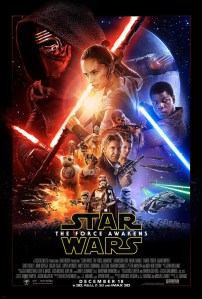 I have read over 100 Star Wars books and watched all the movies dozens of times (probably well over 100 for each of the original trilogy). In other words, I’m a Star Wars fan. I absolutely loved The Force Awakens. It was fantastic. It was wonderful. It was Star Wars. I’m also a devout Christian. Here, I will evaluate the movie from a Christian perspective.
SPOILER WARNING: There will be SPOILERS in what follows. I want to make that as clear as possible. Read no further if you don’t want to read SPOILERS. I’m serious. Big ones. Are we clear? Read on if you have seen the movie, or don’t care about spoilers. I’m sure the comments will also have spoilers.
The Force
One of the most pervasive images of the Star Wars universe is that of the Force. Wait, imagery? Of the Force? Well, you can’t see the Force!
Yep, that’s right. We can see Jedi or Sith using the Force. We can see the effects it has on people, and its power. But we cannot see the Force. One might say it’s just a bunch of hokey religions (thanks, Han). But in The Force Awakens, Han Solo admits what he has known for a while: the Force is real.
What is interesting about this admission is how much people of all varieties have been attracted to the notion of the Force and the Star Wars universe in general. In reality, the Force is a metaphysical concept. It goes beyond the mundane, physical universe and reaches for something more. The drive for that “something more” is pervasive in humanity, I think. Inwardly, we know that the world is not limited to those things we can see through direct observation. Thus, we are drawn to even fictional portrayals of a deeper reality such as the Force. Like Han, we may talk the talk, but when push comes to shove, there is more to our world than meets the eye.
Family, Darkness, and Natural Consequences
Exodus 34:7 reads, in part, “[God] does not leave the guilty unpunished; he punishes the children and their children for the sin of the parents to the third and fourth generation” (NIV).
Many see this as a kind of vindictive verse. In fact, it is an example of human choices bringing about consequences. One of the things I have learned since becoming a parent (and I’m still learning) is that natural consequences are the most effective way to teach my son. If he stands on a chair, he gets removed from the chair until he is willing to sit instead of stand. The verse above shows how our actions and choices have natural consequences.
Anakin Skywalker’s choices have impacted his family in profound, terrible ways. Sure, he saved Luke at the end of Return of the Jedi, and he was reunited with the Force. But think about what his choices visited upon his children: they had to be separated at birth and whisked into hiding. Vader even cut off his son’s hand!
In The Force Awakens, we see those consequences being visited upon the next generation as well. Kylo Ren, Han and Leia’s son, appears to be trying to follow his grandfather’s footsteps. But instead of trying to follow them back towards the Light side of the Force, he is attempting to complete the Dark work of his grandfather’s alter ego, Darth Vader. Can a more poignant reminder of the punishment that can be carried on from generation to generation be given?
In the world we live in, we can see these same systems of injustice bringing punishment on one generation after another. World War II was, in part, brought about by crippling economic hardships imposed after World War I. Systemic racism continues in the United States, demeaning not just those against whom racism is directed, but also bringing darkness onto those who engage in it.
The passage from Exodus above can be read simplistically, but when taken in perspective like this, it is immensely profound. The poignancy of that statement: that the actions we take now can bring about punishment on our children, and their children… should lead us to consider what it is we are doing. Kylo Ren wasn’t created in a vacuum.
Redemption
The Force Awakens also points ahead to a hopeful reality, one which resonates with the Christian worldview. Han and Leia each believe that there remains good in Kylo Ren–Ben–still. Han risks his life on that evaluation and even sacrifices himself for it. Though we don’t see this coming to fruition, the seeds of hope are there. Will Ren follow his grandfather’s Dark choices to a logical end, or will he be brought back to the Light?
The movie ends with Luke Skywalker and Rey on a remote planet. This guru-like setting is also reminiscent of the Desert Fathers of the ancient Christian church (though ironically in a very watery setting!). Will redemption and hope be brought forth once more through Rey? That remains to be seen, but the seeds have been planted. Han’s willingness to believe in goodness in his son is the same kind of willingness we need to have when we confront evil. Yes, we need to be prepared to stand up against evil, but we also need to realize that we were yet sinners when Christ saved us. The “other” is like we were, lost to sin and in need of redemption.
Conclusion
Go see The Force Awakens. Be prepared to celebrate the joys of Star Wars again, but also to think. It’s a fun, delightful movie that is overlaid with much darkness. Yet, in the midst of all that darkness there is hope.
Let me know your own thoughts on the movie in the comments. I’d love to hear what you thought of the film.
Links
Be sure to check out the page for this site on Facebook and Twitter for discussion of posts, links to other pages of interest, random talk about theology/philosophy/apologetics/movies and more!
Read more movie reflections (scroll down for more).
Eclectic Theist– Follow my “other interests” blog for discussion of sci fi, fantasy, movies, sports, food, and much, much more.
SDG.
——
The preceding post is the property of J.W. Wartick (apart from quotations, which are the property of their respective owners, and works of art as credited; images are often freely available to the public and J.W. Wartick makes no claims of owning rights to the images unless he makes that explicit) and should not be reproduced in part or in whole without the expressed consent of the author. All content on this site is the property of J.W. Wartick and is made available for individual and personal usage. If you cite from these documents, whether for personal or professional purposes, please give appropriate citation with both the name of the author (J.W. Wartick) and a link to the original URL. If you’d like to repost a post, you may do so, provided you show less than half of the original post on your own site and link to the original post for the rest. You must also appropriately cite the post as noted above. This blog is protected by Creative Commons licensing. By viewing any part of this site, you are agreeing to this usage policy.
“The Masterpiece Society”- Star Trek: The Next Generation and Genetics, Eugenics, and Ethical Quandaries
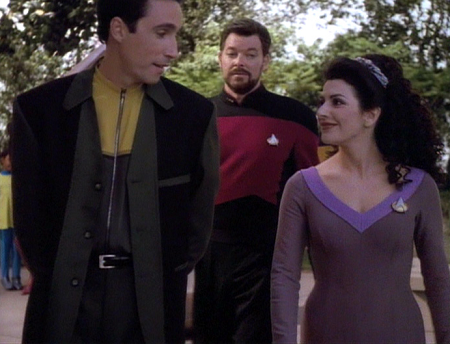
Star Trek: The Next Generation is one of my all-time favorite shows. I have been watching through the series with my wife from the beginning and recently watched “The Mastepiece Society” from Season 5. The episode is a fascinating look into the moral issues of a society that wishes to control breeding. Here, we will examine some of these questions. For a plot summary, see here. There will be SPOILERS in what follows.
Eugenics/Genetics
The “Masterpiece” society is one in which they have actively worked to use genetic enhancement and therapy [see my post on genetic enhancement and therapy to get some background into this debate; see a differing opinion here] to try to create a perfect society. Diseases are genetically selected against; other alleged defects are also screened before birth (euphemistically referencing the termination of pregnancy); and other methods are hinted at.
One of the most poignant scenes is when Geordi La Forge, the Chief Engineer, is sitting down with Hannah Bates and they talk about his blindness. He challenges her on the notion that he would have been terminated before birth:
“It was the wish of our founders that no one have to suffer a life of disabilities.” – Bates
“Who gave them the right to decide whether or not I might have something to contribute?” – La Forge
After this brief discussion, it turns out in an ironic twist that Geordi’s visor that helps him see actually is the solution to saving the colony. This emphasizes his point: he does have much to contribute.
One can’t help but wonder about the echo that those unborn who are killed each and every day through abortion would raise. What contributions have we stolen from our society through the desire for convenience or other reasons for abortions?
Free Will
Suppose we were able to create a society in which we could select genetically the features we deemed best-suited for specific roles. What would this due to free will and the right to choose one’s own destiny? Jean-Luc Picard, the captain of the Enterprise, asks this very question.
It sounds like something wonderful: we can have sure and certain knowledge of what we’re going to do. There is no uncertainty; no worrying about a job. The society has been built around having you in the exact place you are to occupy based on your genetics.
Is there, in any sense, a right for children to not have their genetic qualities selected for them? I’ve discussed this very issue elsewhere, but I think this episode raises it fairly poignantly. Suppose someone was bred to be a leader in the society, but they felt they would rather be a construction worker? The society, it seems, would suffer in the sense that they now lack a leader; but perhaps someone else who would want to be a leader could step up to the task. Of course, as in the episode, one fears a kind of cascade effect in which people who would be perfect, allegedly, for the tasks they are destined to be assigned instead opt for tasks they can only “imperfectly” perform.
This, then, leads to questions of what it means to be “perfect” for a task. Are we merely genetically determined creatures, or does our freedom to choose transcend the genetic history we have been dealt? What benefits or costs might there be to a society in which you are trained from birth to occupy a specific role?
Conclusion
Star Trek frequently raises ethical issues, and “The Masterpiece Society” was particularly thoughtful. I’d recommend watching it and then reflecting on the worldview-level issues it raises. How much are we currently missing out on because of the system we have in place? What might we do ethically to improve our society without restricting the freedom of the individual? Is this latter question even important?
From a Christian perspective, it seems clear that it is impermissible to terminate humans simply because they are blind or have some genetic impairment. Here, it seems, the Christian perspective can also demonstrate its practical utility, for as Geordi demonstrated, we may miss out on quite a bit if we decide to allow such things to occur.
Regarding genetic enhancement, however, the issue is much more difficult. My perspective has shifted a bit, but I am still fairly wary of the notion. I admit this might purely be some kind of bias on my part that doesn’t have as much a rational foundation as I’d like to think. The post I shared earlier from a friend has some pretty strong arguments in the direction of genetic enhancement even from a Christian perspective. I recommend reading his post, and checking out my older post (about 2 years old) that I edited as I wrote this one.
Links
Be sure to check out the page for this site on Facebook and Twitter for discussion of posts, links to other pages of interest, random talk about theology/philosophy/apologetics/movies and more!
Genetics and Bioethics: Enhancement or Therapy?– I go over a number of key ethical issues related to genetic enhancement and therapy.
“The Measure of a Man”- Star Trek: The Next Generation and Personhood– I discuss matters of “personhood,” using the character Data from Star Trek as a foil.
Why You Should Genetically Engineer Your Children– An argument that differs from my perspective on genetic enhancement. What are your thoughts on this post in favor of it?
The photo in this episode was a screenshot capture of the episode. I claim no rights to it and use it under fair use.
SDG.
——
The preceding post is the property of J.W. Wartick (apart from quotations, which are the property of their respective owners, and works of art as credited; images are often freely available to the public and J.W. Wartick makes no claims of owning rights to the images unless he makes that explicit) and should not be reproduced in part or in whole without the expressed consent of the author. All content on this site is the property of J.W. Wartick and is made available for individual and personal usage. If you cite from these documents, whether for personal or professional purposes, please give appropriate citation with both the name of the author (J.W. Wartick) and a link to the original URL. If you’d like to repost a post, you may do so, provided you show less than half of the original post on your own site and link to the original post for the rest. You must also appropriately cite the post as noted above. This blog is protected by Creative Commons licensing. By viewing any part of this site, you are agreeing to this usage policy.
Really Recommended Posts 11/06/15- Star Trek theology, egalitarianism, and more!
 I hope you’ll enjoy this week’s roundup of posts from around the web. You can watch a video explaining egalitarian theology from Genesis, survey challenges your kids might encounter for their faith, learn about pro-life dialogue, discover theology in Star Trek: The Next Generation, and explore a cold time before a young earth could have existed. Let me know what you think of the posts, and be sure to let the authors know as well.
Egalitarian from the Start (Vide0)– this sermon is from Richard Davidson, author of the monumentally important study on sexuality in the Old Testament, Flame of Yahweh. He argues that, from the beginning of creation, egalitarianism is the ideal perspective.
17 Ways Your Kids Will Encounter Challenges to their Faith– Children will encounter a great number of challenges to their faith as they grow up. Simply being aware of the way children can be confronted by these challenges will help parents prepare to answer them and help their kids find answers.
Four Practical [Pro-Life] Dialogue Tips from My Conversation with Brent– Josh Brahm, an excellent pro-life speaker, offers some dialogue tips alongside a case study of an actual conversation he had with a pro-choice advocate.
Star Trek Theology- “Remember Me”– The Sci-Fi Christian, an excellent website and podcast, offers up this heaping helping of theological analysis of The Next Generation episode, “Remember Me.” It’s an episode I enjoy immensely, and I also enjoyed reading this post. Check it out.
A Holocene Cold Snap In the Year 2,200 B.C. (Before Creation)– Here is an analysis which challenges the Young Earth timeline, because it demonstrates that we can observe weather patterns from before dates set by groups like Answers in Genesis.
“The Martian” – Hope, Humanity, and God- a Christian look at the film
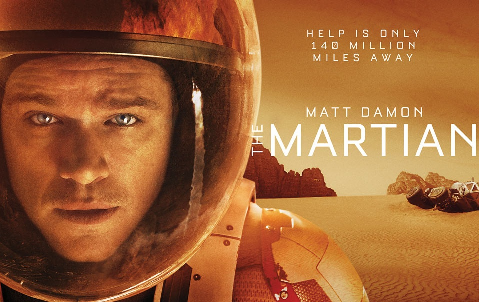 The Martian is receiving some excellent reviews from critics, and for good reason. It is a stirring story about humanity and our capacities and drive to survive. Here we will look at the worldview htemes found in the film. There will be SPOILERS in what follows. I will not be summarizing the plot, but a summary can be found here.
Hope and Humanity
A major theme of the movie is that of hope. Mark Watney, the astronaut left behind on Mars, becomes the center of hope of the entire world. All eyes were following as he continued to fight against the unforgiving Red Planet. When the mission to rescue him finally comes to a climax, there is a scene of people around the globe watching in anticipation and hope. They celebrate merely hearing his voice.
I can’t help but think about the hope of the shepherd in a certain story told be a Jew in Galilee, in which the celebration over but one lost sheep was immense. There is an inter-connectedness that humans experience as we seek to help others and exult in the triumphs even of strangers in need.
Perhaps the central theme in the movie is that of the very, well, human-ness of humanity. We need companionship, and the poignancy of that is found throughout the film. Mark fights against the loneliness he feels by fighting one problem after another. But simply hearing someone’s voice is enough to send him celebrating, and when the rest of his mission team come to rescue him–and he can hear his commander’s voice for the first time, the overwhelming sensation of emotion he feels leads him to tears.
Humanity was not made to be alone.
God?
By no means does this film offer much related to worldview issues about God, but there are a few moments worth mentioning. The first is when Mark has to whittle a crucifix in order to get some material to burn for making water. He looks at the figure of Christ on it and says that he thinks that Jesus wouldn’t mind him using it to save his life. Though this never develops beyond a joke, it is interesting to see how it ultimately is a kind of salvation through the cross–this time in a very literal sense.
Prayer is hinted at when the head of NASA asks the head of the Mars projects whether he believes in God. The answer that came was unexpected: with a Baptist mother and Hindu father, “I believe in several.” The response? “We need all the help we can get.” Again, this joking moment does reveal a hint of truth: that God is the one who provides help. Of course, not the many gods of Hinduism, but the true God is the one who saves.
Conclusion
“The Martian” is a great film. It explores the human need more than most films ever even touch on. These needs reflect deeply ingrained desires that mesh well with the Christian worldview. Only in Christ can we ultimately find the consummation of hope.
Links
Be sure to check out the page for this site on Facebook and Twitter for discussion of posts, links to other pages of interest, random talk about theology/philosophy/apologetics/movies and more!
Andy Weir’s “The Martian” A Christian Look at the Book: Humanity, Community, and Hope– I look at the the worldview themes found throughout the book on which the film was based.
Also see my other looks into movies (scroll down for more).
SDG.
——
The preceding post is the property of J.W. Wartick (apart from quotations, which are the property of their respective owners, and works of art as credited; images are often freely available to the public and J.W. Wartick makes no claims of owning rights to the images unless he makes that explicit) and should not be reproduced in part or in whole without the expressed consent of the author. All content on this site is the property of J.W. Wartick and is made available for individual and personal usage. If you cite from these documents, whether for personal or professional purposes, please give appropriate citation with both the name of the author (J.W. Wartick) and a link to the original URL. If you’d like to repost a post, you may do so, provided you show less than half of the original post on your own site and link to the original post for the rest. You must also appropriately cite the post as noted above. This blog is protected by Creative Commons licensing. By viewing any part of this site, you are agreeing to this usage policy.
Andy Weir’s “The Martian”- A Christian Look at the Book: Humanity, Community, and Hope
 There is a lot of buzz surrounding Andy Weir’s novel, The Martian. It’s being made into a movie staring Matt Damon. Here, we will look at the book from a worldview perspective. There will be major SPOILERS in what follows.
The Value of a Human
One of the objections raised in the novel to moving missions around to try to save Mark is the sheer cost of the expedition. Why spend millions or even billions of dollars trying to save just one person, particularly when there are so many others who could be saved?
Towards the end, Mark himself is reflecting on this and he writes “The cost of my survival must have been hundreds of millions of dollars. All to save one dorky botanist. Why bother? …[T]hey did it because every human being has a basic instinct to help each other out. It might not seem that way sometimes, but it’s true… Yes, there are [expletive]s who just don’t care, but they’re massively outnumbered by the people who do. And because of that, I had billions of people on my side.”
The appeal to basic goodness of humanity is not without a number of assumptions. For example, how is it that the basic goodness of humanity is established? It isn’t just assumed–the evidence cited is that the overwhelming majority of people have basic instinct built into them to help others. But I wonder whether that evidence is drawn more from the extraordinary circumstances Mark found himself in than from the reality of human nature. It is a fact that women are taught in this country (the United States) to shout “fire” rather than “rape” if they are under assault, because people will answer more readily to cries to help fight a fire than they will try to intervene in an assault. The circumstances often determine how willing we are to go the extra mile to help others.
Thus, the conclusion seems a bit naive. Yes, the world pulled together in this work of fiction to help a man stranded on Mars–and I suspect that all kinds of red tape would, in fact, be cut if this ever happened–but that cannot be applied universally to every situation. The fact that there is so much human suffering happening right now–visible human suffering that can be seen in places that are, for example, attacked by IS, or wracked by storms, and the like–without humanity pulling together to stop it suggests that this notion of universal good will towards all is not as powerful as was suggested.
On the other hand, from a Christian perspective, each and every human life is precious, not because we have some inherent need to help others (though that could arguably be there), but because we share human nature, a nature given to us by God to be the image of God in this universe. Humans are valuable simply because they are humans, and we have an obligation to help those in need.
Humans and Others
It is not explored very deeply, but there is a sense throughout the book that humans are made to be with others. Mark feels a profound sense of loneliness when he realizes he is stuck on Mars, but he ultimately gets to work on trying to survive as quickly as possible. This work helps to distract him from his sense of loss, but at times throughout the book it crops up again. The sense of loneliness is at times crushing for him, but he is always able to get himself moving again, perhaps because he continually has hope that the loneliness will be squashed by being rescued or at least getting contact with Earth.
Humans are made to be people in community. I think this again reflects the Christian concept of the image of God. As God is Triune and in community (speaking here rather metaphorically, of course), we are made to be in community as well. Moreover, God created man but then realized “it is not good for man to be alone” and created a woman. These profound words are often explored from various angles, but I wonder whether they don’t also speak to us from a sense of loneliness. We are not meant to be alone but rather to exist in community. Our existential longing and loneliness ultimately points beyond ourselves to a higher reality–in which we may experience communion with God.
Conclusion
The Martian is an entertaining read. It doesn’t raise as many worldview questions as some other science fiction works do, but it does ask us to consider the value of humanity and shared experience. I’d recommend reading it, but be aware of a large amount of swearing.
Links
Be sure to check out the page for this site on Facebook and Twitter for discussion of posts, links to other pages of interest, random talk about theology/philosophy/apologetics/movies and more!
Popular Books– Read through my other posts on popular books–science fiction, fantasy, and more! (Scroll down for more.)
SDG.
——
The preceding post is the property of J.W. Wartick (apart from quotations, which are the property of their respective owners, and works of art as credited; images are often freely available to the public and J.W. Wartick makes no claims of owning rights to the images unless he makes that explicit) and should not be reproduced in part or in whole without the expressed consent of the author. All content on this site is the property of J.W. Wartick and is made available for individual and personal usage. If you cite from these documents, whether for personal or professional purposes, please give appropriate citation with both the name of the author (J.W. Wartick) and a link to the original URL. If you’d like to repost a post, you may do so, provided you show less than half of the original post on your own site and link to the original post for the rest. You must also appropriately cite the post as noted above. This blog is protected by Creative Commons licensing. By viewing any part of this site, you are agreeing to this usage policy.
A World of Darkness and War- “Eisenhorn” by Dan Abnett
 Innocence Proves Nothing.
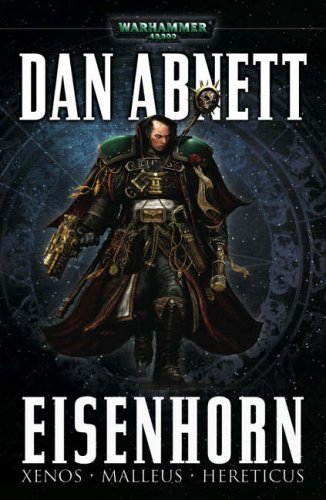
The world of Warhammer 40,000 (hereafter WH40k) is one that has few entry points for the uninitiated. Dan Abnett’s Eisenhorn Trilogy is one such entry point. I reviewed the omnibus on my general interests blog. Here we will be exploring some themes in the trilogy from a worldview perspective. There will be SPOILERS in what follows.
The Darkness
The world of WH40k is ostensibly one set in our very far future. The major tagline for the universe is “In the grim dark future, there is only war.” Confronted by this darkness, readers sometimes struggle to find light. But the light found in the universe is that of relationships: friendships and loyalty. Another light is the fight against the Warp and the forces of Chaos. Christians are similarly called to fight against evil and destroy it. The way that struggle plays out is hotly debated, but Eisenhorn is a kind of call to fight against evil where it is visible.
Puritan or Radical?
There are different sects of the Imperial Inquisition in the WH40k universe and the major way to divide them is along lines of Puritanism or radicalism. Largely, this comes down to whether an Inquisitor would use elements or even knowledge of “Chaos” in order to fight Chaos or whether they would not. This notion of Puritan/Radical is found throughout the Eisenhorn trilogy.
These lines of separation are relevant because in some ways they are paralleled in Christian thought. How literally is the Bible to be taken? How separated from the world should Christians be? What insights can be allowed for in other faith traditions? These are just a few questions that parallel this complex line that is brought to light by Abnett.
Interestingly, the way that Eisenhorn himself develops as a character points to how these might become a false dichotomy. He begins to realize that some of the insights from the Radical side have merit, and began to shift towards a more moderate position. One wonders whether we too often become bogged down in our conservative/liberal divisions to see how the “other side” might have some helpful insights.
War Against Chaos
In the WH40k universe, demons are manifested in the flesh, the forces of darkness work through psychic powers (psykers), aliens worship evil deities, and more. Through the realism of these elements, the universe is put forward as one in which evils are, at times, much easier to identify than the evils we find in our world. Christians have differing views about spiritual warfare (read the link in those words for a brief exploration of a few), but I think we too often pretend that there are no real evils out there or that they can be reduced purely to the evils of the human heart.
Conclusion
The world of WH40k is dark, but the way it portrays evil and the battle against it serves up not only a compelling narrative but one which has some points of contact with Christianity. Ultimately, WH40k ends up left in darkness, but Christianity has the one Story which offers ultimate hope; that found in Christ as victor over death and the devil.
Links
Be sure to check out the page for this site on Facebook and Twitter for discussion of posts, links to other pages of interest, random talk about theology/philosophy/apologetics/movies and more!
Book Reviews– There are plenty more book reviews to read! Read like crazy! (Scroll down for more, and click at bottom for even more!)
Source
Dan Abnett, Eisenhorn (Black Library, 2005).
SDG.
——
The preceding post is the property of J.W. Wartick (apart from quotations, which are the property of their respective owners, and works of art as credited; images are often freely available to the public and J.W. Wartick makes no claims of owning rights to the images unless he makes that explicit) and should not be reproduced in part or in whole without the expressed consent of the author. All content on this site is the property of J.W. Wartick and is made available for individual and personal usage. If you cite from these documents, whether for personal or professional purposes, please give appropriate citation with both the name of the author (J.W. Wartick) and a link to the original URL. If you’d like to repost a post, you may do so, provided you show less than half of the original post on your own site and link to the original post for the rest. You must also appropriately cite the post as noted above. This blog is protected by Creative Commons licensing. By viewing any part of this site, you are agreeing to this usage policy.
Really Recommended Posts 8/21/15- Science Fiction, Debate the New Testament, and more!
Another week, another round of fresh reads for you, dear readers, to enjoy! This week we have posts on a science fiction author you may not have heard of, a debate between an atheist and a New Testament scholar, theology and miscarriages, a pro-life post with some good arguments and advice for advocates, and creationism.
Cordwainer Smith– Cordwainer Smith was a science fiction author who was also an Anglican. He developed a unique and compelling world full of intriguing insights into humanity, religion, and free will. Here’s a post that develops some of his thought and reflects a bit on his body of work.
How Not to Argue Pro-Choice: Eleven Completely Misguided Arguments– Clinton Wilcox has written a valuable piece here responding to a pro-choice article that alleges to discredit 11 common pro-life arguments. Not only does he respond to each of the 11 attacks on pro-life arguments, but he also clarifies some arguments that we probably shouldn’t be using.
Fact-Checking Dan Barker from Our Recent Debate [with Daniel B. Wallace]– Here’s a meaty read that will help you dive into some of the extra-biblical evidence related to Jesus Christ, among other things.
Miss Carry: The Theology of Unrealized Motherhood– Miscarriages happen to anywhere from 10%-50% of all pregnancies. Yet we don’t often talk about the emotional impact these can have on families. Here’s a post reflecting on the need for a theology of unrealized motherhood.
Billions of Stone Artifacts: Witness to the Ancient Occupation of the Saharan Desert– Joel Duff continues his series responding to an Answers in Genesis argument about the sheer volume of stone artifacts in Africa. The basics are that the fact that billions of artifacts exist means that human occupation must have been much longer than a young earth creationist timeline allows for.
Really Recommended Posts 6/12/15- Luther, Treecats [what!?], and more!
 Sorry I’m a bit late today folks. I was on vacation and still catching up to some stuff after a beautiful cruise in Alaska! Anyway, this week I still got some diverse reads for you, dear friends! We have reads ranging from Luther on the Lord’s Supper to science fiction creatures, from Paley to Thomism, and even a comic! Check them out and let me know what you think!
The Lord’s Supper – Martin Luther’s Journey to the Bible– Martin Luther’s theology of the sacraments is central to his view of Christianity and the Christian life. Here’s an extended blog post looking at how he developed his doctrine of the Lord’s Supper.
I’m a Theology Nerd (Comic)- Yep, pretty much this. I am a huge theology nerd, in case anyone didn’t notice. This comic captures some of the reasoning behind that pretty well: if you really think there is a transcendent, loving, creator of the universe, how could we not love to learn more and more about that being?
Crossing the Heath with William Paley (1743-1805)– Doug Geivett continues his fascinating series on historical Christian apologists with one of the most famous to have ever lived: William Paley. He especially emphasizes Paley’s design argument, with a nod towards his historical arguments as well. I have written on Paley myself, and interested readers should check out my posts in the linked text.
Neo-Scholastic Essays– Edward Feser has a new book out that collects many of his essays together for your reading pleasure. Why care about Edward Feser? He is, in my opinion, the clearest thinker on Thomistic philosophy writing today. And he writes a lot. Check out his blog and be sure to look into his books as well. I’ve written on some things from Feser before.
Treecats Climb Into Children’s Hearts– David Weber is my favorite science fiction author. He’s got all kinds of awesome military sci-fi out there that you should read! Here’s a post that should warm your hearts too about his going to classrooms to share the love of literature with kids! I had the chance to meet Weber not too long ago, and I’ve written on his portrayal of women and religion in science fiction as well.
Robert Sawyer’s “The Neanderthal Parallax” – Faith, Scientism, and Humanity
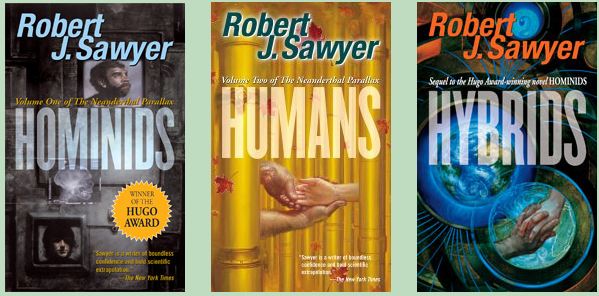 I recently finished reading Robert Sawyer’s trilogy “The Neanderthal Parallax.” I found the plot intriguing, but the worldview issues the books brought up had great difficulties in how they were conveyed and the kind of hidden premises smuggled in. Every story has a worldview, and the worldview of these books was surprisingly hostile and disingenuous particularly to Christians. I have enjoyed Robert Sawyer’s work in the past, but feel forced to interact with these books in a fairly critical fashion. There will be SPOILERS in what follows. I’ll not summarize the plot, but interested readers can see summaries on Wikipedia. I have written a review of the books here.
Faith
Perhaps the most unfortunate aspect of the books is that Sawyer seemingly did not put anything close to the amount of research and care into his portrayal of faith as he did his portrayal of biology, cosmology, and the like. On the latter topics, great detail is put into explaining aspects of various sciences and even invented science that Sawyer employs to support the plot. But people of faith are put up as frequently hypocritical but also lacking in erudition and thoughtfulness.
The central faith figure is Mary Vaughan, a specialist in ancient genetics. She consistently is put forth as the faithful counterweight to the faithlessness of the Neanderthals. However, she is a Roman Catholic who reveals objects to parts of her church’s official doctrines. She rejects the doctrine of original sin, for example. Having her put forward as the example of a religious person makes this even more difficult to swallow. I’m not suggesting that there are no people who have great cognitive dissonance in their beliefs–obviously many people do. The problem is that Sawyer uses Mary as the central image of Christianity throughout the novels, but she is woefully inept at even holding to the faith she claims for herself.
At one point in Humans, Ponter is talking to Mary at the Vietnam Memorial about life after death(188-207). He simply asserts that if you can’t see something it doesn’t exist. But of course this is as absurd as he claims “Gliskins'” (homo sapiens sapiens as opposed to the Neanderthals) belief in things like God is. I cannot see my own thoughts, yet they exist. Neither can I observe other people’s mental life, yet I am not irrational in believing that the people around me are also having thoughts.
In Hominids, Ponter speaks to Mary about the Gliskins’ viewing of a Mass taking place and again basically asserts that Christian belief in deity is absurd on its face. Mary struggles to articulate even the slightest defense of the Incarnation and other central Christian doctrines. Again, plenty of believers would struggle in this fashion, but Sawyer uses Mary as a kind of foil for all of Christianity. She’s got the best defenses Christians have to offer, and she can’t do anything but stutter when challenges to her faith are raised.
At several points, Big Bang Cosmology is challenged as something the Gliskins cling to because of their necessity of belief in a finite universe to support deity. Yet not only was Big Bang Cosmology initially rejected by the scientific community for this and other reasons (and only later accepted due to the mounting evidence for it), but even were the universe infinite, it would hardly follow that it is uncreated, as Ponter asserted without challenge. Sawyer seems to be unaware of–or at least makes his characters ignorant of–the entirety of Scholastic thought on the topic of continuous creation. Thomas Aquinas admitted this as a possibility. Thus, for Christians it is hardly an either/or of either eternal universe or finite universe. Either fits in with various strands of historic Christian theology. But again, Sawyer seems to have been either ignorant of this or willfully ignoring it to portray belief in deity in a more negative and indefensible light.
All of this wouldn’t be as unfortunate if Sawyer didn’t put discussions like this forward as if they were the best defenses Christians could come up with for their positions. Had they been simply believers who were also uninformed or insincere, it would not be as great an error. But Sawyer paints these interactions as though the defenses are the best Christians can come up with. As we have just surveyed very briefly, this is mistaken. I enjoyed the stories Sawyer put forward here, but his portrayal of people of faith is deeply flawed.
Religious Experience
Sawyer uses the books to explore the notion of a God part of the brain which, when triggered, can set off religious experiences. In Humans, it is discovered that Gliskins have a part in their brain which is able to have “religious experiences” triggered through electromagnetic interaction, while Neanderthals do not have a corresponding part of their brains.
A central scene in the entire series is near the end of Hybrids in Times Square, New York City. The Earth’s magnetic field is resetting and it triggers religious experiences, UFO sightings, and the like among the crowd gathered as this part of the Gliskin (homo sapien, remember) brain is triggered. People are crying out to their deities, fending off invading aliens, and the like all over Times Square. From this, Mary Vaughan’s faith is finally shattered:
The Pope had some ‘splainin’ to do.
All religious leaders did…
“It’s all a crock, isn’t it?” [Mary] said [to Ponter].
…”Look, I’ve changed my mind. About our child… Our daughter should not have the God organ…” (389)
Thus, we find that in Sawyer’s universe, the notion that we can induce religious experiences in the brain (and other types of experience like UFOs) means that these experiences are baseless in reality. Mary decides that her child should not have the capacity to have religious experience because it is all “a crock.” The Pope and others have some “‘splainin’ to do.” Presumably they are expected to take this as some kind of major challenge to their respective faiths.
The main problem with this is that we can conceivably trigger all sorts of things in the brain. It does not seem too outlandish to suppose that if we triggered a certain part of the brain, we might bring up a memory. If we extrapolate more, Sawyer’s vision of electromagnetically triggered religious experiences could be on par with memories as well, which could (in this scenario) be triggered in the same way. Should we start to distrust our perceptions or memories if we are able to trigger them with various impulses? Certainly not. This way lies (true) madness: distrust in our own memories and senses.
So what is left? What does the notion that religious experiences might be triggered by various brain activity demonstrate? Just that: religious experience may be triggered through manipulation. Full stop. This doesn’t in any way undercut evidence for theism or other beliefs from religious experience any more than our capacity to trigger scents, sounds, or memories would undercut our rational basis for believing this things to be real (or about real events).
Social Ills?
Sawyer uses the trilogy to attack all kinds of perceived and real social ills, from our treatment of the environment to gun control laws, and the like. But the question is how can he realistically put forward any kind of inter-cultural critique when the whole view he puts forward in the books is ultimately subjective. Mary Vaughan suffers a grotesque act of violence in a rape scene, but this is only used as an instrument in the plot (see my discussion here). Any moral critique Sawyer offers through his characters falls hollow because his only basis for it is some vague concept of pragmatism and self-preservation. Thus, it seems there is no ultimate basis for his criticisms of various ethical wrongs, and his use of several of these as mere instruments to advance the plot betrays this inability to provide an objective basis for right and wrong.
Conclusion
I’ve already written much on the difficulties with worldview in these novels. There are many more I could discuss. Again, I want to emphasize that it is very true that many Christians and believers would struggle to articulate their faith, be unable to defend various aspects of it, and not agree with at least some teachings of their church body. The problem is that Sawyer portrays this as the best Christianity can come up with. I was deeply disappointed to see that the overall thrust of the books was ultimately a kind of attack on my own faith, without any reasonable portrayal or interaction with stronger versions of it. Would that Sawyer had put the time into his depiction and study of faith as he had with the science behind this science fiction. For further reading, check out my reviews of the trilogy.
Links
Be sure to check out the page for this site on Facebook and Twitter for discussion of posts, links to other pages of interest, random talk about theology/philosophy/apologetics/movies and more!
Book Reviews: “The Neanderthal Parallax” – Hominids, Humans, and Hybrids by Robert Sawyer– I wrote a review of the trilogy on my other interests site. This review brings up some of the other worldview issues in the books, in addition to a brief summary of the plot outline and look at the science fiction elements.
Aliens that believe in God: The theological speculations in Robert Sawyer’s “Calculating God”– I write about a different Robert Sawyer book that I did enjoy quite a bit, Calculating God. I even wrote a second post discussing abortion, fundamentalism, and other issues the book raised.
Source
Robert Sawyer, Hominids (New York: Tor, 2002).
—, Humans (New York: Tor, 2003).
—, Hybrids (New York: Tor, 2003).
SDG.
——
The preceding post is the property of J.W. Wartick (apart from quotations, which are the property of their respective owners, and works of art as credited; images are often freely available to the public and J.W. Wartick makes no claims of owning rights to the images unless he makes that explicit) and should not be reproduced in part or in whole without the expressed consent of the author. All content on this site is the property of J.W. Wartick and is made available for individual and personal usage. If you cite from these documents, whether for personal or professional purposes, please give appropriate citation with both the name of the author (J.W. Wartick) and a link to the original URL. If you’d like to repost a post, you may do so, provided you show less than half of the original post on your own site and link to the original post for the rest. You must also appropriately cite the post as noted above. This blog is protected by Creative Commons licensing. By viewing any part of this site, you are agreeing to this usage policy.

 J.W. Wartick - Reconstructing Faith