science
From conception, a human
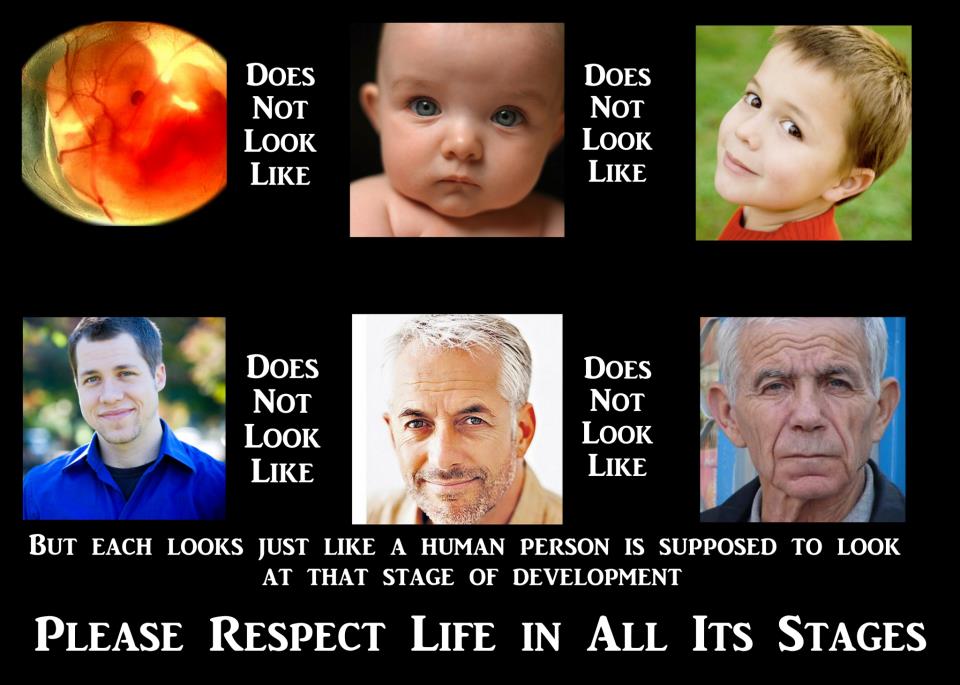 It is important for those on either side of the abortion debate to be informed. One part of that is to realize there are some really, really bad arguments out there. The argument that the unborn is merely a “blob of cells” or “human tissue” is one such argument. Simply put, if one makes this argument they are not on the side of scientific facts.
From the Scientists
A survey of textbooks on embryology by medical professionals shows that regardless of what the person on the street says, science tells us that from conception there is a new human being. I will now demonstrate through the citation of many such sources.
Zygote: this cell results from the union of an oocyte and a sperm. A zygote is the beginning of a new human being (i.e., an embryo). Human development begins at fertilization… This highly specialized, totipotent cell marks the beginning of each of us as a unique individual. [Moore, K. and T.V.N. Persaud, The Developing Human: Clinically Oriented Embryology (6th ed.), (Philadelphia: W.B. Saunders Company, 1998), pp 2-18.]*
“Embryo: An organism in the earliest stage of development; in a man, from the time of conception to the end of the second month in the uterus.”
[Dox, Ida G. et al. The Harper Collins Illustrated Medical Dictionary. New York: Harper Perennial, 1993, p. 146]**In this text, we begin our description of the developing human with the formation and differentiation of the male and female sex cells or gametes, which will unite at fertilization to initiate the embryonic development of a new individual. Larsen, W.J. 1998. Essentials of Human Embryology, Churchill Livingstone, New York, pp. 1-17.*
Fertilization is an important landmark because, under ordinary circumstances, a new, genetically distinct human organism is thereby formed… O’Rahilly, R. and F. Muller. 1996. Human Embryology & Teratology, Wiley-Liss, New York, pp. 5-55.*
The development of a human being begins with fertilization, a process by which two highly specialized cells, the spermatozoon from the male and the oocyte from the female, unite to give rise to a new organism, the zygote. [Langman, Jan. Medical Embryology. 3rd edition. Baltimore: Williams and Wilkins, 1975, p. 3]**
The development of a human begins with fertilization, a process by which the spermatozoon from the male and the oocyte from the female unite to give rise to a new organism, the zygote.
[Sadler, T.W. Langman’s Medical Embryology. 7th edition. Baltimore: Williams & Wilkins 1995, p. 3]**
Furthermore, a number of medical professionals testified under oath to a U.S. Senate committee.
“I have learned from my earliest medical education that human life begins at the time of conception.”- Dr. Alfred Bongioanni (University of Pennsylvania)*
“[A]fter fertilization has taken place a new human being has come into being.”- Dr. Jerome LeJeune (University of Descartes)*
“It is scientifically correct to say that an individual human life begins at conception”- Dr. Micheline Matthews-Roth (Harvard University Medical School)*
Quotes like these could be multiplied almost beyond measure. Scientifically speaking, those who say that the unborn is not a human being are, to put it bluntly, ignorant.
[Want more quotes from professionals? Check them out (each word there is a different link)]
Science, back with a vengeance
 Some may think that amassing endless quotes from medical professionals and scientists is not convincing. They’d rather see the evidence themselves. Let me present it very briefly.
1) The zygote has distinct DNA from the mother (and is therefore not part of the mother).
2) About 50% of the time, the unborn has a different gender than the mother (and is therefore not part of the mother).
3) From conception, the zygote grows and organizes itself (and is therefore a unique individual).
4) As long as there is an environment in which the resources required for life continue to be provided, the zygote will continue to mature and, well, live (much like a baby, or a 20 year old).
5) The zygote is alive and continues to grow.
Therefore, from conception we have an individual with unique DNA and sometimes even a different gender; we have an individual which grows and organizes itself; we have an individual which, as long as no one destroys it, will continue to grow and mature into an adult.
There is a reason the literature sounds so confident that human life begins at conception: those who deny this would have to say that 50% of the time, males with distinct DNA from their “bodies,” who organize themselves towards growth, are reducible to their female mothers. That is what the pro-choice advocate would have to say: “Yes, that male ‘clump of cells’ inside the mother with its self-organization and different DNA is actually part of the mother.” This despite the fact that any DNA test would not show this to be the case. Of course, the female’s DNA would be different as well, so again, the absurdity would have to follow.
The Philosophical Side
Let’s suppose for a moment the science were unconvincing, or at least left open the possibility of denial. What about philosophical arguments that the unborn is not a human being?
Viability
Some argue that viability is the point at which we can decide when an embryo goes from a ‘clump of cells’ to a human being. However, viability continues to be pushed to earlier and earlier stages of development for the embryo. Does that mean that human life continues to be extended earlier and earlier?
This argument is fairly ridiculous because it entails that what was not a human being 100 years ago is now suddenly, miraculously a human being due to new technologies to sustain life. In other words, it reduces humanity to a sliding scale. Imagine a nuclear fallout happened and our technology was pushed back into the 1700s era. Suddenly, viability would be much later than it currently is. Does that mean that those who were humans/persons before suddenly lost that privilege based upon our technology level?
No Brain/No Pain
Some argue that the ‘clump of cells’ is not a human being until it has a brain or can feel pain. There are a number of problems with this argument.
1) it assumes physicalism–it assumes that human beings are somehow identical with their brains. This is a huge area of exploration and I won’t delve into it here.
2) It is unclear how the growth of a body part somehow transforms something from a clump of cells into a human being.
3) It is a completely arbitrary cut-off. Why pick the brain as the arbitrary cutoff? Note that it has to be arbitrary unless someone has an intrinsic value to place all of the qualities of humanity in the brain.
4) If feeling pain is necessary for human life, then someone who is in a coma and can recover is not a human being. Likewise with someone who has passed or gone into shock.
5) The fact is that the unborn can feel pain at somewhere around 7-8 weeks into term. Those who deny that evidence simply must concede that evidence of pain at about 20 weeks. What does that mean? Unfortunately, abhorrently, it means that those unborn who are aborted in extremely gruesome ways [see here: warning: graphic descriptions–and I picked the least graphic one I could find] and that they feel the pain. This is an unfortunate, disturbing, fact. People who deny this fact are either blissfully unaware of the scientific literature or, to be frank, lying. So what to do with this evidence? If the reason for allowing abortion really is that the baby can’t feel pain (and I very much doubt that it is–this is just a rationalization for the real reason behind it), then any abortions over 20 weeks should be illegal.
But really, what is the rationale driving this argument? Why should we care if a “lump of cells” feels pain? After all, according to pro-choice advocates, until the unborn is somehow transformed into a baby by passing from inside to outside of the mother, the unborn is just a “ball of cells.” So really, who cares if it feels pain? Again, that’s because this reason is just a red herring. The real issue is personhood.
Reliance
Some argue that because the unborn has to rely upon the mother to survive it is not a human. But of course so does a newborn infant. If it is asserted that the difference is because the unborn is inside the mother than one can’t help but wonder how going from inside to outside the mother suddenly transforms something from a ‘clump of cells’ into a human being.
For a number of other philosophical arguments see my posts on my pro-life page.
Conclusion
The argument that the unborn is merely a clump of cells is scientifically untenable. Those who make this claim are ignorant of the scientific data that states the exact opposite is the case. If they maintain their assertions in the face of the scientific evidence, then it can only be through blind faith or willful deception.
The philosophical arguments fair no better.
From conception, a human.
*Found quoted at “When Does Human Life Begin”
**Found quoted at Life Begins at Fertilization with the Embryo’s Conception
SDG.
——
The preceding post is the property of J.W. Wartick (apart from citations, which are the property of their respective owners, and works of art as credited) and should not be reproduced in part or in whole without the expressed consent of the author. All content on this site is the property of J.W. Wartick and is made available for individual and personal usage. If you cite from these documents, whether for personal or professional purposes, please give appropriate citation with both the name of the author (J.W. Wartick) and a link to the original URL. If you’d like to repost a post, you may do so, provided you show less than half of the original post on your own site and link to the original post for the rest. You must also appropriately cite the post as noted above. This blog is protected by Creative Commons licensing. By viewing any part of this site, you are agreeing to this usage policy.
Resource Review: “RTB Live! ‘Beyond the Cosmos’ with Hugh Ross”
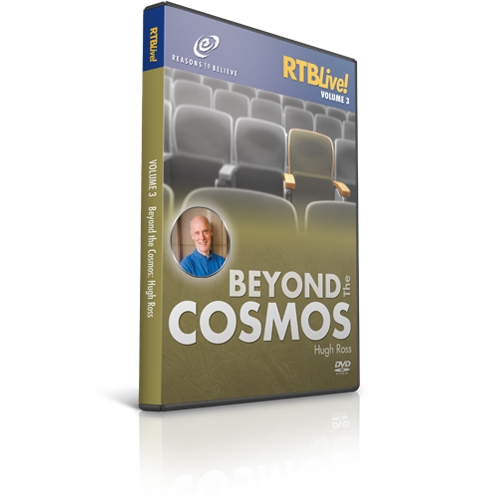 Reasons to Believe is a science-faith think tank that seeks to show that Christianity is a profound source of knowledge. They come out with a number of resources from podcasts to articles to books. One such resource is their “RTB Live!” video series which explores a number of topics on science and Christianity by varied lecturers. I recently had the opportunity to watch “Beyond the Cosmos” which is the third in the series.
Hugh Ross presents this lecture which largely focuses on integrating science and Christian doctrine. He prefaces his comments by letting the audience know that he’s not necessarily suggesting that the ideas he presents are the way things happened, but rather that they show that certain Christian doctrines are possible in light of scientific findings.
God, according to Christianity, is “transcendental.” Ross refers to this as “transdimensional.” He begins his presentation by saying that given that God is beyond the dimensions, a number of interesting scientific findings about dimensions can show how God could bring about certain actions.
Ross discusses the Biblical portrait of God as both transcendent and immanent. God is beyond the universe, but is “everywhere within the universe” and capable of interacting with God. He outlines a number of Bible verses to show these doctrinal truths.
He then moves on to general relativity. General relativity has been confirmed to an amazing degree by big bang cosmology as well as other evidence. Rather than going into detail on this section–which should be familiar to those interested in such a topic–the rest of this review will focus upon the theological implications Ross draws out from current cosmology.
One of the central questions people ask is “If God created the cosmos, who made God?” Ross notes “everybody asks that question!” However, he argues that “these spacetime theorems give us an answer to that question… What these theorems tell us is that there is cause and effect going on before the universe comes into existence.” Ross argues that these cause and effects are due to a causal agent which is itself outside of space and time.
Because God is not confined to linear time, Ross argues, God has access to “at least a plane of time.” It’s hard to convey Ross’ argument here because he utilizes a drawing to depict what he’s saying. But basically if one sees two timelines running independently, they are on the same plane. God could see this plane and therefore interact with all the timelines.
Ross goes on to use a very interesting illustration of “Mr. and Mrs. Flat.” He uses paper cutouts of a male and a female that are two dimensional figures. Now because they are 2D, they exist on a plane. But God, being transcendental, could, in a sense, “poke a finger” through that plane and God would be experienced as a circle (the finger). God could also poke three fingers through the plane and be experienced as three circles. Furthermore, God could see Mr. and Mrs. Flat in their entirety, even though they would appear as straight lines to each other.
This thought illustration was intended to show how God, having access to all dimensions–indeed, being beyond them–could interact with all of spacetime and know what’s happening.
Similarly, because God has access to limitless dimensionality, He could listen to every single prayer on earth by utilizing each point in a “timeline” as an infinite timeline running perpindicular to that moment of time. Thus, God could spend infinite time listening to each prayer.
The atonement is often raised as an objection to Christianity because some ask how God could pay for the sins of the whole world by just suffering for a few hours on a cross. Ross points out that, just as God can expand any single moment of time into an infinite timeline to listen to prayer, so too could Christ have suffered on the cross for a potentially infinite period of time.
Reasons to Believe, as an organization, strives to show that the Christian faith can be put to the test. Ross pointed out several testable predictions that their model brings to the table:
- Evidence for a single cosmic beginning will increase.
- Evidence for finite past time will grow.
- Evidence for general relativity describing cosmic beginnings will increase.
- The grip of spacetime theories will become more “relentless”.
- The case for a transcendent creator will grow stronger.
- The evidence for other miraculous events will increase.
These 6 testable predictions are not strictly hypotheses that could be used in a lab and some criticism from skeptics could come at Ross from this angle. However, it seems clear in the context of the video that Ross was painting in broad strokes here. From his writings, one could see that he parses these 6 predictions into much more precise hypotheses.There are a number of other theological issues Ross touches upon, and as someone who is constantly involved in grappling with these questions, I couldn’t help but have my mind expanded and think on how some of these ideas could affect my perception of Christianity. There do seem to be a number of ways that science can provide possibilities for several Christian doctrines.
Finally, it would be remiss to review a resource like this without commenting on the visuals presented by Ross. There weren’t any extremely flashy slides or demonstrations. Rather, Ross used a whiteboard to illustrate a few things and brought a few objects (some balls, Mr. and Mrs. Flat, etc.) to demonstrate some points. What was interesting was the way he used them. In particular, the aforementioned Mr. and Mrs. Flat was very interesting.
The video was extremely thought-provoking and certainly would be a good watch for a study group on science and religion. As someone who specializes more in the realm of philosophy, I would say that a few of Ross’ ideas have larger implications than is illustrated in the video. For example, it seemed as though the way Ross described God’s interactions in time would entail something like William Lane Craig’s view that God is timeless sans creation and temporal subsequent to Creation. However, from some of Ross’ writings, I am fairly sure he holds that God is in fact “still” timeless (a view I share). Thus, one would have to take the views he puts forth here as perhaps more speculation than reality. Such a discussion over whether God is timeless or in time was beyond the scope of the video, but I think the video could be used to bring up discussions like it.
Overall I enjoyed the video very much. As usual, Hugh Ross was a thought-provoking speaker whose ability to combine his knowledge of astrophysics with theology is often startling. The video would be perfect for a small group and could go hand-in-hand with Ross’ book of the same name (Beyond the Cosmos). Furthermore, the video could be used for a higher-level apologetics group in order to discuss some implications for God and time or science and faith. It is highly recommended.
Disclaimer: I was given this DVD to review by Reasons to Believe. I was not asked for a positive review, nor was I asked to focus upon any particular content. My thanks go to RTB for the video.
SDG.
——
The preceding post is the property of J.W. Wartick (apart from citations, which are the property of their respective owners) and should not be reproduced in part or in whole without the expressed consent of the author. All content on this site is the property of J.W. Wartick and is made available for individual and personal usage. If you cite from these documents, whether for personal or professional purposes, please give appropriate citation with both the name of the author (J.W. Wartick) and a link to the original URL. If you’d like to repost a post, you may do so, provided you show less than half of the original post on your own site and link to the original post for the rest. You must also appropriately cite the post as noted above. This blog is protected by Creative Commons licensing. By viewing any part of this site, you are agreeing to this usage policy.
Shoulders of Giants? -Philosophy and Science in Context, or, “Lawrence Krauss jumps off!”
If I have seen further [than other scientists/philosophers] it is by standing on ye sholders of Giants.- Isaac Newton
We act as if they’re [philosophers without current knowledge of science] authorities about something; they knew nothing!- Lawrence Krauss
Lawrence Krauss recently appeared on the English [UK] radio show “Unbelievable?” In this radio program, Krauss and Randy Holder, a Christian, were in dialog about “A Universe from Nothing?” [not necessarily Krauss’ book, but the subject in general]. The dialog, unfortunately, showed that Krauss continues in his ignorance of the importance of philosophy to his own subject, as well as his own flippant dismissal of generations of scientists.
At one point in the program (around the 26:00 mark), Krauss says the following:
I don’t [indiscernible–he may say “also”] care about what Mr. Leibniz said… we refer to philosophers who wrote at a time when we didn’t know that there were a hundred billion galaxies. [So?] Who cares what they say? We act as if they’re authorities about something; they knew nothing!- Lawrence Krauss
Really?
 I can’t think of a more galling statement for a contemporary cosmologist to make. Gottfried Wilhelm Leibniz, for those who don’t know, happened to be one of the men who discovered infinitesimal calculus. He also (among countless other contributions to mathematics, science, social sciences, engineering, and philosophy) developed a calculator, contributed to the development of binary language, was one of the first to posit that space was relative, and developed the principle of sufficient reason (which supports all scientific investigation).
Yet, according to Krauss, because he lived in a time before we know how large the universe was, he “knew nothing!” You see, Krauss, and some other scientists and thinkers with a scientistic/physicalist bent, too often throw out the very basis of their thought. How far do you think Krauss could get in his cosmological research without infinitesimal calculus? How would Krauss go about investigating the causes of various natural phenomena without the principle of sufficient reason?
The answer is pretty simple: he wouldn’t get anywhere.
Krauss, like those before him, stands on the shoulders of giants. But, unlike those who are humble enough (or who know enough about philosophy and history?) to admit it, Krauss says “We act as if they are authorities about something, they knew nothing!”
Really, Krauss? Let’s see how well your next research project goes if you throw out all the contributions they made to your methodology. Next time you do an experiment, try to do it without parsimony or inference to the best explanation. Write to me how that goes!
What’s happened with people like Krauss, and I can think of others (like Stephen Hawking, Richard Dawkins) who do the same thing, is that in their gusto for the marvels of modern science, they have forgotten the very basis for their methods, their research, and their rationality.
Without philosophy, there would be no way to infer causes from effects; without the principle of sufficient reason, there would be no reason to think that causes even have effects; without a well developed notion that what will happen can be inferred from what has happened, these scientists could not even get going. But then they have the absurd tendency to turn around and reject philosophy. They say things like the quote Krauss fired off above.
Here’s the thing: science is utterly dependent upon philosophy to survive. If we didn’t have philosophy–if we didn’t have the developed notions of rationality, inference, and the like–there would be no science. Other theists (and philosophers) have contributed things like parsimony/Occam’s Razor to the wealth of philosophical methodological backbone which makes the scientific enterprise possible. In fact, there is still debate over whether we can reliably make inferences from science (for one example philosophically defending scientific inference, see Wesley Salmon, The Foundations of Scientific Inference). Some scientists have now apparently become those who sit in the ivory towers, blissfully ignorant of how their own research depends upon others’ outside of their field.
I suspect a multifaceted problem behind the motivation of those who throw philosophy out the window once they’ve embraced full-fledged empiricism. First, many of these thinkers have demonstrated they don’t actually know what empiricism means as a–that’s right–philosophical system. Apart from Krauss and Hawking, one could cite the recent example of Richard Dawkins admitting that he doesn’t know what “epistemic” means. Note to those who embrace that philosophical system of Krauss et al.: without epistemology, you would not even be able to justify inferences to best explanation. How’s that for a dose of reality?
Second, there is a kind of blatant ignorance of–or even intentional trampling on–the historical development of scientific inquiry. I hesitate to say that philosophy makes a “contribution” to science, because that’s not what it is. A simple study of schools of knowledge reveals that science, by its very nature, is utterly dependent upon epistemological research. Without such development, there would be no scientific method.
Third, these scientists constantly make philosophical claims, apparently in complete ignorance of the fact that they are philosophical claims. For example, in the same dialog Krauss argues that “the universe certainly doesn’t care what I like…” and throughout the discussion points out that it doesn’t matter what we think, the universe is revealed in a certain way by research.
He apparently seems utterly oblivious to the fact that that, in itself, is a philosophical position. One could take a rival position and argue that the appearances of nature don’t actually determine reality because everything is mind-dependent (idealism, solipsism, or other schools). It’s not enough to just point at nature and say “see, this is how things are!” because if that’s all one does, then someone could say “Your ideas about how things are are dependent upon your mind and ideas, and therefore don’t have any access to reality.” No scientific research could rebut such an argument, only a philosophical position in which nature can give us a reliable record for rationality can ground science.
Krauss dismisses philosophy very nonchalantly. It seems as though he (and others like him) is oblivious to the fact his entire system is philosophical. Consider the claim that “science can examine reality.” How does one go about proving it? One could argue that one could simply make a test and show that over and over again in circumstances y, x result happens, so we are justified that when we assert that if y, then x. But of course we would have to justify that a test can be connected to reality; we’d have to figure out what it means to have “justified” belief; we have to show that our scientific method is trustworthy; we have to assume that mathematical truths are true; we have to operate within a rational perspective; etc. All of these are philosophical positions. Some of them are debates within philosophy of science, in fact. The bottom line is that whenever someone does science, they are utterly reliant upon philosophy. By simply taking the empirical world as something which can be explored, they have made a number of philosophical assumptions, whether realized or not. Scientists take much of the philosophical development as a given before they even start their research. And then, some of them, like Krauss, have the gall to turn around and dismiss philosophers as though they “know nothing.” Suddenly, he has undermined his own system of thought, without even acknowledging that it is a system of thought.
Frankly, some of these scientists are just confused. Thankfully, many scientists operate with a system that respects the contributions of philosophy to science and encourage the interplay between the fields of knowledge.
Here’s the bottom line for those scientists who agree with Krauss: your entire field of research can only proceed if you grant over a thousand years of philosophical development. One major contribution was made by Leibniz, whom people like Krauss casually dismiss. But without the theistic philosopher with the awesome wig, scientists would have nothing. Thanks, philosophy! Thanks again, Christianity!
SDG.
——
The preceding post is the property of J.W. Wartick (apart from citations, which are the property of their respective owners) and should not be reproduced in part or in whole without the expressed consent of the author. All content on this site is the property of J.W. Wartick and is made available for individual and personal usage. If you cite from these documents, whether for personal or professional purposes, please give appropriate citation with both the name of the author (J.W. Wartick) and a link to the original URL. This blog is protected by Creative Commons licensing. By viewing any part of this site, you are agreeing to this usage policy.
Ken Ham, honesty, and AiG’s Reformation- A lesson in careful reading and hermeneutics
I recently responded (Ken Ham on “Compromise” and Stand to Reason) to a blog post–really a rant–by Ken Ham, young earth creationist. Well, Ken Ham apparently took issue with my own posts (and others’–see links at the end), and has offered another response. All block quotes are from Ken Ham’s post “To Help Bring Reformation” and all credit goes to him for the writing of said quotes. For a shorter response to Ham’s latest post, check out Unrecognized Agreement and Unity.
First, it is worth noting that Ham doesn’t cite any specific sources for the views he attacks, so it may be difficult to draw out all the points. To be fair, it seems that at least a few of his points respond directly to my own blog post. I will try my best to draw out Ham’s points while offering another critique.
In my initial post on the topic, I pondered the notion that AiG is seeking to start a reformation. I mean, Ken specifically stated such in his blog. To whit:
Thus, as part of the mission of AiG, we believe we have been called to challenge the church to return to taking God at His Word from the very first verse—we liken this to helping bring in a new Reformation. -Ken Ham
Leaving aside the hidden assumption that any view which is not exactly the same as AiG’s position is, by implication, not “taking God at His Word”… I wondered what exactly it was that Ken Ham and AiG is seeking to do with a reformation–is it a reformation simply pressing YEC or is it a comprehensive, whole-church reformation. Ham responded:
A few Christians reacted to my comments with blogs falsely accusing me (and AiG) of equating such “Reformation” as getting people to believe in young-earth creationism. That is not our motive—and never has been (despite the numerous times we have been accused of such). Really, believing in a young earth is a consequence of believing God at His Word in Genesis. In other words, our efforts are not directly to get people to believe in a young earth, but to get God’s people to take God at His Word in Genesis. -Ham
That’s fair. Ken Ham–and many other young earth creationists–tend to argue that if one takes the Bible at “its Word,” then one will end up as a YEC as well. But how is it that Ham and others assert their position is the position at which one will arrive if one takes the Bible as true? Well, clearly, it is through a specific hermeneutic. In fact, Ham cites it himself as part of the AiG mission statement:
We relate the relevance of a literal Genesis to the church and the world today with creativity. -AiG Mission statement as cited by Ken Ham
Right! Well then it is part of the mission of the group to endorse, legitimize, and put forward as the truth the hermeneutic of reading a “literal Genesis”–by which it is meant a Young Earth view. But of course others read a “literal Genesis” and have no problems with old earth positions and indeed see absolutely nothing in the account as contradicting an old earth position. So, it seems that if YEC is supposedly a consequences of the position AiG holds, then YEC is absolutely part of the “reformation of the church” that AiG is trying to bring about. It is a consequence of their hermeneutic.
But then there is the question of whether or not their are readings of Genesis which allow for or even call for an old earth position. Other inerrantists like C. John Collins or G.K. Beale argue that the passages do not necessitate a young earth position. Thus, it seems like, without argument, we once more have a YEC dismissing other positions as against “believing God at His Word.” This is the kind of subtle ad hominem attack that people who can sense logical fallacies will react against. Notice the dichotomy that is set up: if you “believe God at His Word” you will hold the same position as AiG; but if you don’t hold the young earth position, you therefore do not believe God at His Word. One can’t make a worse accusation against other evangelicals than this.
But hey, why stick with subtlety?
These bloggers and others who falsely accuse us of being focused on young earth creationism are themselves undermining the authority of the Word of God, for which they will be held accountable before the God of creation. -Ken ham
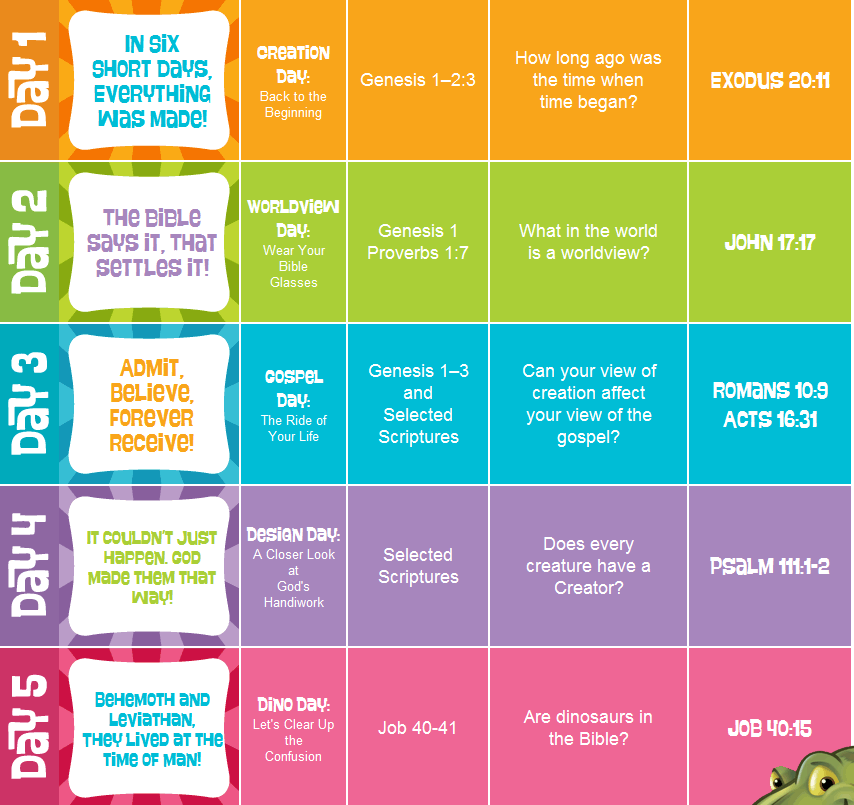 Yes, that’s right. Apparently I (and others) falsely accuse a group named “Answers in Genesis” which actively promotes young earth creationism through books (including children’s books), a magazine, a research journal, and even a VBS program [image on right all credit to answersvbs] (notice that the entire curriculum is focused on Young Earth Creationism: day 1 is in six short days, everything was made; day 2 is the bible says it, that settles it [and note that in Ham’s other post he argued we should teach our children how to think, not what to think–or at least in addition to ‘what to think’]; day 3’s main question is “Can your view of creation affect your view of the gospel?”; day 4 is on intelligent design [admittedly this doesn’t specifically mean young earth]; day 5 is going to teach children there are dinosaurs in the Bible) of focusing on a young earth.
Seriously, you did read that right. I and others are accused of falsely stating that Answers in Genesis is focused on young earth creationism.
Look, I’m not saying it’s a bad thing to have your ministry focused on a specific area. In fact, I think that Christians who are strong in science, the arts, philosophy, and other areas of knowledge need to step up and do what they’re best at for the glory of the Lord, whether that means making new discoveries in a lab or going and working at a retail job. Do it well! The problem is that Ken Ham is saying we’re falsely accusing Answers in Genesis of being focused on young earth creationism. Sorry, but they are.
Moving on:
Thus it is obvious that millions of years is incompatible with God’s Word. And one does not get millions of years from the Bible—it comes from fallible man’s interpretation of the past.- Ken Ham
Honestly, this has to be the favorite line YECs use: “man’s fallible __________” or some variant. Again, all it does is subtly poison the well. Isn’t it equally possible that man’s fallible interpretation could lead to a young earth view? Let me answer the question: YES. People are fallible, and they make hermeneutical mistakes, science mistakes, and other mistakes. Thus, one could equally say: “It is obvious that the young earth position is not necessitated by the text. To say that it is necessitated is to use man’s fallible interpretations of Scripture.”
Suddenly YEC looks like it is the evil “compromiser.” But I’m not going to take that route. Rather, I want to consider arguments, not attacks on character; I want to consider the text, and not bring eisegesis into it by assuming my position is the only possible interpretation.
Moving on:
I would also be prepared to say that those church leaders who condone “gay” marriage will have compromised Genesis! – Ken Ham
Another classic YEC scare tactics. I pointed it out in my last post responding to Ken Ham. Basically, you take the position you want to refute and then associate it with anything people who already agree with you will think is bad. For example, you could say “Hugh Ross believes in an old earth, just like evolutionists.” Suddenly, the people who read things like AiG’s website know that Hugh Ross is evil.
Here’s the problem: Hugh Ross isn’t evil. The statement is no argument. It’s guilt by association. It’s poisoning the well, and it’s unChristian.
Hey look, he does it again:
Those in the church who compromise Genesis with millions of years and evolutionary ideas are really saying that man’s word is infallible, and God’s Word is fallible! It is the other way round!- Ken Ham
Scare words abundant throughout. No argument, just assertions.
So no, the “Reformation” we are calling the church to is not (as some critics have been recently claiming) to get people to believe in a young earth— it’s having them accept the full reliability of the Bible. Believing in a young earth is a consequence of accepting God at His Word in Genesis.- Ken Ham
Honestly, this is the best piece of the entire blog post. It sums up Ham’s position well. Basically, he goes in with the assumption that the young earth is the only possible reading of Genesis. Thus, if anyone does not hold to a young earth position, they do not “accept God at His Word.” Now, what he’s saying is that it’s not that the reformation is young earth creationism; rather, the reformation is to re-evangelicalize the church: sola Scriptura! Amen!
Here’s the problem: a young earth is not the only possible reading of Genesis, and by putting it forth as such, and explicitly stating that it must be a consequences of “accepting God at His Word,” Ham and others who make similar claims have therefore put their views as God’s views. Their view is, in fact, a consequences of an ultra-literal hermeneutic which they espouse. The text itself does not warrant it. The fact that there is almost limitless reading from authors who argue that the Genesis account is Ancient Cosmology; or that it lines up with one week as part of creation; etc.; alone speaks to the fact that AiG’s position is not necessarily a consequences of the text, but of their hermeneutic: it’s a consequences of their method, not the source.
Bottom Line: Let’s focus on the issues involved in Genesis and the world that God has revealed to us, which is a reliable guide to truth (Psalm 19). The only reason I spend time responding to Ken Ham and others like this is because I do not want such statements to go unchallenged. When a Christian goes around accusing other Christians of being “compromisers” or other scare-words simply because they differ in their interpretation of a passage of Scripture, that Christian needs to carefully rethink the issues and realize “In essentials, unity, in non-essentials, liberty.” Stop throwing out the accusations. Focus on the issues.
Frankly, I pray this will happen, but I doubt that it will. As long as one holds one’s own methodology and hermeneutic is the only way to do it, there can’t really be thoughtful dialog. I hope I’m wrong, and I hope that maybe Ken Ham and AiG will be willing to work with others who have different views but still hold to inerrancy of Scripture in order to bring about a whole-church reformation towards inerrancy. But that would require AiG dropping the position that only they are right.
Links to Other Responses to Ken Ham’s “Compromise” Posting
Ken Ham on ‘Compromise’ and Stand to Reason– my response to Ham’s initial post.
Compromising the Kingdom– Faithful Thinkers offers a really in-depth critique of Ham’s use of emotional and ad hominem attacks.
A Brief Word on Ken Ham, Stand to Reason, and the OEC/YEC Debate– two really good points raised in this post. How do our attitudes drive people away?
SDG.
Shells and the Biomass of Earth: A serious problem for young earth creationists
 Imagine an earth covered with 15 creatures per square foot. And no, these creatures are not merely bacteria; rather, they are animals which can produce shells. The sheer amount of biomass would be so great that none of the creatures could survive. Their food would all be gone and their habitat insustainable. Over at Naturalis Historia, the Natural Historian has written a compelling article about how just the fossilized shells in one portion of the Midwest lead to extreme problems for the Young Earth position.
The author of that post did a brief survey of fossils over a 300×500 mile section of the Midwest from West Virginia to Eastern Missouri and from southern Kentucky to the middle of Indiana and Ohio. Utilizing samples and several calculations which were based off of these samples, he decided to try to calculate how thick a layer would be of fossils if just this area (totally covered in fossils) were spread out over the surface of the entire planet. He was able to conclude that “15 shells per square foot are estimated…” over the surface of the earth just from this sampling. Readers should note that in his article he utilized the lower end on his estimates in order to avoid tilting the scale in favor of an old earth position.
What is the point of this discussion? Who cares? Well this fact actually presents young earth creationism (YEC) with a few major difficulties:
…even 15 shells trying to live within the space of a square foot at the same time would have trouble. One also has to consider several other things:
1) Not all the surface of the earth was ocean before the flood, if we say that 50% of the surface was land then that would mean there were 30 shells per square foot in the ocean.
2) In addition, most organisms that produced these shells likely could only live in shallow water along coasts not in the deep ocean so unless the whole ocean were very shallow (and I think some claim that it was, although that presents some other very perplexing problems) then that would also dramatically reduce the space in which these shells could have grown and died.
3) The shells are not sorted at all by size, as very small (<1cm) to large (>4cm) shells are always found mixed with one another.
Each of these is presents a different difficulty with YEC. For, as the author noted, the shells he surveyed is only one small sample of untold amounts of these deposits across the surface of the earth (see below for my own samples and some analysis). Now if YEC is correct, then all of these creatures would have had to live over the course of around 10,000 years (or fewer). Think about that for a moment. I know from personal experience that the area covered with these shells is about twice as large as estimated in the numbers already referenced above, and so we are then talking about 30 creatures per square foot over the surface of the earth. But then consider that these types of formations can be found across America and across the earth. I have no way to estimate the numbers, but ultimately we’re talking about a simply astounding amount of life living on the surface of the earth in that short of a time span. It would be physically impossible for the sheer weight of living creatures to survive at the same time. If the Earth were only about 10,000 years old, then we would have been knee deep or even buried in shell-producing creatures over the course of our lives.
Not only that, but these creatures would have been competing for resources like food and air (think about how much oxygen these creatures would have sucked up all at once!). And again, it’s not like the entire surface of the earth would have been habitable–these creatures live only in shallow waters. It doesn’t seem unreasonable to think that if all these creatures lived over the course of 10,000 years then the oceans would have overflowed with them.

The image I have linked to the right shows a pair of stones discovered in limestone in Kansas. There were literally dozens of feet of fossils just like these as far as the eye could see in the Castle Rock formation in Kansas. One could just walk up and pick a rock up off the ground and it would be like the picture to the right. There are places one can’t walk without stepping on large numbers of fossils. The picture that is at the beginning of this post is a picture I took while in this formation. It is not just the author of the article above who has observed the seemingly unending supply of fossils throughout the Midwest. I myself have observed limestone formations with fossils like these across Kansas for hours and hours of interstate. Not only that, but I grew up in northwest Indiana and observed massive limestone formations there as well. Here in Minnesota, one can also observe limestone along cutouts of the highway and elsewhere. One can go to areas along the Mississippi here in Minnesota and pick up fossilized shells along the riverbed.
So imagine that the estimates listed above by the Natural Historian are correct on the low end. Now imagine that all of Kansas is covered with these shells–I can attest to it. Imagine further that more portions of the Midwest are covered with other types of limestone which also would have added to the biomass of earth. Again, the numbers are staggering.
How in the world did all of this biomass get here within a few (10?) thousand years? That is the question which young earth positions must deal with. Note that the argument and evidence in this post do not rely upon any dating system, any background knowledge, or other scientific dating systems YECs tend to denigrate. Note that the argument only shows what is observable and asks a question: how did it get here? YECs would have to come up with some way to plausibly explain how all these creatures could have had their lives condensed into about 10,000 years.
God is not a liar (Numbers 23:19). The natural world attests to Him (Psalm 19). These conjoined Biblical points tell us that when we go outside and observe that the life we can observe in the past could not have all lived within 10,000 years, then it did not. Those who claim otherwise seemingly must either introduce a third option (some plausible explanation for these creatures’ lives–and note that it must be more plausible than the argument that they lived and died at the same rate they do now and that the world is simply old enough to have had that much life and death over the course of time) or they fall victim to a dilemma involving the cited verses: either the natural world does not attest to the Truth or God is actively deceiving us. The bottom line is that this is just one more hole in the Young Earth position. YEC is, simply put, false.
Appendix 1: A response to one objection
There have already been a few responses to this post on places other than this site. One response argued that the samples which I and/or Natural Historian took were not representative of the fossil record. Here is my brief response:
Take a trip through the Midwest sometime and look at the cuts through the highways. Every single time you pass through one in Kansas it is absolutely filled with limestone and fossil-rich rock. The same happens through most of Missouri, Illinois, Indiana, etc. I could literally walk up to a wall of shells and pull out a huge sampling of them.
Now suppose this isn’t representative. Suppose that it just so happened, at random, that the roads were set up in such a way that they only hit the most fossil-rich deposits out there. What does that mean?
Not very much. We can observe these same deposits all over the world. The sheer amount of these deposits means that we could very easily produce the number of fossils Natural Historian estimates over just the Midwest.
Again, to clarify, I’m saying let’s assume that Natural Historian overestimated several thousand(milliion?)-fold and so the number of fossils he estimates for the midwest can only be gathered if we collect them from all over the earth, and only from those highway cuts or other points of exposure where such deposits have observed (again, making the extreme assumption that only those places which have happened to get hit by highways or erosion are those with these deposits). But in that case, we can still gather enough fossils to say the entire surface of the earth could be covered by about 15 fossils per square foot.
But wait–these fossils don’t occur in deep oceans or on land. They only occur in shallow oceans. Suddenly we’re up to about 30 per square foot if we assume they occurred in water anywhere (including riverbeds, deep oceans, and the like). But eliminate the places these types of fossils do not occur and the number of fossils increases even more.
Suddenly we find that the exact problem I raised above remains a problem–even if we only take those fossils which are exposed now (and again note that this is a huge underestimate and requires extreme blind faith that there are no other fossils under the ground anywhere, not to mention the fact that there may be even more fossils that are exposed which could drive that number up exponentially). There has been simply too much life on earth to maintain a young earth position.
SDG.
——
The preceding post is the property of J.W. Wartick (apart from citations, which are the property of their respective owners) and should not be reproduced in part or in whole without the expressed consent of the author. All content on this site is the property of J.W. Wartick and is made available for individual and personal usage. If you cite from these documents, whether for personal or professional purposes, please give appropriate citation with both the name of the author (J.W. Wartick) and a link to the original URL. If you’d like to repost a post, you may do so, provided you show less than half of the original post on your own site and link to the original post for the rest. You must also appropriately cite the post as noted above. This blog is protected by Creative Commons licensing. By viewing any part of this site, you are agreeing to this usage policy.
Naturalis Historia: Is Young Earth Creationism True?
I recently came upon what is, in my opinion, the finest collection of essays challenging the scientific aspects of Young Earth Creationism to date. The blog, Naturalis Historia features a broad spectrum of posts offering challenges to Young Earth perspectives from a scientific viewpoint. I can’t recommend the blog highly enough. Below are a few links with brief summaries of the contents.
An Ancient and Alien Forest Reconstructed– the recent finds of several fossilized forests have revealed alien landscapes not similar to our own forests in any way. In fact, many of these ancient forests lack any kind of flowering plant whatsoever. If the biodiversity found across all of fossil history is compressed into a young earth timespan, the possibility of explaining these anomalous forests without contemporary features becomes extremely difficult for young earthers. Another forest found in New York exacerbates the problem.
The impact craters from various meteorites presents another difficulty for YEC. Dating these craters puts them well beyond the allowances of a young earth perspective, but the young earth explanations stretch credibility beyond the breaking point.
What of dinosaur eggs? The fact is that these eggs are found across the various strata. Now most YECs I have read argue that the large amounts of sediment across the earth were deposited by the Flood. If that is the case, then how did these dinosaur nests appear across various layers. Natural Historian put forward this challenge in the post, “Juvenile Dinosaur Fossils In a Nest…” One current YEC explanation is that the dinosaurs moved on top of the sediment as it was deposited and laid their eggs on the various layers, which were then covered as the rains continued to fall. The problem is that discoveries have now been made of juveniles in these nests, which would mean they would have had to hatch and grow before being buried by the Flood. Again, this truly stretches credulity beyond the breaking point.
What is the point of linking to these posts and challenging YEC? I am a devout Christian and I’ve struggled with the issues involved in this debate myself. I’ve written extensively on the topics involved and I continually seek to read and understand more about the debate. So why have I been focusing on rebutting YEC? The more I’ve read on the topics involved, the more I’ve realized that YEC truly does undermine the Christian faith. I’m not suggesting those who defend YEC are actively seeking to discredit Christianity; no, I think that YECs generally have their hearts in the right place–they are seeking to defend what they view as the only possible Biblical position against attack. The problem is that when one investigates the scientific evidence, one finds that if one ties Christianity to YEC, it simply cannot hold up to a deep investigation. The issues above are just a number of peripheral problems with YEC, and I don’t see any feasible answers forthcoming on just those topics. There are a great many to be found over at Naturalis Historia, as well as across the web. We must not marry Christianity to positions that are indefensible.
Animal Death?- A Response to AiG Critique of My Argument
I recently wrote a post called “A theological argument against young earth creationism.” In it, my stated claim was “YEC is morally impermissible…” Why? Because “on YEC, animals died because of Adam’s sin…” not because of anything they themselves did. This argument is intended to use the YEC assumption that animal death is an inherently bad thing against them. Let’s outline the argument:
1. If animals did not die before the fall, then their death must be the result of sin.
2. Animals are incapable of sinning (they are not morally responsible agents)
3. Therefore, animal death must be the result of a morally culpable agent’s sin.
The argument as it stands contains a few assumptions which I’ve found in YEC literature. 1) Animals did not die before the fall; 2) Death is inherently a bad thing; 3) all physical death is the result of sin. Now a denial of these assumptions can undermine my argument; I grant that. My point is that if one holds to these three assumptions, my argument shows that YEC is morally impermissible.
Now, Answers in Genesis has provided a critique of my argument, and I must say that I’m very appreciative of their interaction on this important topic. Elizabeth Mitchell wrote the entry, check out her critique, in its entirety, here (under the “And don’t miss…” section). Let me examine the criticism below. (I recommend reading my entire post prior to this one in order to have proper interaction with it.)
First, Mitchell wrote, that my post “…attempts to show young earth creationism is wrong by demonstrating death documented in the fossil record preceded human sin and was unrelated to it.”
I admit I was a bit befuddled when I read this, because nowhere in my post did I try to “demonstrate death document in the fossil record preceded human sin…” I’m not sure where this claim was made in my original post. I don’t mention the fossil record anywhere in the original post and so I’m a bit concerned by this apparent misreading of my article.
Then, she wrote, “He cites no Scripture…” Indeed, I did not cite a single Scripture passage. However, the argument is directly based upon the assertions that some YECs make. But what kind of rebuttal is it to say “He cites no Scripture…” anyway? An argument must be dealt with whether it has Bible passages in it or not.
 The argument itself is based upon the logic of the YEC argument against old earth positions. The picture to the right here demonstrates pictorially the view most YECs present of old earth positions–that animal death before the fall makes God morally questionable (image credit to AiG, accessed here). For example, premise 1 is backed up by this quote from the AiG critique: “the connection between Adam’s sin and animal death…” Premise 2 is indeed mostly an assumption, but I think it is one that most Christians would grant. Animals are not on the same level as humans; they are not moral agents made in God’s image. Three is again backed up by the quote I put above; the AiG (and more generally, YEC) argument assumes that all death is the result of Adam’s sin.
Now, AiG does claim that the Bible backs up this position. They wrote, that I “[seem] oblivious toRomans 8:20–22, which explains the connection between Adam’s sin and animal death” (Mitchell, cited below). Well no, I’m not oblivious to Romans 8:20-22, which makes no mention of animal death. In fact, the word “death” is not even used in the passage. Thus, it looks like this an inference from Scripture, not an obvious connection. And an inference is subject to presuppositions. The YEC presupposition is that animals did not die before the fall, so of course their inference will lead to a reading of Romans 8 in light of that presupposition.
Mitchell argues in regard to my statement, “The post on Answers in Genesis hints that it is because animals are cursed due to the serpent’s deception of Adam and Eve,” that “…we [AiG] teach no such thing” (Mitchell, cited below). That’s fair, and I appreciate the clarification. The reason was that I read the following quote on the original post I was working from: “The first recorded death and passages referring to death as a reality came with sin in Genesis 3 when the serpent, Eve, and Adam all were disobedient to God” (Hodge, cited below). The wording here does seem to at least “hint” at a connection between the serpent and the rest of animal death, but I could be mistaken here and I’m fine with that.
To sum up, my argument was based upon rather firmly established YEC assumptions. That animals did not die before the fall is argued throughout YEC literature, and both posts I cite have this idea in them. That animal death is due to the sin of Adam is demonstrated in the AiG response to my post. That animal death is somehow inherently bad is shown in the picture above as well as throughout YEC literature. For just one example, Bodie Hodge wrote, in the article I was originally linking (cited below), “God gave the command in Genesis 2:16–17 that sin would be punishable by death. This is significant when we look at the big picture of death. If death in any form was around prior to God’s declaration in Genesis 1:31 that everything was ‘very good,’ then death would be very good too—hence not a punishment at all.” But just from these three theses I can construct my argument (as above) which leads to the conclusion:
“Animal death must be the result of a morally culpable agent’s sin…” (on the YEC position).
And, as I argued in my original post, this seems to undermine the goodness of God on YEC, for “the animals didn’t do anything. One day, they were happily living potentially infinitely long lives, eating plants, and doing their animal things. The next day, Adam sinned, and so God decides to start killing them all… not because they themselves sinned” (here).
So, given the assumptions that YECs make, I have constructed an argument that shows their own position is morally impermissible. What does this entail? I suggest it entails that the reading of the texts that YECs present is incorrect and must be modified. I suggested a few ways to do this in the original post, so I won’t repeat them here. Ultimately, it seems my original post has not been refuted.
Sources
Bodie Hodge, “Biblically, Could Death Have Existed before Sin?” Answers in Genesis. 2010. Accessible here: http://www.answersingenesis.org/articles/2010/03/02/satan-the-fall-good-evil-could-death-exist-before-sin
Elizabeth Mitchell, “News to Note, March 17, 2012.” Answers in Genesis. Accessible here: http://www.answersingenesis.org/articles/2012/03/17/news-to-note-03172012.
J.W. Wartick, “Animal Death?- A Theological Argument Against Young Earth Creationism.” 2012. Accessible here: https://jwwartick.com/2012/03/12/against-yec-theology/.
——
The preceding post is the property of J.W. Wartick (apart from citations, which are the property of their respective owners) and should not be reproduced in part or in whole without the expressed consent of the author. All content on this site is the property of J.W. Wartick and is made available for individual and personal usage. If you cite from these documents, whether for personal or professional purposes, please give appropriate citation with both the name of the author (J.W. Wartick) and a link to the original URL. If you’d like to repost a post, you may do so, provided you show less than half of the original post on your own site and link to the original post for the rest. You must also appropriately cite the post as noted above. This blog is protected by Creative Commons licensing. By viewing any part of this site, you are agreeing to this usage policy.
Book Review: “Where the Conflict Really Lies” by Alvin Plantinga
 There are few names bigger than Alvin Plantinga when it comes to philosophy of religion and there are few topics more hotly debated than science and religion. Plantinga’s latest book, Where the Conflict Really Lies
Plantinga minces no words. The very first line of the book outlines his central claim: “there is superficial conflict but deep concord between science and theistic religion, and superficial concord and deep conflict between science and naturalism.”1
The first part of the book is dedicated to the superficial conflict between science and religious belief. The reason this alleged conflict is important is due, largely, to the success of the scientific enterprise. Because science has shown itself to be a reliable way to come to know the world, if religion is in direct conflict with science, then it would seem to discredit religion. Not only that, but, Plantinga argues, Christians should have a “particularly high regard” for science due to the foundations of the scientific enterprise on a study of the world.2
In order to examine this alleged conflict, Plantinga first takes on the article of science most often taken to discredit religion: evolution. Here, readers may be surprised to find that Plantinga does not try to argue against evolution itself. Rather, Plantinga draws a distinction between the notion of evolution and Darwinism. The former, argues Plantinga, is consistent with Christian belief, whether or not it is the way the variety of life came to be, while the latter is not consistent with Christianity because central to its account is the notion that the process of evolution is unguided.3
WCRL then turns to Richard Dawkins. Plantinga argues that “A Darwinist will think there is a complete Darwinian history for every contemporary species, and indeed for every contemporary organism.”4 Here again there is nothing which puts such a theory in conflict with Christian belief. Writes Plantinga, “[The process of evolution] could have been superintended and orchestrated by God.”5 But Dawkins (and others) claim that evolution “reveals a universe without design.” But what argument is provided towards this conclusion? Plantinga draws out Dawkins reasoning and shows that the only logic given is that evolution could have happened by way of unguided evolution. But then:
What [Dawkins] actually argues… is that there is a Darwinian series of contemporary life forms… but [this series] wouldn’t show, of course, that the living world, let alone the entire universe, is without design. At best it would show, given a couple of assumptions, that it is not astronomically improbable that the living world was produced by unguided evolution and hence without design. But the argument form ‘p is not astronomically improbable’ therefore ‘p’ is a bit unprepossessing… What [Dawkins] shows, at best, is that it’s epistemically possible that it’s biologically possible that life came to be without design. But that’s a little short of what he claims to show.6
Plantinga then moves on to argue that Daniel Dennett’s argument is similarly flawed.7 Paul Draper’s argument that evolution is more likely on naturalism than theism is more interesting, but assumes that “everything else is equal.”8 But then, everything is not equal. Theism provides a number of relevant probabilities which weigh the argument in favor of theism instead.9
The arguments against theism from evolution are therefore largely dispensed. What of the possibility of divine action? Some argue that God doesn’t actually act in the world—in fact, the argument is made that even most theologians don’t believe this, despite writing that God does act in various ways. The argument is made that because of natural laws, God cannot or does not intervene.10 However, one can simply argue that the correct view of a natural law is that “When the universe is causally closed (when God is not acting specially in the world), P.”11
Plantinga does acknowledge that there are some fields in science which do provide at least superficial conflict with theism. These include evolutionary psychology and (some) historical critical scholarship.12 Evolutionary psychology generally doesn’t challenge religious belief. “Describing the origin of religious belief and the cognitive mechanisms involved does nothing… to impugn its truth.”13 Now some suggest that religious beliefs are due to devices not aimed at truth, and this would provide a reason to doubt religious belief.14 However, the way that most do this is by conjoining atheism with psychology or operating under other assumptions which undermine religious belief a priori. While this may mean that specific conclusions in psychology are in conflict with theism, these conclusions only follow from the anti-theistic assumptions at the bottom. Thus, while some accounts of evolutionary psychology are in conflict with theism, they don’t provide a solid basis for rejecting it.15 Similarly, varied methods of historical concept may draw some conclusions which are in conflict with Christian theism, but these methods are themselves undergirded by assumptions that theism is, at best, not to be entered into historical discussion.16
There are, Plantinga argues, significant reasons to think that theism is in concord with science. First, the argument from cosmological fine-tuning, he argues, gives “some slight support” for theism.17 The section on fine-tuning has responses to some serious criticisms of such arguments. Most interesting are his responses to Tim and Lydia McGrew and Eric Vestrup—in which Plantinga argues that we can indeed get to the point where we can assess the fine-tuning argument;18 Plantinga’s discussion of the multiverse;19 and his discussion of relevant probabilities regarding fine-tuning.20
Michael Behe’s design theory is discussed at length in WCRL.21 Plantinga offers some additional insights into the Intelligent Design debate. He argues that one can view design not so much as a probabilistic argument but instead as simple perception.22 He reads both Behe and William Paley in this light and argues that they are offering design discourses as opposed to arguments.23 This, in turn, allows him to argue that design is a kind of “properly basic belief” and he offers a robust discussion of epistemology to support this intuition.24
Further, there is deep concord between Christian Theism and Science when one looks at the very roots of the scientific endeavor. Here, rather than simply listing various theists who helped build the empirical method, Plantinga argues that science relies upon various theistic assumptions in order for its methods to succeed. These include the “divine image” in which humans are capable of rational thought;25 God’s order as providing regularity for the universe;26 natural laws;27 mathematics;28 induction;29 and simplicity and “other theoretical virtues” (like beauty).30
Finally, Plantinga turns to naturalism: does it really resonate so well with science? Plantinga grants for the sake of argument that there is at least superficial concord between naturalism on science, if only because so many naturalists trumpet this “fact.”31 Yet there is, he argues, a deep conflict between science and naturalism: namely, that if evolution is true and naturalism is true, there is no reason to trust our cognitive abilities.32 “Suppose you are a naturalist,” he writes, “you think there is no such person as God, and that we and our cognitive faculties have been cobbled together by natural selection. Can you then sensibly think that our cognitive faculties are for the most part reliable?”33
Plantinga argues you cannot. The reason is because we have no way to suppose that evolution is truth aimed, but rather it is merely survival aimed (if indeed it is aimed at all!). He also argues that because naturalists are almost all materialists, there is no way to adequately ground beliefs.34 Finally, because naturalism and evolution conjoin to give a low probability that our rational abilities are reliable, we have received a defeater for every belief we have, including naturalism and evolution.35 Thus, the conflict “is not between science and theistic religion: it is between science and naturalism. That’s where the conflict really lies.”36
WCRL covers an extremely broad range of topics, and will likely be critiqued on each topic outlined above and more. The book touches on issues that are at the core of the debate between naturalists and theists, and as such it will be highly contentious. That said, the book is basically required reading for anyone interested in this discourse. Plantinga provides extremely valuable insights into every topic he touches. His discussion of biological design, for example, provides unique insight into the topic by locating it within epistemology as opposed to biology alone. Further, his “evolutionary argument against naturalism” continues to live despite endless criticism. The list of important topics Plantinga illumines in WCRL is extensive.
Where the Conflict Really Lies
——
1 Alvin Plantinga, Where the Conflict Really Lies (New York, NY: Oxford, 2011), ix.
2 Plantinga, Where the Conflict Really Lies, 3-4. (Unless otherwise noted, all references are to this work.)
3 12 (emphasis his).
4 15 (emphasis his).
5 16.
6 24-25.
7 33ff, esp. 40-41.
8 53.
9 53ff.
10 69ff.
11 86, see the arguments there and following.
12 129ff.
13 140.
14 141ff.
15 143ff.
16 152ff.
17 224.
18 205-211.
19 212ff.
20 219ff.
21 225-264.
22 236ff.
23 240-248.
24 248ff; see esp. 253-258, 262-264.
25 266ff.
26 271ff.
27 274ff.
28 284ff.
29 292ff.
30 296ff.
31 307ff.
32 311ff.
33 313.
34 318ff.
35 339ff.
36 350.
This review was originally posted at Apologetics315 here: http://www.apologetics315.com/2012/02/book-review-where-conflict-really-lies.html
SDG.
——
The preceding post is the property of J.W. Wartick (apart from citations, which are the property of their respective owners) and should not be reproduced in part or in whole without the expressed consent of the author. All content on this site is the property of J.W. Wartick and is made available for individual and personal usage. If you cite from these documents, whether for personal or professional purposes, please give appropriate citation with both the name of the author (J.W. Wartick) and a link to the original URL. This blog is protected by Creative Commons licensing. By viewing any part of this site, you are agreeing to this usage policy.
Guest Post: “Is There Life on Other Planets?” by Greg Reeves
 If you’ve been reading the science news lately, you’ll find there has been a lot of buzz about “extrasolar planets”, or “exoplanets” (i.e., planets that orbit other stars). For an example, see here. The reason why is in the last several years, the number of exoplanets that we’ve discovered has increased dramatically, mostly due to the Kepler mission. But regardless of the reason why, one interesting question this brings up is, “Are there other planets that host life?”
This is an incredibly profound question for both the religious and non-religious alike. For the Christian, the knee-jerk reaction might be “no, of course not, God specially created the life on earth and did not do so elsewhere.” (By the way, I do not necessarily espouse this view.) For the secularist, the presence of life on other planets only adds weight to the idea that life arose here on earth by strictly naturalistic processes. So what does science have to say about this subject? Given the sensationalistic popular news articles, one might think the universe is teeming with alien life. However, the data actually say otherwise.
First, answering the origin of life question, from a scientific standpoint, is incredibly hard. In fact, after investigating the state of affairs on this problem in order to write a book, it has driven agnostic physicist Paul Davies to proclaim1:
When I set out to write this book, I was convinced that science was close to wrapping up the mystery of life’s origin…Having spend a year or two researching the field, I am now of the opinion that there remains a huge gulf in our understanding…This gulf’s not merely ignorance about certain technical details, it is a major conceptual lacuna.
He goes on to say:
Many investigators feel uneasy about stating in public that the origin of life is a mystery, even though behind closed doors they freely admit that they are baffled. There are two reasons for their unease. First they feel it opens the door to religious fundamentalists…Second, they worry that a frank admission of ignorance will undermine funding…
Second, even though it is a conceptually difficult phenomenon to study, scientists are incredibly confident that it will be resolved one day. The main reason why is that the alternative to having a naturalistic origin of life would be a supernaturalistic origin of life, something that most secular scientists not only do not believe in but also that they rule out completely according to their philosophical worldview.
Third, we now know that life on our planet originated in a geological instant. As soon as this planet became even remotely suitable for life, roughly 3.9-3.8 billion years ago, life began (our earliest evidence for life is between 3.86 and 3.80 billion years ago). To the secular scientist, this implies that even though we have no idea how, the origin of life must be a very simple, fast process.
Fourth, because the origin of life is simple and fast, it probably is not a finely-tuned process, according to the reasoning of secularism. In other words, all you need are some minimal requirements (liquid water, a rocky planet, some carbon-containing compounds, and a short window of time) and life will surely appear. This principle led astronomer Steve Vogt, upon discovery of a rocky exoplanet in the “Goldilocks zone” (the distance from their star that would allow a planet to potentially harbor liquid water), to state, “The chances for life on this planet are 100 percent.” (As an interesting sidenote, the particular planet he was referring to may not even be a planet. Of course, we are still discovering exo-planets, and I have been confident for some time that we would find a near-earth-sized rocky planet in the Goldilocks zone. And lo and behold, we have. For examples, see here and here.)
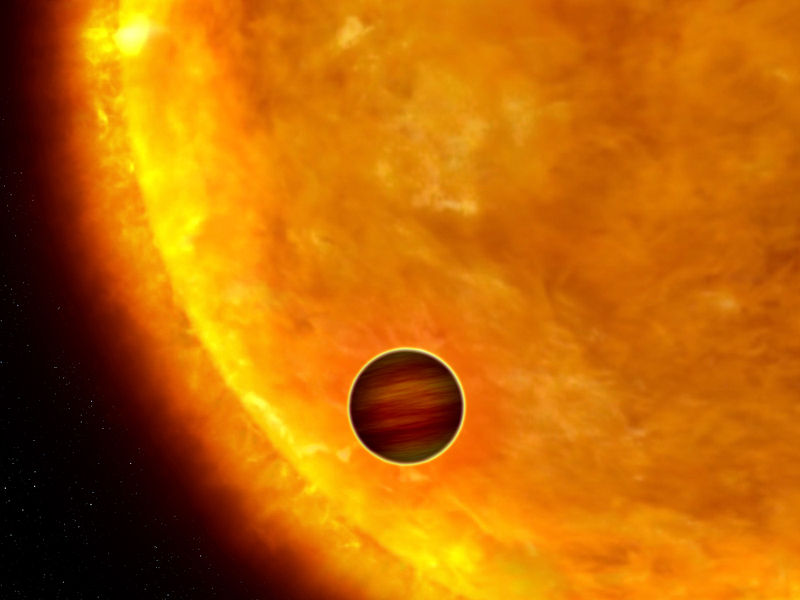 So, given this background, is it likely that such “Goldilocks planets”, which are likely to be all over the place in the universe, harbor life? Well, there are two sides to this story. As I laid out above, the popular secular point of view (and the point of view portrayed by the media) is that life is inevitable whenever loose conditions are met (background point four). So of course, whenever you have a planet in the Goldilocks zone, life is inevitable. This view springs solely from the assumption of naturalism (background point 2) and the fact that life arose on earth quickly (background point 3). You can easily see this point of view when reading the popular news articles, which are overflowing with unbridled optimism.
The other view is that life is rare in the universe, because all of the prowess of the origin-of-life scientific community has returned a comparatively small amount of promising data (background point 1). In fact, not only has little actual progress been made towards discovering naturalistic pathways towards origin of life, but instead the more we know the more we discover how far away we are. Problems such as the lack of a prebiotic soup, the irreducible complexity of life, the homochirality problem (all bio-molecules must be either 100% right-handed or 100% left-handed), the difficulty in producing a cell membrane, and the finely-tuned conditions needed to carry out the chemical reactions that produce biological precursors all reveal a much less optimistic story from the point of view of hard science.
The problems for the hypothesis of the naturalistic origin of life don’t stop there, however. The more we study our planet, the more we realize that an exoplanet needs a lot more going its way than just to be in the Goldilocks zone. There are a whole host of astronomical and geological parameters that must be exquisitely finely-tuned for life to (1) exist and (2) persist on a planet. The timing of the formation of the exosolar system, the location of the exosolar system within the galaxy, the type of galaxy the exosolar system is in, the elemental composition of the star and planet, and the existence of stable, long-lasting plate tectonics are just a few of the finely-tuned parameters that must be met for life to exist and thrive.
None of this is to say that we should not be investigating how life could have originated, or whether exoplanets may harbor other life forms. Indeed, if God did create the universe and life, I am convinced that these scientific disciplines will serve only to glorify Him further.
But these observations do beg the question: which is it? Is life abundant in the universe, a premise based on one data point and questionable assumptions, or is life rare, a premise based upon the empirical findings of the fields of biochemistry, organic chemistry, astronomy, and geology? It seems to me that hope springs eternal for the secular exoplanet researcher, but the hard scientific data tells another story.
1. Davies, Paul. “The Fifth Miracle: The Search for the Origin and Meaning of Life.” Simon & Schuster; 1 edition (March 16, 2000)
Dr Greg Reeves holds a PhD in Chemical Engineering from Princeton University, and is currently an assistant professor of chemical and biomolecular engineering at North Carolina State University. He is the co-director of the NC State chapter of Ratio Christi. His blog can be found at twobooksapproach.blogspot.com.
Announcing my new site: “Eclectic Theist”
I have many more interests than just philosophy of religion and Christian apologetics. I’ve been longing for an outlet for these interests for some time. Finally, I got down to business and made a new blog: “Eclectic Theist.”
On this new site, I’ll be writing about topics not normally discussed here on “Always Have a Reason.” For example, my first main entry is a reflection on science fiction. On this new site I’ll be discussing my other interests. Readers on here may be surprised at how random my reading is sometimes. In my undergraduate studies, I was a social studies major and I read extensively about Mesoamerican history. Did you know that!? Well now you do, and guess what? I’ll be writing about it again. I also love World War 2 history and have been reading more in that area in what exists of my free time. Of course, I’m also a huge fan of science fiction and fantasy, role-playing games, and more. All of these will be featured on this new site.
Will there be crossover? Probably. I’ve already thought of a few posts which can bring my outside interests on here and vice versa. For example, a series I’ve been contemplating for a while about science fiction and Christianity will see its launch on here in just a few short weeks. Other topics may crossover as well as they come up.
Does this mean I’ll write less here? Absolutely not. I have posts lined up for weeks now, and I continue to add to them. I’ll be maintaining my regular posts on here and using “Eclectic Theist” as an outlet for my other creative energy. Please, take the time to check out my introductory post to “Eclectic Theist” and browse the two new posts I have up. The site will be expanding quickly, so be sure to subscribe.
I’m looking forward to seeing many of you over there and talking about topics that interest us apart from philosophy of religion.
Finally, because I like pictures, I’ll share one that I just put up over on the new site: a picture of Orson Scott Card and myself.

 J.W. Wartick - Reconstructing Faith