theology
Sunday Quote!- Questioning Exegesis Through Discovery?
Every Sunday, I will share a quote from something I’ve been reading. The hope is for you, dear reader, to share your thoughts on the quote and related issues and perhaps pick up some reading material along the way!
Questioning Exegesis Through Discovery?
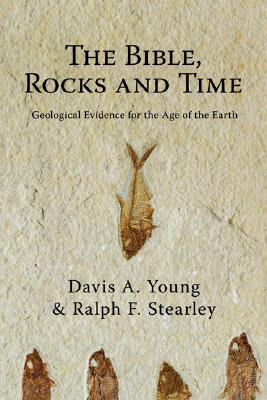
One area that evangelical theologians must weigh is the notion that exegesis should line up with reality. Thus, how might one balance an interpretation between some apparent readings and the findings of certain scientific discoveries? Must they even be balanced at all? Davis Young and Ralph Stearley’s magisterial work on the age of the Earth, The Bible, Rocks and Time, provides an interesting historical background for how discoveries led to the questioning of exegesis of certain texts:
[In the 17th Century…] foundations were gradually being laid for questioning the accepted opinion about the age of the Earth [that being a few thousand years]. Advances in the study of fossils and rock strata were both necessary before such questioning would come about… (47, cited below)
Thus, historically, there has been an interplay between scientific discovery and exegesis of key texts of Scripture. Without certain scientific advances, received opinion on certain features of the natural world remain unquestioned. However, once scientific advances made it possible, these opinions were challenged and often abandoned in the face of extrabiblical evidence. The book provides a great overview for how the interplay between discovery and exegesis played out.
What are your thoughts? Should new discoveries be allowed to challenge received interpretations? How might we best deal with discoveries in the natural world which apparently clash with our reading of the text?
Links
Be sure to check out the page for this site on Facebook and Twitter for discussion of posts, links to other pages of interest, random talk about theology/philosophy/apologetics/movies and more!
Sunday Quote– If you want to read more Sunday Quotes and join the discussion, check them out! (Scroll down for more)
Source
Davis A. Young and Ralph F. Stearley, The Bible, Rocks and Time (Downers Grove, IL: InterVarsity Press, 2008).
Really Recommended Posts 8/1/14- Marriage, Biblical Songs, Confucius, and More!
 Here’s another go-round of great posts for your perusal, dear readers! As always, let me know what you thought, and be sure to drop a comment on those you enjoyed!
Co-Leadership in Marriage: Who’s in Authority?– A question which often comes up in discussions about egalitarianism–the view that men and women have equal authority in the church and home–is how one is supposed to determine who’s in charge in marriage. Here’s a solid post answering that question.
Man’s Fallible Ideas vs. God’s Infallible Word– It is often said that we should harbor some sort of distrust towards “Man’s Fallible Ideas.” Here, Luke Nix examines this claim and sees how it may be applied to issues like creationism.
The Two Most Overlooked Apologetics Verses in the Bible– There are many verses in the Bible which are commonly referenced when it comes to apologetics. Here, Tom Gilson brings up two which are not often referenced in terms of apologetics. I originally found this over at The Poached Egg, which is a site well worth you following!
All the Songs in the Bible [Infographic]– Here, there is an outline and explanation of every single song in the Bible. It’s pretty interesting to see them all written out and explained. Frankly, I find this to be one of the more interesting and helpful sites on the web related to general Bible knowledge. Be sure to follow it for some more excellent general Bible knowledge posts.
How Confucius proves Jesus– Did Jesus exist? How we approach this question should be consistent. How do we explore other historical questions? Check out this post, which explores the question.
Question of the Week: Where do you stand on gender?
 Each Week on Saturday, I’ll be asking a “Question of the Week.” I’d love your input and discussion! Ask a good question in the comments and it may show up as the next week’s question! I may answer the questions in the comments myself.
Gender
It’s no secret on this blog that I support egalitarianism–the view that men and women should serve God through giftedness instead of by gender (read on this topic here). However, I’m curious to see what spectrum my readers have on this important topic.
What do you think is the correct biblical view of the relationship between the genders?
It is worth noting that the dichotomy between full egalitarianism/full complementarinism is a false one. There are those who hold that women may be leaders in the church but not the home (and vice versa), along with a spectrum of other beliefs among these. So I’m curious to know what you think. Let’s not start a theology war here; this post is intended merely for sharing your position.
Links
Be sure to check out the page for this site on Facebook and Twitter for discussion of posts, links to other pages of interest, random talk about theology/philosophy/apologetics/movies and more.
Question of the Week– Check out other questions and give me some answers!
SDG.
Ken Ham Declares Aliens Eternally Doomed
 Ken Ham, a prominent young earth creationist and the founder of Answers in Genesis, recently lamented on his blog about the money being spent on the search for extraterrestrial life in space. Interestingly, part of his objection was that aliens probably don’t exist because they would not be saved:
I do believe there can’t be other intelligent beings in outer space because of the meaning of the gospel. You see, the Bible makes it clear that Adam’s sin affected the whole universe. This means that any aliens would also be affected by Adam’s sin, but because they are not Adam’s descendants, they can’t have salvation.
That’s correct: according to Ken Ham, we can speculate about whether aliens may or may not exist (though both he and I agree that we think it is very improbable), but we can know for sure that aliens cannot be saved. Keep this in mind through the rest of my post: Ken Ham did not say that aliens may not be saved, but rather that they “can’t” be saved.
Space and Cost
Ken Ham was concerned with the notion that we’re spending so much money on space travel: “I’m shocked at the countless hundreds of millions of dollars that have been spent over the years in the desperate and fruitless search for extraterrestrial life.”
I would first point out that the money being thrown at this is hardly exclusively dedicated to the search for ET. Rather, much of it goes to new technology like new telescopes, listening devices, etc. which actually bring benefits for the rest of society. Thus, the money is not being spent in a “fruitless” fashion.
One might come back and say: “What if all that money was instead spent on feeding the hungry, clothing the needy, etc.?” I think that’s a valid point and it is one with some initial force. One wonders, though, about the notion of division of effort. There is a real sense in which not all of human effort may be directed towards one end. As a Christian, I certainly desire to aid those in need, but I would not say that means every dollar I spend should be directed towards that end. There are other evils than need in the world (such as abortion) to direct effort towards, and there are also other goods to promote (evangelization would be one I would list). As such, my activity must be divided. Similarly, on a national level, there are numerous ends to pursue, and an argument which reduces national spending to a single issue is simplistic.
I’m open to disagreement here and would love to hear from those who are either pro-space exploration or con. I lean pro- but I think there is some force to arguments against.
 Doomed Aliens
The thrust of Ken Ham’s post, however, was that aliens would not be saved. He acknowledged that “[T]he Bible doesn’t say whether there is or is not animal or plant life in outer space.” Given his nod to the fact that the Bible is clearly not concerned with the broader universe, it is then shocking to find that Ham asserted without qualifications that “[aliens] can’t have salvation.” I wonder: where is that found in the Bible? Where might I find the notion that: “If aliens exist, they can’t have salvation” implied in the Bible?
Ham’s argument was an implicit one: because “The Earth was created for human life” (an example of the single-end fallacy regarding God’s creation which I discussed elsewhere), and “Adam’s sin affected the whole universe. This means that any aliens would also be affected by Adam’s sin, but because they are not Adam’s descendants, they can’t have salvation.”
The argument depends upon a number of hidden and explicit premises. First, one must ask in what way Adam’s sin affected the whole universe. Does that mean that intelligent aliens instantly became cursed and condemned by the Fall? It seems Ham’s argument depends upon that premise, but there is surely no bibical data to back that up. Rather, Ham is assuming that the Fall means that any other life in the universe would necessarily be sinful and in a state of rebellion against God. Although the Bible speaks of humans being in rebellion against God, and it speaks of “all creation groan”ing awaiting for God’s coming to reconcile all things, it is surely a massive inference to leap from that to the notion that any aliens anywhere are eternally doomed.
Second, the argument assumes that God did not or would not (can not!?) mediate between other sentient beings and God. Surely it is a major assumption to state that God would not operate in a certain fashion about speculative aliens who have speculatively been included in the Fall and are speculatively doomed for eternity! For Ham to turn around and just assert that God would not save these aliens (or again, perhaps cannot, because he states that they “can’t have salvation), is a major theological error.
Third, and perhaps most importantly, the question of how Ham reconciles his first premise with his premise that “because [aliens] are not Adam’s descendants, they can’t have salvation.” After all, the same proof-texts which may be cited to try to imply that all of creation groans under the Fall (Romans 8) could also be taken, when read with the same presumptions, to mean that aliens will be saved or at least have hope of salvation: “For the creation was subjected to frustration, not by its own choice, but by the will of the one who subjected it, in hope the creation itself will be liberated from its bondage to decay and brought into the freedom and glory of the children of God [Romans 8:20-21 NIV].”
Thus, Ham’s argument has a faulty conclusion: if it is true that all of the universe fell through Adam and is therefore doomed, then it equally follows that, according to the same text, it will all be saved through Jesus as the new Adam (not universalism, but rather the “hope of salvation”). There are no grounds for Ham’s assumptions.
Conclusion
Ken Ham has overstated his case to the extreme. Although he may have some force to his argument about the needless spending of money on various space exploration projects (and again, I think these aren’t needless but that perhaps his side has some a priori power), he has committed some major blunders when it comes to speaking of the possibility of alien salvation.
As always, I’d love to have your thoughts in the comments. What do you think about Ham’s statements? Be sure to check out his blog post to get his side of the argument.
Links
Be sure to check out the page for this site on Facebook and Twitter for discussion of posts, links to other pages of interest, random talk about theology/philosophy/apologetics/movies and more!
Alien life: Theological reflections on life on other planets– I engage in some [highly] speculative theology related to the possibility of aliens.
Did God Create the Universe for Humans?-Some Thoughts on God’s purposes for creating– I argue that God’s purposes in creating are needlessly limited when people object that God created the universe [only] for humankind.
Aliens that believe in God: The theological speculations of Robert Sawyer’s “Calculating God”– I reflect on a science fiction book, Calculating God, which has aliens that believe in God.
SDG.
——
The preceding post is the property of J.W. Wartick (apart from quotations, which are the property of their respective owners, and works of art as credited; images are often freely available to the public and J.W. Wartick makes no claims of owning rights to the images unless he makes that explicit) and should not be reproduced in part or in whole without the expressed consent of the author. All content on this site is the property of J.W. Wartick and is made available for individual and personal usage. If you cite from these documents, whether for personal or professional purposes, please give appropriate citation with both the name of the author (J.W. Wartick) and a link to the original URL. If you’d like to repost a post, you may do so, provided you show less than half of the original post on your own site and link to the original post for the rest. You must also appropriately cite the post as noted above. This blog is protected by Creative Commons licensing. By viewing any part of this site, you are agreeing to this usage policy.
Question of the Week: Obscure Theological Topics
Each Week on Saturday, I’ll be asking a “Question of the Week.” I’d love your input and discussion! Ask a good question in the comments and it may show up as the next week’s question! I may answer the questions in the comments myself.
Obscure Theological Topics
The picture on the left (which I took and then added a question mark with my mad paint skills) is perhaps more appropriate this week than most, because some people may be scratching their heads:
What’s your favorite obscure theological topic? Why? What relevance does it have in the broader scheme of things?
Theology is an area of thought that has existed since the beginning of humanity. As such, there are a lot of topics to focus on (understatement). Think about some that interest you. I think a lot of my readers are probably interested in some cool stuff, and I want to know about it! Here are some examples of “obscure” theological topics: aliens and Christian theology or King James Onlyism. What are some you’re interested in? How do you apply what you’ve looked into in that area to a broader schematic of Christian theology?
Links
Be sure to check out the page for this site on Facebook and Twitter for discussion of posts, links to other pages of interest, random talk about theology/philosophy/apologetics/movies and more.
Question of the Week– Check out other questions and give me some answers!
SDG.
Sunday Quote!- Can Randomness have Purpose?
 Every Sunday, I will share a quote from something I’ve been reading. The hope is for you, dear reader, to share your thoughts on the quote and related issues and perhaps pick up some reading material along the way!
Can Randomness have Purpose?
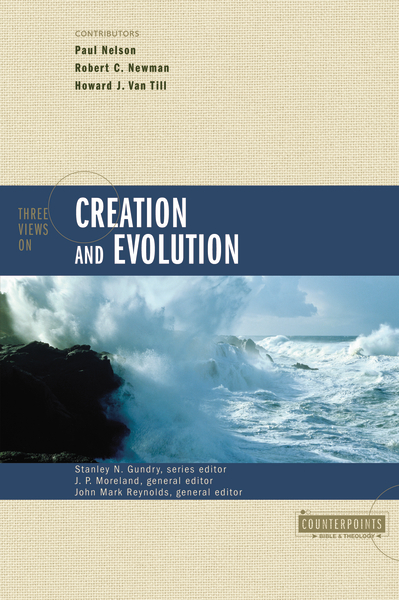
The concept of chance or randomness and its relation to God’s purpose and sovereignty is one which is very interesting to me. It has applications all kinds of direct theological applications. While reading Three Views on Creation and Evolution
While we’re on the issue of purpose, let’s look briefly at a common misunderstanding–that randomness rules out purpose. It is often claimed that randomness [which]… prevail[s] in the fundamental processes and events of biotic evolution rules out the possibility… [of] any preestablished purpose… Suppose there were a perfectly honest gambling casino in which no game was rigged–every[thing]… was authentically random. Does that rule out the possibility that the outcome of the casino operation cannot possibly be the expression of some preestablished purchase? Clearly not. In fact, the operators of the casino depend on that very randomness in their computation of the payout rates to insure that they will have gained a handsome profit… (168, cited below).
Apart from the strangely worded question he asked, Van Till’s point is that there may be purpose even with randomness: a truly random casino can still be oriented toward the purpose of making money. Thus, Van Till reasons, God could have done the same thing with the entirety of creation.
Now, I think this is an interesting claim, and I also think there is some plausibility to it. However, there does seem to be a significant disanalogy as well: the casino operators don’t care about the outcome of the random games, because their overall outcome is to have monetary gain. Presumably, however, God would care about the outcome of the randomness. Just having any creatures come from evolutionary processes would not seem to fit God’s plan as established in Genesis (creation, fall, redemption, consummation). Instead, there would have to be creatures capable of participating in that plan. Of course, Van Till might simply reply by saying that God would have known the outcome ahead of time and so that’s not at issue (or some similar response).
What do you think of the notion that chance or randomness may have purpose? If not, why not? If so, do you think this may be applied to evolution as Van Till does? What other applications do you think this may have?
Links
Be sure to check out the page for this site on Facebook and Twitter for discussion of posts, links to other pages of interest, random talk about theology/philosophy/apologetics/movies and more!
Sunday Quote– If you want to read more Sunday Quotes and join the discussion, check them out! (Scroll down for more)
Source
Howard J. Van Till, “The Fully Gifted Creation: ‘Theistic Evolution'” in Three Views on Creation and Evolution
SDG.
Really Recommended Posts 7/4/14- liberal theology, 1 Timothy 2:12, and more!
Another go-round the internet has turned up a number of links for you, dear reader, to peruse. Here, we discuss 1 Timothy 2:12-a central verse in the debate over women in the church, liberal theology, Psalms, cults, and “feminization” of the church. Check them out, and let me know what you think in the comments below. Be sure to leave them comments as well, as comments are what make we bloggers keep blogging!
NIV, ESV, and 1 Timothy 2:12– 1 Timothy 2:12 is often seen as the central verse for the complementarian position. After all, it teaches women are not to have authority over men, doesn’t it? Here, Paul Adams shares some insights from Craig Blomberg about some difficulties with translating the verse in a complementarian light, and the way this reflects in different Bible versions.
What is Liberal Theology?– I’d say it’s one of those “scare phrases” intended to throw people away from the teachings of theologians or systems which the one using the phrase wants readers to avoid. Check out this post which analyzes the term via words from Roger Olson.
Kinds of Psalms– Different types of Psalms perhaps suggest reading them differently exegetically and also for different reasons in Christian life and practice. Check out this post which discusses the different types of Psalms.
Sure Signs of a Sinister Sect (COMIC)- Here, No Apologies Allowed shares a cartoon about how to perhaps identify some less-than-sound teaching and the methods of various cultic groups.
The “Feminization” of the Church– Recently, I wrote about how many I have read have complained about this alleged “feminization” of the church. Here, the origins of this belief are assessed alongside various studies and quotes from leading approaches to the issue.
Book Review: “The Poverty of Nations” by Wayne Grudem and Barry Asmus

The Poverty of Nations: A Sustainable Solution
It is worth noting up front that I have a BS in Social Studies and had numerous classes on economics and international economics at a college level. This doesn’t make me an expert, but I think it allows me to take a decently accurate look at economic theories.*
Economics
The first half of the book focuses on issues of economics on a national level. Specifically, they endorse the free market as a way to bring prosperity to all nations. Their argument is based upon historical observations about how nations have gotten out of poverty and become prosperous.
Thus, the authors argue that fair trade and open borders (with low or no tariffs and the like) will drive the market to balance itself out and also increase the overall prosperity of people from various nations. Moreover, it will provide a means by which lesser-developed countries can utilize their comparative advantages to produce things that other countries are willing to pay a higher price such that they do not need to produce them. Demand drives the market, and the freer a market, the more demand is able to do so. The reason it is beneficial to allow demand to drive the market is because it allows for people to genuinely respond to others wants and constantly produce newer, better goods in more efficient ways, thus increasing the wealth across the board.
I should note that, by necessity, this is merely the briefest overview of this section of the book. Those who read The Poverty of Nations are essentially getting a fully realized introduction to international economics. In fact, the economic portion of the book is quite strong in many ways (though some issues with the complexity are noted below).
Biblical/Moral Issues
Like the economics portion, this half of the book has much to commend it. Though basic, much of the instruction is vital and important to realize as necessary for economic success. For example, government curtailing of bribery is important for an economic system to become more successful. Another, more complex example would be the notion that tariffs decrease the productivity of international trade and artificially increase prices.
The problem with much of the focus on the moral background to the “Free Market” is that Grudem and Asmus seem to assume or assert more often than they provide evidence. It’s easy for someone like me from a relatively free market system who favors open markets to nod along to how a free market encourages integrity because of the repeated transactions between the same persons and the like, but then a statement like this is made:
When people are held responsible by the voluntary personal interactions of the free market, they are typically more responsible. (Kindle Loc. 3784)**
Statements like this are frequently made, but after reading along and perhaps agreeing largely, one is forced to wonder about things like: “Where is the empirical evidence to show that this is actually the case?”; “To whom or to what are people more responsible to?”; “How are we capable of making judgments like this across incredibly complex systems like the economic practice of states, regions, nations, and the world?” The particular statement made above offers no empirical support for its claim, nor do the authors explore the complexities of simply stating that “people… are typically more responsible” in a free market. This statement, and others like it, leave me scratching my head and asking for the evidence. Certainly it is possibly true or perhaps it is true, but why think it without anything more than an assertion?
Another difficulty with this section is that throughout, the specific examples given are taken to be the biblical approach to economics. Now, I think one could fairly say that the Bible condemns bribery, but what of more complex issues like whether it actually endorses a free market? One constant refrain in the book is the use of Genesis 1:28 (“fill the earth and subdue it”) to support various things, from use of natural resources (which are rather shockingly claimed to be essentially unlimited: “[I]t is highly unlikely that any resources will be used up in the foreseeable future… we keep discovering huge new reserves of resources and inventing more creative ways to access them” (6606-6617)–but of course where are the huge new reserves of forests? fresh water? etc.?) to drive people to invent and make new things (3405), to making products from the earth specifically (1169), to move beyond subsistence farming (4207), and more.
One is forced to wonder whether the verse actually means all these things or if, perhaps, the Bible is simply under-determined when it comes to economic policy. I do genuinely wonder whether the Bible is to be treated as an economics textbook, which it often seems to be in this book. Quotes like these are scattered throughout, often in seemingly random fashion in the economics portion. The question is whether this really may be seen as a systematic treatment of the Bible on economy, or whether it may perhaps instead be mining the text to try to support claims about economy which are not really found therein. Not that these are unbiblical points; merely that they perhaps are not the focus or intention of the texts.
Complexities
The book seems to oversimplify on some aspects. It is common practice to use examples which allow an economist to shift just one aspect in order to demonstrate a theory.* That said, at times the examples used in The Poverty of Nations are often a bit too simplistic to believe. For example, at one point a thought experiment asks whether simply taking money from a group of wealthy elites would solve the existing issue of poverty. Although it seemed clear that simply attempting to redistribute wealth didn’t solve the problem, the proposed solution–the book’s solution–was to produce more goods. But it seems to me that if a number of elites were controlling the wealth in a country, just producing more goods would continue to line the pockets of those elite rather than specifically helping the poor.
Examples like this abound throughout the book, as simple solutions are offered to extremely complex issues. Economics is a wonderfully complex topic, but as the authors themselves note at the beginning, it is one which is hard to study due to the human factor in it. Despite the professed efforts to avoid such simplification (Kindle location 2115, for example), the book often does seem to suggest a one-size-fits-all approach to solving economic problems.
That said, at other times the authors do a great job of speaking directly to the complexities of the issue. For example, their discussion of colonialism was marvelous and ably pointed out both the potential benefits and cons of those endeavors on our present world situation. It was a great way to survey a complex issue without trying to identify any one factor. Portions of the book like this make the places where it is simplistic stand out even more, however.
A final issue is that of audience: Asmus and Grudem claim the book is primarily written for leaders of impoverished nations, which–apart from coming off as a bit imperialistic–doesn’t actually seem to be the likely readership. The authors note others as possible audience, but I wonder whether we may end up with several people walking around with this as their only interaction with economic theory and assuming they are able to fix the world’s problems through this oft-simplified economics instruction.
Conclusion
The Poverty of Nations: A Sustainable Solution is at times brilliant, but at others frustrating. It is well-worth a read for Christians interested in economics and attempting to strike at the core of poverty through effective legislation and whole-nation solutions. It does provide a very useful introduction to international economics, and gives some very good ways forward for those wishing to engage on this topic. However, readers should go in with some caution: the simplification at times means that readers should not take this as the final word on this topic, nor should they assume by reading the book they are suddenly equipped to run national-level economic programs.
Links
Be sure to check out the page for this site on Facebook and Twitter for discussion of posts, links to other pages of interest, random talk about theology/philosophy/apologetics/movies and more!
Sunday Quote!- A biblical answer to economic woes?– I discuss a quote from a section of The Poverty of Nations and whether it is true that the Bible may contain specific economic practice.
Source
Wayne Grudem and Barry Asmus, The Poverty of Nations: A Sustainable Solution
*I was a Social Studies major in college and so took a number of economics classes. I am making no claim to be an expert, but rather educated laity in this area.
**All references are to kindle locations.
Disclaimer: I received a review copy of the book through Crossway. I was not obligated by the publisher to give any specific type of feedback whatsoever.
SDG.
——
The preceding post is the property of J.W. Wartick (apart from quotations, which are the property of their respective owners, and works of art as credited; images are often freely available to the public and J.W. Wartick makes no claims of owning rights to the images unless he makes that explicit) and should not be reproduced in part or in whole without the expressed consent of the author. All content on this site is the property of J.W. Wartick and is made available for individual and personal usage. If you cite from these documents, whether for personal or professional purposes, please give appropriate citation with both the name of the author (J.W. Wartick) and a link to the original URL. If you’d like to repost a post, you may do so, provided you show less than half of the original post on your own site and link to the original post for the rest. You must also appropriately cite the post as noted above. This blog is protected by Creative Commons licensing. By viewing any part of this site, you are agreeing to this usage policy.
Sunday Quote!- Heresy as the Historical Loser?
 Every Sunday, I will share a quote from something I’ve been reading. The hope is for you, dear reader, to share your thoughts on the quote and related issues and perhaps pick up some reading material along the way!
Heresy as the Historical Loser?
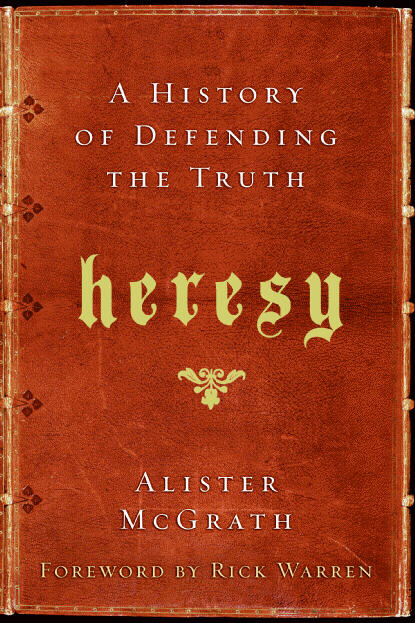
Alister McGrath’s book, Heresy: A History of Defending the Truth was a great read when I read it around two years ago, so I decided to reread it and get my notes in computer form. Almost immediately I began to discover reasons I enjoyed it so much. For example, McGrath notes that heresy has garnered much excitement and interest of late. Many see ancient heresies as something worth reconsidering, perhaps in light of losing by chance. He writes:
In this view, the distinction between heresy and orthodoxy is arbitrary, a matter of historical accident. Orthodoxy designates ideas that won, heresy those that lost. (3, cited below)
The rest of the book is dedicated to the history of heresy and how it interacted with orthodoxy. What do you think, though, of this notion that the distinction between heresy and orthodoxy is arbitrary? Could it be that orthodoxy is merely a historical accident? McGrath, of course, argues that it is not.
Links
Be sure to check out the page for this site on Facebook and Twitter for discussion of posts, links to other pages of interest, random talk about theology/philosophy/apologetics/movies and more!
Sunday Quote– If you want to read more Sunday Quotes and join the discussion, check them out! (Scroll down for more)
Book Review: “Heresy: A History of Defending the Truth” by Alister McGrath– Check out my review of McGrath’s book.
Source
Alister McGrath, Heresy: A History of Defending the Truth
SDG.
Should All Churches Be “Mere”ly “Christian”?
I gave you milk, not solid food, for you were not yet ready for it. Indeed, you are still not ready. (1 Corinthians 3:2)

Apologetics Church
I have had many discussions with my apologetics-inclined friends on the nature and purpose of church. One thing I have heard again and again is the notion that all churches–even all services–should be seeker-friendly or should reflect what C.S. Lewis calls “mere Christianity.” Mere Christianity, as defined by C.S. Lewis, is essentially that which all Christians everywhere have believed.
Interestingly, I have run into several people from a broad spectrum of backgrounds who have told me that they think all churches should be “mere Christian” churches centered on apologetics. The point of church on this view is to evangelize and to provide Christians with reasons to believe what they believe.
Statements like this are repeated by many of my apologist friends. I had a conversation with one friend in which I was informed that the purpose of church was to evangelize, and what better way to do that then to go to “mere Christianity” and have every service revolve around apologetics discussion. That’s right, this person–and others I have talked to–said that every sermon, every service, every time the church meets should be about apologetics and should not focus on those doctrines which have caused so much division within the body of Christ.
As an apologist with an MA in the field, this has some appeal! After all, were all churches to do this it would certainly raise my “employability” quotient! I would be in demand every single Sunday. But realistically, I think that statements like this show underlying confusion about the nature of church and the importance of Christian doctrine.
The Point of Church
There is no way for a complete, systematic outline of what church is about in a post like this. Nor would I claim to be an expert on the doctrine of the church. So, at risk of being simplistic, I would say that the meaning of church is to glorify God. How is this done?* I think it’s clear that the creedal statements about the church accepted throughout the history of Christianity (dare I say, the “mere Christian” definition of church?) is that it is “holy” and a “communion of saints” (Apostles’ Creed) and it is “holy and Apostolic” and “catholic/universal” (Nicene Creed).
A church should not be a place which wards off those who are seeking, but the ultimate purpose of church, confessed for over a thousand years, is to be “holy” and a community of saints. The body of Christ is not immediately perfect; but the point of church is to have community with fellow saints–the Body of Christ. Worshiping and glorifying our Creator and Redeemer is central to the life of the church. If we abandon that, we abandon the very reason for having community to begin with.
Whatever vision we have of church, then, should incorporate how the church has always defined itself. A primary need for the Christian is to worship and thank God for the blessings poured out on us each and every day. The community of believers longs to worship Christ, to join the company of angles to laud and magnify the name of the Most High God.
Moreover, when we look at the verse I led this post with, the church is a place to get the “solid food” believers need to go beyond the “milk.” Churches instruct the community in how to move beyond the “milk” of “mere Christianity” and acceptance of the bare minimum and into “solid food” and a fuller understanding of God’s word.
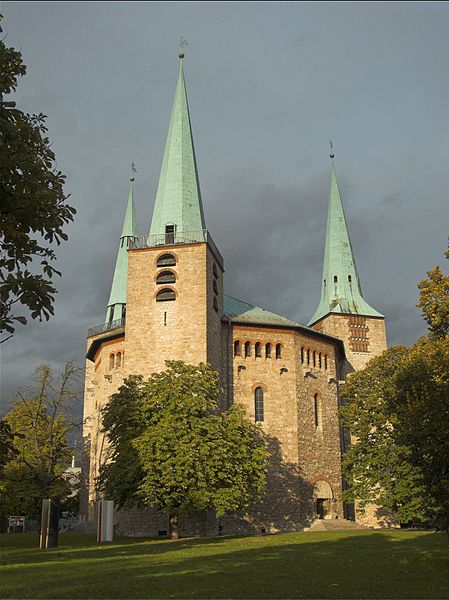 Apologetics Church, Revisited
I have my own vision of what a church that is focused on apologetics would look like.
The “Apologetics Church” would have a study group for both youth and adults to participate in which focused upon various apologetics issues. The group would start at a basic level, teaching on the nature of apologetics and its methods, then move into individual objections to the Christian faith.
The pastor would have studied apologetics on his/her own and would integrate apologetics into sermons when appropriate (Easter would be a great time to talk about evidence for the resurrection, for example). The church would have a monthly “outreach night” in which the local community was invited in to discuss questions about the faith and simply engage in dialogue over desserts or a snack. The church would have groups that went to a movie, or an art show, or a concert, etc. and then met afterwards to discuss the implications of that media for the Christian worldview.
It would be a church aware of, but not overtaken by, apologetics. It would be an evangelical, mission-oriented church, but not a missions-only church.
Conclusion
I have said only the bare minimum about the nature of church and its function. Ultimately, though, I think a vision of the nature of church should include apologetics, but it should not be reduced to it. We seek “solid food” and long for deeper knowledge of God. Your church is an excellent place to get that needed, longed-for instruction.
As the deer pants for the water, so my soul longs for you.. (Psalm 42:1)
Links
Be sure to check out the page for this site on Facebook and Twitter for discussion of posts, links to other pages of interest, random talk about theology/philosophy/apologetics/movies and more!
The Church Universal: Reformation Review– I take a deeper look into the definition of a “universal church” in a post that focuses on theology of the reformation.
*As a Lutheran, I would say that glorifying God in church is best done through Word and Sacrament, but I realize that not all churches are sacramental and do not desire to start that debate here.
SDG.
——
The preceding post is the property of J.W. Wartick (apart from quotations, which are the property of their respective owners, and works of art as credited; images are often freely available to the public and J.W. Wartick makes no claims of owning rights to the images unless he makes that explicit) and should not be reproduced in part or in whole without the expressed consent of the author. All content on this site is the property of J.W. Wartick and is made available for individual and personal usage. If you cite from these documents, whether for personal or professional purposes, please give appropriate citation with both the name of the author (J.W. Wartick) and a link to the original URL. If you’d like to repost a post, you may do so, provided you show less than half of the original post on your own site and link to the original post for the rest. You must also appropriately cite the post as noted above. This blog is protected by Creative Commons licensing. By viewing any part of this site, you are agreeing to this usage policy.

 J.W. Wartick - Reconstructing Faith