theology
The Bible Is Not One Book
 I was doing some research recently for a lengthy (book length!) project I am working on and was searching Amazon for some books on Bible prophecy. I came upon a work by John Walvoord called Every Prophecy of the Bible

I was perplexed by his (a male, judging by the picture) objection to confirming the Bible as true through prophecy. He wrote, “The book basically runs off a list of biblical prophecies that have supposedly been fulfilled. Amazingly pretty much all the evidence for these so called fulfilled prophecies comes from the same book making the prophecies in the first place ie the bible.” He then proceeded to ridicule Christians who do believe this as holding to an “infantile” belief.
The Objection
Unfortunately, this is not the first time I have seen an objection like this. Put simply, the objection is that the Bible can’t confirm itself, because that would be a circular argument. In other words, one can’t use material from one part of the Bible to confirm other parts of the Bible because then one is arguing for the truth of the Bible from the Bible.
The Problem
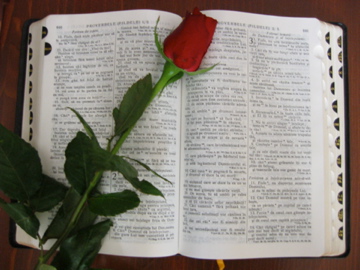
Most people should immediately see what the problem is. Although the Bible as we have it today is a single “book” in the sense that its contents share the same binding, it is really a collection of independent works written across over a thousand years by various authors in different parts of the world. In other words, the Bible is not “one book,” at least in the sense that one needs to maintain for this objection. Thus, if there is a prophecy found in one book which we know to be earlier than a book which is later that records its fulfillment, then there seems to be at least some evidence, prima facie, for the truth of the prophecy. (Of course this would be contingent upon the historical accuracy of the books, etc., etc. but the simple fact of an alleged prophecy’s existing before its fulfillment is an interesting facet to consider.)
A friend, Anthony Weber, made an analogy: think of the Bible as a library of books. Would it not be silly to think you couldn’t pull one book of the shelf and say that it confirmed another book? Suppose each book was about history, and one made a mere mention of a topic, while another featured a more detailed description. Would we not be surprised if someone came along and objected, saying “Well, they’re in the same library, so we can’t trust them!”
Inerrancy?
Christians need to realize that this has implications for doctrine as well. For example, those who maintain inerrancy–and I strongly believe that consistent Christians should do so (see my arguments to this end and defense of the doctrine here)–may be concerned that viewing the Bible in this fashion comes in danger of breaking it up piecemeal and pitting each segment against the others. But this is not what follows at all. Instead, it is simply an acknowledgment that the Bible is a collection of works in different genres written at different times in different places which, when put together, form a coherent whole.
Concluding call for intellectual honesty
In light of what I have explored, I want to first issue a call to the atheists out there: I know that you (atheists) do not all hold to objections like this and would find someone else using this objection a bit alarming. I call you to challenge your fellow atheists to a more honest interaction with positions of faith. If you want to criticize someone else’s position, fine. But do it without completely misrepresenting them. Call out your fellow atheists when they try to put forth this kind of drivel as a serious objection to Christianity. I try to call out fellow Christians when they do the same with other views.
To my fellow Christians: be aware that objections like these are not the backbone of atheism. Frankly, I think people like “gavin” are just grasping at anything to maintain unbelief and ridicule others they choose to look down on as “infantile.” Let’s engage with people who make these objections, but if they persist, dismiss the objection as the ridiculous notion it is. Finally, if you catch yourself treating the Bible like one book without any distinction in genre, time, place, etc., stop yourself. It is important to note the Bible is united in message, but God used different people as they were “carried along by the Holy Spirit.” It wasn’t delivered all by divine dictation.
Links
Be sure to check out the page for this site on Facebook and Twitter for discussion of posts, links to other pages of interest, random talk about theology/philosophy/apologetics/movies and more!
SDG.
——
The preceding post is the property of J.W. Wartick (apart from quotations, which are the property of their respective owners, and works of art as credited; images are often freely available to the public and J.W. Wartick makes no claims of owning rights to the images unless he makes that explicit) and should not be reproduced in part or in whole without the expressed consent of the author. All content on this site is the property of J.W. Wartick and is made available for individual and personal usage. If you cite from these documents, whether for personal or professional purposes, please give appropriate citation with both the name of the author (J.W. Wartick) and a link to the original URL. If you’d like to repost a post, you may do so, provided you show less than half of the original post on your own site and link to the original post for the rest. You must also appropriately cite the post as noted above. This blog is protected by Creative Commons licensing. By viewing any part of this site, you are agreeing to this usage policy.
Molinism and Aseity- A knock-down argument against middle knowledge?
 One of the most recent “Straight Thinking” podcasts–a podcast put on by Reasons to Believe–featured Travis Campbell discussing Middle Knowledge (which is an aspect of the philosophical theological position known as molinism). Middle Knowledge is, essentially, God’s knowledge of counterfactuals–that is, the knowledge of things like “If someone talks about molinism, J.W. Wartick will be interested.” That is a counterfactual because it states something which may be contrary to fact–that is, it depends on some condition to be fulfilled in order to be true (in the example above, it is the occasion of someone to talk about molinism).
On the second part of the interview, Campbell discussed some objections to molinism which he felt made the position intractable. One of the first objections he presented was an objection from “aseity” that is, God’s self-existence. According to the doctrine of divine aseity, God does not rely upon anything else for God’s existence. Now, molinism classically holds that God surveys the realm of possible worlds prior to the creative act and so sees all possibilities related to free creaturely choices. Then, God creates the world God desires. Campbell argued that this undermines God’s aseity because it makes God dependent upon creatures for omniscience–one of God’s essential attributes.
The argument, if sound, has great force. After all, if molinism means one must deny an essential attribute of God, there is a pretty serious difficulty with the doctrine. But does it? Campbell cited William Lane Craig, a leading proponent of molinism, as admitting that molinism entails that God’s knowledge, at least, is in some sense dependent upon creaturely choices. From what I have read of WLC,* I have found it seems he frequently makes it appear as though molinism presents God as able to choose among any parts of possible worlds to construct whatever possible world God wants. Not correct… but possibly also not Craig’s actual view;* perhaps Craig is only making it seem thus when he discusses molinism in summary. What I’m getting at is that I’m not convinced Craig is as consistent a molinist as, well, Molina (or in modern times, Thomas P. Flint).
Now for the claim itself, I do not think it follows that God is actually dependent upon creaturely choices. And, if it follows from molinism that God is dependent in that way, then it must also be true of any view which holds to foreknowledge whatsoever. In fact, this is where I have a pretty serious bone to pick with any view which denies comprehensive foreknowledge. Unless I am much mistaken–which is quite possible–the realm of possible worlds is a set of necessary truths. That is, each possible world is a complete set of all true propositions for the entire history of that world.*** But if that is the case, then molinism is no different on God’s creative activity than any other view of creation, for God is simply selecting one from a set of possible worlds.
There is debate over how such a set of possible worlds might be populated–does the set of possible worlds come from God, or is it simply a set of necessary truths?** Whatever one’s answer for this, it remains clear to me that molinism is not defective in this area: the molinist simply holds that God selects a possible world from the set of possible worlds. The fact that the molinist emphasizes that these possible worlds include free choices is essentially a moot point so far as aseity is concerned. If there is such a set of possible worlds, then any view of God’s foreknowledge and creation has to acknowledge that God’s creative act is the bringing forth of one such possible world. If there is no such set, then it seems our universe is necessary, which would itself be problematic for the doctrine of creation.
So it seems to me that Campbell failed to make a compelling argument against molinism from aseity. In order for his argument to be successful, he would have to show that molinism’s view of possible worlds is somehow radically different from any other position and then also demonstrate that molinism’s view also necessarily makes God dependent upon creaturely freedom. But of course that would also involve him having to show that the set of possible worlds, on molinism, is itself independent of God. And it seems to me that although perhaps not all molinists hold that God does generate the set of possible worlds, it is entirely possible for a molinist to consistently hold that this is the case: the set of possible worlds is dependent upon God. And, if that is true, Campbell’s argument fails. I conclude that Campbell’s argument fails because it is both incomplete and unsound.
*I have his Divine Foreknowledge and Human Freedom but I am working through Molina’s work before I transition into it.
**Interestingly, Craig is working in this area for his next major academic work, according to his own discussion of related topics on his podcasts.
***One may hold that a possible world is merely the starting conditions of a world, but I do not see how that distinction could be made coherently. That is, I’m not convinced that a set of possible worlds would not include the entire history of the possible world. Moreover, any who would argue that God has comprehensive knowledge of the future would have to grant that God’s creative act would entail the history of the entire [possible] world.
Links
Be sure to check out the page for this site on Facebook and Twitter for discussion of posts, links to other pages of interest, random talk about theology/philosophy/apologetics/movies and more!
SDG.
——
The preceding post is the property of J.W. Wartick (apart from quotations, which are the property of their respective owners, and works of art as credited; images are often freely available to the public and J.W. Wartick makes no claims of owning rights to the images unless he makes that explicit) and should not be reproduced in part or in whole without the expressed consent of the author. All content on this site is the property of J.W. Wartick and is made available for individual and personal usage. If you cite from these documents, whether for personal or professional purposes, please give appropriate citation with both the name of the author (J.W. Wartick) and a link to the original URL. If you’d like to repost a post, you may do so, provided you show less than half of the original post on your own site and link to the original post for the rest. You must also appropriately cite the post as noted above. This blog is protected by Creative Commons licensing. By viewing any part of this site, you are agreeing to this usage policy.
“The Saint Who Would Be Santa Claus” by Adam English – A Seasonably Appropriate Book Review
In the quest for the real Santa Claus, what is discovered more often than not is that he can assume any shape. He can accommodate anyone… (191)
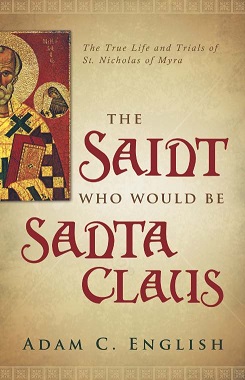
There are many discussions floating around about the “real” Santa Claus, Saint Nicholas. I have a bit of a side interest in the topic because I was never a believer in Santa Claus and so I’ve always been interested in the reality behind the myth. So, when I received The Saint Who Would Be Santa Claus
for Christmas last year, I was excited to dive in for the season this year
Perhaps the most interesting portion of the work is English’s discussion of the historiographical difficulties related to unearthing the historical Nicholas of Myra. The difficulty with discovering the “real Santa Claus”–Saint Nicholas–is compounded by the fact that Nicholas of Myra (the Nicholas in question) is often confused with Nicholas of Sion (10; 80; 120; 174). Historical accounts of the life of Nicholas have often conflated these two persons, which means historians must extract them from each other in order to make an account of either. English confronts the possibility that Nicholas did not exist–a possibility put forth by some scholars, in fact–head-on by noting the multiple, independent sources for his life. Although Nicholas did not leave behind a legacy of his own writings, the extant evidence, argues English, is enough to acknowledge his existence as well as a historical core of stories about his life (11ff).
English does a great job of reflecting upon the apparently historical narrative while also drawing out the legends and apologetic tales which grew up around the narratives. Throughout the book, he reports a number of stories related to the life of Nicholas of Myra. He reports these stories seemingly in order of legendary development. For example, the famous story of Nicholas’ gift of gold to three women in need (about to be sold into prostitution) received more embellishment as time went on (57ff). However, English does not always do a great job of making the distinctions clear when these various types of tales are discussed. Part of this is probably due to the historiographical difficulties noted above, but it would have been nice for English to at least offer his opinion regarding the stories he related as to which he felt might be accurate as opposed to inaccurate. At some points he does, but at others he simply offers a series of increasingly surprising accounts without any commentary as to the possible historicity of the accounts.
A central part of the work focuses upon the council of Nicaea and the famous incident of Nicholas’ alleged slapping or punching of Arius or a different heretic (Arian) at the event. English argues that it is unlikely that it would have been Arius, because Arius was not a bishop and so likely would not have been present at the council itself (101-107). Moreover, English believes that a different story, in which Nicholas reasons with an avowed Arian to change his view, is more likely the historical background for the story (107-109). Nicholas’ own place at the council is disputed, but his orthodoxy is acknowledged by all his biographers, and it is likely that he defended the orthodox position at the council itself (107ff).
Apart from his participation at Nicaea, Nicholas also, of course, performed the basic functions of a bishop, which at his time included helping to resolve issues in Myra and the surrounding area (115ff). He helped with the struggle against pagan belief and practice, and at this point some of the stories and legends of Nicholas of Sion were often intermixed with those stories of Nicholas of Myra (120-125).
English’s work also draws out the way that Nicholas of Myra has been adapted for multiple purposes and occasions. Whether this is through the adaptation of his apparently real, historical life to various theological discussions (including Aquinas) or legends which were developed to supplement his legacy and individual viewpoints, Nicholas’ story continues to have widespread appeal.
The Saint Who Would be Santa Claus is an interesting read on a compelling man. Perhaps the most interesting part is the frequent fusion of myth and legend with the historical account. Those interested in the life of the “real Santa Claus” should immediately grab the book for their collection.
Links/Source
Adam English, The Saint Who Would Be Santa Claus: The True Life and Trials of Nicholas of Myra
Saint Nicholas- A Christian life lived, a story told– I wrote about the interplay between myth and reality in the stories about Nicholas. I wrote about how the myth of Nicholas actually bolsters the Christian worldview by pointing toward our longing for the ideal.
Be sure to check out the page for this site on Facebook for discussion of posts, links to other pages of interest, random talk about theology/philosophy/apologetics/movies and more!
SDG.
——
The preceding post is the property of J.W. Wartick (apart from quotations, which are the property of their respective owners, and works of art as credited; images are often freely available to the public and J.W. Wartick makes no claims of owning rights to the images unless he makes that explicit) and should not be reproduced in part or in whole without the expressed consent of the author. All content on this site is the property of J.W. Wartick and is made available for individual and personal usage. If you cite from these documents, whether for personal or professional purposes, please give appropriate citation with both the name of the author (J.W. Wartick) and a link to the original URL. If you’d like to repost a post, you may do so, provided you show less than half of the original post on your own site and link to the original post for the rest. You must also appropriately cite the post as noted above. This blog is protected by Creative Commons licensing. By viewing any part of this site, you are agreeing to this usage policy.
Really Recommended Posts 12/13/13- Bonhoeffer, Creationism, Feminism, and more!
 The Really Recommended Posts this week are really wide-ranging. I hope you’ll enjoy this smorgasbord as much as I did. We feature Dietrich Bonhoeffer’s theology, creationism, feminism, intelligent design, the conquest narratives in the Bible, and more! Check them out, and, as always, let me know what you think!
Dietrich Bonhoeffer, a New Testament Pastoral Theologian– Bonhoeffer is, I admit, one of my favorite theologians. I only wish he had had more time upon the earth to develop more systematic works than he did write. I’m Lutheran too, which makes me gleeful at the broad appeal Bonhoeffer has demonstrated. In this post, Joel Willitts explores the way in which Bonhoeffer did theology. It’s a fascinating look at the development of his theology.
Multiple Lines of Evidence Support an Ancient Earth– The charge is often made from young earth creationists that dating methods don’t work. What about when those dating methods correspond across independent and multiple lines of evidence? It seems this presents a major challenge to the young-earth paradigm. Check out this post for a summary of several related points.
Was There an Exodus & Conquest– Two of the biggest challenges to the OT narrative are directly related to the historical accounts of the Exodus and the Conquest narratives. That is, did these even happen? Here, there is a post which briefly summarizes the issues and evidences related to these events.
“Darwin’s Doubt” with Stephen Meyer (and Eric Metaxas) [VIDEO]– A fairly lengthy video in which Eric Metaxas discusses intelligent design with Stephen Meyer. I found this video to be highly informative and also really entertaining. Metaxas is clearly a great speaker, and he keeps the discussion going and interesting throughout. Meyer, of course, is also a great speaker and it is worth hearing his discussion of these ideas.
thoughts on being a “Jesus Feminist”– What does it mean to be a Jesus Feminist? Can Christians be feminists and follow Christ? Check out this reflective post on what it means to be a Jesus Feminist.
Rescuing Songs of Christ’s Birth from Christmas– Should songs of Jesus’ birth be sung only during the Christmas season? Here, compelling reasons are offered as to why these songs are appropriate year-round.
The Advent Project– A pretty sweet deal: Biola University, one of the best schools out there (not biased at all ;)), has a series of Advent devotions going up daily available on their site. Each has a work of art, a music selection(s), and a brief reflection upon the coming of Christ, the incarnate God, into our lives. I’ve been following them as they go up and have enjoyed them all. Check them out for an excellent way to meditate on the meaning of Christmas.
My Current Projects and Graduation
Hello, dear readers!
I wanted to let you know how much I appreciate your coming and reading my blog, whether you are just a one-off who happened to stumble on this post, or a follower who has read it for years.
As a kind of thank you, I wanted to give you an update on what I’m currently working on behind the scenes. I am, as always, constantly writing blog posts. I try to give a pretty good spread of topics I’m interested and I hope you find them interesting too. I read a lot of books, so book reviews are a constant part of the process.
I graduate from Biola University with my MA in Christian Apologetics on December 20, 2013. I will be graduating in absentia. I don’t have the money to fly out to CA for it, so I’m a little bummed that I won’t be able to walk for my graduation, but I’m also very excited to be finishing. I have had an absolute blast with the courses and I have learned a lot. Anyway, I have actually had two readers contact me because they wanted to send a gift for graduation and/or Christmas. Wow. That is really, really awesome. Thanks so much! If you also want to consider such a thing, feel free to check out my constantly-updated Amazon wish list.
I’m honestly really looking forward to getting the MA hood. Perhaps I’ll wear it around the home. Okay, no I won’t. But it is a really awesome feeling to be right on the verge of my MA!
But now that I’m on the verge of graduating with my MA in Christian Apologetics, I have been thinking ahead and considering what projects I should work on. Here’s an idea of what I’ll be doing.
Writing Books:
Yes, I’m working on a couple books. I’m actively writing on two of them, with a couple others planned in the future. My hope is to get these published through a major Christian publishing house. So hey, if you have any connections or advice, please send them my way either through the comments here or through the “contact” form.
The books I’m working on right now are, I think, going to be both highly relevant and also very sellable. They’re the kind of books that, if I saw they had been written, I would snap them off Amazon instantly. So I hope that others will feel the same way. The first book is about 95 pages right now, but I hate to say that I’m going to keep the topic top secret. I’ll just say this: it is related to apologetics, and it is going to give a lot of unique insight. It will, I think, drive a whole lot of discussion and research going forward. I’m not trying to brag here, I just think that the outcome will be pretty significant.
The other book I’m working on is related to issues of creation and creationism. It’s going to be largely autobiographical and written in the first person as a kind of memoir of my explorations of the issues involved. I may not reflect it much on the blog, but I have a fairly dry sense of humor and that will be reflected in this book.
School
I am planning on continuing my education, hopefully by pursuing a PhD in theology next. I will be applying not for 2014 but for 2015, so I’m taking this year to study languages and the like while working on my books before I go into full time school work again.
Bible Commentary
I have been working on a commentary on the entire Bible. I’m writing this less as a book project than as a simple project for edification. I have been keeping a document in outline format with notes on the various books of the Bible as I read through them. The outline format allows for easily searchable notes, and I also use some paragraphs therein as well. I think it is pretty neat! I am currently going through Proverbs, Deuteronomy, and Luke.
The insights one gets from such a project are amazing. It is fascinating to see the way you find links between books that you never had before. I highly recommend that you also keep a kind of running commentary going as you read through the Word.
Onward!
Anyway, those are the projects I’m currently working on. I hope you enjoyed reading about them. Let me know what your thoughts are! What are you working on? Leave some comments.
Really Recommended Posts 11/22/13- Miraculous Gifts, Concordism, Archaeology, and more!
 I have to admit, I think this is one of the most engaging “Really Recommended Posts” I’ve put together. There are multiple views presented on two of these posts, and the others give some good food for thought. Check out opposing views on charismatic/miraculous gifts; delve into the notion of concordism from different sides. Leave comments to share your own thoughts on these issues. Then, archaeology, abortion, the Noah movie, and Hume round out the discussion. I hope you’ll drop some comments to let me know your thoughts.
Debate: Have the New Testament Charismatic Gifts Ceased?– The “Strange Fire” book and conference have caused a huge amount of discussion to arise within evangelical circles regarding miraculous/charismatic gifts. Do these gifts continue past the New Testament times? Here, Michael Brown debates Sam Waldron on this topic. I have also written presenting four major views on this topic should you like to explore the topic more deeply. Which side do you think is correct? Why? Leave a comment!
Defending Concordism: Response to The Lost World of Genesis One– Concordism is the view that science will line up with biblical teaching about origins and other scientific aspects of reality. One major challenge to the position is the notion that the Bible simply doesn’t address such things. Here, Reasons to Believe, a major concordist group, answers several objections posed against concordism. William Lane Craig has recently answered a question about concordism himself, in which he raises a few objections to the position and explains why he is not a concordist. What are your thoughts on this debate? Leave a comment!
A Brief Sample of Old Testament Archaeological Corroboration– The Old Testament clearly makes a number of claims about the actual historical events of the Bible. Here, J. Warner Wallace addresses some of these claims and notes how we have archaeological research to back them up.
How the ADF kept nurses who wouldn’t perform abortions from being fired– The ADF–Alliance Defending Freedom–successfully reached a settlement regarding a hospital that was going to force nurses with moral objections to abortion to perform them. I find this a particularly stunning case, because so often the pro-choice side says things like “Don’t want an abortion, don’t get one!” But this is shown to be mere lip service, because now the attempt is being made to force even those with moral objections not to get abortions, but to actually carry them out. I am very pleased to see that sound reasoning prevailed and the nurses were not forced to do this or lose their jobs. It remains troubling to me that anyone would even think this could be okay. Check out the post.
How Should Christians Respond to Noah the Movie?– Greg West over at The Poached Egg (an amazing site you should follow if you don’t already!) found this gem of a post regarding the “Noah” movie. Check out my own thoughts on the trailer and upcoming film.
David Hume’s Genuine Theism– A provocative title, to be sure! In this brief post, the author argues that one of Hume’s aims was to restore “genuine theism” over and against rationalistic deism. It’s a quick read, but very thought-provoking.
“Pastrix: The Cranky, Beautiful Faith of a Sinner and Saint” by Nadia Bolz-Weber: Book Review
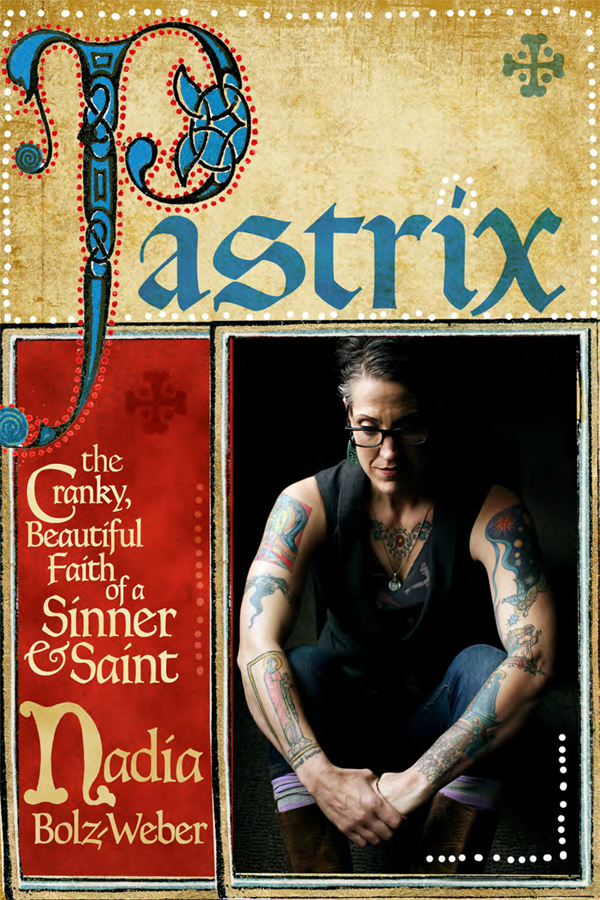 Nadia Bolz-Weber is an edgy, hard-hitting, and often witty pastor in the Evangelical Lutheran Church in America (ELCA). Her latest book is filled with autobiographical stories and a number of anecdotes which focus around the subtitle: they are often cranky, sometimes beautiful, and they reflect a sinner-saint.
The book traces Bolz-Weber’s path towards the ministry through her years in recovery from alcoholism to her starting a church: “House For All Sinners and Saints” and the struggles and triumphs she experienced throughout these events. I’ll not summarize the entire contents of the book but rather I have selected one story to give a brief sample of how the book flows.
The most poignant story in the entire book, in my opinion, is that of Bolz-Weber’s relationship with Chris Rosebrough from Pirate Christian Radio, a very conservative Lutheran (from the Lutheran Church–Missouri Synod [LCMS]) who runs a very conservative radio show. He is, in many ways, all that Bolz-Weber would oppose. And Rosebrough often criticized Bolz-Weber on his show. Then, one day, they had a chance to meet and they talked through the core of Lutheran theology: salvation by grace. Bolz-Weber wrote, “[The other people witnessing their meeting] saw us share a thirty-minute public dialogue about our own brokenness and need for confession and absolution, why we need the Gospel, and what happens in the Eucharist… God made my enemy my friend that day” (113).
Later, Bolz-Weber experienced criticism from her “own side”–liberals [her word, I’m not trying to use it in a derogatory fashion]–and talked with Rosebrough [who is, again, staunchly conservative] about it. They didn’t have to agree on the issues to carry on a conversation about God. “Chris [Rosebrough] doesn’t agree with me [about various issues]… But the one phone call I got in the middle of being attacked by my own tribe was from someone who is on the other side of the issue entirely… [H]e knew what it felt like… [He] said that he loved me and would pray for me. His enemy” (119-120).
Awesome, heart-stopping stories like this are scattered throughout the book. But they are in-between stories that will surely polarize readers. One is a story about a transgender girl turned boy and how Bolz-Weber helped hold a ceremony to help recognize “Asher”‘s new name and identity as a boy. Another story is about her time away from Christianity in which she worshiped a “goddess” instead.
Pastrix ends on a note about Bolz-Weber’s vision of church. Mary Magdalene becomes her foil as she reflects upon the meaning and purpose of church. She wrote, “Like Mary Magdalene, the reason we can stand up and weep and listen for Jesus is because we, like Mary, are bearers of resurrection, we are made new” (201).
Evaluation
There are no words minced in this book. The f-word is sprinkled throughout (and even featured twice in one chapter title). Bolz-Weber continually describes situations or feelings as “s***.” She is completely unapologetic in her approach in this regard.
This raised red flags for me. What does the Bible tell us about the Christian life, and does it say anything about the requirements for teacher, overseer, elder, and deacon? How might Bolz-Weber apply these to her life as a pastor? No, I’m not saying that as a woman she shouldn’t be a pastor–I’m firmly egalitarian. But I wonder about how she would take a passage like James 3 (specifically 3:1-2; 9-10):
Not many of you should become teachers, my fellow believers, because you know that we who teach will be judged more strictly. We all stumble in many ways. Anyone who is never at fault in what they say is perfect, able to keep their whole body in check… With the tongue we praise our Lord and Father, and with it we curse human beings, who have been made in God’s likeness. Out of the same mouth come praise and cursing. My brothers and sisters, this should not be.
Teachers are called to a higher standard. James noted that obviously people stumble, but that does not mean that we should give up or simply embrace whatever wrong behavior we are engaged in. “This should not be!” I wish Bolz-Weber had engaged with this issue in her book.
Another huge issue with the book for me is Bolz-Weber’s exegesis. It seems to me her preconceptions about what the text should mean often shape how she reads it. Specifically, this relates to the question of sanctification. Are Christians really in the process of being made new? If so, how does she reconcile this with the way she seems to conceive of “sinner-saint”–a valid concept–by which she seems to simply mean that one does not even have to try to change? She wrote:
Repentance in Greek means something much closer to ‘thinking differently afterward’ than it does ‘changing your cheating ways.’ Of course repentance can look like a prostitute becoming a librarian, but it can also look like a prostitute simply saying, “OK, I’m a sex worker and I don’t know how to change that, but I can come here and receive bread and wine and I can hold onto the love of God without being deemed worthy of it by anyone but God.”
It seems her primary point in this passage is that God’s grace is firm and sure and we, as sinners, can hold onto that. But I can’t help but feeling Bolz-Weber misses the mark at an astonishing margin in that she never discusses the need to go beyond that. Paul discussed various types of sins in 1 Corinthians 6, and then he went on to say “And that is what some of you were. But you were washed, you were sanctified, you were justified in the name of the Lord Jesus Christ and by the Spirit of our God.” That is, God’s work does not simply end with justification, it continues on into sanctification. We are sinner-saints in the sense that we are yet sinners but God has saved us; but also, we are being made saints by the work of the Holy Spirit. We are to flee from sin, not ignore it.
Bolz-Weber’s entire autobiographical account does speak to the way that the powerful message of grace changes someone, but she never draws this point into the open. Moreover, when she speaks about the life of others, sin is often treated lightly or even entirely ignored. It seems that she is fully willing and able to apply the Law to her own life, but she does not universalize it; she does not make the Law applicable to everyone. Thus, it seems to me she fails to properly preach Law and Gospel.
Pastrix, was a book I really wanted to love. But… I didn’t. There are a number of great insights and anecdotes scattered through the pages, but ultimately readers have to slog through gobs of unnecessary cursing, shock-value stories, and more to find them. One moment, it had me cheering along with Bolz-Weber; the next, I found myself confused about what she was trying to communicate. Ultimately, the book left me wondering who, exactly, the intended audience was supposed to be. It’s not the type of book I’d hand to someone to try to convince them of Bolz-Weber’s view. Nor is it the type of book that I, as someone who agrees in part with her, particularly enjoyed. It seems to me the audience is ultimately those who already agree with her on basically everything. That isn’t a problem, as it is perfectly acceptable to write books that preach to the choir, but I am left confused as to why Bolz-Weber actually did write Pastrix.
Throughout the book it seemed that she was trying to convince me of something, but it never really became clear what that message was. There are times when I really did “get it.” It was like she grabbed that which is Lutheran in me and just played it for all it was worth. But then she failed to make it universal; it applied to her, but she never made Law and Gospel universal. She would discuss intense need for grace which is free and abundant and ever-flowing. She would point out how we need not do works to access this. But then, so often, it seemed she would conflate this with the notion that Christians are not all called to move away from sinner and towards saint. There seemed to be no sanctification in the work. It was all about the initial call to grace; but little about the enduring, sanctifying work of the Spirit.
SDG.
——
The preceding post is the property of J.W. Wartick (apart from quotations, which are the property of their respective owners, and works of art as credited; images are often freely available to the public and J.W. Wartick makes no claims of owning rights to the images unless he makes that explicit) and should not be reproduced in part or in whole without the expressed consent of the author. All content on this site is the property of J.W. Wartick and is made available for individual and personal usage. If you cite from these documents, whether for personal or professional purposes, please give appropriate citation with both the name of the author (J.W. Wartick) and a link to the original URL. If you’d like to repost a post, you may do so, provided you show less than half of the original post on your own site and link to the original post for the rest. You must also appropriately cite the post as noted above. This blog is protected by Creative Commons licensing. By viewing any part of this site, you are agreeing to this usage policy.
Really Recommended Posts 11/15/13 The Quran, egalitarianism, the Dark ages, and more!
I have searched the four corners of the internet to bring you, dear readers, these really recommended posts. This week, we explore the Quran, egalitarianism, evidence for the truth of the Bible, the Dark Ages, and more! Check them out. As always, drop a comment to let me know what you thought! Have a post you think I’d be interested in? Here’s your place to share it (but don’t just leave a link! Tell me why I’d like it).
Is the Quran the Book of God? Debate Transcript– This is a very lengthy written debate between a Muslim and Christian on the topic: “Is the Quran the Book of God?” It is well worth a read as it shows the methodology that Muslims frequently use in debates. The cross-examinations, in particular, are highly useful. Although it is lengthy, I do really recommend that you read through this to get a better understanding of the places Christians and Muslims differ. The Christian, I think, did a fantastic job of showing that the Quran claims the Old and New Testaments are inspired, while also showing that one cannot simply claim corruption. The Quran says the Bible is the word of God, but then contradicts the Bible.
Why I’m an Egalitarian– An excellent post in which Leslie Keeney gives the reasons she holds to an egalitarian view–that women should be allowed full participation in leadership in the church and home. She addresses several biblical and social arguments.
Undesigned Coincidences– Tim McGrew points out, in this phenomenal post, the evidences for the truth of the Bible we can find even in those portions we so often skim past. Paul’s greetings provide us with confirmation of the details of his travels as found in Acts, for example. This post is Part 4, but it is standalone in content. Check out my own posts on this argument.
The Dark Age Myth: An Atheist Reviews “God’s Philosophers”– Christianity really slowed down scientific progress during the Dark Ages, right? Wrong. Here, an atheist explains how ridiculous such claims are historically.
Bad– Another great comic post from Adam4d, this one poignantly shows the truths about human nature.
Ad hominems, Special Pleading, Straw Men & Red Herrings: John Loftus’ Response to MandM– John Loftus has written a number of works attacking Christian theism from multiple angles. Here, MandM respond to a critique he leveled against their satirical moral argument. In this post, they analyze Loftus’ arguments in a number of different lights.
Women and the Reformation: Hope, Silence, and Circumstance
 It is Reformation Day and this year we are going to reflect upon a topic that is all-too-often overlooked: women in the Reformation. We shall consider the impact of women on the Reformation and the impact of the Reformation upon women from a theological perspective. I admit that covering such a broad topic within a blog post means I am very short on detail. I encourage readers to check out the sources at the end of this post in order to explore further avenues.
The Impact of the Reformation Upon Women
The Reformation brought about some changes for women both theologically and socially. Theologically, the issue of inequality between men and women socially and spiritually was more widely discussed. Although the concept had existed before, the Reformers largely held to the notion that men and women were spiritually equal. Spiritual equality led some to wonder whether women could perhaps be social equals, or–if that was to far afield–perhaps they could at least be less inequal (Spierling, 181-183, cited below). Seeds for social and spiritual change were sown during this period, but it must be admitted that there was not as much development as some may allege.
For example, Martin Luther’s notion of the “priesthood of all believers” is sometimes taken to mean that women and men could stand alongside each other as spiritual equals in teaching, preaching, etc. However, when Luther himself was challenged on this issue by the Roman Catholics, he answered by making it very explicit that although women could teach in extraordinary circumstances, he believed the Bible mandated that men were in charge in both church and home (Spierling, 186; see Luther’s Works 36: 151-152). Spiritual equality was seen as equality in the eyes of God, not in the roles that men and women actually took on earth. However, Luther also fought against some of the double standards regarding men and women and was outspoken against brothels and other abuses of women (Lindberg, 360-361, cited below).
The Reformers remained influenced by early Christian views of men and women, which were, in turn, influenced by earlier non-Christian scholars whose pre-scientific views of biology and psychology were adopted. Diarmaid MacCulloch traced the impact of Aristotle and the ancient medical expert Galen upon figures like Augustine and Clement. He described the Reformers’ view of manhood and womanhood as viewed through this lens thus:
What Christian theologians asserted about men, women, and sexuality was nonsense, but it was ancient nonsense, and humanity has always been inclined to respect the assertion of ancient wisdom. The… package of ideas also had a lunatic coherence: it seemed to make sense, explained a baffling aspect of human experience, and contained a good deal of room for flexibility of interpretation. No doubt our own medical theories will seem equally lunatic to generations to come. (MacCulloch,611, cited below)
Carter Lindberg’s own discussion of the impact of the Reformation upon women is bracketed by the question: “Was the Reformation a help or a hindrance to women?” He answers, a bit tongue-in-cheek, “It depends.” The Reformers denied that marriage was a sacrament, which allowed, later, for the dissolution of abusive or even loveless marriage. Women also began to become more actively involved in theology, though their voices were often silenced or ignored. The encouragement to leave convents may have reduced the possibilities for single women to have careers in the church or any sort of involvement (Lindberg, 358-361).
The social expectations for men and women during the Reformation period were shaped by the cultural expectations of “gender” which were themselves handed down to today through the theological writings of the Reformers (Ibid, 360). The concept may be termed “patriarchy” and was theologically adapted to continue to make it appropriate for the culture through the 1800s and into today (MacCulloch, 611).
Women’s Impact on the Reformation
Women had little voice within the Reformation, largely due to some of the issues mentioned above. However, that is not to say that women had no voice whatsoever within the theological developments of the Reformation. There were several women who wrote theological treatises alongside their male counterparts, though their efforts were often ignored (Spierling, 187, 180-181).
Among these was Marie Dentière, who defended her own authority to teach in Galatians 3:28. Dentière was a noblewoman who defended the Reformers through the use of the Bible and who vehemently encouraged women to leave the Catholic faith. She wrote to defend Calvin during his exile. Women were called to teach and take up their Bibles to defend the Christian faith. Dentière’s defense of women’s capacity to teach was grounded in the biblical examples of godly women, among them the first herald of Jesus’ Resurrection, Mary Magdalene (Lindberg, 360; see also McKinley, 155-159, cited below).
Interestingly, Dentière’s writings spurred other women, Catholics, to speak against her in defense of convents. Jeanne de Jussie was directly called upon by Dentière to close her convent, but responded with a theological defense of convents and an attack on Calvinism (Lindberg, 359).
Other women acknowledged the subordination of women in the church and home, but nevertheless argued that the situation of the Reformation had brought about exactly the types of emergency situations Luther had granted women may teach in. Argula von Grumbach wrote defending Arsacius Seehofer, who had been arrested and prosecuted for “holding Lutheran ideas.” She felt the need to defend Seehofer because no one else had done so. Thus, her authority was granted due to the priesthood of all believers.The emergency situation was brought about by Seehofer’s continued imprisonment and the fact that no men had stood up to defend him.
Thus, Reformation theology was seen as the grounds for some women to speak; even those who acknowledged the categories of subordination found within the theology of the Reformers. Others spoke up due to the wielding of Reformation theology against Roman Catholicism. Still others felt that sola scriptura had led them to discover real, biblical grounds for women to teach.
Conclusion
I’m a huge fan of Reformation theology, but it must be admitted that the Reformers’ views on women were essentially a product of their societal background. They embraced, rightfully, sola scriptura, but as I have noted elsewhere (Who Interprets Scripture?), this itself raised a number of issues regarding the interpretation and meaning of a text. Moreover, sola scriptura does not entail that one is able to interpret the Bible in a socio-cultural vaccuum. It seems to me the Reformers view of women as essentially child-bearers and home-makers was more a product of their cultural background than something the text of the Bible specifically taught. Of course, that is a debate for a different time.
To end on a positive note, it is worth noting that the Reformers’ teaching sowed the seeds for greater gender equality. The notion of the “priesthood of all believers” should not be abused in order to be taken as an endorsement of women teaching; but it nevertheless did have within it a concept of spiritual equality which provided a basis, however small, for believing that men and women could be spiritual and social equals. Moreover, women began to take up the torch and teach in “emergency” situations and thus provided a basis for others to do the same. Finally, still other women turned to the Bible itself as a justification for their voice alongside that of men. Their authority to teach was, they argued, itself biblical.
Let us continue that Reformation.
Sources
Carter Lindberg, The European Reformations
Diarmaid MacCulloch The Reformation
Mary McKinley, “Dentiere, Marie” in Handbook of Women Biblical Interpreters
Karen Spierling, “Women, Marriage, and Family” in T&T Clark Companion to Reformation Theology
The Image is of Marie Dentiere and is public domain.
SDG.
——
The preceding post is the property of J.W. Wartick (apart from quotations, which are the property of their respective owners, and works of art as credited; images are often freely available to the public and J.W. Wartick makes no claims of owning rights to the images unless he makes that explicit) and should not be reproduced in part or in whole without the expressed consent of the author. All content on this site is the property of J.W. Wartick and is made available for individual and personal usage. If you cite from these documents, whether for personal or professional purposes, please give appropriate citation with both the name of the author (J.W. Wartick) and a link to the original URL. If you’d like to repost a post, you may do so, provided you show less than half of the original post on your own site and link to the original post for the rest. You must also appropriately cite the post as noted above. This blog is protected by Creative Commons licensing. By viewing any part of this site, you are agreeing to this usage policy.
By Whose Authority? The question of authority in the church

The Question of Authority
One cannot question that perhaps the most central issue which divides the Roman Catholic Church from Protestants is the question of authority. The issue touches upon a number of others. Who has the authority to interpret Scripture (ultimately)? What is the structure of a church? How do we learn doctrines? It must be acknowledged by all that the Roman Catholic Church’s claims to authority are paramount. It is possible for the Church to claim infallible authority for its teachings, however few claims they have actually made.
The question of authority persists in its importance today. If one church body–the Roman Catholic Church–is capable of infallibly defining doctrine for the whole of the Christian world, and some deny these doctrines, then that automatically means that those who deny these doctrines are in some sense denying God. It is important to note what the Church itself has said regarding this doctrine. Here is part of the definition of infallibility from the First Vatican Council (Section 4, Chapter 4):
[W]e teach and define as a divinely revealed dogma that when the Roman Pontiff speaks EX CATHEDRA, that is, when, in the exercise of his office as shepherd and teacher of all Christians, in virtue of his supreme apostolic authority, he defines a doctrine concerning faith or morals to be held by the whole Church, he possesses, by the divine assistance promised to him in blessed Peter, that infallibility which the divine Redeemer willed his Church to enjoy in defining doctrine concerning faith or morals.
What is to be said about those who deny any teaching that the Pope declares infallible? Again, I’ll allow the Church to speak for itself:
So then, should anyone, which God forbid, have the temerity to reject this definition of ours: let him be anathema.
Because I personally do reject some of the infallible teachings of the Church (such as the Marian Dogmas of perpetual virginity, immaculate conception, and the asumption), I, by virtue of this teaching, am anathema. Thus, it should be clear that the authority of the church is at the core of the divide between Catholics and Protestants.
Discordant Voices
The problem of authority is often pressed by Roman Catholic thinkers as a kind of argument against Protestantism. The way in which it is is presented is often through an argument for unity. For example, the claim is made that the Magisterium is capable of preserving doctrinal unity to a higher degree than the Protestant denomination. The claim is also often accompanied by an offhand remark about the number of Protestant Denominations. What is the implication? The discordant voices within Protestantism are, in some way, to be viewed as a discrediting piece of evidence when it comes to the nature of the truth claims of these churches. The implication (as quoted here) that some Roman Catholic apologists draw is that this proves the necessity of an infallible interpreter of doctrine/Scripture.
Infallible Magisterium?
Initially, the claim sounds a bit appealing. One may trust in the infallible Church to settle the debate on various theological topics once and for all. One need not try to draw out the implications of specific texts for themselves, leading to any number of diverging interpretations and arguments and ultimately, the splitting of the church into ever-smaller units each warring against each other and saying they have the truth.
There’s one major problem, though. By whose authority does one make the decision to trust in the infallible magisterium? This question should be on the mind of any individual who chooses to join the Roman Catholic Church based upon the argument from authority. After all, it is the decision of the individual to trust the Church which leads to accepting the Church as the infallible authority.
One must then ask the question: are you infallible? That is, is your [fallible] decision to make the Roman Catholic Church your infallible authority itself an infallible decision? Could you be mistaken? If the answer is that you are indeed fallible and you may be mistaken, then it must follow that any trust placed in the allegedly infallible Church must be equally fallible and stand upon shaky ground. For it is the person who joins the church who has joined the Church, not vice versa. The decision rests upon the individual, and it is therefore a fallible decision to make the Church infallible for one’s faith.
This argument therefore tears down any grounds one might have for asserting that one should trust the infallible Church in order to eliminate the discordant voices of Protestantism or choose-your-own-theology which may be the case outside of the Roman Catholic Church.*
*This is not to mention the often discordant voices within the Roman Catholic Church itself and the fact that fallible persons must interpret allegedly infallible statements in order to discern what they mean. Are you an infallible interpreter? Surely not.
Sola Ecclesia?
Moreover, suppose it is correct that the Church is the infallible interpreter of the Bible and tradition. Does this not mean that any allegations that one is under the authority of the Bible, Tradition, and the Church really boil down to the authority of the Church? After all, the last and final authority in interpreting the Bible, Tradition, or the Church is the Church. If one has a dispute about the meaning of a biblical teaching, the Church may (but does not have to) make the ultimate, infallible decision regarding its meaning. If one argues that tradition hints at something which the Church does not teach, the Church is the ultimate arbiter of tradition as well. Thus, it seems like the final authority in every case lies with the Church. The system, I would argue, ultimately boils down into sola ecclesia.
A Final Note for my Roman Catholic Readers
I want to end with a call to my Roman Catholic readers. First, I would note that in this post I have not sought to insult or denigrate Roman Catholics or their beliefs. I have allowed the Vatican to give its own definitions and presented them, I hope, without distortion. Second, I think that we need to be honest about the differences that we have rather than covering them up. Third and finally, these differences should not, I hope, lead us to be incapable of working together in social and yes–at times–even theological issues. I hope that you will be comfortable interacting with me on this topic and others. I appreciate whatever insight you would like to share.
Links
The Church Universal- Reformation Review– I discuss the possibility of maintaining a universal church in light of the breakup of the church into ever smaller groups. I place this discussion against the background of Reformation theology.
“20,000 denominations”– an in-depth analysis of the claims of those who wish to use denominationalism as an argument against sola scriptura. The link for the article the author evaluates is now down.
Much of the argument found herein has been learned from listening to or reading James White, and although I do not directly quote his work I am greatly indebted to him. A particularly helpful work was The Roman Catholic Controversy
SDG.
——
The preceding post is the property of J.W. Wartick (apart from quotations, which are the property of their respective owners, and works of art as credited; images are often freely available to the public and J.W. Wartick makes no claims of owning rights to the images unless he makes that explicit) and should not be reproduced in part or in whole without the expressed consent of the author. All content on this site is the property of J.W. Wartick and is made available for individual and personal usage. If you cite from these documents, whether for personal or professional purposes, please give appropriate citation with both the name of the author (J.W. Wartick) and a link to the original URL. If you’d like to repost a post, you may do so, provided you show less than half of the original post on your own site and link to the original post for the rest. You must also appropriately cite the post as noted above. This blog is protected by Creative Commons licensing. By viewing any part of this site, you are agreeing to this usage policy.

 J.W. Wartick - Reconstructing Faith