theology
Answering “More Questions for Old Earth Creationists”

One of my primary areas of interest revolves around the debate over origins, specifically within Christianity. Is the universe “young” (~6-10k years) or “old” (about 13.79 billion years)? How do we look at creation texts in the Bible? What do they teach us?
Last week, I wrote on an article in which a young earth creationist on a radio show I enjoy asked a number of questions of old earth creationists. I noted that many of these questions were off-base because they don’t actually address something that is an issue for old earth creationists. For those who follow this debate within Christianity, I want to make it clear that it is extremely important to accurately represent your opponents’ views. It is all well and good to engage in dialogue with and critical examination of other views, but in doing so you should represent those other views accurately.
Pastor Todd Wilken recently wrote a follow up to the article I responded to last week. The first thing of note is that Wilken does nothing to expound on his previous questions. The assumption seems to be that they are left unanswered. But, as I demonstrated before, Wilken’s questions for “old earth creationists” were wildly off-base in a number of ways. The question is, has Wilken now (as he notes, more than a decade later) come to an understanding of the distinctions between views on origins? Do his questions reflect this?
Old Earth Creationism?
One immediate hint at an answer to my questions here is found in the introduction to his paper. He writes:
The Old-Earth Creationist wants to keep the idea of a Creator. But, he also wants to accommodate the latest theory of the age of the Universe, about 15 billion years. The Old-Earth Creationist wants to keep the Genesis Creation account. But, rather than read that account as a record of seven consecutive days of God’s miraculous creation, the Old-Earth Creationist wants to read it as a record of those 15 billion years. Thus the name “Old Earth Creationist.”
There are a number of distortions which already hint that Wilken has not attempted to understand the view he opposes. First, the number of “15 billion years.” Certainly, that date was accurate… many years ago. As the old earth creationist think-tank Reasons to Believe notes (the link will immediately begin playing audio), however, direct measurements place the age at around 13.79 billion years of age. To be fair, Wilken may just be rounding up. However, he says it is the “latest theory.” His number does not reflect that.
More importantly, Wilken misrepresents what old earth creationists think of the text. This is very serious problem. He writes, “…rather than read that account as a record of seven consecutive days of God’s miraculous creation, the Old-Earth Creationist wants to read it as a record of those 15 billion years.” In the broadest sense this may be correct (other than the number), but old earth creationists (hereafter OECs/OEC) such as Hugh Ross specifically read the account as seven days. The question, of course, is what the days are. But Wilken begins his definition of OEC with this question-begging statement. Before even attempting to interact with the view he criticizes, he misrepresents their position.
After this introduction, though, Wilken confidently states that his previous article–which, as I argued, totally misrepresents old earth creationists–was so powerful that it demonstrated that “[The OEC] is reading into that text considerations outside the text. He must go outside the text of Genesis, and of Scripture as a whole to support his 15 billion year reading of the Genesis account.” I demonstrated beyond a reasonable doubt that at least some of Wilken’s questions don’t actually address OEC at all. He quite seriously had no idea what the positions were for OECs related to human origins, the actual dating of processes, and the like. Yet he continues to allege that he has somehow single-handedly demonstrated the project of OEC (which he doesn’t seem to understand) is unbiblical.
 The Questions
I skipped through the next section of Wilken’s paper, in which he basically just argues that OECs cannot be exegetically consistent. What I want to jump to is Wilken’s questions once more. They reflect what he must think OECs actually believe, so if his questions once more show that he is mistaken, I think it is fair to say that Wilken cannot fairly think that he has done anything to refute OEC. Unfortunately for him, his questions do portray exactly that: he again demonstrates that he has little understanding of what OECs actually believe. I will write his questions here in bold/italics. The wording is exactly the same as in the paper. I do not take credit for anything he wrote. My responses will be immediately after each question.
1. How do you reconcile the sequence of events recorded in the Genesis account with the prevailing theories of the formation of the Universe –In particular, the formation of the Earth first before the rest of the Universe, including the Sun, Moon and stars; and the assertion that the early Earth had both liquid water and plant life before the formation of the Sun?
My mouth literally dropped open as I read this question. Why? Well, the fact is that this question is the one that OECs have directly addressed time and again. There is no attempt by Wilken whatsoever to acknowledge that many OECs have written, nor does he attempt to engage with or refute these interpretations.
That said, Wilken’s question here shows that he is spot-on in understanding that this is a project for OEC. But the fact that he asks the question makes me wonder whether he has ever even interacted with any of those works which answer the question. Representative is Hugh Ross’ work, A Matter of Days
2. What does the numbering of the days in the Genesis account signify, if not six, discrete, sequential days or time periods?
As I continued to read the article, my impression that Wilken is unaware of even the most basic tenets of OEC increased. Here is another major blunder. Nearly every major OEC of whom I am aware holds that the days of creation are six discrete time periods. So why even bother to ask this question? The answer for most OECs would be “I don’t know, because they are six discrete time periods.” Once more, Wilken betrays a lack of study in this area.
3. How should the six days of Creation in the Genesis account be rearranged to better reflect the actual events of the Universe’s 15 billion year history?
Again, OECs don’t rearrange the days. Framework theorists do–depending on what is meant by “rearrange”–but the vast majority of OECs today do not hold to the framework view. They hold to the “day-age” view. So again, Wilken shows he is not interacting with OEC.
4. How should the sequence of events within those individual days be rearranged to better reflect the actual events of the Universe’s 15 billion year history?
See above. OECs would answer almost unanimously: “They shouldn’t.”
 5. If the six days of the Genesis account are really six parts of the Universe’s 15 billion year history, how long was the seventh day described in Genesis 2:1-4?
OECs tend to note that the 7th day seems to be continuing. Creation is done, and God is no longer creating. Therefore, the 7th day has continued into the present. I am willing to see someone show any OECs who hold different views on this. I suspect there are at least some who may hold the 7th day is 24 hours or has ended at some point in the past, but those OECs of whom I am aware would say the 7th day continues.
6. To what specifically does the seventh day of Genesis 2:1-4 correspond in the Universe’s 15 billion year history?
The end of God’s creative activity. God is no longer creating distinct species ex nihilo.
7. What is the real chronological relationship between the events describing [sic] in Genesis, chapter one (the six days of Creation), and Genesis chapter two (the specific creation of man)? Is the second chapter a reiteration of the sixth day, focusing on man, or it is a event separate from and subsequent to the six days described in the first chapter?
Great care must be exercised in answering this question. I am trying to answer broadly from the consensus of OECs I have read. I realize there are a number of views OECs hold on these specific questions. I will answer what I think is the majority opinion, but feel free to comment and share other opinions. Genesis chapter two is a reiteration of the sixth day, zooming in on the creation of humankind. It is not a separate event.
8. What is the real chronological relationship between the events describing [sic] in Genesis, chapter one, and Genesis chapter three? Does the Fall described in the third chapter involve the same particular individuals created in chapter two? Are they the same particular individuals created in chapter one?
I admit that the first sentence of this question confuses me. I’m not entirely sure what Wilken is asking, so I will not try to answer it. The second question can easily be answered: “Yes.” OECs, again, hold to the special creation of Adam and Eve. They do not deny this. The insinuations of these questions that OECs hold some other view of human origins is startling, because it is so off-base. Regarding the third question, again the answer is “Yes.” As I noted in my previous response to Wilken’s other article, one of the distinguishing features of OEC is precisely that OECs hold to the special creation of Adam and Eve. It is telling that Wilken seems to be ignorant to this point. Gerald Rau in his work Mapping the Origins Debate explicitly cites this as an area in which young earth creationists and old earth creationists agree (as I noted in my previous response). Wilken seems to be unaware of his agreement with the side he so adamantly opposes (and misrepresents) on this issue.
9.Where in the entire book of Genesis is the transition to “real time”? What in the text itself specifically marks this transition?
I would note the subtle stacking the deck in this question. What is meant by “real time”? After all, we don’t have, in the rest of the Bible, a counting of days. It’s not as though, on the young earth view, one can reference the first week and then simply start adding individual days. The Bible has no running clock in it counting off days and weeks. So Wilken’s term of “real time” seems disingenuous or confused. I am not sure what is meant by the term. Presumably, Wilken means for it to connect to the young earth view of seven 24 hour days as “real time” and the rest of the Bible also using days to mean 24 hours. But again, this is mistaken, because the Bible doesn’t continue to count off days.
As for the transition, it is hard to answer because I’m not sure what the transition is supposed to be between. From “real time” to what? What is meant by “real time”? Would not several billion years be “time” and if it is time, is it not “real”?
10. When the word “day” means something other than 24 hours in Scripture, it most often means a period of less than 24 hours. Why ignore this possibility regarding the Genesis account?
OECs do not ignore this possibility. In fact, they frequently cite Augustine, who held (at one point) that God created the universe in an instant. Why do OECs cite this ultra-young earth interpretation? Because YECs tend to present church history as though everyone throughout history agrees with their interpretation of 7 24-hour days. They don’t. So the possibility is not ignored.
Conclusion
So we return, finally, to the question: Does Wilken’s paper reflect actual knowledge of the distinctions between views on origins? Frankly, the answer is no. It honestly seems to me that Wilken is either blissfully unaware of the actual positions of old earth creationists or he is intentionally misrepresenting them. This seems to be reinforced by the fact that he never once cites any major old earth creationist when representing the position. Instead, he simply reports what he thinks OEC is. But then he goes on to misrepresent OEC and confuse categories. I find this deeply troubling.
The surprising thing is that Wilken has actually demonstrated how much his own view agrees with OEC. In asking questions to try to distinguish himself from OEC, he shows that he and OECs agree on the sequence of days, the days representing distinct time periods, human origins, and a few other minor areas. Unfortunately, Wilken has continued–apparently for over a decade–to misrepresent old earth creationists. I call on him to stop doing so. Read some items from Reasons to Believe. Read Gerald Rau’s book, Mapping the Origins Debate so that one can make the distinctions between differing groups. But stop misrepresenting the views one may oppose. That is disingenuous, and it doesn’t help readers or listeners.
Source
Todd Wilken, “More Questions for Old Earth Creationists” Issues, Etc. Journal (Fall 2013). Accessible here: http://issuesetc.org/podcast/FALL2013.pdf.
SDG.
——
The preceding post is the property of J.W. Wartick (apart from quotations, which are the property of their respective owners, and works of art as credited; images are often freely available to the public and J.W. Wartick makes no claims of owning rights to the images unless he makes that explicit) and should not be reproduced in part or in whole without the expressed consent of the author. All content on this site is the property of J.W. Wartick and is made available for individual and personal usage. If you cite from these documents, whether for personal or professional purposes, please give appropriate citation with both the name of the author (J.W. Wartick) and a link to the original URL. If you’d like to repost a post, you may do so, provided you show less than half of the original post on your own site and link to the original post for the rest. You must also appropriately cite the post as noted above. This blog is protected by Creative Commons licensing. By viewing any part of this site, you are agreeing to this usage policy.
Responding to “Nine Questions for the Old Earth Creationist”
 One of the podcasts I enjoy listening to is “Issues, Etc.,” a conservative Lutheran radio program that addresses a number of different views. As is the case with anything, however, once you talk to someone or listen to something long enough, you find things with which you disagree. Recently, I heard a podcast which was discussing Christianity and Science. During this podcast, the guest alleged that the Bible contradicts things like the Big Bang theory or any interpretation of millions or billions of years. As that is an area of great interest for me, I did a little more digging and found that Pastor Todd Wilken, one of the primary speakers on the radio program, had written a series of questions for Old Earth Creationists in an article titled “Nine Questions for Old Earth ‘Creationists.‘” [Note that he uses scare quotes around the word “Creationists.”]
Here, I shall respond to the Nine Questions asked of Old Earth Creationists. Before I dive in, I want to offer one major disclaimer: these topics are far more complex than one blog post can cover. I fully realize I am leaving objections unanswered and some questions unasked. Feel free to comment to clarify. Second major disclaimer: I realize that there is diversity within old earth creationism. However, I have striven to answer the questions in as broad a manner as possible.
I will be leaving the questions from Todd Wilken in bold and italic font and my answers in this standard font. The questions are direct quotes from his article, and I take no credit for their wording.
1. What in the text of Genesis 1 requires or suggests an old Earth?
I admit that I know of no Old Earth Creationist (hereafter OEC/OECs) who holds that Genesis 1 requires an old earth. I think the question is mistaken to even use that word, but I would be happy to be corrected should someone find an OEC who does allege that the text requires an old earth. Thus, the question must be what is it that suggests an old earth? Well, as readers of this blog may know already, I think this question itself is mistaken. The text is not referring to the age of the universe at all, anywhere. On this view, although an old earth may be permissible according to the text, it is not suggested; nor is a young earth suggested. The text just isn’t talking about the age of the universe.
Now, many OECs do hold that the text suggests an old earth. Hints of this, they argue, can be found in the fact that evening and morning occurs before there is a sun. Moreover, it is not until the fourth day that days may even be measured. Others hold that the terminology in Genesis 1:1, “In the beginning God created the heavens and the earth” suggests that the creation occurred in that verse, and that the rest of the chapter (and chapter 2) narrow the focus to earth or even the Garden of Eden.
2. What are the referents of the words “morning” and “evening” in Genesis 1?
I find it extremely telling that Wilken decided to switch the order of these words around. It absolutely must be noted that the text says “evening” and morning.” Why is this? Well, if the first day is really the first 24 hour period in the history of all that exists apart from God, how is it possible for evening to come before morning? [One insightful reader noted that the Hebrews saw evening as the beginning of the day anyway… but my point is that the fact there is an evening implies there is a sun to set… which isn’t created until later.] That is a question with which the literalistic young earth creationists must contend. If they choose to read the Bible literal[istical]ly, they must be consistent. The fact that they cannot when it comes to things such as evening coming first shows that their reading is self-referentially inconsistent.
Now, to answer the actual question, that really depends on which OEC you are referring to. I would tentatively suggest that most OECs hold that the referents are simply ways to mark the beginning and ends of creation periods.
3. What in the text of Genesis 1:26-27 requires or suggests the creation of man over millions of years?
I admit that this was where I really started to wonder whether Wilken understands the distinctions between OECs and other views of creation. In asking this question of OECs, Wilken betrays an apparent ignorance of the views of major proponents of OEC.
Representative is Hugh Ross, the founder of Reasons to Believe, which is itself the largest Old Earth Creationist organization. In his work, More Than a Theory, he writes regarding human origins: “God created humans in a deliberate, miraculous act” (182, cited below). In other words, Ross (and this is the position of the entire organization, along with every other OEC I know of) holds that humankind was specially created by God in a single miraculous act. “Ah, but wait!” one might cry. “That doesn’t deny millions of years for the creation of humanity.”
Very well, a very small amount of digging shows Hugh Ross again writing, this time with Fazale Rana (also of Reasons to Believe and another Old Earth Creationist) in their work Who Was Adam? “God created the first humans… both physically and spiritually through direct intervention… All humanity came from Adam and Eve… God created Adam and Eve relatively recently, between 10,000 and 100,000 years ago” (44-45, cited below).
Therefore, it seems this question is nonsensical. OECs hold that humankind was created specially by God and not over the course of millions of years. I admit that I think just about any OEC would be scratching their head trying to figure out why this question is even being asked because it is so far off the mark of the actual views of OECs. It is particularly remarkable because this feature is one of the very things which distinguishes Old Earth Creationism from other, non-creationist models. Gerald Rau notes this distinction: “Although differing in the timing, both [Young- and Old- Earth creationists] believe God created two humans… without progenitor. This, of course, is a radically different perspective from the evolutionary models” (147, cited below). Note his wording: “of course”; “radically different.” Frankly, anyone who has done even a cursory study of varying Christian views about the timing and means of creation would know this.
4. Where in the text of the Genesis 2 and following is the transition from epoch-long days to 24-hour days?
This question seems to be a bit strange. The word “day” is only used in Genesis 2:2, 3, 4, and 17. In verse 4 even Young Earth Creationists (YEC) have to admit that the word is being used as more than one day (the text says “These are the generations of the heavens and the earth when they were created, in the day that the LORD God made the earth and the heavens” (ESV).
Verse 17 is also of great interest because it says, “…’but of the tree of the knowledge of good and evil you shall not eat, for in the day that you eat of it you shall surely die'” (ESV).
Did Adam die on the 24-hour day he ate of that tree? No. In fact, he and Eve went on to have children and raise them to some point. So again, we find that “day” is not referring to a 24 hour period.
But where is the transition? I don’t know. I think the question itself is confused because the word is used four times in the chapter, two of which cannot be 24-hour days.
5. What creative actions described in Genesis 1 require more than six 24-hour days to accomplish for a God Who creates ex nihilo?
The use of the word “require” is again extremely problematic. Of course any OEC would agree that God could create in any time period God wanted. God certainly could have created anything God wanted in any amount of time in which God wanted to. So no OEC that I know of would say that God required more time.
However, some OECs do argue that Adam may have needed more time to accomplish everything it is said he accomplished in the allotted times. Naming all the animals, given the untold thousands of species which exist, would have taken quite a bit of time. (Genesis 2:19 is still part of the sixth day because God is still creating and has not yet made woman.)
But, again, I do not think any OEC would say that the text “requires” God to use more than 24 hours.
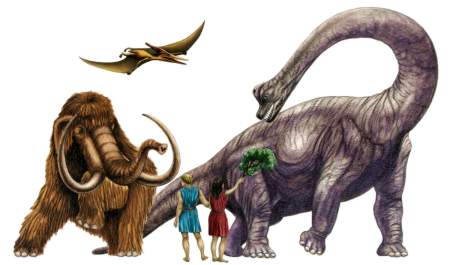 6. Where else in Scripture is the word “day” used to designate billions of years?
Here we find yet another question that is just so incredibly off base that it is remarkable. Of course, the Bible does use the word “day” to denote that such a period, for the LORD, is like a thousand years. And the meaning of “like a thousand years” is debatable, but surely it is a long period of time [and much longer than 24 hours]. But the question of “billions of years” is just the wrong question. Again, the text is not trying to tell us how old the earth is.
If Wilken desires to dispute this, I would gladly ask him to present me with a verse in the Bible which sets the date of creation.
7. How are we to understand the connection between the six epoch-days of creation and the sanctification of a literal seventh day in Genesis 2:1-3 and Exodus 20:11?
I am often confused when YECs bring up this argument. Yes, Exodus 20:11 parallels Genesis 1-2 by having 7 days and denoting the seventh as a day of rest. Now, what about that somehow entails that they are exactly the same? I mean think about the Biblical categories of typology. Very often things correspond to each other but are not exactly the same. One might think of the use of Hosea 11:1 to Matthew 2:15. The passage in Hosea is clearly discussing the nation of Israel. In Matthew 2:15 it is applied to an individual, the Son of God. Does this automatically mean that in Hosea we must assume that “son” is being used in the same sense as “Son of God”? Obviously not. Then why ignore typological categories in other texts?
Okay, but how would an OEC answer this objection? By pointing out that the words “day” and “Sabbath” are used variably in the Pentateuch, so a direct 1 to 1 correlation is off-base. Sabbath, for example, may refer to the span of an entire year as opposed to just one day (Leviticus 25:4). Day may refer to a thousand years (Psalm 90:4).
8. Are there considerations outside the text of Genesis that require an old Earth?
I’m not sure if Wilken means to express the question of other texts, or whether he wishes to address the issue of extra-Biblical evidence.
Regarding the first possible meaning, again the answer would be “No.” I will continue to maintain that I know of no OEC who holds the Bible requires an old earth. Many would follow my own reasoning and note that the Bible isn’t trying to discuss time periods. That just isn’t a concern of the text.
9. According to the Old-Earth theory, what is the relationship between death and human sin? When did death enter the world?
Frankly, at this point it should be abundantly clear that Wilken has not interacted very much with the works of Old Earth Creationists. As was noted in the answer to question 3, many OECs hold to the special creation of Adam and Eve. Therefore, this question is similarly extremely easy to answer: human death entered the world because of sin.
A Major Issue
I think one of the main problems with Wilken’s comments are that he doesn’t seem to distinguish between Old Earth Creationists, Theistic Evolutionists, and the various varieties of design theorists. This leads him to a few confused questions which he directs towards OECs that make no sense when directed towards them. I admit that the series of questions here leads me to wonder whether Wilken is simply unaware of the distinctions between these groups or just over-simplifying and obfuscating. I suspect the former.*
Conclusion
I have endeavored to provide brief answers for the Nine Questions Wilken asks of Old Earth Creationists. I believe that some of the questions he asks demonstrate confusion about the actual category of Old Earth Creationism. Moreover, the questions that are on target have been answered repeatedly by various OECs. Whether these answers are taken as convincing is another story.
*It should be noted that Wilken’s article was published in 2002, which is prior to the works cited here. Therefore, Wilken could not have known about the works I have cited to show some of the difficulties with his paper. However, I cited these works specifically to show how mistaken these questions are. If one is going to attempt to educate concerned Christians about a topic like this, it is vastly important to be aware of the distinctions to be found within each group, and Wilken fails to show awareness of these distinctions. Moreover, we will explore Wilken’s very recent article next week, in which he continues to make these errors.
Sources
Hugh Ross, More Than a Theory (Grand Rapids, MI: Baker Books, 2009).
Hugh Ross and Fazale Rana, Who Was Adam? (Grand Rapids, MI: Baker, 2005).
Gerald Rau, Mapping the Origins Debate (Downers Grove, IL: InterVarsity Press, 2012).
Todd Wilken, “Nine Questions for the Old Earth ‘Creationist,'” 2002.
SDG.
——
The preceding post is the property of J.W. Wartick (apart from citations, which are the property of their respective owners, and works of art as credited) and should not be reproduced in part or in whole without the expressed consent of the author. All content on this site is the property of J.W. Wartick and is made available for individual and personal usage. If you cite from these documents, whether for personal or professional purposes, please give appropriate citation with both the name of the author (J.W. Wartick) and a link to the original URL. If you’d like to repost a post, you may do so, provided you show less than half of the original post on your own site and link to the original post for the rest. You must also appropriately cite the post as noted above. This blog is protected by Creative Commons licensing. By viewing any part of this site, you are agreeing to this usage policy.
Book Review: “For the Beauty of the Earth” by Steven Bouma-Prediger
The practical consequences of… a radical faith are themselves radical. (182, cited below)
How should Christians think about creation care? More importantly, should Christians even bother with creation care? What is the state of the Earth? What does the Bible say about these issues? These are the primary topics which Steven Bouma-Prediger turns to in his work, For the Beauty of the Earth
Place
We are on Earth, and it is a place full of the glory of God. For the Beauty of the Earth (hereafter FBE) begins with a call to marvel at creation. Bouma-Prediger traces the beauty of the earth through ecological inter-connectedness of animals, plants, and geography in mountains, forests, and lakes. It is truly astounding to think of how the world interacts as a unit; it is still more fascinating to reflect upon how even the–to use a Biblical phrase–“least of these” has an extremely important part to play. I was reading this book while on a camping trip, and it was wonderful to resonate with FBE’s discussion of the wonders of the natural world. But what’s the point?
Bouma-Prediger notes that “We care only for what we love” (21). If we do not love the Earth, we will not care for it. Moreover, he points to the interconnections found throughout the world as a reflection of the importance of all things to creation. He draws ten primary points of importance, including a rejection of the notion that things can be “thrown away”–all things go somewhere; the fact that our actions never affect just one thing; the finitude of resources on the Earth; and the amazing complexity of Creation (19-20).
The Science
Having reflected on our place on Earth, FBE asks: What is the state of planet Earth? Put simply, it is not good. Population is booming while per-capita grain production has not increased, the extinction rates are vastly larger than ever in the past, deforestation is cutting down state-sized holes in the world forests (which leads to a decrease of plants capable of producing oxygen), water consumption is increasing exponentially, topsoil is eroding more quickly than it can be produced, and more.
Bouma-Prediger is careful to present a significant amount of documentation for the claims made in FBE. Consider “Global Warming”- there is an observable upward trend in the average global temperature. There is a real consensus on this topic, although there are always who will disagree with a consensus. It is important to note that “Global Warming” is something of a misnomer because it does not reflect the complexity of the issue. “Climate Change” is a better description, which captures the full range of the impact on the planet.
These issues remain controversial, but those who wish to deny humanity’s impact upon the planet must contend with all the lines of evidence. Bouma-Prediger notes that “The real scientific debate is not over whether global warming is real, but rather is over how much and how fast average global temperature might rise, whether other factors in the climate system will counter or amplify a temperature rise, and what the specific effects will be” (52). [2014 edit: it is interesting to observe that there seems to be some increasing skepticism among scientists over the phenomenon of global warming.]
Finally, he notes that the news is “not all doom and gloom,” for there are many bright spots regarding our care for the Earth as well. Unfortunately, “the case is overwhelming that we humans are responsible for the damage to our home planet” (55). The question it raises is: what now?
Ecological Apologetics
The charge has been made that Christianity is bad for the environment. That is, Christian belief tends to denigrate creation and thus should be rejected, for it cannot provide answers to the ecological crises discussed above. Bouma-Prediger presents a number of ways this objection can be stated and responds accordingly. The complaint ranges from charges that Christian eschatology entails a lack of concern for the current creation to (a very interesting) complaint that because a Christian worldview helped the rise of science, which has itself been the source of many things which harm creation, Christianity is to be blamed for the current crisis.
Bouma-Prediger offers multiple responses. Most importantly, the notion that there is any single root cause for our current ecological crisis is hard to sustain. He offers other responses related to eschatology and more. Christian theology, he argues, in fact gives extremely solid motivation for creation care.
Interestingly, at one point he notes that perhaps substance dualism could be divorced from Christianity (a thesis against which I have argued here). His argument is brief and largely just notes that there are other strands within Christianity which do not rely upon this substance dualism.
Finally, in an interesting spin, the charge is made that materialism actually denigrates the environment. In particular, materialism in the form of economic materialism: when wealth drives worth, the environment will suffer, period. Now, the book does not make the charge that this is the only or even the root cause of our crisis; instead, the point is that when one does value economic gain over other ends, the environment will suffer.
The Question for Christians
Clearly, the most important question is whether or not there is any reason for Christians to care about creation. Interestingly, Bouma-Prediger places this section towards the middle-end of the book as opposed to the beginning. In it, he offers an analysis of several Biblical texts to show that Christians should care for and about creation. Central to this is his conclusion that “Individual creatures and the earth as a whole have an integrity as created by God and as such have more than merely instrumental value” (136). When we view creation as a gift from God–a good gift–we see that no individual part of that creation should be denigrated or seen as merely an instrument.
He goes on to offer a number of ecological vices of excess and deficiency regarding a number of areas related to theology and ecology. These include addiction, belief in autonomy, and more.
A Vision for Creation Care
Finally, Bouma-Prediger presents a brief vision for creation care. He places this squarely within the context of the vice list and Biblical theology. Christians are to act in humility, wisdom, and virtue. As such, they are to care for that which God has given them and be aware that one should not destroy that which sustains oneself. Christians are called to emulate God’s benevolence and love for all creation as illustrated throughout the Biblical text. As such, to be dismissive of individual species or parts of creation does not line up with a Christian worldview.
Conclusion
There are many more themes found throughout FBE and in particular in the area of Christians and the environment. Overall, the book is an astounding, life-shifting read. It raises one’s awareness of the integration of their beliefs with the world around us. It is amazing to immerse oneself in a sense of place–be that a forest, mountain, lake, or elsewhere–and realize that this is truly a great good which God has created for us to enjoy. As embodied creations of God, we are to honor those other created aspects of His plan. We are to care for His creation. The book is commendable in its scope, erudition, and groundedness in those concerns which Christians would perhaps be most interested in. It comes highly recommended.
For the Beauty of the Earth.
Links
Like this page on Facebook: J.W. Wartick – “Always Have a Reason.”
Caring for Creation: A discussion among evangelicals– I write about creation care from a number of perspectives offered at a recent panel of prominent evangelical thinkers in this area.
SDG.
——
The preceding post is the property of J.W. Wartick (apart from citations, which are the property of their respective owners, and works of art as credited) and should not be reproduced in part or in whole without the expressed consent of the author. All content on this site is the property of J.W. Wartick and is made available for individual and personal usage. If you cite from these documents, whether for personal or professional purposes, please give appropriate citation with both the name of the author (J.W. Wartick) and a link to the original URL. If you’d like to repost a post, you may do so, provided you show less than half of the original post on your own site and link to the original post for the rest. You must also appropriately cite the post as noted above. This blog is protected by Creative Commons licensing. By viewing any part of this site, you are agreeing to this usage policy.
Really Recommended Posts 9/6/13- Dystopia, Poetry, and Creationism (+more!)
 Another look around the internet this week, as we investigate young earth creationism from a few angles, intelligent design, some dead guys, and dystopian fiction. Let me know what you think!
Christian Virtues in Dystopian Fiction– Look, if you read my blog much you’ll know I am an absolute sucker for science fiction. One recurring theme in sci-fi is that of a dystopia: attempts to make a perfect world gone wrong. Most recently, The Hunger Games is a great example of the genre. In this post, Garret Johnson explores Christian Virtues found in this genre. It is a truly fascinating post, and I highly recommend you follow the blog to see more of the like.
Dead Guys, a poem– A very clever poem with a comic about the need to look at the works of the past in order to understand the present more fully. We stand on the shoulders of giants. I have written about the need to read more of the classic defenses of Christianity and theology, along with several ways to direct reading in my post, “On the Shoulders of Giants.”
A Horse is a Horse According to Answers in Genesis– An analysis of a recent attempt to present evidence for the young earth paradigm, this post looks at the genetic lineage of various species of horse. It is pretty awesome.
Stephen C. Meyer debates Michael Ruse about intelligent design and evolution on NPR– A “snarky” summary of a recent debate between Intelligent Design theorist Stephen Meyer and atheist Michael Ruse. Check out the review and listen to the debate.
Compromising Christians Don’t Like “Evolution vs. God” Film– I am “recommending” this post not because I endorse its contents, but because I think it shows how not to interact in “in-house” debates with other Christians. Ken Ham constantly uses the scare word “compromise” as a descriptor for other Christians. Compromise on what? Ham’s preferred interpretation of the text. It is a word he uses as a weapon time and again. As for the film itself, for some other perspectives (both positive and negative), check out my previous RRP.
**As always my linking to a post does not imply I endorse all or even part of that site**
“Are Miraculous Gifts for Today?” A look at four views in Christian Theology
 What are we to make of the notion of miraculous gifts today? Have they continued into the modern era, or did they cease after the apostolic age?
I want to preface the following discussion by expressing the fact that I am by no means an expert in this area. I only recently finished reading Are Miraculous Gifts for Today?, which presents four views on the issue of miraculous gifts in the church now. The
Here, I will outline what I understand to be the four views on the topic (as outlined in the book–I am more than willing to concede there are likely more views), along with a few arguments and against each. After that, I will offer a brief analysis. I’m hoping that you, the reader, will help spur the discussion.
Miraculous Gifts?
Before progressing, it is important to know what is meant by miraculous gifts. Essentially, these are the gifts outlined in various passages of the Bible. 1 Corinthians 12 is illustrative. It lists as spiritual gifts the following: speaking in tongues, prophecy, the gift of wisdom, etc.
One must note the issue of the “gift of healing.” What is the “gift of healing” and does it exist today? James 5:14-16 is integral to understanding what is meant by this gift.
Perhaps the most central issue regarding miraculous gifts is this: do they continue into today? A secondary, but still very important question is: if these gifts do continue, in what way?
Cessationism
Cessationism is the view that miraculous gifts essentially ended after the formation of the Apostolic Church. Richard B. Gaffin, Jr. defends this view. He clarifies his position by noting that he is not arguing that all gifts of the Spirit have ceased. Rather, the question is “not whether but which spiritual gifts continue today” (41). He notes that God may choose to miraculously heal persons, but expresses doubt over people being granted a specific gift of healing. His greatest difficulty lies with the “word” gifts such as prophecy, speaking in and interpreting tongues, and the like.
The problem with these sorts of gifts, argues Gaffin, lies in the question of the sufficiency and closedness of the canon. Suppose that prophecy does continue today. What level of authority should be ascribed to it? If it is truly the utterances of the prophet guided by God, he reasons, should we not grant such utterances the same authority as the Scriptures (47)? Gaffin notes that those who hold to the continuation of these gifts generally assert that prophecy may be fallible and thus should not be given the same authority as the canon. Gaffin responds by countering that the Bible does not seem to support the notion of fallible prophecy as a possibility (48-52).
Moreover, the gifts of the Spirit were intended for the Apostolic Church as signs of God’s special activity during that period (56-58).
Open but Cautious
The “Open but Cautious” view is championed by Robert Saucy. He expresses the view that the Bible does not make clear whether specific miraculous gifts continue today or not. Thus, he remains open to continuation of these gifts, but cautious in their application and use.
Central to Saucy’s caution is the argument that miraculous gifts are centered around specific times and purposes within salvation history. Thus, according to Saucy, miraculous gifts act as signs of God’s activity within very specific contexts. The Apostolic Era is to be considered unique, and the expression of spiritual gifts during this time should not be read verbatim onto the present era (100-102). Moreover, the Biblical evidence for periods of miraculous activity is “uneven” and “particularly concentrated at certain times,” specifically “that of Moses and the Exodus, the ministries of Elijah and Elisha, and Christ and the apostles” (103). Miracles are thus to be understood explicitly as a “sign” with a specific purpose in mind to “give credibility to something” (105). Miracles are used to “authenticate” specific individuals in times of need (108).
Saucy appeals to the history of the church to make his point. He argues that throughout the history of the church, there is little miraculous activity noted. Thus, although we should be open to the possibility that such gifts may manifest themselves, we should remain cautious of claims to that effect. Saucy concludes with a discussion of individual gifts and what the Bible teaches about them. Representative is his discussion of prophecy, which notes several clarifications regarding how it should be used and understood (including that it is to be done in an “orderly fashion” and that the content will be “edifying to the community”) (128).
Third Wave
C. Samuel Storms argues that miraculous gifts do continue today, but that the doctrine of “subsequence” should be rejected. Subsequence is the notion that after conversion, there is a “baptism in the Holy Spirit” which is initially experienced by speaking in tongues and manifests itself in various spiritual gifts (176).
Storms argues that cessationists misrepresent those who argue for continuation, for cessationists often appeal to the “infrequency” of the miraculous in order to argue against the notion of miraculous gifts. They argue that this demonstrates that such events are purely the actions of a sovereign God acting whenever God chooses. In contrast, Storms notes that God’s spontaneous action may indeed empower individuals and indeed that the intermittent nature of the practice of such gifts does not undermine their classification as spiritual gifts.
Storms further asserts that although miracles have indeed been used as signs, this fact does not allow one to reduce the miraculous gifts to being only signs and nothing else (188-189). Storms analyzes a number of major arguments for cessationism and finds them all wanting. In particular, Storms presses the notion that the Bible nowhere declares that the gifts found in the Apostolic period would have some cutoff time period.
Pentecostal
Douglas Oss argues that defining Pentecostalism as a “second blessing” theology must clarify what they mean by “second blessing.” He notes that Pentecostals do believe that believers receive the Holy Spirit post-conversion as an empowerment for charismatic gifts. However, this filling is not part of salvation nor is it required for salvation. Instead it is part of sanctification: it is empowerment by the Spirit. Moreover, Oss notes that there may be several empowerments or “refillings” of the Holy Spirit, for there is diversity in the “manifestations” of the Spirit (242-243).
Oss traces the Biblical data and concludes that the Old Testament shows that there is both the “inner-transforming” work of the Holy Spirit and the “empowering” work located therein. In the New Testament, Oss notes that the Holy Spirit works to empower the believers with various manifestations of miraculous gifts.
The gifting of the Holy Spirit is initially observable through speaking in tongues, but again this is not required for salvation. It is merely the pattern of God’s gifting. First tongues, later other gifts, though this is not always the case or even a requirement (260-263). Oss appeals to Joel 2:28-32 to note that the last days will not conclude until Christ’s second coming and so we should expect giftings of the Spirit throughout the present era (266ff).
Analysis
It seems to me that there is little warrant for arguing negatively that the miraculous gifts do not continue today. Gaffin provided no textual basis that I could discern for holding that when the NT authors speak of these gifts within the church, they intended to limit the gifting in their own era. Moreover, I think that Joel 2:28ff does speak of the current age, though some of it seems to be yet future. The future fulfillment left for some of the passage does not seem to imply that it should all be taken is “not yet,” however.
That said, Gaffin’s concerns regarding the authority and inspiration of prophecy should be rightly noted. The issue of the nature and authority of prophecy in the modern period is one which the other offers attempted to address, but it seemed to me they came up short in virtually every case. Moreover, some of the Pentecostal position seemed to be a bit off to me. Why even argue that speaking in tongues comes first, but then qualify that by saying that it doesn’t need to or that it may not always be the case? Would that not suggest that the pattern isn’t much of a pattern after all?
Storms in particular did an excellent job of showing the error of arguing that miracles in the Bible centered only around certain periods of time in which “signs” were needed. Although it seems clear that the Bible is a selection of time periods and parts of history, God’s miraculous activity is observable throughout much of the Bible. To argue otherwise, and to then build a framework for interpreting miraculous gifts for today (as both Saucy and Gaffin did to an extent) seems to be an overreach given the data.
Thus, I would say my position seems to be closest to a synthesis of Storms and Saucy. I think Saucy does not go far enough in his allowing for gifts of the spirit, but I think that Storms struggles with the notion of the authority of such continuing prophecy.
So what do you think of this issue? What is your position? Share your thoughts in the comments below.
Source
Stanley Gundry and Wayne Grudem, editors, Are Miraculous Gifts for Today?
SDG.
——
The preceding post is the property of J.W. Wartick (apart from citations, which are the property of their respective owners, and works of art as credited) and should not be reproduced in part or in whole without the expressed consent of the author. All content on this site is the property of J.W. Wartick and is made available for individual and personal usage. If you cite from these documents, whether for personal or professional purposes, please give appropriate citation with both the name of the author (J.W. Wartick) and a link to the original URL. If you’d like to repost a post, you may do so, provided you show less than half of the original post on your own site and link to the original post for the rest. You must also appropriately cite the post as noted above. This blog is protected by Creative Commons licensing. By viewing any part of this site, you are agreeing to this usage policy.
“The Rocks Don’t Lie” by David Montgomery: Chapter 4
 Here, I continue my look at The Rocks Don’t Lie
Chapter 4: World in Ruins
Outline
Montgomery begins by outlining the state of beliefs before early geological investigations. These were formed from theological understandings and thus derived themselves either from creation or the Flood.
The early theories of how the Flood shaped the rocks lent themselves as hypotheses for investigating the natural world. Although many of these theories would be dismissed immediately now, for their time they were serious ideas about how the world may have been shaped. Yet even in the early days of geological investigation, many theologians and geologists realized some of the major difficulties attributing the whole geologic story to the Flood would raise. Isaac Vossius, for example, “argued for a local flood on the grounds that there simply was not enough water on earth to submerge the highest mountains” (55). The amount of water needed for a global flood remains a great difficulty into today.
Other early geologic difficulties were centered around fossils. Were they really vestiges of once-living creatures, or merely tricks of the stones (59)? Steno entered this debate and, apart from noting that fossils were similar to those bones of living creatures, he also developed principles of geology which are used to this day. These were the notion that the bottom of a pile of sediment is oldest and that sedimentary layers are deposited horizontally (60).
As geologic investigations continued, more radical theories were put forth to hold a global flood. These included the notion that, prior to the Flood, the earth was smooth, and so it would have been easy to cover the globe with the water we observe now (66). Yet theories like this, which hypothesize the Flood wreaking havoc upon the earth, yield great difficulties of their own. For example, how could Noah’s descendants have populated the ends of the earth so quickly? Thomas Burnet, who had proposed this theory, argued that Native Americans had also survived the Flood (68).
John Woodward became another champion for advocates of a global flood. He asserted that the Flood dissolved the Earth’s crust and then laid down the sediment observable now (70). His theory was in keeping with others who held that a “mighty flood burst forth from a subterranean abyss” (71). However, John Arbuthnot, a physician, published an essay which not only showed that Woodward had plagiarized Steno, but also blew holes through the Flood theory Woodward had proposed. These included the fact that fossils did not rearrange according to specific gravity and that the layering of sediment could not have occurred within such a mix (71, 73).
Edmund Halley (of Halley’s Comet fame) came up with a theory which involved a comet coming near the earth and disturbing it on its axis, which “heaved the seafloor up… carving the topography we know today.” He also came up with the idea of a “vapor canopy” over the Earth which yielded the great amount of water needed to flood the entire planet (74).
Montgomery notes that it is “ironic” that many of the arguments used by young earth creationists for their positions on geology have been derived from the seventeenth-century geologists, who themselves “did not blindly trust particular literal interpretations of scripture. They had faith reason would lead to enlightened interpretation of God’s creation, as read from the pages of the book of nature…” (76).
Analysis
Montgomery has done a commendable job documenting the long history of the interplay between geology and theology related to the Flood. Moreover, he has shown how many of the ideas found in modern creationism reflect the debates of this period–some of which were acknowledged as refuted back then.
The importance of this historical background should not be understated. When one investigates the way that theories of the Flood developed alongside geology, it provides a fascinating case study for the interplay between science and faith. More importantly, studying the arguments of the past shows how easy it is to resurrect the same ideas in new contexts. Modern young earth creationism owes a great debt to people like Halley and Woodward. Unfortunately, many of these ideas remain just as refuted as they were shortly after they were first proposed.
It is also important to observe cases like Burnet, who started out trying to fit geology into his interpretation of Genesis, but ended up being forced to hypothesize all kinds of things which are not actually found in the Genesis account in order to maintain his theory. Modern creationists should be wary of doing the same: in attempting to stay true to the meaning of the text, people too often introduce concepts which are entirely foreign to the passages themselves. Ironically, this is often done in the name of being “literal.” I hope that works like Montgomery’s (and Young’s, see below) will help inform the Church regarding this debate.
Conclusion
Again, Montgomery’s book shows its great similarities with The Biblical Flood by Davis Young, which itself focuses almost entirely upon the interplay between geology and theology. Both of these books come recommended from me. Montgomery’s work is a faster read with a bit more focus upon the arguments of modern young earth views, while Young’s work provides more of the much-needed background for the debate. [I skipped ahead a bit and saw that Montgomery acknowledges Young’s own contributions to this discussion. I am of the opinion that each of their works bring unique contributions and are worth having.]
The Rocks Don’t Lie has so far proven to be a fantastic work in which the author acknowledges the complexities of the issues as well as the debt geology owes to Christianity. Soon, we will look into chapter 5.
Links
Like this page on Facebook: J.W. Wartick – “Always Have a Reason”
Check out my review of a similar work by a Christian: The Biblical Flood. I think this book is vastly important and should be in every Christian’s library.
Be sure to browse my extensive writings on the “Origins Debate” over creationism, theistic evolutionism, and intelligent design (among other views) in Christianity.
Source: David Montgomery, The Rocks Don’t Lie
SDG.
——
The preceding post is the property of J.W. Wartick (apart from citations, which are the property of their respective owners, and works of art as credited) and should not be reproduced in part or in whole without the expressed consent of the author. All content on this site is the property of J.W. Wartick and is made available for individual and personal usage. If you cite from these documents, whether for personal or professional purposes, please give appropriate citation with both the name of the author (J.W. Wartick) and a link to the original URL. If you’d like to repost a post, you may do so, provided you show less than half of the original post on your own site and link to the original post for the rest. You must also appropriately cite the post as noted above. This blog is protected by Creative Commons licensing. By viewing any part of this site, you are agreeing to this usage policy.
The Binding of Satan: An Eschatological Question
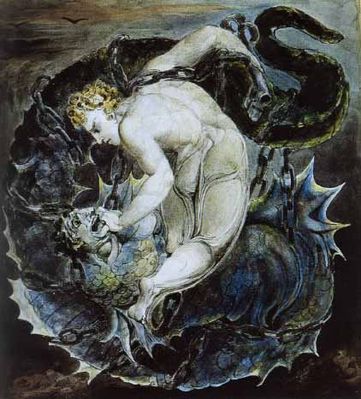 When does the binding of Satan occur? Is it something yet to come, or is it something which has already happened? Here, I will analyze the futurist position on these questions: the notion that Satan and his minions are yet to be bound.*
Futurism is, essentially, the position that the prophecies in Daniel and Revelation (and many elsewhere) are largely yet to be fulfilled. This is in contrast to historicism– the view that these prophecies have been fulfilled through the church age (with some yet future); preterism– the view that many of these prophecies have already been fulfilled in the past; and idealism– the view that these prophecies have spiritual meanings which may be fulfilled multiple times through history until the End.
The central passage for the question at hand is Revelation 20:1-3:
And I saw an angel coming down out of heaven, having the key to the Abyss and holding in his hand a great chain. He seized the dragon, that ancient serpent, who is the devil, or Satan, and bound him for a thousand years. He threw him into the Abyss, and locked and sealed it over him, to keep him from deceiving the nations anymore until the thousand years were ended. After that, he must be set free for a short time. (NIV)
The futurist interpretation of this passage would be fairly straightforward: at some point in the future, before the millennium, Satan will be bound. Many futurists hold that this also includes Satan’s minions. Representative is Paul Benware: “With the removal of Satan comes the removal of his demonic forces and his world system” (Benware, 334, cited below). It is on this point that the question I have turns. Consider Jude 6:
And the angels who did not keep their positions of authority but abandoned their proper dwelling–these he has kept in darkness, bound with everlasting chains for judgment on the great Day. (NIV)
Note the interesting parallels with the passage from Revelation 20. Both use the language of “chains” and reference a time when something will happen after this binding. Yet Jude 6 seems to imply the definite binding of these demonic forces from the time it was written or even before. Why? Jude 5 gives the temproal context, which is sandwiched in between discussion of the Exodus and Sodom and Gomorrah. Of course, Sodom and Gomorrah predate the Exodus, but the overall context of the passage is given by Jude as being around that time period (“I want to remind you…” v. 5).
Moreover, 2 Peter 2:4 states:
For if God did not spare angels when they sinned, but cast them into hell and committed them to chains of gloomy darkness to be kept until the judgment…
Again, in context Peter is discussing a number of past events. So it certainly seems that at least some demonic forces have already been bound. Benware writes of these passages: “The Scriptures reveal that Satan and his angelic followers will be judged for their sin and rebellion…” (329, emphasis mine). Now, Benware is clearly saying that there will be a judgment in the future, and that seems correct from both passages. However, he does not note anywhere in his major work the difficulty these verses present to his own view, for he insists elsewhere that amillenialists are incorrect when they view this binding as being a present reality (129ff). But he does grant that at least some demonic forces are bound now.
The question, then, is how is it that futurists can consistently insist upon the impossibility of Revelation 20:1-3 being a present reality while already granting that it is, at least in part, fulfilled? That is, if one grants that at least some demonic forces are bound, it seems that one cannot insist that certain spiritual forces cannot possibly be bound at present. Thus, it seems to me this particular aspect of futurism is not on as strong a ground as many insist.
Indeed, one may read Jude 6 and 2 Peter 2 and get the impression that these things have already occurred. There is no stipulation within the text to say that only some wicked angels have been bound. Indeed, they both seem to imply the total binding of all demonic forces. But this would not be compatible with the standard futurist interpretation of Revelation 20:1-3.
*Readers should note that I am not here intending to critique the overall futurist position. Instead, I am merely wondering about one specific aspect of some futurist interpretations.
Links
Check out my other posts on eschatology (scroll down for more).
Also, read my review of Benware’s massive work on premillenial dispensationalism, Understanding End Times Prophecy.
Sources
Paul Beware Understanding End Times Prophecy
SDG.
——
The preceding post is the property of J.W. Wartick (apart from citations, which are the property of their respective owners, and works of art as credited) and should not be reproduced in part or in whole without the expressed consent of the author. All content on this site is the property of J.W. Wartick and is made available for individual and personal usage. If you cite from these documents, whether for personal or professional purposes, please give appropriate citation with both the name of the author (J.W. Wartick) and a link to the original URL. If you’d like to repost a post, you may do so, provided you show less than half of the original post on your own site and link to the original post for the rest. You must also appropriately cite the post as noted above. This blog is protected by Creative Commons licensing. By viewing any part of this site, you are agreeing to this usage policy.
Against Christian Materialism
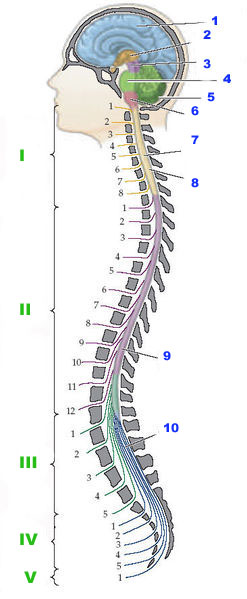 Is it possible for Christians to be materialists? A number of Christians say that yes, it is. Here, I will argue that the conjunction of Christianity and materialism is indefensible.
The Biblical Witness
Having read a bit on this topic, I realize that many who are Christian materialists do not think that the Biblical data is conclusive. However, granting that this is their position, I would maintain that the Biblical evidence is very strong: we are more than a material body. Here, I will examine only a small collection of texts.**
Matthew 10:28- “Do not be afraid of those who kill the body but cannot kill the soul. Rather, be afraid of the One who can destroy both soul and body in hell.” (NIV)
What does this text mean if the soul and the body are not different things which compose the human being?
Ecclesiastes 12:7- “and the dust returns to the ground it came from, and the spirit returns to God who gave it.” (NIV)
When we die, our bodies–made of dust–return to the earth, but our spirit returns to God. What does this mean on materialism? Which part of our material selves go to God?
Revelation 6:9- “When he opened the fifth seal, I saw under the altar the souls of those who had been slain because of the word of God and the testimony they had maintained.” (NIV)
The souls of those killed for their faith cry out for justice from under the altar. The objection may be made that this is apocalyptic language. In answer, I would simply point out that even then it makes no sense on materialism even in that context. What are the souls that are crying out in this vision? What is the referent for the alleged metaphor?
In Matthew 17:1-8, Jesus speaks with Moses and Elijah, who have died. Did God raise them bodily, and did they then die again immediately afterwards and decompose when they are no longer visible?
1 Peter 3:18-19- “For Christ also suffered once for sins, the righteous for the unrighteous, to bring you to God.He was put to death in the body but made alive in the Spirit. After being made alive, he went and made proclamation to the imprisoned spirits…”
What was Jesus proclaiming the Gospel to? What is imprisoned? Where are the physical/material bodies in this passage? (Note that in context it is talking about those alive in Noah’s day–so again, where did their bodies go?)
Verses like these could be multiplied continually. Perhaps more telling is that the reasoning I’m using here regarding the texts and the distinction between body and soul is similar to the arguments put forth to justify the Trinity. That is, texts which discuss the Father and Son as different entities or even have all three persons of the Trinity in the same context are used to demonstrate that there really are three distinct persons in the Godhead. Yet this is exactly the type of argument I am here making for body and soul. They are used too many places together to be the same thing.
It seems to me utterly clear from the Biblical text that human beings are not purely material entities. Again and again texts can be shown to refer to the body on the one hand and the soul on the other. This is not to say that humans are necessarily one or the other; instead, it is to point out that humans are (at least) body and soul. (I say “at least” because there is a long tradition of trichotomy in Christianity wherein people hold that humans are body, soul, and spirit. I remain neutral in that debate and here only wish to show that humans are not merely material entities.)
The Philosophical Debate
Suppose that one maintains that the Biblical evidence is inconclusive. What then? Could we then say that Christianity and materialism are compatible, for materialism is not explicitly ruled out by the text? Here, I will offer two arguments against these conjoined propositions.
Identity Through Time
How do we maintain identity through time? Here, the problem must be answered by all materialists, not just Christian materialists.
The problem is, of course, that our bodies don’t maintain physical identity. We are continually replacing the physical parts of our body over time. Now, I am hesitant to make the oft-repeated claim that our entire bodies are replaced every so many years, as I have been unable to find any research confirming it. However, it simply is the case that large portions of our body are replaced. Given this fact, how do we maintain identity? What is it that keeps us the same person over time?
Another major problem is this: to which part of our body are we identical? Or, to put it another way, which parts of our body do we need to keep in order to be the same person? Here we can appeal to a thought experiment. A mad scientist has us captured and he wants to see how long we can maintain identity. Slowly, he replaces each part of our body with a new one with the exact same DNA, structure, etc. As he replaces these parts, he discards the old ones and destroys them. He starts with the legs. Then he moves to the midsection, replacing one organ at a time. Then the heart, the arms, the ears, the eyes. When he gets to the brain, he goes through and replaces only single neurons at a time.
The question is pretty obvious: When do we stop being the same person? The materialist simply has to admit that we are our bodies (for what else could we be?). But given that fact, to which part are we identical? The brain? If so, at one point in the experiment do we cease to exist? 51% of our brain is gone? 70%? All but one neuron? So is our identity grounded in that one neuron? If so, which one? Or is it just grounded in having any one neuron as the same? If so, how?
Frankly, I think this problem is devastating for materialists, but especially those who are Christians. Why would it be more acute for Christians? Well…
 Is There Hope in the Resurrection?
Central to the Christian hope is the hope for a future resurrection. The question which must be asked is this: Is this hope grounded in reality?
Suppose materialism were true. If that is the case, then humans are identical with their bodies in some fashion. I am intentionally vague here because I admit I’m not convinced as to how identity works within a Christian view of materialism (see above). If this were the case, then when we die and our material body decomposes, it may go on to become all sorts of different things, which themselves later pass away (plants may grow from the nutrients broken down from the body; then those plants may be harvested and eaten by other humans/animals/etc, which then die and are broken down, etc.). In the resurrection, then, God creates our body anew, complete–I assume–with our memories, experiences, etc. built in (perhaps they are simply functions of our brain, which God recreated perfectly, which thus contains our experiences).
Is there actual hope on this scenario?
Suppose the mad scientist were to come and kidnap you. He gleefully announces that he is going to use you for excruciatingly painful experiments which will take place over several years until you die. But, do not worry, because once you die, he is going to create a new body which is an exactly perfect copy of you, which will of course have all your experiences (minus this torturous one) and memories in place, and then he is going to give you billions of dollars.* Would you be comforted by this scenario? After all, you’re not going to remember the pain and you are going to come out the other end extremely rich!
Well there is a problem: the new body is not you. It is just a copy. For any materialist, this is problematic. We seem to know that identity transcends the body. But let us not delve into that difficulty right now. Instead, we will focus on Christian materialism. Now, it seems to me that this problem is almost the same for the Christian materialist with the Resurrection. After all, we are going to die. But we are told, don’t worry, we will be raised bodily by God! But whose body is going to be raised? How will God gather the material from our body (and at which time of our body–see above) in order to recreate us? And will not this body purely be a copy, rather than actually us?
There is a real disconnect here. Christian materialism cannot offer us the hope of the resurrection, without which our faith is worthless (1 Corinthians 15). Instead, it offers us the hope for our future copies, which will themselves have our memories and experiences, but will not be us. Our bodies will die and distribute throughout various portions of the world (even the universe–who knows if an asteroid might hit and distribute the molecules which made up our body elsewhere?). Then God will create us again in some fashion, and that body will live on in the Kingdom. But that body is not us. It will be a new body. This isn’t begging the question, it is merely stating a fact. The body that will be raised is not the body I have now. Thus, if I am my body, I am not raised.
Interestingly, Peter van Inwagen, a Christian philosopher who is himself a materialist, concedes the point I made in this section. In order to escape this extreme problem for Christian theology, he comes up with a rather unique solution: “Perhaps at the moment of each man’s death, God removes each man’s corpse and replaces it with a simulacrum which is what is burned or rots. Or perhaps God is not quite so wholesale as this: perhaps he removes for ‘safekeeping’ only the ‘core person’–the brain and the central nervous system–or even some special part of it… I take it that this story shows that the resurrection is a feat an almighty being could accomplish. I think it is the only way such a being could accomplish it…” (Van Inwagen, 121, cited below).
What response can we have to this? Well surely, it is possible for God to do this, but it raises all kinds of speculation. First, what Biblical evidence do we have to support that our bodies or our brains/nervous systems are transported by God somewhere in order to preserve them? Honestly, I think that someone who posits this kind of miraculous working holds a burden of proof to support it. Second, where is this storage yard of brains/nervous systems? This question is not intended to beg the question. Instead, my intent is to point out that they would have to be somewhere in the physical universe. Thus, we should be able to find a planet where all the brains/central nervous systems of everyone who ever died are being stored. Third, given this, could we potentially destroy this planet and thus destroy all possibility of the resurrection? Fourth, other than as a completely ad hoc measure to preserve the possibility of hope, what possible justification (philosophical, theological, and/or Biblical) do we have for this?
On the whole, it seems to me that Peter van Inwagen’s proposed solution fails. It fails because it is extremely ad hoc and because it may not even solve the problem it is intended to solve. Thus, it seems to me that Christian materialism fails as a worldview.
Conclusion
I have offered several arguments against the conjunction of Christianity and materialism. I think any one of these arguments is successful on its own (I should note that I also think the argument from the ego is successful–I have argued here against atheistic materialism, but this argument would be equally successful against Christian materialism). If any one is successful, the conjunction of Christianity and materialism must be false. Frankly, I think all the arguments are successful. I leave the Christian materialist to justify their position.
Links
Like this page on Facebook: J.W. Wartick – “Always Have a Reason.”
If Materialism, are there Subjects?– I contend that a materialist worldview cannot account for subjects. This post was written specifically to address atheistic materialism, but is perfectly relevant for theistic materialism as well.
Sources
*I am indebted to Alvin Plantinga and Stephen Parrish for this type of argument.
**I am indebted to Kevin A. Lewis for his list of texts provided in his “Essentials of Christian Doctrine II” syllabus.
Peter van Inwagen “The Possibility of Resurrection,” International Journal for Philosophy of Religion, 9:2 (1978), 114ff.
SDG.
——
The preceding post is the property of J.W. Wartick (apart from citations, which are the property of their respective owners, and works of art as credited) and should not be reproduced in part or in whole without the expressed consent of the author. All content on this site is the property of J.W. Wartick and is made available for individual and personal usage. If you cite from these documents, whether for personal or professional purposes, please give appropriate citation with both the name of the author (J.W. Wartick) and a link to the original URL. If you’d like to repost a post, you may do so, provided you show less than half of the original post on your own site and link to the original post for the rest. You must also appropriately cite the post as noted above. This blog is protected by Creative Commons licensing. By viewing any part of this site, you are agreeing to this usage policy.
“The Rocks Don’t Lie” by David Montgomery: Preface and Chapter 1
I recently finished reading the Christian geologist Davis Young’s The Biblical Flood
It didn’t take long before I had decided that I would go through this one on an extended basis (sometimes lumping more than one chapter together) similar to how I reviewed Rob Bell’s work Love Wins. The reason is because I think the work has much to inform both Christian and atheist alike, while it also has some problems I would like to discuss as I go along.
I have not finished the book, but am rather writing these reviews as I read the chapters, so each one is fresh. Check out the end of the post for links to the other chapters as well as other related posts.
Outline
Preface
David Montgomery states that his purpose in writing the book was initially “to present a straightforward refutation of creationism, the belief that the world is a few thousand years old and that all the world’s topography… was formed by the biblical Flood.” However, he came to “a different story about the nature of faith” once he began researching the topic: “…I thought I’d find the standard conflict between reason and faith. Instead, I found a much richer story of people struggling to explain the world–and our place in it” (xii).
Essentially, he discovered that there was a complex interrelationship between science and theology which has played out in vastly different ways over time.
Chapter 1
Montgomery begins the book by telling a story of how he discovered evidence for a local flood in Tibet. He observed various geological features and came to believe that a lake had once covered the land. He suspected that such a feature in memorable history would yield an oral tradition and was rewarded with a story of a flood in the area (2-7). He asserts that “People around the world tell stories to explain distinctive landforms and geological phenomena” (7).
These stories are often dismissed as “relic[s] of another time,” but he believes that they may have an element of truth: “For most of our history as a species, oral traditions were the only way to preserve knowledge. So why wouldn’t the world’s flood stories record actual ancient disasters” (8-9). He notes that the story of Noah’s Flood may perhaps be among these stories, and hints that there could be truth to the biblical tale (9).
When science has come to interact with evidence which may hint at explanations for Noah’s Flood, certain forms of Christianity (here he uses “creationist” as he defined it in the preface) are “outraged” due to the preconceived notion that the Flood must have been global and account for all geologic history.
Yet the Flood has had a positive influence on geology by providing an early hypothesis to be tested once geology had progressed as a science (11-12). Theology and geology played off each other in a complex way which has spawned various factions of belief over the use of that evidence in theology (12-14).
Analysis
Preface
David Montgomery presents his case in a very winsome manner. I cannot help but be pleased by the way he has begun his interaction with science and faith issues. Rather than ranting over the alleged war between science and faith (something he admits he was expecting), he discovered a different story of a complex relationship which has often been mutually beneficial. Would that all atheists–and yes, it is worth saying, theists–interacted with other views in such a generous manner.
Chapter 1
Montgomery has provided a number of interesting insights already, particularly in regards to the fact that the relationship between science and faith is multifaceted and not as one-dimensional as many often portray it.
It is unfortunate, I think, that his own faith was seemingly built upon very poor theology. He writes, “In Sunday school I learned that Bible stories were parables to be read more for their moral message than their literal words. The story of Noah’s Flood taught mankind to be stewards of the environment… Growing up, I was satisfied that Jesus taught how to live a good life and that science revealed how the world worked” (9-10). Here we see how an anemic theology cannot be sustained. Christianity is picture that is much fuller than a mere “moral message” or “how to live a good life.” If only someone had taught that in Sunday school instead!
If the book continues in this fashion, I will have no qualms about recommending it. Tune in next week to continue the series!
Links
Like this page on Facebook: J.W. Wartick – “Always Have a Reason”
Check out my review of a similar work by a Christian: The Biblical Flood. I think this book is vastly important and should be in every Christian’s library.
Be sure to browse my extensive writings on the “Origins Debate” over creationism, theistic evolutionism, and intelligent design (among other views) in Christianity.
Source: David Montgomery, The Rocks Don’t Lie
SDG.
——
The preceding post is the property of J.W. Wartick (apart from citations, which are the property of their respective owners, and works of art as credited) and should not be reproduced in part or in whole without the expressed consent of the author. All content on this site is the property of J.W. Wartick and is made available for individual and personal usage. If you cite from these documents, whether for personal or professional purposes, please give appropriate citation with both the name of the author (J.W. Wartick) and a link to the original URL. If you’d like to repost a post, you may do so, provided you show less than half of the original post on your own site and link to the original post for the rest. You must also appropriately cite the post as noted above. This blog is protected by Creative Commons licensing. By viewing any part of this site, you are agreeing to this usage policy.
Inerrancy and Presuppositional Apologetics: A different approach to defending the Bible
Scripture is inerrant because the personal word of God cannot be anything other than true. -John Frame (The Doctrine of the Word of God
, 176 cited below)

One of the most difficult issues facing evangelical Christian apologists is the doctrine of inerrancy. I’m not trying to suggest the doctrine is itself problematic. Indeed, I have defended the doctrine in writing on more than one occasion. Instead, I am saying that defending this doctrine in an apologetics-related discussion is difficult. Here, I will explore one way that I think should be used more frequently when discussing the doctrine.
What is the problem?
There are any number of attacks on inerrancy and Biblical authority, generally speaking. Very often, when I discuss the Bible with others in a discussion over worldviews, I find that the challenge which is most frequently leveled against the notion of inerrancy is a series of alleged contradictions. The second most common objection is some sort of textual criticism which allegedly shows that the Bible could not be without error in its autographs. A third common argument against inerrancy is to quote specific verses and express utter incredulity at their contents.
Of course, it doesn’t help that the definition of inerrancy is often misunderstood. For simplicity’s sake, I will here operate under the definition that “The Bible, in all it teaches, is without error.” I have already written on some misconceptions about the definition of inerrancy, and readers looking for more clarification may wish to read that post.
How do we address the problem?
Most frequently, the way I have seen apologists engage with these challenges is through a series of arguments. First, they’ll argue for the general reliability of the Bible by pointing out the numerous places in which it lines up with archaeological or historical information we have. Second, they’ll argue that these historical reports given in the Bible cannot be divorced from the miraculous content contained therein. Given the accuracy with which these writers reported historical events, what basis is there to deny the miraculous events they also report?
Other apologists may establish inerrancy by rebutting arguments which are leveled against the doctrine. That is, if one puts forth an argument against inerrancy by pointing out alleged contradictions, these apologists seek to rebut those contradictions. Thus, once every single alleged error has been addressed, this approach concludes the Bible is inerrant.
Now, I’m not suggesting that either of these methods are wrong. Instead, I’m saying there is another way to approach the defense of the Bible.
A Presuppositional Defense of Inerrancy
Suppose God exists. Suppose further that this God which exists is indeed the God of classical Christian theism. Now, supposing that this is the case, what basis is there for arguing that the Bible is full of errors? For, given that the God of Christianity exists, it seems to be fairly obvious that such a God is not only capable of but would have the motivation to preserve His Word as reported in the Bible.
Or, consider the first step-by-step argument for inerrancy given in the section above, where one would present archaeological, philosophical, historical, etc. evidence point-by-point to make a case for miracles. Could it not be the case that the only reason for rejecting the miraculous reports as wholly inaccurate fictions while simultaneously acknowledging the careful historical accuracy of the authors is simply due to a worldview which cannot allow for the miraculous at the outset?
What’s the Point?
At this point one might be thinking, So what? Who cares?
Well, to answer this head on: my point is that one’s overall worldview is almost certainly going to determine how one views inerrancy. The point may seem obvious, but I think it is worth making very explicit. If we already hold to a Christian worldview broadly, then alleged contradictions in the Bible seem to be much less likely–after all, God, who cannot lie (Numbers 23:19), has given us this text as His Word. Here it is worth affirming again what John Frame said above: the Bible is inerrant because it is of God, who is true.
Thus, if one is to get just one takeaway from this entire post, my hope would be that it is this: ultimately the issue of Biblical inerrancy does not stand or fall on whether can rebut or explain individual alleged errors in the Bible–it stands or falls on one’s worldview.
One final objection may be noted: Some Christians do not believe in inerrancy, so it seems to go beyond an issue of worldview after all. Well yes, that is true. I’m not saying a defense of inerrancy is utterly reducible down to whether or not one is a Christian or not–as I said, I think evidential arguments are very powerful in their own right. I am saying that inerrancy is impossible given the prior probabilities assigned by non-Christian worldviews and altogether plausible (not certain) given Christian worldview assumptions.
A Positive Case for Inerrancy
Too often, defense of inerrancy take the via negativa–it proceeds simply by refuting objections to the doctrine. Here, my goal is to present, in brief, a positive argument for inerrancy. The argument I am proposing here looks something like this (and I admit readily that I have left out a number of steps):
1) Granting that a personal God exists, it seems likely that such a deity would want to interact with sentient beings
2) such a deity would be capable of communicating with creation
3) such a deity would be capable of preserving that communication without error
Therefore, given the desire and capability of giving a communication to people without error, it becomes vastly more plausible, if not altogether certain, that the Bible is inerrant. Of course, if God does not exist–if we deny that there is a person deity–then it seems altogether impossible that an inerrant text could be produced on anything, let alone a faith system.
I consider this a positive argument because it proceeds from principles which can be established (or denied) as opposed to a simple assertion. It is not a matter of just presupposing inerrancy and challenging anyone who would take it on; instead it is a matter of arguing that God exists, desires communication with His people, and has brought about this communication without error. Although each premise needs to be expanded and defended on its on right, I ultimately think that each is true or at least more plausible than its denial. Christians who deny inerrancy must, I think, interact with an argument similar to this one. Their denial of inerrancy seems to entail a denial of one of these premises. I would contend that such a denial would be inconsistent within the Christian worldview.
Note that this argument turns on the issue of whether or not God exists. That is, for this argument to be carried, one must first turn to the question of whether God exists. I would note this is intentional: I do think that inerrancy is ultimately an issue which will be dependent upon and perhaps even derivative of one’s view of God.
Other Books
One counter-argument which inevitably comes up in conversations about an argument like this is that of “other books.” That is, could not the Mormon and the Muslim (among others) also make a similar case.
The short answer: Yes, they could.
Here is where I would turn to the evidence for each individual book. Granting a common ground that these claimed revelations–the Bible, the Book of Mormon, the Qu’ran, etc.–are each purported to be inerrant and that their inerrancy is more probable on a theistic view, which best matches reality? In other words, I would turn here to investigate the claims found within each book in order to see if they match with what we can discern from the world.
The argument I am making here is not intended to be a one step argument for Christian theism. Instead, it is an argument about the possibility of an inerrant work.
 Appendix 1: Poythress and Inerrancy
Vern Poythress provides an example of how this approach works. In his work, Inerrancy and Worldview (my review of this work can be found here), he continually focuses on how worldviews color one’s approach to challenges presented against inerrancy such as historical criticism, certain sociological theories, and philosophy of language. One example can be found in his discussion of historical criticism:
The difference between the two interpretations of the principle [of criticism] goes back to a difference in worldview. Does God govern the universe, including its history, or do impersonal laws govern it? If we assume the latter, it should not be surprising that the resulting principle undermines the Bible… It undermines the Bible because it assumes at the beginning that the God of the Bible does not exist. (Poythress, Inerrancy and Worldview
, 53, cited below)
Yet it is important to see that my approach here is different from that of Poythress. His approach seems to be largely negative. That is, he utilizes presuppositionalism in order to counter various challenges to the Bible. When a challenge is brought up to inerrancy, he argues that it of course stems from an issue of worldview. Although this is similar to my approach, Poythress never makes a positive argument for inerrancy, which I consider to be a vital part of the overall defense of the doctrine.
Appendix 2: Standard Presuppositionalism and Inerrancy
I would like to note that I am not attempting to claim that my defense of inerrancy here is the standard presuppositional approach. The standard presuppositional approach is much simpler: the apologist simply assumes the absolute truth and authority of God’s word as the starting point for all knowledge.
It should not surprise readers that, given this approach, most (if not all) presuppositionalists embrace the via negativa for defense of inerrancy. That is, the standard presuppositional defense of the Bible usually is reducible to merely pointing out how the attacks on Scripture stem largely from one’s worldview, not from the facts.
Thus, one of the foremost presuppositional apologists to have lived, Greg Bahnsen, writes:
[I]f the believer and unbeliever have different starting points [that is, different presuppositions from which all authority comes for the realm of knowledge] how can apologetic debate ever be resolved? [In answer to this,] the Christian carries his argument beyond “the facts…” to the level of self-evidencing presuppositions–the ultimate assumptions which select and interpret the facts. (Bahnsen, Always Ready, 72 cited below).
It should be clear that this standard presuppositional defense is therefore very different from what I have offered here. The standard presuppositional defense simply reduces the debate to “starting points” and attempts to show contradictions in other “starting points” in method, exposition, or the like. My defense has noted the vast importance of worldviews in a denial of inerrancy, but has also offered a positive defense of inerrancy. Yes, this defense turns on whether God exists, but that can hardly be seen as a defect or circularity in the argument.
Links
Like this page on Facebook: J.W. Wartick – “Always Have a Reason.” I often ask questions for readers and give links related to interests on this site.
The Presuppositional Apologetic of Cornelius Van Til– I explore the presuppositional method of apologetics through a case study of the man who may fairly be called its founder, Cornelius Van Til.
Debate Review: Greg Bahnsen vs. Gordon Stein– I review a debate between a prominent presuppositional apologist, the late Greg Bahnsen, and a leading atheist, Gordon Stein. It is worth reading/listening to because the debate really brings out the distinctiveness of the presuppositional apologetic.
Sources
Greg Bahnsen, Always Ready
John Frame The Doctrine of the Word of God
Vern Sheridan Poythress, Inerrancy and Worldview
SDG.
——
The preceding post is the property of J.W. Wartick (apart from citations, which are the property of their respective owners, and works of art as credited) and should not be reproduced in part or in whole without the expressed consent of the author. All content on this site is the property of J.W. Wartick and is made available for individual and personal usage. If you cite from these documents, whether for personal or professional purposes, please give appropriate citation with both the name of the author (J.W. Wartick) and a link to the original URL. If you’d like to repost a post, you may do so, provided you show less than half of the original post on your own site and link to the original post for the rest. You must also appropriately cite the post as noted above. This blog is protected by Creative Commons licensing. By viewing any part of this site, you are agreeing to this usage policy.

 J.W. Wartick - Reconstructing Faith