theology
Religious Dialogue: A case study in science fiction with Bova and Weber
I love science fiction. One of the main reasons is because it provides a medium for authors to share their philosophical outlook for the world. Some authors portray their vision of what the world would like like if…. and what fills in that “if” is that which the author would like readers to be wary of our condemn. For example, distopian fiction often takes some aspect of society and shows how if we allow it to run rampant, we will create a world wherein we would not want to dwell. Other authors use science fiction to portray an ideal (or nearly ideal) society and show how the things they are promoting or believe fit into that ideal society.
Ben Bova and David Weber are two of my favorite science fiction authors. Bova blends hard science fiction (sci-fi which is largely focuses upon the applications of science that is at least seemingly possible) with great storytelling. His “Grand Tour” series of books is the story of humanity spreading across our solar system and even finding life on mars and founding a colony on the moon. David Weber writes military science fiction on an epic scale, complete with amazing battles in space (and who doesn’t like some big explosions in space?). I was fascinated to see both authors interact with Christianity, particularly on a fundamentalist level, and see how they took that discussion.
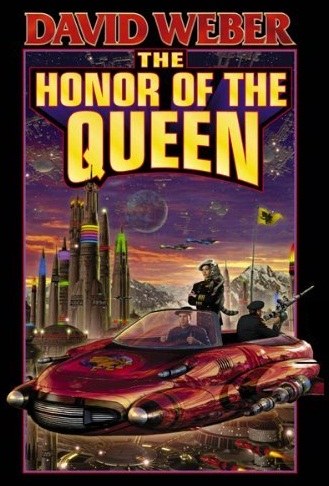 David Weber
David Weber’s book, The Honor of the Queen
What really struck me is that David Weber fairly presented firm believers as a spectrum. He showed that believers can be reasoned with and even persuaded to believe differently based upon evidence. Furthermore, he showed that even those who may line up on the side with which he disagrees [presumably–I don’t know where he stands on the issue] are not all (or even mostly) blinded by faith or foolishness. Rather, although there are some truly evil and disillusioned people, Weber shows that many are capable of changing their position or at least acknowledging that rival views are worth consideration.
The most vivid portrayal of this theme is found in a conversation between Admiral Courvosier and Admiral Yakanov. Courvosier is from the same nation as Honor Harrington and wholly endorses his female officer in a position of command. They discuss Captain Honor Harrington:
[Yanakov responds to Courvosier’s question about his society’s reaction to Honor]: “If Captain Harrington is as outstanding an officer as you believe–asI believe–she invalidates all our concepts of womanhood. She means we’re wrong, that our religion is wrong. She means we’ve spent nine centuries being wrong… I think we can admit our error, in time. Not easily… but I believe we can do it.”
“Yet if we do[” Yanakov continues, “]what happens to Grayson [their world]? You’ve met two of my wives. I love all three of them dearly… but your Captain Harrington, just by existing, tells me I’ve made them less than they could have been… Less capable of her independence, her ability to accept responsibility and risk… How do I know where my doubts over their capability stop being genuine love and concern?”
The exchange is characteristic of the way Grayson’s people are treated throughout the book. They are real people, capable of interacting with other views in honest ways. They feel challenged by a view contrary to their own. Some react poorly, and there are extremists who are blinded by hatred and anger. Yet all of them are treated as people with real concerns shaped by their upbringing and backgrounds.
Honor Harrington ends up saving Grayson, and at the end of the book, she is commended by the rulers of that planet. She talks to the “Protector” [read: king/president]:
“You see,” [said the Protector] “we need you.”
“Need me, Sir?” [Responded Honor]
“Yes, Grayson faces tremendous changes… You’ll be the first woman in our history to hold land… and we need you as a model–and a challenge–as we bring our women fully into our society.”
Weber thus allows for even ardent supporters of specific religious backgrounds to respond to reasoned argument and to change. They are capable of interacting on a human level and deserve every bit of respect as those who disagree with them. Again, there are those who are radicals and will not be reasoned with, but they are the minority and they do not win out.
Weber therefore presents religious dialogue in The Honor of the Queen as a genuine interaction between real people from differing backgrounds. Those who are “fundamentalist” are capable of changing their views when challenged with a rival view which out-reasons their own. Religious dialogue is possible and fruitful.
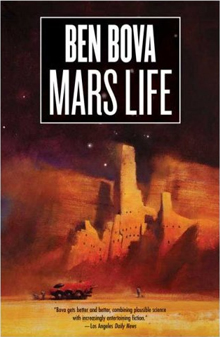 Ben Bova
Ben Bova’s whole “Grand Tour” series has a number of dealings with “fundamentalists.” He never really defines the term to be specifically Christian but one can tell when reading the books that it is pretty clear he is referencing hardcore fundamentalist evangelical Christianity.
I recently finished reading Mars Life
Bova’s treatment of extremist positions in religion is somewhat disingenuous in my opinion, particularly when one compares his portrayal with that of Weber. Bova tends to illustrate religious fundamentalists as a black and white issue. Basically, if you are a hardcore believer, you’re in it for power and control, you are willing to incite violence to achieve your ends, and you are incapable of reasoning. Again, note the contrasts with Weber’s depiction above. A few examples will help to draw this out.
On page 142 and following there is a discussion about putting together a panel to discuss the finding of a fossil on Mars. The interaction shows that no matter what, fundamentalists cannot accept scientific findings:
“Look,” said the bureau chief… “everybody’s calling it a fossil…. …”Call it an alleged fossil, then,” insisted the consultant (from the fundamentalists)… [The group then continues to suggest terms for the fossil:] “A probable fossil?” …”A possible fossil”… [Then, finally] “Say that the scientists believe it’s a fossil and until proven otherwise that’s what we’re going to call it.”
Here one can see that fundamentalism is intrinsically tied to an anti-science mentality. The key for them is to use words which deny absolutes, essentially skirting issues rather than discussing the truth. But that’s not all there is to it. Later on, one of the fundamentalists is engaged in a discussion about “requesting” that some lyrics in music they view as morally reprehensible be changed. The musician flat out refuses, angering the fundamentalist in the process. The section closes as follows:
[The musician] was shot to death at a Dog Dirt concert three months later. His killer surrendered easily to the police, smilingly explaining that he was doing God’s work.
What is interesting about this example is that it is illustrative of a number of such examples throughout the book. These are completely unrelated to the main plot. Rather, it seems what Bova is doing is very explicitly showing that fundamentalists are unafraid to use immoral tactics, censoring, and even incite violence in order to get their way. Theirs is an unquestioned and unquestionable faith. Those in power in fundamentalism are inherently evil and devious. They only want to control. Again, these asides are in no way tied to the plot of the book. It’s almost as though Bova is preaching a different worldview, one which views religiosity as inherently dangerous and violent, with few exceptions.
There is one positive example, however. A Roman Catholic, Monsignor Fulvio DiNardo, who is also a world-renowned geologist decides he wants to go to Mars to find the answer to a question about faith which is pressing on him. Namely, why God would exterminate an entire intelligent species. His thread in the story seems to show two things: first, that fundamentalism is inherently incapable of responding to reason; second, that it is possible to have reasoned faith and science together. The second point is illustrated very well when DiNardo is finally on Mars. He suffers from a likely stroke and is dying and begins a dialog with God:
Why did you kill them, Lord? They were intelligent. They must have worshipped You in some form or other. Why kill them? How could you–
And then DiNardo understood. Like a calming wave of love and peace, comprehension flowed through his soul at last… God had taken the Martians to Him! Of course. It was so simple, so pure. I should have seen it earlier. I should have known. My faith should have revealed the truth to me.
The good Lord took the Martians to Him. He ended their trial of tears in this world and brought them to eternal paradise. They must have fulfilled their mission. They must have shown their Creator the love and faith that He demands from us all. So He gave them their eternal reward…
The light was getting so bright… Glaring. Brilliant… Like staring into the sun. Like looking upon the face of… (297-298)
So Bova does offer a counterbalance to fundamentalism, and I appreciate that portrayal. Although DiNardo’s death and his revelation receives very little further comment (and no further comment at all on the revelation), it seems as though it is positively portrayed.
A reason for criticism is that Bova is uncompromising with fundamentalists. I’ve already drawn out his portrayal of them, and it seems to me to be a bit disingenuous. Although there are plenty on the “religious right” who would be all too happy to be able to legislate all morality, control the media, and deny well-attested scientific findings, I have hardly found that to be the majority. And certainly, fundamentalism is not a homogeneous entity filled with people who are trying to control everyone else. I’ll grant that this is a work of fiction, but in light of how Weber was able to handle a fairly similar issue with respectful portrayals of the ‘other side,’ I had hoped for more from Bova, whose work I enjoy greatly. For Bova, it seems, religious dialogue is not a real possibility, with few exceptions. Fundamentalists are incapable of reasoning and are barely even convinced believers; rather they are using their positions of authority within their organizations to consolidate power and execute their own prerogatives on their witless followers.
Fair Discussion
It seems pretty clear to me that David Weber provided a better model for utilizing science fiction in religious dialogue than Ben Bova did. The people representing the ‘bad guys’ in Weber’s book did have some who were truly evil and/or beyond reason, but also had many with whom reason resonated. When confronted with rival views, they were thoughtful and even receptive. On the other hand, the characters with whom Bova disagreed were a true black/white dichotomy with the “good guys.” Fundamentalists were bad. Period. He portrayed them as power-hungry, censor-happy maniacs. Although there was one notable exception (the Catholic priest, DiNardo), who showed a bright spot for “believers” at large, he was by far the exception.
It seems clear this study has applications for real-world dialogue about religion. When we interact with other worldviews, we should be capable of treating the other side with the same kind of dignity we would like to be treated. Although other worldviews may have their extremists who will not respond to reason, our attitude should be that of the humble friend trying to explore the beliefs of the “other.” The “other” is not that which must be demonized, but rather understood and with which to interact.
More Reading
I explore the theological implications of life on other planets.
I discuss a book which will change the way you think about about the notion that religion is violent. It also deals with the notion of the religious “other” as a construct.- William Cavanaugh’s The Myth of Religious Violence.
Sources
Ben Bova, Mars Life
David Weber, The Honor of the Queen
SDG.
——
The preceding post is the property of J.W. Wartick (apart from citations, which are the property of their respective owners, and works of art as credited) and should not be reproduced in part or in whole without the expressed consent of the author. All content on this site is the property of J.W. Wartick and is made available for individual and personal usage. If you cite from these documents, whether for personal or professional purposes, please give appropriate citation with both the name of the author (J.W. Wartick) and a link to the original URL. If you’d like to repost a post, you may do so, provided you show less than half of the original post on your own site and link to the original post for the rest. You must also appropriately cite the post as noted above. This blog is protected by Creative Commons licensing. By viewing any part of this site, you are agreeing to this usage policy.
Alien Life: Theological reflections on life on other planets
 I have two general beliefs/feelings when it comes to life on other planets which are in conflict. Part of me is extremely skeptical. The probability of their being life on other planets given the extremely precise conditions needed to sustain life is exceedingly, vanishingly, absurdly low. Sure, there are unimaginably numerous planets in our universe, any number of which may be earthlike, but I just do not see why we should think that life is inevitable or even likely. On the other hand another part of me thinks that God could just as easily have brought life forth in various places throughout the universe, utilizing it much like an artist uses a tapestry. Our universe could be teeming with life, just waiting to be discovered.
Reading a couple books recently, along with the recent exploration of Mars, have turned me to reflect on the implications of life on other planets for Christian theology. One book, Vast Universe [link at bottom of post], was on Christian theology of life on other planets. Here, I shall be setting aside my extreme skepticism about life “out there.” Instead, I shall consider the following statement: “If there is other life in the universe, what does that mean for Christian theology?”
Science and Christianity
The topic is so oft-discussed that I will not dedicate too much time to it. What would the discovery of life ‘out there’ do for science and Christianity?
I think that Christian theology already has the resources built in it to adapt itself to life on other planets. Although some would be disturbed by such a possibility or reality, I do not see how such a discovery would be damaging to Christianity as a whole. The real problem would lie with those willing to abuse the text of the Bible in order to try to make it say there is no possibility of life outside of Earth or that our planet is the focal point of all creation. Theologies which take such a path those would indeed suffer greatly.
Humanity’s Place in the Universe
The discovery of life on other planets would almost certainly remove the notion that humanity is some kind of privileged being in this universe. It was not all created by God for us. What would that mean for Christian theology?
Again, I do not think this would be very damaging. Although the notion that humanity has a special place in the universe has a traceable line throughout the history of Christian theology, it is hardly a necessary component. In fact, life on other planets would be a great illustration of another thread of Christian theology: the notion of God as a cosmic artist who delights in creation. On this view, God takes such pleasure in the creation of and interaction with various living species that He caused them to arise across the universe. Furthermore, our discovery of these other living creatures could be a reflection of His providence, having set up the world in such a way that we could discover other life and marvel at His creation.
Salvation
What about salvation on other planets? Did Jesus go to other planets in His incarnate form and save them as a human? Was there more than one crucifixion? Thomas O’Meara, in the book I mentioned above, reflects upon questions just like these. He argues that “All three persons can become incarnate because incarnation is one aspect of boundless divine power… The divine motive for fashioning a universe of galaxies is God’s goodness; the same motive brings incarnation” (47, cited below). He establishes the notion of more than one incarnation as a live option throughout Christian history (63ff).
It therefore seems as though other life in the universe would not destroy God’s salvation plan. The Bible tells us about God’s salvation history for humanity. We know God is good, and we therefore know that God would providentially interact with other beings at their own levels and needs.
Finally, one thoughtful reader pointed out to me one area I had forgotten to add in here. There is the possibility that if there are aliens, then they have not fallen. Perhaps they have lived in communion with God instead of in rebellion against God. The possibility is very real, and must be considered in this kind of speculative theology. Such aliens would possibly be corrupted by meeting humanity; but they may also have much to teach us. As O’Meara notes, they may be some kind of “Star Mentors” with spiritual insights we may miss in our fallen state.
 The Sentient Alien and other faiths
What kind of challenge would a sentient alien present to Christianity? What of their faith, their religion?
As far as other sentient species’ religions, I think that Christianity could interact with them in the same way that Christian theology has considered other human faiths. Seek truth where truth exists, and critique where it is untrue. (For my fuller vision of world religions, check out my post on A Vision for Christian Apologetics to World Religions.)
Some could even argue that a Christian interaction with other sentient races should be open to their own incarnations and truth in their religion as revealed by God. What of an alien Bible? Again, it seems that a good God, as we know God is, would interact with all life in a way that reflects His omnibenevolent nature. God’s providence would extend to life across the whole universe.
Alleged Disproofs
Would life on other planets somehow discredit Christianity? What of panspermia? How should we treat the discovery of life in the universe, were it to happen?
The Bible does not seem to make any kind of statement about life outside of our planet. However, it does make it clear that there is a spiritual realm of angels and demons. Thus, there is at least life outside of our easily accessible realm. No verse in the Bible states that there is no life elsewhere in the universe. It seems that the possibility is certainly open.
Furthermore, I don’t see any reason to think that life on other planets would somehow justify belief in panspermia or some other pseudo-scientific explanation of the spread and origins of life. We would have to deal with the same questions about life on other planets that we must deal with on our own.
Created life and the universe
Overall, I think that as a purely rational standpoint there is reason for immense skepticism about life on other planets. Although many express optimism and point to the sheer volume of planets in our universe as somehow necessitating life elsewhere, I am not convinced that sheer numbers somehow increase the likelihood of life on other planets. To put it plainly, it is my opinion that the only rational way to hope for life elsewhere in our universe is to conjoin that hope with belief in a God who loves creating and interacting with created life.
A final disclaimer
I realize that many of the points I wrote about in this post are likely to be extremely contentious. What I want to say is that this has been an exercise in speculative theology. I have been writing about something which is a mere possibility and offering possible answers to a number of questions from a perspective which takes this possibility seriously. I am quite possibly wrong on any of these. What I have tried to do here is offer a number of things for Christians to think about when they consider life on other planets. For a great post on the possibility of life on other planets, check out this guest post by Greg Reeves on that very topic.
Source
Thomas O’Meara, Vast Universe
SDG.
——
The preceding post is the property of J.W. Wartick (apart from citations, which are the property of their respective owners, and works of art as credited) and should not be reproduced in part or in whole without the expressed consent of the author. All content on this site is the property of J.W. Wartick and is made available for individual and personal usage. If you cite from these documents, whether for personal or professional purposes, please give appropriate citation with both the name of the author (J.W. Wartick) and a link to the original URL. If you’d like to repost a post, you may do so, provided you show less than half of the original post on your own site and link to the original post for the rest. You must also appropriately cite the post as noted above. This blog is protected by Creative Commons licensing. By viewing any part of this site, you are agreeing to this usage policy.
The Consolation of Counterfactuals: The Molinism of Boethius
Whence comes this powerful understanding
That all things sees and all discerns?
…This is a cause more powerful
More forceful and effectual
Than that which passively awaits… (Boethius, The Consolation of Philosophy, Book V, section IV)

Molinism is holds that God has counterfactual knowledge of every situation. What this boils down to is that God knows conditional statements for every possible situation, such that God knows statements like “If J.W. has free time, then he will read.”
One prominent challenge to molinism is the notion that such counterfactuals about future choices cannot exist or that God simply couldn’t know them. I was startled as I read Boethius’ (480-525 AD) work, The Consolation of Philosophy, to see that he had anticipated this objection and provided the outline of an answer to it about 1500 years ago.
Boethius wrote the work as a dialog between himself and Philosophy, a woman who represented, well, philosophy. The last book focuses upon God’s foreknowledge and human freedom.
Writing as philosophy, Boethius states
All those things which happen without happening of necessity are, before they happen, future events about to happen, but not about to happen of necessity… But this, you will say, is the very point in question–whether there can be any foreknowledge of things whose occurrence is not inevitable. (Book V, section IV)
Again, it was amazing to see that Boethius had anticipated an objection to molinism–a system of theological thought which hadn’t been conceived fully yet (and wouldn’t be for about 1100 years!)–and provided an answer. The objection was seen above: many modern philosophers and theologians contend that God could not know that which is not necessitated to happen.
Yet Boethius answers the problem in a unique way:
The cause of this mistake [believing that God couldn’t know things that will not happen by necessity] is that people think that the totality of their knowledge depends on the nature and capacity to be known of the objects of knowledge. But this is all wrong. Everything that is known is comprehended not according to its own nature, but according to the ability to know of those who do the knowing. (Book V, section IV)
Before developing this argument, it is important to note that it rests squarely within Boethius’ later reflection upon the eternity of God–a being who has “the complete, simultaneous, and perfect possession of everlasting life” (Book V, section VI). Because Boethius holds that God is eternal in this sense–timeless–he can reasonably hold that God’s capacity to know is not limited by temporal constrictions.
Thus, we get back to the nature of his response to the counterfactual objection to molinism. Boethius, holding that God is eternal and therefore not limited by time, grounds the knowledge of counterfactuals not in their own inherent ability to be known or not known, but rather in the ability of the knower to know them.
It is worth emphasizing how radical and powerful this response is to the modern argument against molinism. If God is indeed timeless in the sense Boethius presses, then God would have access to the entirety of time as far as knowledge and action are concerned. Thus, by grounding knowledge not in the objects of knowledge themselves but in the capacity of the knower, Boethius grounded counterfactual knowledge.
Objection
Now, modern opponents of molinism would take this in stride and argue either against the contention that God is timeless or against the contention that knowledge is based in the capacity of the knower rather than the known. Exploring either of these objections is beyond the scope of this post, but it is worth noting that Boethius’ rebuttal to the problem of counterfactual knowledge works if both of his contentions are true. The question is, of course, whether they are.
A Final Objection and Response
Another way to attack Boethius’ defense of God’s knowledge of counterfactuals is to argue that even if it is the case that God is eternal and that His knowledge is grounded in the knower rather than the known, then it still would only mean that God knows what will happen, not what would happen if something were to happen. In other words, one could hold that Boethius’ answer doesn’t actually apply to counterfactual knowledge.
It seems possible, however, to modify Boethius’ defense to counter this argument as well. One could note that because God is eternal, any event that would happen, God would know about it. In other words, if x were z instead, then God’s knowledge would simply be z instead of x. This response turns the counterfactual into a counterfactual about God’s knowledge rather than about freedom. The response offered turns the question from whether God could know that “If x, then y” about John Smith into a question of “If z instead of x, then God knows z.”
Conclusion
It seems clear to me that there is much to develop yet in the objections and responses offered above. The last critique offered and my response certainly opens a number of areas of inquiry. However, for now it seems clear that Boethius has offered a unique way to look at the problem of counterfactual knowledge. Whether his perspective is correct remains a matter for further inquiry.
Boethius offered a unique and stirring defense of molinism over a thousand years before it was fully articulated by Luis de Molina. It is worth looking into his answer, even if it fails, simply for the foresight it provided. But Boethius’ work is known as an astounding discussion of divine eternity as well, among other things. Thus, I encourage readers to look into his short work, The Consolation of Philosophy. Who knows, you may even find the consolation of counterfactuals therein.
Edition Used: For this post I used the Penguin Classics edition of The Consolation of Philosophy (New York: Penguin, 1999).
SDG.
——
The preceding post is the property of J.W. Wartick (apart from citations, which are the property of their respective owners) and should not be reproduced in part or in whole without the expressed consent of the author. All content on this site is the property of J.W. Wartick and is made available for individual and personal usage. If you cite from these documents, whether for personal or professional purposes, please give appropriate citation with both the name of the author (J.W. Wartick) and a link to the original URL. If you’d like to repost a post, you may do so, provided you show less than half of the original post on your own site and link to the original post for the rest. You must also appropriately cite the post as noted above. This blog is protected by Creative Commons licensing. By viewing any part of this site, you are agreeing to this usage policy.
Book Review: “Heresy: A History of Defending the Truth” by Alister McGrath
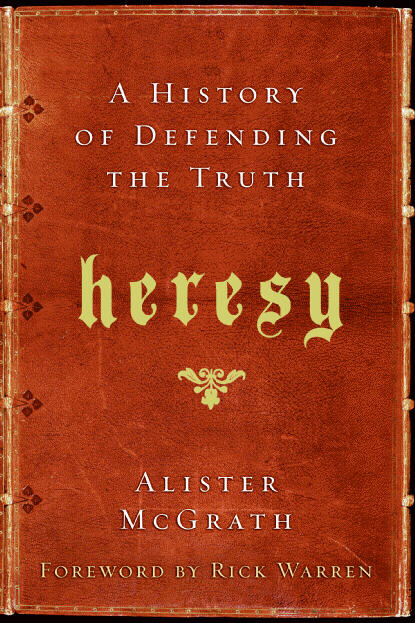 There is a trend today to see heresy as a forbidden fruit. What is heresy?; Who says these views are wrong?; Aren’t heresies just the losers in a power struggle?–these are but a few examples of the questions being asked about heresy. Alister McGrath’s book,Heresy: A History of Defending the Truth
“A heresy,” states McGrath, “is a doctrine that ultimately destroys, destabilizes, or distorts a mystery rather than preserving it… A heresy is a failed attempt at orthodoxy, whose fault lies not in its willingness to explore possibilities or press conceptual boundaries, but in its unwillingness to accept that it has in fact failed.” (31, emphasis his).
One might wonder why McGrath utilizes this view of heresy, and it is important to see that his definition stands between two misunderstandings of the historical context of the development of heresy. McGrath argues that there are two positions about the history of heresy which are extremely popular but also highly anachronistic. The first is that heresy is something from outside of the church which was able to somehow “get into” the church and corrupt it (34); the second erroneous view is that “What determines whether a set of ideas is heretical or not is whether those ideas are approved and adopted by those who happen to be in power. Orthodoxy is simply the set of ideas that won out, heresies are losers” (81). Both positions suffer from an anachronistic view of the history of heresy and tend to over-emphasize certain aspects of that development.
The notion that heresy is some kind of “Trojan horse” smuggled into Christianity from without is historically untenable (34). Furthermore, this view generally holds that “Heresy was a later deviation from [the] original pure doctrine” (65). Instead, “heretics were insiders who threatened to subvert and disrupt [the church]….” (35). However, the fact is that the notion of early Christianity holding to the best orthodoxy is a purely fictional historical concept. Rather, doctrine developed as new challenged were presented to the Christian faith or new truths were explored (66-67). Heresy was part of this development. Heresies were ideas that failed to take hold within Christianity because it was deemed to undermine the strength of the Christian faith as a whole (83).
Therefore, McGrath argues, it can be seen that the second view of the development of heresy is also historically mistaken. There was an orthodox core from which doctrine developed, and heresies were seen as defective (81ff). “The process of marginalization or neglect of these ‘lost Christianities’ generally has more to do with an emerging consensus within the church that they are inadequate than with any attempt to impose an unpopular orthodoxy on an unwilling body of believers” (81-82). Heresy was “an intellectually defective vision” of Christianity (83), rejected because it could not stand up to the theological challenges raised against it (83ff).
McGrath provides more development of the concept of heresy, and then turns from his analysis of the rise and rejection of heresy to a historical account of several early heresies. His analysis of these early heresies (ebionitism, docetism, valentinism, arianism, donatism, and pelagianism) provides significant historical support for his thesis that heresies are ultimately insufficient accounts of Christian theology and were rejected thereby. Against the thesis of Walter Bauer, who held that orthodoxy was an “ideological accident,” it is rather the case that “The relative weakness of institutional ecclesiastical structures at this time, including those at Rome, suggest that the quality of the ideas themselves played a significant role in their evaluation…” (133).
It is also important to note that heresies are not necessarily tools aimed to destroy Christianity from within. McGrath is particularly concerned with the contextualization of heresies. These were often developed within a context of a question, like “What is the nature of Christ?” (Ebionitism). “The problem [of heresy] lay not with the motivations of [heretics], but rather with the outcomes of their voyages of theological exploration” (171).
McGrath ends Heresy with an exploration of the origins and development of heresy. Heresy, he argues, develops through 5 major strands, each of which usually involves turning theology towards: cultural norms, rational norms, social identity, religious accomodation, and ethical concerns (180ff). Heresies will continue to emerge as Christianity faces new challenges. Furthermore, orthodoxy is itself a process of ongoing development (221).
McGrath concludes with a vision for orthodoxy: “If Christ is indeed the ‘Lord of the Imagination’… the real challenge is for the churches to demonstrate that orthodoxy is imaginatively compelling, emotionally engaging, aesthetically enhancing, and personally liberating. We await this development with eager anticipation” (234).
Heresy is indeed something which has caught the popular imagination. McGrath’s book offers a reasonable, sound defense of Christian orthodoxy in an era wherein heresy is often portrayed as an unfairly suppressed system which should be resurrected. By providing a significant investigation of the historical background and development of heresy, McGrath avoids the two ahistorical extreme views of heresy: that it was entirely a plague from outside the church or that it was merely one of many competing ideas that happened to lose.
Christians would do well to have knowledge of the development of Christian doctrine. As more challenges are raised to the Christian faith, orthodoxy will have to continue to respond. Without a historical grounding firmly in place, Christianity is liable to change with the winds. Heresies repeat themselves (232), and Christians need to be ready to respond to these alterations of the faith. Heresies have historically been rejected not due to an internal power struggle, but rather due to their insufficient intellectual bases.
Alister McGrath’s Heresy: A History of Defending the Truth is one of those books Christians should have within reach on their shelf in order to readily access it as challenges arise. He provides an enormously useful historical evaluation of heresy which allows readers to avoid the pitfalls of ahistorical views. Furthermore, McGrath convincingly demonstrates the reasoning behind labeling a position as heretical follows from a corruption of Christianity which makes it less theologically or intellectaully viable. By providing Christians with a vision of orthodoxy and heresy that is both aware of its past and looking towards the future, McGrath has written an invaluable source.
Heresy: A History of Defending the Truth
SDG.
——
The preceding post is the property of J.W. Wartick (apart from citations, which are the property of their respective owners) and should not be reproduced in part or in whole without the expressed consent of the author. All content on this site is the property of J.W. Wartick and is made available for individual and personal usage. If you cite from these documents, whether for personal or professional purposes, please give appropriate citation with both the name of the author (J.W. Wartick) and a link to the original URL. If you’d like to repost a post, you may do so, provided you show less than half of the original post on your own site and link to the original post for the rest. You must also appropriately cite the post as noted above. This blog is protected by Creative Commons licensing. By viewing any part of this site, you are agreeing to this usage policy.
Answering Common Young Earth Creationist Arguments
 The debate over the age of the universe is a hot issue for some Christians, and this unfortunately leads to a number of faulty arguments and even some name-calling. This post is not going to argue against young earth creationism specifically. Rather, I hope that it can be a resource for both young earth and old earth proponents in order to avoid faulty reasoning. Each argument’s topic will be in bold with the problem outlined and a response. [Image at head of post credit here.]
Please see the end of the post for a response to an article linking back to this one.
Perspicuity of Scripture–
The Argument
Some young earth creationists (hereafter YEC or YECs) argue that old earth positions undermine the perspicuity of Scripture. Perspicuity of Scripture is the notion that the central teachings of Scripture can be understood by any who come to the Gospel. The charge YECs make is that because it seems, on a surface level reading of the text, that Genesis 1 implies creation over the period of 6 literal 24 hour days, those who deny this undermine the Perspicuity/Clarity of Scripture.
Response
The Perspicuity of Scripture does not apply to all areas of Biblical doctrine. Rather, it is the notion that anyone can understand the plan of salvation as laid out in Scripture and come to right knowledge for faith.
Think of it this way: read the book of Revelation. Do you understand everything in this book, or is the apocalyptic literature hard to discern? Throughout much of Christian history, there has been debate over the meaning of Revelation. There are a number of views, like preterism, idealism, dispensationalism, etc. But this doesn’t mean that what Scripture teaches in general is unclear. The clarity of Scripture in regards to salvific issues is absolute. Any reader can read and understand God’s plan for salvation.
Addendum
If the argument is pressed, again ask the YEC whether they are claiming they understand every single doctrine that the Bible teaches. Do you understand perfectly the Trinity, the atonement, the incarnation, the Lord’s Supper, the proper relation of Law and Gospel, etc.? If someone claims they do, they are essentially equating their understanding to God, rather than adhering to Scriptural teaching (1 Corinthians 13:12).
The Meaning of Day
The Argument
The Hebrew word used in Genesis one, yom, means day. It literally means a 24 hour period.
Often this argument is presented in a fairly demeaning and/or ad hominem way to the opponent: “Why do you insist on reading man’s fallible ideas into the text? It says day, it means day. I trust the Bible.”
Response
Actually, the Hebrew word yom has several different literal meanings. For example, according to Brown-Driver-Briggs’ Hebrew Lexicon, yom can mean “day, time, or year”; day as opposed to night; a 24 hour day; a time or period of time; a year; an age. Thus, if someone reads the text and argues that in Genesis 1 the days mean “ages”, they are still reading the text literally.
Evening and Morning
The Argument
When the Genesis 1 text refers to the days, it applies the terms “evening and morning” to each one of days 1-6, which means that each day is indeed a 24 hour period. That’s what evening and morning means.
Response
The delineation of time periods for days was not possible until the fourth day. As it is written, “Let there be lights in the vault of the sky to separate the day from the night, and let them serve as signs to mark sacred times, and days and years, and let them be lights in the vault of the sky to give light on the earth” (Genesis 1:14-15, I italicized “days”). Thus, the text itself tells us that the sun did not serve as a specific indicator of the length of days until the fourth “day.”
The repetition of evening and morning is an indication of the metaphor for the work week used throughout Genesis 1. Notice that evening and morning are reversed from the order in which they occur in a 24 hour day.
Day is not a long period of time
The Argument
Sure, there are other literal meanings of “yom” and in poetic literature it says that a day is like a thousand years for the LORD, but Genesis is a narrative and so the days mean literal 24 hour periods.
Response
Actually, in the very same account the word day is used in order to refer to the whole time of creation. As it is written, “These are the generations of the heavens and the earth when they were created, in the day that the Lord God made the earth and the heavens” (Genesis 2:4). I used the ESV translation here because the NIV translation translates yom as “when” here. In this text, the word “day” refers to the entirety of God’s creative work. Thus, the text itself utilizes the same word, yom, to mean a longer period of time than a 24 hour period in the same context of creation. And because this is “narrative” it can’t be dismissed as “mere poetry.” Speaking of which…
That’s Just Poetry
The Argument
Many of the verses that old earth proponents use are from places like the Psalms. For example, the verse about a day being like a thousand years is from Psalm 90:4. These verses are poetry and therefore not relevant to the actual age of the earth.
Response
Poetic literature still makes truth claims. Are you suggesting that nothing in the Psalms is true? To dismiss a text that is brought up in order to counter your position by saying “that’s just poetry” is tantamount to throwing God’s word out the window. One might wonder why it is that the YEC interpretation of Genesis 1 trumps every other passage in the Bible.
Appearance of Age
The Argument
Sure, some scientific evidence may make it seem as though the earth is old, but it is not actually old. Instead, God made it in such a way that it would support life, and in order to do so, it had to look old. He created light already on its way to earth and the Flood explains sedimentation.
Response
Nature tells us about reality, though we cannot infallibly search it (Psalm 19); God does not lie; therefore, God would not make something which by all appearances would look old, but is not in fact old.
Rebuttal
But Adam looked old. He was created about 30 years [or some adult age] old! Similarly, the plants in the garden, etc. would have looked old, but been new.
Response
The text doesn’t actually say how old Adam was when he was created. But that’s a side issue. More importantly, we would be able to tell how old Adam was by looking at evidences like his teeth, his bones, and the like. All of these would show signs of age.
Regarding the plants, this argument really just begs the question for YEC. As it is written, “And the LORD God planted a garden in Eden, in the east, and there he put the man whom he had formed. And out of the ground the LORD God made to spring up every tree that is pleasant to the sight and good for food…” (Genesis 2:8-9a).
The text clearly says that God planted a garden. While it says that God made plants spring up, it is prefaced by the notion of planting. The notion of planting implies growth over time.
And suppose this is wrong; suppose the plants were grown instantly: we’d still be able to test them and see how old they actually were by looking at things like cell division and tree rings.
Rebuttal
Your response assumes uniformitarianism.
Response
See section on uniformitarianism.
Presuppose Naturalism
The Argument
This one is extremely common when one listens to/watches debates between YEC and old earth proponents. Essentially, the argument goes like this: “You are presupposing naturalism in order to come up with an old earth. I presuppose the Bible is true instead. The difference is I [the YEC] am aware of my presupposition.”
Response
Strictly speaking this argument is actually completely false. Naturalism is the philosophical position that only the natural world exists. The debates in which this argument is often brought up are very often between Christians of opposing views. Therefore, because they are both Christians, neither one is operating under the presupposition of naturalism.
Rebuttal
The YEC may press this objection, however, and say what they mean is that one is presupposing a naturalistic methodology as opposed to the entire worldview.
Response
Define “naturalistic methodology.”
1) If you mean assuming “uniformitarianism”: see the argument and response below.
2) If by “naturalistic methodology” you mean something else, show how that is the case.
Uniformitarianism
The Argument
The only way to come up with an old earth is by assuming that everything has been uniform forever; in other words, the processes in place now are operating at the same speed they always have.
Response
Let’s apply this argument to one field: geology. Geology does come up with ages around 4.5 billion years old for the age of the earth. Now, the problem is that this is not due to uniformitarianism. Rather, geologists must take into account the fact that catastrophes do happen. For example, a huge meteor hitting the earth would change the geological landscape. Modern geology is neither catastrophist nor uniformitarian; rather, it must take both into account. And it still comes up with an “ancient” earth. The problem is that YECs go to the opposite extreme and actually assume that a catastrophe (or numerous catastrophes) can account for all geologic evidence. By citing specific examples of catastrophism, they then apply a catastrophic geology to the rest of the earth. It’s exactly the methodology YECs critique, but then they do it themselves. This is simply naive.
Furthermore, the burden of proof here is upon the YEC to show that the rates could increase at such a monumental rate on such a monumental scale that everything we observe that looks ancient is, in fact, ‘young.’ They must make the argument.
Rebuttal
You’re just starting with man’s fallible ideas. I just use the text for my guide.
Response
See “Look, it’s what the Bible says” and “Man’s Fallible Ideas” sections below.
Look, it’s what the Bible says
The Argument
I just read the Bible and agree with it. It says days, I say days; it gives genealogies, I add them together. All I do is take Genesis literally. You use man’s fallible ideas to distort the text.
Response
It has already been shown that the word “day” has several literal meanings. It has already been shown that “day” is used for a longer period than a “day” in the context of creation in Genesis. Thus, one could respond by saying “I just read the text literally too. On the first ‘age’, God created…. on the second age, God created…., etc.”
Furthermore, the genealogies are incomplete. It can be demonstrated that a number of genealogies in the Bible skip people or operate in an inexact fashion. By assuming the genealogies are linear, one has read anachronistically a 21st century notion of a genealogy back onto the text. That would be one of man’s fallible ideas.
Furthermore, the notion of an old earth proponent importing ‘man’s fallible ideas’ into the text can be equally applied to YEC. Who says that YECs are infallible? Would you claim you read the Bible perfectly and discern everything correctly?
You weren’t there!
The Argument
You weren’t there at creation. Neither were these “scientists” you cite in your “evidence.” How do you know what happened?
Response
You weren’t there either, my friend. However, when we look at the stars, we are looking at the past. Furthermore, we can measure things like cosmic background radiation, sedimentation rates, volcanic activity, and the like in order to discern how old the earth is. Again, God tells us that nature gives us a record (Psalm 19), so one wonders why we are being told to doubt that record.
 Very Good
The Argument
God says that his creation was “very good”; how could there then be animal death, thorns, cancer, and the like. The world would have been beautiful, without death, and without any kind of evils. Think about it, you’re saying that God was calling cancer eating away at dinosaurs and the like a “very good” thing! [Image credit here.]
Response
First, it seems very often that when YECs use the phrase “very good” what they mean is “perfect” in their own eyes. Why think that animal death is necessarily bad? If animals didn’t die, ecosystems would collapse: all the plant-eaters would starve, insects would take over and eat all plant life, and any number of other “bad” things would happen. Animal death is part of a beautiful system of maintaining order in the world.
Using the cancer example to try to argue that it couldn’t be “very good” is importing human emotions into creatures which are not moral agents. Simply put, an animal is not a moral agent. This doesn’t mean it is good to kill them, but it isn’t bad either. The harm comes when a moral agent intentionally brings unnecessary harm to an animal.
I would like to see an argument for what “very good” means to YECs. Why should it mean absolute perfection?
Finally, one must wonder about the fact that God planted the garden in Eden and it is that creation which is “very good”. God planted this Garden, and it was the localized area in which Adam and Eve were placed. That’s what the text says. Nowhere does it say the whole earth was like the Garden.
Compromise
The Argument
Unfortunately, this is one of the less subtle ad hominem types of arguments YECs employ. It basically goes like this: use a scare word like “evolution,” put in in context with an old earth proponent, and then call them compromisers. For example, “Wartick, who believes in a form of old earth creationism–really just a variety of theistic evolutionism–chooses to compromise the text to fit secular science.”
Response
Unfortunately, this very type of argument is used to discredit many fellow Christians. Rather than focusing on the issues at hand, it is indeed easier to just bash the opposition. For the record, I am not a theistic evolutionist. The point is that others who hold views similar to my own suffer from arguments like this against them. It’s dishonest.
The most unfortunate thing to take from this type of argument is that the average Christian on the street is very affected by it. Recently, I recommended an article from an extremely prominent Christian philosopher to another Christian. Their response was that if this other believer thought evolution might be true, they were too biased and they would not read the article.
That’s right, the effect of this type of argument is that it brings about a situation in which people won’t even read what other believers have to say about a topic. One must wonder, at least a little bit, about a position which discourages adherents to read the works of the opposition. Why not read and consider other viewpoints and take what is true?
Plain and Obvious Meaning- or “I don’t need to twist the text.”
The Argument
Basically, the way this one goes is as follows:
I just read the text for what it says. You have to do all kinds of things to interpret it. Why do you twist the text to fit your views?
Response
 Actually, YEC is also an interpretation of the Biblical text. It is an inference from the textual data. You are also interpreting the text, and need to justify your hermeneutic. Given the mounting evidence against it in books like The Lost World of Genesis One
You’re Using Science to Change the Meaning of Scripture
The Argument
Old earth proponents may have a viable exegetical position, but why on earth would they pick old earth over young earth? It seems the only reason is because they are caving in to science.
Response
Science can give us a record of reality. When the church lines itself up with views that do not accord with reality, it is discredited. Consider the controversy over heliocentrism vs. geocentrism. This controversy resulted because the church lined itself up with a philosophical position that it thought was taught by the text of the Bible. Similarly, the young earth position is an interpretation of Scripture and its advocates must contend with the scientific evidence.
Augustine issued a strong warning related to this objection [Literal Meaning of Genesis, Chapter 19, Volume 1]:
“If they find a Christian mistaken in a field which they themselves know well and hear him maintaining his foolish opinions about our books, how are they going to believe those books in matters concerning the resurrection of the dead, the hope of eternal life, and the kingdom of heaven, when they think their pages are full of falsehoods and on facts which they themselves have learnt from experience and the light of reason?”
The Bible says it, I believe it, that settles it
The Argument
This argument has a few varieties:
1) The Bible says the earth is not millions or billions of years. Why do you insist on changing God’s word for man’s fallible ideas?
2)The Biblical text entails a young earth. Why do you read it as a long period of time?
Response
1) Where in the Bible does it say “the earth is not millions or billions of years old”? Where in the Bible does it tell me the date of creation?
2) Please show me: where in the Bible does it tell me the date of creation? Where does in the Bible does it specifically say YEC is true? If you can’t, then you’re using an inference. See “Plain and Obvious Meaning” above.
Man’s Fallible Ideas
The Argument
Perhaps the most frequently used argument is of this variety. Too often, when threatened by exegetical or extra-biblical evidence that contradicts their position, YECs will fall back to this type of argument:
“That’s just using man’s fallible ideas to interpret the text.”
or
“That’s using man’s fallible [geology, astronomy, physics, insert discipline] to alter the meaning of God’s word.”
Response
The Young Earth position is an interpretation of the text as much as any other. Thus, the argument could just as easily be turned around:
“You’re just using man’s fallible interpretation to read a young earth onto the text.”
But, to be honest, this argument just amounts to a subtle ad hominem, even if the one using the argument doesn’t realize it. Why? Because it suggests that the other side is a) wrong; and b) not thinking Biblically.
A better response, therefore, would be to simply point out that the YEC position is also interpreting the text and that old earth proponents are looking at the whole body of evidence God has provided instead of just trusting what others tell them about the text.
Response to article against this one:
Over at “fortress maximus” the author offered a response to this article. I’ll not go point by point, but rather I listed a few areas of major contention. The most contentious point for me is that the author says I reject inerrancy, which is false. When I say “you” after this, I’m referencing his article. As of this point in time (January, 2013), he has not amended his article to remove the false claims made about me therein. Anyway, response:
Thanks for your thoughtful response. I have a few comments, but I won’t be too lengthy because I don’t have time.
1) You wrote “the author fails his own claims by only outing the YEC arguments as faulty and then offering the OEC arguments as an unchallenged substitute.”
The title of the post is “answering common YEC arguments.” I think that pretty much makes my intention clear. The stated purpose is that I’m not arguing specifically against the YEC position, which I don’t. I only answer many arguments. It’s a bit disingenuous to claim I’m doing otherwise.
2) You wrote, “Poetry in the Bible certainly is relevant, but only in revealing spiritual truths, not historic ones.”
No historic truths in the Psalms, eh? I guess the Psalms by David when he was fleeing from his enemies don’t tell us anything about his situation? I would like to see an argument for this claim.
3) Regarding appearance of age, you wrote “I’ve never heard any serious YECer use these arguments. Old appearance has nothing to do with God’s creation and how it may appear. This stance is also unsupported scripturally, hence it is blatantly flawed. So, if you are a YECer and you used this argument, stop it!”
I was once YEC and unfortunately used this argument myself, because almost every other YEC I knew used it as well. Thus, it’s an argument used by YECs, and I answered it. I agree, though: stop it!
4) You wrote “We’re finally getting to the greatest point of contention – this argument states that the Bible is inaccurate and as such flawed (“the genealogies are incomplete”). This goes against the premise that the Bible is the holy, inspired, infallible, written Word of God.”
Wrong, absolutely wrong. Unfortunately, YECs tend to do this to me all the time: put words in my mouth. Please show me in a quote where I said the Bible is inaccurate and flawed. Show me. You literally say it right there: “this argument states that the Bible is inaccurate and as such flawed”
But wait, the quote is actually: “the genealogies are incomplete” which we can demonstrate from the Bible. It’s not that they are inaccurate; it is that the modern notion of a genealogy stating one generation after another with no gaps is just that: a modern notion. I never stated the Bible is inaccurate, nor do I state it is flawed. I have been a staunch defender of inerrancy. Your statement here is extremely ad hominem; it is, in fact, so wrong and unsubstantiated by my blog that if I weren’t giving you the benefit of the doubt I’d think you’re just lying about me. I therefore ask you to retract it.
5) regarding dating methods: I hate to say it but anyone who reads non-YEC literature on this topic will not be convinced by these arguments. Yes, there are aberrations in the dating which are not covered up by secular or other scientists whatsoever: they state them in their works; no, they do not undermine the whole system.
Resources
Here is a list of resources for old earth perspectives. I will annotate it at some point. For now it’s just a list of amazon links.


SDG.
——
The preceding post is the property of J.W. Wartick (apart from citations, which are the property of their respective owners) and should not be reproduced in part or in whole without the expressed consent of the author. All content on this site is the property of J.W. Wartick and is made available for individual and personal usage. If you cite from these documents, whether for personal or professional purposes, please give appropriate citation with both the name of the author (J.W. Wartick) and a link to the original URL. If you’d like to repost a post, you may do so, provided you show less than half of the original post on your own site and link to the original post for the rest. You must also appropriately cite the post as noted above. This blog is protected by Creative Commons licensing. By viewing any part of this site, you are agreeing to this usage policy.
Naturalis Historia: Is Young Earth Creationism True?
I recently came upon what is, in my opinion, the finest collection of essays challenging the scientific aspects of Young Earth Creationism to date. The blog, Naturalis Historia features a broad spectrum of posts offering challenges to Young Earth perspectives from a scientific viewpoint. I can’t recommend the blog highly enough. Below are a few links with brief summaries of the contents.
An Ancient and Alien Forest Reconstructed– the recent finds of several fossilized forests have revealed alien landscapes not similar to our own forests in any way. In fact, many of these ancient forests lack any kind of flowering plant whatsoever. If the biodiversity found across all of fossil history is compressed into a young earth timespan, the possibility of explaining these anomalous forests without contemporary features becomes extremely difficult for young earthers. Another forest found in New York exacerbates the problem.
The impact craters from various meteorites presents another difficulty for YEC. Dating these craters puts them well beyond the allowances of a young earth perspective, but the young earth explanations stretch credibility beyond the breaking point.
What of dinosaur eggs? The fact is that these eggs are found across the various strata. Now most YECs I have read argue that the large amounts of sediment across the earth were deposited by the Flood. If that is the case, then how did these dinosaur nests appear across various layers. Natural Historian put forward this challenge in the post, “Juvenile Dinosaur Fossils In a Nest…” One current YEC explanation is that the dinosaurs moved on top of the sediment as it was deposited and laid their eggs on the various layers, which were then covered as the rains continued to fall. The problem is that discoveries have now been made of juveniles in these nests, which would mean they would have had to hatch and grow before being buried by the Flood. Again, this truly stretches credulity beyond the breaking point.
What is the point of linking to these posts and challenging YEC? I am a devout Christian and I’ve struggled with the issues involved in this debate myself. I’ve written extensively on the topics involved and I continually seek to read and understand more about the debate. So why have I been focusing on rebutting YEC? The more I’ve read on the topics involved, the more I’ve realized that YEC truly does undermine the Christian faith. I’m not suggesting those who defend YEC are actively seeking to discredit Christianity; no, I think that YECs generally have their hearts in the right place–they are seeking to defend what they view as the only possible Biblical position against attack. The problem is that when one investigates the scientific evidence, one finds that if one ties Christianity to YEC, it simply cannot hold up to a deep investigation. The issues above are just a number of peripheral problems with YEC, and I don’t see any feasible answers forthcoming on just those topics. There are a great many to be found over at Naturalis Historia, as well as across the web. We must not marry Christianity to positions that are indefensible.
Adam, Animals, and the Fall: A response to ‘Defending Genesis’
 I recently argued that Young Earth Creationism makes a theological blunder in that its picture of God is morally impermissible. Please read the full post here, as well as my response to the Answers in Genesis critique here.
The post has generated a large amount of discussion and a number of critiques. I am thankful for numerous thoughtful responses and while I can’t respond to all of them I’d like to at least answer a few more criticisms.
First, let me restate the argument:
1. If animals did not die before the fall, then their death must be the result of sin.
2. Animals are incapable of sinning (they are not morally responsible agents)
3. Therefore, animal death must be the result of a morally culpable agent’s sin.
From this, I concluded that because God kills animals due to Adam’s sin, and not their own, this would make God unjust. As I noted in my response to Answers in Genesis, “The argument as it stands contains a few assumptions which I’ve found in YEC literature. 1) Animals did not die before the fall; 2) Death is inherently a bad thing; 3) all physical death is the result of sin. Now a denial of these assumptions can undermine my argument; I grant that. My point is that if one holds to these three assumptions, my argument shows that YEC is morally impermissible.”
Now, the post has received another lengthy critique from “Defending Genesis” over at http://siriusknotts.wordpress.com/. The post in question can be found here.
I’d like to thank Rev. Tony Breeden for his thoughtful criticism of my post, but still offer my response and hope that any dialog that continues can ensure that iron sharpens iron.
One criticism that has been repeated, and Rev. Breeden continues in this vein, is “At no point does his [my, J.W.’s] argument start with the Bible because he is supposing he can simply use Young earth Creationism’s presuppositions against us. So he’s not asking if Young Earth Creationism is Biblically correct but whether it will stand up to his rational critique. In this regard, his objection is more philosophical than theological.”
Others, like Elizabeth Mitchell at Answers in Genesis, have stated the objection more simply, “He cites no Scripture…”
Again, I must reiterate that in no way is exegesis the limit of theology. Those who wish to discredit my argument by this subtly veiled ad hominem seem to be unaware of the entire practice of analytic theology. I can’t help but think that these two examples are much less an attempt at getting to the issues as they are an attempt to discredit me personally because I did not use a passage from Scripture in my argument. Let me point out something: if someone’s theological background leads their position to paint a portrait of God that is unjust, that is very much a theological problem.
Moving on, the Rev. Breeden writes, “In any case, we can firmly establish that he’s not starting with the Bible as his ultimate authority.”
I’m very curious as to where this statement comes from. Clearly, God is my ultimate authority. The Bible, as I’ve argued elsewhere, is God’s inerrant word. I can’t help but think that this quotation is a not-so-subtle ad hominem. Perhaps it’s not, but one can’t help but wish that those criticizing my argument had stuck to the premises rather than going off on tangents and speculation.
Unfortunately, that is not the only tacit hint at my lack of Christian fortuity hinted at in the article. The Rev. proceeds to say, “In his rebuttal, Wartick admits that he remains oblivious [to Romans 8:20-22]…” Of course, in the post to which he is referring, I do not say anywhere that I remain oblivious. Rather, I pointed out that the verses do not establish that which Answers in Genesis (and apparently Rev. Breeden) want them to.
Thankfully, Rev. Breeden does turn to the arguments eventually. He agrees with my contention that animals are not moral agents (he says that it is “true enough”). Yet the Rev. does not believe that God’s character is called into question despite the notion that if YEC’s contentions are true then God would have apparently decided to start killing animals due to Adam’s sin. Rather, he turns to Romans 8:20-22 and a bit of exegesis in order to draw out this point.
Writes Breeden, “The passage referenced [Romans 8:20-22] notes that all of creation has come under the bondage of corruption. It also admits that the whole of creation was not made subject to this futility willingly, which admits the point that it suffers but not of any decision it made itself. So why was it made bondage to decay, so that the whole of creation groans and travails in pain until now?”
Again, as I read this, I note that there is nothing here which states that animals did not die before the fall. Rather, as will be seen shortly, it seems the YEC control belief that animals could not have died before the fall forces this interpretation of the passage. Note that Rev. Breeden’s own words say that creation is subject to bondage and decay. There is nothing which mentions the explicit death of animals suddenly starting to occur post-fall.
Moving on, he writes, “The answer is found in Genesis 1:28, where God gave dominion over all creation to Adam. This is the answer to Wartick’s objection and to the more common atheist objection that God is unjust for making the rest of us culpable for Adam’s sin: just as when a kingdom suffers for the actions of its king, all of creation [including animals and humanity itself] suffered for the sin of the one who had been given dominion over them.”
Now this is the exact response one astute reader of the original post gave, and I admitted that this does seem to have some plausibility (of course my admission to plausibility was translated by Rev. Breeden into “So it appears his argument is refuted by his own admission…” which is hardly the case–again it seems that I am refused a fair hearing. But what is the problem with this interpretation? Let’s look at the verse in question, Genesis 1:28:
God blessed them and said to them, “Be fruitful and increase in number; fill the earth and subdue it. Rule over the fish in the sea and the birds in the sky and over every living creature that moves on the ground.” (NIV)
Does this verse establish a link between Adam’s death and animal death? I do not see how it does, at all. In fact, one could just as plausibly read it in conjunction with Romans 8:20-22 to show that mankind’s fallen state has lead to a misuse of man’s dominion over the earth which has indeed subjected it to decay and ruin–as anyone who does research on our impact on the environment could attest to. Such a reading does no damage to the text. Adam’s fall led to the corruption and decay of the earth due to Adam’s subjugation and dominion over it.
As pointed out by GeoChristian, the passages YECs cite to support their contentions only lead to this support if one assumes YEC is correct to begin with. And here again we see that the reading of Genesis 1:28 in conjunction with Romans 8:20-22 is linked to animal only by the control belief that animal death is the consequence of the fall. The verses don’t say anything about animal death; that is simply read into the text.
Thus, it seems to me that despite my initial nod to the potential plausibility of this response, the texts that YECs use to support it do not offer anything near the robustness of the link between Adam’s dominion and animals’ death that is required for their position.
Moving on with the ad hominiems, we find that:
“For example, he [I, J.W. Wartick] suggests that a traditional orthodox reading of the text is incorrect and must be modified. This impugns the doctrine known as the perspicuity of Scripture, for he suggests that the traditional reading of Genesis is unclear; it also suggests a form of neo-Gnosticism, for it suggests that the Scriptures cannot be understood without an understanding of 21st century science. While he claims that his argument shows that the traditional Biblical interpretation of Genesis is morally impermissible, he admits that his argument is partly a reaction to [dare I say, rebellion against] the point that a compromise with extraBiblical millions of years requires pre-Fall animal death, and that, as he notes, ‘animal death before the fall makes God morally questionable.'”
I would like the Reverend Breeden to point out where I made these assertions. Nowhere have I suggested that a “traditional orthodox reading of the text is incorrect” (unless one assumes that the YEC reading is the traditional, orthodox reading, contrary to evidence that as far back as Augustine, this has not been the required reading). Further, I do not suggest that reading Genesis is unclear. I have nowhere done this. Nor do I endorse neo-Gnosticism.
I noted on his blog that there seemed to be at least one subtle ad hominem in his post (and one seemingly can’t deny the string of unestablished claims about my Christian character above) and the Rev Breeden responded, saying “This is not an attack on you personally, but on your presuppositions, which begin with man’s fallible ideas rather than the Bible…”
I must object and point out this is simply false. One can’t help but notice several points throughout the post where Rev Breeden poisons the well regarding my character. A quick survey: “If you’re reading that from an orthodox Christian worldview [contrasted with my worldview]…”; “we can firmly establish that he’s [meaning me, J.W.] not starting with the Bible as his ultimate authority”; “if he were to examine the consequences of his own worldview, he would come to some troubling conclusions” [again suggesting that I am not an orthodox Christian]; “your [my, J.W.’s] presuppositions, which begin with man’s fallible ideas rather than the Bible” [in other words, I am accused of not taking the Bible as authoritative (again)]; “I would expect an apologist to recognize the difference between an ad hominem and a critique of one’s starting points” [a not-so-subtle hint that I am an inadequate apologist].
I’ll let the reader decide here. Read through my site, and notice that I defend the inerrancy of the Bible; that I argue for the existence of God; affirm the deity of Christ; have defended the Trinity against errors; have continually attacked naturalism; etc. Contrast that with Rev Breeden’s comments, in which he implies repeatedly that I am not orthodox, that I am “oblivious” to the Bible, and that I do not use Scripture as a starting point for my theology.
Frankly, I’m insulted, but I’m here going to publicly offer my forgiveness to the Reverend Breeden for his hopefully unintentional poisoning of the well in regards to my character. If he wishes to continue this dialog, I’d be happy to do so… but only provided he abstains from insulting my character in the process.
Conclusion
To sum up my answer to this criticism. First, my argument clearly has not been answered by “Defending Genesis.” As I pointed out, the majority of the criticisms were in fact just thinly veiled (if at all) insults, for which I have offered forgiveness. The substantive part of the critique focused upon a few verses for which I’ve pointed out at least one alternative, and which I have noted do not, in fact, establish the point that “Defending Genesis” attempted to make. I pointed out that only with the assumed truth of the control belief that animal death is the result of the fall will those verses be read as YECs do. I noted that the case for linking animal death to Adam’s dominion is not nearly as robust as it would have to be in order to establish the link YECs hope to establish.
Thus, it seems my argument has not been refuted. It still seems that if we grant the YEC control belief that animal death is inherently bad and link it to the fact (granted by “Defending Genesis”) that animals are not moral agents then we find that according to the theological tenants of YEC, God unjustly punishes animals.
Finally, I have made an appeal to those in this debate to stay away from personal attacks. I have demonstrated that I have already weathered some of these, but have offered my forgiveness in the name of Jesus Christ for these personal attacks. Going forward, I hope these can be avoided.
Image credit: http://commons.wikimedia.org/wiki/File:R%C3%B8d_r%C3%A6v_(Vulpes_vulpes).jpg
“A New Vision for Natural Theology” A Book Review of “The Open Secret” by Alister McGrath
 Alister McGrath is a well-known name in Christian philosophy, science, and apologetics. His book, The Open Secret
Natural theology, according to McGrath, is not just a way to argue for the existence of God. Rather, “The enterprise of natural theology… is one of discernment, of seeing nature in a certain way…” (3). He argues that natural theology in fact should not be viewed as a system to prove the existence of God. Rather, it “addresses fundamental questions about divine disclosure and human cognition and perception. In what way can human beings, reflecting on nature by means of natural processes, discern the transcendent?” (5, emphasis his). Natural theology can be seen as an entire worldview, put forth to view the world in a certain way (17).
McGrath, after outlining his vision thus, turns to the human experience of the transcendent. He focuses on three thinkers- Iris Murdoch, Roy Bhaskar, and John Dewey (41ff). He then turns to various ways humans have accessed the transcendent (59ff) and includes an evaluation of the psychology of perception (80ff).
He once more emphasizes the need to see natural theology as a type of “seeing” (115) and turns to Jesus to demonstrate the approach McGrath favors. Jesus’ parables are a model for natural theology, argues McGrath. They are “open… the interpretation is generally left indefinite and imprecise… the imagery of the parables is readily grasped [but] their meaning is often veiled…” (120-121). Similarly, nature itself is easy to grasp, but it has hidden meanings which can only be perceived by viewing the world in a certain way (126ff).
The Enlightenment approaches to natural theology have been largely unsuccessful historically and are in need of modification (140ff).
A Christian approach to natural theology should focus on “seeing” God in the natural. God has chosen to “self-disclose in history and nature” (178) and natural theology can reveal God in nature (178ff). Christian natural theology is “eschatological… The fading beauty and goodness of the world are to be interpreted in the light of the hope of their restoration and renewal” (206).
Natural theology must also break out of its boundaries. It is not just the realm of philosophical reflection, but also opens many points of contacts with the world. It is “about perceiving nature in a certain way” (221). Beauty, goodness, and truth are all aspects of reality which can be drawn out through a Christian Natural Theology (222ff). Again,
“natural theology… cannot be regarded as ‘proving’ God’s existence. Rather, it insists that the existence of a God such as that proposed by the Christian tradition makes sense of what may be observed of the world. Such an approach holds that there is an accumulation of considerations which, though not constituting logical proof (how could experience prove anything in such a way?), is at the very least consistent with the existence of a creator God (233).
The goal is not proof but a demonstration of consistency, which will “reinforce the plausibility” of Christianity (234).
Beauty and goodness draw out the reality of the Christian vision of the world. Beauty must not be neglected in natural theology (262ff). Beauty “can… call us, seeking a response” (283). Goodness underlies the resonance with natural law and the moral truths that can be seen as built in to “the fabric of the universe” (293ff).
McGrath concludes by urging readers to see natural theology as a key to open the “mysteries” and “hidden meaning” of nature’s “open secret” (314-315). Natural theology is primarily a vision–a way of viewing the world. The goal of the natural theologian, therefore, is to show how the reality of the world resonates best with a Christian worldview.
There is little to find at fault in McGrath’s powerful work. The Open Secret has enormous depth and breadth. Few areas of development are left unexplored. As one who has great interest in natural theology and who frequently discusses it, this reader must agree with McGrath that the arguments of natural theology often don’t work as proofs so much as pointers. Few are willing to embrace Christianity due only to an argument from natural theology, but the arguments themselves can be used to show how Christianity touches and explains many aspects of reality. McGrath’s vision is really an expanded “cumulative case”; one which focuses not just on many arguments, but brings the beauty of the world and its inherent goodness (while acknowledging ugliness and evils) into the folds of natural theology.
Alister McGrath’s The Open Secret provides a vision for the development and integration of natural theology into the arts, the sciences; indeed, into every aspect of life. It is a vision that will resonate with readers and drive them to see Christianity as an integrated whole. The book is, without a doubt, a must read.
Source
Alister McGrath, The Open Secret
SDG.
——
The preceding post is the property of J.W. Wartick (apart from citations, which are the property of their respective owners) and should not be reproduced in part or in whole without the expressed consent of the author. All content on this site is the property of J.W. Wartick and is made available for individual and personal usage. If you cite from these documents, whether for personal or professional purposes, please give appropriate citation with both the name of the author (J.W. Wartick) and a link to the original URL. This blog is protected by Creative Commons licensing. By viewing any part of this site, you are agreeing to this usage policy.
Really Recommended Posts 02/17/12
 God and Art– Deeper Waters discusses the beauty of our world along with God. Fairly lengthy post, but it’s very interesting. I recommend it.
How the Ontological Argument Proves God’s Existence– a brief discussion of the ontological argument. For more, check out my own posts on the topic which can be accessed here.
An interesting discussion on Intelligent Design’s denigration in the public square.
Interview of Erik Larsen– A fascinating interview with comic giant Erik Larsen. It brings up a few apologetic issues and is overall just a good read. I’m not even a comic book fan and loved it.
The Theological Advantages of Molinism– A great look at the reasons to accept molinism theologically over other views.
Explaining Beauty Away– A follow up post on the argument from aesthetics. (See the first one here.)
Book Review: “How My Savior Leads Me” by Terri Stellrecht
It is with great rejoicing that we release our son, Trent Lee Stellrecht, age 12, to our Heavenly Father. Dance before your King, my son (xiii).
“How My Savior Leads Me” by Terri Stellrecht is a beautiful work of theological reflection.
Terri’s son, Trent, passed away at age 12. The first part of the book reflects upon the incident. Everything is set against the background of Terri’s faith. She describes Tren’s life from birth to death, and throughout focuses on the joys of a son and his coming to faith. The reality of sin in the life Trent is acknowledged, even from a young age (10-11). But Trent eventually repented, telling Terri, “I’m not right with God” and repenting, turning to Bible study, and glorying in the Lord (12ff).
But Trent’s life was cut short in a skiing accident. Terri describes the heart-rending scenes. The whole family saw his body, and Terri noted that “There was my son, but it was so clearly not Trent anymore. It was truly just a shell. A beautiful, young, 12-year-old shell of a body… It was so evident that there was no soul left” (32). The family took comfort in the last verses Trent had read, Isaiah 65:17-25, which starts, “See I will create new heavens and a new earth. The former things will not be remembered, nor will they come to mind.” Terri’s description of the funeral and other events surrounding Trent’s death is stirring and easily draws readers in. This is a Christian sister in mourning, and it rends the heart, even as readers rejoice with her that her son is in heaven.
The book continues with several chapters on sovereignty, mourning, and other topics. It concludes with a series of edited blog posts Terri wrote during the period shortly before and after Trent’s death. The blog posts are all worth reading. Readers will delight in Terri’s joy in her son and also weep with her in the times of sorrow. Her exhortations to fellow Christians to “wake up” reflect an intimate knowledge of one’s own standing with God that Christians would do well to remember (132ff).
Theology is found throughout “How My Savior Leads Me.” Terri is consistently affirming of God’s sovereignty. The book makes it very apparent how comforting a strong view of sovereignty can be in times of mourning. Terri writes, “When we are weak, God is strong/ He empowered us to walk through those church doors, and promised to be with us for it all… We acknowledged God’s goodness in His perfect plan…” (40). Later, she writes, “If God ordained the beginning, the middle, and every detail until the end of Joseph’s life, [see the Joseph narrative Genesis chapters 37-50] then isn’t it easy to conclude that He has ordained every detail in our lives as well?” (59). Clearly, the comfort is found in acknowledging that all things are part of God’s plan.
She turns also to the important question “Why has God ordained all things?” The answer Terri provides, on the basis of Ephesians 1:11-12 and Isaiah 43:7 is that it is for God’s glory to show through all things (59ff). “God’s sovereign hand” is found in suffering (61). It is part of a process of sanctification by which we are made holy (62ff).
Now, within the Christian tradition there are those who definitely do not agree that God “ordained” every detail of Joseph’s life, if the sense of “ordained” is “caused.” Here, this reader’s own philosophy of religion may be peeking through, but it does seem that, at times, “How My Savior Leads Me” is advancing theological determinism. That may indeed be the view Terri holds, but it seems to me that such a position is inconsistent with some other propositions she makes. For example, she clearly does seem to hold that Trent willingly came to the faith after being a willing rebel against God’s will earlier in his life. Further, Terri writes, “In God’s sovereign plan, man had to fall so that the glory of God would be revealed to it’s [sic] fullest” (65, emphasis mine). Now, this assertion is highly contentious and doesn’t receive any argument [there are verses on either side of it, but they are used to support propositions in conjunction with them… the quoted statement has no cited verses]. I realize this is a position most in the various Reformed schools hold, but it does require some kind of argument to support it. Many Christians–myself included–certainly do not agree that man “had to fall” in order to reveal God’s glory. Also, Terri briefly admits chagrin at the female chaplain presented to her at the hospital, noting “How many times… have I gone on about women pastors and what I believe about the churches embracing of a practice and position that the Bible clearly lays out as a man’s role?” (31). Again, no argument is made to support this position. It should be noted that these criticisms mostly come from treating the book as something it’s not. The book itself is a book of mourning and theological reflection; it is not a defense of a position. Readers like me who may disagree with some of Terri’s points, but can still laugh, cry, and jump for joy with Terri as we follow her reflective journey in this book.
Ultimately, “How My Savior Leads Me” deserves a read by anyone. I must use the word “beauty” to describe much of the book. It is beautiful to see a mother mourning her son while affirming the Lord. It is beautiful to weep with our fellow Christian as they endure suffering. It is beautiful to look ahead, and to marvel at how our savior leads us.
Terri Stellrecht, How My Savior Leads Me (Bloomington, IN: WestBow, 2011).
Disclaimer: I was provided a review copy of this book by the author. My thanks to Terri for the opportunity to review her book.
SDG.
——
The preceding post is the property of J.W. Wartick (apart from citations, which are the property of their respective owners) and should not be reproduced in part or in whole without the expressed consent of the author. All content on this site is the property of J.W. Wartick and is made available for individual and personal usage. If you cite from these documents, whether for personal or professional purposes, please give appropriate citation with both the name of the author (J.W. Wartick) and a link to the original URL. If you’d like to repost a post, you may do so, provided you show less than half of the original post on your own site and link to the original post for the rest. You must also appropriately cite the post as noted above. This blog is protected by Creative Commons licensing. By viewing any part of this site, you are agreeing to this usage policy.

 J.W. Wartick - Reconstructing Faith
.jpg)