Trinity
Book Review: “Faith, Freedom, and the Spirit” by Paul Molnar
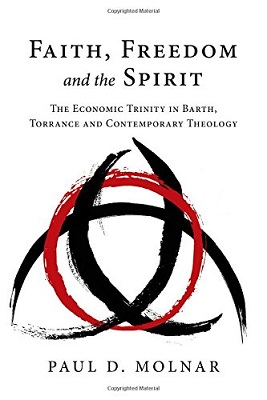 Paul Molnar’s Faith, Freedom and the Spirit
The book is packed with insights into numerous topics, whether readers are interested in learning more about Barth and Torrance (and Rahner) or the relations within the Trinity, Molnar sweeps broadly but takes the time to dissect many topics in helpful ways.
A primary topic is how we relate to God, and through Barth (though alongside other theologians), Molnar argues that God is perfectly free in relation to us and frees us through grace. It is not our work that saves us but rather God entirely and miraculously revealing Himself to us through Christ by the power of the Spirit.
Throughout the entire book, the aforementioned theologians are highlighted, often providing readers with lengthy quotes and expositions of their positions in order to lend more detail and analysis to topics related to the Trinity.
There seems to be a bit bit too much discussion of various other scholars’ dissent from Molnar’s position or misunderstanding it. At times it reads as though there are journal articles put into the book rather than developing as a book itself. Responses to specific authors seem to often be esoteric rather than helpful, though I’m sure in the broader project Molnar is tracing, it makes sense.
Another downside is that it seems that at a few points the “low hanging fruit” is that which is engaged. For example, Molnar’s discussion of eternal subordination was interesting–in particular his insight from Barth and Torrance about how such a position confuses the immanent and economic Trinity–but then he went on to focus on specific views of select scholars which were blatantly subordinationist in the Arian sense rather than on some of the more nuanced approaches of others. Another example is his discussion of natural theology, which did not seem to take into account the various ways in which Barth’s attack on the notion are undermined by other considerations.
Overall, Faith, Freedom and the Spirit
The Good
+Insight into many aspects of the economic and immanent Trinity
+Deeply thought-provoking
+Solid critique of some views of the Trinity which (potentially or actually) stray from orthodoxy
The Bad
-A few too many rabbit trails make it feel like pieced-together journal articles at times
-Fails to distinguish adequately between types of apologetics
-At times feels repetitious
I received a review copy of the book from InterVarsity. I was not required to give any kind of review whatsoever. My thanks to the publisher for the book.
Links
Be sure to check out the page for this site on Facebook and Twitter for discussion of posts, links to other pages of interest, random talk about theology/philosophy/apologetics/movies and more!
Book Reviews– There are plenty more book reviews to read! Read like crazy! (Scroll down for more, and click at bottom for even more!)
Source
Paul D. Molnar, Faith, Freedom and the Spirit (Downers Grove, IL: InterVarsity, 2015).
SDG.
——
The preceding post is the property of J.W. Wartick (apart from quotations, which are the property of their respective owners, and works of art as credited; images are often freely available to the public and J.W. Wartick makes no claims of owning rights to the images unless he makes that explicit) and should not be reproduced in part or in whole without the expressed consent of the author. All content on this site is the property of J.W. Wartick and is made available for individual and personal usage. If you cite from these documents, whether for personal or professional purposes, please give appropriate citation with both the name of the author (J.W. Wartick) and a link to the original URL. If you’d like to repost a post, you may do so, provided you show less than half of the original post on your own site and link to the original post for the rest. You must also appropriately cite the post as noted above. This blog is protected by Creative Commons licensing. By viewing any part of this site, you are agreeing to this usage policy.
Is Natural Theology Excluded for Apologetics? – Sunday Quote!+
Here’s a special edition Sunday Quote which features a more extended discussion. Let me know what you think in the comments.
Is Natural Theology Excluded for Apologetics?
Paul Molnar’s Faith, Freedom and the Spirit
If contemporary theologians were to make explicit the role of the Holy Spirit in enabling our knowledge of the triune God, then there could be wide agreement that natural theology of whatever stripe is not only unhelpful but is directly excluded from any serious understanding of theological epistemology. (82)
Now, “natural theology” is, according to Justo Gonzalez’s Essential Theological Terms, “A theology that claims to be based on the natural gifts of the human mind, and on the ‘general revelation’ granted to all… rather than on a ‘special revelation’ in Scripture or Jesus Christ” (118). Natural theology, that is, is the attempt to show that God exists and certain other truths through looking at the world. From this quote, it seems that Molnar is arguing that if we had a better notion of the role of the Holy Spirit, we would basically think that natural theology is worthless related to knowledge of God.
Molnar develops this notion further throughout the next 50 pages or so. His argument basically is that if we acknowledge that it is the Holy Spirit who enables faith and knowledge of God, then any “knowledge” of God which is not directly through faith (i.e. through something like a cosmological argument) is not objective knowledge of God.
Although some of what Molnar argues resonates with me–particularly the notion that the Holy Spirit is the one who imparts faith rather than it being some kind of choice we make–I think that his dismissal of natural theology is unnecessary and mistaken. First, the most obvious question to be asked is whether the Spirit can use natural theology to create faith. If it is the case that the Holy Spirit can work through natural theology–something which seems to be clearly correct to me–then the objection that natural theology ignores the role of the Spirit is mistaken.
Second, Molnar’s argument seems to rely on a concept of natural theology which is entirely about trying to impart knowledge of God to those who do not have faith. This, however, ignores the use of apologetics in strengthening the faith of believers. Natural theology can be a valuable tool for those who have faith to pursue the call of 1 Peter 3:15 and have a reason for the hope within them. Whatever one’s view of whether natural theology can bring people to the true God, it seems that it can and should be used for believers to explore the natural world and bolster their faith.
Third and finally, it seems to me that Romans 1 in particular demonstrates that natural theology is not a worthless project. If God’s invisible attributes are capable of being discovered in the things God has made, then surely natural theology has some value in tracing God’s handiwork.
Should we think that natural theology is a failed project? Can it have other uses like those I listed? Is it possible to go from God to Christ? What of the role of the Spirit in apologetics?
Faith, Freedom and the Spirit
Links
Be sure to check out the page for this site on Facebook and Twitter for discussion of posts, links to other pages of interest, random talk about theology/philosophy/apologetics/movies and more!
Sunday Quote– If you want to read more Sunday Quotes and join the discussion, check them out! (Scroll down for more)
Source
Paul D. Molnar, Faith, Freedom and the Spirit (Downers Grove, IL: InterVarsity, 2015).
SDG.
——
The preceding post is the property of J.W. Wartick (apart from quotations, which are the property of their respective owners, and works of art as credited; images are often freely available to the public and J.W. Wartick makes no claims of owning rights to the images unless he makes that explicit) and should not be reproduced in part or in whole without the expressed consent of the author. All content on this site is the property of J.W. Wartick and is made available for individual and personal usage. If you cite from these documents, whether for personal or professional purposes, please give appropriate citation with both the name of the author (J.W. Wartick) and a link to the original URL. If you’d like to repost a post, you may do so, provided you show less than half of the original post on your own site and link to the original post for the rest. You must also appropriately cite the post as noted above. This blog is protected by Creative Commons licensing. By viewing any part of this site, you are agreeing to this usage policy.
“Cross Roads” by Wm. Paul Young- An Evangelical’s Perspective
 One of the biggest publishing phenomena of late, The Shack

Free Will
The notion of crossroads is a major theme throughout the work, and Young utilizes the imagery to discuss free will metaphorically. Anthony Spencer (Tony), the main character, finds himself inside his mind, which is portrayed as a kind of land with various roads and places inside it. Initially, he begins exploring this land and finds himself coming to numerous forks in the road. He continues to find these forks and realizes that as he continues to make choices, “it occurred to Tony that the number of direction decisions was diminishing; options were significantly decreasing” (35). Young doesn’t expand on this much, but it seems like a vivid illustration of libertarian free will, wherein one’s choices in the past do indeed influence their choices in the future. As Tony makes choices on his path, he finds that the choices available to him decrease. The reason, it seems, is because his choices have started to form his world. It seems to me that this is a great way to show libertarian free will in literature.
Church
A robust theology of church and salvation is something that I think is necessary for an adequate theology. I find one reason for this illustrated well by Young:
Church, thought Tony. He hadn’t set foot inside one of those since his last foster family had been religious. He and Jake [Tony’s brother] had been required to sit silently for what seemed like hours… He smiled to himself, remembering how he and Jake had schemed together and ‘gone forward’ one night at church, thinking it would win them points with the family, which it did. The attention their conversions garnered was initially rewarding, but it soon became clear that ‘asking Jesus into your heart’ dramatically increased expectations for strict obedience to a host of rules they hadn’t anticipated. He soon became a ‘backslider,’ in a category, he discovered, that was profoundly worse than being pagan in the first place. (124)
It seems clear to me that here the act of conversion has itself become a work, rather than a gift of grace. Tony’s concept of conversion at this point in the book is that of “asking Jesus into your heart.” Unsurprisingly, when he fails to perform other adequate works–obeying a set of rules. The problem with this theology should become clear immediately. By suggesting that Christianity is about “going forward” and publicly affirming a faith, this form of theology puts the believer in the position of affirming faith, rather than receiving it as a gift. When faith becomes a public work, it becomes the Law instead of the Gospel. When demands for works are made on faith, then faith itself becomes a work. Unfortunately, this kind of works-righteousness sneaks into theology at all levels, ever seeking a place to grow.
The problems with this theology are portrayed vividly in this illustration. The notion that people need to make a public declaration of faith leads to its abuse, as Tony and Jake attempted to do, but it also leads to difficulties for those who believe their declaration was itself true (unlike Tony and Jake, who simply did it to glorify themselves in the eyes of their foster parents). When someone makes their “decision for Christ,” their faith life becomes wrapped up in that decision. Their walk with God is contingent upon their continuing to make this decision. Unfortunately, this type of theology makes faith all about one’s own decisions, rather than Christ’s justification and the free gift of faith.
Women
There are many church bodies who do not ordain women to the office of the ministry. That is, they hold beliefs that say women should not be spiritual leaders of men in the church. Young explores this issue when Pastor Skor shows up and challenges Maggie, one of the main characters, regarding her outburst during a church service. Pastor Skor takes Maggie’s outburst and disruptive behavior as a clue to him from God that he has been too lax in his instructing his congregation in the Bible. He makes an argument that women should not be leaders in church and should remain silent:
And we affirm the Word, which declares there is no longer male or female [Galatians 3:28], but… the Word is speaking of how God sees us, not about how we function in the church, and we must always remember that God is a God of order. It is vital that each person play their part, and as long as they stay within the roles that God has mandated, the church functions as it was meant to… (167)
The pastor goes on to quote 1 Corinthians 14:34-35 to support his position. Yet Young, through Clarence, an elder who is with the pastor to talk with Maggie, provides a counter-argument to this reasoning:
It is sarcasm… I believe that the apostle Paul was being sarcastic when he wrote what you read… He is quoting a letter that these folk sent him with questions, and he is in total disagreement with what they have written to him. (168-169)
Clarence defends this position by alluding to 1 Corinthians 14:36, apparently using the KJV: “What? came the word of God out from you? or came it unto you only?” Given the way this verse is worded, Clarence holds that verses 34-35 are a quote from a letter the Corinthians sent to Paul which Paul then responds to sarcastically by wondering whether the Corinthians think that God’s word came only to them.
Young’s offered interpretation seems possible, but perhaps not made explicit enough. It seems to me possible that Paul would have made it more clear that he was quoting another’s writing here. The KJV seems to support the interpretation given to 1 Cor 14:36 here, but other translations phrase it differently, in such a way that the verse seems to be more of a challenge to readers to dismiss what Paul is declaring in 34-35.
Of course, one could still argue that Young’s interpretation has great strength, noting that nowhere in the Bible do we see this command in the Scripture “as the law also says” and so we may infer that Paul is referencing an extra-biblical teaching and rebutting it. In fact, this seems to line up with Young’s argument perfectly because we can see that Paul would be citing a Judaizer’s teaching in the church in Corinth–who would hold that the silence of women is taught by the Law [Jewish extra-biblical law]–and then refuting this by noting that the word of God did not come from them alone (see Katharine Bushnell’s God’s Word to Women
Therefore, it seems to me that Young offers a fairly decent egalitarian interpretation of the passage, though he could have given other arguments which would take into account the passage’s cultural context, in which women were speaking out of turn in worship. The core of the statement seems to me to be that the women in this specific context needed to learn from their husbands at home and remain silent in church so that they did not cause disruption.
The way the scenario plays out in the book is also difficult to evaluate because Maggie definitely was disrupting the church service and would have appeared at least slightly crazy to those around her. She was screaming about a demon speaking to her and was, in fact, mistaken about that. I think she can be forgiven for her extreme reaction given the strange situation in which she found herself, but the Corinthians passage is in context all about order in worship in general, and certainly people bursting in screaming about demons would be disorderly worship.
Thus, it seems to me that Young offers a possible interpretation of 1 Corinthians 14:34-35, but he has made his case problematic by the narrative context in which he placed it. It is worth noting that this work will get people talking about the issue. Young has given a somewhat strong version of a lengthy egalitarian argument in the form of narrative.
Practical Ethics and Disability
Cabby, a boy with Down’s Syndrome, is featured prominently throughout the book. Young uses him as a foil to show that those with disabilities have much to contribute to modern society. Perhaps the most poignant way he does this is through the negative portrayal of Tony’s view of Cabby:
Tony had never known a ‘retarded’ person. He wasn’t sure if that is what you called them… His opinions on most nonbusiness matters may not have been founded on evidence or experience, but he was sure of them. People like Cabby were an unproductive drain on the resources of society; they were valuable only to their families. He believed they were tolerated because of liberal persuasions, not because such people had any intrinsic worth… It is easy to create a category of persons, like retarded or handicapped, and then pass judgment on the group as a whole. He wondered if that was not the heart of all prejudice. (108-109)
In contrast to Tony’s view, Cabby turns out to be insightful and delightful. He is shown to have positive value in a number of ways that go beyond his immediate family. He ultimately shows the practical usefulness of inherent human worth.
God
For Young, understanding God as relationship is central to the concept of deity. The concept of deity that is presented is that of Trinity. Much ink will be spilled, I feel certain, on whether or not Young portrays the persons of the Trinity correctly, just as there was in The Shack (see my own discussion here).
Young’s position seems to be largely unchanged from that in The Shack, and so much of the commentary will follow the same line. I think he does a very good job of exploring the inter-relational character of God and the temporal submission of Christ in the incarnation to God the Father. Some may see the primary difficulty with Young’s portrayal of God is that the Father makes very little appearance in the book, but near the end readers find out that is not the case. In fact, the Father is intricately involved in all aspects of God and the life portrayed in the novel.
Those who conceptualize God as inherently male will have a problem with the book, however. Unfortunately, some paganism has indeed hung on in the church, wherein some view God as a gendered being. In the Bible, however, we find that God is spirit and not a man. Thus, I think that Young’s use of gender with God may shock some but also underscores the fact that God is not a gendered being, and instead transcendent.
Historical Theology
Young offers a short discussion of historical theology and God that seems to me to at least partially miss the mark. It is very brief, but I think it is worth discussing. Young puts the following commentary in the mouth of Jesus himself:
The Greeks, with their love for isolation [of deity] influence Augustine and later Aquinas… and a nonrelational religious Christianity is born. Along come the Reformers, like Luther and Calvin, who do their best to send the Greeks back outside the Holy of Holies, but they are barely in the grave before the Greeks are resuscitated and invited back to teach in their schools of religion. The tenacity of bad ideas is rather remarkable, don’t you think? (73)
There are a number of problems with this small passage. First, Augustine heavily influenced both Calvin and Luther. In fact, Calvin’s theology is tied very intricately to Augustine’s view of free will and original sin. Similarly, Luther’s view of original sin derives directly from Augustine’s exposition in City of God. Second, it seems unfair to view Aquinas as a kind of anti-relationalist when it comes to God’s nature. Aquinas very much emphasized the triunity of God, which was (and is!) an extremely important topic. To thus accuse Aquinas of undermining God’s relational-ness seems unfair. Finally, the notion that the influence of Greek philosophy on Christianity is somehow inherently bad seems a bit shortsighted. There are innumerable positive contributions that reflection on Greek thought has brought into the fold of Christianity. Among these are the very concept of free will that Young pushes in his book, along with a number of aspects of Trinitarian and Incarnational theology that Young seems to support. This may seem to be a nitpick, but it seems to me that if Young is going to use his book to make comments about historical theology, it is vastly important to get that historical development right.
Conclusion
Cross Roads
SDG.
——
The preceding post is the property of J.W. Wartick (apart from citations, which are the property of their respective owners, and works of art as credited) and should not be reproduced in part or in whole without the expressed consent of the author. All content on this site is the property of J.W. Wartick and is made available for individual and personal usage. If you cite from these documents, whether for personal or professional purposes, please give appropriate citation with both the name of the author (J.W. Wartick) and a link to the original URL. If you’d like to repost a post, you may do so, provided you show less than half of the original post on your own site and link to the original post for the rest. You must also appropriately cite the post as noted above. This blog is protected by Creative Commons licensing. By viewing any part of this site, you are agreeing to this usage policy.
Saint Nicholas- A Christian life lived, a story told
It has been remarked, with much truth, that all of us lead double lives, a life of our fancy, in a world of things as they should be, or as we should like them to be, and a life in a world of things as they really are. And this is as it should be. We can lift the level of real existence by thinking of things as we should like them to be. It is well not to walk with one’s eyes always fixed on the ground. (McKnight, cited below, Kindle location 401)
It is easy to hear the “real story” of Santa Claus, but few investigate further than looking it up to see the parallels between the Bishop of Myra’s life and that of the story of Santa Claus. There is so much more to his story–and indeed to stories in general–than that.
Saint Nicholas (270-343 AD) was a valiant man who fought prostitution, abortion, and poverty. He attended the council at Nicaea, from which we received the Nicene Creed. At that council, he defended vigorously the orthodox doctrine of the Trinity. He was an exemplar of Christian teaching put into practice. Not only that, but the legend which has grown up around his life has inspired and enthralled untold numbers of people through the Christian era.
It is important to note the intertwining of legend and truth in the stories about St. Nicholas, and the impact that has had upon innumerable people. George McKnight, writing in the early 1900s, explored a number of issues related to the mingling of fact and fiction in the life of St. Nicholas. The quote highlighted above touches on many of these topics.
First, there is power in narrative. A story which is told well is one which can effect change. We are impacted by fantasy in ways which cause us to reflect upon reality with new–perhaps better trained–eyes. Second, we, as spirited people in a world which we so often see only as the physical, are called to heights of reality by fiction. As McKnight noted, “It is well not to walk with one’s eyes always fixed on the ground.” Our eyes are driven upwards and outwards by the stories we hear–they cause us to interact with others in new ways, and they also cause us to think about topics which perhaps we had not even considered before.
The story of St. Nicholas is no different. Yes, legend has crept into the accounts of this godly man, but what is the purpose of that legend? Not only that, but is it possible to separate out the fiction?, McKnight also commented upon the nature of radical skeptical history being done in his time (about 100 years ago). He bemoaned the fact that nearly every facet of Nicholas’ life is thrown into question with the arrival of critical scholarship. But of course to focus merely upon what is historical fact or fiction is to miss the entire point of the life of St. Nicholas. McKnight goes on:
The story of St. Nicholas consists almost entirely of a series of beneficent deeds, of aid afforded to humanity in distress, accomplished either by St. Nicholas… or through his intervention… The conception of St. Nicholas, then, is almost that of beneficence incarnate. (Kindle Location 469-481).
That is, the story of St. Nicholas, and the legends that surround him, turn him into a type of Christ–one who is deeply concerned for humanity and showing Christian love for God and neighbor.
Yet this is not all there is to the life of the Saint. Although difficult to sift from the legends, there is a historical core to the life of St. Nicholas which is just as profoundly Christian as the legends which have grown up around him. With that said, we turn to the story of St. Nicholas, with an eye toward how his life is one of a Christian lived as well as a story told.
Nicholas is well-attested to have attended the council of Nicaea. There is a possibly apocryphal story about his 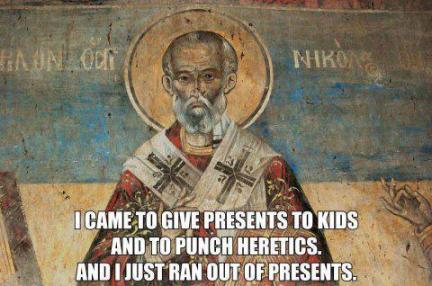 attendance there wherein he confronted the heretic Arias himself and slapped him in the face. The story continues, telling of how Nicholas was initially exiled for his act but later allowed to return after Arianism had been thoroughly acknowledged as heresy. Although it is nearly impossible to know whether this story is historically accurate, there is at least some truth behind the story in that Nicholas was known to vehemently defend the orthodox doctrine of the Trinity.
Nicholas actively opposed prostitution. However, instead of simply condemning the practice, he also gave money to young women in need to keep them from turning to prostitution to feed themselves. Again, this truth served as the basis for a possibly historic legend in which Nicholas learned of three women who were about to turn to prostitution (or be sold into slavery, depending on the account) because they couldn’t pay their dowries in order to be wed. Nicholas is said to have thrown a bag of gold for each young woman through their window so that they could be married instead of sell their bodies. Again, this legend may not be true–but it points to the truth about Nicholas’ life–he gave to those in need and fought against the evils of prostitution. It also points beyond itself towards an ideal.
Nicholas fought against the Pagan practices, which led to his persecution and imprisonment by those angered by his preaching against false idols. Furthermore, his opposition to paganism included working against a number of practices in the pagan world, including abortion. Roman Catholics have continued to spearhead St. Nicholas’ commitment to helping children. A search for “Nicholas of Myra” turns up adoption agencies one after another. Christians have used Nicholas’ example as a call to end human trafficking and slavery. One can see throughout these historical kernels how myth and legend could grow up around this figure–fighting heresy, giving to those in need, and having utmost concern for the innocent were all aspects of St. Nicholas’ life. We don’t necessarily know the extent of his actions in these areas, but we know enough to be inspired.
Therefore, we turn to another part of McKnight’s thought-provoking quote at the beginning of this post:
…all of us lead double lives, a life of our fancy, in a world of things as they should be, or as we should like them to be, and a life in a world of things as they really are. And this is as it should be. We can lift the level of real existence by thinking of things as we should like them to be.
Take a moment to consider what McKnight is saying here: we know there is a realm of absolutes–a way that things should be. We also have a way that we should like things to be. But the way the world “really is” does not often reflect that. Yet we can enact change upon our realm of existence–we can “lift it up”–by focusing on the way that things should be, and living our lives differently because of that. St. Nicholas enacted this in his life, working towards the ideal while living in an imperfect world. The legends of St. Nicholas inspire us to do the same. We are not to focus so much on the critical challenge–which stories are true and which are “only” legends. Instead, we are to focus on St. Nicholas as a story–one which inspires us to change the world around us.
Nicholas’ life was one which fought against poverty, paganism, heresy, prostitution, and idolatry. He incorporated sound doctrine into his life and then lived it. There can hardly be a better example of a Christian life lived than that of St. Nicholas. Yet that is not all there is to the story of the “real” saint. No, his life is one of calling us to live a life for Christ as well. His life is action. It is a life incarnate with truth and the beneficence that comes from the Christian worldview. It is a call to follow Christ.
Sources
James Parker III, “My Kind of Santa Claus.”
Robert Ellsberg, “St. Nicholas, Bishop of Myra.”
George Harley McKnight, St. Nicholas (New York: G.P. Putnam’s sons, 1917). This book is available legally free of charge in a number of digital formats through Open Library.
SDG.
——
The preceding post is the property of J.W. Wartick (apart from citations, which are the property of their respective owners, and works of art as credited) and should not be reproduced in part or in whole without the expressed consent of the author. All content on this site is the property of J.W. Wartick and is made available for individual and personal usage. If you cite from these documents, whether for personal or professional purposes, please give appropriate citation with both the name of the author (J.W. Wartick) and a link to the original URL. If you’d like to repost a post, you may do so, provided you show less than half of the original post on your own site and link to the original post for the rest. You must also appropriately cite the post as noted above. This blog is protected by Creative Commons licensing. By viewing any part of this site, you are agreeing to this usage policy.
Book Review: “Good News for Women” by Rebecca Groothuis
 The debate over women’s roles in the home and in the church rages on. A large part of the debate has focused upon the Bible verses that either side raises in defense of their view. Little of the debate has focused on the philosophical implications of either position. Rebecca Groothuis’ Good News for Women
Groothuis first turns to a Biblical case for the equality of men and women. She bases this notion on several Biblical texts. She refers to God’s creation of both male and female in the image/likeness of God (21ff). Her argument also goes into Galatians 3:26-28 and notes how it again draws out the equality between male and female. Regarding the discussions of women’s silence in the churches, Groothuis parallels these passages to those about slaves submitting to their masters:
[T]he strategy of the New Testament church was to tolerate the social subordination of slaves and women so as not to risk alienating non-Christians from the gospel, and yet to modulate and moderate these customs, and ultimately to point beyond them to God’s original intention for human relations. Today, however, when non-Christians are not likely to be offended by an equalitarian gospel, but are likely to find a hierarchical gospel offensive, we have no reason to perpetuate the cultural practices that were intially intended for Christians living in patriarchal societies (25).
Groothuis concludes that throughout the Bible, there is a pattern in which male and female are equal in being. They are, in other words, ontologically equal. Neither is more valuable than the other.
It should be noted that most complementarians today are willing to grant this case. They agree that women and men are indeed created equal and should have equal rights. Groothuis then turns to a series of philosophical arguments which seek to demonstrate that the complementarian position cannot consistently hold that women are equal to men while holding that they are excluded from the ministry. Her argument, therefore, goes deeper than an exegetical challenge. Instead, her argument undermines the theological core groundings of complementarianism.
The very core of Groothuis’ argument is that complementarianism is grounded upon an ontological difference between male and female. The reason she holds that complementarinism must hold this position is “[b]ecause a woman’s traditionally inferior status follows necessarily from the single fact of her essential, female nature, her status is itself a function of her ‘being’ [ontology]; it is determined by what she is, not by what she can do” (53). Complementarians hold that women cannot hold certain offices of the church due only to the fact of her femininity. It is not based upon a functional subordination in which the female chooses to take up a role that is subordinate (62ff); instead, it must be grounded upon the female’s nature as a female. There is nothing about the female which limits her from being a pastor, on most contemporary complementarian positions (that is, those which no longer hold that women are excluded from the ministry simply because she is not as smart or gifted as men in general). Instead, it is exclusively her feminine nature which determines her role as subordinate. Therefore, it is part of her essential nature. I have argued this point myself elsewhere: “Women in the Ministry: The philosophy of equality and why complementarianism fails.”
Grothuis continues with extensive argument to rebut the notion of servant leadership (78ff). She also deals with various analogies complementarians use to attempt to ground equality and hierarchy, such as the Trinity (55ff–it should be noted that grounding subordination in the Trinity undermines the doctrine of the Godhead). It should become immediately apparent as to how this leads to a problem for complementarians. Biblically, they are forced to concede that women and men are, in fact, equal. However, their position undermines this Biblical position of the equality of men and women. Therefore, it seems their position fails.
Groothuis then turns to a number of strategies that complementarians have used in order to try to tie the subordination of women in to patterns of the Godhead. Unfortunately, many of these strategies end up making God into a gendered creature rather than a transcendent Creator. Some complementarians, such as C.S. Lewis, actually go so far as to make God male (93). Groothuis points out that this gendering of God cannot be affirmed based upon the Bible. One difficulty is that both male and female language is used of God (93-94). Yet she insists that the debate must not become a simple adding up of verses on either side to see how God illustrates either gender. That would turn God into a “God who suffers from some gender identity confusion” (93). Instead:
The view that God is both masculine and feminine confuses and distorts the image of God in humanity. It requires that the divine image be divided between women and men, such that women image God’s feminine aspects and men image God’s masculine aspects. This sexualizing of spiritual attributes renders men and women spiritual ‘opposites,’ creating a need to compartmentalize aspects of spiritual life and ministry into separate masculine and feminine quarters. (98)
Groothuis also spends some time dealing with some of the odd–and frankly, pagan–ideas used by some complementarians. For example, some argue that God must act as a male in the creation event: one who gives so much, while the created world merely receives. To be blunt, they describe God’s creative act as a sexual act, with no Biblical support. Groothuis rightly points out that this idea is little more than paganism dressed up in theism, but goes on to note that “It seems a good deal of imagination and determination is required in order to characterize the strenuous effort required of a woman’s body in nourishing, growing, and delivering a child as ‘overwhelmingly passive,’ while depicting the male role of standing around watching it happen as ‘active’!” (95). Another abuse of gender in the Godhead involves some complementarians arguing that because Jesus was a man, only men can be priests (109ff). Groothuis points out that “If we are to regard maleness as essential to who Christ is as Christ, not only must we question whether Jesus Christ can represent women as fully as he can men… we must also view women as essentially inferior to men. Women lack the Christlike attribute of maleness that renders men best qualified to represent Christ…” (113). Interestingly, then, complementarians who utilize this argument essentially undermine the doctrine of the atonement: for Christ’s maleness is emphasized to the point that Jesus is not an adequate representation of humanity. He is essentially male.
The second half of Good News for Women focuses upon an evaluation of the texts used to support complementarianism. These texts are examined in light of the theological points already established. Namely, women and men are created equally as imagers/likenesses of God; and that any attempt to ground hierarchy ultimate fails because it undermines this Biblical concept of equality. A full presentation of Groothuis’ analysis of these texts would probably triple the length of this review, and I don’t see any way to sum up these arguments adequately in a few sentences, so I unfortunately must leave it to those interested to read the book to see these analyses.
Finally, it would be remiss to go without mentioning the outstanding contribution Groothuis gives to the discussion of egalitarian marriage. Groothuis discusses marriage in detail for over 40 pages of the book. What is astonishing is how lucidly she lays out the principles of egalitarian marriage. She illustrates the nature of marriage and how it is a give-and-take with both persons involved as opposed to one ruling over the other. She also discusses in detail how such an egalitarian system can work without having anyone to have a vote to “trump” the other’s vote. Frankly, the book is worth reading just for her discussion on marriage.
Groothuis’ most important contribution here is in the first part of her book, which establishes a strong theological and philosophical case for the equality of men and women in teaching roles in the Church and equal roles in marriage. However, there are numerous important insights throughout the text, both into specific verses and into overarching themes in the debate from both the complementarian and egalitarian positions. Groothuis’ discussion of egalitarian marriage provides a way forward for discussion on the roles of men and women in marriage and also helps to give insight into the Biblical view of marriage. Overall Good News for Women
Links
See my other writings on egalitarianism on my theology page (scroll to the bottom).
I argue that certain complementarian arguments undermine the Trinity.
I review a book which focuses entirely upon exegetical issues related to egalitarianism: Man and Woman: One in Christ.
Source
Rebecca Groothuis, Good News for Women
SDG.
——
The preceding post is the property of J.W. Wartick (apart from citations, which are the property of their respective owners, and works of art as credited) and should not be reproduced in part or in whole without the expressed consent of the author. All content on this site is the property of J.W. Wartick and is made available for individual and personal usage. If you cite from these documents, whether for personal or professional purposes, please give appropriate citation with both the name of the author (J.W. Wartick) and a link to the original URL. If you’d like to repost a post, you may do so, provided you show less than half of the original post on your own site and link to the original post for the rest. You must also appropriately cite the post as noted above. This blog is protected by Creative Commons licensing. By viewing any part of this site, you are agreeing to this usage policy.
Really Recommended Posts 7/28/2012
 I’m excited by the great diversity of topics Christian bloggers have taken up all over the web. It’s hard to keep up. Here is my attempt to try. Check out these excellent selections.
Subordinating the Trinity for Gender Purposes– A brief post discussing the unfortunate fact that some theologians have been distorting the Trinity simply to push their own agenda regarding gender. I have discussed this at length in my own post, “Women, Complementarianism, and the Trinity.”
H.P. Lovecraft and the horror of Naturalistic Materialism– A very thought-provoking post about Lovecraft’s view of a Godless universe as a thing of horror. I highly recommend this read.
In Praise of Personal Retreats– there is something to be said for taking a break and delving into the Word. Check out this post, and think about a retreat of your own.
Spider-Man Spins a Design Argument– An interesting post about intelligent design and Spider-Man.
Which is Hate Speech? – Is it hate speech if you disagree with someone? Dan Savage, ironically an anti-bullying advocate, recently used a number of curse words and slurs to describe a group of Christian students. Meanwhile, Douglas Wilson is called out for hate speech due to talking about a controversial topic. Check out this insightful discussion.
Women, Complementarianism, and the Trinity- How getting subordination wrong has undermined the Trinity
[Please see note at end of this post for some qualifications added 2/1/15.]
Even though [God the Son] is in all ways equal to the Father and in no way inferior to the Father, he is nevertheless utterly subordinate to the Father… Christ’s relation as Son to his Father is therefore characterized by his subordination to the headship of the Father. (John Kleinig, 222-223 cited below)
In opposition to the above:
The subordination of Jesus Christ is this: it is his freely chosen submission ‘for us and for our salvation.’ The person of the Son is truly subordinate only for ‘economic’ reasons, and only insofar as these reasons entail being subordinate (and even thus far only contingently)–even while his full divinity, equality, and communion with the Father and Holy Spirit continues unabated, world without end. (Thomas McCall and Keith Yandell, 358, cited below)
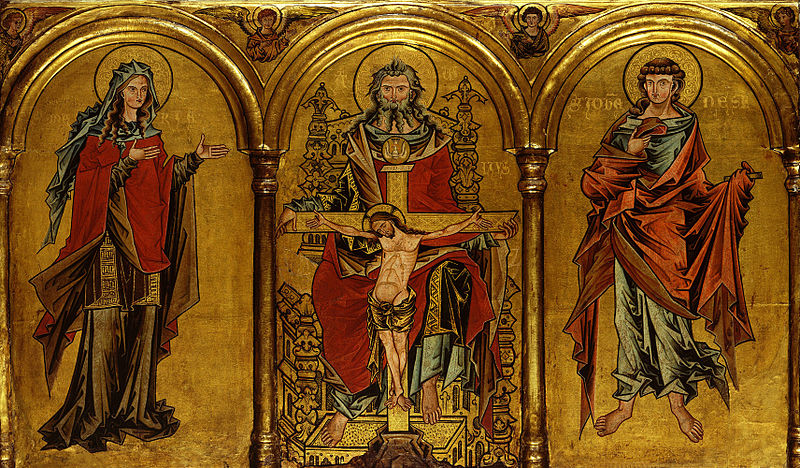
The doctrine of the Trinity is a subject of enormous theological debate. One of the major debates of our time is social trinitarianism as opposed to substance views of the Trinity or other classical positions. However, another important area to explore is the nature of Christ’s submission to the Father. Paul writes in 1 Corinthians 15:28 “When he [God the Father] has done this [put all things under Christ’s feet], then the Son himself will be made subject to him who put everything under him, so that God may be all in all.” Some have argued that this means that Jesus Christ is eternally into the future, and even from eternity past, subordinate to God the Father (see Wayne Grudem and Bruce Ware for two examples of scholars who hold to this view–in fairness to John Kleinig, cited above, I do not include him as one of those who assert these positions because his view of the Trinity was not fully developed in the material from him to which I have access). We shall refer to this position as “necessary role subordination,” following McCall and Yandell.
What does such a position entail about the Trinity? First, if the functional subordination of the Son (and, very often, the Spirit is also said to be subordinate) is indeed necessary, then “it is necessarily true that the Father is authoritative over the Son, and the Son subordinate to the Father” (McCall and Yandell, 354). Why? Because the modal implications of this necessary subordination entails that the Father has, as an essential property, “being authoritative over the Son” (Ibid). Now, this in turn entails that the Father has an essential property the Son (and perhaps the Spirit) do not have. Then, by simple evaluation of the law of identity, the Father has different being than the Son and Spirit. Indeed, the Son would then be “heteroousios rather than homoousios.”
The error can be understood by viewing the Trinity within the substance based metaphysics from which the doctrine has been classically analyzed. As William Alston notes in his study of substance metaphysics and the Trinity, the formulation of the Trinity has been placed squarely within a substance metaphysics, and this provides a grounds for viewing the Trinity as three persons in one being (Alston, 183ff, cited below). Tying this into the laws of identity, one finds that in order for the Trinity of persons to be one being, none of them can lack essential properties of the others. But, as noted, once one asserts that the Son (and/or the Spirit) are necessarily subordinate to the Father, one has separated their essential properties and therefore confounded the Triune nature of God.
The Biblical arguments for such a position are fairly weak. For example, Ware and Grudem (and Kleinig, who does make this argument) argue that 1 Cor. 15:25ff entails the eternal subordination of the Son. But these verses explicitly state that “God may be in all in all.” It does not state “God the Father alone may be all in all” (I owe this point to McCall and Yandell, 342-344).
It may be that these theologians are not drawing this necessary role subordination from Scripture so much as allowing their other theological dispositions to color their trinitarianism. Grudem, Ware, and Kleinig are all explicit complementarians–that is, they restrict women from the ministry. Now please understand I absolutely do not think that complementarianism entails this position on the Trinity. However, I am asserting that complementarianism can color one’s perception of the doctrine of God.
Why think that the correlation between those who hold to necessary role subordination and complementarianism is interesting? First, because necessary role subordination, if true, would give some philosophical bolster to complementarianism; second, because at least one complementarian makes the connection himself.
Regarding the first point, complementarianism has been struggling with a major philosophical challenge presented by Rebecca Groothuis (among others). Namely, the problem of how to ground the subordination of women. Groothuis argues, essentially, as follows: If the permanent, comprehensive, and ontologically grounded subordination of women is justified, then women are inferior persons; Women are not inferior persons; Therefore, women’s subordination is not justified (Groothuis, cited below, 317). Now I’ve defended this argument elsewhere, and I think that some complementarians actually agree with the general argument. Instead of rejecting complementarianism, however, they choose to model their doctrine of the Trinity in order to try to preserve their position. How? By grounding subordination analogously in the submission of God the Son to God the Father. Here, Kleinig is an explicit example of this position. Following the quote at the beginning of this post, he writes, “Those who serve in [the pastoral ministry] pass on what they have received from God the Father through Christ… The exercise of the public ministry depends on this pattern of subordination within the church…” (Kleinig, 223). Now, the subordination of Christ, it is claimed, “has nothing to do with the dominance and power of the Father. It involves and expresses the harmony of the Son with the Father and his love for the Father” (Ibid). Thus, according to Kleinig, the model for women and men in the church is grounded in the Trinity, and because, according to him, the Son is subordinate to the Father yet remains equal, so too should women be subordinate to men and yet remain equal.
Does this complementarian view entail necessary role subordination? It seems so. For what is woman’s role subordinate upon? It seems it must be because of her being (for an argument to that end, see my post linked above and here). Yet her being is, of course, her essential nature. It is necessarily the case, therefore, that she is subordinate.
Finally, it is interesting to note that even were the egalitarian to grant to Ware, Grudem, and Kleinig their points about the Son’s subordination to the Father, it would not follow that the Trinity is an adequate model for women in the church. Why not? Kleinig essentially says it himself, “Now this call to subordination in the divinely instituted order of the church is based on the willing subordination of the Son to the Father” (Kleinig 223, emphasis mine). Well that’s exactly the point egalitarians make! Egalitarians argue that the roles of subordination in the church are taken willingly by those who serve at various levels. The laity has not been called to the ministry, and therefore willingly cede the authority of the office of the ministry to their ministers. It is a bit stunning to see Kleinig make this remark, for it also undermines his own case. Women, unlike Christ, are not [all] willingly subordinate. Rather, some very much would like to be ordained. Thus, if Christ’s subordination is grounded in his “willing subordination” then it seems that Kleinig’s case has completely evaporated. So too, of course, has the case of other complementarians who make this argument.
Do I think that those who make these arguments are heterodox? I wanted to explicate that I think that Ware, Kleinig, and Grudem are more likely victims of misuse of philosophical theology and their own presuppositions than they are actually trying to claim that the Trinity is not of one being. Certainly, I think, were they to examine their position on the subject, they would distance themselves from such a claim. Instead, as I’ve pressed, I think they’ve allowed their presuppositions–that women cannot be pastors and that they must ground this in the Trinity–to cause philosophical confusion on the topic. Kleinig, for example, almost so much as admits this point when he favorably cites Willliam Oddie, making the claim “that the ordination of women would involve a radical changing in the teaching of the church about the fatherhood of God” (224). It seems that it is not so much egalitarians who are guilty of misconstruing the Trinity, but rather over-eager complementarians who are shaping the Trinity to match their own preconceived notions of subordination and roles. Perhaps it should serve as a warning to take more care when doing philosophical theology and systematics. In any case, I sincerely hope these Christian brothers do not reject the doctrine of the Trinity as one being.
The theological implications of this discussion can now be brought to light. Some complementarians, in their eagerness to support their philosophically vacuous position, have read eternal subordination into the doctrine of the Trinity. I agree that complementarians are correct to worry about the implications of women’s ordination for the doctrine of the Trinity, but I disagree with their conclusions. In their zeal to exclude women from the ministry, they have undermined the doctrine of God. By confusing the willing, economic, salvific role of Christ submitting to the Father in a contingent manner with the eternal, ontological “subordination” of women, complementarians have mounted an attack on the Godhead. Indeed, as has been shown above, their position entails the that the Trinity is not “of one being.” Thus, it is a position that must be rejected. Again, I do not think that all or even most complementarians hold this position in relation to the Trinity, but those who do must consider the theological implications of their position: it entails that God the Son lacks at least one essential property of God the Father and therefore is of a different being; it fails to adequately account for the Scripture related to the Trinity; and finally, it doesn’t even make their case because the subordination is grounded in Christ’s willingness to do so.
In light of these major problems, it seems complementarianism, when tied to necessary role subordination, must be rejected. Should it be rejected outright, even with such ties severed? I certainly think so. Complementarianism is philosophically tenuous and can’t account for all the Scriptural evidence (see Philip Payne’s book, reviewed here). It is time to stop allowing preconceptions to shape all doctrine. Rather than reforming God in the image of complementarianism, we should allow God to shape our image of humanity. God is coequal, with no essential properties split among His being. Similarly, human kind is equal, sharing the image of God. Man and woman: one in Christ.
[It has come to my attention that there is a newer edition of Kleinig’s essay which was published in the 2009 version of the book from which I quoted. A message sent to me on the topic informed me that Kleinig’s essay is substantially different–to the extent that the first four quotes I present from him are not present in the newer edition, which is also a page shorter. I am pleased to note that perhaps this means Kleinig has dropped his original view, which seemed to entail necessary role subordination. Regardless, my points would still stand for any who do hold such a position.]
[NOTE: I complementarians do not necessarily have to hold to eternal subordination; nor do those who argue for eternal subordination have to be complementarian. One can be an egalitarian with gender roles but argue for the Son’s subordination and vice versa.]
Sources
William Alston, “Substance and the Trinity” in The Trinity ed. Stephen Davis et al. (New York, NY: 1999), 179-201.
Rebecca Groothuis, “‘Equal in Being, Unequal in Role’: Exploring the Logic of Woman’s Subordination” in Discovering Biblical Equalityed. Ronald Pierce and Rebecca Groothuis, 301-333 (Downers Grove, IL: InterVarsity Academic, 2005).
John Kleinig, “The Ordination of Women and the Doctrine of the Holy Trinity” in Women Pastors? The Ordination of Women in Biblical Lutheran Perspective (St. Louis, MO: Concordia, 2008), p. 217-225.
Thomas McCall and Keith Yandell, “On Trinitarian Subordinationism”Philosophia Christi 11-2, 2009, p. 339-358.
SDG.
——
The preceding post is the property of J.W. Wartick (apart from citations, which are the property of their respective owners) and should not be reproduced in part or in whole without the expressed consent of the author. All content on this site is the property of J.W. Wartick and is made available for individual and personal usage. If you cite from these documents, whether for personal or professional purposes, please give appropriate citation with both the name of the author (J.W. Wartick) and a link to the original URL. If you’d like to repost a post, you may do so, provided you show less than half of the original post on your own site and link to the original post for the rest. You must also appropriately cite the post as noted above. This blog is protected by Creative Commons licensing. By viewing any part of this site, you are agreeing to this usage policy.

 J.W. Wartick - Reconstructing Faith