Young Earth Creationism
Ken Ham, honesty, and AiG’s Reformation- A lesson in careful reading and hermeneutics
I recently responded (Ken Ham on “Compromise” and Stand to Reason) to a blog post–really a rant–by Ken Ham, young earth creationist. Well, Ken Ham apparently took issue with my own posts (and others’–see links at the end), and has offered another response. All block quotes are from Ken Ham’s post “To Help Bring Reformation” and all credit goes to him for the writing of said quotes. For a shorter response to Ham’s latest post, check out Unrecognized Agreement and Unity.
First, it is worth noting that Ham doesn’t cite any specific sources for the views he attacks, so it may be difficult to draw out all the points. To be fair, it seems that at least a few of his points respond directly to my own blog post. I will try my best to draw out Ham’s points while offering another critique.
In my initial post on the topic, I pondered the notion that AiG is seeking to start a reformation. I mean, Ken specifically stated such in his blog. To whit:
Thus, as part of the mission of AiG, we believe we have been called to challenge the church to return to taking God at His Word from the very first verse—we liken this to helping bring in a new Reformation. -Ken Ham
Leaving aside the hidden assumption that any view which is not exactly the same as AiG’s position is, by implication, not “taking God at His Word”… I wondered what exactly it was that Ken Ham and AiG is seeking to do with a reformation–is it a reformation simply pressing YEC or is it a comprehensive, whole-church reformation. Ham responded:
A few Christians reacted to my comments with blogs falsely accusing me (and AiG) of equating such “Reformation” as getting people to believe in young-earth creationism. That is not our motive—and never has been (despite the numerous times we have been accused of such). Really, believing in a young earth is a consequence of believing God at His Word in Genesis. In other words, our efforts are not directly to get people to believe in a young earth, but to get God’s people to take God at His Word in Genesis. -Ham
That’s fair. Ken Ham–and many other young earth creationists–tend to argue that if one takes the Bible at “its Word,” then one will end up as a YEC as well. But how is it that Ham and others assert their position is the position at which one will arrive if one takes the Bible as true? Well, clearly, it is through a specific hermeneutic. In fact, Ham cites it himself as part of the AiG mission statement:
We relate the relevance of a literal Genesis to the church and the world today with creativity. -AiG Mission statement as cited by Ken Ham
Right! Well then it is part of the mission of the group to endorse, legitimize, and put forward as the truth the hermeneutic of reading a “literal Genesis”–by which it is meant a Young Earth view. But of course others read a “literal Genesis” and have no problems with old earth positions and indeed see absolutely nothing in the account as contradicting an old earth position. So, it seems that if YEC is supposedly a consequences of the position AiG holds, then YEC is absolutely part of the “reformation of the church” that AiG is trying to bring about. It is a consequence of their hermeneutic.
But then there is the question of whether or not their are readings of Genesis which allow for or even call for an old earth position. Other inerrantists like C. John Collins or G.K. Beale argue that the passages do not necessitate a young earth position. Thus, it seems like, without argument, we once more have a YEC dismissing other positions as against “believing God at His Word.” This is the kind of subtle ad hominem attack that people who can sense logical fallacies will react against. Notice the dichotomy that is set up: if you “believe God at His Word” you will hold the same position as AiG; but if you don’t hold the young earth position, you therefore do not believe God at His Word. One can’t make a worse accusation against other evangelicals than this.
But hey, why stick with subtlety?
These bloggers and others who falsely accuse us of being focused on young earth creationism are themselves undermining the authority of the Word of God, for which they will be held accountable before the God of creation. -Ken ham
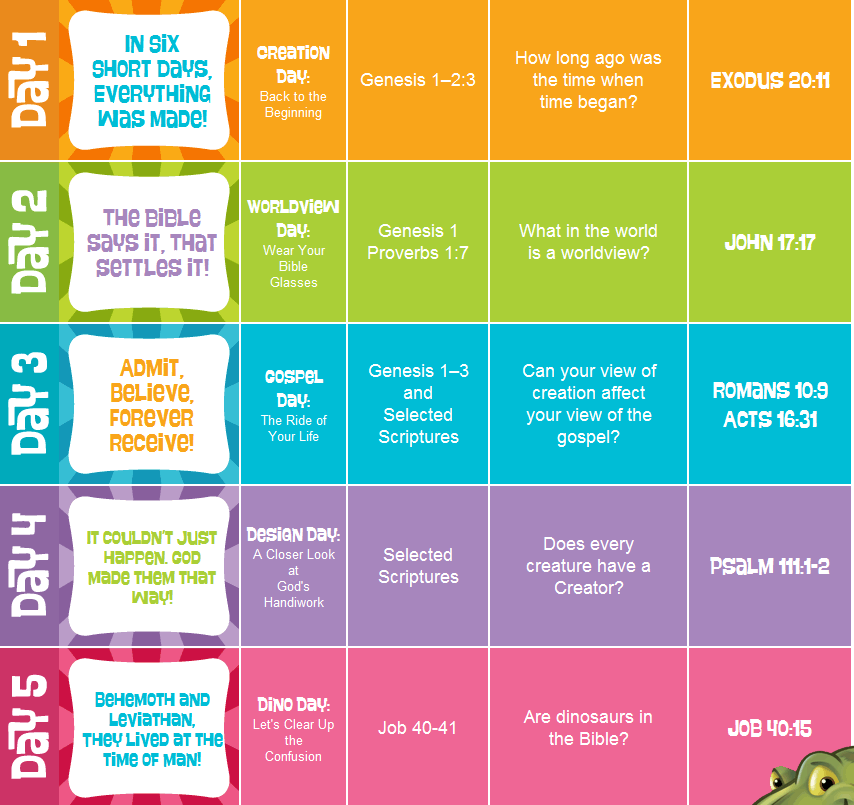 Yes, that’s right. Apparently I (and others) falsely accuse a group named “Answers in Genesis” which actively promotes young earth creationism through books (including children’s books), a magazine, a research journal, and even a VBS program [image on right all credit to answersvbs] (notice that the entire curriculum is focused on Young Earth Creationism: day 1 is in six short days, everything was made; day 2 is the bible says it, that settles it [and note that in Ham’s other post he argued we should teach our children how to think, not what to think–or at least in addition to ‘what to think’]; day 3’s main question is “Can your view of creation affect your view of the gospel?”; day 4 is on intelligent design [admittedly this doesn’t specifically mean young earth]; day 5 is going to teach children there are dinosaurs in the Bible) of focusing on a young earth.
Seriously, you did read that right. I and others are accused of falsely stating that Answers in Genesis is focused on young earth creationism.
Look, I’m not saying it’s a bad thing to have your ministry focused on a specific area. In fact, I think that Christians who are strong in science, the arts, philosophy, and other areas of knowledge need to step up and do what they’re best at for the glory of the Lord, whether that means making new discoveries in a lab or going and working at a retail job. Do it well! The problem is that Ken Ham is saying we’re falsely accusing Answers in Genesis of being focused on young earth creationism. Sorry, but they are.
Moving on:
Thus it is obvious that millions of years is incompatible with God’s Word. And one does not get millions of years from the Bible—it comes from fallible man’s interpretation of the past.- Ken Ham
Honestly, this has to be the favorite line YECs use: “man’s fallible __________” or some variant. Again, all it does is subtly poison the well. Isn’t it equally possible that man’s fallible interpretation could lead to a young earth view? Let me answer the question: YES. People are fallible, and they make hermeneutical mistakes, science mistakes, and other mistakes. Thus, one could equally say: “It is obvious that the young earth position is not necessitated by the text. To say that it is necessitated is to use man’s fallible interpretations of Scripture.”
Suddenly YEC looks like it is the evil “compromiser.” But I’m not going to take that route. Rather, I want to consider arguments, not attacks on character; I want to consider the text, and not bring eisegesis into it by assuming my position is the only possible interpretation.
Moving on:
I would also be prepared to say that those church leaders who condone “gay” marriage will have compromised Genesis! – Ken Ham
Another classic YEC scare tactics. I pointed it out in my last post responding to Ken Ham. Basically, you take the position you want to refute and then associate it with anything people who already agree with you will think is bad. For example, you could say “Hugh Ross believes in an old earth, just like evolutionists.” Suddenly, the people who read things like AiG’s website know that Hugh Ross is evil.
Here’s the problem: Hugh Ross isn’t evil. The statement is no argument. It’s guilt by association. It’s poisoning the well, and it’s unChristian.
Hey look, he does it again:
Those in the church who compromise Genesis with millions of years and evolutionary ideas are really saying that man’s word is infallible, and God’s Word is fallible! It is the other way round!- Ken Ham
Scare words abundant throughout. No argument, just assertions.
So no, the “Reformation” we are calling the church to is not (as some critics have been recently claiming) to get people to believe in a young earth— it’s having them accept the full reliability of the Bible. Believing in a young earth is a consequence of accepting God at His Word in Genesis.- Ken Ham
Honestly, this is the best piece of the entire blog post. It sums up Ham’s position well. Basically, he goes in with the assumption that the young earth is the only possible reading of Genesis. Thus, if anyone does not hold to a young earth position, they do not “accept God at His Word.” Now, what he’s saying is that it’s not that the reformation is young earth creationism; rather, the reformation is to re-evangelicalize the church: sola Scriptura! Amen!
Here’s the problem: a young earth is not the only possible reading of Genesis, and by putting it forth as such, and explicitly stating that it must be a consequences of “accepting God at His Word,” Ham and others who make similar claims have therefore put their views as God’s views. Their view is, in fact, a consequences of an ultra-literal hermeneutic which they espouse. The text itself does not warrant it. The fact that there is almost limitless reading from authors who argue that the Genesis account is Ancient Cosmology; or that it lines up with one week as part of creation; etc.; alone speaks to the fact that AiG’s position is not necessarily a consequences of the text, but of their hermeneutic: it’s a consequences of their method, not the source.
Bottom Line: Let’s focus on the issues involved in Genesis and the world that God has revealed to us, which is a reliable guide to truth (Psalm 19). The only reason I spend time responding to Ken Ham and others like this is because I do not want such statements to go unchallenged. When a Christian goes around accusing other Christians of being “compromisers” or other scare-words simply because they differ in their interpretation of a passage of Scripture, that Christian needs to carefully rethink the issues and realize “In essentials, unity, in non-essentials, liberty.” Stop throwing out the accusations. Focus on the issues.
Frankly, I pray this will happen, but I doubt that it will. As long as one holds one’s own methodology and hermeneutic is the only way to do it, there can’t really be thoughtful dialog. I hope I’m wrong, and I hope that maybe Ken Ham and AiG will be willing to work with others who have different views but still hold to inerrancy of Scripture in order to bring about a whole-church reformation towards inerrancy. But that would require AiG dropping the position that only they are right.
Links to Other Responses to Ken Ham’s “Compromise” Posting
Ken Ham on ‘Compromise’ and Stand to Reason– my response to Ham’s initial post.
Compromising the Kingdom– Faithful Thinkers offers a really in-depth critique of Ham’s use of emotional and ad hominem attacks.
A Brief Word on Ken Ham, Stand to Reason, and the OEC/YEC Debate– two really good points raised in this post. How do our attitudes drive people away?
SDG.
Ken Ham on “Compromise” and Stand to Reason
Ken Ham recently released a rant about compromise in the church. Rather than evaluating any single point, I’m just going to go through a short, point-by-point response. Quotes from the article are in block quotes.
…a big part of our mission is to bring reformation to the church, so of course we expect opposition to our efforts. Sadly, the worst opposition from my perspective is from within the church, since we should expect opposition from the world.- Ham
I would like to know what the “reformation” is that Answers in Genesis (hereafter AiG) hopes to bring about. I suspect it is a reformation of young earth creationism, but that seems to be a fairly major position within the average church anyway. A “reformation” is never restricted to just one point, however, so one must wonder what theology it is that AiG hopes to bring to the forefront.
Stand to Reason states its mission as teaching people “not just what to think, but how to think.” Sadly, their supposed teaching people “how to think” is actually teaching them to think in terms of millions of years and evolutionary ideas. -Ham
Ken next turned to an attack on the ministry group, “Stand to Reason.” Note that the reason it is under attack is because the group is teaching “to think in terms of millions of years and evolutionary ideas…” I found this quote particularly strange, considering that Stand to Reason is a specific and vocal advocate of Intelligent Design. The group goes so far as to offer Intelligent Design as “a scientific alternative to evolution.” As far as “millions of years,” one may say that this is indeed part of teaching people “how to think.” Let’s investigate the evidence. Let’s come to our own conclusions. Let’s think about it.
It seems particularly strange to see an AiG person complaining about others teaching “how to think” because anyone who disagrees with the AiG position on the age of the universe is labeled, ironically, a “compromiser.” Only if you hold the position AiG desires you to hold are you someone who knows “how to think.” Seems like a very strange way to teach “how to think,” doesn’t it?
Hugh Ross believes in an old earth and promotes the day-age and progressive theories of creation. He says God created over millions of years in the same basic order as the secularists claim life evolved (in reality, this is a form of theistic evolution). -Ham
Hugh Ross is a favorite target of groups like AiG. Why? I suspect it is because Ross doesn’t focus exclusively on scientific evidence (which young earth creationists tend to reject as “a different interpretation of the same evidence”) but instead offers alternative theological interpretations.
That aside, this quote from Ken Ham is factually incorrect. It makes me wonder whether he has interacted with Ross’ works on a thoughtful level. Ross certainly doesn’t hold the position outlined above. Ross does believe the timeline science has uncovered matches up with the Biblical account. The important distinction is that Ross leans towards progressive creationism (in the writings of his I have read); in other words, God created species over time. When one species passed away, God brought forth a new one. Initially it may seem that this is how Ham described Ross’ position, but note the last clause in which Ham says this is a form of theistic evolution. That is absolutely incorrect. I know of no theistic evolutionist who would agree that God brings forth new species over time in special creative events. None. Rather, it seems Ham is just using the scare word “evolution” and associating it with any position he disagrees with (see Stand to Reason above).
[Skipping over a number of point-counterpoint rebuttals in Ham’s post.]
They [Stand to Reason/other groups like them] can try to modify things all they want, but what they are doing is compromising man’s ideas of millions of years with the Bible and reinterpreting the clear text of Scripture, thus undermining the authority of the Word of God. They do believe in evolution—it’s just that they just don’t accept the naturalistic neo-Darwinian view but modify their beliefs to suit their purposes of having God create but over millions of years. -Ham
Another juicy quote. Let me break it down. First, Ham is tugging the standard YEC line that anyone who disagrees with their interpretation of Scripture is “compromising” by using “man’s ideas.” Essentially, if you are a Christian who doesn’t believe the universe is 6000-10,000 years old, you are compromising Scripture. Never mind a huge amount of exegetical evidence to the contrary (one thinks of C. John Collins’ study of Genesis; Hugh Ross’ own theological work; Sailhamer; Walton’s important study of Genesis in light of ANE cosmology; etc.), if you disagree, you can’t possibly take Scripture seriously. I have run into this personally a number of times. If you disagree, your position simply cannot even have any merit. Never mind if you offer a reading of Genesis which more closely matches the theological/cultural/historical aspects of the text, you’re just wrong.
Moving on, Ham, in baffling fashion, wrote that Stand to Reason does “believe in evolution.” Again, this is a simple misrepresentation of STR’s position. In fact, Young Earth Creationists “believe in evolution” in the abstract too. What? It’s true. Consider the research YECs do in journals of their own publication. Not only that, but even the “Answers in Genesis Research Journal” does a study of “kinds” in the Bible and asserts, “the Bible’s description of created kinds implies an information model which uses variables. The findings in this paper show that a model which uses variables forms a stronger basis for true scientific understanding of biology and, by implication, the Bible provides a superior foundation for scientific investigation.” Wow, looks like AiG believes in microevolution through variables too! I should therefore reject the site as “compromise.”
The problem is that, as is typical in these types of discussions, such a rejection would be an unfair reading of the opposition. Ham and others put scare words like “evolution”; “compromise”; and “man’s ideas” in the context of their opposition. The tactic is highly rhetorical and has little, if any, substance. The fact remains that Ham is cherry-picking ideas from the opposition, putting them in context with scare words, and then declaring victory.
Overall, one must wonder about a few things based simply upon this recent article. 1) What kind of theology is a group like AiG trying to “reform”? Is their perspective limited only to the age of the universe, or do they have a broader vision? 2) Did AiG inaccurately represent their opposition? 3) No matter what side we take in this debate, should we not try to be fair and honest about the other side’s view? 4) Was Ken Ham fair and honest?
Source: “Compromise Being Spread” Ken Ham, http://blogs.answersingenesis.org/blogs/ken-ham/2012/05/08/compromise-being-spread/.
Shells and the Biomass of Earth: A serious problem for young earth creationists
 Imagine an earth covered with 15 creatures per square foot. And no, these creatures are not merely bacteria; rather, they are animals which can produce shells. The sheer amount of biomass would be so great that none of the creatures could survive. Their food would all be gone and their habitat insustainable. Over at Naturalis Historia, the Natural Historian has written a compelling article about how just the fossilized shells in one portion of the Midwest lead to extreme problems for the Young Earth position.
The author of that post did a brief survey of fossils over a 300×500 mile section of the Midwest from West Virginia to Eastern Missouri and from southern Kentucky to the middle of Indiana and Ohio. Utilizing samples and several calculations which were based off of these samples, he decided to try to calculate how thick a layer would be of fossils if just this area (totally covered in fossils) were spread out over the surface of the entire planet. He was able to conclude that “15 shells per square foot are estimated…” over the surface of the earth just from this sampling. Readers should note that in his article he utilized the lower end on his estimates in order to avoid tilting the scale in favor of an old earth position.
What is the point of this discussion? Who cares? Well this fact actually presents young earth creationism (YEC) with a few major difficulties:
…even 15 shells trying to live within the space of a square foot at the same time would have trouble. One also has to consider several other things:
1) Not all the surface of the earth was ocean before the flood, if we say that 50% of the surface was land then that would mean there were 30 shells per square foot in the ocean.
2) In addition, most organisms that produced these shells likely could only live in shallow water along coasts not in the deep ocean so unless the whole ocean were very shallow (and I think some claim that it was, although that presents some other very perplexing problems) then that would also dramatically reduce the space in which these shells could have grown and died.
3) The shells are not sorted at all by size, as very small (<1cm) to large (>4cm) shells are always found mixed with one another.
Each of these is presents a different difficulty with YEC. For, as the author noted, the shells he surveyed is only one small sample of untold amounts of these deposits across the surface of the earth (see below for my own samples and some analysis). Now if YEC is correct, then all of these creatures would have had to live over the course of around 10,000 years (or fewer). Think about that for a moment. I know from personal experience that the area covered with these shells is about twice as large as estimated in the numbers already referenced above, and so we are then talking about 30 creatures per square foot over the surface of the earth. But then consider that these types of formations can be found across America and across the earth. I have no way to estimate the numbers, but ultimately we’re talking about a simply astounding amount of life living on the surface of the earth in that short of a time span. It would be physically impossible for the sheer weight of living creatures to survive at the same time. If the Earth were only about 10,000 years old, then we would have been knee deep or even buried in shell-producing creatures over the course of our lives.
Not only that, but these creatures would have been competing for resources like food and air (think about how much oxygen these creatures would have sucked up all at once!). And again, it’s not like the entire surface of the earth would have been habitable–these creatures live only in shallow waters. It doesn’t seem unreasonable to think that if all these creatures lived over the course of 10,000 years then the oceans would have overflowed with them.

The image I have linked to the right shows a pair of stones discovered in limestone in Kansas. There were literally dozens of feet of fossils just like these as far as the eye could see in the Castle Rock formation in Kansas. One could just walk up and pick a rock up off the ground and it would be like the picture to the right. There are places one can’t walk without stepping on large numbers of fossils. The picture that is at the beginning of this post is a picture I took while in this formation. It is not just the author of the article above who has observed the seemingly unending supply of fossils throughout the Midwest. I myself have observed limestone formations with fossils like these across Kansas for hours and hours of interstate. Not only that, but I grew up in northwest Indiana and observed massive limestone formations there as well. Here in Minnesota, one can also observe limestone along cutouts of the highway and elsewhere. One can go to areas along the Mississippi here in Minnesota and pick up fossilized shells along the riverbed.
So imagine that the estimates listed above by the Natural Historian are correct on the low end. Now imagine that all of Kansas is covered with these shells–I can attest to it. Imagine further that more portions of the Midwest are covered with other types of limestone which also would have added to the biomass of earth. Again, the numbers are staggering.
How in the world did all of this biomass get here within a few (10?) thousand years? That is the question which young earth positions must deal with. Note that the argument and evidence in this post do not rely upon any dating system, any background knowledge, or other scientific dating systems YECs tend to denigrate. Note that the argument only shows what is observable and asks a question: how did it get here? YECs would have to come up with some way to plausibly explain how all these creatures could have had their lives condensed into about 10,000 years.
God is not a liar (Numbers 23:19). The natural world attests to Him (Psalm 19). These conjoined Biblical points tell us that when we go outside and observe that the life we can observe in the past could not have all lived within 10,000 years, then it did not. Those who claim otherwise seemingly must either introduce a third option (some plausible explanation for these creatures’ lives–and note that it must be more plausible than the argument that they lived and died at the same rate they do now and that the world is simply old enough to have had that much life and death over the course of time) or they fall victim to a dilemma involving the cited verses: either the natural world does not attest to the Truth or God is actively deceiving us. The bottom line is that this is just one more hole in the Young Earth position. YEC is, simply put, false.
Appendix 1: A response to one objection
There have already been a few responses to this post on places other than this site. One response argued that the samples which I and/or Natural Historian took were not representative of the fossil record. Here is my brief response:
Take a trip through the Midwest sometime and look at the cuts through the highways. Every single time you pass through one in Kansas it is absolutely filled with limestone and fossil-rich rock. The same happens through most of Missouri, Illinois, Indiana, etc. I could literally walk up to a wall of shells and pull out a huge sampling of them.
Now suppose this isn’t representative. Suppose that it just so happened, at random, that the roads were set up in such a way that they only hit the most fossil-rich deposits out there. What does that mean?
Not very much. We can observe these same deposits all over the world. The sheer amount of these deposits means that we could very easily produce the number of fossils Natural Historian estimates over just the Midwest.
Again, to clarify, I’m saying let’s assume that Natural Historian overestimated several thousand(milliion?)-fold and so the number of fossils he estimates for the midwest can only be gathered if we collect them from all over the earth, and only from those highway cuts or other points of exposure where such deposits have observed (again, making the extreme assumption that only those places which have happened to get hit by highways or erosion are those with these deposits). But in that case, we can still gather enough fossils to say the entire surface of the earth could be covered by about 15 fossils per square foot.
But wait–these fossils don’t occur in deep oceans or on land. They only occur in shallow oceans. Suddenly we’re up to about 30 per square foot if we assume they occurred in water anywhere (including riverbeds, deep oceans, and the like). But eliminate the places these types of fossils do not occur and the number of fossils increases even more.
Suddenly we find that the exact problem I raised above remains a problem–even if we only take those fossils which are exposed now (and again note that this is a huge underestimate and requires extreme blind faith that there are no other fossils under the ground anywhere, not to mention the fact that there may be even more fossils that are exposed which could drive that number up exponentially). There has been simply too much life on earth to maintain a young earth position.
SDG.
——
The preceding post is the property of J.W. Wartick (apart from citations, which are the property of their respective owners) and should not be reproduced in part or in whole without the expressed consent of the author. All content on this site is the property of J.W. Wartick and is made available for individual and personal usage. If you cite from these documents, whether for personal or professional purposes, please give appropriate citation with both the name of the author (J.W. Wartick) and a link to the original URL. If you’d like to repost a post, you may do so, provided you show less than half of the original post on your own site and link to the original post for the rest. You must also appropriately cite the post as noted above. This blog is protected by Creative Commons licensing. By viewing any part of this site, you are agreeing to this usage policy.
Really Recommended Posts 4/26/2012
 There are a ton of great Christian blogs out there. Here I’ve highlighted only a few great posts. Check out my blogroll for more excellent blogs! This week I’ve featured posts discussing Christian Memes (one extremely important post!), how some secondary issues can be extremely important in apologetics, a beautiful sculpture and a discussion about it, an apologetic comic, Richard Carrier, and more.
By the way, as you read these posts I’d like to know what you think of them, so feel free to drop a comment here or at the posts themselves and let bloggers know you’re reading. Our best encouragement is you!
What Memes Mean: Avoiding Scumbag Apologetics– I have seen this same problem occurring in many places. I really appreciated this relevant post about the use of memes (often pictures with captions) and Christianity.
Debate in Apologetics: Secondary Issues of Primary Importance– This thoughtful post notes how some issues, like Young Earth Creationism, can potentially be harmful to the faith and the defense of the faith.
‘Heart-rending’: Young Slovakian sculptor captures post-abortion pain, mercy, and forgiveness– Beautiful artwork and pro-life discussion as we remember that it is not just one innocent life harmed by abortion.
Web Traffic for Reformed and Creationist Sites– A post which provides some insights into how people on the internet are consuming theology.
Constitution of the Divine Foot-in-the-Door Resistance Army– No Apologies Allowed constantly puts out great comics which allow for Christian engagement. This one is no different. Thought-provoking and insightful.
Compassion Wins: A Longtime Atheist Becomes Christian– Demonstrating a life like Jesus’ can be the best witness.
Richard Carrier on the Resurrection: Part 2– A lengthy and engaging post which shows some of the problems with Richard Carrier’s attacks on Christianity and miracles.
Naturalis Historia: Is Young Earth Creationism True?
I recently came upon what is, in my opinion, the finest collection of essays challenging the scientific aspects of Young Earth Creationism to date. The blog, Naturalis Historia features a broad spectrum of posts offering challenges to Young Earth perspectives from a scientific viewpoint. I can’t recommend the blog highly enough. Below are a few links with brief summaries of the contents.
An Ancient and Alien Forest Reconstructed– the recent finds of several fossilized forests have revealed alien landscapes not similar to our own forests in any way. In fact, many of these ancient forests lack any kind of flowering plant whatsoever. If the biodiversity found across all of fossil history is compressed into a young earth timespan, the possibility of explaining these anomalous forests without contemporary features becomes extremely difficult for young earthers. Another forest found in New York exacerbates the problem.
The impact craters from various meteorites presents another difficulty for YEC. Dating these craters puts them well beyond the allowances of a young earth perspective, but the young earth explanations stretch credibility beyond the breaking point.
What of dinosaur eggs? The fact is that these eggs are found across the various strata. Now most YECs I have read argue that the large amounts of sediment across the earth were deposited by the Flood. If that is the case, then how did these dinosaur nests appear across various layers. Natural Historian put forward this challenge in the post, “Juvenile Dinosaur Fossils In a Nest…” One current YEC explanation is that the dinosaurs moved on top of the sediment as it was deposited and laid their eggs on the various layers, which were then covered as the rains continued to fall. The problem is that discoveries have now been made of juveniles in these nests, which would mean they would have had to hatch and grow before being buried by the Flood. Again, this truly stretches credulity beyond the breaking point.
What is the point of linking to these posts and challenging YEC? I am a devout Christian and I’ve struggled with the issues involved in this debate myself. I’ve written extensively on the topics involved and I continually seek to read and understand more about the debate. So why have I been focusing on rebutting YEC? The more I’ve read on the topics involved, the more I’ve realized that YEC truly does undermine the Christian faith. I’m not suggesting those who defend YEC are actively seeking to discredit Christianity; no, I think that YECs generally have their hearts in the right place–they are seeking to defend what they view as the only possible Biblical position against attack. The problem is that when one investigates the scientific evidence, one finds that if one ties Christianity to YEC, it simply cannot hold up to a deep investigation. The issues above are just a number of peripheral problems with YEC, and I don’t see any feasible answers forthcoming on just those topics. There are a great many to be found over at Naturalis Historia, as well as across the web. We must not marry Christianity to positions that are indefensible.
Adam, Animals, and the Fall: A response to ‘Defending Genesis’
 I recently argued that Young Earth Creationism makes a theological blunder in that its picture of God is morally impermissible. Please read the full post here, as well as my response to the Answers in Genesis critique here.
The post has generated a large amount of discussion and a number of critiques. I am thankful for numerous thoughtful responses and while I can’t respond to all of them I’d like to at least answer a few more criticisms.
First, let me restate the argument:
1. If animals did not die before the fall, then their death must be the result of sin.
2. Animals are incapable of sinning (they are not morally responsible agents)
3. Therefore, animal death must be the result of a morally culpable agent’s sin.
From this, I concluded that because God kills animals due to Adam’s sin, and not their own, this would make God unjust. As I noted in my response to Answers in Genesis, “The argument as it stands contains a few assumptions which I’ve found in YEC literature. 1) Animals did not die before the fall; 2) Death is inherently a bad thing; 3) all physical death is the result of sin. Now a denial of these assumptions can undermine my argument; I grant that. My point is that if one holds to these three assumptions, my argument shows that YEC is morally impermissible.”
Now, the post has received another lengthy critique from “Defending Genesis” over at http://siriusknotts.wordpress.com/. The post in question can be found here.
I’d like to thank Rev. Tony Breeden for his thoughtful criticism of my post, but still offer my response and hope that any dialog that continues can ensure that iron sharpens iron.
One criticism that has been repeated, and Rev. Breeden continues in this vein, is “At no point does his [my, J.W.’s] argument start with the Bible because he is supposing he can simply use Young earth Creationism’s presuppositions against us. So he’s not asking if Young Earth Creationism is Biblically correct but whether it will stand up to his rational critique. In this regard, his objection is more philosophical than theological.”
Others, like Elizabeth Mitchell at Answers in Genesis, have stated the objection more simply, “He cites no Scripture…”
Again, I must reiterate that in no way is exegesis the limit of theology. Those who wish to discredit my argument by this subtly veiled ad hominem seem to be unaware of the entire practice of analytic theology. I can’t help but think that these two examples are much less an attempt at getting to the issues as they are an attempt to discredit me personally because I did not use a passage from Scripture in my argument. Let me point out something: if someone’s theological background leads their position to paint a portrait of God that is unjust, that is very much a theological problem.
Moving on, the Rev. Breeden writes, “In any case, we can firmly establish that he’s not starting with the Bible as his ultimate authority.”
I’m very curious as to where this statement comes from. Clearly, God is my ultimate authority. The Bible, as I’ve argued elsewhere, is God’s inerrant word. I can’t help but think that this quotation is a not-so-subtle ad hominem. Perhaps it’s not, but one can’t help but wish that those criticizing my argument had stuck to the premises rather than going off on tangents and speculation.
Unfortunately, that is not the only tacit hint at my lack of Christian fortuity hinted at in the article. The Rev. proceeds to say, “In his rebuttal, Wartick admits that he remains oblivious [to Romans 8:20-22]…” Of course, in the post to which he is referring, I do not say anywhere that I remain oblivious. Rather, I pointed out that the verses do not establish that which Answers in Genesis (and apparently Rev. Breeden) want them to.
Thankfully, Rev. Breeden does turn to the arguments eventually. He agrees with my contention that animals are not moral agents (he says that it is “true enough”). Yet the Rev. does not believe that God’s character is called into question despite the notion that if YEC’s contentions are true then God would have apparently decided to start killing animals due to Adam’s sin. Rather, he turns to Romans 8:20-22 and a bit of exegesis in order to draw out this point.
Writes Breeden, “The passage referenced [Romans 8:20-22] notes that all of creation has come under the bondage of corruption. It also admits that the whole of creation was not made subject to this futility willingly, which admits the point that it suffers but not of any decision it made itself. So why was it made bondage to decay, so that the whole of creation groans and travails in pain until now?”
Again, as I read this, I note that there is nothing here which states that animals did not die before the fall. Rather, as will be seen shortly, it seems the YEC control belief that animals could not have died before the fall forces this interpretation of the passage. Note that Rev. Breeden’s own words say that creation is subject to bondage and decay. There is nothing which mentions the explicit death of animals suddenly starting to occur post-fall.
Moving on, he writes, “The answer is found in Genesis 1:28, where God gave dominion over all creation to Adam. This is the answer to Wartick’s objection and to the more common atheist objection that God is unjust for making the rest of us culpable for Adam’s sin: just as when a kingdom suffers for the actions of its king, all of creation [including animals and humanity itself] suffered for the sin of the one who had been given dominion over them.”
Now this is the exact response one astute reader of the original post gave, and I admitted that this does seem to have some plausibility (of course my admission to plausibility was translated by Rev. Breeden into “So it appears his argument is refuted by his own admission…” which is hardly the case–again it seems that I am refused a fair hearing. But what is the problem with this interpretation? Let’s look at the verse in question, Genesis 1:28:
God blessed them and said to them, “Be fruitful and increase in number; fill the earth and subdue it. Rule over the fish in the sea and the birds in the sky and over every living creature that moves on the ground.” (NIV)
Does this verse establish a link between Adam’s death and animal death? I do not see how it does, at all. In fact, one could just as plausibly read it in conjunction with Romans 8:20-22 to show that mankind’s fallen state has lead to a misuse of man’s dominion over the earth which has indeed subjected it to decay and ruin–as anyone who does research on our impact on the environment could attest to. Such a reading does no damage to the text. Adam’s fall led to the corruption and decay of the earth due to Adam’s subjugation and dominion over it.
As pointed out by GeoChristian, the passages YECs cite to support their contentions only lead to this support if one assumes YEC is correct to begin with. And here again we see that the reading of Genesis 1:28 in conjunction with Romans 8:20-22 is linked to animal only by the control belief that animal death is the consequence of the fall. The verses don’t say anything about animal death; that is simply read into the text.
Thus, it seems to me that despite my initial nod to the potential plausibility of this response, the texts that YECs use to support it do not offer anything near the robustness of the link between Adam’s dominion and animals’ death that is required for their position.
Moving on with the ad hominiems, we find that:
“For example, he [I, J.W. Wartick] suggests that a traditional orthodox reading of the text is incorrect and must be modified. This impugns the doctrine known as the perspicuity of Scripture, for he suggests that the traditional reading of Genesis is unclear; it also suggests a form of neo-Gnosticism, for it suggests that the Scriptures cannot be understood without an understanding of 21st century science. While he claims that his argument shows that the traditional Biblical interpretation of Genesis is morally impermissible, he admits that his argument is partly a reaction to [dare I say, rebellion against] the point that a compromise with extraBiblical millions of years requires pre-Fall animal death, and that, as he notes, ‘animal death before the fall makes God morally questionable.'”
I would like the Reverend Breeden to point out where I made these assertions. Nowhere have I suggested that a “traditional orthodox reading of the text is incorrect” (unless one assumes that the YEC reading is the traditional, orthodox reading, contrary to evidence that as far back as Augustine, this has not been the required reading). Further, I do not suggest that reading Genesis is unclear. I have nowhere done this. Nor do I endorse neo-Gnosticism.
I noted on his blog that there seemed to be at least one subtle ad hominem in his post (and one seemingly can’t deny the string of unestablished claims about my Christian character above) and the Rev Breeden responded, saying “This is not an attack on you personally, but on your presuppositions, which begin with man’s fallible ideas rather than the Bible…”
I must object and point out this is simply false. One can’t help but notice several points throughout the post where Rev Breeden poisons the well regarding my character. A quick survey: “If you’re reading that from an orthodox Christian worldview [contrasted with my worldview]…”; “we can firmly establish that he’s [meaning me, J.W.] not starting with the Bible as his ultimate authority”; “if he were to examine the consequences of his own worldview, he would come to some troubling conclusions” [again suggesting that I am not an orthodox Christian]; “your [my, J.W.’s] presuppositions, which begin with man’s fallible ideas rather than the Bible” [in other words, I am accused of not taking the Bible as authoritative (again)]; “I would expect an apologist to recognize the difference between an ad hominem and a critique of one’s starting points” [a not-so-subtle hint that I am an inadequate apologist].
I’ll let the reader decide here. Read through my site, and notice that I defend the inerrancy of the Bible; that I argue for the existence of God; affirm the deity of Christ; have defended the Trinity against errors; have continually attacked naturalism; etc. Contrast that with Rev Breeden’s comments, in which he implies repeatedly that I am not orthodox, that I am “oblivious” to the Bible, and that I do not use Scripture as a starting point for my theology.
Frankly, I’m insulted, but I’m here going to publicly offer my forgiveness to the Reverend Breeden for his hopefully unintentional poisoning of the well in regards to my character. If he wishes to continue this dialog, I’d be happy to do so… but only provided he abstains from insulting my character in the process.
Conclusion
To sum up my answer to this criticism. First, my argument clearly has not been answered by “Defending Genesis.” As I pointed out, the majority of the criticisms were in fact just thinly veiled (if at all) insults, for which I have offered forgiveness. The substantive part of the critique focused upon a few verses for which I’ve pointed out at least one alternative, and which I have noted do not, in fact, establish the point that “Defending Genesis” attempted to make. I pointed out that only with the assumed truth of the control belief that animal death is the result of the fall will those verses be read as YECs do. I noted that the case for linking animal death to Adam’s dominion is not nearly as robust as it would have to be in order to establish the link YECs hope to establish.
Thus, it seems my argument has not been refuted. It still seems that if we grant the YEC control belief that animal death is inherently bad and link it to the fact (granted by “Defending Genesis”) that animals are not moral agents then we find that according to the theological tenants of YEC, God unjustly punishes animals.
Finally, I have made an appeal to those in this debate to stay away from personal attacks. I have demonstrated that I have already weathered some of these, but have offered my forgiveness in the name of Jesus Christ for these personal attacks. Going forward, I hope these can be avoided.
Image credit: http://commons.wikimedia.org/wiki/File:R%C3%B8d_r%C3%A6v_(Vulpes_vulpes).jpg
Animal Death?- A Response to AiG Critique of My Argument
I recently wrote a post called “A theological argument against young earth creationism.” In it, my stated claim was “YEC is morally impermissible…” Why? Because “on YEC, animals died because of Adam’s sin…” not because of anything they themselves did. This argument is intended to use the YEC assumption that animal death is an inherently bad thing against them. Let’s outline the argument:
1. If animals did not die before the fall, then their death must be the result of sin.
2. Animals are incapable of sinning (they are not morally responsible agents)
3. Therefore, animal death must be the result of a morally culpable agent’s sin.
The argument as it stands contains a few assumptions which I’ve found in YEC literature. 1) Animals did not die before the fall; 2) Death is inherently a bad thing; 3) all physical death is the result of sin. Now a denial of these assumptions can undermine my argument; I grant that. My point is that if one holds to these three assumptions, my argument shows that YEC is morally impermissible.
Now, Answers in Genesis has provided a critique of my argument, and I must say that I’m very appreciative of their interaction on this important topic. Elizabeth Mitchell wrote the entry, check out her critique, in its entirety, here (under the “And don’t miss…” section). Let me examine the criticism below. (I recommend reading my entire post prior to this one in order to have proper interaction with it.)
First, Mitchell wrote, that my post “…attempts to show young earth creationism is wrong by demonstrating death documented in the fossil record preceded human sin and was unrelated to it.”
I admit I was a bit befuddled when I read this, because nowhere in my post did I try to “demonstrate death document in the fossil record preceded human sin…” I’m not sure where this claim was made in my original post. I don’t mention the fossil record anywhere in the original post and so I’m a bit concerned by this apparent misreading of my article.
Then, she wrote, “He cites no Scripture…” Indeed, I did not cite a single Scripture passage. However, the argument is directly based upon the assertions that some YECs make. But what kind of rebuttal is it to say “He cites no Scripture…” anyway? An argument must be dealt with whether it has Bible passages in it or not.
 The argument itself is based upon the logic of the YEC argument against old earth positions. The picture to the right here demonstrates pictorially the view most YECs present of old earth positions–that animal death before the fall makes God morally questionable (image credit to AiG, accessed here). For example, premise 1 is backed up by this quote from the AiG critique: “the connection between Adam’s sin and animal death…” Premise 2 is indeed mostly an assumption, but I think it is one that most Christians would grant. Animals are not on the same level as humans; they are not moral agents made in God’s image. Three is again backed up by the quote I put above; the AiG (and more generally, YEC) argument assumes that all death is the result of Adam’s sin.
Now, AiG does claim that the Bible backs up this position. They wrote, that I “[seem] oblivious toRomans 8:20–22, which explains the connection between Adam’s sin and animal death” (Mitchell, cited below). Well no, I’m not oblivious to Romans 8:20-22, which makes no mention of animal death. In fact, the word “death” is not even used in the passage. Thus, it looks like this an inference from Scripture, not an obvious connection. And an inference is subject to presuppositions. The YEC presupposition is that animals did not die before the fall, so of course their inference will lead to a reading of Romans 8 in light of that presupposition.
Mitchell argues in regard to my statement, “The post on Answers in Genesis hints that it is because animals are cursed due to the serpent’s deception of Adam and Eve,” that “…we [AiG] teach no such thing” (Mitchell, cited below). That’s fair, and I appreciate the clarification. The reason was that I read the following quote on the original post I was working from: “The first recorded death and passages referring to death as a reality came with sin in Genesis 3 when the serpent, Eve, and Adam all were disobedient to God” (Hodge, cited below). The wording here does seem to at least “hint” at a connection between the serpent and the rest of animal death, but I could be mistaken here and I’m fine with that.
To sum up, my argument was based upon rather firmly established YEC assumptions. That animals did not die before the fall is argued throughout YEC literature, and both posts I cite have this idea in them. That animal death is due to the sin of Adam is demonstrated in the AiG response to my post. That animal death is somehow inherently bad is shown in the picture above as well as throughout YEC literature. For just one example, Bodie Hodge wrote, in the article I was originally linking (cited below), “God gave the command in Genesis 2:16–17 that sin would be punishable by death. This is significant when we look at the big picture of death. If death in any form was around prior to God’s declaration in Genesis 1:31 that everything was ‘very good,’ then death would be very good too—hence not a punishment at all.” But just from these three theses I can construct my argument (as above) which leads to the conclusion:
“Animal death must be the result of a morally culpable agent’s sin…” (on the YEC position).
And, as I argued in my original post, this seems to undermine the goodness of God on YEC, for “the animals didn’t do anything. One day, they were happily living potentially infinitely long lives, eating plants, and doing their animal things. The next day, Adam sinned, and so God decides to start killing them all… not because they themselves sinned” (here).
So, given the assumptions that YECs make, I have constructed an argument that shows their own position is morally impermissible. What does this entail? I suggest it entails that the reading of the texts that YECs present is incorrect and must be modified. I suggested a few ways to do this in the original post, so I won’t repeat them here. Ultimately, it seems my original post has not been refuted.
Sources
Bodie Hodge, “Biblically, Could Death Have Existed before Sin?” Answers in Genesis. 2010. Accessible here: http://www.answersingenesis.org/articles/2010/03/02/satan-the-fall-good-evil-could-death-exist-before-sin
Elizabeth Mitchell, “News to Note, March 17, 2012.” Answers in Genesis. Accessible here: http://www.answersingenesis.org/articles/2012/03/17/news-to-note-03172012.
J.W. Wartick, “Animal Death?- A Theological Argument Against Young Earth Creationism.” 2012. Accessible here: https://jwwartick.com/2012/03/12/against-yec-theology/.
——
The preceding post is the property of J.W. Wartick (apart from citations, which are the property of their respective owners) and should not be reproduced in part or in whole without the expressed consent of the author. All content on this site is the property of J.W. Wartick and is made available for individual and personal usage. If you cite from these documents, whether for personal or professional purposes, please give appropriate citation with both the name of the author (J.W. Wartick) and a link to the original URL. If you’d like to repost a post, you may do so, provided you show less than half of the original post on your own site and link to the original post for the rest. You must also appropriately cite the post as noted above. This blog is protected by Creative Commons licensing. By viewing any part of this site, you are agreeing to this usage policy.
Animal Death?- A Theological Argument Against Young Earth Creationism
 [Answers in Genesis recently posted a critique of this article. I have responded here.] I have explored extensively the varied positions within Christianity about the origins and diversity of life. I come from a background in which I was a young earth creationist for quite some time, but my research has caused me to reject this position in favor of another. Those reading this article, please understand I do not wish to denigrate or devalue those who are young earth creationists (hereafter YEC and YECs). I appreciate that many who are YEC are doing their work in the field because they feel it is closest to the Biblical position and that they often believe science supports their view. That said, I cannot agree. In the following, I present a theological argument against the YEC position.
One of the theological arguments YECs use against other Christian positions (such as Intelligent Design or Theistic Evolutionism) is that it would imply death before the fall. I tried to track down an explicit syllogistic form of this argument and couldn’t find any in the literature with which I am familiar, however the argument is everywhere presented. For example, Ken Ham writes in The New Answers Book 1:
The book of Genesis teaches that death is the result of Adam’s sin… and that all of God’s creation was ‘very good’ upon its completion… But if we compromise the history of Genesis by adding millions of years, we must believe that death and disease were part of the world before Adam sinned… How could a God of love allow such horrible processes as disease, suffering, and death for millions of years as part of his ‘very good’ creation? (36)
Elsewhere, we can find statements like this: “The Bible tells us very clearly that there was no death before sin from many passages. In fact, there are no Bible verses indicating there was death prior to sin.”
Now it is not my point in this post to cite every disagreement I have with such arguments (there are a great deal of them), but rather to show that the implications of an argument like this are absurd. One immediate problem with the argument is that it begs the question in the opening sentence by smuggling in a hidden premise. Namely, the notion that all death is the result of sin, as opposed to the death of mankind or a kind of spiritual death. Further, note the conflation of the terms in the second quote–just because there are no Bible verses which show there was death before sin, it does not follow that the Bible teaches that there was no death before sin. But those parts aside, I wish to show that this argument from YECs actually works against their position.
Suppose we lay out the argument:
- Death is the result of sin.
- If YEC is false, then things died before sin.
- Therefore, if YEC is false, God is unjust.
Now I know this is not the full argument. There are many premises I have left unstated, but it seems that is the gist of the passage cited from Ham. Why do I find this problematic? Well, it seems that the logic is that if death happened because of sin, then animals would not have died before the fall. But if that is the case, then why do animals die after the fall? The post on Answers in Genesis hints that it is because animals are cursed due to the serpent’s deception of Adam and Eve (cited below). One is still forced to wonder why all animals are cursed because a serpent–Satan–deceived Adam and Eve. Thus we are led to the following argument:
- If animals did not die before the fall, then their death must be the result of sin.
- Animals are incapable of sinning. (They have no culpability.)
- Therefore, their death would have to be the result of morally culpable agents’ sins.
But this argument, it seems, shows that YEC is morally impermissible. For on YEC, animals died because of Adam’s sin. The animals themselves didn’t do anything. One day, they were happily living potentially infinitely long lives, eating plants, and doing their animal things. The next day, Adam sinned, and so God decides to start killing them all, putting countdowns on their lifespans. But why? Because Adam sinned, not because they themselves sinned. Thus, animals, through no culpability of their own, suffered the punishment of death for Adam’s sin. This seems to be morally impossible.
Now it seems the YEC position could be modified to get around this argument, but it would have to drop the argument against the other positions that death could not have happened before the fall. The modification would essentially have to hold that animals were part of the natural world which lived and died. Or, the YEC position could charge that animals were moral agents, but that would seem absurd. Finally, the YEC position could hold that, somehow, the serpent’s culpability transferred to all other animals, but that would seem extremely difficult as well, particularly because the serpent is Satan.
The argument, therefore, has been that animals are not morally culpable because they are not moral agents. Because that is the case, if they died due to sin, it was through not fault of their own. This would make God seem unjust if He caused animal death due to Adam’s fall. I’ve noted that YECs can avoid this injustice, but only by dropping the argument that Ham and others use against other positions.
There have been some interesting reactions to this article, and some of them are confusing my argument. What I’d like to note is this post is written from a perspective inside of YEC. In other words, I’m using the presuppositions of YEC against itself. What I’m not doing is personally saying that the death of animals is a morally impermissible state of affairs. What I am doing is saying that, on YEC, they assert it is morally impermissible, and so they have to accept the consequences of that argument.
Finally, I’d like to note that even if readers are unconvinced by this argument, they still must contend with other theological problems with YEC. For example, the notion that YEC makes God a deceiver. For this and other reasons I am no longer a YEC.
But what of the argument itself from YEC? What of the argument that there cannot be death before the fall? I urge readers to check out the following post over at geocreationism: Death before the fall — an old-Earth Biblical perspective. See also Luke Nix’s phenomenal post on the topic, “Cartoons, Animal Death, and Theology.”
Image Credit- http://commons.wikimedia.org/wiki/File:R%C3%B8d_r%C3%A6v_(Vulpes_vulpes).jpg image by Malene
Sources
Answers in Genesis, “Biblically, Could Death Have Existed Before Sin?” – http://www.answersingenesis.org/articles/2010/03/02/satan-the-fall-good-evil-could-death-exist-before-sin
Ken Ham, The New Answers Book 1 (Green Forest, Arizona: Answers in Genesis, Master Books, 2006).
SDG.
——
The preceding post is the property of J.W. Wartick (apart from citations, which are the property of their respective owners) and should not be reproduced in part or in whole without the expressed consent of the author. All content on this site is the property of J.W. Wartick and is made available for individual and personal usage. If you cite from these documents, whether for personal or professional purposes, please give appropriate citation with both the name of the author (J.W. Wartick) and a link to the original URL. If you’d like to repost a post, you may do so, provided you show less than half of the original post on your own site and link to the original post for the rest. You must also appropriately cite the post as noted above. This blog is protected by Creative Commons licensing. By viewing any part of this site, you are agreeing to this usage policy.
Really Recommended Posts: 11/26/11
 The Problem of Pain Sonnet Sequence 3– Holly Ordway, author of “Not God’s Type,” has an awesome blog going. This post is a sonnet which focuses on the problem of pain/evil. Be sure to check her site out in-depth, it has some amazing and unique content.
Over at Geocreationism, there is a new blog discussing death and original sin. It’s extremely interesting. Be sure to read his links on the various passages, which each lead to another in-depth and thoughtful discussion of creationism.
Book Review: “Good God: The Theistic Foundations of Morality” by David Baggett and Jerry Walls. The best book reviews don’t just review the content of a book, but present its central arguments. This is one such review. Check it out.
David and Tiffany O’Day have a great series of posts about “Authentic Community & Friendship.” Check out Part 1. Be sure to visit their homepage to check out the rest in the series.
The problem of anti-intellectualism in the church and some solutions.
Check out Apologetics 315’s list of 10 Apologetics books for giving. I will surely copy this feature with one of my own. His top book is Edgar Andrews’ “Who Made God,” with which I heartily agree. Check out the review.
10 Surprisingly Simple Tips for Talking to Cult Members, Part 3– this is part of a series on, well, look at the title! Find Part 1 and Part 2 as well.
Book Review: “Hidden Treasures in the Book of Job” by Hugh Ross
 Hidden Treasures in the Book of Job
Ross begins with an exhortation to Christian leaders to stop avoiding the issue of Creation and to come up with a reasonable “strategy of engagement. Christians who take the Bible as a trustworthy revelation from God need to study science and engage with scientists at the highest academic and research levels” (12). I pray Ross’s words will not fall on deaf ears.
Ross goes on to point out the historical backdrop of the book. The debaters present, Job, Eliphaz, Zophar, and Bildad were “likely the intellectual powerhouses of their day…” (28). Along with Elihu, who most likely recorded the book, they comprise the major characters. Interestingly, Eliphaz was named as a Temanite. Teman, Ross points out, “was famous in the ancient world for its exceptionally wise scholars” (28). Contrary to some who may accuse Ross of demeaning the historical value of Scripture, it is clear that he affirms the historical realism of the Book of Job.
Interestingly, HTBJ doesn’t start with the scientific questions; it dives in to “timeless questions” about God. Ross points out answers given throughout Job about the reason for death (39-40), the shorter lifespans of humans (40-41), blessings for the wicked (43ff), and more. Ross provides an argument about what is often called “natural evil.” He points out Job’s rejection of a “direct cause-and-effect relationship between destructive natural events and the people affected by them” and goes on to argue that scientifically, these “acts of God” are necessary for life (49). Hurricanes, for example, bring a number of benefits (51).
Ross quickly moves into scientific questions throughout the book of Job. He argues that God’s challenges to Job and friends reject naturalism, deism, evolutionism, and young-earth creationism (54). Job specifically points out that God continually interacts with creation. Perhaps most interestingly, Ross points out that in Job the Bible specifically points towards the Big Bang–with language of God “stretching out the heavens.” This, thousands of years before any scientific evidence existed (56-58). Not only that, but the book also alludes to dark matter. Rather than treating darkness as the “absence of light” as was the belief historically, Job points out the actual existence of darkness and its separation from light. Here again there is evidence that Job lines up powerfully with science (60-63).
Another fascinating aspect of the Book of Job, argues Ross, is its ability to speak to current situations like Global Warming (63ff).
Central to Ross’ argument in HTBJ is the thesis that the book of Job can be used as an interpretive backdrop for the Genesis creation account. Ross argues that Job 38-39 can be read in their entirety as a creation account (72). This opens the gate for interpreting other creation accounts through the lens of Job 38-39. He points out that there are areas of Moses’ creation account that Job makes explicit. Some of these points include a correct interpretation of “heavens and earth” (74); an outline of when plants were created (78-79); and perhaps most interestingly, one of the best explanations of the problem of light before the sun I’ve ever seen (80-84). Ross argues that, contrary to most interpretations, the Genesis account does not explicate that there was no sun before light, but rather that the light had been hidden by the atmosphere (82-83). Again, this would serve as powerful scientific confirmation of the Bible.
Ross is unafraid to pull his punches. He takes on the question of the extent of the flood (92ff) and argues convincingly that the flood was localized to all of humanity. Perhaps the most controversial point Ross makes is in regards to one of the best arguments for young-earth creationism–death and the Fall. Often, the young-earth argument is that the Bible excludes any possibility of death before the Fall. Ross argues that, given Job 38-39’s creation account, that interpretation can no longer be valid. He urges that Job 38:39-41 coincides with creation day five, and because these verses include death before the fall, this argument for a young-earth is unsuccessful. Ross’s argument here will really depend upon how convincing his assertion is that all of Job 38-39 lines up with the days of creation. Ultimately, I think, most young-earth creationists will remain unconvinced and argue that only the early part of Job 38 is a creation account. In Ross’s favor is the continuing tense (it appears as though the verbs throughout the section are in the Qal stem). But Ross doesn’t make this argument. Thus, it seems that this part of Ross’s argument will be convincing only to those willing to agree that Job 38-39 are, in their entirety, a creation account.
Later, Ross soundly demolishes the young-earth argument that Job provides evidence for dinosaurs living with humans. He convincingly argues that the behemoth is a hippopotamus (178-180) and the leviathan a crocodile (180-183).
Ross doesn’t leave the book of Job without discussing what seems like its primary question: suffering. He presents evidence that Job argues for both a greater good theodicy along with a free-will defense (190ff). Both of these sections are interesting, if brief.
There are many areas of interest within HTBJ I have left unexplored. Ross focuses extensively on soulish creatures and the differences between humans and animals. Most interestingly is Ross’s explication of the list of 10 “soulish” creatures named in Job and their import for humans (150-165). Suffice to say that there is much more content in the book worth reading.
There were times as I read Hidden Treasures in the Book of Job that I was filled with marvel at the magnificence of creation. At one point I stood up and surprised my wife, saying “Can you believe what God has made? And we know it from the Book of Job! Can you believe this!?” as I described some of the things Ross reveals in the book. There are some astounding ways that the Bible lines up with the evidence we have from cosmology, astronomy, biology, and other sciences. While some Christians may remain unconvinced by Ross’s argument for interpreting Genesis 1 through the lens of all of Job 7-39, the book deserves a reading and response by even those who disagree. Ultimately, readers of Hidden Treasures in the Book of Job will come away with some powerful evidence from science for the truths of Scripture–and vice versa.
Disclaimer: I was provided with a review copy of this book by Reasons to Believe. You can learn more about this science-faith think tank at reasons.org.
Source: Hugh Ross, Hidden Treasures in the Book of Job
SDG.
——
The preceding post is the property of J.W. Wartick (apart from citations, which are the property of their respective owners) and should not be reproduced in part or in whole without the expressed consent of the author. All content on this site is the property of J.W. Wartick and is made available for individual and personal usage. If you cite from these documents, whether for personal or professional purposes, please give appropriate citation with both the name of the author (J.W. Wartick) and a link to the original URL. This blog is protected by Creative Commons licensing. By viewing any part of this site, you are agreeing to this usage policy.

 J.W. Wartick - Reconstructing Faith
.jpg)