Old Earth Creationism
Book Review: “Thinking About Evolution: 25 Questions Christians Want Answered” by Anjeanette Roberts, Fazale Rana, Sue Dykes, and Mark Perez
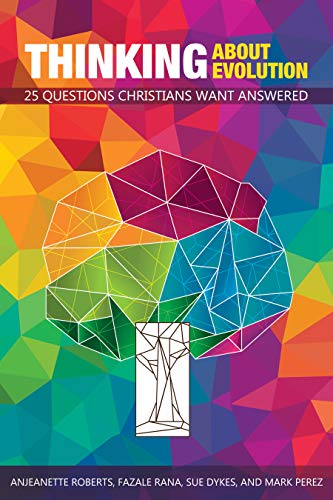
Reasons to Believe is a science-faith thinktank that operates from the perspective of Old Earth Creationism. Essentially, they hold that the earth and universe are billions of years old, but that God created progressively. Individual species or families were created by God ex nihilo at different points in time. Recently the organization published a book, Thinking About Evolution: 25 Questions Christians Want Answered that explores the evidence for evolution.
The book is written around 25 chapters corresponding to the eponymous questions. These questions are: “Does Evolution Explain Life on Earth?; Is Religious Belief the Only Reason to Question Evolution?; What’s Philosophy Got to Do With Evolution?; How Can We Keep Our Thinking Free from Fallacy?; Is Evolution Really a Problem for the Christian Faith?; What is Chemical Evolution?; Is Microevolution a Fact?; Does Microbial Evolution Prove Evolution is True>’ Is Natural Selection the Blind Force Driving Evolution?; Is There a Novelty Problem for Evolution?; What to Do with Teleology in Evolution? Can Evolutionary Processes Generate New Information?; Does Evolution Explain the Fossil Record?; What about the Genetic Similarity between Humans and Chimps?; Are the Hominin Fossils Evidence for Human Evolution?; Did Humans and Neanderthals Interbreed?; Did Neanderthals Create Art?; Can Evolutionary Processes Explain the Origin of Eukaryotic Cells?; Can Evolution Repeat Outcomes?; Can Evolutionary Co-option Explain the Irreducible Complexity of Biochemical Systems?; Has Evolution Refuted the Watchmaker Argument?; Is the Watchmaker Really Blind?; Is Junk DNA Evidence for Evolution?; Why Are We Progressive Creationists?; What if Big-E Evolution is True?
I wrote all these chapter titles out because it’s worth seeing that this is the content of the book. At a glance, readers interested in science-faith intersections probably have a number of assumptions about the answers to these questions, given the creationist background of Reasons to Believe. These assumptions may line up, but there are also sure to be some surprises mixed in there. For example, microevolution is most definitely affirmed as factual, but a significant amount of ink is spilled about trying to guarantee Neanderthals aren’t in any way associated with humans.
One thing that’s evident throughout the book is that there are numerous assumptions guiding the way evidence is interpreted by the authors. This is, of course, totally impossible to avoid. We all have assumptions that go into how we interpret anything. But some of these assumptions are put forward as almost obvious statements as though all Christians can or should agree. For example, in the chapter on “Is Evolution Really a Problem for the Christian Faith?” by Fazale Rana, he writes “Science should have no problem detecting a Creator’s handiwork–and even determining a Creator’s attributes,” (72). Prior to this remarkable statement, SETI is cited as an example of scientists attempting to find intelligence based on scientific assumptions. But of course, SETI and similar endeavors are predicated on the notion that intelligence wants to be discovered or that it is, in principle, discoverable. Yet many Christians may oppose this. For example, there is a lengthy tradition and numerous writings related to the hiddenness of God. Paul K. Moser, a philosopher, has written a few books on the topic of evidence for God only being available purposively (for example, The Elusive God). If, as Christian theology affirms, God is personal, then it seems quite possible that a person would have reasons to perhaps hide from or not be available for evidence in conventional means, especially given that person’s goals may be relational to humans rather than purely evidentiary. All of this is to say that certain assumptions made by the authors in this book are worth challenging. The very model that Reasons to Believe operates upon–a kind of strong concordism in which science will ultimately reveal God (or, minimally, unveil that the Bible is unchallenged by science, properly interpreted)–relies upon such assumptions. If they’re mistaken, significant questions about the inputs and outputs of the model would be raised.
The evidence for evolution is extremely strong. I don’t think the authors would seriously dispute that statement, given that they frankly acknowledge microevolution and microbial evolution. However, when confronted by this evidence, and the rather reasonable inference that one can move from small changes over large time to bigger changes, the authors shut down. For example, in the chapter on microbial evolution, Anjeanette Roberts writes, “But does microbial evolution involve production of totally novel protein products, cellular structures, cellular functions, metabolic pathways, or stepping stones to major transitions between kinds of organisms? …That’s highly debatable” (106). One might want to debate this, but the mere fact that just a sentence before, it had been acknowledged that microbial evolution does occur means that such “stepping stones” are in place. If we can observe microbial evolution in such small time spans, then given hundreds of millions of years, it seems to be little more than a lack of imagination to insist that such larger changes could not possibly occur. Of course, that’s not how strongly worded the objection is here. Throughout the book, the authors dance along this fine line of implying the evidence for evolution is highly contentious or questionable while also having to acknowledge that evolution just does occur.
For example, Sue Dykes makes it clear that she questions the existence of transitional forms, but then has to explain away the transitional forms that have been discovered in the fossil record (161ff). The reason to dismiss transitional forms appears to be that Dykes prefers to define transitional forms in the now-archaic way Darwin did as finding exacting step-by-step A-to-B lineages that we know for certain show the transition from A-Z. But this is not how evidence works. If we had the evidence to plays someone at the scene of a crime at the time in which it occurred with the weapon and intent to commit murder, someone coming along and saying “Ah ha! You cannot tell me the exact sequence in which the victim was stabbed!” wouldn’t be a compelling reason to question the suspect’s guilt. The sequence is there, though the order may be hotly contested. Examples Dykes investigates include whale evolution, which is quite frankly a compelling series of transitional fossils. Why are they questioned, then? Because there is the occasional discovery that may perhaps have a fossil dated differently or one form showing up earlier than expected! But that doesn’t really undermine the sequence any more than having one’s ancestor (grandparent, say) still alive today would mean one could not have been born yet. On a total-species level, it would be surprising to see entire species that were successful and ubiquitous enough for there to have actually been preserved fossils of them just dying off the exact moment a somewhat more adapted creature came along. Moreover, it is difficult for me to take seriously the questioning of transitional fossils when so many striking examples have been found. Not just the ones that exist in the public’s memory writ large, but also numerous amazing examples, like turtles, having “halfway” point type fossils. I wrote about some of these elsewhere. Again, do we have every one of the presumably hundreds of species preserved to get from point A-to-Z? No. But missing C, D, F, G, H, and I hardly precludes calling B, E, J, and M transitional forms.
The authors occasionally fall into the unfortunate position of implying that because scientists have updated predictions and models due to changing evidence, we can question the core idea. Sue Dykes writes about Hominin fossils, “It seems that the more we dsicover and the more we test, the more frustrated paleontologists become. New discoveries regularly undermine the ideal of a clear, single evolving lineage leading to modern humankind” (177). Well yes, because I doubt there are any paleontologists who actually that that “ideal” is attainable in actuality. Evolution is messy. It doesn’t produce simple chains. There are offshoots, branches that break off, never to come back, divergence, convergence, and more. Simply having a ton of fossils that fit to show evolution is occurring and not being able to find an “ideal” lineage doesn’t undermine the evidence for evolution. The stunning number of fossils and traits that can be found amongst them instead shows the compelling notion of evolution over time.
I was also surprised to see Fazale Rana seem to argue that evolutionary biologists would think that if we turned back the clock, evolution would just repeat results (225). I believe it was in Dawkins’s work that I read (reading it as a skeptic of evolution, more than a decade ago) that evolution would do the exact opposite. The metaphor was a videotape: if we rolled back the tape, the movie evolution would play would be completely different, because the forces acting upon nature that drive evolution couldn’t possibly be replicated. This seems to undermine the whole chapter in which Rana makes this statement about replicating results. Convergent evolution doesn’t really seem to be evidence against evolution, either, which is the somewhat confusing point that may be alluded to in this chapter (“Can Evolution Repeat Outcomes?”). Instead, Rana argues convergence points to progressive creationism due to shared features. But this was not established in the text, and the point Rana made about rewinding the clock seems to me to be mistaken.
A few chapters hint at more difficult problems for evolution. The question of irreducible complexity was compelling to me for quite a while, but though the authors here make the case, it still seems that co-option is but one of the several possible ways evolution could account for seemingly irreducible complexity. As has been pointed out by others much more in the know than I, irreducible complexity itself is something of a construct. For example, it may be the case that taking out a part of the eye that allows us to focus upon something would make the eye unable to function as an eye, but it would hardly make it useless. The mere ability to sense light/dark would be extremely advantageous on a number of levels. Another problem that is raised in the book is the question of generating information. I myself have become pretty skeptical of this argument, though, because it seems something of a category error. Yes, there is a strong metaphorical connection between human written language and the “language” of DNA, but to equate them to the point that is required for introducing intelligent design into the process is a stretch at best. Rana makes his case by pointing to the stunning improbability of randomly producing a functional cytochrome (153), but the very nature of evolution makes this nonsensical. Evolution isn’t randomly generating series of DNA strands in order to, hopefully, come up with a functional and beneficial protein. Instead, it is operating upon existing, functional (and even deleterious or non-functional) features. Simply stating blind probabilities is to massively overstate the range of actual possibility.
The concluding chapter is perhaps the best chapter of its kind I’ve read in any creationist literature anywhere. Anjeanette Roberts writes, “there are many faithful Christians today who confess Christ as Lord, hold the Bible as the authoritative Word of God, and believe in real miraculous events… while also holding that God used the initial conditions he established at the creation along with evolutionary processes to accomplish his purposes for life’s biological history on Earth” (282).
Later, she writes, “After all, it is not one’s view of origins that determines a person’s Christian status” (ibid). Then, she writes this great counterfactual: “If at some point in the future, the scientific evidence shows that evolutionary mechanisms are the mechanisms of god’s creation, then interpretive models… will fill a needed space in biblical Christian thought,” (283). Though not fully stating it, it is clear the implications here are that Roberts, and presumably other RTB scholars, are acknowledging that if evidence existed to convince them evolution were true, they would utilize some of the models for reconciling that with biblical truth that they already see as viable. This is an extraordinarily honest position, particularly for a creationist organization. Too often, people accuse creationists of being liars and/or deceivers, obfuscating truth. I have noted numerous points of disagreement with the book in my own review here. But let it be said that I think that RTB has done extremely valuable work, and that they’ll continue to do so. I can’t help but admire the integrity and honesty of their scholars, and am honored to work alongside them for God’s Kingdom.
Thinking About Evolution will give readers a solid base for understanding the most prominent old earth creationist perspective. While I think that the case it builds against evolution is lacking, I appreciate the candor, the integrity, and the genuine searching for truth the authors are pursuing. Readers interested in the intersection of Christianity and science will appreciate this book.
Disclaimer: I was provided with a copy of the book for review by the publisher. I was not required to give any specific kind of feedback whatsoever.
Links
Be sure to check out the page for this site on Facebook and Twitter for discussion of posts, links to other pages of interest, random talk about theology/philosophy/apologetics/movies and more!
Book Reviews– There are plenty more book reviews to read! Read like crazy! (Scroll down for more, and click at bottom for even more!)
SDG.
——
The preceding post is the property of J.W. Wartick (apart from quotations, which are the property of their respective owners, and works of art as credited; images are often freely available to the public and J.W. Wartick makes no claims of owning rights to the images unless he makes that explicit) and should not be reproduced in part or in whole without the expressed consent of the author. All content on this site is the property of J.W. Wartick and is made available for individual and personal usage. If you cite from these documents, whether for personal or professional purposes, please give appropriate citation with both the name of the author (J.W. Wartick) and a link to the original URL. If you’d like to repost a post, you may do so, provided you show less than half of the original post on your own site and link to the original post for the rest. You must also appropriately cite the post as noted above. This blog is protected by Creative Commons licensing. By viewing any part of this site, you are agreeing to this usage policy.
The Age of the Earth: How Interlinking Evidence from Tree Rings, Carbon-14, and Varves demonstrates an old earth
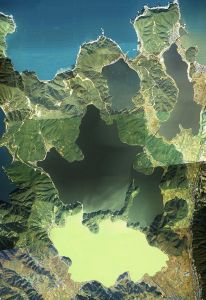
Image from Wikipedia. Credit: By Copyright © National Land Image Information (Color Aerial Photographs), Ministry of Land, Infrastructure, Transport and Tourism, Attribution, https://commons.wikimedia.org/w/index.php?curid=28702247
What kind of evidence do we have to support the notion that the Earth is truly ancient? It’s a question I often get asked, as someone who came from a young earth background. Young Earth Creationists often posit that the evidence for an “old earth,” if viewed from a different angle, could just as easily (or perhaps better) point to a young earth. However, there are some aspects of evidence for an old earth that seem to defy this argument, particularly because they interlink in such a way that independently points towards an old earth. Here, I take a look at an article by Gregg Davidson and Ken Wolgemuth in which they make this very argument. Below is the title and abstract.
Testing and Verifying Old Age Evidence: Lake Suigetsu Varves, Tree Rings, and Carbon-14
Gregg Davidson and Ken Wolgemuth
Abstract
Carbon-14 measurements from layered sediments collected in 2006 from Lake Suigetsu, Japan, together with tree-ring data, offer an unprecedented opportunity to demonstrate how competing old- and young-earth hypotheses can be quantifiably tested. Conventional observation of radioactive decay rates, atmospheric carbon-14 production, tree-ring growth, cross-dating, and varve formation yields a narrow range of expected values for the carbon-14 content of samples over the last 50,000 years. Young-earth challenges to each observation should result in specific and predictable departures from conventional expectations. This article documents a sequence of tests to demonstrate beyond reasonable doubt that carbon-14 decay rates have remained unchanged, estimates of past atmospheric production rates are accurate, cross-dating of tree rings is reliable, the sampled trees have grown one ring per year going back more than 14,000 years, and finely layered sediments from Lake Suigetsu were deposited annually going back more than 50,000 years.
Gregg Davidson and Ken Wolgemuth, in this paper, analyze three independent lines of evidence that interlink to confirm each other. Specifically, by looking at tree rings, varve formation, and carbon-14 dating, they yield a range of possible dates that matches across these independent variables. This gives a strong confirmation of the age of the earth, along with demonstrating that the decay rate of carbon-14 does not seem to have changed and remain accurate for more than 50,000 years.
The importance of this paper, and arguments like it, is that these are independent lines of evidence that all interlink to show the same conclusion. This needs to be emphasized, because young earth creationists will often call into question these pieces of evidence individually, shooting them down with objections that they then conclude shows they are individually faulty. Rarely, if ever, do young earth creationists acknowledge or deal with the fact that these evidences, while being independent, yield results that all add up to the same ages. Again, the importance of this cannot be understated, because it would mean that, for whatever reason, the young earth creationist must then assert that their independent objections to each individual dating method also can somehow explain why those dating methods to which they are objecting yield the same results.
Tree Rings
Trees record the years they’ve been growing through rings that show how quickly their cells grew during different seasons. A record of years can be traced by comparing tree rings to show wet/dry seasons that form something similar to a bar code type pattern allowing for identifications across years. The oldest living trees have 5000 years recorded, and fossilized trees can be compared to living trees to extend that record back further, with the oldest reliable comparison yielding 14,000 years. Young earth objections to tree rings typically center around the notion that multiple rings form in single years.
Carbon-14 Dating
Wolgemuth and Davidson write that, in regards to Carbon-14 dating:
The primary requirements for determining age are (1) a constant radioactive decay rate, (2) knowledge of the original carbon-14 content, and (3) quantification of any old carbon that may have been incorporated into the specimen.
Standard young earth objections are leveled at each of these three requirements. However, it is rarely (if ever–though I’m sure someone does, somewhere) disputed that certain dates are yielded when Carbon-14 testing is done. Thus, it is the young earth objections to the three requirements where they rest their case. These objections are often that we cannot know whether the radioactive decay rate changed in the past; (less typically) that the original carbon-14 content is in question; and that the samples are somehow contaminated. Now, Wolgemuth and Davidson do clearly state that scientists must account for some known factors that can vary how quickly Carbon-14 is formed. But these can be accounted for and allow scientists to get fairly accurate data on dating samples.

Image source: http://www.suigetsu.org/varves.html Used under fair use. Accessed January 2019
Varves
Probably the least familiar of these dating methods to anyone with a passing interest in the age of the earth is varves. These are sets of alternating layers formed by sediment on the floor of bodies of water due to a number of factors. With Lake Suigetsu in mind, the method of dating involved is a measurement of algae blooms via examination of the varves. At this lake, cores have yielded dependable rates that allow dates traced back to around 150,000 years.
Independent Methods, Same Results
Where this gets interesting, and where young earth creationists ought to take note, is that while it is somewhat easy to discount individual pieces of evidence based on independent objections, it is much more difficult to do so when these allegedly faulty dating systems yield the same dates.
Carbon-14 dating methods allow scientists to make predictions for how much Carbon-14 ought to be present in a sample before testing the sample. Thus, scientists can use these predictions to chart what the expected Carbon-14 content of tree rings or varves will be. The article has just such a chart, yielding a very narrow range of expectations regarding Carbon-14 content with the age of the sample. They can then take tree rings, going with the conventional assumption that the rings indicate years, and sample them for Carbon-14 to see if they match the expectations of carbon dating. What is remarkable (visually, especially, again, see the article) is that these expected ranges correspond exactly to the samples taken of tree rings. This means that a tree ring yielding an age of 14,000 years due to the number of rings also yields an age of 14,000 years when sampled for Carbon-14. But these dating methods are completely independent. The Carbon-14 date doesn’t rely at all on the number of rings in a tree, nor is reverse true.
Wolgemuth and Davidson then show the expectations from a young earth model with explanations of tree rings. For example, the expectation of multiple rings per year is tested and falls well outside the predictions of the Carbon-14 dating. This is important, because it means that the conventional assumptions about testing dates align together independent dating systems while young earth predictions yield wildly dissimilar results. These results are presented in the paper.
Scientists go further, though, and can line these evidences up with varves of Lake Suigetsu. Here, there is some technical data about how scientists can determine when significant events happened in the lake, such as extreme algae blooms or additional brackish water, but the core of the point is that when these factors are accounted for, a predictive range for Carbon-14 can again be made and set alongside the age estimate based upon the varve samples. Once again, when aligned, there is remarkable correspondence between Carbon-14 expectations and the actual measurements set alongside the varve-counting method of dating. Additionally, note Wolgemuth and Davidson, there is a steady decline backwards in the amount of Carbon-14 present, showing not a wildly erratic decay rate but rather a steady and predictable rate as one goes deeper into the sediment of Lake Suigetsu. These predictions falsify a young earth account, in part, because the young earth model “expects… massive sediment deposits during the flood year…” in addition to other expectations of many flood models for a young earth.
Next, Wolgemuth and Davidson turn to combining all of these lines of evidence together, demonstrating that the period of overlap where we can measure tree rings, varves, and Carbon-14 yields a graph just as predicted by conventional expectations, and that varves and Carbon-14 can be plotted much farther (due to their availability and the lack of reliable tree ring data older than 14,000 years), showing a constant alignment of these independent forms of evidence.
The authors state the decisiveness of this data and its implications for models of the age of the earth quite well:
we have two options. Option 1 is that God gave us amazing tools to test and verify that carbon-14 decay rates have not changed and sediments in Lake Suigetsu have been accumulating for more than 50,000 years. Option 2 is that God precisely manipulated multiple independent phenomena—tree ring growth, atmospheric carbon-14 production, and sediment couplet formation—to mimic conventional expectations.
More Methods of Dating
Wolgemuth and Davidson don’t leave the evidence there, however, because more methods of dating can converge on Lake Suigetsu, allowing for additional independent dating. Argon-Argon dating from volcanic ash in the Lake yields a radiometric test that corresponds to Carbon-14 dating and tree ring data.
They note that most young earth creationists don’t object when Carbon-14 dating is used on things that corroborate biblical materials, such as the Dead Sea Scrolls. Yet when one puts the data point for the Dead Sea Scrolls alongside the tree ring carbon data, we find that there is, again, alignment between the Carbon-14 dating for the tree rings, the actual counting of the tree rings, and the age of the Dead Sea Scrolls. This would mean that some form of manipulation of dating systems would have to yield the correct date for the Dead Sea Scrolls but incorrect dates by counting tree rings and Carbon-14 despite the fact that these align perfectly with the data for the Dead Sea Scrolls. And with this latter data, again, Argon-Argon dating with radiometric dating can be incorporated to show yet another independent method of dating.
Conclusion
Young earth creationists have not dealt with the fact that it is not just independent methods of dating that yield similar dates but rather that these independent methods correspond with each other and back each other up. On a young earth reading of the evidence, there is no explanation for why the allegedly mistaken methods of counting tree rings, varves, measuring Carbon-14 dating, and Argon-Argon dating from volcanic ash should all correspond with the same dates. After all, each of these is taken to be independently mistaken for different reasons and at different rates. But if that’s true, then the observed data should be completely different from what it actually is. Additionally, the alleged accuracy for dating things in biblical archaeology is generally conceded by young earth creationists, and this dating for biblical artifacts also corresponds to other dating methods. Thus, the accurate date of the Dead Sea Scrolls corresponds with the allegedly inaccurate methods of tree ring counting, varve counting, and radiometric dating. What possible reason could there be for this to be the case? Going back to the words of Wolgemuth and Davidson, the most reasonable explanation is that God has given us the tools to study creation, and that these tools give us an accurate record of earth’s history.
Links
Be sure to check out the page for this site on Facebook and Twitter for discussion of posts, links to other pages of interest, random talk about theology/philosophy/apologetics/movies and more!
What options are there in the origins debate? – A Taxonomy of Christian Origins Positions– I clarify the breadth of options available for Christians who want to interact on various levels with models of origins. I think this post is extremely important because it gives readers a chance to see the various positions explained briefly.
What is the relationship between Christianity and science?- An Overview of 4 Views– How should the Christian faith interact with science? Do they interact at all? I survey 4 major views on these and other questions.
SDG.
——
The preceding post is the property of J.W. Wartick (apart from quotations, which are the property of their respective owners, and works of art as credited; images are often freely available to the public and J.W. Wartick makes no claims of owning rights to the images unless he makes that explicit) and should not be reproduced in part or in whole without the expressed consent of the author. All content on this site is the property of J.W. Wartick and is made available for individual and personal usage. If you cite from these documents, whether for personal or professional purposes, please give appropriate citation with both the name of the author (J.W. Wartick) and a link to the original URL. If you’d like to repost a post, you may do so, provided you show less than half of the original post on your own site and link to the original post for the rest. You must also appropriately cite the post as noted above. This blog is protected by Creative Commons licensing. By viewing any part of this site, you are agreeing to this usage policy.
Book Review: “The Creator and the Cosmos, 4th Edition” by Hugh Ross
 Hugh Ross is perhaps the most well-known advocate of the position known as Old Earth Creationism today. He is the founder of Reasons to Believe, a science-faith think tank that centers on the OEC position. His works have been highly influential in my own life and faith journey. Although I no longer ascribe to Old Earth Creationism of Ross and Reasons to Believe, I have much respect for all those working at Reasons to Believe and appreciate their mission. The Creator and the Cosmos is one of the more broadly applicable books from Reasons to Believe because it focuses not so much on the concordism that defines their position but rather largely on the evidence for cosmic fine-tuning.
The core of Ross’ argument in the book is the fine-tuning argument. Basically, this is the argument that certain constants about our universe are such that any minuscule change to them would mean our universe would no longer be life-permitting. Because there are so many of these factors, the argument goes, that chance is not the best explanation for our universe. Instead, some kind of being that can act on our universe is posited as the best explanation.
Ross begins his work with an autobiographical account of how he became interested in astronomy. His own interest in the night sky led to him deciding to go through the holy books of various religions to see if any aligned with what science has revealed about our universe. His search culminated in the surprising discovery that, he believes, the Bible actually taught first what science has now revealed. This is one of the central aspects of the Reasons to Believe model: the belief in concordism. Concordism is the idea that the Bible and science will not just operate alongside each other but rather confirm and interlink with each other. Thus, as Ross argues, the Bible speaking of things like the stretching out of the heavens (Psalm 104:2, for one example) is said to be not just metaphorical language but rather literal language about the creation of the universe through the Big Bang.
It is in the chapter entitled “The Bible Taught it First” that I find the most with which to take issue in the book. For almost the entirety of my life, I, too, ascribed to concordism, but as I have read more and more I think that it is not what the intention of the Bible is at all. The Bible is not a science textbook, and simply finding a few isolated sentences that seem to correspond to 21st century science does not demonstrate that it is scientifically advanced. Indeed, as many a skeptic would gleefully point out, there are many points in the Bible which seem to speak about the sky as a solid dome or the literal rising and setting of the sun. Groups like Reasons to Believe work to show how these are actually non-literal language or merely figures of speech, but to me this seems ad hoc. The approach seems piecemeal and the idea that the heavens stretching out “like a tent” is meant to teach Big Bang Cosmology is a tenuous link, at best. After all, if the Bible intended to teach Big Bang Cosmology, would it not be quite simple to do so rather more explicitly than an allusion here and there? It seems to speak rather directly about creation, after all. Instead, it seems that writers like John Walton are more on point when they note that the authors of the Bible had background scientific beliefs of their Ancient Near Eastern times, but that the Bible is not intentionally teaching any kind of cosmology. Instead, it is teaching about the ordering of the cosmos by God as creator. This approach allows readers to avoid the difficult questions raised against concordism regarding the difficult passages about creation, while also not completely divorcing it from reality.
Apart from this allegiance to concordism, the rest of the book is almost entirely focused on scientific discoveries of the past hundred or so years regarding the universe. These are covered in some detail, but Ross does a good job covering these discoveries in such a way that they will be generally understood by most readers. Time and again, he shows that major discoveries seem to show that the sheer improbabilities involved in our life-permitting universe undercut the notion of chance as an explanation for reality. These are cosmic-scale fine tuning arguments. They don’t rely on anything related to evolution or anti-evolution. Instead, the things Ross focuses on in this book are all large scale discoveries and constants that impact our universe writ large. A lengthy appendix summarizes much of this evidence, and going through that appendix shows that time and again our universe falls within an extraordinarily limited range for life to exist.
I do still feel some caution, however, even regarding the fine-tuning argument on a cosmic scale. Though many skeptics have acknowledged it to be perhaps the strongest argument for theism, I am wary of completely aligning ourselves as Christians to any scientific view of the day. After all, many are positing oscillating universe models or a big crunch as another possible alternative to a Big Bang and heat death of the universe. Yes, Ross does deal with these alternatives, but as with so many things in science, we can only hold the conclusions as strongly as the evidence allows and we are a single future discovery away from something that overcomes the problems Ross raises with these models. Is it possible that Big Bang cosmology is entirely correct? Absolutely, and it certainly seems to be the strongest model. But I don’t want to base my entire defense of the Christian faith on that. Indeed, I’d rather base very little on it.
The Creator and the Cosmos is a truly marvelous book for learning about the fine-tuning of the universe. Though I have noted my wariness of Ross’s concordism and of other potential pitfalls, I do think that overall, Ross makes a strong argument. As a non-expert in science, it is very impressive to see one piece of evidence after another appear to confirm fine-tuning of the universe. Time, and future discoveries, will tell whether the fine-tuning argument carries the day. As it stands, I believe it is but one piece of the total Christian apologetic, and this book will help Christians in that regard.
Disclaimer: I was provided with a copy of the book for review by the publisher. I was not required to give any specific kind of feedback whatsoever.
Links
Be sure to check out the page for this site on Facebook and Twitter for discussion of posts, links to other pages of interest, random talk about theology/philosophy/apologetics/movies and more!
Book Reviews– There are plenty more book reviews to read! Read like crazy! (Scroll down for more, and click at bottom for even more!)
SDG.
——
The preceding post is the property of J.W. Wartick (apart from quotations, which are the property of their respective owners, and works of art as credited; images are often freely available to the public and J.W. Wartick makes no claims of owning rights to the images unless he makes that explicit) and should not be reproduced in part or in whole without the expressed consent of the author. All content on this site is the property of J.W. Wartick and is made available for individual and personal usage. If you cite from these documents, whether for personal or professional purposes, please give appropriate citation with both the name of the author (J.W. Wartick) and a link to the original URL. If you’d like to repost a post, you may do so, provided you show less than half of the original post on your own site and link to the original post for the rest. You must also appropriately cite the post as noted above. This blog is protected by Creative Commons licensing. By viewing any part of this site, you are agreeing to this usage policy.
“Remarkable Creatures” by Tracy Chevalier – Creationism, women, and paleontology
 Remarkable Creatures by Tracy Chevalier is a historical fiction novel based on the lives of Mary Anning and Elizabeth Philpot, early fossil hunters in England. It raises an astonishing number of worldview questions related to women, paleontology, and creationism, and we will here discuss just a few of these issues. There will be SPOILERS in what follows, but it is history!
Paleontology, Creationism, and Controversy
Perhaps the most fascinating aspect of Remarkable Creatures is its survey of the controversies surrounding the discovery of fossils that challenged reigning scientific and religious paradigms. One of the greatest challenges was to come to believe that extinction had occurred. Think about it: if all you ever knew was the living beings around you, what possible reason would there be for thinking that those beings could die out, such that none were left anywhere? Mary Anning and Elizabeth Philpot’s finds of creatures like icthyosaurus challenged even the greatest thinkers of the time to come up with new paradigms for fitting these creatures–which didn’t exist anywhere on earth at their time–into reality.
For a time, it was thought that the bones of icthyosaurus were just those of a crocodile. But then Mary Anning discovered a complete fossil that included huge eyes (eyes that even had bones in them!). This forced people to the realization that these truly were novel creatures.
It’s a fascinating thing to think about, because the problem wasn’t just that it forced them to come up with a new concept–extinction. It also led to theological crises. After all, why would God create creatures that would all die out? One pastor in the book was particularly disturbed by this notion. He argues with Elizabeth Philpot: “All that you see about you is as God set it out in the beginning. He did not create beasts and then get rid of them. That would suggest He had made a mistake, and of course God is all knowing and incapable of error…” (144, citation from large print edition [only one they had at the library]). Philpot then comes back, noting that rock formations change and that if creation is supposed to be without change, how could rock fall or change a cliff face? The pastor ultimately comes back by saying that “God placed the fossils there when He created the rocks, to test our faith…” (145). Chevalier cleverly puts an answer in Philpot’s head: “It is my faith in you [the pastor as interpreter of Scripture] that is being tested, I thought” (145). The pastor, it should be noted, was also using, as was commonplace, Bishop Ussher’s chronology of the world, which put the date of creation “on the night preceding the 23rd of October 4004 B.C.” (144). Philpot wryly remarks- “I had always wondered at his precision.”
Another idea that was prominent at the time was the notion of anatomical laws or conformity with Aristotle’s Great Chain of Being. According to these ideas, there is a kind of hierarchy of being that puts humans at the top (usually) with other creatures in stages below that. It is not evolution, for it predates that idea. Instead, it is a way of ordering those creatures which exist now according to some principles. Mary Anning’s finding of a plesiosaur challenged this chain of being by violating the ways that creatures were supposed to appear or exist.
Late in the book, Elizabeth Philpot is finally questioned on what she thinks about the fossils and God. She is pleased to finally be asked:
I am comfortable with reading the Bible figuratively rather than literally. For instance, I think the six days in Genesis are not literal days, but different periods of creation, so that it took many thousands–or hundreds of thousands of years–to create. It does not demean God; it simply gives Him more time to build this extraordinary world. (391, again note reference from large print edition)
Although this is a work of historical fiction, these debates continue into today. Some groups still use Bishop Ussher’s chronology to date the age of the earth. Although few would argue that there are no extinct creatures, new forms of the same arguments have led to the young earth creationist movement, in which people argue that the Bible requires us to believe that all the creatures that are extinct were alive at the same time as humans. I have personally had conversations with young earth creationists who say that fossils are one way God tests our faith (I know of no young earth organization who would use this argument, thankfully). Scientific findings continue to challenge entrenched religious beliefs.
One is perhaps left to wonder, like Philpot’s thoughts, on how some people get so much precision. The Bible nowhere puts a date on creation. Nor does the Bible demand that all creatures that have ever lived were allowed at the same time. Yet these beliefs persist, and many Christians insist that if one does not hold to them, they are not true Christians, or are perhaps abandoning Scripture. As in Mary Anning’s time, we still have much work to do. We cannot let our external paradigms (things like Aristotle’s Great Chain of Being, or perhaps more germane, our own assumptions about how texts ought to be read “literally” and what the word “literal” means) determine how God is allowed to act or what God may communicate to us.
Women
The book does a good job portraying the way the contributions of women were ignored or even stolen. Mary Anning was an expert fossil hunter–self taught. Yet time and again, men used her expertise to find their fossils and then take credit for the finds. Although her contributions were acknowledged later, her life of poverty is a sad testimony to the way that unequal treatment of women can so easily be perpetuated. The book portrays this unequal treatment in many ways. First, there is the exclusion of both Philpot and Anning from societies of geologists (this was before paleontology was a separate field of study from geology). Second, social norms provide for a simple way to create inequality. When one sex is given the benefit of the doubt (men, in this case) while the other is considered permanently damaged even by gossip about impropriety (women), restraints upon the social movement and capacity of the latter follow by necessity. Third, the contributions of women were ignored.
Unfortunately, parallels to each of these scenarios continue today. Women are excluded from certain groups or positions (such as those who keep women from becoming pastors), thus creating spiritual inequality. Conventions of purity culture, for example, treat women as “impure” or “damaged goods,” putting the onus on young women to abstain while simultaneously removing blame from young men. The power of imagery–objectification of women–continues to impact both women and men in negative ways. We can learn from Remarkable Creatures that much progress has been made, but it also points us in the direction of more work to be done.
Conclusion
Remarkable Creatures is a fascinating read. Although it is dry at times, it provides much insight into a number of discoveries that changed the world. It highlights the careers of two women who contributed much to paleontology in its formative stages. Perhaps most importantly, it challenges us to keep improving, to keep thinking, and to keep observing God’s remarkable world.
Source
Tracy Chevalier, Remarkable Creatures (New York: Penguin, 2010).
Links
Be sure to check out the page for this site on Facebook and Twitter for discussion of posts, links to other pages of interest, random talk about theology/philosophy/apologetics/movies and more!
Popular Books– Read through my other posts on popular books–science fiction, fantasy, and more! (Scroll down for more.)
Mary Anning: Plesiosaurs, Pterosaurs, and The Age of Reptiles– A post that highlights the contributions Mary Anning made to the paleontology. It particularly focuses on how these discoveries pre-dated Darwin.
SDG.
——
The preceding post is the property of J.W. Wartick (apart from quotations, which are the property of their respective owners, and works of art as credited; images are often freely available to the public and J.W. Wartick makes no claims of owning rights to the images unless he makes that explicit) and should not be reproduced in part or in whole without the expressed consent of the author. All content on this site is the property of J.W. Wartick and is made available for individual and personal usage. If you cite from these documents, whether for personal or professional purposes, please give appropriate citation with both the name of the author (J.W. Wartick) and a link to the original URL. If you’d like to repost a post, you may do so, provided you show less than half of the original post on your own site and link to the original post for the rest. You must also appropriately cite the post as noted above. This blog is protected by Creative Commons licensing. By viewing any part of this site, you are agreeing to this usage policy.
Book Review: “Who Was Adam?” – 10-Year Update by Fazale Rana with Hugh Ross
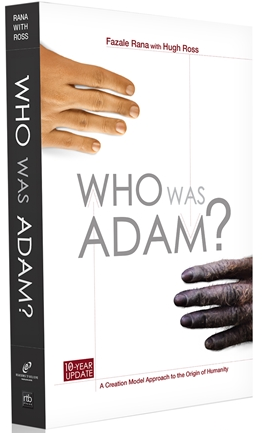
Who Was Adam? by Fazale Rana with Hugh Ross is a major work on human origins from the group Reasons to Believe, an Old-Earth Creationist think-tank. This edition, the 10-Year Update, features over 100 pages of additional material analyzing recent discoveries.
The book is organized in such a way that the first two parts are the original book, while the third part is all new material and analysis. Rana and Ross do an admirable job surveying an immense amount of scientific material related to human origins. They present what they argue is a scientific, creationist model (called the Reasons to Believe model [hereafter referred to as the RTB model]) on human origins. This model includes predictions and testable hypotheses. For example, one of the main predictions is that humans–homo sapiens sapiens–are utterly unique and that their cultural capacity will turn out to be unmatched. Thus, any alleged ancestors of humans will not demonstrate continuity of culture and the like.
They take as confirmation of this prediction the notion that biologists have not managed to put together a solid order in which to place the fossils that are alleged to be human ancestors. Without any such family tree that can be confirmed, the notion that humans evolved, Rana and Ross argue, remains a theory and the question of human evolution is not a fact. They conclude this after having looked at a number of major fossil finds while identifying difficulties with dating them, difficulties with taxonomy and identification, and more.
The updated portion of the book is significant. Those wondering if it is worth getting for this update should know the answer is in the affirmative. There are over 100 additional pages filled with analysis of more recent discoveries and how they impact the RTB model of human origins. To their credit, the authors frankly admit areas in which their predictions were mistaken or their model is challenged. Perhaps the most interesting section is that in which Rana and Ross analyze various behaviors thought to be evidence of early culture among hominids and the like (chapter 23). They show that these behaviors might be anthropomorphism of animal behavior. The chapter on junk DNA shows how scientific discovery has confirmed one of the predictions of the RTB model, and the concluding pair of chapters analyze arguments for and against the RTB model and its viability.
One critique I have is particularly evident in the original work (not in the expanded materials, though), is the occasional use of pure rhetoric to try to make a point. For example, in discussing hominid and homo fossils, Rana and Ross argue that the connections between these fossils has not been established. They therefore conclude that “Without these connections, human evolution cannot be declared a fact but remains a theory” (42). I find this type of wording unfortunate.
Some of the other reasoning behind the RTB model seems possible to go either way (i.e. towards evolutionary theory or the RTB model). For example, Chapter 6 outlines a number of conditions which are to demonstrate humans arrived at the just-right timing for human civilization to flourish–something the RTB model would predict. On the other hand, the authors state the evolutionary model would not necessarily predict this. However, it seems that–from my admittedly limited understanding of biology–the evolutionary model would also predict something similar because life adapts so well that if there was a “just right” circumstance for a type of life, that life would be selected for. Whether this is accurate or not is a different question (and whether I have it right), but it doesn’t seem like this is necessarily evidence for RTB over and against evolution.
The difficulty of evidence that could go either way is one of the biggest difficulties throughout the book. Arguments are often made that because the RTB model allows for a specific piece of evidence, that means that the RTB model is still viable. But there is a difference between confirmation of a model and lack of disconfirmation. It would be more reassuring to have more specific scientific evidence in favor of the model rather than simply being able to be subsumed into it.
At times I also wondered whether certain aspects of the RTB model were necessary for them to defend. For example, the insistence on reading the ages of early humans in the Bible as literal periods in which humans lived for 900+ years. They acknowledge in the expanded section that there has yet to be confirmation of this and that findings so far challenge this idea, yet they continue to hold it as part of the model. I can’t help but think it is a superfluous part that doesn’t actually contribute much to the overall workings of their model.
Who Was Adam? is a significant work worthy of a careful reading by any interested in Christian perspectives on human origins. It provides Christians insight into an Old Earth Creationist perspective on human origins, while also providing enough raw information for readers to draw their own conclusions and formulate their own ideas. It will challenge Christians on their thinking and perhaps force people to re-evaluate their own theories. It is a valuable resource despite having what I see as some difficulties throughout. It is recommended.
The Good
+Frank evaluation of own model after 10 years
+Offers much insight into research of hominids
+Plenty of data means readers can form their own conclusions
+Genuinely valuable update with much new material
The Bad
-Some unfortunate reliance on rhetoric
-Methodological concerns
Disclaimer: I received a copy of the book for review from the publisher. I was not required to give any specific kind of feedback whatsoever.
Links
Be sure to check out the page for this site on Facebook and Twitter for discussion of posts, links to other pages of interest, random talk about theology/philosophy/apologetics/movies and more!
Book Reviews– There are plenty more book reviews to read! Read like crazy! (Scroll down for more, and click at bottom for even more!)
Source
Fazale Rana with Hugh Ross, Who Was Adam? (Covina, CA: Reasons to Believe Press, 2015).
SDG.
——
The preceding post is the property of J.W. Wartick (apart from quotations, which are the property of their respective owners, and works of art as credited; images are often freely available to the public and J.W. Wartick makes no claims of owning rights to the images unless he makes that explicit) and should not be reproduced in part or in whole without the expressed consent of the author. All content on this site is the property of J.W. Wartick and is made available for individual and personal usage. If you cite from these documents, whether for personal or professional purposes, please give appropriate citation with both the name of the author (J.W. Wartick) and a link to the original URL. If you’d like to repost a post, you may do so, provided you show less than half of the original post on your own site and link to the original post for the rest. You must also appropriately cite the post as noted above. This blog is protected by Creative Commons licensing. By viewing any part of this site, you are agreeing to this usage policy.
Book Review: “A Matter of Days” by Hugh Ross, Second Expanded Edition
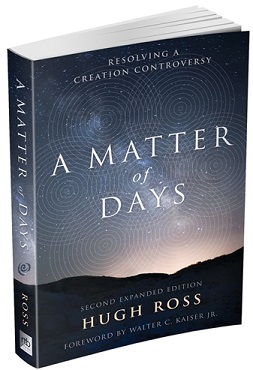
Hugh Ross is one of the most influential Old Earth Creationists alive. The founder of Reasons to Believe, he has had a profound influence on putting forth Old Earth Creationism from a concordist–that is, the notion that the Bible and science will agree where they overlap [often including the notion that the Bible explicitly speaks on scientific issues]–perspective. A Matter of Days
The book provides a huge amount of material for those wanting to interact with topics of creationism. Ross begins by surveying the contentious way the issue is often argued and noting that we as Christians ought to strive for more tolerant attitudes towards each other. Alongside this, he notes various statements by evangelicals allowing for some openness on the topic.
The book covers a massive range of arguments for and against young earth creationism, but the real meat of the text is dealing with various scientific arguments on either side. These are surveyed in a kind of question and answer or objection and rejoinder format in which Ross clearly explains a huge amount of scientific data for an ancient universe and deals with the major objections to such a position from the young earth creationist perspective.
Ross also confronts textual issues in a number of places, including much discussion on the concept of “day” and its meaning in Genesis 1. This, he covers from different perspectives including historic theology, exegesis, and science. He also puts forward a canonical view of how to see Creation in the Bible rather than limiting it simply to Genesis 1-2. There are a number of other texts that he argues also teach on creation.
Although he is an “Old Earth” believer, Ross is also clearly a creationist and puts forward several brief arguments about the faultiness of evolution. This is not a focus of the work, but through such arguments he establishes a clearer picture of his own position related to origins of both life and speciation.
One issue that might be raised with the book is whether the seemingly strict concordism Ross advocates is necessary. For example, rather than arguing that entropy and decay are spoken about in the Bible (100-102), could one not simply note that the human biblical author almost certainly had no concept of entropy and therefore was not addressing it? That is to say, a concept of divine condescension might be easier to hold to than one of future scientific knowledge revealed in the Bible.
The new edition is expanded and has noticeably featured references to some recent works as well as more arguments. It is a rather large re-write with much new information. Readers considering purchase should get this edition.
The Good
+Major point-by-point explorations of evidence for and against an old earth
+Strong defense of the Old Earth Creationist/Concordist position
+Many technical issues explained in understandable ways
+Charitable tone
+Excellent index
+Expanded arguments and new information for the new edition
+Really cool cover
The Bad
-Some questions about concordism remain
-Perhaps too brief on some objections
Conclusion
A Matter of Days
Disclaimer: I was provided with a review copy by the publisher. I was not required to write any sort of review whatsoever thereby.
Links
Be sure to check out the page for this site on Facebook and Twitter for discussion of posts, links to other pages of interest, random talk about theology/philosophy/apologetics/movies and more!
Origins Debate– Read a whole bunch more on different views within Christianity of the “origins debate.” Here I have posts on young and old earth creationism, intelligent design, theistic evolutionism, and more!
Source
Hugh Ross, A Matter of Days
SDG.
——
The preceding post is the property of J.W. Wartick (apart from quotations, which are the property of their respective owners, and works of art as credited; images are often freely available to the public and J.W. Wartick makes no claims of owning rights to the images unless he makes that explicit) and should not be reproduced in part or in whole without the expressed consent of the author. All content on this site is the property of J.W. Wartick and is made available for individual and personal usage. If you cite from these documents, whether for personal or professional purposes, please give appropriate citation with both the name of the author (J.W. Wartick) and a link to the original URL. If you’d like to repost a post, you may do so, provided you show less than half of the original post on your own site and link to the original post for the rest. You must also appropriately cite the post as noted above. This blog is protected by Creative Commons licensing. By viewing any part of this site, you are agreeing to this usage policy.
What options are there in the origins debate? – A Taxonomy of Christian Origins Positions
 The origins debate within Christianity is often viewed through the lens of a very narrow spectrum. Most recently, this was demonstrated in the debate between Ken Ham and Bill Nye. I also demonstrated this recently by answering questions for old earth creationists (see the first and second parts): some people tend to see the only options available for Christians as either young earth creationism (the earth was made in six 24 hour days 6-10 thousand years ago) or theistic evolutionism (God set it up, then evolution accounts for diversification). These perspectives, though showing a few of those available to Christians, do not actually reflect the whole realm of possibilities for Christians.
More thoughtful Christians tend to think of the perspectives as threefold. There are theistic evolutionists, young earth creationists, and then in between there is a kind of amorphous glob of people who hold to an “old earth” without expressing it in strictly evolutionary terms. Here, we’ll explore this amorphous glob (as well as the extremes) to show that there really is a range of options. I’m writing this mainly to clarify for many some of the difficulties in commenting on creation issues without such a taxonomy.
Gerald Rau’s Mapping the Origins Debate
If I could recommend one book to anyone who is going to get involved in creation issues, I would have to say I’d recommend Gerald Rau’s Mapping the Origins Debate: Six Models of the Beginning of Everything
Rau’s Taxonomy
Rau divided the major positions on the origins debate into a sixfold division (see Rau, 41):
Naturalistic Evolution- On this view, there is no God and no purpose in origins. The process for the origin of species and its diversity is “spontaneous.”
Nonteleological Evolution- On this view, there is a creator, but there remains no intervention in the natural process which yield life and its diversity. Thus, the “conditions necessary for life” were “established at creation.” However, evolution is still without purpose and the creator did not specify its parameters.
Planned Evolution- On this view, there is a creator who had a purpose for life and its origin. This purpose is through a “perfect creation” which “naturally fulfills God’s purposes.” Thus, the purpose which the creator had was essentially front-loaded in at the moment of creation. There is no direction during the process.
Directed Evolution- On this view, there is a creator with a purpose for the diversity of life. Unlike the previous view, the creator doesn’t merely front-load design and purpose but rather intervenes throughout the course of history to bring about purpose: “changes in universe and life” are “subtly directed over time.”
Old-Earth Creation- On this view, the process by which the diversity of species came about is not through directed evolution but rather through creation over time: “major body plans” are “created over millions of years.” New diversity of life is through God’s direct creative act.
Young-Earth creation- on this view, “each ‘kind'” is “created in one week, within the last 10,000 years. All diversity of life is due to God’s creative act; any changes since then are only among the “kinds” represented on the ark.
 A Larger Picture
Rau’s division of these groups is extremely helpful because he hits on the major positions represented within the spectrum. Of course the only options which are available to Christians are those which do not exclude God from the picture. Thus all but naturalistic evolution remain open to the believer. Now, the debate over how these might fit into the teaching of the Bible is not what I’m trying to dive into here. Instead, I’m simply pointing out there is diversity of views greater than the YEC/Theistic Evolutionism divide. One can see from the above that even within theistic evolutionism there is some diversity. Does evolution take place nonteleologically or did God plan it from the beginning? Perhaps God directed evolution along the way. There also is the option of Old Earth Creationism which shares many features with young earth creationism but radically diverges from the latter in many respects.
However, the spectrum opens up even more than Rau’s taxonomy depicts. The views he discusses focus primarily upon the science; that is, they are distinctions among views on the specifics of a scientific account of origins. Other views may be listed which may be distinguished by the reading of the Bible. Now, there is of course much overlap between these and Rau’s list, but I wanted to highlight a few views of interest.
First, there are interpreters like John Sailhamer in his book Genesis Unbound
Second, John Walton’s view reads the creation account within the Ancient Near Eastern context and so he views Genesis not as a literal creation account but rather as an account showing how God is enthroned over the entire creation as King. Again, such a view would be amenable to the spectrum of views possible for a Christian as I noted.
It is worth noting that either of these is distinct from the spectrum Rau lists. They are distinct because they do not require commitment to any of the creation models. Thus, for Collins, Sailhamer, and Walton, one may simply remain open to the evidence rather than filtering the evidence through specific readings of the Genesis text. Of course, one could hold to this view and remain a young earth creationist; but none of these readings explicitly forces someone to hold to any position on the actual means of creation and speciation.
Third, there are positions related to the scientific origins which would further subdivide Rau’s categories as dilineated above. For example, young earth creationists often hold that the Global Flood can account for the fossil record and stratification. But some YECs have historically held that the Flood would have been tranquil and essentially had no impact on the Earth. Other YECs simply hold that the universe and the Earth have an appearance of age because God would have known at what age it would have needed to be in order to sustain life. There is much diversity about the mechanisms related to the Flood as well. Similarly, Old Earth Creationists exist upon a spectrum, though Rau’s principles about what unites them are correct. However, OECs are often confused with other views along the spectrum such as directed evolution. Strictly speaking, an Old Earth Creationist will not hold to the notion that speciation occurs on such a broad scale through evolution.
Conclusion
I have utilized Rau’s work to demonstrate there is a spectrum of beliefs related to the origins debate. The spectrum, I have argued, is even broader than Rau showed. Within each category he listed, there may be subdivisions. Moreover, there are some views which eschew attempts to dilineate the scientific truths but simply ascribe to reading the text. These latter views would fit with essentially any along the spectrum of beliefs so long as God is involved.
The purpose of this post is not to sow confusion for those interested in the topic of origins. Rather, it is to demonstrate that there really are more options on the table than either Young Earth Creationism or Theistic Evolutionism. Within either of those views there is much diversity, and there is a whole range in-between. Thus, let us hope that when we discuss origins we avoid falsely portraying the positions as being so limited that we fail to account for the range. Hopefully, this taxonomy will prove helpful.
Links
Be sure to check out the page for this site on Facebook and Twitter for discussion of posts, links to other pages of interest, random talk about theology/philosophy/apologetics/movies and more!
Source
Gerald Rau, Mapping the Origins Debate: Six Models of the Beginning of Everything
SDG.
——
The preceding post is the property of J.W. Wartick (apart from quotations, which are the property of their respective owners, and works of art as credited; images are often freely available to the public and J.W. Wartick makes no claims of owning rights to the images unless he makes that explicit) and should not be reproduced in part or in whole without the expressed consent of the author. All content on this site is the property of J.W. Wartick and is made available for individual and personal usage. If you cite from these documents, whether for personal or professional purposes, please give appropriate citation with both the name of the author (J.W. Wartick) and a link to the original URL. If you’d like to repost a post, you may do so, provided you show less than half of the original post on your own site and link to the original post for the rest. You must also appropriately cite the post as noted above. This blog is protected by Creative Commons licensing. By viewing any part of this site, you are agreeing to this usage policy.
Answering “More Questions for Old Earth Creationists”

One of my primary areas of interest revolves around the debate over origins, specifically within Christianity. Is the universe “young” (~6-10k years) or “old” (about 13.79 billion years)? How do we look at creation texts in the Bible? What do they teach us?
Last week, I wrote on an article in which a young earth creationist on a radio show I enjoy asked a number of questions of old earth creationists. I noted that many of these questions were off-base because they don’t actually address something that is an issue for old earth creationists. For those who follow this debate within Christianity, I want to make it clear that it is extremely important to accurately represent your opponents’ views. It is all well and good to engage in dialogue with and critical examination of other views, but in doing so you should represent those other views accurately.
Pastor Todd Wilken recently wrote a follow up to the article I responded to last week. The first thing of note is that Wilken does nothing to expound on his previous questions. The assumption seems to be that they are left unanswered. But, as I demonstrated before, Wilken’s questions for “old earth creationists” were wildly off-base in a number of ways. The question is, has Wilken now (as he notes, more than a decade later) come to an understanding of the distinctions between views on origins? Do his questions reflect this?
Old Earth Creationism?
One immediate hint at an answer to my questions here is found in the introduction to his paper. He writes:
The Old-Earth Creationist wants to keep the idea of a Creator. But, he also wants to accommodate the latest theory of the age of the Universe, about 15 billion years. The Old-Earth Creationist wants to keep the Genesis Creation account. But, rather than read that account as a record of seven consecutive days of God’s miraculous creation, the Old-Earth Creationist wants to read it as a record of those 15 billion years. Thus the name “Old Earth Creationist.”
There are a number of distortions which already hint that Wilken has not attempted to understand the view he opposes. First, the number of “15 billion years.” Certainly, that date was accurate… many years ago. As the old earth creationist think-tank Reasons to Believe notes (the link will immediately begin playing audio), however, direct measurements place the age at around 13.79 billion years of age. To be fair, Wilken may just be rounding up. However, he says it is the “latest theory.” His number does not reflect that.
More importantly, Wilken misrepresents what old earth creationists think of the text. This is very serious problem. He writes, “…rather than read that account as a record of seven consecutive days of God’s miraculous creation, the Old-Earth Creationist wants to read it as a record of those 15 billion years.” In the broadest sense this may be correct (other than the number), but old earth creationists (hereafter OECs/OEC) such as Hugh Ross specifically read the account as seven days. The question, of course, is what the days are. But Wilken begins his definition of OEC with this question-begging statement. Before even attempting to interact with the view he criticizes, he misrepresents their position.
After this introduction, though, Wilken confidently states that his previous article–which, as I argued, totally misrepresents old earth creationists–was so powerful that it demonstrated that “[The OEC] is reading into that text considerations outside the text. He must go outside the text of Genesis, and of Scripture as a whole to support his 15 billion year reading of the Genesis account.” I demonstrated beyond a reasonable doubt that at least some of Wilken’s questions don’t actually address OEC at all. He quite seriously had no idea what the positions were for OECs related to human origins, the actual dating of processes, and the like. Yet he continues to allege that he has somehow single-handedly demonstrated the project of OEC (which he doesn’t seem to understand) is unbiblical.
The Questions
I skipped through the next section of Wilken’s paper, in which he basically just argues that OECs cannot be exegetically consistent. What I want to jump to is Wilken’s questions once more. They reflect what he must think OECs actually believe, so if his questions once more show that he is mistaken, I think it is fair to say that Wilken cannot fairly think that he has done anything to refute OEC. Unfortunately for him, his questions do portray exactly that: he again demonstrates that he has little understanding of what OECs actually believe. I will write his questions here in bold/italics. The wording is exactly the same as in the paper. I do not take credit for anything he wrote. My responses will be immediately after each question.
1. How do you reconcile the sequence of events recorded in the Genesis account with the prevailing theories of the formation of the Universe –In particular, the formation of the Earth first before the rest of the Universe, including the Sun, Moon and stars; and the assertion that the early Earth had both liquid water and plant life before the formation of the Sun?
My mouth literally dropped open as I read this question. Why? Well, the fact is that this question is the one that OECs have directly addressed time and again. There is no attempt by Wilken whatsoever to acknowledge that many OECs have written, nor does he attempt to engage with or refute these interpretations.
That said, Wilken’s question here shows that he is spot-on in understanding that this is a project for OEC. But the fact that he asks the question makes me wonder whether he has ever even interacted with any of those works which answer the question. Representative is Hugh Ross’ work, A Matter of Days
2. What does the numbering of the days in the Genesis account signify, if not six, discrete, sequential days or time periods?
As I continued to read the article, my impression that Wilken is unaware of even the most basic tenets of OEC increased. Here is another major blunder. Nearly every major OEC of whom I am aware holds that the days of creation are six discrete time periods. So why even bother to ask this question? The answer for most OECs would be “I don’t know, because they are six discrete time periods.” Once more, Wilken betrays a lack of study in this area.
3. How should the six days of Creation in the Genesis account be rearranged to better reflect the actual events of the Universe’s 15 billion year history?
Again, OECs don’t rearrange the days. Framework theorists do–depending on what is meant by “rearrange”–but the vast majority of OECs today do not hold to the framework view. They hold to the “day-age” view. So again, Wilken shows he is not interacting with OEC.
4. How should the sequence of events within those individual days be rearranged to better reflect the actual events of the Universe’s 15 billion year history?
See above. OECs would answer almost unanimously: “They shouldn’t.”
 5. If the six days of the Genesis account are really six parts of the Universe’s 15 billion year history, how long was the seventh day described in Genesis 2:1-4?
OECs tend to note that the 7th day seems to be continuing. Creation is done, and God is no longer creating. Therefore, the 7th day has continued into the present. I am willing to see someone show any OECs who hold different views on this. I suspect there are at least some who may hold the 7th day is 24 hours or has ended at some point in the past, but those OECs of whom I am aware would say the 7th day continues.
6. To what specifically does the seventh day of Genesis 2:1-4 correspond in the Universe’s 15 billion year history?
The end of God’s creative activity. God is no longer creating distinct species ex nihilo.
7. What is the real chronological relationship between the events describing [sic] in Genesis, chapter one (the six days of Creation), and Genesis chapter two (the specific creation of man)? Is the second chapter a reiteration of the sixth day, focusing on man, or it is a event separate from and subsequent to the six days described in the first chapter?
Great care must be exercised in answering this question. I am trying to answer broadly from the consensus of OECs I have read. I realize there are a number of views OECs hold on these specific questions. I will answer what I think is the majority opinion, but feel free to comment and share other opinions. Genesis chapter two is a reiteration of the sixth day, zooming in on the creation of humankind. It is not a separate event.
8. What is the real chronological relationship between the events describing [sic] in Genesis, chapter one, and Genesis chapter three? Does the Fall described in the third chapter involve the same particular individuals created in chapter two? Are they the same particular individuals created in chapter one?
I admit that the first sentence of this question confuses me. I’m not entirely sure what Wilken is asking, so I will not try to answer it. The second question can easily be answered: “Yes.” OECs, again, hold to the special creation of Adam and Eve. They do not deny this. The insinuations of these questions that OECs hold some other view of human origins is startling, because it is so off-base. Regarding the third question, again the answer is “Yes.” As I noted in my previous response to Wilken’s other article, one of the distinguishing features of OEC is precisely that OECs hold to the special creation of Adam and Eve. It is telling that Wilken seems to be ignorant to this point. Gerald Rau in his work Mapping the Origins Debate explicitly cites this as an area in which young earth creationists and old earth creationists agree (as I noted in my previous response). Wilken seems to be unaware of his agreement with the side he so adamantly opposes (and misrepresents) on this issue.
9.Where in the entire book of Genesis is the transition to “real time”? What in the text itself specifically marks this transition?
I would note the subtle stacking the deck in this question. What is meant by “real time”? After all, we don’t have, in the rest of the Bible, a counting of days. It’s not as though, on the young earth view, one can reference the first week and then simply start adding individual days. The Bible has no running clock in it counting off days and weeks. So Wilken’s term of “real time” seems disingenuous or confused. I am not sure what is meant by the term. Presumably, Wilken means for it to connect to the young earth view of seven 24 hour days as “real time” and the rest of the Bible also using days to mean 24 hours. But again, this is mistaken, because the Bible doesn’t continue to count off days.
As for the transition, it is hard to answer because I’m not sure what the transition is supposed to be between. From “real time” to what? What is meant by “real time”? Would not several billion years be “time” and if it is time, is it not “real”?
10. When the word “day” means something other than 24 hours in Scripture, it most often means a period of less than 24 hours. Why ignore this possibility regarding the Genesis account?
OECs do not ignore this possibility. In fact, they frequently cite Augustine, who held (at one point) that God created the universe in an instant. Why do OECs cite this ultra-young earth interpretation? Because YECs tend to present church history as though everyone throughout history agrees with their interpretation of 7 24-hour days. They don’t. So the possibility is not ignored.
Conclusion
So we return, finally, to the question: Does Wilken’s paper reflect actual knowledge of the distinctions between views on origins? Frankly, the answer is no. It honestly seems to me that Wilken is either blissfully unaware of the actual positions of old earth creationists or he is intentionally misrepresenting them. This seems to be reinforced by the fact that he never once cites any major old earth creationist when representing the position. Instead, he simply reports what he thinks OEC is. But then he goes on to misrepresent OEC and confuse categories. I find this deeply troubling.
The surprising thing is that Wilken has actually demonstrated how much his own view agrees with OEC. In asking questions to try to distinguish himself from OEC, he shows that he and OECs agree on the sequence of days, the days representing distinct time periods, human origins, and a few other minor areas. Unfortunately, Wilken has continued–apparently for over a decade–to misrepresent old earth creationists. I call on him to stop doing so. Read some items from Reasons to Believe. Read Gerald Rau’s book, Mapping the Origins Debate so that one can make the distinctions between differing groups. But stop misrepresenting the views one may oppose. That is disingenuous, and it doesn’t help readers or listeners.
Source
Todd Wilken, “More Questions for Old Earth Creationists” Issues, Etc. Journal (Fall 2013). Accessible here: http://issuesetc.org/podcast/FALL2013.pdf.
SDG.
——
The preceding post is the property of J.W. Wartick (apart from quotations, which are the property of their respective owners, and works of art as credited; images are often freely available to the public and J.W. Wartick makes no claims of owning rights to the images unless he makes that explicit) and should not be reproduced in part or in whole without the expressed consent of the author. All content on this site is the property of J.W. Wartick and is made available for individual and personal usage. If you cite from these documents, whether for personal or professional purposes, please give appropriate citation with both the name of the author (J.W. Wartick) and a link to the original URL. If you’d like to repost a post, you may do so, provided you show less than half of the original post on your own site and link to the original post for the rest. You must also appropriately cite the post as noted above. This blog is protected by Creative Commons licensing. By viewing any part of this site, you are agreeing to this usage policy.
Responding to “Nine Questions for the Old Earth Creationist”
 One of the podcasts I enjoy listening to is “Issues, Etc.,” a conservative Lutheran radio program that addresses a number of different views. As is the case with anything, however, once you talk to someone or listen to something long enough, you find things with which you disagree. Recently, I heard a podcast which was discussing Christianity and Science. During this podcast, the guest alleged that the Bible contradicts things like the Big Bang theory or any interpretation of millions or billions of years. As that is an area of great interest for me, I did a little more digging and found that Pastor Todd Wilken, one of the primary speakers on the radio program, had written a series of questions for Old Earth Creationists in an article titled “Nine Questions for Old Earth ‘Creationists.‘” [Note that he uses scare quotes around the word “Creationists.”]
Here, I shall respond to the Nine Questions asked of Old Earth Creationists. Before I dive in, I want to offer one major disclaimer: these topics are far more complex than one blog post can cover. I fully realize I am leaving objections unanswered and some questions unasked. Feel free to comment to clarify. Second major disclaimer: I realize that there is diversity within old earth creationism. However, I have striven to answer the questions in as broad a manner as possible.
I will be leaving the questions from Todd Wilken in bold and italic font and my answers in this standard font. The questions are direct quotes from his article, and I take no credit for their wording.
1. What in the text of Genesis 1 requires or suggests an old Earth?
I admit that I know of no Old Earth Creationist (hereafter OEC/OECs) who holds that Genesis 1 requires an old earth. I think the question is mistaken to even use that word, but I would be happy to be corrected should someone find an OEC who does allege that the text requires an old earth. Thus, the question must be what is it that suggests an old earth? Well, as readers of this blog may know already, I think this question itself is mistaken. The text is not referring to the age of the universe at all, anywhere. On this view, although an old earth may be permissible according to the text, it is not suggested; nor is a young earth suggested. The text just isn’t talking about the age of the universe.
Now, many OECs do hold that the text suggests an old earth. Hints of this, they argue, can be found in the fact that evening and morning occurs before there is a sun. Moreover, it is not until the fourth day that days may even be measured. Others hold that the terminology in Genesis 1:1, “In the beginning God created the heavens and the earth” suggests that the creation occurred in that verse, and that the rest of the chapter (and chapter 2) narrow the focus to earth or even the Garden of Eden.
2. What are the referents of the words “morning” and “evening” in Genesis 1?
I find it extremely telling that Wilken decided to switch the order of these words around. It absolutely must be noted that the text says “evening” and morning.” Why is this? Well, if the first day is really the first 24 hour period in the history of all that exists apart from God, how is it possible for evening to come before morning? [One insightful reader noted that the Hebrews saw evening as the beginning of the day anyway… but my point is that the fact there is an evening implies there is a sun to set… which isn’t created until later.] That is a question with which the literalistic young earth creationists must contend. If they choose to read the Bible literal[istical]ly, they must be consistent. The fact that they cannot when it comes to things such as evening coming first shows that their reading is self-referentially inconsistent.
Now, to answer the actual question, that really depends on which OEC you are referring to. I would tentatively suggest that most OECs hold that the referents are simply ways to mark the beginning and ends of creation periods.
3. What in the text of Genesis 1:26-27 requires or suggests the creation of man over millions of years?
I admit that this was where I really started to wonder whether Wilken understands the distinctions between OECs and other views of creation. In asking this question of OECs, Wilken betrays an apparent ignorance of the views of major proponents of OEC.
Representative is Hugh Ross, the founder of Reasons to Believe, which is itself the largest Old Earth Creationist organization. In his work, More Than a Theory, he writes regarding human origins: “God created humans in a deliberate, miraculous act” (182, cited below). In other words, Ross (and this is the position of the entire organization, along with every other OEC I know of) holds that humankind was specially created by God in a single miraculous act. “Ah, but wait!” one might cry. “That doesn’t deny millions of years for the creation of humanity.”
Very well, a very small amount of digging shows Hugh Ross again writing, this time with Fazale Rana (also of Reasons to Believe and another Old Earth Creationist) in their work Who Was Adam? “God created the first humans… both physically and spiritually through direct intervention… All humanity came from Adam and Eve… God created Adam and Eve relatively recently, between 10,000 and 100,000 years ago” (44-45, cited below).
Therefore, it seems this question is nonsensical. OECs hold that humankind was created specially by God and not over the course of millions of years. I admit that I think just about any OEC would be scratching their head trying to figure out why this question is even being asked because it is so far off the mark of the actual views of OECs. It is particularly remarkable because this feature is one of the very things which distinguishes Old Earth Creationism from other, non-creationist models. Gerald Rau notes this distinction: “Although differing in the timing, both [Young- and Old- Earth creationists] believe God created two humans… without progenitor. This, of course, is a radically different perspective from the evolutionary models” (147, cited below). Note his wording: “of course”; “radically different.” Frankly, anyone who has done even a cursory study of varying Christian views about the timing and means of creation would know this.
4. Where in the text of the Genesis 2 and following is the transition from epoch-long days to 24-hour days?
This question seems to be a bit strange. The word “day” is only used in Genesis 2:2, 3, 4, and 17. In verse 4 even Young Earth Creationists (YEC) have to admit that the word is being used as more than one day (the text says “These are the generations of the heavens and the earth when they were created, in the day that the LORD God made the earth and the heavens” (ESV).
Verse 17 is also of great interest because it says, “…’but of the tree of the knowledge of good and evil you shall not eat, for in the day that you eat of it you shall surely die'” (ESV).
Did Adam die on the 24-hour day he ate of that tree? No. In fact, he and Eve went on to have children and raise them to some point. So again, we find that “day” is not referring to a 24 hour period.
But where is the transition? I don’t know. I think the question itself is confused because the word is used four times in the chapter, two of which cannot be 24-hour days.
5. What creative actions described in Genesis 1 require more than six 24-hour days to accomplish for a God Who creates ex nihilo?
The use of the word “require” is again extremely problematic. Of course any OEC would agree that God could create in any time period God wanted. God certainly could have created anything God wanted in any amount of time in which God wanted to. So no OEC that I know of would say that God required more time.
However, some OECs do argue that Adam may have needed more time to accomplish everything it is said he accomplished in the allotted times. Naming all the animals, given the untold thousands of species which exist, would have taken quite a bit of time. (Genesis 2:19 is still part of the sixth day because God is still creating and has not yet made woman.)
But, again, I do not think any OEC would say that the text “requires” God to use more than 24 hours.
 6. Where else in Scripture is the word “day” used to designate billions of years?
Here we find yet another question that is just so incredibly off base that it is remarkable. Of course, the Bible does use the word “day” to denote that such a period, for the LORD, is like a thousand years. And the meaning of “like a thousand years” is debatable, but surely it is a long period of time [and much longer than 24 hours]. But the question of “billions of years” is just the wrong question. Again, the text is not trying to tell us how old the earth is.
If Wilken desires to dispute this, I would gladly ask him to present me with a verse in the Bible which sets the date of creation.
7. How are we to understand the connection between the six epoch-days of creation and the sanctification of a literal seventh day in Genesis 2:1-3 and Exodus 20:11?
I am often confused when YECs bring up this argument. Yes, Exodus 20:11 parallels Genesis 1-2 by having 7 days and denoting the seventh as a day of rest. Now, what about that somehow entails that they are exactly the same? I mean think about the Biblical categories of typology. Very often things correspond to each other but are not exactly the same. One might think of the use of Hosea 11:1 to Matthew 2:15. The passage in Hosea is clearly discussing the nation of Israel. In Matthew 2:15 it is applied to an individual, the Son of God. Does this automatically mean that in Hosea we must assume that “son” is being used in the same sense as “Son of God”? Obviously not. Then why ignore typological categories in other texts?
Okay, but how would an OEC answer this objection? By pointing out that the words “day” and “Sabbath” are used variably in the Pentateuch, so a direct 1 to 1 correlation is off-base. Sabbath, for example, may refer to the span of an entire year as opposed to just one day (Leviticus 25:4). Day may refer to a thousand years (Psalm 90:4).
8. Are there considerations outside the text of Genesis that require an old Earth?
I’m not sure if Wilken means to express the question of other texts, or whether he wishes to address the issue of extra-Biblical evidence.
Regarding the first possible meaning, again the answer would be “No.” I will continue to maintain that I know of no OEC who holds the Bible requires an old earth. Many would follow my own reasoning and note that the Bible isn’t trying to discuss time periods. That just isn’t a concern of the text.
9. According to the Old-Earth theory, what is the relationship between death and human sin? When did death enter the world?
Frankly, at this point it should be abundantly clear that Wilken has not interacted very much with the works of Old Earth Creationists. As was noted in the answer to question 3, many OECs hold to the special creation of Adam and Eve. Therefore, this question is similarly extremely easy to answer: human death entered the world because of sin.
A Major Issue
I think one of the main problems with Wilken’s comments are that he doesn’t seem to distinguish between Old Earth Creationists, Theistic Evolutionists, and the various varieties of design theorists. This leads him to a few confused questions which he directs towards OECs that make no sense when directed towards them. I admit that the series of questions here leads me to wonder whether Wilken is simply unaware of the distinctions between these groups or just over-simplifying and obfuscating. I suspect the former.*
Conclusion
I have endeavored to provide brief answers for the Nine Questions Wilken asks of Old Earth Creationists. I believe that some of the questions he asks demonstrate confusion about the actual category of Old Earth Creationism. Moreover, the questions that are on target have been answered repeatedly by various OECs. Whether these answers are taken as convincing is another story.
*It should be noted that Wilken’s article was published in 2002, which is prior to the works cited here. Therefore, Wilken could not have known about the works I have cited to show some of the difficulties with his paper. However, I cited these works specifically to show how mistaken these questions are. If one is going to attempt to educate concerned Christians about a topic like this, it is vastly important to be aware of the distinctions to be found within each group, and Wilken fails to show awareness of these distinctions. Moreover, we will explore Wilken’s very recent article next week, in which he continues to make these errors.
Sources
Hugh Ross, More Than a Theory (Grand Rapids, MI: Baker Books, 2009).
Hugh Ross and Fazale Rana, Who Was Adam? (Grand Rapids, MI: Baker, 2005).
Gerald Rau, Mapping the Origins Debate (Downers Grove, IL: InterVarsity Press, 2012).
Todd Wilken, “Nine Questions for the Old Earth ‘Creationist,'” 2002.
SDG.
——
The preceding post is the property of J.W. Wartick (apart from citations, which are the property of their respective owners, and works of art as credited) and should not be reproduced in part or in whole without the expressed consent of the author. All content on this site is the property of J.W. Wartick and is made available for individual and personal usage. If you cite from these documents, whether for personal or professional purposes, please give appropriate citation with both the name of the author (J.W. Wartick) and a link to the original URL. If you’d like to repost a post, you may do so, provided you show less than half of the original post on your own site and link to the original post for the rest. You must also appropriately cite the post as noted above. This blog is protected by Creative Commons licensing. By viewing any part of this site, you are agreeing to this usage policy.
The Rocks Cry Out: A visual journey on a lake and its implications for the age of the earth
 I recently visited Mirror Lake in Wisconsin and had the opportunity to canoe along the lake. Looking up from rowing the canoe, one is able to see exposed rock formations on either side as one goes from one major part of the lake to the other. How did this lake get here? How did the rocks erode as they show?
Two Primary Paradigms
There are two primary paradigms for interpreting the formation of the Earth. These are naturalistic or supernaturalistic. A naturalistic paradigm excludes God from the outset. A supernaturalistic paradigm may have any number of gods or spiritual forces. The reason I make the split here is because it is important to note that, regarding the ultimate origins of the universe and the Earth Christians are in agreement. God is the ultimate cause of reality.
Although we occupy the same paradigm with regards to the origin of all things, Christians are divided along a spectrum of possibilities (other paradigms) about the origin and diversity of life and species. Moreover, Christians are divided on the age of the Earth itself. Is the Earth a few thousand years old or a few billion years old? It is around this question that I shall focus here. Which subdivision of the supernaturalist paradigm better accounts for the evidence? Is the Earth “young” or “old”?
The Rocks, the Flood, and the Questions
Take a look at the photo above. The stone you see there is largely sandstone, layered upon itself. One can go up to the wall and crumble some of the rock between one’s fingers. The layers are extensive, going several dozen feet above the water level before diving below the surface. Where did all this sand come from? Why is it now here, above the ground and exposed?
Global Flood and a Young Earth
There are a number of ways to answer this question, but there is a stark difference between how the answers are given. Young Earth Creationists (hereafter YEC will refer to Young Earth Creationists, Young Earth Creationism, etc.) largely hold to the position that this sand was deposited during the Noahic Flood found in the Bible. That is, these layers of sand were deposited all at once during the great deluge which covered the surface of the earth. Other YECs hold that after the flood, some additional depositions were made by other catastrophic events, including the Ice Age.
What of the notion that nearly all this sediment was placed there by the Noahic Flood? There are immediate problems with this explanation. How is it that the layers are clearly distinct types of rock? For example, I canoed up to the rock shown in the picture and observed the fact that the rock was almost uniformly sandstone. But if the explanation for this is that the sediment was mired together in the Flood, how is it that the types of stone were so neatly parsed out? Should we not instead observe all types of different sediments congealed together? Now, a YEC might counter by pointing out that perhaps the granules were deposited according to their specific gravity, but this would be to appeal to a notion which has been proven wrong via direct observation since John Arbuthnot wrote An Examination of Dr. Woodward’s Account of the Deluge in 1697 (Montgomery, 72-73, cited below).
But there are even more problems with this explanation. If the sediments were all stirred up during a violent Flood, then how did marine animals survive? How did fossilization occur when such violent activity was taking place? What of unconformities in the rock? The issues multiply the more one considers the explanation proffered.
The alternative YEC interpretation–that some of the sediment was placed only later, during the Ice Age, runs into its own share of major difficulties.
 Geologic Time
Other explanations come forth via inference from principles of geology. It should be noted that the foundations of geology were largely laid down by Christians like Hugh Miller and Steno who had themselves reflected upon the Flood and its implications for geology, while also looking at the natural world.
The geology of the Mirror Lake area in Wisconsin, according to this position, was shaped over the course of very long periods of time. The sandstone was cut across during a period of glaciation about 10-20 thousand years ago, and it rests on top of millions of years of geologic processes which created other rock formations, which each have their own explanations of how they came to rest under the sandstone. The lakes themselves were formed by Dell Creek, which takes a right angle. The reason for this angle is explained by “glacial outwash” which blocked the flow of the Creek and forced it to proceed at an angle. The Creek then proceeded to flow into the area it now occupies, shaping the landscape as it moved. It is amazing to consider the time which one can observe as one travels through this area, which was carved by a Creek! For a detailed summary of the formation of the geology of this area, check out the Wisconsin Geological Survey’s report on this region.
Another Challenge for the Flood Explanation
As I canoed through the two major portions of Mirror Lake with several friends, it was interesting to consider how all the winding we experienced as we traversed could have been formed. If this area were formed by the Noahic Flood, then how could it have occurred? After all, the sediment through which it cuts is supposed to have been formed during this flood. But how did the rock get hard enough to be carved through even as it was settling? Why would not the Flood waters have simply caused a mixing of materials?
Plus, one must consider the angle that the occurs in the Mirror Lake area. Why, given fresh layers of sediment deposited by the Flood, did the waters carve out an angle? There seems to be no physical explanation for this phenomenon, granting a YEC paradigm. If the Flood accounts for Earth’s geologic past, then how does it actually explain the physical world?
YECs have sometimes contended that the great amount of pressure put on the sediments by the Flood waters would have allowed for these rocks to form quickly enough to then be carved by the Flood. But if this were the case, how did any marine life survive this extreme pressure? How did delicate fossils get preserved when so much pressure and turbulent water came crashing upon them? Again, we see the difficulties continue to multiply.
 Catastrophism or Uniformitarianism?
Very often, YECs will make a distinction between their own view as catastrophism and other views as uniformitarianism. I have discussed this distinction elsewhere, but it is highly relevant for the observations I was able to make around Mirror Lake.
Generally speaking, catastrophism is the notion that catastrophes (such as a flood, earthquake, etc.) form Earth’s geologic past. WIthin the parlance of YEC, this is generally tightened to mean something more akin to the notion that catastrophes can account for the vast majority of the geologic record. Uniformitarianism is the notion that the processes we observe today were the processes which formed Earth’s geologic past.
It absolutely must be noted that this notion of either catastrophism or uniformitarianism is a false dichotomy. Note that standard geology describes the formation of the Mirror Lake region as both a series of lengthy events taking place over fairly uniform time periods (the formation of the rocks and layers of sediment themselves) and a series of catastrophic events (wherein the Wisconsin Glaciation both scoured the surface and left new deposits and later flooding from the glaciers melting helped carve a path through the area to help form much of the region). That is, there is no either/or question. It is a matter of both/and within standard geology. Catastrophes are part of Earth’s past, but they do not destroy completely the record of the uniformities which have shaped the planet.
A Linchpin?
We have already noted briefly many problems for a YEC paradigm. Perhaps there is an even greater difficulty to be found. YECs wish to offer an explanation for the geologic past and they hold that their reading of the Bible is the most literal. But after looking into YEC explanations of how specific geological formations are formed, is it really the case that YECs are reading the Bible literally? Where does it, in the text, suggest extremely high pressures from the water, the destruction of Earth’s crust or at least its extensive modification, the formation of lakes and rivers due to the activity of the Flood, the deposition of sediments, the formation of fossils, or any number of other specific things that YECs tend to argue are results of the Flood?
It should become clear that these suggestions made by YECs are merely attempts to match their interpretation of the text with the geologic record. It is a guiding presupposition which determines all interpretation of the Bible and natural history. And, as I have argued extensively, it is a presupposition which is misguided.
Conclusion
My journey along the Mirror Lake watershed was enlightening. It was as though I could observe geologic time simply by looking at the rock formations around me. Moreover, it presented me with ample opportunity for reflecting upon the varied explanations given for how all these things were formed and shaped. It seems clear to me that the YEC paradigm suffers from impossible difficulties.
Links
Like this page on Facebook: J.W. Wartick – “Always Have a Reason.” I often ask questions for readers and give links related to interests on this site.
Gregg Davidson vs. Andrew Snelling on the Age of the Earth– This debate was between two Christians about the age of the Earth. I found it highly informative. Check out this post, which surveys the arguments.
Answering Common Young Earth Creationist Arguments– I survey a number of theological, Biblical, and scientific arguments put forth for YEC and find them wanting.
Young Earth Creationism and Presuppositionalism– I argue that YEC is tied directly to a specific use of presuppositionalism, but that it provides an epistemological quandary by doing so.
Check out my other posts on the Origins Debate.
Sources:
David Montgomery, The Rocks Don’t Lie
The Wisconsin Geologic Society.
Wisconsin DNR: Mirror Lake Geology.
SDG.
——
The preceding post is the property of J.W. Wartick (apart from citations, which are the property of their respective owners, and works of art as credited) and should not be reproduced in part or in whole without the expressed consent of the author. All content on this site is the property of J.W. Wartick and is made available for individual and personal usage. If you cite from these documents, whether for personal or professional purposes, please give appropriate citation with both the name of the author (J.W. Wartick) and a link to the original URL. If you’d like to repost a post, you may do so, provided you show less than half of the original post on your own site and link to the original post for the rest. You must also appropriately cite the post as noted above. This blog is protected by Creative Commons licensing. By viewing any part of this site, you are agreeing to this usage policy.

 J.W. Wartick - Reconstructing Faith