J.W. Wartick
Book Review: “Truth in the Flesh” by John Hartung
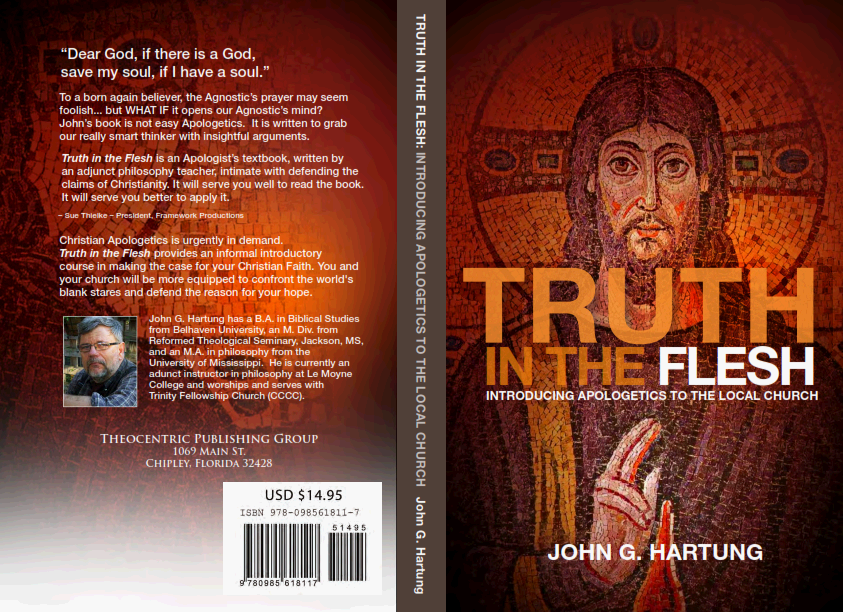 Truth in the Flesh
Hartung begins with an analysis of plausibility structures and “blank stares” (7ff). Throughout the work, Hartung works to make high level ideas accessible at the level where a lay person can come to an understanding, and the notion of a “blank stare” is just one example of how he does this. He notes that Christian claims are often met with a “blank stare.” Such incredulity is often based on one’s own presumption of “prestige” and “social gate-keeping.” To break through this kind of barrier, Hartung suggests pressing on by questioning the listener on why they seem incredulous, which will open the path to discussing plausibility. He notes that one must keep in mind the notion that worldviews are at odds here, not just opposing views on individual topics.
Hartung’s discussion of the problem of evil is multi-leveled and interesting. He addresses the notion of evil as a privation, something that is a lack of something rather than a thing-in-itself. Hartung then analyzes how evil could possibly be viewed as a challenge to the existence of God. He offers Christ as a solution to suffering. God who suffers with us cures our suffering.
Hartung then turns to two purported challenges to Christianity: science and faith and religious pluralism. Regarding the former, Hartung addresses a number of issues, including supposed incompatibility of faith and science, the “god of the gaps” objection, the possibility of making an inference to God, and more. Regarding the latter, he considers the possibility of testing truth claims of religion, relativism, religious experience, and a few other topics. Ultimately, he concludes that neither of these supposed challenges undermines Christian faith.
Hartung’s case for the Christian faith is built upon a cumulative case version of argument. He builds bottom up from God to Christ to Christian theism. One of the several highlights from the second part of Truth in the Flesh is the discussion of philosophical modernity. He traces modern thought from Plato on down through Locke and Hume and touches the important points of the development of their ideas. He continues to interact with these and other thinkers throughout the work.
Hartung’s arguments for the existence of God are concise and will give lay readers an introduction to a number of prominent philosophical arguments. He also offers a chapter in which he breaks apart the naturalistic worldview, arguing that it cannot account for meaning. Finally, the arguments for Christian theism specifically are added to the mix and the possibility of miracles, reliability of the New Testament, and the Incarnation are all defended.
Truth in the Flesh is an extraodinary work in a number of ways. Its breadth is impressive. Hartung manages to discuss extremely complex issues in such a way that those looking to learn about apologetics can understand, while those who have read thoroughly on the topic will get new insight and a great review. In particular, Hartung’s focus on some of the thinkers of modernity helps to make the work stand apart from the pack. I recommend Truth in the Flesh primarily as an introductory text for apologetics, but also as a great reference for those who are experienced in the field.
Source
John Hartung, Truth in the Flesh
Disclosure: I received a copy of the book for review from the publisher. I was not asked to endorse it, nor was I in any way influenced in my opinion by the publisher. My thanks to the publisher for the book.
SDG.
——
The preceding post is the property of J.W. Wartick (apart from citations, which are the property of their respective owners, and works of art as credited) and should not be reproduced in part or in whole without the expressed consent of the author. All content on this site is the property of J.W. Wartick and is made available for individual and personal usage. If you cite from these documents, whether for personal or professional purposes, please give appropriate citation with both the name of the author (J.W. Wartick) and a link to the original URL. If you’d like to repost a post, you may do so, provided you show less than half of the original post on your own site and link to the original post for the rest. You must also appropriately cite the post as noted above. This blog is protected by Creative Commons licensing. By viewing any part of this site, you are agreeing to this usage policy.
EPS Conference
I will be away for several days at the EPS Conference and EPS Apologetics Conference. I will be back to approve comments and engage in discussion after that!
The Prayer of Judith: A Devotion from the Apocrypha
 The Apocrypha is a wealth of devotional reading that remains largely untouched by Protestants. No longer, I say! Martin Luther said of the Book of Judith (in the Apocrypha): “[T]his is a fine, good, holy, useful book, well worth reading by us Christians. For the words spoken by the persons in it should be understood as though they were uttered in the Holy Spirit by a spiritual, holy poet or prophet who, in presenting such persons in his play, preaches to us through them” (cited in The Apocrypha: The Lutheran Edition With Notes, 5-6). It should be noted that Luther is not suggesting that the Apocrypha is on par with the sacred canon. Instead, his view of the office of the ministry is that those ministering are speaking through the spirit. He and others view the book of Judith as a piece of historical fiction, made clear to its readers that it was fictional by its commingling of names from different cultural backgrounds and its generally ahistorical nature. Although it is fiction, that does not undermine the possibility of spiritual truths.
Here, we’ll explore the Prayer of Judith in Judith 9:1ff and see how it points to God as transcendent Lord of all creation.
[Y]ou have designed the things that are now and those that are to come. Yea, the things you intended came to pass, and the things you decided presented themselves and said, ‘Lo, we are here’; for all your ways are prepared in advance, and your judgment is with foreknowledge. (Judith 9:5ff, ESV translation of the Apocrypha)
Judith here acknowledges that all which God plans comes to be. Note that here, Judith does not affirm that God specifically intends for each and every thing that occurs. Rather, this passage reveals that God is in control over all things, accomplishing His plan in such a way that the things He intends will come to pass. Yet the author does not imply that God intends for all things which do happen. Judith does not pray thanking God for causing evil–such would be wildly inappropriate. Instead, Judith focuses upon God’s comprehensive plan which takes into account all things. God has “prepared in advance” all His ways. His judgment and execution of plans is “with foreknowledge.” God’s plans are with absolute foreknowledge of what occurs, and we can trust in God to execute rightly.
[T]hey [the Assyrians] trust in shield and spear, in bow and sling, and know not that you are the Lord who crushes wars; the Lord [YHWH] is your name. (9:7b)
One of my favorite lines in the entire book of Judith: “the Lord who crushes wars.” Think about the implications there: it is God who is control of the destinies of nations. Although the weapons of humanity may be raised against each other, the Lord crushes the war itself. We are reminded in Revelation that there will be a day with no more tears (Revelation 21:4). One day, God will crush the very possibility of war.
 Furthermore, it should be noted that in context, Judith is not suggesting that God is against any type of war per se; after all, Judith goes on to behead the leader of the Assyrians and the Israelites pursue the Assyrians from their land. Instead, it is the trust in human invention that is under assault here. The Assyrians put their trust into their own weapons instead of God. Rather, it is God who should be trusted, for it is God who has the power not only to wage war but to destroy war itself.
[C]rush their arrogance by the hand of a woman. (9:10b)
God uses the unexpected for His ends. Women were not the expected leaders; deliverance was more likely to have come from a great general–a man. Yet God uses the weak to bring down the strong.
[C]ause your whole nation and every tribe to know and understand that you are God, the God of all power and might and that there is no other who protects the people of Israel but you alone! (9:14)
Judith continues her prayer, exhorting God to bring His message to all peoples across the whole earth. Such is our own call as Christians. We are to carry out God’s plan in this mortal realm and bring God’s message to the whole earth. Yet we cannot forget that it is God alone who is our unfailing protector. We can trust only in God, not our weapons, not our might: we must trust in God who is far beyond such earthly powers.
Amen.
Source:
The Apocrypha: The Lutheran Edition With Notes
SDG.
——
The preceding post is the property of J.W. Wartick (apart from citations, which are the property of their respective owners, and works of art as credited) and should not be reproduced in part or in whole without the expressed consent of the author. All content on this site is the property of J.W. Wartick and is made available for individual and personal usage. If you cite from these documents, whether for personal or professional purposes, please give appropriate citation with both the name of the author (J.W. Wartick) and a link to the original URL. If you’d like to repost a post, you may do so, provided you show less than half of the original post on your own site and link to the original post for the rest. You must also appropriately cite the post as noted above. This blog is protected by Creative Commons licensing. By viewing any part of this site, you are agreeing to this usage policy.
Really Recommended Posts: 11/09/2012
 I have featured literary apologetics, apologetics to Muslims and Jehovah’s Witnesses, geocreationism, and more. Check out the posts. Let me know what you liked. Come back for more.
Elves, Orcs, and Freaks: The Shared Authorial Vision of JRR Tolkien and Flannery O’Connor– Garret Johnson has written a very interesting look into the works of Tolkien and O’Connor. He notes that they viewed fiction as reality from a different outlook. It’s a fascinating post, and there is a second part, which can be viewed here.
An Encounter with a Jehovah’s Witness– It is easy for Christians to slam their doors on those who come door-to-door. What if, instead, we engaged them? This post is a model for engagement and provides some ways forward to engage with Jehovah’s Witnesses.
The Day After: My Thoughts on the Presidential Election– Michael Licona, author of The Resurrection of Jesus: A New Historiographical Approach
Human Footprints in Dinosaur Footprints– Over at GeoCreationism (a highly recommended site), Mike addresses the notion that human and dinosaur footprints have been found together or side by side. Some argue that this supports young earth creationism. Mike explores the paleontological evidence.
Meet the Multiverse– Edgar Andrews, author of what I think is the best introduction to Christian apologetics with a scientific emphasis, Who Made God?
Did Jesus Claim to be Divine? (Answering Islam)– I found this look at answering Muslim objections to the deity of Christ refreshing. It offers an essentially presuppositional approach, which I have found to be very useful when engaging with Muslims. Check it out.
Book Review: “Always Ready” by Greg Bahnsen – Presuppositional Apologetics
 Greg Bahnsen is well-known within the community of presuppositional apologetics (with good reason–see his debate with prominent atheist Gordon Stein). But what is presuppositional apologetics? How is it distinctive from other approaches to defending the faith? Bahnsen seeks to answer those questions (and more) in his work, Always Ready
In section one, Bahnsen introduces one of the most important aspects of the presuppositional approach: the focus upon the impossibility of epistemic neutral ground. Often, in debates over the verifiability of the faith, the believer is encouraged to set aside their neutrality. Bahnsen argues forcefully that to do so is not just to give up a great weapon in the defense of the faith; it actually damages one’s defense irreparably (3ff). Because of the impossibility of neutral ground, Bahnsen urges apologists to begin not with any supposed neutral ground, but rather with “fear of the Lord” (5). What does he mean by this? Simply put, “the Christian presupposes the truthful word o f God as his standard of truth and direction” (19, emphasis his). The Bible, in other words, is the epistemological starting point for the presuppositional apologist. Rather than starting with a defense of the Bible, the apologist is to start with the Bible as given.
Bahnsen realizes that this point is the one which will likely be most contentious for those who oppose the presuppositionalist approach and thus he turns to a defense of the use of the Bible as an epistemological foundation. He argues that “God’s word has… absolute epistemic authority and it is the necessary presupposition of all knowledge which man possesses” (29). One argument against this presupposition is that it is dogmatic. The argument is made that one cannot simply presuppose their own position to take on all comers. Against this, Bahnsen argues that the presuppositional approach is in fact dogmatic because any approach is dogmatic. On a Christian perspective, knowledge without God’s Word is impossible. Therefore, a Christian cannot set that aside as though one could become “neutral”; in doing so, one has in fact rejected the Christian worldview (31, 7-9, 34, 36). Others may object that this seems to make any knowledge of non-Christians impossible. Again, Bahnsen corrects such a view, arguing that unbelievers “cannot but have them [knowledge of God as a presupposition for knowledge] as a creature made as God’s image and living in God’s created world” (38). In other words, he holds that the unbeliever unwittingly holds to Christian presuppositions in order to have any kind of knowledge. In principle, the unbeliever can have no knowledge; in practice, by borrowing from the Christian worldview, unbelievers have knowledge (ibid). Bahnsen does present several more arguments in favor of the presuppostional perspective, including an examination of the Christian perspective of the knowledge of unbelievers and the rebellion of those without God.
Part of the distinctiveness of the presuppositional approach is that rather than approaching the defense of the faith as a cumulative case, it presents Christianity as a worldview to line up against other worldviews in conflict. The importance of this is emphasized by Bahnsen.”The Christian,” he argues, “can never be satisfied to defend [the faith]… by merely stringing together isolated evidences…. [which] will be evaluated… by the unbeliver’s tacit assumptions; his general world-and-life view will provide the context in which the evidential claim is understood and weighted. What one presupposes as to possibility will even determine how he rates ‘probability'” (67). Thus, if one offers an argument for the existence of God, that argument will be evaluated by the unbeliever within their own assumptions. According to Bahnsen, only by destroying those assumptions–only by pitting whole worldviews side-by-side and showing how they rate on coherence with reality–can one adequately do apologetics. Bahnsen then turns to an evaluation of the conditions necessary for successful apologetics (81-106). Largely, this includes God’s soverein control over all things and fleeing from sin.
Perhaps the most illuminating portion of Always Ready is its presentation of various apologetic issues and the way that presuppositional apologetics provides answers to these arguments. For example, regarding the problem of evil, the presuppositionalist approach rests upon its usefulness as a paradigm of “worldviews in conflict.” Rather than trying to provide varied theodicies, the presuppositionalist argues, as does Bahnsen, “If the Christian presupposes that God is perfectly and completely good… then he is committed to evaluating everything within his experience in light of that presupposition” (171, emphasis his). Thus, on a presuppositional approach, the premise that “God has a morally sufficient reason for the evil which exists” is a given (172). For every evil, on the Christian worldview, God has a morally sufficient reason. Only by assuming that Christianity is false can one argue that the problem of evil is truly a problem. Thus, Bahnsen reevaluates the problem of evil as a psychological problem rather than a logical problem. It is a problem of trusting in God that God has good reasons for allowing evil (173).
Challenges to miracles are also assessed in light of presuppositionalism. At the core of the presuppositianalist response is again the centralization of the conflict of worldviews. Only by assuming that miracles do not occur can one exclude them a priori from investigation. Thus, the unbeliever has begged the question and their argument is undermined (225). Bahnsen answers a number of other arguments from a presuppositional perspective, including challenges from the possibility of metaphysics, religious language, faith, and the like.
The work ends with an extended investigation of Paul’s apologetic approach in Acts 17. Bahnsen argues that Paul’s approach was thoroughly presuppositional and that it acts as a model for the presuppositional approach to apologetics.
The strengths of Always Ready are immediately apparent. Bahnsen provides a thorough look at presuppositional apologetics which presents not just the outline of the approach but also several case studies in order to help people put it into practice. The distinctiveness of presuppositional apologetics shines throughout the book
There are a few flaws in the work, however. First, as is often the case, the presuppositionalism presented in this work is thoroughly Calvinistic. Simply being Calvinistic is not a flaw, but the way that Calvinism is presented by many defenders of presuppositionalism (Bahnsen, Van Til, Frame, and the like) is essentially as the one true faith. It is Calvinism or it isn’t Christianity. Frankly, that’s a huge problem. Setting that aside, the weakest point of the work is also its most important one: namely, the presupposition of the Bible as necessary for apologetics. There are a great many who are extremely skeptical of this approach. First, there is the charge of circularity, which presuppositionalists actually accept. Their response is that all worldviews are ultimately circular.The debate remains largely unsettled, but as for this reviewer, it is hard to accept that the entire Bible is a necessary presupposition for the defense of the faith. Finally, the dim view of individual evidences as useful for defense of the faith remains a problem within the presuppositional approach.
That said, even if one rejects the possibility of presupposing the Christian worldview wholesale, one can still utilize the presuppositional approach in their apologetic. By focusing squarely upon defense of the faith as a clash of worldviews, Bahnsen has highlighted the extreme usefulness of pointing out how presuppositions can color one’s outlook on the interpretation of evidences and the investigation of other positions. Although readers may not be ready to embrace the whole of presuppositionalism, after reading Always Ready, they may be ready to integrate a number of presuppositional approaches into their apologetic.
Source
Greg Bahnsen, Always Ready
SDG.
——
The preceding post is the property of J.W. Wartick (apart from citations, which are the property of their respective owners, and works of art as credited) and should not be reproduced in part or in whole without the expressed consent of the author. All content on this site is the property of J.W. Wartick and is made available for individual and personal usage. If you cite from these documents, whether for personal or professional purposes, please give appropriate citation with both the name of the author (J.W. Wartick) and a link to the original URL. If you’d like to repost a post, you may do so, provided you show less than half of the original post on your own site and link to the original post for the rest. You must also appropriately cite the post as noted above. This blog is protected by Creative Commons licensing. By viewing any part of this site, you are agreeing to this usage policy.
Pre-Election Day 2012 Political Readings for Christians
 The U.S. election in 2012 is just around the corner. I think it is a monumentally important election for a number of issues. I have surveyed the ‘net for Christian perspectives on varied political issues and presented them for your browsing pleasure. We are all biased, we cannot deny that, so please don’t bother accusing me of being biased one way or the other. I’ll talk issues, I won’t debate whether or not I’m biased (I am, and so are you).
Natural Law and Christians in the Public Square– One of the most difficult questions for Christians in politics is “How do we interact in the Public Square?” David VanDrunen provides a way forward by viewing Natural Law as a way to interact in the public square with people who don’t share our beliefs. It is an extremely lucid article, and I highly recommend it.
A Mormon in the White House?– One area that many Christians have expressed concern about has been whether we can vote for a Mormon without violating our conscience. Nick Peters over at Deeper Waters has a fantastic article that approaches this from a unique angle. Here’s one choice quote:
What we have to ask [in regards to the President] is not “Who believes like me the most in religion?”, but “Who is more capable of doing the job?”
If there is one area we should be concerned about, it’s that Christians unfortunately are not producing the best candidates. Christians are shying away from politics when we shouldn’t. There are several brilliant Christian minds that could make a difference in the world if we will allow them to do so.
Are Reproductive Rights Civil Rights?– Another area of major importance in the election concerns reproductive rights. Paul Rezkalla discusses this hot issue from a unique perspective: whether it involves civil rights. I have written a great deal about abortion specifically on my pro-life page.
California: Obamacare exchanges will raise health insurance premiums up to 25%– Obamacare is supposed to make life easier on those without health insurance, and even on those with health insurance. Does it actually do that? This case study in California suggests otherwise. Wintery Knight’s site is awesome in general, so I would recommend you browse it.
Should we vote for 3rd party candidates?– A pragmatic argument for voting with the major parties in order to bring about the most possible good. There is an alternative view on why we cannot compromise offered below, the post with a title starting “Abolitionist’s Voting Guide.”
Abolitionist’s Voting Guide addendum, or more info on how we will note vote Romney– Abolish Human Abortion, a movement I wholeheartedly support, offers this post on why we cannot vote for compromise regarding the abortion issue. Equally important is their “Abolitionist’s Voting Guide” which argues against any type of compromise when it comes to one’s vote. I highly recommend reading this along with the post above on whether we should vote 3rd party. It will help give you a balanced perspective.
Your Vote in this Election– Tom Gilson at Thinking Christian urges Christians to vote and to use discernment in their voting decisions. Some great advice in a concise form here.
Freedom of Religion and the HHS Mandate– I write about HHS Mandate and the fact that it is not so much the issue of contraception or abortion that is at stake; rather it is religious freedom that is under attack.
Modern Secularism and its Disdain for Conscience– Are Christians imposing their religion on others? Can we vote for what we believe? A number of tough topics are tackled in this great post.
A Pre-Election Post: Abortion and the Right of Conscience– Matt shares some insight into the right of conscience in the medical field. He explores how the topic relates to the coming election.
For the Roman Catholics out there (and those interested, like me!), check out Disciple’s post on the Vote which features a number of Catholic resources for voting discernment.
Really Recommended Posts 11/02/12
Snowy Owl Post edition of Really Recommended Posts. Why snowy owl? Because it is snowing outside here. This week, I feature a whole range of posts. Yes, they are diverse. Yes, they are awesome. Read them all. Let me know what you think. Share with friends.
Stop Teaching Young Christians About Their Faith– say what!? Yes, you read that right. Stop teaching about faith. Challenge them to more than rote memorization. Check out this fantastic post.
Young Earth Creationism and the intensity of volcanism– Is there a curve of decreasing volcanic activity that supports old earth creationism? The Geochristian investigates.
You Say the Bible Advocates Slavery?– Erik Manning shares some insight into a common ad hominem attack against Christians and the Bible. Does the Bible actually advocate slavery? What kind of morality is that? I highly recommend this post.
A short, humorous video in which William Lane Craig discusses the multiverse.
Mandy Patinkin: 25 Years After ‘The Princess Bride,’ He’s Not Tired Of That Line– No, this is not really related to apologetics. But it is about “The Princess Bride
Four Myths About the Crusades– The Crusades are a hot-button topic. They are used as an easy way to bash Christians. What actually happened? What can history teach us about the Crusades? Check out this post to find some thought-provoking answers.
Biden on Abortion– The VP Debate ended with a question about abortion. I largely think both VP Candidates failed to answer consistently, though Paul Ryan’s answer was slightly better. Biden’s answer was patently absurd. Check out Nick Peters’ response to Biden’s incoherence on the topic of abortion.
The Continuing Influence of the Reformation: Our lives, our thoughts, our theology- Reformation Review
 The Reformation has had a lasting impact upon our lives. You may not realize it, but from the economy to politics, from theology to family life, the debates of the Reformation resonate through to today. Here, we will investigate in very broad strokes the influence the Reformation continues to have on our daily lives.
Family
The Reformation period led to a development of thought about the family. Praise of the family over and against celibacy was ubiquitous throughout the Reformation thinkers (Diamard MacCulloch, The Reformation
The Reformation’s thought on marriage was largely patriarchal. Men were the heads of the family both spiritually and in society. This was less a development of the Reformation as it was a continuation of the view of marriage in contemporary cultural thought. Interestingly, Protestantism led to a relaxation of two aspects of marriage. First, the clergy was allowed to marry; second, divorce was legally established in many Reformation contexts (MacCulloch, 660). By allowing for divorce, the Reformers undercut the notion of marriage as a sacrament (as above), but they also helped draw a distinction between the moral law of the Bible and the law of the land. Whether this was for better or worse, one may debate.
Economy
Capitalism had already begun before the European Reformations, having its renewal start in Italian city states in the 12th Century (for a detailed and extremely interesting discussion of this, see Rodney Stark, The Victory of Reason

The Reformation also paved the way for a “Protestant Work Ethic.” Martin Luther’s notion of the “priesthood of all believers” demolished the hard distinction between the “temporal” and “spiritual” realm which dominated the thought of the church at the time. By breaking down this barrier, hard labor was elevated. It was no longer seen as an inferior life to that of monastic withdrawal; rather, any type of work could be pleasing to God (McGrath, 256-258). In contemporary churches, one can often hear about how the engineer, the retail worker, the auto worker, and the like should all utilize their skills to the glory of God. Such thinking came directly from the Reformation.
 Theology
Clearly, the most pervasive influence of the Reformation has been upon theology. I have already written on a number of these aspects. The Reformation thought necessarily reflected upon the church. How do we define the church, and who belongs in the church? These questions drove the Reformers to a number of views on the role of the church universal. I discuss these at length in my post on the Church Universal. Central to the Reformation was the notion of sola scriptura. However, it quickly became apparent that without any specific way to interpret Scripture, radical individualism would follow. I’ve written on the Reformers views on these topics and the continuing debate today in my post on Sola Scriptura. To try to list all the areas of theology that the Reformation touched upon would be impossible for a post of this size, so suffice to say I will be discussing these more in the future.
Other Aspects
Diarmard MacCulloch, in his magisterial study of the Reformation, aptly named The Reformation
Counter Reformation
It would be remiss of me to write this without noting that one of the huge continuing influences of the Reformation was the Roman Catholic counter-reformation. The Reformation did not go by unnoticed by Roman Catholics, by any stretch of the imagination. Instead, the Catholic Church reacted against the Reformation and, in part, did so by incorporating many aspects of the Reformation.
Interestingly, some of the debates that played out within Protestantism were mirrored within the Roman Catholic Church. For example, a debate similar to the Calvinist-Arminian arguments became pervasive in Banezian and Molinist schools of thought. It is intriguing to note, however, that the Catholics largely allowed these debates to remain internal without dividing. The Catholic Church, it seems favored doctrinal humility over unity on a number of levels (for a discussion of doctrinal humility/unity, check out my post on the Church).
That is not to say, however, that the Roman Catholics were eager to affirm every aspect of the Reformer’s theology. Part of the counter-reformation included the Inquisition and the formation of the Society of Jesus (Jesuits). Ignatius of Loyola founded the Society of Jesus to counter what he saw not as doctrinal aberration but lives that were not conformed to the moral standards of the church (Carter Lindberg, The European Reformations, 333ff).
Finally, it could easily be argued that the modern innovation of Vatican II has its roots within the Reformation and Counter-Reformation. The changes brought about by Vatican II reflect a development of thought that has occurred since the Reformation on many of the issues brought up by the Reformers.
Conclusion
The Reformation’s influence on today’s society is pervasive. Our thinking on family, economy, working, theology, sex and sexuality, and more are all reflections of the influence of Reformation thought. In many ways, these aspects of our lives are just further reforms on the thoughts of the Reformers. The aspects in which we have changed dramatically since the Reformation, it could be argued, are areas in which the Reformation laid the groundwork for exploration. Our thoughts are Reformation thoughts. Our debates are Reformation debates. Our God is the Reformation’s God.
Regardless of your own feelings on the Reformation, these comments are undeniable. The way you think is largely formed by the debates that happened during the Reformation. Your freedom of expression was opened by Reformation developments on the value of every human being. Investigating the Reformation is a worthy endeavor because it opens up new avenues for exploration of our own era.
Links
Please check out my other posts on the Reformation:
I discuss the origins of the European Reformations and how many of its debates carry on into our own day.
The notion of “sola scriptura” is of central importance to understanding the Reformation, but it is also hotly debated to day and can be traced to many theological controversies of our time. Who interprets Scripture?
The Church Universal: Reformation Review– What makes a church part of the Church Universal? What makes a church part of the true church? I write on these topics (and more!) and their origins in the Reformation.
Sources
Alister E. McGrath, Reformation Thought: An Introduction
Carter Lindberg, The European Reformations
Diarmaid MacCulloch The Reformation
Rodney Stark, The Victory of Reason
Thanks
Alister McGrath’s Reformation Thought: An Introduction was a gift from an anonymous donor. I was blown away when I saw it show up at my door and I have to say Thank you so much for being such a blessing! Whoever you are, you made my day. Well, more than just one day actually. This series of posts is a direct result of your donation. Thank you!
SDG.
——
The preceding post is the property of J.W. Wartick (apart from citations, which are the property of their respective owners, and works of art as credited) and should not be reproduced in part or in whole without the expressed consent of the author. All content on this site is the property of J.W. Wartick and is made available for individual and personal usage. If you cite from these documents, whether for personal or professional purposes, please give appropriate citation with both the name of the author (J.W. Wartick) and a link to the original URL. If you’d like to repost a post, you may do so, provided you show less than half of the original post on your own site and link to the original post for the rest. You must also appropriately cite the post as noted above. This blog is protected by Creative Commons licensing. By viewing any part of this site, you are agreeing to this usage policy.
Really Recommended Posts- Halloween Edition 2012
 Halloween is this week. How are Christians to interact with this holiday? Some believe it is a purely evil celebration and caution other Christians against it; some believe it is harmless and enjoy participating. I have gone across the web and collected these links with discussions on the topic from various Christian perspectives.
Halloween and the Fascination with Fear– Stephen McAndrew, author of Why It Doesn’t Matter What You Belive If It’s Not True, comments on how our fascination with things whose existence we generally dismiss points to something beyond our everyday reality.
Sent into the Harvest: Halloween on Mission– Over at Desiring God, check out this post which points out Christians are sent to the world and comments on how that may relate to Halloween.
The Tricky Topic of Halloween– (You’ll need to scroll down to the heading of the same title.) RTB scholar Ken Samples, author of 7 Truths that Changed the World, discusses Halloween. He shares some history of Halloween as well as suggestions to Christians about the holiday. A very useful discussion.
Halloween- The Great Omission?– A phenomenal post on a mission-oriented view of Halloween. It’s also entertaining to read, so check it out!
Hallelujah, Harvest, and Halloween Alternatives– Discussion about how Christians have utilized Halloween and made an alternate celebration or holiday. It has a few suggestions for how to incorporate these alternatives.
A balanced perspective on the topic found at: As a Christian, Should I celebrate Halloween?
Redeeming Halloween– Discussion of the book, “Redeeming Halloween” by Kim Wier and Pam McCune.
Halloween: Fascinated by Spirituality?– Interesting discussion on the motivations of Halloween and Christianity.
Of Halloween and Rubber Tanks– An interesting post talking about whether Christians should be spending time debating Halloween’s “Satanic Origins.”
What is Halloween?– Discusses the background of the holiday and some of the traditions that go with it.
A different perspective (with which I disagree, but respect) is given over at Christian Answers: Should Christians Celebrate Halloween?
A respectful, middle-of-the-road answer to the question “Should Christians Celebrate Halloween?” is given over at Grace Communication International.
Image Credit
Anthony92931 http://commons.wikimedia.org/wiki/File:Jack_O_Lanterns.jpg
Book Review: “Good News for Women” by Rebecca Groothuis
 The debate over women’s roles in the home and in the church rages on. A large part of the debate has focused upon the Bible verses that either side raises in defense of their view. Little of the debate has focused on the philosophical implications of either position. Rebecca Groothuis’ Good News for Women
Groothuis first turns to a Biblical case for the equality of men and women. She bases this notion on several Biblical texts. She refers to God’s creation of both male and female in the image/likeness of God (21ff). Her argument also goes into Galatians 3:26-28 and notes how it again draws out the equality between male and female. Regarding the discussions of women’s silence in the churches, Groothuis parallels these passages to those about slaves submitting to their masters:
[T]he strategy of the New Testament church was to tolerate the social subordination of slaves and women so as not to risk alienating non-Christians from the gospel, and yet to modulate and moderate these customs, and ultimately to point beyond them to God’s original intention for human relations. Today, however, when non-Christians are not likely to be offended by an equalitarian gospel, but are likely to find a hierarchical gospel offensive, we have no reason to perpetuate the cultural practices that were intially intended for Christians living in patriarchal societies (25).
Groothuis concludes that throughout the Bible, there is a pattern in which male and female are equal in being. They are, in other words, ontologically equal. Neither is more valuable than the other.
It should be noted that most complementarians today are willing to grant this case. They agree that women and men are indeed created equal and should have equal rights. Groothuis then turns to a series of philosophical arguments which seek to demonstrate that the complementarian position cannot consistently hold that women are equal to men while holding that they are excluded from the ministry. Her argument, therefore, goes deeper than an exegetical challenge. Instead, her argument undermines the theological core groundings of complementarianism.
The very core of Groothuis’ argument is that complementarianism is grounded upon an ontological difference between male and female. The reason she holds that complementarinism must hold this position is “[b]ecause a woman’s traditionally inferior status follows necessarily from the single fact of her essential, female nature, her status is itself a function of her ‘being’ [ontology]; it is determined by what she is, not by what she can do” (53). Complementarians hold that women cannot hold certain offices of the church due only to the fact of her femininity. It is not based upon a functional subordination in which the female chooses to take up a role that is subordinate (62ff); instead, it must be grounded upon the female’s nature as a female. There is nothing about the female which limits her from being a pastor, on most contemporary complementarian positions (that is, those which no longer hold that women are excluded from the ministry simply because she is not as smart or gifted as men in general). Instead, it is exclusively her feminine nature which determines her role as subordinate. Therefore, it is part of her essential nature. I have argued this point myself elsewhere: “Women in the Ministry: The philosophy of equality and why complementarianism fails.”
Grothuis continues with extensive argument to rebut the notion of servant leadership (78ff). She also deals with various analogies complementarians use to attempt to ground equality and hierarchy, such as the Trinity (55ff–it should be noted that grounding subordination in the Trinity undermines the doctrine of the Godhead). It should become immediately apparent as to how this leads to a problem for complementarians. Biblically, they are forced to concede that women and men are, in fact, equal. However, their position undermines this Biblical position of the equality of men and women. Therefore, it seems their position fails.
Groothuis then turns to a number of strategies that complementarians have used in order to try to tie the subordination of women in to patterns of the Godhead. Unfortunately, many of these strategies end up making God into a gendered creature rather than a transcendent Creator. Some complementarians, such as C.S. Lewis, actually go so far as to make God male (93). Groothuis points out that this gendering of God cannot be affirmed based upon the Bible. One difficulty is that both male and female language is used of God (93-94). Yet she insists that the debate must not become a simple adding up of verses on either side to see how God illustrates either gender. That would turn God into a “God who suffers from some gender identity confusion” (93). Instead:
The view that God is both masculine and feminine confuses and distorts the image of God in humanity. It requires that the divine image be divided between women and men, such that women image God’s feminine aspects and men image God’s masculine aspects. This sexualizing of spiritual attributes renders men and women spiritual ‘opposites,’ creating a need to compartmentalize aspects of spiritual life and ministry into separate masculine and feminine quarters. (98)
Groothuis also spends some time dealing with some of the odd–and frankly, pagan–ideas used by some complementarians. For example, some argue that God must act as a male in the creation event: one who gives so much, while the created world merely receives. To be blunt, they describe God’s creative act as a sexual act, with no Biblical support. Groothuis rightly points out that this idea is little more than paganism dressed up in theism, but goes on to note that “It seems a good deal of imagination and determination is required in order to characterize the strenuous effort required of a woman’s body in nourishing, growing, and delivering a child as ‘overwhelmingly passive,’ while depicting the male role of standing around watching it happen as ‘active’!” (95). Another abuse of gender in the Godhead involves some complementarians arguing that because Jesus was a man, only men can be priests (109ff). Groothuis points out that “If we are to regard maleness as essential to who Christ is as Christ, not only must we question whether Jesus Christ can represent women as fully as he can men… we must also view women as essentially inferior to men. Women lack the Christlike attribute of maleness that renders men best qualified to represent Christ…” (113). Interestingly, then, complementarians who utilize this argument essentially undermine the doctrine of the atonement: for Christ’s maleness is emphasized to the point that Jesus is not an adequate representation of humanity. He is essentially male.
The second half of Good News for Women focuses upon an evaluation of the texts used to support complementarianism. These texts are examined in light of the theological points already established. Namely, women and men are created equally as imagers/likenesses of God; and that any attempt to ground hierarchy ultimate fails because it undermines this Biblical concept of equality. A full presentation of Groothuis’ analysis of these texts would probably triple the length of this review, and I don’t see any way to sum up these arguments adequately in a few sentences, so I unfortunately must leave it to those interested to read the book to see these analyses.
Finally, it would be remiss to go without mentioning the outstanding contribution Groothuis gives to the discussion of egalitarian marriage. Groothuis discusses marriage in detail for over 40 pages of the book. What is astonishing is how lucidly she lays out the principles of egalitarian marriage. She illustrates the nature of marriage and how it is a give-and-take with both persons involved as opposed to one ruling over the other. She also discusses in detail how such an egalitarian system can work without having anyone to have a vote to “trump” the other’s vote. Frankly, the book is worth reading just for her discussion on marriage.
Groothuis’ most important contribution here is in the first part of her book, which establishes a strong theological and philosophical case for the equality of men and women in teaching roles in the Church and equal roles in marriage. However, there are numerous important insights throughout the text, both into specific verses and into overarching themes in the debate from both the complementarian and egalitarian positions. Groothuis’ discussion of egalitarian marriage provides a way forward for discussion on the roles of men and women in marriage and also helps to give insight into the Biblical view of marriage. Overall Good News for Women
Links
See my other writings on egalitarianism on my theology page (scroll to the bottom).
I argue that certain complementarian arguments undermine the Trinity.
I review a book which focuses entirely upon exegetical issues related to egalitarianism: Man and Woman: One in Christ.
Source
Rebecca Groothuis, Good News for Women
SDG.
——
The preceding post is the property of J.W. Wartick (apart from citations, which are the property of their respective owners, and works of art as credited) and should not be reproduced in part or in whole without the expressed consent of the author. All content on this site is the property of J.W. Wartick and is made available for individual and personal usage. If you cite from these documents, whether for personal or professional purposes, please give appropriate citation with both the name of the author (J.W. Wartick) and a link to the original URL. If you’d like to repost a post, you may do so, provided you show less than half of the original post on your own site and link to the original post for the rest. You must also appropriately cite the post as noted above. This blog is protected by Creative Commons licensing. By viewing any part of this site, you are agreeing to this usage policy.



