J.W. Wartick
“Manual of Christian Evidences”- Fisher Chapter 3 Guided Reading

Image from a camping trip I took.
I am leading a guided reading of the Manual of Christian Evidences by George Park Fisher. It is freely available online and will serve as a base for discussing Christian apologetics throughout this series. The chapters are short and readable. I encourage you to join in by reading the chapters and commenting with your thoughts. When I discuss the book, I will be citing page numbers from the edition linked above.
Chapter 3
Chapter 3 is quite short but has some thoughts to chew on. Perhaps the highlight is a brief exposition of the argument from felt need (also commonly called the argument from desire). Let’s talk about this and other issues below!
First, the discussion of the felt need for revelation in humanity (22-24). I wonder if this is an aspect of the argument that could be made stronger. It seems to me that the Bible speaks to the notion of all humanity knowing God, in some sense (Romans 1). But how do we tap into that? Do all people really have this felt need? There are plenty of atheists who deny such a felt need. I wonder if arguments focused on the existential need for Christianity could be expounded and strengthened. This argument is a different type than the more common one (below), but it still appeals to an pparent need within human nature that is met by Christianity. As more discoveries point to the notion of a “God gene” or psychological desire to believe in God, this argument, I think, actually gains more empirical support. Can such needs be reduced to nothing but genetics?
Second, regarding Fisher’s argument for the “way in which Christianity meets the deep wants of human nature” (25ff) is quite engaging. It is just the kind of argument people like us who are interested in historical apologetics are looking for: one that is not so commonly used now. But I think Fisher puts it forward masterfully. It is worth noting that he integrates wide ranges of evidence into his points. The first point is that the main truths of natural religion are put forth in Christianity in a “clear and vivid form” (25). Thus, Fisher is arguing that whatever is revealed in nature should point to the truth of Christianity. I’ve found this to be true time and again. After this first point, Fisher notes several lines of evidence that appeal to human conscience and desires.
I think this is an argument that could have broader appeal in our culture. People want to know that what they believe resonates with reality and pointing to how Christianity relates to desires can make it seem more real.
I do, however, wonder about things like the claim on p 26- “The moral precepts of Christianity are conformed to the dictates of conscience.” I think that this aspect of the argument would meet with vehement challenge as people charge Christianity with teaching against common sense and nature in regards to morality. How might we counter these responses?
Links
Be sure to check out the page for this site on Facebook and Twitter for discussion of posts, links to other pages of interest, random talk about theology/philosophy/apologetics/movies and more!
Apologetics Read-Through: Historical Apologetics Read-Along– Here are links for the collected posts in this series and other read-throughs of apologetics books (forthcoming).
Dead Apologists Society– A page for Christians interested in the works of historical apologetics. There is also a Facebook group for it.
SDG.
——
The preceding post is the property of J.W. Wartick (apart from quotations, which are the property of their respective owners, and works of art as credited; images are often freely available to the public and J.W. Wartick makes no claims of owning rights to the images unless he makes that explicit) and should not be reproduced in part or in whole without the expressed consent of the author. All content on this site is the property of J.W. Wartick and is made available for individual and personal usage. If you cite from these documents, whether for personal or professional purposes, please give appropriate citation with both the name of the author (J.W. Wartick) and a link to the original URL. If you’d like to repost a post, you may do so, provided you show less than half of the original post on your own site and link to the original post for the rest. You must also appropriately cite the post as noted above. This blog is protected by Creative Commons licensing. By viewing any part of this site, you are agreeing to this usage policy.
Really Recommended Posts 7/15/16- Ark Encounter, Pokemon Go, the Trinity, and more!
 Hello all! My apologies for missing out on the Really Recommended Posts for a few weeks. In between moving, doctor visits for the second child (!), and having family and friends in and out of the new place, it’s been absolutely chaotic. Anyhow, here are the latest reads I’ve found for you from around the web. As always, let me know what you think, and let the authors know as well!
Biologos Responds to the Ark Encounter– Answers in Genesis has made a huge splash in the news recently with their “Ark Encounter”- a $100 million theme park dedicated to young earth creationism. Here, from a different part of the spectrum of Christian belief about faith and science, Deborah Haarsma, the president of Biologos, offers a response to the Ark Encounter.
Pokemon Go and our longing for the world to be transformed– An intriguing post about how augmented reality games might point to our desire for more in the world than the mundane. My home church is a hotspot for Pokemon Go, in other news!
Send Dr. Giles to the Evangelical Theological Society Conference– Kevin Giles is one of the world’s foremost experts on Trinitarian theology and has written multiple books on the relation between God the Father and God the Son. I had the privilege of meeting him a few years ago and was blown away by both his courtesy and knowledge. Christians for Biblical Equality is raising money to send him to the ETS conference this year. This is greatly important, given the recent debates (click link to see summary) over the “Eternal Functional Subordination” of God the Son. Here’s another link from a different perspective on the topic.
As a Psychiatrist, I Diagnose Mental Illness. Also, I help spot demonic possession.– An interesting read whatever your perspective, this article by a psychiatrist speaks on how sometimes phenomenon occur which cannot be explained but by agents.
Christian Thinkers 101: A Crash Course on Soren Kierkegaard– Kierkegaard is one of the most misunderstood thinkers in Christianity. Here’s a crash course on his philosophical and theological thinking. Be sure to read the rest of the series to get introductions to a number of important thinkers.
Book Review: “Undeniable” by Douglas Axe
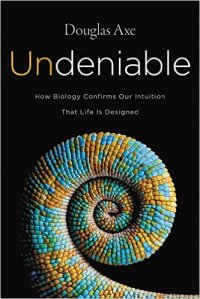 Undeniable: How Biology Confirms Our Intuition That Life is Designed by Douglas Axe is an explanation of Intelligent Design theory at a lay level. Axe contends that by appealing to “common science”—the notion that experience is integral to how we live and that each individual is, in a sense, a scientist because we use experience to make models and figure out how things work (60-61)—the inference to design will be vindicated.
A central aspect of Axe’s case is appeal to what he calls “The Universal Design Intuition” defined as “Tasks that we would need knowledge to accomplish can be accomplished only by someone who has that knowledge” (20). This intuition, argues Axe, is supported by experimental data, including difficulties with forming proteins to form specific chemical transformations (33ff). He also utilizes mathematical modeling to show that it is effectively impossible to achieve certain results purely by chance (89ff). It is insight that is required to achieve the results that we see in biology, he argues. There is no amount of repetition possible to offset the improbability of life in our universe and life as we see (103).
Counter-arguments to design are addressed, including the multiverse. Axe argues that “aimless wandering” of chance effectively means that anything but design for the results we observe is impossible. There is a specific “target area” which must be achieved to get life, and the odds against hitting that target are infinitesimal to the point that they are practically impossible (113ff).
Ultimately, Axe concludes, “Functional coherence makes accidental invention fantastically improbable and therefore physically impossible” (160). The sheer improbability stacked against the notion that life could evolve functionally to new life forms makes it physically impossible, thus showing that design is the best inference when it comes to life. Scenarios which are alleged to show evolution in action require tweaking from outside, thus demonstrating that insight and design are required for life (198ff; 209). Moreover, “Nothing evolves unless it already exists” (214), and the existence of life cannot merely evolve from non-life given the probabilities stacked against it.
Why, then, do so few scientists advocate for design or see it in nature? Axe’s answer to this question is that there is enormous bias and no small amount of power being wielded against the design inference: “Harm comes to science not by people hoping to find a particular result but by people trying to suppress results that go against their hopes” (45). He argues that there is at least some intentional suppression of design theory and that new ideas take time to gain space in academia (46ff; 215ff).
Axe’s argument is geared towards lay readers, though it does have a few new things to offer those who have read the majority of ID literature already. His analysis of the mathematics behind design inferences will help gain an understanding of what is meant by “possible” in logical vs. physical senses. Moreover, his firsthand experience of experimental confirmation gives him a voice that is not often heard in defense of ID. It is not merely modeling that is happening, but rather experimentation with results.
That said, there are a few issues in the book. First, I think that the continued appeal to bias as the reason for rejecting ID is overdone. Although some certainly do reject ID due to bias against the notion of a creator or designer, there are many who reject it because they find its arguments either inconclusive or mistaken. Bias exists, but it is not the only reason for rejecting ID theory any more than materialism is the only reason for rejecting ID. Second, evolution is treated as a kind of singular entity, with natural selection as the only mechanism proposed to accomplish the diversification of species. Though he acknowledges some efforts to modify evolutionary theory that acknowledge other mechanisms (220-224), he dismisses such efforts as “patching holes” instead of as serious alternative proposals. I admit I have no expertise in evolutionary biology, but I am familiar enough with the idea to know that several different notions of how evolution may produce new life forms are proposed, and that most acknowledge some combination of several factors is probably right. It seemed strange for Axe to largely dismiss these as dead ends. Third, there are several points of the argument that seemed rushed or simply passed by. I understand this is a book for laity, but the movement from seeing some aspect of evolution as physically impossible to design is an inference that requires some explanation beyond assertion.
Overall, Undeniable provides more food for thought for those interested in Intelligent Design and the debate between ID advocates and opponents. Axe does offer some insights that I, at least, haven’t read anywhere else. The book is also written at a level that almost any reader could pick it up and get the core of Axe’s argument. Those interested in the debate over Intelligent Design would be well-served to pick up a copy. I will be interested in seeing what responses are offered.
The Good
+Good introduction to ID theory
+A fresh take on some aspects of ID
+Use of examples that are easy to understand
The Bad
-Relies too much upon perceived bias in science
-Skims through much argumentation
-Little interaction with alternate evolutionary scenarios
Source
Douglas Axe, Undeniable: How Biology Confirms Our Intuition That Life is Designed (New York: HarperOne, 2016).
Disclaimer: I received a copy of the book for review from the publisher. I was not obligated to provide any specific feedback whatsoever.
Links
Be sure to check out the page for this site on Facebook and Twitter for discussion of posts, links to other pages of interest, random talk about theology/philosophy/apologetics/movies and more!
Book Reviews– There are plenty more book reviews to read! Read like crazy! (Scroll down for more, and click at bottom for even more!)
Eclectic Theist– Check out my other blog for my writings on science fiction, history, fantasy movies, and more!
SDG.
——
The preceding post is the property of J.W. Wartick (apart from quotations, which are the property of their respective owners, and works of art as credited; images are often freely available to the public and J.W. Wartick makes no claims of owning rights to the images unless he makes that explicit) and should not be reproduced in part or in whole without the expressed consent of the author. All content on this site is the property of J.W. Wartick and is made available for individual and personal usage. If you cite from these documents, whether for personal or professional purposes, please give appropriate citation with both the name of the author (J.W. Wartick) and a link to the original URL. If you’d like to repost a post, you may do so, provided you show less than half of the original post on your own site and link to the original post for the rest. You must also appropriately cite the post as noted above. This blog is protected by Creative Commons licensing. By viewing any part of this site, you are agreeing to this usage policy.
Book Review: “The Great Divide: A Lutheran Evaluation of Reformed Theology” by Jordan Cooper
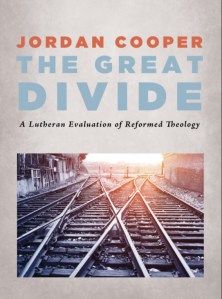 The Great Divide: A Lutheran Evaluation of Reformed Theology presents a broad-spectrum look at Reformed theology from a Lutheran perspective.* Cooper breaks this analysis up into three parts: Predestination and Free Will, Worship and the Sacraments, and Salvation. These parts are intended to show the greatest dividing lines between Reformed and Lutheran thought.
It is really quite exciting to see how well-read Cooper is on both Reformed and Lutheran thought. On the Reformed side, he frequently cites Calvin (of course), Bavinck, Edwards, Piper, Grudem, and more. On the Lutheran side, he draws from Luther, Chemnitz, Melanchthon, Kolb, and more. This thorough use of sources on both sides helps shield against bias, as Cooper continually cites the words of prominent theologians of each tradition.
Cooper provides in each chapter a presentation of Reformed thought on the topic, drawing extensively from prominent Reformed thinkers past and present, as well as various Reformed Confessions. Then, he provides a look at the Lutheran perspective, often quoting the Lutheran Confessions as well as prominent Lutheran thinkers. After providing this comparison, Cooper argues for the Lutheran position, noting the points of divergence along the way. At many points, this analysis is fairly robust. However, at other points Cooper does swiftly move from one point to another before providing enough to establish each point.
One of the things that comes to the front most clearly in the book is just how close Reformed and Lutheran thought are on a number of issues. Unfortunately, as close as the two traditions come on many areas, the chasm between the two remains vast. This is particularly clear in regards to the Sacraments and Predestination. I was also pretty surprised to see how different the Reformed and Lutheran view regarding worship is. The regulative principle within Reformed thought–that whatever is not commanded in Scripture ought not to be done in worship–was something that startled me. I hadn’t considered such a position, but Cooper showed the arguments for and against this position, coming down on the side of Lutheranism (again, he’s coming from that perspective), which sees worship as something that God allows for more leeway in than do Reformed thinkers.
It is truly amazing how much information Cooper manages to convey in just 200 pages. Readers are introduced to both Lutheran and Reformed perspectives on a number of important theological topics, treated to both exposition of those views and offered critique of the Reformed position all in a very clear style and form.
There are two minor critiques I’d offer of the book. The first is the continued use of the archaic “man” to refer to all people. There were, in fact, a few places in which I had to work to discern whether Cooper meant all people or just men when it came to what he was writing. A second critique is that because of the books relatively short length, some of the arguments on either the Reformed or Lutheran side seem extremely brief, leaving some of the arguments inconclusively demonstrated.
Jordan Cooper’s The Great Divide: A Lutheran Evaluation of Reformed Theology is a vast trove of information and analysis. Extensively researched and well-reasoned, it will provide readers unfamiliar with either Reformed or Lutheran theology (or both) an introduction to each tradition as well as a look at how they may interact with one another.
The Good
+Engages with prominent theologians from each group
+Historically informed
+Treats Reformed thought fairly
+Vast wealth of information
The Bad
-Continued use of archaic “man” etc. as inclusive
-Some points are breezed through very quickly
*It is worth noting my own bias here: I am a Lutheran who was raised Lutheran and, though I wandered a little bit, have become quite convinced of Lutheran theology in recent years.
Disclaimer: I was provided with a copy of the book for review by the publisher. I was not required to provide any specific kind of feedback whatsoever.
Source
Jordan Cooper The Great Divide: A Lutheran Evaluation of Reformed Theology (Eugene, OR: Wipf & Stock, 2015).
Links
Be sure to check out the page for this site on Facebook and Twitter for discussion of posts, links to other pages of interest, random talk about theology/philosophy/apologetics/movies and more!
Book Reviews– There are plenty more book reviews to read! Read like crazy! (Scroll down for more, and click at bottom for even more!)
Eclectic Theist– Check out my other blog for my writings on science fiction, history, fantasy movies, and more!
SDG.
——
The preceding post is the property of J.W. Wartick (apart from quotations, which are the property of their respective owners, and works of art as credited; images are often freely available to the public and J.W. Wartick makes no claims of owning rights to the images unless he makes that explicit) and should not be reproduced in part or in whole without the expressed consent of the author. All content on this site is the property of J.W. Wartick and is made available for individual and personal usage. If you cite from these documents, whether for personal or professional purposes, please give appropriate citation with both the name of the author (J.W. Wartick) and a link to the original URL. If you’d like to repost a post, you may do so, provided you show less than half of the original post on your own site and link to the original post for the rest. You must also appropriately cite the post as noted above. This blog is protected by Creative Commons licensing. By viewing any part of this site, you are agreeing to this usage policy.
Book Review: “Karl Barth’s Infralapsarian Theology” by Shao Kai Tseng
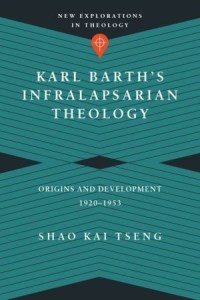 Shao Kai Tseng’s Karl Barth’s Infralapsarian Theology is a thorough examination of Barth’s lapsarian position. There are two major positions in Reformed circles regarding how God ordered the divine decrees. Supralapsarianism teaches that God decreed election (who would be saved) and reprobation (who would be condemned) prior to the Fall, while infralapsarianism teaches that God first decrees the Fall, then election and reprobation (among other things). Not all Reformed thinkers hold to one of these two positions. For a fuller explanation, see here, or look more deeply at the book. Barth, historically, has been understood as a supralapsarian, and even at times explicitly claimed that position for himself. Tseng argues, however, that Barth’s position is truly infralapsarian.
Tseng argues for his thesis through an examination of Barth’s developing thought. He begins with Barth’s earliest works and then traces his thought on problems of atonement, decree, and redemption throughout his life. Tseng interacts with numerous interpreters of Barth, utilizing them to support his theory or showing where they are mistaken.
The two greatest difficulties with the book are linked. Tseng’s tone is relentlessly even, such that there are few breaks for readers to pause and consider the contents, and few examples of application of the texts are given. This means that there is little reason given to investigate the central topic of the book: Barth’s lapsarian position. Why, exactly, does Barth’s lapsarian position actually matter to us now? Other than scratching a curious itch, what application does it have? Surely, for historical reasons, it is good to know where Barth ought to line up, but beyond that Tseng doesn’t give much of a reason for seeing why this impacts broader theological studies.
Of course, that doesn’t mean the book is without merit. Those deeply interested in Barth will want to engage with it and debate its contents. Moreover, because Tseng looks deeply at Barth’s developing thought, it provides some analysis of Barth’s overall theology.
Karl Barth’s Infralapsarian Theology is dry and fairly esoteric. For those who are deeply interested in Barthian thought, however, this will be necessary reading, particularly if one wants to engage in Barth’s doctrine of election. If one wishes to delve deeply into Barthian thought and Reformed disputes over lapsarian positions, this is a good read, but its audience is limited to that group.
The Good
+Exposes readers to large amounts of Barth’s thought
+Utilizes interpreters of Barth well
+Detailed look at the central topic
The Bad
-Little reason offered to pursue central topic
-Tone doesn’t put much “life” in the text itself
Disclaimer: I was provided with a review copy of the book by the publisher. I was not required to provide any specific kind of feedback whatsoever.
Source
Shao Kai Tseng, Karl Barth’s Infralapsarian Theology (Downers Grove, IL: InterVarsity, 2016).
Links
Be sure to check out the page for this site on Facebook and Twitter for discussion of posts, links to other pages of interest, random talk about theology/philosophy/apologetics/movies and more!
Book Reviews– There are plenty more book reviews to read! Read like crazy! (Scroll down for more, and click at bottom for even more!)
Eclectic Theist– Check out my other blog for my writings on science fiction, history, fantasy movies, and more!
SDG.
——
The preceding post is the property of J.W. Wartick (apart from quotations, which are the property of their respective owners, and works of art as credited; images are often freely available to the public and J.W. Wartick makes no claims of owning rights to the images unless he makes that explicit) and should not be reproduced in part or in whole without the expressed consent of the author. All content on this site is the property of J.W. Wartick and is made available for individual and personal usage. If you cite from these documents, whether for personal or professional purposes, please give appropriate citation with both the name of the author (J.W. Wartick) and a link to the original URL. If you’d like to repost a post, you may do so, provided you show less than half of the original post on your own site and link to the original post for the rest. You must also appropriately cite the post as noted above. This blog is protected by Creative Commons licensing. By viewing any part of this site, you are agreeing to this usage policy.
Christian Disagreement About Doctrines
 Christians disagree about things. There, now that I’ve made the understatement of the century, I want to explore how Christians disagree about things. These usually aren’t just “things” but are rather doctrines–teachings that we believe and confess as the truth about reality itself. Not only that, but we believe that these are the things which God taught us in God’s very word revealed to us. That is not a recipe for thinking kindly of others when disagreement occurs. After all, they aren’t just wrong, they are in violation of God’s own word!
Some Personal Examples
Too often, the tenor we have in disagreement is something that reflects an extraordinarily un-Christlike manner. Several personal experiences have led me to writing this post.
I was once accosted by someone who had been directed my way by a mutual acquaintance. After summarily consigning me to hell and taunting me for being unwilling to engage in a debate with him, he asked me to direct him to some exegetical case for my position. I mentioned a book. His response was that he’d read the book and knew it was all wrong. Later in that same conversation he admitted that he’d lied about reading the book. I said I forgave him, but asked him to consider the fact that he was willing to lie about reading a book just because he was so convinced it would be so utterly worthless to him that he could just dismiss it without even having heard of it before. When I continued to refuse to respond to his insults (including his attacks on my wife) and his accusations of blasphemy, he finally stated that he was convinced that the reason I wouldn’t respond was because the Holy Spirit had shut my mouth and wouldn’t let me type responses to him because I was so blatantly wrong.
Was there any acknowledgement of how he was verbally abusing me and my wife on social media? No. Instead, his self-righteous assumption was that God had deigned to prevent me from typing responses to an angry man made blind by hatred.
Another time, I received a comment (not approved) on a post about engaging culture from a Christian perspective. The interlocutor suggested that I was a pagan promoting evil to fellow Christians. When I noted that this person had never even met or talked to me before, he responded, “I have spent a ton of time in cult and street ministry… If you’ve talked to one, you’ve talked to em all. Same lingo same, same pagan book reviews, same plastic cordiality, on and on on. Just switch the faces around. I have read and heard EVERY conceivable argument that will ever be possible regarding what you say… I am thoroughly versed in that unbiblical, antichristian garbage they taught you at Biola. Your fellow drones are roaming about the online countryside in hordes.”
These are extreme examples, yes, but they are just a few among the many, many examples that I and I’m sure countless others could cite of Christians acting without any semblance of charity or obedience to Christ to “Do unto others as you would have them do unto you.” I’m not here throwing a pity party–though I admit sometimes that would be nice!–nor am I attempting to promote my own views which were being criticized in these and other comments. After all, I’m sad to say that I’m convinced people who hold my view act the same way towards those with whom I disagree. The point is that this is completely unacceptable in any context, let alone one in which Christians are interacting with fellow Christians, who are going to inherit the earth.
Some Reflection
I’ve already hinted at an approach, which is to remember Christ’s commandment to “Do unto others as you would have them do unto you.” It is easy to say that, but how often do we actually think about what that means? I am fairly confident the hate-filled man who insulted my wife and I on social media while telling us to repent or go to hell didn’t much consider how he would have felt if someone did the same thing to he and his wife. Nor, I suspect, would the writer of the other example have been pleased to see me assuming that I had already conceived of every possible argument that would “ever be possible regarding” what he had to say… and dismissed them.
But again, these are extreme examples. I’m using them to highlight something, however, which is that we do this kind of thing all the time, just not on the same level. Any time we come along and refuse to listen to one with whom we’re disagreeing, or even simply wait for them to stop talking so we can jump in to show them how wrong they are–any of these times, we have disobeyed our calling to be Christ to others. Recently, I had a discussion with a fellow Christian with whom I had disagreement and they said they’d look into a source I showed them. But they followed that comment up by saying, effectively, “and I know that source is completely wrong.” This kind of theological hubris demands a cure.
A Way Forward
First, we need to note it is perfectly okay to think you’re right about something. That’s not what is at issue here. What is our concern is how we express disagreement. Second, I think it is important to not only focus on what I’d like others to change about their attitude, but also on how I might change to understand others better.
One thing I have found helpful is to try to remember the spectrum of theological humility and theological unity. Theological humility is an approach which we can take to admit that we may be wrong. I am a fallible human, so my interpretation of God’s words could be mistaken. Theological unity is an emphasis on the importance of agreement. People will fall along a spectrum of positions between extreme humility (I might or even probably am wrong about most things) and extreme unity (if you disagree with me about anything you must be an idiot). When in dialogue, we should try to explore where the other person falls along this spectrum. It is likely that if they fall on either extreme, a dialogue will be difficult to move forward. Sometimes it is best to stop a dialogue before it becomes heated.
Another thing to think about is our own need to be at least somewhat humble theologically. Yes, I believe I have rightly discerned what God has taught in the Bible, but it is possible that I am mistaken. That is because, shock of all shocks, I am not God. Thus, it is always possible for me to be wrong. We ought to reflect on the fact that we are all sinners who have fallen short of God’s glory, and sin impacts our mind, among other things. This does not mean we aren’t allowed to believe we are correct. What it does mean is that we should never be so certain that we are right that we won’t even give ear to someone who disagrees. Why? Well, apart from the fact that we would like them to listen to us (going back to Jesus’ words about doing to others…), we should also remember that our attitude towards others will likely determine how willing they are to hear what we have to say. Moreover, it is true that we could always be possibly mistaken, no matter what the one commentator quoted above said. We may think we’ve run into every possible permutation of arguments for the other side, but we are limited beings with finite imagination.
Concluding Thoughts
I think it is a good exercise to once in a while re-examine my beliefs about various doctrines. Why? Because I want to make sure I am always in pursuit of truth. This re-examination means not just reading sources which agree with me, but also sources on the other side.
Christians should be open to being wrong. We remain sinners, though we have been justified by faith in Christ. That doesn’t mean we will always be right about everything. We need to remember to be humble, that we are finite beings, and that God has called us to listen to others and respond to them with the same respect and dignity we would like to receive.
Links
Be sure to check out the page for this site on Facebook and Twitter for discussion of posts, links to other pages of interest, random talk about theology/philosophy/apologetics/movies and more!
Eclectic Theist– Check out my other blog for discussions about all kinds of topics including science fiction, history, fantasy movies, and more!
SDG.
Book Review: “None Like Him: 10 Ways God is Different from Us (And Why That’s a Good Thing)” by Jen Wilkin
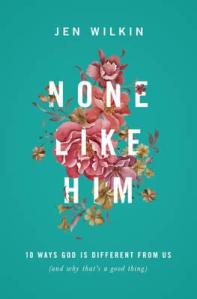
Jen Wilkin’s None Like Him is an introduction to the study of divine attributes.
Each chapter is laid out in much the same fashion: an anecdote begins each with a way to conceptualize the topic of the chapter (such as omnipotence), then an exposition of the meaning of the term and its importance in the Bible, following this there are a few ways that humans distort whatever divine attribute is being discussed, and the chapter closes with a few study questions, verses for more exploration, and a prayer. The format makes it ideal to use as a 10-11 meeting study group.
Upon starting the book, I immediately realized I wasn’t the intended audience. Although I checked the catalogue description and didn’t see anything about this, the book is apparently intended for study by women who are interested in getting deeper into theology. I’m a man, but I don’t think this precluded me in any way from doing a review of the book.
Wilkin’s use of examples, I felt, was particularly helpful. As I said, each chapter begins with an anecdote that helps illustrate the attribute or quality that is being disussed. Wilkin uses examples throughout the text to help make the abstract concrete, and I didn’t notice any that seemed to be off point. I also thought including sections on how humans distort various divine attributes was a wise choice, and made the book even more practical and applicable than it might otherwise have been.
The book is not without flaws, however. One of the most obvious is the somewhat ironic continued usage of the archaic “man” to refer to all humanity. Because the book is explicitly written for women (see the Introduction), this makes saying things like “our fellow man” in the same context as “we” sound stilted and strange. A deeper problem is that control of one’s own body is treated as a “sin” explicitly and exclusively even when it comes to a disease like anorexia or other eating disorders (Kindle Location 1746): “when we cross the line into unhealthy control [of our bodies], we move… to idolatry. This can take the form of… eating disorders…” No grace is offered in this passage for those who do struggle with things like eating disorders. Indeed, the message conveyed is contextually that all we need to do is stop “striving for control” and take away our commitment to “your own sovereignty” and we can then conquer these sinful issues. This is a deeply problematic to engage with something like an eating disorder, because eating disorders impact people mentally as well as physically to the point where it takes outside intervention to stop. Indeed, it is at this point that it might make the most sense to offer grace, because God’s inworking on humanity is what it takes to fight against such darkness in the world.
None Like Him is, ultimately, a decent introduction to the topics it covers. It doesn’t go much beyond the basics, but it does offer a good format and examples to help think through the issues. However, it is marred by a simplistic understanding of sin and adherence to archaic forms of expression.
The Good
+Interesting use of day-to-day examples
+Helpful format
The Bad
-Archaic use of masculine to refer… to women
-Treats disorders as inherently sinful
Disclaimer: I was provided with a copy of the book for review by the publisher. I was not obligated to provide any specific kind of feedback whatsoever.
Source
Jen Wilkin, None Like Him (Wheaton, IL: Crossway, 2016).
Ken Follett’s “Fall of Giants” – Deconversion, Hope, and Strife
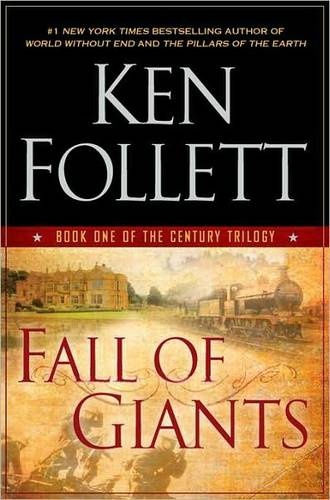
Ken Follett’s “The Century Trilogy” is a sweeping series . I just finished the first book, Fall of Giants, and realized there were several themes found therein that begged comment here. Here, I will analyze the book from a worldview perspective. There will be SPOILERS in what follows.
I will not go over the plot of the book. A brief summary may be found here.
Deconversion
Billy Williams is a Welsh boy who goes to work in a coal mine. The first day on the job he is left alone in the pitch black–his lamp went out. Rather than wandering lost in the tunnels he keeps working until someone comes to get him. To keep himself from being too frightened, he sings Christian hymns and draws comfort from them. At the end, when the light is restored, he sees a fleeting vision of Christ just at the corner of the light and says “Thank you.”
If that sounds like the start of a storyline that will be an example of a life of faith to you, you would be disappointed. After an explosion in the coal mine, he is distressed by the problem of evil–why does God let bad things happen? As he grows older, Billy is exposed to textural criticism. He is disturbed that we don’t have copies of the original texts from which we get the words of the Bible. His father, who often preaches at their worship services, has insufficient answers. Later in life, Billy’s sister gets pregnant and is judged sharply by his father and their town because she is not married. He is strongly put off by the apparent hypocrisy of the people. He never returns to church.
I admit that “deconversion” may be a bit of a misnomer because it is never specifically said that Billy doesn’t believe in God anymore, but the implications are there. He has a deep distrust of and distaste for Christianity, it seems, after this.
The story illustrates the need for a firm foundation. Textual criticism is not something Christians should fear, as it allows us to recover the text of the Bible more accurately. The problem of evil is not unsolvable. And, unfortunately, Christian hypocrisy is actually something to be expected. Indeed, the Christian worldview would expect hypocrisy at times because we are still sinners in this world and will continue to commit wrongs, despite being people of faith. None of this was hinted at in the novel, but I suspect that this is due in part to the fact that Follett is himself an avowed secular humanist. There seems to be an agenda here (and see below).
Unfortunately, Billy’s story is similar to one we can see repeating in churches and families all over. We have not studied our faith. We have not worked out the hard problems related to Christianity, so when we are confronted by them, we are often found with pat answers rather than the truth. We need to actively seek out answers and be aware of our own limitations. Unable to answer every question, we should commit ourselves to a life of faith seeking understanding.
Hope
There is hope found in the darkness throughout the coming World War and the plights of the individual people. Hope is found largely in the actions of other people–the small kindnesses that are done even in the face of evil. As the world seems to be crashing down all around, it is relationships which keep people going. Some of these are vaguely religious in nature, though the persisting theme seems to be that people need to do for themselves whatever they’d like to accomplish.
Religious Leaders?
One persistent theme throughout the book is that those involved in the church are mean, nasty, and most likely sexual deviants. Any time a priest-whether Roman Catholic or Eastern Orthodoxy or Anglican–is mentioned or encountered, it is almost always in context of some offhand remark about how they sexually harassed a child or how someone who is now an adult remembers when they were asked to have sex with the priest, etc. It’s actually quite tiresome. While on the one hand it is important to note that there are those within Christianity who have abused power throughout time, on the other hand, to suggest that everyone in some sort of position in power was a power-hungry sexual predator is uneven, to put it mildly.
Those who are not in established religion–like Billy’s dad–are portrayed as aloof, distant, and largely uncaring. Billy’s dad does get a chance to redeem himself as he accepts Ethel back into the family, but only after he had to consider the possibility of having his whole family fall apart.
Conclusion
Follett has woven an intriguing story with a very strong premise. It is unfortunate that throughout there also seem to be straight polemics against Christianity. A better balance was needed to make it seem realistic and not so much a diatribe against Christianity. Some good takeaways can be had from reading the book, but the worldview it presents is largely bleak and hopeless.
Links
Be sure to check out the page for this site on Facebook and Twitter for discussion of posts, links to other pages of interest, random talk about theology/philosophy/apologetics/movies and more!
Popular Books– Check out my other posts on popular books, including several other science fiction works. (Scroll down for more.)
Source
Ken Follet, Fall of Giants (Signet, 2012).
SDG.
——
The preceding post is the property of J.W. Wartick (apart from citations, which are the property of their respective owners, and works of art as credited) and should not be reproduced in part or in whole without the expressed consent of the author. All content on this site is the property of J.W. Wartick and is made available for individual and personal usage. If you cite from these documents, whether for personal or professional purposes, please give appropriate citation with both the name of the author (J.W. Wartick) and a link to the original URL. If you’d like to repost a post, you may do so, provided you show less than half of the original post on your own site and link to the original post for the rest. You must also appropriately cite the post as noted above. This blog is protected by Creative Commons licensing. By viewing any part of this site, you are agreeing to this usage policy.
Really Recommended Posts 6/17/16- horror movies, The Gospel Coalition, and more!

A picture of a goldfinch I took. All rights reserved.
Another week, another round of posts for you to enjoy, dear readers! This week has an exciting lineup–hopefully with some posts that will get you thinking and talking! This week, we have horror movies and Christianity, the Gospel Coalition’s (non-)engagement with culture, apologetics for kids with elephants and waterfalls, debate over the relation between the Father and Son in the Trinity, and the topic of the use of guns. As always, I’m curious to read your thoughts. I don’t always agree with 100% of everything I link, but try to choose posts that get me thinking and that I hope will get you thinking as well! [EDIT: I accidentally had one link to the wrong post. My apologies! It is fixed now.]
Why Horror Movies Make Me a Better Christian– I don’t like horror movies at all. Unless by “horror movies” you mean black-and-white horror movies with monsters that are hilarious now due to special effect differences (i.e. Creature from the Black Lagoon, etc.), then I love them. Can horror movies, with all their gore and violence, really have any redeeming qualities? This post made me think about that in a fresh light. What do you think?
The Gospel Colition and How Not to Engage Culture– Can The Gospel Coalition really claim to be about engaging with culture when they continually silence critics on social media? Check out this post for more information on this issue.
How Elephant is a Waterfall– How do you get kids thinking in different categories? What is concrete/abstract? What is a contradiction? Here’s a post from an exciting new site about apologetics for kids.
The Coming War: Nicene Complementarians vs Homoian Complementarians– There is a debate raging within complementarian camps over the subordination of the Son to the Father in the Trinity. Here is an outline of that debate. Read the follow-up posts as well for more. I’ve written on one side of this debate before- “Is the Son ‘Equal to God‘?”
Actually, Guns do kill people (Think Christian)– Think Christian is a great site for engaging culture and getting us thinking about topics we might not normally. This post is, I think, thought provoking regarding issues related to gun violence. It doesn’t offer solutions, but rather a way to conceptualize. What do you think about this issue? How might Christians engage with the topic of gun violence–or should we?
Book Review: “Wesley and the Anglicans” by Ryan Nicholas Danker
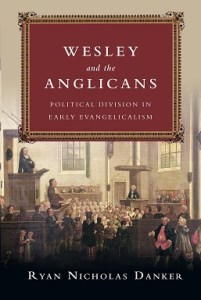 Wesley and the Anglicans by Ryan Nicholas Danker is an historical project about the developing split between John Wesley and the Methodists on the one hand and the Anglicans and Evangelicals on the other. Danker’s work offers a mixture of data and correction, exploring the topic in a way that brings new insights.
Danker does an excellent job interweaving different disciplines into his approach to the issues at hand. Instead of taking a purely theological approach to the reasons Wesley and the Anglicans split, he argues forcefully that sociological and political issues were just as–if not more–important to the division than the theological reasons. Indeed, theologically there was an Evangelical movement with Anglicanism (Danker uses Evangelical to refer to those within the Anglican church and evangelical to refer to those either immediately or ultimately outside of it). There were plenty of theological sympathies to be had for Wesley’s movement within the Anglican communion, but John Wesley (and Charles Wesley, his brother) ultimately pushed against the political and sociological hierarchy too hard to maintain unity.
Indeed, for Wesley, his commitment to aspects of the Anglican Church made the pushback from Evangelicals (and others) within the church more surprising to him. These ideas are developed through a number of case studies. For example, because of Wesley’s commitment to evangelism, he continued to encourage lay preaching. When confronted about how this may lead to laity taking over the Sacraments and the like, Wesley was (to sum up Danker’s argument) surprised; after all, he was not encouraging these lay preachers to make their own church buildings or orders of hierarchy–how could this therefore be seen as a challenge to the Anglican Church? Wesley’s own intriguing mixture of old and new made it difficult both for him to understand why he was being criticized so harshly and for those within the Anglican Church to see why he was being so divisive.
Political pressures were also brought to bear on the topic, and much of this was due to hierarchy within the church and concerns over how Wesley’s teaching might lead to a collapse of this hierarchy and unity of belief. Thus, laws were passed which began to make lay preaching more and more difficult, for small groups were suddenly considered rivals to official church business by law. Further pressure came from the laity, which began to push back and wonder why they couldn’t do things like administer the Sacraments. All of this came to a head over the course of several meetings of the Methodists, and ultimately led to the split with the Anglican Church we see today.
Danker does an admirable job uniting so many divergent threads into one continuous stream, but he does so in a way that sometimes leaves a bit to be desired. Perhaps the main downside of the book is that it reads very dryly. It doesn’t so much bring life to the historical persons and events as it does describe them. This does an adequate job of presenting the ideas and important topics, but it makes it less exciting to read than some other historic works. It conveys information, but doesn’t necessarily awaken a love of the topic in the reader.
Wesley and the Anglicans is an interesting read about a vital point in church history. Danker also demonstrates that church history ought to incorporate broader studies into its approach than just theology or history. It isn’t the most exciting history book, but it presents readers with a great deal of information on a topic of interest.
The Good
+Sheds light on an important time in church history
+Multi-disciplinary approach that incorporates sociology and politics into theology
+Full of information
The Bad
-Dryly presented
Disclaimer: I received a review copy of this book from the publisher. I was not obligated to provide any specific kind of feedback whatsoever.
Source
Ryan Nicholas Danker, Wesley and the Anglicans (Downers Grove, IL: InterVarsity, 2016).
Links
Be sure to check out the page for this site on Facebook and Twitter for discussion of posts, links to other pages of interest, random talk about theology/philosophy/apologetics/movies and more!
Book Reviews– There are plenty more book reviews to read! Read like crazy! (Scroll down for more, and click at bottom for even more!)
Eclectic Theist– Check out my other blog for my writings on science fiction, history, fantasy movies, and more!
SDG.
——
The preceding post is the property of J.W. Wartick (apart from quotations, which are the property of their respective owners, and works of art as credited; images are often freely available to the public and J.W. Wartick makes no claims of owning rights to the images unless he makes that explicit) and should not be reproduced in part or in whole without the expressed consent of the author. All content on this site is the property of J.W. Wartick and is made available for individual and personal usage. If you cite from these documents, whether for personal or professional purposes, please give appropriate citation with both the name of the author (J.W. Wartick) and a link to the original URL. If you’d like to repost a post, you may do so, provided you show less than half of the original post on your own site and link to the original post for the rest. You must also appropriately cite the post as noted above. This blog is protected by Creative Commons licensing. By viewing any part of this site, you are agreeing to this usage policy.

 J.W. Wartick - Reconstructing Faith