J.W. Wartick
Book Review: “John Newton on the Christian Life” by Tony Reinke
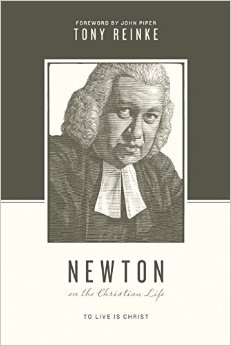 Newton on the Christian Life presents the theology of John Newton (more on that later) in light of Christian living. Central to Newton’s theology is the notion that “to live is Christ.” We as Christians are to continually rely upon Christ in all things.
The book has only parts of Newton’s biographical information found throughout the various chapters, but there is enough there to get a picture of the mighty fall the man had and the depths from which God plucked him. Here is the man who wrote the hymn “Amazing Grace” and who was friend of such prominent persons as William Wilberforce, yet who had worked on a slave ship and taken place in the vulgarities thereof. It is truly a story of grace, but Reinke emphasizes throughout the book Newton’s own commitment to “to live is Christ.”
The concept of living as Christ or “being Christ” is central to the book, which highlights again and again. Newton’s belief in, description of, and application of this concept are each drawn out in detail. Admittedly, this emphasis became a little overmuch by the end of the book as it seemed some themes were touched on over and over. However, there are many other insightful points throughout the book which are intertwined with Newton’s emphasis.
For example, the chapter on “Christian blemishes” utilizes examples of how we might live our life as Christians in ways which are largely commendable, but which lend themselves to certain sins. Another chapter highlights the effects of indwelling sin from Newton’s perspective (himself a Calvinist) and applies this to the Christian life. The chapters on spiritual weariness and battling insecurity are extremely pastoral and applicable in their content and tone and, I think highly valuable. Yet another deeply insightful section was chapter 9, which speaks about how trials in our lives can be used as spiritual discipline. Finally, the section on “Victory Over Mr. Self” that spoke of theological controversies had profound insights into how we should treat others with whom we disagree. I should note that I’m a Lutheran and at no point felt that I was not getting value for my time out of this book, despite Newton’s own strong Calvinism. I would say that anyone could benefit hugely from these chapters.
There is a wealth of firsthand quotations from Newton himself in the book, which makes it well worth engaging for that purpose alone. The pastoral tone and care that Newton had shines through in these quotations and Reinke himself does an excellent job summarizing points in a way that lends itself to the same tone as the man about whom he is writing.
One critique may be my own obtuseness coming through, but I think it’s worth mentioning. When I first got the book I saw some guy with a wig on the cover and thought–reasonably enough, I think–that “Newton” probably referred to Isaac Newton. It wasn’t long into the book before I was disillusioned, but I think that although it might make sense to leave books in the series consistent, given that not everyone may immediately think of John Newton instead of Isaac Newton, it might have been a better choice to include first names across the board. I asked a few friends who they thought the book was about based on the cover or title and every single one said Isaac Newton. It’s not a substantial critique, but I think it was worth a mention.
Another criticism I have is that there is virtually no use of women as examples in the discussions. Much of this is because Newton himself did not use women as examples in his letters and Reinke worked closely with Newton’s own writings. However, it would have been nice to have some counter-balancing examples to show that women struggle with the same problems. Here and there this is brought out in a letter, but it is very rare and noticeably so.
Newton on the Christian Life is an excellent read worthy of a thorough study. The examples he used can be applied in all kinds of pastoral contexts, and the emphasis on life in Christ is commendable. Moreover, the last several chapters are completely full of deeply impactful and applicable insights into the Christian life. The book comes highly recommended.
The Good
+Great insight into the pastoral theology of John Newton
+Extensive quotes from the letters of Newton
+Filled with insights
The Bad
-Sometimes repetitive
-Title could stand to be clearer
-Almost every single generic person used as an example is masculine
Disclaimer: I was provided with a review copy of the book from the publisher. I was not asked to give any specific kind of feedback whatsoever.
Links
Be sure to check out the page for this site on Facebook and Twitter for discussion of posts, links to other pages of interest, random talk about theology/philosophy/apologetics/movies and more!
Luther on the Christian Life by Carl Trueman– I review another book in this series, this one focusing on Martin Luther.
Book Reviews– There are plenty more book reviews to read! Read like crazy! (Scroll down for more, and click at bottom for even more!)
Source
Tony Reinke, Newton on the Christian Life (Downers Grove, IL: Crossway, 2015).
SDG.
——
The preceding post is the property of J.W. Wartick (apart from quotations, which are the property of their respective owners, and works of art as credited; images are often freely available to the public and J.W. Wartick makes no claims of owning rights to the images unless he makes that explicit) and should not be reproduced in part or in whole without the expressed consent of the author. All content on this site is the property of J.W. Wartick and is made available for individual and personal usage. If you cite from these documents, whether for personal or professional purposes, please give appropriate citation with both the name of the author (J.W. Wartick) and a link to the original URL. If you’d like to repost a post, you may do so, provided you show less than half of the original post on your own site and link to the original post for the rest. You must also appropriately cite the post as noted above. This blog is protected by Creative Commons licensing. By viewing any part of this site, you are agreeing to this usage policy.
Abortion, the Violinist Analogy, and Body Parts

A Pro-Life Demonstration at the Supreme Court. Courtesy Wikimedia Commons.
The “violinist analogy” is an argument for the permissiveness of abortion. It is based on granting that the unborn is a human person, but argues that it is still permissible to kill the unborn because it may be justified as “non-intentional killing.” The argument originated with Judith Jarvis Thomson, to the best of my knowledge. She put the analogy like so:
You wake up in the morning and find yourself back to back in bed with an unconscious violinist. A famous unconscious violinist. He has been found to have a fatal kidney ailment, and the Society of Music Lovers has canvassed all the available medical records and found that you alone have the right blood type to help. They have therefore kidnapped you, and last night the violinist’s circulatory system was plugged into yours, so that your kidneys can be used to extract poisons from his blood as well as your own. [If he is unplugged from you now, he will die; but] in nine months he will have recovered from his ailment, and can safely be unplugged from you. (Thomson, cited below)
The argument seems to have much force. After all, who wouldn’t agree that you may be well within your rights to unplug yourself from this violinist. You aren’t obligated to him in any way.
There are a number of glaring difficulties with this argument (see this post for one argument against it), but the one I want to focus on now is tied to the recent controversy over the allegations of Planned Parenthood selling body parts. I’ve already pointed out one of the biggest problems is the question of “Whose body parts are they?” However, we may see that this controversy also undercuts the violinist analogy in a very brutal way.
Thomson has clearly massaged the analogy to make it seem fairly innocuous. After all, unplugging the violinist is fairly non-violent, right? You’re just having him removed from you so that you are no longer in the state of having to support him with your own body. But Thomson’s analogy needs to be amended. After all, Planned Parenthood itself acknowledges that they’re getting body parts from abortions and donating them. Thus, we might now fix Thomson’s argument for her to make it more accurate.
When the choice is made to “unplug” the violinist, it isn’t just unplugging him. Instead, those doing the unplugging are concerned with making sure that the violinist’s body parts come unplugged intact. They thus break his body apart in such a way as to preserve the heart, liver, brain, and other parts which might be used for science or saving the lives of other people. The violinist is not merely unplugged, but torn quite literally limb-from-limb in order to remove him.
Clearly, Thomson’s analogy has missed this point–a point Planned Parenthood itself acknowledges. For some reason, Thomson decided to smooth over these clinical facts in her “defense of abortion,” choosing instead to present it as something as simple and innocent as an “unplugging.” But the reality is that the analogy should point out that the choice involved is not merely to unplug the violinist but rather to have him effectively ripped from the one to whom he is hooked up in such a way that dismembers him.
There is good news, though: the parts of the violinist can now be used for research!
Source
Thomson, J. “A Defense of Abortion”. Philosophy and Public Affairs 1:1 (Autumn 1971): 47–66. Citation and quote found on Wikipedia.
Links
Be sure to check out the page for this site on Facebook and Twitter for discussion of posts, links to other pages of interest, random talk about theology/philosophy/apologetics/movies and more!
Be sure to check out my other posts in which I argue for the pro-life position. Particularly relevant to the present discussion are “From conception, a human” and “The issue at the heart of the abortion debate.”
SDG.
——
The preceding post is the property of J.W. Wartick (apart from citations, which are the property of their respective owners, and works of art as credited) and should not be reproduced in part or in whole without the expressed consent of the author. All content on this site is the property of J.W. Wartick and is made available for individual and personal usage. If you cite from these documents, whether for personal or professional purposes, please give appropriate citation with both the name of the author (J.W. Wartick) and a link to the original URL. If you’d like to repost a post, you may do so, provided you show less than half of the original post on your own site and link to the original post for the rest. You must also appropriately cite the post as noted above. This blog is protected by Creative Commons licensing. By viewing any part of this site, you are agreeing to this usage policy.
Sunday Quote!- Samson’s Torment
Every Sunday, I will share a quote from something I’ve been reading. The hope is for you, dear reader, to share your thoughts on the quote and related issues and perhaps pick up some reading material along the way!
Samson’s Torment
Reading commentaries can be an extremely edifying and valuable experience. I have very slowly been working through the book of Judges alongside Barry G. Webb’s commentary from the New International Commentary on the Old Testament series–an excellent series indeed–and came upon a gem regarding Samson. The passage in question is Judges 16:1-3, in which the people of Gaza attempt to trap him when he comes and sleeps with a prostitute (an interesting path to pursue at a later point) and he instead escapes in the middle of the night by tearing their gate out of the ground and carrying it to Hebron. Webb comments:
[The gate] would have been a formidable barrier… But Samson has spent all his life breaching barriers: between the permissible and the forbidden, holy and profane, man and animal, Israelite and Philistine, Naziriteship and normality. Barriers have never been able to contain him. They appear to him only as challenges which rouse him to a renewed frenzy of breaking through. So it is here again. His “grasping,” “pulling,” “putting,” and “taking” (v. 3) transgress the boundary between the human and superhuman. No normal person could do what he did. But Samson is not normal; that is his glory and his torment. (395, cited below)
Webb’s comments continue as he shows that this act of carrying the gates and placing them before Hebron demonstrate the lack of possible peace between Philistine and Israelite in Samson’s time, among other things. Webb’s comments on Samson are well worth taking the time to read, as is the rest of the commentary on Judges.
Links
Be sure to check out the page for this site on Facebook and Twitter for discussion of posts, links to other pages of interest, random talk about theology/philosophy/apologetics/movies and more!
Sunday Quote– If you want to read more Sunday Quotes and join the discussion, check them out! (Scroll down for more)
Source
Barry Webb, The Book of Judges (Grand Rapids, MI: Wm B. Eerdmans, 2012).
SDG.
Really Recommended Posts 7/17/15- Inside Out, women and sacraments, apologetics, and more!
 I’m excited to present this week of “Really Recommended Posts” to you, dear readers, because it is a truly extraordinary lineup. I’ve worked ’round the clock (or at least for an hour) to read and bring to you some excellent posts from all over. Our diverse reads today include the latest Pixar movie, “Inside Out,” the necessity of not sharing (or apologizing for) fake news, women in sacramental churches, an exciting new book, and the criminal justice system. As always, let me know what you think! Be sure to let the authors know you appreciated their posts as well.
Inside Out– One of my favorite web sites, Empires and Mangers, takes a look at Pixar’s latest smash hit, “Inside Out.” Anthony Weber looks at the worldview issues raised in the movie, as well as how it might be used to start discussions about some good topics with children. Check out this great reflection.
An Embarassing Week for Christians Sharing Fake News– Here is some advice that we all need to take to heart. Ed Stetzer goes beyond just calling on Christians to check their sources to a real urgency to repenting and admitting wrong when we do share falsities. This is a phenomenal read that deserves to go viral.
Women Leadership in Sacramental Churches– The debate over women’s “role” in the church looks different in those church bodies which are sacramental in nature. I am Lutheran and have experienced the kind of reasoning outlined in this post to try to restrict women’s places in the church firsthand. This is a good read that will not only broaden perspectives about sacramental churches but also make headway in the debate over women in the church.
New Book by James Warner Wallace: “God’s Crime Scene: A Cold Case Detective Examines the Evidence for a Divinely Created Universe– Here is some background on an exciting upcoming release from the author of “Cold Case Christianity,” J. Warner Wallace. It looks like it will be examining arguments like the fine-tuning argument for the existence of God. I wrote a glowing review of Wallace’s previous book, and I look forward to reading this one as well.
Obama frees drug offenders whose terms ‘didn’t fit crimes’– I think that the criminal justice system has turned into a major issue of injustice that we need to address. I think the President’s calling attention to this is a great thing, regardless of what political stance I and others take. There is gross injustice in inequality of sentencing for drug-related crimes, and there is data to back up that much sentencing is racially-biased. We as Christians must speak up for those treated unjustly, and this is an issue worth talking about. What are your thoughts? I’d love to read them here.
Whose body parts are they?
The recent revealing of a video that purports to show a Planned Parenthood employee talking about selling the body parts of aborted fetuses has caused a stir around the web. There have been, predictably, many different reactions to this video. Some have been skeptical, noting that Planned Parenthood itself claims to only receive reimbursement for the transportation of this “tissue.” Others have jumped to accuse Planned Parenthood of human trafficking. Tired labels rejected by those being labeled have been tossed back and forth, like “anti-abortion activists”; “murderers”; and the like.
I’m not going to dive into the controversy over whether careful editing made the video say more than it actually does, or whether Planned Parenthood needs to be shut down. It seems like investigations are already underway to look into this issue more deeply.
What I instead want to offer is a brief discussion of the question that is behind all of this controversy: “Whose body parts are they?”
To whom do these hearts, livers, lungs, and the like belong? Which body are they a part of? How you answer these questions is extremely important. If these are part of the mother, then the controversy may still stand–selling one’s own body parts would be questionable ethically. But if they’re not, then what?
The position that maintains these are just parts of the mother cannot be maintained. Does a mother, upon pregnancy, begin to grow an extra heart, extra limbs, an extra brain? How many brains do human beings have?
To maintain that this “tissue” is merely part of the mother that is being donated or sold for research (or whatever purposes) is absurd on its face. One would have to actually believe–not just argue for the sake of maintaining their position–that during pregnancy, a mother grows new parts of her body such as a brain, legs, and the like, which are all characterized by different DNA (unless cloned) and around 50% of the time has a different gender. That is, not to put too fine a point on it, one would have to actually claim that women grow penises.
So I ask you, dear readers. Whose body parts are they?
The outrage for selling these body parts may be on point. But how much greater should the outrage be at the fact that the body parts in question are those not of the mother, but of a distinct living organism with separate DNA?
Links
Like this page on Facebook: J.W. Wartick – “Always Have a Reason.”
Be sure to check out my other posts in which I argue for the pro-life position. Particularly relevant to the present discussion are “From conception, a human” and “The issue at the heart of the abortion debate.”
SDG.
——
The preceding post is the property of J.W. Wartick (apart from citations, which are the property of their respective owners, and works of art as credited) and should not be reproduced in part or in whole without the expressed consent of the author. All content on this site is the property of J.W. Wartick and is made available for individual and personal usage. If you cite from these documents, whether for personal or professional purposes, please give appropriate citation with both the name of the author (J.W. Wartick) and a link to the original URL. If you’d like to repost a post, you may do so, provided you show less than half of the original post on your own site and link to the original post for the rest. You must also appropriately cite the post as noted above. This blog is protected by Creative Commons licensing. By viewing any part of this site, you are agreeing to this usage policy.
John Wesley’s Directions for Singing Hymns
 A while ago, I was visiting my Grandma’s church. She goes to a United Methodist church. When I visit other churches, I like to go through hymnals, bulletins, etc. and see what they say about where they’re coming from. I was delighted to come upon some comments from John Wesley in the beginning of the hymnal, because I think they’re fairly well on-point for how we should sing in worship to this day:
1. Sing all. See that you join with the congregation as frequently as you can. Let not a slight degree of weakness or weariness hinder you. If it is a cross to you, take it up, and you will find a blessing.
2. Sing lustily, and with a good courage. Beware of singing as if you were half dead, or half asleep; but lift up your voice with strength. Be no more afraid of your voice now, nor more ashamed of its being heard, than when you sung the songs of Satan.
3. Sing modestly. Do not bawl, so as to be heard above, or distinct from, the rest of the congregation, that you may not destroy the harmony; but strive to unite your voices together, so as to make one clear melodious sound.
4. Sing in time. Whatever time is sung, be sure to keep with it. Do not run before, nor stay behind it; but attend closely to the leading voices and move therewith as exactly as you can. And take care you sing not too slow. This drawling way naturally steals on all who are lazy; and it is high time to drive it out from among us, and sing all our tunes just as quick as we did at first.
5. Above all, sing spiritually. Have an eye to God in every word you sing. Aim to pleasing Him more than yourself, or any other creature. In order to do this, attend strictly to the sense of what you sing; and see that your heart is not carried away with the sound, but offered to God continually; so shall your singing be such as the Lord will approve of here, and reward when he cometh in the clouds of heaven.
I’ve excluded his first two from this list because he also exhorts readers to learn hymns in a specific way and try to unlearn other ways (presumably to help with unity in singing). These comments are from Wesley’s Select Hymns (1761), according to multiple sources I found. However, I was unable to track down a copy to browse online to ensure this is the correct citation and I apologize if I have incorrectly cited it.
As I said, I believe these instructions are just as good for today as they were in 1761. Too often, I go to a church and very few people are singing apart from those in the choir. Hey, my voice is not that great, but if I follow the directions above, my average-quality voice will lend itself alongside some better singers and together we’ll make a joyful noise unto the Lord! Just a thought! Let’s all sing along to those words which sing praises to our God.
Links
Be sure to check out the page for this site on Facebook and Twitter for discussion of posts, links to other pages of interest, random talk about theology/philosophy/apologetics/movies and more!
SDG.
——
The preceding post is the property of J.W. Wartick (apart from quotations, which are the property of their respective owners, and works of art as credited; images are often freely available to the public and J.W. Wartick makes no claims of owning rights to the images unless he makes that explicit) and should not be reproduced in part or in whole without the expressed consent of the author. All content on this site is the property of J.W. Wartick and is made available for individual and personal usage. If you cite from these documents, whether for personal or professional purposes, please give appropriate citation with both the name of the author (J.W. Wartick) and a link to the original URL. If you’d like to repost a post, you may do so, provided you show less than half of the original post on your own site and link to the original post for the rest. You must also appropriately cite the post as noted above. This blog is protected by Creative Commons licensing. By viewing any part of this site, you are agreeing to this usage policy.
Sunday Quote!- Drizzt Do’Urden on Equality

Every Sunday, I will share a quote from something I’ve been reading. The hope is for you, dear reader, to share your thoughts on the quote and related issues and perhaps pick up some reading material along the way!
Drizzt Do’Urden on Equality
For those who don’t know, Drizzt Do’Urden is a chracter from a fantasy series by R.A. Salvatore set in the “Forgotten Realms.” Drizzt is a Dark Elf who rejected the evil ways of his race and went to the surface in order to avoid their constant attempts to kill him. The books are mostly made up of standard swords and sorcery types of action, but there are occasional thoughtful interludes. In one, Salvatore, writing as Drizzt, discusses the concept of “equality” and how it might best be done:
Beware the engineers of society, I say, who would make everyone in all the world equal. Opportunity should be equal… but achievements must remain individual. – Drizzt Do’Urden (572, cited below)
I found this a fairly poignant statement in the midst of what is generally “light” reading for me. In our world, we have all kinds of inequality: there is income inequality, racial inequality, and all kinds of other ills. But a world in which all inequality is eliminated would be horrifying. In such a world, how could we appreciate things like sports, for all people would be forced to perform at the same level? How could we appreciate heroism? Moral fortitude? Any number of “inequalities” are actually good things. I couldn’t code a program to save my life; thank goodness people who are unequal to me at coding are in charge of maintaining this website!
The quote, then, has several subtle messages in it. I think it is worth Christians contemplating on. We should be working to reduce the inequalities of opportunity. People should not be unable to pursue their God-given gifts simply because of their circumstances. But we must beware the danger of trying to crush all inequality and make the world into a sea of sameness.
What are your thoughts? What inequalities should me most actively be working to combat? Is it true that opportunity should be equal?
Links
Be sure to check out the page for this site on Facebook and Twitter for discussion of posts, links to other pages of interest, random talk about theology/philosophy/apologetics/movies and more!
Sunday Quote– If you want to read more Sunday Quotes and join the discussion, check them out! (Scroll down for more)
Source
R.A. Salvatore, Streams of Silver in The Legend of Drizzt, Book II (Wizards of the Coast, 2013).
SDG.
Really Recommended Posts 7/10/15- Kangaroos, Cosmology, Fidelity, and more!
My apologies for missing the “Really Recommended Posts” last week, we just moved to Iowa and it was a very hectic week. We’re back in action now with a list of great reads for you. Be sure to let me know what you think, and let the authors know as well!
Dear Ken Ham: About Those Kangaroo Fossils…- Ken Ham’s response to why we don’t find kangaroo fossils from Ararat to Australia is another example of poor reasoning. Here, a response is offered to his argument.
So you think you understand the cosmological argument?– A lot of mistakes are made when evaluating the cosmological argument. Here’s a post by Edward Feser that explains several of these mistakes and answers some criticisms of the argument.
Think the “Billy Graham Rule” would have saved Tullian? Think again– There has been much commentary on the sexual infidelity of a fairly prominent church leader, Tullian Tchividjian. A lot of it has focused on how he should have stayed separate from women in general and avoided being along with women, as the “Billy Graham Rule” argues. But what does this say about women and men? Read on. My thanks to a friend on Facebook for sharing this.
Sci fi, free will, and the problem of evil– what might the resonating themes about free will in science fiction have to say about reality? Here, Clay Jones analyzes several aspects of science fiction with an eye for a greater metanarrative. My thanks to a friend on Facebook for sharing this.
Review: Unchristian: What a New Generation Really Thinks About Christianity… and Why it Mattes by David Kinnaman– This is a book I really enjoyed, though I share some of the concerns raised in this review. It’s worth reading the review to get an overview of the book’s content and some of the issues it raises. If I may be permitted a somewhat brief story here:
This was actually a pretty formative book for me when I read it some time ago (6+ years?). I remember finishing the book and feling supercharged to try to spread the truth of Christianity in a winsome manner. And quite seriously minutes after I finished and felt this supercharge of missional energy, a man showed up at the door of the house I was staying at at the time (a pastor’s house) and said he needed spiritual help. He entered the house right when I cracked open the door and kept saying he needed prayers.
I prayed with him and then thought he was going to leave, but he would not. He kept looking at the cat and saying he wouldn’t hurt a cat, and that he’d tried to kill himself a couple times that night by speeding and going through stop signs. I kept a short distance between he and I because he seemed clearly disturbed in some way.
Finally he did leave, answering the prayer I was saying over and over in my mind to God to protect me. I called the police but nothing ever came of it that I know of.
I’m still not sure how or why that happened, and I’m hoping I made an impact, but I don’t think I’ll know until the hereafter.
But I can’t help but think on it once in a while and wonder if what I did made a difference; if somehow that was God leading someone who needed help to where they needed to be.
Rhetoric as Apologetic- Can we learn from ancient apologetics?
 In the ancient world, rhetoric was a major field of study. Briefly, classical rhetoric is the practice of discourse as a means to motivate, inform, persuade. It is hard to pin down to an exact degree what rhetoric is, but here we will use the term as broadly defined above.
Ancient Rhetoric in Apologetics
Mark Edwards, in “The Flowering of Latin Apologetic: Lactantius and Arnobius,” (cited below) examines the way these ancient apologists used rhetoric in their defense of the Christian faith. This involved demonstrating that Christians were educated over and against the notion that Christians were all slaves and fools. It also involved showing that Christians were the paragons of (Roman) society rather than people who overthrew society. They presented Christianity as an alternative way of thinking–a whole system which was to overthrow the Pagan thought of the time.
These different aspects of rhetoric in apologetics were specifically aimed at the audience of the time of Lactantius and Arnobius. Perhaps we can learn from their example.
Rhetoric in Apologetics Today
There are a number of ways we may apply rhetoric to apologetics today. One may argue that the use of memes is one (lowbrow) way of utilizing rhetoric in apologetics–making brief points in a provocative manner that brings forth further thought. How might we best use memes in apologetics? Are they even appropriate? These are questions that I will not delve into, but I think they are worth trying to work out for those involved in apologetics or interested in doing the same.
Another aspect of rhetoric which may be integrated into today’s apologetic is the continued deflection of charges from non-Christians against the faith. Specifically, some allege that Christians are stupid. Like Lactantius and Arnobius, we may feel free to flourish the names of Christian scholars through time and into today. Christians cannot truly be classified as necessarily stupid or foolish when they continually work in the highest levels of academia.
Rhetoric in apologetics seems as though it may necessarily be focused on the “low hanging fruit” like the examples given above. I’m not convinced this is the case, nor am I convinced that this is a valid objection to its use. Regarding the latter point, surely if charges are made against Christians necessarily being foolish or lacking education, a valid response is to demonstrate how this is false. The use of memes is frequently effective, though we must be wary of their tendency to oversimplify.
Regarding the former point–that rhetoric is not necessarily focused on “low hanging fruit,” I would note that in many ways, a convincing case depends on how it is presented. Moreover, as Christians we are called to present our case in a way that will put us above reproach in character. If we’re able to eloquently present a case, then perhaps more will consider the case itself. I’m not suggesting we try to obfuscate, but we should try to work to present our case in a winsome manner that utilizes the best scholarship, the most current language, and integrates the fewest possible errors (and this includes typos and spelling errors–something of which I am guilty, I’m sure).
Moreover, Lactantius and Arnobius were both clearly concerned with the imminent attacks on Christianity. They weren’t seeking to anticipate and shoot down future problems so much as they were dealing with the current attacks on their faith. Perhaps we can take this as a call to focus on the issues which face Christianity today ourselves. Like them, we need to confront the most popular of our naysayers and utilize the best scholarship in order to refute criticisms of Christianity.
Links
Be sure to check out the page for this site on Facebook and Twitter for discussion of posts, links to other pages of interest, random talk about theology/philosophy/apologetics/movies and more!
Sunday Quote– If you want to read more Sunday Quotes and join the discussion, check them out! (Scroll down for more)
On the Shoulders of Giants: Rediscovering the lost defenses of Christianity– I have written on how we may discover the enormous resources historical apologists have left behind for us. Take and read!
Source
Mark Edwards, “The Flowering of Latin Apologetic: Lactantius and Arnobius” in Mark Edwards, Martin Goodman, and Simon Price, eds., Apologetics in the Roman Empire
SDG.
——
The preceding post is the property of J.W. Wartick (apart from quotations, which are the property of their respective owners, and works of art as credited; images are often freely available to the public and J.W. Wartick makes no claims of owning rights to the images unless he makes that explicit) and should not be reproduced in part or in whole without the expressed consent of the author. All content on this site is the property of J.W. Wartick and is made available for individual and personal usage. If you cite from these documents, whether for personal or professional purposes, please give appropriate citation with both the name of the author (J.W. Wartick) and a link to the original URL. If you’d like to repost a post, you may do so, provided you show less than half of the original post on your own site and link to the original post for the rest. You must also appropriately cite the post as noted above. This blog is protected by Creative Commons licensing. By viewing any part of this site, you are agreeing to this usage policy.
Book Review: “Fool’s Talk” by Os Guinness
 Os Guinness’ Fool’s Talk is an argument for the need to change the forms of Christian persuasion used in apologetics specifically but also more generally in evangelism.
Guinness critiques the way that many go about their witnessing in categories that really only make sense within contexts that are foreign to a biblical understanding and worldview. He also shines the light on how often we allow our modern concepts to distort our witness–often for the worse. There are also a number of incisive arguments against the ways that people use excuses or sinfulness to avoid the truth in witness.
There are also many helpful comments on how we need to change our communication to confront the assumptions of our cultures and resonate even with those who are predisposed to disagree with us or not want to listen to the message of Christ. These include the need to confront sin, but do so in a winsome manner; to surprise listeners with a story told in a different way, and more.
The book is also supremely quotable, with many excellent one-line examples that people might use to illustrate points about communication, culture, and other important topics.
My main complaint with the book is that Guinness uses few practical examples to go with his critique or discerning of the styles of witnessing and engagement. The main examples used are biblical examples–surely a good way to find some effective communication!–but often these feel highly occasional rather than applicable to everyday situations. Guinness does an admirable job explaining these examples and highlighting how they were effective means of communication, but it would have been nice to have several practical applications in order to see exactly how Guinness thinks we are to change in these areas.
In several sections does offer some examples of how we might better communicate, but often it seems he is more concerned with informing the readers about how communication needs to change rather than following that with exactly how change might look.
Another complaint is that one of the hooks used by Guinness to start a chapter was to talk about a misogynist who successfully redirected the ire towards his position into making people think about what they were saying. It was an example that caught my attention, but using such a negative example to try to make a positive point was jarring.
Fool’s Talk provides many insights into how apologetically- and evangelically-minded people can explore new avenues for witnessing. However, it does not provide many practical examples for how people might go about exploring these avenues. It’s a good starting point, but readers will need to go farther.
The Good
+Clever wording often puts new perspective on old issues
+Some helpful hints at directions apologetics may pursue effectively
+Insightful commentary on ways engagement needs to change to be successful
The Bad
-Doesn’t offer many practical applications
Disclaimer: I was provided with a review copy of the book from the publisher. I was not asked to give any specific kind of feedback whatsoever.
Links
Be sure to check out the page for this site on Facebook and Twitter for discussion of posts, links to other pages of interest, random talk about theology/philosophy/apologetics/movies and more!
Book Reviews– There are plenty more book reviews to read! Read like crazy! (Scroll down for more, and click at bottom for even more!)
Source
Os Guinness, Fool’s Talk (Downers Grove, IL: InterVarsity, 2015).
SDG.
——
The preceding post is the property of J.W. Wartick (apart from quotations, which are the property of their respective owners, and works of art as credited; images are often freely available to the public and J.W. Wartick makes no claims of owning rights to the images unless he makes that explicit) and should not be reproduced in part or in whole without the expressed consent of the author. All content on this site is the property of J.W. Wartick and is made available for individual and personal usage. If you cite from these documents, whether for personal or professional purposes, please give appropriate citation with both the name of the author (J.W. Wartick) and a link to the original URL. If you’d like to repost a post, you may do so, provided you show less than half of the original post on your own site and link to the original post for the rest. You must also appropriately cite the post as noted above. This blog is protected by Creative Commons licensing. By viewing any part of this site, you are agreeing to this usage policy.

 J.W. Wartick - Reconstructing Faith