Book Reviews
Book Review: “Good News for Women” by Rebecca Groothuis
 The debate over women’s roles in the home and in the church rages on. A large part of the debate has focused upon the Bible verses that either side raises in defense of their view. Little of the debate has focused on the philosophical implications of either position. Rebecca Groothuis’ Good News for Women
Groothuis first turns to a Biblical case for the equality of men and women. She bases this notion on several Biblical texts. She refers to God’s creation of both male and female in the image/likeness of God (21ff). Her argument also goes into Galatians 3:26-28 and notes how it again draws out the equality between male and female. Regarding the discussions of women’s silence in the churches, Groothuis parallels these passages to those about slaves submitting to their masters:
[T]he strategy of the New Testament church was to tolerate the social subordination of slaves and women so as not to risk alienating non-Christians from the gospel, and yet to modulate and moderate these customs, and ultimately to point beyond them to God’s original intention for human relations. Today, however, when non-Christians are not likely to be offended by an equalitarian gospel, but are likely to find a hierarchical gospel offensive, we have no reason to perpetuate the cultural practices that were intially intended for Christians living in patriarchal societies (25).
Groothuis concludes that throughout the Bible, there is a pattern in which male and female are equal in being. They are, in other words, ontologically equal. Neither is more valuable than the other.
It should be noted that most complementarians today are willing to grant this case. They agree that women and men are indeed created equal and should have equal rights. Groothuis then turns to a series of philosophical arguments which seek to demonstrate that the complementarian position cannot consistently hold that women are equal to men while holding that they are excluded from the ministry. Her argument, therefore, goes deeper than an exegetical challenge. Instead, her argument undermines the theological core groundings of complementarianism.
The very core of Groothuis’ argument is that complementarianism is grounded upon an ontological difference between male and female. The reason she holds that complementarinism must hold this position is “[b]ecause a woman’s traditionally inferior status follows necessarily from the single fact of her essential, female nature, her status is itself a function of her ‘being’ [ontology]; it is determined by what she is, not by what she can do” (53). Complementarians hold that women cannot hold certain offices of the church due only to the fact of her femininity. It is not based upon a functional subordination in which the female chooses to take up a role that is subordinate (62ff); instead, it must be grounded upon the female’s nature as a female. There is nothing about the female which limits her from being a pastor, on most contemporary complementarian positions (that is, those which no longer hold that women are excluded from the ministry simply because she is not as smart or gifted as men in general). Instead, it is exclusively her feminine nature which determines her role as subordinate. Therefore, it is part of her essential nature. I have argued this point myself elsewhere: “Women in the Ministry: The philosophy of equality and why complementarianism fails.”
Grothuis continues with extensive argument to rebut the notion of servant leadership (78ff). She also deals with various analogies complementarians use to attempt to ground equality and hierarchy, such as the Trinity (55ff–it should be noted that grounding subordination in the Trinity undermines the doctrine of the Godhead). It should become immediately apparent as to how this leads to a problem for complementarians. Biblically, they are forced to concede that women and men are, in fact, equal. However, their position undermines this Biblical position of the equality of men and women. Therefore, it seems their position fails.
Groothuis then turns to a number of strategies that complementarians have used in order to try to tie the subordination of women in to patterns of the Godhead. Unfortunately, many of these strategies end up making God into a gendered creature rather than a transcendent Creator. Some complementarians, such as C.S. Lewis, actually go so far as to make God male (93). Groothuis points out that this gendering of God cannot be affirmed based upon the Bible. One difficulty is that both male and female language is used of God (93-94). Yet she insists that the debate must not become a simple adding up of verses on either side to see how God illustrates either gender. That would turn God into a “God who suffers from some gender identity confusion” (93). Instead:
The view that God is both masculine and feminine confuses and distorts the image of God in humanity. It requires that the divine image be divided between women and men, such that women image God’s feminine aspects and men image God’s masculine aspects. This sexualizing of spiritual attributes renders men and women spiritual ‘opposites,’ creating a need to compartmentalize aspects of spiritual life and ministry into separate masculine and feminine quarters. (98)
Groothuis also spends some time dealing with some of the odd–and frankly, pagan–ideas used by some complementarians. For example, some argue that God must act as a male in the creation event: one who gives so much, while the created world merely receives. To be blunt, they describe God’s creative act as a sexual act, with no Biblical support. Groothuis rightly points out that this idea is little more than paganism dressed up in theism, but goes on to note that “It seems a good deal of imagination and determination is required in order to characterize the strenuous effort required of a woman’s body in nourishing, growing, and delivering a child as ‘overwhelmingly passive,’ while depicting the male role of standing around watching it happen as ‘active’!” (95). Another abuse of gender in the Godhead involves some complementarians arguing that because Jesus was a man, only men can be priests (109ff). Groothuis points out that “If we are to regard maleness as essential to who Christ is as Christ, not only must we question whether Jesus Christ can represent women as fully as he can men… we must also view women as essentially inferior to men. Women lack the Christlike attribute of maleness that renders men best qualified to represent Christ…” (113). Interestingly, then, complementarians who utilize this argument essentially undermine the doctrine of the atonement: for Christ’s maleness is emphasized to the point that Jesus is not an adequate representation of humanity. He is essentially male.
The second half of Good News for Women focuses upon an evaluation of the texts used to support complementarianism. These texts are examined in light of the theological points already established. Namely, women and men are created equally as imagers/likenesses of God; and that any attempt to ground hierarchy ultimate fails because it undermines this Biblical concept of equality. A full presentation of Groothuis’ analysis of these texts would probably triple the length of this review, and I don’t see any way to sum up these arguments adequately in a few sentences, so I unfortunately must leave it to those interested to read the book to see these analyses.
Finally, it would be remiss to go without mentioning the outstanding contribution Groothuis gives to the discussion of egalitarian marriage. Groothuis discusses marriage in detail for over 40 pages of the book. What is astonishing is how lucidly she lays out the principles of egalitarian marriage. She illustrates the nature of marriage and how it is a give-and-take with both persons involved as opposed to one ruling over the other. She also discusses in detail how such an egalitarian system can work without having anyone to have a vote to “trump” the other’s vote. Frankly, the book is worth reading just for her discussion on marriage.
Groothuis’ most important contribution here is in the first part of her book, which establishes a strong theological and philosophical case for the equality of men and women in teaching roles in the Church and equal roles in marriage. However, there are numerous important insights throughout the text, both into specific verses and into overarching themes in the debate from both the complementarian and egalitarian positions. Groothuis’ discussion of egalitarian marriage provides a way forward for discussion on the roles of men and women in marriage and also helps to give insight into the Biblical view of marriage. Overall Good News for Women
Links
See my other writings on egalitarianism on my theology page (scroll to the bottom).
I argue that certain complementarian arguments undermine the Trinity.
I review a book which focuses entirely upon exegetical issues related to egalitarianism: Man and Woman: One in Christ.
Source
Rebecca Groothuis, Good News for Women
SDG.
——
The preceding post is the property of J.W. Wartick (apart from citations, which are the property of their respective owners, and works of art as credited) and should not be reproduced in part or in whole without the expressed consent of the author. All content on this site is the property of J.W. Wartick and is made available for individual and personal usage. If you cite from these documents, whether for personal or professional purposes, please give appropriate citation with both the name of the author (J.W. Wartick) and a link to the original URL. If you’d like to repost a post, you may do so, provided you show less than half of the original post on your own site and link to the original post for the rest. You must also appropriately cite the post as noted above. This blog is protected by Creative Commons licensing. By viewing any part of this site, you are agreeing to this usage policy.
Book Review: “From God to Us” by Norman Geisler and William Nix
 From God To Us
Inspiration
FGU outlines the nature of inspiration. It is important to note that “it is only the product that is inspired, not the persons” (17). Another misconception is that inerrancy/inspiration applies to copies. The sense in which it does must be limited: “Only the autographic [original] texts themselves (or perfect copies of them) are inerrant… Every other copy is inspired only insofar as it is an accurate reproduction of the original” (18).
The authors then turn to a defense of inspiration through the Biblical teaching of inspiration. By outlining the way the text is treated as inspired in both the Old and New Testaments, the authors make a case for the general inerrancy of the autographic texts. Finally, the authors provide an argument for the Bible as the word of God (68ff). The argument is 12 steps and they provide a basic defense of each premise.
Canonization
One of the most frequent objections brought up offhand to those who hold to a high view of the inspiration of the Bible is that of the canon. Some say that the canon was just arbitrarily chosen by a church council somewhere, and that there is no way to determine how books got into the Bible.
FGU provides a more historically accurate look at the canon. The authors first outline a number of factors that are faulty for determining canonicity. For example, age alone cannot determine canonicty because some books of the Bible drew from contemporary sources.
In direct opposition to the notion that a council alone could determine the canon, FGU underscores the notion that: “the role of the Christian church… is not to determine which books are in the canon but to discover which books God determined should be in the canon, namely, those that He had inspired” (91). The authors then explore a number of factors which play into discovering the canon.
Historically, FGU explores the extent and formation of the Old Testament and New Testament canons. The arguments are concise and direct readers to further areas of exploration, while providing enough information to refute most basic arguments.
Transmission
The Bible had to be transmitted: namely, God’s word had to be communicated to human persons. How was this done? Largely in the form of written languages. FGU explores the importance of written language as a means of communication and provides a brief background in the development thereof (164ff).
Of great importance to the reader is the extensive material on the manuscripts of the Bible. The details of the manuscript tradition are outlined and even several forms of extrabiblical manuscript evidence is brought into the picture. Such evidence is an important part of a believers’ background of Bible knowledge. FGU also does a fantastic job outlining the foundations of textual criticism and the valuable role it can play in determining the accurate reading of the text (221ff).
One of the most enlightening parts of FGU outlines the nature of finding “errors” in the transmission of Scripture. Often, one will hear the claim that there are 100s of thousands of errors in the Bible. Bart Ehrman has, in particular, focused upon this in order to cause some unrest in the notion of the accuracy of the Bible (243). But these are actually variants in manuscripts which are sometimes counted numerous times:
If a single word were misspelled in 3,000 different manuscripts, they are counted as 3,000 variants… Ironically, the way Ehrman counts ‘errors’ (variants), there were 1.6 million errors in the first printing of his book. For there were 16 errors, and the book printed an alleged 100,000 copies… Ehrman himself admits the biblical variants do not affect the central message of the Bible. (243)
The authors then turn to an analysis of variant readings and how they occur, from misspellings and unintentional changes to corrections to try to bring texts into concord (246ff).
Translation
FGU provides an intense look at a number of ways the Bible has been translated and the way that translations happen. The traditions of translation are outlined and traced through history (280ff) and the importance of individual translations are analyzed.
Another extremely valuable part of the book is the analysis of how translations come about as far as the emphasis placed upon form-driven versions, meaning-driven versions, and paraphrases. Readers interested in modern Bible translations will find a wealth of resources for analyzing the varied translations. There are nearly 70 pages of information on these translations, so readers will have a number of points to discuss with those asking questions about translations.
Analysis
FGU is a huge resource for those interested in not just defending but learning about the Bible and how it has arrived in its current state in our pews. The book covers a number of issues and it will have appeal to both lay readers and interested professionals. Christian apologists will find a treasure trove of information about the background of the Bible which is often glossed or ignored in a number of apologetics resources.
The authors come from a decidedly conservative background, but this does not prevent them from a generally fair analysis of a number of topics. For example, though they seem critical of the so-called “gender accurate” language of TNIV, the analysis of the translation is objective and simply outlines how the translation comes to its current form (350-353).
Conclusion
Norman Geisler and William Nix have provided a solid resource with From God to Us. It will appeal to those who want to get a lengthy introduction to a number of relevant apologetical issues related to the Bible. Furthermore, it provides a significant amount of background on various translations of the Bible. What is most surprising about the book is how it manages to provide so much information without becoming too dense or thin. It covers so many issues that the danger would seem to be either to err on the side of being too long or too brief on each issue. The authors admirably do not stray to either side, and in doing so, have provided an invaluable resource for both the interested lay reader and professional.
SDG.
——
The preceding post is the property of J.W. Wartick (apart from citations, which are the property of their respective owners, and works of art as credited) and should not be reproduced in part or in whole without the expressed consent of the author. All content on this site is the property of J.W. Wartick and is made available for individual and personal usage. If you cite from these documents, whether for personal or professional purposes, please give appropriate citation with both the name of the author (J.W. Wartick) and a link to the original URL. If you’d like to repost a post, you may do so, provided you show less than half of the original post on your own site and link to the original post for the rest. You must also appropriately cite the post as noted above. This blog is protected by Creative Commons licensing. By viewing any part of this site, you are agreeing to this usage policy.
Book Review: “The Myth of Religious Violence” by William Cavanaugh
 William T. Cavanaugh’s The Myth of Religious Violence
Violence in the name of…
Cavanaugh first turns to the analysis of violence. He argues that rather than just declaring “religion” violent, people should engage in an empirical study. In analyzing various “ideologies, practices, and institutions” like “Islam, Marxism, capitalism, Christianity, nationalism, Confucianism, secularism, Hinduism…” “A careful examination of the varieties of each [worldview] and the empirical conditions under which each does in fact support violence is helpful and necessary. What is not helpful is to divide the above list into religious and secular phenomena and then claim that the former are more prone to violence… such a division is arbitrary and unsustainable on either theoretical or empirical grounds” (16).
Next, Cavanaugh analyzes three ways that religion is supposed to be tied intrinsically to violence. These are that “religion causes violence because it is (1) absolutist, (2) divisive, and (3) insufficiently rational” (17-18). MRV follows several important thinkers who argue from each camp. Cavanaugh concludes that:
[T]here is no doubt that, under certain circumstances, particular construals of Islam or Christianity contribute to violence… Where the above arguments [about the intrinsic ties of religion to violence]–and others like them–fail is in trying to separate a category called religion with a peculiar tendency toward violence from a putatively secular reality that is less prone to violence. There is no reason to suppose that so-called secular ideologies such as nationalism, patriotism, capitalism, Marxism, and liberalism are any less prone to be absolutist, divisive, and irrational than belief in, for example, the biblical God (54-55).
The Myth of Religion
In a very real sense, MRV could just as easily be titled The Myth of Religion. Cavanaugh argues extensively for the conclusion that “Within the west, religion was invented as a transhistorical and transcultural impulse embedded in the human heart, essentially distinct from the public business of government and economic life” (120).
The attempt to define “religion” has “nothing close to agreement among scholars…” (57). In fact, “[t]here is a significant and growing body of scholars… who have been exploring the ways that the very category religion has been constructed in different times and different places… Religion is a constructed category, not a neutral descriptor of a reality that is simply out there in the world” (58). Following Jonathan Z. Smith, Cavanaugh states, “religion is not simply found, but invented. The term religion has been used in different times and places by different people according to different interests” (58).
Cavanaugh argues towards these conclusion through multiple lines of evidence. First, the concept of religion itself is different across different times and places. The Western notion of religion is not mirrored in other cultures (61). Yet even in the west, the concept of what denoted “religion” evolved. The concept was used simply to mean “worship” in the past (63). Through the medieval period, religion basically just meant “rites” or “piety”: religion was “not a universal genus of which Christianity is a particular species” (64-65).
Thus, religion was “invented in the West.” Now it has come to mean a “universal genus of which the various religions are species” (69). Part of this development was due to a need in the Reformation to demarcate differences between the varying schools of thought (72ff). When moderns use the concept religion in a universal fashion, such as Edward, Lord Herbert of Cherbury (1583-1648) did, the problem “is that it is unfalsifiable. In constructing an a priori religion in the minds of all people, Herbert [and those like him] has made his theory impervious to empirical evidence. All evidence is seen and interpreted through the lens of his religious view a priori” (77). “There was a time when religion, as modern people use the term, was not, and then it was invented” (81).
MRV then outlines two ways to define religion, either through a substantavist–one which focuses on the content of religion–or functionalist–which focuses on how a practice functions–approach. The problem with a substantivist definition is that “even if one were able to come up with a coherent, transhistorical, and transcultural definition of religion which would include things like Christianity and Confucianism and Buddhism and exclude things like Marxism and nationalism and capitalism, it would not tell us anything worthwhile about the cuases of violence. Indeed, to exclude [the latter three] a priori from an investigation of violence in the service of ideology in fact distorts the results of any such study” (105). Functionalist definitions fare slightly better because they define religion in such a way that “‘if it looks like a religion and acts like a religion, then it is a religion'” (109). This approach is capable of including things like the American Civil Religion.
Thus, Cavanaugh states that “there is no transhistorical or transcultural concept of religion. Religion has a history, and what counts as religion and what does not in any given context depends on different configurations of power and authority… the attempt to say that there is a transhistorical and transcultural concept of religion that is separable from secular phenomena is itself part of a particular configuration of power, that of the modern, liberal nation-state as it developed in the West (59).
What does this mean for violence and religion? Cavanaugh proposes a test:
The crucial test, however, is what people do with their bodies. It is clear that, among those who identify themselves as Christians in the United States, there are very few who would be willing to kill in the name of the Christian God, whereas the willingness, under certain circumstances, to kill and die for the nation in war is generally taken for granted (122).
The Creation Myth of the Wars of Religion
The story goes that, after the Protestant Reformation divided Christendom along religious lines, Catholics and Protestants began killing each other for holding to different doctrines. The wars of religion… demonstrated to the West the inherent danger of public religion. The solution to the problem lay in the rise of the modern state, in which religious loyalties were marginalized and the state secured a monopoly on the means of violence…
This story is more than just a prominent example of the myth of religious violence. It has a foundational importance for the secular West, because it explains the origin of its way of life and its system of governance. It is a creation myth for modernity (123).
Following the lines of thinking of Voltaire, John Locke, and others, Cavanaugh argues that the myth of religious violence is perpetuated in order to marginalize that which is considered religious and give rise to the nation-state. According to this myth, “All theological religions are to be tolerated, provided they do not interfere with the obligations of citizens to the state…” (129). The myth is that religion is divisive and that they “fight over doctrines or ‘religious creeds'” so that “the state steps in to make peace” (130).
Cavanaugh shows that this myth is indeed false. The “wars of religion” had any number of motivating factors. The use of this story is not so much to tell a truth as it is a means by which to legitimize the nation-state. He argues towards these conclusions by showing that many “wars of religion” were in fact wars of economy, wars of power structures, and the like. He notes four primary factors for this myth to work: that combatants were motivated by religious difference, that the primary cause of war was religion, that religious causes are analytically separable from political, economic, and social causes at the time of the wars, and that the rise of the modern state was not a cause of the wars (141-142). He then analyzes each of these in turn based upon the historical record and shows that these all fail to account for the actual history of the “wars of religion.” In fact, the opposite is true in each case (142-177).
“We must conclude that the myth of the wars of religion is finally incredible, which is to say, false” (177).
The Uses of the Myth
Perhaps the most challenging and paradigm-shifting portion of the book is that which focuses upon the uses of the myth of religious violence. Cavanaugh argues that the myth is so perpetuated because of its usefulness.
First, he analyzes the use of the myth in building the “wall of separation” between church and state. He examines a number of supreme courses and how the myth of religious violence was used to favor the constructed notion of “secular” over that of “religious” (183ff).
The myth of religious violence is used to create a religious “other” which can then be exploited, coerced, and denigrated. “[R]eligion–or more precisely, religion in public–is what the liberal nation-state saves us from” (192). History is revised in order to show how religion is that which causes violence, while the secular nation-state is that toward which we should turn for salvation.
Oddly, it is permitted, encouraged, and sometimes even required to give devotion to the nation state, while this is not religious. “We are all Americans, and devotional exercises [the pledge of allegiance, venerating of the flag, etc.] meant to instill love of our country are unitive, not divisive. Such exercises, however, are not religion. Patriotism, in this world view, is defined over against public religion. To allow that patriotism might be a type of religion and might carry its own dangers of violence would threaten the very basis of our social order” (192).
On a functionalist definition of religion, however, nationalism counts as religion. “American religion” has “saints (the founding fathers)… shrines (Independence Hall)… relics (the Liberty Bell)… holy scriptures (the Declaration of Independence, the Constitution)… martyrs (Lincoln)… inquisition (school boards that enforce patriotism)…” and various religious festivals (Flag Day, the Fourth of July) (117). Nationalism is prevalent in many countries. Religion is privatized, secular nationalism is standardized and enforced. Not only that, but “Only the nation-state may kill” (118).
Again, Cavanaugh’s point ties into his earlier discussion: the ties to violence must be an empirical study based upon ideologies, not one based upon constructed categories of religious and secular. These categories are faulty in-and-of themselves. Furthermore, they undermine the possibility of the empirical study of violence. Nationalism and secularism–ideologies in other words–can be every bit as violent as some ideologies called “religion.”
The myth is also used to hide possible “secular” causes for war. Al Qaeda is specifically religious, and the West is all too happy to use this to ignore the fact that its own mistakes in installing regimes in the Middle East has caused the rise of absolutist, controlling states (202ff).
Worst of all, the myth of religious violence has been used to carry out violence against the religious other. Those who perpetuate this myth often use it in order to legitimize violence against the religious person, who, after all, is irrational and incapable of reason due to their religious beliefs. Sam Harris is a prime example of this notion. He argues that “There are other ideologies with which to expunge the last vapors of reasonableness from a society’s discourse, but Islam is undoubtedly one of the best we’ve got” (HarrisThe End of Faith, 136, quoted in Cavanaugh, 214). Furthermore, “Some propositions are so dangerous that it may even be ethical to kill people for believing them… Certain beliefs place their adherents beyond the reach of peaceful means of persuasion while inspiring them to commit acts of extraordinary violence against others” (Ibid, 52-53, quoted in MRV 213). Notice how this works: the religious other is that which is unreasonable and violent; in order to stop their violence, it may be ethical to kill them for their beliefs. Harris is not the only one who perpetuates this ideology. Cavanaugh cites a number of other thinkers who have utilized the myth of religious violence in this fashion.
Killing for religion is bad, killing for the state is often good (219). As Cavanaugh states, “The myth of religious violence thus becomes a justification for the use of violence. We will have peace once we have bombed the Muslims into being reasonable” (215). This analysis of violence again plays off the myth of religious violence: “Violence labeled religious is always irrational, particularly virulent, and reprehensible. Violence labeled secular, on the other hand, no matter how regrettable, is often necessary and sometimes even praiseworthy for the job it does defending us from religious violence” (216).
Violence feeds on the need for enemies, the need to separate us from them. Such binary ways of dividing the world make the world understandable for us, but they also make the world unlivable for many. Doing away with the myth of religious violence is one way of resisting such binaries, and, perhaps, turning some enemies into friends (230).
Conclusion
It is rare that one comes across a book that forces them to rethink just about everything they have thought about a specific issue. William Cavanaugh’s The Myth of Religious Violence is one of those books which will challenge readers on every level of the discussion. It has an extremely broad scope, but argues convincingly and with a depth that seems almost indefeasible.
The myth of religious suffers a number of serious defects. It assumes an unwarranted division between the constructed categories of “religious” and “secular,” it oversimplifies the justification for violence, it is a clear example of a creation myth used for the founding of the nation state, and most alarmingly it is used to justify violence against the religious other.
The myth of religious violence may live on on the popular level, but Cavanaugh has dealt its death blow. Whether it takes 50 years or never happens, the myth has been destroyed.
The review has been lengthy, but that is due to the importance of this topic. I will be expanding on and elaborating Cavanaugh’s ideas over the course of the next 1-2 months. Check back here, where I will post links to future posts, or be sure to follow the blog to catch the posts over the coming weeks.
Finally, I want to say that this book was a gift from an anonymous donor from this site and I must say Thank you, you have been a huge blessing! It was so delightful to receive a book out of the blue, and to have it be so fantastic was another reward.
Source
William T. Cavanaugh, The Myth of Religious Violence
SDG.
——
The preceding post is the property of J.W. Wartick (apart from citations, which are the property of their respective owners, and works of art as credited) and should not be reproduced in part or in whole without the expressed consent of the author. All content on this site is the property of J.W. Wartick and is made available for individual and personal usage. If you cite from these documents, whether for personal or professional purposes, please give appropriate citation with both the name of the author (J.W. Wartick) and a link to the original URL. If you’d like to repost a post, you may do so, provided you show less than half of the original post on your own site and link to the original post for the rest. You must also appropriately cite the post as noted above. This blog is protected by Creative Commons licensing. By viewing any part of this site, you are agreeing to this usage policy.
Book Review: “The Closing of the Muslim Mind” by Robert Reilly
 One can tell from the outset that Robert Reilly’s The Closing of the Muslim Mind
The central point of the book is “the story of how Islam grappled with the role of reason after its conquests exposed it to Hellenic thought and how the side of reason ultimately lost in the ensuing, deadly struggle” (1). Reilly contrasts this with how the West dealt with some of the same issues: “The radical voluntaraism (God as pure will) and occasionalism (no cause and effect in the natural order) found in them [Muslim theologians in the 9th-12th centuries] were not seen to any significant extent in the West until… David Hume began writing in the eighteenth century. By that time the recognition of reality had become firmly enough established to withstand the assault… Unfortunately, this was not true in Sunni Islam, where these views arrived much earlier” (7).
Reilly maps out the history of the development of Muslim thought. Initially, once Islam came into contact with western philosophy, there was a great amount of interplay (11ff). One early struggle was between man’s free will and fate. This struggle was over the meaning of key verses in the Qur’an as well as a debate over whether the Qur’an is temporal or eternal and uncreated. The notion that the Qur’an is eternal and uncreated, in turn, restricted rationality from evaluating the meaning therein (19).
The development of Muslim reflection on the Qur’an and Allah’s will led to the replacement of reason with rationality (45-46). Similarly, because the Qur’an was Allah’s will, and it did not explicitly endorse kalam (a branch of Muslim philosophy and theology), this rational discourse was to be abandoned (47). Furthermore, this entailed the destruction of the notion of the “autonomy of reason.” Only within the structures of revelation could reason operate effectively (48).
Furthermore, creation itself has no inherent reason. Each moment is merely a “second-to-second manifestation of God’s will” (51). While one may be tempted to say Christianity is exactly like this (and some branches may indeed hold to this teaching), there is an important distinction between the two views, for on the Christian view of God, God’s action is driven by His nature, and so He will operate within His promises as well as within the boundaries He has set for himself. God, on most Christian views, is inherently rational and so will operate in rational ways. So while creation indeed subsists moment-by-moment because of the will of God, God does not arbitrarily change His will (56ff). On the Muslim view, Reilly argues, God’s will is absolute (as opposed to His nature) and so there is absolute voluntarism. At any time, Allah could will that which before Allah did not will (51-53). Furthermore, one cannot say one “knows” God because God is pure will. As pure will, there is no reason for any particular action, and so God is inherently unknowable (54ff).
Another consequence of viewing God as pure will is that good and evil are essentially vacuous terms. “If Allah is pure will, good and evil are only conventions of Allah’s–some things are halal (permitted/lawful) and others are haram (forbidden/unlawful), simply because He says so and for no reasons in themselves” (70). Allah is therefore above morality and the problem of evil is made meaningless, for evil is merely that which God forbids. Essentially, the system is voluntaristic theism (71ff).
Reilly argues that these theological positions have had dire consequences for Islam in the political realm as well. These positions undermine the inherent worth of human beings and posit the primacy of power over reason (128); democracy is the answer to a question the Muslim world has not asked (130), for if God is pure will, then His regents on earth are operating merely under his whims, and can be just as arbitrary in their decisions (131); “Man’s only responsibility is to obey” (131); finally, “there is no ontological foundation for equal human rights in Islam, which formally divides men and women, believer and unbeliever, freeman and slave” (133).
The consequences reach farther, however, and touch the sciences as well. For if Allah’s will is that which causes all things, then to say that there are “natural” explanations is to insult Allah. Instead of saying that hydrogen and oxygen yield water, people are instructed to say “when you bring hydrogen and oxygen together… by the will of Allah water was created…” (142). Of course, the denial of secondary causation touches upon more pragmatic areas of life as well. After all, if Allah wants something to happen, then it will; if not, then it won’t.
Reilly presents a number of contemporary sources demonstrating how these aspects have been radically undermined in the Muslim world, where often anything can pass as a news story and anything can be stated as true (147ff). Furthermore, the Muslim world trends towards underdevelopment and illiteracy. Reilly maintains that some of this is due to the consequences of the theological views outlined above.
Historically, the dilemma within Islam over reason vs. voluntarism came to a head when the Muslim conquests began to be turned back. When defeats happened, Muslims had to ask why it was that they were losing when, presumably, Allah desired them to win (165ff). Some viewed it as a consequence of the stagnation of science and intellectual development in the Muslim world. Others, however, viewed it as a need to go back to the roots of Islam and become even more radical. The world, therefore, according to Reilly, is faced with a crisis: can reason be re-introduced into the Muslim theology and trickle down into every aspect of life, thus freeing the Muslim world from the shackles of voluntarism? Or, will Islam continue down its path and overemphasize the radical occasionalism of nature and God, while undermining reason? Such is the crisis.
It is striking how well Reilly has supported his theses with quotes from the writings of various Muslim theologians and philosophers. Throughout the work, he quotes numerous scholars from both modern and ancient sources. What these quotes reveal is that his points are not found in a vaccuum–rather, the notion that the absolute, determinating, arbitrary will of Allah underlies everything that happens does indeed undermine rationality.
It is interesting here to reflect briefly upon the notion that some of these same themes are found within certain branches of Christianity. Whenever God’s will is placed as the ultimate source of all activity on earth (voluntarism/occasionalism) rather than as a providential will which guides such activity, reason and rationality can be jettisoned just as easily as they were in the development of Muslim thought. Similarly, if Scripture is seen as above any kind of rational inquiry to determine its meaning, one can replace man’s cognitive abilities with blind faith. Reilly’s book can therefore serve as much a warning for Christians engaging in doctrinal reflection as it is a call to Muslims to restore rationality to their faith.
Reilly’s work, The Closing of the Muslim Mind should be seen as required reading for those interested in interfacing with the Muslim faith. Reilly ties together compelling chains of thought which have led to the current Muslim crisis and demonstrates how current thinking is a result of the past. It is a thoroughly researched book and those opposed to his conclusions will be hard-pressed to show the cracks in his theses. I highly recommend this work. Once one gets past the title, which may be seen as inflammatory by some, Reilly presents well-reasoned, compelling, historically grounded argument about how the theology of Islam has led to the destruction of its intellectual capacity.
Robert Reilly, The Closing of the Muslim Mind
SDG.
——
The preceding post is the property of J.W. Wartick (apart from citations, which are the property of their respective owners) and should not be reproduced in part or in whole without the expressed consent of the author. All content on this site is the property of J.W. Wartick and is made available for individual and personal usage. If you cite from these documents, whether for personal or professional purposes, please give appropriate citation with both the name of the author (J.W. Wartick) and a link to the original URL. If you’d like to repost a post, you may do so, provided you show less than half of the original post on your own site and link to the original post for the rest. You must also appropriately cite the post as noted above. This blog is protected by Creative Commons licensing. By viewing any part of this site, you are agreeing to this usage policy.
Book Review: “Heresy: A History of Defending the Truth” by Alister McGrath
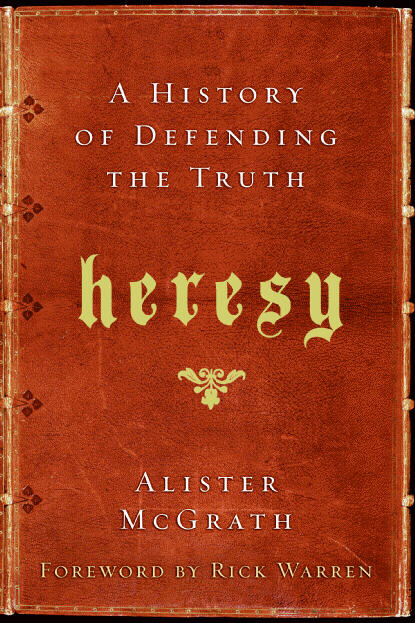 There is a trend today to see heresy as a forbidden fruit. What is heresy?; Who says these views are wrong?; Aren’t heresies just the losers in a power struggle?–these are but a few examples of the questions being asked about heresy. Alister McGrath’s book,Heresy: A History of Defending the Truth
“A heresy,” states McGrath, “is a doctrine that ultimately destroys, destabilizes, or distorts a mystery rather than preserving it… A heresy is a failed attempt at orthodoxy, whose fault lies not in its willingness to explore possibilities or press conceptual boundaries, but in its unwillingness to accept that it has in fact failed.” (31, emphasis his).
One might wonder why McGrath utilizes this view of heresy, and it is important to see that his definition stands between two misunderstandings of the historical context of the development of heresy. McGrath argues that there are two positions about the history of heresy which are extremely popular but also highly anachronistic. The first is that heresy is something from outside of the church which was able to somehow “get into” the church and corrupt it (34); the second erroneous view is that “What determines whether a set of ideas is heretical or not is whether those ideas are approved and adopted by those who happen to be in power. Orthodoxy is simply the set of ideas that won out, heresies are losers” (81). Both positions suffer from an anachronistic view of the history of heresy and tend to over-emphasize certain aspects of that development.
The notion that heresy is some kind of “Trojan horse” smuggled into Christianity from without is historically untenable (34). Furthermore, this view generally holds that “Heresy was a later deviation from [the] original pure doctrine” (65). Instead, “heretics were insiders who threatened to subvert and disrupt [the church]….” (35). However, the fact is that the notion of early Christianity holding to the best orthodoxy is a purely fictional historical concept. Rather, doctrine developed as new challenged were presented to the Christian faith or new truths were explored (66-67). Heresy was part of this development. Heresies were ideas that failed to take hold within Christianity because it was deemed to undermine the strength of the Christian faith as a whole (83).
Therefore, McGrath argues, it can be seen that the second view of the development of heresy is also historically mistaken. There was an orthodox core from which doctrine developed, and heresies were seen as defective (81ff). “The process of marginalization or neglect of these ‘lost Christianities’ generally has more to do with an emerging consensus within the church that they are inadequate than with any attempt to impose an unpopular orthodoxy on an unwilling body of believers” (81-82). Heresy was “an intellectually defective vision” of Christianity (83), rejected because it could not stand up to the theological challenges raised against it (83ff).
McGrath provides more development of the concept of heresy, and then turns from his analysis of the rise and rejection of heresy to a historical account of several early heresies. His analysis of these early heresies (ebionitism, docetism, valentinism, arianism, donatism, and pelagianism) provides significant historical support for his thesis that heresies are ultimately insufficient accounts of Christian theology and were rejected thereby. Against the thesis of Walter Bauer, who held that orthodoxy was an “ideological accident,” it is rather the case that “The relative weakness of institutional ecclesiastical structures at this time, including those at Rome, suggest that the quality of the ideas themselves played a significant role in their evaluation…” (133).
It is also important to note that heresies are not necessarily tools aimed to destroy Christianity from within. McGrath is particularly concerned with the contextualization of heresies. These were often developed within a context of a question, like “What is the nature of Christ?” (Ebionitism). “The problem [of heresy] lay not with the motivations of [heretics], but rather with the outcomes of their voyages of theological exploration” (171).
McGrath ends Heresy with an exploration of the origins and development of heresy. Heresy, he argues, develops through 5 major strands, each of which usually involves turning theology towards: cultural norms, rational norms, social identity, religious accomodation, and ethical concerns (180ff). Heresies will continue to emerge as Christianity faces new challenges. Furthermore, orthodoxy is itself a process of ongoing development (221).
McGrath concludes with a vision for orthodoxy: “If Christ is indeed the ‘Lord of the Imagination’… the real challenge is for the churches to demonstrate that orthodoxy is imaginatively compelling, emotionally engaging, aesthetically enhancing, and personally liberating. We await this development with eager anticipation” (234).
Heresy is indeed something which has caught the popular imagination. McGrath’s book offers a reasonable, sound defense of Christian orthodoxy in an era wherein heresy is often portrayed as an unfairly suppressed system which should be resurrected. By providing a significant investigation of the historical background and development of heresy, McGrath avoids the two ahistorical extreme views of heresy: that it was entirely a plague from outside the church or that it was merely one of many competing ideas that happened to lose.
Christians would do well to have knowledge of the development of Christian doctrine. As more challenges are raised to the Christian faith, orthodoxy will have to continue to respond. Without a historical grounding firmly in place, Christianity is liable to change with the winds. Heresies repeat themselves (232), and Christians need to be ready to respond to these alterations of the faith. Heresies have historically been rejected not due to an internal power struggle, but rather due to their insufficient intellectual bases.
Alister McGrath’s Heresy: A History of Defending the Truth is one of those books Christians should have within reach on their shelf in order to readily access it as challenges arise. He provides an enormously useful historical evaluation of heresy which allows readers to avoid the pitfalls of ahistorical views. Furthermore, McGrath convincingly demonstrates the reasoning behind labeling a position as heretical follows from a corruption of Christianity which makes it less theologically or intellectaully viable. By providing Christians with a vision of orthodoxy and heresy that is both aware of its past and looking towards the future, McGrath has written an invaluable source.
Heresy: A History of Defending the Truth
SDG.
——
The preceding post is the property of J.W. Wartick (apart from citations, which are the property of their respective owners) and should not be reproduced in part or in whole without the expressed consent of the author. All content on this site is the property of J.W. Wartick and is made available for individual and personal usage. If you cite from these documents, whether for personal or professional purposes, please give appropriate citation with both the name of the author (J.W. Wartick) and a link to the original URL. If you’d like to repost a post, you may do so, provided you show less than half of the original post on your own site and link to the original post for the rest. You must also appropriately cite the post as noted above. This blog is protected by Creative Commons licensing. By viewing any part of this site, you are agreeing to this usage policy.
Book Review: “7 Truths that Changed the World” by Kenneth Samples
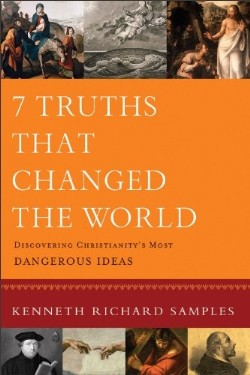 Kenneth Samples’ latest book, 7 Truths That Changed the World
Samples presents 7TC as a kind of investigation into the “dangerous ideas” that are central to Christianity. These dangerous ideas are:
- Not all men stay dead. In this section, Samples defends the historicity of Jesus’ resurrection. Christians who are actively involved in reading apologetics will find that the argument is the fairly well-known “minimal facts” style, but Samples does manage to give some uniqueness to the argument in the next chapter, wherein he examines various objections to the argument for the resurrection. Particularly unique was the fact that Samples takes the time to offer critiques of some of the more outlandish objections, like the twin brother theory (38).
- God walked the earth- Here, Samples puts the “dangerous idea” squarely in the context of religious pluralism. Not all religions can be true (48ff) and if Jesus was God on earth, then Christianity is true. Interestingly, rather than simply presenting arguments for Jesus’ Godhood, Samples offers a few theories of the incarnation and only then moves towards Biblical evidence for Jesus’ deity (50-53; 53ff). Again, Samples engages with some little-known but often abused objections, including the notion that Jesus was a guru (69-70) or even an alien (70-71).
- A fine-tuned cosmos with a beginning- Samples then engages in an argument from cosmic fine-tuning. Again, Samples puts the argument into a context rather than simply throwing it out to be fielded. Throughout the book, Samples grounds the arguments he makes within the broad theological history that surrounds the ideas. For this argument, he points out the historical doctrine of creation out of nothing through the Bible and church history (78-80). He also points out the “weighty theological implications” of the fine-tuning argument (82-83). He then argues that Christian theology helped ground the emergence of science (91ff).
- Clear pointers to God- Explanatory power is one way to evaluate worldviews, and Samples weighs atheistic naturalism against Christian theism. Samples offers a method by which people can evaluate worldviews. Essentially, this is a summary of his excellent work, A World of Difference, which I comment on in my post “Can We Evaluate Worldviews? How to navigate the sea of ideas.” Throughout this section, Samples offers a number of arguments in favor of the notion that God exists and can best explain the universe we observe.
- Not by Works- One of the core tenets of Protestantism, and indeed of evangelicalism (and in many ways, more modern Roman Catholicism) is salvation by grace. The fact that Christianity offers salvation as a gift provides another way to analyze it in light of other worldviews (134ff). All humans feel an urge to try to work for salvation, but this is mistaken. Ultimately, we cannot do it by ourselves (136ff). Sin is a predicament in which we find ourselves, it is a condition (137-138). Thus, Christianity offers a “way out” by salvation through grace in Christ.
- Humanity’s Value and Dignity- Humans have value. Most humans realize that it is wrong to cause harm or suffering and that certain virtues are good. However, without theism, there is no basis for human values (167ff). Some atheists have realized this and rejected meaning (163-166), but their worldviews dim in comparison to the light Christianity brings.
- The Good in Suffering- The problem of evil is the most oft-trumpeted argument for atheism, and Samples responds to it mostly by utilizing the “greater good” theodicy (theodicy means, basically, a defense from the problem of evil). First, he points out that it is not logically incoherent to suppose God is all powerful and all good while still believing evil exists (196-200). Then, he argues that God can have good purposes for evil and suffering (205ff). While we may not come up with a specific reason for every single evil that occurs, God’s sovereignty ensures that good will triumph and that all things work for His purposes (209ff). I don’t tend to favor the “greater good” theodicy because I’m not sure I can swallow the notion that every evil has a greater good–but I think that when applied to evil generally it may be more powerful. Samples does a good job introducing the reader to the basics on the problem of evil and a theodicy here.
While much of the material in 7TC goes over things the avid reader of apologetics will have encountered, the novelty of some of the arguments as well as the answers to some infrequently-considered objections makes the book worthwhile even to “veterans.” It is also very helpful to have some of the background in historical theology that Samples gives to contextualize many of his points. These kinds of extra details with the overall argument give readers a level of background knowledge that not all introductory apologetics books can provide.
Moreover, the format makes it work well as the kind of book to hand to a skeptic or a believer with doubts. It presents the core doctrines of the Christian faith in their broad contexts and defends them admirably. While hardened skeptics may laugh a book like this off, for those with open minds the arguments will be compelling enough to start conversations. Due to the effort to make the book readable for a general audience, it is clear that Samples can’t touch on every objection, but it will get readers thinking.
Overall, 7 Truths That Changed the World
Disclosure: I received a copy of the book for review from the publisher. I was not asked to endorse it, nor was I in any way influenced in my opinion by the publisher. My thanks to the publisher for the book.
SDG.
——
The preceding post is the property of J.W. Wartick (apart from citations, which are the property of their respective owners) and should not be reproduced in part or in whole without the expressed consent of the author. All content on this site is the property of J.W. Wartick and is made available for individual and personal usage. If you cite from these documents, whether for personal or professional purposes, please give appropriate citation with both the name of the author (J.W. Wartick) and a link to the original URL. This blog is protected by Creative Commons licensing. By viewing any part of this site, you are agreeing to this usage policy.
Book Review: “Think Christianly” by Jonathan Morrow
 Jonathan Morrow’s new book, Think Christianly
Central to the work is the notion that “Due to the unprecedented influence and availability of constant media… the thoughts, attitudes, perceptions, convictions, values, and lifestyles of those inside the church are rapidly growing indistinguishable from… those outside the church” (19). The key is to see how to help Christians “think Christianly” about every aspect of life. The Christian life is not “Sunday only” or “in church only” but rather it is an every day, every second, every interaction life. Morrow, throughout the book, seeks to touch upon nearly every area of Christian interactions with culture, providing brief introductions along with recommendations for a way forward in each area.
Part one of Think Christianly focuses on our own culture and the need to equip the next generation to interact with the issues brought up around them. Morrow provides a survey of ways people try to avoid interacting with Christianity (54ff) and suggests a threefold way to engage with our youths so they do not fall victim to the challenges to our faith. This threefold engagement is composed of 1) mentors, “people to learn from and imitate in the faith” (57); 2) peers, “people to run the race with and to spur us on” (57); and 3) a robust Christian worldview, a challenge to youths to explore what they believe and why it matters (58). Conjoined, these help provide a valuable base for youths to explore their faith among their peers and mentors who can guide them towards resources and answer questions.
Part two provides ways to integrate the Christian worldview into every aspect of one’s life. Chapter four discusses three worldviews- naturalism, postmodernism, and Christian theism. These are the worldviews pervasive currently in western cultures, and Morrow provides several ways to interact with the competing views and analyze them. Chapter five provides ways to “cultivate a thoughtful faith” and chapter six provides some ways to be confident about engagement (along with a helpful discussion of forgiveness and breaking away from anger on pages 98-99). Part Two continues with a couple chapters about living like Jesus, which are extremely insightful–we need to be sure we think of Jesus as who He was and is: the Lord of all professions, master of all crafts. Finally, part two wraps up with what may be the most important chapter of the book: “Can We Do That in Church?” Morrow argues that we must see “The local church” as “God’s vehicle to reach the world with the good news… it is also the primary place where Christians are to be equipped for the ministry” (130). By utilizing some small portion in time in church to equip believers to engage, Christian leaders can radically change the perception of Christianity as a “Sunday only” venture. If believers do not get equipped, where will they be equipped? The truth is they’ll “google it” and find people without good credentials or intentions and learn from them instead (not saying there’s nothing good online–plenty of scholars and wonderful teachers are out there, but sifting through the muck can be difficult). This chapter, I think, is the most important in the whole book and provides a number of insights that church leaders must take to heart.
Part three provides a number of areas in which Christians need to engage and ways to engage with them. For example, taking the Bible seriously is a top priority and Christians need to know how to interact with the text. Of particular importance are the chapters on sex–which talks about porn addiction and same-sex attraction; and Christianity in the public square.
Morrow has peppered the book with brief interviews of leading Christian thinkers on a number of topics. While short, these interviews provide a number of great insights and will lead readers to explore many issues in greater detail. They range from “Leveraging the Internet to Make God Known” (with Randall Niles) to “Jesus Among World Religions” (with Craig Hazen), and beyond. Another helpful aspect are the lists of resources for further study, included at the end of each chapter. These include a list of books, DVDs, and websites for interested readers to explore.
There are few books that span as broadly as Think Christianly while also giving solid background discussions of each topic touched. Morrow continually provides valuable insights at a basic level which Christians can apply right now to start to “Think Christianly” about every aspect of life. If our churches and the members therein embrace many of the suggestions found in Morrow’s important book, we will be able to grow and positively impact the world in a major way. The book comes very highly recommended–it is the kind of book anyone involved in the church must have on their shelf and seek to apply to their lives.
I received a review copy of the book from Zondervan publishers. My thanks to Zondervan for the opportunity to review the book. I was not asked to write anything positive or negative about the book.
Think Christianly
Book Review: “Learning to Jump Again” by Anthony Weber
 Anthony Weber’s work, Learning to Jump Again, is part memoir of a lost father, part philosophical treatise on the problem of suffering. The focus throughout is Weber’s father and the issues with mourning, suffering, and heroism his life and death brought up.
The book starts with “the Journal”–a series of entries from Weber’s journal during the time surrounding the death of his father. As one who is very close to his father, these entries truly struck home. There were many moments where this reader just lost it in tears. Weber does not hold back, at all. His father was suffering from jaundice due to cancer. He writes, “A friend stopped by that weekend to borrow some tools, and I stammered through an explanation of why my visiting father was yellow… He [the friend] knew that after the fall comes winter, and after the chill comes the cold, and he was mercifully silent” (2).
Weber does not restrict the period of mourning or the discussion thereof to the months immediately surrounding his father’s death; rather, the Journal contains entries as far as eight years (and later) after his father’s death. Christians reading the book are forced to the realization that it is not easy to struggle through these issues. When a beloved father dies, it is not something that passes with the seasons. Even eight years later, he wrote of his withholding himself from his wife and children, and the realization that came with it that he must trust in God, “even if I don’t always understand him” (76-78).
Yet the journal section is not merely a reflection. Weber shares lessons and thoughts he has on mourning, God, and the reality of pain in the world throughout his memoirs. He notes that too many people know about God without knowing God (72-73); refers to the experiences of wrestling God (45); and contrasts the ways and beliefs of “the flesh” with that of reality (33). Throughout this section, there is much for readers to take away.
The second part of the book focuses on the issues behind suffering and the Christian worldview. Weber’s discussion is an admirably easy-to-read introduction to many of the philosophical issues surrounding the problem of evil and other issues. In particular, his discussions of emotions, dreams, and prayer in particular offered a number of insights that readers will be interested in reading more about. Weber included a lot of resources for interested readers to explore, so the book serves as a valuable resource in that regard as well. His discussion of the problem of pain does an excellent job introducing difficult notions like distinguishing between types of the problem of evil (122ff). His discussion of the various possible routes theists can take to discuss the problem of evil is also brief but informative.
Throughout the book there are numerous quotes from various authors. Many of these are novelists such as J.R.R. Tolkien, Dean Koontz, Shakespeare, and C.S. Lewis. Others are from people like Helen Keller, Phillip Yancey, and Scripture. These quotes are often profound and fit the context perfectly. As a reader, this reviewer admits to frequently skimming past quotes when I see them in texts, particularly when they are out of context, but with Learning to Jump Again, the quotes all draw out new emotions, thoughts, and ideas very well. They add to, rather than distract from, the text.
Learning to Jump Again was a bit of a surprise for me. The section of the book that was a memoir served poignantly to draw readers into the heart of a mourning man. But it did not leave readers with that; rather, Weber constantly struggled with issues that Christians at all stages must deal with. Further, the philosophical section which encompassed the latter part of the book is an excellent survey of a number of issues. Many will benefit from the insights Weber provides. The book tugs at the heart strings and gets the mind working. Readers who have already extensively explored the issues of the latter part of the book will benefit from viewing the issues in the context of a memoir. Those who have not will benefit greatly from the discussion throughout the book. I recommend it very highly.
SDG.
——
The preceding post is the property of J.W. Wartick (apart from citations, which are the property of their respective owners) and should not be reproduced in part or in whole without the expressed consent of the author. All content on this site is the property of J.W. Wartick and is made available for individual and personal usage. If you cite from these documents, whether for personal or professional purposes, please give appropriate citation with both the name of the author (J.W. Wartick) and a link to the original URL. If you’d like to repost a post, you may do so, provided you show less than half of the original post on your own site and link to the original post for the rest. You must also appropriately cite the post as noted above. This blog is protected by Creative Commons licensing. By viewing any part of this site, you are agreeing to this usage policy.
Book Review: “Where the Conflict Really Lies” by Alvin Plantinga
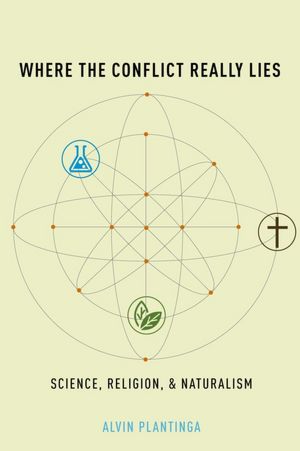 There are few names bigger than Alvin Plantinga when it comes to philosophy of religion and there are few topics more hotly debated than science and religion. Plantinga’s latest book, Where the Conflict Really Lies
Plantinga minces no words. The very first line of the book outlines his central claim: “there is superficial conflict but deep concord between science and theistic religion, and superficial concord and deep conflict between science and naturalism.”1
The first part of the book is dedicated to the superficial conflict between science and religious belief. The reason this alleged conflict is important is due, largely, to the success of the scientific enterprise. Because science has shown itself to be a reliable way to come to know the world, if religion is in direct conflict with science, then it would seem to discredit religion. Not only that, but, Plantinga argues, Christians should have a “particularly high regard” for science due to the foundations of the scientific enterprise on a study of the world.2
In order to examine this alleged conflict, Plantinga first takes on the article of science most often taken to discredit religion: evolution. Here, readers may be surprised to find that Plantinga does not try to argue against evolution itself. Rather, Plantinga draws a distinction between the notion of evolution and Darwinism. The former, argues Plantinga, is consistent with Christian belief, whether or not it is the way the variety of life came to be, while the latter is not consistent with Christianity because central to its account is the notion that the process of evolution is unguided.3
WCRL then turns to Richard Dawkins. Plantinga argues that “A Darwinist will think there is a complete Darwinian history for every contemporary species, and indeed for every contemporary organism.”4 Here again there is nothing which puts such a theory in conflict with Christian belief. Writes Plantinga, “[The process of evolution] could have been superintended and orchestrated by God.”5 But Dawkins (and others) claim that evolution “reveals a universe without design.” But what argument is provided towards this conclusion? Plantinga draws out Dawkins reasoning and shows that the only logic given is that evolution could have happened by way of unguided evolution. But then:
What [Dawkins] actually argues… is that there is a Darwinian series of contemporary life forms… but [this series] wouldn’t show, of course, that the living world, let alone the entire universe, is without design. At best it would show, given a couple of assumptions, that it is not astronomically improbable that the living world was produced by unguided evolution and hence without design. But the argument form ‘p is not astronomically improbable’ therefore ‘p’ is a bit unprepossessing… What [Dawkins] shows, at best, is that it’s epistemically possible that it’s biologically possible that life came to be without design. But that’s a little short of what he claims to show.6
Plantinga then moves on to argue that Daniel Dennett’s argument is similarly flawed.7 Paul Draper’s argument that evolution is more likely on naturalism than theism is more interesting, but assumes that “everything else is equal.”8 But then, everything is not equal. Theism provides a number of relevant probabilities which weigh the argument in favor of theism instead.9
The arguments against theism from evolution are therefore largely dispensed. What of the possibility of divine action? Some argue that God doesn’t actually act in the world—in fact, the argument is made that even most theologians don’t believe this, despite writing that God does act in various ways. The argument is made that because of natural laws, God cannot or does not intervene.10 However, one can simply argue that the correct view of a natural law is that “When the universe is causally closed (when God is not acting specially in the world), P.”11
Plantinga does acknowledge that there are some fields in science which do provide at least superficial conflict with theism. These include evolutionary psychology and (some) historical critical scholarship.12 Evolutionary psychology generally doesn’t challenge religious belief. “Describing the origin of religious belief and the cognitive mechanisms involved does nothing… to impugn its truth.”13 Now some suggest that religious beliefs are due to devices not aimed at truth, and this would provide a reason to doubt religious belief.14 However, the way that most do this is by conjoining atheism with psychology or operating under other assumptions which undermine religious belief a priori. While this may mean that specific conclusions in psychology are in conflict with theism, these conclusions only follow from the anti-theistic assumptions at the bottom. Thus, while some accounts of evolutionary psychology are in conflict with theism, they don’t provide a solid basis for rejecting it.15 Similarly, varied methods of historical concept may draw some conclusions which are in conflict with Christian theism, but these methods are themselves undergirded by assumptions that theism is, at best, not to be entered into historical discussion.16
There are, Plantinga argues, significant reasons to think that theism is in concord with science. First, the argument from cosmological fine-tuning, he argues, gives “some slight support” for theism.17 The section on fine-tuning has responses to some serious criticisms of such arguments. Most interesting are his responses to Tim and Lydia McGrew and Eric Vestrup—in which Plantinga argues that we can indeed get to the point where we can assess the fine-tuning argument;18 Plantinga’s discussion of the multiverse;19 and his discussion of relevant probabilities regarding fine-tuning.20
Michael Behe’s design theory is discussed at length in WCRL.21 Plantinga offers some additional insights into the Intelligent Design debate. He argues that one can view design not so much as a probabilistic argument but instead as simple perception.22 He reads both Behe and William Paley in this light and argues that they are offering design discourses as opposed to arguments.23 This, in turn, allows him to argue that design is a kind of “properly basic belief” and he offers a robust discussion of epistemology to support this intuition.24
Further, there is deep concord between Christian Theism and Science when one looks at the very roots of the scientific endeavor. Here, rather than simply listing various theists who helped build the empirical method, Plantinga argues that science relies upon various theistic assumptions in order for its methods to succeed. These include the “divine image” in which humans are capable of rational thought;25 God’s order as providing regularity for the universe;26 natural laws;27 mathematics;28 induction;29 and simplicity and “other theoretical virtues” (like beauty).30
Finally, Plantinga turns to naturalism: does it really resonate so well with science? Plantinga grants for the sake of argument that there is at least superficial concord between naturalism on science, if only because so many naturalists trumpet this “fact.”31 Yet there is, he argues, a deep conflict between science and naturalism: namely, that if evolution is true and naturalism is true, there is no reason to trust our cognitive abilities.32 “Suppose you are a naturalist,” he writes, “you think there is no such person as God, and that we and our cognitive faculties have been cobbled together by natural selection. Can you then sensibly think that our cognitive faculties are for the most part reliable?”33
Plantinga argues you cannot. The reason is because we have no way to suppose that evolution is truth aimed, but rather it is merely survival aimed (if indeed it is aimed at all!). He also argues that because naturalists are almost all materialists, there is no way to adequately ground beliefs.34 Finally, because naturalism and evolution conjoin to give a low probability that our rational abilities are reliable, we have received a defeater for every belief we have, including naturalism and evolution.35 Thus, the conflict “is not between science and theistic religion: it is between science and naturalism. That’s where the conflict really lies.”36
WCRL covers an extremely broad range of topics, and will likely be critiqued on each topic outlined above and more. The book touches on issues that are at the core of the debate between naturalists and theists, and as such it will be highly contentious. That said, the book is basically required reading for anyone interested in this discourse. Plantinga provides extremely valuable insights into every topic he touches. His discussion of biological design, for example, provides unique insight into the topic by locating it within epistemology as opposed to biology alone. Further, his “evolutionary argument against naturalism” continues to live despite endless criticism. The list of important topics Plantinga illumines in WCRL is extensive.
Where the Conflict Really Lies
——
1 Alvin Plantinga, Where the Conflict Really Lies (New York, NY: Oxford, 2011), ix.
2 Plantinga, Where the Conflict Really Lies, 3-4. (Unless otherwise noted, all references are to this work.)
3 12 (emphasis his).
4 15 (emphasis his).
5 16.
6 24-25.
7 33ff, esp. 40-41.
8 53.
9 53ff.
10 69ff.
11 86, see the arguments there and following.
12 129ff.
13 140.
14 141ff.
15 143ff.
16 152ff.
17 224.
18 205-211.
19 212ff.
20 219ff.
21 225-264.
22 236ff.
23 240-248.
24 248ff; see esp. 253-258, 262-264.
25 266ff.
26 271ff.
27 274ff.
28 284ff.
29 292ff.
30 296ff.
31 307ff.
32 311ff.
33 313.
34 318ff.
35 339ff.
36 350.
This review was originally posted at Apologetics315 here: http://www.apologetics315.com/2012/02/book-review-where-conflict-really-lies.html
SDG.
——
The preceding post is the property of J.W. Wartick (apart from citations, which are the property of their respective owners) and should not be reproduced in part or in whole without the expressed consent of the author. All content on this site is the property of J.W. Wartick and is made available for individual and personal usage. If you cite from these documents, whether for personal or professional purposes, please give appropriate citation with both the name of the author (J.W. Wartick) and a link to the original URL. This blog is protected by Creative Commons licensing. By viewing any part of this site, you are agreeing to this usage policy.
“A New Vision for Natural Theology” A Book Review of “The Open Secret” by Alister McGrath
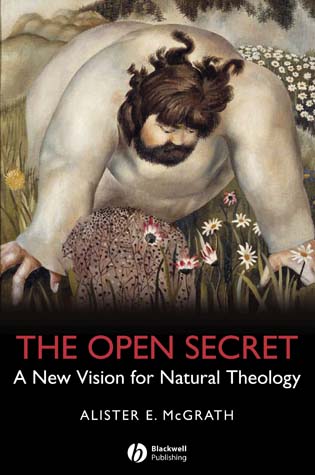 Alister McGrath is a well-known name in Christian philosophy, science, and apologetics. His book, The Open Secret
Natural theology, according to McGrath, is not just a way to argue for the existence of God. Rather, “The enterprise of natural theology… is one of discernment, of seeing nature in a certain way…” (3). He argues that natural theology in fact should not be viewed as a system to prove the existence of God. Rather, it “addresses fundamental questions about divine disclosure and human cognition and perception. In what way can human beings, reflecting on nature by means of natural processes, discern the transcendent?” (5, emphasis his). Natural theology can be seen as an entire worldview, put forth to view the world in a certain way (17).
McGrath, after outlining his vision thus, turns to the human experience of the transcendent. He focuses on three thinkers- Iris Murdoch, Roy Bhaskar, and John Dewey (41ff). He then turns to various ways humans have accessed the transcendent (59ff) and includes an evaluation of the psychology of perception (80ff).
He once more emphasizes the need to see natural theology as a type of “seeing” (115) and turns to Jesus to demonstrate the approach McGrath favors. Jesus’ parables are a model for natural theology, argues McGrath. They are “open… the interpretation is generally left indefinite and imprecise… the imagery of the parables is readily grasped [but] their meaning is often veiled…” (120-121). Similarly, nature itself is easy to grasp, but it has hidden meanings which can only be perceived by viewing the world in a certain way (126ff).
The Enlightenment approaches to natural theology have been largely unsuccessful historically and are in need of modification (140ff).
A Christian approach to natural theology should focus on “seeing” God in the natural. God has chosen to “self-disclose in history and nature” (178) and natural theology can reveal God in nature (178ff). Christian natural theology is “eschatological… The fading beauty and goodness of the world are to be interpreted in the light of the hope of their restoration and renewal” (206).
Natural theology must also break out of its boundaries. It is not just the realm of philosophical reflection, but also opens many points of contacts with the world. It is “about perceiving nature in a certain way” (221). Beauty, goodness, and truth are all aspects of reality which can be drawn out through a Christian Natural Theology (222ff). Again,
“natural theology… cannot be regarded as ‘proving’ God’s existence. Rather, it insists that the existence of a God such as that proposed by the Christian tradition makes sense of what may be observed of the world. Such an approach holds that there is an accumulation of considerations which, though not constituting logical proof (how could experience prove anything in such a way?), is at the very least consistent with the existence of a creator God (233).
The goal is not proof but a demonstration of consistency, which will “reinforce the plausibility” of Christianity (234).
Beauty and goodness draw out the reality of the Christian vision of the world. Beauty must not be neglected in natural theology (262ff). Beauty “can… call us, seeking a response” (283). Goodness underlies the resonance with natural law and the moral truths that can be seen as built in to “the fabric of the universe” (293ff).
McGrath concludes by urging readers to see natural theology as a key to open the “mysteries” and “hidden meaning” of nature’s “open secret” (314-315). Natural theology is primarily a vision–a way of viewing the world. The goal of the natural theologian, therefore, is to show how the reality of the world resonates best with a Christian worldview.
There is little to find at fault in McGrath’s powerful work. The Open Secret has enormous depth and breadth. Few areas of development are left unexplored. As one who has great interest in natural theology and who frequently discusses it, this reader must agree with McGrath that the arguments of natural theology often don’t work as proofs so much as pointers. Few are willing to embrace Christianity due only to an argument from natural theology, but the arguments themselves can be used to show how Christianity touches and explains many aspects of reality. McGrath’s vision is really an expanded “cumulative case”; one which focuses not just on many arguments, but brings the beauty of the world and its inherent goodness (while acknowledging ugliness and evils) into the folds of natural theology.
Alister McGrath’s The Open Secret provides a vision for the development and integration of natural theology into the arts, the sciences; indeed, into every aspect of life. It is a vision that will resonate with readers and drive them to see Christianity as an integrated whole. The book is, without a doubt, a must read.
Source
Alister McGrath, The Open Secret
SDG.
——
The preceding post is the property of J.W. Wartick (apart from citations, which are the property of their respective owners) and should not be reproduced in part or in whole without the expressed consent of the author. All content on this site is the property of J.W. Wartick and is made available for individual and personal usage. If you cite from these documents, whether for personal or professional purposes, please give appropriate citation with both the name of the author (J.W. Wartick) and a link to the original URL. This blog is protected by Creative Commons licensing. By viewing any part of this site, you are agreeing to this usage policy.

 J.W. Wartick - Reconstructing Faith