apologetics
Review of “Love Wins” by Rob Bell: Chapter 4
 I have been reviewing Rob Bell’s book, Love Wins, with a particular interest in his theological views and how he argues for those views. I have not read the book before, so each review is fresh: I am writing these having just completed the chapter the post is on. This week, I look at Chapter 4: “Does God Get what God Wants?”
Chapter 4
Outline
Bell starts the chapter by surveying a number of statements from church’s web sites regarding hell. These statements range from the unsaved being separated from God forever to eternal conscious torment. He seems to be pointing readers towards a kind of discontinuity between these statements and the statements about God’s power and love:
I point out these parallel claims: that God is mighty, powerful, and “in control” and that millions of people will spend forever apart from this God… even though it’s written in the Bible that “God wants all people to be saved and to come to a knowledge of the truth” [1 Timothy 2:4- seems to be NIV]
…How great is God? Great enough to achieve what God sets out to do… but in this, the fate of billions of people, not totally great. Sort of great. A little great. (97-98)
Bell asks a poignant question: “Will all people be saved, or will God not get what God wants?” (98). He then goes through a number of verses focused around God’s love. He notes the parables in Luke 15 about people pursuing their desires and concludes, “The God that Jesus teaches us about doesn’t give up until everything that was lost is found. This God simply doesn’t give up. Ever” (101).
Bell turns to the reason that many people think God may fail in his desire to save everyone. From the perspective of those who advocate the views he outlined at the beginning of the chapter, “love, by its very nature, is freedom… God has to respect our freedom to choose to the very end” (103). However, Bell argues that “We aren’t fixed, static beings–we change and morph as life unfolds.”
Tied into this notion of the unfixed nature of our lives, he seems to hold that it is possible that people can choose to come to Christ after they die. He asks, “why limit that chance [the chance to come to Christ] to a one-off immediately after death? And so they expand the possibilities… [The chance is given for] as long as it takes, in other words” (106-107).
Bell then traces this notion through Clement of Alexandria, Origen, Gregory of Nyssa, and Eusebius. He goes so far as to cite Augustine saying “‘very many’ believed in the ultimate reconciliation of all people to God” (108).
He argues that “central to their trust that all would be reconciled was the belief that untold masses of people suffering forever doesn’t bring God glory” (ibid). Moreover, he argues that “At the center of the Christian tradition since the first church have been a number who insist that history is not tragic, hell is not forever…” (109). He notes that “serious, orthodox followers of Jesus have answered these questions [about hell and salvation] in a number of ways” (ibid).
Next, Bell turns to an analysis of the book of Revelation. he notes that the book ends with notion that the gates of the city “never shut” and infers that “gates are for keeping people in and keeping people out. If the gates are never shut, then people are free to come and go” (114-115).
Bell ends the chapter with what seems like a poetic inference. He goes into prose and concludes that: “[Love] always leaves room for the other to decide. God says yes, we can have what we want, because love wins” (119).
Analysis
There is much to discuss in this chapter. First, it is important to note that Bell has done much to cause reflection upon the subject of hell. It is something that we as a group of believers need to be thinking on. Too often, the subject is cast aside. Bell has done admirably in bringing the topic to the table.
Moreover, Bell is correct to note that confusion can be caused by simply throwing statements on hell “out there” in a void. It is important to contextualize statements about heaven and hell and make clear what is meant by the phrases that are used in the discussion.
Bell seemingly just assumes that there will be more chances to “accept Christ” in the afterlife. His discussion of the possibility of people changing after death implies this perspective, but he has done nothing to establish it. Perhaps he will do so in a later chapter, at which point we will evaluate his argument for that perspective. Indeed, thus far his argument seems to be a kind of straw man: he asserts the notion that people are changeable beings even in the afterlife as a counterpoint to those who hold that people will continue to choose evil in the hereafter as though this choice is the reason people hold to the eternal hell view. Yet this is not the case; many who hold this position do argue that people will continue to choose evil, but the reason that people are condemned to hell is because they rejected the God, whose existence and power are obvious (Romans 1) in their lives. No one has an excuse (Romans 1:20).
Bell’s utilization of church fathers is problematic. I can’t help but think there is a subtle twisting of some of their views to fit his position. In particular, he cites Augustine as “acknowledging” that “very many” believed in “ultimate reconciliation of all people” (107-108). Yet Augustine himself categorically denies and denounces this position. In fact, almost the entirety of Book XXI of The City of God
I hate to beat a dead horse here, but let’s look what Augustine says (The City of God
Origen was even more indulgent; for he believed that even the devil himself and his angels, after suffering those more severe and prolonged pains which their sins deserved, should be delivered from their torments, and associated with the holy angels. But the Church, not without reason, condemned him for this and other errors…
So we see that Augustine, far from being anywhere near Origen’s view on the topic, endorses the Church’s condemnation of Origen as a heretic in this regard. Yet where does Bell reveal this? Where does Bell interact with historical theology? No, he seems perfectly content to throw out a bunch of names out of context together and let readers make their own assumptions. I realize this is a popular level book, but I can’t help but be very worried about Bell’s style here. It is very misleading. Maybe he does note later in the book that Origen was condemned as a heretic for this view, and that Augustine endorses this condemnation, but considering Bell seemingly endorses Origen’s view, I very much doubt that he will reveal that it was condemned by the Church.
More damning is the fact that Bell is able to, seemingly seriously, say that “At the center of the Christian tradition since the first church have been a number who insist that history is not tragic, hell is not forever…” (109). I admit that I agree in one sense–there have been many universalists throughout church history. However, that view was condemned as heretical. Augustine upholds that condemnation in The City of God
Here again we see one of Bell’s biggest methodological problems: he simply introduces a notion, argues that there are diverse views, and then assumes that they are all equally legitimate. but this is simply mistaken. Multiplication of viewpoints does not mean they are equally valid. Furthermore, Bell’s lack of interaction with historical theology on this point, when he himself is the one who introduces several of the church fathers, is questionable at best. Moreover, he says these teachers were “orthodox” when in fact Origen specifically was far from orthodox in his beliefs, as even a cursory study of Origen would reveal. Origen lived at a time before certain views were made explicit, yes, so he in a sense gets a pass in that his theology was intentionally exploratory. However, many of his views were later condemned, including the one Bell endorses. For Bell to turn around and use Origen to support his diversity of orthodox views on the topic is seemingly dishonest.
Moreover, one must wonder about Bell’s analysis of the meaning of the gates of heaven as open. Instead of looking at this passage in context, in which the notion of a city with open gates would imply a city unthreatened by outsiders because all enemies were defeated (which fits much better into the book of Revelation), Bell states explicitly “If gates are never shut, then people are free to come and go” (115). Think on this for a moment. What Bell has stated here undermines the notion of security of salvation. Now I do not hold to the doctrine of eternal security; however, I do affirm that once people are saved and in the New Creation in heaven, they are not about to change their status. They aren’t “going” anywhere. Bell’s view here undermines the assurance of salvation. His view of “love winning” also serves to illustrate this point, for if there is “always room for the other to decide” we must ask: is there always room to choose hell? Can “love win” by letting us walk away from the eternal salvation we are promised in Christ?*
Conclusion
I admit I have been highly critical in this chapter. I have tried throughout so far to find positive things to say about Bell’s work, and as I noted, Bell does well in this chapter to center discussion around the hard questions.
However, there are numerous problems with Bell’s work in this chapter. His use of the church fathers is highly problematic. I won’t rehearse the arguments again (see above). Oddly, his view also seems to imply that we have absolute autonomy and the ability to simply walk out of heaven whenever we wish. That in itself is another great difficulty, for it undermines the assurance of salvation we have in Christ: “I give them eternal life, and they shall never perish; no one will snatch them out of my hand” (John 10:28).
Bell continues to use the method of argumentation in which he simply notes diverse views on a topic and concludes that all are somehow equally at the table or equally valid.
Next week, we will look at Chapter 5: Dying to Live.
*My thanks to my wife for this point.
Links
The book: Rob Bell, Love Wins
Review of “Love Wins” by Rob Bell: Preface and Chapter 1– I discuss the preface and chapter 1 of Love Wins.
Review of “Love Wins” by Rob Bell: Chapter 2– I review chapter 2.
Review of “Love Wins” by Rob Bell: Chapter 3– I look at Chapter 3: Hell.
Review of “Love Wins” by Rob Bell: Chapter 5– I analyze chapter 5.
Love Wins Critique– I found this to be a very informative series critiquing the book. For all the posts in the series, check out this post.
Should we condemn Rob Bell?– a pretty excellent response to Bell’s book and whether we should condemn different doctrines. Also check out his video on “Is Love Wins Biblical?“
Source
Rob Bell, Love Wins
SDG.
——
The preceding post is the property of J.W. Wartick (apart from citations, which are the property of their respective owners, and works of art as credited) and should not be reproduced in part or in whole without the expressed consent of the author. All content on this site is the property of J.W. Wartick and is made available for individual and personal usage. If you cite from these documents, whether for personal or professional purposes, please give appropriate citation with both the name of the author (J.W. Wartick) and a link to the original URL. If you’d like to repost a post, you may do so, provided you show less than half of the original post on your own site and link to the original post for the rest. You must also appropriately cite the post as noted above. This blog is protected by Creative Commons licensing. By viewing any part of this site, you are agreeing to this usage policy.
Really Recommended Posts 2/8/13
 I could do these every day and still not catch up to the amount of fantastic posts out there. This week’s Really Recommended Posts feature “Love Wins,” natural evil, apologetics methodology, Tolkien, and more! As always, I’d love to hear your thoughts (and recommendations!).
Love Wins Critique– Rob Bell’s book on hell (or lack thereof?) caused quite a stir when it came out, and it continues to be discussed widely. Check out this excellent multi-part critique of the book. You can access all 5 parts here.
Why Would God Allow Natural Disasters? – One of the hardest parts of the problem of evil is the difficulty of “natural evils.” Check out this insightful response to the problem.
Is the Cold Case Still Valid? – One of the debates within Christianity is about apologetics methodology. Should we be evidentialists or presuppositionalists or something else (spoiler: I don’t think we need to be either/or)? This post discusses a critique of Cold-Case Christianity from an apologetic methodology standpoint. The book is phenomenal and I recommend it highly (see my review). See also J. Warner Wallace’s own response to the objection.
John Lennox vs. Richard Dawkins– A great video in which Lennox discusses science and Christianity, set against beautiful backdrops and quotes from the Bible. It also features some other excellent Christian thinkers. It’s worth the watch.
Loyal dog continues to attend mass at church where owner’s funeral was held– Just a heart-wrenching story about a loyal dog. Not apologetics related, really, but I enjoyed it.
Tolkien’s essay, “On Fairy Stories” continues to have massive influence today. Read it here online (or obtain the PDF file to read later). I found this post through another excellent list of links which is well worth checking out.
“Is Faith in God Reasonable?” Brief Debate Review: Alex Rosenberg vs. William Lane Craig
 Recently, the atheist Alex Rosenberg debated the theist William Lane Craig. The meat started to happen in the rebuttals, so I will focus on those. For a full review, check out Wintery Knight’s excellent summary.
Craig’s First Rebuttal
Craig pointed out the extreme implausibility of the naturalistic worldview in contrast to theism. He outlined several ways in which naturalism fails as an explanation of reality and cited Rosenberg’s work several times throughout this discussion. He argued that mental states have an “aboutness” which naturalism cannot explain.Then, he pointed out the profound difficulty naturalism has with locating truth and meaning within the worldview. He asserted that libertarian free will and purpose are incompatible with naturalism. Finally, the concept of the “self” and the first-person awareness cannot be explained by naturalism.
Rosenberg’s First Rebuttal
Alex Rosenberg: He focused on this question quite a bit in his rebuttal: “How is it possible for one chunk of manner to be ‘about’ some other piece of matter?” Yet after saying that this, he asserted that this debate over naturalism has nothing to do with the topic of the debate: “Is Faith in God Reasonable?”
He then turned to a discussion of the problem of evil. “If God is omnibenevolent, omniscience, and omnipotent, then the suffering of animals and humans needs desperately to be explained… Nobody has yet to offer a satisfactory explanation… Dr. Craig needs to tell us how [God] had to have the holocaust!”
He also argued that different religious books are false, so there is no reason to trust the New Testament.
Rosenberg said if Craig could provide an explanation for this, then he would become a Christian.
Craig 2nd Rebuttal
Craig immediately exclaimed his excitement over Rosenberg’s possibility of becoming a Christian, arguing that the logical problem of evil, which Rosenberg seemed to be using, has been largely abandoned due to its immense problems. In order to make this argument, the atheist assumes that if God is all powerful than he can create any world he wants, but this is not necessarily true. It is logically impossible for God to make someone freely do something. The atheist would have to prove that there is a world with as much free good in this world but without as much free evil. It seems this premise is impossible to prove. Thus, the logical problem of evil has largely been dropped.
Craig pointed out the fact that Rosenberg was simply mistaken about the importance of metaphysical naturalism. If metaphysical naturalism is false, then it seems clear that theism is that much more plausible.
Craig also once again pointed out that discrediting things like the Book of Mormon or the Qur’an does nothing to undermine the truth of the New Testament documents.
Rosenberg Final Rebuttal
Rosenberg continued to attack Craig as well as the format of the debate. He asserted that Craig was merely repeating himself. Then he commented that the format of a debate does not work to discuss questions like those at hand. One honestly is forced to wonder why Rosenberg chose to engage in the debate, if such were his opinions. Rosenberg attacked Craig’s arguments for “giving philosophy a bad name” and said he would be “embarrassed” to outline Craig’s defense of his arguments.
He did get into some actual comments on the arguments, however. He argued that some things can come into being from “nothing at all,” specifically alpha particles.
Finally, he got to the problem of evil. Here I continued to be confused over whether Rosenberg was sure which variety of the problem of evil he was presenting. He continued to utilize the evidential problem of evil as though it were the same as the logical problem of evil. He was confusing his arguments, mixing necessity with contingency. There is little to comment on here, because it was so confused.
Regarding the New Testament, Rosenberg essentially argued that we cannot know how corrupt the New Testament is.
Craig Closing
Craig turned once more to Rosenberg’s construction of the problem of evil. He pointed out that Rosenberg was mistaken about free will as well as the nature of the God’s creation. He pointed out that the holocaust was not necessary. Instead, he noted that the onus is upon Rosenberg to show that God could have actualized a world with as much good as there is in this world while simultaneously showing there would be less evil, which is of course beyond the ken of the atheist (or the theist).
Craig pointed out that we can confirm that New Testament sources we have go back to within 5 years of the actual events. Furthermore, Rosenberg was mistaken in saying that the New Testament documents were written in Aramaic. They were written in Greek.
Rosenberg Closing
Rosenberg used his closing to present an “obvious” argument for atheism. He argued that science has no need of the God hypothesis and that there is no basis “to invoke God for explanatory or any other purpose” in science. Thus, science has no reason to accept the existence of God. I find it interesting that he chose to save this argument for the point when he couldn’t be rebutted on the argument. Perhaps that is due to the extreme weakness of the argument. Only be equating science with knowledge could this argument have any relevance. This is not to mention that he is mistaken on this, but to show that he is mistaken would take us too far afield. Interested readers can view the links at the end of this post.
Rosenberg closed with “advice from an atheist.” His advice was to tell theists to not demand that their faith be reasonable. He continued with a discussion saying that theists should say “I believe because it is absurd.” He essentially asserted that theists cannot be reasonable. Honestly, this was just an insult. I admit I was not surprised by this comment by the end of the debate, as Rosenberg’s general strategy had seemed to be to denigrate, rather than interact with, theism.
Comments
I was honestly stunned by Rosenberg’s assertion that substance dualism or a debate over naturalism had nothing to do with faith in God. It seems quite obvious that such things are indeed germane to the discussion. If substance dualism is true, then theism has a much better account than non-theistic worldviews. If naturalism is false, the plausibility of theism increases greatly.
In the Q+A following the debate, someone asked Rosenberg why they should believe anything he said in the debate if he himself doesn’t believe in true. Rosenberg basically answered by saying that he’s just rearranging the brain in a way to meet truth… but of course he already denied that we can know what truth is. It’s just a certain way of orienting the matter in one’s brain! Ridiculous. I’m sorry, but it is ridiculous.
Regarding the debate itself, there were a number of non-scientific ways that people voted on the results of the debate. A formal panel awarded Craig the victory 4-2. The local (Purdue) voting on the debate 303-1390 Craig won. Online vote favored Craig 734-59. In other words, Craig crushed Rosenberg. I agree wholeheartedly. Let me know your thoughts. Comment below!
One awesome line from the debate came from Craig: “The purpose of life is not happiness. The purpose of life is knowledge of God.”
An awesome tweet: “Rosenberg apparently knows not only what God could have done but what would have been best for us for all eternity.” @ThnkngChristian
Links
Wintery Knight provided a simply fantastic summary of the debate.
Glenn Andrew Peoples has a post on quantum events in relation to the cosmological argument which is very relevant to this debate.
Shoulders of Giants?- Philosophy and Science in Context, or, “Lawrence Krauss Jumps off!”– I write on the relationship of science to philosophy as well as Christianity.
Science: “Thanks Christianity!”– Does Christianity say anything about science?
Really Recommended Posts 2/1/13
Thinking About ‘Future Things,’ Part 1– One area I will admit I have very little knowledge about in relation to Christian theology is eschatology. This series by Reasons to Believe provides an introductions to many aspects of eschatology and provides a fairly balanced view. I enjoyed it greatly and came away feeling much better informed. I recommend checking out the whole series.
Wukong’s Dilemma– An interesting look at Buddhist philosophy and the dilemma of a works-based religious system. I found this a very fascinating post.
Lance Armstrong, Thor and Ideal Heroism– A comparison of ‘real life heroes’ to the idealized heroes we construct. I found this post very insightful. I highly recommend it.
Christianity and High Beauty (With Pictures!)– A simply excellent post on the relation of the Christian worldview to beauty. There is much to be said about the importance of aesthetics in reality. This post hints at many of these themes.
Tim Keller, Women, and Ignoring your own rules– I found this post really excellent. It evaluates some of the Gospel Coalition’s stance on women in light of the rules that one of its adherents, Tim Keller, holds regarding discussion with other people. The problem is that they make many claims about egalitarians which simply are not true.
Critiquing Mormon Theology: An Innovative Approach– A presuppositional apologist examines various doctrines of Mormonism and offers a critique. It’s an interesting look into how the presuppositional approach can be integrated into a broad apologetic.
The Cross and the Stars– This is a fascinating look at some Roman Catholic science fiction authors. Readers of this site know I love science fiction and write about it frequently under popular books.
Teaching Effective Apologetics for Small Time Periods
 So you think you have what it takes to be an apologist? You’ve mastered the arguments, and you’re ready to go? Well, using apologetics effectively involves not just making formal, lengthy arguments, but also the ability to condense those arguments down into everyday conversations. Sometimes God presents opportunities which only last for a few minutes. It is important as Christians to be able to present a reasoned defense in the time given to us. Here, I will explore a few of the ways to effectively defend one’s faith in short time periods. Then, I’ll give a brief lesson in teaching this to others.
Listen
It may come as a surprise, but the most important thing for apologists to do in any circumstance is to be a thoughtful listener. Get ready for a bigger surprise: No two people are the same, and all people have beliefs they hold strongly. By having a simple conversation with someone about a topic (politics, environmentalism, God, sports), you will immediately see the things that they find important begin to appear in the topics they choose to discuss.
The importance of listening comes into play when using apologetics in small time frames because it allows you to effectively engage with people where they stand as opposed to whatever presuppositions you may hold about them. They will reveal to you their own knowledge level and convictions as you ask them perceptive questions.
Ask Perceptive Questions
One of the most important tools in the apologist’s kit is the use of open-ended, probing questions. Consider an encounter in which someone is claiming that there is no such thing as objective truth. They say “There is no truth.” But if you’ve applied your skills as an effective listener, you should immediately pick up on the problem with this statement. Asking a simple question like “Is that true?” can be just as effective as a fully-fledged case for objective truth.
When you start asking questions like these, you’ll find that your skills as an effective listener will be expanded as well. Someone’s response to the perceptive questions you ask will key you in on where they stand on issues. Do they really think there is no truth? Have they even thought about the implications of such a statement?
Again, suppose someone says “all morality is relative.” How would you answer that? Well suppose such that person has launched into an extended defense of relativism and argued that because various cultures evolve over time and seem to have different laws across the board, it seems that morality is a human construct which has been created for the purpose of sustaining society. You are going to answer that person very differently than if they said “All morality is relative” and only put it in context by saying that smoking marijuana shouldn’t be illegal. That’s a very different perspective than the former, and you need to ask them different questions.
Guide the Discussion and Make Your Case
Utilizing perceptive questions will allow you to guide the discussion while making your case in a winsome manner. Instead of outlining a lengthy case for Christianity, be aware of the time you have available and allow the discussion to guide your case-making.
One example for this would be someone who argues against you by simply saying “The Bible is corrupt.” Instead of launching into a huge outline of why you think the New Testament is reliable, why not just ask: “Why do you think so?” Their answer should guide the rest of your discussion. Often, you’ll find that the answer you get doesn’t really need an extended defense. But suppose that they launch into an argument about textual criticism: “Well, we can be pretty confident that passages like the ending of Mark are later additions.” Wow! I would very much commend this person on their knowledge on the topic, and I am not being sarcastic here. Such an answer shows thoughtfulness, and that should be commended: “Wow, I’m so pleased you brought that up. Did you know that almost every translation of the Bible has a note about how we’re fairly sure that is indeed a late addition? But more importantly, do you have any evidence for me to suggest that the entire Bible is corrupt? Are you suggesting that there is not one verse in the Bible that conveys a truth?”
Questions like these show that you’re listening, and also help guide the discussion. This is exactly what we want as apologists. The goal is not to force-feed huge amounts of information to other people. The goal is to engage in winsome dialogue with them that will allow both sides to feel affirmed, while giving them things to think about later.
Engage in More Tactics
I cannot emphasize enough how important Greg Koukl’s book, Tactics
Teaching Apologetics to Others
Okay, so you’ve mastered the ability to listen, ask perceptive questions, guide the conversation, and think apologetically. What about teaching these skills to others?
I have found that role-playing is perhaps the best way to do this. Make a list of common objections to Christianity and then do a question-and-answer session to guide the discussion.
Utilize these role-playing sessions in between sessions where you present effective arguments for the truth of Christianity. At some point, the goal is to get to the point where we can indeed present these longer arguments to people whose minds have been expanded beyond trite comments. For more on making a simple case for Christianity, see my post “The Case for Christianity in 15 Minutes (or less).”
Another really effective way to get apologetics discussions going is to watch movies. Yes, I said it: watch movies! Movies are full of worldview questions, and watching them with an eye towards seeing these themes is absolutely essential practice. What is the movie saying about truth? What does it say about reality? Is it a movie about a moral issue? If so, what is it saying? Why should we think that way? I have presented a number of these very discussions in my looks at popular movies.
Here are some sample statements to get started on a role-play session, along with sample perceptive questions. Be sure that when you do this role play, you do not supply the guiding questions. Try to guide your group to think of questions themselves. Implement tactics into the discussion.
There is no truth. Is that true?
Morality is relative. Would you say that Hitler was only ‘relatively evil’?
The Bible is corrupt. Why do you think that?
There is no God. Why do you think so?
All religions are the same. If all religions are the same, why do some believe in one God, some many gods, and some no god?
There are so many more of these question/answer pairs. Try thinking of some yourself!
Winsome Dialogue, a final note
You are not going to be converting people on the spot by using these effective apologetics methods. In fact, conversion is not the ultimate end-goal of apologetics. Apologetics is about presenting a winsome case for Christianity, but God Himself is the one who brings about conversion by the Holy Spirit. Thus, do not be Remember, as Greg Koukl says, the goal is to put stones in shoes: we want to get people thinking about Christianity and to get them to notice that it is very much an intellectual faith capable of interacting in the arena of worldviews.
The examples given above, particularly in the “Teach” portion, are not meant to be exhaustive. Instead, they are meant to give you some insight into how to discuss a worldview issue with someone you bump into at Barnes and Noble or Starbucks. I’m not suggesting that my simple questions above are comprehensive refutations of the statements they are placed alongside. Instead, I’m suggesting that these are great ways to kick off continuing dialogue.
That said, as Christians, we must carry on this dialogue in a winsome manner. The paraphrase on the name for this site: “Always have a reason” comes from 1 Peter 3:15-16, which makes this explicit: “Always be prepared to give an answer to everyone who asks you to give the reason for the hope that you have. But do this with gentleness and respect, keeping a clear conscience, so that those who speak maliciously against your good behavior in Christ may be ashamed of their slander.”
Truth will win out in the end. But to make the only goal persuasion is to miss the very purpose of apologetics. We are not only to be good case makers, but also to be Christ’s mediators on earth. Your good behavior will be an effective witness, and it will be perhaps an even better witness than your arguments.
Above all, pray for the Holy Spirit to open hearts and minds. Always have a reason.
Further Reading
The Case for Christianity in 15 Minutes (or less)– It is extremely important to have developed a way to present the case cor Christianity in a concise form that is easy to share and effective. In this post, I present my own 15-minute case for Christianity.
Greg Koukl’s Tactics
SDG.
——
The preceding post is the property of J.W. Wartick (apart from citations, which are the property of their respective owners, and works of art as credited) and should not be reproduced in part or in whole without the expressed consent of the author. All content on this site is the property of J.W. Wartick and is made available for individual and personal usage. If you cite from these documents, whether for personal or professional purposes, please give appropriate citation with both the name of the author (J.W. Wartick) and a link to the original URL. If you’d like to repost a post, you may do so, provided you show less than half of the original post on your own site and link to the original post for the rest. You must also appropriately cite the post as noted above. This blog is protected by Creative Commons licensing. By viewing any part of this site, you are agreeing to this usage policy.
Really Recommended Posts 1/4/13
 Readers, I encourage you to check out the posts I have linked here. Let me know what you think and be sure to check out the other Really Recommended Posts!
What’s Wrong with the Zeitgeist Movie? – Jonathan McLatchie has written this excellent article which thoroughly rebuts the Zeitgeist movie. That movie claims that Jesus is an amalgamation of Pagan myths and never actually existed. It claims that the very foundation of Christianity is a lie. McLatchie’s examination dispels this claims in the movie with insight. I highly recommend reading this.
Philosophical Arguments Destroy “Pro-Choice” Case on Abortion – Clinton Wilcox presents a fantastic look at how strong the philosophical arguments against abortion are, along with an evaluation of some common pro-choice arguments.
Time for a New Hobby – An apologetics comic (!) which poignantly shows the truth about end-of-the-world predictions. Short, sweet, and awesome.
Alien Particles Challenge a Young-Earth Creationist Model – This fascinating article presents a great difficulty with the young earth paradigm. Namely, the fact that we have particles from places which are too far away for a young universe. It’s a fascinating read. Check it out.
Apologetics: Fighting Last Year’s Battles, Last Year’s Way – A really insightful post on the need for story with arguments. A worldview is a story of how the universe works, and it is important to keep that in mind. This will stretch your mind.
J.P. Moreland’s EPS Address– I had the pleasure of attending the 2012 ETS/EPS conference. J.P. Moreland’s address was fantastic, with a message that deserves to be heard. I have written on the conference itself here.
Guest Post: Rev. Kent Wartick on “The Virgin Birth”
“Behold, the virgin shall conceive and bear a son,
and they shall call his name Immanuel”
(which means, God with us). Matthew 1:28 ESV.
Familiar words to most Christians, aren’t they? Along with His Death and Resurrection, the virgin birth of Jesus is among the most celebrated and unifying events in all of Christianity. Nativity scenes can be found in front of Roman Catholic, Lutheran, Baptist, Methodist, and all sorts of churches of all denominations. The virgin birth is counted as among the fundamental doctrines of Christianity, and was important enough to be counted as one of the twelve articles of the Apostolic Creed. For centuries, the account that Jesus Christ was born of a virgin woman, Mary of Nazareth, was undisputed, at least as far as any known challenges can be documented.
But, then, along came the Enlightenment. With it came the idea that science and reason were the test of Scripture and all truth, and not the reverse. Therefore, if Scripture says that Jesus was born of a virgin, and that is not logical nor scientifically provable, then it must be rejected. Thus, the Jefferson “Bible” excludes any reference to the virgin birth as well as Jesus’ miracles, Deity, resurrection, etc. As time went on, through the historical critical method and other destructive methods of using reason not to teach but to judge Scripture, the Enlightenment principle of reason and science over Scripture slowly infiltrated the thinking of many churches. Surveys confirm this infiltration.
1998: A poll of 7,441 Protestant clergy in the U.S. showed a wide variation in belief. The following ministers did not believe in the virgin birth:
- American Lutherans- 19%
- American Baptists- 34%
- Episcopalians- 44%
- Presbyterians- 49%
- Methodists- 60%
2007-DEC: The Barna Group sampled 1,005 adults and found that 75% believed that Jesus was born to a virgin. 53% of the unchurched, and 15% of Agnostics and Atheists believe as well. Even among those who describe themselves as mostly liberal on political and social issues, 60% believe in the virgin birth. (Source for surveys.)
It is a great travesty in the Church today that many clergy find themselves looking at their positions only as a job, and will say what they must to preserve their positions. From the source of the polls previously cited comes this quote:
“…one Hampshire vicar was typical: ‘There was nothing special about his birth or his childhood – it was his adult life that was extraordinary….I have a very traditional bishop and this is one of those topics I do not go public on. I need to keep the job I have got.’
Such hypocrisy and blatant deceit is unworthy of anyone, let alone one who claims to proclaim the Word of God and represent Him to the people. yet such is the state of much of the clergy, as indicated by the above polling figures. No wonder the Church is in such disarray, and seems so powerless in the world today!
If Christianity is only a “nice” way of life that is only about love and compassion, then I suppose the virgin birth is not so essential, But if Christianity is an intimate and personal relationship by faith with the Creator of the Universe, then Who that Creator is makes all the difference. And if being born of a virgin is something He says about himself, even once, in His Book, then it might be best if we believe it. After all, wouldn’t you like to know a bit about, say, the pedigree of a dog or horse that you were to buy, or even more so, wouldn’t you like to know all about a future spouse that you profess to love before marriage? (Please forgive the analogy, which is not meant to cheapen God, spouses, dogs, or horses).
The virgin birth of Christ—and I would say, the historical fact that Jesus was conceived by a miracle like unto creation itself—does not travel alone. It ties intimately into other doctrines-the Holy Trinity, the Deity of Christ, the substitutionary atonement, the inspiration, inerrancy, and infallibility of Scripture, and more. “Scripture cannot be broken”, Jesus said in John 10:35. Even so, the most basic teachings of the Christian faith cannot be broken off and accepted like items on a buffet table. They are all one. Accept all of them-or none of them. That is the challenge that the catechumen, the seeker, the growing disciple of Christ is faced with. Finally, you see, the importance of the virgin birth is found, like all things, bound in the Person and Work of Jesus Christ.
As far as the prophecy quoted by Matthew, namely Isaiah 7:14, much ink has been spilled on this by scholars with more degrees than I have. Some modern Bible translations, notably the NRSV, CEB, TEV and others use “young woman” to translate the Hebrew word almah. Others, such as the NASB, ESV, NKJB, TNIV (=NIV 2011), use the more traditional “virgin.” The LXX also translates the word “virgin.” While the matter is not as simple as some might make it, certainly I would think that the Septuagint scholars would have known Hebrew and Greek well enough to have chosen a different word besides the Greek word for “virgin” if “young woman” would have been indicated. They had no agenda to support a virgin birth or not. The same cannot be said of some modern translators. The sainted Dr. William Beck wrote a study on this subject, available at www.wlsessays.net/.
Human reason helps us put all of these things together systematically from Scripture; but human reason cannot accept and believe them itself. That, too, is a special creative work of the Holy Spirit. What a delight to know that God wants everyone to know Him as He reveals Himself in Scripture. It is through the very words of Scripture that God creates faith. Through those Holy Spirit given and empowered words He keeps one in the faith. As I stand in awe that God chose this supernatural way to join our human race, so I stand in awe that He created faith in my heart, and has kept that faith to this day. All glory and praise to Him forever!
Finally, though, the virgin birth is a matter of faith. For the individual, it is a matter of personal faith whether one accepts what Scripture says about the miraculous conception and birth of Jesus or not. But the virgin birth is also a matter of THE Faith; that is to say, it is an article of Christian doctrine that is beyond dispute. To accept it is to accept a fundamental, essential doctrine of all Christianity. To reject it is to put one outside the bounds of the Christian faith. I pray that this Advent and Christmas season you will join with me, and with all the Christian world, in celebrating the supernatural way that God chose to enter our human race to bear our sin and be our savior.
Rev. Kent Wartick is the pastor of Faith Lutheran Church in Kent, Ohio. He has been preaching for over 26 years in the Lutheran Church – Missouri Synod. He’s my dad, and an inspiration for the faithful.
Book Review: “Cold Case Christianity” by J. Warner Wallace
 I’ll forego the preliminaries here and just say it: this is the best introductory apologetics book in regards to the historicity of the Gospels I have ever read. If you are looking for a book in that area, get it now. If you are not looking for a book in that area, get it anyway because it is that good. Now, on to the details.
Cold-Case Christianity
He begins the work with a section on method. He argues that we must learn to acknowledge our presuppositions and be aware of them when we begin an investigation. Like the detective who walks into a crime scene with a preconceived notion of how the murder played out, we can easily fall into the trap of using our expectations about a truth claim to color our investigation of the evidence for that claim. Learning to infer is another vastly important piece of the investigation. People must learn to distinguish between the “possible” and the “reasonable” (34ff). This introduction to “abductive reasoning” is presented in such a way as to make it understandable for those unfamiliar with even the term, while also serving as great training on how to teach others to reason for those involved in apologetics.
Chapter 3, “Think Circumstantially” is perhaps the central chapter for the whole book. Wallace notes that what is necessary in order to provide evidence “beyond a reasonable doubt” is not necessarily “direct evidence.” That is, direct evidence–the type of evidence which can prove something all by itself (i.e. seeing it rain outside as proof for it actually raining)–is often thought of to be the standard for truth. Yet if this were the standard for truth, then we would hardly be able to believe anything. The key is to notice that a number of indirect evidences can add up to make the case. For example, if a suspected murderer is known to have had the victim’s key, spot cleaned pants (suspected blood stains), matches the height and weight a witness saw leaving the scene of the crime, has boots that matched the description, was nervous during the interview and changed his story, has a baseball bat (a bat was the murder weapon) which has also been bleached and is dented, and the like, these can add up to a very compelling case (57ff). Any one of these evidences would not lead one to say they could reasonably conclude the man was the murderer, but added together they provide a case which pushes the case beyond a reasonable doubt–the man was the murderer.
In a similar way, the evidences for the existence of God can add up to a compelling case for the God of classical theism. Wallace then turns to examining a number of these arguments, including the moral, cosmological, fine-tuning, and design arguments. These are each touched on briefly, as a kind of preliminary to consider when turning to the case for the Gospels. Furthermore, the notion of “circumstantial” or cumulative case arguments hints towards the capacity to examine the Bible and the Gospels to see if they are true.
Wallace then turns to examining the Gospels–Mathew, Mark, Luke, and John–in light of what he has learned as a detective. He utilizes forensic statement analysis as well as a number of other means by which to investigate witnesses and eyewitness reports to determine whether the Gospels can be trusted. He first turns to Mark and makes an argument that Mark had firsthand contact with Peter, one of the Disciples and an Apostle. He shows how we can search for and find “artifacts”–textual additions that were late into the accounts of the Gospels. None of these are surprises, because we know about them by investigating the evidence we have from the manuscript tradition. By piecing together the puzzle of the evidences for the Gospels, we form a complete picture of Christ (106ff).
It is easy to get caught up in “conspiracy theory” types of explanations for the events in the Bible. People argue that all kinds of alternative explanations are possible. Yet Wallace notes again that there is a difference between possible and reasonable. Simply throwing out possible scenarios does nothing to undermine the truth claims of the Gospels if the Gospels’ own account is more reasonable. Furthermore, drawing on his own knowledge from investigating conspiracy theories, Wallace notes that the Gospels and their authors do not display signs of a conspiracy.
A very important part of Cold-Case Christianity is the notion that we can trace back the “chain of custody” for the Gospels. By arguing that we are able to see how the New Testament was passed authoritatively from one eyewitness to disciple to disciple and so on, Wallace argues that conspiracy theories which argue the Gospel stories were made up have a much less reasonable explanation than that they are firsthand accounts of what happened. Much of the information in these chapters is compelling and draws on knowledge of the Apostles’ and their disciples. It therefore provides a great introduction to church history. Furthermore, Wallace notes that a number of things that we learn from the Gospels are corroborated not just by other Christians, but also by hostile witnesses (182ff). He also argues that we can know that the people who wrote the Gospels were contemporaries of the events they purported to report by noting the difficulties with placing the authors at a later date (159ff). This case is extremely compelling and this reviewer hasn’t seen a better presentation of this type of argument anywhere.
There are many other evidences that Wallace provides for the historicity of the Gospels. These include undesigned coincidences which interlink the Gospel accounts through incidental cross-confirmations in their accounts. I have written on this argument from undesigned coincidences before. Archaeology also provides confirmation of a number of the details noted in the Gospel accounts. The use of names in the Gospels place them within their first century Semitic context.
Again, the individual evidences for these claims may each be challenged individually, but such a case is built upon missing the forest for the trees. On its own, any individual piece of evidence may not prove that the Gospels were written by eyewitnesses, but the force of the evidence must be viewed as a complete whole–pieces of a puzzle which fit together in such a way that the best explanation for them is a total-picture view of the Gospels as history (129ff).
All of these examples are highlighted by real-world stories from Wallace’s work as a detective. These stories highlight the importance of the various features of an investigator’s toolkit that Wallace outlined above. They play out from various viewpoints as well: some show the perspective of a juror, while others are from the detectives stance. Every one of them is used masterfully by Wallace to illustrate how certain principles play out in practice. Not only that, but they are all riveting. Readers–even those who are hostile to Christianity–will be drawn in by these examples. It makes reading the book similar to reading a suspense novel, such that readers will not want to put it down. For example, when looking at distinguishing between possible/reasonable, he uses a lengthy illustration of finding a dead body and eliminating various explanations for the cause of death through observations like “having a knife in the back” as making it much less probable that accidental death is a reasonable explanation, despite being possible.
Throughout the book there are also sidebars with extremely pertinent information. These include quotations from legal handbooks which describe how evidence is to be viewed, explanations of key points within the text, and definitions of terms with which people may be unfamiliar. Again, these add to the usefulness of the book for both a beginner and for the expert in apologetics because it can serve either as a way to introduce the material or as helpful guides for using the book to teach others.
Overall, Cold-Case Christianity
Links
View J. Warner Wallace’s site, Please Convince Me, for a number of free and excellent resources. I highly recommend the blog and podcast.
I would strongly endorse reading this book alongside On Guard
Source
J. Warner Wallace, Cold-Case Christianity
Disclosure: I received a copy of the book for review from the publisher. I was not asked to endorse it, nor was I in any way influenced in my opinion by the publisher. My thanks to the publisher for the book.
SDG.
——
The preceding post is the property of J.W. Wartick (apart from citations, which are the property of their respective owners, and works of art as credited) and should not be reproduced in part or in whole without the expressed consent of the author. All content on this site is the property of J.W. Wartick and is made available for individual and personal usage. If you cite from these documents, whether for personal or professional purposes, please give appropriate citation with both the name of the author (J.W. Wartick) and a link to the original URL. If you’d like to repost a post, you may do so, provided you show less than half of the original post on your own site and link to the original post for the rest. You must also appropriately cite the post as noted above. This blog is protected by Creative Commons licensing. By viewing any part of this site, you are agreeing to this usage policy.
Jesus’ Birth: How undesigned coincidences give evidence for the truth of the Gospel accounts
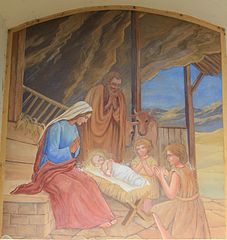 There are many charges raised against the historicity of the birth narratives of Jesus Christ. These run the gamut from objections based upon alleged contradictions to inconsistencies in the genealogies to incredulity over the possibility of a virgin birth. Rather than make a case to rebut each of these objections in turn, here I will focus upon using undesigned coincidences to note how these birth narratives of Christ have the ring of truth. How exactly do undesigned coincidences work? Simply put, they are incidental details that confirm historical details of stories across reports. I have written more extensively on how these can be used as an argument for the historicity of the Gospels: Undesigned Coincidences- The Argument Stated. It should be noted that the birth narrative occurs only in Matthew and Luke. John begins with a direct link of Christ to God, while Mark characteristically skips ahead to the action. Thus, there are only a few places to compare these stories across different reports. However, both Mark and John have incidental details which hint at the birth account. These incidental details lend power to the notion that the birth narratives of Jesus are historical events.
Joseph
First, there is one undesigned coincidence that is such a gaping hole and such a part of these narratives most people will probably miss it. Namely, what in the world was Joseph thinking in Luke!? Do not take my word for this–look up Luke chapters 1-2. Read them. See anything missing? That’s right! Joseph, who is pledged to a virgin named Mary (1:27) doesn’t say anything at all about the fact that his bride-to-be is suddenly pregnant. There is no mention of him worrying at all about it.
So far as we can tell from Luke, Joseph, who we only know as a descendant of David here, is going to be wed to a virgin and then finds out that she’s pregnant. He’s not the father? What’s his reaction? We don’t find out until Luke 2, where Joseph simply takes Mary with him to be counted in the census, dutifully takes Jesus to the Temple, and that’s about it. Isn’t he wondering anything about this child? It’s not his! What happened?
Only by turning to Matthew 1:18ff do we find out that Joseph did have his second thoughts, but that God sent an angel explaining that Mary had not been unfaithful, and that the baby was a gift of the Holy Spirit. So we have an explanation for why Joseph acted as he did in Luke. Now these are independent accounts, and it would be hard to say that Luke just decided to leave out the portion about Joseph just because he wanted to have Matthew explain his account.
The genealogies of Jesus that Matthew and Luke include are different, but they reflect the meta-narratives going on within each Gospel. Luke’s narrative generally points out the women throughout in a positive light, and it is often argued that his genealogy traces the line of Mary. Matthew, writing to a Jewish audience, traces through Jesus’ legal father, Joseph. Now it could be argued that these are simply reflections of the authors’ imaginations within their fictional accounts, but surely including names with descendants tracing all the way back to Abraham and beyond is not a good way to construct a fictional account. No, Matthew and Luke include the genealogies because their accounts are grounded in history.
Incidental Details
Interestingly, the birth narratives of Jesus also help explain the events reported in Mark and John, which do not report His birth. What of the apparent familiarity John had with Jesus in Mark 1:3ff and John 1:19ff? It seems a bit odd for John to go around talking about someone else “out there” who will be better in every way than he himself is without knowing who this other person is. Well, looking back at Matthew and Luke, we find that Mary and Elizabeth (John’s mother) knew each other and had visited each other during their pregnancy. It seems a foregone conclusion that they continued to interact with each other after the births of their sons, which would explain John’s apparent familiarity with Jesus in Mark and John.
Strangely, Mark never mentions Joseph as Jesus’ father. If all we had was Mark’s Gospel, we would be very confused about who Jesus’ father is. The oddness is compounded by the fact that Mary is mentioned a number of times. Well okay, that still seems pretty incidental. But what about the fact that Mark explicitly has a verse where he lists Mary as well as Jesus’ siblings?
Is not this the carpenter, the son of Mary and brother of James and Joses and Judas and Simon? And are not his sisters here with us?” And they took offense at him. (Mark 6:3, ESV)
This verse seems extremely weird. After all, Joseph was a carpenter (well, a more accurate translation is probably “craftsman”) and yet despite Mark explicitly using that word for Jesus, as well as listing Mary and Jesus’ siblings, we still see nothing but silence regarding Jesus’ father. Well, of course! After all, when we turn to the birth narratives in Matthew and Luke, we find that Jesus was born of a virgin. Jesus had no human father. Thus, Mark, ever the concise master of words, simply omits Joseph from details about Jesus’ life. But to not mention Jesus’ father in a largely patriarchal society alongside his mother and siblings seems extremely strange. It is only explained by the fact of the virgin birth, with which Mark would have been familiar. However, Mark didn’t see the birth narrative as important in his “action Gospel.” Only by turning to Matthew and Luke do we find an explanation for the strange omission of Joseph from Mark’s Gospel.
Conclusion
I have listed just a few undesigned coincidences to be gleaned from the birth narratives of Jesus. The fact of the matter is that these can be multiplied almost indefinitely if one looks at the whole of the Gospels, and even moreso if one investigates the whole Bible. These incidental details fit together in such a way as to give the Gospels the ring of truth. The way that Matthew fills in details of Luke, Mark demonstrates his familiarity with the birth narratives, and the intimate connections of Jesus and John are all cross-confirmed is both incidental and amazing. The claim is not that based upon these incidences alone the Gospel accounts are true. No, the claim is that those who challenge the truth of these accounts must account for these incidences in a way that is more plausible than that they simply occur when people relate history. It seems that the only way to do that would be to resort to outlandish narratives that involve the four authors sitting together and discussing which portions of stories to leave out so the others can fill them in. No, instead it seems much more likely that these four authors were writing what they had witnessed–or received from eyewitness testimony, and just as we do when recounting events (think of 9/11, for example, and the different things people remember) they wrote specific details they felt were important or part of the narrative, while the others found other things more important or had other incidental knowledge related to the events they recorded.
SDG.
——
The preceding post is the property of J.W. Wartick (apart from citations, which are the property of their respective owners, and works of art as credited) and should not be reproduced in part or in whole without the expressed consent of the author. All content on this site is the property of J.W. Wartick and is made available for individual and personal usage. If you cite from these documents, whether for personal or professional purposes, please give appropriate citation with both the name of the author (J.W. Wartick) and a link to the original URL. If you’d like to repost a post, you may do so, provided you show less than half of the original post on your own site and link to the original post for the rest. You must also appropriately cite the post as noted above. This blog is protected by Creative Commons licensing. By viewing any part of this site, you are agreeing to this usage policy.
Saint Nicholas- A Christian life lived, a story told
It has been remarked, with much truth, that all of us lead double lives, a life of our fancy, in a world of things as they should be, or as we should like them to be, and a life in a world of things as they really are. And this is as it should be. We can lift the level of real existence by thinking of things as we should like them to be. It is well not to walk with one’s eyes always fixed on the ground. (McKnight, cited below, Kindle location 401)
It is easy to hear the “real story” of Santa Claus, but few investigate further than looking it up to see the parallels between the Bishop of Myra’s life and that of the story of Santa Claus. There is so much more to his story–and indeed to stories in general–than that.
Saint Nicholas (270-343 AD) was a valiant man who fought prostitution, abortion, and poverty. He attended the council at Nicaea, from which we received the Nicene Creed. At that council, he defended vigorously the orthodox doctrine of the Trinity. He was an exemplar of Christian teaching put into practice. Not only that, but the legend which has grown up around his life has inspired and enthralled untold numbers of people through the Christian era.
It is important to note the intertwining of legend and truth in the stories about St. Nicholas, and the impact that has had upon innumerable people. George McKnight, writing in the early 1900s, explored a number of issues related to the mingling of fact and fiction in the life of St. Nicholas. The quote highlighted above touches on many of these topics.
First, there is power in narrative. A story which is told well is one which can effect change. We are impacted by fantasy in ways which cause us to reflect upon reality with new–perhaps better trained–eyes. Second, we, as spirited people in a world which we so often see only as the physical, are called to heights of reality by fiction. As McKnight noted, “It is well not to walk with one’s eyes always fixed on the ground.” Our eyes are driven upwards and outwards by the stories we hear–they cause us to interact with others in new ways, and they also cause us to think about topics which perhaps we had not even considered before.
The story of St. Nicholas is no different. Yes, legend has crept into the accounts of this godly man, but what is the purpose of that legend? Not only that, but is it possible to separate out the fiction?, McKnight also commented upon the nature of radical skeptical history being done in his time (about 100 years ago). He bemoaned the fact that nearly every facet of Nicholas’ life is thrown into question with the arrival of critical scholarship. But of course to focus merely upon what is historical fact or fiction is to miss the entire point of the life of St. Nicholas. McKnight goes on:
The story of St. Nicholas consists almost entirely of a series of beneficent deeds, of aid afforded to humanity in distress, accomplished either by St. Nicholas… or through his intervention… The conception of St. Nicholas, then, is almost that of beneficence incarnate. (Kindle Location 469-481).
That is, the story of St. Nicholas, and the legends that surround him, turn him into a type of Christ–one who is deeply concerned for humanity and showing Christian love for God and neighbor.
Yet this is not all there is to the life of the Saint. Although difficult to sift from the legends, there is a historical core to the life of St. Nicholas which is just as profoundly Christian as the legends which have grown up around him. With that said, we turn to the story of St. Nicholas, with an eye toward how his life is one of a Christian lived as well as a story told.
Nicholas is well-attested to have attended the council of Nicaea. There is a possibly apocryphal story about his 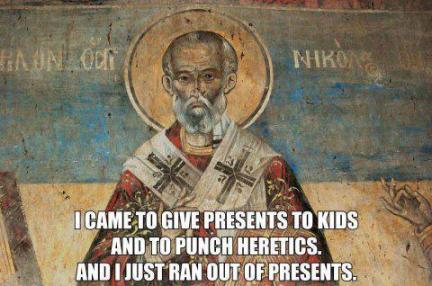 attendance there wherein he confronted the heretic Arias himself and slapped him in the face. The story continues, telling of how Nicholas was initially exiled for his act but later allowed to return after Arianism had been thoroughly acknowledged as heresy. Although it is nearly impossible to know whether this story is historically accurate, there is at least some truth behind the story in that Nicholas was known to vehemently defend the orthodox doctrine of the Trinity.
Nicholas actively opposed prostitution. However, instead of simply condemning the practice, he also gave money to young women in need to keep them from turning to prostitution to feed themselves. Again, this truth served as the basis for a possibly historic legend in which Nicholas learned of three women who were about to turn to prostitution (or be sold into slavery, depending on the account) because they couldn’t pay their dowries in order to be wed. Nicholas is said to have thrown a bag of gold for each young woman through their window so that they could be married instead of sell their bodies. Again, this legend may not be true–but it points to the truth about Nicholas’ life–he gave to those in need and fought against the evils of prostitution. It also points beyond itself towards an ideal.
Nicholas fought against the Pagan practices, which led to his persecution and imprisonment by those angered by his preaching against false idols. Furthermore, his opposition to paganism included working against a number of practices in the pagan world, including abortion. Roman Catholics have continued to spearhead St. Nicholas’ commitment to helping children. A search for “Nicholas of Myra” turns up adoption agencies one after another. Christians have used Nicholas’ example as a call to end human trafficking and slavery. One can see throughout these historical kernels how myth and legend could grow up around this figure–fighting heresy, giving to those in need, and having utmost concern for the innocent were all aspects of St. Nicholas’ life. We don’t necessarily know the extent of his actions in these areas, but we know enough to be inspired.
Therefore, we turn to another part of McKnight’s thought-provoking quote at the beginning of this post:
…all of us lead double lives, a life of our fancy, in a world of things as they should be, or as we should like them to be, and a life in a world of things as they really are. And this is as it should be. We can lift the level of real existence by thinking of things as we should like them to be.
Take a moment to consider what McKnight is saying here: we know there is a realm of absolutes–a way that things should be. We also have a way that we should like things to be. But the way the world “really is” does not often reflect that. Yet we can enact change upon our realm of existence–we can “lift it up”–by focusing on the way that things should be, and living our lives differently because of that. St. Nicholas enacted this in his life, working towards the ideal while living in an imperfect world. The legends of St. Nicholas inspire us to do the same. We are not to focus so much on the critical challenge–which stories are true and which are “only” legends. Instead, we are to focus on St. Nicholas as a story–one which inspires us to change the world around us.
Nicholas’ life was one which fought against poverty, paganism, heresy, prostitution, and idolatry. He incorporated sound doctrine into his life and then lived it. There can hardly be a better example of a Christian life lived than that of St. Nicholas. Yet that is not all there is to the story of the “real” saint. No, his life is one of calling us to live a life for Christ as well. His life is action. It is a life incarnate with truth and the beneficence that comes from the Christian worldview. It is a call to follow Christ.
Sources
James Parker III, “My Kind of Santa Claus.”
Robert Ellsberg, “St. Nicholas, Bishop of Myra.”
George Harley McKnight, St. Nicholas (New York: G.P. Putnam’s sons, 1917). This book is available legally free of charge in a number of digital formats through Open Library.
SDG.
——
The preceding post is the property of J.W. Wartick (apart from citations, which are the property of their respective owners, and works of art as credited) and should not be reproduced in part or in whole without the expressed consent of the author. All content on this site is the property of J.W. Wartick and is made available for individual and personal usage. If you cite from these documents, whether for personal or professional purposes, please give appropriate citation with both the name of the author (J.W. Wartick) and a link to the original URL. If you’d like to repost a post, you may do so, provided you show less than half of the original post on your own site and link to the original post for the rest. You must also appropriately cite the post as noted above. This blog is protected by Creative Commons licensing. By viewing any part of this site, you are agreeing to this usage policy.

 J.W. Wartick - Reconstructing Faith