atheism
Really Recommended Posts 7/31/15- Planned Parenthood, the next Earth, the Quran, and more!
 I’m pleased to present to you, dear readers, another round of “Really Recommended Posts.” This round includes posts on science, the Quran, Planned Parenthood, and a four-legged snake.
Response to Planned Parenthood President Cecile Richards’ Washington Post Opinion Piece– A point-by-point rebuttal of Planned Parenthood’s response to the recent revelations regarding the possibility of their selling of body parts. Richards’ response leaves something to be desired.
Earth 2.0? Not Quite. – The recent revealing of an “earth-like” planet has sent some into spirals of hyperbole and extrapolation. What might we say about this “Earth 2.0”? Check out this post to find out more.
Why the Discovery of the Oldest Quran Fragments is No Big Deal– Recently, fragments of the Quran thought to be the oldest ever have been discovered. Does this demonstrate the truth of Islam? I think this is a good post on the apologetic significance of this find, though I do think that the increased ability to do textual criticism of the Quran is a pretty important aspect of the find.
How Atheists Try to Incorporate the Big Bang into their Worldview– Although not exhaustive, this post on some of the ways that some prominent atheist have tried to explain (or explain away) the Big Bang and its significance for the origin of the cosmos is worth reading and taking note of.
A Four-Legged Snake! Has the Edenic Serpent Been Found?– Does the discovery of a four-legged snake demonstrate the truth of young earth creationism?
Really Recommended Posts 5/22/15- Mars, Hinduism, Prosperity, and more!
I’m pretty sure we’re not going to get nice weather here in MN for anything more than one 5 hour period at a time. Alas. Anyway, I took the chilled days to find you some more good reading. As always, be sure to let the authors know you appreciated what they wrote and let me know what you think here.
Curiosity Rover Update: Diverse Geological Formations on Mars– Not only does this post have some really beautiful imagery from Mars (seriously, it’s like a science fiction story come true!), but it also discusses how the geology of Mars might pose an interesting problem for young earth creationists.
Self-knockout: A Twitter dialogue with a Hindu against Christian Evangelism– The Nepalese Earthquake led to many Christians praying not just for the physical but also spiritual needs of those impacted. This led to major pushback from many Hindus who argued that Christians are “soul vultures” and should not evangelize. Here’s an interesting look at a dialogue with one of these Hindus who attacked Christians for sharing their faith.
The Biology Professor Who Hated our Outreach Exhibit– Pro-Life advocates continue to show how embryology and related sciences help support the case against abortion. Here’s a post about one biology professor who took issue with the use of scientific evidence against abortion.
How “faith” works in the prosperity gospel (Comic)- A nice flowchart depicting the way faith allegedly works according to the prosperity Gospel.
Upon the Ground of Men– There is a lot of anger (I don’t think this word is to strong) towards those who argue for gender-inclusive translations of the Bible and the like. Here’s a post that looks at some of the difficulties gendered translations face.
Bonus Link: Sam Harris’ performance in a discussion with Noam Chomsky left much to be desired. Sam Harris, one of the “new atheists,” has activated wanton violence against Muslims and other peoples of faith. Here, he had a dialogue with a noted activist against state-sponsored violence. How did it go?
Really Recommended Posts 4/10/15- raising a son, tropical islands, self-harm, and more!
Another round of awesome posts for you, dear readers. Please keep me in your prayers as I have a kidney stone. Sad me. But happy you, because you have some great reading ahead! Self-harm, Easter, raising a son, tropical islands and creationism are all featured topics this week. Let me know your thoughts in the comments here, and be sure to let the authors of the posts know as well.
My Depression and Self Harm vs. Jesus Passion and Sacrifice– Christianity can speak to people in all walks of life and circumstances. Here is a beautiful post that compares the struggles of someone dealing with self-harm to the hope found in the sufferings and death of Christ.
Thoughts on Raising a Son– What is it like to raise a son in our day and world? My wife shares some thoughts on raising a son and the difficulties we face as parents. How can we teach him to not give in to a culture of inequalities?
My Favorite Atheist Easter Memes of 2015– Here, Jason Wisdom shares and analyzes a number of Easter memes atheists put out to “celebrate” this most holy day–the resurrection of God Incarnate. He provides some thoughtful insights into the mindset behind them.
Origins of a Tropical Island – The long road from lava to colonization– Do the formation of islands and their ecology fit into a young earth paradigm? Short answer: no. Check out this post for some reasons why.
The Greatest Risk of All– It is often noted that women were the first evangelists. Does this have any implications for our faith?
On the Alleged Atheism of Early Christians
 It is interesting to note that modern atheists of the internet-infidel variety share much with Pagan counterparts in the first few centuries after Christ. “How can this be?” one might ask. Well, the charge of atheism against Christians is shared both by the common internet-infidel comment that “We’re all atheists, I [the atheist] just take it one god further” and Pagans in the Roman Empire. Oddly, some atheists have gone so far as to suggest that the Pagan accusation is somehow evidence for their position.
The early Christians, it is true, were accused of being atheists. However, to suggest that this is somehow synonymous with contemporary usage of the term “atheist” is ahistorical and anachronistic. Frances Young notes several facets of the charge of atheism leveled against Christians:
What the charge [of atheism leveled against Christians] really amounted to was an expression of dismay and distaste over the fact that people were abandoning conventional ritual practices… The charge of atheism against Christians focused on their refusal after conversion to continue to participate in traditional religious customs… Religion, embedded in the ethnic cultures, was a matter not of belief but of loyalty. (99, 101, cited below)
The charge against Christians, then, was that they were abandoning the ways of the Romans. They were outsiders, outcasts, and, by extension, atheists. By refusing to worship the gods of Rome, they became targets. The fact that the Christians did this conscientiously–they intentionally abandoned the gods–led to the charge of atheism. It was a charge related not to belief in deity, but rather to rejection of shared societal practice, with a culturally charged impetus for making it.
In fact, others who yet believed in the gods were also charged with atheism. The Epicureans were accused of atheism, despite believing that the gods existed:
It is significant that these ‘atheists’ [Epicureans] did not question the existence of the gods. Rather, they liberated people from religion by suggesting that the blessed immortals were not the slightest bit interested in what goes on among human beings… (ibid, 100)
Thus, when modern atheists continue to perpetuate the claim that “we’re all atheists,” and then move on to argue that Christians should agree with them because, after all, Christians were considered ‘atheists’ by the Romans, it is difficult to take them seriously. The Pagan charge was made for cultural reasons, and is tied up in the notion of rejection of the societal norms of the time. It was also made even against those who acknowledged those gods existence. This last point is very important, because one attempted rebuttal I have seen from the modern atheist is that “You are an atheist to other religions.” Well, according to ancient Pagans, you could even be an atheist to your own religion! Of course, the point is that Christians are not atheists, but theists.
The word “atheism” was used back then as a damning charge of societal blasphemy–rejecting the ethnic practices of your own society in pursuit of another’s. Now, modern atheists attempt to forcibly include others in atheism with this kind of pithy phrase. The historical charge is interesting, but clearly entirely different from the modern one. Either charge, however, is inaccurate. Christians, by definition, are not atheists–theists cannot be atheists. The ancient cultural charge is of interest for its historical implications, but it is hardly evidence for the modern use of the charge of atheism against Christians.
I suspect that this post won’t silence many who will continue to persist in saying Christians are atheists. At that point, I suggest to others the following: the people who persist in this mislabeling should be written off as being just as irrelevant as the ancient Pagans with whom they share at least this part of their worldview.
Links
Be sure to check out the page for this site on Facebook and Twitter for discussion of posts, links to other pages of interest, random talk about theology/philosophy/apologetics/movies and more!
On the statement that “We are all atheists”– I evaluate the claim that atheists make which say that “we are all atheists.” I evaluate it from a philosophical point of view here.
On the Shoulders of Giants: Rediscovering the lost defenses of Christianity– I have written on how we may discover these enormous resources historical apologists have left behind for us. Take and read!
Source
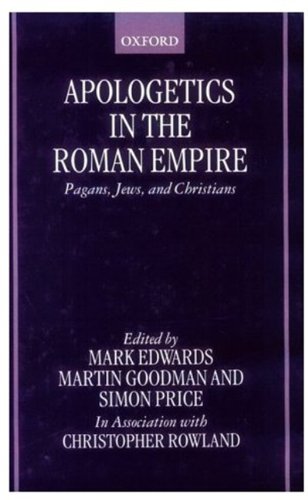
Frances Young, “Greek Apologists of the Second Century” in Mark Edwards, Martin Goodman, and Simon Price, eds., Apologetics in the Roman Empire
SDG.
——
The preceding post is the property of J.W. Wartick (apart from quotations, which are the property of their respective owners, and works of art as credited; images are often freely available to the public and J.W. Wartick makes no claims of owning rights to the images unless he makes that explicit) and should not be reproduced in part or in whole without the expressed consent of the author. All content on this site is the property of J.W. Wartick and is made available for individual and personal usage. If you cite from these documents, whether for personal or professional purposes, please give appropriate citation with both the name of the author (J.W. Wartick) and a link to the original URL. If you’d like to repost a post, you may do so, provided you show less than half of the original post on your own site and link to the original post for the rest. You must also appropriately cite the post as noted above. This blog is protected by Creative Commons licensing. By viewing any part of this site, you are agreeing to this usage policy.
Book Review: “Pascal’s Wager” by Jeff Jordan
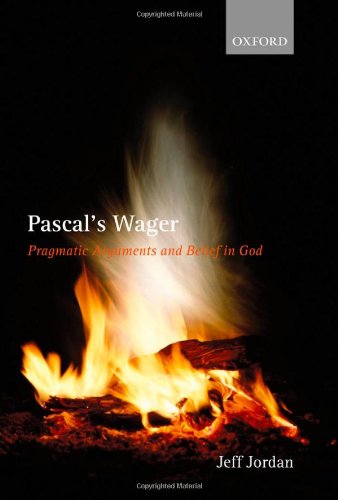
For some time, I’d been wanting to put some effort into studying Pascal’s Wager. I picked up Pascal’s Wager: Pragmatic Arguments and Belief in God by Jeff Jordan in order to familiarize myself more with the philosophical grounding behind the argument. Jordan approaches the Wager through a lens of analytic philosophy and, I think, demonstrates that the argument has some force to it.
Jordan’s work has great scope. Several aspects of the Wager are brought to light. He analyzes several different formulations of the argument, while also noting where the argument has been changed or modernized. For example, the notion that Pascal’s Wager was infinite bad vs. infinite good is a more recent innovation than Pascal’s original argument.
He studies the argument contextually to determine whether the Wager was intended as a generalized theistic proof or an argument for Christianity. Numerous objections from leading critics of the Wager are put to the test. Ultimately, a version of the Wager developed by William James is put forward as an argument that passes the philosophical muster. Jordan analyzes this argument from many angles, ultimately demonstrating that it overcomes the challenge of the “many gods” objection and provides grounds for Christian faith.
The value of Pascal’s Wager may is increased by the fact that many aspects of Jordan’s work are applicable to other arguments or areas of interest for philosophers of religion and apologists. For example, Jordan raises significant challenges to the notion that philosopher’s fictional deities may actually be counted as evidence for a “many gods” objection (75-76; 80-81). Another example is a rather interesting argument he derives from the work of James Beattie (1735-1803- Jordan notes Beattie is at times rightly accused of misrepresenting Hume’s arguments) about whether attempts to deconvert might bring about pragmatic wrongs (190-194). These and other tantalizing topics command even more interest than the book might otherwise have had.
Simply put, Pascal’s Wager: Pragmatic Arguments and Belief in God is a phenomenal, thought-provoking work that will have readers rethinking their evaluation not only of the (in)famous Wager but also of a number of related topics. Even at its steep price tag, the book is a bargain.
Links
Be sure to check out the page for this site on Facebook and Twitter for discussion of posts, links to other pages of interest, random talk about theology/philosophy/apologetics/movies and more!
Pascal’s Wager: The Utility Argument Examined– I outline and defend one of the versions of Pascal’s Wager which Jordan brings up in this work. I find it to be a very interesting argument and a great addition to the apologist’s toolkit.
Source
Jeff Jordan, Pascal’s Wager: Pragmatic Arguments and Belief in God
SDG.
——
The preceding post is the property of J.W. Wartick (apart from quotations, which are the property of their respective owners, and works of art as credited; images are often freely available to the public and J.W. Wartick makes no claims of owning rights to the images unless he makes that explicit) and should not be reproduced in part or in whole without the expressed consent of the author. All content on this site is the property of J.W. Wartick and is made available for individual and personal usage. If you cite from these documents, whether for personal or professional purposes, please give appropriate citation with both the name of the author (J.W. Wartick) and a link to the original URL. If you’d like to repost a post, you may do so, provided you show less than half of the original post on your own site and link to the original post for the rest. You must also appropriately cite the post as noted above. This blog is protected by Creative Commons licensing. By viewing any part of this site, you are agreeing to this usage policy.
Really Recommended Posts 9/26/14- Jesus Seminar, atheists and kids, and creationism!
First, I gotta brag: I have a son! He was born 9/17 and he’s just the cutest darling ever. Yay! I’ve been greatly blessed.
Now, I have still put together some awesome posts for your persual, dear readers! Here we have a nice variety of topics from the need to realize the dangers of a hardened heart to the Jesus seminar to talking about atheism with kids (I’m sure this last one won’t be controversial). Check them out and let me know what you thought!
Chemostratigraphy: silent objector to ‘Flood Geology’– Young Earth Creationists often argue that the Noachian Flood is to be seen as the explanation for the layers of sediment we find all over the planet. Can this claim stand up to scrutiny?
Who Were the Jesus Seminar? Should anyone have taken them seriously?– Christians have long faced challenges thrown at the historical faith by historical critics like those in the Jesus Seminar. But should the Jesus Seminar really be (or have been) taken seriously? Check out this post which addresses some issues related to this group.
14 Ways for Christian Parents to Teach Kids about Atheism– How might we as Christians approach the topic of atheism when speaking with children? Natasha Crain provides some much-needed insights into this area. I think this is a must-read even for those who are not parents so that we can think about how to interact in age-appropriate ways.
The Dangers of a Hardened Heart– The heardening of one’s heart presents a number of dangers for both a life of faith and a life without faith. Eric Chabot addresses these dangers in this thought-provoking post.
Is Your View Falsifiable?– Luke Nix points out a number of helpful ideas regarding whether one’s view is falsifiable. Does this matter? Read the post for many insights related to falsifiability and the Christian life.
Sunday Quote: Aliens and Paganism?
 Every Sunday, I will share a quote from something I’ve been reading. The hope is for you, dear reader, to share your thoughts on the quote and related issues and perhaps pick up some reading material along the way!
Aliens and Paganism?
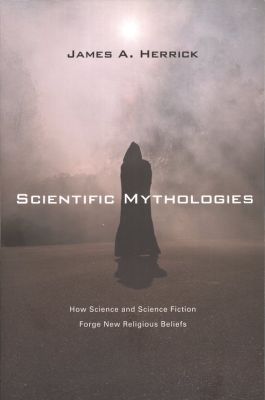
I’ve been entering notes into my computer and because of that I’ve been rereading a bunch of books. Scientific Mythologies: How Science and Science Fiction Forge New Religious Beliefs
[W]e are witnessing nothing less than the emergence of new transcendent narratives–new myths–to answer our deepest questions. We appear to have entered a second pagan era, complete with a new mythology in which minor deities once again descend from the stars, seek intimate involvement in our lives, direct our course into the future… Our mythologies… have a way of shaping who we are and what we are becoming. (17, cited below)
Have you witnessed any kind of “new mythologies” being followed or created through science or science fiction? I think that sci-fi is a great way to convey a worldview, and I’ve commented often on various ways people have used it for just that purpose. What ways might new scientific mythologies shape our perceptions of ourselves and others? Do you think Herrick’s point is to be well taken, or is he wrong? Why/not? I encourage you to check out the fascinating book. Thanks to my friend Josh over at No Apologies Allowed for so long ago introducing me to it.
Links
Be sure to check out the page for this site on Facebook and Twitter for discussion of posts, links to other pages of interest, random talk about theology/philosophy/apologetics/movies and more!
Sunday Quote– If you want to read more Sunday Quotes and join the discussion, check them out! (Scroll down for more)
Materialists: Where is hope? Look to the stars!– I analyze one aspect of materialism: the way that some look to hope in the “beyond” of the outer limits of the universe. Hope, for materialists, may come from the stars. Our salvation may lay beyond our solar system, in benevolent aliens who will bring great change and advances to us.
Source
James Herrick, Scientific Mythologies: How Science and Science Fiction Forge New Religious Beliefs
An Apologist’s Insights on “God’s Not Dead”
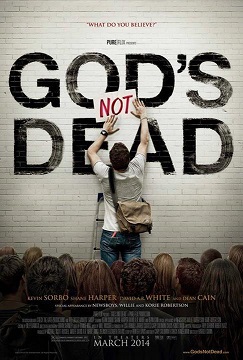 I recently had the chance to watch “God’s Not Dead,” a film which presents a story in which a college student decides to take a stand for his faith against the pressure of an atheistic philosophy professor. A summary of the plot may be found here. As an apologist with an MA in the field, I thought my comments might help provide some insight into the film. I’ll offer a look at some aspects of the film which I wanted to address. Feel free to chime in in the comments with your own thoughts.
Apologetics
The movie presents a clear picture of the need for apologetics. When challenged by attacks on the faith it is important to always have a reason for the hope within (1 Peter 3:15). Josh Wheaton–the protagonist–put together a decent presentation of various evidences for theism in the snippets that viewers get through the film. Of course, these are very simplified and don’t address several major issues with the arguments, but it gets the point across. It also, I have noted through conversations with others, spurred much interest in the area of apologetics. That’s awesome!
That said, I think there are some issues with even the arguments presented in the film. First, after Wheaton has presented the cosmological, design, and other arguments for theism, he is challenged by Professor Radisson on the notion that one just has to choose between atheism and theism. Wheaton acknowledges that yes, it is a choice. Now, there are a number of issues with this portrayal. First, it treats the balance of evidence as a kind of 50/50 proposition, which is, I would think, hardly the position of anyone. Second, it presents a view of belief in which we can just choose what we believe. This is called “doxastic voluntarism” which is a fancy way of saying that one can believe propositions at will. But that is a highly controversial position (just try to force yourself to believe that “Fairies fill my refrigerator every morning” and you’ll see the folly of it) and also flies in the face of biblical accounts of what faith is. Third, here I’ll tip my bias a bit and say I’m fairly well convinced that the balance of evidence is hardly 50/50 but actually compelling.
Another difficulty with the apologetic in the film is that it seems like the lynchpin argument offered was actually just a point of rhetoric. Wheaton presses Professor Radisson and asks “Why do you hate God?” and follows it up with [paraphrased]: “How can you hate someone who doesn’t exist?” This is the last straw and what prompts the class to vote by standing to say that “God’s not dead.” Although I think rhetoric has a clear place in the Christian apologetic (and has since the earliest times: see the apologetic works of Lactantius and Arnobius in the 200-300s AD), I thought it was an odd choice to make it the climactic argument for God. Perhaps it was because this added to the drama of the moment–and I suspect that’s right–but it did so at the cost of detracting from whatever apologetic the film could put forward.
I did, however, appreciate the interaction with some top scholars like Hawking and Lennox. I think it is very important for Christians interested in apologetics to read the top scholars in their fields in order to best get acquainted to the arguments.
Characters or Caricatures?
The way the Muslim father was portrayed was problematic. In the beginning of the film we see him dropping off his daughter and showing great concern for her. Later, he shares an intimate discussion of his faith and the importance of obedience in his background. But then, when it is revealed his daughter has converted to Christianity, he not only kicks her out of the house, but he also immediately hits her more than once. Now, I make no claims to being an expert on this, but I know from anecdotal evidence only that people are indeed kicked out of their homes for converting to Christianity (and sometimes for deconverting), and this is surely a bad thing. It’s not a bad thing to address this as an issue.
But the problem I saw was that the Muslim father’s immediate reaction was violence, without any explanation or any background for thinking this would be a reaction. The rest of the film up to this point had shown him as a caring father who was concerned for the faith and well-being of his daughter. To have him immediately turn to violence when she converted was jarring and I think it speaks to our cultural presuppositions about the religious “Other” to portray the “Other”–the Muslim–in that way. We need to move beyond such stereotypes and into genuine dialogue with those of other faiths, always looking to share the light and love of Christ with them.
On the positive side, the film did do a great job speaking to the importance of reaching out to others like the young man from China. It also emphasized missions in a number of ways, like centering some major plot points around a very amiable character as a missionary.
Pastoral Care
I appreciated the comments about the work of a pastor, in which Pastor Dave in the film was comparing his own work to that of a missionary friend’s and felt his own day-to-day tasks were mundane and trivial. The answer given by the missionary, however, was essentially that such work is part of the work of God as well and that we each occupy a place which God has put us in to make an impact on the world. I thought this was a great message and one that deserves further exploration.
On the other hand, I thought that the pastoral care at points in the movie presented some difficulties. For example, Pastor Dave’s conversation with Josh Wheaton before Wheaton decides to for sure stand up to his professor boiled down to a couple citations (not even quotations) of Bible verses to look up later and the comment that “It’s not easy, but it’s simple” [I may have the order in this quotation wrong]. I’ll be blunt: I think that this is actually a gross oversimplification. Quoting Matthew 10:33 (click for reference) does not actually make the issue facing Wheaton “simple.”
For example, would it be “denying” Christ to acknowledge that one might not have the resources available as a freshman student in a general studies philosophy class (and not a major) to take on a philosophy professor on the topic of God’s existence? I don’t think so. One could instead acknowledge that both the clearly adversarial tone taken in the environment and one’s own lack of knowledge or expertise in the area make it likely that one may actually harm the body of Christ by, well, looking like a freshman non-philosophy student outmatched by an atheistic philosophy professor. Wheaton, of course, has the benefits of film, so he is able to put together a beautiful powerpoint each week and manages to pound the books so hard that he can articulate the cosmological, design, and other arguments within a few days. But is this a realistic perspective? Moreover, is it a “simple” application of the passage to our lives?
Conclusion
“God’s Not Dead” awakens people to the need for apologetics. That is a great compliment, because it is a much-needed awakening. However, it has several issues (including those mentioned above) with the presentation of apologetics, its portrayal of the “Other,” and the oversimplification of several arguments, positions, and even pastoral care and reading of texts. In short, it’s a mixed bag.
Links
Be sure to check out the page for this site on Facebook and Twitter for discussion of posts, links to other pages of interest, random talk about theology/philosophy/apologetics/movies and more!
SDG.
——
The preceding post is the property of J.W. Wartick (apart from quotations, which are the property of their respective owners, and works of art as credited; images are often freely available to the public and J.W. Wartick makes no claims of owning rights to the images unless he makes that explicit) and should not be reproduced in part or in whole without the expressed consent of the author. All content on this site is the property of J.W. Wartick and is made available for individual and personal usage. If you cite from these documents, whether for personal or professional purposes, please give appropriate citation with both the name of the author (J.W. Wartick) and a link to the original URL. If you’d like to repost a post, you may do so, provided you show less than half of the original post on your own site and link to the original post for the rest. You must also appropriately cite the post as noted above. This blog is protected by Creative Commons licensing. By viewing any part of this site, you are agreeing to this usage policy.
Book Review: “The New Atheist Novel” by Arthur Bradley and Andrew Tate
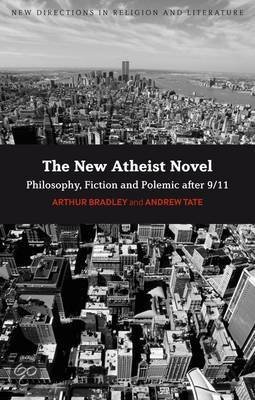 There are moments in which you pick up a book and are delivered into a completely unexpected and fresh-feeling experience. The New Atheist Novel: Fiction, Philosophy and Polemic after 9/11 was one such experience for me. Arthur Bradley and Andrew Tate take readers on a journey through the literature of four modern authors who, they argue, are representative of a new form of novel: the “New Atheist Novel.” This novel is a kind of counter-mythology which invents the transcendent within an atheistic universe. Bradley and Tate analyze the work of Ian McEwan, Martin Amis, Philip Pullman, and Salman Rushdie. The authors show how some have shifted their polemic after 9/11 to viewing religion as a kind of one-size-fits all mentality that has no distinction between liberalism and fundamentalism.
Bradley and Tate apply critical theory to the works of fiction presented in this book in incisive fashion. They draw out themes of the authors analyzed in order to show how often they are just as guilty of irrationality as those against whom they pontificate through the voices in their novels.
Ian McEwan’s fiction, they argue, shows a distinctly New Atheist bent. He sees religious persons as ultimately violent and anti-intellectual. Interstingly, McEewan’s vision of transcendence develops through music and the written word. His post 9/11 writings show a more distinctly anti-Islamist bent, which sees religion as a failure of the imagination. However, Tate and Bradley argue that McEwan’s imagination is itself failing in its capacity to see the radical Muslim act of terror as inherently symbolic and transcendent itself.
This kind of analysis proceeds across the authors analyzed, from Martin Amis’ cliché-filled war against cliché to Salmun Rushdie’s more even-handed but nevertheless anti-theistic vision of the “Quarrels over God.” The analysis of Philip Pullman’s work is perhaps the highest point of the work, as it shows how even in disagreement, one might learn from the “New Atheist Novel.” Pullman’s work shows the myth of the death of God as a kind of human transcendence and freedom from restraint. This vision may be seen as a sometimes on target critique of religion which sometimes becomes authoritarian and too bent towards heresy-hunting. Tate and Bradley ultimately see Pullman’s fiction as a kind of neo-heresy which is attempting to purify religion of its alleged bent towards fundamentalism and too-small vision of deity.
The book’s usefulness goes beyond simple critique. Instead, it gives readers a chance to interact with all literature in a critical fashion. Moreover, Bradley and Tate are not entirely unsympathetic to the “New Atheist Novel” and show how it may help to inform future discussions. The critical interaction is not merely critical but also constructive.
Perhaps the biggest weakness in the book is that its thesis doesn’t seem to carry throughout. The “New Atheist Novel” makes its debut with McEwan, but by the time the author’s reach Rushdie’s slightly more amiable vision of religions in conflict, it seems to lack cohesion as a concept. Perhaps it would be more accurate to say that the “New Atheist Novel” is more of an “Anti- (or Alter-) Theistic Novel” which encompasses not mere anger against religion but rather a critical and sometimes polemical and mistaken vision of the “religious other.” Thus, it seems in the end the “New Atheist Novel” namenclature might not be inaccurate after all, but I tend to think–and the authors reinforce this–of the “New Atheism” along specifically Dawkinsian lines of thought, and Rushdie and Pullman’s works did not seem to fit this usage of the term. A minor gripe, but one worth noting.
This is a book well worth reading and referencing. Don’t be deceived by its length (111 pages of text); it truly has an enormous amount of useful information and discussion. I took a monstrous amount of notes on this book given its length. It will get you thinking, whatever your own view. I recommend it without reservation.
Links
Be sure to check out the page for this site on Facebook and Twitter for discussion of posts, links to other pages of interest, random talk about theology/philosophy/apologetics/movies and more!
Sunday Quote!- The New Atheist Mythology– I share a quote from The New Atheist Novel which discusses the notion that there is a mythology growing up around atheism.
Source
Arthur Bradley and Andrew Tate, The New Atheist Novel: Fiction, Philosophy and Polemic after 9/11 
SDG.
——
The preceding post is the property of J.W. Wartick (apart from quotations, which are the property of their respective owners, and works of art as credited; images are often freely available to the public and J.W. Wartick makes no claims of owning rights to the images unless he makes that explicit) and should not be reproduced in part or in whole without the expressed consent of the author. All content on this site is the property of J.W. Wartick and is made available for individual and personal usage. If you cite from these documents, whether for personal or professional purposes, please give appropriate citation with both the name of the author (J.W. Wartick) and a link to the original URL. If you’d like to repost a post, you may do so, provided you show less than half of the original post on your own site and link to the original post for the rest. You must also appropriately cite the post as noted above. This blog is protected by Creative Commons licensing. By viewing any part of this site, you are agreeing to this usage policy.
Really Recommended Posts 8/29/14- Eschatology, Creationism, Morality, and more!
There is a lot of good reading to be found in this round of Really Recommended Posts. Be sure to leave comments on those you enjoyed and let me know what you thought here! The topics include eschatology, creationism, morality, Star Trek, and more!
Hitchens’ Challenge: Name one moral act that a religious person can do that an atheist cannot– Jason Wisdom takes on Christopher Hitchens’ challenge to name a moral act that is exclusive to a religious person. He challenges the core assumptions behind the argument, along with the notion of what it means to be “moral.” This is a great read.
Coexist? – A Pox On Both Bumper Stickers-This post is about more than you may think, so be sure to read it. Philosopher David Marshall takes on the “bumper sticker” mentality of both the “Coexist” bumper sticker and its negation.
Exceptional Dinosaur Tracksite in Denali National Park Reveals Herd of Hadrosaurs– Who doesn’t love to read about dinosaurs and creationism? Put your hand down, you, you’re lying! Check out this post which talks about how a rather awesome find of dinosaur tracks presents a challenge for a young earth paradigm.
What does the Bible say about “End Times”? Three Historic Perspectives– Eschatology is something of a side interest for me, and I found this post by J. Warner Wallace to be a pretty solid summary of a few major positions Christians hold regarding end times.
Some Tips on Research– The title pretty much says it all. These are some handy things to keep in mind while doing research.
Make It So- Parody of “Let it Go”– It’s no secret that I love Star Trek. I’ve discussed it on this site with theological/apologetic questions, and I’ve also had an ongoing series of reviews of TNG on my “alternate interests” site. Here, there is a parody of the song “Let it Go” based on Star Trek: First Contact. I thought it’d be a fun way to round out this week’s posts.

 J.W. Wartick - Reconstructing Faith