Christianity
The Lutheran Church-Missouri Synod and Creationism: An Unnecessary Match
 The Lutheran Church-Missouri Synod, at their 2019 convention, re-iterated an affirmation and strengthened adherence to statements about creation and evolution made previously by Synod bodies. Res. 5-09A, according to the report from the LCMS, restates the position of earlier statements in the Synod, including a 1932 doctrinal statement that states, among other things:
We reject every doctrine which denies or limits the work of creation as taught in Scripture. In our days it is denied or limited by those who assert, ostensibly in deference to science, that the world came into existence through a process of evolution; that is, that it has, in immense periods of time, developed more or less of itself. Since no man was present when it pleased God to create the world, we must look for a reliable account of creation to God’s own record, found in God’s own book, the Bible. We accept God’s own record with full confidence and confess with Luther’s Catechism: “I believe that God has made me and all creatures.”
In effect, the Resolution (Res. 5-09A) is a significant and modern reiteration of creationism within the LCMS, specifically of young earth creationism. Thus, it also more emphatically excludes and alienates those within the Synod who do not affirm such a position and who have explored the possibility of other positions within the church.
I believe God has made me and all creatures?
There are a number of problems, of course, with such a statement. The quote provided above issues a bald appeal to Luther’s Small Catechism with the statement that “I believe God has made me and all creatures.” On the surface, this appears to be an attempt to use that quote to support direct, fiat creationism. Yet when one reads the rest of that section of the Small Catechism, one finds that the same exact section also states “[God] also gives me clothing and shoes, food and drink, house and home, wife and children, land, animals, and all I have. He richly and daily provides me with all that I need to support this body and life.” Yet the LCMS is not also passing resolutions that affirm direct, fiat action by God in the providing of our clothes, food, drink, shoes, house, and home. They’re not passing resolutions in which Synod laity is expected to affirm that God literally created their clothing and gave it to them directly. But the Catechism does make those statements in the exact same context, without any such qualification. This means that the Catechism does not exclude means when it comes to divine providence regarding these matters. God uses means to provide us with food, home, and clothing. Similarly, God may have used means when it comes to “God made me and all creatures.”
The appeal to the lack of humans being present at creation cuts both ways. No member or pastor in the LCMS was present when God created the heavens and the Earth, so how is it that they may define in more exacting detail how God created them? Indeed, they say that we ought to look at God’s own record, which explicitly states that the heavens declare God’s glory. Scientists have looked to the heavens to see direct evidence of God’s glorious creation. Such evidence, God’s “speech” from the heavens (Psalm 19), points to a universe much, much more ancient than the six- to ten-thousand years most young earth creationists affirm, especially those who are so exacting in defining days as “6 natural days” (more on that below, though).
Six Natural Days?
The Resolution (5-09A) reiterates that creation is in “6 natural days.” But the fact is that the concept of a day as 24 hours is itself a giving into cultural norms of our own time. The length of a day has changed through history, as is demonstrable from such things as the variance in Earth’s rotation, tidal forces, and more can and have changed the length of the day, either permanently or for short periods of time (read more on this phenomenon here). Now, these fluctuations are extremely minor, so the objection may be lodged that this doesn’t impact the concept of a “24 hour day” or a “natural day.” Once one does admit that minor variations are acceptable, however, it becomes much less clear why major variations or even different meanings may not be explored. After all, nothing in the Bible states that God held the Earth in a completely still, static state as the creation week continued. It may be the case that even with a “standard” or “natural” day, the actual duration of each of the 6 days of creation could have varied. So, again, the very concept itself is flawed, for it both reads into the Bible things that are not there and ignores actual observational evidence that it is wrong. In attempting to circumvent science and purely affirm Scripture, the LCMS has fallen into the trap of bringing along scientific presuppositions that are hidden in the premises of their statements, thus doubling the error by both affirming a non-scientific viewpoint and smuggling in scientific assumptions that undermine their position.
Consequences of the Position
The fact is that the LCMS attempt to “take a stand” on this issue places it squarely and officially outside of any possibility for youths or adults to reconcile the official stance of their denomination with modern science. As someone who was within the LCMS and is no longer, I can say that this is one of the reasons I left. The total disregard for any viewpoint that went against a (then unofficial) stance on the timing and/or means of creation as well as the lack of regard for science generally was a massive difficulty for me within the denomination. Making this the official stance will do nothing but exacerbate that same concern for many, many more. I distinctly recall several conversations with other LCMS people, young and old, about how the denomination’s stance on creation was a significant hurdle for them in their faith life.
This is about much larger issues than whether the LCMS will lose or gain members; it is about the actual faith lives of those within the denomination. By drawing the wagons in tighter in the circle, the LCMS pastors have rejected the duty to be pastoral to their congregants and aligned their church body with a statement that cannot be reconciled with mainstream science with mountains of data and evidence to support it. Youths will be told that not to affirm this “6 natural day” creation is to oppose the Bible, and because the LCMS has so strongly emphasized that to believe as they do just is to trust the Bible, such a rejection will lead to crises of faith. As someone who experienced this in my own life, this is deeply disturbing and disappointing. The church body has effectively taken a stance on a non-essential that will lead to many questioning essential issues.
There are many, many more issues with the stance of the LCMS here, as well. For example, in my own experience I have seen several LCMS churches utilize program materials from creationist organizations like Answers in Genesis. Yet, for all the LCMS purports to value doctrinal purity and affirm centrally Lutheran beliefs, their support for groups like Answers in Genesis shows that the Synod is far more interested in aligning with broad evangelical theology than in maintaining a distinctive Lutheranism. The use of youth materials from Answers in Genesis is troubling, not only because it stands so clearly against modern science, but because Answers in Genesis also uses its website to promote non-and even anti-Lutheran positions on things like baptism. For example, a search for “baptism” on the Answers in Genesis Website yields immediate links like this one, a sermon from Charles Spurgeon, in which he states:
the very great majority of Christian people think infant children are fit and proper subjects for this ordinance [baptism]; we, on the other hand, believe that none are fit and proper subjects for the ordinance of baptism, except those who really believe and trust in the Lord Jesus Christ as their Saviour and their King.
Yet the LCMS, an unashamedly Lutheran organization, is perfectly willing to hold hands with an organization that promotes strictly anti-Lutheran materials as top results on its website? Why? Because, again, the LCMS has fallen into the trap of valuing evangelicalism and the narrative of the “culture wars” more than it values its own adherence to Lutheran doctrine. This strong and hard stance on young earth creationism is just one of the many results of such a capitulation, but it is also one of the most vehement positions the LCMS is promoting within its churchwide body.
A Personal Appeal
The LCMS recently published a report in which it was revealed that the “2017 Confirmation Survey identified around a 1-in-3 rate of retention for individuals after confirmation” in the LCMS. This number spawned a number of discussions and responses to it. One such response, the “Executive Summary” of the survey, stated as a category that “Congregations must be safe places for young people to wrestle with life and faith in order for them to faithfully reach out to today’s culture.” Taking such a hard stance on a scientific issue that the LCMS is unwilling or unable to actively engage with (as shown by reliance on outside resources like Answers in Genesis) is the exact opposite of being a “safe place for young people to wrestle with life and faith…” It was not a safe place for me, personally, as I dealt with some of these difficult topics. I came very near to leaving the faith entirely, and it was ironically an LCMS person who said that Jesus resurrection didn’t hinge upon whether the Earth was 10,000 or 10 billion years old that helped me rethink my faith. But now, the LCMS has made even that slight possibility outside the bounds. Their statement has tied people’s faith with the age of the Earth, and that should not and must not be the foundation for any Christian faith whatsoever.
Links
Be sure to check out the page for this site on Facebook and Twitter for discussion of posts, links to other pages of interest, random talk about theology/philosophy/apologetics/movies and more!
Gregg Davidson vs. Andrew Snelling on the Age of the Earth– I attended a debate between an old earth and young earth creationist (the latter from Answers in Genesis like Ken Ham). Check out my overview of the debate as well as my analysis.
Ken Ham vs. Bill Nye- An analysis of a lose-lose debate– In-depth coverage and analysis of the famous debate between young earth creationist Ken Ham and Bill Nye the science guy.
SDG.
——
The preceding post is the property of J.W. Wartick (apart from quotations, which are the property of their respective owners, and works of art as credited; images are often freely available to the public and J.W. Wartick makes no claims of owning rights to the images unless he makes that explicit) and should not be reproduced in part or in whole without the expressed consent of the author. All content on this site is the property of J.W. Wartick and is made available for individual and personal usage. If you cite from these documents, whether for personal or professional purposes, please give appropriate citation with both the name of the author (J.W. Wartick) and a link to the original URL. If you’d like to repost a post, you may do so, provided you show less than half of the original post on your own site and link to the original post for the rest. You must also appropriately cite the post as noted above. This blog is protected by Creative Commons licensing. By viewing any part of this site, you are agreeing to this usage policy.
Book Review: “Haunted by Christ: Modern Writers and the Struggle for Faith” by Richard Harries
 Haunted by Christ is a riveting look at how modern writers dealt with lingering doubts, anger, sorrow, and the question of Christianity. Richard Harries asks readers to engage with several writers to ask them questions that might not normally be asked, and he challenges readers in ways that are intricately tied into these authors’ lives.
First, it is worth pointing out that the concept of “modern” here is being used in the technical sense, related to modernism. Harries sets this period starting with Fyodor Dostoevsky (1821-1881) and Closing in the early 20th century. The authors Harries surveys are Dostoevsky, Emily Dickinson, Gerard Manley Hopkins, Edward Thomas, T.S. Eliot, Stevie Smith, Samuel Beckett, W.H. Auden, William Golding, R.S. Thomas, Edwin Muir and George Mackay Brown, Elizabeth Jennings, Graham Greene with Flannery O’Connor, Shusaku Endo, and Evelyn Waugh, C.S. Lewis and Philip Pullman, and Marilynne Robinson. Readers familiar with the works of these authors will know they run the gamut from skeptics to devout Christians. What ties them together, in Harries reading, is that their works are “haunted” by the supernatural, and specifically through a grappling with the person of Jesus Christ.
As a reader, I was unfamiliar with many of the authors, not having read much from the modernist movement. (This line makes me want to say sorry to my English teachers.) Nevertheless, Harries gives enough biographical information on each author to understand the points he’s making. Indeed, most of the information in the book is biographical, as Harries draws out each authors’ struggle with faith and coming to terms with the person of Jesus Christ. Even the skeptics surveyed clearly interact with Christianity, even if in negative ways.
I found several chapters of particular interest. Seeing C.S. Lewis’s and Philip Pullman’s competing mythologies set alongside each other for examination was fascinating. The chapter on W.H. Auden and his quiet, almost “polite” faith drew to light the great impact culture can have on one’s perception of religion and the work of God. The chapter on Golding makes me want to read more from him, despite not enjoying The Lord of the Flies. Emily Dickinson as “smouldering volcano” was an insightful look at a phenomenally successful poet. Each chapter had something that struck me, though the book also left me wishing I did know more about the authors and their works. I suspect Harries would be pleased to know his work led me to reach out and start reading some of these other works.
The biographical way Harries writes integrates worldview questions into the writings of each author. It never felt as though he subverted their own personal narratives, however. He didn’t pull punches in describing the way a skeptic like Pullman spoke about religion. Nor did he cover up aspects of authors’ lives that some might find unappealing. It’s an honest, almost unyielding book. It made me uncomfortable at times, but in ways that challenged me to learn and understand.
Haunted by Christ is a fascinating work. Harries offers insight and vision into Christianity in ways that I hadn’t really thought of before. It made me want to read many of the authors mentioned. And it made me want to know what someone who actually was more familiar with these authors might think. Recommended.
Disclaimer: I was provided with a copy of the book for review by the publisher. I was not required to give any specific kind of feedback whatsoever.
Links
Be sure to check out the page for this site on Facebook and Twitter for discussion of posts, links to other pages of interest, random talk about theology/philosophy/apologetics/movies and more!
Book Reviews– There are plenty more book reviews to read! Read like crazy! (Scroll down for more, and click at bottom for even more!)
SDG.
——
The preceding post is the property of J.W. Wartick (apart from quotations, which are the property of their respective owners, and works of art as credited; images are often freely available to the public and J.W. Wartick makes no claims of owning rights to the images unless he makes that explicit) and should not be reproduced in part or in whole without the expressed consent of the author. All content on this site is the property of J.W. Wartick and is made available for individual and personal usage. If you cite from these documents, whether for personal or professional purposes, please give appropriate citation with both the name of the author (J.W. Wartick) and a link to the original URL. If you’d like to repost a post, you may do so, provided you show less than half of the original post on your own site and link to the original post for the rest. You must also appropriately cite the post as noted above. This blog is protected by Creative Commons licensing. By viewing any part of this site, you are agreeing to this usage policy.
Book Review: “Bonhoeffer’s Black Jesus: Harlem Renaissance Theology and an Ethic of Resistance” by Reggie L. Williams
 Reggie L. Williams’s Bonhoeffer’s Black Jesus is a deep look at how Bonhoeffer’s experience in New York, and more specifically in Harlem, shaped him as a theologian of resistance against Hitler. It’s not just that, though, as it also traces Bonhoeffer’s intellectual development, specifically about racism, both before and after this epochal change.
First, Williams outlines the early theological development of Bonhoeffer, tracing his early intellectual development as well as his struggles to find a church home while visiting the United States. Here, in the United States, Bonhoeffer first encountered white racial terrorism in the form of lynching. Later, he would appeal to a German theologian to speak out against the charade of trials against in Scottsboro, in which nine black men were falsely accused of raping two white women. Eight of them were sentenced to death and killed. This caused something of an awakening for Bonhoeffer to racial violence, though he still had to become aware of his own biases.
The movement of Bonhoeffer from a proponent of volk (the German word for “Folk) type nationalism to a race-conscious and anti-racist perspective is one of the most fascinating portions of Williams’s research. While Bonhoeffer retained several core convictions throughout his life, his thought about race was directly impacted by his time in Harlem. Germany had been a colonial power until the Treaty of Versailles assigned the nation’s colonies to the winning powers, and many German people longed for that Imperial power once again. Williams demonstrates that Bonhoeffer’s own thought was impacted by this, particularly when he surveys Bonhoeffer’s early sermons and discussions of the concept of volk.
Williams then draws an outline of the Harlem Renaissance, including major thinkers and themes, as well as how some of these thinkers and themes explicitly or implicitly show up in Bonhoeffer’s works. Unfortunately, at least one of the works that would provide more insight into this has been lost (a paper Bonhoeffer wrote on black thinkers while in the United States). Nevertheless, Williams demonstrates that the themes of the Harlem Renaissance, along with Bonhoeffer’s own time in Harlem, became deeply influential on his later life. It is in this section that Williams does the most to bring to light strands of thought in Bonhoeffer that might otherwise be missed. Specifically, he traces the constant theme of Jesus identifying with the marginalized as something that would lead to active theology of resistance in Bonhoeffer’s thought. This theme is highlighted both in the thought of W.E.B. Du Bois and the poem “Black Christ” by Countee Cullen, which Bonhoeffer was aware of. The latter is lain out in detail, and shows both how Harlem Renaissance theology could be linked to liberation theology and how Bonhoeffer’s thought developed along that direction as well. It was black thinkers who helped awaken in Bonhoeffer a truly great desire for resistance against racism.
Another major theme of Williams’s work is that of empathy. He argues throughout that Bonhoeffer’s move towards empathy was something that he found through observing segregation in the United States and the resistance to it in Harlem. This, Williams argues, developed into a “Christ-Centered Empathic Resistance,” which is the last part of Bonhoeffer’s life as he actively worked against the Nazis in Germany.
The bulk of Williams’s work focuses on Bonhoeffer’s time in the United States, supporting his theses with meticulous notes and documentary evidence. The endnotes are full of additional argumentation as well as sources and reading.
Bonhoeffer’s Black Jesus is an essential read for those interested in Bonhoeffer’s theology of resistance. More than that, Williams provides here both an historic overview of Bonhoeffer’s thought and the ways in which one might develop him further. The unity of Bonhoeffer’s thought with Harlem Renaissance thinking and the movement of that into modern movements for societal justice is another major theme in the book. It’s a rare work that surveys the thought of a thinker while also offering insight into how modern thought might move forward along the same lines or go beyond its subject. Highly recommended.
Links
Be sure to check out the page for this site on Facebook and Twitter for discussion of posts, links to other pages of interest, random talk about theology/philosophy/apologetics/movies and more!
Book Reviews– There are plenty more book reviews to read! Read like crazy! (Scroll down for more, and click at bottom for even more!)
SDG.
——
The preceding post is the property of J.W. Wartick (apart from quotations, which are the property of their respective owners, and works of art as credited; images are often freely available to the public and J.W. Wartick makes no claims of owning rights to the images unless he makes that explicit) and should not be reproduced in part or in whole without the expressed consent of the author. All content on this site is the property of J.W. Wartick and is made available for individual and personal usage. If you cite from these documents, whether for personal or professional purposes, please give appropriate citation with both the name of the author (J.W. Wartick) and a link to the original URL. If you’d like to repost a post, you may do so, provided you show less than half of the original post on your own site and link to the original post for the rest. You must also appropriately cite the post as noted above. This blog is protected by Creative Commons licensing. By viewing any part of this site, you are agreeing to this usage policy.
Book Review: “Phoebe: A Story” by Paula Gooder
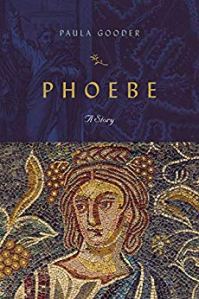 Phoebe: A Story by Paula Gooder is two books in one: a fictional picture of what Phoebe’s life and society might have looked like; and an academic exploration of this same society, world, and individual.
Paula Gooder writes in a style that is engaging and informative. The plot of the narrative section grabbed my interest from the get-go with its interweaving of biblical details with background information from historical studies as well. The main plot is of interest, following Phoebe through potential struggles and a narrative that gives readers rich imagery of what house churches were like and how these could have differed in different places due to income levels, the patrons, and the like. Gooder gives a vital look into the life of early Christians, doing so in a way that is winsome in style. What’s interesting is that, due to the integration of some biblical persons, I as a reader was hyper-aware of these characters. I have to say, I was a bit sad that I didn’t love Junia as a character in Gooder’s book as much as I’d have hoped. But Gooder makes these characters seem true to life, with real motivations and interests beyond simply being set pieces for teaching readers about early Christianity.
The second part is full of notes that bring historical and theological insight into the narrative woven throughout the book. They provide justification for various narrative choices, background information about how things may have been in the early church, and are full of rich details about Christian life. Gooder’s research is quite thorough and will give interested readers more avenues for exploration.
Readers should note that the book is probably best enjoyed with one finger in the endnotes to integrate those notes into their reading of the narrative. I saw the notes section at the back, but read the book front-to-back, thinking that since the notes were called “Part 2,” it made sense to read Part 1 and then 2. But doing so meant I missed out on several key points of interest within the narrative, which meant I went back and re-read portions to make more sense of what Gooder was saying. The book doesn’t have an introduction or preface to recommend this reading order, so be aware of it.
Readers will find much of interest in Phoebe: A Story. From the background information to the more intimate picture of what life may have looked like in the early church, this book is well-worth the time investment. Recommended.
Disclaimer: I was provided with a copy of the book for review by the publisher. I was not required to give any specific kind of feedback whatsoever.
Links
Be sure to check out the page for this site on Facebook and Twitter for discussion of posts, links to other pages of interest, random talk about theology/philosophy/apologetics/movies and more!
Book Reviews– There are plenty more book reviews to read! Read like crazy! (Scroll down for more, and click at bottom for even more!)
SDG.
——
The preceding post is the property of J.W. Wartick (apart from quotations, which are the property of their respective owners, and works of art as credited; images are often freely available to the public and J.W. Wartick makes no claims of owning rights to the images unless he makes that explicit) and should not be reproduced in part or in whole without the expressed consent of the author. All content on this site is the property of J.W. Wartick and is made available for individual and personal usage. If you cite from these documents, whether for personal or professional purposes, please give appropriate citation with both the name of the author (J.W. Wartick) and a link to the original URL. If you’d like to repost a post, you may do so, provided you show less than half of the original post on your own site and link to the original post for the rest. You must also appropriately cite the post as noted above. This blog is protected by Creative Commons licensing. By viewing any part of this site, you are agreeing to this usage policy.
Book Review: “Atheism? A Critical Analysis” by Stephen E. Parrish
 Stephen E. Parrish analyzes atheism with the sharpest tools of analytic philosophy in his latest book, Atheism? A Critical Analysis. After an introductory chapter looking at the issues at hand (circularity, the meaning and extent of worldview, definitions of key words like faith, and the specific type of atheism he’s analyzing–the most prominent one in contemporary philosophy today, naturalistic atheism), Parrish takes up the task of inspecting atheism from all sides, with chapters on competing theories of existence, the existence and order of the universe, the existence of the mind, ethics, and beauty and evil.
The chapter on competing theories of existence is insightful as it both helps divide different worldviews and categorize them and offers a fuller look at what Parrish calls ‘perfect being theism’ which is essentially classical theism sans a strong view of divine simplicity. With definitions under the belt, Parrish then dives into the critical analysis of naturalistic atheism.
The first question explored is that of the universe’s existence and order. Here, Parrish surveys the various possibilities. On naturalistic atheism, the universe may either exist by chance or necessity. He then offers deep analysis of each possibility. The concept of brute fact–that the universe just exists as it does by chance–is, frankly, brutalized in Parrish’s analysis. For example, the idea that our universe is the way it is and ordered because it just happens to be the one in an untold trillions chance that we exist and observe it, and that any other universe would have been just as likely, so we just happened to be likely, does not stand up to scrutiny when one also factors in the selection of an orderly, life-permitting universe like our own. As Parrish’s example points out, if we roll one trillion fair/unloaded dice, what is the likelihood of getting a six on every roll? Each additional sequence would be exponentially less likely. Then, if one rolls the trillion dice a trillion times, the odds of getting this sequence is remote in the extreme. That is, unlikely dice rolls are much, much, much more likely than lucking out and selecting the desired sequence of all 6 rolls. So even if there are an infinite number of possible universes, there is still a set of universes within that overall set of possible universes which would be infinitely less likely to exist, for we’d be trying to select a specific universe with a specific set of circumstances (eg. our own, as opposed to one in which no life is possible, or all that exists is a single star, or a black hole or something of the sort). So brute fact theory still has not accounted for the unlikely nature of our own universe. It is, effectively, equivalent to hand waving and saying the odds don’t matter, we just exist. Calling that an explanation for the existence of the universe is a misnomer at best (see Parrish’s analogy on p. 118). The universe as existing with necessity is analyzed by Parrish in a similar, thought-provoking fashion.
The existence of mind is the next question, and Parrish has done significant work on this question from a philosophical perspective in another work of his, The Knower and the Known (see my two part review: part 1, part 2). Here, Parrish offers a more succinct but nevertheless thorough analysis of the major philosophical positions on the mind from a naturalistic perspective. After a survey of the main options (eg. eliminativism, identity theory, supervenience, and more), he turns to pointing out problems with materialism such as the relationship between the brain and consciousness (146-147), the notion that consciousness is an illusion (147-148), and intentionality–that thoughts sem to be about things (148). Dualism, Parrish notes, has its own set of difficulties, but theism is able to offer a better explanatory power than naturalism because theism has reality as fundamentally personal due to the personal nature of God, thus allowing for an explanation for mind that does not reduce it to nothing, make it illusory, or any other position that suffers from the problems of effectively making consciousness a fiction, or, minimally, a non-intentional state (163).
The next two chapters cover ethics, value, and beauty and note how though these things seem to be observable aspects of our universe, naturalistic atheistic attempts to explain them fail on a number of levels. In particular, they struggle to explain how they can either exist or be objective. Two appendices at the end of the book provide a look at atheism’s ideological development and the social impacts of atheism. The latter appendix is particular aimed to be an answer to those that charge religion specifically is the cause of the worst of society’s ills.
Of the admirable aspects of this book, there is a noted effort to both present the strongest arguments atheists have to offer, including such noted names as J.L. Mackie and Graham Oppy, and an effort in tandem to avoid making arguments that not all Christians could agree with (eg. avoiding making something like ID theory a primary pillar of analyzing atheism in regards to natural order).
It should be noted that this work is intended for a more general audience, with more analogies and basic information presented than in Parrish’s other work. Nevertheless, it still remains deep and incisive in its reasoning and analysis, and readers of any level of expertise in relevant areas will find parts of interest. It would be hard to find a more well-reasoned, deeper look at analyzing atheism in the analytic tradition in a way that is written with accessibility to a more general readership in mind. Words and phrases like “worldview” and “probability structure” are utilized throughout the text, but Parrish defines them in the introductory chapters in such a way that readers will be able to grasp them. When it comes to the analysis itself, because of his engagement with major thinkers and positions in modern atheism, the book will be useful to any reader who finds the topic of interest. Atheism? A Critical Analysis comes recommended without reservations. Any reader can benefit from this extraordinary work.
Full Disclosure: I am named in the acknowledgements of the book, read an early draft, and provided some feedback on the early draft as well. I received a review copy from the author.
Links
Be sure to check out the page for this site on Facebook and Twitter for discussion of posts, links to other pages of interest, random talk about theology/philosophy/apologetics/movies and more!
The Knower and the Known by Stephen E Parrish– I wrote an extensive two-part review of Stephen E. Parrish’s book on dualism and naturalistic theories of mind. See the second part as well.
Book Reviews– There are plenty more book reviews to read! Read like crazy! (Scroll down for more, and click at bottom for even more!)
SDG.
——
The preceding post is the property of J.W. Wartick (apart from quotations, which are the property of their respective owners, and works of art as credited; images are often freely available to the public and J.W. Wartick makes no claims of owning rights to the images unless he makes that explicit) and should not be reproduced in part or in whole without the expressed consent of the author. All content on this site is the property of J.W. Wartick and is made available for individual and personal usage. If you cite from these documents, whether for personal or professional purposes, please give appropriate citation with both the name of the author (J.W. Wartick) and a link to the original URL. If you’d like to repost a post, you may do so, provided you show less than half of the original post on your own site and link to the original post for the rest. You must also appropriately cite the post as noted above. This blog is protected by Creative Commons licensing. By viewing any part of this site, you are agreeing to this usage policy.
Junia and Bayesian Epistemology: Philosophical probability trumping Biblical scholarship?
 Alexander Pruss is one of the smartest people I’ve encountered. Though I don’t always agree with his conclusions, the sharpness of his intellect and his wit is always fascinating. His blog is frequently a place to flex mental muscles, as he offers small, one-off arguments to spur discussion. Recently, he wrote a post entitled “Junia/Junias and the base rate fallacy” Pruss argued that application of Bayesian analysis to biblical scholarship would help solve the question of whether Junia/Junias was an apostle. Apologies in advance for possible lack of care with terms like “factor,” “probability,” and “odds”; I tried to be careful but I’m tired.
The Argument
The preliminaries are explanations of Bayes’ Theorem and the meaning of the “base rate fallacy,” both of which are easily searched online, but I provided the links here (with all the caveats that a little bit of knowledge is a dangerous thing and Wikipedia articles don’t make anyone an expert). With that information in mind, we approach Pruss’s argument.
Pruss does fudge the numbers some, admitting he hasn’t explored the question on the actual numbers for some of these probabilities. So, for example, he begins by giving a 9:1 factor for Junia:Junias names in the early church. With that, and with the note that to avoid the base rate fallacy, we ought to assign a probability (he gives .9) to the question of whether this person was “among” the apostles, it yields a .19 rate of false positives for people who are not woman apostles to be assigned the notion of being a woman apostle. Moreover, if we say that there are 12 male apostles (the disciples) for every one female apostle (Junia), the probability of an apostle being a woman is now 1/13. Finally, because “not everyone Paul praises is an apostle” we have to assign a probability to whether Paul is praising an apostle here (Pruss gives it .3). This means that “the chance that a randomly chosen person that Paul praises is a female apostle even given the existence of female apostles is only about (1/13)×(1/3) or about three percent.”
Plugging in the .19 we got above for false positives and doing more math (read his post), we now discover that “even assuming that some apostles are female, the probability that Junia/s is a female apostle is at most about 14%, once one takes into account the low base rate of women among apostles and apostles among those mentioned by Paul.”
Pruss immediately notes the numbers are made up and could change the overall results.
Analysis
There are some significant problems with Pruss’s argument here. First, the fact is that there is no extant name “Junias/Junianias” found anywhere in lexical evidence whatsoever. Thus, instead of .9 for Junia being a woman, it should be 1. One comment pointed this out and Pruss pressed the argument that even in this case, the math would still be “significantly less than 50%” for Junia to be a female apostle. Doing the math is too hard for my tired brain, but let’s just say he’s right. The question still remains of why the chances for Junia to be a female apostle would be so low.
Looking at his other percentages, it seems a large part of the argument, once we’ve established Junia is female, turns on whether it is the case that she may not be “among” the apostles. Pruss’s position here falls into the goalpost moving arguments that complementarians have engaged in since the lexical evidence turning her into a man came up dry. Typically, this is how it goes:
Junia was not a man => Okay, Junia was not an apostle => Okay, Junia was not the type of apostle that was authoritative
The third stage above is one that is essentially a theological fiction supported almost entirely by punting to the fallacious importation of the semantic range of a word into a foreign context. When Paul wrote to say that Junia was an apostle, according to this argument, but she was one only in the semantic meaning of the word apostle as witness/sent one/messenger. Never mind that the word is used for an office in the New Testament, including in the writings of Paul (1 Corinthians 12:28). No, because it does not serve the purpose of continuing to prevent women from holding pastoral office, the entire semantic range of meaning for the word “apostle” must be imported in order to reduce Junia in status once again. This fallacious importation of meaning is a demonstration of an ad hoc explanation. (Unfortunately, Pruss himself succumbs to this goalpost moving argument in the comments on this post when he questions whether Junia as an apostle would be an authoritative apostle or not.)
But it is the second stage that is at question initially, and here, once again, it seems that the importation of complementarian assumptions into the text has occurred, for this reading goes against the earlier known readings from church fathers (see here, for example) which saw Junia as an apostle and did not import the lexical range of the word into “among” either. So, again, the factor needs to be moved from .9 to 1.
The proportion of male:female apostles is made up, as Pruss acknowledges. It’s possible that the reality is 1:1 or 100:1. So it would be possible to move numbers around to make it either extraordinarily likely Junia was a woman apostle or unlikely. It also seems to me the 1/3 possibility that Paul is praising an apostle seems high. So again, this would potentially lower the probability for Junia as a woman apostle. It could raise it, though that seems unlikely given the biblical text. Nevertheless, significant gains were made with “Junia” being established as the name and being among the apostles. And, the question of just how likely something ought to be in order to be epistemically justified in believing it is itself a matter of very hot debate. If, say, the likelihood for Junia being a woman apostle were 33%, would someone be justified in holding that belief? The answer to that question is very messy indeed.
But the most relevant evidence, the most clear counter-point to Pruss wasn’t even considered. That is this: using prior probability to determine the likelihood of an event does not matter if the event has already occurred. That is, if it is the case that Paul does name a woman apostle, then whether or not this was likely or unlikely given any number of other prior probability considerations does not change what Paul does in Romans 16:7. And while Pruss tries to say that his use of Bayesian theorem ought to somehow guide biblical scholars in their reading of this text, what he doesn’t consider is that highly improbable events do occur and that if they do, whether or not the event is improbable does not impact the event’s actually having occurred. Indeed, it is unclear as to why a biblical scholar should take such prior probability into account to begin with (apart from, potentially, taking caution with offering interpretations that are particularly unlikely). Suppose that the name were not Junia but Rebecca and the Greek text were so clear as to make it impossible to take it as anything but “among the authoritative apostles” (despite their being no use of this term in the NT and it being a demand for evidence by complementarians that they cannot meet for people they themselves admit to being apostles). What then? Would a scholar be justified in dismissing the sentence written by Paul that “Rebecca was an authoritative office-holding apostle” simply because of prior probabilities? It seems obvious the answer is no. So then the question is why should the biblical scholar be beholden to prior probabilities in a supposedly less clear case (and again, I by no means grant that it is unclear)? Again, the answer seems to be that the scholar ought not to worry about that, given the relevant data is directly in front of them.
Conclusion
Bayesian reasoning is interesting. I’ve enjoyed reading about it and learning about it from time to time. Whether or not it is helpful to theological questions is a concern for a different time, though it is a fascinating question to ponder (related questions such as how can we fill in sometimes arbitrary probabilities for certain events/people/etc. and still think the theological reasoning is sound would be interesting to explore in depth). In this specific case, though, it seems clear that Pruss’s argument fails for several reasons. All of these center around the actual meaning of the text (the name Junia and the meaning of “among the apostles”) which no amount of external probabilities can alter. Pruss’s argument is a fun mental exercise that need not undermine confidence in the data of the text itself: Junia was a female apostle. Pruss’s claim that biblical theologians ought to use Bayesian reasoning in their exegesis does not seem to be sustained by this example.
Links
A Brief Biblical Proof for Women Pastors– Read why 1 Corinthians 12:28 is an even bigger problem for complementarians, as it effectively guarantees women may hold the same or more authority than that of pastors.
On the Femnization of the Church– It is frequently alleged that the church is being “feminized” and that this is a bad thing. Check out this post, wherein I analyze this notion from a few different angles.
Women in the Ministry: The philosophy of equality and why complementarianism fails– I argue that the position in which women are excluded from church leadership entails inequality of being.
SDG.
——
The preceding post is the property of J.W. Wartick (apart from quotations, which are the property of their respective owners, and works of art as credited; images are often freely available to the public and J.W. Wartick makes no claims of owning rights to the images unless he makes that explicit) and should not be reproduced in part or in whole without the expressed consent of the author. All content on this site is the property of J.W. Wartick and is made available for individual and personal usage. If you cite from these documents, whether for personal or professional purposes, please give appropriate citation with both the name of the author (J.W. Wartick) and a link to the original URL. If you’d like to repost a post, you may do so, provided you show less than half of the original post on your own site and link to the original post for the rest. You must also appropriately cite the post as noted above. This blog is protected by Creative Commons licensing. By viewing any part of this site, you are agreeing to this usage policy.
Peace Must Be Dared: Dietrich Bonhoeffer’s call for true, insecure peace
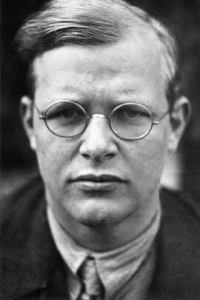 “How does peace come about? Through a system of political treaties? Through the investment of international capital in different countries? Through big banks, through money? Or through universal peaceful rearmament in order to guarantee peace? Through none of these, for the single reason that in all of them peace is confused with safety.” (DBWE 13:308)
Dietrich Bonhoeffer’s words continue to resonate prophetically into our own times. As war seems to loom around every corner, and the potential for armed conflict increases, fear mounts and we turn to our weapons and armies to bring us peace. But Bonhoeffer’s words correct this fleeing to violent means of security, and he challenges us to realize that there is a huge difference between peace and security. Arming ourselves for war does not bring peace but rather confuses the security we feel from our weapons with peace. Bonhoeffer explains:
There is no way to peace along the way of safety. For peace must be dared. It is the great venture. It can never be made safe. Peace is the opposite of security. To demand guarantees is to mistrust, and this mistrust in turn brings forth war. (DBWE 13, 308-309)
Our rush to mistrust the national “other” leads us not to peace but to confusing safety with peace. Peace, as Bonhoeffer says, must be dared. It demands vulnerability and, yes, trust of the other. And though this may seem foolish, we have been told that as we walk with Christ, we will be seen as fools to the world. God makes the supposed wisdom of the world, a wisdom which seeks security and safety, foolishness as we seek peace. Next, Bonhoeffer offers one of the most powerful calls to international peace that has perhaps ever been uttered or written:
Peace means to give oneself altogether to the law of God, wanting no security, but in faith and obedience laying the destiny of the nations in the hand of Almighty God, not trying to direct it for selfish purposes. Battles are won, not with weapons, but with God. They are won where the way leads to the cross. Which of us can say he knows what it might mean for the world if one nation should meet the aggressor, not with weapons in hand, but praying, defenseless, and for that very reason protected by “a bulwark never failing”? (DBWE 309)
These words are worth reading and re-reading and reflecting upon. Think about what Bonhoeffer is saying, particularly in context of his total corpus. He famously wrote that “When Christ calls someone, he bids them come and die” (Discipleship). But if that’s Christ’s call; if the way of the cross is a bid to come and die, do we truly, really think that Bonhoeffer is asking us to spiritualize that call to death, that call to the cross? Or is Bonhoeffer truly saying, radically, that the call from Christ is a real call for peace, a call that asks us to set aside our securities and safety and be willing, yes, to lay down our lives for the sake of our neighbor and even our enemy; a bid to come and die to know the peace that surpasses all human understanding?
Yes, it may seem foolish. Yes, it may seem unwise. But a true, radical call to peace as a call from Christ is a call to come and die. It sets aside all securities; it sets aside the fear of the other; and it asks us to truly, radically, follow where the way leads to the cross of Christ.
Peace and Security and the “Other”
Bonhoeffer’s words are relevant to more than war, too. More than once, as I’ve talked about refugee crises around the globe, people questioned me on whether it was safe to have potentially dangerous people around. Now, I vehemently disagree with any notion that the “other” is inherently violent, or that we as Christians should turn away from the passages in Scripture which so clearly state we ought to care for the sojourner in our land and the refugee. But even more, Bonhoeffer’s insight here makes clear that those who live in fear of the “other” and use that as justification for their turning away the sojourner or refugee are living by making security their goal rather than peace. Peace, Bonhoeffer states, is the opposite of security. The appeal to the security of our home forsakes love of neighbor and true, lasting peace in favor of the idolatry of security. In fear, we demand the closing of our homes, our neighborhoods, and our borders to the “other.” In fear, we blasphemously turn aside from the words of God and turn them into spiritualized texts that we use to soothe our consciousness as we watch the least of those among us get thrown into camps; get turned away; get sent to die; starve; die of thirst; and more. Our demands for peace, which we have conflated with security, have turned into a fearful rejection of the peace of God and the way of the cross.
Peace Must Be Dared
(DBWE 309, capitalization mine)
Bonhoeffer’s Context, and Ours
Bonhoeffer spoke these words during an ecumenical conference that sat in recent memory of the Great War and with the seething political forces moving towards the Second World War. He ends his demand for peace at this conference with the question: “Who knows if we shall see each other again another year?” It would be four years until Germany would take over Austria and have parts of Czechoslovakia ceded to Hitler. But Bonhoeffer issued his call for demanding peace, a call that would be ignored, as the German Christian church capitulated to the Nazis. It was a call that some may look back upon and see as naive. But in our own world, in the here and now, what wars can we prevent? What tragedies and miscarriages of justice continue for the sake of our false security-oriented “peace”? What would happen if we answered the fears of the “illegal,” the “refugee,” or the “enemy” with a call for daring peace–by praying and setting ourselves, defenseless, to fight against injustice with the power of God? What if we did dare peace?
SDG.
Links
Be sure to check out the page for this site on Facebook and Twitter for discussion of posts, links to other pages of interest, random talk about theology/philosophy/apologetics/movies and more!
Dietrich Bonhoeffer’s sermon demands we hear him today– Bonhoeffer’s prophetic words resonate in more than peace; here, find some analysis of what he said about the poor.
Dietrich Bonhoeffer– A collection of my posts on Dietrich Bonhoeffer and reviews related to him (scroll down for more).
SDG.
——
The preceding post is the property of J.W. Wartick (apart from quotations, which are the property of their respective owners, and works of art as credited; images are often freely available to the public and J.W. Wartick makes no claims of owning rights to the images unless he makes that explicit) and should not be reproduced in part or in whole without the expressed consent of the author. All content on this site is the property of J.W. Wartick and is made available for individual and personal usage. If you cite from these documents, whether for personal or professional purposes, please give appropriate citation with both the name of the author (J.W. Wartick) and a link to the original URL. If you’d like to repost a post, you may do so, provided you show less than half of the original post on your own site and link to the original post for the rest. You must also appropriately cite the post as noted above. This blog is protected by Creative Commons licensing. By viewing any part of this site, you are agreeing to this usage policy.
Book Review: “So the Next Generation Will Know” by Sean McDowell and J. Warner Wallace
 So the Next Generation Will Know is a book that I admit I approached with some trepidation. It is all too common to see books about youth and faith devolve into a “kids these days” type of discussion in which people bemoan the wayward youth, especially in some circles. J. Warner Wallace and Sean McDowell have, however, presented a serious call to winsome engagement with youth and preparing them for a life of faith.
The book’s chapters follow the theme of developing a response that truly engages and listens to youth. The first chapter, looks at the challenge of worldviews in a pluralist society, but again it doesn’t devolve into a kind of hopeless look at the youth. Instead, Wallace and McDowell acknowledge the challenges, look at the data, and ask “what now?” with a look forward. The second chapter looks at more data, including how Generation Z in particular has unique challenges with the constant changes brought by technology. Once again, though, the authors don’t bemoan self-obsessed youths or a generation of selifes; instead, they ask what it is like to engage with youth who have totally different access to information, image, and on-demand services than ever before. There’s not a judgment here but rather a call to rethink engagement along lines that make sense. If 89% of Gen Z owned a smartphone by the time they’re 13, smartphones are a good way to engage. If Snapchat and YouTube have made soundbites a relevant way to communicate, better change your way to engage. None of this, at any point, means the authors say we cannot continue to write serious scholarship or the like; but the way its presented should adapt for the audience.
Some aspects of our technology have changed us in remarkable ways, and data continues to suggest that the youth of Generation Z feel lonely and self-report as lonely (61). Engagement with people who are lonely includes genuine relationships and caring, while also acknowledging the challenges presented by the various calls for immediacy and attention. The need for trust is true in every generation, and the on-demand access to information and the need for fact-checking is something that means we need to build trust rather than view a relationship as a “tool for instruction” (67-68). One of the more interesting points in the book is genuine, real listening in which people do not rush to instruction or correction when disagreement happens, but rather acknowledgement of hurt or concern and continuing to build trust.
Making things practical is a good practice for every generation, and Wallace and McDowell emphasize this in engagement with youth. Building a worldview includes application rather than memorization. It’s great if youth can recite a biblical teaching about poverty, but why not couple that with a hands-on activity for helping alleviate some of the stress that causes. Resisting the urge for easy answers is another winsome approach. The model of “two why’s for every what” (99ff) is important because it means application of the ideas we are teaching youth in youth groups and at church. Instead of just telling what all the time, explain why it is important.
Warner and Wallace move into training youth to communicate their own worldview, and valuable ideas are again found throughout the section. For example, talking about debriefing after speaking in disagreement is huge–how do those become learning opportunities or build relationships with others? Setting boundaries is hugely important, as well (162). Some ways to engage with watching movies, reading works by skeptics, and the like all seem like important insight.
What readers may think at this point is that the book is broadly applicable, and I would agree. Saying we need genuine relationships certainly is not limited to Generation Z. What makes the book more specific is the data is focused around that generation and so it helps to reflect on ministry to them. But the suggestions would, I think, work well for any generation. Winsome, practical apologetics is what So the Next Generation Will Know provides, and those looking for an introductory level book on such topics should check it out.
Disclaimer: I was provided with a copy of the book for review by the publisher. I was not required to give any specific kind of feedback whatsoever.
Links
Be sure to check out the page for this site on Facebook and Twitter for discussion of posts, links to other pages of interest, random talk about theology/philosophy/apologetics/movies and more!
Book Reviews– There are plenty more book reviews to read! Read like crazy! (Scroll down for more, and click at bottom for even more!)
SDG.
——
The preceding post is the property of J.W. Wartick (apart from quotations, which are the property of their respective owners, and works of art as credited; images are often freely available to the public and J.W. Wartick makes no claims of owning rights to the images unless he makes that explicit) and should not be reproduced in part or in whole without the expressed consent of the author. All content on this site is the property of J.W. Wartick and is made available for individual and personal usage. If you cite from these documents, whether for personal or professional purposes, please give appropriate citation with both the name of the author (J.W. Wartick) and a link to the original URL. If you’d like to repost a post, you may do so, provided you show less than half of the original post on your own site and link to the original post for the rest. You must also appropriately cite the post as noted above. This blog is protected by Creative Commons licensing. By viewing any part of this site, you are agreeing to this usage policy.
Women Prophets, Complementarianism, and Submission
I have seen multiple complementarians recently on Twitter asserting that women prophets in the Bible were in submission to men; particularly to male teachers who were in the role of what we have turned into the modern pastor. Denny Burk, the current President of the Council for Biblical Manhood and Womanhood, responded to a lengthy series of questions and comments about a post he wrote supporting complementarianism recently. One of the questions was about women who were prophets in the Bible and whether they submitted to men. Burk wrote:
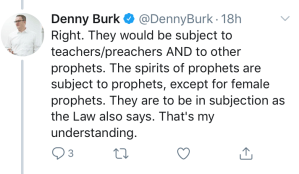 “Right. They [women prophets] would be subject to teachers/preachers AND to other prophets. The spirits of prophets are subject to prophets, except for female prophets. They are to be in subjection, as the Law also says. That’s my understanding.”
Another complementarian, John Carpenter, pastor at a Reformed Church, wrote “…I’m a lax complementarian, believing that women can ‘pray and prophesy’ in church under the authority of all male elders. But I could be wrong. The stricter [complementarians] may be right. I know the egalitarians are wrong.”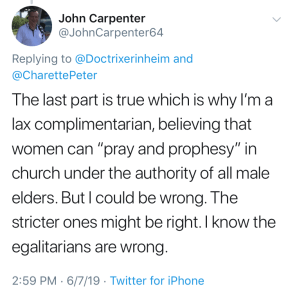
The problem with these and related statements is that they actually directly contradict Scripture. This isn’t an issue of interpretation that allows for disagreement. Instead, complementarians, by asserting that women prophets would explicitly be under teachers in the church, are going directly against the Word of God.
1 Corinthians 12:28 quite clearly states “…God has appointed in the church first apostles, second prophets, third teachers, then miracles, then gifts of healing, helping, administrating, and various kinds of tongues” (ESV).
So in the church, we find that prophets, in fact, rank above teacher/preachers, though Denny Burk, the President of a major evangelical group that promotes complementarianism, says they do not, and that instead “they are to be in subjection as the Law also says.” We might ask Denny Burk where he finds that verse in the “Law.” Which verse in the Hebrew Scriptures state that women prophets are to be in subjection to teachers/preachers? There is none. But not only that, he and other complementarians who make this argument are going against the very Bible they purport to affirm when they hold to complementarianism.
Links
A Brief Biblical Proof for Women Pastors– Read why 1 Corinthians 12:28 is an even bigger problem for complementarians, as it effectively guarantees women may hold the same or more authority than that of pastors.
On the Femnization of the Church– It is frequently alleged that the church is being “feminized” and that this is a bad thing. Check out this post, wherein I analyze this notion from a few different angles.
Women in the Ministry: The philosophy of equality and why complementarianism fails– I argue that the position in which women are excluded from church leadership entails inequality of being.
SDG.
——
The preceding post is the property of J.W. Wartick (apart from quotations, which are the property of their respective owners, and works of art as credited; images are often freely available to the public and J.W. Wartick makes no claims of owning rights to the images unless he makes that explicit) and should not be reproduced in part or in whole without the expressed consent of the author. All content on this site is the property of J.W. Wartick and is made available for individual and personal usage. If you cite from these documents, whether for personal or professional purposes, please give appropriate citation with both the name of the author (J.W. Wartick) and a link to the original URL. If you’d like to repost a post, you may do so, provided you show less than half of the original post on your own site and link to the original post for the rest. You must also appropriately cite the post as noted above. This blog is protected by Creative Commons licensing. By viewing any part of this site, you are agreeing to this usage policy.
Disney’s “Aladdin,” A Christian view – silence, tradition, and justice
 Disney’s “Aladdin” is a remake of a beloved animated classic. The film is a feast for the eyes and ears, with a few tweaks to the original that will be debated by longtime fans. I’d like to offer a reflection on the film from a worldview perspective. There will be SPOILERS, of course.
Aladdin and Temptation
One of the major themes of Aladdin is that of character. What kind of people are the characters, really? Aladdin at first appears to be nothing but a common criminal, but we quickly find that his thieving is in order to survive. He sings: “Gotta eat to live, gotta steal to eat” and, though the song presents it as a tongue-in-cheek moment (“I steal only what I can’t afford/(That’s everything)”), it already presents viewers with questions about the society in which he lives and the rightness or wrongness of his actions.
Aladdin is then faced with a huge test: what will he do with three wishes that seem to have no limits other than his imagination (or to wish for more wishes, of course)? As his relationship with Jasmine encounters a few lumps, he considers using his last wish to improve his situation even more, going against his promise to the Genie. The Genie, for his part, has acted as a moral compass throughout, asking whether Aladdin really wants to go “that way” and variations on that question multiple times. Aladdin is facing temptation, and he ultimately passes the test. After stopping Jafar, he gives Genie his freedom.
The temptation Aladdin faced was made more acute by his social situation. Coming from utter poverty, he was faced with the choice to descend into decadence and deceit in order to maintain his newfound power or to risk what he’d gained being honest. Of course, it certainly helps that he’d already saved the Kingdom multiple times.
The temptation of Christ in the desert is something I thought of as I reflected on this scene of temptation of Aladdin. In that part of Christ’s life, the deceiver offers Jesus all the power in the world if he will but bend the knee to him. But Jesus rejects this temptation, staying on a path that would ultimately lead to his death for us.
Justice
Agrabah is a Kingdom full of injustice. The streets overflow with people in need, and Princess Jasmine is touched by their plight and determined to do something about it. Her exploration of the city is not portrayed in this film as a flight of fancy, trying to escape for a day of adventure from the palace. Instead, Jasmine is trying to determine the state of her people and use that, she hopes, to rule better than she could have otherwise.
The Christian faith makes it absolutely clear that we are to care for the poor. Time and again, Jesus warns about the dangers of wealth and the fact that we cannot serve money and God. Additionally, throughout the Bible demands are made that we care for the poor and the refugee.
Jasmine’s own concern for the poor is a model of character. Placed into a position of great poverty and wealth, she seeks to understand the plight of those who are in need. The movie doesn’t go beyond a resolution that places her as Sultan, though her character leaves us in little doubt over what her actions will be.
Silence and Tradition
Jasmine is also central to the plot in another way: as a challenge to the silencing of marginalized voices and the wielding of authority to do so. She briefly hints at the concept of being told to go “speechless” early in the movie. Both her father and Jafar have repeatedly told her that women are to be silent, seen and not heard. In a climactic scene in which Jafar takes over as Sultan, she erupts into a powerful song that pushes back against this silencing of women that. She sings, in part:
I won’t be silenced
You can’t keep me quiet
Won’t tremble when you try it
All I know is I won’t go speechless
Speechless
She here makes the decision to speak up, appealing to the guards to push back against blind allegiance to tradition and authority and instead look to standards that go beyond that. Though not made explicit at all, it is clear in this scene that there is a higher standard than that of tradition or the authority vested in a seat like the Sultanate. Her wisdom challenged the tradition to show that it was mistaken.
Too often in our churches, appeals are made to authority or tradition to do the very same thing that Jafar and the Sultan tried to do to Jasmine: silence women. Instead, we are taught that there is “no man and woman” in Christ (Galatians 3:28) and that women were prophets, deacons, and apostles in the church. Like Jasmine, let us raise up women who won’t go speechless so that we can hear their wisdom as they wisely point us towards Christ.
Links
Be sure to check out the page for this site on Facebook and Twitter for discussion of posts, links to other pages of interest, random talk about theology/philosophy/apologetics/movies and more.
Engaging Culture: A brief guide for movies– I outline my approach to evaluating movies from a worldview perspective.
I have a number of ways in which I have critically engaged with culture in movies, books, and other arts in my posts on current events (scroll down for more posts).
SDG.
——
The preceding post is the property of J.W. Wartick (apart from quotations, which are the property of their respective owners, and works of art as credited; images are often freely available to the public and J.W. Wartick makes no claims of owning rights to the images unless he makes that explicit) and should not be reproduced in part or in whole without the expressed consent of the author. All content on this site is the property of J.W. Wartick and is made available for individual and personal usage. If you cite from these documents, whether for personal or professional purposes, please give appropriate citation with both the name of the author (J.W. Wartick) and a link to the original URL. If you’d like to repost a post, you may do so, provided you show less than half of the original post on your own site and link to the original post for the rest. You must also appropriately cite the post as noted above. This blog is protected by Creative Commons licensing. By viewing any part of this site, you are agreeing to this usage policy.

 J.W. Wartick - Reconstructing Faith