 Yeah, I said it. The Kalam Cosmological Argument is in vogue, and for good reason. It’s an extremely powerful argument for the existence of God, the first Cause. Nothing I say here should be taken as a condemnation of the Kalam. However, I don’t think it is the most powerful argument for theism. In fact, I don’t think it’s even close. The Argument from Religious Experience wins that prize, and it is a landslide.
Is it so powerful?
The obvious question is this: what makes the Argument from Religious Experience (hereafter ARE) so powerful? Here are just a few reasons:
1. The ARE is malleable and may be used as an argument for a) merely the existence of the transcendent–anything beyond the physical world; b) theism specifically c) Christianity specifically.
2. The ARE does not rely upon anything more than things we already do in everyday life, such as trusting that people are reporting the truth.
3. The ARE has evidence backed from millions of persons across the world and time.
4. It is possible, though not at all certain, to have personal confirmation of the ARE.
Why Not ARE?
Okay, well if it’s so strong, why don’t more apologists use the argument? There are a number of reasons, and some are basic: they haven’t read about the argument in much popular apologetic literature and so are unfamiliar with the argument, they know of it but are unsure of how to formulate it in a helpful way, or they simply haven’t thought about how powerful the argument is. Another reason may be (as I suggested elsewhere) that apologists prefer arguments that are useful in debate formats.
To be honest, though, I think the primary reason is because the ARE has almost an inherent strangeness to it. There is a kind of spiritualism about the argument itself which might turn off apologists who would prefer a purely deductive argument. If one wants to talk about a religious “experience,” there is a kind of feeling to that phrase which an argument like the Kalam does not share. Just admitting that there is a category of religious experience itself admits to a kind of transcendence, and I think that apologists–I include myself in this category–are overly cautious about spirituality. So let’s get over it and start using this powerful argument, okay?
What is the ARE?
As I noted in point 1 in favor of the ARE’s strength above, the argument itself is malleable and may be formulated in different ways (for some examples, see my post on the usefulness of the argument). Here’s a way to formulate it to merely defend a transcendent reality:
1. Generally, when someone has an experience of something, they are within their rational limits to believe the experience is genuine.
2. Across all socio-historical contexts, people have had experiences they purport to be of a transcendent realm.*
3. Therefore, it is rational to believe there is a transcendent realm.
Just consider this for a second. The argument leaves a few spaces to fill in for the sake of making it deductively valid, but we’ll just look at how it stands now. Suppose that 2 is true. In that case, one who wants to deny the ARE’s strength would have to say that all of the experiences of these people have been in error. Frankly, when it comes down to it, that’s a pretty big claim, because reports of religious experience really do come from all times and places.
The argument, though, can be narrowed to defend theism specifically or even Christianity. For more on this, see my post talking about its strength as it narrows.
Now point 2 above suggested the ARE doesn’t rely on anything more than what we do in everyday life. I am speaking, of course, of the principle of credulity: the notion that when x appears to someone in way s, it is rational [barring some epistemic defeater]** to believe that x is s (or some other formulation). Moreover, we also trust the principle of testimony: when person x tells us that y occurred, it is prima facie rational to believe y. When you read a news story and someone says they saw a woman running from the scene of a crime, it is rational to believe them. Similarly, when millions say they have experienced a transcendent realm, prima facie it is rational to believe them.
 The Knock Down Objection?
The most common objection is the objection from competing religions. That is, if person x has an experience that purports to prove Christianity, and person y has an experience of the truth of Buddhism, what then? Often it is suggested that x and y’s testimony would just cancel each other out. But of course that’s not the case in any other area of experience. If I am a witness in court testifying about a murder, and I say I saw a tall dark male commit the crime, while another witness says they saw a short pale male, does each testimony cancel the other? Well, suppose the criminal was of average male height and fairly tan. To me, a short very pale man, he would appear tall and dark. To someone who is taller than I and of darker skin, the person would appear short and pale.
The point is that even with religious experience, different facets may be recognized even were the experience the same. Now much more nuance needs to go into this argument, but I think cogent answers have been provided in the relevant literature. The point is that even the most common and strongest objection to the ARE really isn’t that powerful in the end, particularly when weighed against the cumulative force of religious experience.
Conclusion
I readily admit this post has only very briefly touched on issues which could each take entire volumes to discuss. There is so much more to consider, and so many avenues to explore, but I think my overall point stands: The ARE is the strongest argument for theism. Fellow apologists, I suggest you research the argument (see the suggested reading list at the end of this post and also check out my other posts below) and use it! Let’s integrate it into our defense of the faith. Let me know your own thoughts below.
Links
Be sure to check out the page for this site on Facebook and Twitter for discussion of posts, links to other pages of interest, random talk about theology/philosophy/apologetics/movies and more!
The Argument from Religious Experience: Some thoughts on method and usefulness– a post which puts forward an easy-to-use version of the ARE and discusses its importance in apologetic endeavors.
The Argument from Religious Experience: A look at its strength– I evaluate the different ways the ARE may be presented and discuss how strong the argument may be considered across different formulations.
The image above to the left was a photo taken by me and I claim all rights noted below. The image to the right is from Wiki Commons.
*[thanks to a commentator for correcting this error- see comments]
**In the interest of shortening this post, I glossed over tightening of the principle of credulity and have added this clause to make it more clear.
SDG.
——
The preceding post is the property of J.W. Wartick (apart from quotations, which are the property of their respective owners, and works of art as credited; images are often freely available to the public and J.W. Wartick makes no claims of owning rights to the images unless he makes that explicit) and should not be reproduced in part or in whole without the expressed consent of the author. All content on this site is the property of J.W. Wartick and is made available for individual and personal usage. If you cite from these documents, whether for personal or professional purposes, please give appropriate citation with both the name of the author (J.W. Wartick) and a link to the original URL. If you’d like to repost a post, you may do so, provided you show less than half of the original post on your own site and link to the original post for the rest. You must also appropriately cite the post as noted above. This blog is protected by Creative Commons licensing. By viewing any part of this site, you are agreeing to this usage policy.
 Every Sunday, I will share a quote from something I’ve been reading. The hope is for you, dear reader, to share your thoughts on the quote and related issues and perhaps pick up some reading material along the way!
Can Randomness have Purpose?
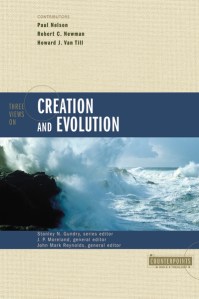
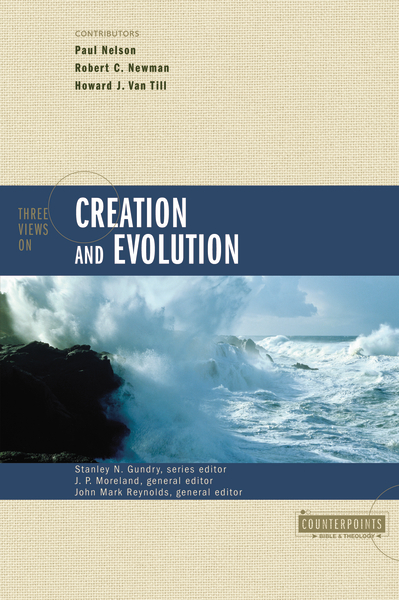
The concept of chance or randomness and its relation to God’s purpose and sovereignty is one which is very interesting to me. It has applications all kinds of direct theological applications. While reading Three Views on Creation and Evolution , I came upon an application related to the origins debate within Christianity. Howard J. Van Till, who was writing in support of theistic evolutionism, considered the possibility that God could have purpose even through the process of evolution:
While we’re on the issue of purpose, let’s look briefly at a common misunderstanding–that randomness rules out purpose. It is often claimed that randomness [which]… prevail[s] in the fundamental processes and events of biotic evolution rules out the possibility… [of] any preestablished purpose… Suppose there were a perfectly honest gambling casino in which no game was rigged–every[thing]… was authentically random. Does that rule out the possibility that the outcome of the casino operation cannot possibly be the expression of some preestablished purchase? Clearly not. In fact, the operators of the casino depend on that very randomness in their computation of the payout rates to insure that they will have gained a handsome profit… (168, cited below).
Apart from the strangely worded question he asked, Van Till’s point is that there may be purpose even with randomness: a truly random casino can still be oriented toward the purpose of making money. Thus, Van Till reasons, God could have done the same thing with the entirety of creation.
Now, I think this is an interesting claim, and I also think there is some plausibility to it. However, there does seem to be a significant disanalogy as well: the casino operators don’t care about the outcome of the random games, because their overall outcome is to have monetary gain. Presumably, however, God would care about the outcome of the randomness. Just having any creatures come from evolutionary processes would not seem to fit God’s plan as established in Genesis (creation, fall, redemption, consummation). Instead, there would have to be creatures capable of participating in that plan. Of course, Van Till might simply reply by saying that God would have known the outcome ahead of time and so that’s not at issue (or some similar response).
What do you think of the notion that chance or randomness may have purpose? If not, why not? If so, do you think this may be applied to evolution as Van Till does? What other applications do you think this may have?
Links
Be sure to check out the page for this site on Facebook and Twitter for discussion of posts, links to other pages of interest, random talk about theology/philosophy/apologetics/movies and more!
Sunday Quote– If you want to read more Sunday Quotes and join the discussion, check them out! (Scroll down for more)
Source
Howard J. Van Till, “The Fully Gifted Creation: ‘Theistic Evolution'” in Three Views on Creation and Evolution edited by J.P. Moreland & John Mark Reynolds (Grand Rapids, MI: Zondervan, 1999).
SDG.
 Each Week on Saturday, I’ll be asking a “Question of the Week.” I’d love your input and discussion! Ask a good question in the comments and it may show up as the next week’s question! I may answer the questions in the comments myself.
Wagering much?
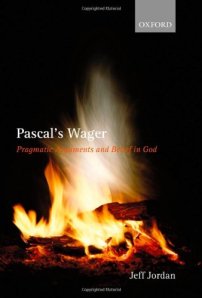
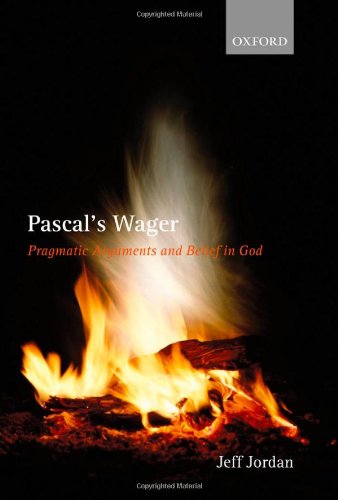
Okay, the title may be a little deceptive. I’m talking about Pascal’s Wager! I recently finished Pascal’s Wager: Pragmatic Arguments and Belief in God by Jeff Jordan (and loved it- posts coming… eventually). That got me thinking quite a bit on Pascal’s Wager, of course! It also made me wonder why I haven’t really heard much about it in apologetic circles. Thus, the question:
What do you think of Pascal’s Wager as an argument for Christian theism (or bare theism)? Why? How much have you studied it?
I am, of course, a bit biased having just read a book I thought was phenomenal arguing that the argument is sound. Let’s hear what you have to think in the comments! I might chime in as well!
Links
Be sure to check out the page for this site on Facebook and Twitter for discussion of posts, links to other pages of interest, random talk about theology/philosophy/apologetics/movies and more.
Question of the Week– Check out other questions and give me some answers!
SDG.
 Another go-round the internet has turned up a number of links for you, dear reader, to peruse. Here, we discuss 1 Timothy 2:12-a central verse in the debate over women in the church, liberal theology, Psalms, cults, and “feminization” of the church. Check them out, and let me know what you think in the comments below. Be sure to leave them comments as well, as comments are what make we bloggers keep blogging!
NIV, ESV, and 1 Timothy 2:12– 1 Timothy 2:12 is often seen as the central verse for the complementarian position. After all, it teaches women are not to have authority over men, doesn’t it? Here, Paul Adams shares some insights from Craig Blomberg about some difficulties with translating the verse in a complementarian light, and the way this reflects in different Bible versions.
What is Liberal Theology?– I’d say it’s one of those “scare phrases” intended to throw people away from the teachings of theologians or systems which the one using the phrase wants readers to avoid. Check out this post which analyzes the term via words from Roger Olson.
Kinds of Psalms– Different types of Psalms perhaps suggest reading them differently exegetically and also for different reasons in Christian life and practice. Check out this post which discusses the different types of Psalms.
Sure Signs of a Sinister Sect (COMIC)- Here, No Apologies Allowed shares a cartoon about how to perhaps identify some less-than-sound teaching and the methods of various cultic groups.
The “Feminization” of the Church– Recently, I wrote about how many I have read have complained about this alleged “feminization” of the church. Here, the origins of this belief are assessed alongside various studies and quotes from leading approaches to the issue.

The Poverty of Nations: A Sustainable Solution is an ambitious book. Wayne Grudem (theologian) and Barry Asmus (economist) claim to put forward a list of 78 traits which, if incorporated at a national level, will bring about a solution to poverty. The book is an economic and moral/biblical treatise aimed at stamping out poverty through the production of goods and the integration of morality into global economic practice. Here, I’ll analyze it from its two primary thrusts: economic and moral. Then, we’ll discuss some of the issues involved in a book of this scope.
It is worth noting up front that I have a BS in Social Studies and had numerous classes on economics and international economics at a college level. This doesn’t make me an expert, but I think it allows me to take a decently accurate look at economic theories.*
Economics
The first half of the book focuses on issues of economics on a national level. Specifically, they endorse the free market as a way to bring prosperity to all nations. Their argument is based upon historical observations about how nations have gotten out of poverty and become prosperous.
Thus, the authors argue that fair trade and open borders (with low or no tariffs and the like) will drive the market to balance itself out and also increase the overall prosperity of people from various nations. Moreover, it will provide a means by which lesser-developed countries can utilize their comparative advantages to produce things that other countries are willing to pay a higher price such that they do not need to produce them. Demand drives the market, and the freer a market, the more demand is able to do so. The reason it is beneficial to allow demand to drive the market is because it allows for people to genuinely respond to others wants and constantly produce newer, better goods in more efficient ways, thus increasing the wealth across the board.
I should note that, by necessity, this is merely the briefest overview of this section of the book. Those who read The Poverty of Nations are essentially getting a fully realized introduction to international economics. In fact, the economic portion of the book is quite strong in many ways (though some issues with the complexity are noted below).
Biblical/Moral Issues
Like the economics portion, this half of the book has much to commend it. Though basic, much of the instruction is vital and important to realize as necessary for economic success. For example, government curtailing of bribery is important for an economic system to become more successful. Another, more complex example would be the notion that tariffs decrease the productivity of international trade and artificially increase prices.
The problem with much of the focus on the moral background to the “Free Market” is that Grudem and Asmus seem to assume or assert more often than they provide evidence. It’s easy for someone like me from a relatively free market system who favors open markets to nod along to how a free market encourages integrity because of the repeated transactions between the same persons and the like, but then a statement like this is made:
When people are held responsible by the voluntary personal interactions of the free market, they are typically more responsible. (Kindle Loc. 3784)**
Statements like this are frequently made, but after reading along and perhaps agreeing largely, one is forced to wonder about things like: “Where is the empirical evidence to show that this is actually the case?”; “To whom or to what are people more responsible to?”; “How are we capable of making judgments like this across incredibly complex systems like the economic practice of states, regions, nations, and the world?” The particular statement made above offers no empirical support for its claim, nor do the authors explore the complexities of simply stating that “people… are typically more responsible” in a free market. This statement, and others like it, leave me scratching my head and asking for the evidence. Certainly it is possibly true or perhaps it is true, but why think it without anything more than an assertion?
Another difficulty with this section is that throughout, the specific examples given are taken to be the biblical approach to economics. Now, I think one could fairly say that the Bible condemns bribery, but what of more complex issues like whether it actually endorses a free market? One constant refrain in the book is the use of Genesis 1:28 (“fill the earth and subdue it”) to support various things, from use of natural resources (which are rather shockingly claimed to be essentially unlimited: “[I]t is highly unlikely that any resources will be used up in the foreseeable future… we keep discovering huge new reserves of resources and inventing more creative ways to access them” (6606-6617)–but of course where are the huge new reserves of forests? fresh water? etc.?) to drive people to invent and make new things (3405), to making products from the earth specifically (1169), to move beyond subsistence farming (4207), and more.
One is forced to wonder whether the verse actually means all these things or if, perhaps, the Bible is simply under-determined when it comes to economic policy. I do genuinely wonder whether the Bible is to be treated as an economics textbook, which it often seems to be in this book. Quotes like these are scattered throughout, often in seemingly random fashion in the economics portion. The question is whether this really may be seen as a systematic treatment of the Bible on economy, or whether it may perhaps instead be mining the text to try to support claims about economy which are not really found therein. Not that these are unbiblical points; merely that they perhaps are not the focus or intention of the texts.
Complexities
The book seems to oversimplify on some aspects. It is common practice to use examples which allow an economist to shift just one aspect in order to demonstrate a theory.* That said, at times the examples used in The Poverty of Nations are often a bit too simplistic to believe. For example, at one point a thought experiment asks whether simply taking money from a group of wealthy elites would solve the existing issue of poverty. Although it seemed clear that simply attempting to redistribute wealth didn’t solve the problem, the proposed solution–the book’s solution–was to produce more goods. But it seems to me that if a number of elites were controlling the wealth in a country, just producing more goods would continue to line the pockets of those elite rather than specifically helping the poor.
Examples like this abound throughout the book, as simple solutions are offered to extremely complex issues. Economics is a wonderfully complex topic, but as the authors themselves note at the beginning, it is one which is hard to study due to the human factor in it. Despite the professed efforts to avoid such simplification (Kindle location 2115, for example), the book often does seem to suggest a one-size-fits-all approach to solving economic problems.
That said, at other times the authors do a great job of speaking directly to the complexities of the issue. For example, their discussion of colonialism was marvelous and ably pointed out both the potential benefits and cons of those endeavors on our present world situation. It was a great way to survey a complex issue without trying to identify any one factor. Portions of the book like this make the places where it is simplistic stand out even more, however.
A final issue is that of audience: Asmus and Grudem claim the book is primarily written for leaders of impoverished nations, which–apart from coming off as a bit imperialistic–doesn’t actually seem to be the likely readership. The authors note others as possible audience, but I wonder whether we may end up with several people walking around with this as their only interaction with economic theory and assuming they are able to fix the world’s problems through this oft-simplified economics instruction.
Conclusion
The Poverty of Nations: A Sustainable Solution is at times brilliant, but at others frustrating. It is well-worth a read for Christians interested in economics and attempting to strike at the core of poverty through effective legislation and whole-nation solutions. It does provide a very useful introduction to international economics, and gives some very good ways forward for those wishing to engage on this topic. However, readers should go in with some caution: the simplification at times means that readers should not take this as the final word on this topic, nor should they assume by reading the book they are suddenly equipped to run national-level economic programs.
Links
Be sure to check out the page for this site on Facebook and Twitter for discussion of posts, links to other pages of interest, random talk about theology/philosophy/apologetics/movies and more!
Sunday Quote!- A biblical answer to economic woes?– I discuss a quote from a section of The Poverty of Nations and whether it is true that the Bible may contain specific economic practice.
Source
Wayne Grudem and Barry Asmus, The Poverty of Nations: A Sustainable Solution (Wheaton, IL: Crossway, 2013).
*I was a Social Studies major in college and so took a number of economics classes. I am making no claim to be an expert, but rather educated laity in this area.
**All references are to kindle locations.
Disclaimer: I received a review copy of the book through Crossway. I was not obligated by the publisher to give any specific type of feedback whatsoever.
SDG.
——
The preceding post is the property of J.W. Wartick (apart from quotations, which are the property of their respective owners, and works of art as credited; images are often freely available to the public and J.W. Wartick makes no claims of owning rights to the images unless he makes that explicit) and should not be reproduced in part or in whole without the expressed consent of the author. All content on this site is the property of J.W. Wartick and is made available for individual and personal usage. If you cite from these documents, whether for personal or professional purposes, please give appropriate citation with both the name of the author (J.W. Wartick) and a link to the original URL. If you’d like to repost a post, you may do so, provided you show less than half of the original post on your own site and link to the original post for the rest. You must also appropriately cite the post as noted above. This blog is protected by Creative Commons licensing. By viewing any part of this site, you are agreeing to this usage policy.
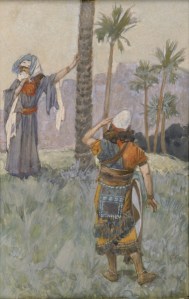
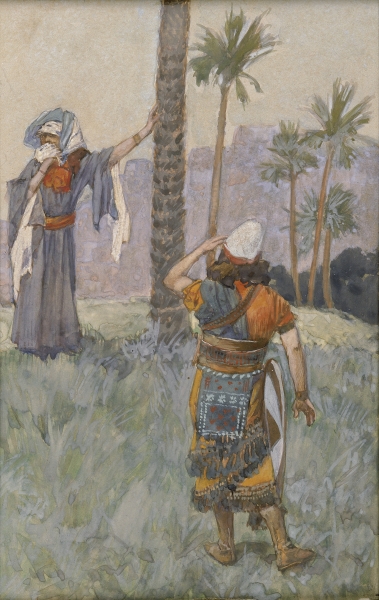
Deborah, leading the people of Israel
There are some who advocate a notion of “Biblical Manhood and Womanhood” with strict definitions of what roles men and women should occupy. Representative is John Piper, a leading voice in the movement named “Recovering Biblical Manhood and Womanhood.” In his essay “A Vision of Biblical Complementarity: Manhood and Womanhood Defined According to the Bible,” Piper writes about “biblical” manhood:
When my father came home he was clearly the head of the house… (32, cited below)
[W]hen there is no bread on the table, it is the man who should feel the main pressure to do something to get it there… a man will feel his personhood compromised if he… becomes dependent over the long haul… on his wife’s income. (42)
Shockingly, Piper even goes so far as to say that:
“[E]ven where a Christian wife may have to stand with Christ against the sinful will of her husband, she can still have a spirit of submission–a disposition to yield” (47).
Piper alleges that biblical womanhood follows this pattern:
A mature woman is glad when a respectful, caring, upright man… provides a pattern of appropriate initiatives in their relationship. (48)
[She is to follow] Biblical submission[, which] for the wife is the divine calling to honor and affirm her husband’s leadership and help carry it through… (53)
From Piper, we learn that “biblical” womanhood is to yield, to be led, not to be the head of the home, be provided for, indeed even to avoid situations in which a woman is closely leading a man in the office (52).
Proverbs 31 destroys this concept of what a “biblical” woman should be. In this astonishing passage, we read that the ideal woman:
1. Takes care when selecting products to purchase (31:13)
2. Brings food to her family (31:14)
3. Provides for her family (31:15)
4. Appraises and purchases land (31:16)
5. Brings profitable gain (31:18)
6. Works with tools of various trades (31:18)
7. Helps the poor and needy (31:20)
8. Crafts goods to be used by the family (31:22)
9. Crafts goods to sell and is shrewd in selling them (31:24; 18)
10. Speaks and instructs with wisdom (31:26)
11. Watches over the ways of the household (31:27)
12. Above all, she fears the Lord (31:30)
Now remember, this is an “ideal” and of course no woman could be or do all of these things. This passage illustrates aspects of what a biblical woman would be.
Recall, though, the roles that have been defined for women by some complementarians–people who hold a view in which man and woman occupy different roles in the home and church, with men as leaders. Which of these are found in the description of woman in Proverbs 31? Let’s just do a quick comparison of a few (Piper citations from above):
Piper: [I]t is the man who should feel the main pressure to do something to get [bread on the table]
Bible: “[The ideal wife/woman] gets up while it is still night; she provides food for her family...” (31:15a)
Do women not share the pressure in putting bread on the table when the Bible describes ideal womanhood as a provider of food for her family without excluding the husband?
Piper: When my father came home he was clearly the head of the house…
Bible: “She watches over the affairs of her household…”(31:27a)
Does watching over the affairs of the household have an unwritten, unspoken clause that excludes men?
Piper: [A] man will feel his personhood compromised if he… becomes dependent over the long haul… on his wife’s income.
Bible: “She considers a field and buys it; out of her earnings she plants a vineyard… She sees that her trading is profitable, and her lamp does not go out at night.” (31:16; 18)
Does the wife/woman’s managing money, earning it, buying fields, ensuring profit, and staying up late into the night focusing on this profitable gain compromise her husband’s personhood?
Also interesting are the things that are not said. It doesn’t say the ideal woman yields to her husband when he does wrong, she rather brings him good, not harm (31:12). Sin is a harmful cycle, and to say women are to rebuke it, but yield because a man is the leader is perpetuating that cycle.
The question, then, becomes this: where are those like Piper, who make the statements quoted above getting their ideas from? Is Proverbs 31 biblical womanhood when it contradicts these notions, or are the Scriptural quotes above instead to be defined as the properly biblical womanhood?
The question is ‘how do we define Biblical Womanhood’? The answer: A buyer, seller, purveyor, manufacturer, innovator, leader, provider, entrepreneur, and above all, one of God.
You ask “What is Biblical womanhood?” I’ll tell you: Proverbs 31.
Links
Be sure to check out the page for this site on Facebook and Twitter for discussion of posts, links to other pages of interest, random talk about theology/philosophy/apologetics/movies and more!
Check out my posts on egalitarianism – the belief that men and women are equally qualified and called in the church and home (scroll down for more).
On the Femnization of the Church– It is frequently alleged that the church is being “feminized” and that this is a bad thing. Check out this post, wherein I analyze this notion from a few different angles.
Source
John Piper, “A Vision of Biblical Complementarity: Manhood and Womanhood Defined According to the Bible” in Recovering Biblical Manhood and Womanhood edited by Piper and Grudem (Wheaton, IL: Crossway, 2006).
SDG.
——
The preceding post is the property of J.W. Wartick (apart from quotations, which are the property of their respective owners, and works of art as credited; images are often freely available to the public and J.W. Wartick makes no claims of owning rights to the images unless he makes that explicit) and should not be reproduced in part or in whole without the expressed consent of the author. All content on this site is the property of J.W. Wartick and is made available for individual and personal usage. If you cite from these documents, whether for personal or professional purposes, please give appropriate citation with both the name of the author (J.W. Wartick) and a link to the original URL. If you’d like to repost a post, you may do so, provided you show less than half of the original post on your own site and link to the original post for the rest. You must also appropriately cite the post as noted above. This blog is protected by Creative Commons licensing. By viewing any part of this site, you are agreeing to this usage policy.
 Every Sunday, I will share a quote from something I’ve been reading. The hope is for you, dear reader, to share your thoughts on the quote and related issues and perhaps pick up some reading material along the way!
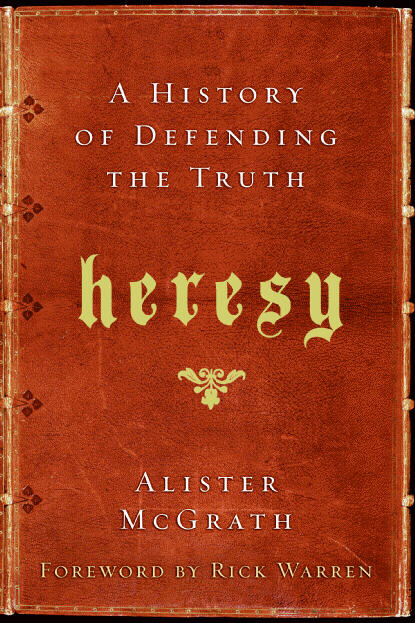
Heresy as the Historical Loser?
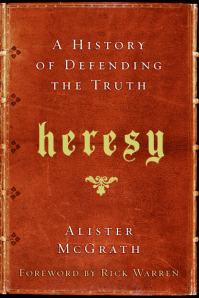
Alister McGrath’s book, Heresy: A History of Defending the Truth was a great read when I read it around two years ago, so I decided to reread it and get my notes in computer form. Almost immediately I began to discover reasons I enjoyed it so much. For example, McGrath notes that heresy has garnered much excitement and interest of late. Many see ancient heresies as something worth reconsidering, perhaps in light of losing by chance. He writes:
In this view, the distinction between heresy and orthodoxy is arbitrary, a matter of historical accident. Orthodoxy designates ideas that won, heresy those that lost. (3, cited below)
The rest of the book is dedicated to the history of heresy and how it interacted with orthodoxy. What do you think, though, of this notion that the distinction between heresy and orthodoxy is arbitrary? Could it be that orthodoxy is merely a historical accident? McGrath, of course, argues that it is not.
Links
Be sure to check out the page for this site on Facebook and Twitter for discussion of posts, links to other pages of interest, random talk about theology/philosophy/apologetics/movies and more!
Sunday Quote– If you want to read more Sunday Quotes and join the discussion, check them out! (Scroll down for more)
Book Review: “Heresy: A History of Defending the Truth” by Alister McGrath– Check out my review of McGrath’s book.
Source
Alister McGrath, Heresy: A History of Defending the Truth (New York: HarperOne, 2009).
SDG.
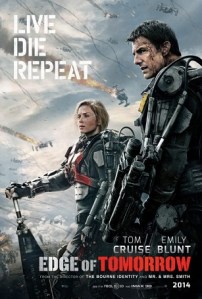
My favorite movie of the year so far.
Each Week on Saturday, I’ll be asking a “Question of the Week.” I’d love your input and discussion! Ask a good question in the comments and it may show up as the next week’s question! I may answer the questions in the comments myself.
Movies of 2014
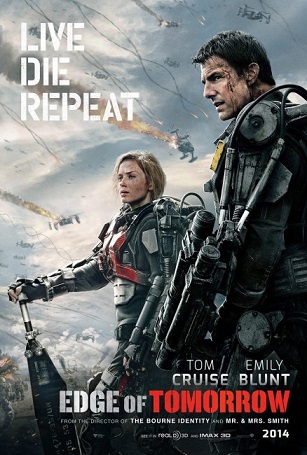
I realized recently that I haven’t been to as many movies this year as I went to last year. However, it does seem that the movies I have gone to see have been awesome. Early in the year I saw the appropriately-timed Frozen, which I felt had some great themes in it to go with its fantastic music. Then, I went with a friend to see “Lone Survivor,” which I am pleased to report showed greater complexity than many war movies or commentary on the war in Iraq. Then, I saw “Captain America: The Winter Soldier,” which may have been the greatest superhero movie other than the Dark Knight trilogy. I loved its moral commentary.
Finally, I went to go see “Edge of Tomorrow” and “X-Men: Days of Future Past” back-to-back last weekend. The X-Men flick was fantastic and brought up, again, questions of morality. “Edge of Tomorrow,” I would say, is my favorite movie of the pack so far. It was just so good and it helps that it was a genuine sci-fi epic. “Edge of Tomorrow” brings up a number of topics like sacrifice and choice which aren’t always explored in movies, let alone blockbuster action flicks.
As for the question this week:
What movies have I missed that you would consider a “must see”? Let me know in the comments!
This post was adapted from my “other interests” site, which you may want to check out- Eclectic Theist.
Links
Be sure to check out the page for this site on Facebook and Twitter for discussion of posts, links to other pages of interest, random talk about theology/philosophy/apologetics/movies and more.
Question of the Week– Check out other questions and give me some answers!
SDG.
Another week, another slew of posts for you to add some extra reading to your plate! This time around, we have a comic about self-deception, a quiz for you to test yourself, some young adult literature, and more! Let me know what you thought of the posts, and if you liked them, let the authors know on their blogs!
How to Spot a VBS Volunteer (Comic)– I found this hilarious because it speaks so well of my time as a VBS Volunteer many moons ago. I had an absolute blast though, which is something left off the comic. There’s a reason we keep going back: we love the kids, we love what we got to do, despite our eyes twitching from the caffeine (my preferred stimulant was Mountain Dew). Do you have a fun VBS Story? Share it below!
[Not your Sunday School’s] Biblical Literacy Quiz– Speaking of VBS, how about brushing up on some Bible literacy questions? Warning: this won’t be as easy as just answering “Jesus!” every time. Post your grade here! Let’s have some fun with this and maybe motivate ourselves to read more.
Why Neil deGrasse Tyson should stick to science– The host of “Cosmos” has attempted ironic philosophical critiques of philosophy, metaphysics, and more. Here’s a post arguing he should stick to science–if that.
Common Routes to Self-Deception (Comic)– Do you catch yourself following one of these common paths to pulling the wool over your own eyes? How might we work to prevent self-deception? Check out this thought-provoking comic.
Steelheart: Helping Heroes Along– Brandon Sanderson’s latest YA literature has people abuzz. For good reason? Check out this analysis from a worldview perspective by Anthony Weber.
Darwin’s Finches Show Rule Constrained Variation in Beak Shape– Here’s some heavy reading for you. Could it be that variation operates through certain constraints? What might this imply for evolution? What do you think?
 A recent tragedy has forced me to reflect a bit on the notion of “Christian Music.” This recent tragedy was the professedly Christian lead singer of the band “As I Lay Dying” being arrested for plotting to murder his wife. Then, later, admitting that he was no longer a Christian and kept the label as a way to sell records. Now this is a horrible, tragic situation and we shouldn’t downplay it. We should stay in prayer and hope that God leads him back to Christ. We should also learn from it. I simply want to reflect on the category of Christian music and, as a parent (with my first not yet born), think about how I may guide my children’s choices (and my own) when it comes to music.
The Category of Christian Music
One question that comes up from this story and something I’ve frequently thought about is whether the category of “Christian Music” is even a category that should exist. It has been noted by others that this label may serve as an excuse for sub-par musical talent to sell records by having Christian lyrics. As someone who frequents Christian bookstores, I would say this, at times, may not be far from the truth, but there are many extremely talented musicians who carry this label with pride.
I do wonder, however, whether the label just becomes that: a label. It may not reflect the actual content of the lyrics or music (as is admitted in the case of “As I Lay Dying”), but parents feel comfortable picking up a CD from that section simply because it gets called “Christian.” I think that’s not the greatest practice (more on this below). Another problem is that the label of “Christian Music” implies a wholly separate and distinct category of “non-Christian” music, which does not seem to be accurate. So-called “secular” music is often performed by or written by Christians and reflects that.
An ideal world, in my opinion, would be one in which Christian musicians simply played music and had their music on the shelves next to non-Christian music, where someone might get their redeeming lyrics. For now, it’s shoved in the corner of the music section away from all the others. Rather than labeling ourselves “Christian” musicians, why not just play music, and let our worldview flow through it? (I have similar thoughts about “Christian fiction” and the like.)
Doing the Grunt Work
A case like the “As I Lay Dying” scenario brings up another issue. Namely, we should be examining the lyrics of everything we listen to. We need to do the grunt work and examine what we consume to see whether it builds us up as people of God or not. As parents, we should not just assume a so-called Christian artist has lyrical content of value. Instead, we need to do the work and see what the artists are saying so that we can make informed choices. More importantly, we are to raise our children in a way that they make wise choices with what they consume when they get to the age where we feel we let them make their own choices. It’s a huge responsibility, and one I feel very strongly for my child already, even before he or she is born!
Thoughts
I don’t think the label “Christian Music” is going to go away. In some ways that could be a good thing, but I think that we should do due diligence in whatever we consume and assure that it is something that builds us up. I’ve put the album art from a recent album from Demon Hunter up on this post because I think that group exemplifies the character of a Christian band. Their lyrics are a reflection of their worldview. Rather than being praise music, it is music and lyrics which demonstrate the Christian worldview and the struggles of faith. See the links for some more discussion of this.
To sum up, I think we should just examine whatever we consume. Moreover, we should respect Christian artists who are operating on the shelves of “Rock” or “Pop” rather than in the “Christian Music” corner of the store. Why? Because they are letting their faith work through their music without that label. I’m not at all saying those who aren’t doing that are somehow less valuable. Instead, they ought to seek to ensure their content is truly reflective of the label they have received or given themselves. Moreover, all Christians should seek to guard themselves and walk a life of prayer and one of seeking God.
What are your thoughts? I admit I’m no expert in this area, so I’d love to read what you have to say in the comments below.
Links
Be sure to check out the page for this site on Facebook and Twitter for discussion of posts, links to other pages of interest, random talk about theology/philosophy/apologetics/movies and more!
Engaging Culture: Demon Hunter’s “Extremist” and the Apologetic Task– I discuss the latest album from Demon Hunter and how music may act as an apologetic endeavor.
Ryan Clark Interview– Ryan Clark of “Demon Hunter” discusses one of their recent songs, “The Last One Alive” and how it reflects his faith.
7 Things Christian Parents Can Learn from the Tim Lambesis Story– What can we learn from the tragic story of a Christian band leader who turned atheist and tried to murder his wife? Check out these great insights from Natasha Crain.
SDG.
——
The preceding post is the property of J.W. Wartick (apart from quotations, which are the property of their respective owners, and works of art as credited; images are often freely available to the public and J.W. Wartick makes no claims of owning rights to the images unless he makes that explicit) and should not be reproduced in part or in whole without the expressed consent of the author. All content on this site is the property of J.W. Wartick and is made available for individual and personal usage. If you cite from these documents, whether for personal or professional purposes, please give appropriate citation with both the name of the author (J.W. Wartick) and a link to the original URL. If you’d like to repost a post, you may do so, provided you show less than half of the original post on your own site and link to the original post for the rest. You must also appropriately cite the post as noted above. This blog is protected by Creative Commons licensing. By viewing any part of this site, you are agreeing to this usage policy.






 J.W. Wartick - Reconstructing Faith