Christianity
Abortion, fundamentalists, physicalism, and evolution: Sawyer’s “Calculating God” and some contentious issues
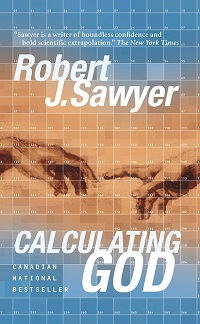 I have already written on Sawyer’s Calculating God
Fundamentalism, Religion, and Abortion
Sawyer lumps fundamentalism in with the discussions about abortion. Unfortunately, fundamentalism is portrayed in the worst possible light, not unlike in the work of Ben Bova. The religious fundamentalists here are extremists bent on destroying anything that counts as evidence against their worldview. As such, they are first introduced as blowing up an abortion clinic (86-87). Frequent readers of my site know that I write often from a pro-life perspective but also that I am very much opposed to violence in this opposition. Unfortunately, such principled opposition is not portrayed as an option in Sawyer’s work.
Interestingly the discussion of abortion in the book–intentionally or not–reveals some important details about the abortion debate. The alien, Hollus, notes the irony in being “pro-life” while also killing people who perform abortions. Yet in this discussion, Hollus reveals something of note:
Hollus looked at me [Tom Jericho, the main character] for the longest time. “These–what did you call them? Fundamentalist extremists? These fundamentalist extremists believe it is wrong to kill even an unborn child?”
“Yes” [Tom responded].
It may take a moment, but think about it: Sawyer expresses incredulity at this notion through the alien Hollus, yet in what may have been a Freudian slip, calls the unborn “children.” Yes, of course I’m opposed to killing an unborn child! In fact, this dialogue reveals exactly what is at stake in the abortion debate: if the unborn is not a human person, then who cares what you do with it? But if it is, then what relevant status difference is there between a child who is located inside the mother as opposed to outside the mother? Again, I’ve written more on this issue elsewhere, but it is important to note that even in expressing incredulity about this, there is a revealing phrase: child. It is an unborn child killed in abortion.
Disturbingly, the book touches on an issue very relevant to the personhood debate: children who are screened for disabilities. In one scene, Hollus is confronted by a child with Down’s Syndrome. He notes nonchalantly that a similar disease is almost always “screened for” in the wombs of the alien mothers (115-116). Unfortunately, this exact thing is happening right now. Unborn children who are shown as having Down’s Syndrome are being aborted inside their mothers at an alarming rate. I can’t help but see this as a modern eugenics movement: killing those we deem unworthy of life for a genetic reason. The logic that this entails is even more disturbing.
Of course the same fundamentalists who bombed the abortion clinic were also out to destroy any evidence for evolution. They sought to destroy a fossil exhibit which they saw as an affront to God. Thus, I can’t help but think that the way Sawyer presents fundamentalists is a bit disingenuous. Not all fundamentalists are incapable of reason and violent. Indeed, almost no fundamentalists are like this! Thankfully, there are positive examples of religious persons in Calculating God, including Tom’s wife.
In one poignant scene, Tom–who is dying from cancer–struggles with the fact that he has been confronted with evidence for the existence of a god. He considers famous atheists who purportedly went to death, all the while denying God’s existence to the end. Yet Tom himself gets down on his knees to pray. When he does so, though, he considers the words of someone from his past: “The Lord works in mysterious ways.” He can’t help but react violently against this:
Such bull. Such unmitigated crap. I felt my stomach knotting. Cancer didn’t happen for any purpose. It tore people apart; if a god did create life, then he’s a shoddy workman, churning out flawed, self-destructing products. “God,” [he prayed] “I wish–I wish you had decided to do some things differently.” (230-231)
Interestingly, in the book, cancer turns out to actually have a purpose… in the sense of being a side-effect of something great: the ability to fuse genetic codes with other intelligently designed species. Here it seems Sawyer has employed a great deal of imaginative techno-babble to explore the notion of a physical god, but it also has hints of a greater good theodicy akin to that of Swinburne.
Physicalism
The discussion of physicalism in Sawyer’s work is very brief, but enlightening. There is a variety of substance dualism here in the sense of emergence. That is, in Sawyer’s fictional world, intelligence and “mind” emerges from matter once complexity reaches a certain threshold. This is similar to the theories of emergence theorists like William Hasker. I can’t help but find this a bit strange. The people who argue for this type of theory are frequently the same who are very hostile to the notion of anything beyond the physical realm, yet they argue that something aphysical can indeed “emerge” from matter itself. Surely this is a leap of the imagination! That matter has creative force simply because it can reach a certain level of complexity seems to me patently absurd.
Not only that, emergence suffers from a second major problem. Namely, if our “mind” is simply a product of complexity in matter, then our “intelligence” is entirely supervenient upon physical complexity. Indeed, our intelligence is a product of that complexity and therefore cannot operate independently of that matter. Therefore, it is hard to see any kind of properties that our minds would have that would be capable of maintaining free will or even rational thought on this theory. Indeed, I have trouble seeing how this theory would be any different from physicalistic monism.
Evolution
The simple notion of evolution is a given in the book. No, it is not friendly to any who are unwilling to accept the notion of “macroevolution,” as the term is used in relevant literature. All the intelligent beings depicted in the book had evolved from a (potentially distinct) distant ancestor.
Darwinian evolution is simply assumed as truth in Calculating God. Or is it? The deity presented in the book is not very conducive to undirected evolution via natural selection and chance. It is portrayed as hurling asteroids at the planets where life was developing in order to press a “reset” button on the creatures that were currently dominant there. It also shown that this deity prevented other catastrophes from happening on these planets, thus interfering with natural selection. Indeed, the evolution depicted here is eerily similar to intelligent design, wherein the process is guided by a deity with a specific aim.
Indeed, one could argue that the entire book is an argument for intelligent design, albeit divorced from much of the theological framework that many of that movement’s frameworks operate within. Yet I can’t help but find this part of Sawyer’s argument (if, indeed, the intention is to make the argument that theists have it all wrong) is completely off. After all, the “god” of Sawyer’s universe is imperfect and concrete in the sense of physically existing. But this works against his concept of deity as being capable of coordinating the events it brings about. Granted, he could perhaps continue to increase the power of this deity beyond what is clearly outlined in the book, but there are hints that the deity is capable of knowing what is happening on places where it is not present, that it is capable of knowing what will happen with certain directions for evolution, and what will happen at the end of the universe. These work against the notion of God as a kind of blundering physical entity that just happens to be supremely powerful. Indeed, the god of calculating God may not be as hostile to Christianity as it initially seems. It serves as a pointer towards the true God of spacetime.
Links
Like this page on Facebook: J.W. Wartick – “Always Have a Reason”
Check out my other post on this book: Aliens that believe in God: The theological speculations of Robert Sawyer’s “Calculating God”
I have discussed the use of science fiction in showing how religious persons act. Check out Religious Dialogue: A case study in science fiction with Bova and Weber.
What would it mean if we discovered life? I have reflected on the possibility: Alien Life: Theological reflections on life on other planets.
Our Spooky Universe– I make the case for the intelligent design argument for the existence of God, which is heavily used throughout Calculating God.
Check out my other looks at popular level books. (Scroll down to see more!)
Source
Robert Sawyer, Calculating God
SDG.
——
The preceding post is the property of J.W. Wartick (apart from citations, which are the property of their respective owners, and works of art as credited) and should not be reproduced in part or in whole without the expressed consent of the author. All content on this site is the property of J.W. Wartick and is made available for individual and personal usage. If you cite from these documents, whether for personal or professional purposes, please give appropriate citation with both the name of the author (J.W. Wartick) and a link to the original URL. If you’d like to repost a post, you may do so, provided you show less than half of the original post on your own site and link to the original post for the rest. You must also appropriately cite the post as noted above. This blog is protected by Creative Commons licensing. By viewing any part of this site, you are agreeing to this usage policy.
Really Recommended Posts 3/22/2013- Rob Bell, Loftus, and Dawkins, oh my!
 Very often, I am just taken aback by the consistent high quality of posts I turn up in a search across the web. Check out the posts I bring to your attention this week! The topics include Loftus’ “outsider test” of faith, John Carter, Farmers, Richard Dawkins, morality, and Rob Bell with the emergent church.
Loftus vs Marshall I: An Alphabet of Errors (on Science and Faith)– I can’t tell you how much I recommend this for reading. Loftus is one of the up-and-comers in the “New Atheist” movement, and he is in love with his own devised argument against theism: “The Outsider Test of Faith.” Marshall exposes numerous flaws in Loftus’ latest work on the topic, as well as showing many of the difficulties which persist in his position.
A “John Carter” Calendar: Twelve Months, Twelve Reasons to Visit Barsoom– A great look at reasons to watch “John Carter,” a film I feel has been very underrated. I have written an analysis of the movie itself, in which I discuss many of the themes found therein: “A Christian look at ‘John Carter.'”
God Made a Farmer (Video)– A video recognizing women farmers, which is itself a companion to the original, a Dodge Super Bowl commercial which lauds farmers generally but doesn’t show any women. That original version, itself very much worth watching, can be found here. I found the message here to be very endearing.
Richard Dawkins defends the moral goodness of infanticide and adultery– I’ll be one of the first to say atheists are perfectly capable of being moral people. God’s moral law is clear to anyone. Yet, once someone denies that grounding for morality, it is permissible for them to develop all kinds of random moral systems. Dawkins’ comments about infanticide and adultery are just one example of the kind of hedonism which can occur when the basis for morality is jettisoned.
The Submergent Church– A powerful image showing the way some “emergent” people have put holes into the notion of orthodoxy and thus undermined their own credibility. This is one of my favorite websites, and I highly recommend that you follow it: No Apologies Allowed.
Review of “Love Wins” by Rob Bell: Chapter 6
 I have been reviewing Rob Bell’s book, Love Wins, with a particular interest in his theological views and how he argues for those views. I have not read the book before, so each review is fresh: I am writing these having just completed the chapter the post is on. This week, I look at Chapter 6: There Are Rocks Everywhere.
Chapter 6
Outline
Rob Bell begins with a number of stories illustrating how we often come into contact with what some people take to be God or some kind of abstract “love.” He ponders this and wonders “are we alone in the world?… what does any of this have to do with Jesus?” (142). He argues that the rock which Moses struck in the desert from which the people drank was Jesus, utilizing 1 Corinthians 10:3-5 and applying it back to Exodus 17. He asks: “That rock was… Christ? Jesus? Jesus was the rock?” He notes that Paul interprets the story to show how Christ was there.
Bell then turns to the notion of that “There is an energy in the world, a spark, an electricity that everything is plugged into” (144). It has been called the Force, life, “Spirit” and other things. Bell argues that there is such a force and it is found in the “Word of God,” for “God speaks… and it happens. God says it… and it comes into being” (145).
Jesus, Bell argues, shows “what God has been up to all along” (148). God is bringing all people together under Christ.
Moreover, according to Bell, “Jesus is bigger than any one religion. He didn’t come to start a new religion, and he continually disrupted whatever conventions or systems or establishments that [sic] existed in his day” (150). Jesus came to draw all people to himself, a point Bell emphasizes through repetition and restating it in numerous ways.
Regarding this drawing all people, Bell argues for “inclusivity” which he defines as “exclusivity on the other side of inclusivity. This kind insists that Jesus is the way, but holds tightly to the assumption that the all-embracing, saving love of this particular Jesus the Christ will of course include all sorts of unexpected people from across the cultural spectrum” (155). Jesus, Bell argues, leaves the door “wide open” which provides the possibility for any to enter.
Bell notes that we must wonder what people mean when they say “Jesus.” Do they mean “tribal membership, the source of “imperial impulse,” or some kind of “political, economic, or military system through which they sanctify their greed and lust for power?” (156).
No one has “cornered the market” on Jesus. We cannot contain him. Bell reemphasizes the importance of not pre-judging people’s eternal destinies. He writes, “it is our responsibility to be extremely careful about making negative, decisive, lasting judgments about people’s eternal destinies. As Jesus says, he ‘did not come to judge the world, but to save the world’ (John 12[:47])” (160).
Analysis
There is much to commend in this chapter, just like I pointed out in my review of Chapter 5. First, Bell rightly warns against trying to bottle Jesus in one form or another. It is not an individual denomination which owns Jesus. Second, Bell again makes the very important point that it is not our place to say whether one person’s eternal destiny is heaven or hell. We do not know how God may be working on that person. Third, he is correct in emphasizing Jesus as the “only way.” Finally, he is right to note how some people attempt to make Jesus into a slogan or a cry for some specific cause they are doing. Doing so undermines the message of Jesus and should be avoided.
Yet there are also many areas to critique in this chapter. First, there is the notion of questionable exegesis. For example, Bell cites John 12:47 to show that Jesus is not about judgment, but fails to cite the very next verse which states: “There is a judge for the one who rejects me and does not accept my words; the very words I have spoken will condemn them at the last day” (NIV). Bell spends the whole section centered around 12:47 and how God isn’t about judgment, but rather “exclusivity on the other side of inclusivity.” One wonders, then, why he fails to read the next verse of the passage he cites in context. I find this a gross example of proof-texting wherein a part of a verse is ripped from its context and used to rant against the very thing the next verse affirms. The importance of looking at the entire context of individual verses is paramount, and Bell continues to fail to be attentive to the evidence against his positions.
Again, Bell emphasizes the notion of an “open door.” We discussed this at some length in my look at Chapter 4. Once more, the “open gates” in context show a city without any enemy. That is, the enemies of that city have been utterly defeated. Yet Bell takes it to mean wide openness in the sense that people can always come [and go?–does Bell imply that we can leave heaven if we so choose? Is our salvation not secure?]. He emphasizes this over and over again, but then he has yet failed to cite Matthew 7:14, in which Jesus describes the gate and the road to eternal life “narrow” and says “only a few find it.” Why this emphasizing on some texts while ignoring others? Certainly, we need to balance these Biblical teachings, but we cannot ignore one at the expense of the other. Bell seems to do the latter time and again. He cites a text out of its context and ignores anything in the text which goes against his own interpretation. He doesn’t interact with the other parts of the text, he just pretends they don’t exist. I find this highly problematic.
I am also wary of Bell’s statement that Jesus is beyond any one religion. Clearly, Jesus saw himself as a Jew. Making this argument would take me well beyond the scope of this post, but suffice to say that Jesus’ language and imagery regarding himself as the temple places him exactly within the Jewish religion. Yes, he interpreted things in startling ways which led Jews to call him blasphemous, but other Jews saw his resurrection and what did they do? They began to proclaim Christ glorified as the Son of God. Did Jesus really come to overthrow religion, as Bell seemingly implies? Again, such an assertion abuses the Bible. I say this in strong words because it needs to be said. What does Jesus actually say about the religious system in place at the time? Yes he criticized it, but when it came down to the core of the Hebrew faith, the Torah, Jesus said:
“Do not think that I have come to abolish the Law or the Prophets; I have not come to abolish them but to fulfill them. For truly I tell you, until heaven and earth disappear, not the smallest letter, not the least stroke of a pen, will by any means disappear from the Law until everything is accomplished.” Matthew 5:17-18 NIV
That doesn’t sound to me like Jesus overthrew that religion. Instead, he argues he came to be the reality of that faith. Jesus came to fulfill the expectations of the Law. Again, Bell’s selective reading of the texts undermines the core of Christian teaching.
Conclusion
There are many positive things to say about this chapter of Love Wins. Bell has rightly emphasized a number of themes to which Christians should be attentive. We need to avoid making Jesus too small and turning him into our personal example or slogan. Yet Bell has also continued to perpetuate a number of errors, and his exegesis is very selective. The way he reads texts seems to have theological blinders on. When he finds the verse he wants, he uses it to trump anything else. We have seen how problematic this is in a number of examples. Next week, we will explore Chapter 7.
Links
Like this page on Facebook: J.W. Wartick – “Always Have a Reason”
The book: Rob Bell, Love Wins
Review of “Love Wins” by Rob Bell: Preface and Chapter 1– I discuss the preface and chapter 1 of Love Wins.
Review of “Love Wins” by Rob Bell: Chapter 2– I review chapter 2.
Review of “Love Wins” by Rob Bell: Chapter 3– I look at Chapter 3: Hell.
Review of “Love Wins” by Rob Bell: Chapter 4– I look at Chapter 4: Does God Get what God Wants?
Review of “Love Wins” by Rob Bell: Chapter 5– I analyze chapter 5.
Love Wins Critique– I found this to be a very informative series critiquing the book. For all the posts in the series, check out this post.
Should we condemn Rob Bell?– a pretty excellent response to Bell’s book and whether we should condemn different doctrines. Also check out his video on “Is Love Wins Biblical?“
Source
Rob Bell, Love Wins
SDG.
——
The preceding post is the property of J.W. Wartick (apart from citations, which are the property of their respective owners, and works of art as credited) and should not be reproduced in part or in whole without the expressed consent of the author. All content on this site is the property of J.W. Wartick and is made available for individual and personal usage. If you cite from these documents, whether for personal or professional purposes, please give appropriate citation with both the name of the author (J.W. Wartick) and a link to the original URL. If you’d like to repost a post, you may do so, provided you show less than half of the original post on your own site and link to the original post for the rest. You must also appropriately cite the post as noted above. This blog is protected by Creative Commons licensing. By viewing any part of this site, you are agreeing to this usage policy.
The Crusades: Wanton Religious Violence?
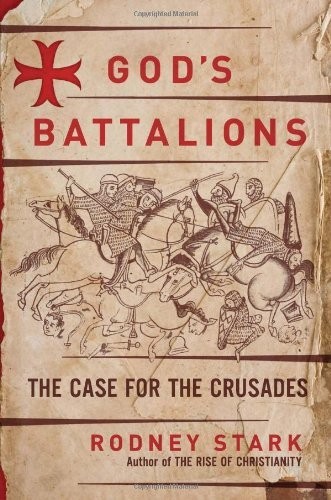 The Crusades are often cited as the prime example of the evils of religion and of Christianity specifically. The picture is often painted of an innocent world on which Christians came in violent fervor, raping and pillaging as they went. But this picture of the Crusades is inaccurate on a number of levels. Here, I’ll explore the historical context of the Crusades with an eye towards seeing why they occurred. I’ll wrap it up with a discussion on violence and religion.
The Historical Context of the Crusades
The Crusades were not just some bubbling up of violence latent within all religions. Instead, they were part of a history of conquest across the Asian and European continents. Prior to the Crusades, there was a sweeping conquest by the Muslims of territory formerly possessed by various Christian nations.
Muslim invasions had pressed in on all sides. Rodney Stark, in his extremely important work on the Crusades, God’s Battalions
Many critics of the Crusades would seem to suppose that after the Muslims had overrun a major portion of Christendom, they should have been ignored or forgiven… This outlook is certainly unrealistic and probably insincere. Not only had the Byzantines lost most of their empire, the enemy was at their gates… (32-33)
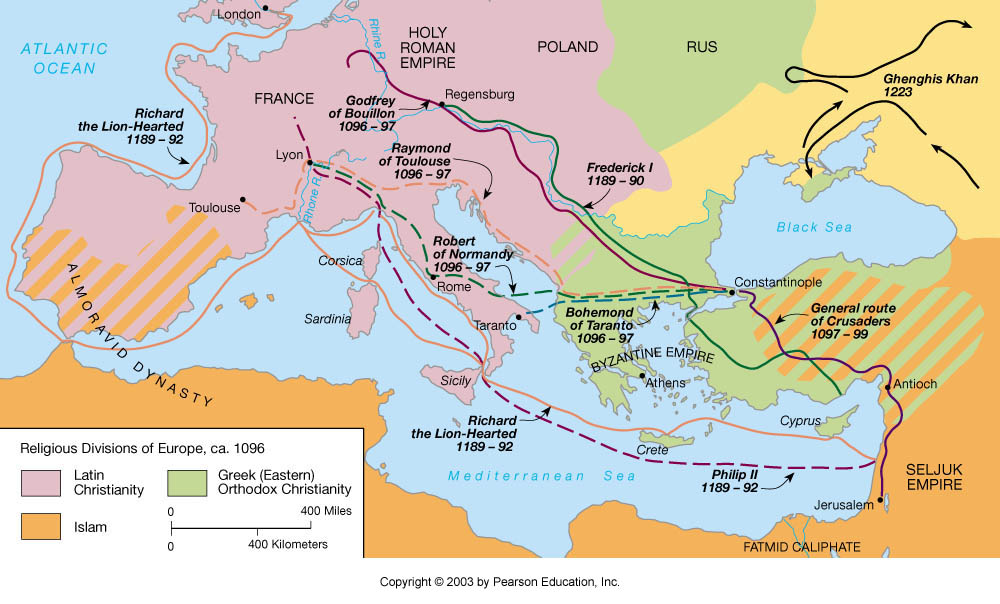
Prior to the Crusades, it is absolutely essential to note that the invaders were, quite literally, at the gates. Constantinople was threatened in the East, and Spain was overthrown in the West. Europe was under assault. The map below illustrates the situation in the time during and before the Crusades well.
The question of the Crusades must be understood within this historical setting: much of the land which European countries had controlled had been taken, by force. Furthermore, those who had taken these lands were knocking on the very gates of Europe, having already crossed into Europe in many places. Stark’s words, therefore, seem to ring true: is it really genuine to assume that these invaders should have been ignored or forgiven? Is that the reality of “secular” nations? It seems to me the very fact that so much land had been lost, as well as so much wealth, would lead many to war for “secular” reasons rather than religious reasons.
Regarding the beginning of the Crusades, Stark writes:
[T]hat’s when it all [The Crusades] started–in the seventh century, when Islamic armies swept over the larger portion of what was then Christian territory: the Middle East, Egypt, and all of North Africa, and then Spain and southern Italy, as well as many major Mediterranean islands including Sicily, Corsica, Cyprus, Rhodes, Crete, Malta, and Sardinia. (9)
So the Crusades were not unprovoked mass murders of innocents. But they were indeed quite brutal, and involved no small amount of very un-Christian activities. Raping and pillaging has no part in the Christian worldview. But Stark once again has a sobering point: war was hell. “[I]t was a brutal and intolerant age” (29). The criticism of brutality equally applies to both sides, but it is also equally anachronistic about the realities of that time. This is not to say that the horrors which occurred were not awful; it is to say that to criticize the Crusaders or Muslims as though they were doing something extraordinarily brutal for their time period is extremely short-sighted.
The Crusades as a Polemic Device
The Crusades were not all-good or all-evil affairs. Like virtually any part of human history, both good and evil intentions and outcomes were involved. To view the Crusades as either an entirely evil affair showing how religion is ultimately prone to violence or as a benevolent attempt by loving people to liberate lands that were rightfully theirs is to grossly oversimplify the historical reality. Unfortunately, modern looks at the Crusades have largely leaned towards the former of these positions, without any acknowledgement of the historical context as noted above.
Instead, the Crusades were a complex of historical events which were often brutal, often provoked, and never motivated for just one reason. To say that the Crusades are a typical example of the violence of religion is, frankly, ahistorical. Was religion involved? Yes. Were there even “religious reasons” involved in the motivations for the Crusades? Clearly. But the general movement with recent attacks on Christianity has been to argue that the Crusades were purely religious instances of religious brutality. The historical perspective provided above provides evidence against that limited perspective.
The Crusades have been used as a kind of polemic device against Christianity. Whenever it is argued that Christianity is reasonable, someone inevitably brings up this historical period. Readers will note that this historical perspective has not attempted to explain away the Crusades. Instead, I have argued for the notion that these events were historically complex, involving a number of factors beyond purely war for the sake of a faith.
As Keith Ward has noted:
It is… beyond dispute that the Crusades were a major disaster… The Crusades can be seen as justified defense… but their conduct and continuance rapidly became unjustifiable on any Christian principles. (68-69, Is Religion Dangerous?
cited below)
The point is simple: there were many motivations behind the Crusades, some of them justified. Yet in carrying out the Crusades, many horrible actions were taken which were unjustifiable. Does this somehow disprove Christianity? Not on Christianity’s own principles, on which we expect to see people acting as sinner-saints in the process of sanctification.
 Religious and Secular Violence
Apart from the historical outline given here, there is another, equally important point: the dichotomy between religious violence and secular violence is simply a myth. The reason for this is because human actions are far more complex in their motivations than a simple dichotomy of one or the other reason. In our everyday experience, we know that the decisions we make are very rarely made for only one reason.
Oddly, Stark is able to note that “many historians have urged entirely material, secular explanations for the early Muslim conquests…” (13). This, in contrast to the many historians and new atheists who continue to press that the Crusades were entirely religious in their provocations. The unfortunate truth this reveals is the very human tendency to simplify history beyond the point of breaking. Human actions, particularly corporate human actions, have extremely complex motivations behind them. They are not all-or-nothing affairs which happen due to one reason or another. Very often we make decisions for a combination of reasons of differing strengths, weighing options against each other whether we realize it or not.
By utilizing the Crusades as a rhetorical device–a polemic weapon–many have done damage to the historical events themselves. Worse, they have engaged in faulty reasoning and attacked the religious other due to their own emotional hatred. The Crusades were not all-good or all-evil affairs. They were affairs of human history. To forget that is to drown them in a sea of obfuscation. Let us get beyond simple polemical attacks on the “other.” Let us instead engage in honest history and dialogue with our neighbors.
Links
The Myth of “Religion”: Constructing the Other as an enemy– I explore the notion that religion is violent and argue that one of the major difficulties with this notion is that the distinction between secular/religious is a myth.
For an interesting exploration of some aspects of Muslim Philosophy, see my book review: The Closing of the Muslim Mind.
Essential reading: Rodney Stark, God’s Battalions
Pacifism, Matthew 5, and “Turning the other cheek”– Glenn Andrew Peoples discusses pacifism in the Christian tradition and some of the arguments in its favor. Ultimately, he finds these arguments wanting.
Sources
Rodney Stark, God’s Battalions
Keith Ward, Is Religion Dangerous?
Image Credit:
The image of the map is from this page with free resources for instructors. I do not claim credit for this image, nor do I claim that the makers of this resource in any way endorse this post.
SDG.
——
The preceding post is the property of J.W. Wartick (apart from citations, which are the property of their respective owners, and works of art as credited) and should not be reproduced in part or in whole without the expressed consent of the author. All content on this site is the property of J.W. Wartick and is made available for individual and personal usage. If you cite from these documents, whether for personal or professional purposes, please give appropriate citation with both the name of the author (J.W. Wartick) and a link to the original URL. If you’d like to repost a post, you may do so, provided you show less than half of the original post on your own site and link to the original post for the rest. You must also appropriately cite the post as noted above. This blog is protected by Creative Commons licensing. By viewing any part of this site, you are agreeing to this usage policy.
Questions of the Week: March 10-16, 2013
 I have begun a new “thing” over on the Facebook page for this site. If you haven’t checked that out, go over and like the page: “J.W. Wartick- Always Have a Reason.” What is this thing? Well, I’m asking you, dear readers, to respond to various questions throughout the week, which I will then post here. The goal is to get you thinking about a number of issues, and to get some great interaction both on the Facebook page and here. Each week, I will ask questions on the Facebook page, and wait eagerly for responses. Then, I will post the questions here with perhaps some commentary. I don’t know, I’m figuring it out too. This will be a series to go alongside the “Really Recommended Posts” where I send you all to other awesome sites. Give me feedback on what you like about this, or what you don’t like. With no further ado:
Questions of the Week
What is your view on Christianity and the Environment?
I have seen in discussion on this site that people hold an array of views on how we should answer this question. I wrote a post discussing “Caring for Creation” and reactions were very diverse. Skepticism was expressed over global warming, while others expressed the notion that such skepticism is unfounded. The bigger issue, however, is the issue of caring for creation more broadly and how to interact on that level. The answers there were diverse as well. You should check out the post, and let me know here what your thoughts are on this hot-button topic.
Do you have a view on the eschatological millennium? If so, what is it?
One of the most hotly-contested issues in Christian doctrine is that of eschatology. There are various views of the “millennium” which compete for adherents. I recently reviewed a book outlining premillenialism, but it also provided an overview of the various positions “out there.” Check out the review, and let me know what your view is on this contentious issue. Responses to this question on the page covered a diverse array, from those who felt the issue focused around Israel to a recommendation of amillennialism to one who held to a diverse pick-and-choose approach. What do you think?
“The Big One”: What are your thoughts on the Newly Selected Pope?
Judging from my Twitter feed and Facebook, reactions to this question were wildly diverse. Some people decried the “most recent antichrist” while others celebrated their new “papa.” Pope Francis’ second blessing was for a pregnant woman and her child, which gives me great comfort in knowing that the Roman Catholics will continue to stand firmly against abortion. I know little else of this Jesuit man from Argentina, so let me know your thoughts.
Image:
The image is a picture I took of my NIV Study Bible (copyright for the pages to Zondervan, but image copyright as below).
SDG.
——
The preceding post is the property of J.W. Wartick (apart from citations, which are the property of their respective owners, and works of art as credited) and should not be reproduced in part or in whole without the expressed consent of the author. All content on this site is the property of J.W. Wartick and is made available for individual and personal usage. If you cite from these documents, whether for personal or professional purposes, please give appropriate citation with both the name of the author (J.W. Wartick) and a link to the original URL. If you’d like to repost a post, you may do so, provided you show less than half of the original post on your own site and link to the original post for the rest. You must also appropriately cite the post as noted above. This blog is protected by Creative Commons licensing. By viewing any part of this site, you are agreeing to this usage policy.
Really Recommended Posts 3/15/13
I have found another round of excellent posts around the internet, and I will share them with you! This week, we look at zombies, complementarianism, moralistic therapeutic deism, Faith, video games, and Oz. As always, drop a comment about what you liked!
Warm Bodies: Exhuming Humanity– Anthony Weber looks into both the book and movie “Warm Bodies” to find a too-true account of humanity, with some confusing messages along the way.
How Complementarian is the Bible? (video)– Philip Payne, author of Man and Woman, One in Christ (my review is linked), offers a presentation on the Bible’s view of women and whether it entails complementarianism–the view that women are to be subordinate to men.
What is moralistic therapeutic deism?– A fascinating post outlining the state of beliefs in contemporary Christianity. The post also goes into “debunking” this position. This is well-worth the read because we have essentially an entire generation of children who hold this position growing up in our churches.
Hebrews 11:1-3- Defining Faith– Edgar Andrews has a fantastic post up on how we define faith, in contrast to many modern notions and distortions. Edgar Andrews is the author of what I think is one of the greatest introductions to apologetics available: “Who Made God?”
Review: Of Games and God– I found this post on a book about video games and Christianity pretty interesting. I appreciated the notion that the issue is much more complex than some people paint it: “The simple truth is that those not significantly invested in the world of video games often lack a point of reference to understand and interpret this artistic culture. Rather than condemning those who have genuine concerns about this new medium, however, Schut takes the time to work through what they may have missed—as well as the places where their impressions may be correct.” Check out this interesting review.
Recommending Viewing: DIsney’s “Return to Oz” (1985)– One of my new favorite sites (and podcasts!) is “The Sci-Fi Christian” (readers know this is for good reason: I LOVE science fiction). Check out their excellent look at a 1985 Disney movie on Oz, which offers a different look into the world than either the new movie or the old classic.
Review of “Love Wins” by Rob Bell: Chapter 5
I have been reviewing Rob Bell’s book, Love Wins, with a particular interest in his theological views and how he argues for those views. I have not read the book before, so each review is fresh: I am writing these having just completed the chapter the post is on. This week, I look at Chapter 5: Dying to Live.
Chapter 5
Outline
Rob Bell begins by noting the ubiquity of the cross. Crosses are everywhere. But we can “inoculate. Familiarity leads to unfamiliarity… ‘Jesus died on the cross for your sins.’ Yes, we know. We’ve seen that… countless times. Anything else?” (122). Of course, there is so much more to the cross! Bell argues that we have missed much of the message of the cross by our cultural apathy towards it.
Bell then turns to the notion of sacrifice. He outlines very generally what cultures believed about sacrifice and then focuses in upon Christ. “Jesus was the ultimate sacrifice that thoroughly pleased the only God who ever mattered” (125).
He then uses this as a backdrop for discussing the work of Christ. Jesus’ death on the cross is ultimately the fulfillment of a number of expectations including reconciliation, winning the battle, etc. (127). Jesus is “where life is” (129). The cross and resurrection were understood as “an event as wide as the world, extending to all creation” (132).
Bell asserts that we need to think of the Gospel as a big deal:
A gospel that leaves out its cosmic scope will always feel small. A gospel that has as its chief message avoiding hell or not sinning will never be the full story. A gospel that repeatedly, narrowly affirms and bolsters the “in-ness” of one group at the expense of the “out-ness” of another group will not be true to the story that includes “all things and people in heaven and on earth.” (135)
Jesus is the “source, the strength, the example, and the assurance” to us that death and resurrection lead us into life (136).
Analysis
There is much to commend in this chapter. Bell has masterfully highlighted the problems with trivializing the cross. It is easy in our culture to see a cross and react with complete indifference. Why is that? Bell rightly yearns to snap free from this apathy and see the cross for what it is: a symbol of hope, the truth of death defeated.
Furthermore, Bell is spot-on when he critiques the notion that the gospel is about living the right way or being “in” or “out.” The Gospel is more than any of the things he mentioned. A generous reading of bell in the passage block-quoted above shows his commitment to seeing the Gospel as applicable to all people: everyone is called to Christ.
Thus, I am left with only two very minor critiques. First, I am a bit concerned with the over-generalization on sacrifice, which I think has a deeper Biblical meaning than Bell outlined and also has a much broader spectrum of belief than he touched upon.
Second, Bell at one point mentioned the number seven and related it back to Genesis. He describes the creation account as: “In the poem that begins the Bible…” (133). Again, this is a very minor critique and well beyond the scope of his book, but I’d be very curious to see what Bell means by “Poem” here to refer to Genesis 1-2 (and beyond?). The Hebrew does not seem to reflect a poetic style, though it has a pattern with Days 1-3 relating to days 4-6. So yes, minor issue, but I found it interesting that he included this sentence with no real context when discussing numbers through the Bible.
Conclusion
Bell has done very well to highlight the importance of the Gospel message. He is rightly saddened by the fact that people have become disillusioned with the cross and its truth. Next week, we’ll look at Chapter 6.
Links
The book: Rob Bell, Love Wins
Review of “Love Wins” by Rob Bell: Preface and Chapter 1– I discuss the preface and chapter 1 of Love Wins.
Review of “Love Wins” by Rob Bell: Chapter 2– I review chapter 2.
Review of “Love Wins” by Rob Bell: Chapter 3– I look at Chapter 3: Hell.
Review of “Love Wins” by Rob Bell: Chapter 4– I look at Chapter 4: Does God Get what God Wants?
Love Wins Critique– I found this to be a very informative series critiquing the book. For all the posts in the series, check out this post.
Should we condemn Rob Bell?– a pretty excellent response to Bell’s book and whether we should condemn different doctrines. Also check out his video on “Is Love Wins Biblical?“
Source
Rob Bell, Love Wins
SDG.
——
The preceding post is the property of J.W. Wartick (apart from citations, which are the property of their respective owners, and works of art as credited) and should not be reproduced in part or in whole without the expressed consent of the author. All content on this site is the property of J.W. Wartick and is made available for individual and personal usage. If you cite from these documents, whether for personal or professional purposes, please give appropriate citation with both the name of the author (J.W. Wartick) and a link to the original URL. If you’d like to repost a post, you may do so, provided you show less than half of the original post on your own site and link to the original post for the rest. You must also appropriately cite the post as noted above. This blog is protected by Creative Commons licensing. By viewing any part of this site, you are agreeing to this usage policy.
Mulan Among Us: Disney’s “Mulan” and Womanhood
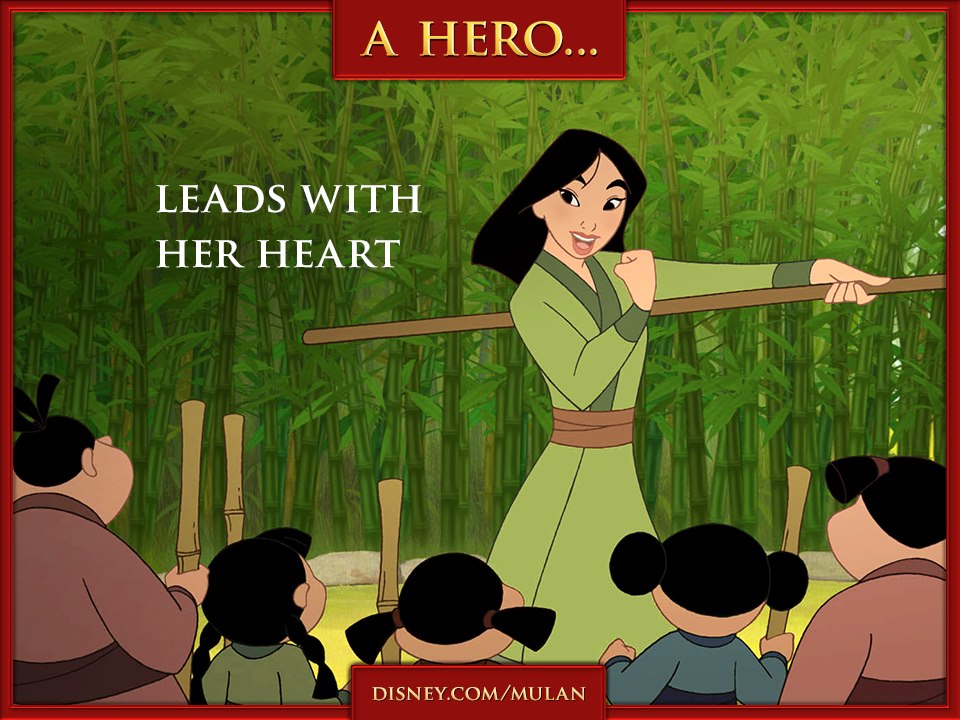
Disney’s “Mulan
Warning: There are spoilers for Disney’s Mulan in the following discussion
Mulan and Cultural Expectations
Mulan is a warrior. She is powerful, capable, and determined.
Oh, and I forgot: she is a woman.
It is that “shocking” pronouncement which is the focus of the Disney’s Mulan
Mulan is challenged at numerous points throughout the movie. She does not fit into her society’s gender ideals. She is expected to be clean, quiet, submissive, and “womanly.” And she tries to fit into these expectations. The culture wants her to be a good wife, so she tries to match what her culture’s idea is in order to become a good wife. Those who have seen the movie knows she fails miserably. When she visits the matchmaker, she recites, in a stumbling way, the right sayings: “Fulfill your duties, calmly and respectively. Reflect before you… Act!” She lacks grace, poise, and ultimately ends up comically ruining the whole scene, setting the matchmaker on fire and dousing that fire with hot tea, running the matchmaker’s makeup and earning the pronouncement that she will never fit society’s expectations for her.
Yet this reveals another cultural shock: it is the very fact that Mulan is placed into a one-size-fits-all box to take on roles which do not match her abilities that leads to her triumph. It is not that she should be trying harder, or that she is wrong; instead, the fact is that it is her culture’s expectations which are wrong. Mulan destroys those expectations. She saves China, and the Emperor himself honors her. Thus, the expectations are shattered, and Mulan remains “true to herself.” Her abilities destroyed the cultural norms that people had tried to apply to her.
“So what!?” you may be asking. “I already knew this, though I may not have outlined it like this.” After all, telling women to be submissive and arguing that there are very specific roles that they should fit into is a thing of the past.
Is it?
Have you never heard the phrase “she wears the pants in that family”? That speaks to a division of roles that is still at least unconsciously acknowledged in our culture. What about “make me a sandwich” or “get in the kitchen”? What of more subtle distinctions? “I would never vote for a woman president.” “A man is in charge of the family.”
Moreover, some theological traditions continue to argue that there are very explicit roles for man and woman in leadership and the home. It is to that concept that we will turn to, with a focus on Mulan.
Mulan and Theology
The shock of Mulan’s story may seem almost comical to us, but the fact remains that there are women whose talents are not being acknowledged. They do not fit the mold. It is said within some branches of contemporary theology that women are to submit to their husbands. These theologians teach that women have very specific roles: that of “helper,” servant, or anything but “leader” or “teacher.” According to these views, women can teach other women and even male children, but when it comes to man, she is always subordinate. Consider the following passage, from a book endorsing this view (“Recovering Biblical Manhood and Womanhood
[I]t is simply impossible that from time to time a woman not be put in a position of influencing or guiding men. For example, a housewife in her backyard may be asked by a man how to get to the freeway. At that point she is giving a kind of leadership… But we all know that there is a way for that housewife to direct the man that neither of them feels their mature femininity or masculinity compromised. (John Piper, 50, cited below)
Moreover, women, on this view, must be careful about how they give their advice; they must remember that they are to be submissive:
A wife who ‘comes on strong’ with her advice will probably drive a husband into passive silence, or into active anger (Ibid, 52)
I can’t help but think of the scene from Mulan just before she saves the Emperor when she is trying to get people to listen to her about the great danger of the Huns in the Imperial City. They pull away from her forcibly, ignoring what she says. Finally, her trusty sidekick, Mushu, points out that “You’re a woman.”
Such is the way in which manhood and womanhood is supposed to play out within those branches of contemporary theology which lean towards complementarianism–the view that men and women are to occupy different “roles” in the church and the home. Women are to be submissive, even when they try to give directions to a man. Mulan, in this view, perhaps came on “too strong” in her insistence that the Emperor was in danger. If she had only been more submissive, then she would not have provoked “passive silence” or “active anger.”
The absurdity of this notion can be found in the fact that it is the victim who is blamed for the abuse. “Passive silence” can be just as harmful as “active anger.” Is it really acceptable to say that a woman, by offering advice, “provokes” the man? Moreover, is it really honorable to men to turn us into seething machines, who, if the right button is pressed, turn into active aggressors or passively-aggressive “victims”? Again, the movie “Mulan” has presented a more balanced approach: there are women who transcend society’s–and religion’s–expectations.
There are Mulans among us. There are women who challenge this perceived view of manhood and womanhood. There are women who are gifted greatly to be leaders, not followers. There are women with the gift of teaching. There are women whose very existence shatters the notion that woman’s role is to be submissive. Their talents and abilities call us to use them, not to force them to singular submission. The Bible calls us to mutual submission, not a singular silence from one gender. These Mulans are powerful missionaries, leaders, teachers, yes, even pastors: gifted and called by God to take on roles that their cultural milieu often wants to deny to them.
I pray that more of these women would arise and use their gifts for the church. Many women have already done so, but our church’s culture has too often tried to silence women. Instead, we need to acknowledge the Mulans we know.
Check the links below for more discussions of women and the church. For all my posts on the topic, check out my egalitarianism category (scroll down for more posts).
Links
Be sure to check out my looks at other movies. If you like Mulan, what about Brave?
For information on egalitarianism–the view that the Bible teaches us women and men should fill equal roles–check out “Christians for Biblical Equality.”
Women in the Ministry: The philosophy of equality and why complementarianism fails– I argue that the position in which women are excluded from church leadership entails inequality of being.
Book Review: “Good News for Women” by Rebecca Groothuis– I review an excellent book on the issue of gender equality in the Bible.
Religious Dialogue: A case study in science fiction with Bova and Weber– I take a look at how science fiction has dealt with theological topics, with a particular focus on dialogue about religion and women.
I discuss the notion of having my expectations of women shattered here.
Sources
John Piper, “A Vision of Biblical Complementarity: Manhood and Womanhood defined According to the Bible” in Recovering Biblical Manhood and Womanhood
Mulan
Image Credit
The image used in this post is credited to the Mulan Facebook page.
SDG.
——
The preceding post is the property of J.W. Wartick (apart from citations, which are the property of their respective owners, and works of art as credited) and should not be reproduced in part or in whole without the expressed consent of the author. All content on this site is the property of J.W. Wartick and is made available for individual and personal usage. If you cite from these documents, whether for personal or professional purposes, please give appropriate citation with both the name of the author (J.W. Wartick) and a link to the original URL. If you’d like to repost a post, you may do so, provided you show less than half of the original post on your own site and link to the original post for the rest. You must also appropriately cite the post as noted above. This blog is protected by Creative Commons licensing. By viewing any part of this site, you are agreeing to this usage policy.
Really Recommended Posts 3/8/13
 It really is difficult to keep up with all the excellent posts around the internet. But, I have taken the liberty of doing some of that work for you and found a diverse array of posts on fascinating topics. Read them, love them, comment! This week, we’ll be looking at the prosperity gospel, Calvinism, women in the Bible, Young Earth Creationism, the History Channel’s TV show on “The Bible”, and design flaws in creation.
The Prosperity Gospel Revisted– I found this post about the “Prosperity Gospel” quite fascinating. Dan offers critical interaction with the notion that the Gospel is about empowering us to gain. I also really recommend checking out the entire site, Rockadoodee, which is always thought-provoking.
Jerry Walls: What’s wrong with Calvinism? (Video)- One of the most interesting evangelical scholars writing right now, Jerry Walls, evaluates Calvinism. I found this video quite interesting. I’ve met Walls in person and I find him to be very gracious and thoughtful.
Correcting Caricatures: Women in the Bible [This link appears to be broken now… I don’t know why. Please let me know if you can view it]- Eminent scholar Walter Kaiser looks at several key texts related to women in the Bible. I found this fascinating and enlightening. Whether you are egalitarian or complementarian, it is worth reading.
2013 International Conference on Creationism– The Geochristian outlines a number of interesting discussions at this conference, which is where all the major scholars within the Young Earth Creation movement meet. Alongside this article, you should check out these articles on the state of Young Earth Creationism: The State of Creation Science as Measured by Scholarly Publishing– this one looks at scholarly works by YECs over a recent period of time and evaluates what it means for YEC; The Next Generation of Creation Scientists?– this post looks at who may be stepping in to fill the roles of the major YEC organizations.
The Bible–Night One Review– A look at the theology in the new TV series by the History Channel: The Bible.
If God Designed Humans, How Do We Account for “Design Flaws”?– One of my favorite blogs, “Well-Spent Journey” examines the notion that humans are flawed designs as an argument against intelligent design.
Review of “Love Wins” by Rob Bell: Chapter 4
I have been reviewing Rob Bell’s book, Love Wins, with a particular interest in his theological views and how he argues for those views. I have not read the book before, so each review is fresh: I am writing these having just completed the chapter the post is on. This week, I look at Chapter 4: “Does God Get what God Wants?”
Chapter 4
Outline
Bell starts the chapter by surveying a number of statements from church’s web sites regarding hell. These statements range from the unsaved being separated from God forever to eternal conscious torment. He seems to be pointing readers towards a kind of discontinuity between these statements and the statements about God’s power and love:
I point out these parallel claims: that God is mighty, powerful, and “in control” and that millions of people will spend forever apart from this God… even though it’s written in the Bible that “God wants all people to be saved and to come to a knowledge of the truth” [1 Timothy 2:4- seems to be NIV]
…How great is God? Great enough to achieve what God sets out to do… but in this, the fate of billions of people, not totally great. Sort of great. A little great. (97-98)
Bell asks a poignant question: “Will all people be saved, or will God not get what God wants?” (98). He then goes through a number of verses focused around God’s love. He notes the parables in Luke 15 about people pursuing their desires and concludes, “The God that Jesus teaches us about doesn’t give up until everything that was lost is found. This God simply doesn’t give up. Ever” (101).
Bell turns to the reason that many people think God may fail in his desire to save everyone. From the perspective of those who advocate the views he outlined at the beginning of the chapter, “love, by its very nature, is freedom… God has to respect our freedom to choose to the very end” (103). However, Bell argues that “We aren’t fixed, static beings–we change and morph as life unfolds.”
Tied into this notion of the unfixed nature of our lives, he seems to hold that it is possible that people can choose to come to Christ after they die. He asks, “why limit that chance [the chance to come to Christ] to a one-off immediately after death? And so they expand the possibilities… [The chance is given for] as long as it takes, in other words” (106-107).
Bell then traces this notion through Clement of Alexandria, Origen, Gregory of Nyssa, and Eusebius. He goes so far as to cite Augustine saying “‘very many’ believed in the ultimate reconciliation of all people to God” (108).
He argues that “central to their trust that all would be reconciled was the belief that untold masses of people suffering forever doesn’t bring God glory” (ibid). Moreover, he argues that “At the center of the Christian tradition since the first church have been a number who insist that history is not tragic, hell is not forever…” (109). He notes that “serious, orthodox followers of Jesus have answered these questions [about hell and salvation] in a number of ways” (ibid).
Next, Bell turns to an analysis of the book of Revelation. he notes that the book ends with notion that the gates of the city “never shut” and infers that “gates are for keeping people in and keeping people out. If the gates are never shut, then people are free to come and go” (114-115).
Bell ends the chapter with what seems like a poetic inference. He goes into prose and concludes that: “[Love] always leaves room for the other to decide. God says yes, we can have what we want, because love wins” (119).
Analysis
There is much to discuss in this chapter. First, it is important to note that Bell has done much to cause reflection upon the subject of hell. It is something that we as a group of believers need to be thinking on. Too often, the subject is cast aside. Bell has done admirably in bringing the topic to the table.
Moreover, Bell is correct to note that confusion can be caused by simply throwing statements on hell “out there” in a void. It is important to contextualize statements about heaven and hell and make clear what is meant by the phrases that are used in the discussion.
Bell seemingly just assumes that there will be more chances to “accept Christ” in the afterlife. His discussion of the possibility of people changing after death implies this perspective, but he has done nothing to establish it. Perhaps he will do so in a later chapter, at which point we will evaluate his argument for that perspective. Indeed, thus far his argument seems to be a kind of straw man: he asserts the notion that people are changeable beings even in the afterlife as a counterpoint to those who hold that people will continue to choose evil in the hereafter as though this choice is the reason people hold to the eternal hell view. Yet this is not the case; many who hold this position do argue that people will continue to choose evil, but the reason that people are condemned to hell is because they rejected the God, whose existence and power are obvious (Romans 1) in their lives. No one has an excuse (Romans 1:20).
Bell’s utilization of church fathers is problematic. I can’t help but think there is a subtle twisting of some of their views to fit his position. In particular, he cites Augustine as “acknowledging” that “very many” believed in “ultimate reconciliation of all people” (107-108). Yet Augustine himself categorically denies and denounces this position. In fact, almost the entirety of Book XXI of The City of God
I hate to beat a dead horse here, but let’s look what Augustine says (The City of God
Origen was even more indulgent; for he believed that even the devil himself and his angels, after suffering those more severe and prolonged pains which their sins deserved, should be delivered from their torments, and associated with the holy angels. But the Church, not without reason, condemned him for this and other errors…
So we see that Augustine, far from being anywhere near Origen’s view on the topic, endorses the Church’s condemnation of Origen as a heretic in this regard. Yet where does Bell reveal this? Where does Bell interact with historical theology? No, he seems perfectly content to throw out a bunch of names out of context together and let readers make their own assumptions. I realize this is a popular level book, but I can’t help but be very worried about Bell’s style here. It is very misleading. Maybe he does note later in the book that Origen was condemned as a heretic for this view, and that Augustine endorses this condemnation, but considering Bell seemingly endorses Origen’s view, I very much doubt that he will reveal that it was condemned by the Church.
More damning is the fact that Bell is able to, seemingly seriously, say that “At the center of the Christian tradition since the first church have been a number who insist that history is not tragic, hell is not forever…” (109). I admit that I agree in one sense–there have been many universalists throughout church history. However, that view was condemned as heretical. Augustine upholds that condemnation in The City of God
Here again we see one of Bell’s biggest methodological problems: he simply introduces a notion, argues that there are diverse views, and then assumes that they are all equally legitimate. but this is simply mistaken. Multiplication of viewpoints does not mean they are equally valid. Furthermore, Bell’s lack of interaction with historical theology on this point, when he himself is the one who introduces several of the church fathers, is questionable at best. Moreover, he says these teachers were “orthodox” when in fact Origen specifically was far from orthodox in his beliefs, as even a cursory study of Origen would reveal. Origen lived at a time before certain views were made explicit, yes, so he in a sense gets a pass in that his theology was intentionally exploratory. However, many of his views were later condemned, including the one Bell endorses. For Bell to turn around and use Origen to support his diversity of orthodox views on the topic is seemingly dishonest.
Moreover, one must wonder about Bell’s analysis of the meaning of the gates of heaven as open. Instead of looking at this passage in context, in which the notion of a city with open gates would imply a city unthreatened by outsiders because all enemies were defeated (which fits much better into the book of Revelation), Bell states explicitly “If gates are never shut, then people are free to come and go” (115). Think on this for a moment. What Bell has stated here undermines the notion of security of salvation. Now I do not hold to the doctrine of eternal security; however, I do affirm that once people are saved and in the New Creation in heaven, they are not about to change their status. They aren’t “going” anywhere. Bell’s view here undermines the assurance of salvation. His view of “love winning” also serves to illustrate this point, for if there is “always room for the other to decide” we must ask: is there always room to choose hell? Can “love win” by letting us walk away from the eternal salvation we are promised in Christ?*
Conclusion
I admit I have been highly critical in this chapter. I have tried throughout so far to find positive things to say about Bell’s work, and as I noted, Bell does well in this chapter to center discussion around the hard questions.
However, there are numerous problems with Bell’s work in this chapter. His use of the church fathers is highly problematic. I won’t rehearse the arguments again (see above). Oddly, his view also seems to imply that we have absolute autonomy and the ability to simply walk out of heaven whenever we wish. That in itself is another great difficulty, for it undermines the assurance of salvation we have in Christ: “I give them eternal life, and they shall never perish; no one will snatch them out of my hand” (John 10:28).
Bell continues to use the method of argumentation in which he simply notes diverse views on a topic and concludes that all are somehow equally at the table or equally valid.
Next week, we will look at Chapter 5: Dying to Live.
*My thanks to my wife for this point.
Links
The book: Rob Bell, Love Wins
Review of “Love Wins” by Rob Bell: Preface and Chapter 1– I discuss the preface and chapter 1 of Love Wins.
Review of “Love Wins” by Rob Bell: Chapter 2– I review chapter 2.
Review of “Love Wins” by Rob Bell: Chapter 3– I look at Chapter 3: Hell.
Review of “Love Wins” by Rob Bell: Chapter 5– I analyze chapter 5.
Love Wins Critique– I found this to be a very informative series critiquing the book. For all the posts in the series, check out this post.
Should we condemn Rob Bell?– a pretty excellent response to Bell’s book and whether we should condemn different doctrines. Also check out his video on “Is Love Wins Biblical?“
Source
Rob Bell, Love Wins
SDG.
——
The preceding post is the property of J.W. Wartick (apart from citations, which are the property of their respective owners, and works of art as credited) and should not be reproduced in part or in whole without the expressed consent of the author. All content on this site is the property of J.W. Wartick and is made available for individual and personal usage. If you cite from these documents, whether for personal or professional purposes, please give appropriate citation with both the name of the author (J.W. Wartick) and a link to the original URL. If you’d like to repost a post, you may do so, provided you show less than half of the original post on your own site and link to the original post for the rest. You must also appropriately cite the post as noted above. This blog is protected by Creative Commons licensing. By viewing any part of this site, you are agreeing to this usage policy.

 J.W. Wartick - Reconstructing Faith